
[No.6] To You in Week Three of RHS | When Facial Paralysis Strikes in the U.S.: Settle into the Darkness, and Simply Stay Aware

Prologue | The Glowing Message Board
This article is a record of the unsteady heart I quietly carried
in week three after RHS onset —
behind the scenes, even as I pressed busily ahead
with the medical procedures.
In the previous article, No.5, I focused on what I actually did
within the American medical system:
the steps for reaching specialists through TRICARE,
checking Referrals and Authorizations, reading bills and EOBs.
But in truth, while I moved those procedures forward little by little,
all manner of emotions and anxieties
sat stubbornly, silently, at the bottom of my heart.
That bottomless worry slipped easily past
the simple question of
"will this facial paralysis and pain ever heal?" —
led by a vague dread of "what on earth will become of my life from here,"
it spread quietly into groundless fears,
into irrational anguish with no end in sight.
"Isn't this onset of RHS an omen —
the herald of some great hardship in the future to come?"
Just like thirteen years ago......
A deep-rooted weed, even when its growth above ground is cleared away,
goes on secretly spreading its stubborn life
through the deep layers underground.
My emotions were the same:
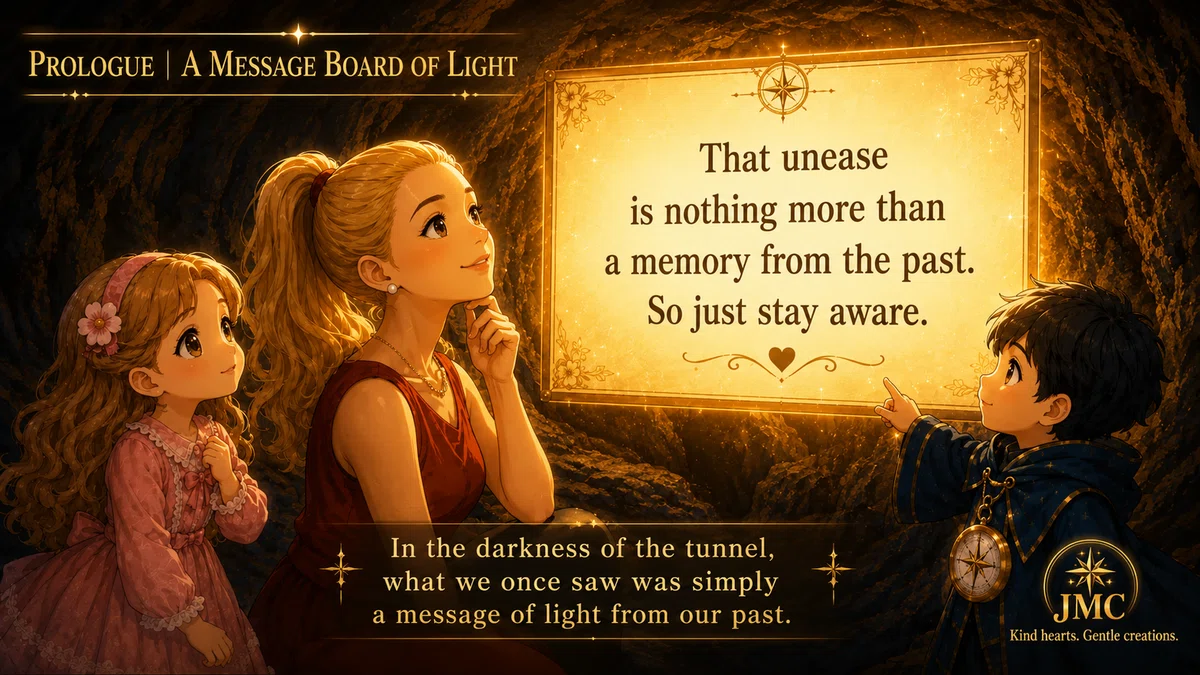
in the darkness inside the tunnel,
memories of the past were hiding, holding their breath.
As I sat still in that dark tunnel, straining my eyes,
what came into view at last was a glowing message board,
inscribed vividly with these words:
"That anxiety is only a memory of the past. So just stay aware."
Here, I would like to leave a record
of how the me of week three
eventually arrived at that message.
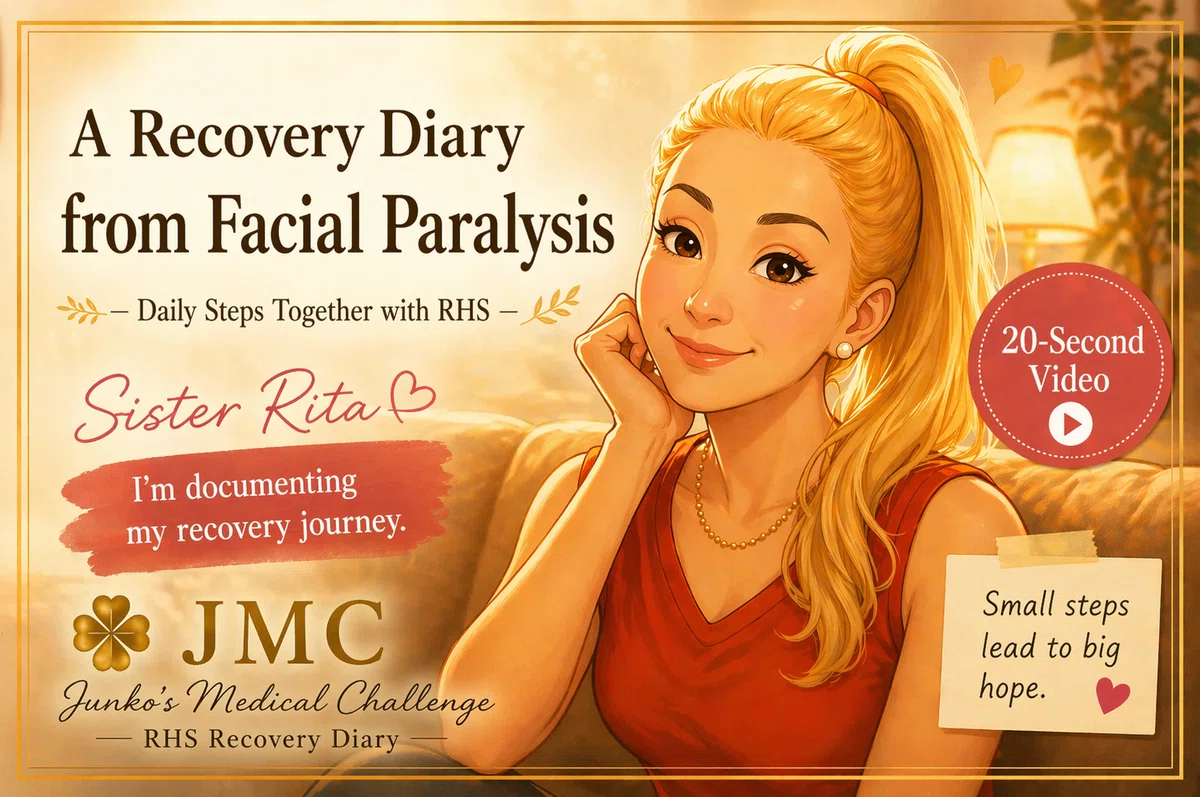
Sharing the Day-19 Video of My Face
January 15, 2026 — Ramsay Hunt syndrome struck.
And then, around the three-week mark.
What was I feeling, thinking, and doing back then?
It was only a few months ago,
yet it feels like a very long time has passed.
I am sharing what my face looked like on day 19.
Making it public was, honestly, frightening.
But if it helps even one person, even a little, I will be glad.
Looking That "Something" Straight in the Eye
The moment I drift into sleep — or a mere fraction of a second before —
a feeling sometimes takes hold of me:
as if my body were being folded up into a veil of blackness,
then dragged straight down, all at once —
a nameless, unplaceable terror washing over me.
Around week three of RHS,
even as I made resting my body and mind the first priority,
I kept myself moving, and busily so:
medical and insurance procedures, appointments with specialists ,
protecting my eye, managing the pain,
keeping track of prescriptions and supplements.
Perhaps, by staying in motion,
I was trying to generate some kind of self-charging energy from it all —
to secure even a small backing of reassurance,
proof that I was still holding on to my sanity.
Yes — as long as I kept moving,
my head and my heart were still, somehow, staying in gear.
"Here is my current condition;
this happened here, that happened there,
and along that same straight line,
this is probably what will happen next."
In this way, I could still put the episodes of daily life
into words with relative ease.
For example: "Three weeks ago I came down with an illness,
and the right half of my face doesn't move.
Recovery will take at least half a year." — Like that,
I could explain my own condition objectively.
Things that had to be done were — thankfully? (laughs) —
piled up in mountains right before me.
The To-Do list kept growing, completely indifferent to how I was feeling.
Each time the illness entered a new phase, more items were loaded on.
This state of affairs anchored me
in the real world, where I could still be myself.
And it seemed to keep nudging that "Something" —
the one that peeked out at me now and then —
ever so slightly beyond the reach of my conscious awareness.
But the mind's displacement never holds at a constant degree.
As it slipped to the right, then to the left,
the moment inevitably arrives when I must meet its gaze directly —
locked, face to face.
The time to confront that "Something."
The more I pushed it down,
the more determined it became to rise to the surface —
that "Something."
The more I averted my eyes,
the more it reflected back as a terrifying phantasm;
the more I tried to shake it off,
the more tightly it clung fast inside my heart —
that "Something."
RHS was nothing more than the trigger.
This appointed encounter with the "Something"
did not have its root cause solely in the facial paralysis,
the pain, and the suffering the illness brought.
It floated somewhere much deeper, somewhere beyond reach,
dim and distant, far away.
And the more I sensed it, the farther it receded —
yet the instant I let my guard down, there it was before my eyes: a phantom.
"Isn't this, once again, the herald of some great storm in my life?"
An apparition, summoned by an old habit of the mind.
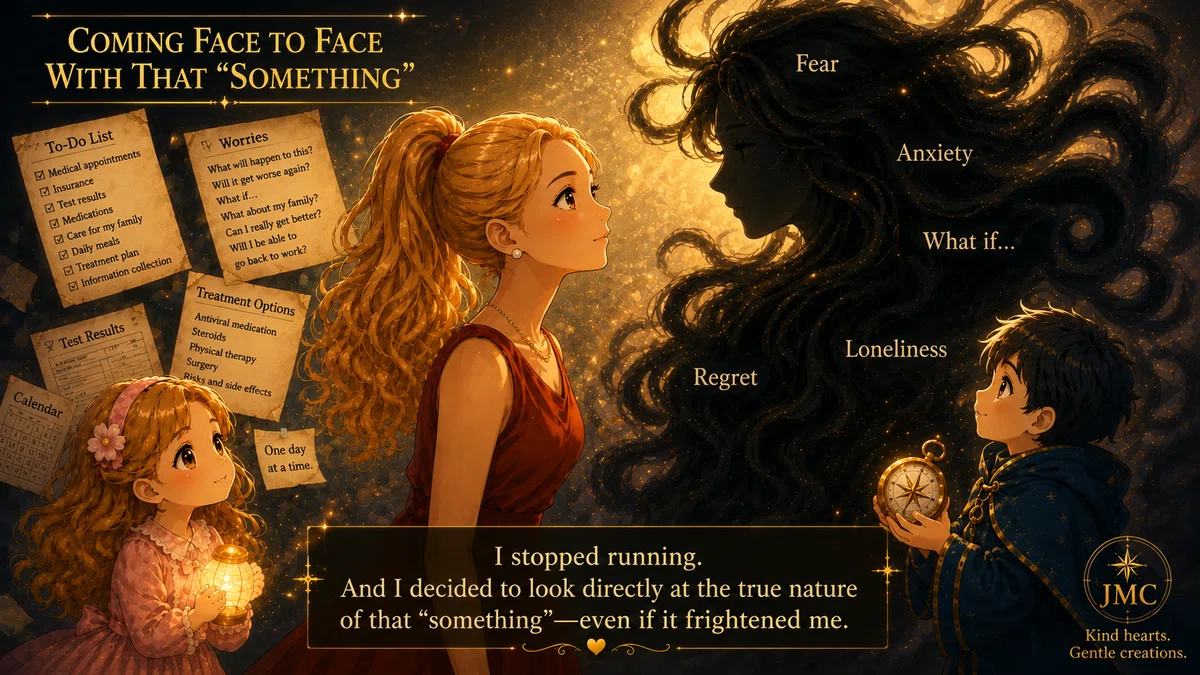
To confirm that it was an illusion and nothing more,
I stopped running. I chose to look at the true nature of that "Something" —
timidly, fearfully, but straight on —
and see it for what it was.
Descending into the Past | Surrendering Mind and Body to Gravity
Thirteen years ago.
I came down with Ramsay Hunt syndrome.
The same illness I am facing now.
It was just after I had returned from a short trip back to Japan,
where I had attended my high school reunion.
In those days, I carried a vague premonition —
that something momentous was about to happen,
both in the world at large and in my own life.
The direction of my interests was shifting;
what I had believed in until then was being quietly rearranged
from its very axis.
My relationships, even the scenery before my eyes, were surely changing.
For me, it was a period of Copernican revolution.
The busy close of 2012 —
and then, in 2013, though a rather mild case,
I came down with an illness whose unfamiliar name I had never heard:
Ramsay Hunt syndrome.
And soon after that,
as though a dam had burst,
my life began to crumble.
There is a space where the soul spills out of a person — all of it.
At that time, I was there.
The coming of morning was not a salvation,
only a painful continuation.
Drawing a breath hurt as though I were swallowing shards of glass,
and unless I forced my unmoving self into motion,
pushed my own awareness forward from behind,
I could do nothing at all — surrounded, hemmed in, by that helplessness.
My mind and my body seemed to have come apart,
so distant they no longer felt like my own.
Even now, I remember that feeling with perfect clarity.
Guided, Unexpectedly, to a Yoga Studio
One day in Seattle (where I lived at the time),
under a cold, drizzling rain.
I could no longer tell
what was happening, even inside myself,
and I burst out of the house and ran — just ran, and ran.
Not that there was anywhere I wanted to go.
What I was running from, what I wanted to do —
I no longer knew any of it.
Only, if I didn't run,
I felt I would come undone;
if I stayed still,
I would be swept into the whirlpool of grief and suffocate —
so I ran. Just ran, and ran, and ran.
When my breath gave out and I could not take another step,
my feet, for some reason,
had come to a stop in front of a neighborhood yoga studio.
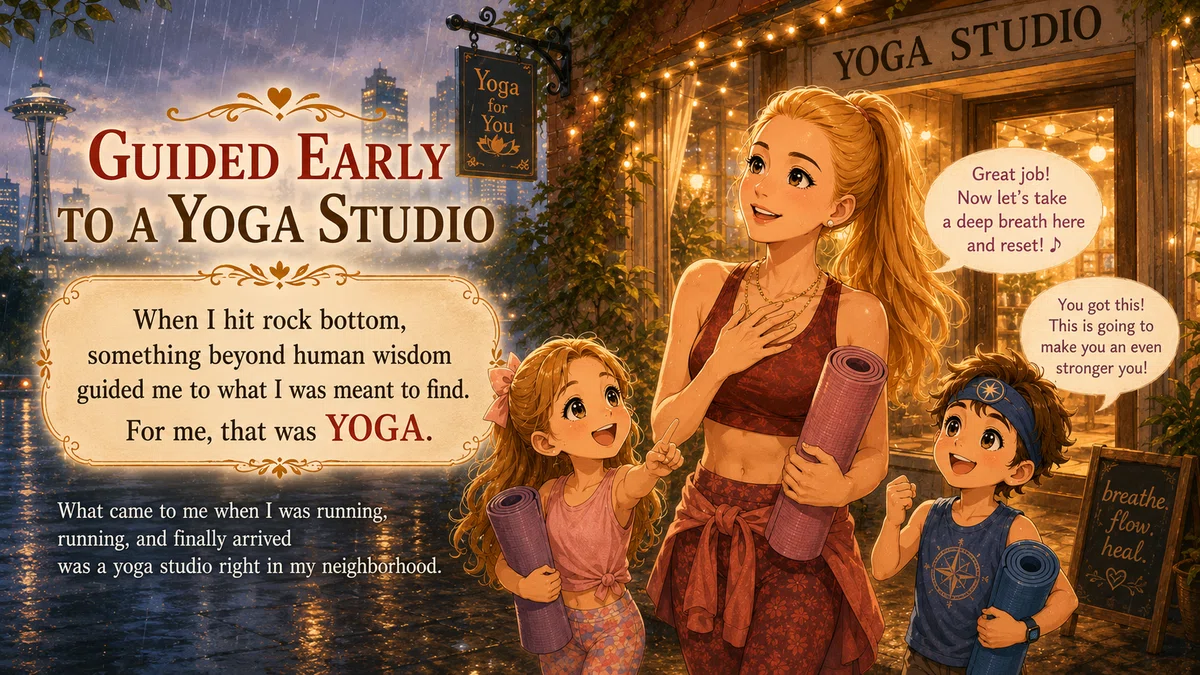
I had never had the slightest interest in yoga,
yet before I knew it, I had opened the door, walked up to the front desk, spoken with someone —
and from that very day, I was a member of the yoga studio.
Running, and running, to shake something off,
and arriving, at the end of all that running, at a neighborhood yoga studio.
Looking back now, that whole sequence feels less like a choice of my own
than a thin, glowing thread I grasped at the very last moment —
a "gift" from another dimension.
When a person truly falls to the bottom of the abyss,
they are sometimes guided by something beyond human understanding.
For me, that was "yoga."
Reunion with That "Something"
Thirteen years have passed since then.
Little by little, I rebuilt myself —
as if picking up, one by one, the pieces of what had crumbled.
The magic called merciful time slowly transformed "pain" into "learning,"
and relationships once broken were retied, firmly,
at a place deeper than before.
As my days became quiet, calm, and firmly grounded,
I had come to believe
that those days were already a distant past.
—— Yes, that is what I believed.
Until this time, when the same illness struck me once again.
When the right half of my face stopped moving,
and I was in pain and darkness,
something began to stir,
deep at the bottom of my consciousness —
that "Something," slowly raising its head.
At first, I had no idea what it was.
It wasn't even something I could put into words —
only a vague, nameless heaviness.
Yet it was undeniably there,
and at night, in the moment I fell into sleep,
it would try to drag me down into the darkness.
I had not yet grasped
the true identity of that "Something."
But one thing I was faintly beginning to remember:
this was a sensation I had tasted,
once before,
somewhere.
The True Identity of That "Something"
It does not reveal its form right away —
that "Something."
Like drifting fog, it has no outline;
the moment you try to grasp it,
it slips quietly through your fingers —
and yet it leaves behind only the unmistakable presence
of something heavy, certainly there.
A shadow-puppet monster appears enormous and terrifying
only because you do not know it is an illusion, created by light and shadow.
As long as fear and anxiety remain vague and undefined,
they can feel infinitely large.
But put them into words, once,
and lay them out before you —
and you begin to see them for what they really are:
trivial, insubstantial
remnants of an illusion.
So I tried a little experiment.
Yes — never losing a sense of play,
that is Rita's one redeeming feature (laughs).
An experiment: to face that "Something" head-on, without averting my eyes,
and to put my questions into words —
as honestly, as clearly, as I could.
"What if, just like thirteen years ago,
another great storm of hardship is about to begin?"
"What if this illness is an omen
of something terrible, yet to come?"
"What if some 'Something' that wishes for my growth
is about to hand me a new trial of life?"
I wrote them out, and I was quietly astonished.
Every one of those "Somethings," once they became words,
wore ”the face of the future.”
The mind layers a present event over patterns of the past,
and out of the countless possible futures,
it pulls out just one story that resembles them —
and then it tries to name that story "fate."
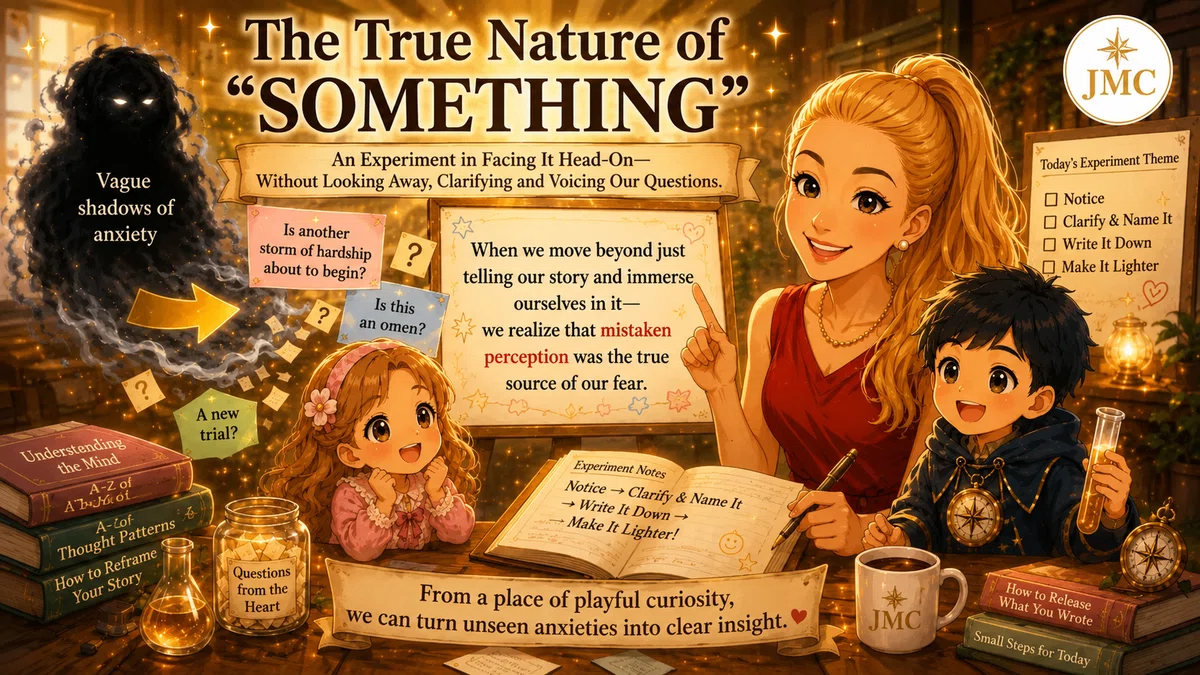
Mistaking what is nothing but a story
for unmovable fact ——
this illusion, itself,
was the true identity of the "Something" that made me anxious.
What I had been fearing was not an ominous premonition,
nor a vision of the future.
It was nothing more than a fabrication of illusion —
the story of a memory, thirteen years old.
Vipassana Meditation and the Awareness of Ruts
Among the things I have learned, through the body,
in long years of Vipassana meditation,
is this: the "habits of thinking" inside the human mind —
the "assumptions that everyone wants to cling to."
Whenever a stimulus arrives, a fixed reaction, without fail,
rises up automatically.
I did not think it. I did not choose it.
And yet the mind, all on its own, starts running
down its usual rut.
And each time the same reaction repeats,
that rut grows deeper and deeper.
The true face of the anxiety and fear I had not wanted to see
was nothing other than a single rut,
deepened by the mind's autopilot.
Thirteen years ago, one rut was carved: "after illness, calamity follows."
So this time, the moment illness arrived,
the mind, without a single thought,
had already turned the wheel toward that old rut.
How faithful, how precise — the mind's autopilot.
But this is not my free will.
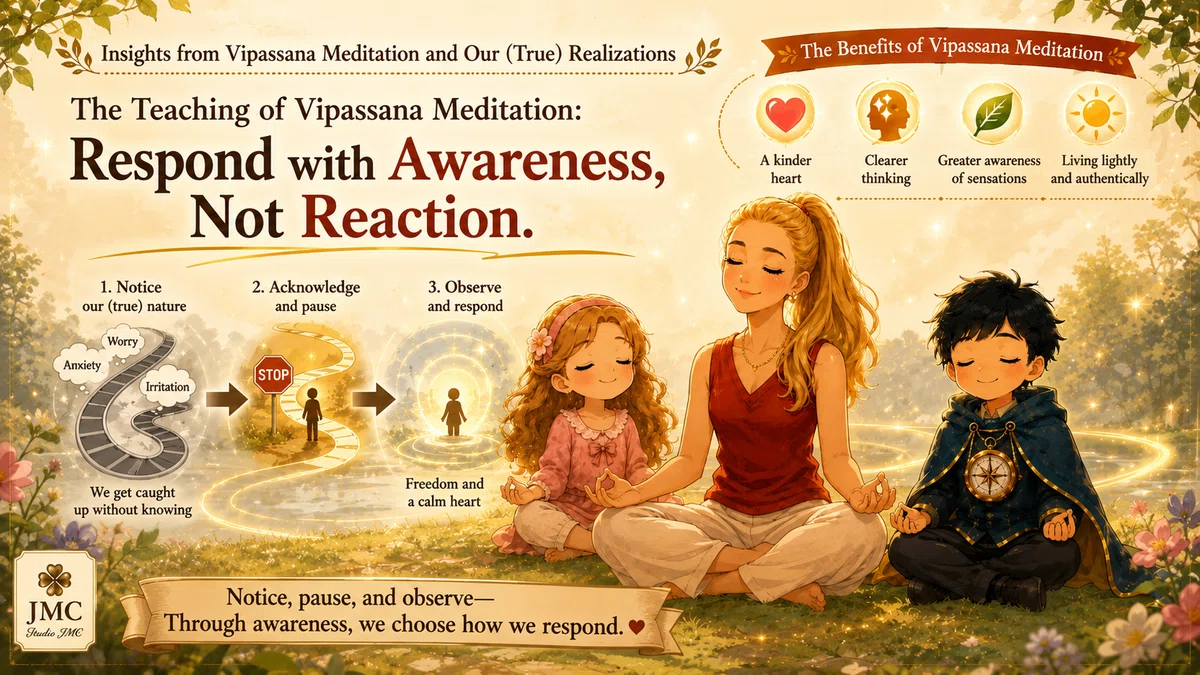
What Vipassana meditation taught me
is not a way to stop this autopilot.
When a stimulus comes, the old reactions
will, of course, keep rising up.
The teaching of Vipassana is simply this:
in the moment a reaction rises,
to notice — "Ah, right now, I am about to slip into the usual rut."
To notice, to stop, to observe.
Not to react to the reaction.
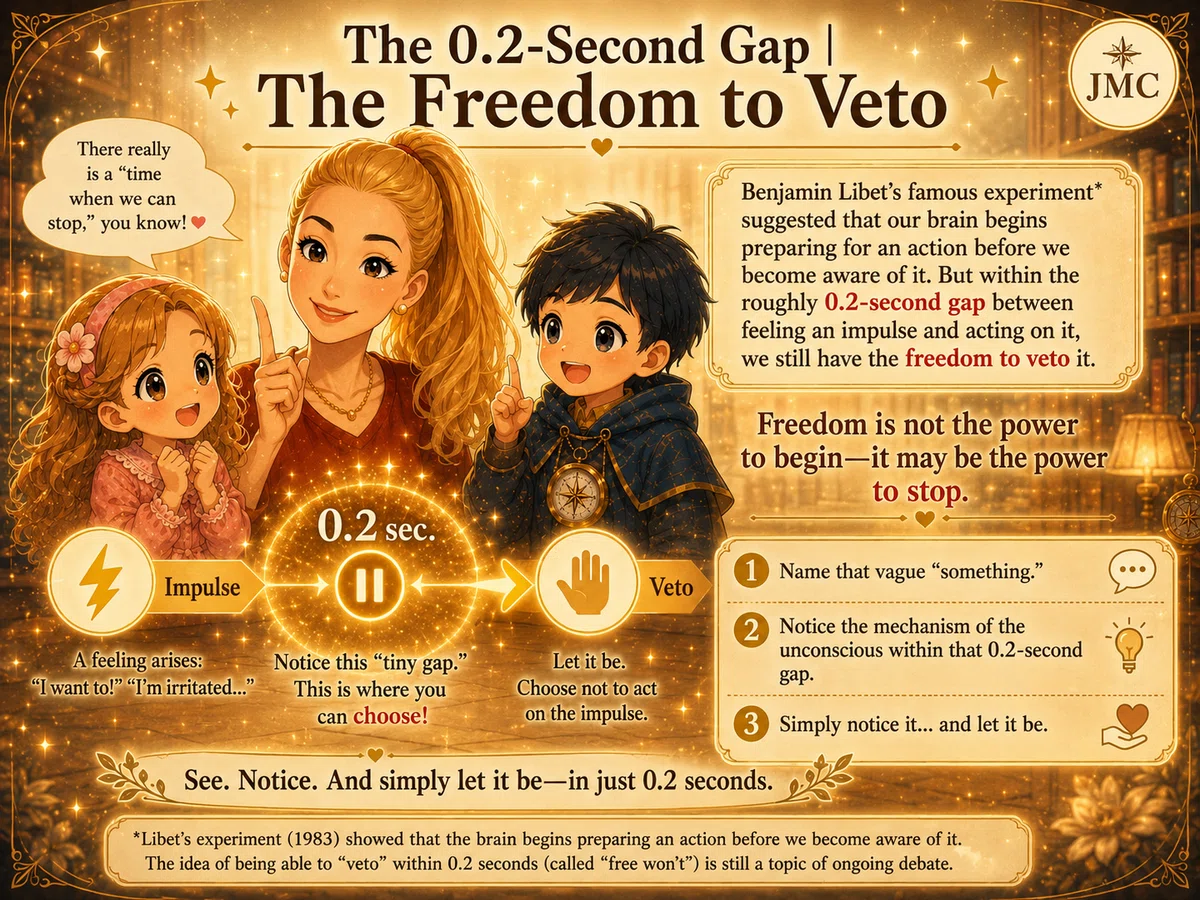
The 0.2-Second Gap | The Freedom to Veto
What Benjamin Libet's famous experiment* suggested
was this ——
We do not freely choose to "initiate" an action.
But in the roughly 0.2 seconds
between noticing an impulse rise and acting on it,
in that gap, a person can "veto" the reaction.
* Benjamin Libet (1983):
An experiment showing that the brain begins preparing an action
before the person consciously decides to "move."
However, between the conscious awareness of the impulse and the action itself,
there is a gap of roughly 0.2 seconds —
and within that interval, Libet believed, the reaction can still be vetoed
(commonly known as "free won't"). Its interpretation remains a subject of scientific debate today.
Freedom may be not the power to begin,
but the power to stop.
In that brief, fleeting 0.2-second gap,
what matters is to notice the mechanism of automatic reaction.
Because that is the only place where freedom can be found.
My deepened understanding, put simply, comes down to this.
① Putting the vague, formless "Something" into words
② Noticing the mechanism, in the 0.2 seconds while the unconscious (the automatic reaction) rises into consciousness
③ Noticing — and simply letting it be — until the automatic reaction stops
That old memories resurface, that fear rises up —
these, in themselves, are entirely natural.
They cannot be stopped.
But whether we recognize that fear
as just one part of a built-in system,
or remain on the usual autopilot, actively repeating the pattern —
there, we have been given the freedom to choose.
In other words: to go on deepening the rut,
tossed about by a mind's machinery that sometimes runs away with itself —
or to step out of that rut and be free.
The choice was always within us.
Even now, in the moment I fall into sleep,
that dark, heavy sensation still comes to visit, at times.
But once I know it for what it is — the usual pattern,
just an echo from the past —
I even have the freedom to say to that echo, "Welcome back,"
and see it off once again.
When you think of it that way — isn't it, somehow, fun?
Thirteen years ago, carried along by a mind's autopilot running out of control,
I was simply tossed about, inside the storm.
Now, I watch that same storm
from a small distance, inside the system of memory —
quietly.
In 0.2 seconds: see it, notice it, let it be.
The freedom that dwells in this 0.2-second gap
may well be a sanctuary granted to humankind alone —
one that AI can never enter.
That quiet, inner freedom
was the great treasure
that thirteen years of time had given me.
And this RHS, this time,
became a precious, precious experience —
one that called that treasure back to life.
Inside the Tunnel | Settling into the Darkness
The true identity of that "Something" grew clearer, little by little.
But the tunnel itself — the thing shutting my mind and body off from the outside world —
had not disappeared.
How much longer until further recovery?
How far, in the end, would I recover?
Would any aftereffects remain?
When would my eye close? When would the pain fade?
Would my smile ever return?
The exit was still nowhere in sight.
Worse — I could not even tell whether I was moving forward or standing still.
There were moments I lost even the direction to move in.
Inside a pitch-dark tunnel, with nothing to rely on but my own senses,
I dragged my feet, as if with lead weights fastened to them,
searching for something, thinking about something, without end.
I stared hard at the "self" in the mirror —
and connected with it, and lost sight of it.
Check, and grow anxious. Check, and smile with a face that has no smile.
—— And in that meaningless repetition,
my mind was wearing away, without a sound.
Our eyes, opening their pupils wide,
take in even the faintest trace of light for us.
In time, even in a pitch-dark tunnel, they will begin to adjust.
But you know — however long you keep straining to see,
there is, after all, a limit to what can be seen in the dark.
This stagnant pool of time — what is it, really?
Is this an intermission in life, given to me by RHS?
To that me, in her third week,
here is one more phrase the present me would like to give.
In a pitch-dark tunnel,
straining desperately to see around you will only wear you out.
Until you're through it,
just settle deep into the darkness, and be still.
That's all you need to do.
What cannot be seen stays unseen,
what does not move stays unmoving,
when you want to cry, let yourself want to cry.
If a smile is impossible, that's all right.
You don't have to put on a bright face.
Positive words, proof of recovery —
you don't have to force yourself to find them. Not yet.
And then, my voice from those days replies.
Oh, I see — this darkness, with no light in sight, is a restful retreat.
Until my heart and body have rested, I can simply take my time here.
Having received the gift from my future self, and received it fully,
I could finally, truly, begin to feel that way.
Little by little, the impatience slipped out of sight,
and my spirits grew just a little calmer.
The 0.2-second awareness is the wisdom of "motion."
Settling deep into the darkness is the wisdom of "stillness."
For the ruts of the mind: eyes awake, and notice.
For the darkness that cannot be seen through: eyes closed, and surrender.
Moving back and forth between these two,
I made my way through the tunnel, little by little.
A Precious Presence, and Communication
And inside that dark tunnel,
I was never, ever alone.
Through this unstable time, there was a presence that stayed by my side, always.
My husband.
When illness comes, so many things get stripped away.
Vanity. Bravado. Fixed ideas, the masks we wear and the roles we play —
the self whose job it was to laugh brightly, always, and light up the room.
When those things peel away, one layer at a time — what remains at the end?
Someone who, without explanations, without being asked for anything,
is simply there, as if it were the most natural thing in the world.
Someone who, even when I was close to crumbling, even when I lamented,
stayed with me — always, at the same distance.
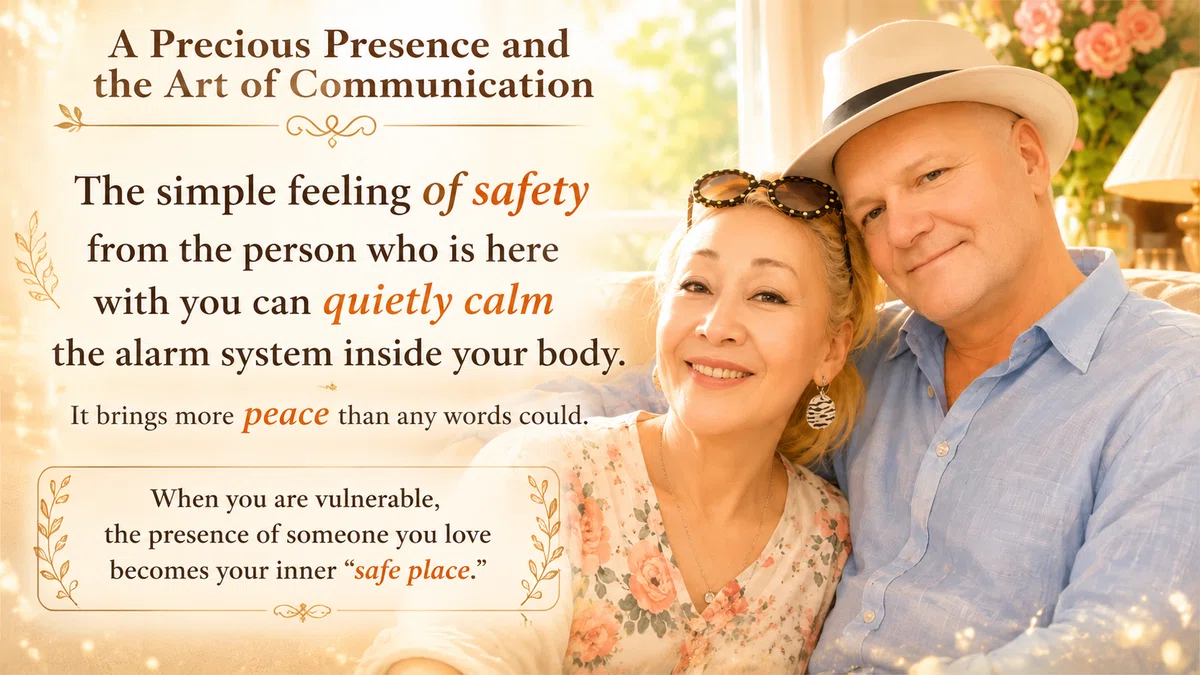
This person is here ——
That sense of safety, by itself, was enough
to make the alarm bells inside my body grow a little quieter.
More than any words,
it was this that brought me calm.
And there is one more thing I learned.
Say clearly what you want to say.
If there is something you need, put your feelings into words —
as calmly, as objectively, as you can. ——
That, I learned, is how much it matters.
For example: to my ears, made hypersensitive by the symptoms,
even his voice, just slightly raised, brought considerable pain.
Rather than crying out, "Why don't you understand!?" —
appealing through emotion —
I would explain, carefully:
the nature of this illness, the specific things I needed his help with,
weaving in a little medical knowledge as I went.
There were also times when his choice of words,
or some casual manner of his,
stabbed deep into a heart made fragile by the fight.
To stay as unemotional as I could —
"this is how I feel, and this is what I would be grateful for" —
and from that stance,
to talk sincerely, and seriously: that is what matters.
Precisely because we are at our weakest,
communication with the ones we love
may need to be polished one degree finer.
What We Need Is Not "Suffering" but "Awareness"
Inside the tunnel, held up by the stillness,
and by the warmth of the person beside me,
another powerful realization, within me,
was slowly taking shape.
It is this.
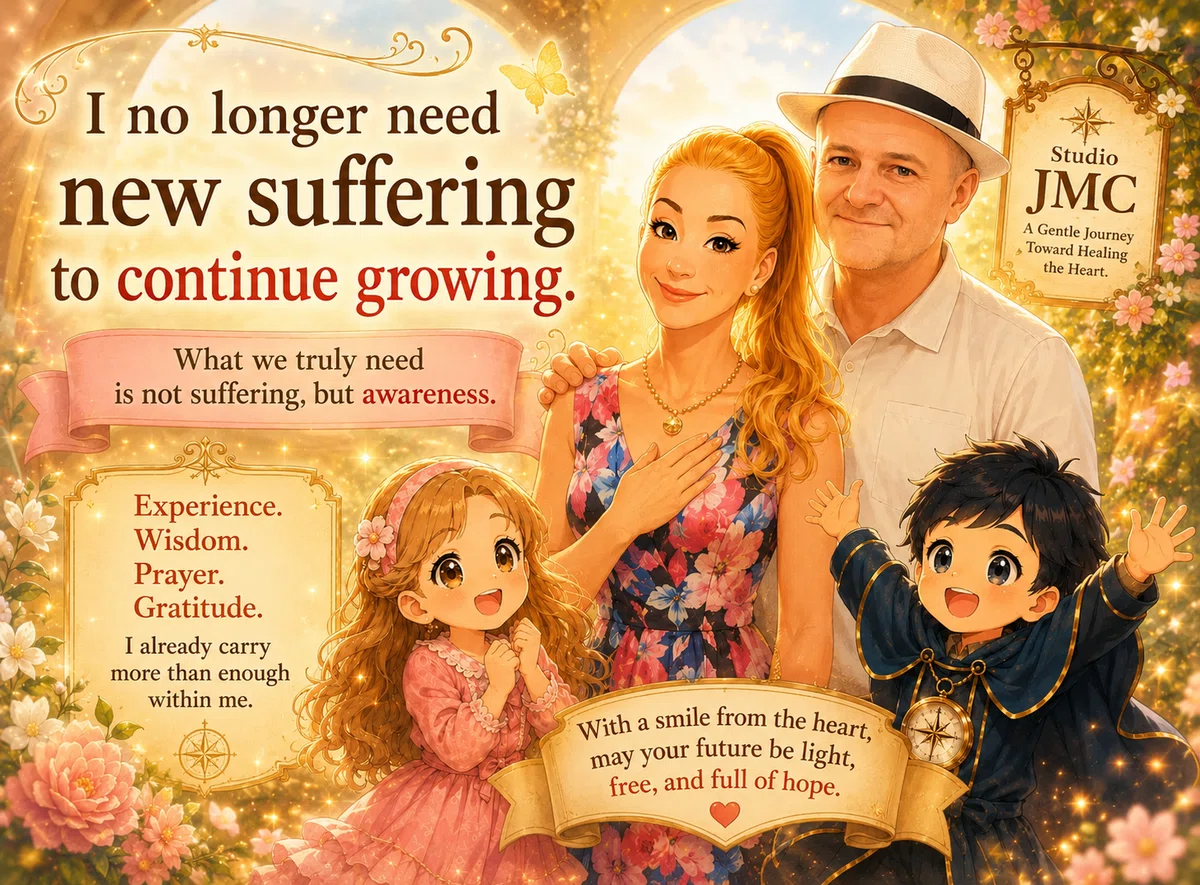
I no longer need to take on new suffering in order to grow.
To be honest, for a long time, somewhere deep inside,
I think I had believed something like this:
"Unless a person passes through the checkpoint called suffering,
they cannot deepen. They cannot grow."
That was nothing more than an assumption.
Thirteen years ago, standing at the edge of the abyss —
what was given to me as life's learning.
The relationships that deepened, even as they wounded.
The pieces of wisdom, picked up, little by little, out of regret.
That those painful hours transformed my life —
this is an unmistakable fact.
The third question I put into words, in the earlier chapter,
in order to find that "Something" ——
"Is some 'Something' that wishes for my growth
about to hand me a new trial of life?" ——
At the root of that question, too,
this very assumption lay quietly waiting.
But this experience of RHS
gave me a new vantage point
on the relationship between "suffering and growth."
We do not grow through suffering itself.
What matters is what we receive after the suffering,
and what meaning we give it — that is the key.
Experience, wisdom, prayer, gratitude — and
the courage and strength to rebuild myself:
—— the me of today already carries them, in plenty.
What my growth needs now is no longer new suffering,
but the small, subtle daily "awareness" itself.
Do you remember the Message Board I wrote about in the prologue?
Inside a pitch-dark tunnel, at the far end of a long, unblinking gaze,
a single phrase, in time, rose up into view.
"That anxiety is only a memory of the past. So just stay aware."
The me in her third week — facing the fear, putting it into words,
noticing the ruts of the mind, settling into the darkness, held by the warmth of someone dear ——
what she finally arrived at was this single phrase.
And if you, now, in your third week of RHS,
have lost sight of yourself inside a long, pitch-dark tunnel —
to you, I would like to softly pass this on.
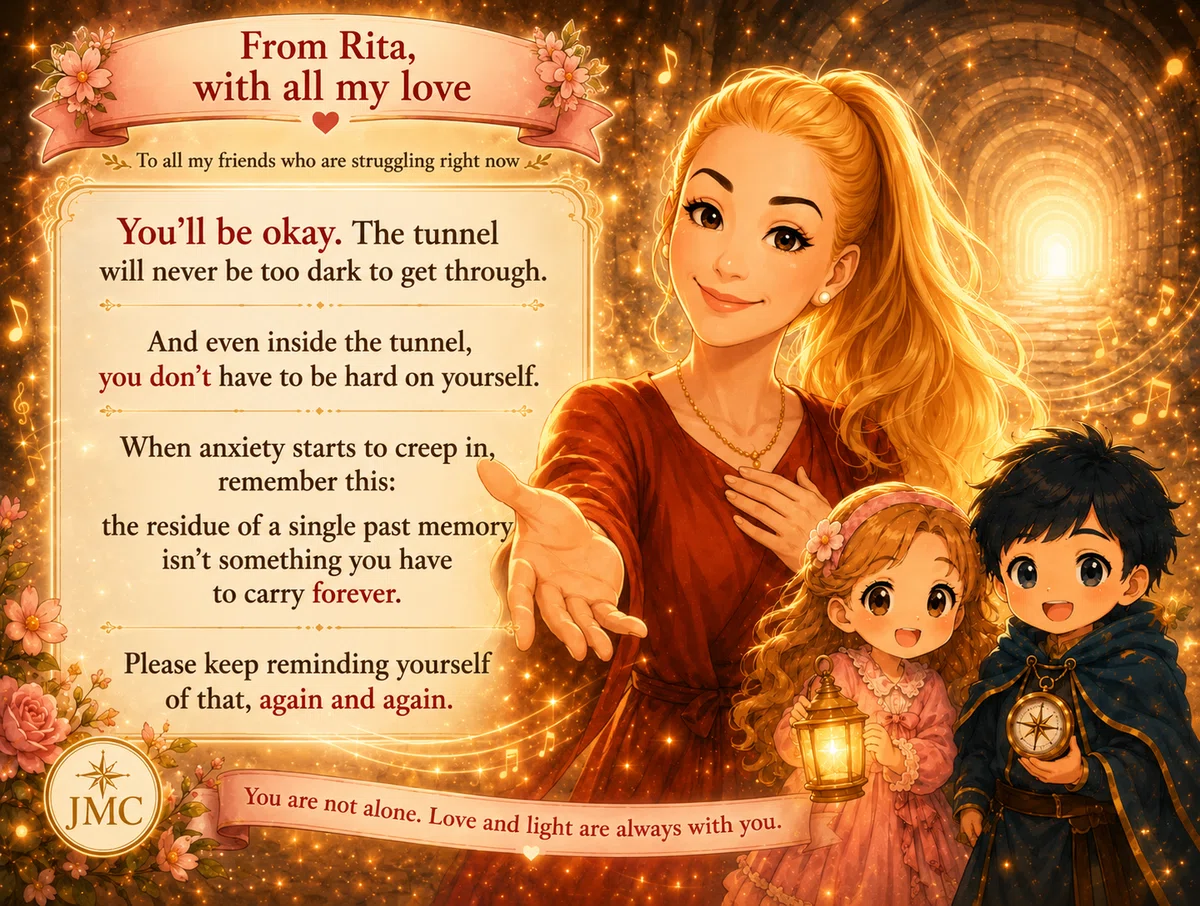
It's all right. The tunnel will end, in time.
And you know — in truth, inside the tunnel is not so bad at all.
When anxiety rises up,
that it is only the remains of a memory of the past —
please, just keep staying aware.
Recap Manga: (No.6) To You in Week Three of RHS
Here, a short manga recap of No.6.
Press the "Open viewer (ビューアを開く)" button below
to read the recap manga.
It is in Japanese manga format, so once the viewer opens,
please use the left-pointing arrow to move to the next page.
Next Episode
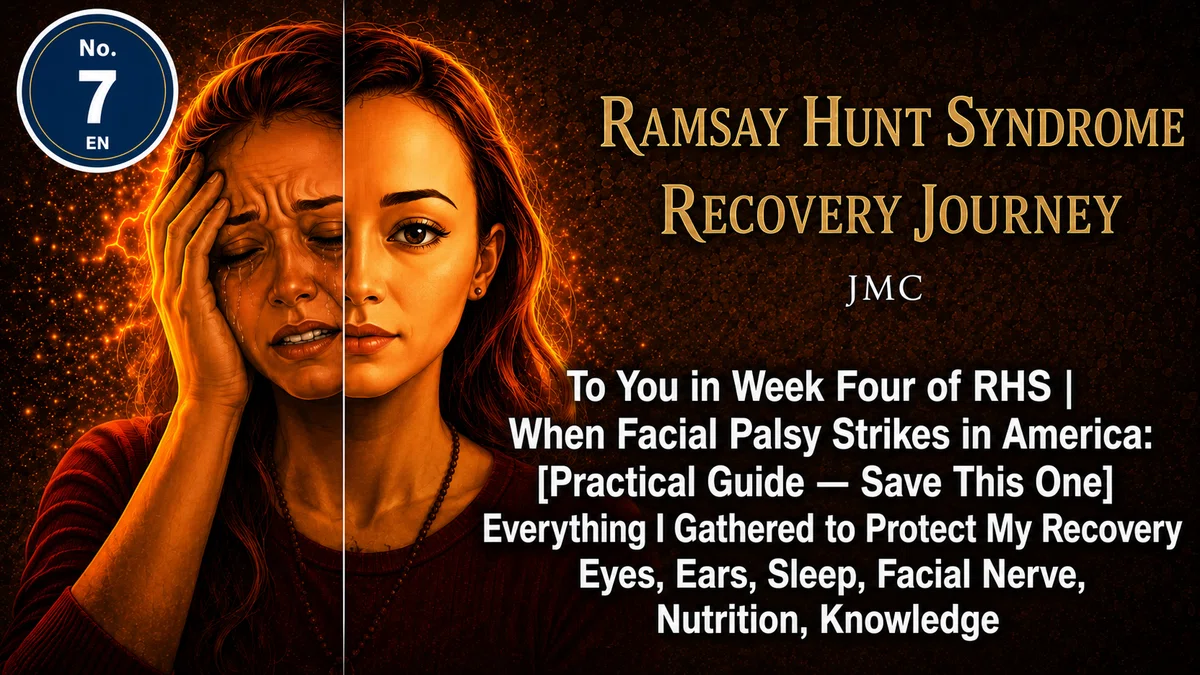
Next: To You in Week Four of RHS
On the road to recovery, there is no end to what you can do at home.
In those days, I was focused on
protecting my eye,
resting my nerves,
reducing the small dangers of daily life,
and building a recovery routine of my own.
Those small daily measures, I believe,
became a great foundation for my recovery.
So next time, I will bring you
the things I personally found helpful —
supplements and eye protection,
what I learned to watch for while living with one working eye,
and the routines I put in place to protect my recovery.
👉
Click the image to continue to the next article.

Rita Code | Studio JMC
🇯🇵 Click here for the Japanese version
https://note.com/studio_jmc/n/n8a06ca059385
