
Pickleball combines all the best elements of other racket sports, from badminton to table tennis. But, when it comes to terminology, there are a lot of new pickleball terms to learn!
When you first start playing, you’ll probably have lots of questions such as:
What does Opa mean in pickleball?
What is the ball in pickleball called?
What is the slang term used for the non volley zone?
If you’ve ever wondered any of these, fear not! We are going to cover everything you need to know about pickleball slang and other useful pickleball terminology in this post.
Hey, maybe you want to bookmark this page for easy reference. And don’t forget to send it to a friend who is new to the sport – they’ll certainly find it useful!
This post contains affiliate links, including Amazon Associates links, and we may receive a small commission if you use one. This is at no extra cost to you and allows this site to continue providing free pickleball resources.
What you need to know about pickleball terms
The rules of pickleball are simple and it is an easy game for beginners to learn. However, if you are new to the sport, some of the pickleball terminology can be confusing at first.
Don’t worry – we promised that’s the hardest part of starting out with this game!
In fact, even the players with the highest skill level in pickleball can struggle with this because there are new pickleball terms being added all the time.
No matter how much pickleball knowledge you have, this guide to pickleball slang will make it easy.
And, once you start discovering some of the funny pickleball terms and sayings, you’ll realise it’s actually quite fun to learn!
We’ve listed the most important pickleball terms and their definitions, so you can hit the court with confidence.
From equipment to shots and any pickleball slang you may hear during the game, you will soon be fluent in the language of pickleball.
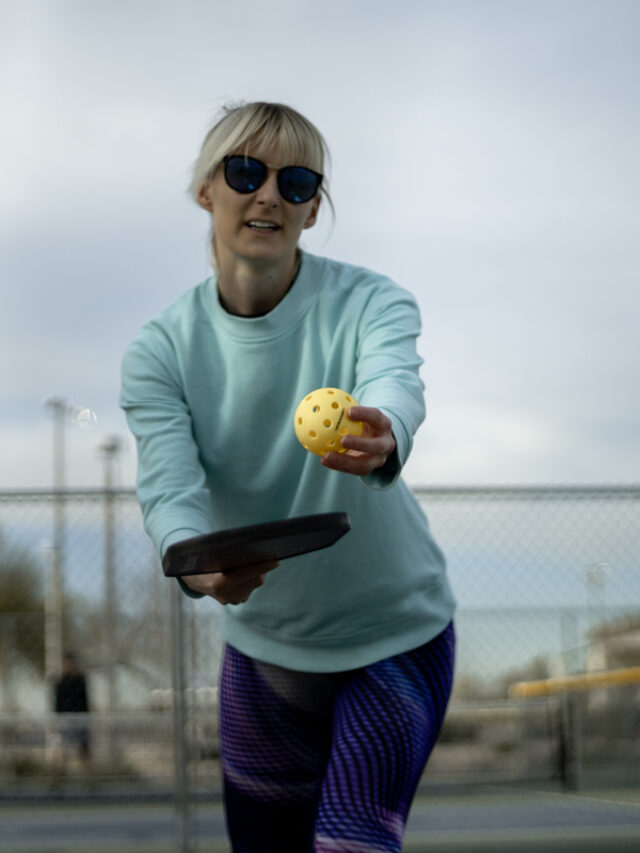
Essential Pickleball terminology: an easy guide
There are four essential things you need to play Pickleball: a pickleball ball, a pickleball paddle, a pickleball net and an understanding of the rules and phrases used on the court.
Don’t worry if you can’t remember everything. Pickleball is so popular because it is easy to pick up and a lot of fun.
With up to four people crammed into a small court, there will always be someone nearby to consult if you get lost.
Here is the essential pickleball terminology to know when starting out.
Ball: The ball used in Pickleball is a plastic ball with holes or a wiffle ball.
Paddle: This is what you use to hit the Pickleball, don’t call it a racket!
Doubles: A game of pickleball doubles is played with four people divided into two teams, with two players on each team.
Singles: A game of pickleball singles played with two people, one on each side, with no second server on either team.
Skinny singles: A game played with two people, one on each side, using only half of the court.
Other Common Pickleball Terms
Most of the pickleball terms you’ll come across will relate to of a few things: the pickleball court, gameplay or the gear you’re using.
Pickleball terms related to the court
Let’s start with some court-related pickleball terminology:
Non-volley Zone: This 7-foot section of the court is on either side of the net at the front. Pickleball players cannot hit balls out of the air with volleys if standing in this area.
Non-Volley Line: The line parallel to the net that indicates the non-volley zone.
Backcourt: The few feet at the back of a courtside near the baseline.
Double Bounce Rule or Two Bounce Rule: Both teams must play their first shot after letting the ball bounce. The receiving team must let the serve bounce and the serving team must let the return of the serve bounce before playing it.
Centerline: The centerline divides the service court into halves from the non-volley zone to the baseline.
Sideline: The lines on each side of the court.
Baseline: The line at the back of the court. A baseline is usually 22 feet from the pickleball net.
Permanent Object: Any object on or near the court that could interfere with game play, including ceilings, spectators, etc.
Rally: Continuous play from the time of serving until a fault or point occurs.
RELATED READ: Improve your game with these solo pickleball drills.
Pickleball serving terms & pickleball scoring terms
Many of the new terminology you’ll come across when playing pickleball relate to two of the most important parts of the game: serving and scoring.
Therefore, when it comes to playing, these are the pickleball terms you will hear all the time.
Serve: An underhanded shot that begins a pickleball rally. In pickleball, you get 2 serves. The player must serve the ball from below the waist level.
Service outside scoring: In pickleball, a player must get the serve to win a point and you can only get a point if you are serving.
Server number: If playing doubles, the server must call their number – either “1” or “2”, depending on whether you served first or second on your side. This number must be called out along with the score.
Volley shot: This shot picks the ball out of the air before it bounces. This move is not allowed when the player is in the kitchen (see below) or before the first 3 shots.
Ace: A serve that is not returned by the opposing team
Put away: A ball that the opponent cannot return, therefore a winning shot.
Overhead shot: A shot hit over the shoulder, similar to a tennis serve.
Line Call: Calling the ball in or out.
Foot Fault: When you make an illegal serve or volley because of your foot placement.
Other Moves & Pickleball Terminology
Don’t worry if you don’t remember all of these at once. They’ll make much more sense as you play and improve your pickleball strategy!
Face of the Paddle: the surface of the paddle used to make shots.
Approach shot: The ball is hit while moving forward towards the pickleball net.
Backhand: Moving the paddle back to prepare for a shot.
Backspin: Hitting the ball with a low-high motion that causes the ball to spin in the opposite direction.
Carry: A shot that does not bounce off the paddle and instead slides along the paddle during a forward swing.
Double hit: When a ball is hit twice in one single, continuous groundstroke.
Forehand: Forehand shot hit on a player’s dominant side, for example for a left-handed player, a ball hit on their left side.
Half Volley: A shot where a ball bounces but doesn’t reach full height before it is hit.
Punch: A quick shot with a minimal backswing, with a similar motion to stabbing the ball out of the air with the paddle.
Top Spin: A shot with spin caused by hitting the ball swinging low to high. Some pickleball players buy a pickleball paddle for spin specifically.
Cross-court dink: This is a dink that carries all the way from one side of the court to the other and usually lands in the opposite opponent’s kitchen.
Lob: An extremely high shot that goes over the heads of your opponents and into the backcourt. The purpose of this shot is to make your opponents run for the ball and lose their positions.
Slammers: Slammers hit the ball hard and fast. Advanced players claim playing like this demonstrates poor technique as they can run out of energy quickly.
Dink Shot or Drop shot: This is a soft shot that lands in the non-volley zone.
Poach: Poaching is where one team member will take the shots going towards their partner, instead of letting the partner play. Poaching may happen when one player is on a much higher skill level than their partner.

Pickleball Sayings
Pickleball is an extremely social sport, which means it has developed a vocabulary of its own.
It can feel like learning a new language at times, but learning the language is worth the effort.
It will mean you can easily communicate with your partners (and know what is going on at all times!).
Here are some of the most common pickleball sayings that you might hear from your pickleball partners (or an opposing player!).
Bounce it: Your partner will call this out if they want you to let the ball bounce as it is likely to land out of bounds.
OPA!: A cheer shouted out after the 3rd shot has been hit and open rallying has started.
Nice setup: This is another compliment. In pickleball, a setup means a player has successfully manipulated a player to move to an area of the court, which leaves an exposed section not covered by the opposing team.
Nice get: If someone on the court yells “nice get” this means that you hit a ball that was difficult to reach or return.
Nice rally: This is a compliment to all players, meaning there has been a long streak of shots between teams.
Dead ball: The ball has gone out and the current point is over.
Funny Pickleball Sayings & Pickleball Slang
One of the first things you probably noticed about pickleball is that there are a lot of unusual pickleball terms!
Some of these are the official terminology, but many of them are simply pickleball slang that have become popular with players.
Here are some of the funny pickleball sayings and pickleball slang you are likely to hear on the court.
Falafel: No not the middle eastern food! A falafel in pickleball is a shot that doesn’t reach its full potential, due to the player hitting the ball without any power.
Flapjack: A shot that must bounce once before it can be hit.
Kitchen: Slang term for the Non-Volley Zone.
Pickle!: A player shouts “Pickle!” to let the other players know they are about to serve.
Pickled: If a team scores zero points by the end of the game, they have been pickled. This is what you want to avoid.
Pickledome: The court where the championship match in a pickleball tournament is played.
Pickler: Someone who is obsessed with Pickleball and cannot stop talking about the sport. Are you a pickleball addict?
Volley llama: An illegal move where a player hits a shot into the kitchen.
New Pickleball Terms
As if there aren’t enough pickleball terms to get your head around already, each year sees the arrival of several new words and phrases.
These are usually pickleball sayings that have become popular on courts, but weren’t previously official.
We will keep this section up to date with the new pickleball terminology that gets added each year, so make sure you check back in 2023 to quickly get clued in!
New pickleball terms for 2022
Several changes were made to the pickleball rules in 2022.
Here are the main changes to the pickleball terms that came into effect:
Technical Warning: A referee’s warning for a behavioral violation. Points are not deducted.
Verbal Warning: The referee’s verbal warning. Only one may be issued to each team per match.
Volley Serve: The most traditional way to serve, this is when the server releases the pickleball ball with one hand and hits it before it is allowed to bounce.
New pickleball terms for 2021
Even if you’ve been playing pickleball for years, take part in tournaments regularly and are an active member of our Facebook community, there may still be some pickleball terms you’re not familiar with.
That’s because, as part of the updated pickleball rules, several new pickleball terms were added in January 2021.
Here are some of the newest pickleball terms to be officially recognized in 2021:
Ejection: When a player is prohibited from participating in a tournament by Tournament Director due to unacceptable behavior.
Momentum: When a body is in motion, for example after executing a volley, that causes a player to continue in motion after contacting the ball.
Plane of the net: The imaginary vertical planes that extend beyond the net system on all sides.
Retirement: Even though pickleball may be your retirement game of choice, you won’t want to call a retirement during a match. If you do so, it means you have decided to stop the match and award the point to your opponent.
Profanity: Any words, phrases or gestures that are considered too impolite to use around children or in polite company. Using a profanity may go against pickleball etiquette!
Third Shot: When the serving team returns the ball after it has been return by the receivers once. In other words, this is the first time the serving team hits the ball after serving (i.e. the third shot of the game).

What is the difference between a put away shot and slamming a shot deep, hard and low close to the back line…if any?
How do you address comment/criticism from another player with equal experience.
What is a cargo shot in Pickleball mean?
Can I grammar check on that last definition in the last section (“Third shot”)?