| National Protest Against Prop 8 on November 15! |
[Nov. 11th, 2008|08:45 am]
queer_marriage
|
Hey, all...
I just heard about this. Pass the word on to everyone you know. Cities all across the CA and the US are participating in this protest.
Let's show them that Americans care about equal rights for all!
SF link: http://jointheimpact.wetpaint.com/page/San+Francisco
CA link: http://jointheimpact.wetpaint.com/page/California
Homepage: http://jointheimpact.wetpaint.com/?t=anon
(You can print out fliers here)
See you there. . . |
|
|
| BIG GAY GOP FEAR FACTOR FEVER |
[Jun. 5th, 2008|08:42 pm]
queer_marriage
|

There's an actual song that you can listen to.
With elections round the corner
When the voters start to care
About the mess we have created
We give you issues that aren't even there
We give you Homosexual marriage
Gonna wreck your family's life
Gay men want your husbands
Lesbians will steal your wife
Lies lit up the daytime
Till bombs lit up the night
Bin Laden sleeps in a cave somewhere
While in Iraq our soldiers die and fight
We give you Homosexual marriage
Gonna wreck your family's life
Gay men want your husbands
Lesbians will steal your wife
Sam Brownback and Arlen Specter
Know the votes are just not there
Orrin Hatch said "Go tell all of your wives"
In his sacred Mormon underwear
Gas is four bucks a gallon
Katrina's wrath is still unfixed
The deficit is at an all-time high
While Republicans play politics
They give us Homosexual marriage
Gonna wreck your family's life
Gay men want your husbands
Lesbians will steal your wife
With scandal all around us
Indictments everywhere you look
We ask ourselves what would Jesus do?
He'd said "Hey! Look out, what¹s that over there"
It must be Homosexual marriage
Gonna wreck your family's life
Gay men want your husbands
Lesbians will steal your wife
Just remember there's a price paid
For each inflammatory thing you say
Mathew Sheppard's safe in heaven dead
How many other souls will have to pay
You give them Homosexual marriage
It won't affect your family's life
Gay men don't want your husband
Lesbians won't steal your wife |
|
|
| GOP Tries Gay Marriage Again |
[Jun. 5th, 2008|08:38 pm]
queer_marriage
|
Americans are deeply dissatisfied with the failure of the Bush Administration and the Congress to address the major problems facing the nation including the deteriorating situation in Iraq, our growing dependence on foreign oil, health care, education, and the environment. But Republican leaders have finally come up with a strategy to deal with growing public discontent--bring back gay marriage. On Monday President Bush will again announce his support for a constitutional amendment to ban gay marriage. Despite the fact that the amendment has no chance of being enacted, Republican strategists hopes to use the issue of gay marriage to distract the public from the war and other issues and to energize its conservative base--just like they did in 2004.
The problem with this scenario, however, is that the strategy didn't even work the first time. There is no credible evidence that the issue of gay marriage actually helped the GOP in 2004. Gay marriage referenda were supposed to increase turnout and support for President Bush among religious white voters. But they didn't. Turnout increased by the same amount in states with and without gay marriage referenda on the ballot and George Bush's share of the vote increased by the same amount in states with and without gay marriage referenda on the ballot.
According to national exit poll data, in the 11 states with gay marriage referenda on the ballot, regular churchgoers made up 46 percent of the white electorate in 2000 and an identical 46 percent in 2004. The percentage of regular churchgoers who voted for George Bush was 72 percent in 2000 vs. 74 percent in 2004, an increase of two percentage points. But this was less than the three point increase in support for Bush among all white voters.
The gay marriage ploy didn't work in 2004 and it is highly unlikely that it work in 2008. Maybe the Republicans should try something different this time--like dealing with the real problems facing the American people.
Link. |
|
|
| (no subject) |
[May. 29th, 2008|02:51 pm]
queer_marriage
|
Posting this everywhere because it is made of win.
http://people.ischool.berkeley.edu/~nunberg/gaymarriage.html
A linguist talks about the definition of marriage. |
|
|
| OK, let's vote on marriage |
[May. 17th, 2008|10:51 am]
queer_marriage
|
By Monique Doyle Spencer | May 17, 2008
IT'S MAY 17, the anniversary of same-sex marriage in Massachusetts. You can bet you'll hear plenty of talk about defining marriage, and whether or not we should have a referendum question about it. I can't wait to vote on marriage. I have studied the issue carefully so I know it will work like this: If you want to get married, you have to put your choice of spouse on the ballot. Nobody can walk down the aisle unless we all think you should. At last. We people will have the power we really want.
I've always felt that Ann Romney could do better, so I like to think we would have voted young Mitt off. Keep looking, Ann, we would say. Don't rush into this. Hillary, we would warn, that fella has a wandering eye. Kick him to the curb. There's a tall skinny guy from Massachusetts who would be a better mate. Dull but faithful.
And does your sister want to marry a no-goodnik? She should know better, but she doesn't. We would "vote no" on that guy long before the bachelor party. That woman your brother likes? The one who is taking a break from ruling the demons of evil just to ruin your life? Stopped long before the altar. Imagine the bumper stickers. Save Joe! Vote No! Vote Yes on Maryellen, It's Her Last Chance! No on Tiffany, For the Love of God!
Of course, this referendum question is really about sex. So before your wedding is approved, we will have to observe you in flagrante delicto, which is Latin for "in the back seat." I don't know how the Legislature will make that work. Maybe you'll be on YouTube, or maybe you'll have to canvass door-to-door. Gosh, it's going to be time-consuming and tough on the furniture.
I got in under the wire. I got married before anybody could vote on it. I showed up in an almost white dress, I wrote thank you notes in a timely fashion. If I make a lifetime commitment to somebody, say, for lack of a better example, my husband, then there are certain things I would like in return. We should be able to have joint health insurance. If we welcome children together, nobody better say they shouldn't be mine. Well, except for me, on a bad day.
Are you worried about your marriage passing the test of public opinion? Well, if history repeats, the referendum question will be so confusing that everyone will just vote no. The question will be written by a monkey who was raised by wolves. Not smart wolves, but wolves raised by referendum writers. So the question will be: Should the Legislature of Massachusetts be instructed to implement the non-implementation of a definition of marriage to be defined as a definition?
If we want to make a difference in marriage, let's vote on something that's everyone's business. If the groom's mother is thinner than the bride's mother, should said groom mother be required to wear a bridesmaid dress? If an aunt accidentally sent a "You're Expecting!" card to the bride, may the best man use this in his toast?
Otherwise, we should stick to the definition of marriage that God bestowed upon us. A romantic, loving, and spiritual journey of no more than two people, shortly to be destroyed by children.
Monique Doyle Spencer is author of "The Courage Muscle: A Chicken's Guide to Living With Breast Cancer." |
|
|
| Gays can learn from civil rights backlash |
[Aug. 8th, 2006|02:10 am]
queer_marriage
|
By Deb Price:
In May 1954, overjoyed by the U.S. Supreme Court's ruling in Brown v. Board of Education that racially segregated public schools were unconstitutional, NACCP attorney Thurgood Marshall predicted school segregation would vanish within five years.
Instead, a decade later, only 1 percent of black children in the Deep South sat in the same classrooms as whites.
What had interfered? A fierce backlash by the white majority.
That backlash prompted black leaders to debate whether full-throated demands for equality, particularly in courts, should be replaced by a go-slow approach aimed at giving white supremacists more time to see the error of their ways.
The aftermath of the Brown decision has much to teach those of us who are gay and feeling wobbly after a string of heartbreaking setbacks in our push for equal marriage rights.
Legal scholar Carlos Ball offers historical perspective and a much-needed pep talk in "The Backlash Thesis and Same-Sex Marriage" in the William & Mary Bill of Rights Journal. (Find it using Google.) He stresses that the heterosexual backlash after the 2003 Massachusetts ruling opening marriage to gay couples was a predictable majority response to minority progress -- much like the backlash after Brown.
Why? Because civil rights movements ask "the majority to give up privilegesthat reinforce their perceived superiority," Ball says. And a lot of people get mighty angry when their special privileges are threatened.
The Massachusetts marriage decision certainly wasn't the first ruling to trigger reactionary constitutional amendments or to bring out the worst in some folks.
Soon after Brown, 11 black children were admitted to a white high school in Milford, Del. White parents were furious; outsiders burned crosses; the school was boycotted. In the end, integration was delayed another eight years.
Louisiana amended its constitution in 1954 to declare that public schools "shall be operated separately for white and colored children."
Yet NAACP attorneys wisely pushed ahead, getting the Supreme Court in 1955 to order desegregation "with all deliberate speed."
Resistance intensified: Southern voters replaced moderate politicians with strict segregationists. The Ku Klux Klan spread like a virus. Nearly 100 Southern congressmen blasted the high court. Some towns shut down their schools.
But once backlash is recognized as unavoidable, it is "less threatening," says Ball, who adds, "The aftermath to Brownteaches us that the backlash can be overcome."
Recent gay marriage setbacks -- court losses in New York and Washington state, and the sad breakup of the lead lesbian couple in the Massachusetts case -- are painful. But civil rights movements are "struggles"-- difficult and long.
Gay rights attorneys Evan Wolfson and Jon Davidson note that only after losses in 14 states' courts did a challenge to a ban on interracial marriage succeed--in California's Supreme Court in 1948. Interracial marriage remained illegal in 29 states. Nineteen years later, the U.S. Supreme Court struck down the last 16 bans.
Thank goodness advocates of racial equality didn't wait for attitudes to change. In 1958, just 4 percent of whites approved of interracial marriage. That rose to 17 percent in 1968, the year after the court's ruling, but it took until 1997 for a majority of whites, 61 percent, to approve. In 2003--when Gallup last asked--27 percent still objected.
The durability of prejudice is no reason to go slow in pushing for full equality. Speak up for fairness, and trust that the nation will catch up.
Reach Deb Price at (202) 662-8736 |
|
|
| A Message of Hope |
[Jul. 28th, 2006|02:13 pm]
queer_marriage
|
|
Hello,
The following open letter from John S. Spong, XIII Bishop of Newark, The Episcopal Church is reprinted with permission of WATERFRONTMEDIA, Bishop Spong's online publisher.
Dawning Hope: The Supreme Court and the Case of Lewis v. Harris
The Supreme Court of the State of New Jersey will sometime in the next few months hand down its ruling in the case of Lewis v. Harris. The final arguments from the attorneys for the plaintiff and the state have already been heard. All that remains is for the members of the Court to engage in their own deliberations, to vote and to announce their decision.
This case was filed more than three years ago by seven gay and lesbian couples of New Jersey, who have been living in faithful, committed and loving partnerships that range from 13 to 34 years in duration. They are asking in this suit for the State to recognize their relationships as marriages and to sanction them, thus giving them the same rights and privileges enjoyed by heterosexual couples, including equal benefits under the tax codes, full spousal coverage in insurance programs, and equal visitation rights and authority in all circumstances of sickness, accidents and death.
It has been my privilege to know two of these seven couples quite well. I respect their integrity, I honor their partnerships and I yearn for the High Court of this State to put its legal stamp of approval on their commitments to each other. Even more, I want this Court to speak for the people of New Jersey. It would mark one more time in our history when this State strikes a blow for justice and inclusion in the long human struggle to make the promise of our State Constitution to provide our citizens with equal protection under the law a reality.
Because I feel so deeply about this matter, I have taken the unusual step of becoming amicus curiae, filing a brief with the Court in support of the petition of these seven couples. I wanted the members of the Supreme Court to know that New Jerseys retired Episcopal Bishop is ready to welcome their positive decision. I do not believe I am alone in this.
I am encouraged about the prospects for this case. The questions asked by the justices during final arguments seemed to me to offer sufficient reason to anticipate a positive decision. The State of New Jersey is a place where a consensus has already been formed in favor of extending basic human rights to all of our citizens. This case has been in the legal process since 2002, winding its way step by step to this last stop with the Supreme Court. The time for a decision has come. I thus anticipate a positive decision.
This decision is a deeply personal one for me. I grew up as homophobic as anyone I know. It was healthy, whole and indeed wonderful gay and lesbian people who by the beauty and integrity of their lives, forced me to reassess and finally to abandon my ill-informed prejudices. On the day that I retired as the Bishop of Newark, I had 35 openly gay and lesbian clergy serving churches in my Diocese. Thirty-one of those clergy lived with their partners, once again quite openly. Our Diocesan Convention supported the issues brought to us by our homosexual members with huge majority votes. Gay and lesbian clergy were elected by this Convention time after time to the highest offices a Diocese can bestow upon a priest. Never once in my 24 year career as a bishop did I have a complaint about sexual misconduct on the part of any of our gay or lesbian clergy. I cannot make that statement about our heterosexual clergy.
Our stance as a Diocese also brought tremendous numbers of gay and lesbian lay people out of their closets of fear and into significant roles of leadership in the life of the Diocese. At this moment a gay attorney is the president of our Standing Committee, a gay university professor is the chair of the committee to nominate candidates for the office of the tenth Bishop of Newark, who will be elected in September and who will then become my successor twice removed. These people were chosen for these positions for no other reason than that they were competent and devoted Christians. I no longer believe it is possible for any part of the institutional church to claim to be the body of Christ, if it is not open to all of the variations that exist in the human family. For me that is not being liberal, it is simply being Christian!
I do not think it is coincidental that two of the seven couples in this lawsuit are part of the Episcopal Church in the Diocese of Newark. Both of these couples are people I admire. That is why I have chosen to stand with them in this case.
The first is a lesbian couple; active lay people in one of the churches I was privileged to serve as bishop. These women, who have been a couple as long as I have known them, have children who are reaching toward the teenage years. Their parish priest is one of our finest; an open, sensitive and courageous man, whose church signboard states overtly, that in this house of worship all gay, lesbian, and transgender people are welcome. That welcome is real. The homosexual members of that church are not merely tolerated; their presence is enthusiastically celebrated. Indeed this wonderfully diverse and open congregation charters buses on Gay Pride day so that its straight members can join its gay members marching together in the Pride parade down 5th Avenue in New York City.
This lesbian couple has also been an inspiration to this congregation. When their child was baptized some years ago in that in Church, the entire congregation gathered to be the welcoming community. It was quite poignant to me that during the closing arguments before the New Jersey Supreme Court, one of the members of this particular couple told the justices that it was her hope that she and her partner could get married before our children do. I join them in that hope.
The partners who form the other couple I know even better, for one of them was and is a priest in our Diocese. His partner is an Episcopal priest in the Diocese of New York. Both serve with distinction in two different Episcopal Churches, separated only by the Hudson River. Beyond having had this professional relationship with them, these two people are also close personal friends both to me and to my wife. The four of us have shared meals together on five or six occasions since my retirement, sometimes in our home and sometimes in theirs. When I was still the active bishop this priest was one of the most effective ordained leaders of our Diocese. He was and still is an extraordinary clergyman, well loved by his congregation that deeply appreciates his sensitive and enthusiastic ministry. He lives his life quietly but quite openly and enjoys the admiration of all who know him. He is respected in his community, writing a well-read and popular weekly column in his local newspaper. He has served on the Board of Trustees at the major hospital in his area, giving much of his time to that facility. Doctors and nurses alike, as well as the administrative staff and trustees hold him in high esteem. He is active in the civic life of his larger region and state, including doing volunteer work on the telephones for the Public Broadcasting System during their annual fundraising drive. He has an infectious sense of humor and is quite often the life of the party in a variety of social settings. His partner is a dedicated urban priest in New York City, whose church has helped to transform his neighborhood. The Bishop of New York is as fond of him as I am of his partner. These two priests have found in each other a sustaining love that has made each of them more whole, more giving and more alive.
The arguments against gay marriage are to me so strange, revealing, as they do, deep levels of irrationality. The State of New Jersey, in the defendant role in this case, has argued that marriage is by definition between one man and one woman. However, there were times in American history when that was not all it took. It was not until 1967 that the Supreme Court of the United States ruled that all state laws prohibiting racially mixed marriage were invalid. There were also times in history when the words one man and one woman did not imply equality since the woman did not enjoy the same rights in that marriage as the man. Now the State of New Jersey is actually arguing that gay marriage will somehow compromise this historically already compromised institution. This defense is an example of how entrenched interests always grasp at irrational straws to buttress their dying prejudices.
The executive director of the league of American Families, John Tomicki, opposing the petition of these couples, said before the proceedings, We hope the Court will resist the temptation to legislate from the bench. That is a tired argument and was used to try to stop the Supreme Court from both declaring segregation illegal and supporting the rights of women to equal treatment. Legislating is an interesting code word. New Jersey?s Assistant Attorney General, Patrick De Almeida, took the same line in his closing statement, basing his entire case on the argument that this is an issue that should be decided not by the courts but by the legislature. Since when, I wonder, have basic human rights been granted by the vote of the legislature, rather than by the guarantee of the Constitution? What this argument seems to be based on is the hope that there is sufficient homophobia still existing in the people of this State to defeat equality for homosexual people through a legislative process. If that is true then no person would ever be safe from the tyranny of the majority. This pitiful argument is a tacit admission that justice for gay and lesbian people is right but it might not yet be sufficiently popular to be passed by a vote in the legislature. Clearly, under our State Constitution, it is the Courts duty to make this decision. If inequality before the law is the plight or the reality of any citizen of this state, then the Supreme Court must act to remove the barrier. I believe this Court will act and when it does I will be very proud of my adopted and now much loved state. John Shelby Spong
We sincerely thank Bishop Spong for extending permission to the New Jersey Lesbian and Gay Coalition to reprinting his open letter in support of marriage equality. If you wish to support the Coalition in acheiving marriage equality and other important rights and protections for LBGTI people, please visit https://secure.ga4.org/01/mem2006a
|
|
|
| And the WA state marriage ban was indeed... |
[Jul. 26th, 2006|02:28 pm]
queer_marriage
|
upheld, as much as the now thoroughly corporatized, LOGO-ized 365gay, which got their hands caught in the broken crystal ball, whine 'bout it.
NJ will indeed be the second US state to offer its citizens marriage equality. |
|
|
| Married, but Certainly Not to Tradition |
[Jul. 18th, 2006|12:07 am]
queer_marriage
|
From The New York Times
Modern Love
Married, but Certainly Not to Tradition
By ALISON LUTERMAN
Published: July 16, 2006
Put "Catholic" and "gay wedding" together, and you get an extravaganza of rituals.
THE groom’s mother wore a peach silk suit and an expression of mingled happiness, anxiety and bemusement. The other groom’s mother wore a peacock-blue dress and a similar expression, one that seemed to combine “I can’t believe this is happening” with “What a beautiful day, what a lovely chapel, what nice well-dressed people — just like a real wedding.” 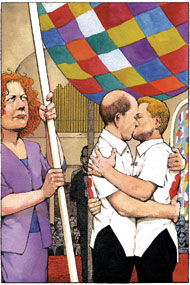 One groom’s father needed to step outside and smoke a lot. The other groom’s father was dead. Nieces were in abundance, though — a bouquet of skinny adorable girls, dressed in hot pink and giggling with excitement. One groom’s father needed to step outside and smoke a lot. The other groom’s father was dead. Nieces were in abundance, though — a bouquet of skinny adorable girls, dressed in hot pink and giggling with excitement.
But I didn’t have a lot of time to gawk at the family members because I was a huppah holder at this gay Christian wedding, and our routine was intricately choreographed. The huppah, in the Jewish tradition, is a canopy, often made from a prayer shawl, whose corners are held up on poles by four people close to the wedding couple. But these grooms, Randy and Michael, were Catholic — super Catholic in fact. Michael had been a seminarian, preparing for the Jesuit priesthood in a former life, and Randy a Benedictine monk, deeply steeped in prayer, contemplation and service. So why, as my Brooklyn-raised father carefully asked, would they want a huppah? The thing is, when you put “Catholic” and “gay wedding” together, you come out with one inevitable conclusion: an extravaganza of rituals.
( Read More...Collapse ) It wasn’t a legal wedding. Even so, it made me think the Right is correct in fearing same-sex unions. There is such power in this kind of brave and naked love that it may make the walls of Jericho come tumbling down.
Alison Luterman, who lives in Oakland, Calif., is the author of “The Largest Possible Life” (Cleveland State University). |
|
|
| navigation |
| [ |
viewing |
| |
most recent entries |
] |
| [ |
go |
| |
earlier |
] |
| |
|
|


