It has been entertaining to watch the controversy surrounding Colin Kaepernick, the NFL quarterback who refused to stand for the National Anthem. After seeing the predictable frothing reaction by white racist jingoes, I'm half-inclined to agree with Donald Trump that Political Correctness is killing America: Kaepernick was just speaking his mind, telling it like it is, refusing to let Political Correctness stifle his thought and opinions, and all these whiny Social Justice Warriors got their delicate sensibilities in a bunch. They want professional sports to be a Safe Space, and they'll accept no trigger warnings -- they want total conformity to the Politically Correct thought police.
This morning I met a friend for lunch at a bar, which of course had a TV tuned to ESPN. The big question of the segment was Rodney Harrison's celebrity-style apology for claiming that Kaepernick is not black. I say "celebrity-style" because, as is typical of the genre, Harrison's apology groveled without actually saying something or even acknowledging that, or why he was wrong -- he just hadn't meant to offend or hurt anybody. A self-identified "Caucasian person" on the panel of commentators, also predictably, lamented that Harrison shouldn't be "humiliated" for making an honest mistake. The other commentators did better, though.
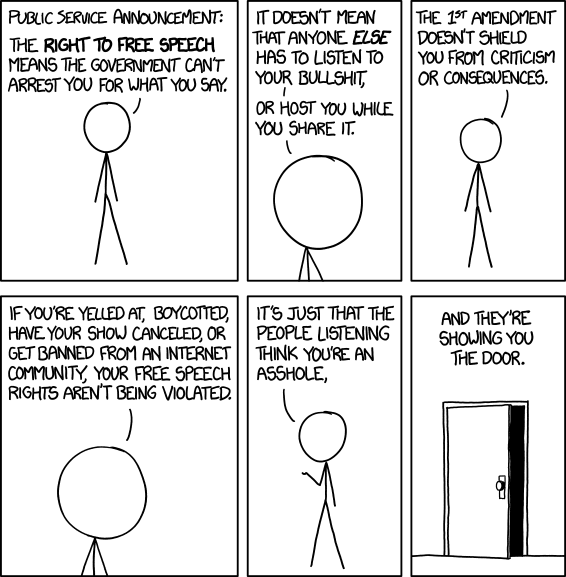
But I have a question. The cartoon above got a lot of traffic among
liberals and progressives a few years back, when Brendan Eich, Alec
Baldwin, Duck Dynasty and some other people got in trouble over some
antigay and racist remarks and actions. The point was that as long as
the government isn't censoring them, it's okay for them to be fired, to
lose their contracts with their media overlords, and for millions of
people to throw virtual caca at them on the Intertoobz -- because it's
only censorship if the government does it. Corporations and other
private entities are not bound by the First Amendment. This can be
argued, and it was.
So here's my question: why does this cartoon not apply to Colin Kaepernick? Or does it? Should the NFL show Colin Kaepernick the door for being (as he is, in many people's opinion, though not in mine) an asshole, whose bullshit they don't want to have to listen to? I have no particular
opinion myself, I'm just curious to know what other people think. It seems to me that this case confirms my oft-stated belief that freedom of speech almost always comes down to which asshole and which bullshit is on the block.
Showing posts with label xkcd. Show all posts
Wednesday, August 31, 2016
Monday, April 21, 2014
Toleration for Me, But Not for Thee!
The point I was driving at in yesterday's post was not only that anyone who tries to silence someone else on the grounds that the latter is an "asshole" who utters "bullshit" has discredited him or herself as a rational person, but that allowing such complaints to affect public discussions (whether in "private" or "public" environments) will severely limit, if not destroy, free speech in our society. You don't like what I say? Complain to my employer or to my web host that I'm an asshole! If enough people complain, I'll be fired and my blog deleted. Social conservatives won't be the only ones who will be silenced; anyone who offends enough people will also be removed from the public eye, because private employers and companies aren't required to protect freedom of expression except their own, not that of their employees -- and a newscaster or a columnist or a variety show host is an employee, who's employed at the will and pleasure of his or her employer.
This evidently doesn't worry the people who try to silence others, either because they believe they have the power to protect themselves or because they don't realize that their blogs, their tumblrs, their Twitter feeds, their Facebook accounts, are private rather than "public" media -- until they run up against the limits of corporate tolerance. Corporate tolerance is limited by public pressure, and you never know when your boss or web host will decide you're more trouble than you're worth. (Not that it's very different in the increasingly corporate world of government: just ask Shirley Sherrod, for one.) And it's not even necessary to construct an argument: according to that xkcd cartoon and the liberals who spread it around the Internet, it's enough that someone thinks you're an asshole and your opinions are bullshit. Your (and my) freedom of expression consists of freedom from government action against you, limited though that is by legal restrictions but also because there are fewer and fewer venues not under corporate ownership and control nowadays. Public sites like parks are increasingly privatized, so you have no guarantee of freedom of assembly or expression there. The police will silence you, not because the government doesn't like you, but because the owner of the site doesn't like you; besides, you're only an asshole.
Now, granted that there is a rational case to be made against Brendan Eich as CEO of Mozilla; in yesterday's post I linked to some people who attempted to make one. Because Eich participated by donation in the Proposition 8 campaign against same-sex marriage in California, he arguably took a step beyond speech into action against the rights of other citizens -- though as I argued, such action is and should be protected by law to some extent, an extent which can be debated but isn't clearly marked out anywhere. And as CEO he does have a representative function where his political opinions and actions might be the concern of Mozilla.
It occurs to me, though, that the same "employees have no rights" line was used by the critics of Phil Robertson, Paula Deen, and others, though their offense was limited to speech. Stupid, bigoted speech, true, but speech nonetheless, and it's one of the pillars of free speech doctrine that speech is not (necessarily) action. It also occurs to me that the idea that every performer in corporate media represents the corporate owner, who is therefore responsible for their every word and thought, is very similar to the claim advanced by religious opponents of same-sex marriage, who claim that taking money to bake a wedding cake for a same-sex couple amounts to endorsement and acceptance, even celebration of their marriage. Some writers pointed out quite simply that no, baking a cake for a wedding doesn't constitute endorsement of the coupling. In the same way, my buying used books from the shop of a right-wing acquaintance of mine doesn't constitute endorsement of or agreement with his often fascist opinions -- just as his occasional part-time employment of me doesn't constitute agreement with or endorsement of my America-hating, Communist opinions. I pick on him constantly, but I still do business with him. I might consider changing that policy if he crossed some line or other, but I can't think at the moment of what the line would be.
A writer at Slate asked, rhetorically but seriously, why, if conservatives are so upset by the plight of Brendan Eich, they don't also concern themselves with ordinary Americans. It's a good article. But it works both ways. The liberals who howled for Eich's removal, justifying it because he works for a private company, must also explain why they think lower-profile employees shouldn't be subject to the discretion of their private employers. If customers complain about a salesperson's visible tattoos or piercings, for example, shouldn't that be grounds for firing her? After all, it's not like the government is picking on her. Or if a business loses customers (or is afraid it will lose customers) who don't want to deal with a black clerk, or a female doctor, it's not the business's fault; shouldn't employers be allowed to comply with (their fantasies about) public opinion?
As the Slate writer points out, in most of the US a private employer can discriminate in employment on the basis of sexual orientation or gender "identity." Instead of acknowledging that private employees have no freedom in such areas, many people are working to limit the rights of private employers by passing a law forbidding such discrimination. The excuse is largely that sexual orientation or gender identity is not a "choice" but something innate and therefore should be protected against discrimination, an excuse which is doubtful for various reasons; but the key point is that private employers do not have total license to cave in to public complaints about what the public considers unacceptable employees, and their freedom to do so is not written in stone but can change. Where to draw the line is not clear either; it is a matter of judgment, and as such needs to be debated as rationally as possible. That's not going to be easy, but it's necessary. And it's odd to see many liberals and progressives suddenly so solicitous about the power businesses have over their employees.
This evidently doesn't worry the people who try to silence others, either because they believe they have the power to protect themselves or because they don't realize that their blogs, their tumblrs, their Twitter feeds, their Facebook accounts, are private rather than "public" media -- until they run up against the limits of corporate tolerance. Corporate tolerance is limited by public pressure, and you never know when your boss or web host will decide you're more trouble than you're worth. (Not that it's very different in the increasingly corporate world of government: just ask Shirley Sherrod, for one.) And it's not even necessary to construct an argument: according to that xkcd cartoon and the liberals who spread it around the Internet, it's enough that someone thinks you're an asshole and your opinions are bullshit. Your (and my) freedom of expression consists of freedom from government action against you, limited though that is by legal restrictions but also because there are fewer and fewer venues not under corporate ownership and control nowadays. Public sites like parks are increasingly privatized, so you have no guarantee of freedom of assembly or expression there. The police will silence you, not because the government doesn't like you, but because the owner of the site doesn't like you; besides, you're only an asshole.
Now, granted that there is a rational case to be made against Brendan Eich as CEO of Mozilla; in yesterday's post I linked to some people who attempted to make one. Because Eich participated by donation in the Proposition 8 campaign against same-sex marriage in California, he arguably took a step beyond speech into action against the rights of other citizens -- though as I argued, such action is and should be protected by law to some extent, an extent which can be debated but isn't clearly marked out anywhere. And as CEO he does have a representative function where his political opinions and actions might be the concern of Mozilla.
It occurs to me, though, that the same "employees have no rights" line was used by the critics of Phil Robertson, Paula Deen, and others, though their offense was limited to speech. Stupid, bigoted speech, true, but speech nonetheless, and it's one of the pillars of free speech doctrine that speech is not (necessarily) action. It also occurs to me that the idea that every performer in corporate media represents the corporate owner, who is therefore responsible for their every word and thought, is very similar to the claim advanced by religious opponents of same-sex marriage, who claim that taking money to bake a wedding cake for a same-sex couple amounts to endorsement and acceptance, even celebration of their marriage. Some writers pointed out quite simply that no, baking a cake for a wedding doesn't constitute endorsement of the coupling. In the same way, my buying used books from the shop of a right-wing acquaintance of mine doesn't constitute endorsement of or agreement with his often fascist opinions -- just as his occasional part-time employment of me doesn't constitute agreement with or endorsement of my America-hating, Communist opinions. I pick on him constantly, but I still do business with him. I might consider changing that policy if he crossed some line or other, but I can't think at the moment of what the line would be.
A writer at Slate asked, rhetorically but seriously, why, if conservatives are so upset by the plight of Brendan Eich, they don't also concern themselves with ordinary Americans. It's a good article. But it works both ways. The liberals who howled for Eich's removal, justifying it because he works for a private company, must also explain why they think lower-profile employees shouldn't be subject to the discretion of their private employers. If customers complain about a salesperson's visible tattoos or piercings, for example, shouldn't that be grounds for firing her? After all, it's not like the government is picking on her. Or if a business loses customers (or is afraid it will lose customers) who don't want to deal with a black clerk, or a female doctor, it's not the business's fault; shouldn't employers be allowed to comply with (their fantasies about) public opinion?
As the Slate writer points out, in most of the US a private employer can discriminate in employment on the basis of sexual orientation or gender "identity." Instead of acknowledging that private employees have no freedom in such areas, many people are working to limit the rights of private employers by passing a law forbidding such discrimination. The excuse is largely that sexual orientation or gender identity is not a "choice" but something innate and therefore should be protected against discrimination, an excuse which is doubtful for various reasons; but the key point is that private employers do not have total license to cave in to public complaints about what the public considers unacceptable employees, and their freedom to do so is not written in stone but can change. Where to draw the line is not clear either; it is a matter of judgment, and as such needs to be debated as rationally as possible. That's not going to be easy, but it's necessary. And it's odd to see many liberals and progressives suddenly so solicitous about the power businesses have over their employees.
Sunday, April 20, 2014
The Multi That Owns Us
So I guess I'd better write something about the Great Mozilla Flap of 2014. In case you haven't heard, Brendan Eich, the recently-elevated CEO of Mozilla, which produces the Firefox browser, came under attack because in 2008 he donated a thousand dollars to support the anti-same-sex-marriage Proposition 8 in California. After a little more than a week of controversy, including calls to boycott Mozilla products, Eich stepped down. Which was a relief for me, because after checking the main alternatives, I wasn't sure I was willing to switch to another browser; I have some problems with Firefox, but I'm used to it and I don't much like Chrome or IE.
Conor Friedersdorf summed up the controversy reasonably well here; I also liked this post by Ampersand at Alas, a Blog, which helped me sort out my own position. It reminded me that I'd written much the same things in this post right after the success of Prop 8 at the polls in 2008. Entertainingly, Andrew Sullivan got upset over Brendan Eich's departure, though he helped lead the attack on the liberal gay-marriage supporter Alec Baldwin for using homophobic language, even unto Baldwin's losing his TV program. (Maybe because Baldwin is a high-profile Hollywood liberal and Eich is a right-wing libertarian who supported Ron Paul?) Baldwin singled out Sullivan for contumely as part of the "fundamentalist wing of gay advocacy." And the fuss hasn't died down yet, as shown by xkcd's latest cartoon, linked above, which has been getting shared widely on the Intertoobz, including sf writer John Scalzi's blog.
For a computer/math geek and science cultist, xkcd has wandered off into irrationality with this cartoon. Part of what he says is fair enough, I guess: I agree that the First Amendment only applies to government censorship, so being fired for your political or other views is not a violation of your First Amendment rights. This has been brought home repeatedly in the controversies over Paula Deen, Juan Williams, Phil Robertson, and others lately. (Oddly, when the racist writer John Derbyshire was fired from the National Review two years ago for his expressed views, few right-wingers came to his defense.) Nor is it a violation of your freedom of speech to be kicked out of an Internet forum, or if your letter to the editor of a newspaper isn't published, or if you're attacked in the "mainstream media" for attacking your political opponents. So far so good.
But xkcd made some odd statements, starting with "It doesn't mean that anyone else has to listen to your bullshit" and climaxing with "It's just that the people listening think you're an asshole, and they're showing you the door." On a narrow literal level, the first statement is also true, but "bullshit" is perniciously irrelevant, as is "asshole." It doesn't matter whether what you say or write is "bullshit," but the question arises: Who gets to decide that what you've said is bullshit, or that you're an asshole? At Scalzi's blog I posted a comment, asking whether Phil Donahue was fired from MSNBC in 2003 because he was an asshole? And how many people who are grimly celebrating the fall of Brendan Eich now, threw hissyfits over Donahue's losing his TV show because he gave a forum to opponents of the Bush-Cheney invasion of Iraq? Many liberals and progressives did at the time, and they're still upset a decade later; I'll cite Chris Hedges for special notice because of his overwrought claim that "TV news died" when Donahue was shown the door. As if the corporate media had ever given a platform to critics of US wars; Hedges surely must know better.
Another commenter at Scalzi's blog bit. They wrote:
@Duncan, more like MSNBC’s viewers were letting MSNBC know they thought he was an asshole, and MSNBC decided that it did not want to present programming by someone their viewers thought was an asshole. Unless you’re implying that he lost his show because the government applied pressure to MSNBC?No, I wasn't implying anything of the kind; as far as I know, the government applied no pressure to MSNBC. There was no need to. The decision to get rid of Donahue seems not to have had anything to do with "viewers" thinking Donahue was an asshole; it came from the upper reaches of management, as revealed by a leaked internal memo which warned that Donahue presented a "difficult public face for NBC in a time of war.... He seems to delight in presenting guests who are anti-war, anti-Bush and skeptical of the administration's motives." The decision was framed in commercial terms, that at a time when MSNBC wanted to "reinvent itself", Donahue might put off an "anticipated larger audience who will tune in during a time of war" by linking pundits to war coverage, "particularly given his public stance on the advisability of the war effort." So far I haven't seen any of Donahue's advocates acknowledging that a corporate network has the right to determine the face it shows to its audiences, and to dismiss employees like Donahue who don't fit its plans to reinvent itself. But that was last year, after all.
There are other examples I could give. Michael Moore, who is widely regarded as an asshole by conservatives and liberals alike, publicly opposed the Iraq war before it became safe to do so, and endured death threats, vandalism of his home, and (unsuccessful) physical attacks as a consequence. (He was also harshly criticized by liberal heroes and Iraq war supporters Keith Olbermann and Al Franken, whom I consider assholes.) But while I doubt that those who've justified the firing of various right-wing bigots would be comfortable defending the response Moore faced because of his 'bullshit,' I wonder how many of them are even aware of it? And it's true, death threats and bomb plots go way beyond what xkcd is talking about. But c'mon, the audience at the Academy Awards had every right to boo Moore because they didn't want to hear this asshole spout his bullshit, right?
I hope this points to the problem not only with xkcd's specific point about bullshit and assholes, but to the broader defense of private businesses demoting, firing, and otherwise showing the door to people whose opinions and political stances rile others. After all, John Scalzi has been called an asshole often enough, and though he runs his own blog he doesn't own the Internet hardware that stores and transmits it -- it's in the hands of private companies, who then could reasonably give him the boot if enough people complained that he was an asshole and they didn't want to read his bullshit anymore. A common argument used about Internet forums is that if your comments get deleted or you get banned from the comment section, you can always start your own blog. And that's true, but what if you can't find a host for your bullshit? This happened to Wikileaks a few years back, for example; and why not, since Julian Assange is widely considered an asshole by right-thinking people? Why should they have to listen to his bullshit? They were just showing him the door.
Throwing around words like "asshole" and "bullshit" in this situation is a rejection of rational debate. I've pointed before to the way many people all over the political spectrum confuse a person's opinions with their style of presentation, which are separate issues. And while it's convenient (which is to say, lazy) to dismiss free-speech issues by characterizing the offending speech as "bullshit," it's irrelevant. It seems to me to echo the distaste for critical thinking I've seen exhibited by many good liberals and progressives, who want to impose, with varying degrees of force, their opinions on the benighted troglodytes who aren't as rational as they like to believe they are. (And no, this has nothing to do with being "open-minded.")
Many of Eich's critics argued that his offense went beyond speech into action: he donated a thousand dollars to support the campaign for Proposition 8 in 2008, to ban same-sex civil marriage in California. I've seen quite a lot of GLBT people say that because he tried to take away their rights, he had no right to be CEO of Mozilla. (I would agree that he doesn't have a right to be CEO of Mozilla, but that doesn't seem to be what these people meant -- I think it's more like the person who wanted Paula Deen to "lose everything.") I suppose that case could be made, but matters of principle must apply across the board, not just to specific cases, so let's consider some analogous possibilities. Can a company fire an employee who contributes to an organization seeking to raise taxes on businesses, or on the top income brackets? Such an employee could reasonably be accused of trying to deprive businesses or rich individuals of their right to keep as much of their income as possible. How about union organizers (to say nothing of strikers), who also seek to limit the power of business owners and management, thereby affecting them in their pocketbooks? Though labor law has limited the freedom of workers to organize and strike, our society and the law recognizes at least in theory that people have the right to assert their rights at what may be the expense of their opponents. Not all freedom is a zero-sum game, where one person gains only if another loses, but sometimes it is. People have the right to advance themselves at others' expense in such situations. It's certainly not true that a person who does so has automatically forfeited his freedom of speech or action. And contrary to another liberal-left claim I've often seen, freedom of speech does extend to "hate speech" and advocating the diminution or removal of other people's rights. Those others have the corresponding freedom to respond with more speech, including hateful speech as they often do. That's part of the messiness of living in a free society.
I guess I should clarify that I'm not displeased that Brendan Eich stepped down; I think that the criticism of Mozilla and the pressure it produced were legitimate. But I do think that some of those who agree with his demotion are not clear about what the issues are, what they were doing, or how the same tactics can and will legitimately be turned against people they support.
I don't think there's an easy answer to this problem, but I do think that the power corporations and other private, ostensibly non-government entities, can exercise over people's expression is a matter that ought to concern those who care about public debate. It appears to me that many liberals and "progressives" and even leftists are all too accepting of corporate power over corporate employees, because it's not government power. lt's just not possible to separate the public and the private that neatly. And what these recent controversies -- not just Eich, but Deen and Robertson and others -- indicate to me is that for many if not people, their positions on any given case are determined by where they stand on the issue. If they approve of the opinions of the person fired, they get indignant; if they don't, they celebrate and justify the firing. Which is their right, of course; but it doesn't bespeak a principled commitment to freedom of expression.
Subscribe to:
Posts (Atom)