Academia.eduAcademia.edu

Outline

The subgrouping of the Semitic languages

2008, Language and Linguistics Compass

https://doi.org/10.1111/J.1749-818X.2007.00044.XLast updated

Abstract

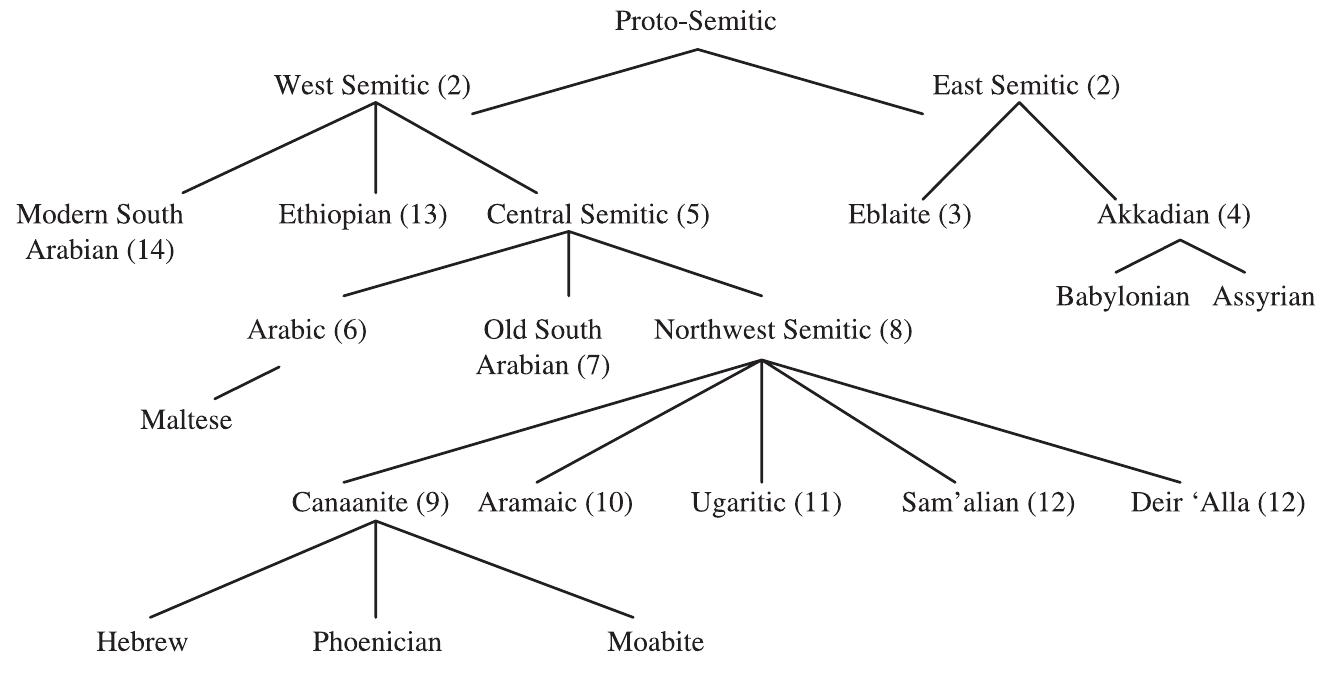
The Semitic languages have enjoyed a long tradition of linguistic study, and remain one of the most widely studied of the world's language families. The large amount of scholarship that is generated on both the ancient and modern languages continues to have an effect on our understanding of the internal subgrouping of the Semitic family. Unfortunately, for both the specialist and non-specialist, reliable and up-to-date treatments of this topic are not easily found. This article will survey the current views on Semitic subgrouping and highlight recent scholarship on the issue.

Key takeaways
sparkles

AI

  1. The article surveys current views on Semitic language subgrouping and recent scholarship.
  2. Hetzron's model remains influential in classifying Semitic languages despite ongoing debates.
  3. Eblaite is classified as East Semitic, challenging previous assumptions of it being Northwest Semitic.
  4. Central Semitic is distinguished by the innovative verbal form yaqtulu, impacting classification.
  5. Modern South Arabian languages are not direct descendants of Old South Arabian languages, complicating subgrouping.

References (144)

  1. The history of Semitic classification is discussed by Hetzron (1974), Voigt (1987), and Rubio (2003).
  2. Excellent synopses of Semitic subgrouping can be found in Faber (1997) and Huehnergard (1992a, 1995a), with Faber providing the most detailed discussion. Huehnergard (2004) presents the current scheme (and very valuable Proto-Semitic reconstructions), though specific discussion of classification is very brief.
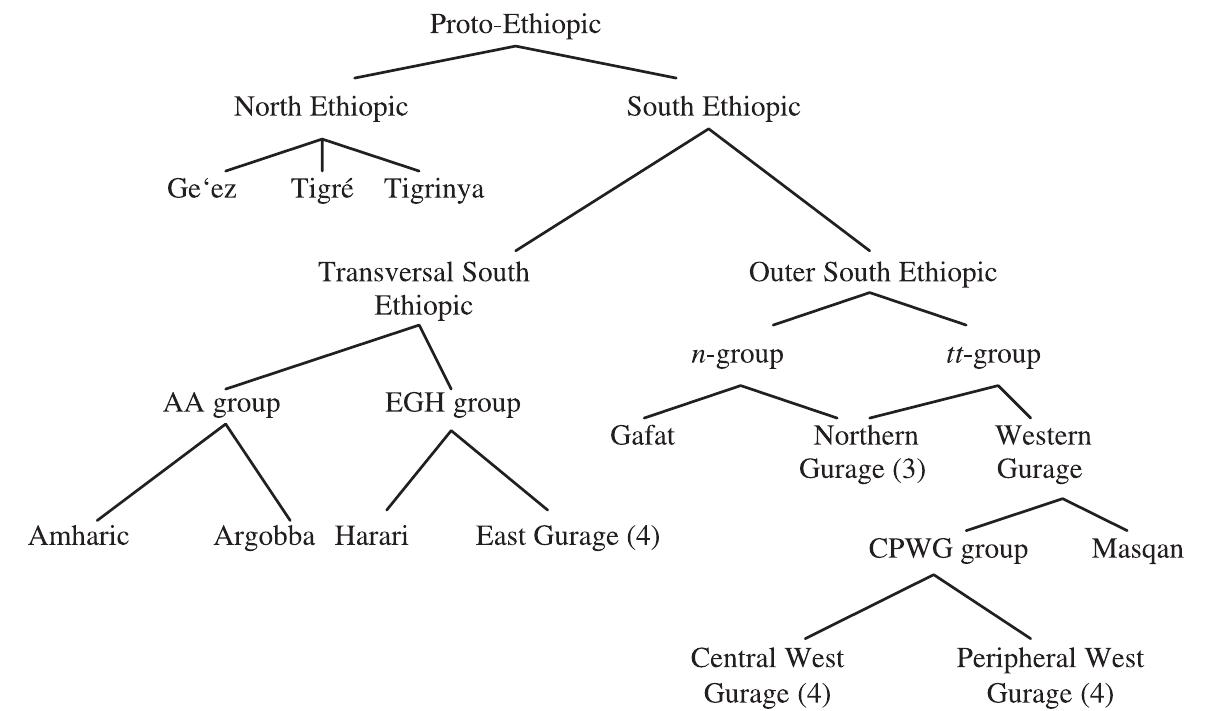
  3. Cf. Hetzron (1974, 1975, 1976). On Hetzron's contribution to the subgrouping of the Ethiopian languages, see below, Section 13.
  4. The statement made by Lipinski (1997: 47) that 'this [East-West] conception can no more be sustained' would find very few adherents.
  5. P. Haupt (1878) first recognized that the qatala past tense found in West Semitic was an innovation, and that the Akkadian prefixed past tense must be archaic. It was F. Hommel, however, who recognized the implications of this for the subgrouping of Semitic; cf. Hommel (1883: 63, 442; 1892: 92-97; 1926: 75 -82).
  6. See my discussion elsewhere on the origins and development of the Semitic stative (Rubin 2005: 26-8).
  7. For further on the innovations specific to East and West Semitic, see Huehnergard (2006). On the existence of the form iptaras in Eblaite, see Rubio (2006: 122).
  8. Hetzron (1976: 105).
  9. Cf. Pettinato (1975: 373 -74 = 1979: 16 -17), Dahood (1981). Still others have seen Eblaite as forming a distinct North Semitic branch. For example, Lipinski (1997: 50) groups Eblaite (which he terms 'Palaeosyrian') with Ugaritic and Amorite (the latter known only from proper names in Akkadian and Egyptian texts) as North Semitic.
  10. On this conclusion, see Gelb (1981: 46 -52), Caplice (1981), Krebernik (1996), and the excellent recent studies of Rubio (2003, 2006) and Huehnergard (2006).
  11. Huehnergard (2006: 4).
  12. Cf. Huehnergard (2006: 4-5).
  13. Cf. Dombrowski (1988), Krebernik (1996).
  14. Cf. Reiner (1966: 21, 113 -14), Huehnergard and Woods (2004: 219). For some arguments supporting this conclusion, see Kienast (1981).
  15. See the study of Hasselbach (2007).
  16. Examples and discussion can be found in Aro (1955: 75 -8).
  17. The Akkadian texts from El-Amarna (Egypt) are letters that originated in a variety of locales, most of which were Canaanite speaking areas (i.e. modern Israel and Lebanon).
  18. For an example of an archaism in peripheral Akkadian, see Moran (1973). On Assyrianisms see Moran (1975) and the sources in the following note.
  19. On issues pertaining to peripheral dialects, including their classification and divergent features, see Huehnergard (1989: 20, 271-84), Pentiuc (2001: 12).
  20. Hetzron (1974, 1976). For Hetzron, Central Semitic included Aramaic, Arabic, and Canaanite. 21 On the development of the Central Semitic indicative, see Hamori (1973) and Rubin (2005: 146 -8).
  21. The Afro-Asiastic background of this form was demonstrated by Rössler (1951 [= 2001: 341-56], 1981 [= 2001: 693 -72]) and Greenberg (1952), though both of these authors should be read with caution; see also Lipinski (1997: 339, 382-3). For the internal evidence, see Gensler (1997).
  22. Faber (1990: 629, 1997: 8).
  23. For a discussion of Ugaritic emphatics, see Tropper (2000: 96 -8).
  24. See Steiner (1982) for discussion.
  25. Faber (1991, 1997: 9). Strangely, Faber ignores the occurrence of bl 'without' in OSA. This fits with the presentation of Central Semitic in this article, but Faber herself (in these works, at least) does not classify OSA as Central Semitic.
  26. Cf. the classic reference work of Nöldeke (1899: 17 = 1911: 621). Many modern scholars still use this evidence to promote this scenario, for example, Blau (1978), Diem (1980); see also Corriente (1996).
  27. Christian (1919 -20).
  28. Hetzron (1974, 1976).
  29. See Zaborski (1991, 1994) for discussion of this ongoing debate.
  30. Ratcliffe (1998a,b).
  31. Ratcliffe (1998b: 122).
  32. For an overview of the dialects and this system of division, see Fischer and Jastrow (1980: 20-38) and Versteegh (1997: 130 -72).
  33. See the classic study of Blanc (1964).
  34. There have been some more careful linguistic studies of dialect groups in recent years, but no comprehensive work. See Behnstedt and Woidich (2005) for an excellent overview. 36 It was Nöldeke (1904) who first made this clear. See the discussion in Borg (1978: 343 -7).
  35. Macdonald (2000, 2004). Macdonald continues to use the older terms Thamudic B, C, D, and Southern Thamudic for those texts which are essentially unclassified.
  36. See Rubin (2005: 65 -90) for a discussion of the forms of the articles and their origins.
  37. The first three of these are also referred to as Sabaean, Minaean, and Qatabanian. Recently, South Arabian scholars have suggested replacing the names Minaic/Minaean with Madhabic; cf. Robin (1991: 98) and Macdonald (2000: 30). For an overview of the languages, see Robin (1991: 93 -100).
  38. Beeston (1984: 1).
  39. See the discussions in Beeston (1987) and Macdonald (2000: 30 -1).
  40. Nebes (1994). Nebes also provides discussion of the history of the debate.
  41. It should be noted that already Voigt (1987) argued for the inclusion the Sayhadic languages in the Central Semitic branch. 45 Although many scholars have made such a connection with accompanying doubts, for example, Huehnergard (1992a: 158, 1995a: 2120), Lipinski (1997: 81). Already Rabin (1963: 108 n. 1) recognized that the MSA languages do not descend from the OSA, but it was the short article of Porkhomovsky (1997) that has most influenced recent scholarship.
  42. Cf. Huehnergard (1992a: 158; 2004: 142).
  43. I transcribe here <š> and <s> in place of the traditional, but more cumbersome, <s 1 > and <s 3 >. It is not relevant for our purposes whether the symbols <š> and <s> accurately reflect the phonetics of Hadramitic. It is possible that <s 1 > and <s 3 > actually represent [s] and [ t s], which are their Proto-Semitic values.
  44. Forms with asterisks in Qatabanic and Minaic are unattested, but are based on other attested forms of the pronoun, such as the suffixed forms.
  45. The initial h of the Mehri 3ms form is derived from an earlier sibilant, just as the h's of Sabaic, Hebrew, and Arabic undoubtedly are.
  46. Cf. the introduction of the feminine pronouns with initial sh-(she, scho, etc.) in Middle English dialects, replacing the inherited forms with initial h-, in order to remove ambiguity.
  47. See Frantsouzoff (1997: 115 -17, 123). Frantsouzoff also suggests an additional morphological isogloss, but this is rather speculative, as it is based on a single Hadramitic form, of uncertain etymology.
  48. A minority of scholars, most notably David Cohen and his students, have suggested that the MSA imperfective form (e.g. Mehri yekoteb) does in fact stem from yaqtulu, and not from the Proto-Semitic *yVqattVl; cf. Cohen (1974; 1984: 68-75);
  49. Lonnet (2005: 187-8). See Goldenberg (1977: 475 -77, 1979) for an argument against this scenario.
  50. Cf. the works of Cantineau (1932), Leslau (1943), Marrassini (1991), and Rodgers (1991), all of whom also group OSA (but not Arabic) with Ethiopic and MSA.
  51. For this conclusion, see Porkhomovsky (1997). The data in Appleyard (1996) support this conclusion, though Appleyard himself seems to suggest otherwise. Against this conclusion, see Müller (1964).
  52. Johnstone (1975: 2).
  53. Cf. Simeone-Senelle (1997: 408-9). On this development in Mehri, see Rubin (2007b).
  54. Cf. Lonnet (1998: 303 -4).
  55. On the loss of t, see Johnstone (1968, 1980), Testen (1992), and Voigt (2006). Both Johnstone (1980) and Testen note the importance of this feature in grouping these two languages. On feminine marking in -i, see Lonnet (forthcoming). Works Cited Appleyard, David L. 1996. Ethiopian Semitic and South Arabian: Towards a re-examination of a relationship. Israel Oriental Studies XVI: Studies in modern Semitic languages, ed. by Shlomo Izre'el and Shlomo Raz, 203 -28. Leiden, The Netherlands: Brill.
  56. Arnold, Werner. 1989-91. Das Neuwestaramäische. 5 vols. Wiesbaden, Germany: Harrassowitz.
  57. Aro, Jussi. 1955. Studien zur mittelbabylonischen Grammatik. Helsinki, Finland: Societas Orientalis Fennica.
  58. Beeston, A. F. L. 1984. Sabaic grammar. Manchester, UK: Journal of Semitic Studies.
  59. --. 1987. Apologia for 'Sayhadic'. Proceedings of the Seminar for Arabian Studies 17.13 -14.
  60. Behnstedt, Peter, and Manfred Woidich. 2005. Arabische Dialektgeographie: Eine Einführung. Leiden, The Netherlands: Brill.
  61. Blanc, Haim. 1964. Communal dialects of Baghdad. Cambridge, MA: Harvard University Press.
  62. Blau, Joshua. 1978. Hebrew and North West Semitic: Reflections on the classification of the Semitic languages. Hebrew Annual Review 2.21-44. Reprinted in idem, Topics in Hebrew and Semitic linguistics, 308 -32. Jerusalem, Israel: Magnes (1998).
  63. Borg, Alexander. 1978. A historical and comparative phonology and morphology of Maltese, PhD dissertation, The Hebrew University of Jerusalem.
  64. Boyarin, Daniel. 1981. An inquiry into the formation of Middle Aramaic dialects. Bono homini donum: Essays in historical linguistics in memory of J. Alexander Kerns, Part II, ed. by Yoël L. Arbeitman and Allan R. Bomhard, 613 -49. Amsterdam, The Netherlands: Benjamins.
  65. Brock, Sebastian P. 2001. The hidden pearl: The Syrian Orthodox Church and its ancient Aramaic heritage. 3 vols. With the assistance of David G.K. Taylor. Rome, Italy: Trans World Films Italia.
  66. Cantineau, Jean. 1932. Accadien et sudarabique. Bulletin de la Société de Linguistique de Paris 33.175 -204.
  67. Caplice, Richard. 1981. Eblaite and Akkadian. La lingua di Ebla: Atti del convegno internazionale ( Napoli, 21-23 aprile 1980), ed. by Luigi Cagni, 161-4. Naples, Italy: Istituto Universitario Orientale.
  68. Christian, V. 1919 -20. Akkader und Südaraber als ältere Semitenschichte. Anthropos 14 - 15.729-39.
  69. Cohen, David. 1974. La forme verbale à marques personelles préfixées en sudarabique moderne. IV Congresso internazionale di studi etiopici (Roma, 10 -15 aprile 1972), vol. 2, 63 -70. Rome, Italy: Accademia Nazionale dei Lincei.
  70. --. 1984. La phrase nominale et l'évolution du système verbal en sémitique: Études de syntaxe historique. Leuven, Belgium: Peeters.
  71. Corriente, Federico. 1996. Introducción a la gramática comparada del semítico meridional. Madrid, Spain: Consejo Superior de Investigaciones Científicas.
  72. Dahood, Mitchell. 1981. The linguistic classification of Eblaite. La lingua di Ebla: Atti del convegno internazionale (Napoli, 21-23 aprile 1980), ed. by Luigi Cagni, 177-89. Naples, Italy: Istituto Universitario Orientale.
  73. Diem, Werner. 1980. Die genealogische Stellung des Arabischen in den semitischen Sprachen: Ein ungelöstes Problem der Semitistik. Studien aus Arabistik und Semitistik Anton Spitlaer zum siebzigsten Geburtstag von Seinen Schülern überreicht, ed. by Werner Diem and Stefan Wild, 65 -85. Wiesbaden, Germany: Harrassowitz.
  74. Dombrowski, B. W. W. 1988. 'Eblaitic' = The earliest known dialect of Akkadian. Zeitschrift der Deutschen Morgenländischen Gesellschaft 138.211-35.
  75. Elias, David L. 2005. Tigre of Habab: Short grammar and texts from the Rigbat people, PhD dissertation, Harvard University.
  76. Faber, Alice. 1990. Interpretation of orthographic forms. Linguistic change and reconstruction methodology, ed. by Philip Baldi, 619 -37. Berlin, Germany/New York, NY: Mouton de Gruyter.
  77. --. 1991. The diachronic relationship between negative and interrogative markers in Semitic. Semitic studies in honor of Wolf Leslau, ed. by Alan S. Kaye, vol. 1, 411-29. Wiesbaden, Germany: Harrassowitz.
  78. --. 1997. Genetic subgrouping of the Semitic languages. The Semitic languages, ed. by Robert Hetzron, 3-15. London/New York, NY: Routledge.
  79. Ferrer, Joan. 2004. Esbozo de historia de la lengua aramea. Cordoba, Spain: Servicio de Publicaciones de la Universidad de Córdoba.
  80. Fischer, Wolfdietrich, and Otto Jastrow, eds. 1980. Handbuch der arabischen Dialekte. Wiesbaden, Germany: Harrassowitz.
  81. Fitzmyer, Joseph A. 1979. A wandering Aramean: Collected Aramaic essays. Missoula, MT: Scholars Press.
  82. Fox, Samuel Ethan. 1994. The relationships of the Eastern Neo-Aramaic dialects. Journal of the American Oriental Society 114.154 -62.
  83. Frantsouzoff, Serguei A. 1997. Regulation of conjugal relations in ancient Raybun. Proceedings of the Seminar for Arabian Studies 27.113 -27.
  84. Garr, W. Randall. 1985. Dialect geography of Syria-Palestine, 1000 -586 B.C.E. Philadelphia, PA: University of Pennsylvania Press.
  85. Gelb, Ignace. 1981. Ebla and the Kish civilization. La lingua di Ebla: Atti del convegno internazionale (Napoli, 21-23 aprile 1980), ed. by Luigi Cagni, 9-73. Naples, Italy: Istituto Universitario Orientale.
  86. Gensler, Orin D. 1997. Reconstructing quadriliteral verb inflection: Ethiopic, Akkadian, Proto-Semitic. Journal of Semitic Studies 42.229 -57.
  87. Ginsburg, H. L. 1970. The Northwest Semitic languages. The world history of the Jewish people, vol. 2: Patriarchs, ed. by B. Mazar, 102-24. Givatayim, Israel: Jewish History Publications/Rutgers University Press.
  88. Goldenberg, Gideon. 1977. The Semitic languages of Ethiopia and their classification. Bulletin of the School of Oriental and African Studies 40.461-507.
  89. --. 1979. The Modern South Arabian prefix-conjugation: Addendum to BSOAS, XL, 3, 1977. Bulletin of the School of Oriental and African Studies 42.541-5.
  90. Greenberg, Joseph H. 1952. The Afro-Asiatic (Hamito-Semitic) present. Journal of the Ameri- can Oriental Society 72.1-9.
  91. Hamori, Andras. 1973. A note on yaqtulu in East and West Semitic. Archiv Orientální 41.319-24.
  92. Harris, Zellig S. 1939. Development of the Canaanite dialects: An investigation in linguistic history. New Haven, CT: American Oriental Society.
  93. Hasselbach, Rebecca. 2007. The affiliation of Sargonic Akkadian with Babylonian and Assyrian: New insights concerning the internal subgrouping of Akkadian. Journal of Semitic Studies 52.21-43.
  94. Haupt, Paul. 1878. The oldest Semitic verb-form. Journal of the Royal Asiatic Society 10.244 -52.
  95. Heinrichs, Wolfhart. 2002. Peculiarities of the verbal system of Senaya within the framework of North Eastern Neo-Aramaic (NENA). 'Sprich doch mit deinen Knechten aramäisch, wir verstehen es!'. 60 Beiträge zur Semitistik: Festschrift für Otto Jastrow zum 60. Geburtstag, ed. by Werner Arnold and Hartmut Bobzin, 237-68. Wiesbaden, Germany: Harrassowitz. results. The study of the Ancient Near East in the twenty-first century: The William Foxwell Albright Centennial Conference, ed. by Jerrold S. Cooper and Glenn M. Schwartz, 233-49. Winona Lake, IN: Eisenbrauns.
  96. Leslau, Wolf. 1943. South-East Semitic (Ethiopic and South-Arabic). Journal of the American Oriental Society 63.4-14.
  97. Lipinski, Edward. 1997. Semitic languages: Outline of a comparative grammar. Leuven, Belgium: Peeters.
  98. Lonnet, Antoine. 1985. The Modern South Arabian languages of the P.D.R. of Yemen. Proceedings of the Seminar for Arabian Studies 15.49-55.
  99. --. 1998. The Soqotri language: Past, present and future. Proceedings of the first international symposium on Soqotra Island: Present and future, ed. by H. J. Dumont, vol. 1, 297-308. New York, NY: United Nations.
  100. --. 2005. Quelques réflexions sur le verbe sudarabique moderne. Studi Afroasiatici: XI Incontro italiana di linguistica camitosemitica, ed. by Alessandro Mengozzi, 187-201. Milan, Italy: FrancoAngeli.
  101. --. 2006. Les langues sudarabiques modernes. Faits de Langues 27.27-44.
  102. --. forthcoming. Le féminin en -i du sémitique. Aula Orientalis.
  103. Macdonald, M. C. A. 2000. Reflections on the linguistic map of pre-Islamic Arabia. Arabian Archaeology and Epigraphy 11.28-79.
  104. --. 2004. Ancient North Arabian. Cambridge encyclopedia of the world's ancient languages, ed. by Roger Woodard, 488-533. Cambridge, UK: Cambridge University Press.
  105. Marrassini, Paolo. 1991. Some observations on South Semitic. Semitic studies in honor of Wolf Leslau, ed. by Alan S. Kaye, vol. 2, 1016-23. Wiesbaden, Germany: Harrassowitz.
  106. Moran, William. 1973. The dual personal pronouns in Western Peripheral Akkadian. Bulletin of the American Schools of Oriental Research 211.50-3. Reprinted in idem, Amarna Studies: Collected Writings, ed. by John Huehnergard and Shlomo Izre'el, 243-47. Winona Lake, IN: Eisenbrauns (2003).
  107. --. 1975. The Syrian scribe of the Jerusalem Amarna letters. Unity and diversity, ed. by Hans Goedicke and J. J. M. Roberts, 146-68. Baltimore, MD: Johns Hopkins University. Reprinted in idem, Amarna Studies: Collected Writings, ed. by John Huehnergard and Shlomo Izre'el, 249-74. Winona Lake, IN: Eisenbrauns (2003).
  108. Müller, Walter W. 1964. Über Beziehungen zwischen den neusüdarabischen und den abessi- nischen Sprachen. Journal of Semitic Studies 9.50-5.
  109. Nebes, Norbert. 1994. Zur Form der Imperfektbasis des unvermehrten Grundstammes im Altsüdarabischen. Festschrift Ewald Wagner zum 65. Geburtstag, vol. 1: Semitische Studien unter besonderer Berücksichtigung der Südsemitistiker, ed. by Wolfhart Heinrichs and Gregor Schoeller, 59-81. Beirut, Lebanon/Stuttgart, Germany: F. Steiner.
  110. Nöldeke, Th. 1899. Die semitischen Sprachen: Eine Skizze, 2nd edn. Leipzig, Germany: Chr. Herm. Tauchnitz.
  111. --. 1904. Review of Maltesische Studien, by Hans Stumme. Zeitschrift der Deutschen Morgenländischen Gesellschaft 58.903-20.
  112. --. 1911. Semitic languages. The Encyclopaedia Britannica, 11th edn, vol. 24, 617-30. London: Encyclopaedia Britannica.
  113. Pentiuc, Eugen J. 2001. West Semitic vocabulary in the Akkadian texts from Emar. Winona Lake, IN: Eisenbrauns.
  114. Pettinato, G. 1975. Testi cuneiformi del 3. millennio in paleo-cananeo rinvenuti nella campagna 1974 a Tell Mardikh = Ebla. Orientalia N.S. 44.61-74.
  115. --. 1979. Old Canaanite cuneiform texts of the third millennium. Introduction and translation by Matthew L. Jaffe. Malibu, CA: Undena.
  116. Porkhomovsky, Victor. 1997. Modern South Arabian languages from a Semitic and Hamito- Semitic perspective. Proceedings of the Seminar for Arabian Studies 27.219-23.
  117. Rabin, C. 1963. The origin of the subdivisions of Semitic. Hebrew and Semitic studies presented to Godfrey Rolles Driver in celebration of his seventieth birthday, 20 August 1962, ed. by D. Winton Thomas and W. D. McHardy, 104-15. Oxford, UK: Clarendon Press.
  118. Ratcliffe, Robert R. 1998a. The 'broken' plural problem in Arabic and comparative Semitic. Amsterdam, The Netherlands/Philadelphia, PA: John Benjamins.
  119. --. 1998b. Defining morphological isoglosses: The 'broken' plural and Semitic subclassification. Journal of Near Eastern Studies 57.81-123.
  120. Reiner, Erica. 1966. A linguistic analysis of Akkadian. The Hague, The Netherlands: Mouton.
  121. Robin, Christian, ed. 1991. L'Arabie antique de Karib'îl à Mahomet. Revue du Monde Musulman et de la Méditerranée 61. Aix-en-Provence, France: Édisud.
  122. Rodgers, Jonathan. 1991. The subgrouping of the South Semitic languages. Semitic studies in honor of Wolf Leslau, ed. by Alan S. Kaye, vol. 2, 1323-36. Wiesbaden, Germany: Harrassowitz.
  123. Rössler, O. 1951. Akkadisches und libysches verbum. Orientalia N.S. 20.101-7, 366-73.
  124. --. 1981. The structure and inflection of the verb in the Semito-Hamitic languages - Preliminary studies for a comparative Semito-Hamitic grammar. Bono homini donum: Essays in historical linguistics in memory of J. A. Kerns, ed. by Y. L. Arbeitman and A. R. Bomhard, 679-748. Amsterdam, The Netherlands: Benjamins.
  125. --. 2001. Gesammelte Schriften zur Semitohamitistik, ed. by Thomas Schneider, with Oskar Kaelin. Münster, Germany: Ugarit-Verlag.
  126. Rubin, Aaron. 2005. Studies in Semitic grammaticalization. Winona Lake, IN: Eisenbrauns.
  127. --. 2007a. On the third person preformative l-/n-in Aramaic, and an Ethiopic parallel. Ancient Near Eastern Studies 44.1-28.
  128. --. 2007b. The Mehri participle: Form, function, and evolution. Journal of the Royal Asiatic Society (Series 3) 17.381-8.
  129. Rubio, Gonzalo. 2003. Falling trees and forking tongues: On the place of Akkadian and Eblaite within Semitic. Studia Semitica, ed. by Leonid Kogan, 152-89. Moscow, Russia: Russian State University for the Humanities.
  130. --. 2006. Eblaite, Akkadian, and East Semitic. The Akkadian language in its Semitic context, ed. by G. Deutscher and N. J. C. Kouwenberg, 110-39. Leiden, The Netherlands: Nederlands Instituut voor het Nabije Oosten.
  131. Segert, Stanislav. 1984. A basic grammar of the Ugaritic language. Berkeley, CA: University of California Press.
  132. Simeone-Senelle, Marie-Claude. 1997. The Modern South Arabian languages. The Semitic languages, ed. by Robert Hetzron, 378-423. London/New York, NY: Routledge.
  133. --. 2005. La détermination du nom en dahalik, langue afro-sémitique parlée en Erythrée. Studi Afroasiatici: XI Incontro italiana di linguistica camitosemitica, ed. by Alessandro Mengozzi, 203-17. Milan, Italy: FrancoAngeli.
  134. Steiner, Richard C. 1982. Affricated Sade in the Semitic languages. New York, NY: American Academy for Jewish Research.
  135. Testen, David. 1992. The loss of the person-marker t-in Jibbali and Soqotri. Bulletin of the School of African and Oriental Studies 55.445 -50.
  136. Tropper, Josef. 1993. Die Inschriften von Zincirli. Münster, Germany: Ugarit-Verlag.
  137. --. 2000. Ugaritische Grammatik. Münster, Germany: Ugarit-Verlag.
  138. Versteegh, Kees. 1997. The Arabic language. Edinburgh, UK: Edinburgh University Press.
  139. Voigt, Rainer. 1987. The classification of Central Semitic. Journal of Semitic Studies 32.1-21.
  140. --. 2006. Zum Verlust der personalen Elemente in den Präfixkonjugationen des Neu- südarabischen. Loquentes linguis: Linguistic and oriental studies in honour of Fabrizio A. Pennacchietti, ed. by Pier Giorgio Borbone, Alessandro Mengozzi, and Mauro Tosco, 717- 31. Wiesbaden, Germany: Harrassowitz.
  141. Wagner, Ewald. 1959. Der Dialekt von 'Abd-el-Kuri. Anthropos 54.475-86.
  142. Zaborski, Andrzej. 1991. The position of Arabic within the Semitic dialect continuum. Proceedings of the Colloquium on Arabic Grammar, ed. by Kinga Dévéni and Tamás Iványi, 365-75.
  143. Budapest, Hungary: Eötvös Loránd University Chair for Arabic Studies and Csoma de Korös Society Section of Islamic Studies.
  144. --. 1994. Problèmes de classification des dialectes sémitiques méridionaux. Actes des premières journées internationales de dialectologie arabe de Paris, ed. by Dominique Caubet and Martine Vanhove, 399 -411. Paris, France: Institut National des Langues et Civilisations Orientales.

FAQs

sparkles

AI

What are the key morphological innovations distinguishing Central Semitic languages?add

Central Semitic languages are characterized by the development of the indicative form yaqtulu and specific alterations in tense-mood-aspect systems, as detailed in Huehnergard's 2005 study.

How does the classification of Eblaite differ from earlier theories?add

Recent analysis indicates Eblaite should be classified as East Semitic rather than Northwest Semitic, based on shared morphological innovations with Akkadian and discrepancies in phonological rules.

What defines the subgrouping of Ancient North Arabian dialects?add

Ancient North Arabian dialects, including Safaitic and Taymanitic, are characterized by unique features like the prefixed definite article h(n-) and linguistic similarities with Classical Arabic.

What recent findings challenge the traditional view of Arabic’s classification?add

Current scholarship, notably by Ratcliffe, indicates Arabic shares innovations with both Central Semitic and other southern languages, complicating its grouping beyond traditional lineages.

How do scholars approach the subgrouping of Modern South Arabian languages?add

The subgrouping of Modern South Arabian languages remains uncertain due to limited data, but similarities suggest potential grouping among languages like Mehri and Jibbali.

About the author
The University of Georgia, Faculty Member
Papers
74
Followers
2,019
View all papers from Aaron Rubinarrow_forward