
Open your phone and check the first image in your gallery. You can easily identify the people in the image and even describe it to your friend. That’s because it is very easy for humans to see things and describe what they are seeing but is that the same for computers? Not at all! It isn’t as easy for computers to “see” as it is for humans. And that is why the field of Computer Vision is so important as it tries to find better and faster ways for computers to “see”.
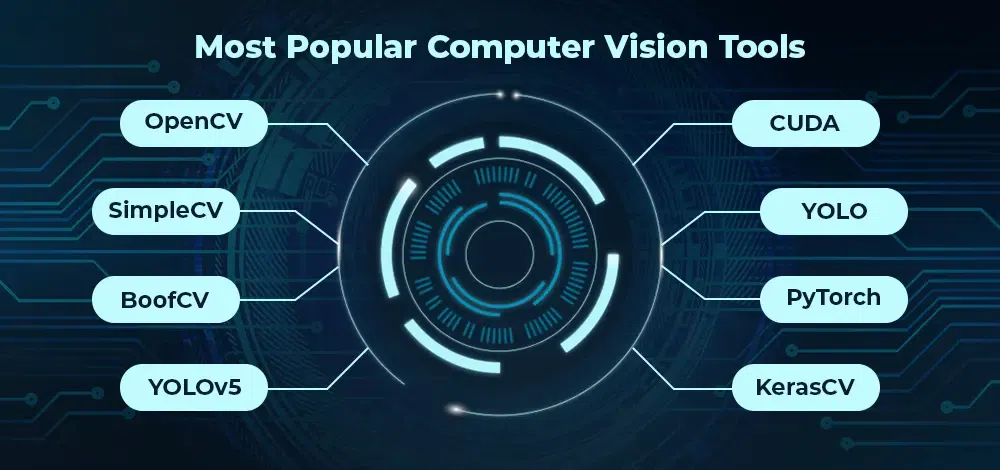
Currently, various online tools provide algorithms for Computer Vision and a platform to execute these algorithms or create new ones. So, Here in this article, we will explore about Top 15 Popular Computer Vision Tools in 2025
List of the Most Popular Computer Vision Tools in 2025
As we step into 2025, a wide range of powerful tools and frameworks have appeared that make it easier for developers and researchers to create advanced computer vision solutions quickly and efficiently. Below is mentioned list of the Top 15 Most Popular Computer Vision Tools.
1. OpenCV
Overview: OpenCV (Open Source Computer Vision Library) is an open-source computer vision library that contains many different functions for computer vision and machine learning. It's open-source, which means it’s free to use and modify, and it supports a variety of programming languages, including Python, C++, and Java.
Key Features:
- Image processing functions like edge detection, histogram equalization, and feature extraction.
- Algorithms for object tracking, 3D reconstruction, and facial recognition.
- AR overlay and support for machine learning integration.
Use Cases: OpenCV is applied in video surveillance, motion detection, gesture recognition, augmented reality, and industrial automation, among others.
2. Tensorflow Object Detection API
Overview : A robust framework within TensorFlow for object detection, supporting various pre-trained models and facilitating model training and deployment. An established framework that facilitates training and deploying models for object detection and other CV tasks.
Key Features:
- Pre-trained models for computer vision tasks like object detection, segmentation, and image classification.
- High-level APIs for model training and deployment on various platforms.
- TensorFlow Lite for mobile and embedded devices, and TensorFlow Extended (TFX) for production pipelines.
Use Cases: Tensorflow Object Detection API is extensively used in academic research, autonomous vehicle systems, and robotics for tasks like 3D vision and camera calibration.
3. Matlab (Computer Vision Toolbox)
Overview: Matlab is a numerical computing environment that was developed by MathWorks in 1984. It contains the Computer Vision Toolbox which provides various algorithms and functions for computer vision. These include object detection, object tracking, feature detection, feature matching, camera calibration in 3-D, 3D reconstruction, etc.
Key Features:
- Computer Vision Toolbox for object tracking, camera calibration, and feature matching.
- Robust 3D vision functions and image processing capabilities.
- Support for custom algorithms in research and development
Use Cases: Matlab (Computer Vision Toolbox) used in extensively used in academic research, autonomous vehicle systems, and robotics for tasks like 3D vision and camera calibration.
4. CUDA
Overview: CUDA or the Compute Unified Device Architecture is a parallel computing platform that was created by Nvidia and released in 2007. It is used by software engineers for general purpose processing using the CUDA-enabled graphics processing unit or GPU.
Key Features:
- Libraries such as cuDNN and GPU4Vision optimized for deep learning and computer vision.
- Support for languages including C, C++, Python, and MATLAB.
- Enhanced processing speed and efficiency for real-time applications.
Use Cases: Compute Unified Device Architecture is Often used in autonomous driving, real-time video processing, and medical imaging to enhance computational performance.
5. SimpleCV
Overview: SimpleCV is an open-source computer vision framework that can be used for building various computer vision applications. SimpleCV is simple (as the name suggests!) and SimpleCV is an easy-to-use framework that simplifies working with complex computer vision concepts, making it accessible to beginners.
Key Features:
- Integrates with other computer vision libraries like OpenCV.
- Simplified functions for basic image processing, feature detection, and object tracking.
- Supports rapid prototyping for machine learning applications.
Use Cases: Ideal for educational projects, hobbyist robotics, and rapid prototyping in real-time computer vision applications.
6. YOLO
Overview: YOLO or You only look once! is a latest and cutting edge real-time object detection system. The YOLO algorithm is so fast as compared to other object detection algorithms because it applies a neural network to the full image in order to classify the objects.
Key Features:
- Processes an entire image in one go for fast, real-time detection.
- High accuracy with low computational requirements.
- Continual updates and newer versions (like YOLOv5).
Use Cases: Used in surveillance systems, autonomous vehicles, and robotics for real-time object tracking and detection.
7. BoofCV
Overview: BoofCV is an open-source library that is written specifically for real-time computer vision. It was released under an Apache 2.0 license for both academic and commercial use.
Key Features:
- Geometric and image processing functions.
- Supports 2D and 3D geometric operations.
- Lightweight and ideal for embedded systems.
Use Cases: Commonly used in robotics, manufacturing quality control, and mobile devices due to its efficient, lightweight design.
8. PyTorch
Overview: PyTorch, favored for its ease of use and flexibility, is another popular machine learning library with robust support for computer vision through TorchVision. It’s known for research as well as production deployments. Highly favored in the research community for its ease of use and flexibility, especially for deep learning and CV tasks.
Key Features:
- Modular and flexible, supporting high-performance applications.
- Pre-trained models and customizability.
- Supports seamless integration with PyTorch.
Use Cases: Used in autonomous vehicles, complex object tracking, and precision agriculture for high-accuracy object detection and segmentation.
9. Detectron2
Overview: Developed by Facebook AI Research (FAIR), Detectron2 is a state-of-the-art tool for object detection and segmentation. Its modularity and scalability make it highly popular for high-performance applications. Highly favored in the research community for its ease of use and flexibility, especially for deep learning and CV tasks.
Key Features:
- Modular and flexible, supporting high-performance applications.
- Pre-trained models and customizability.
- Supports seamless integration with PyTorch.
Use Cases: Used in autonomous vehicles, complex object tracking, and precision agriculture for high-accuracy object detection and segmentation.
10. YOLOv5
Overview: YOLO (You Only Look Once) has revolutionized real-time object detection, and YOLOv5 continues to lead in terms of speed and accuracy in 2025. It’s popular for edge AI applications due to its lightweight architecture.
Key Features:
- Lightweight architecture ideal for embedded devices.
- Real-time object detection capabilities.
- Versatile for on-device applications in mobile and IoT.
Use Cases: Applied in drones, robotics, and IoT devices for efficient real-time object detection with low latency.
11. KerasCV
Overview: KerasCV, introduced in the Keras ecosystem, focuses on computer vision applications, leveraging the simplicity of Keras with TensorFlow's powerful backend. It offers plug-and-play model training for various tasks.
Key Features:
- Easy-to-use, high-level API for building vision models.
- Integrates with TensorFlow for seamless deployment.
- Pre-trained models available for common tasks.
Use Cases: Ideal for prototyping and deploying applications in industries like e-commerce, healthcare, and manufacturing.
12. Microsoft Azure Computer Vision
Overview : Azure’s Computer Vision service offers a cloud-based solution for analyzing visual content. It's popular for enterprise-level applications due to its scalability, security, and ease of integration. A cloud service that offers scalable image analysis capabilities for enterprises.
Key Features:
- OCR capabilities, image tagging, and facial recognition.
- Enterprise-level scalability and robust security.
- Supports deployment in Microsoft cloud ecosystem.
Use Cases: Used in retail for visual product searches, in content moderation, and in healthcare for document processing.
13. AWS Rekognition
Overview: AWS Rekognition offers highly scalable and easy-to-use image and video analysis services. Known for its integration into the AWS ecosystem, it’s widely used in production environments.
Key Features:
- Powerful facial and object recognition.
- Seamless integration with other AWS services.
- Scalable and ideal for large datasets.
Use Cases: Widely used in e-commerce, video streaming, and security applications for content moderation and facial recognition.
14. OpenVINO Toolkit
Overview: Intel’s OpenVINO Toolkit is a comprehensive toolkit for deploying deep learning models on Intel hardware. It accelerates computer vision applications from edge to cloud. Designed to optimize deep learning inference on Intel hardware, supporting various CV applications.
Key Features:
- Optimized for Intel CPUs and VPUs, from edge to cloud.
- Integrates with a wide range of deep learning frameworks.
- Accelerates inference for real-time vision applications.
Use Cases: Used in manufacturing for quality control, healthcare for imaging analysis, and retail for real-time product recognition.
15. Labelbox
Overview: Labelbox is a leading platform for training data labeling and management. It has gained popularity in 2025 as the go-to tool for building high-quality datasets, especially in computer vision projects.
Key Features:
- Intuitive labeling tools and customizable workflows.
- Supports annotation and dataset management at scale.
- Collaboration features for large teams.
Use Cases: Essential for computer vision projects in industries like autonomous vehicles, retail, and healthcare, where high-quality training data is crucial.
Comparision Between Top Computer Vision Tools
Tool | Pros | Cons |
|---|---|---|
OpenCV | - Extensive library of functions | - Steeper learning curve for beginners |
TensorFlow Object Detection API | - Pre-trained models for quick implementation | - High memory consumption |
MATLAB (Computer Vision Toolbox) | - Rich set of algorithms | - Expensive licensing |
CUDA | - High performance for real-time applications | - Requires Nvidia hardware |
SimpleCV | - Easy to use for beginners | - Limited advanced functionalities |
YOLO | - Real-time detection capabilities | - Requires good quality training data |
BoofCV | - Lightweight and efficient | - Fewer features compared to larger libraries |
PyTorch | - Flexible and user-friendly | - Higher resource consumption for large models |
Detectron2 | - State-of-the-art performance | - Can be resource-intensive |
YOLOv5 | - Fast and lightweight | - Limited to certain tasks |
KerasCV | - High-level API simplifies model building | - May lack advanced functionalities for experienced users |
Microsoft Azure Computer Vision | - Scalable and secure cloud solution | - Dependency on internet connection |
AWS Rekognition | - Easy integration with AWS ecosystem | - Limited customizability |
OpenVINO Toolkit | - Optimized for Intel hardware | - Limited support for non-Intel hardware |
Labelbox | - Intuitive user interface for labeling | - Costs associated with larger teams |
Conclusion
In 2025, the Top 15 Computer Vision Tools offer a range of helpful solutions that make it easier for computers to "see" and understand the world around them. Each tool has its own special strengths: OpenCV is flexible and can be used for many purposes, TensorFlow is great for building AI models, and YOLO and YOLOv5 are super fast at spotting objects in real-time.
