
Matter is anything that has mass and occupies space. It is composed of tiny particles such as atoms, molecules, or ions. Depending on the arrangement of particles and the strength of intermolecular forces, matter exists in different physical states.
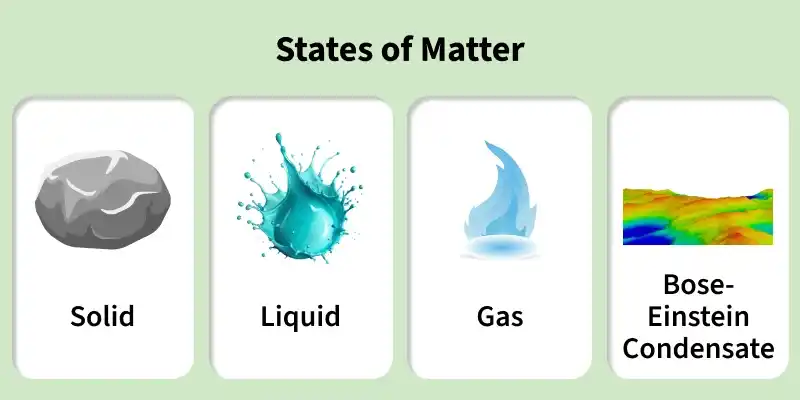
Characteristics of Particles of Matter
The particle nature of matter explains many of its physical properties.
- Matter is made up of extremely small particles that are continuously moving.
- These particles possess kinetic energy and attract one another through intermolecular forces.
- The spaces present between particles and the balance between attractive forces and kinetic energy determine whether a substance exists as a solid, liquid, or gas.
- The movement and arrangement of particles can change when temperature or pressure is altered.
Three States of Matter
Under ordinary conditions, matter commonly exists in three states: solid, liquid, and gas. These states differ in shape, volume, compressibility, and particle arrangement.
1. Solids
A solid is a state of matter in which the constituent particles are closely packed and held together by strong intermolecular forces. The particles possess low kinetic energy and can only vibrate about their fixed positions.
- The rigidity of solids distinguishes them from liquids and gases.
- Solids are states of matter that have a definite shape and volume as well as a rigid structure.
- Solids have the least compressibility and thermal expansion of any material.
- Iron, copper, and ice are common examples of solids.
2. Liquids
The most visible physical properties of a liquid are volume retention and conformation to the shape of its container. When a liquid substance is poured into a vessel, it takes on the shape of the vessel and will remain inside as long as the substance is liquid.
- The intermolecular forces in liquids are weaker than those in solids but stronger than those in gases.
- Liquid particles are less closely packed than those in solids and have sufficient freedom of movement.
- Liquids have a definite volume but no definite shape and take the shape of the container in which they are placed.
3. Gases
A gas is a state of matter in which the particles are far apart and move freely in all directions. The intermolecular forces between particles are negligible compared to their kinetic energy.
- As a result, translatory, rotatory, and vibratory motions are prominent in gases.
- Gases have neither definite shape nor definite volume.
- They expand to fill the entire container, are highly compressible, and diffuse rapidly.
- Oxygen, nitrogen, and carbon dioxide are common examples of gases.
4. Plasma
Plasma is an ionized state of matter consisting of positively charged ions and free electrons.
- It is formed when a gas is heated to very high temperatures or subjected to a strong electric field.
- Plasma is found in stars, lightning, fluorescent lamps, and neon signs.
5. Bose-Einstein Condensates
Bose-Einstein Condensate (BEC) is a special state of matter formed when certain gases are cooled to temperatures extremely close to absolute zero.
- At such low temperatures, the kinetic energy of atoms becomes very small, and a large number of atoms occupy the same quantum state.
- As a result, they behave as a single quantum entity. BECs exhibit unique properties such as superfluidity and have helped scientists study quantum phenomena in greater detail.
