
Pipelining is a mechanism used to improve system performance in which tasks are executed in an overlapping manner. In this technique, the problem is divided into subproblems & assigned to the pipes, then the pipes operate under the same clock.
- Pipelining is the process of arranging hardware elements of a CPU such that its overall performance is increased.
- Simultaneous execution of more than one instruction takes place in a pipelined processor.
- In pipelining, multiple instructions are overlapped in execution.
- Accepting new input before the previously accepted input appears as an output at the other end.
Design of Pipeline
The diagram shows the concept of pipelining with stages:
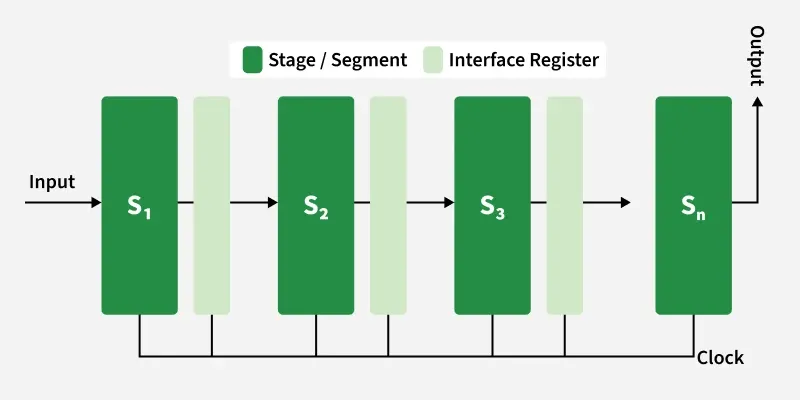
- Pipelining has two ends: the input end & output end. Between the input & output ends, Multiple pipes are interconnected to satisfy the functionality.
- These Pipes are called stage or segments. Between the stages buffer are used to store to intermediate result.
- This Buffer is also called as pipeline Register/Interface.
Pipeline Stages
A typical instruction pipeline is comprised of several discrete stages. Each stage completes a part of the instruction cycle, such as:
- Instruction Fetch (IF): Retrieves the next instruction from memory.
- Instruction Decode (ID): Decodes the instruction to determine required operations.
- Execute (EX): Performs arithmetic or logical operations.
- Memory Access (MEM): Reads or writes data from/to memory.
- Writeback (WB): Writes the result back to the register file.
The output from one stage becomes the input for the next, passed via pipeline registers. All stages progress in parallel, synchronised by a common clock.
Benefits of Pipelining
- Increased Throughput: Multiple instructions are executed simultaneously, improving CPU performance.
- Efficient Resource Usage: Stages keep hardware busy nearly all the time, akin to an assembly line.
- Higher Clock Rates: Pipelined CPUs can run at higher frequencies since stages work on simpler operations within each clock cycle.
Challenges
Pipelining can encounter several issues called hazards, which disrupt smooth execution:
- Data Hazards: When instructions depend on results of previous instructions still in the pipeline.
- Control Hazards: Caused by branch instructions altering the instruction flow.
- Structural Hazards: Occur when hardware resources are insufficient for concurrent stages.
Techniques like forwarding, stalling, and hazard detection help mitigate these problems.
