
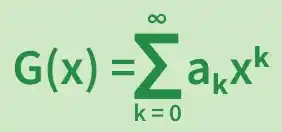
A generating function is a way to represent a sequence of numbers using a power series. In this series, the coefficients of powers of x represent the terms of the sequence. Generating functions make it easier to solve problems related to sequences, counting, and recurrence relations.
The general form of a generating function is shown below,
Basic Prerequisites
Before learning generating functions, we need to understand some basic combinatorics concepts.
1. Permutation: An arrangement of objects where the order matters. It tells us how many different ways we can arrange k objects from n distinct objects.
Number of ways to arrange k objects from n objects:
2. Combination: A selection of objects where the order does not matter. It tells us how many ways we can choose k objects from n distinct objects.
Number of ways to choose k objects from n objects:
- You should also know the Geometric Series formula, which is the backbone of most generating function derivations:
\sum_{n=0}^{\infty} r^n = \frac{1}{1-r}, \quad |r| < 1 - And the Binomial Theorem:
(1+x)^n = \sum_{k=0}^{n} \binom{n}{k} x^k
Important Generating Functions
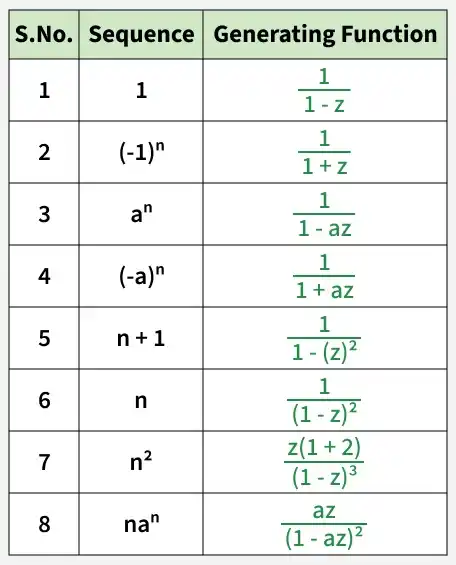
The following table shows some important generating functions and their corresponding sequences. These standard results are frequently used to solve combinatorial and recurrence relation problems.
Types of Generating Functions
1. Ordinary Generating Function (OGF)
A generating function in which the coefficients of powers of x represent the terms of a sequence. It is mainly used in counting problems and combinatorics.
Formula:
2. Exponential Generating Function (EGF)
A generating function where each term of the sequence is divided by n!. It is commonly used in permutation and arrangement problems where order matters.
Formula:
3. Dirichlet Generating Function (DGF)
A generating function used mainly in number theory, where the terms are divided by ns, with s being a complex variable.
Formula:
4. Probability Generating Function (PGF)
A generating function used in probability theory to represent the probability distribution of a discrete random variable.
Formula:
Solved Examples
Example 1: Find the generating function for the sequence {1, 1, 1, 1, …}.
Solution:
The generating function is
G(x) = 1 + x + x² + x³ + …
This is an infinite geometric series with common ratio x.
Using the formula,
1 + x + x² + x³ + … = 1 / (1 − x)
Therefore, G(x) = 1 / (1 − x)
Example 2: Find the generating function for the sequence {0, 1, 2, 3, …}.
Solution:
The generating function is
G(x) = 0 + x + 2x² + 3x³ + …
Using the standard generating function formula,
x + 2x² + 3x³ + … = x / (1 − x)²
Therefore, G(x) = x / (1 − x)²
Example 3: Find the generating function for the sequence {1, 2, 4, 8, …}.
Solution:
The generating function is
G(x) = 1 + 2x + 4x² + 8x³ + …
This is a geometric series with common ratio 2x.
Using the formula,
1 + 2x + 4x² + … = 1 / (1 − 2x)
Therefore, G(x) = 1 / (1 − 2x)
Example 4: Find the generating function for the sequence
Solution:
The generating function is
G(x) = ⁿC₀ + ⁿC₁x + ⁿC₂x² + … + ⁿCₙxⁿ Using the Binomial Theorem,
(1 + x)ⁿ = ⁿC₀ + ⁿC₁x + ⁿC₂x² + … + ⁿCₙxⁿ Therefore,
G(x) = (1 + x)ⁿ
Practice Problems
- Problem 1: Find the generating function for the sequence {1,2,3,4,…}
- Problem 2: Determine the generating function for the sequence {1,−1,1,−1,…}.
- Problem 3: Find the generating function for the sequence {1,0,1,0,1,0,…}.
- Problem 4: Derive the generating function for the sequence {1,3,5,7,…}.
- Problem 5: Determine the generating function for the sequence {1,4,9,16,…}.
- Problem 6: Find the generating function for the sequence {0,1,0,1,0,1,…}.
- Problem 7: Derive the generating function for the sequence {1,1/2,1/4,1/8,…}.
- Problem 8: Find the generating function for the sequence {1,1,0,0,1,1,0,0,…}.
- Problem 9: Determine the generating function for the sequence {1,2,1,2,1,2,….}.
- Problem 10: Derive the generating function for the sequence {1,3,6,10,15,…}.
