
Strings are one of the most commonly used objects in Java. A String is immutable, which means that once a String object is created, its value cannot be changed.
- Strings are stored in a String Pool, allowing reuse of objects and reducing memory overhead.
- Multiple threads can safely share the same string object without synchronization.
public class Main{

    public static void main(String[] args) {

        String str = "Hello";

        str.concat(" World");

        System.out.println(str);
    }
}
Output
Hello
Explanation: In the above example, the concat() method does not modify the original String object. When str.concat(" World") is executed:
- A new String object "Hello World" is created.
- The original String "Hello" remains unchanged.
- Since the new object is not assigned to any variable, it is discarded.
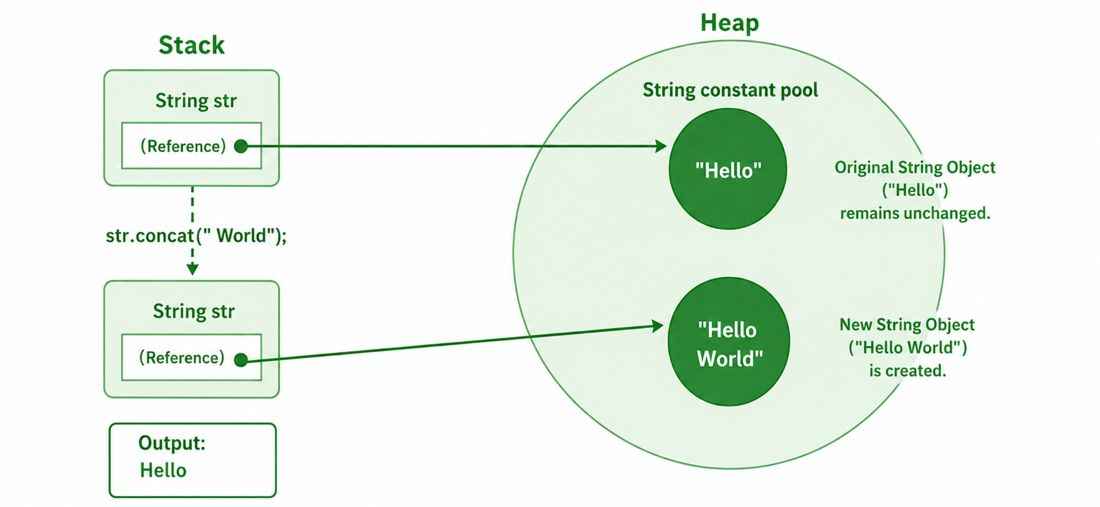
The original String "Hello" remains unchanged because Strings are immutable in Java. The concat() method creates a new String object "Hello World", but since it is not assigned to any variable, the output remains "Hello".
How to Modify a String?
Since Strings cannot be modified directly, you must store the result in a new reference.
public class Main{

    public static void main(String[] args) {

        String str = "Hello";

        str = str.concat(" World");

        System.out.println(str);
    }
}
Output
Hello World
Explanation: Here, the newly created String object is assigned back to str, so the reference now points to the updated String.
Why Are Strings Immutable
- Security: Prevents sensitive data such as passwords, file paths, and URLs from being modified after creation.
- String Pool Optimization: Allows multiple references to safely share the same string object, saving memory.
- Thread Safety: Multiple threads can access the same string object without synchronization issues.
- HashCode Caching: The hashcode remains constant, improving the performance of collections like
HashMap. - Better Memory Management: Immutable strings can be reused, reducing unnecessary object creation.
