
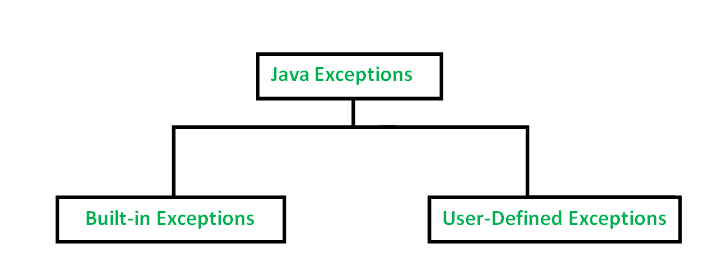
Exceptions in Java are events that occur during program execution and disrupt the normal flow of a program. Java provides many built-in exceptions to handle common runtime and compile-time errors. Developers can also create custom exceptions to handle application-specific error conditions.
- Exceptions help detect and handle errors gracefully.
- Java provides both built-in and user-defined exceptions.
- Proper exception handling improves program reliability and maintainability.
Built-in Exceptions
Built-in exceptions are predefined exception classes provided by Java's standard library to handle common runtime and compile-time errors. They help identify and manage abnormal situations such as invalid input, file errors, arithmetic errors, and null references. Java automatically throws these exceptions when such conditions occur.
- Built-in exceptions are predefined and available in Java libraries.
- They help handle common errors and prevent unexpected program termination.
Examples of Built-in Exception
1. ArithmeticException
ArithmeticException occurs when an illegal arithmetic operation is performed, such as division by zero.
- Commonly occurs during mathematical calculations.
- It is an unchecked exception.
class ArithmeticException_Demo
{
    public static void main(String args[])
    {
        try {
            int a = 30, b = 0;
            int c = a/b;  // cannot divide by zero
            System.out.println ("Result = " + c);
        }
        catch(ArithmeticException e) {
            System.out.println ("Can't divide a number by 0");
        }
    }
}
Output
Can't divide a number by 0
2. NullPointerException
NullPointerException occurs when a program tries to access a method or variable using a null reference.
- One of the most common runtime exceptions.
- Occurs when an object reference points to null.
class NullPointer_Demo
{
    public static void main(String args[])
    {
        try {
            String a = null; //null value
            System.out.println(a.charAt(0));
        } catch(NullPointerException e) {
            System.out.println("NullPointerException..");
        }
    }
}
Output
NullPointerException..
3. StringIndexOutOfBoundsException
StringIndexOutOfBoundsException occurs when an invalid index is used to access characters in a string.
- Happens when index is less than 0 or greater than string length.
- Thrown by String class methods.
class StringIndexOutOfBound_Demo
{
    public static void main(String args[])
    {
        try {
            String a = "This is like chipping "; // length is 22
            char c = a.charAt(24); // accessing 25th element
            System.out.println(c);
        }
        catch(StringIndexOutOfBoundsException e) {
            System.out.println("StringIndexOutOfBoundsException");
        }
    }
}
Output
StringIndexOutOfBoundsException
4. FileNotFoundException
FileNotFoundException occurs when a specified file cannot be found or opened.
- Common in file handling operations.
- It is a checked exception.
import java.io.File;
import java.io.FileNotFoundException;
import java.io.FileReader;
 class File_notFound_Demo {

    public static void main(String args[])  {
        try {

            // Following file does not exist
            File file = new File("E://file.txt");

            FileReader fr = new FileReader(file);
        } catch (FileNotFoundException e) {
           System.out.println("File does not exist");
        }
    }
}
Output:
File does not exist5. NumberFormatException
NumberFormatException occurs when a string cannot be converted into a numeric value.
- Commonly occurs with parsing methods.
- It is an unchecked exception.
class  NumberFormat_Demo
{
    public static void main(String args[])
    {
        try {
            // "akki" is not a number
            int num = Integer.parseInt ("akki") ;

            System.out.println(num);
        } catch(NumberFormatException e) {
            System.out.println("Number format exception");
        }
    }
}
Output
Number format exception
6. ArrayIndexOutOfBoundsException
ArrayIndexOutOfBoundsException occurs when an invalid array index is accessed.
- Index is either negative or exceeds array size.
- It is an unchecked exception.
class ArrayIndexOutOfBound_Demo
{
    public static void main(String args[])
    {
        try{
            int a[] = new int[5];
            a[6] = 9; // accessing 7th element in an array of
                      // size 5
        }
        catch(ArrayIndexOutOfBoundsException e){
            System.out.println ("Array Index is Out Of Bounds");
        }
    }
}
Output
Array Index is Out Of Bounds
7. IOException
IOException occurs when an input/output operation fails during file or stream processing.
- Related to reading and writing data.
- It is a checked exception.
class IOException_Demo {

    public static void main(String[] args)
    {

        // Create a new scanner with the specified String
        // Object
        Scanner scan = new Scanner("Hello Geek!");

        // Print the line
        System.out.println("" + scan.nextLine());

        // Check if there is an IO exception
        System.out.println("Exception Output: "
                           + scan.ioException());

        scan.close();
    }
}
Output:
Hello Geek!
Exception Output: null
8. NoSuchMethodException
NoSuchMethodException occurs when a requested method does not exist.
- Common in Reflection API.
- It is a checked exception.
public class NoSuchElementException_Demo {

    public static void main(String[] args)
    {

        Set exampleleSet = new HashSet();

        Hashtable exampleTable = new Hashtable();

        exampleleSet.iterator().next();
          //accessing Set

        exampleTable.elements().nextElement();
          //accessing Hashtable

          // This throws a NoSuchElementException as there are
        // no elements in Set and HashTable and we are
        // trying to access elements
    }
}
9. IllegalArgumentException
IllegalArgumentException occurs when a method receives an invalid argument.
- Indicates inappropriate method parameters.
- It is an unchecked exception.
/*package whatever //do not write package name here */

import java.io.*;

class GFG {
   public static void print(int a)
    {
         if(a>=18){
          System.out.println("Eligible for Voting");
          }
          else{

          throw new IllegalArgumentException("Not Eligible for Voting");

          }

    }
    public static void main(String[] args) {
         GFG.print(14);
    }
}
Output :
Exception in thread "main" java.lang.IllegalArgumentException: Not Eligible for Voting
at GFG.print(File.java:13)
at GFG.main(File.java:19)
10. IllegalStateException
IllegalStateException occurs when a method is invoked at an inappropriate time or state.
- Indicates the object is not in the required state.
- It is an unchecked exception.
/*package whatever //do not write package name here */

import java.io.*;

class GFG {
      public static void  print(int a,int b)
     {
         System.out.println("Addition of Positive Integers :"+(a+b));
     }

    public static void main(String[] args) {
    int n1=7;
    int n2=-3;
     if(n1>=0 && n2>=0)
     {
         GFG.print(n1,n2);
     }
     else
     {
         throw new IllegalStateException("Either one or two numbers are not Positive Integer");
     }
    }
}
Output :
Exception in thread "main" java.lang.IllegalStateException: Either one or two numbers are not Positive Integer
at GFG.main(File.java:20)
11. ClassNotFoundException
ClassNotFoundException occurs when the JVM cannot find a specified class at runtime.
- Common when loading classes dynamically.
- It is a checked exception.
public class ClassNotFoundException_Demo
{
    public static void main(String[] args) {
        try{
            Class.forName("Class1");   // Class1 is not defined
        }
        catch(ClassNotFoundException e){
            System.out.println(e);
            System.out.println("Class Not Found...");
        }
    }
}
Output
java.lang.ClassNotFoundException: Class1
Class Not Found...
User-Defined Exceptions
User-defined exceptions are custom exceptions created by programmers to handle application-specific error conditions that are not covered by Java's built-in exceptions.
- Created by extending the Exception class.
- Used to represent custom business logic errors.
Syntax:
class MyException extends Exception {
MyException() { }
MyException(String message) {
super(message);
}
}
Throwing a User-Defined Exception:
MyException me = new MyException("Exception details");
throw me;
Example
class MyException extends Exception
{
    //store account information
    private static int accno[] = {1001, 1002, 1003, 1004};

    private static String name[] =
                 {"Nish", "Shubh", "Sush", "Abhi", "Akash"};

    private static double bal[] =
         {10000.00, 12000.00, 5600.0, 999.00, 1100.55};

    // default constructor
    MyException() {    }

    // parameterized constructor
    MyException(String str) { super(str); }

    // write main()
    public static void main(String[] args)
    {
        try  {
            // display the heading for the table
            System.out.println("ACCNO" + "\t" + "CUSTOMER" +
                                           "\t" + "BALANCE");

            // display the actual account information
            for (int i = 0; i < 5 ; i++)
            {
                System.out.println(accno[i] + "\t" + name[i] +
                                               "\t" + bal[i]);

                // display own exception if balance < 1000
                if (bal[i] < 1000)
                {
                    MyException me =
                       new MyException("Balance is less than 1000");
                    throw me;
                }
            }
        } //end of try

        catch (MyException e) {
            e.printStackTrace();
        }
    }
}
Runtime Error
 MyException: Balance is less than 1000
    at MyException.main(fileProperty.java:36)
Output:
ACCNO    CUSTOMER    BALANCE
1001    Nish    10000.0
1002    Shubh    12000.0
1003    Sush    5600.0
1004    Abhi    999.0
