
Group management commands in Linux are used to create, modify, and manage user groups on the system. These commands help administrators control group-based access to files and resources, making user management easier and more secure in multi-user environments.
- Used to create and delete user groups
- Helps manage group memberships and passwords
- Supports group-based permission management
- Essential for organizing users and maintaining security
The following commands are used for group management in Linux.
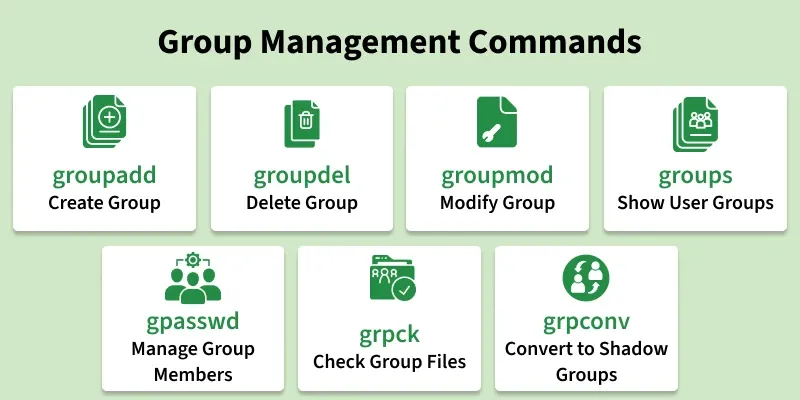
1. groupadd
The groupadd command is used to create a new user group on the system. It helps organize users with similar access requirements.
- Creates a new group
- Used by system administrators
- Supports group-based access control
Syntax:
groupadd group_nameExample:
groupadd developers- This creates a new group named developers.
2. groupdel
The groupdel command is used to delete an existing group from the system. It removes group-related entries safely.
- Deletes user groups
- Used for cleanup
- Admin-level command
Syntax:
groupdel group_nameExample:
groupdel developers- This deletes the developers group.
3. groupmod
The groupmod command is used to modify an existing group’s properties. It can change the group name or group ID.
- Modifies group details
- Supports renaming groups
- Useful for group maintenance
Syntax:
groupmod [options] group_nameExample:
groupmod -n devteam developers- This renames the developers group to devteam.
4. groups
The groups command displays the groups a user belongs to. It helps verify group memberships.
- Shows user group membership
- Useful for permission checks
- Simple and fast command
Syntax:
groups usernameExample:
groups user1- This shows all groups assigned to user1.
5. gpasswd
The gpasswd command is used to manage group passwords and group membership. It allows adding or removing users from groups.
- Manages group members
- Controls group access
- Admin-level utility
Syntax:
gpasswd [options] group_nameExample:
gpasswd -a umang geeks
- This adds umang to the geeks group.
6. grpck
The grpck command checks the integrity of group files. It verifies entries in /etc/group and /etc/gshadow.
- Checks group file consistency
- Detects invalid group entries
- Helps maintain system integrity
Syntax:
grpckExample:
grpck- This checks group configuration files for errors.
7. grpconv
The grpconv command converts group information to shadow format. It improves security by storing sensitive group data securely.
- Converts group files to shadow format
- Improves security
- Admin-only command
Syntax:
grpconvExample:
grpconv- This converts group files to shadow group files.
