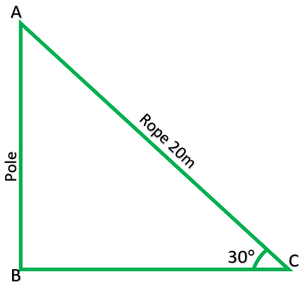
Question 1. A circus artist is climbing a 20 m long rope, which is tightly stretched and tied from the top of a vertical pole to the ground. Find the height of the pole, if the angle made by the rope with the ground level is 30° (see Fig.).
Solution:
In rt ∆ABC,
AB = pole = ?
AC = rope = 20m
sinθ =
\frac{P}{H} sin30° =
\frac{AB}{AC} AB = 1/2 * 20
AB = 10m
Height of pole = 10m
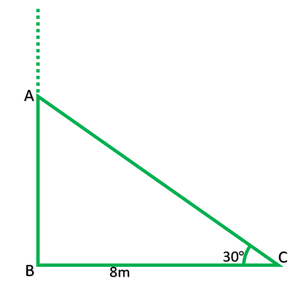
Question 2. A tree breaks due to storm and the broken part bends so that the top of the tree touches the ground making an angle 30° with it. The distance between the foot of the tree to the point where the top touches the ground is 8 m. Find the height of the tree.
Solution:
In rt ∆ABC,
BC = 8m
\frac{P}{B} = \frac{AB}{BC} = tan30°
\frac{AB}{BC} = 1/√3AB = 8/√3 -(1)
Now,
\frac{BC}{ AC} = cos30°8/AC = √3/2
√3AC = 16
AC = 16/√3 -(2)
From (1) and (2)
Height of tree = AB + AC
= 8/√3 * 16√3
= 8√3 m
8 * 1.73 = 13.84m
The height of the tree is 13.84
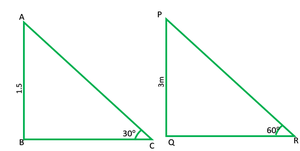
Question 3. A contractor plans to install two slides for the children to play in a park. For the children below the age of 5 years, she prefers to have a slide whose top is at a height of 1.5 m and is inclined at an angle of 30° to the ground, whereas for elder children, she wants to have a steep slide at a height of 3 m, and inclined at an angle of 60° to the ground. What should be the length of the slide in each case?
Solution:
In rt ∆ABC,
AB = 1.5m
AC = side = ?
\frac{P}{H} = \frac{AB}{AC} = sin30°1.5/AC = 1/2
AC = 1/5 * 2
AC = 3m
In rt ∆PQR,
PQ = 3m
PR = side = ?
\frac{P}{H} = \frac{PQ}{PR} = sin60°3/PR = √3/2
√3 PR = 6
PR = 6/√3
6/√3 * √3/√3
= 2√3
= 2 * 1.73
= 3.46m
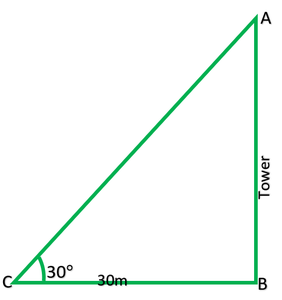
Question 4. The angle of elevation of the top of a tower from a point on the ground, which is 30 m away from the foot of the tower, is 30°. Find the height of the tower.
Solution:
In rt ∆ABC,
AB = tower = ?
BC = 30m
\frac{P}{B} = \frac{AB}{BC} = tan30°AB/30 = 1/√3
AB = 30/√3
AB = 30/√3 * √3/√3
= (30√3)/3 = 10√3
= 10 * 1.73
= 17.3m
The height of tower 17.3m
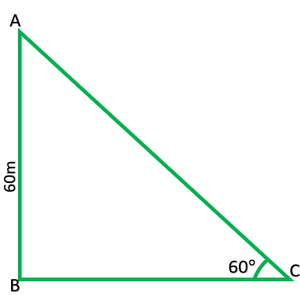
Question 5. A kite is flying at a height of 60 m above the ground. The string attached to the kite is temporarily tied to a point on the ground. The inclination of the string with the ground is 60°. Find the length of the string, assuming that there is no slack in the string.
Solution:
In rt ∆ABC,
AB = 6Om
AC = string = ?
\frac{P}{H} = \frac{AB}{AC} = sin60°60/AC = √3/3
√3 AC = 60 * 2
AC = 120/120/(√3) * √3/√3
120/√3 * √3/√3
40 = √3
40 * 1.73 = 69.20m
Length of the string is 69.20m
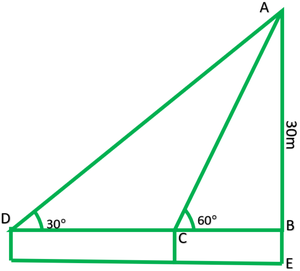
Question 6. A 1.5 m tall boy is standing at some distance from a 30 m tall building. The angle of elevation from his eyes to the top of the building increases from 30° to 60° as he walks towards the building. Find the distance he walked towards the building.
Solution:
In fig AB = AE - 1.5
= 30 - 1.5
= 28.5
In rt ∆ABD,
\frac{P}{B} = \frac{AB}{BD} = tan30°= 28.5/BD = 1/√3
BD = 28.5√3 -(1)
In rt ∆ABC,
\frac{P}{B} = \frac{AB}{BC} = tan60°28.5/BC*√3
√3 BC = 28.5
BC = 28.5/√3 -(2)
CD = BD − BC
= 28.5√3 - 28.5/√3
= 28.5(2/√3)
57/√3 * √3/√3 = (57√3)/3 = 19√3
19 * 1.73 = 32.87m
The boy walked 32.87m towards the building.
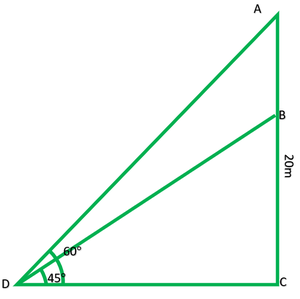
Question 7. From a point on the ground, the angles of elevation of the bottom and the top of a transmission tower fixed at the top of a 20 m high building are 45° and 60° respectively. Find the height of the tower.
Solution:
In fig:
AB = tower = ?
BC = building = 20m
In rt ∆BCD
\frac{P}{B} = \frac{BC}{CD} = tan45°20/CD = 1/1
CD = 20
In rt. ∆ACD,
\frac{P}{B} = \frac{AC}{CD} = tan60°AC/20 = √3/1
AC = 20√3 -(1)
AB = AC-BC
20√3 - 20
20(√3 - 1)
20(1.732 - 1)
20(0.732)
14.64m
The height of the tower is 14.6m
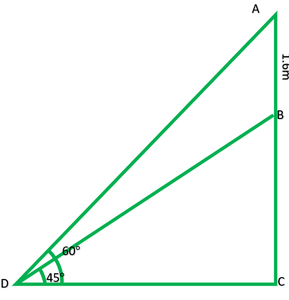
Question 8. A statue, 1.6 m tall, stands on the top of a pedestal. From a point on the ground, the angle of elevation of the top of the statue is 60° and from the same point, the angle of elevation of the top of the pedestal is 45°. Find the height of the pedestal.
Solution:
In fig: AB = statue = 1.6m
BC = pedestal = ?
In rt ∆ACD
\frac{P}{B} = \frac{AC}{CD} = tan60°1.6 + BC/CD = √3
√3 CD = 1.6 + BC
CD = 1.6+BC/√3 -(1)
In rt ∆BCD,
\frac{BC}{CD} = tan45°
\frac{BC}{CD} = 1/1CD = BC
From (1)
1.6 + BC/√3 = BC/1
√3 BC = 1.6 + BC
1.732 BC - 1 BC = 1.6
0.732 * BC = 1.6
BC = 1.6/0.732
BC = 16/10 * 100/732 = 1600/732
BC = 2.18m
Height of pedestal is 2.18m
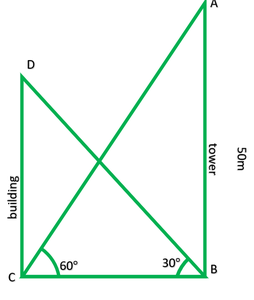
Question 9. The angle of elevation of the top of a building from the foot of the tower is 30° and the angle of elevation of the top of the tower from the foot of the building is 60°. If the tower is 50 m high, find the height of the building.
Solution:
In fig:
AB = tower = 50m
DC = building = ?
In rt.∆ABC,
\frac{P}{B} = \frac{AB}{BC} = tan60°√3 BC = 50
BC = 50/√3
In rt. ∆DCB
\frac{P}{B} = \frac{DC}{BC} = tan30°
\frac{P}{B} = \frac{DC}{\frac{50}{√3}} = 1/√3DC = 50/√3
DC = 50/√3 * 1/√3
DC = 50/3
DC =
16\tfrac{2}{3} The height of the building is
16\tfrac{2}{3} m
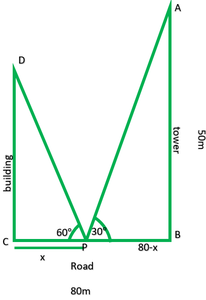
Question 10. Two poles of equal heights are standing opposite each other on either side of the road, which is 80 m wide. From a point between them on the road, the angles of elevation of the top of the poles are 60° and 30°, respectively. Find the height of the poles and the distances of the point from the poles.
Solution:
AB and CD on equal poles.
Let their height = h
Let DP = x
Then PB = BD - x
In rt. ∆CDP,
\frac{P}{B} = \frac{CD}{DP} = tan60°h/x = √3/1
h = √3 x -(1)
In rt. ∆ABP
\frac{P}{B} = \frac{AB}{BP} = tan30°h/(80 - x) = 1/√3
h = (80 - x)/√3 -(2)
From (1) and (2)
(√3 x)/1 = 80 - x/√3
3x = 80 - x
3x + x = 80
4x = 80
X = 80/4
X = 20
Putting values of X in equation 1
h = √3 x
h = √3(20)
h = 1.732(20)
h = 34.640
Height of each pole = 34.64m
The point is 20m away from first pole and 60m away from second pole.
Chapter 9 Some Application of Trigonometry - Exercise 9.1 | Set 1
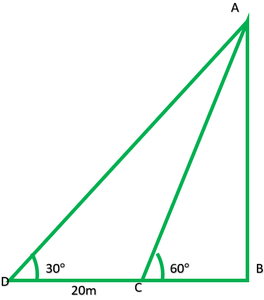
Question 11. A TV tower stands vertically on a bank of a canal. From a point on the other bank directly opposite the tower, the angle of elevation of the top of the tower is 60°. From another point 20 m away from this point on the line joining this point to the foot of the tower, the angle of elevation of the top of the tower is 30° (see Fig.). Find the height of the tower and the width of the canal.
Solution:
In fig: AB = tower = ?
CB = canal = ?
In rt. ∆ABC,
tan60° =
\frac{AB}{BC} h/x = √3
h = √3 x -(1)
In rt. ∆ABD
\frac{AB}{BD} = tan 30°
\frac{h}{x + 20} = 1/√3h = (x + 20)/√3 -(2)
From (1) and (2)
√3/1 = (x + 20)/√3
3x = x + 20
3x - x = 20
2x = 20
X = 20/2
X = 10
Width of the canal is 10m
Putting value of x in equation 1
h = √3 x
= 1.732(10)
= 17.32
Height of the tower 17.32m.
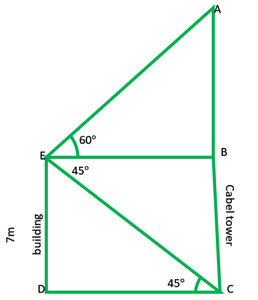
Question 12. From the top of a 7 m high building, the angle of elevation of the top of a cable tower is 60° and the angle of depression of its foot is 45°. Determine the height of the tower.
Solution:
In fig: ED = building = 7m
AC = cable tower = ?
In rt ∆EDC,
\frac{ED}{DC} = tan45°7/x = 1/1
DC = 7
Now, EB = DC = 7m
In rt. ∆ABE,
\frac{AB}{BC} = tan60°AB/7 = √3/1
Height of tower = AC = AB + BC
7√3 + 7
= 7(√3 + 1)
= 7(1.732 + 1)
= 7(2.732)
Height of cable tower = 19.125m
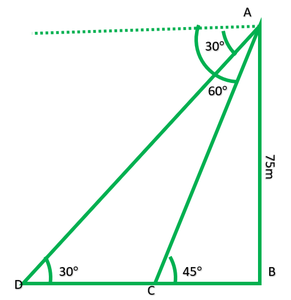
Question 13. As observed from the top of a 75 m high lighthouse from the sea-level, the angles of depression of two ships are 30° and 45°. If one ship is exactly behind the other on the same side of the lighthouse, find the distance between the two ships.
Solution:
In fig:
AB = lighthouse = 75m
D and C are two ships
DC = ?
In rt. ∆ABD,
\frac{AB}{BD} = tan30°75/BD = 1/√3
BD = 75√3
In rt. ∆ABC
\frac{AB}{BC} = tan45°75/BC = 1/1
BC = 75
DC = BD - BC
= 75√3 - 75
75(√3 - 1)
75(1.372 - 1)
34.900
Hence, distance between two sheep is 34.900
Question 14. A 1.2 m tall girl spots a balloon moving with the wind in a horizontal line at a height of 88.2 m from the ground. The height of 88.2 m from the ground. The angle of elevation of the balloon from the eyes of the girl at any instant is 60°. After some time, the angle of elevation reduces to 30° (see Fig.). Find the distance traveled by the balloon during the interval.
Solution:
In fig: AB = AC - BC
= 88.2 - 1.2
= 81m
In rt. ∆ABE
\frac{AB}{EB} = 87/EB = tan30°87/EB = 1/√3
EB = 87√3
In rt. ∆FDE
\frac{FD}{ED} = tan60°√3 ED = 87
ED = 87/√3
DB = DB - ED
87√3 - 87/√3
87(√3 - 1/√3)
= 87(3 - 1/√3)
= 87(2/√3) = 174/√3 * √3/√3
= 174 * √3/3 = 58√3
58 * 1.732 = 100.456m
Distance traveled by balloon is 100.456m
Question 15. A straight highway leads to the foot of a tower. A man standing at the top of the tower observes a car at an angle of depression of 30°, which is approaching the foot of the tower with a uniform speed. Six seconds later, the angle of depression of the car is found to be 60°. Find the time taken by the car to reach the foot of the tower from this point.
Solution:
In fig: AB is tower
In rt. ∆ABD
\frac{AB}{DB} = tan30°
\frac{AB}{DB} = 1/√3DB = √3 AB -(1)
In rt. ∆ABC
\frac{AB}{BC} = tan60°BC = AB/√3 -(2)
DC = DB - BC
= √3 AB - AB/√3
AB(3 - 1/√3)
CD = 2AB/√3
Speed = \frac{Distance}{Time} S1 = S2
\frac{D1}{T1} = \frac{D2}{T2}
\frac{DC}{6} = \frac{CB}{t} 2/√3AB/6 = AB/√3/t
2t = 6
t = 6/2
t = 3sec
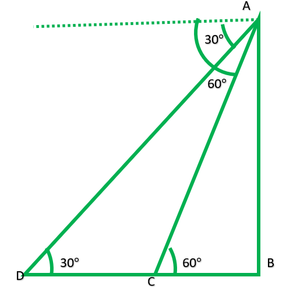
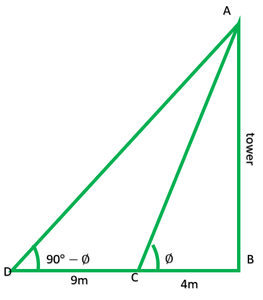
Question 16. The angles of elevation of the top of a tower from two points at a distance of 4 m and 9 m from the base of the tower and in the same straight line with it are complementary. Prove that the height of the tower is 6 m.
Solution:
In fig: AB is tower
To prove: AB = 6m
Given: BC = 4m DB = 9m
In ∆ABC
\frac{AB}{BC} = tanθAB/4 = tanθ -(1)
In ∆ABD
\frac{AB}{BD} = tan (90°-θ)AB/9 = 1/ tanθ
9/AB = tanθ -(2)
From (1) and (2)
AB/4 = 9/AB
AB2 = 36
AB = √36
AB = √(6 * 6)
AB = 6m
Height of the tower is 6m.