
A parallelogram is a quadrilateral with equal pairs of opposite sides and angles.
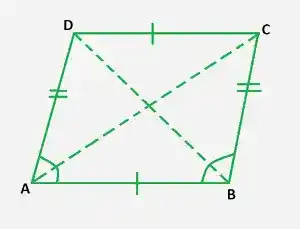
The above figure depicts a parallelogram ABCD with sides AB, BC, CD, and AD and diagonals AC and BD. Here the lengths of opposite sides AB and CD are equal to each other. Similarly, the lengths of BC and AD are the same. The pairs of opposite angles, that is, ∠A and ∠C and ∠B and ∠D are equal to each other.
The formula for the length of a diagonal of a parallelogram is equal to the magnitude of the resultant of any two adjacent sides.
x = \sqrt{(a^2 + b^2 - 2ab cos A)} = \sqrt{(a^2 + b^2 + 2ab cos B)}\\[3pts]y = \sqrt{(a^2 + b^2 + 2ab cos A)} = \sqrt{(a2 + b2 - 2ab cos B)}\\
where,
- x and y are the lengths of the diagonals,
- a and b are the adjacent side lengths,
- A and B are the angles formed between the sides.
The diagonal lengths and sides of a parallelogram have a relation between each other. The sum of squares of diagonals is equal to twice the sum of squares of two adjacent sides.
x^2 + y^2 = 2(a^2 + b^2) where,
x and y are diagonal lengths,
a and b are adjacent side lengths.
Sample Problems
Problem 1. Calculate the length of the diagonals of a parallelogram of side lengths 5 m and 10 m, if one of the interior angles is 60°.
We have,
a = 5
b = 10
∠A = 60°
∠B = 120°
We have to find the diagonal lengths x and y.
Using the formula we get,
x = √(a2 + b2 - 2ab cos A)
= √(52 + 102 - 2 (5) (10) cos 60°)
= √75
= 8.66 m
y = √(a2 + b2 + 2ab cos A)
= √(52 + 102 + 2 (5) (10) cos 60°)
= √175
= 13.22 m
Problem 2. Calculate the length of the diagonals of a parallelogram of side lengths 4 m and 7 m, if one of the interior angles is 30°.
We have,
a = 4
b = 7
∠A = 30°
We have to find the diagonal lengths x and y.
Using the formula we get,
x = √(a2 + b2 - 2ab cos A)
= √(42 + 72 - 2 (4) (7) cos 30°)
= √16.48
= 4.06 m
y = √(a2 + b2 + 2ab cos A)
= √(42 + 72 + 2 (4) (7) cos 30°)
= √73.63
= 8.5 m
