
A fraction has two parts: numerator & denominator; the numerator is the number above the line, and the denominator is the number below the line. In a fraction, the line or slash that divides the numerator and denominator denotes division.
Complex Fractions
A fraction with fractions in the denominator and numerator, or both, is called a complicated fraction. A complex rational expression is a complex fraction that contains a variable.
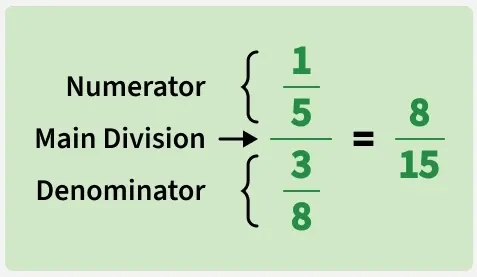
Other examples include:
Steps to simplifying complex fractions
- Multiply both the numerator and denominator by the radical that can remove the radical in the denominator. For example, in the expression
\frac{2}{\sqrt3} , the common radical to be multiplied in order to rationalize the denominator is √3. - Evaluate the expression, if possible, by multiplying the terms and further simplifying the numerator and denominator by taking out any common factors.
Example: Rationalize the denominator:
Solution:
Given:
\frac{4}{\sqrt6} Clearly, in order to rationalize the denominator, √6 needs to be multiplied with both the numerator and numerator.
=
\frac{4}{\sqrt6}×\frac{\sqrt{6}}{\sqrt6} =
\frac{4\sqrt{6}}{(\sqrt6)^2} =
\frac{4\sqrt{6}}{6} = 2√6/3
Practice Problems on Simplifying Complex Fractions with Square Roots
Question 1: Rationalize the denominator:
Solution:
Multiply both the numerator and denominator with 2 − √5 to rationalize the denominator.
\frac{4\sqrt3}{2+\sqrt5}×\frac{2-\sqrt5}{2-\sqrt5} Using the identity (a + b)(a − b) = a2 − b2, we have:
=
\frac{4\sqrt3(2-\sqrt5)}{2^2-(\sqrt5)^2}\\=\frac{8\sqrt3-4\sqrt{15}}{4-5}\\=\frac{8\sqrt3-4\sqrt{15}}{-1}\\=4\sqrt{15}-8\sqrt{3}
Question 2: Rationalize the denominator:
Solution:
Multiply both the numerator and denominator with 4 + √3 to rationalize the denominator.
\frac{6+\sqrt3}{4-\sqrt3} ×\frac{4+\sqrt3}{4+\sqrt3} Using the identity (a + b)(a − b) = a2 − b2, we have:
=
\frac{6+\sqrt3(4+\sqrt3)}{4^2-(\sqrt3)^2}\\=\frac{24+10\sqrt3+3}{16-3}\\=\frac{27+10\sqrt3}{13}
Question 3: Rationalize the denominator:
Solution:
To rationalise the denominator of
\frac{1}{\sqrt{5}-2} Multiply numerator and denominator by the conjugtae of the denominator,
\sqrt{5}+2
\frac{1}{\sqrt{5}-2} \times \frac{\sqrt{5}+2}{\sqrt{5}+2}
= \frac{\sqrt{5}+2}{(\sqrt{5})^2 - 2^2} Now simplify the denominator:
(√5)2 - 22 = 5 - 4 = 1
So the expression becomes:
\frac{\sqrt{5}+2}{1} =
\sqrt{5}+2
Question 4: Rationalize the denominator:
Solution:
Multiply both the numerator and denominator with 3 - √7 to rationalize the denominator.
\frac{6}{3+\sqrt7}×\frac{3-\sqrt7}{3-\sqrt7} Using the identity (a + b)(a − b) = a2 − b2, we have:
=
\frac{6(3-\sqrt7)}{3^2-(\sqrt7)^2}\\=\frac{18-6\sqrt7}{9-7}\\=\frac{18-6\sqrt7}{2}\\=9-3\sqrt7
Question 5: Rationalize the denominator:
Solution:
Multiply both the numerator and denominator with √5 + 2 to rationalize the denominator.
\frac{2}{2+\sqrt5}×\frac{√5 + 2}{√5 + 2} Using the identity (a + b)(a − b) = a2 − b2, we have:
=
\frac{2\sqrt5+4}{(\sqrt5)^2-2^2} Simplify the denominator: 5 - 4 = 1
\frac{2\sqrt5+4}{1}
Question 6: Rationalize the denominator:
Solution:
Multiply both the numerator and denominator with √5 + 2 to rationalize the denominator.
\frac{7}{2+\sqrt5}×\frac{√5 + 2}{√5 + 2} Using the identity (a + b)(a − b) = a2 − b2, we have:
=
\frac{7\sqrt5+14}{(\sqrt5)^2-2^2}
=\frac{2\sqrt5+4}{5-4}
=2\sqrt{5}+4
Question 7: Rationalize the denominator:
Solution:
Given:
\frac{3}{\sqrt5} Clearly, in order to rationalize the denominator, √6 needs to be multiplied with both the numerator and numerator.
=
\frac{3}{\sqrt5}×\frac{\sqrt{5}}{\sqrt5}\\=\frac{3\sqrt{5}}{(\sqrt5)^2}\\=\frac{3\sqrt{5}}{5} \
