
Hugging Face models are pre-trained machine learning models that you can directly download and plug into our applications for tasks like text classification, translation, summarization and more without training from scratch.
- It is an open-source AI platform best known for the transformers library and the Model Hub, which hosts thousands of ready-to-use models for NLP, vision and multimodal tasks.
- Model Hub lets you search, compare and use community and organisation models with just a few lines of code.
- Pre-trained models save you from collecting huge datasets and training deep networks from the beginning.
- They can be fine-tuned on our own data, giving you both speed and flexibility.
Importance of Using Pre-Trained Models
Pre-trained models are models that have already been trained on large datasets. Using them offers several advantages:
- Saves time and computing: We don’t need to train from scratch on massive datasets.
- State-of-the-art performance: Many models on Hugging Face are based on cutting edge research.
- Easy to use: Just load the model and tokeniser with a few lines of code.
- Customizable: You can fine tune them on our own dataset for our specific task.
- Consistent APIs: Same pattern for different tasks and architectures.
Downloading a Model from Hugging Face
Step 1: Environment Setup
- We need to install the required packages and libraries.
- Run the following command in your command prompt
pip install transformers
pip install torch
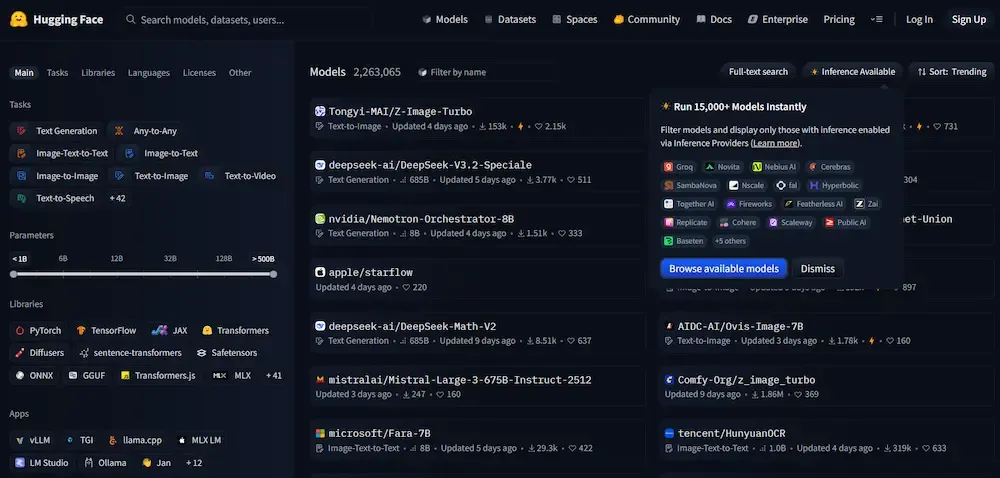
Step 2: Choose a Model from the Model Hub
- Go to the Hugging Face Model Hub on the browser and we can choose any model based on our task from the wide range of pre trained models available.
- For example, we will use "bert-base-uncased" model.
Step 3: Download the Model and Tokenizer
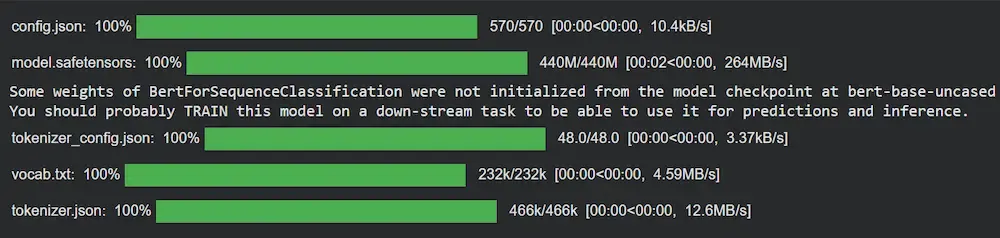
We use AutoModelForSequenceClassification and AutoTokenizer from transformers to download and load the model.
from transformers import AutoModelForSequenceClassification, AutoTokenizer
model_name = "bert-base-uncased"
model = AutoModelForSequenceClassification.from_pretrained(model_name)
tokenizer = AutoTokenizer.from_pretrained(model_name)
Output:
Step 4: Saving and Loading the Model Locally
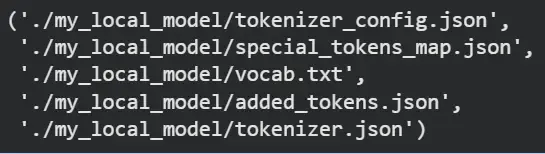
1. If we want to keep a copy for offline use or reuse, we can save our downloaded model into a local directory.
model.save_pretrained("./my_local_model")
tokenizer.save_pretrained("./my_local_model")
Output:
2. To load the saved model from local directory, we perform the following step
from transformers import AutoModelForSequenceClassification, AutoTokenizer
local_model = AutoModelForSequenceClassification.from_pretrained(
    "./my_local_model")
local_tokenizer = AutoTokenizer.from_pretrained("./my_local_model")
Step 5: Use the Model
Let's use the model to verify if it is working or not by performing a simple text classification.
text = "I love using Hugging Face models for NLP!"
inputs = local_tokenizer(text, return_tensors="pt")
outputs = local_model(**inputs)
print(outputs.logits)
Output:
tensor([[-0.1011, 0.3558]], grad_fn=<AddmmBackward0>)
Applications
- Used for tasks like text classification, generation, translation and entity recognition
- Enables rapid prototyping and deployment without training from scratch
- Supports multiple domains including NLP, computer vision and audio
Limitations
While convenient, using pre trained models also comes with certain constraints.
- Large models require high memory and computational resources
- May need fine-tuning for task specific accuracy
- Performance depends on hardware and model compatibility
