
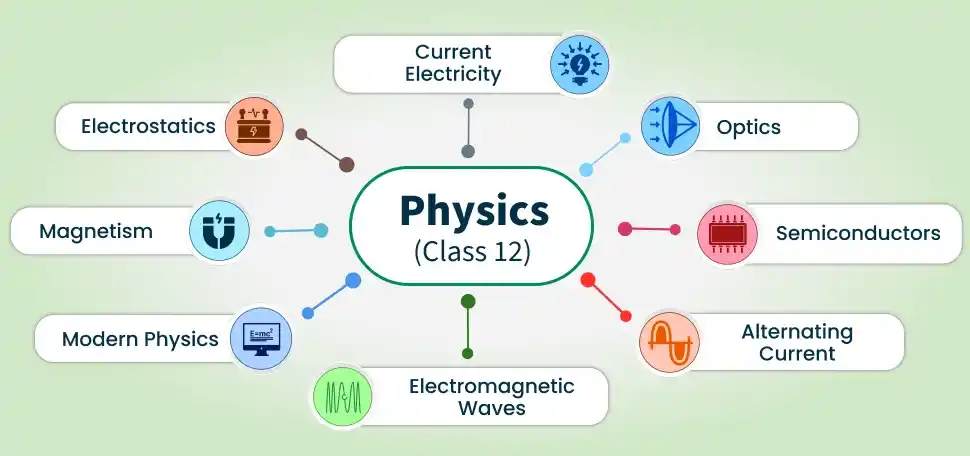
Class 12 Physics explores advanced concepts that explain electricity, magnetism, light, and modern physics. It builds on the fundamentals learned in earlier classes and introduces important theories that form the basis of many modern technologies.
Electric Charges and Fields
Covers the fundamental nature of electric charge and its conservation and quantization, interaction between charges through Coulomb’s inverse square law, the concept of electric field and electric flux, field lines, electric dipoles, continuous charge distributions, and systematic application of Gauss’s law to calculate electric fields for symmetric configurations.
- Electric Charge
- Conductors and Insulators
- Charging by Induction
- Basic Properties of Electric Charge
- Coulomb’s Law
- Electric Field
- Electric Field Lines
- Electric Flux
- Electric Dipole
- Continuous Charge Distribution
- Gauss’s Law
- Applications of Gauss’s Law
Electrostatic Potential and Capacitance
Explains electric potential as work done per unit charge, the relation between electric field and potential, the potential energy of charge systems, the properties of conductors in electrostatic equilibrium, the behavior of dielectrics, the capacitance of parallel plate capacitors, combinations of capacitors, and a detailed analysis of energy stored in electric fields.
- Electrostatic Potential
- Potential Due to a Point Charge
- Potential Due to an Electric Dipole
- Potential Due to a System of Charges
- Equipotential Surfaces
- Potential Energy of a System of Charges
- Potential Energy in an External Field
- Electrostatics of Conductors
- Dielectrics and Polarisation
- Capacitors and Capacitance
- The Parallel Plate Capacitor
- Effect of Dielectric on Capacitance
- Combination of Capacitors
- Energy Stored in a Capacitor
- Van de Graaff Generator
Current Electricity
Describes electric current as the flow of charges, the microscopic origin of drift velocity and resistivity, the limitations of Ohm’s law, the temperature dependence of resistance, electrical energy and power, series and parallel resistor combinations, cells with internal resistance, and detailed circuit analysis using Kirchhoff’s laws, Wheatstone bridge, meter bridge, and potentiometer.
- Electric Current
- Electric Currents in Conductors
- Ohm’s Law
- Drift of Electrons and Origin of Resistivity
- Limitations of Ohm’s Law
- Resistivity of various Materials
- Temperature Dependence of Resistivity
- Electrical Energy, Power
- Combination of Resistors—Series and Parallel
- Cells, Emf, Internal Resistance
- Cells in Series and in Parallel
- Kirchhoff’s Laws
- Wheatstone Bridge
- Meter Bridge
- Potentiometer
Moving Charges and Magnetism
Examines magnetic effects produced by moving charges and current-carrying conductors, Lorentz force, motion in uniform magnetic fields, Biot–Savart law, Ampere’s circuital law, magnetic field due to loops and solenoids, force between parallel currents, torque on current loops, and the working principle of the moving coil galvanometer.
- Magnetic Force
- Motion in a Magnetic Field
- Motion in Combined Electric and Magnetic Fields
- Magnetic Field Due to a Current Element
- Biot-Savart Law
- Magnetic Field on the Axis of a Circular Current Loop
- Ampere’s Circuital Law
- The Solenoid and the Toroid
- Force Between Two Parallel Currents Conductors
- Torque on Current Loop, Magnetic Dipole
- The Moving Coil Galvanometer
Magnetism and Matter
Discusses magnetic field lines and properties of bar magnets, Gauss’s law of magnetism, Earth’s magnetic elements, magnetization and magnetic intensity, classification of materials into diamagnetic, paramagnetic, and ferromagnetic substances, and a comparative study of permanent magnets and electromagnets with their practical applications.
- Magnetism
- The Bar Magnet
- Gauss’s Law of Magnetism
- The Earth’s Magnetism
- Magnetisation and Magnetic Intensity
- Magnetic Properties of Materials
- Permanent Magnets and Electromagnets
Electromagnetic Induction
Explains experimental observations of Faraday and Henry, the concept of magnetic flux, Faraday’s laws of induction, Lenz’s law and conservation of energy, motional emf, eddy currents and their applications, self and mutual inductance, energy stored in inductors, and the operating principle of an AC generator.
- Experiments of Faraday and Henry
- Magnetic Flux
- Faraday’s Law of Induction
- Lenz’s Law and Conservation of Energy
- Motional Electromotive Force
- Energy Consideration: a Quantitative Study
- Eddy Currents
- Inductance
- AC Generator
Alternating Current
Focuses on alternating voltage and current in resistive, inductive, and capacitive circuits; phasor representation; impedance and phase difference; behavior of series LCR circuits; resonance condition; power factor and average power; LC oscillations; and detailed construction and efficiency of transformers.
- Ac Voltage Applied to a Resistor
- Phasors
- Ac Voltage Applied to an Inductor
- Ac Voltage Applied to a Capacitor
- Ac Voltage Applied to a Series LCR Circuit
- Power in Ac Circuit: the Power Factor
- LC Oscillations
- Transformer
Electromagnetic Waves
Introduces displacement current as a modification of Ampere’s law, generation and propagation of electromagnetic waves, transverse nature and speed of EM waves in a vacuum, and a comprehensive study of the electromagnetic spectrum, including radio waves, microwaves, infrared, visible, ultraviolet, X-rays, and gamma rays.
Ray Optics and Optical Instruments
Deals with reflection from spherical mirrors, refraction at plane and spherical surfaces, total internal reflection and its applications, lens formula and magnification, refraction and dispersion through prisms, optical phenomena in nature, and working principles and magnifying power of microscopes and telescopes.
- Reflection of Light by Spherical Mirrors
- Refraction
- Total Internal Reflection
- Refraction at Spherical Surfaces and by Lenses
- Refraction Through a Prism
- Dispersion by a Prism
- Some Natural Phenomena due to Sunlight
- Optical Instruments
Wave Optics
Develops the wave theory of light using Huygens’ principle, reflection and refraction of plane waves, interference of light with Young’s double-slit experiment, conditions for constructive and destructive interference, diffraction due to a single slit, and polarization as experimental proof of the transverse wave nature.
- Huygens' Principle
- Refraction and Reflection of Plane Waves Using Huygens' Principle
- Coherent and Incoherent Addition of Waves
- Interference of Light Waves and Young’s Experiment
- Diffraction
- Polarisation
Dual Nature of Radiation and Matter
Explains electron emission processes, detailed experimental study of the photoelectric effect, failure of classical wave theory, Einstein’s photoelectric equation and photon concept, wave–particle duality, de Broglie hypothesis of matter waves, and experimental confirmation through the Davisson–Germer electron diffraction experiment.
- Electron Emission
- Photoelectric Effect
- Experimental Study of Photoelectric Effect
- Photoelectric Effect and Wave Theory of Light
- Einstein’s Photoelectric Equation
- Particle Nature of Light
- Wave Nature of Matter
- Davisson and Germer Experiment
Atoms
Describes Rutherford’s alpha-particle scattering experiment and nuclear model, atomic spectra and spectral series, limitations of classical mechanics, Bohr’s quantized energy levels for the hydrogen atom, explanation of line spectra, and de Broglie’s interpretation of quantization through standing matter waves.
- Alpha-particle Scattering and Rutherford’s Nuclear Model of Atom
- Atomic Spectra
- Bohr Model of the Hydrogen Atom
- The Line Spectra of the Hydrogen Atom
- De Broglie’s Explanation of Bohr’s Second Postulate of Quantisation
Nuclei
Covers composition and size of nucleus, atomic masses, mass–energy equivalence, binding energy and stability of nuclei, nuclear forces and their characteristics, radioactive decay laws, alpha, beta, and gamma emissions, and principles of nuclear fission and fusion as sources of nuclear energy.
- Atomic Masses and Composition of Nucleus
- Size of the Nucleus
- Mass energy
- Nuclear Binding Energy
- Nuclear Force
- Radioactivity
- Nuclear Energy
Semiconductor Electronics
Introduces the energy band theory of solids, classification into conductors, insulators, and semiconductors, intrinsic and extrinsic semiconductors, formation and characteristics of p-n junction diodes, Zener diode operation, the rectification process, and implementation of basic digital logic gates in simple electronic circuits.
- Classification of Metals, Conductors, and Semiconductors
- Intrinsic and Extrinsic Semiconductors
- P-n Junction
- Semiconductor Diode
- Difference between P-n Junction Diodes and Zener Diodes
- Logic Gates
