
Poisson’s ratio is defined as the negative ratio of transverse strain to longitudinal strain within the elastic limit of a material. It describes how much a material expands or contracts laterally when it is stretched or compressed along its length.
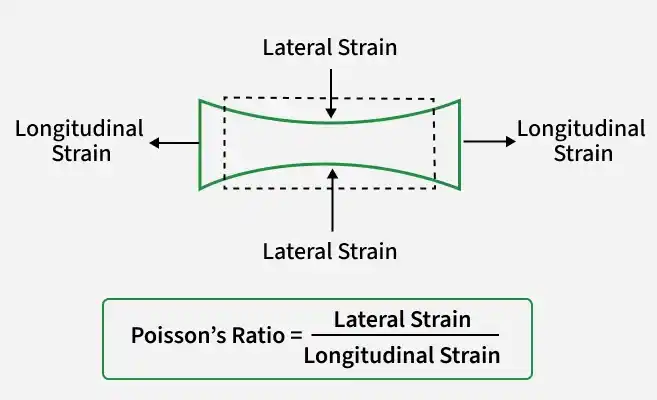
In simple terms, it compares the change in breadth of an object to the change in its length under applied stress. It helps in understanding the deformation behavior of a material under load.
Longitudinal and Transversal Strain
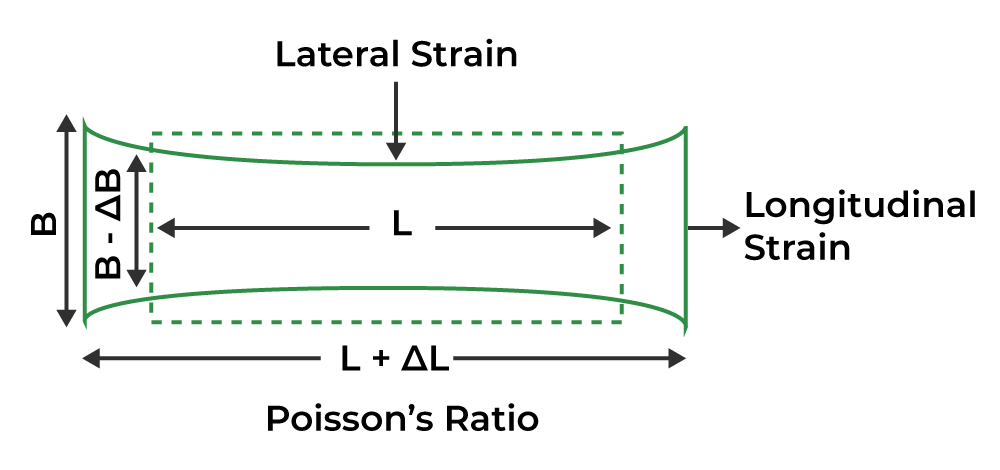
When stress is applied to a body, changes in its dimensions occur both along the direction of the applied force and perpendicular to it. For example, when tensile stress is put on a horizontal bar, its length gets longer in the direction of the force; this change is called longitudinal strain. At the same time, the bar becomes thinner, meaning its breadth decreases; this change is known as transverse strain. Although both strains occur simultaneously, they are not equal in magnitude. The relationship between longitudinal and transverse strain is measured using Poisson’s ratio.
- Longitudinal strain is
εl=\frac{ΔL}{L} . It is positive because the length increases under tensile stress. - Transverse strain is
ε_t = \frac{ΔB}{B} . It is negative because the breadth decreases when tensile stress is applied.
Poisson's ratio is given as the negative of the ratio of the transversal strain to the longitudinal strain
\boxed {ν = \frac{\text{lateral/transversal strain}}{\text{longitudinal strain}}=\frac{-ε_t}{ε_l}} where,
- ν is Poisson's Ratio
- εt is Transversal Strain, and
- εl is Longitudinal Strain.
The negative sign in the formula is used to make Poisson’s ratio positive because transverse strain is generally negative when a material is stretched, as the breadth decreases. Therefore, for most common materials, Poisson’s ratio is positive. However, in some special materials, the thickness increases when tensile stress is applied, resulting in a negative Poisson’s ratio. Poisson’s ratio is a scalar quantity.
Poisson’s ratio has no unit and no dimension because it is the ratio of two strains, and the strain itself is unitless.
Poisson Effect
The Poisson effect is the phenomenon in which a material changes its dimensions in directions perpendicular to the applied stress. When a material is compressed, it expands sideways, and when it is stretched, it contracts laterally. Poisson’s ratio measures the extent of this lateral deformation in relation to the longitudinal deformation.
Material-wise Poisson’s Ratio
Poisson’s ratio is a scalar and unitless quantity. For most common materials, it has a positive value because transverse strain is negative when a material is stretched. However, in special materials called auxetic materials, Poisson’s ratio can be negative as they expand laterally when subjected to tensile stress. The negative sign in the formula ensures that Poisson’s ratio remains positive for ordinary materials.
Poisson's Ratio Range
The theoretical range of Poisson’s ratio is –1 to 0.5, but for most common materials it lies between 0 and 0.5.
If
If
Material | Poisson's Ratio |
|---|---|
Rubber | 0.49 |
Gold | 0.43 |
Cast Iron | 0.24 |
Concrete | 0.2 |
Cork | 0 |
Poisson's Ratio is usually positive since most common materials get narrower in the opposite or cross direction when stretched. Most materials resist changes in volume, as defined by the bulk modulus K, also known as B, more than changes in shape, as determined by the shear modulus G. The shape distortion also causes the interatomic connections to realign.
Applications
1. Poisson's Ratio in Bending: While bending a bar, the curvature of the bar perpendicular to the bending is governed by Poisson's Ratio, while in the case of rubber, anticlastic curvature, i.e., convex along the longitudinal plane and concave along the perpendicular plane, is observed.
2. Poisson's Ratio in Anisotropic Material: Anisotropic material is those which have direction-dependent properties. Examples include crystals, honeycombs, etc. In such objects, the Poisson's Ratio is also direction dependent. Also, it can take any arbitrarily large positive or negative value under the defined positive strain energy density.
3. Poisson's Ratio in Viscoelastic Material: The viscoelastic material goes under creep, which is a time-dependent phenomenon. In this case, Poisson's ratio is a function of time, as well as the frequency and phase angle if there is sinusoidal deformation in the viscoelastic material.
4. Poisson's Ratio in Phase Transformation: The Poisson's Ratio of material is significantly affected by its phase transformation. At the point of phase transformation, the value of Poisson's Ratio starts decreasing significantly and can even take a negative value as the bulk modulus of a material reduces at the phase transformation point.
Solved Problems
Question 1: The longitudinal strain for a wire is 0.02, and its Poisson ratio is 0.6. Find the lateral strain in the wire.
Solution: Given
Longitudinal strain of wire = 0.02
Poisson ratio = 0.6
The Poisson’s Ratio formula is as follows:
ν = lateral strain/longitudinal strain
Substitute the given values to find the lateral strain.
0.6 = Lateral strain / 0.02
Lateral strain = 0.012
the lateral strain in the wire is 0.012.
Question 2: A 2.0 m long metal wire is loaded, resulting in a 4 mm elongation. Find the change in diameter of the wire when elongated if the diameter of the wire is 1.5 mm and the Poisson's ratio of the wire is 0.24.
Solution: Given
Length of wire, L is 2.0 m.
Change in length, ΔL is 4 mm = 0.004 m
Diameter of wire, D is 1.5 mm.
Poisson's ratio, ν is 0.24.
The longitudinal strain in the wire is given as:
Longitudinal strain = ΔL/L
= 0.004/2.0
= 0.002
The Poisson’s Ratio formula is as follows:
ν = Lateral strain/longitudinal strain
Substitute the given values to find the lateral strain.
0.24 = lateral strain / 0.002
Lateral strain = 0.00048
The lateral strain in a wire is given as:
Lateral strain = ΔD / D
0.00048 = ΔD / 1.5 mm
ΔD = 0.00072 mm
the change in diameter of the wire is 0.00072 mm.
Question 3: A metal wire of length 3 m and diameter 2 mm is stretched by a force producing an extension of 2 mm. If Young’s modulus of the material is 2 × 10¹¹ and Poisson’s ratio is 0.3. Calculate the change in diameter of the wire.
Solution: Given
Length L=3 m
Diameter D=2 mm
Extension ΔL = 2 mm = 0.002 m
Poisson’s ratio
\nu = 0.3Longitudinal strain
= \frac{\Delta L}{L}
= \frac{0.002}{3}
= 0.000667 Lateral Strain
\nu = \frac{\text{Lateral strain}}{\text{Longitudinal strain}}
0.3 = \frac{\text{Lateral strain}}{0.000667}
\text{Lateral strain} = 0.3 \times 0.000667
= 0.0002 Change in Diameter
\text{Lateral strain} = \frac{\Delta D}{D}
0.0002 = \frac{\Delta D}{2}
\boxed{\Delta D = 0.0004\,mm}
Question 4: A cube of side 0.5 m is subjected to a tensile stress producing a longitudinal strain of 0.002. If Poisson’s ratio of the material is 0.25, calculate the volumetric strain of the cube.
Solution: Given
Longitudinal strain = 0.002
Poisson’s ratio (ν) = 0.25
Relation for Volumetric Strain
Formula for Volumetric Strain
\text{Volumetric strain} = \text{Longitudinal strain} \times (1 - 2\nu) Substitute values
= 0.002 \times (1 - 2 \times 0.25)
= 0.002 \times (1 - 0.5)
= 0.002 \times 0.5
\boxed{\text{Volumetric strain} = 0.001}
Unsolved Problems
Question 1: A metal rod experiences a longitudinal strain of 0.004 under tensile stress. If Poisson’s ratio of the material is 0.35, calculate the lateral strain produced in the rod.
Question 2: A cube is subjected to tensile stress, producing a longitudinal strain of 0.003. If Poisson’s ratio is 0.2, find the volumetric strain of the material.
Question 3: A cylindrical wire of length 4 m and cross-sectional area 2 × 10⁻⁶ m2 is stretched by a force of 800 N. If Young’s modulus is 2 × 10¹¹ N/m2 and Poisson’s ratio is 0.3, determine the lateral strain in the wire.
Question 4: A material has Poisson’s ratio 0.5. If it is subjected to a tensile strain of 0.001, determine the volumetric strain and comment on the nature of the material.
Question 5: A rectangular bar undergoes a longitudinal strain of 0.0025. If the lateral contraction is measured as 0.00075, calculate the Poisson’s ratio of the material.
