
An electrical machine that converts mechanical energy input into electrical energy output is called a generator or electrical generator. There are two types of generators, AC Generators and DC Generators. An AC generator has an electromagnet while a DC generator has a permanent magnet. AC generators have commutators, while DC generators have slip rings.
In this article, we will learn what is AC and DC Generators are and the Difference Between AC and DC Generators.
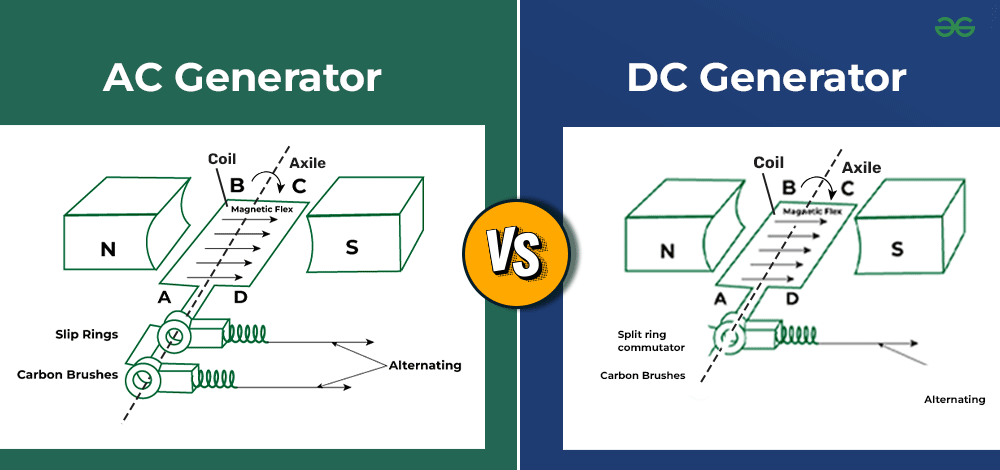
What is AC Generator?
A generator that converts mechanical energy into electrical energy in the form of alternating current is called an AC generator. The principle on which an AC generator works is electromagnetic induction.
A machine that converts mechanical energy into electrical energy is called an AC generator or alternator.
The electrical energy generated is in the form of an alternating current sinusoidal output wave. Steam turbines, gas turbines, and combustion engines commonly supply mechanical energy.
Field, armature, prime mover, rotor, stator, and slip ring are the various components of AC generator.
The principle on which an AC generator works is Faraday's Law of Electromagnetic Induction, which states that an electromotive force (EMF) or voltage is produced in a conductor when it moves through a magnetic field or when the magnetic field around the conductor changes. In the case of an AC generator, this EMF is induced by rotating a conducting coil in a constant magnetic field.
How AC generator Works?
When the armature rotates between the poles of the magnet on an axis perpendicular to the magnetic field, the flux attaching to the armature is continuously changing.
Due to this emf is induced in the armature. It generates electric current through galvanometer and slip rings and brushes.
The galvanometer oscillates between positive and negative values. This indicates that an alternating current is flowing through the galvanometer.
Advantages of AC Generator
- Efficient Power Transmission: AC generators are highly efficient for long-distance power transmission due to the ability to step-up or step-down voltages using transformers.
- Simple Design: Requires slip rings, which are simpler and more durable than commutators used in DC generators.
- Low Maintenance: Slip rings experience less wear and tear, reducing maintenance needs.
- High Power Output: AC generators are capable of producing high power suitable for industrial and commercial applications.
Disadvantages of AC Generator
- Complex Regulation: Voltage regulation in AC generators is more complex than in DC generators.
- Not Suitable for Small Devices: AC generators are less ideal for low-power or portable devices compared to DC generators.
What is DC Generator?
A machine that converts mechanical energy into DC (direct current) electricity is a DC generator. The DC generator uses the principle of energetically induced electromotive force.
When the conductor reduces the magnetic flux, an EMF will be generated based on the electromagnetic induction principle of Faraday's laws. The electromotive force produced when a conductor circuit is closed can cause the flow of current.
How DC generator Works?
DC generator works on Faraday's principle of electromagnetic induction which tells us that if an index conductor is rotated in a magnetic flux, then E.M.F (Electromotive force) is generated on that conductor and lasts as long as the conductor continues to rotate.
According to this theory, field, conductor, and motion are all three required to generate voltage. Prime mover is used to rotate the armature.
Prime movers can be diesel engines, water powered machines, wind mills etc. It is run by AC motor.
Advantages of DC Generator
- Stable Output: Provides a constant voltage and current, making it suitable for applications requiring a steady power supply.
- Simple Voltage Regulation: Easier to regulate voltage compared to AC generators.
- Ideal for Low-Power Applications: Suitable for small devices, battery charging, and other low-power applications.
- Portability: Often used in portable generators and smaller devices.
Disadvantages of DC Generator
- Higher Maintenance: Commutators and brushes require regular maintenance due to wear and tear.
- Less Efficient for High Power: DC generators are less efficient for high-power applications and long-distance transmission.
- Complex Design: The use of commutators makes the design more complex and prone to mechanical issues.
Difference Between AC and DC Generator
Parameters | AC Generator | DC Generator |
|---|---|---|
Output Power | It generates AC electrical power. | It produces DC electrical power |
Rings | AC generators have close slip-rings. | Dc generators have split-ring commutators. |
Current induction | Its output current can be induced in the rotor or stator | Its output current is induced in the rotor only |
Direction of Current | The electric current reverses direction from time to time. | Electric current flows in only one direction. |
Commutators | AC generators do not have commutators. | DC generators have commutators due to which current flows in only one direction. |
Distribution and Transmission | Distribution of output in AC generator is easy. | It is difficult to distribute output in a DC generator. |
Efficiency | AC generators are very efficient because energy losses are low. | DC generators are less efficient due to sparking and other losses such as copper, eddy current, mechanical and hysteresis losses. |
Maintenance | Requires very less Maintenance | Requires frequent Maintenance |
Types | Rotating armature, Rotating field Single-phase, Three-phase | Permanent magnet, Separately excited, Self-excited |
Voltage Distribution | Transformers are used to distribute AC voltage. | Transformers are not used to distribute DC voltage. |
Voltage Level | AC generators are useful for generating very high voltages | Dc generator is used to generate low voltage |
Conclusion
Both AC and DC generators play critical roles in electrical systems, but their applications vary significantly:
- AC Generators: Preferred for large-scale power generation and transmission due to high efficiency and low maintenance.
- DC Generators: Ideal for low-power and portable applications requiring a stable voltage supply.
The choice between an AC or DC generator depends on the application's specific requirements, such as power output, voltage stability, maintenance, and efficiency
Also, Check
