
Induced Current is the electric current generated when a conductor is exposed to a changing magnetic field. As the magnetic field changes, it causes charges in the conductor to move, creating an electric current. This principle is used in devices like generators and transformers to convert motion into electricity. It plays a key role in powering everyday electrical devices.
This article will discuss Induced current and its formula, Current- Induced Magnetic Field and its application, Factor affecting Induced current, Faraday's Law of Induction and its formula and applications, Lenz's Law and its formula and applications, and Induced Voltage.
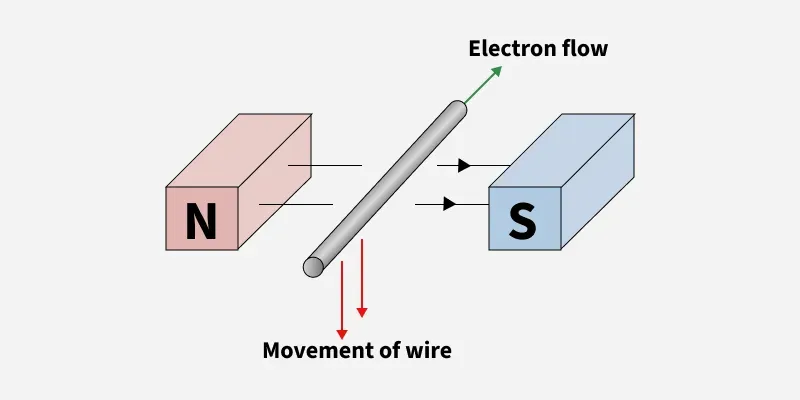
What is Induced Current?
Induced current refers to the electric current generated in a wire or conductor when there is a change in the surrounding magnetic field.
This happens when the magnetic field moves or changes strength, causing tiny particles in the wire to move, which creates an electric current.
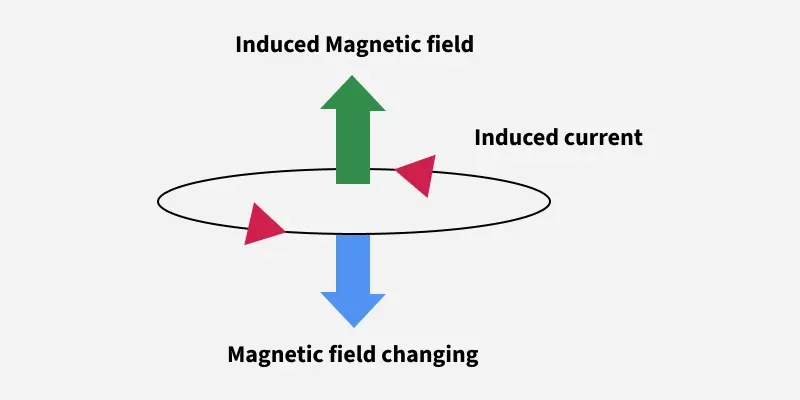
Note: The induced current occurs when there is a change in magnetic flux.
To Calculate Induced Current (I), we use Ohm's Law,
I = ϵ / R
Where,
- I is the induced current (in amperes, A).
- R is the resistance of the conductor (in ohms, Ω).
Thus, the Induced Current can be found by combining this equation, depending on the rate of change of the magnetic flux and the resistance of the Conductor.
Note: Faster-changing magnetic fields result in more current. Higher resistance results in less current
Example:
Imagine you have a metal loop with a resistance of 5 Ω placed near a changing magnetic field. The magnetic field changes in such a way that it induces an electromotive force (ϵ) of 10 volts in the loop.
Using Ohm’s Law:
I = ϵ / R
→ I = 10 V / 5 Ω
⇒ I = 2 A
So, the induced current in the loop is 2 amperes (A).
Current-Induced Magnetic field
A current-induced magnetic field is the magnetic field created when electricity flows through a wire or conductor.
Imagine a wire with electricity running through it like water flowing through a pipe. As electricity flows through the wire, it generates a circular magnetic field around it, similar to invisible rings encircling the wire.
The strength of this magnetic field is influenced by the how much electricity (or current) is flowing through the wire—more electricity means a stronger magnetic field.
The farther you move away from the wire, the weaker the magnetic field becomes. This effect is used in many devices, like motors and magnets, to create movement or power.
Application of Current-Induced Magnetic field
- Electromagnets: When a current flows through a coiled wire around a metal core, it becomes a strong, temporary magnet.
- Motors and Generators: The magnetic field produced by current is key to the operation of electric motors (which turn electrical energy into movement) and generators (which turn movement into electrical energy).
- Transformers and Induction: Devices like transformers use changing magnetic fields to transfer electricity, and induction cookers use magnetic fields to heat pots and pans.
Factors Affecting Induced Current
- Strength of the Magnetic Field: The stronger the magnetic field, the more current will be induced. A stronger magnet or a stronger magnetic field means more electricity will be generated.
- Rate of Change in the Magnetic Field: If the magnetic field is changing faster, it will produce a stronger induced current. Moving a magnet quickly through a coil generates more electricity than moving it slowly.
- Number of Coils (Turns of Wire): More loops or turns of wire in a coil will result in a stronger induced current. Think of it like having more hands grabbing the electricity; more coils catch more energy.
- Coil size : A larger area (bigger loop of wire) can "catch" more of the changing magnetic field, leading to more induced current. Larger coils produce stronger currents.
- Angle Between the Magnetic Field and the Coil: The angle at which the magnetic field hits the coil also matters. If the magnetic field is aligned in the most effective way (perpendicular to the coil), the induced current will be stronger.
- Type of Conductor: The material of the wire affects how easily the current flows. For example, copper conducts electricity better than steel, so a coil made of copper wire will have a stronger induced current.
- Resistance of the Circuit: If the wire or circuit has high resistance, it will limit the flow of the induced current. Low-resistance materials allow more current to flow freely.
Note: To fully understand how induced currents are generated and controlled in these applications, it's essential to explore the underlying principles that govern them, such as Faraday’s Law of Induction and Lenz’s Law. These laws explain not only how the current is induced but also the direction and behavior of the induced current, helping to explain the efficiency and functioning of devices like motors, generators, and transformers
Faraday's Law of Induction
Faraday's Law of Induction simply says that when a magnetic field changes near a wire or conductor, it can create an electric current in the wire.
In more everyday terms:
- Imagine you have a wire, and a magnet is nearby. If the magnet moves or if the strength of the magnetic field changes, it pushes or pulls tiny particles (called electrons) inside the wire.
- The flow of electrons generates an electric current within the wire.
- The quicker the magnetic field changes, the stronger the electric current becomes.
Faraday's given the formula:
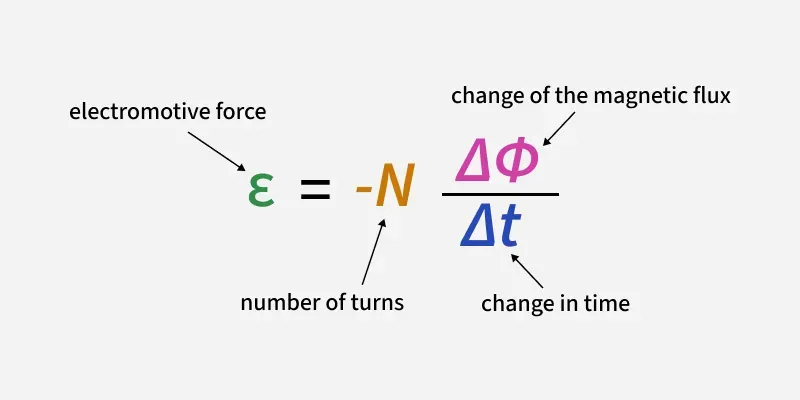
ϵ = -N dΦ/ dt
Where,
- ϵ = Induced electromotive force (EMF) or induced voltage (in volts, V)
- N = Number of turns in the coil
- dΦ/dt = Rate of change of magnetic flux (Φ) (in Weber per second, Wb/s)
- Φ = Magnetic flux, given by:
Φ = B.A. cos θ
Where,
- B = Magnetic field strength (Tesla, T)
- A = Area of the coil (square meters, m²)
- θ = Angle between the magnetic field and the normal to the surface
Applications of Faraday's Law
- Generators: In power plants, generators use Faraday’s Law to create electricity. When a coil of wire is spun inside a magnetic field, it generates an electric current.
- Transformers: Transformers use Faraday’s Law to change the voltage of electricity as it travels along power lines. They depend on changing magnetic fields to increase or decrease the voltage, which helps safely distribute electricity over long distances.
- Electric Motors: Electric motors found in appliances like fans, washing machines, and electric cars use Faraday’s Law to turn electricity into mechanical movement. When a current flows through a coil in a magnetic field, it creates a force that spins the motor’s parts.
- Induction Cooktops: Faraday’s Law is used in induction cookers. A changing magnetic field in the cooktop generates electricity directly in the cookware, heating it up without needing a flame or hot element.
Lenz's Law
Lenz's Law explains that the direction of the electric current induced by a changing magnetic field will always work in a way that opposes the change in the magnetic field that created it.
In everyday terms:
- Imagine you are trying to push a magnet into a coil of wire. The current created by the changing magnetic field will act like a "resistance" to that change, trying to push the magnet out of the coil or slow it down.
- It's like trying to push an object against friction: the current "fights back" against the change in the magnetic field.
This law ensures energy is conserved—meaning the system resists sudden changes, and the induced current creates a magnetic field that opposes the original one.
Applications of Lenz's Law
- Electric Generators: In power plants, electric generators use Lenz's Law to produce electricity. As the generator's coil rotates in a magnetic field, the induced current opposes the motion of the coil, creating resistance that helps generate electricity. This opposition to the motion is a direct result of Lenz's Law.
- Induction Heating: Induction cookers and induction heaters use Lenz's Law to heat metal objects. A changing magnetic field induces current in the metal, and as the metal resists this current (due to Lenz's Law), it heats up. The stronger the magnetic field, the more current is induced, resulting in more heat.
- Electric Motors: Electric motors depend on Lenz's Law to create motion. In these motors, when current passes through a coil in a magnetic field, it produces a force. The induced current (due to the magnetic field) opposes the motion, creating rotational movement that powers appliances like fans, washing machines, and cars.
- Transformers: Transformers use Lenz's Law to step up or step down voltage. The changing magnetic field in the primary coil induces current in the secondary coil. The induced current in the secondary coil opposes the original magnetic field, ensuring that energy is transferred efficiently between the coils.
Induced Voltage
Induced voltage is the electrical "push" or force that is created when a magnetic field around a conductor (like a wire) changes.
This change could happen if the magnetic field gets stronger, weaker, or moves.
When the magnetic field changes, it causes tiny particles inside the conductor (electrons) to move, creating an electric force, which we call induced voltage.
In Simple Terms:
- Imagine moving a magnet near a wire. As the magnet moves, the magnetic field around the wire changes, which makes the electrons in the wire start moving. This movement is what creates Voltage.
- This voltage is what drives an electrical current through the wire if the wire is part of a complete circuit.
This principle is used in devices like generators, where mechanical movement (like spinning a magnet) creates electricity through the changing magnetic field, generating induced voltage.
The induced voltage (electromotive force, ϵ) is given by Faraday’s Law of Electromagnetic Induction:
ϵ = -N dΦ/ dt
Where,
- ϵ = Induced voltage (in volts, V)
- N = Number of turns in the coil
- dΦ/dt = Rate of change of magnetic flux (Φ) (in Weber per second, Wb/s)
- Φ = Magnetic flux
Example,
Imagine you have a coil with 50 turns (N = 50), and the magnetic field through the coil changes by 0.2 Weber (Wb) in 0.5 seconds.
Using Faraday’s Law:
ϵ = -N dΦ/ dt
Put the values in this formula :
→ ϵ = −(50) × 0.2/ 0.5
→ ϵ = −(50) × 0.4
⇒ ϵ = -20 V
Conclusion
Induced current is the electricity generated when a magnetic field changes near a conductor, like a wire. This phenomenon is responsible for creating the electricity we use every day, such as in generators and transformers. The faster the magnetic field changes, the stronger the current produced. Factors like the strength of the magnetic field, the number of wire coils, and the speed of change all influence how much current is generated.
