
The motion of planets around the Sun has been a subject of curiosity for centuries. Earlier scientists believed planets moved in circular paths, but careful observations led to a more accurate understanding.
The German astronomer Johannes Kepler formulated three fundamental laws that describe planetary motion. i.e.,
- Kepler's First Law (Law of Orbits)
- Kepler’s Second Law (Law of Areas)
- Kepler’s Third Law (Law of Periods)
These laws are known as Kepler’s Laws of Planetary Motion and form the basis of modern astronomy.
Kepler’s First Law (Law of Orbits)
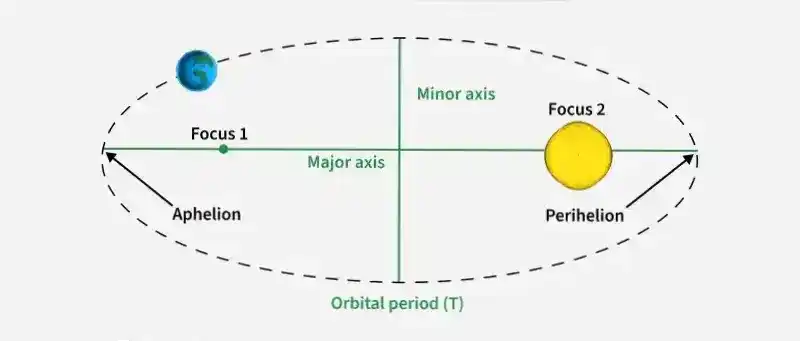
All planets move around the Sun in an elliptical orbit, with the Sun at one of the two foci.
Explanation
- Planetary orbits are elliptical (oval-shaped)
- The Sun is located at one focus, not at the center
- The distance between the planet and the Sun keeps changing
Important Terms:
- Perihelion: Closest point to the Sun
- Aphelion: Farthest point from the Sun
- Semi-major axis (a): Half of the longest diameter
- Semi-minor axis (b): Half of the shortest diameter
Equation of Elliptical Orbit:
where:
- r = distance from Sun
- p = semi-latus rectum
- e = eccentricity
Eccentricity (e):
- Measures how much the orbit deviates from a circle
- (e = 0) → perfect circle
- (0 < e < 1) → ellipse
At Special Points:
- At perihelion (θ = 0):
r_{min} = \frac{p}{1 + e}
- At aphelion (θ = 180°):
r_{max} = \frac{p}{1 - e}
Relation Between Axes:
Kepler’s Second Law (Law of Areas)
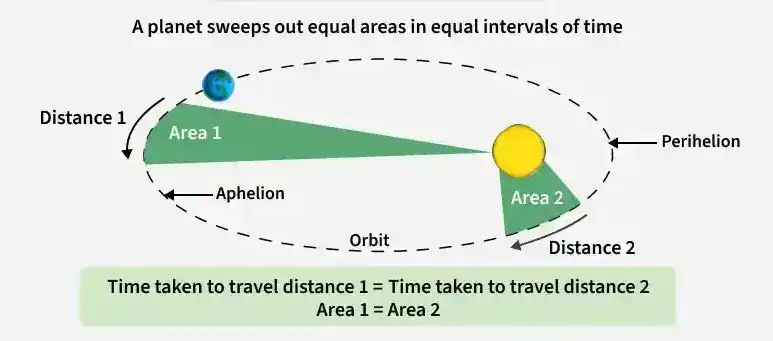
A line joining a planet and the Sun sweeps out equal areas in equal intervals of time.
Explanation
- When the planet is closer to the Sun, it moves faster
- When it is farther, it moves slower
This means planetary speed is not constant
Mathematical Form (Areal Velocity):
Derivation Insight:
From angular momentum:
Since angular momentum is conserved, area rate is constant. Kepler’s Second Law is a result of conservation of angular momentum
Kepler’s Third Law (Law of Periods)
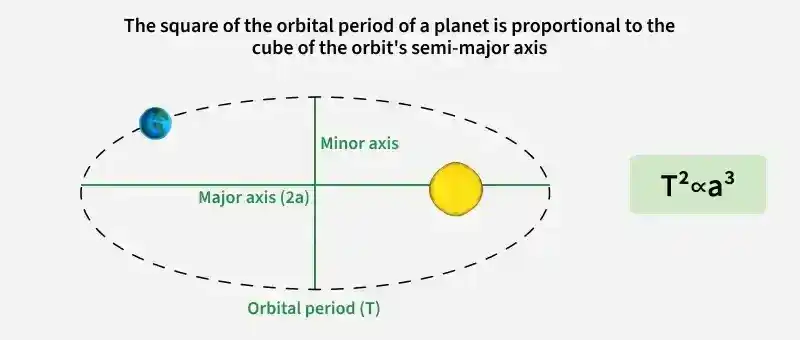
The square of the orbital period is proportional to the cube of the semi-major axis.
Explanation
- Planets farther from the Sun take more time to complete one revolution
- There exists a fixed relationship between distance and time period
Derivation Using Newton’s Law:
Using Isaac Newton’s law of gravitation:
Centripetal force:
Equating:
Using:
We get:
Replacing (R) with (a):
Constant of Proportionality:
Significance of Kepler’s Laws
- Explained planetary motion accurately
- Helped develop Newton’s law of gravitation
- Used in space missions and satellite design
- Basis of modern astronomy
Applications of Kepler’s Laws
- Satellite orbit design
- Space exploration
- Predicting planetary positions
- Studying celestial bodies
Solved Examples
Example 1: The radius of a planet is 3 times the radius of the Earth. Calculate the time period of the revolution of the planet.
Solution: According to Kepler's third law:
T2 ∝ R3
Consider the radius of the Earth be Re, radius of the planet be Rp, time period of the Earth be Te and time period of the planet be Tp.
Given:
Rp = 3 Re
Time period of the Earth, Te = 1 yr
The relation between the planets is given as:
Tp2 ⁄ Te2 = Rp3 ⁄ Re3
Tp2 ⁄ (1 yr)2 = (3 Re)3 ⁄ Re3
Tp2 = 27 yr
Tp = 5.2 yr
Hence, the time period of the planet is 5.2 years.
Example 2: The radius of a planet is 8 times the radius of the Earth. Calculate the time period of the revolution of the planet.
Solution: According to Kepler's third law:
T2 ∝ R3
Consider the radius of the Earth be Re, radius of the planet be Rp, time period of the Earth be Te and time period of the planet be Tp.
Given:
Rp = 8 Re
Time period of the Earth, Te = 1 yr
The relation between the planets is given as:
Tp2 ⁄ Te2 = Rp3 ⁄ Re3
Tp2 ⁄ (1 yr)2 = (8 Re)3 ⁄ Re3
Tp2 = 512 yr
Tp = 22.62 yr
Hence, the time period of the planet is 22.62 years.
Example 3: The ratio of orbital angular momentum (about the sun) to the mass of the Earth is 4.4 × 10¹⁵ m2/s. Find the area enclosed by the Earth.
Solution: Given:
L ⁄ m = 4.4 × 10¹⁵ m2 ⁄ s
Time taken to cover the complete orbit is equal to the time period of the Earth,i.e.,
dt = 365 days
= 365 × 86400 s
= 31536000 s
Area enclosed by a planet in an orbit is given by:
dA ⁄ dt = L ⁄ 2 m
dA = (L ⁄ m) × (dt ⁄ 2)
= (4.4 × 1015 × 31536000) m2
= 6.938 × 10²² m2
Hence, the area enclosed by the Earth is equal to 6.938 × 10²² m2.
