
In the world of software development, APIs are essential for enabling different systems to communicate with each other. When an API needs to change, developers face two main strategies: API Versioning and API Evolution. Each approach has its benefits and challenges, which can help you choose the right one for your project.
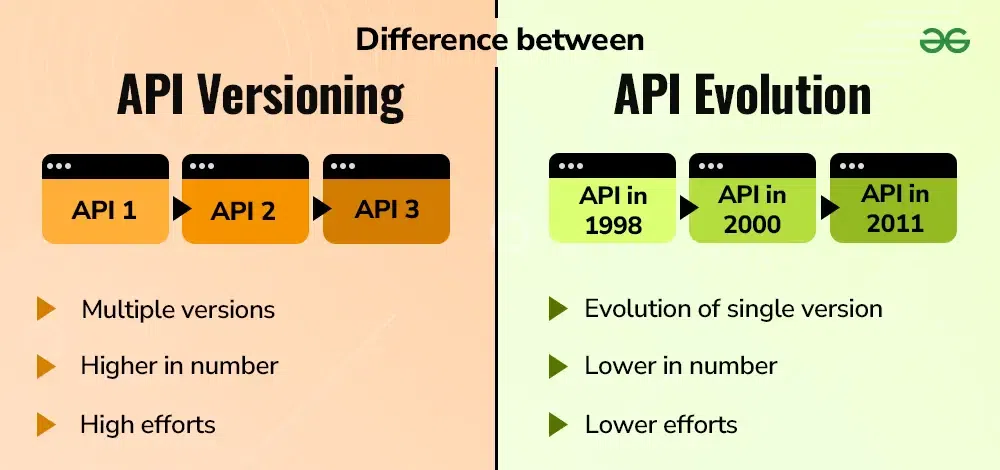
These are the following topics that we are going to discuss:
Table of Content
What is API Versioning?
API Versioning is the practice of creating different versions of an API to ensure that existing users can still access the features they rely on while allowing for changes and improvements in new versions.
Advantages:
- Old clients can continue to use the old version without issues.
- It's different versions can have distinct features or behaviors, making it easy to manage changes.
- Users can choose when to upgrade to a new version based on their needs.
Disadvantages:
- Supporting multiple versions can lead to more work for developers.
- It is managing different versions can complicate the codebase.
- Users may be unsure which version to use.
Pseudocode for API Versioning:
Function HandleRequest(apiVersion, request):
    if apiVersion == "v1":
        return ProcessRequestV1(request)
    else if apiVersion == "v2":
        return ProcessRequestV2(request)
    else:
        return Error("Unsupported API Version")

Function ProcessRequestV1(request):
    response = {}
    return response

Function ProcessRequestV2(request):
    response = {}
    return response

apiVersion = GetAPIVersionFromRequest()
request = GetRequestData()
response = HandleRequest(apiVersion, request)
Return response
What is API Evolution?
API Evolution is the practice of making changes to an API without creating new versions. This means updating the existing API while trying to maintain compatibility for current users.
Advantages:
- Users always interact with a single version, reducing confusion.
- There is no need to manage multiple versions, simplifying development.
- Updates can be rolled out more easily and frequently.
Disadvantages:
- It changes might by mistake disrupt existing users.
- Users must adapt to changes without the option to stick to an old version.
- If something goes wrong, reverting to an old state can be difficult.
Pseudocode for API Evolution:
Function UpdateAPI(currentAPI):
    if UserRequest for FeatureX:
        Modify currentAPI to add FeatureX
    else if UserRequest for FeatureY:
        Modify currentAPI to add FeatureY
    else:
        Return currentAPI
Difference between API Versioning and API Evolution
API Versioning | API Evolution |
|---|---|
In API Versioning multiple versions of an API | In API Evolution single version with updates |
It's higher due to version management and routing | It's lower fewer conditions to handle |
API Versioning is lower, as changes can be isolated in new versions | API Evolution higher, since changes may disrupt current functionality |
Higher effort to implement and manage multiple versions | Lower effort easy to implement gradual changes |
It is Less frequent major changes require new versions | It is more frequent continuous updates can be deployed |
It can be incorporated in new versions based on specific user needs | Immediate feedback can affect ongoing development |
Needs testing for each version to ensure compatibility | Focused testing for the single version |
Conclusion
API Versioning and API Evolution depends on your project needs. API Versioning provides stability for existing users but requires more maintenance, while API Evolution simplifies updates but carries a higher risk of disrupting users. Understanding both approaches will help you make informed decisions for your API development.
