
Verification and Validation (V&V) are important processes in SDLC used to ensure software quality and correctness. Verification checks whether the software is built according to requirements and design, while validation ensures the final product meets user needs.
- V&V helps in improving software quality and reliability.
- Verification focuses on checking documents and development process, while validation focuses on testing the final product.
- They help in detecting defects early and reducing development cost
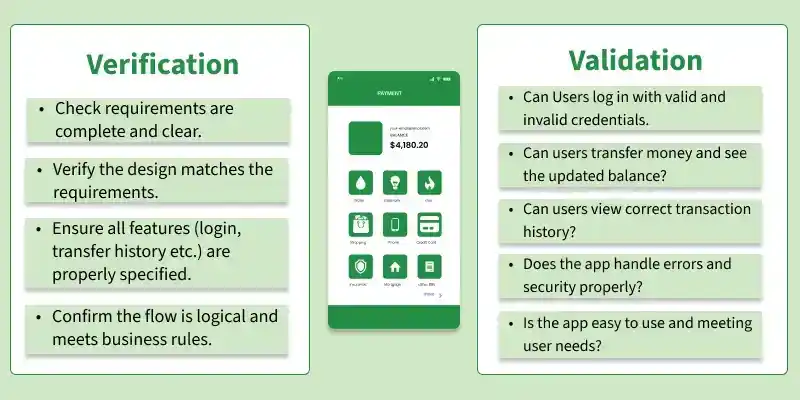
Verification
Verification is the process of checking whether the software is being developed correctly according to specified requirements and design documents without executing the code.
- Focuses on “Are we building the product right?”
- Performed during early stages of SDLC (requirements, design, coding).
- Ensures software follows standards and specifications.
- Helps detect defects early and reduces cost of fixing errors.
- Includes activities like reviews, inspections, walkthroughs, and audits.
Example: Reviewing design documents of a banking application to ensure they match requirement specifications before coding begins.
Validation
Validation is the process of evaluating the final software product by executing it to ensure it meets user needs and works correctly in real-world conditions.
- Focuses on “Are we building the right product?”
- Performed after development through testing activities.
- Ensures software meets user expectations and requirements.
- Identifies defects missed during development stages.
- Includes testing methods like system testing and user acceptance testing (UAT).
Example: Testing a shopping application where users verify login, product search, cart, and payment features work correctly.
Role of Verification and Validation in SDLC
V&V activities are applied throughout the SDLC to ensure quality at every stage.
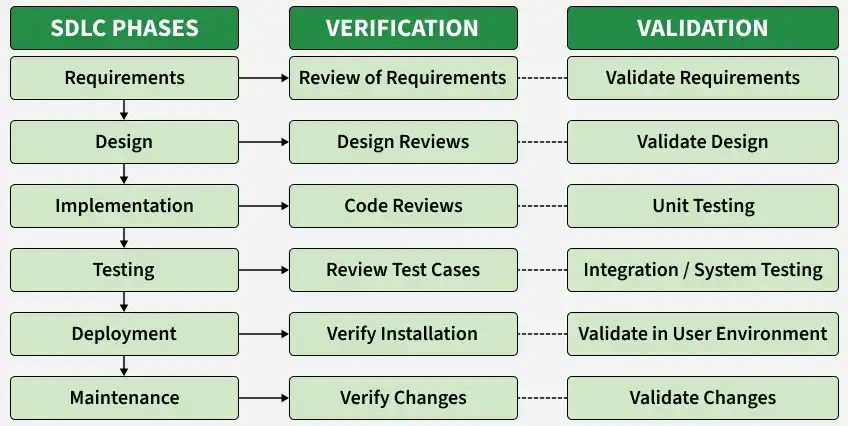
- In the requirement phase, verification ensures requirements are clear and complete, while validation checks user needs.
- In the design phase, verification ensures correct system design, while validation ensures suitability for implementation.
- In implementation, verification is done through code reviews and walkthroughs, while validation begins with unit testing.
- In testing phase, verification ensures proper test cases, while validation is done using system and acceptance testing.
- In deployment and maintenance, verification ensures proper changes and configuration, while validation ensures the system works correctly in the real environment.
Techniques Used in Verification
Verification is done without executing code.
- Reviews: Formal or informal evaluation of documents like requirement specifications, design documents, and code to find errors early.
- Inspections: A structured and detailed examination of software documents or code by a trained team to detect defects systematically.
- Walkthroughs: A step-by-step review process where the developer explains the work product to peers to identify issues and improve quality.
Techniques Used in Validation
Validation is done by executing the software.
- Unit Testing: Testing individual components or modules of the software.
- Integration Testing: Testing combined modules to ensure they work together correctly.
- System Testing: Testing the complete system as a whole to verify overall functionality.
- Acceptance Testing: Testing performed by users or clients to confirm the software meets their needs before release.
V&V Activities Across SDLC Phases
Verification and Validation (V&V) activities are performed throughout all phases of the Software Development Life Cycle (SDLC) to ensure software quality, correctness, and reliability at every step.
- Requirement Phase: Verification is done by reviewing requirement documents to ensure they are clear, complete, and consistent. Validation is performed by checking whether requirements reflect actual user needs.
- Design Phase: Verification is carried out through design reviews and inspections to ensure the architecture and system design meet requirements. Validation ensures the design is suitable for real-world implementation.
- Implementation Phase: Verification is done by code reviews, walkthroughs, and static analysis to ensure coding standards are followed. Validation begins with unit testing to check individual modules.
- Testing Phase: Verification ensures test plans and test cases are correctly designed. Validation is performed through integration, system, and acceptance testing of the working software.
- Deployment Phase: Verification ensures the final product is correctly installed and configured. Validation checks whether the deployed system works as expected in the user environment.
- Maintenance Phase: Verification ensures that changes and updates follow proper procedures. Validation ensures that fixes or enhancements do not introduce new issues and still meet user requirements.
Limitations of Verification and Validation (V&V)
Verification and Validation (V&V) are essential for ensuring software quality, but they also have certain limitations that can affect the development process.
- V&V processes can increase the overall cost of software development due to additional reviews and testing activities.
- They are time-consuming because each phase of SDLC requires proper checking and validation.
- Complete error detection is not possible, as some defects may still remain in the software after V&V.
- V&V depends heavily on the skill and experience of testers and reviewers, which can affect accuracy.
- It may not be effective for very complex systems where requirements frequently change.
- Excessive focus on V&V can slow down the development process and delay delivery.
- It cannot guarantee 100% defect-free software or complete correctness of the system.
Read More: Verification vs Validation.
