
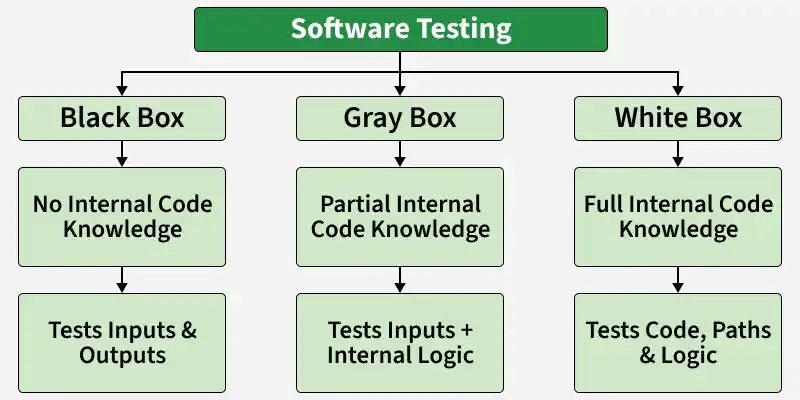
Software testing differs based on how much internal knowledge the tester has. Black box, white box, and grey box testing represent three different approaches used at various stages of development.
- Black Box Testing: No knowledge of code; focuses on input and output behavior.
- White Box Testing: Full knowledge of code; checks internal logic and paths.
- Gray Box Testing: Partial knowledge of code; combines both functional and structural testing.
Black Box Testing
Black Box Testing is a software testing technique in which the tester does not have knowledge of the internal structure or code of the application. It focuses on validating the software’s functionality by examining inputs and verifying outputs from the user’s perspective. It is also known as Functional Testing.
Strengths
- No programming knowledge required.
- Simulates real user behavior and scenarios.
- Helps identify functional and usability issues.
Limitations
- Limited visibility into internal code paths.
- Difficult to identify the exact cause of defects.
- May miss hidden logic errors and edge cases.
White Box Testing
White Box Testing (also known as Glass Box or Structural Testing) is a software testing technique in which the tester has knowledge of the internal code, logic, and structure of the application. It verifies the flow of data, control paths, and source code from the developer’s perspective.
Strengths
- Provides thorough code coverage.
- Detects logic errors and dead code.
- Helps improve code quality and reliability.
Limitations
- Requires programming knowledge.
- Can be time-consuming for large applications.
- May overlook missing requirements or user-focused issues.
Gray Box Testing
Gray Box Testing is a software testing technique that combines Black Box and White Box Testing approaches. In this method, the tester has partial knowledge of the internal code and designs test cases accordingly, while validating the application through inputs and outputs. It is especially useful for web applications and integration testing.
Strengths
- Combines benefits of Black Box and White Box Testing.
- Effective for integration and security testing.
- Improves test coverage and efficiency.
Limitations
- Requires both technical and domain knowledge.
- Partial knowledge may leave some areas untested.
- Designing effective test cases can be challenging.
Black Box vs Gray Box vs White Box Testing
| Feature | Black Box Testing | Gray Box Testing | White Box Testing |
|---|---|---|---|
| Definition | Testing without knowing internal code or structure | Testing with partial knowledge of internal code | Testing with full knowledge of internal code and structure |
| Focus | Input and output behavior | Combination of internal logic + external behavior | Internal code, logic, and structure |
| Tester Knowledge | No knowledge of code required | Partial knowledge of code/architecture | Full knowledge of code required |
| Performed by | Testers, end users | Testers + developers | Developers / skilled testers |
| Testing Level | Functional testing | Functional + structural testing | Structural (code-based) testing |
| Techniques Used | Equivalence partitioning, boundary value analysis | Matrix testing, regression testing with internal insight | Code coverage, path testing, statement/branch testing |
| Main Purpose | Validate software behavior against requirements | Improve test coverage using internal knowledge | Ensure all internal paths and logic are correct |
