
Pairwise Testing is a software testing technique that uses permutation and combination to test all possible pairs of input parameters. It helps achieve effective test coverage while reducing the number of test cases compared to exhaustive testing.
- Tests all possible combinations of input parameters in pairs rather than every possible combination.
- Provides effective coverage of interactions between input parameters.
- Improves testing efficiency by reducing the overall testing effort.
Example: Testing every possible combination of 20 input parameters is often impractical. Pairwise testing focuses on parameter pairs, significantly reducing the number of required test cases.
Graphical Comparison of Pairwise Testing and Exhaustive Testing
The graph shows how the number of test cases increases with the number of test factors in both pairwise and exhaustive testing approaches.
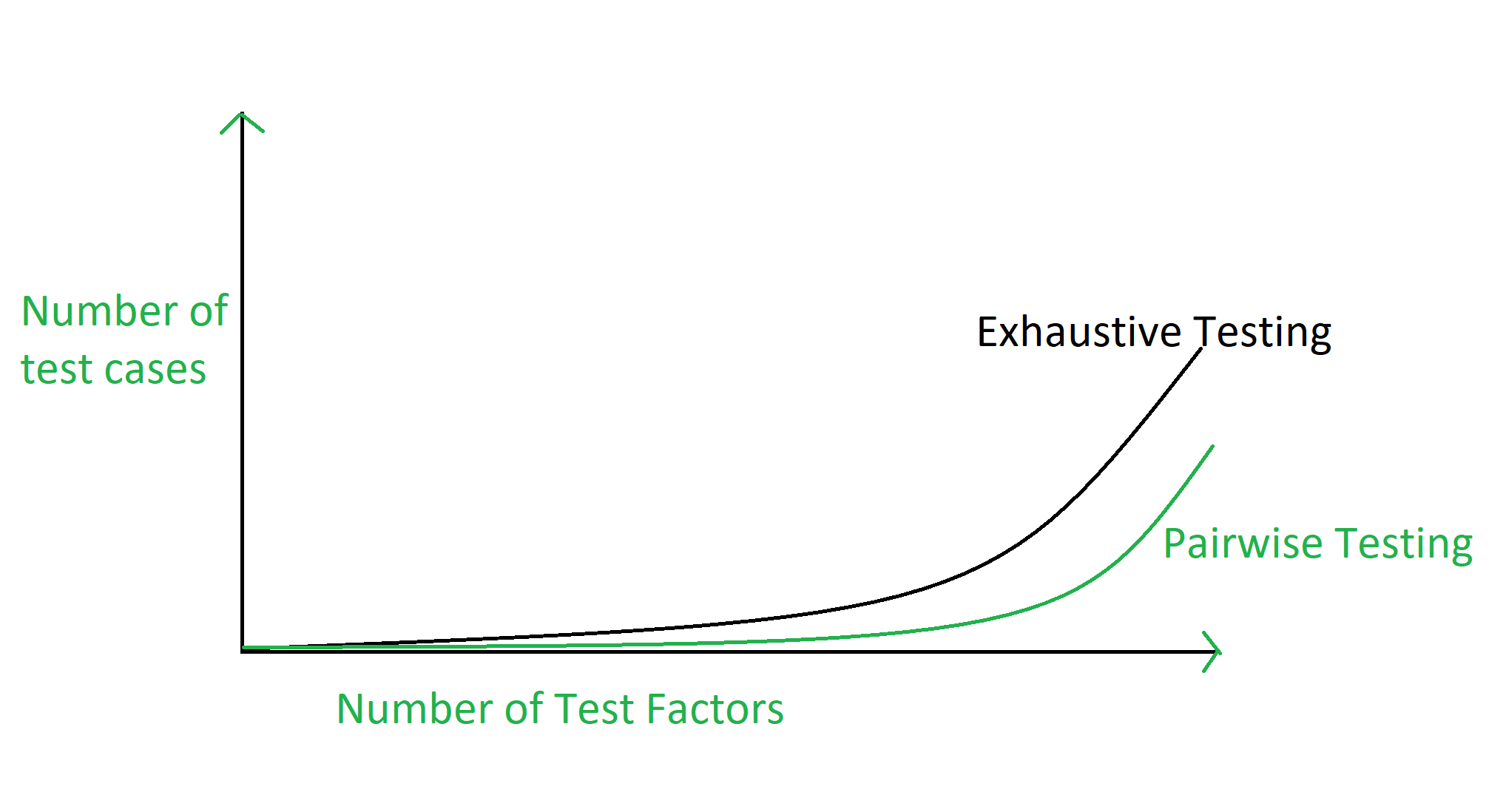
- In exhaustive testing, the number of test cases increases exponentially because every possible combination is tested.
- In pairwise testing, the growth is much slower because only combinations of parameter pairs are considered.
- This makes pairwise testing more scalable and practical for systems with a large number of input parameters while still providing effective coverage.
Pairwise testing is more efficient and scalable compared to exhaustive testing, especially for systems with a large number of input parameters.
Generalized Form of Pairwise Testing
Pairwise testing is a special case of the broader N-wise testing approach, where interactions among multiple input parameters are systematically tested to improve coverage while controlling the number of test cases.
- To organize the parameters efficiently, sorting is applied to the set: X = n{i}
- so that the parameter set P = { Pi } is arranged in a defined order.
- The sorted parameter set can be represented as an N-tuple: Ps = {Pi} such that | R(Pi) | < | R (Pj) |
Explanation:
- Pairwise (2-wise) testing considers all possible combinations of any two parameters: X(2)={P(N−1),P(N−2)}
- 3-wise testing considers combinations of any three parameters: X(3)={P(N−1),P(N−2),P(N−3)}
- K-wise testing generalizes this to any K parameters: X(K)={P(N−1),P(N−2),…,P(N−K)}
- N-wise testing includes all possible combinations of all N parameters.
As the value of K increases, the interaction coverage becomes more comprehensive; however, the number of test cases also increases significantly, leading to higher execution cost and complexity.
Advantages of Pairwise Testing
Pairwise testing offers several benefits for improving test efficiency and coverage.
- Significantly reduces the number of test cases compared to exhaustive testing.
- Ensures coverage of all possible pairs of input parameters.
- Detects defects caused by interactions between two variables effectively.
- Saves testing time and resources.
- Easy to design and implement using available tools and algorithms.
Limitations of Pairwise Testing
Despite its benefits, pairwise testing has certain limitations.
- May miss defects caused by interactions among three or more parameters.
- Not suitable for systems with critical multi-parameter dependencies.
- The number of test cases can still become large when there are many inputs and values.
- Requires careful selection of input parameters and values to achieve effective coverage.
