
HEART Framework is a user-centric product management approach developed by Google to measure and improve user experience. It helps teams track meaningful UX metrics instead of relying only on raw data. By focusing on five key dimensions, it ensures products are both useful and enjoyable for users.
History
The HEART Framework was introduced in 2010 by Google researchers Kerry Rodden, Hilary Hutchinson, and Xin Fu at the CHI Conference. It was designed to solve the challenge of measuring user experience at scale across multiple products. Over time, it became a widely adopted UX measurement standard in product management.
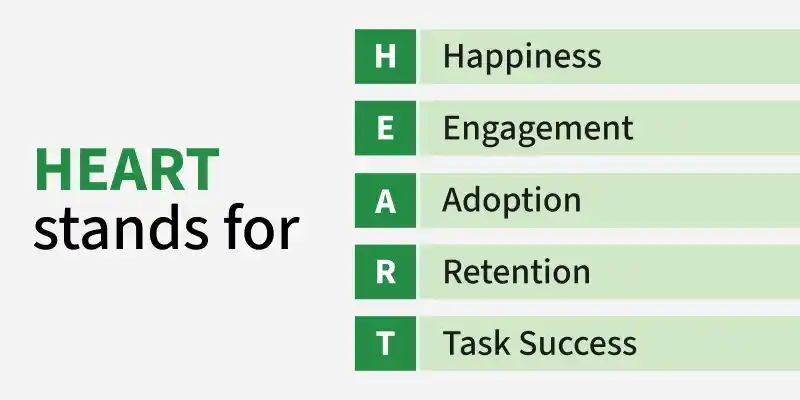
Five Pillars of HEART
The HEART framework evaluates user experience through five key dimensions that measure satisfaction, engagement, and product effectiveness.
1. Happiness
- Measures user satisfaction and overall experience.
- Common metrics: NPS, customer satisfaction (CSAT), app ratings, reviews.
2. Engagement
- Tracks how actively users interact with the product.
- Common metrics: session duration, frequency of use, and and feature usage.
3. Adoption
- Indicates how many new users start using the product or a feature.
- Common metrics: sign-ups, activation rate, and onboarding completion.
4. Retention
- Measures how well the product keeps users over time.
- Common metrics: churn rate, repeat usage, subscription renewals.
5. Task Success
- Evaluates how efficiently users complete key actions.
- Common metrics: success rate, time to complete tasks, and error rate.
Working
The framework is typically implemented using the Goals–Signals–Metrics (GSM) approach:
- Goals: Define what you want to achieve (e.g., improve onboarding experience).
- Signals: Identify user behaviors that indicate success (e.g., users completing signup).
- Metrics: Track measurable data (e.g., onboarding completion rate).
Teams map each HEART category to these three elements to create a structured measurement system. Not all five metrics are always required-teams can focus on the most relevant ones.
Example
| Category | Goal | Signal | Metric |
|---|---|---|---|
| Happiness | Users enjoy the product | Positive feedback | NPS, ratings |
| Engagement | Users interact frequently | Increased session time | Avg. session duration |
| Adoption | New users start using product | Sign-ups, feature usage | Registration rate |
| Retention | Users return regularly | Repeat visits | Churn rate |
| Task Success | Users complete actions easily | Fewer errors | Task completion rate |
Benefits
- User-Centric Insights: Focuses on real user experience, not vanity metrics.
- Better Decision Making: Helps prioritize features that improve UX.
- Balanced Metrics: Prevents over-optimization of one metric at the cost of others.
- Strategic Focus: Keeps teams aligned on impactful areas.
- Data-Driven Growth: Enables measurable improvements in product performance.
Users
The HEART Framework is used by cross-functional teams to measure, analyze, and improve user experience through data-driven insights.
- Product Managers: To prioritize features and track UX impact
- Designers (UX/UI): To create user-friendly experiences
- Engineers: To understand how technical changes affect users
- Data Analysts: To measure and interpret user behavior
- Marketing Teams: To align campaigns with user engagement and retention
- Customer Success Teams: To identify and fix user pain points
- Executives: To make informed strategic decisions
