
"YAGNI" stands for "You Aren't Gonna Need It". It is a principle in software development that suggests developers should implement only the features required for current needs and avoid adding unnecessary future functionality. It helps reduce complexity, development time, and potential bugs by focusing only on present requirements.
- Prevents unnecessary feature development by focusing only on current requirements, helping teams stay aligned with actual needs.
- Closely related to "KISS" ("Keep It Simple, Stupid"), which promotes simplicity in design. Both principles encourage focusing on current requirements instead of anticipating future needs.
Importance of following the YAGNI principle
The developer should follow YAGNI principles for the following reasons:
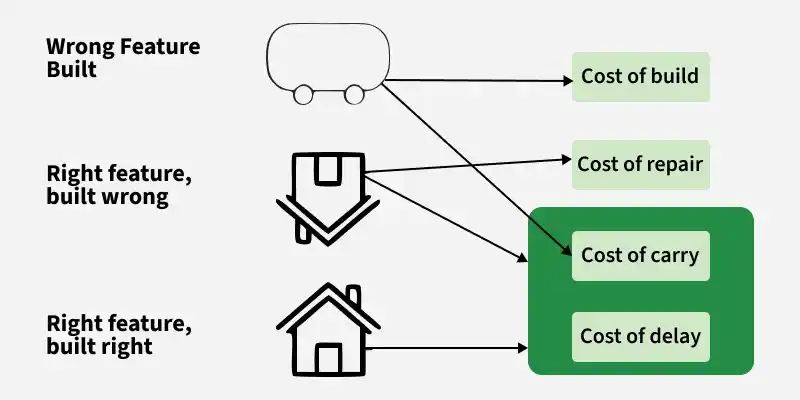
- Cost of Building: The cost of building is the amount of time, effort, and resources spent on creating a feature or solution. It includes everything from planning and coding to testing.
- Cost of Delay: The cost of delay is the missed opportunity or economic impact of not delivering a feature or solution promptly.
- Cost of Carry: When a feature adds complexity, it can make it harder to work on other parts of the software, leading to additional time and effort.
- Cost of Repair: The cost of repair, also known as technical debt, is the ongoing cost associated with fixing mistakes, bugs, or poor choices made during the development of a feature.
Steps to follow YAGNI Principle
To use YAGNI as a developer, it's like having a practical guide to keep your work focused and efficient.
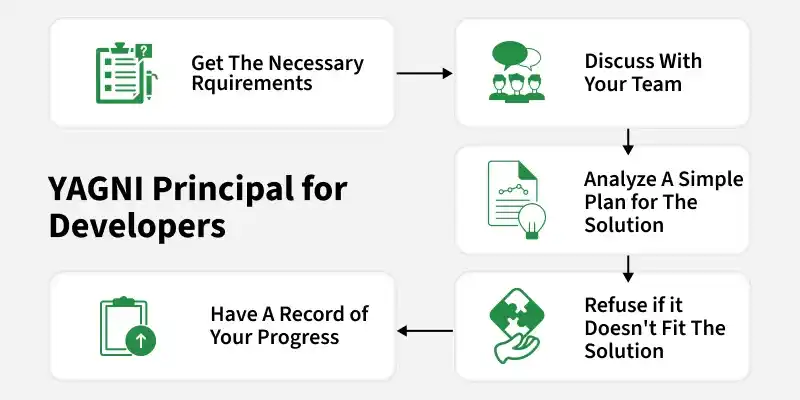
- Get the Necessary Requirements: All the things your project needs and sort them into "must-haves" and "can wait."
- Discuss with Your Team: After that, it's time to talk with your team. Share your plans and goals with them. This makes sure everyone is on the same page and understands what needs to be done.
- Analyze a Simple Plan for the Solution: Now, when it comes to planning the actual work, keep it simple. Break down your big goals into smaller tasks. This helps you avoid getting overwhelmed and ensures you're focusing on what really matters.
- Refuse If It Doesn't Fit for the Solution: Refuse ideas that don’t fit the solution to avoid scope creep and stay focused. Prioritize core requirements to ensure timely and efficient delivery.
- Have a Record of Your Progress: Keep a record of what you've done. It's like keeping score in a game. This helps you see how far you've come and if you're heading in the right direction.
YAGNI Vs Over-Engineering
Over-engineering occurs when developers build features or abstractions that are not immediately required. YAGNI helps prevent this by enforcing a focus on current needs only.
| YAGNI | Over-Engineering |
|---|---|
| Focuses only on current requirements and avoids unnecessary future features | Builds features based on assumptions about future needs |
| Keeps the system simple and minimal, improving clarity | Introduces unnecessary complexity, making systems harder to manage |
| Enables faster development by reducing extra work | Slows down development due to added features and abstractions |
| Uses time and resources efficiently by building only what is needed | Wastes time and effort on functionality that may never be used |
| Easier to maintain, debug, and extend when required | Harder to maintain and debug due to complex and unused code |
| Lower risk of bugs due to less and cleaner code | Higher risk of bugs due to increased complexity |
Mistakes When Applying YAGNI
While YAGNI promotes simplicity, it must be applied carefully.
- Confusing YAGNI with ignoring scalability or design quality can lead to poor system design and future limitations.
- Rejecting all future planning instead of avoiding premature implementation may result in systems that are hard to extend later.
- Removing necessary abstractions that support current requirements can make the code less flexible and harder to maintain.
YAGNI is about delaying implementation, not avoiding good design.
Advantages
Applying this approach helps in building simpler, efficient, and more maintainable systems by focusing only on what is truly needed.
- Reduced Development Time: By avoiding the development of unused features, teams can focus on current requirements and accelerate the delivery of functional software.
- Improved Maintainability: Simpler, more focused codebases are easier to understand and maintain over time.
- Increased Flexibility: The ability to defer decisions until later provides more clarity and allows for more informed design choices as requirements become clearer.
- Fewer Bugs: Less complex code with fewer speculative features is less prone to bugs, leading to a higher quality product.
