
L-graphs can generate context-sensitive languages, but programming such languages is more difficult than programming regular languages. Therefore, a hypothesis is proposed to identify the type of L-graphs that generate regular languages.A nest is a neutral path T₁ T₂ T₃ where T₁ and T₃ are cycles and T₂ is a neutral path connecting them. This path is called an iterating nest if all three paths print repetitions of the same string α.
Points defining an iterating nest:
- T₁ prints αᵏ
- T₂ prints αˡ
- T₃ prints αᵐ
- k, l, m ≥ 0
- α is a string of input symbols
- At least one of k, l, or m should be ≥ 1
Hypothesis: If all nests in a context-free L-graph G are iterating nests, then the language L(G) generated by G is a regular language. Based on this hypothesis, such L-graphs can be converted into an equivalent NFA.
- Step-1: Languages of the L-graph and NFA must be the same, thusly, we won’t need a new alphabet
\Rightarrow \Sigma’’ = \Sigma, \: P’’ = P . (Comment: we build context free L-graph G’’, which is equal to the start graph G’, with no conflicting nests) - Step-2: Build Core(1, 1) for the graph G. V’’ := {(v,
\varepsilon ) | v\in V of\forall canon k\in Core(1, 1), v\notin k}\lambda'' := { arcso \in \lambda | start and final stateso', o'' \in V’’} For all k\in Core(1, 1): Step 1’. v := 1st state of canon k.\eta := \varepsilon . V’’\cup= (v, \eta) Step 2’.\lambda'' \cup= arc from state(v, \eta) followed this arc into new state defined with following rules:\eta := \eta , if the input bracket on this arc= \varepsilon ;\eta'the\: input\: bracket' , if the input bracket is an opening one;\eta 'without\: the\: last\: bracket' , if the input bracket is a closing bracket v := 2nd state of canon k V’’\cup= (v, \eta) Step 3’. Repeat Step 2’, while there are still arcs in the canon. - Step-3: Build Core(1, 2). If the canon has 2 equal arcs in a row: the start state and the final state match; we add the arc from given state into itself, using this arc, to
\lambda'' . Add the remaining in\lambda arcs v – u(\alpha) to\lambda'' in the form of(v, \varepsilon) - (u, \varepsilon) (\alpha) - Step-4:
P''_0 = (P_0, \varepsilon).\: F'' = \{(f, \varepsilon) | f \in F\} (Comment: following is an algorithm of converting context free L-graph G’’ into NFA G’) - Step-5: Do the following to every iterating complement
T = T_1T_2T_3 in G’’: Add a new state v. Create a path that starts in statebeg(T_3) , equal toT_3 . From v intoT_3 create the path, equal toT_1 . Delete cyclesT_1 andT_3 . - Step-6: G’ = G’’, where arcs are not loaded with brackets.
So that every step above is clear I’m showing you the next example.  Start graph G
 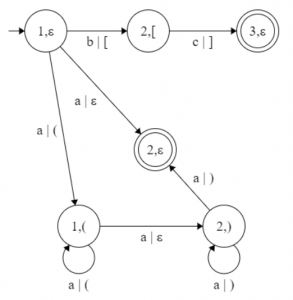 Intermediate graph G’’
 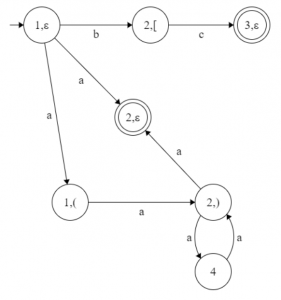 NFA G’
Advantages of hypotheses
- Framework for analysis: Hypotheses about language regularity provide a structured way to analyze and classify languages into classes such as regular and context-free.
- Understanding language behavior: They help researchers understand how languages behave. For example, regular languages have clear properties and can be recognized using finite automata.
- Bridging theory and practice: These hypotheses connect theoretical concepts with practical applications like compiler design, pattern matching, and text processing.
Disadvantages of hypotheses
- Limitations of classification: Not all languages fit clearly into predefined classes like regular or context-free, which makes classification difficult.
- Complex languages: Many real-world applications involve complex languages such as context-free or context-sensitive languages where the regularity assumption may not work.
- Oversimplification: Assuming a language is regular can oversimplify the problem and may ignore important structural properties of the language.
