
Deterministic Finite Automata (DFA) are abstract machines that recognize patterns and regular languages by processing input step by step using fixed rules. They are widely used in search engines, spell-checkers, and text-processing systems, and DFA operations help build more complex language recognizers from simpler ones.
- Union → strings accepted by DFA1 or DFA2
- Concatenation → strings of DFA1 followed by DFA2
- Reversal → reverse of accepted strings
- Complement → strings not accepted by DFA
- Intersection → strings accepted by both DFAs
- Difference → strings in DFA1 but not in DFA2
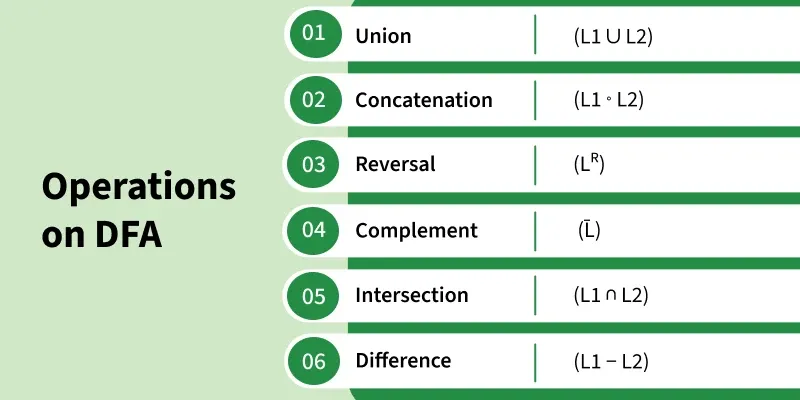
Here are some key operations on DFAs, explained with examples:
1. Union of Two DFAs (L₁ ∪ L₂)
Union means combining two DFAs so that the new DFA accepts all words that either of the original DFAs would accept. Example: Let,
- DFA 1 (L₁) accepts L₁ = {a, ab}
- DFA 2 (L₂) accepts L₂ = {b, ab}
- The union DFA accepts L₁ ∪ L₂ = {a, ab, b}
Read more about Union process in DFA.
2. Concatenation of Two DFAs (L₁ ∘ L₂)
Concatenation means creating a new DFA that accepts words formed by taking a word from L₁ followed by a word from L₂. Example:
Let,
- DFA 1 (L₁) accepts L₁ = {a, b}
- DFA 2 (L₂) accepts L₂ = {c, d}
- The concatenation DFA accepts L₁ ∘ L₂ = {ac, ad, bc, bd}
Read more about Concatenation process in DFA
3. Reversal of a DFA (Lᴿ)
A new DFA that accepts the reversed versions of words accepted by the original DFA. Example:
- Let DFA accept L = {ab, abc, ba}
- Then, reversed DFA accepts Lᴿ = {ba, cba, ab}
Read more about Reversal process in DFA.
4. Complementation of a DFA (L̅)
A new DFA that accepts all words not accepted by the original DFA. Example:
- Let DFA accept L = {all strings containing 'a'}
- Then, the complement DFA accepts L̅ = {all strings that do not contain 'a'}
Read more about Complementation process in DFA.
5. Intersection of Two DFAs (L₁ ∩ L₂)
A new DFA that accepts only words that are in both original DFAs. Example:
Let:
- DFA 1 (L₁) accepts L₁ = {a, ab, bc}
- DFA 2 (L₂) accepts L₂ = {ab, bc, cd}
- The intersection DFA accepts L₁ ∩ L₂ = {ab, bc}
Read more about Intersection process in DFA
6. Difference of Two DFAs (L₁ - L₂)
Accepts strings in A but not in B
Let :
- DFA A accepts strings containing at least one '0'.
- DFA B accepts strings ending with '1'.
- Difference DFA L₁ - L₂ accepts strings that have at least one '0' and do not end with '1'.
