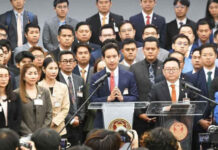




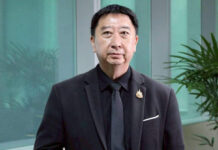












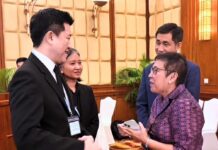







BANGKOK — 31 March 2026, Political activist and social media influencer Bow Nuttaa Mahattana has been appointed spokesperson for the government’s Middle East Situation Centre by Prime Minister Anutin Charnvirakul, effective today.
In an exchange with Khaosod English’s Pravit Rojanaphruk, Nuttaa responded to five questions on public communication, the ongoing Middle East conflict, and Thailand’s energy outlook.
Public communication challenges
Asked about the government’s biggest challenge in communicating with the public amid the war and energy crisis, Nuttaa said clarity without causing panic is key.
“As with any major crisis, the challenge is communicating facts clearly without creating unnecessary panic,” she said. “That is why transparency is critical, along with making sure people understand the reasoning behind each decision the government makes.”
Government assessment of the conflict
Prime Minister Anutin said late last week, while apologising to the public, that he had not foreseen the Middle East conflict dragging on this long. Asked whether this reflected a failure by the Ministry of Foreign Affairs, Nuttaa declined to assess.
“I have not reviewed the Ministry of Foreign Affairs’ assessment, so I am not in a position to judge,” she said.
She added that governments often attempt to reassure the public during uncertain periods, sometimes at the expense of fully explaining difficult realities.
“Going forward, I think we can improve by communicating risks more openly and consistently, even when the message is not easy,” she said. “At the same time, the government must do what is right, even when those decisions are unpopular.”
Public perceptions of the war
When asked about the biggest misconception among the Thai public regarding the conflict, Nuttaa declined to comment.
“I would rather not answer this question as it may not contribute anything to the situation for now,” she said.
Outlook on the energy crisis
On a personal note, Nuttaa expressed optimism about Thailand’s ability to manage the energy crisis.
“I am optimistic. From our track record, Thai people can be very adaptable and cooperative in times of crisis,” she said. “We may strongly criticise the government the whole day, but we also cooperate when it matters.”
She also highlighted what she described as Thailand’s enduring culture of generosity.
“It is our asset, much needed in challenging times like this,” she added.
Concerns over social division
Asked whether rising Islamophobia or antisemitism could become an issue in Thailand, particularly on social media, Nuttaa said she had not observed clear signs of either.
“So far, I have not seen clear signs of that in Thailand,” she said. “This is a complex conflict where taking sides is not straightforward.”
However, she noted that the situation underscores the broader global impact of war.
“It is important that we learn from this and continue to promote understanding, while governments work together to rebuild international stability,” she said.