

Hire .NET Developers
Hire the Top 3% of Freelance .NET Developers
Hire .NET developers, programmers, experts, engineers, consultants, and specialists on demand. Top companies and startups choose .NET developers from Toptal for enterprise systems, C# development, ASP.NET Core, cloud services, and more.
Hire a Top .NET Developer Now
No-Risk Trial, Pay Only If Satisfied.









Hire Freelance .NET Developers

Fernando Rodriguez
Freelance .NET Developer
Verified Expert in Engineering
Spain
Toptal Member Since February 16, 2015
Fernando is a highly skilled senior .NET developer with a decade of experience. He is known for his attention to detail and commitment to delivering top-quality software. He is proficient in various technologies, including C#, ASP.NET MVC, .NET Core, Angular, RxJS, Bootstrap, Entity Framework, SQL Server, Git, TypeScript, and JavaScript. Fernando’s expertise extends across various frameworks and languages, ensuring comprehensive solutions for complex development needs.
Show More
Michael Latham
Freelance .NET Developer
Verified Expert in Engineering
United States
Toptal Member Since August 29, 2025
Michael is a principal software engineer and senior software systems architect with 27 years of professional experience building high-availability, critical software services. He has extensive experience with C, C#, Java, and .NET, and has worked with Rust for the past 10 years, along with various ERP and ITSM SaaS. Most of Michael's work has been with Microsoft and running his own LLC over the past four years, where he continues to design and implement scalable software systems.
Show More
Remya Naadam
Freelance .NET Developer
Verified Expert in Engineering
United Arab Emirates
Toptal Member Since March 10, 2022
Remya has more than 15 years of software development experience, is very passionate about coding, and is committed to her work. She has extensive experience mainly on .NET frameworks from .NET 2.0 until .NET Core. Remya's main area of focus is building back-end APIs in C# and VB.NET, and she is also experienced in IBM MQ, Apache Kafka, Microservices, and PL/SQL coding.
Show More
Anderson Luiz Ferrari
Freelance .NET Developer
Verified Expert in Engineering
Brazil
Toptal Member Since March 7, 2016
Anderson is a software engineer committed to delivering effective solutions to complex problems. With more than 20 years of experience in the IT industry, he has worked on projects including custom web applications, collaboration portals, ERP and CMS systems, mobile apps, and business intelligence platforms. Anderson holds an MBA in project management and is certified as a PMP and MCSD (.NET).
Show More
Blanka Pop
Freelance .NET Developer
Verified Expert in Engineering
Romania
Toptal Member Since September 24, 2021
Blanka is a .NET developer with 15 years of experience delivering desktop and mobile projects primarily using WPF, Objective-C, and Xamarin.Android. Blanka also has experience with project management as she has served as a project manager for a total of five years. Thanks to her ability to quickly adapt to new environments and technologies, Blanka can hit the ground running on any project. Currently, VR technologies (specifically Unity3D) have piqued Blanka's curiosity.
Show More
Ernestas Romeika
Freelance .NET Developer
Verified Expert in Engineering
Finland
Toptal Member Since March 1, 2017
Ernestas has over 10 years of experience working with .NET-based applications. He graduated five years ago with a bachelor's degree in software engineering. He has primarily been working on web-related projects in both the front and back end. Ernestas is always up for a new challenge.
Show More
David Pfeffer
Freelance .NET Developer
Verified Expert in Engineering
United States
Toptal Member Since October 17, 2016
David is a software engineer and an adjunct computer science professor at Stevens Institute of Technology in Hoboken, NJ. They've been involved in a number of startup businesses and worked in the financial services sector on high bandwidth/high transaction computing. They're an expert in C#/.NET and TypeScript, having used both since initial betas, and they do regular work with .NET Core and Node.js on the back end and React, Angular, Cordova, and Ionic on the front end.
Show More
Laurynas Aleksiunas
Freelance .NET Developer
Verified Expert in Engineering
Lithuania
Toptal Member Since June 8, 2022
Laurynas has over four years of professional experience developing web and mobile applications with modern and efficient technologies. He is proficient in a diversified tech stack, including C#, .NET, Node.js, Python, TypeScript, JavaScript, React, and Angular. Laurynas has worked across the financial, eCommerce, video games, and software industries and is willing to embrace new challenges.
Show More
Mohamed Fakhreddine
Freelance .NET Developer
Verified Expert in Engineering
United States
Toptal Member Since September 18, 2015
Mohamed is a principal software engineer with 15+ years of experience at Microsoft, Google, Amazon, and Facebook. He specializes in building reliable, scalable distributed systems and has recently led engineering on AI-powered agentic products. He is a proven team player with a strong track record across front-end, back-end, and infrastructure.
Show More
Emil Stoev
Freelance .NET Developer
Verified Expert in Engineering
Czech Republic
Toptal Member Since June 14, 2019
Emil is an engineering lead with over 20 years of experience in software development and team management. He has a proven track record in leading agile teams and optimizing processes. Emil has expertise in a wide range of technologies, including .NET, C#, C++, Python, Azure, and AWS.
Show More
Stefano Altieri
Freelance .NET Developer
Verified Expert in Engineering
United Kingdom
Toptal Member Since November 18, 2021
Stefano is an experienced .NET developer, designer, and architect, working on SOA and enterprise application integrations for 15+ years. A Microsoft Certified Technology Specialist (MCTS) and Microsoft Certified Professional Developer (MCPD), he uses the Microsoft .NET stack, Java, and other platforms. Stefano is best in small agile teams but works confidently both alone and in big teams. He's developed complex and modular solutions, with three of them currently sold as frameworks and products.
Show MoreDiscover More .NET Developers in the Toptal Network
Start HiringA Hiring Guide
Guide to Hiring a Great .NET Developer
.NET developers serve various needs, including work on web, mobile, embedded, and cloud apps. This hiring guide outlines the critical skills, job descriptions, and interview questions to help you pinpoint the best .NET specialist based on your project requirements.
Read Hiring Guide.NET Hiring Resources
Toptal in the press
... allows corporations to quickly assemble teams that have the right skills for specific projects.

Despite accelerating demand for coders, Toptal prides itself on almost Ivy League-level vetting.

Our clients


Creating an app for the game


Leading a digital transformation


Building a cross-platform app to be used worldwide


Drilling into real-time data creates an industry game changer
Testimonials
How to Hire .NET Programmers Through Toptal
1
Talk to One of Our Client Advisors
A Toptal client advisor will work with you to understand your goals, technical needs, and team dynamics.
2
Work With Hand-selected Talent
Within days, we’ll introduce you to the right .NET expert for your project. Average time to match is under 24 hours.
3
The Right Fit, Guaranteed
Work with your new .NET engineer for a trial period (pay only if satisfied), ensuring they’re the right fit before starting the engagement.
EXCEPTIONAL TALENT
How We Source the Top 3% of .NET Developers
Our name “Toptal” comes from Top Talent—meaning we constantly strive to find and work with the best from around the world. Our rigorous screening process identifies experts in their domains who have passion and drive.
Of the thousands of applications Toptal sees each month, typically fewer than 3% are accepted.
Toptal .NET Case Studies
Discover how our .NET developers help the world’s top companies drive innovation at scale.
CASE STUDY
500X Data Processing Gain for Software Firm
CASE STUDY
.NET Developer Boosts Media Company’s Streaming Speed
CASE STUDY
Edtech Deployment Times Reduced to Minutes

Toptal modernizes legacy tool for investment software firm.
Challenge: An investment software company’s legacy application was outdated, non-operational, and unable to compile code. A deep technical investigation was needed to identify and resolve the core issues.
Solution: Toptal deployed an experienced .NET developer to lead the modernization effort, migrating the software from .NET Framework 4.7 to .NET Core 8. The developer refactored the codebase for full compatibility and integrated modern features to support today’s massive data volumes.
Outcome: The revitalized software, previously capped at 6 million records per day, can now process more than 3 billion records daily—a 500X gain. With dramatically improved performance and lower latency, the firm can now act on real-time insights essential for success in fast-paced financial markets.
RELATED CAPABILITIES
- C++

Toptal enhances news media company’s streaming service development.
Challenge: A leading media company faced a critical lack of development resources that hindered content delivery and cloud migration efforts. It turned to Toptal to improve its news streaming platform, boosting productivity and accelerating project timelines.
Solution: Toptal integrated experienced C# and .NET developers into the team, increasing sprint productivity and streamlining the development process. Toptal migrated the company’s news extraction pipeline from AWS to GCP and enhanced the content management system (CMS), allowing earlier issue detection and better video management.
Outcome: Sprint productivity increased significantly, accelerating the implementation of new functionalities for the streaming service and effectively addressing resource limitations. The migration to GCP improved cloud infrastructure management. Enhancements in the CMS streamlined operations and increased efficiency.
RELATED CAPABILITIES
- C#
- Cloud Engineering
- Back-end Developers
- Content Management
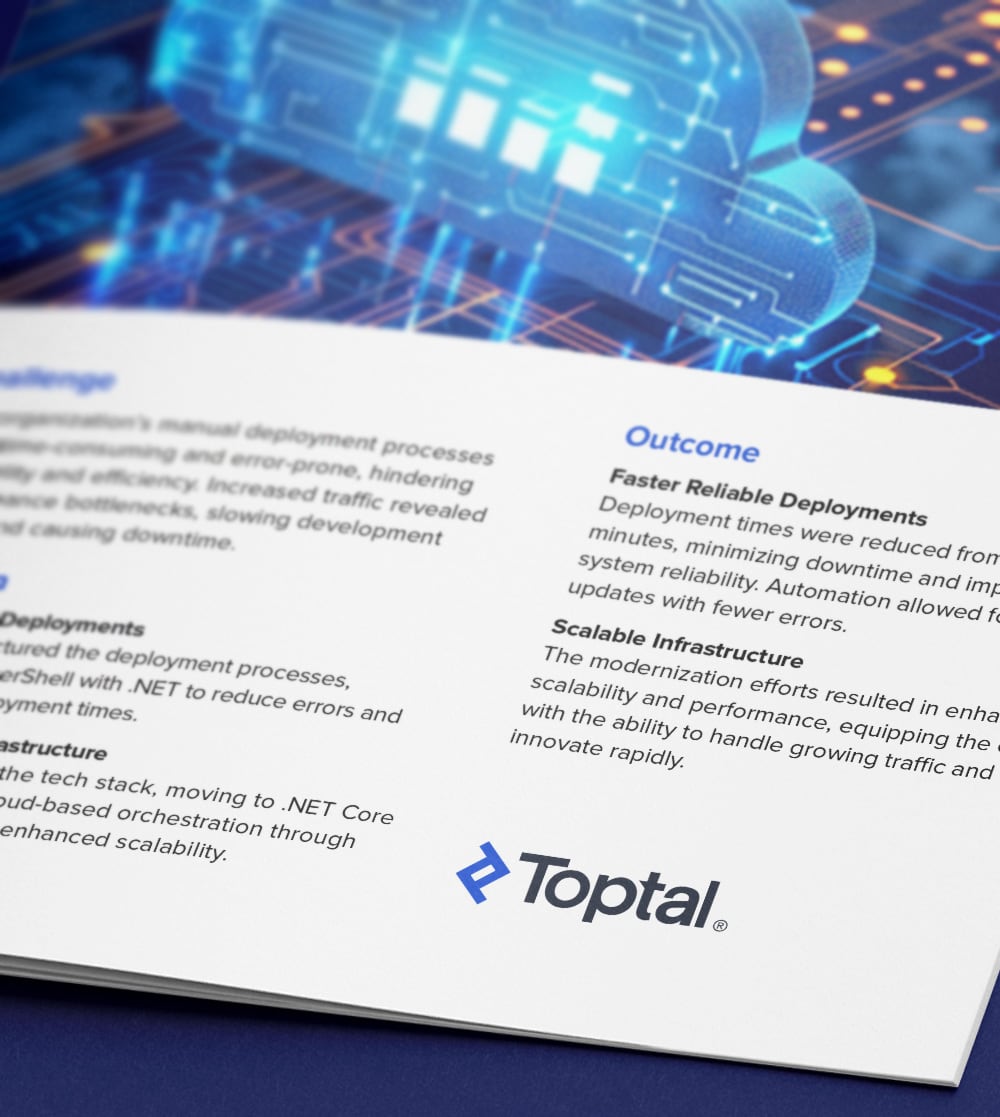
Toptal enhances educational services with streamlined deployments and expert .NET development.
Challenge: A leading edtech company faced challenges with manual deployment processes that slowed updates and reduced scalability. Toptal helped modernize the technology stack, automate deployments, and improve cloud operations.
Solution: Toptal deployed a seasoned .NET developer to lead the restructuring of deployment workflows. The team replaced PowerShell scripts with .NET-based automation, significantly reducing errors and improving speed. Toptal also upgraded the tech stack to .NET Core and implemented Kubernetes for cloud-based orchestration, enabling seamless scalability.
Outcome: Deployment times were reduced from hours to minutes, minimizing downtime and improving overall system reliability. Automation allowed for quicker updates with fewer errors. The modernization efforts resulted in enhanced scalability and performance, equipping the client with the ability to handle growing traffic and innovate rapidly.
RELATED CAPABILITIES
- Software Development
- DevOps
- Full-stack
- Cloud Engineering
Capabilities of .NET Developers
Our skilled developers leverage the performance and versatility of Microsoft’s popular framework to deliver software solutions tailored to your business needs.
Consulting and System Analysis
The technologies in the .NET ecosystem have grown and evolved significantly over time, often leading to system architectures that are unique. Toptal developers become experts in your infrastructure, then use this knowledge to provide actionable recommendations and solutions that leverage the latest technologies.
Cross-platform .NET Core Development
.NET Core applications run natively on multiple platforms, including Windows and Linux, providing a unified development experience. These cross-platform capabilities enable Toptal developers to build software solutions with consistent and reliable performance across a diverse range of environments.
End-to-End ASP.NET Development
Our comprehensive development services cover the full life cycle of your applications, from initial concept to final deployment. Toptal developers use the framework’s powerful tools, like Razor Pages, Blazor, and MVC, to deliver dynamic, reliable, and high-performing applications that provide exceptional user experiences.
API Integration and Management
The framework supports tools like WCF and gRPC for API integration and management, enabling seamless communication with external data sources, legacy systems, and third-party services. Our developers also leverage ASP.NET Core to build reliable and secure RESTful APIs and web services from the ground up.
Legacy System Migration and Modernization
Legacy applications form the backbone of countless business processes; however, their outdated technologies often hinder growth and scalability. Our developers ensure a smooth transition to the most up-to-date versions, future-proofing your business systems with modern principles like microservices, containerization, and cloud integration.
Enterprise-grade E-commerce Solutions
The performance, reliability, and security provided by the .NET framework make it a solid foundation for enterprise-grade e-commerce platforms. Our developers have extensive experience in creating flexible, user-friendly e-commerce solutions that are scalable, efficient, and provide a streamlined shopping experience.
Agile Development and Continuous Delivery
Toptal’s Agile-driven development process ensures adaptability, collaboration, rapid development cycles, and timely project delivery. In addition, by incorporating continuous integration/continuous delivery (CI/CD) practices, the likelihood of bugs and other issues in production is minimized, resulting in the highest-quality and most reliable code.
IoT Development
.NET provides a unified development platform that supports a wide range of applications, including the Internet of Things (IoT). Our developers build optimized solutions for enterprise and consumer smart devices using the framework’s rich ecosystem of libraries and tools dedicated to IoT.
ASP.NET MVC
Leverage ASP.NET MVC to build modular, maintainable applications with a focus on separation of concerns, testability, and scalability. Our expert developers take advantage of the MVC framework’s strengths to deliver custom solutions that streamline your business processes and support long-term growth.
RESTful API Development and Integration
RESTful APIs facilitate seamless data exchange between applications and third-party services, enhancing connectivity and interoperability. To enhance your application’s capabilities, Toptal’s software architects skillfully build and integrate APIs using tools like Web API to optimize data flow and establish secure communication.
Trusted by 25,000+ Clients Worldwide
Find the Right Talent for Every Project
Accelerate your project with versatile, expert talent. From short-term solutions to long-term collaboration, Toptal delivers impactful results.
Senior .NET Developers
Senior .NET developers bring deep technical expertise and advanced problem-solving skills to address your most complex challenges. Toptal’s rigorous vetting process provides access to professionals who combine robust technical experience with proven leadership.
Dedicated .NET Developers
Dedicated .NET developers focus exclusively on your projects, leverage advanced .NET expertise, and align with your long-term objectives to enable seamless integration and deliver high-quality outcomes.
Offshore .NET Developers
Offshore .NET developers combine exceptional expertise with competitive rates, making them ideal for scaling projects efficiently. Operating across multiple time zones, they provide global coverage and 24/7 support for time-sensitive requests.
Remote .NET Developers
Remote .NET developers offer top-tier expertise worldwide, removing location barriers to connect you with the best talent for your projects. They integrate seamlessly with distributed or hybrid teams, enabling flexible collaboration from anywhere.
FAQs
The cost depends on various factors, including preferred talent location, complexity and size of the project you’re hiring for, seniority, engagement commitment (hourly, part-time, or full-time), and more. In the US, for example, Glassdoor’s reported average total annual pay for .NET developers is $137,680 as of July 28, 2023. With Toptal, you can speak with an expert talent matcher who will help you understand the cost of talent with the right skills and seniority level for your needs. To get started, schedule a call with us — it’s free, and there’s no obligation to hire with Toptal.
Typically, you can hire .NET developers with Toptal in about 48 hours. For larger teams of talent or full end-to-end project delivery, timelines may vary. Our talent matchers are highly skilled in the same fields they’re matching in—they’re not recruiters or HR reps. They’ll work with you to understand your goals, technical needs, and team dynamics, and match you with ideal candidates from our vetted global talent network.
Once you select your .NET engineer, you’ll have a no-risk trial period to ensure they’re the perfect fit. Our matching process has a 98% trial-to-hire rate, so you can rest assured that you’re getting the best fit every time.
Yes, these professionals are in high demand. They are versatile talent who can address a variety of project types—whether big or small, and in the mobile, web, gaming, cloud, or embedded spaces—and can build solutions from scratch or fix existing projects. .NET experts bring various benefits to a company and ultimately increase the efficiency of your business. In 2023, .NET was the most used framework among developers, with a predicted job growth rate of 13% from 2018 to 2028, outpacing the 5% average.
Choosing the best experts for your project doesn’t have to be challenging or time-consuming. Narrowing down the core requirements for your project and the required developer type will optimize the hiring process. Candidates should have some core technical and soft skills, including:
- Experience with C# or VB.
- An understanding of .NET features, its common language runtime (CLR), and its development environment (Visual Studio).
- Foundations in object-oriented programming, data structures, and design patterns.
- Familiarity with databases and relevant tools.
- Comprehension of systems engineering principles (e.g., testing, version control, performance).
- The ability to collaborate, manage time effectively, be adaptable, and problem-solve.
Aside from these general skills, you should add other requirements based on the type of application you are developing—mobile, web, gaming, cloud, or embedded—and your industry, team, and project technologies.
To hire the right .NET consultant, it’s important to evaluate a candidate’s experience, technical skills, and communication skills. You’ll also want to consider the fit with your particular industry, company, and project. Toptal’s rigorous screening process ensures that every member of our network has excellent experience and skills, and our team will match you with the perfect .NET developers for your project.
.NET is a versatile tool with many strengths. It is a reliable, free, open-source, cross-platform framework. You can create web, mobile, embedded, cloud-native, gaming, and microservices applications and deploy apps to a wide range of devices using a single codebase. If you find .NET experts for your project, you will see various benefits, such as better development efficiency, performance, scalability, and security.
At Toptal, we thoroughly screen our .NET specialists to ensure we only match you with the highest caliber of talent. Of the more than 200,000 people who apply to join the Toptal network each year, fewer than 3% make the cut.
In addition to screening for industry-leading expertise, we also assess candidates’ language and interpersonal skills to ensure that you have a smooth working relationship.
When you hire .NET experts with Toptal, you’ll always work with world-class, custom-matched .NET developers ready to help you achieve your goals.
You can hire .NET engineers on an hourly, part-time, or full-time basis. Toptal can also manage the project end-to-end based on your specific requirements as part of our Consulting and Services offerings. Whether you hire a .NET developer for a full- or part-time position, you’ll have the control and flexibility to scale your team up or down as your needs evolve. Our .NET developers can fully integrate into your existing team for a seamless working experience.
We make sure that each engagement between you and your .NET developer begins with a trial period of up to two weeks. This means that you have time to confirm the engagement will be successful. If you’re completely satisfied with the results, we’ll bill you for the time and continue the engagement for as long as you’d like. If you’re not completely satisfied, you won’t be billed. From there, we can either part ways, or we can provide you with another .NET developer who may be a better fit and with whom we will begin a second, no-risk trial.
Explore Related Toptal Services
Looking for an end-to-end business solution? Browse Toptal's portfolio of services.
How to Hire .NET and ASP.NET Developers

Verified Expert in Engineering
17 Years of Experience
Pablo is a .NET and database developer and Microsoft-certified expert with more than 17 years of experience. He has worked at large companies like Atos and has built various applications using .NET, such as websites, CRM apps, and database and marketing systems. Pablo single-handedly created a letter management system leveraging database communication and parallelism to handle 500 concurrent users and 7,000 letters daily.
Previously at

.NET Developers are Multifaceted Experts in Peak Demand
Microsoft’s .NET framework is the Swiss Army knife of app development: a powerful, expansive platform for building web, mobile, desktop, and cloud-native applications. According to the 2025 Stack Overflow Developer Survey, 20.7% of professional developers report regular use of .NET 8+, the latest generation of Microsoft’s unified, cross-platform development framework, reflecting its growing role in backend and enterprise development. Additionally, 21.3% of developers reported extensive work with ASP.NET Core, the modern web framework built into .NET, further highlighting its relevance for scalable, high-performance web applications.
As demand grows, companies are racing to hire .NET developers. However, the platform’s versatility is a double-edged sword. With so many specializations under the umbrella of .NET engineering, hiring the right expert is no easy task. Your project type will determine the unique hiring process and skill requirements that will match you with a suitable on-demand, full-time, or part-time developer.

This guide outlines your next steps in hiring a .NET programmer—whether you are creating web applications, mobile apps, or microservices apps. With these tips, you can target the correct skill requirements, job description, and interview questions for your .NET project.
What Attributes Distinguish Quality .NET Developers From Others?
Foundational .NET developer skills are grounded in the framework itself, its complementary languages, its development environment, and object-oriented programming:
- .NET: The software framework that builds and runs .NET applications; comprehensive experience with the framework and its common language runtime (CLR) is a must, and developers should be familiar with the latest version and its most helpful features.
- C#: An object-oriented, powerful, and easy-to-learn programming language, and the standard for developing .NET applications; developers may also develop using the VB programming language.
- Visual Studio: The primary development environment for .NET, offering comprehensive tools for building, debugging, and deploying applications; familiarity with Visual Studio is essential for efficient development.
- ASP.NET: This open source web framework is essential for building web applications and services; proficiency in it is a core skill for .NET developers who focus on web development.
- ASP.NET Core MVC: This modern, cross-platform MVC framework is part of ASP.NET Core and is widely used to build scalable, maintainable, and testable web applications. It replaces the older ASP.NET MVC framework with a faster, more modular architecture.
Most modern apps also interact with data and cloud providers like AWS and Microsoft Azure. If your project falls into this category, search for programmers with additional mastery in these areas:
- Databases: A vital aspect of any application working with data; candidates should possess experience with common SQL databases (e.g., Microsoft SQL Server or Oracle), understand NoSQL basics, and stay up to date with database trends.
- ADO.NET: A data access framework that connects to, queries, and manipulates data from a variety of sources, including databases and XML files, in .NET applications.
- LINQ: A set of language extensions to write queries directly in C# that simplifies data retrieval and manipulation across a variety of formats, including arrays, lists, and databases.
Other fundamental basic skills include:
- Translating user needs into project requirements.
- Creating and validating use cases.
- Handling code versioning (e.g., with Git) and release management.
Code Quality Assurance
In addition, all candidates should understand the basics of systems engineering that are critical for any software engineer to deliver results effectively. For example, quality developers prioritize high standards in coding through established best practices like unit testing, code reviews, and tracking key metrics such as the maintainability index and cyclomatic complexity. These techniques help ensure the code is reliable, scalable, and easy to maintain, minimizing technical debt and improving long-term performance. By emphasizing code quality, developers can deliver applications that are not only functional but also resilient and optimized for future updates.
Finally, multiple specializations exist under the umbrella of .NET engineering, and the additional core proficiencies required will depend on the developer type.
C# Specialization
Though most .NET professionals should be familiar with .NET programming languages, some experts focus on the framework’s internals and are especially adept at C#. These engineers are best suited for extending the development ecosystem, optimizing app performance, working with classes and methods, and interfacing with external components and systems.
Web App Specialization
Other .NET experts are best suited for web app projects. These are typically ASP.NET engineers specializing in web development (e.g., web servers, Internet Information Services, and networks). The required skills include:
- ASP.NET: A web application framework used to build dynamic, interactive websites.
- HTML, CSS, and JavaScript: The standard front-end languages used to build the client side of applications; basic knowledge of these languages enables developers to create optimal user experiences and collaborate with teams effectively.
Other Specializations
Although any of these specialists can understand the .NET ecosystem, they may not know how to integrate an embedded application with Azure, add cloud services to an Android app, or develop a desktop application with Windows Forms. Searching for the specific skills relevant to your project and technologies is essential.
Custom .NET Development Services
In some cases, businesses may require a custom framework or a unique solution that is carefully crafted to meet specific objectives. Custom .NET development is a highly specialized area that goes beyond standard application building, involving a comprehensive analysis of the project’s requirements, stakeholder needs, and operational goals. This approach is particularly valuable for companies looking to create proprietary solutions that offer a competitive edge or require advanced features not typically found in off-the-shelf frameworks.
Custom .NET development often leverages ASP.NET to build dynamic, scalable, and performance-optimized applications. ASP.NET is especially suited for developing high-performance web applications, while .NET provides the flexibility of cross-platform compatibility, allowing applications to run on Windows, Linux, macOS, and mobile operating systems. Together, these technologies enable developers to create bespoke solutions that align with specific business environments and deployment preferences.
How Can You Identify the Ideal .NET Developer for You?
When choosing a developer, you must clearly define your project environment and development area before identifying the specific technical knowledge and proficiencies your developer must have.
First, clearly outline your business needs. What technology and build environment are you working in—desktop (e.g., Windows), web (e.g., Azure), mobile (e.g., Android), or some other (e.g., embedded systems)? Narrow down the type of development services you require. Each technology category has different developer requirements you must define:
Machine Learning | Language and tools used, model requirements |
Games | Framework(s) used, developer type (e.g., graphics, UI, back-end, or physics programmer) |
Mobile | Operating system (e.g., Android or iOS), specialization (e.g., performance, building new features, launching a new app) |
Web | Operating system (e.g., Windows, Linux, macOS, Docker), specialization |
Desktop | Operating system (e.g., Windows or macOS), specialization |
Back End or API | Server/host platform, architecture (e.g., microservices or monolithic) |
Cloud | Component boundaries and infrastructure |
Next, you may select relevant knowledge and skills based on your project requirements. These include the preferred languages, tools, technologies, and engineering skills that best complement your project focus.

Finally, it is essential to consider whether you would benefit from the skills of a junior, mid-level, or senior .NET engineer. Let’s examine example projects for each developer type:
- Junior developers suit simple projects with minimal tech debt or straightforward tasks like CRUD operations or building pages with Model-View-Controller (MVC) architecture.
- Mid-level developers fit more independent projects like a beta release that requires rapid iterations of improvements and debugging.
- Senior developers support mature products with several years in the market, advanced specializations, or projects requiring business and architecture decisions. They will require less onboarding and supervision than junior professionals.
In general, junior developers are best for development tasks of small scope. In contrast, more skilled developers possess substantial experience and can independently navigate complex projects with advanced features.
How to Write a .NET and ASP.NET Job Descriptions for Your Project
Your job description will depend heavily on the type of developer you need. You’ll want to immediately highlight the language (i.e., C# or VB), the technology and build environment, and the development area you are targeting. Be clear about whether you’re hiring a .NET generalist or seeking a specialist—such as an ASP.NET programmer, ASP.NET Core developer, os ASP.NET MVC freelancer—to ensure candidates understand the role’s focus. Entice them to apply by providing specifics and detailing:
- The company and its culture.
- The engineering team the developer will work with.
- The role, its responsibilities, and technologies that are being—or will be—used. For example, specify whether the project requires building APIs with ASP.NET Core or maintaining legacy applications on the ASP.NET Framework.
- The required skill set and qualifications.
- Any perks of the job (e.g., continued learning, mentorship opportunities, company benefits).
A clear explanation of the role, team, and project goes a long way in identifying an engineer who will succeed at your startup, enterprise, or development company. You may look to an example .NET developer job description for inspiration on getting started.
What Are the Most Important .NET and ASP.NET Developer Interview Questions?
After screening candidates and identifying your skill requirements, interviewing is the final step to match your application with the right expert. Start with fundamentals that all applicants should know, such as object-oriented programming and database topics:
How comfortable are you with object-oriented programming concepts?
Candidates should confidently explain standard object-oriented programming (OOP) concepts, such as polymorphism, encapsulation, abstraction, and inheritance. You may request examples of situations in which they’ve used OOP. The answer should provide insight into not just how the candidate implements solutions but whether they always treat everything as an object or if they’ve found scenarios where it is valuable to take a different approach.
Are you familiar with the different versions of .NET, particularly the transition from the .NET Framework to modern versions like .NET 10? How have you adapted to changes introduced in the modern, unified .NET platform?
An experienced developer should be familiar with the evolution of the framework, from the original .NET Framework, through .NET Core, and into the current unified platform represented by versions like .NET 10. Candidates should demonstrate an understanding of how the transition has influenced cross-platform compatibility, performance improvements, and changes in tooling. Ideally, they should provide examples of adapting to these shifts, such as migrating applications, leveraging new features for performance gains, or adjusting workflows to accommodate cross-platform development on Windows, Linux, and macOS.
Have you used any object-relational mapping (ORM) tools?
If your project involves a relational database, you will want a developer familiar with ORM tools. These technologies make it easier to query and interact with a database using object-oriented paradigms instead of SQL. Look for substantial experience with the specific ORM tools you plan to use (e.g., Entity Framework or NHibernate); if you do not require working with any particular technologies, ask the developer about the tool they are most comfortable using.
Tell us about your experience with ASP.NET Core and the .NET Framework.
Knowing the differences between ASP.NET Core and the traditional .NET Framework is a must for any ASP.NET programmer. The .NET Framework is better suited for Windows-based applications, as it was created to work specifically within this ecosystem. Conversely, ASP.NET Core is open-source and cross-platform, and offers substantial performance improvements and flexibility, making it a better choice when building cloud-native applications. An expert developer should be able to clearly explain how these differences influence the development approach with each framework, and how they would go about building an application of your choice, from choosing the right framework for the task to implementing components that take full advantage of each platform’s unique features.
What post-development support and maintenance can developers provide?
Developers often provide ongoing support and maintenance after a project’s launch, ensuring applications remain secure, optimized, and up-to-date. This includes regular updates, bug fixes, performance tuning, and implementing security patches as needed. Skilled developers can also proactively monitor applications to catch potential issues before they impact performance, offering businesses the reassurance of continuous stability and operational efficiency for their applications. Candidates should be able to describe their experiences with supporting and updating applications after launch.
How would you optimize the performance of an ASP.NET Core application under heavy load?
For applications that are set to handle numerous users and high traffic volumes, performance optimization is extremely important. A professional developer should be able to discuss techniques such as optimizing database queries, caching, configuring load balancing, and using asynchronous programming. They might also discuss monitoring tools they use to detect bottlenecks, like New Relic or Application Insights, and how they handle issues such as memory leaks.
How do you ensure the security of an ASP.NET application?
Security is a top priority in web application development, which is why your prospective ASP.NET developer should be well-versed in safeguarding applications against common threats. Some of the techniques your candidate should be familiar with include SQL injection prevention, input validation, XSS protection, and proper authorization and authentication procedures with tools such as ASP.NET Identity or OAuth. They should also be confident when it comes to securing sensitive data, implementing HTTPS, and following best practices when dealing with logging and error handling.
To ensure the engineer has real-world experience with .NET technologies and has not just been studying the subject, ask the candidate about challenging or rewarding tasks they’ve completed while working with the .NET framework.
This approach will assess their problem-solving abilities and provide proof of tangible projects they’ve driven to success. You may follow up and request more details about their work with more complex .NET interview questions regarding topics like:
- How have you handled memory management?
- What is the difference between managed and unmanaged code in the context of .NET development? When have you worked with each?
- Can you explain the role of CLR? How do you typically debug CLR errors?
- How does the garbage collector function in .NET? Can it affect the performance of an application?
Finally, when hiring a specialist, you may supplement more general questions with additional questions on mobile, web, embedded, or cloud development. Inquire about a candidate’s experience using the technologies most relevant to your project management and .NET development team workflows.
Where to Hire .NET Developers
.NET development teams can be built in many different ways, including in-house hiring, outsourcing, or via on-demand, vetted talent platforms.
In-house Hiring
Larger companies typically hire at least a small number of full-time, in-house developers or IT staffers to build and/or maintain their core technology stack. Hiring is typically accomplished through technology recruiters or by placing job ads on sites like Indeed, Glassdoor, or LinkedIn.
Outsourcing
With outsourcing, a firm hires external individuals or companies—sometimes located in different countries—to handle .NET development tasks. This approach allows businesses to access specialized skills, reduce costs, and speed up project delivery by leveraging global talent and resources. Typically, the client and the outsourced developer establish a clear agreement outlining project expectations and timelines before work begins.
Hiring Through a Vetted Talent Platform
Sourcing .NET developers through a vetted, on-demand developer platform is a good option for startups, SMBs, and enterprise-level companies. In this model, the marketplace verifies the skill set of each local or offshore developer through testing and interviews. Some platforms also offer:
- Matching services in which a talent specialist matches companies looking to hire .NET programmers with candidates who have the preferred experience, communication skills, and industry specialization
- Full-time dedicated developers for your project, as well as part-time or hourly developers who may be working on multiple projects
- The ability to hire remote, offshore .NET developers, .NET development teams, or individual .NET consultants who will be managed by your in-house CTO or product owner
How Much Does It Cost to Hire a .NET Developer?
We’ve compiled information on the average salaries of .NET developers from several countries via Glassdoor, and have reported them below in US dollars. Please note that actual pricing can vary greatly, with experienced .NET developers able to demand higher pay.
Country | Median total salary per year, USD |
United States | $131,000 |
Canada | $53,500 |
Mexico | $24,300 |
Brazil | $20,400 |
United Kingdom | $56,400 |
Germany | $69,500 |
Romania | $21,900 |
Ukraine | $36,000 |
China | $20,200 |
India | $5,600 |
Australia | $66,200 |
Source: Glassdoor, November 2025
These numbers represent the median incomes as reported by Glassdoor’s proprietary Total Pay Estimate model based on salaries collected from the platform users. Wages in many areas consist of a base salary and additional pay, which may include cash bonuses, commissions, tips, and profit sharing. Glassdoor information and the currency exchange rates were accurate as of November 2025.
Why Do Companies Hire .NET Developers?
Companies hire .NET developers to build all kinds of applications, including embedded, mobile applications, desktop, cloud-native, gaming, and microservices apps. They are performance optimization experts with deep knowledge of data structures, caches, latency, and database communications.
With such a wide range of skills, these developers can enhance a company’s application in various ways, depending on a range of business goals, such as:
- Development Efficiency: Because the framework is well-documented, widely used, and offers many open-source libraries, tools, and methodologies, its developers have support in mastering it and debugging code issues.
- Performance: Applications run efficiently because the language is designed to take advantage of the performance capabilities of modern hardware; the benefits multiply with performance specialists on a team.
- Scalability: .NET provides several features, such as caching, multithreading, and connection pooling, that can improve the scalability of applications when leveraged by a skilled engineer.
- Security: Developers can employ several features built into the framework, such as authorization, authentication, and encryption, to secure apps.
- Cross-platform Compatibility: With the evolution of .NET Core into the unified modern platform, now simply known as .NET, applications can run seamlessly across multiple operating systems, including Windows, Linux, and macOS.
The tips in this guide are designed to help you identify your specific requirements and pinpoint a developer who can realize your project goals. By hiring a skilled .NET engineer, you can achieve faster time-to-market for new applications—providing the ultimate competitive advantage—and save your company time and money on any project.
Featured Toptal .NET Publications
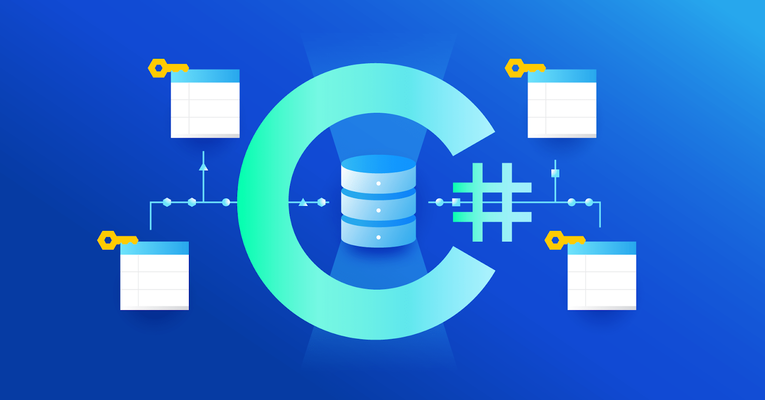

An Expert Workaround for Executing Complex Entity Framework Core Stored Procedures
By Pankaj Kansodariya




Top .NET Developers Are in High Demand.
