Paradoxia epidemica
in Dialogue
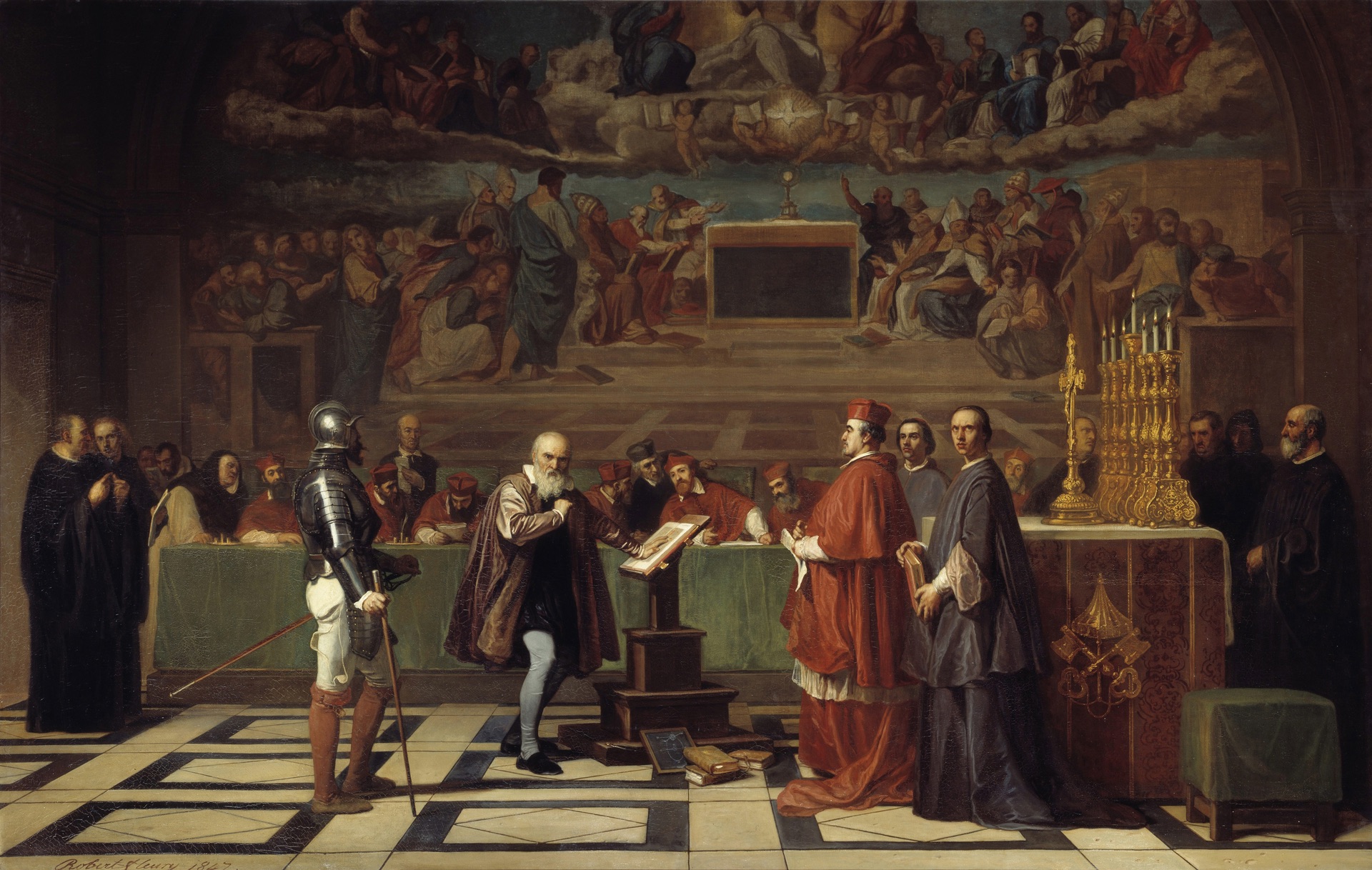
ガリレオ裁判, Joseph-Nicolas Robert-Fleury, Galilée devant le Saint-Office au Vatican (1847), Paris, musée du Louvre.
Paradoxia epidemica
in Dialogue
ガリレオ裁判, Joseph-Nicolas Robert-Fleury, Galilée devant le Saint-Office au Vatican (1847), Paris, musée du Louvre.
池田光穂
■ガリレオ『天文対話』(1959: 68)のシンプリシオ
※シンプリシオは、プトレマイオスとアリストテレスの追随者であり、アリストテレスのテキストを信奉している。そのため対話者であり解説者と仲裁的な位置 を占めるサグレドと、コペルニクス派のサルビアチから常に反論を食らう。
〈ガリレオによる摘要=科学の諸原理を否定すれば、どんな逆説も主張できる〉「ぼくはわれわれがたえず眼前に有しており、またこれらについてアリストテレ スが二巻の書物を書いた生成と消滅が自然にあるかどうかを疑うようなことには耳を傾けることができません。それに科学の諸原理を否定し、まったく明らかな ことが疑われねばならぬとすれば、欲すること何でも立証でき、またどんな逆説も主張できるということを知らないものがあるでしょうか。またもし君が、一日 中草木や動物が生成し消滅しているのをみていないのなら、ほかに何を見ているのですか。どうして、君は反対性の間に永遠につづけられる争いをみないのです か。また地が水に変わり、水が空気に、空気が火に変化し、さらに空気が凝結して雲に、雨に、霰(あられ)、嵐になるのをみないのですか」(1959: 68)(この後にサグレドの論破とシンプリシオの防戦が続く)。
出典:ガリレオ・ガリレイ『天文対話(上)』青木靖三訳、岩波文庫、岩波書店、1959年
★天文対話

| Dialogue
Concerning the Two Chief World Systems (Dialogo sopra i due massimi
sistemi del mondo) is a 1632 book by Galileo Galilei comparing Nicolaus
Copernicus's heliocentric system model with Ptolemy's geocentric model.
Written in Italian, it was translated into Latin as Systema cosmicum[1]
(Cosmic System) in 1635 by Matthias Bernegger.[2] The book was
dedicated to Galileo's patron, Ferdinando II de' Medici, Grand Duke of
Tuscany, who received the first printed copy on February 22, 1632.[3]
It consists of four Socratic dialogues between the Copernican Salviati,
the educated layman Sagredo and the geocentrist Simplicio. They discuss
the findings of their "mutual friend the Academician" (Galileo). In the heliocentric system, the Earth and other planets orbit the Sun, while in the Ptolemaic system, everything in the Universe circles around the Earth. The Dialogue was published in Florence under a formal license from the Inquisition. In 1633, Galileo was found to be "vehemently suspect of heresy" based on the book, which was then placed on the Index of Forbidden Books, from which it was not removed until 1835 (after the theories it discussed had been permitted in print in 1822).[4] In an action that was not announced at the time, the publication of anything else he had written or ever might write was also banned in Catholic countries.[5] |
『二
つの主要な世界体系に関する対話』(Dialogo sopra i due massimi sistemi del
mondo)は、1632年に出版されたガリレオ・ガリレイの著作であり、ニコラウス・コペルニクスの地動説とプトレマイオスの天動説を比較している。イ
タリア語で書かれた本書は、1635年にマティアス・ベルネッガーによってラテン語に翻訳され、『Systema
cosmicum』[1](『宇宙体系』)として出版された。[2]
この書は、ガリレオの後援者であるトスカーナ大公フェルディナンド2世・デ・メディチに献呈され、彼は1632年2月22日に最初の印刷本を手にした。
[3]
本書は、コペルニクス派のサルヴィアティ、教養ある素人のサグレド、そして地動説反対派のシンプリシオによる4つのソクラテス式対話で構成されている。彼
らは「共通の友人であるアカデミー会員」(ガリレオ)の発見について議論する。 地動説では、地球や他の惑星が太陽の周りを公転するが、プトレマイオスの体系では、宇宙のすべてのものが地球の周りを回っている。『対話篇』は、異端審問 所からの正式な許可を得てフィレンツェで出版された。1633年、ガリレオはこの本を根拠に「異端の疑いが極めて強い」と判定され、同書は禁書目録に掲載 された。同書が禁書目録から削除されたのは1835年になってからである(同書で論じられた理論が1822年に印刷物として許可された後のことである)。 [4] 当時は公表されなかった措置として、カトリック諸国では、彼がこれまでに執筆した、あるいは今後執筆する可能性のあるあらゆる著作の出版も禁止された。 [5] |
| Overview While writing the book, Galileo referred to it as his Dialogue on the Tides, and when the manuscript went to the Inquisition for approval, the title was Dialogue on the Ebb and Flow of the Sea. He was ordered to remove all mention of tides from the title and to change the preface because not granting approval to such a title would look like approval of his theory of the tides using the motion of the Earth as proof. As a result, the formal title on the title page is Dialogue, which is followed by Galileo's name, academic posts, and followed by a long subtitle. The name by which the work is now known was extracted by the printer from the description on the title page when permission was given to reprint it with an approved preface by a Catholic theologian in 1744.[6] This must be kept in mind when discussing Galileo's motives for writing the book. Although the book is presented formally as a consideration of both systems (as it needed to be in order to be published at all), there is no question that the Copernican side gets the better of the argument.[7] Structure The book is presented as a series of discussions, over a span of four days, among two philosophers and a layman: Salviati argues for the Copernican position and presents some of Galileo's views directly, calling him the "Academician" in honor of Galileo's membership in the Accademia dei Lincei. He is named after Galileo's friend Filippo Salviati (1582–1614). Sagredo is an intelligent layman who is initially neutral. He is named after Galileo's friend Giovanni Francesco Sagredo (1571–1620). Simplicio, a dedicated follower of Ptolemy and Aristotle, presents the traditional views and the arguments against the Copernican position. He is supposedly named after Simplicius of Cilicia, a sixth-century commentator on Aristotle, but it was suspected the name was a double entendre, as the Italian for "simple" (as in "simple minded") is "semplice".[8] Simplicio is modeled on two contemporary conservative philosophers, Lodovico delle Colombe (1565–1616?), Galileo's opponent, and Cesare Cremonini (1550–1631), a Paduan colleague who had refused to look through the telescope.[9] Colombe was the leader of a group of Florentine opponents of Galileo's, which some of the latter's friends referred to as "the pigeon league".[10] Content The discussion is not narrowly limited to astronomical topics, but ranges over much of contemporary science. Some of this is to show what Galileo considered good science, such as the discussion of William Gilbert's work on magnetism. Other parts are important to the debate, answering erroneous arguments against the Earth's motion. A classic argument against Earth motion is the lack of speed sensations of the Earth surface, though it moves, by the Earth's rotation, at about 1700 km/h at the equator. In this category there is a thought experiment in which a man is below decks on a ship and cannot tell whether the ship is docked or is moving smoothly through the water: he observes water dripping from a bottle, fish swimming in a tank, butterflies flying, and so on; and their behavior is the same whether the ship is moving or not. This is a classic exposition of the inertial frame of reference and refutes the objection that if we were moving hundreds of kilometres an hour as the Earth rotated, anything that one dropped would rapidly fall behind and drift to the west. The bulk of Galileo's arguments may be divided into three classes: Rebuttals to the objections raised by traditional philosophers; for example, the thought experiment on the ship. Observations that are incompatible with the Ptolemaic model: the phases of Venus, for instance, which simply could not happen, or the apparent motions of sunspots, which could only be explained in the Ptolemaic or Tychonic systems as resulting from an implausibly complicated precession of the Sun's axis of rotation.[11] Arguments showing that the elegant unified theory of the Heavens that the philosophers held, which was believed to prove that the Earth was stationary, was incorrect; for instance, the mountains of the Moon, the moons of Jupiter, and the very existence of sunspots, none of which was part of the old astronomy. Generally, these arguments have held up well in terms of the knowledge of the next four centuries. Just how convincing they ought to have been to an impartial reader in 1632 remains a contentious issue. Galileo attempted a fourth class of argument: Direct physical argument for the Earth's motion, by means of an explanation of tides. As an account of the causation of tides or a proof of the Earth's motion, it is a failure. The fundamental argument is internally inconsistent and actually leads to the conclusion that tides do not exist. But, Galileo was fond of the argument and devoted the "Fourth Day" of the discussion to it. The degree of its failure is—like nearly anything having to do with Galileo—a matter of controversy. On the one hand, the whole thing has recently been described in print as "cockamamie."[12] On the other hand, Einstein used a rather different description: It was Galileo's longing for a mechanical proof of the motion of the earth which misled him into formulating a wrong theory of the tides. The fascinating arguments in the last conversation would hardly have been accepted as proof by Galileo, had his temperament not got the better of him. [Emphasis added][13][14] |
概要 ガリレオはこの本を執筆中、それを『潮汐に関する対話』と呼んでいたが、原稿が異端審問所に承認を求めて提出された際、タイトルは『海の満ち引きに関する 対話』となっていた。彼は、そのようなタイトルを承認しないことは、地球の運動を証拠とする彼の潮汐説を承認しているように見えるため、タイトルから潮汐 に関する言及をすべて削除し、序文を変更するよう命じられた。その結果、タイトルページ上の正式なタイトルは『対話』となり、その後にガリレオの名前、学 職、そして長い副題が続いている。現在この著作が知られている名称は、1744年にカトリックの神学者による承認済みの序文を添えて再版が許可された際、 印刷業者がタイトルページの記述から抽出したものである。[6] ガリレオがこの本を執筆した動機について論じる際には、この点を念頭に置いておく必要がある。本書は形式上、両方の体系を検討したものとして提示されてい る(出版されるためにはそうせざるを得なかった)が、議論においてコペルニクス派が優勢であることに疑いの余地はない。[7] 構成 本書は、2人の哲学者と1人の一般人による、4日間にわたる一連の議論として構成されている: サルヴィアティはコペルニクス説を擁護し、ガリレオの『リンチェイ学院』会員であることを称えて彼を「アカデミー会員」と呼び、ガリレオの見解を直接提示する。彼の名は、ガリレオの友人フィリッポ・サルヴィアティ(1582–1614)に由来する。 サグレドは、当初は中立の立場をとる聡明な素人である。彼はガリレオの友人ジョヴァンニ・フランチェスコ・サグレド(1571–1620)にちなんで名付けられた。 シンプリシオは、プトレマイオスとアリストテレスの熱心な信奉者であり、伝統的な見解とコペルニクス説に対する反論を提示する。彼は6世紀のアリストテレ ス注釈者であるキリキアのシンプリキウスにちなんで名付けられたとされるが、イタリア語で「単純な」(「単純な考え」という意味で)を意味する 「semplice」との語呂合わせであるとの疑いもあった。[8] シンプリシオは、ガリレオの対立者であったロドヴィコ・デッレ・コロンベ(1565–1616?)と、望遠鏡を覗くことを拒んだパドヴァの同僚チェーザ レ・クレモニーニ(1550–1631)という、2人の当時の保守的な哲学者をモデルにしている。[9] コロンベは、ガリレオのフィレンツェにおける反対派グループのリーダーであり、ガリレオの友人たちの一部は彼らを「鳩同盟」と呼んでいた。[10] 内容 議論は天文学の話題に限定されているわけではなく、当時の科学の多くの分野に及んでいる。その一部は、ウィリアム・ギルバートの磁気に関する研究について の議論など、ガリレオが優れた科学とみなしたものを示すものである。他の部分は、地球の運動に対する誤った反論に答えるものであり、論争において重要であ る。 地球の運動に対する典型的な反論は、地球の表面に速度感覚がないという点である。しかし実際には、地球の自転により、赤道付近では時速約1700キロメー トルで移動している。このカテゴリーには、ある思考実験が含まれている。船の甲板下にいる男が、船が停泊しているのか、それとも水面を滑らかに移動してい るのか判別できないというものである。彼は、瓶から滴り落ちる水、水槽を泳ぐ魚、飛び回る蝶などを観察するが、それらの振る舞いは船が動いていようがいま いが同じである。これは慣性座標系の古典的な説明であり、地球の自転に伴い時速数百キロメートルで移動しているならば、何かを落とした場合、それは急速に 後方に落ち、西へ流れていくはずだという反論を退けるものである。 ガリレオの議論の大部分は、以下の3つの類に分類できる: 伝統的な哲学者たちによって提起された異議への反論。例えば、船に関する思考実験などである。 プトレマイオスの天体モデルと矛盾する観測結果:例えば、あり得ないはずの金星の満ち欠けや、プトレマイオスやティコ・ブラーエの体系では、太陽の自転軸の信じがたいほど複雑な歳差運動の結果としてしか説明できない太陽黒点の視運動などである。[11] 哲学者たちが提唱し、地球が静止していることを証明すると信じられていた、天界に関する洗練された統一理論が誤りであることを示す論拠。例えば、月の山々、木星の衛星、そして黒点の存在そのものである。これらはどれも、従来の天文学には含まれていなかった。 概して、これらの論拠は、その後の4世紀にわたる知識の進展に照らしても、十分にその妥当性を保っている。1632年当時、公平な読者にとってこれらがどれほど説得力のあるものであったべきかは、依然として議論の的となっている。ガリレオは第四の論証を試みた: 潮汐の説明を通じて、地球の運動を直接的に物理的に論証するものだ。 潮汐の成因の説明としても、地球の運動の証明としても、これは失敗作である。この根本的な論証は内部的に矛盾しており、実際には潮汐は存在しないという結 論に至ってしまう。しかし、ガリレオはこの論証を気に入っており、議論の「第四日」をこれに割いた。その失敗の度合いは――ガリレオに関わるほとんどのこ とと同様に――議論の的となっている。一方で、この論証全体は最近、ある出版物において「とんでもない」と評されている[12]。他方、アインシュタイン はかなり異なる表現を用いた: ガリレオを誤った潮汐理論の構築へと導いたのは、地球の運動に対する機械的な証明への執着であった。最後の対話における魅力的な議論も、もし彼の気性が彼 を支配していなければ、ガリレオ自身によって証明として受け入れられることはまずなかっただろう。[強調は筆者による][13][14] |
Omissions A copy of the Dialogo, Florence edition, located at the Tom Slick rare book collection at Southwest Research Institute, in Texas. The Dialogue does not treat the Tychonic system, which was becoming the preferred system of many astronomers at the time of publication and which was ultimately proven incorrect. The Tychonic system is a motionless Earth system but not a Ptolemaic system; it is a hybrid system of the Copernican and Ptolemaic models. Mercury and Venus orbit the Sun (as in the Copernican system) in small circles, while the Sun in turn orbits a stationary Earth; Mars, Jupiter, and Saturn orbit the Sun in much larger circles, which means they also orbit the Earth. The Tychonian system is mathematically equivalent to the Copernican system, except that the Copernican system predicts a stellar parallax, while the Tychonian system predicts none. Stellar parallax was not measurable until the 19th century, and therefore there was at the time no valid disproof of the Tychonic system on empirical grounds, nor any decisive observational evidence for the Copernican system. Galileo never took Tycho's system seriously, as can be seen in his correspondence, regarding it as an inadequate and physically unsatisfactory compromise. A reason for the absence of Tycho's system (in spite of many references to Tycho and his work in the book) may be sought in Galileo's theory of the tides, which provided the original title and organizing principle of the Dialogue. While the Copernican and Tychonic systems are equivalent geometrically, they are quite different dynamically. Galileo's tidal theory entailed the actual, physical movement of the Earth; that is, if true, it would have provided the kind of proof that Foucault's pendulum apparently provided two centuries later. Without reference to Galileo's tidal theory, there would be no difference between the Copernican and Tychonic systems. Galileo fails to discuss the possibility of non-circular orbits, although Johannes Kepler had sent him a copy of his 1609 book, Astronomia nova, in which he proposes elliptical orbits—correctly calculating that of Mars.[15] Prince Federico Cesi's letter to Galileo of 1612 treated the two laws of planetary motion presented in the book as common knowledge;[16][17] Kepler's third law was published in 1619. Four and a half decades after Galileo's death, Isaac Newton published his laws of motion and gravity, from which a heliocentric system with planets in approximately elliptical orbits is deducible. |
省略 テキサス州のサウスウエスト研究所にあるトム・スリック希少書籍コレクションに所蔵されている、『対話篇』フィレンツェ版の写本。 『対話篇』は、出版当時多くの天文学者に支持されつつあったが、最終的には誤りであることが証明されたティコ・ブラーエの体系については扱っていない。 ティコ・ブラヘの体系は、地球が静止している体系ではあるが、プトレマイオスの体系ではない。これはコペルニクスとプトレマイオスのモデルのハイブリッド 体系である。水星と金星は(コペルニクスの体系と同様に)小さな円軌道で太陽を公転し、太陽は静止した地球の周りを公転する。火星、木星、土星ははるかに 大きな円軌道で太陽を公転しており、これは彼らが地球の周りも公転していることを意味する。ティコ・ブラーエの体系は、コペルニクスの体系が恒星視差を予 測するのに対し、ティコ・ブラーエの体系はそれを予測しない点を除けば、数学的にはコペルニクスの体系と同等である。恒星視差は19世紀になるまで測定不 可能であったため、当時、経験的根拠に基づくティコ・ブラーエの体系の有効な反証も、コペルニクスの体系を裏付ける決定的な観測的証拠も存在しなかった。 ガリレオは、書簡からも明らかなように、ティコ・ブラーエの体系を真剣に受け止めることは決してなく、それを不十分で物理的に納得のいかない妥協案と見な していた。本書においてティコ・ブラーエやその業績への言及が数多くあるにもかかわらず、ティコ・ブラーエの体系が取り上げられていない理由の一つは、ガ リレオの潮汐理論にあるかもしれない。この理論こそが、『対話篇』の原題および構成原理を提供したものである。コペルニクス説とティコ説は幾何学的には同 等だが、力学的には大きく異なる。ガリレオの潮汐説は、地球の実際の物理的な運動を前提としていた。つまり、もしそれが真実であれば、2世紀後にフーコー の振り子が明らかにしたような種類の証明を提供したことになるだろう。ガリレオの潮汐説に言及しなければ、コペルニクス説とティコ説の間に違いは生じな い。 ガリレオは非円軌道の可能性について論じていないが、ヨハネス・ケプラーは1609年の著書『アストロノミア・ノヴァ』の写しを彼に送っており、その中で ケプラーは楕円軌道を提唱し、火星の軌道を正しく計算していた。[15] 1612年にフェデリコ・チェージ公がガリレオに送った書簡では、同書で提示された惑星運動の二法則が常識として扱われていた。[16][17] ケプラーの第三法則は1619年に出版された。ガリレオの死から45年余り後、アイザック・ニュートンは運動法則と万有引力の法則を発表し、そこから惑星 がほぼ楕円軌道を描く地動説が導き出される。 |
| Summary "Preface: To the Discerning Reader" refers to the ban on the "Pythagorean opinion that the earth moves" and says that the author "takes the Copernican side with a pure mathematical hypothesis".[18] He introduces the friends Sagredo and Salviati with whom he had had discussions as well as the peripatetic philosopher Simplicio. Day one Salviati starts with Aristotle's proof of the completeness and perfection of the world (i.e. the universe) because of its three dimensions. Simplicio points out that three was favoured by the Pythagoreans whereas Salviati cannot understand why three legs are better than two or four. He suggests that the numbers were "trifles which later spread among the vulgar" and that their definitions, such as those of straight lines and right angles, were more useful in establishing the dimensions. Simplicio's response was that Aristotle thought that in physical matters mathematical demonstration was not always needed. Salviati attacks Aristotle's definition of the heavens as incorruptible and unchanging whilst only the lunar-bound zone shows change. He points to the changes seen in the skies: the new stars of 1572 and 1604 and sunspots, seen through the new telescope. There is a discussion about Aristotle's use of a priori arguments. Salviati suggests that Aristotle uses Aristotle’s personal experience to choose an appropriate argument to prove just as others do and that Aristotle would change his mind in the present circumstances. Simplicio argues that sunspots could simply be small opaque objects passing in front of the Sun, but Salviati points out that some appear or disappear randomly and those at the edge are flattened, unlike separate bodies. Therefore, "it is better Aristotelian philosophy to say 'Heaven is alterable because my senses tell me' than 'Heaven is unalterable because Aristotle was so persuaded by reasoning.'" He adds "we possess a much better basis for reasoning about celestial things than Aristotle did...Now we, thanks to the telescope, have brought the heavens thirty or forty times closer to us than they were to Aristotle, so that we can discern many things in them that he could not see; among other things these sunspots, which were absolutely invisible to him."[19] Experiments with a mirror are used to show that the Moon's surface must be opaque and not a perfect crystal sphere as Simplicio believes. He refuses to accept that mountains on the Moon cause shadows, or that reflected light from the Earth is responsible for the faint outline in a crescent moon. Sagredo holds that he considers the Earth noble because of the changes in it whereas Simplicio says that change in the Moon or stars would be useless because they do not benefit man. Salviati points out that days on the Moon are a month long and despite the varied terrain that the telescope has disclosed, it would not sustain life. Humans acquire mathematical truths slowly and hesitantly, whereas God knows the full infinity of them intuitively. And when one looks into the marvelous things men have understood and contrived, then clearly the human mind is one of the most excellent of God's works. |
概要 「序文:見識ある読者に」では、「地球が動いているというピタゴラス派の説」が禁じられていることに触れ、著者は「純粋な数学的仮説をもってコペルニクス の立場をとる」と述べている。[18] 彼は、議論を交わした友人であるサグレドとサルヴィアティ、そしてペリパトス派の哲学者シンプリシオを紹介する。 第1日 サルヴィアティは、世界(すなわち宇宙)が3次元であることから、その完全性と完璧さを証明したアリストテレスの論証から話を始める。シンプリシオは、3 という数がピタゴラス派に好まれていたことを指摘するが、サルヴィアティは、なぜ3本足の方が2本や4本より優れているのか理解できない。彼は、それらの 数は「後に庶民の間で広まった些細な事柄」に過ぎず、直線や直角といった定義の方が、次元を確立する上でより有用であったと示唆する。シンプリシオの返答 は、アリストテレスは物理的な事柄において、数学的な証明が常に必要とは限らないと考えていたというものだった。 サルヴィアティは、天界を「腐敗せず不変である」と定義したアリストテレスを批判し、変化が見られるのは月が支配する領域だけだと主張する。彼は、 1572年と1604年に現れた新星や、新しい望遠鏡を通して観測された黒点など、空に見られる変化を指摘する。アリストテレスのア・プリオリ論証の用い 方について議論が行われる。サルヴィアティは、アリストテレスも他の人々と同様に、個人的な経験に基づいて証明にふさわしい論証を選んでいるに過ぎず、現 在の状況であればアリストテレスも考えを変えるだろうと示唆する。 シンプリシオは、黒点は単に太陽の前を横切る小さな不透明な物体である可能性があると主張するが、サルヴィアティは、それらがランダムに出現したり消えた りすること、また端の部分が平らになっていること(独立した物体とは異なる)を指摘する。したがって、「『アリストテレスが推論によってそう確信したから 天は不変である』と言うよりも、『私の感覚がそう告げているから天は可変である』と言う方が、アリストテレス哲学にかなっている」と。彼はさらにこう付け 加える。「我々は、天体について推論するための、アリストテレスよりもはるかに優れた根拠を持っている……今や我々は、望遠鏡のおかげで、天をアリストテ レスがいた時代よりも30倍、40倍も近くに引き寄せた。それゆえ、彼が目にできなかった多くの事柄を、我々はそこに見分けることができる。とりわけ、彼 には全く見えなかったこれらの黒点もそうだ。」 [19] 鏡を用いた実験により、月の表面は不透明であり、シンプリシオが信じているような完全な水晶の球体ではないことが示される。彼は、月の山々が影を落とすと いう説や、三日月のかすかな輪郭が地球からの反射光によるものだという説を受け入れようとしない。 サグレドは、地球には変化があるからこそ高貴だと考えるが、シンプリシオは、月や星の変化は人間に利益をもたらさないため無意味だと述べる。サルヴィア ティは、月の1日は1ヶ月に相当し、望遠鏡によって明らかになった多様な地形にもかかわらず、生命を維持することはできないと指摘する。人間は数学的真理 をゆっくりと、躊躇しながら獲得するが、神はそれらの無限のすべてを直感的に知っている。そして、人間が理解し、考案してきた驚くべき事柄を見れば、人間 の精神こそが神の業の中でも最も優れたものの一つであることは明らかだ。 |
| Day two The second day starts by repeating that Aristotle would be changing his opinions if he saw what they were seeing. "It is the followers of Aristotle who have crowned him with authority, not he who has usurped or appropriated it to himself."[20] There is one supreme motion—that by which the Sun, Moon, planets and fixed stars appear to be moved from east to west in the space of 24 hours. This may as logically belong to the Earth alone as to the rest of the universe. Aristotle and Ptolemy, who understood this, do not argue against any other motion than this diurnal one. Motion is relative: the position of the sacks of grain on a ship can be identical at the end of the voyage despite the movement of the ship. Why should we believe that nature moves all these extremely large bodies with inconceivable velocities rather than simply moving the moderately sized Earth? If the Earth is removed from the picture, what happens to all the movement? The movement of the skies from east to west is the opposite of all the other motions of the heavenly bodies which are from west to east; making the Earth rotate brings it into line with all the others. Although Aristotle argues that circular motions are not contraries, they could still lead to collisions. The great orbits of the planets take longer than the shorter: Saturn and Jupiter take many years, Mars two, whereas the Moon takes only a month. Jupiter's moons take even less. This is not changed if the Earth rotates every day, but if the Earth is stationary then we suddenly find that the sphere of the fixed stars rotates in 24 hours. Given the distances, that would more reasonably be thousands of years. In addition some of these stars have to travel faster than others: if the Pole Star was precisely at the axis, then it would be entirely stationary whereas those of the equator have unimaginable speed. The solidity of this supposed sphere is incomprehensible. Make the Earth the primum mobile and the need for this extra sphere disappears.  Actual path of cannonball B is from C to D They consider three main objections to the motion of the Earth: that a falling body would be left behind by the Earth and thus fall far to the west of its point of release; that a cannonball fired to the west would similarly fly much further than one fired to the east; and that a cannonball fired vertically would also land far to the west. Salviati shows that these do not take account of the impetus of the cannon. He also points out that attempting to prove that the Earth does not move by using vertical fall commits the logical fault of paralogism (assuming what is to be proved), because if the Earth is moving then it is only in appearance that it is falling vertically; in fact it is falling at a slant, as happens with a cannonball rising through the cannon (illustrated). In rebutting a work which claims that a ball falling from the Moon would take six days to arrive, the odd-number rule is introduced: a body falling 1 unit in an interval would fall 3 units in the next interval, 5 units in the subsequent one, etc. This gives rise to the rule by which the distance fallen is according to the square of the time. Using this he calculates the time is really little more than 3 hours. He also points out that density of the material does not make much difference: a lead ball might only accelerate twice as fast as one of cork. In fact, a ball falling from such a height would not fall behind but ahead of the vertical because the rotational motion would be in ever-decreasing circles. What makes the Earth move is similar to whatever moves Mars or Jupiter and is the same as that which pulls the stone to Earth. Calling it gravity does not explain what it is. |
2日目 2日目は、もしアリストテレスが彼らが見ているものを見れば、自分の見解を変えるだろうという主張を繰り返すことから始まる。「アリストテレスに権威の冠 を授けたのは彼の追随者たちであり、彼がそれを奪い取ったわけでも、自らに帰属させたわけでもない」[20]。唯一の至高の運動がある――それは、太陽、 月、惑星、そして恒星が24時間の間に東から西へと動いているように見える運動である。この運動は、宇宙の他の部分と同様に、論理的には地球のみに帰属し 得るものである。このことを理解していたアリストテレスとプトレマイオスは、この日周運動以外のいかなる運動に対しても反論していない。運動は相対的なも のである。船上の穀物袋の位置は、船が動いていても航海終了時には同じままである可能性がある。なぜ我々は、適度な大きさの地球を動かすのではなく、自然 がこれら極めて巨大な天体を想像を絶する速度で動かしていると信じるべきなのか。もし地球をこの図式から取り除いたら、すべての運動はどうなるのか? 東から西への天球の運動は、西から東へ向かう他のすべての天体の運動とは逆方向である。地球を回転させることで、他のすべての天体の動きと整合させること ができる。アリストテレスは円運動は相反するものではないと論じているが、それでも衝突を引き起こす可能性はある。惑星の大きな軌道は、短い軌道よりも時 間がかかる。土星と木星は数十年、火星は2年かかるのに対し、月はわずか1ヶ月だ。木星の衛星はさらに短い。地球が毎日回転してもこの事実は変わらない が、もし地球が静止しているとすれば、固定星の球体が24時間で回転することになる。距離を考慮すれば、それはむしろ数千年に相当するはずだ。さらに、こ れらの恒星の中には他の恒星よりも速く移動しなければならないものもある。もし北極星が正確に軸上にあれば、それは完全に静止していることになるが、赤道 上の恒星は想像を絶する速度で移動することになる。この想定される球体の実体性は理解しがたい。地球を「第一動者」とすれば、この余分な球体の必要性は消 え去る。 砲弾Bの実際の軌道はCからDへである 彼らは、地球の運動に対する三つの主な反論を検討している。すなわち、落下する物体は地球に取り残され、放出点から遥か西に落下することになるという主 張、西に向けて発射された砲弾は同様に東に向けて発射されたものよりはるかに遠くまで飛ぶという主張、そして垂直に発射された砲弾もまた遥か西に着地する という主張である。サルヴィアティは、これらが大砲の運動量を考慮に入れていないことを示す。また彼は、垂直落下を用いて地球が動かないことを証明しよう とする試みは、パラロジズム(証明すべきことを前提とする)という論理的誤りを犯していると指摘する。なぜなら、もし地球が動いているならば、垂直に落下 しているのは見かけ上のことであり、実際には砲身を通って上昇する砲弾と同様に、斜めに落下しているからである(図示)。 月から落下する球体が到着するのに6日かかると主張する著作への反論において、「奇数則」が導入される。ある間隔で1単位落下した物体は、次の間隔では3 単位、その次は5単位と落下していく。これにより、落下距離は時間の二乗に比例するという法則が導かれる。これを用いて、彼は実際に要する時間は3時間強 に過ぎないと計算する。また、物質の密度による影響はさほど大きくないとも指摘している。鉛の球はコルクの球に比べて2倍速く加速するに過ぎない。実際、 そのような高さから落下する球は、回転運動が次第に小さくなる円を描くため、垂直線より後ろではなく前に落ちることになる。地球を動かす力は、火星や木星 を動かす力と同様であり、石を地球に引き寄せる力と同じものである。それを重力と呼んでも、それが何であるかは説明にならない。 |
| Day three Salviati starts by dismissing the arguments of a book against the novas he has been reading overnight.[21] Unlike comets, these were stationary and their lack of parallax easily checked and thus could not have been in the sublunary sphere. Simplicio now gives the greatest argument against the annual motion of the Earth that if it moves then it can no longer be the center of the zodiac, the world. Aristotle gives proofs that the universe is finite bounded and spherical. Salviati points out that these disappear if he denies him the assumption that it is movable, but allows the assumption initially in order not to multiply disputes.  The Solar System Salviati points out that if anything is the center, it must be the Sun not the Earth, because all the planets are closer or further away from the Earth at different times, Venus and Mars up to eight times. He encourages Simplicio to make a plan of the planets, starting with Venus and Mercury which are easily seen to rotate about the Sun. Mars must also go about the Sun (as well as the Earth) since it is never seen horned, unlike Venus now seen through the telescope; similarly with Jupiter and Saturn. Earth, which is between Mars with a period of two years and Venus with nine months, has a period of a year which may more elegantly be attributed to motion than a state of rest. Sagredo brings up two other common objections. If the Earth rotated, the mountains would soon be in a position that one would have to descend them rather than ascend. Secondly, the motion would be so rapid that someone at the bottom of a well would have only a brief instance to glimpse a star as it traversed. Simplicio can see that the first is no different from travelling over the globe, as any who have circumnavigated but though he realizes the second is the same as if the heavens were rotating, he still does not understand it. Salviati says the first is no different from those who deny the antipodes. For the second, he encourages Simplicio to decide what fraction of the sky can be seen from down the well. Salviati brings up another problem, which is that Mars and Venus are not as variable as the theory would suggest. He explains that the size of a star to the human eye is affected by the brightness and the sizes are not real. This is resolved by use of the telescope which also shows the crescent shape of Venus. A further objection to the movement of the Earth, the unique existence of the Moon, has been resolved by the discovery of the moons of Jupiter, which would appear like Earth's Moon to any Jovian.  How retrogression is explained by Copernicus Copernicus has succeeded in reducing some of the uneven motions of Ptolemy who had to deal with motions that sometimes go fast, sometimes slow, and sometimes backwards, by means of vast epicycles. Mars, above the Sun's sphere, often falls far below it, then soars above it. These anomalies are cured by the annual movement of the Earth. This is explained by a diagram in which the varying motion of Jupiter is shown using the Earth's orbit. Simplicio produces another booklet in which theological arguments are mixed with astronomic, but Salviati refuses to address the issues from Scripture. So he produces the argument that the fixed stars must be at an inconceivable distance with the smallest larger than the whole orbit of the Earth. Salviati explains that this all comes from a misrepresentation of what Copernicus said, resulting in a huge over-calculation of the size of a sixth magnitude star. But many other famous astronomers over-estimated the size of stars by ignoring the brightness factor. Not even Tycho, with his accurate instruments, set himself to measure the size of any star except the Sun and Moon. But Salviati (Galileo) was able to make a reasonable estimate simply by hanging a cord to obscure the star and measuring the distance from eye to cord. But still many cannot believe that the fixed stars can individually be as big or bigger than the Sun. To what end are these? Salviati maintains that "it is brash for our feebleness to attempt to judge the reasons for God's actions, and to call everything in the universe vain and superfluous which does not serve us".[22] Has Tycho or any of his disciples tried to investigate in any way phenomena that might affirm or deny the movement of the Earth? Do any of them know how much variation is needed in the fixed stars? Simplicio objects to conceding that the distance of the fixed stars is too great for it to be detectable. Salviati points out how difficult it is even to detect the varying distances of Saturn. Many of the positions of the fixed stars are not known accurately and far better instruments than Tycho's are needed: say using a sight with a fixed position 60 miles away. Sagredo then asks Salviati to explain how the Copernican system explains the seasons and inequalities of night and day. This he does with the aid of a diagram showing the position of the Earth in the four seasons. He points out how much simpler it is than the Ptolemaic system. But Simplicio thinks Aristotle was wise to avoid too much geometry. He prefers Aristotle's axiom to avoid more than one simple motion at a time. |
3日目 サルヴィアティはまず、昨夜読みふけっていた新星を否定するある書物の主張を一蹴する。[21] 彗星とは異なり、新星は静止しており、視差がないことは容易に確認できたため、月下界にあるはずがない。シンプリシオはここで、地球の年周運動に対する最 大の反論を提示する。すなわち、もし地球が動いているなら、もはや黄道帯の中心、すなわち世界の中心であることはできないというのだ。アリストテレスは、 宇宙が有限で境界があり、球体であることを証明している。サルヴィアティは、地球が可動であるという前提を否定すればこれらの証明は成立しなくなるが、論 争を長引かせないために、ひとまずその前提を認める、と指摘する。 太陽系 サルヴィアティは、もし何かが中心であるとするなら、それは地球ではなく太陽でなければならないと指摘する。なぜなら、すべての惑星は時期によって地球か らの距離が異なるものであり、金星や火星に至っては最大で8倍もの差があるからだ。彼はシンプリシオに対し、金星と水星から始めて惑星の図を作成するよう 勧める。これら2つの惑星は、太陽の周りを公転していることが容易に確認できるからだ。火星も(地球と同様に)太陽の周りを回っているに違いない。なぜな ら、望遠鏡を通して今見えている金星とは異なり、火星が「角」を向いている姿は決して見られないからだ。木星や土星についても同様である。2年周期の火星 と9ヶ月周期の金星の間に位置する地球の周期は1年であり、これは静止状態であるよりも、運動によるものと考える方がより優雅である。 サグレドは、他にも二つの一般的な反論を挙げる。もし地球が回転しているなら、山々はすぐに、登るのではなく下りなければならない位置にくるはずだ。第二 に、その運動はあまりにも速いため、井戸の底にいる者が星が通過するのを目にするのはほんの一瞬に過ぎないだろう。シンプリシオは、第一の反論は地球を横 断する旅と異なるものではないと理解している。実際、地球を一周した者なら誰でもそう思うだろう。しかし、第二の反論については、天体が回転している場合 と同じことだと気づきつつも、依然として理解できていない。サルヴィアティは、第一の反論については、対蹠地を否定する者たちと異なるものではないと述べ る。第二の反論については、井戸の底から空のどの程度の範囲が見えるか、シンプリシオ自身に判断するよう促す。 サルヴィアティは別の問題を提起する。それは、火星と金星が、その理論が示唆するほど変化に富んでいないという点だ。彼は、人間の目に見える星の大きさは 明るさの影響を受け、その大きさは実在するものではないと説明する。これは望遠鏡を用いることで解決され、望遠鏡は金星の三日月形も示す。地球の運動に対 するさらなる反論、すなわち月の唯一無二の存在という点は、木星の衛星の発見によって解決された。木星の住人から見れば、それらの衛星は地球の月と同じよ うに見えるだろう。 コペルニクスによる逆行の説明 コペルニクスは、時として速く、時として遅く、時には逆行する動きに対処するために巨大な周転円を用いざるを得なかったプトレマイオスの不規則な運動の一 部を、見事に解消することに成功した。太陽の球体の上にある火星は、しばしばそのはるか下まで落ち込み、その後、その上へと舞い上がる。これらの異常は、 地球の年周運動によって解消される。これは、地球の軌道を用いて木星の変動する運動を示した図によって説明される。 シンプリシオは、神学的な議論と天文学的な議論を混ぜ合わせた別の小冊子を作成するが、サルヴィアティは聖書に基づいてこれらの問題に取り組むことを拒否 する。そこで彼は、恒星は想像を絶する距離にあり、最も小さいものでさえ地球の軌道全体よりも大きいに違いないという論拠を提示する。サルヴィアティは、 これらはすべてコペルニクスの発言の誤解に起因するものであり、その結果、6等星の大きさが大幅に過大評価されていると説明する。しかし、他の多くの著名 な天文学者たちも、明るさの要因を無視したために星の大きさを過大評価していた。正確な観測機器を持っていたティコでさえ、太陽と月以外の星の大きさを測 定しようとはしなかった。だがサルヴィアティ(ガリレオ)は、単に紐を垂らして星を隠し、目から紐までの距離を測るだけで、合理的な推定を行うことができ た。 それでもなお、多くの者は、恒星が一つひとつが太陽と同じかそれ以上の大きさになり得るとは信じられない。それらは一体何のためなのか。サルヴィアティ は、「我々の微力な者が、神の御業の理由を判断しようと試み、我々に役立たない宇宙のあらゆるものを虚しく、余分なものと呼ぶのは、無謀なことだ」と主張 する。[22] ティコやその弟子たちは、地球の運動を肯定あるいは否定しうる現象を、何らかの形で調査しようとしたことがあるだろうか。彼らの中に、恒星の距離にどれほ どの変動が必要かを知っている者はいるだろうか。シンプリシオは、恒星の距離が遠すぎて検出できないという点を認めることに異議を唱える。サルヴィアティ は、土星の距離の変動を検出することさえいかに困難であるかを指摘する。恒星の位置の多くは正確には知られておらず、ティコのものよりはるかに優れた観測 器具が必要だ。例えば、60マイル離れた固定位置から望遠鏡を使うようなものだ。 そこでサグレドは、サルヴィアティに対し、コペルニクスの体系が四季や昼夜の長短の変動をどのように説明するのかを問う。サルヴィアティは、四季における 地球の位置を示す図を用いてこれを説明する。彼は、それがプトレマイオスの体系よりもいかに単純であるかを指摘する。しかしシンプリシオは、アリストテレ スが幾何学を過度に用いることを避けたのは賢明だったと考えている。彼は、一度に一つの単純な運動しか行わないというアリストテレスの公理を好むのだ。 |
| Day four They are in Sagredo's house in Venice, where tides are an important issue, and Salviati wants to show the effect of the Earth's movement on the tides. He first points out the three periods of the tides: daily (diurnal), generally with intervals of 6 hours of rising and six more of falling; monthly, seemingly from the Moon, which increases or decreases these tides; and annual, leading to different sizes at the equinoxes. He considers first the daily motion. Three varieties are observed: in some places the waters rise and fall without any forward motion; in others they move towards the east and back to the west without rising or falling; in still others there is a combination of both—this happens in Venice where the waters rise on entering and fall on leaving. In the Straits of Messina there are very swift currents between Scylla and Charybdis. In the open Mediterranean the alteration of height is small but the currents are noticeable. Simplicio counters with the peripatetic explanations, which are based on the depths of the sea, and the dominion of the Moon over the water, though this does not explain the risings when the Moon is below the horizon. But he admits it could be a miracle. When the water in Venice rises, where does it come from? There is little rise in Corfu or Dubrovnik. From the ocean through the Straits of Gibraltar? It's much too far away and the currents are too slow. So could the movement of the container cause the disturbance? Consider the barges that bring water into Venice. When they hit an obstacle, the water rushes forward; when they speed up it will go to the back. For all this disturbance there is no need for new water and the level in the middle stays largely constant though the water there rushes backwards and forwards. Consider a point on the Earth under the joint action of the annual and diurnal movements. At one time these are added together and 12 hours later they act against each other, so there is an alternate speeding up and slowing down. So the ocean basins are affected in the same way as the barge particularly in an east-west direction. The length of the barge makes a difference to the speed of oscillations, just as the length of a plumb bob changes its speed. The depth of water also makes a difference to the size of vibrations. The primary effect only explains tides once a day; one must look elsewhere for the six-hour change, to the oscillation periods of the water. In some places, such as the Hellespont and the Aegean the periods are briefer and variable. But a north-south sea like the Red Sea has very little tide whereas the Messina Strait carries the pent up effect of two basins. Simplicio objects that if this accounts for the water, should it not even more be seen in the winds? Salviati suggests that the containing basins are not so effective and the air does not sustain its motion. Nevertheless, these forces are seen by the steady winds from east to west in the oceans in the tropical zone. It seems that the Moon also is taking part in the production of the daily effects, but that is repugnant to his mind. The motions of the Moon have caused great difficulty to astronomers. It's impossible to make a full account of these things given the irregular nature of the sea basins. |
4日目 彼らはヴェネツィアのサグレドの家にいる。そこでは潮汐が重要な問題となっており、サルヴィアティは地球の動きが潮汐に及ぼす影響を示そうとしている。彼 はまず、潮汐の3つの周期を指摘する。日周(昼夜)の周期で、一般に6時間の満潮と6時間の干潮が交互に訪れるもの。月周の周期で、月によるものと見ら れ、これによって潮汐の増減が生じるもの。そして年周の周期で、春分や秋分には潮汐の大きさが異なるもの。彼はまず日周の運動について考察する。3つの様 式が観察される。ある場所では、水は前進することなく満ち引きする。別の場所では、水は満ちたり引いたりすることなく東へ進み、西へ戻る。さらに別の場所 では、その両方が組み合わさっている――これはヴェネツィアで起こり、水は入ってくる時に満ち、去る時に引く。メッシーナ海峡では、スキュラとカリュブ ディスの間に非常に速い海流がある。地中海の外洋では、水位の変化は小さいが、海流は顕著である。 シンプリシオは、海の深さや月が水に及ぼす支配力に基づくペリパトス学派の説で反論するが、これは月が地平線の下にある時の潮位の上昇を説明できない。し かし彼は、それが奇跡である可能性も認めている。ヴェネツィアで水位が上昇する時、その水はどこから来るのか。コルフやドゥブロヴニクではほとんど上昇し ない。ジブラルタル海峡を通って大洋からか?距離が遠すぎるし、海流も遅すぎる。では、運搬船の動きが擾乱を引き起こしているのだろうか?ヴェネツィアに 水を運ぶはしけを考えてみよう。障害物にぶつかると水は前方へ押し出され、速度を上げれば後方へ流れる。こうした擾乱があっても、新たな水は必要なく、中 央の水位はほぼ一定に保たれている。そこでは水が前後に激しく動いているにもかかわらずだ。 年周運動と日周運動の複合的な作用を受ける地球上のある点を考えてみよう。ある時点ではこれらが加算され、12時間後には互いに打ち消し合うため、加速と 減速が交互に起こる。したがって、海洋盆地も、特に東西方向において、はしけと同様に影響を受ける。はしけの長さがその振動速度に影響を与えるのと同様 に、鉛直線の長さもその速度を変える。水深もまた、振動の大きさに影響を与える。主たる作用は1日1回の潮汐しか説明できない。6時間ごとの変化について は、水の振動周期に原因を求める必要がある。ヘレスポントやエーゲ海のような場所では、周期は短く変動しやすい。しかし、紅海のような南北に伸びる海では 潮汐がほとんど見られないのに対し、メッシーナ海峡では二つの水域の力が蓄積された影響が表れている。 シンプリシオは、もしこれが水の影響だとすれば、風においてさらに顕著に現れるはずではないかと反論する。サルヴィアティは、水域を囲む盆地の影響はそれ ほど強くなく、空気はその運動を維持しないのだと示唆する。とはいえ、熱帯地域の海では、東から西へと吹く安定した風によって、こうした力が確認されてい る。月もまた日周的な現象の発生に関与しているようだが、それは彼の考えには受け入れがたいものだ。月の運動は天文学者たちに大きな難題をもたらしてき た。海盆の不規則な性質を考えると、これらの事象を完全に説明することは不可能である。 |
| "Discourse on the Tides", 1616 Galileo essay |
『潮汐に関する言説』、1616年 ガリレオの論文 |
| Further reading Kelly, Henry Ansgar (2026). "Galileo's Three Repudiations of Copernicanism – Two Coerced and One Volunteered". The Historical Journal. |
追加文献(さらに読む) ケリー、ヘンリー・アンスガー(2026)。「ガリレオによるコペルニクス説の3度の否定――2度は強要され、1度は自発的であった」。『ヒストリカル・ジャーナル』。 |
| Notes 01. Maurice A. Finocchiaro: Retrying Galileo, 1633-1992, University of California Press, 2007 ISBN 0-520-25387-6, ISBN 978-0-520-25387-2 Journal for the history of astronomy, 2005 Gindikin, Semen Grigorʹevich (1988). Tales of physicists and mathematicians. Birkhäuser. p. 62. ISBN 978-0-8176-3317-2. Retrieved February 22, 2011. The Trial of Galileo: A Chronology Archived 2007-02-05 at the Wayback Machine See Galileo affair for more details, including sources. Drake, Stillman (1990). Galileo: Pioneer Scientist. U of Toronto Press. p. 187. ISBN 0-8020-2725-3. Koestler, Arthur (1989). The Sleepwalkers. Penguin Arkana. p. 480. ISBN 9780140192469. Arthur Koestler, The Sleepwalkers: A History of Man's Changing Vision of the Universe (1959), Penguin Books, 1986 edition: ISBN 0-14-055212-X, 978014055212X 1990 reprint: ISBN 0-14-019246-8, ISBN 978-0-14-019246-9 [1] Stillman Drake: Galileo at Work: His Scientific Biography, Courier Dover Publications, 2003, ISBN 0-486-49542-6, page 355 : Cremonini and delle Colombe 10. "La legha del pippione". "Pippione" is a pun on Colombe's surname—which is the plural of the Italian word for dove. Galileo's friends, the painter, Lodovico Cardi da Cigoli (in Italian), his former student, Benedetto Castelli, and a couple of his other correspondents often referred to Colombe as "il Colombo", which means "the Pigeon". Galileo himself used this term a couple of times in a letter to Cigoli of October, 1611 (Edizione Nazionale 11:214). The more derisive nickname, "il Pippione", sometimes used by Cigoli (Edizione Nazionale 11:176, 11:229, 11:476, 11:502), is a now archaic Italian word with a triple entendre. Besides meaning "young pigeon", it is also a jocular term for a testicle, and a Tuscan dialect word for a fool. Drake, (1970, pp. 191–196), Linton (2004, pp. 211–12), Sharratt (1994, p. 166). This is not true, however, for geocentric systems—such as that proposed by Longomontanus—in which the Earth rotated. In such systems the apparent motion of sunspots could be accounted for just as easily as in Copernicus's. Timothy Moy (September 2001). "Science, Religion, and the Galileo Affair". Skeptical Inquirer. 25 (5): 43–49. Archived from the original on January 29, 2009. "Foreword; By Albert Einstein; Authorized Translation by Sonja Bargmann". Archived from the original on September 25, 2007.(passages omitted) Paul Mainwood (August 9, 2003). "Thought Experiments in Galileo and Newton's Mathematical Philosophy" (PDF). 7th Annual Oxford Philosophy Graduate Conference. 7th Annual Oxford Philosophy Graduate Conference. Archived from the original (PDF) on September 22, 2006., quoting page xvii of Einstein's foreword in G. Galilei (1953) [1632]. Dialogue Concerning the Two Chief World Systems. Translated by Stillman Drake. Berkeley and Los Angeles, CA: The University of California Press. Gillispie, Charles Coulston (1960). The Edge of Objectivity: An Essay in the History of Scientific Ideas. Princeton University Press. p. 51. ISBN 0-691-02350-6. Galileo's Opere, Ed.Naz., XI (Florence 1901) pp. 365–367 "Kepler", by Max Caspar, p. 137 Gailei, Galileo (1632). Dialogue Concerning the Two Chief World Systems (Modern Library Science Classics ed.). p. 5. Galilei, Galileo (1632). Dialogue Concerning the Two Chief World Systems (Modern Library Science Classics ed.). pp. 64–65. 20. Galilei, Galileo (1632). Dialogue Concerning the Two Chief World Systems (Modern Library Science Classics ed.). p. 128. Chiaramonti, Scipio (1628). De tribus novis stellis. 22. Gailei, Galileo (1632). Dialogue Concerning the Two Chief World Systems (Modern Library Science Classics ed.). p. 427. |
注 01. モーリス・A・フィノッキアーロ:『ガリレオの再審――1633-1992』、カリフォルニア大学出版局、2007年 ISBN 0-520-25387-6、ISBN 978-0-520-25387-2 『天文学史ジャーナル』、2005年 ギンディキン、セメン・グリゴリエヴィチ(1988年)。『物理学者と数学者の物語』。ビルクハウザー。p. 62。ISBN 978-0-8176-3317-2。2011年2月22日閲覧。 『ガリレオの裁判:年表』2007年2月5日ウェイバックマシンにアーカイブ 出典を含む詳細については、ガリレオ事件を参照のこと。 ドレイク、スティルマン(1990)。『ガリレオ:先駆的科学者』。トロント大学出版局。p. 187。ISBN 0-8020-2725-3。 ケストラー、アーサー(1989)。『夢遊者たち』。ペンギン・アルカナ。p. 480。ISBN 9780140192469。 アーサー・ケストラー、『夢遊者たち:宇宙に対する人間の変遷する視座の歴史』(1959年)、ペンギン・ブックス、1986年版:ISBN 0-14-055212-X、978014055212X 1990年再版:ISBN 0-14-019246-8、 ISBN 978-0-14-019246-9 [1] スティルマン・ドレイク:『ガリレオの研究:その科学的伝記』、クーリエ・ドーバー出版、2003年、ISBN 0-486-49542-6、355ページ:クレモニーニとデッレ・コロンベ 10. 「ラ・レガ・デル・ピッピオーネ」。「ピッピオーネ」は、コロンベの姓(イタリア語で「鳩」の複数形)をかけた駄洒落である。ガリレオの友人である画家ロ ドヴィコ・カルディ・ダ・チゴリ(イタリア語表記)、かつての教え子ベネデット・カステッリ、および他の数人の文通相手は、しばしばコロンベを「イル・コ ロンボ」(「鳩」を意味する)と呼んでいた。ガリレオ自身も、1611年10月のチゴリへの手紙の中でこの表現を数回使用している(『エディツィオーネ・ ナツィオナーレ』11:214)。チゴリが時折用いた、より嘲笑的なあだ名「イル・ピッピオーネ」(『エディツィオーネ・ナツィオナーレ』11:176、 11:229、 11:476、11:502)は、現在では古語となったイタリア語であり、三重の意味を持つ。すなわち「若い鳩」を意味するだけでなく、睾丸を冗談めかし て指す言葉であり、さらにトスカーナ方言で「愚か者」を意味する言葉でもある。 ドレイク(1970年、pp. 191–196)、リントン(2004年、pp. 211–12)、シャラット(1994年、p. 166)。しかし、ロンゴモンタヌスが提唱したような、地球が回転する地心説の体系においては、これは当てはまらない。そのような体系においても、黒点の 視運動はコペルニクスの体系と同様に容易に説明できた。 ティモシー・モイ(2001年9月)。「科学、宗教、そしてガリレオ事件」。『Skeptical Inquirer』。25巻5号:43–49頁。2009年1月29日にオリジナルからアーカイブされた。 「序文;アルベルト・アインシュタイン著;ソーニャ・バルグマンによる公認翻訳」。2007年9月25日にオリジナルからアーカイブされた。(一部省略) ポール・メインウッド(2003年8月9日)。「ガリレオとニュートンの数学的哲学における思考実験」(PDF)。第7回オックスフォード哲 学大学院生会議。第7回オックスフォード哲学大学院生会議。2006年9月22日にオリジナル(PDF)からアーカイブされたもの。G. ガリレイ(1953年)[1632年]『二大世界体系に関する対話』の序文xviiページを引用。スティルマン・ドレイク訳。カリフォルニア州バークレー およびロサンゼルス:カリフォルニア大学出版局。 ギルスピー、チャールズ・コールストン(1960年)。『客観性の限界:科学思想史の一論』プリンストン大学出版局。51頁。ISBN 0-691-02350-6。 ガリレオ『作品集』、Ed.Naz.、XI(フィレンツェ 1901年)365–367頁 「ケプラー」、マックス・カスパー著、137頁 ガリレイ、ガリレオ(1632年)。『二つの主要な世界体系に関する対話』(モダン・ライブラリー・サイエンス・クラシックス版)。5頁。 ガリレイ、ガリレオ(1632年)。『二つの主要な世界体系に関する対話』(モダン・ライブラリー・サイエンス・クラシックス版)。64–65頁。 20. ガリレイ、ガリレオ(1632年)。『二つの主要な世界体系に関する対話』(モダン・ライブラリー・サイエンス・クラシック版)。128頁。 キアラモンティ、スキピオ(1628年)。『三つの新しい星について』。 22. ガリレオ・ガリレイ(1632年)。『二つの主要な世界体系に関する対話』(モダン・ライブラリー・サイエンス・クラシック版)。427頁。 |
| Bibliography Drake, Stillman (1970). Galileo Studies. Ann Arbor: The University of Michigan Press. ISBN 0-472-08283-3. Linton, Christopher M. (2004). From Eudoxus to Einstein – A History of Mathematical Astronomy. Cambridge: Cambridge University Press. ISBN 978-0-521-82750-8. Sharratt, Michael (1994). Galileo: Decisive Innovator. Cambridge: Cambridge University Press. ISBN 0-521-56671-1. |
参考文献 ドレイク、スティルマン(1970)。『ガリレオ研究』。アナーバー:ミシガン大学出版局。ISBN 0-472-08283-3。 リントン、クリストファー・M.(2004)。『エウドクソスからアインシュタインへ――数学天文学の歴史』。ケンブリッジ:ケンブリッジ大学出版局。ISBN 978-0-521-82750-8. シャラット、マイケル(1994)。『ガリレオ:決定的な革新者』。ケンブリッジ:ケンブリッジ大学出版局。ISBN 0-521-56671-1。 |
リンク
文献
その他の情報

Do not paste, but [re]think this message for all undergraduate students!!!
Copyleft,
CC, Mitzub'ixi Quq Chi'j, 1996-2099
