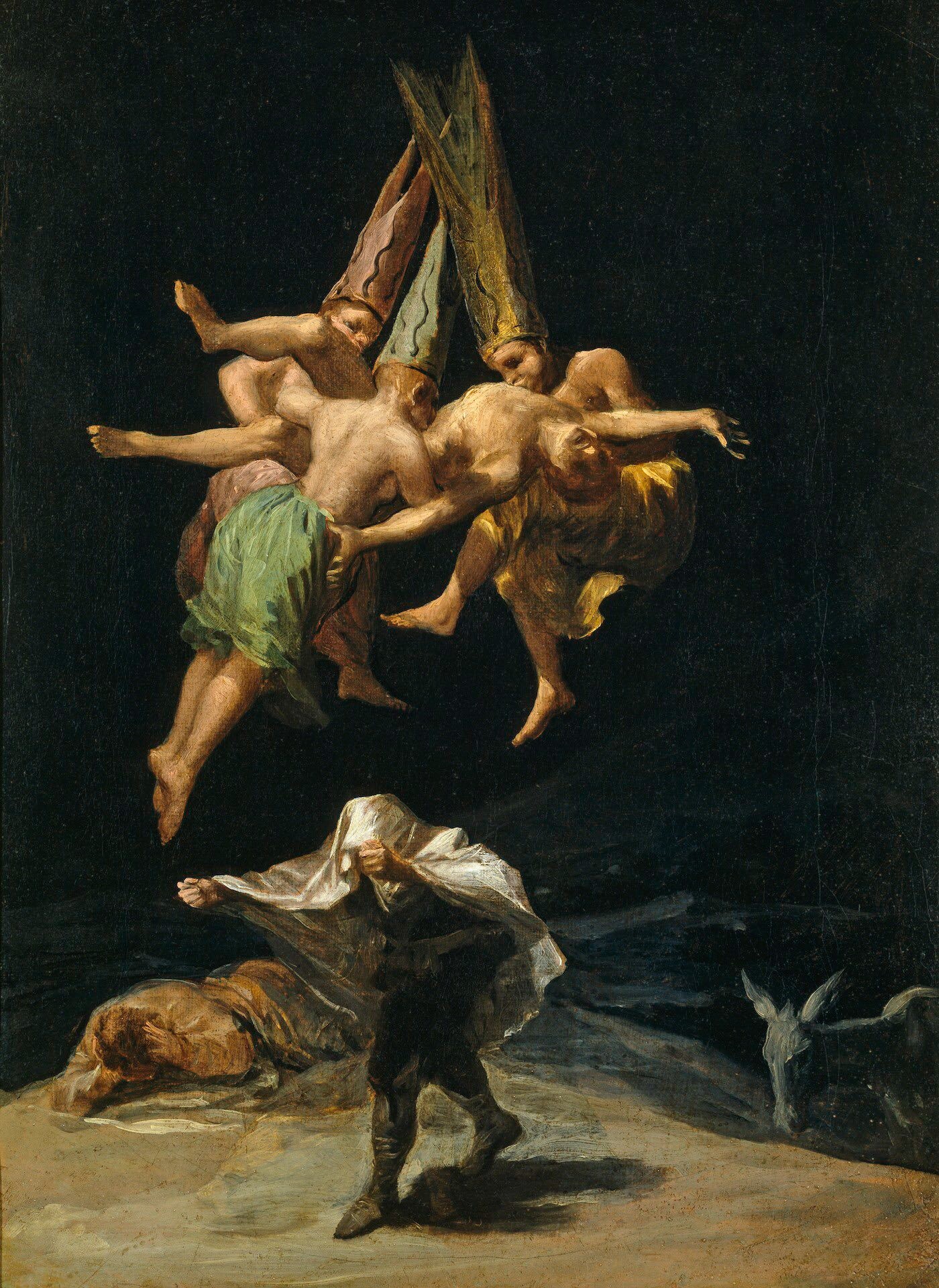
ゴヤ「魔女の浮遊」1798
年ごろ
妖術を信じなくても妖術を理解することは可能である
Anthropologists
explain what happens
when they are attributed to witchcraft, and not, as among ourselves, to
other causes.
ゴヤ「魔女の浮遊」1798
年ごろ
妖術(ようじゅつ)とは、ザンデ語のマング (mangu)を、エヴァンズ=プリチャードが翻訳した際に与えた witchcraft の翻訳語である。ウィッチクラフトつまり、中世ヨーロッパのウィッチ(魔女)がおこなう施術としてのwitchcraft の用例は古く、OEDには11〜12世紀まで遡れるという。しかし人類学のいうウィッチクラフトは、エヴァンズ=プリチャードの独特のマングの用例で使わ れるもので、マングという言葉と概念で理解するアザンデ人以外には、類似のものがみつからないという、ややこしい起源をもつものである。
マングとは、アザンデの平民のうちある特殊な人がも つ腸の突起のことで、その人が他人に腹をたてたりすると、そのマングが超自然的な力を発揮して、その他人に危害を加えるという。マングをもっていることは 自覚するが、誰に対して攻撃するのかは、本人にもわからないらしい。それに対してアザンデの支配者層たる貴族では、意図的な超自然的な攻撃が可能で、エ ヴァンズ=プリチャードは、こちらのほうをソーサリー(sorcery)と名づけている。この訳語は、社会人類学者の馬淵東一(まぶち・とういち 1909-1988)が日本語の「邪術(じゃじゅつ)」の翻訳語として定着させたらしい(長島 2007)。この邪術(=悪意のある人が意図的に超自然的な力を行使して攻撃する)というものと、珍しいアザンデの妖術(=本人の意図とは無関係に他者に 危害を加えてしまう)を多くの研究者は混乱して使っているのが現状である。
エヴァンズ=プリチャードの民族誌(1937)のマ ングの検討以前にも古典的な意味で/そして邪術の意味で、ウィッチクラフト(妖術)が使われるのは、超自然的な攻撃(意図的、非意図的を問わない)と、そ の神判(あるいは審判=近代法体系でも呪術や妖術を悪意のあるものとして禁止することがある)が、どのような社会にも膾炙しているからである。にも関わら ず、非意図的な攻撃という意味でのアザンデのマングの重要な意義は失われない。
17■妖術を信じなくても妖術を理解することは可能 である
"Now this is not because the anthropologist becomes committed to a belief in witchcraft as the Azande understand it. He views it from quite a different angle. By reference to witchcraft, the Azande account for certain sorts of misfortune, and death; the anthropologist does not seek to account for these troubles by his theory of witchcraft, but to explain what happens when they are attributed to witchcraft, and not, as among ourselves, to other causes. "( Lienhardt 1956:102)
「もっとも、これは人類学者がアザンデ族が理解するような意味での妖術を信じるようになった からではない。彼はまったく異なる角度からそれを捉えているのだ。アザンデ族は妖術を根拠として、ある種の不幸や死を説明している。人類学者は、自身の妖 術理論を用いてこうした災難を説明しようとするのではなく、それらが妖術のせいだとされ、私たちの間のように他の原因によるものではないとされた場合に、 何が起こるのかを解明しようとしているのである。」
★Witchcraft, Oracles and Magic Among the Azande (「アザンデ人の世界」)

| Witchcraft, Oracles and Magic Among the Azande
is one of social anthropology's most noted texts. In this work E. E.
Evans-Pritchard examines the witchcraft beliefs of the Azande, a group
of agricultural people in southern Sudan on the upper Nile. There are
two main points he makes in the work. One is that witchcraft can be
seen as a safety valve, that releases potential harmful conflict into
less damaging activities. The other is that it can be seen as an
attempt to explain a complex alien world in a society's own terms of
reference. Together these make for a practical solution that is
consistent and rational.[1][2][3] Eriksen and Nielsen (2013) argue that the remarkable thing about Evans-Pritchard is the way the two approaches are combined into a single approach. In this approach the Zande are seen to have developed a belief systems that both acts stabilise and harmonise the order of society, but also is both rational and logically consistent. A logical consistency based on the presuppositions of the Azande's thought. Eriksen and Nielsen also report the criticism of other scholars of Evans-Pritchard's monograph. They record Peter Winch (1958) as making a big deal out of Evans-Pritchard's structural-functionalist approach where in he is reported as arguing that the Azande's belief in witchcraft is reduced to its ‘social functions’.[4][5] The work was a development of his earlier (1928). Oracle-magic of the Azande. Sudan Notes and Records, 11, 1-53.. |
『アザンデ族における妖術、神託、そして呪術』は、社会人類学において
最も著名な著作の一つである。本書において、E・E・エヴァンズ=プリチャードは、ナイル川上流の南スーダンに暮らす農耕民族であるアザンデ族の妖術信仰
を考察している。著者は本書の中で、主に二つの点を指摘している。一つは、妖術は「安全弁」として捉えることができるという点である。つまり、潜在的に有
害な対立を、被害の少ない活動へと転換させる役割を果たすのだ。もう一つは、魔術が、複雑な異質な世界を、社会独自の枠組みで説明しようとする試みとして
捉えられるという点だ。これら二つの要素が相まって、一貫性があり合理的な実践的な解決策を形成している。[1][2][3] エリクセンとニールセン(2013)は、エヴァンズ=プリチャードの特筆すべき点は、これら二つのアプローチが単一のアプローチへと統合されている点にあ ると論じている。このアプローチにおいて、ザンデ族は、社会の秩序を安定させ調和させるだけでなく、かつ合理的かつ論理的に一貫した信仰体系を発展させた ものと見なされる。その論理的一貫性は、アザンデ族の思考の前提に基づいている。エリクセンとニールセンはまた、エヴァンズ=プリチャードの単行本に対す る他の学者たちの批判についても報告している。彼らは、ピーター・ウィンチ(1958)がエヴァンズ=プリチャードの構造機能主義的アプローチを大げさに 取り上げたと記録しており、そこでは、アザンデ族の妖術への信仰がその「社会的機能」に還元されていると論じているとされている。[4] [5] この著作は、彼の以前の研究(1928年)『アザンデの呪術』(Sudan Notes and Records, 11, 1-53)を発展させたものである。 |
| The book Evans-Pritchard, E.E. (1937). Witchcraft, Oracles, and Magic Among the Azande. Oxford: The Clarendon Press Contents I. Witchcraft is an organic and hereditary phenomenon II. The notion of witchcraft explains unfortunate events III. Sufferers from misfortune seek for witches among their enemies IV. Are witches conscious agents? V. Witch-doctors VI. Training of a novice in the art of a witch-doctor VII. The place of witch-doctors in Zande society VIII. The Poison Oracle in daily life IX. Problems arising from consultation of the poison oracle X. Other Zande oracles XI. Magic and medicines XII. An association for the practice of magic XIII. Witchcraft, oracles, and magic, in the situation of death |
本書 エヴァンズ=プリチャード, E.E. (1937). 『アザンデ族における妖術、神託、および呪術』. オックスフォード:クラレンドン・プレス 目次 I. 妖術は有機的かつ遺伝的な現象である II. 妖術の概念は不幸な出来事を説明する III. 苦悩に見舞われた者は敵の中に妖術師を探す IV. 妖術師は意識的な行為者か? V. 妖術師 VI. 妖術師の技芸における見習いの修業 VII. ザンデ社会における妖術師の位置づけ VIII. 日常生活における毒の神託 IX. 毒の神託の相談から生じる問題 X. その他のザンデの神託 XI. 呪術と薬 XII. 呪術の実践のための団体 XIII. 死の状況における妖術、神託、および妖術 |
| References 1. Eriksen, T. H., & Nielsen, F. S. (2013). A history of anthropology. Pluto Press. (pp.70-71) 2. Wheater, K. (2017). An Analysis of EE Evans-Pritchard's Witchcraft, Oracles and Magic Among the Azande. Macat Library. 3. Otto, B. C., & Stausberg, M. (2014). Edward E. Evans-Pritchard Witchcraft, Oracles and Magic among the Azande. In Defining Magic (pp. 155-169). Routledge. 4. Eriksen, T. H., & Nielsen, F. S. (2013). A history of anthropology. Pluto Press. (pp.70-71) 5. Winch, P. (1958). The idea of a social science and its relation to philosophy. Routledge. |
参考文献 1. Eriksen, T. H., & Nielsen, F. S. (2013). 『人類学の歴史』. Pluto Press. (pp.70-71) 2. Wheater, K. (2017). 『E. E. エヴァンズ=プリチャード著『アザンデ族における妖術、神託、および呪術』の分析』. Macat Library. 3. オットー, B. C., & スタウスバーグ, M. (2014). エヴァンズ=プリチャード『アザンデ族における妖術、神託、および魔法』. 『魔術の定義』所収 (pp. 155-169). ラウトリッジ. 4. エリクセン, T. H., & ニールセン, F. S. (2013). 『人類学の歴史』. プルート・プレス. (pp.70-71) 5. ウィンチ, P. (1958). 『社会科学の理念とその哲学との関係』. ラウトリッジ. |
| https://en.wikipedia.org/wiki/Witchcraft,_Oracles_and_Magic_Among_the_Azande |
|
★アフリカにおける妖術(Witchcraft より)
| Main article: Witchcraft in Africa |
|
| African witchcraft
encompasses various beliefs and practices. These beliefs often play a
significant role in shaping social dynamics and can influence how
communities address challenges and seek spiritual assistance. Much of
what "witchcraft" represents in Africa has been susceptible to
misunderstandings and confusion, due to a tendency among western
scholars to approach the subject through a comparative lens vis-a-vis
European witchcraft.[122] For example, the Maka people of Cameroon
believe in an occult force known as djambe, that dwells inside a
person. It is often translated as "witchcraft" or "sorcery", but it has
a broader meaning that encompasses supernatural harm, healing and
shapeshifting; this highlights the problem of using European terms for
African concepts.[123] |
ア
フリカの妖術は、多様な信仰や慣習を包含している。こうした信仰は、社会構造を形成する上でしばしば重要な役割を果たし、地域社会が課題に対処したり、霊
的な助けを求めたりする方法に影響を与えることがある。アフリカにおける「妖術」の多くが誤解や混乱を招きやすいのは、西洋の学者たちが、ヨーロッパの妖
術(魔術)との比較という視点からこのテーマにアプローチする傾向があるためである。[122]
例えば、カメルーンのマカ族は、人の体内に宿る「ジャンベ」と呼ばれる超自然的な力を信じている。これはしばしば「妖術」や「呪術」と訳されるが、その意
味はより広く、超自然的な害、治癒、変身などを包含しており、これはアフリカの概念にヨーロッパの用語を用いることの問題点を浮き彫りにしている。
[123] |
| While
some 19th–20th century European colonialists tried to stamp out
witch-hunting in Africa by introducing laws banning accusations of
witchcraft, some former African colonies introduced laws banning
witchcraft after they gained independence. This has produced an
environment that encourages persecution of suspected witches.[124] |
19
世紀から20世紀にかけて、一部のヨーロッパの植民地支配者は、妖術の告発を禁じる法律を導入することでアフリカにおける妖術師狩りを根絶しようとした
が、一方で、かつての植民地であったアフリカ諸国の中には、独立後に妖術を禁じる法律を導入した国もあった。その結果、妖術師と疑われた人々に対する迫害
を助長する環境が生まれている。[124] |
| In
the Central African Republic, hundreds of people are convicted of
witchcraft yearly, with reports of violence against accused women.[125]
The Democratic Republic of the Congo witnessed a disturbing trend of
child witchcraft accusations in Kinshasa, leading to abuse and
exorcisms supervised by self-styled pastors.[126] In Ghana, there are
several "witch camps", where women accused of witchcraft can seek
refuge, though the government plans to close them.[127] |
中央アフリカ共和国では、毎年数百人が妖術の
罪で有罪判決を受けており、告発された女性に対する暴力の報告も寄せられている。[125]
コンゴ民主共和国では、キンシャサで子供に対する妖術師狩りの告発が相次ぐという憂慮すべき傾向が見られ、その結果、自称牧師が監督する虐待や悪魔祓いが
行われている。[126]
ガーナには、妖術師として告発された女性が避難できる「妖術師キャンプ」がいくつか存在するが、政府はこれらを閉鎖する計画である。[127] |
| In
west Kenya, there have been cases of accused witches being burned to
death in their homes by mobs.[128] Malawi faces a similar issue of
child witchcraft accusations, with traditional healers and some
Christian counterparts involved in exorcisms, causing abandonment and
abuse of children.[129] In Nigeria, Pentecostal pastors have
intertwined Christianity with witchcraft beliefs for profit, leading to
the torture and killing of accused children.[130] Sierra Leone's Mende
people see witchcraft convictions as beneficial, as the accused receive
support and care from the community.[131] |
ケ
ニア西部では、妖術師と告発された人々が暴徒によって自宅内で焼き殺される事件が発生している。[128]
マラウイでも、子供に対する妖術師告発という同様の問題に直面しており、伝統的治療師や一部のキリスト教徒が除霊に関与することで、子供たちの遺棄や虐待
を引き起こしている。[129]
ナイジェリアでは、ペンテコステ派の牧師たちが利益を得るためにキリスト教と妖術の信仰を結びつけ、その結果、妖術師とされた子供たちが拷問を受け、殺害
される事態を招いている。[130]
シエラレオネのメンデ族は、妖術師とされた者が地域社会から支援やケアを受けるため、妖術師裁判による有罪判決を有益なものだと見なしている。[131] |
| Lastly,
in Zulu culture, healers known as sangomas protect people from
witchcraft and evil spirits through divination, rituals and
mediumship.[132] However, concerns arise regarding the training and
authenticity of some sangomas. |
最後に、ズールー文化において、「サンゴマ」と呼ばれる治療師たちは、占いや儀式、霊媒術を通じて、人々を妖術や悪霊から守っている[132]。しかし、一部のサンゴマの養成やその正当性については懸念が寄せられている。 |
| In parts of Africa, beliefs
about illness being caused by witchcraft continue to fuel suspicion of
modern medicine, with serious healthcare consequences. HIV/AIDS[133]
and Ebola[134] are two examples of often-lethal infectious disease
epidemics whose medical care and containment has been severely hampered
by regional beliefs in witchcraft. Other severe medical conditions
whose treatment is hampered in this way include tuberculosis, leprosy,
epilepsy and the common severe bacterial Buruli ulcer.[135][136] |
アフリカの一部地域では、病気は妖術によるものだという迷信が、現代医
学に対する不信感を煽り続けており、医療面において深刻な影響を及ぼしている。HIV/エイズ[133]やエボラ出血熱[134]は、しばしば死に至る感
染症の流行例であり、その医療ケアや封じ込めは、地域に根付く妖術への信仰によって著しく妨げられてきた。このよう治療が妨げられている他の重篤な疾患に
は、結核、ハンセン病、てんかん、そして一般的な重篤な細菌性疾患であるブルリ潰瘍などが挙げられる。[135][136] |
| 122 Okeja, Uchenna (2011). 'An
African Context of the Belief in Witchcraft and Magic,' in Rational
Magic. Fisher Imprints. ISBN 978-1-84888-061-0.[page needed] 123. Geschiere, Peter (1997). The Modernity of Witchcraft: Politics and the Occult in Postcolonial Africa. Translated by Peter Geschiere and Janet Roitman. University of Virginia Press. p. 13. ISBN 0-8139-1703-4. Igwe, Leo (September–October 2020). "Accused Witches Burned, Killed in Nigeria". Skeptical Inquirer. Amherst, New York: Center for Inquiry. 124. "The dangers of witchcraft". Archived from the original on 12 March 2010. Retrieved 26 March 2010. 125. "Kolwezi: Accused of witchcraft by parents and churches, children in the Democratic Republic of Congo are being rescued by Christian activists". Christianity Today. September 2009. Archived from the original on 14 November 2011. Retrieved 14 October 2011. 126. Whitaker, Kati (September 2012). "Ghana witch camps: Widows' lives in exile". BBC News. Archived from the original on 20 October 2018. Retrieved 1 September 2012. Kanina, Wangui (21 May 2008). "Mob burns to death 11 Kenyan 'witches'". Reuters. Archived from the original on 20 June 2017. Retrieved 15 September 2016. Byrne, Carrie 2011. "Hunting the vulnerable: Witchcraft and the law in Malawi"; Consultancy Africa Intelligence (16 June): "Stepping Stones Nigeria 2007. Supporting Victims of Witchcraft Abuse and Street Children in Nigeria". humantrafficking.org. Archived from the original on 17 October 2012. West, Harry G. Ethnographic Sorcery (p. 24); 2007. The University of Chicago Press. ISBN 978-0226893983 (pbk.). Cumes, David (2004). Africa in my bones. Claremont: New Africa Books. p. 14. ISBN 978-0-86486-556-4. Kielburger, Craig; Kielburger, Marc (18 February 2008). "HIV in Africa: Distinguishing disease from witchcraft". Toronto Star. Toronto, Ontario: Toronto Star Newspapers Ltd. Archived from the original on 19 October 2017. Retrieved 18 September 2017. "Ebola outbreak: 'Witchcraft' hampering treatment, says doctor". BBC News. London: BBC. 2 August 2014. Archived from the original on 18 July 2021. Retrieved 22 June 2018. citing a doctor from Médecins Sans Frontières: 'A widespread belief in witchcraft is hampering efforts to halt the Ebola virus from spreading' "Social stigma as an epidemiological determinant for leprosy elimination in Cameroon". Journal of Public Health in Africa. Archived from the original on 31 July 2017. Retrieved 27 August 2014. 136 Akosua, Adu (3 September 2014). "Ebola: Human Rights Group Warns Disease Is Not Caused By Witchcraft". The Ghana-Italy News. Archived from the original on 3 September 2014. Retrieved 31 October 2017. |
122 オケジャ、ウチェンナ(2011)。「妖術と魔法への信仰のアフリカ的文脈」、『Rational Magic』所収。Fisher Imprints。ISBN 978-1-84888-061-0。[ページ番号不明] 123. ゲシエール、ピーター(1997)。『妖術の現代性:ポストコロニアル・アフリカにおける政治とオカルト』. ピーター・ゲシエール、ジャネット・ロイトマン訳. バージニア大学出版局. p. 13. ISBN 0-8139-1703-4. イグウェ、レオ(2020年9月–10月).「ナイジェリアで妖術師とされた人々が焼かれ、殺害される」.『Skeptical Inquirer』. ニューヨーク州アマースト:Center for Inquiry. 124. 「妖術の危険性」。2010年3月12日にオリジナルからアーカイブ。2010年3月26日閲覧。 125. 「コルウェジ:両親や教会から妖術の容疑をかけられたコンゴ民主共和国の子供たちが、キリスト教活動家によって救出されている」。 『Christianity Today』。2009年9月。2011年11月14日にオリジナルからアーカイブ。2011年10月14日閲覧。 126. ウィテカー、カティ(2012年9月)。「ガーナの妖術師収容所:追放された未亡人たちの生活」。BBCニュース。2018年10月20日にオリジナルからアーカイブ。2012年9月1日閲覧。 カニナ、ワンギ(2008年5月21日)。「暴徒がケニアの『妖術師』11人を焼き殺す」。ロイター。2017年6月20日にオリジナルからアーカイブ。2016年9月15日閲覧。 バーン、キャリー 2011。「弱者を狩る:マラウイにおける妖術と法律」; Consultancy Africa Intelligence (2012年10月17日): 「ステッピング・ストーンズ・ナイジェリア 2007年。ナイジェリアにおける妖術虐待の被害者とストリートチルドレンへの支援」。humantrafficking.org。2012年10月17日にオリジナルからアーカイブ。 ウェスト、ハリー・G. 『民族誌的妖術』(p. 24);2007年。シカゴ大学出版局。ISBN 978-0226893983(ペーパーバック)。 キュームズ、デビッド(2004年)。『Africa in my bones』。クレアモント:ニュー・アフリカ・ブックス。p. 14。ISBN 978-0-86486-556-4。 キールバーガー、クレイグ;キールバーガー、マーク(2008年2月18日)。「アフリカのHIV:病気と妖術の区別」。トロント・スター。オンタリオ州 トロント:トロント・スター・ニューズペーパーズ社。2017年10月19日にオリジナルからアーカイブ。2017年9月18日閲覧。 「エボラ出血熱の流行:『妖術』が治療の妨げになっていると医師が語る」。BBCニュース。ロンドン:BBC。2014年8月2日。2021 年7月18日にオリジナルからアーカイブ。2018年6月22日閲覧。国境なき医師団の医師の言葉を引用:「妖術に対する広範な信仰が、エボラウイルスの 拡散を食い止める取り組みを妨げている」 「カメルーンにおけるハンセン病根絶の疫学的決定要因としての社会的スティグマ」。『Journal of Public Health in Africa』。2017年7月31日にオリジナルからアーカイブ。2014年8月27日閲覧。 136 Akosua, Adu (2014年9月3日). 「エボラ:人権団体、病気は妖術によるものではないと警告」. The Ghana-Italy News. 2014年9月3日にオリジナルからアーカイブ。2017年10月31日閲覧。 |
| Works cited Abusch, Tzvi (2002). Mesopotamian Witchcraft: Toward a History and Understanding of Babylonian Witchcraft Beliefs and Literature. Brill Styx. ISBN 978-90-04-12387-8. Adler, Margot (2006). Drawing Down the Moon: Witches, Druids, Goddess-Worshippers, and Other Pagans in America Today. New York: Penguin Books. OCLC 515560. Ankarloo, Bengt; Clark, Stuart (2001). Witchcraft and Magic in Europe: Biblical and Pagan Societies. Philadelphia, Pennsylvania: University of Philadelphia Press. ISBN 978-0-8264-8606-6. Buse, Jasper (1995). Cook Islands Maori Dictionary. Cook Islands Ministry of Education. ISBN 978-0-7286-0230-4. Cusack, Carole M. (2009). "The Return of the Goddess: Mythology, Witchcraft and Feminist Spirituality". In Pizza, Murphy; Lewis, James (eds.). Handbook of Contemporary Paganism. Brill. ISBN 978-90-04-16373-7. Davies, Owen (2003). Cunning-Folk: Popular Magic in English History. London: Hambledon Continuum. ISBN 978-1-85285-297-9. Ehrenreich, Barbara; English, Deirdre (2010). Witches, Midwives & Nurses: A History of Women Healers (2nd ed.). New York: Feminist Press at CUNY. ISBN 978-1-55861-690-5. Herrera-Sobek, María (2012). Celebrating Latino Folklore: An Encyclopedia of Cultural Traditions. ABC-CLIO. ISBN 978-0-313-34339-1. Hutton, Ronald (1999). The Triumph of the Moon: A History of Modern Pagan Witchcraft. Oxford University Press. ISBN 978-0-19-820744-3. Hutton, Ronald (2017). The Witch: A History of Fear, from Ancient Times to the Present. Yale University Press. Levack, Brian (2013). The Oxford Handbook of Witchcraft in Early Modern Europe and Colonial America. Oxford University Press. Pócs, É. (1999). Between the Living and the Dead: A Perspective on Witches and Seers in the Early Modern Age. Hungary: Central European University Press. ISBN 978-963-9116-19-1. Reiner, E. (1995). Astral Magic in Babylonia. Philadelphia: American Philosophical Society. ISBN 978-0-87169-854-4. Thomas, Keith (1997). Religion and the Decline of Magic. Oxford, England: Oxford University Press. ISBN 978-0-297-00220-8. Wilby, Emma (2005). Cunning Folk and Familiar Spirits: Shamanistic Visionary Traditions in Early Modern British Witchcraft and Magic. Sussex Academic Press. ISBN 978-1-84519-079-8. Willis, Deborah (2018). Malevolent Nurture: Witch-Hunting and Maternal Power in Early Modern England. Cornell University Press. |
参考文献 アブシュ、ツヴィ(2002)。『メソポタミアの魔術:バビロニアの魔術信仰と文学の歴史と理解に向けて』。ブリル・スティクス。ISBN 978-90-04-12387-8。 アドラー、マーゴット(2006)。『月を引き下ろす:今日のアメリカにおける妖術師、ドルイド、女神崇拝者、その他の異教徒たち』。ニューヨーク:ペンギン・ブックス。OCLC 515560。 アンカルー、ベングト;クラーク、スチュアート(2001)。『ヨーロッパの魔術と魔法:聖書的および異教的社会』。ペンシルベニア州フィラデルフィア:フィラデルフィア大学出版局。ISBN 978-0-8264-8606-6. ビュース、ジャスパー(1995)。『クック諸島マオリ語辞典』。クック諸島教育省。ISBN 978-0-7286-0230-4。 カサック、キャロル・M. (2009). 「女神の帰還:神話、魔術、そしてフェミニスト的スピリチュアリティ」. ピッツァ、マーフィー;ルイス、ジェームズ(編). 『現代異教ハンドブック』. ブリル. ISBN 978-90-04-16373-7. デイヴィス、オーウェン(2003)。『カニング・フォーク:英国史における大衆魔術』。ロンドン:ハンブルドン・コンティニュアム。ISBN 978-1-85285-297-9。 エーレンライク、バーバラ;イングリッシュ、ディアドラ(2010)。『魔女、助産師、そして看護師:女性ヒーラーの歴史』(第2版)。ニューヨーク:CUNYフェミニスト・プレス。ISBN 978-1-55861-690-5。 エレーラ=ソベック、マリア(2012)。『ラティーノ・フォークロアを祝う:文化伝統の百科事典』。ABC-CLIO。ISBN 978-0-313-34339-1。 ハットン、ロナルド(1999)。『月の勝利:近代異教の魔術の歴史』。オックスフォード大学出版局。ISBN 978-0-19-820744-3。 ハットン、ロナルド(2017)。『魔女:古代から現代までの恐怖の歴史』。イェール大学出版局。 レヴァック、ブライアン(2013)。『近世ヨーロッパと植民地時代のアメリカにおける魔女術のオックスフォード・ハンドブック』。オックスフォード大学出版局。 ポッチ、E.(1999)。『生者と死者の間:近世における魔女と予言者への視点』。ハンガリー:中央ヨーロッパ大学出版局。ISBN 978-963-9116-19-1。 ライナー, E. (1995). 『バビロニアの星魔術』. フィラデルフィア: アメリカ哲学協会. ISBN 978-0-87169-854-4. トーマス, キース (1997). 『宗教と魔術の衰退』. オックスフォード(イギリス): オックスフォード大学出版局. ISBN 978-0-297-00220-8. ウィルビー、エマ(2005)。『賢者たちと使い魔:近世英国の魔女狩りと魔術におけるシャーマニズム的幻視の伝統』。サセックス・アカデミック・プレス。ISBN 978-1-84519-079-8。 ウィリス、デボラ(2018)。『悪意ある養育:近世イングランドにおける魔女狩りと母性的な力』。コーネル大学出版局。 |
| Further reading Bailey, M. D. (2010). Battling Demons: Witchcraft, Heresy, and Reform in the Late Middle Ages. Pennsylvania State University Press. Bosworth, Joseph (1991) [1882]. Toller, T. Northcote (ed.). An Anglo-Saxon dictionary, based on the manuscript collections of the late Joseph Bosworth. Oxford: Oxford University Press. Chardonnens, László Sándor (2007). Anglo-Saxon Prognostics, 900–1100: Study and Texts. Leiden: Brill. ISBN 978-90-04-15829-0. Davies, Owen, ed. (2023). The Oxford History of Witchcraft and Magic. Oxford University Press. ISBN 978-0-19-288405-3. Epstein, I. (2008). The Greenwood Encyclopedia of Children's Issues Worldwide. Greenwood Press. ISBN 978-0-313-05559-1. Ginzburg, Carlo (1983) [1966]. The Night Battles: Witchcraft and Agrarian Cults in the Sixteenth and Seventeenth Centuries. Translated by Tedeschi, John; Tedeschi, Anne. Baltimore: Johns Hopkins University Press. ISBN 978-0-8018-4386-0. Ginzburg, Carlo (2004) [1989]. Ecstasies: Deciphering the Witches' Sabbath. Translated by Raymond Rosenthal. University of Chicago Press. ISBN 978-0-226-29693-7. Gill, William Wyatt (1892). "Wizards". The South Pacific and New Guinea, Past and Present. Sydney: Charles Potter, Government Printer. Hutton, R. (2006). Witches, Druids and King Arthur. Bloomsbury Academic. ISBN 978-1-85285-555-0. Kent, Elizabeth (2005). "Masculinity and Male Witches in Old and New England". History Workshop. 60: 69–92. doi:10.1093/hwj/dbi034. Lima, R. (2005). Stages of Evil: Occultism in Western Theater and Drama. University Press of Kentucky. ISBN 978-0-8131-2362-2. Lühr, R. (1988). Expressivität und Lautgesetz im Germanischen (in German). Heidelberg: Winter. ISBN 978-3-533-03864-1. North, Richard (1997). Heathen Gods in Old English Literature. Cambridge, UK: Cambridge University Press. Rasbold, K. (2019). Crossroads of Conjure: The Roots and Practices of Granny Magic, Hoodoo, Brujería, and Curanderismo. Llewellyn Worldwide. ISBN 978-0-7387-5824-4. Ruickbie, Leo (2004). Witchcraft out of the Shadows: A History. London: Robert Hale. ISBN 978-0-7090-7567-7. Williams, Howard (1865). The Superstitions of Witchcraft. London: Longman, Green, Longman, Roberts, & Green – via Project Gutenberg. |
参考文献 ベイリー, M. D. (2010). 『悪魔との戦い:中世後期の魔術、異端、そして宗教改革』. ペンシルベニア州立大学出版局. ボスワース, ジョセフ (1991) [1882]. トラー, T. ノースコート (編). 『アングロ・サクソン語辞典:故ジョセフ・ボスワースの写本コレクションに基づく』. オックスフォード:オックスフォード大学出版局。 シャルドネン、ラースロー・サンドール(2007)。『アングロ・サクソン予言集、900–1100年:研究とテキスト』。ライデン:ブリル。ISBN 978-90-04-15829-0。 デイヴィス、オーウェン編(2023)。『オックスフォード魔女術・魔術史』。オックスフォード大学出版局。ISBN 978-0-19-288405-3。 エプスタイン、I.(2008)。『グリーンウッド世界児童問題百科事典』。グリーンウッド・プレス。ISBN 978-0-313-05559-1。 ギンツブルグ、カルロ(1983年)[1966年]. 『夜の戦い:16世紀および17世紀の魔術と農耕信仰』. ジョン・テデスキ、アン・テデスキ訳. ボルチモア:ジョンズ・ホプキンス大学出版局. ISBN 978-0-8018-4386-0. ギンズブルグ、カルロ(2004年)[1989年]. 『エクスタシー:魔女の安息日の解読』. レイモンド・ローゼンタール訳. シカゴ大学出版局. ISBN 978-0-226-29693-7. ギル、ウィリアム・ワイアット(1892年).「ウィザーズ」.『南太平洋とニューギニア、過去と現在』.シドニー:チャールズ・ポッター、政府印刷局. ハットン、R.(2006年).『魔女、ドルイド、そしてアーサー王』.ブルームズベリー・アカデミック.ISBN 978-1-85285-555-0. ケント、エリザベス(2005)。「オールド・イングランドとニュー・イングランドにおける男らしさと男性の魔女」。『ヒストリー・ワークショップ』。60: 69–92. doi:10.1093/hwj/dbi034. リマ、R.(2005)。『悪の舞台:西洋演劇におけるオカルティズム』。ケンタッキー大学出版局。ISBN 978-0-8131-2362-2. リュール, R. (1988). 『ゲルマン語における表現性と音律』(ドイツ語)。ハイデルベルク:ウィンター。ISBN 978-3-533-03864-1. ノース, リチャード (1997). 『古英語文学における異教の神々』. 英国ケンブリッジ: ケンブリッジ大学出版局. ラスボルト, K. (2019). 『呪術の交差点:グラニー・マジック、フードゥー、ブルヘリア、クランデリスモのルーツと実践』. ルウェリン・ワールドワイド. ISBN 978-0-7387-5824-4. ルイックビー、レオ(2004)。『影から現れた魔術:その歴史』。ロンドン:ロバート・ヘイル。ISBN 978-0-7090-7567-7。 ウィリアムズ、ハワード(1865)。『魔術の迷信』。ロンドン:ロングマン、グリーン、ロングマン、ロバーツ、&グリーン – プロジェクト・グーテンベルク経由。 |
| https://en.wikipedia.org/wiki/Witchcraft |
リンク
文献
その他の情報


Do not paste, but [re]think this message for all undergraduate students!!!
++
Copyleft,
CC, Mitzub'ixi Quq Chi'j, 1996-2099
