代替医療
Alternative medicine
☆代替医療[Alternative medicine]
とは、医療の治癒効果を達成することを目的とするが、定義上、生物学的妥当性、検証可能性、再現性、あるいは有効性を裏付ける証拠を欠いている療法を指
す。このような療法は、エビデンスに基づく医療の一部ではない。科学的メソッドを用いて、責任ある倫理的な臨床試験を通じて妥当な治療法を検証し、効果が
あるか、あるいは効果がないかの再現可能な証拠を生み出す現代医学とは異なり、代替療法は主流の医学の外側に位置し[n 1][n
2]、科学的メソッドに基づくものではなく、体験談、逸話、宗教、伝統、迷信、超自然的な「エネルギー」への信仰、
疑似科学、推論の誤り、プロパガンダ、詐欺、あるいはその他の非科学的な情報源に依拠している。関連する実践によく使われる用語には、ニューエイジ医学、
疑似医学、非正統医学、ホリスティック医学、フリンジ医学、非伝統的医学などがあり、これらはペテンとほとんど区別がつかない。
一部の代替療法は、人体の働きに関する確立された科学と矛盾する理論に基づいている。また、その効果や無効性を説明するために、超自然的なものや迷信に訴
えるものもある。また、その手法に妥当性はあっても、リスクとベネフィットのバランスにおいて肯定的な結果が得られる確率が低いものもある。代替療法に関
する研究は、しばしば適切な研究プロトコル(プラセボ対照試験、盲検実験、事前の確率の算出など)に従っておらず、無効な結果をもたらしている。歴史が示
すように、ある手法が有効であると証明されれば、それはやがて代替療法ではなく、主流の医学となる。
代替療法に見られる効果の多くは、それが有効であるという信念、プラセボ効果、あるいは治療対象の病状が自然に治癒すること(病気の自然経過)に起因して
いる。この傾向は、従来の医療が失敗した際に代替療法に頼る傾向によってさらに悪化しており、その時点では病状が最悪の状態にあり、自然治癒の可能性が最
も高くなっている。このバイアスが存在しない場合、特にがんやHIV感染のように自然治癒が見込めない疾患においては、患者が代替療法に頼ると予後が著し
く悪化するとの研究結果が多数報告されている。これは、患者が有効な治療を避けているためである可能性もあるが、一部の代替療法は(アミグダリンによるシ
アン化物中毒や過酸化水素の意図的な摂取など)積極的に有害であったり、有効な治療を妨げたりするものである。
代替医療分野は強力なロビー活動を持つ高収益産業であり[1]、実証されていない治療法の使用や販売に対する規制ははるかに緩い。補完医療(CM)、補
完・代替医療(CAM)、機能医学(FM)、統合医療(IM)、ホリスティック医療は、代替療法と主流の医療を組み合わせようとするものである。伝統的な
医療行為は、本来の枠組みの外で、かつ適切な科学的説明や証拠なしに使用されると、「代替」医療となる。代替療法は、しばしば医学が提供する手法よりも
「自然」あるいは「ホリスティック」であると宣伝されるが、代替医療の支持者からは、医学が「ビッグ・ファーマ」と蔑称されることもある。代替医療の研究
には数十億ドルが費やされてきたが、肯定的な結果はほとんど、あるいは全く得られておらず、多くの手法は完全に否定されている。
| Alternative medicine
refers to practices that aim to achieve the healing effects of
medicine, but that by definition lack biological plausibility,
testability, repeatability, or supporting evidence of effectiveness.
Such practices are not part of evidence-based medicine. Unlike modern
medicine, which employs the scientific method to test plausible
therapies by way of responsible and ethical clinical trials, producing
repeatable evidence of either effect or of no effect, alternative
therapies reside outside of mainstream medicine[n 1][n 2] and do not
originate from using the scientific method, but instead rely on
testimonials, anecdotes, religion, tradition, superstition, belief in
supernatural "energies", pseudoscience, errors in reasoning,
propaganda, fraud, or other unscientific sources. Frequently used terms
for relevant practices are New Age medicine, pseudo-medicine,
unorthodox medicine, holistic medicine, fringe medicine, and
unconventional medicine, with little distinction from quackery. Some alternative practices are based on theories that contradict the established science of how the human body works; others appeal to the supernatural or superstitions to explain their effect or lack thereof. In others, the practice has plausibility but lacks a positive risk–benefit outcome probability. Research into alternative therapies often fails to follow proper research protocols (such as placebo-controlled trials, blind experiments and calculation of prior probability), providing invalid results. History has shown that if a method is proven to work, it eventually ceases to be alternative and becomes mainstream medicine. Much of the perceived effect of an alternative practice arises from a belief that it will be effective, the placebo effect, or from the treated condition resolving on its own (the natural course of disease). This is further exacerbated by the tendency to turn to alternative therapies upon the failure of medicine, at which point the condition will be at its worst and most likely to spontaneously improve. In the absence of this bias, especially for diseases that are not expected to get better by themselves such as cancer or HIV infection, multiple studies have shown significantly worse outcomes if patients turn to alternative therapies. While this may be because these patients avoid effective treatment, some alternative therapies are actively harmful (such as cyanide poisoning from amygdalin, or the intentional ingestion of hydrogen peroxide) or actively interfere with effective treatments. The alternative medicine sector is a highly profitable industry with a strong lobby,[1] and faces far less regulation over the use and marketing of unproven treatments. Complementary medicine (CM), complementary and alternative medicine (CAM), functional medicine (FM), integrated medicine or integrative medicine (IM), and holistic medicine attempt to combine alternative practices with those of mainstream medicine. Traditional medicine practices become "alternative" when used outside their original settings and without proper scientific explanation and evidence. Alternative methods are often marketed as more "natural" or "holistic" than methods offered by medical science, that is sometimes derogatorily called "Big Pharma" by supporters of alternative medicine. Billions of dollars have been spent studying alternative medicine, with few or no positive results and many methods thoroughly disproven. |
代替医療[Alternative medicine]とは、医療の治癒効果を達成することを目的とするが、定義上、
生物学的妥当性、検証可能性、再現性、あるいは有効性を裏付ける証拠を欠いている療法を指す。このような療法は、エビデンスに基づく医療の一部ではない。
科学的メソッドを用いて、責任ある倫理的な臨床試験を通じて妥当な治療法を検証し、効果があるか、あるいは効果がないかの再現可能な証拠を生み出す現代医
学とは異なり、代替療法は主流の医学の外側に位置し[n 1][n
2]、科学的メソッドに基づくものではなく、体験談、逸話、宗教、伝統、迷信、超自然的な「エネルギー」への信仰、
疑似科学、推論の誤り、プロパガンダ、詐欺、あるいはその他の非科学的な情報源に依拠している。関連する実践によく使われる用語には、ニューエイジ医学、
疑似医学、非正統医学、ホリスティック医学、フリンジ医学、非伝統的医学などがあり、これらはペテンとほとんど区別がつかない。 一部の代替療法は、人体の働きに関する確立された科学と矛盾する理論に基づいている。また、その効果や無効性を説明するために、超自然的なものや迷信に訴 えるものもある。また、その手法に妥当性はあっても、リスクとベネフィットのバランスにおいて肯定的な結果が得られる確率が低いものもある。代替療法に関 する研究は、しばしば適切な研究プロトコル(プラセボ対照試験、盲検実験、事前の確率の算出など)に従っておらず、無効な結果をもたらしている。歴史が示 すように、ある手法が有効であると証明されれば、それはやがて代替療法ではなく、主流の医学となる。 代替療法に見られる効果の多くは、それが有効であるという信念、プラセボ効果、あるいは治療対象の病状が自然に治癒すること(病気の自然経過)に起因して いる。この傾向は、従来の医療が失敗した際に代替療法に頼る傾向によってさらに悪化しており、その時点では病状が最悪の状態にあり、自然治癒の可能性が最 も高くなっている。このバイアスが存在しない場合、特にがんやHIV感染のように自然治癒が見込めない疾患においては、患者が代替療法に頼ると予後が著し く悪化するとの研究結果が多数報告されている。これは、患者が有効な治療を避けているためである可能性もあるが、一部の代替療法は(アミグダリンによるシ アン化物中毒や過酸化水素の意図的な摂取など)積極的に有害であったり、有効な治療を妨げたりするものである。 代替医療分野は強力なロビー活動を持つ高収益産業であり[1]、実証されていない治療法の使用や販売に対する規制ははるかに緩い。補完医療(CM)、補 完・代替医療(CAM)、機能医学(FM)、統合医療(IM)、ホリスティック医療は、代替療法と主流の医療を組み合わせようとするものである。伝統的な 医療行為は、本来の枠組みの外で、かつ適切な科学的説明や証拠なしに使用されると、「代替」医療となる。代替療法は、しばしば医学が提供する手法よりも 「自然」あるいは「ホリスティック」であると宣伝されるが、代替医療の支持者からは、医学が「ビッグ・ファーマ」と蔑称されることもある。代替医療の研究 には数十億ドルが費やされてきたが、肯定的な結果はほとんど、あるいは全く得られておらず、多くの手法は完全に否定されている。 |
| Definitions and terminology See also: Terminology of alternative medicine  Neil deGrasse Tyson: Q: What do you call Alternative Medicine that survives double-blind laboratory tests? A: Regular Medicine.[2] The terms alternative medicine, complementary medicine, integrative medicine, holistic medicine, natural medicine, unorthodox medicine, fringe medicine, unconventional medicine, and new age medicine are used interchangeably as having the same meaning and are almost synonymous in most contexts.[3][4][5][6] Terminology has shifted over time, reflecting the preferred branding of practitioners.[7] For example, the department of the United States National Institutes of Health studying alternative medicine is currently named the National Center for Complementary and Integrative Health (NCCIH), but it was established as the Office of Alternative Medicine (OAM) and then renamed the National Center for Complementary and Alternative Medicine (NCCAM) before now. Therapies are often framed as "natural" or "holistic", implicitly and intentionally suggesting that conventional medicine is "artificial" and "narrow in scope".[1] The meaning of the term "alternative" in the expression "alternative medicine", is not that it is an effective alternative to medical science (though some alternative medicine promoters may use the loose terminology to give the appearance of effectiveness).[8][9] Loose terminology may also be used to suggest meaning that a dichotomy exists when it does not (such as the use of the expressions Western medicineand Eastern medicine to suggest a cultural difference between the Asian east and the European west, rather than that the difference is between evidence-based medicine and treatments that do not work).[8] |
定義と用語 関連項目:代替医療の用語 ニール・ドグラース・タイソン: Q:二重盲検実験をクリアした代替医療を何と呼ぶか? A:通常の医療だ。[2] 「代替医療」、「補完医療」、「統合医療」、「ホリスティック医療」、「自然療法」、「非正統的医療」、「フリンジ医療」、「非伝統的医療」、「ニューエ イジ医療」といった用語は、同じ意味を持つものとして互換的に使用され、ほとんどの文脈においてほぼ同義である。[3][4][5][6] 用語は、施術者が好むブランドイメージを反映して、時代とともに変化してきた。[7] 例えば、米国国立衛生研究所(NIH)で代替医療を研究する部門は、現在は国立補完統合医療センター(NCCIH)と名付けられているが、設立当初は代替 医療局(OAM)として発足し、その後、国立補完代替医療センター(NCCAM)と改称された経緯がある。これらの療法はしばしば「自然」あるいは「ホリ スティック」と位置づけられ、それによって暗黙的かつ意図的に、従来の医学が「人工的」であり「範囲が狭い」ものであることが示唆される。[1] 「代替医療」という表現における「代替」という言葉の意味は、それが医学に対する有効な代替手段であるということではない(もっとも、一部の代替医療推進 者は、有効性があるかのような印象を与えるために、この曖昧な用語を用いる場合もある)。[8][9] 曖昧な用語は、実際には存在しない二分法があるかのように示唆するためにも用いられることがある(例えば、「西洋医学」や「東洋医学」という表現を用い て、アジアの東とヨーロッパの西との文化的な違いを示唆するのではなく、エビデンスに基づく医学と効果のない治療法との違いを示唆する場合などである)。 [8] |
| Alternative medicine Alternative medicine is defined loosely as a set of products, practices, and theories that are believed or perceived by their users to have the healing effects of medicine,[n 3][n 4] but whose effectiveness has not been established using scientific methods,[n 3][n 5][13][14][15][8] or whose theory and practice is not part of biomedicine,[n 4][n 1][n 2][n 6] or whose theories or practices are directly contradicted by scientific evidence or scientific principles used in biomedicine.[8][13][19] "Biomedicine" or "medicine" is that part of medical science that applies principles of biology, physiology, molecular biology, biophysics, and other natural sciences to clinical practice, using scientific methods to establish the effectiveness of that practice. Unlike medicine,[n 1] an alternative product or practice does not originate from using scientific methods, but may instead be based on hearsay, religion, tradition, superstition, belief in supernatural energies, pseudoscience, errors in reasoning, propaganda, fraud, or other unscientific sources.[n 5][8][10][13][19] Some other definitions seek to specify alternative medicine in terms of its social and political marginality to mainstream healthcare.[20] This can refer to the lack of support that alternative therapies receive from medical scientists regarding access to research funding, sympathetic coverage in the medical press, or inclusion in the standard medical curriculum.[20] For example, a widely used[21] definition devised by the National Center for Complementary and Alternative Medicine (NCCIH) calls it "a group of diverse medical and health care systems, practices, and products that are not generally considered part of conventional medicine".[22] However, these descriptive definitions are inadequate in the present-day when some conventional doctors offer alternative medical treatments and introductory courses or modules can be offered as part of standard undergraduate medical training;[23] alternative medicine is taught in more than half of US medical schools and US health insurers are increasingly willing to provide reimbursement for alternative therapies.[24] |
代替医療 代替医療とは、大まかに言えば、利用者によって薬と同様の治癒効果があると信じられている、あるいは認識されている一連の製品、実践、理論を指す[n 3][n 4]が、その有効性は科学的手法によって立証されていない[n 3][n 5][13] [14][15][8] あるいは、その理論や実践が生物医学の一部ではないもの[n 4][n 1][n 2][n 6]、あるいはその理論や実践が、生物医学で使用される科学的証拠や科学的原理と直接矛盾するものである。[8][13][19] 「生物医学」または「医学」とは、生物学、生理学、分子生物学、生物物理学、およびその他の自然科学の原理を臨床実践に応用し、科学的手法を用いてその実 践の有効性を立証する医学の一分野である。医学とは異なり[n 1]、代替医療の製品や実践は科学的方法に基づいていない。その代わりに、伝聞、宗教、伝統、迷信、超自然的なエネルギーへの信仰、疑似科学、推論の誤 り、プロパガンダ、詐欺、あるいはその他の非科学的な源に基づいている場合がある[n 5][8][10][13][19]。 その他の定義の中には、主流の医療に対する社会的・政治的な境界性という観点から代替医療を規定しようとするものもある。[20] これは、研究資金へのアクセス、医学専門誌における好意的な報道、あるいは標準的な医学カリキュラムへの組み込みに関して、代替療法が医学研究者から十分 な支持を得られていないことを指す場合がある。[20] 例えば、国立補完代替医療センター(NCCIH)が考案し広く用いられている[21]定義では、代替医療を「一般的に従来の医療の一部とは見なされていな い、多様な医療・健康の体系、実践、および製品の総称」としている。[22] しかし、一部の一般医が代替医療を提供し、標準的な医学部教育の一環として入門コースやモジュールが開講されるようになった現代において[23]、こうし た記述的な定義は不十分である。米国の医学部の半数以上で代替医療が教えられており、米国の健康保険会社も代替療法に対する保険適用をますます積極的に認 めるようになっているからだ。[24] |
Complementary or integrative medicine Marcia Angell: "There cannot be two kinds of medicine – conventional and alternative."[12]  Acupuncture involves insertion of needles in the body. Complementary medicine (CM) or integrative medicine (IM) is when alternative medicine is used together with mainstream medical treatment in a belief that it improves the effect of treatments.[n 7][10][26][27][28] Several medical organizations differentiate between complementary and alternative medicine including the UK National Health Service (NHS),[29] Cancer Research UK,[30] and the US Center for Disease Control and Prevention (CDC), the latter of which states that "Complementary medicine is used in addition to standard treatments" whereas "Alternative medicine is used instead of standard treatments."[31] For example, acupuncture (piercing the body with needles to influence the flow of energy) might be believed to increase the effectiveness or "complement" science-based medicine when used at the same time.[32][33][34] Significant drug interactions caused by alternative therapies may make treatments less effective, notably in cancer therapy.[35][36][37] Some mainstream academic medical centers have integrative or functional medicine departments, including the Cleveland Clinic, the Mayo Clinic,[38] Stanford University,[39] UCLA,[40] UC San Francisco[41] and Northwestern University.[42] In contrast, other medical practitioners are unconvinced by these practices. For example, surgical oncologist, David Gorski has described integrative medicine as an attempt to bring pseudoscience into academic science-based medicine[43] with skeptics such as Gorski and David Colquhoun referring to this with the pejorative term "quackademia".[44] Robert Todd Carroll described integrative medicine as "a synonym for 'alternative' medicine that, at its worst, integrates sense with nonsense. At its best, integrative medicine supports both consensus treatments of science-based medicine and treatments that the science, while promising perhaps, does not justify"[45] Rose Shapiro has criticized the field of alternative medicine for rebranding the same practices as integrative medicine.[3] CAM is an acronym for complementary and alternative medicine.[46][47][48] The 2019 World Health Organization (WHO) Global Report on Traditional and Complementary Medicine states that the terms complementary and alternative medicine "refer to a broad set of health care practices that are not part of that country's own traditional or conventional medicine and are not fully integrated into the dominant health care system. They are used interchangeably with traditional medicine in some countries."[49] The Integrative Medicine Exam by the American Board of Physician Specialties[50] includes the following subjects: Manual Therapies, Biofield Therapies, Acupuncture, Movement Therapies, Expressive Arts, Traditional Chinese Medicine, Ayurveda, Indigenous Medical Systems, Homeopathic Medicine, Naturopathic Medicine, Osteopathic Medicine, Chiropractic, and Functional Medicine.[50] |
補完医療または統合医療 マーシア・アンジェル:「『従来の医療』と『代替医療』という2種類の医療が存在するはずがない。」[12] 鍼治療は、体に針を刺すものである。 補完医療(CM)または統合医療(IM)とは、治療効果を高めるという考えのもと、代替医療を主流の医療と併用することである。[n 7][10] [26][27][28] 英国国民保健サービス(NHS)[29]、英国がん研究機構(Cancer Research UK)[30]、米国疾病予防管理センター(CDC)など、いくつかの医療機関は補完医療と代替医療を区別している。後者は、「補完医療は標準的な治療に 加えて用いられる」のに対し、「代替医療は標準的な治療の代わりに用いられる」と述べている。[31] 例えば、鍼治療(針を体に刺してエネルギーの流れに影響を与える療法)は、科学に基づく医療と同時に使用される場合、その有効性を高めたり、「補完」した りすると考えられている。[32][33][34] 代替療法による重大な薬物相互作用は、特にがん治療において、治療の効果を低下させる可能性がある。[35][36] [37] クリーブランド・クリニック、メイヨー・クリニック[38]、スタンフォード大学[39]、UCLA[40]、カリフォルニア大学サンフランシスコ校 [41]、ノースウェスタン大学[42]など、一部の主流な学術医療センターには、統合医療や機能医学の部門が設置されている。対照的に、他の医療従事者 はこうした実践に懐疑的である。例えば、外科腫瘍医のデビッド・ゴルスキーは、統合医療を「疑似科学を学術的な科学に基づく医療に取り込もうとする試み」 [43]と表現しており、ゴルスキーやデビッド・コルクーンといった懐疑論者は、これを蔑称として「クワッカデミア」と呼んでいる。[44] ロバート・トッド・キャロルは、統合医療を「『代替』医療の同義語であり、最悪の場合、理にかなったものとナンセンスなものを統合するものだ」と述べた。 最良の場合、統合医療は、科学に基づく医学のコンセンサス治療と、科学的には有望かもしれないが正当化されていない治療の両方を支持するものである」 [45]。ローズ・シャピロは、代替医療の分野が、同じ実践を統合医療として再ブランド化していることを批判している。[3] CAMは、補完・代替医療(Complementary and Alternative Medicine)の頭字語である。[46][47][48] 2019年の世界保健機関(WHO)『伝統・補完医療に関するグローバル報告書』は、補完・代替医療という用語について、「当該国の伝統的または通常医療 の一部ではなく、主流の医療システムに完全に統合されていない、幅広い医療実践を指す。一部の国では、伝統医療と互換的に使用されている」と述べている。 [49] 米国医師専門医認定委員会(ABPS)による統合医療試験[50]には、以下の科目が含まれている:手技療法、バイオフィールド療法、鍼灸、運動療法、表 現芸術療法、伝統中国医学、アーユルヴェーダ、先住民医療体系、ホメオパシー、自然療法、オステオパシー、カイロプラクティック、および機能医学。 [50] |
| Functional medicine Functional medicine (FM) is a form of alternative medicine that encompasses many unproven and disproven methods and treatments.[51][52][53] At its essence, it is a rebranding of complementary and alternative medicine (CAM),[54] and as such is pseudoscientific,[55] and has been described as a form of quackery.[56][57][58][59][54] In the US, FM practices have been ruled ineligible for course credits by the American Academy of Family Physicians because of concerns they may be harmful.[60][61] Functional medicine was created by Jeffrey Bland,[62] who founded The Institute for Functional Medicine (IFM), which is based in the US state of Washington, in the early 1990s as part of one of his companies, HealthComm.[63] IFM, which promotes functional medicine, became a registered non-profit in 2001.[64] Mark Hyman became an IFM board member and prominent promoter.[62][64] David Gorski, a surgical oncologist at Wayne State University, has written that FM is not well-defined and performs "expensive and generally unnecessary tests".[65] Gorski says FM's vagueness is a deliberate tactic that makes functional medicine difficult to challenge.[66] In an analysis for the Office for Science and Society at McGill University, Jonathan Jarry writes "Test enough people and you get a lot of false positives, which generate anxiety, more invasive tests, and sometimes unnecessary treatments."[67] Proponents of functional medicine oppose established medical knowledge and reject its models, instead adopting a model of disease based on the notion of "antecedents", "triggers", and "mediators". These are meant to correspond to the underlying causes of health issues, the immediate causes, and the particular characteristics of a person's illness. A functional medicine practitioner devises a "matrix" from these factors to serve as the basis for treatment.[68] Treatments, practices, and concepts are generally not supported by medical evidence.[51] Patients of functional medicine practitioners may also be told to undertake unnecessary diets that can limit food choices.[67] Jonathan Stea writes that functional medicine, integrative medicine, and CAM "are marketing terms designed to confuse patients, promote pseudoscience, and sow distrust in mainstream medicine."[69] In the 1990s, integrative medicine started to be marketed by a new term, "functional medicine".[70] FM practitioners claim to diagnose and treat conditions that have been found by research studies not to exist, such as adrenal fatigue and numerous imbalances in body chemistry.[71][72] For instance, contrary to scientific evidence, Joe Pizzorno, a major figure in FM, claimed that 25% of people in the United States have heavy metal poisoning and need to undergo detoxification.[60] Many scientists state that such detox supplements are a waste of time and money.[73] Detox has been also called "mass delusion".[74] In 2014, the American Academy of Family Physicians withdrew course credits for functional medicine courses, having identified some of its treatments as "harmful and dangerous".[60] In 2018, it partly lifted the ban, but only to allow overview classes, not to teach its practice.[61] The opening of centers for functional medicine at the Cleveland Clinic and George Washington University was described by David Gorski as an "unfortunate" example of "quackademia" — that is, a quackery infiltrating academic medical centers.[54] |
機能医学 機能医学(FM)は、多くの実証されていない、あるいは反証された手法や治療法を含む代替医療の一形態である。[51][52][53] その本質は、補完・代替医療(CAM)の名称変更に過ぎず[54]、その意味で疑似科学的であり[55]、偽医療の一形態であると評されている[56] [57][58][59][54]。米国では、FMの実践が有害である恐れがあるとして、米国家庭医学会により単位認定の対象外とされている。[60] [61] 機能医学はジェフリー・ブランドによって創始された。[62] 彼は1990年代初頭、自身の企業の一つであるヘルスコム(HealthComm)の一環として、米国ワシントン州に拠点を置く機能医学研究所(IFM) を設立した。[63] 機能医学を推進するIFMは、2001年に登録非営利団体となった。[64] マーク・ハイマンはIFMの理事を務め、その有力な推進者となった。[62][64] ウェイン州立大学の外科腫瘍医であるデビッド・ゴルスキーは、FMは明確に定義されておらず、「高価で、概して不要な検査」を行っていると記している。 [65] ゴルスキーは、FMの曖昧さは、機能医学への異議申し立てを困難にするための意図的な戦術であると述べている。[66] マギル大学科学社会局のための分析において、ジョナサン・ジャリーは「十分な人数を検査すれば、多くの偽陽性結果が得られ、それが不安や、より侵襲的な検 査、時には不必要な治療を招く」と記している。[67] 機能医学の支持者は、確立された医学的知見に反対し、そのモデルを拒否する代わりに、「先行要因」、「誘因」、「媒介因子」という概念に基づいた疾患モデ ルを採用している。これらは、健康問題の根本原因、直接的な原因、そして個人の病気の特異的な特徴に対応するものとされている。機能医学の施術者は、これ らの要因から「マトリックス」を作成し、それを治療の基礎とする。[68] 治療法、実践法、概念は、一般的に医学的根拠によって裏付けられていない。[51] 機能医学の実践者の患者は、食事の選択肢を制限するような不必要な食事療法を行うよう指示される場合もある。[67] ジョナサン・ステアは、機能医学、統合医療、および補完代替医療(CAM)は、「患者を混乱させ、疑似科学を助長し、主流の医学に対する不信感を植え付け るために考案されたマーケティング用語である」と記している。[69] 1990年代、統合医療は「機能医学」という新しい用語で売り出され始めた。[70] 機能医学の施術者は、副腎疲労や体内の化学的バランスの数多くの乱れなど、研究によって存在しないと判明している病態を診断・治療していると主張してい る。[71][72] 例えば、科学的証拠に反して、機能医学の主要人物であるジョー・ピッツォーノは、米国人の25%が重金属中毒であり、解毒療法を受ける必要があると主張し た。[60] 多くの科学者は、そのようなデトックスサプリメントは時間と金の無駄だと述べている。[73] デトックスは「集団的妄想」とも呼ばれている。[74] 2014年、米国家庭医学会は、機能医学のコースの一部を「有害かつ危険」であると認定し、そのコースの単位認定を取り消した。[60] 2018年、同学会は禁止措置を一部解除したが、それは概要講義のみを許可するものであり、その実践を教えることを認めたわけではない。[61] クリーブランド・クリニックとジョージ・ワシントン大学に機能医学センターが開設されたことについて、デビッド・ゴルスキーは、これを「クワッカデミア」 ——すなわち、学術医療センターに浸透する偽科学——の「不幸な」例だと評した。[54] |
| Other terms See also: Traditional medicine Traditional medicine (TM) refers to certain practices within a culture which have existed since before the advent of medical science,[75][76] Many TM practices are based on "holistic" approaches to disease and health, versus the scientific evidence-based methods in conventional medicine.[77][78] The 2019 WHO report defines traditional medicine as "the sum total of the knowledge, skill and practices based on the theories, beliefs and experiences indigenous to different cultures, whether explicable or not, used in the maintenance of health as well as in the prevention, diagnosis, improvement or treatment of physical and mental illness."[49] When used outside the original setting and in the absence of scientific evidence, TM practices are typically referred to as "alternative medicine".[79][80][81] Holistic medicine is another rebranding of alternative medicine. In this case, the words balance and holism are often used alongside complementary or integrative, claiming to take into fuller account the "whole" person, in contrast to the supposed reductionism of medicine.[82][83] |
その他の用語 関連項目:伝統医学 伝統医学(TM)とは、医学が確立される以前から存在し てきた、ある文化圏における特定の医療行為を指す[75][76]。多くの伝統医学の実践は、疾病や健康に対する「全体論的」なアプローチに基づいてお り、これは科学的根拠に基づく現代医学の手法とは対照的である[77][78]。2019年のWHO報告書は、伝統医学を「説明可能か否かを問わず、異な る文化に固有の理論、信念、経験に基づく知識、技能、実践の総体であり、健康の維持、ならびに心身の疾病の予防、診断、改善、または治療に用いられるも の」と定義している。[49] 本来の文脈外で、かつ科学的根拠がない状況下で使用される場合、伝統医学の実践は通常「代替医療」と呼ばれる。[79][80][81] ホリスティック医学は、代替医療の別名である。この場合、「バランス」や「ホリスティック」という言葉が、補完的あるいは統合的という言葉と共に用いられ ることが多く、医学のいわゆる還元主義とは対照的に、人格を「全体」としてより十分に考慮していると主張している。[82][83] |
| Challenges in defining alternative medicine Prominent members of the science[84][85] and biomedical science community[12] say that it is not meaningful to define an alternative medicine that is separate from a conventional medicine because the expressions "conventional medicine", "alternative medicine", "complementary medicine", "integrative medicine", and "holistic medicine" do not refer to any medicine at all.[12][84][85][81] Others say that alternative medicine cannot be precisely defined because of the diversity of theories and practices it includes, and because the boundaries between alternative and conventional medicine overlap, are porous, and change.[16][86] Healthcare practices categorized as alternative may differ in their historical origin, theoretical basis, diagnostic technique, therapeutic practice and in their relationship to the medical mainstream.[87] Under a definition of alternative medicine as "non-mainstream", treatments considered alternative in one location may be considered conventional in another.[88] Critics say the expression is deceptive because it implies there is an effective alternative to science-based medicine, and that complementary is deceptive because it implies that the treatment increases the effectiveness of (complements) science-based medicine, while alternative medicines that have been tested nearly always have no measurable positive effect compared to a placebo.[8][43][89][90] Journalist John Diamond wrote that "there is really no such thing as alternative medicine, just medicine that works and medicine that doesn't",[85][91] a notion later echoed by Paul Offit: "The truth is there's no such thing as conventional or alternative or complementary or integrative or holistic medicine. There's only medicine that works and medicine that doesn't. And the best way to sort it out is by carefully evaluating scientific studies—not by visiting Internet chat rooms, reading magazine articles, or talking to friends."[84] |
代替医療の定義における課題 科学界[84][85]や生物医学界[12]の著名な研究者らは、「従来の医療」、「代替医療」、「補完医療」、「統合医療」、「ホリスティック医療」と いった表現は、特定の医療を指すものではないため、従来の医療とは切り離された代替医療を定義することには意味がないと述べている。[12][84] [85][81] また、代替医療には多様な理論や実践が含まれており、代替医療と従来の医療の境界は重なり合い、曖昧で、変化し続けるため、代替医療を正確に定義すること はできないと主張する者もいる。[16][86] 代替医療に分類される医療行為は、その歴史的起源、理論的根拠、診断技術、治療法、そして主流の医学との関係において異なる場合がある。[87] 代替医療を「非主流」と定義する場合、ある場所では代替と見なされる治療法が、別の場所では従来の医療と見なされることがある。[88] 批判派は、この表現は科学に基づく医療に代わる有効な選択肢が存在するかのように示唆するため欺瞞的であり、「補完的」という表現も、その治療法が科学に 基づく医療の効果を高める(補完する)かのように示唆するため欺瞞的であると指摘する。一方で、検証された代替医療のほとんどは、プラセボと比較して測定 可能な肯定的な効果を示さない。[8][43][89][90] ジャーナリストのジョン・ダイアモンドは、「代替医療などというものは実際には存在せず、効果がある医療と効果のない医療があるだけだ」と記した。 [85][91] この考えは後にポール・オフィットも次のように繰り返している。「実のところ、従来の医療、代替医療、補完医療、統合医療、ホリスティック医療などという ものは存在しない。効果がある医療と、効果のない医療があるだけだ。そして、それを区別する最善の方法は、インターネットのチャットルームを訪れたり、雑 誌の記事を読んだり、友人と話したりすることではなく、科学的研究を慎重に評価することである。」[84] |
 "They told me if I took 1000 pills at night I should be quite another thing in the morning", an early 19th-century satire on Morison's Vegetable Pills, an alternative medicine supplement Types See also: List of forms of alternative medicine Alternative medicine consists of a wide range of health care practices, products, and therapies. The shared feature is a claim to heal that is not based on the scientific method. Alternative medicine practices are diverse in their foundations and methodologies.[22] Alternative medicine practices may be classified by their cultural origins or by the types of beliefs upon which they are based.[10][8][19][22] Methods may incorporate or be based on traditional medicinal practices of a particular culture, folk knowledge, superstition,[92] spiritual beliefs, belief in supernatural energies (antiscience), pseudoscience, errors in reasoning, propaganda, fraud, new or different concepts of health and disease, and any bases other than being proven by scientific methods.[10][8][13][19] Different cultures may have their own unique traditional or belief based practices developed recently or over thousands of years, and specific practices or entire systems of practices. |
「夜に1000錠飲めば、朝には別人のようになっているはずだ」と彼らは言った。これは、19世紀初頭、代替医療サプリメントである「モリソンの野菜錠」を風刺した言葉だ 種類 関連項目:代替医療の形態一覧 代替医療は、幅広い健康行為、製品、療法から成る。共通する特徴は、科学的方法に基づかない治癒効果を主張している点だ。代替医療の実践は、その基盤や方 法論において多様である。[22] 代替医療の実践は、文化的起源や、その根拠となる信念の種類によって分類されることがある。[10][8][19][22] その手法には、特定の文化における伝統的な医療慣行、民間知識、迷信[92]、精神的信念、超自然的なエネルギーへの信仰(反科学)、疑似科学、推論の誤 り、プロパガンダ、詐欺、健康や病気に関する新しいあるいは異なる概念、および科学的方法によって証明されたもの以外のあらゆる根拠が組み込まれている か、あるいはそれらに基づいている場合がある。[10][8][13][19] 異なる文化によって、近年あるいは数千年にわたって発展してきた独自の伝統的または信念に基づく実践、あるいは特定の施術や施術体系全体が存在する。 |
| Unscientific belief systems Alternative medicine, such as using naturopathy or homeopathy in place of conventional medicine, is based on belief systems not grounded in science.[22]  |
非科学的な信念体系 自然療法やホメオパシーを従来の医療の代わりに用いるといった代替医療は、科学的な根拠のない信念体系に基づいている。[22] |
| Traditional ethnic systems Alternative medical systems may be based on traditional medicine practices, such as traditional Chinese medicine (TCM), Ayurveda in India, or practices of other cultures around the world.[22] Some useful applications of traditional medicines have been researched and accepted within ordinary medicine, however the underlying belief systems are seldom scientific and are not accepted. Traditional medicine is considered alternative when it is used outside its home region; or when it is used together with or instead of known functional treatment; or when it can be reasonably expected that the patient or practitioner knows or should know that it will not work – such as knowing that the practice is based on superstition. 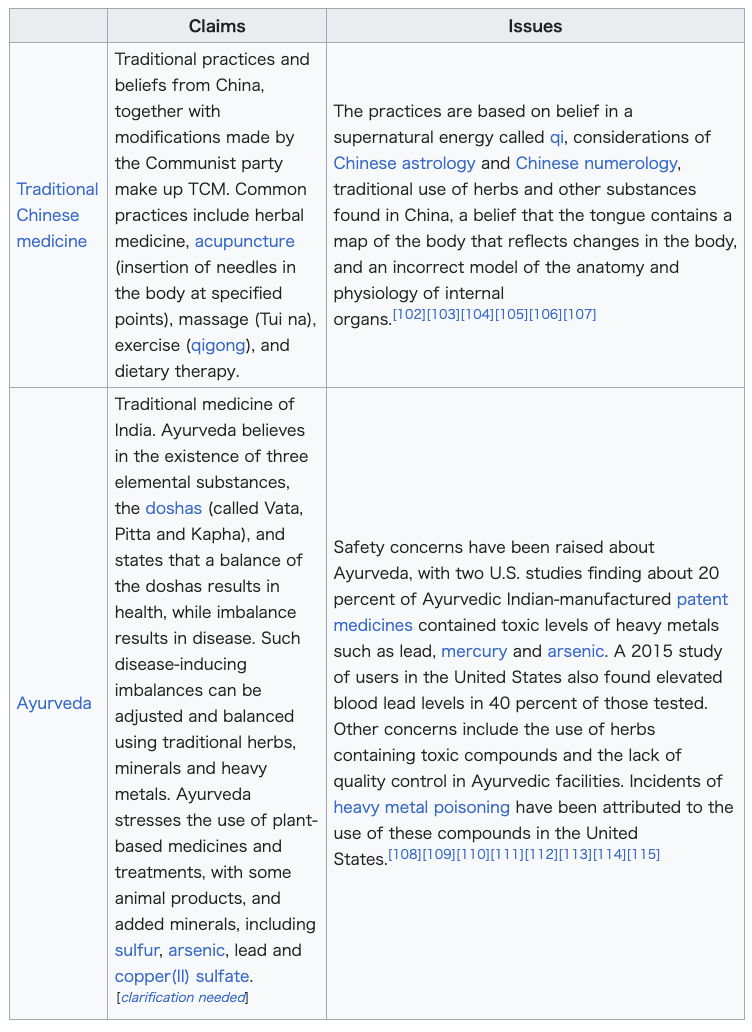 |
伝統的な民族医療体系 代替医療体系は、伝統中国医学(TCM)、インドのアーユルヴェーダ、あるいは世界中の他の文化における医療慣行など、伝統的な医療の実践に基づいている 場合がある。[22] 伝統医療の有用な応用例の一部は研究され、一般医学の中で受け入れられているが、その根底にある信念体系は科学的であることは稀であり、受け入れられてい ない。 伝統医学は、その発祥地域以外で使用される場合、既知の有効な治療法と併用されるか、あるいはその代わりとして使用される場合、あるいは患者や施術者が、 その療法が効果がないことを知っている、あるいは知るべきであると合理的に予想される場合(例えば、その療法が迷信に基づいていることを知っている場合な ど)に、代替医療と見なされる。 |
| Supernatural energies Bases of belief may include belief in existence of supernatural energies undetected by the science of physics, as in biofields, or in belief in properties of the energies of physics that are inconsistent with the laws of physics, as in energy medicine.[22] 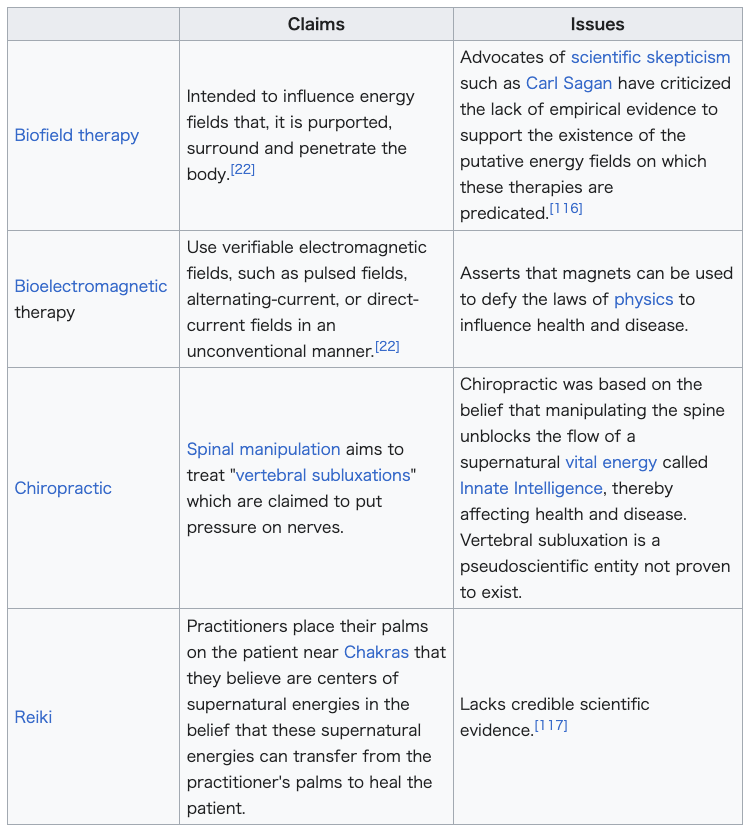 |
超自然的なエネルギー 信仰の根拠には、バイオフィールドのように物理学では検出できない超自然的なエネルギーの存在を信じるものや、エネルギー医学のように物理学の法則と矛盾する物理的エネルギーの特性を信じるものが含まれる。[22] |
| Herbal remedies and other substances Main article: Herbal medicine Substance based practices use substances found in nature such as herbs, foods, non-vitamin supplements and megavitamins, animal and fungal products, and minerals, including use of these products in traditional medical practices that may also incorporate other methods.[22][118][119] Examples include healing claims for non-vitamin supplements, fish oil, Omega-3 fatty acid, glucosamine, echinacea, flaxseed oil, and ginseng.[120] Herbal medicine, or phytotherapy, includes not just the use of plant products, but may also include the use of animal and mineral products.[118] It is among the most commercially successful branches of alternative medicine, and includes the tablets, powders and elixirs that are sold as "nutritional supplements".[118] Only a very small percentage of these have been shown to have any efficacy, and there is little regulation as to standards and safety of their contents.[118] |
ハーブ療法およびその他の物質 本記事:ハーブ療法 物質に基づく療法では、ハーブ、食品、ビタミン以外のサプリメントやメガビタミン、動物性・菌類由来の製品、ミネラルなど、自然界に存在する物質を用い る。これには、他の手法も組み合わされることがある伝統的な医療行為におけるこれらの製品の使用も含まれる。[22][118][119] 例としては、非ビタミン系サプリメント、魚油、オメガ3脂肪酸、グルコサミン、エキナセア、亜麻仁油、高麗人参に対する治療効果の主張が挙げられる。 [120] ハーブ療法、あるいは植物療法には、植物由来の製品の使用だけでなく、動物や鉱物由来の製品の使用も含まれることがある。[118] これは代替医療の中でも最も商業的に成功している分野の一つであり、「栄養補助食品」として販売されている錠剤、粉末、エリキシル剤などが含まれる。 [118] これらの中で何らかの有効性が示されているものはごく一部に過ぎず、その成分の基準や安全性に関する規制はほとんど存在しない。[118] |
| Religion, faith healing, and prayer See also: Shamanism Faith healing Claim: There is a divine or spiritual intervention in healing. Issues:Lack of evidence for effectiveness.[121] Unwanted outcomes, such as death and disability, "have occurred when faith healing was elected instead of medical care for serious injuries or illnesses".[122] A 2001 double-blind study of 799 discharged coronary surgery patients found that "intercessory prayer had no significant effect on medical outcomes after hospitalization in a coronary care unit."[123] |
宗教、信仰による癒し、そして祈り 関連項目:シャーマニズム 信仰治療(Faith healing) 主張:癒しには、神聖な、あるいは霊的な働きかけがある。 問題(批判):有効性を裏付ける証拠がない。[121] 重篤な怪我や病気に対して、医療ケアではなく信仰による癒やしを選んだ結果、死亡や障害といった望ましくない結果が生じている。[122] 2001年に冠動脈手術を受けた退院患者799人を対象に行われた二重盲検試験では、「執り成しの祈りは、冠動脈集中治療室での入院後の治療成績に有意な 影響を与えなかった」ことが判明した。[123] |
NCCIH classification Ready-to-drink traditional Chinese medicine mixture The United States agency National Center for Complementary and Integrative Health (NCCIH) has created a classification system for branches of complementary and alternative medicine that divides them into five major groups. These groups have some overlap, and distinguish two types of energy medicine: veritable which involves scientifically observable energy (including magnet therapy, colorpuncture and light therapy) and putative, which invokes physically undetectable or unverifiable energy.[124] None of these energies have any evidence to support that they affect the body in any positive or health promoting way.[1] 1. Whole medical systems: Cut across more than one of the other groups; examples include traditional Chinese medicine, naturopathy, homeopathy, and ayurveda. 2. Mind-body interventions: Explore the interconnection between the mind, body, and spirit, under the premise that they affect "bodily functions and symptoms". A connection between mind and body is conventional medical fact, and this classification does not include therapies with proven function such as cognitive behavioral therapy. 3. "Biology"-based practices: Use substances found in nature such as herbs, foods, vitamins, and other natural substances. (As used here, "biology" does not refer to the science of biology, but is a usage newly coined by NCCIH in the primary source used for this article. "Biology-based" as coined by NCCIH may refer to chemicals from a nonbiological source, such as use of the poison lead in traditional Chinese medicine, and to other nonbiological substances.) 4. Manipulative and body-based practices: feature manipulation or movement of body parts, such as is done in bodywork, chiropractic, and osteopathic manipulation. 5. Energy medicine: is a domain that deals with putative and verifiable energy fields: - Biofield therapies are intended to influence energy fields that are purported to surround and penetrate the body. The existence of such energy fields have been disproven. - Bioelectromagnetic-based therapies use verifiable electromagnetic fields, such as pulsed fields, alternating-current, or direct-current fields in a non-scientific manner. |
NCCIHの分類 即飲型漢方薬 米国の機関である国立補完統合医療センター(NCCIH)は、補完代替医療の分野を5つの主要なグループに分類する体系を策定した。これらのグループには 一部重複があり、エネルギー医学を2つのタイプに区別している。すなわち、科学的に観測可能なエネルギーを扱う「実在的エネルギー医学」(磁気療法、カ ラーパンクチャー、光療法など)と、物理的に検出不能または検証不能なエネルギーを扱う「仮説的エネルギー医学」である。[124] これらのエネルギーはいずれも、身体に何らかの有益な影響や健康増進効果をもたらすことを裏付ける証拠はない。[1] 1. 総合医療体系:他のグループの複数にまたがる。例としては、伝統中国医学、自然療法、ホメオパシー、アーユルヴェーダなどが挙げられる。 2. 心身介入:心、身体、精神が「身体機能や症状」に影響を与えるという前提の下、それらの相互関係を追求する。心と身体のつながりは従来の医学的事実であり、この分類には認知行動療法のような効果が実証されている療法は含まれない。 3. 「生物学」に基づく実践:ハーブ、食品、ビタミン、その他の天然物質など、自然界に存在する物質を用いる。(ここでいう「生物学」は、生物学という科学を 指すのではなく、本記事の一次資料においてNCCIHが新たに造語した用法である。NCCIHが造語した「生物学に基づく」という表現は、伝統中国医学に おける鉛毒の使用など、非生物学的起源の化学物質や、その他の非生物学的物質を指す場合もある。) 4. 手技療法および身体に基づく療法:ボディワーク、カイロプラクティック、オステオパシーなど、身体部位の操作や運動を特徴とする。 5. エネルギー医学:仮説的かつ検証可能なエネルギー場を取り扱う領域である: - バイオフィールド療法は、身体を包み込み、貫通しているとされるエネルギー場に影響を与えることを目的としている。そのようなエネルギー場の存在は否定されている。 - 生体電磁気療法は、パルス電磁場、交流電磁場、直流電磁場などの検証可能な電磁場を、非科学的な方法で用いるものである。 |
| History Main article: History of alternative medicine The history of alternative medicine may refer to the history of a group of diverse medical practices that were collectively promoted as "alternative medicine" beginning in the 1970s, to the collection of individual histories of members of that group, or to the history of western medical practices that were labeled "irregular practices" by the western medical establishment.[8][125][126][127][128] It includes the histories of complementary medicine and of integrative medicine. Before the 1970s, western practitioners that were not part of the increasingly science-based medical establishment were referred to "irregular practitioners", and were dismissed by the medical establishment as unscientific and as practicing quackery.[125][126] Until the 1970s, irregular practice became increasingly marginalized as quackery and fraud, as western medicine increasingly incorporated scientific methods and discoveries, and had a corresponding increase in success of its treatments.[128] In the 1970s, irregular practices were grouped with traditional practices of nonwestern cultures and with other unproven or disproven practices that were not part of biomedicine, with the entire group collectively marketed and promoted under the single expression "alternative medicine".[8][125][126][128][129] Use of alternative medicine in the west began to rise following the counterculture movement of the 1960s, as part of the rising new age movement of the 1970s.[8][130][131] This was due to misleading mass marketing of "alternative medicine" being an effective "alternative" to biomedicine, changing social attitudes about not using chemicals and challenging the establishment and authority of any kind, sensitivity to giving equal measure to beliefs and practices of other cultures (cultural relativism), and growing frustration and desperation by patients about limitations and side effects of science-based medicine.[8][126][128][127][129][131][132] At the same time, in 1975, the American Medical Association, which played the central role in fighting quackery in the United States, abolished its quackery committee and closed down its Department of Investigation.[125]: xxi [132] By the early to mid 1970s the expression "alternative medicine" came into widespread use, and the expression became mass marketed as a collection of "natural" and effective treatment "alternatives" to science-based biomedicine.[8][132][133][134] By 1983, mass marketing of "alternative medicine" was so pervasive that the British Medical Journal (BMJ) pointed to "an apparently endless stream of books, articles, and radio and television programmes urge on the public the virtues of (alternative medicine) treatments ranging from meditation to drilling a hole in the skull to let in more oxygen".[132] An analysis of trends in the criticism of complementary and alternative medicine (CAM) in five prestigious American medical journals during the period of reorganization within medicine (1965–1999) was reported as showing that the medical profession had responded to the growth of CAM in three phases, and that in each phase, changes in the medical marketplace had influenced the type of response in the journals.[135] Changes included relaxed medical licensing, the development of managed care, rising consumerism, and the establishment of the USA Office of Alternative Medicine (later National Center for Complementary and Alternative Medicine, currently National Center for Complementary and Integrative Health).[n 9] Medical education Mainly as a result of reforms following the Flexner Report of 1910[137] medical education in established medical schools in the US has generally not included alternative medicine as a teaching topic.[n 10] Typically, their teaching is based on current practice and scientific knowledge about: anatomy, physiology, histology, embryology, neuroanatomy, pathology, pharmacology, microbiology and immunology.[139] Medical schools' teaching includes such topics as doctor-patient communication, ethics, the art of medicine,[140] and engaging in complex clinical reasoning (medical decision-making).[141] Writing in 2002, Snyderman and Weil remarked that by the early twentieth century the Flexner model had helped to create the 20th-century academic health center, in which education, research, and practice were inseparable. While this had much improved medical practice by defining with increasing certainty the pathophysiological basis of disease, a single-minded focus on the pathophysiological had diverted much of mainstream American medicine from clinical conditions that were not well understood in mechanistic terms, and were not effectively treated by conventional therapies.[142] By 2001 some form of CAM training was being offered by at least 75 out of 125 medical schools in the US.[143] Exceptionally, the School of Medicine of the University of Maryland, Baltimore, includes a research institute for integrative medicine (a member entity of the Cochrane Collaboration).[144][145] Medical schools are responsible for conferring medical degrees, but a physician typically may not legally practice medicine until licensed by the local government authority. Licensed physicians in the US who have attended one of the established medical schools there have usually graduated Doctor of Medicine (MD).[146] All states require that applicants for MD licensure be graduates of an approved medical school and complete the United States Medical Licensing Examination (USMLE).[146] |
歴史 主な記事:代替医療の歴史 代替医療の歴史とは、1970年代から「代替医療」として総称されてきた多様な医療実践の歴史、そのグループを構成する個々の歴史の集積、あるいは西洋医 学界によって「非正規の医療行為」とレッテルを貼られた西洋医療の実践の歴史を指す場合がある。[8][125][126][127][128] これには、補完医療および統合医療の歴史も含まれる。1970年代以前、ますます科学主義的になっていった西洋医学界に属さない西洋の医療従事者は「非正 規の医療従事者」と呼ばれ、医学界からは非科学的であり、偽医療を行っていると一蹴されていた。[125][126] 1970年代に至るまで、西洋医学が科学的手法や発見をますます取り入れ、それに伴い治療の成功率も向上するにつれ、非正規医療は偽医療や詐欺としてます ます周縁化されていった。[128] 1970年代には、非正規の医療行為は、非西洋文化の伝統的医療や、生物医学の一部ではないその他の未検証あるいは反証された医療行為とひとまとめにさ れ、その全体が「代替医療」という単一の表現の下で一括して宣伝・推進されるようになった。[8][125][126][128] [129] 西洋における代替医療の利用は、1960年代のカウンターカルチャー運動に続き、1970年代に台頭したニューエイジ運動の一環として増加し始めた。 [8][130] [131] これは、「代替医療」が生物医学に対する有効な「代替手段」であるという誤解を招くような大規模なマーケティング、化学物質を使用しないことへの社会的意 識の変化、あらゆる種類の体制や権威への挑戦、他文化の信念や慣行を対等に扱うことへの配慮(文化相対主義)、そして科学に基づく医療の限界や副作用に対 する患者の高まる不満や絶望感によるものであった。[8][126][128][127][129][131][132] それと同時に、1975年、米国における偽医療との闘いで中心的な役割を果たしていた米国医師会は、偽医療対策委員会を廃止し、調査部を閉鎖した。 [125]: xxi [132] 1970年代前半から半ばにかけて、「代替医療」という表現が広く使われるようになり、この表現は、科学に基づく生物医学に対する「自然」で効果的な治療 の「代替案」の集合体として、大衆向けに売り出されるようになった。[8][132] [133][134] 1983年までに、「代替医療」の大衆向けマーケティングは極めて広範なものとなり、英国医学雑誌(BMJ)は、「瞑想から、より多くの酸素を取り入れる ために頭蓋骨に穴を開けることまで、(代替医療)治療の効能を一般大衆に説く書籍、記事、ラジオ・テレビ番組の、一見して尽きることのない流れ」を指摘し た。[132] 医学界の再編期(1965年~1999年)における、5つの権威ある米国医学雑誌での補完・代替医療(CAM)に対する批判の傾向分析によると、医療専門 職はCAMの台頭に対し3つの段階を経て対応しており、各段階において、医療市場の変化が雑誌上の対応の様式に影響を与えていたことが示された。 [135] 変化には、医師免許取得要件の緩和、マネージドケアの発展、消費者志向の高まり、および米国代替医療局(後の国立補完・代替医療センター、現在は国立補 完・統合医療センター)の設立などが含まれる。[n 9] 医学教育 主に1910年のフレックスナー報告書[137]に続く改革の結果として、米国の定評ある医学部における医学教育では、一般的に代替医療が教育テーマとし て含まれていない。[n 10] 通常、その教育は、解剖学、生理学、組織学、発生学、神経解剖学、病理学、薬理学、微生物学、免疫学に関する現在の実践と科学的知見に基づいている。 [139] 医学部の教育には、医師と患者のコミュニケーション、倫理、医療の技法[140]、そして複雑な臨床推論(医療上の意思決定)を行うことなどのトピックが 含まれている。[141] 2002年にスナイダーマンとウェイルは、20世紀初頭までにフレックスナー・モデルが、教育、研究、診療が不可分である20世紀の学術医療センターの形 成に寄与したと指摘した。これは、疾患の病態生理学的基盤をますます確実に定義することで医療実践を大いに改善したが、病態生理学への一途な注力は、メカ ニズムの観点から十分に理解されておらず、従来の治療法では効果的に治療できなかった臨床症状から、アメリカの主流医学の多くを逸脱させてしまった。 [142] 2001年までに、米国の125校の医学部のうち少なくとも75校で、何らかの形の補完代替医療(CAM)の研修が提供されていた。[143] 例外として、メリーランド大学ボルチモア校医学部には、統合医療の研究機関(コクラン・コラボレーションの加盟団体)が設置されている。[144] [145] 医学部は医学学位を授与する責任を負っているが、医師は通常、地方自治体の当局から免許を取得するまで、法的に医療行為を行うことはできない。米国の認可 された医学部を卒業した免許を持つ医師は、通常、医学博士(MD)の学位を取得している。[146] すべての州において、MD免許の申請者は、認可された医学部の卒業生であり、米国医師免許試験(USMLE)に合格していることが求められる。[146] |
Efficacy Edzard Ernst, an authority on scientific study of alternative therapies and diagnoses and the first university professor of CAM, in 2012 There is a general scientific consensus that alternative therapies lack the requisite scientific validation, and their effectiveness is either unproved or disproved.[10][8][147][148] Many of the claims regarding the efficacy of alternative medicines are controversial, since research on them is frequently of low quality and methodologically flawed.[149] Selective publication bias, marked differences in product quality and standardisation, and some companies making unsubstantiated claims call into question the claims of efficacy of isolated examples where there is evidence for alternative therapies.[150] The Scientific Review of Alternative Medicine points to confusions in the general population – a person may attribute symptomatic relief to an otherwise-ineffective therapy just because they are taking something (the placebo effect); the natural recovery from or the cyclical nature of an illness (the regression fallacy) gets misattributed to an alternative medicine being taken; a person not diagnosed with science-based medicine may never originally have had a true illness diagnosed as an alternative disease category.[151] Edzard Ernst, the first university professor of Complementary and Alternative Medicine, characterized the evidence for many alternative techniques as weak, nonexistent, or negative[152] and in 2011 published his estimate that about 7.4% were based on "sound evidence", although he believes that may be an overestimate.[153] Ernst has concluded that 95% of the alternative therapies he and his team studied, including acupuncture, herbal medicine, homeopathy, and reflexology, are "statistically indistinguishable from placebo treatments", but he also believes there is something that conventional doctors can usefully learn from the chiropractors and homeopath: this is the therapeutic value of the placebo effect, one of the strangest phenomena in medicine.[154][155] In 2003, a project funded by the CDC identified 208 condition-treatment pairs, of which 58% had been studied by at least one randomized controlled trial (RCT), and 23% had been assessed with a meta-analysis.[156] According to a 2005 book by a US Institute of Medicine panel, the number of RCTs focused on CAM has risen dramatically. As of 2005, the Cochrane Library had 145 CAM-related Cochrane systematic reviews and 340 non-Cochrane systematic reviews. An analysis of the conclusions of only the 145 Cochrane reviews was done by two readers. In 83% of the cases, the readers agreed. In the 17% in which they disagreed, a third reader agreed with one of the initial readers to set a rating. These studies found that, for CAM, 38.4% concluded positive effect or possibly positive (12.4%), 4.8% concluded no effect, 0.7% concluded harmful effect, and 56.6% concluded insufficient evidence. An assessment of conventional treatments found that 41.3% concluded positive or possibly positive effect, 20% concluded no effect, 8.1% concluded net harmful effects, and 21.3% concluded insufficient evidence. However, the CAM review used the more developed 2004 Cochrane database, while the conventional review used the initial 1998 Cochrane database.[157] Alternative therapies do not "complement" (improve the effect of, or mitigate the side effects of) functional medical treatment.[n 7][10][26][27][28] Significant drug interactions caused by alternative therapies may instead negatively impact functional treatment by making prescription drugs less effective, such as interference by herbal preparations with warfarin.[158][36] In the same way as for conventional therapies, drugs, and interventions, it can be difficult to test the efficacy of alternative medicine in clinical trials. In instances where an established, effective, treatment for a condition is already available, the Helsinki Declaration states that withholding such treatment is unethical in most circumstances. Use of standard-of-care treatment in addition to an alternative technique being tested may produce confounded or difficult-to-interpret results.[159] Cancer researcher Andrew J. Vickers has stated: Contrary to much popular and scientific writing, many alternative cancer treatments have been investigated in good-quality clinical trials, and they have been shown to be ineffective. The label "unproven" is inappropriate for such therapies; it is time to assert that many alternative cancer therapies have been "disproven".[160] |
有効性 代替療法および診断法の科学的研究における権威であり、CAM(補完・代替医療)分野初の大学教授であるエドザード・エルンストは、2012年に次のように述べている 代替療法には必要な科学的検証が欠けており、その有効性は証明されていないか、あるいは否定されているという科学的コンセンサスが広く存在している。 [10][8][147][148] 代替医療の有効性に関する主張の多くは、その研究がしばしば質の低いものであり、方法論的に欠陥があるため、議論の的となっている。[149] 選択的出版バイアス、製品の品質や標準化における著しい差異、そして根拠のない主張を行う一部の企業は、代替療法の証拠が存在する孤立した事例における有 効性の主張に疑問を投げかけている。[150] 『代替医療の科学的レビュー』は、一般市民の間にある混乱を指摘している。つまり、人は単に何かを摂取しているという理由だけで(プラセボ効果)、本来は 効果のない療法に症状の緩和を帰属させたり、病気からの自然回復や病気の周期的な性質(回帰の誤謬)を、摂取している代替医療のせいに誤って帰属させたり する。また、科学に基づく医療で診断されていない人は、もともと真の病気ではなく、単に代替医療の疾患カテゴリーとして診断されただけである可能性もあ る。[151] 補完・代替医療分野で初の大学教授となったエドザード・エルンストは、多くの代替療法に関するエビデンスを「弱い」「存在しない」「否定的なもの」と評し た[152]。また2011年には、約7.4%が「確かなエビデンス」に基づいているとの推計を公表したが、これは過大評価である可能性もあると考えてい る。[153] エルンストは、鍼治療、漢方薬、ホメオパシー、リフレクソロジーなど、自身とチームが調査した代替療法の95%が「統計的にプラセボ治療と区別がつかな い」と結論付けている。しかし彼は、カイロプラクターやホメオパスから、従来の医師が有益な学びを得られる点があると信じている。それは、医学において最 も不可解な現象の一つであるプラセボ効果の治療的価値である。[154][155] 2003年、CDCの資金提供を受けたプロジェクトにより、208の疾患・治療法の組み合わせが特定された。そのうち58%は少なくとも1件のランダム化 比較試験(RCT)で研究されており、23%はメタ分析によって評価されていた。[156] 米国医学研究所(IOM)のパネルによる2005年の報告書によると、CAMに焦点を当てたRCTの数は劇的に増加している。 2005年時点で、コクラン・ライブラリには145件のCAM関連コクラン・システマティック・レビューと340件の非コクラン・システマティック・レ ビューが収録されていた。2名の査読者が、これら145件のコクラン・レビューの結論のみを対象に分析を行った。83%のケースで、査読者の意見は一致し た。意見が一致しなかった17%のケースについては、第3の査読者が最初の査読者のいずれかの評価に同意し、評価を確定させた。これらの研究によると、 CAMに関しては、38.4%が「肯定的な効果」または「おそらく肯定的な効果」(12.4%)と結論付け、4.8%が「効果なし」、0.7%が「有害な 効果」、56.6%が「証拠不十分」と結論付けていた。従来の治療法の評価では、41.3%が肯定的な効果またはおそらく肯定的な効果と結論付け、20% が効果なし、8.1%が実質的な有害効果、21.3%が証拠不十分と結論付けた。ただし、CAMのレビューではより充実した2004年版のコクラン・デー タベースが使用されたのに対し、従来の治療法のレビューでは初期の1998年版コクラン・データベースが使用された。[157] 代替療法は、機能的医療治療を「補完」(効果を高めたり、副作用を軽減したりすること)するものではない。[n 7][10][26][27][28] 代替療法による重大な薬物相互作用は、むしろ処方薬の効果を低下させることで機能的治療に悪影響を及ぼす可能性がある。例えば、ハーブ製剤によるワルファ リンへの干渉などが挙げられる。[158][36] 従来の療法、薬剤、介入と同様に、臨床試験において代替医療の有効性を検証することは困難である場合がある。ある疾患に対して確立された有効な治療法が既 に存在する場合、ヘルシンキ宣言は、そのような治療を差し控えることはほとんどの状況において非倫理的であると述べている。試験中の代替療法に加えて標準 治療を行うと、交絡が生じたり、結果の解釈が困難になったりする可能性がある。[159] がん研究者のアンドルー・J・ヴィッカーズは次のように述べている: 多くの一般向けや科学的な文献とは対照的に、多くの代替がん治療法は質の高い臨床試験で検証されており、それらは無効であることが示されている。「未証 明」というレッテルは、そのような療法には不適切である。今こそ、多くの代替がん療法は「否定された」と断言すべき時である。[160] |
| Perceived mechanism of effect Anything classified as alternative medicine by definition does not have a proven healing or medical effect.[12][8][13][14][15] However, there are different mechanisms through which it can be perceived to "work". The common denominator of these mechanisms is that effects are mis-attributed to the alternative treatment. 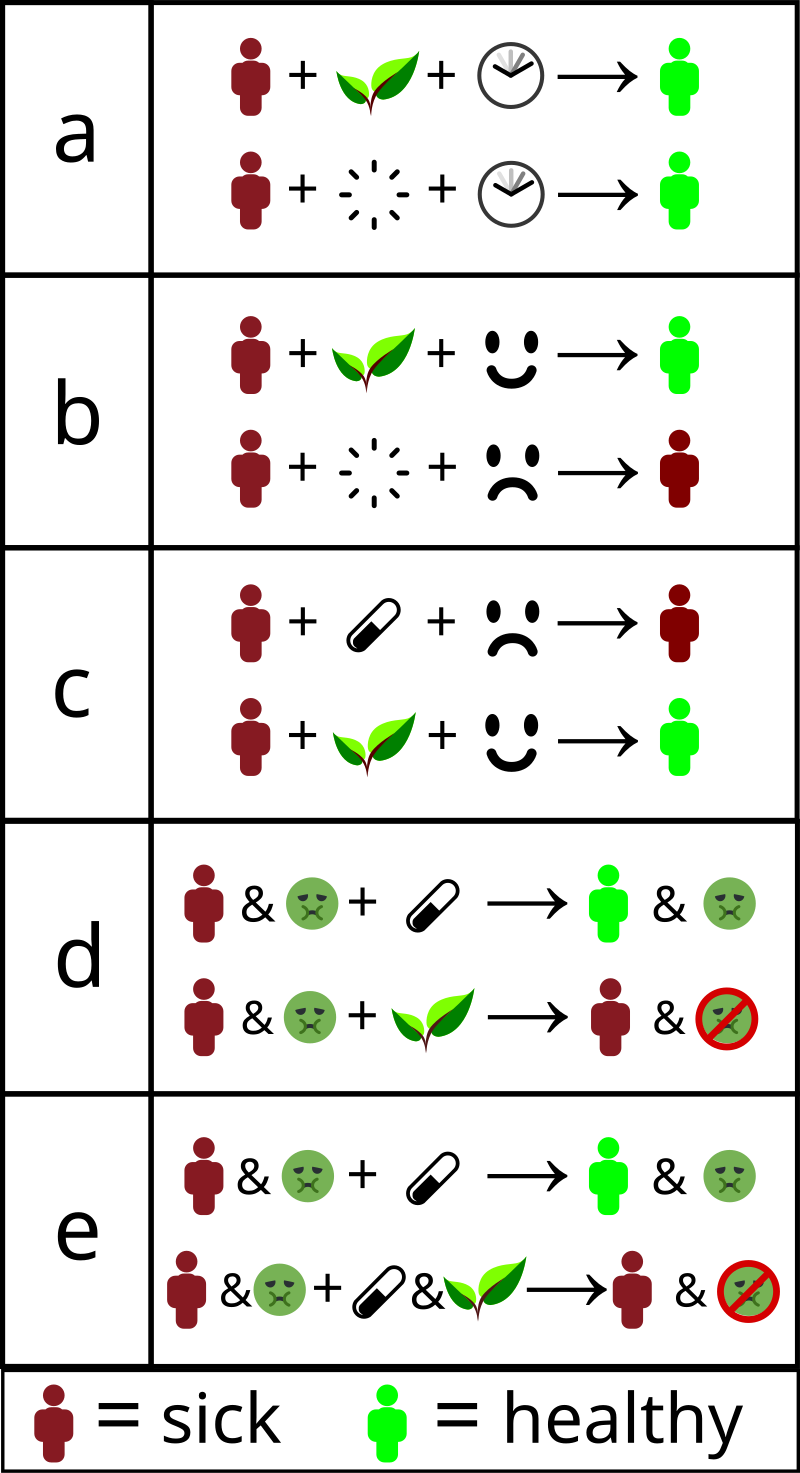 How alternative therapies "work": a) Misinterpreted natural course – the individual gets better without treatment. b) Placebo effect or false treatment effect – an individual receives "alternative therapy" and is convinced it will help. The conviction makes them more likely to get better. c) Nocebo effect – an individual is convinced that standard treatment will not work, and that alternative therapies will work. This decreases the likelihood standard treatment will work, while the placebo effect of the "alternative" remains. d) No adverse effects – Standard treatment is replaced with "alternative" treatment, getting rid of adverse effects, but also of improvement. e) Interference – Standard treatment is "complemented" with something that interferes with its effect. This can both cause worse effect, but also decreased (or even increased) side effects, which may be interpreted as "helping". Researchers, such as epidemiologists, clinical statisticians and pharmacologists, use clinical trials to reveal such effects, allowing physicians to offer a therapeutic solution best known to work. "Alternative treatments" often refuse to use trials or make it deliberately hard to do so. Placebo effect A placebo is a treatment with no intended therapeutic value. An example of a placebo is an inert pill, but it can include more dramatic interventions like sham surgery. The placebo effect is the concept that patients will perceive an improvement after being treated with an inert treatment. The opposite of the placebo effect is the nocebo effect, when patients who expect a treatment to be harmful will perceive harmful effects after taking it. Placebos do not have a physical effect on diseases or improve overall outcomes, but patients may report improvements in subjective outcomes such as pain and nausea.[161] A 1955 study suggested that a substantial part of a medicine's impact was due to the placebo effect.[162][161] However, reassessments found the study to have flawed methodology.[162][163] This and other modern reviews suggest that other factors like natural recovery and reporting bias should also be considered.[161][163] All of these are reasons why alternative therapies may be credited for improving a patient's condition even though the objective effect is non-existent, or even harmful.[158][43][90] David Gorski argues that alternative treatments should be treated as a placebo, rather than as medicine.[43] Almost none have performed significantly better than a placebo in clinical trials.[102][89][164][118] Furthermore, distrust of conventional medicine may lead to patients experiencing the nocebo effect when taking effective medication.[158] Regression to the mean A patient who receives an inert treatment may report improvements afterwards that it did not cause.[161][163] Assuming it was the cause without evidence is an example of the regression fallacy. This may be due to a natural recovery from the illness, or a fluctuation in the symptoms of a long-term condition.[163] The concept of regression toward the mean implies that an extreme result is more likely to be followed by a less extreme result. Other factors There are also reasons why a placebo treatment group may outperform a "no-treatment" group in a test which are not related to a patient's experience. These include patients reporting more favourable results than they really felt due to politeness or "experimental subordination", observer bias, and misleading wording of questions.[163] In their 2010 systematic review of studies into placebos, Asbjørn Hróbjartsson and Peter C. Gøtzsche write that "even if there were no true effect of placebo, one would expect to record differences between placebo and no-treatment groups due to bias associated with lack of blinding."[161] Alternative therapies may also be credited for perceived improvement through decreased use or effect of medical treatment, and therefore either decreased side effects or nocebo effects towards standard treatment.[158] |
効果の認識されるメカニズム 定義上、代替医療に分類されるものは、治癒効果や医学的効果が実証されていない[12][8][13][14][15]。しかし、それが「効いている」と 認識されるメカニズムは異なるものがある。これらのメカニズムに共通するのは、効果が代替療法に誤って帰属されているという点である。 代替療法が「効く」仕組み: a) 自然経過の誤解釈 – 治療を受けなくても個人が回復する。 b) プラセボ効果または偽治療効果 – 個人が「代替療法」を受け、それが役立つと確信する。その確信によって、回復する可能性が高まる。 c) ノセボ効果 – 患者は標準治療は効かず、代替療法は効くと確信する。これにより標準治療が効く可能性は低下するが、「代替」療法のプラセボ効果は残る。 d) 副作用の不在 – 標準治療が「代替」療法に置き換えられることで、副作用はなくなるが、改善も失われる。 e) 干渉 – 標準治療に、その効果を妨げる何かが「併用」される。これにより、治療効果が低下するだけでなく、副作用が減少(あるいは増加)することもあり、それが 「改善」と解釈される可能性がある。疫学者、臨床統計学者、薬理学者などの研究者は、臨床試験を用いてこうした効果を明らかにし、医師が確実に効果がある と分かっている治療法を提供できるようにしている。「代替療法」は、しばしば臨床試験の実施を拒否したり、意図的に実施を困難にしたりする。 プラセボ効果 プラセボとは、意図された治療的価値を持たない処置のことだ。プラセボの例としては無効な錠剤が挙げられるが、偽手術のようなより劇的な介入も含まれる。 プラセボ効果とは、患者が無効な処置を受けた後に改善を感じるとする概念である。プラセボ効果の対極にあるのがノセボ効果であり、治療が有害であると予想 する患者が、それを摂取した後に有害な影響を自覚する現象である。 プラセボは疾患に対して物理的な効果をもたらしたり、全体的な転帰を改善したりはしないが、患者は痛みや吐き気といった主観的な症状の改善を報告すること がある。[161] 1955年の研究では、医薬品の影響のかなりの部分がプラセボ効果によるものであることが示唆された。[162][161] しかし、再評価の結果、この研究には方法論上の欠陥があることが判明した。[162][163] この研究やその他の現代的なレビューは、自然治癒や報告バイアスといった他の要因も考慮すべきであることを示唆している。[161][163] これらはすべて、客観的な効果が存在しない、あるいは有害であるにもかかわらず、代替療法が患者の状態を改善したと評価される理由である。[158] [43][90] デビッド・ゴルスキーは、代替療法は医薬品としてではなく、プラセボとして扱われるべきだと主張している。[43] 臨床試験において、プラセボよりも有意に優れた結果を示したものはほとんどない。[102][89][164][118] さらに、従来の医療に対する不信感は、有効な薬を服用する際に患者がノセボ効果を経験する原因となり得る。[158] 平均への回帰 無効な治療を受けた患者は、その治療が原因ではないにもかかわらず、後に改善を報告することがある。[161][163] 証拠なしにそれが原因であると仮定することは、回帰の誤謬の一例である。これは、病気からの自然回復、あるいは慢性疾患の症状の変動によるものかもしれな い。[163] 平均への回帰という概念は、極端な結果の後に、それほど極端ではない結果が続く可能性が高いことを示唆している。 その他の要因 また、プラセボ治療群が「無治療」群よりも試験で優れた結果を示す理由として、患者の体験とは関係のない要因も存在する。これには、礼儀や「実験的従属」 により、患者が実際に感じたよりも好ましい結果を報告すること、観察者バイアス、および質問の誤解を招くような表現などが含まれる。[163] 2010年のプラセボに関する研究の系統的レビューにおいて、アスビョルン・フロビャルツソンとピーター・C・ゲッツシェは、「たとえプラセボに真の効果 がなかったとしても、盲検化の欠如に伴うバイアスにより、プラセボ群と無治療群の間に差異が記録されることが予想される」と記している。[161] 代替療法は、医療処置の使用減少や効果の低下による改善の知覚にも寄与している可能性があり、その結果、標準治療に対する副作用の減少やノセボ効果が生じ ている可能性がある。[158] |
| Use and regulation Appeal Practitioners of complementary medicine usually discuss and advise patients as to available alternative therapies. Patients often express interest in mind-body complementary therapies because they offer a non-drug approach to treating some health conditions.[165] In addition to the social-cultural underpinnings of the popularity of alternative medicine, there are several psychological issues that are critical to its growth, notably psychological effects, such as the will to believe,[166] cognitive biases that help maintain self-esteem and promote harmonious social functioning,[166] and the post hoc, ergo propter hoc fallacy.[166] In a 2018 interview with The BMJ, Edzard Ernst stated: "The present popularity of complementary and alternative medicine is also inviting criticism of what we are doing in mainstream medicine. It shows that we aren't fulfilling a certain need-we are not giving patients enough time, compassion, or empathy. These are things that complementary practitioners are very good at. Mainstream medicine could learn something from complementary medicine."[167] Marketing Alternative medicine is a profitable industry with large media advertising expenditures. Accordingly, alternative practices are often portrayed positively and compared favorably to "big pharma".[1] The popularity of complementary & alternative medicine (CAM) may be related to other factors that Ernst mentioned in a 2008 interview in The Independent: Why is it so popular, then? Ernst blames the providers, customers and the doctors whose neglect, he says, has created the opening into which alternative therapists have stepped. "People are told lies. There are 40 million websites and 39.9 million tell lies, sometimes outrageous lies. They mislead cancer patients, who are encouraged not only to pay their last penny but to be treated with something that shortens their lives." At the same time, people are gullible. It needs gullibility for the industry to succeed. It doesn't make me popular with the public, but it's the truth.[168] Paul Offit proposed that "alternative medicine becomes quackery" in four ways: by recommending against conventional therapies that are helpful, promoting potentially harmful therapies without adequate warning, draining patients' bank accounts, or by promoting "magical thinking".[84] Promoting alternative medicine has been called dangerous and unethical.[n 11][170]  Friendly and colorful images of herbal treatments may look less threatening or dangerous when compared to conventional medicine. This is an intentional marketing strategy.[171][172] Social factors Authors have speculated on the socio-cultural and psychological reasons for the appeal of alternative medicines among the minority using them in lieu of conventional medicine. There are several socio-cultural reasons for the interest in these treatments centered on the low level of scientific literacy among the public at large and a concomitant increase in antiscientific attitudes and new age mysticism.[166] Related to this are vigorous marketing[173] of extravagant claims by the alternative medical community combined with inadequate media scrutiny and attacks on critics.[166][174] Alternative medicine is criticized for taking advantage of the least fortunate members of society.[1] There is also an increase in conspiracy theories toward conventional medicine and pharmaceutical companies,[37] mistrust of traditional authority figures, such as the physician, and a dislike of the current delivery methods of scientific biomedicine, all of which have led patients to seek out alternative medicine to treat a variety of ailments.[174] Many patients lack access to contemporary medicine, due to a lack of private or public health insurance, which leads them to seek out lower-cost alternative medicine.[175] Medical doctors are also aggressively marketing alternative medicine to profit from this market.[173] Patients can be averse to the painful, unpleasant, and sometimes-dangerous side effects of biomedical treatments. Treatments for severe diseases such as cancer and HIV infection have well-known, significant side-effects. Even low-risk medications such as antibiotics can have potential to cause life-threatening anaphylactic reactions in a very few individuals. Many medications may cause minor but bothersome symptoms such as cough or upset stomach. In all of these cases, patients may be seeking out alternative therapies to avoid the adverse effects of conventional treatments.[166][174] Prevalence of use According to research published in 2015, the increasing popularity of CAM needs to be explained by moral convictions or lifestyle choices rather than by economic reasoning.[176] In developing nations, access to essential medicines is severely restricted by lack of resources and poverty. Traditional remedies, often closely resembling or forming the basis for alternative remedies, may comprise primary healthcare or be integrated into the healthcare system. In Africa, traditional medicine is used for 80% of primary healthcare, and in developing nations as a whole over one-third of the population lack access to essential medicines.[177] In Latin America, inequities against BIPOC communities keep them tied to their traditional practices and therefore, it is often these communities that constitute the majority of users of alternative medicine. Racist attitudes towards certain communities disable them from accessing more urbanized modes of care. In a study that assessed access to care in rural communities of Latin America, it was found that discrimination is a huge barrier to the ability of citizens to access care; more specifically, women of Indigenous and African descent, and lower-income families were especially hurt.[178] Such exclusion exacerbates the inequities that minorities in Latin America already face. Consistently excluded from many systems of westernized care for socioeconomic and other reasons, low-income communities of color often turn to traditional medicine for care as it has proved reliable to them across generations. Commentators including David Horrobin have proposed adopting a prize system to reward medical research.[179] This stands in opposition to the current mechanism for funding research proposals in most countries around the world. In the US, the NCCIH provides public research funding for alternative medicine. The NCCIH has spent more than US$2.5 billion on such research since 1992 and this research has not demonstrated the efficacy of alternative therapies.[164][180][181][182][183][184] As of 2011, the NCCIH's sister organization in the NIH Office of Cancer Complementary and Alternative Medicine had given out grants of around $105 million each year for several years.[185] Testing alternative medicine that has no scientific basis (as in the aforementioned grants) has been called a waste of scarce research resources.[186][187] That alternative medicine has been on the rise "in countries where Western science and scientific method generally are accepted as the major foundations for healthcare, and 'evidence-based' practice is the dominant paradigm" was described as an "enigma" in the Medical Journal of Australia.[188] A 15-year systematic review published in 2022 on the global acceptance and use of CAM among medical specialists found the overall acceptance of CAM at 52% and the overall use at 45%.[189] In the United States In the United States, the 1974 Child Abuse Prevention and Treatment Act (CAPTA) required that for states to receive federal money, they had to grant religious exemptions to child neglect and abuse laws regarding religion-based healing practices.[190] Thirty-one states have child-abuse religious exemptions.[191] The use of alternative medicine in the US has increased,[10][192] with a 50 percent increase in expenditures and a 25 percent increase in the use of alternative therapies between 1990 and 1997 in America.[192] According to a national survey conducted in 2002, "36 percent of U.S. adults aged 18 years and over use some form of complementary and alternative medicine."[193] Americans spend many billions on the therapies annually.[192] Most Americans used CAM to treat and/or prevent musculoskeletal conditions or other conditions associated with chronic or recurring pain.[175] In America, women were more likely than men to use CAM, with the biggest difference in use of mind-body therapies including prayer specifically for health reasons".[175] In 2008, more than 37% of American hospitals offered alternative therapies, up from 27 percent in 2005, and 25% in 2004.[194] More than 70% of the hospitals offering CAM were in urban areas.[citation needed] A survey of Americans found that 88 percent thought that "there are some good ways of treating sickness that medical science does not recognize".[10] Use of magnets was the most common tool in energy medicine in America, and among users of it, 58 percent described it as at least "sort of scientific", when it is not at all scientific.[10] In 2002, at least 60 percent of US medical schools have at least some class time spent teaching alternative therapies.[10] "Therapeutic touch" was taught at more than 100 colleges and universities in 75 countries before the practice was debunked by a nine-year-old child for a school science project.[10][117] Prevalence of use of specific therapies  Health campaign flyers, as in this example from the Food and Drug Administration, warn the public about unsafe products. The most common CAM therapies used in the US in 2002 were prayer (45%), herbalism (19%), breathing meditation (12%), meditation (8%), chiropractic medicine (8%), yoga (5–6%), body work (5%), diet-based therapy (4%), progressive relaxation (3%), mega-vitamin therapy (3%) and visualization (2%).[175][195] In Britain, the most often used alternative therapies were Alexander technique, aromatherapy, Bach and other flower remedies, body work therapies including massage, Counseling stress therapies, hypnotherapy, meditation, reflexology, Shiatsu, Ayurvedic medicine, nutritional medicine, and yoga.[196] Ayurvedic medicine remedies are mainly plant based with some use of animal materials.[197] Safety concerns include the use of herbs containing toxic compounds and the lack of quality control in Ayurvedic facilities.[111][113] According to the National Health Service (England), the most commonly used complementary and alternative medicines (CAM) supported by the NHS in the UK are: acupuncture, aromatherapy, chiropractic, homeopathy, massage, osteopathy and clinical hypnotherapy.[198] In palliative care Complementary therapies are often used in palliative care or by practitioners attempting to manage chronic pain in patients. Integrative medicine is considered more acceptable in the interdisciplinary approach used in palliative care than in other areas of medicine. "From its early experiences of care for the dying, palliative care took for granted the necessity of placing patient values and lifestyle habits at the core of any design and delivery of quality care at the end of life. If the patient desired complementary therapies, and as long as such treatments provided additional support and did not endanger the patient, they were considered acceptable."[199] The non-pharmacologic interventions of complementary medicine can employ mind-body interventions designed to "reduce pain and concomitant mood disturbance and increase quality of life."[200] Regulation Further information: Regulation of alternative medicine and Regulation and prevalence of homeopathy [icon] This section needs expansion. You can help by adding missing information. (May 2018)  A chiropractor "adjusting" the spine The alternative medicine lobby has successfully pushed for alternative therapies to be subject to far less regulation than conventional medicine.[1] Some professions of complementary/traditional/alternative medicine, such as chiropractic, have achieved full regulation in North America and other parts of the world[201] and are regulated in a manner similar to that governing science-based medicine. In contrast, other approaches may be partially recognized and others have no regulation at all.[201] In some cases, promotion of alternative therapies is allowed when there is demonstrably no effect, only a tradition of use. Despite laws making it illegal to market or promote alternative therapies for use in cancer treatment, many practitioners promote them.[202] Regulation and licensing of alternative medicine ranges widely from country to country, and state to state.[201] In Austria and Germany complementary and alternative medicine is mainly in the hands of doctors with MDs,[46] and half or more of the American alternative practitioners are licensed MDs.[203] In Germany herbs are tightly regulated: half are prescribed by doctors and covered by health insurance.[204] Government bodies in the US and elsewhere have published information or guidance about alternative medicine. The U.S. Food and Drug Administration (FDA), has issued online warnings for consumers about medication health fraud.[205] This includes a section on Alternative Medicine Fraud, such as a warning that Ayurvedic products generally have not been approved by the FDA before marketing.[206] |
利用と規制 訴求力 補完医療の施術者は通常、利用可能な代替療法について患者と話し合い、助言を行う。患者は、一部の健康状態に対して薬物を使用しない治療法を提供する点から、心身療法への関心をよく示す。[165] 代替医療の人気を支える社会文化的基盤に加え、その拡大に決定的な役割を果たすいくつかの心理的要因が存在する。特に、「信じたいという意志」 [166]、自尊心を維持し調和のとれた社会的機能を促進する認知バイアス[166]、そして「事後相関の誤謬(post hoc, ergo propter hoc)」[166]といった心理的効果が挙げられる。 2018年の『The BMJ』誌のインタビューで、エドザード・エルンストは次のように述べた。「補完・代替医療の現在の人気は、主流の医療が行っていることに対する批判も招 いている。それは、私たちが特定のニーズを満たせていないことを示している――患者に十分な時間や思いやり、共感を与えていないのだ。これらは補完医療の 実践者が非常に得意とする点である。主流の医療は、補完医療から学ぶべきことがある。」[167] マーケティング 代替医療は、メディア広告費を多額に投じる収益性の高い産業である。したがって、代替医療の実践はしばしば肯定的に描かれ、「大手製薬会社」と比較されて好意的に扱われる。[1] 補完・代替医療(CAM)の人気は、エルンストが2008年の『インディペンデント』紙のインタビューで言及した他の要因と関連している可能性がある: では、なぜこれほど人気があるのか? エルンストは、提供者、顧客、そして医師を非難している。彼らの怠慢が、代替療法士が乗り込む隙を生み出したのだと彼は言う。「人々は嘘をつかれている。 4,000万のウェブサイトがあり、そのうち3,990万が嘘をついている。時にはとんでもない嘘だ。それらはがん患者を誤った方向に導き、最後の1ペ ニーまで支払うよう促すだけでなく、寿命を縮めるような治療を受けさせるのだ。」同時に、人々は騙されやすい。この業界が成功するには、その騙されやすさ が必要なのだ。一般の人々からは好かれないだろうが、それが真実だ。[168] ポール・オフィットは、「代替医療が偽医療となる」のは以下の4つの場合だと指摘した。有益な従来の治療法を推奨しないこと、十分な警告なしに潜在的に有 害な治療法を推奨すること、患者の銀行口座を空にすること、あるいは「呪術的思考」を助長することである。[84] 代替医療の推奨は、危険かつ非倫理的であると指摘されてきた。[n 11] [170] ハーブ療法の親しみやすくカラフルなイメージは、従来の医療と比較すると、それほど脅威的でも危険でもないように見えるかもしれない。これは意図的なマーケティング戦略である。[171][172] 社会的要因 著者らは、従来の医療の代わりに代替医療を利用する少数派の間で、代替医療が支持される社会文化的・心理的理由について推測している。こうした治療法への 関心には、一般大衆の科学リテラシーの低さと、それに伴う反科学的な態度やニューエイジ的ミスティシズムの高まりを中心とした、いくつかの社会文化的要因 がある。[166] これに関連して、代替医療界による誇大広告の活発な展開[173]、メディアによる不十分な検証、そして批判者への攻撃が挙げられる。[166] [174] 代替医療は、社会の中で最も恵まれない人々を利用していると批判されている。[1] また、従来の医療や製薬会社に対する陰謀論の増加[37]、医師などの伝統的な権威者への不信感、そして現在の科学的生物医学の提供方法への嫌悪感も見ら れ、これらすべてが、患者を様々な病気を治療するために代替医療を求めるように導いている。[174] 多くの患者は、民間または公衆衛生保険に加入していないため、現代医学へのアクセスが限られており、その結果、より低コストな代替医療を求めることにな る。[175] 医師たちもまた、この市場から利益を得るために、代替医療を積極的に売り込んでいる。[173] 患者は、生物医学的治療に伴う、苦痛を伴い、不快で、時には危険な副作用を嫌うことがある。がんやHIV感染などの重篤な疾患に対する治療には、よく知ら れた重大な副作用がある。抗生物質のような低リスクの薬剤でさえ、ごく一部の個人において生命を脅かすアナフィラキシー反応を引き起こす可能性がある。多 くの薬剤は、咳や胃の不快感など、軽度ではあるが煩わしい症状を引き起こすことがある。これらすべてのケースにおいて、患者は従来の治療法の副作用を避け るために代替療法を求めている可能性がある。[166] [174] 利用の普及状況 2015年に発表された研究によると、CAMの人気の高まりは、経済的な理由よりも、道徳的信念やライフスタイルの選択によって説明される必要がある。[176] 発展途上国では、資源の不足や貧困により、必須医薬品へのアクセスが著しく制限されている。代替療法と酷似しているか、あるいはその基礎をなすことが多い 伝統的な治療法は、一次医療を構成したり、医療制度に統合されたりしている。アフリカでは、一次医療の80%に伝統医療が用いられており、開発途上国全体 では人口の3分の1以上が必須医薬品へのアクセスを欠いている。[177] ラテンアメリカでは、BIPOC(黒人、先住民、有色人種)コミュニティに対する不平等が、彼らを伝統的な慣行に縛り付けており、そのため、代替医療の利 用者の大半を構成しているのは往々にしてこれらのコミュニティである。特定のコミュニティに対する人種差別的な態度は、彼らがより都市化された医療形態に アクセスすることを妨げている。ラテンアメリカの農村コミュニティにおける医療アクセスを評価した研究では、差別が市民の医療アクセス能力に対する大きな 障壁であることが判明した。具体的には、先住民やアフリカ系女性、低所得世帯が特に深刻な影響を受けていた。[178] このような排除は、ラテンアメリカのマイノリティが既に直面している不平等をさらに悪化させている。社会経済的その他の理由により、西洋化された医療シス テムの多くから一貫して排除されてきた低所得の有色人種コミュニティは、世代を超えて信頼性が高いと証明されてきた伝統医療に、しばしば頼るようになる。 デビッド・ホロビンをはじめとする論者は、医学研究を奨励するための賞制度の導入を提案している。[179] これは、世界中のほとんどの国で採用されている研究提案への資金提供の現行メカニズムとは対立するものである。米国では、NCCIHが代替医療に対する公 的研究資金を提供している。NCCIHは1992年以来、こうした研究に25億米ドル以上を費やしてきたが、これらの研究は代替療法の有効性を立証できて いない。[164][180][181][182][183] [184] 2011年時点で、NIHがん補完・代替医療局(NIH Office of Cancer Complementary and Alternative Medicine)内のNCCIHの姉妹組織は、数年にわたり毎年約1億500万ドルの助成金を交付していた。[185] 科学的根拠のない代替医療(前述の助成金のようなもの)を検証することは、限られた研究資源の浪費であると指摘されている。[186] [187] 「西洋科学と科学的方法が一般的に医療の主要な基盤として受け入れられ、『エビデンスに基づく』実践が支配的なパラダイムとなっている国々」において、代 替医療が台頭していることは、『Medical Journal of Australia』誌において「謎」であると記述された。[188] 2022年に発表された、専門医におけるCAM(補完代替医療)の世界的な受容と利用に関する15年間の系統的レビューでは、CAMの全体的な受容率は 52%、利用率は45%であることが判明した。[189] 米国において 米国では、1974年の児童虐待防止・治療法(CAPTA)により、各州が連邦政府からの資金を受け取るためには、宗教に基づく治療行為に関する児童ネグ レクトおよび虐待法に対して宗教的免除を認めることが義務付けられた。[190] 31の州が児童虐待に関する宗教的免除を設けている。[191] 米国における代替医療の利用は増加しており、 [10][192] 1990年から1997年の間に、米国では代替療法への支出が50%増加し、利用率も25%増加した。[192] 2002年に実施された全国調査によると、「18歳以上の米国成人の36%が、何らかの形の補完・代替医療を利用している」 [193] アメリカ人は毎年、これらの療法に数十億ドルを費やしている。[192] ほとんどのアメリカ人は、筋骨格系の疾患や、慢性または再発性の痛みに関連するその他の疾患の治療および/または予防のためにCAMを利用していた。 [175] アメリカでは、男性よりも女性がCAMを利用する傾向が強く、特に健康上の理由による祈りを含む心身療法の利用においてその差が最も大きかった。 [175] 2008年には、米国の病院の37%以上が代替療法を提供しており、これは2005年の27%、2004年の25%から増加した。[194] CAMを提供する病院の70%以上は都市部にあった。[出典必要] アメリカ人を対象とした調査では、88%が「医学が認めていない病気の治療法にも有効なものがある」と考えていた。[10] アメリカにおけるエネルギー療法で最も一般的なツールは磁石であり、その利用者の58%は、全く科学的ではないにもかかわらず、それを少なくとも「ある程 度科学的」であると評していた。[10] 2002年時点で、米国の医学部の少なくとも60%が、代替療法の指導に何らかの授業時間を割いていた。[10] 「セラピューティック・タッチ」は、ある9歳の子供が学校の理科の課題でその効果を否定するまで、75カ国の100以上の大学で教えられていた。[10] [117] 特定の療法の利用実態 食品医薬品局(FDA)のこの例に見られるような健康キャンペーンのチラシは、安全でない製品について一般市民に警告している。 2002年に米国で最も一般的に利用されたCAM療法は、祈り(45%)、ハーブ療法(19%)、呼吸瞑想(12%)、瞑想(8%)、カイロプラクティッ ク(8%)、ヨガ(5~6%)、ボディワーク(5%)、食事療法(4%)、漸進的筋弛緩法(3%)、 メガビタミン療法(3%)、およびビジュアライゼーション(2%)であった。[175][195] 英国において最も頻繁に利用された代替療法は、アレクサンダー・テクニック、アロマセラピー、バッハ・フラワーレメディおよびその他のフラワーレメディ、 マッサージを含むボディワーク療法、カウンセリングによるストレス療法、催眠療法、瞑想、リフレクソロジー、指圧、アーユルヴェーダ医学、栄養医学、およ びヨガであった。[196] アーユルヴェーダ療法の薬剤は主に植物由来であるが、動物性材料が一部使用される。[197] 安全性に関する懸念としては、有毒化合物を含むハーブの使用や、アーユルヴェーダ施設における品質管理の欠如が挙げられる。[111] [113] 英国国民保健サービス(イングランド)によると、英国のNHSが支援する最も一般的に利用されている補完・代替医療(CAM)は、鍼治療、アロマセラピー、カイロプラクティック、ホメオパシー、マッサージ、オステオパシー、臨床催眠療法である。[198] 緩和ケアにおいて 補完療法は、緩和ケアや、患者の慢性疼痛の管理を試みる医療従事者によって頻繁に用いられる。統合医療は、他の医療分野に比べ、緩和ケアで用いられる学際 的アプローチにおいてより受け入れられやすいと考えられている。「死を目前にした患者へのケアにおける初期の経験から、緩和ケアは、終末期における質の高 いケアの設計と提供において、患者の価値観や生活習慣を中核に据える必要性を当然のこととしてきた。患者が補完療法を希望し、かつそのような治療が追加的 な支援を提供し、患者を危険にさらさない限り、それらは容認されるものとみなされた。」 [199] 補完医療の非薬物療法には、「痛みやそれに伴う気分障害を軽減し、生活の質を向上させる」ことを目的とした心身療法が用いられることがある。[200] 規制 詳細情報:代替医療の規制およびホメオパシーの規制と普及状況 [icon] この節は拡張が必要である。不足している情報を追加することで協力できる。(2018年5月) 脊椎を「調整」するカイロプラクター 代替医療のロビー活動により、代替療法は従来の医療よりもはるかに緩やかな規制の対象となることが認められた。[1] カイロプラクティックなど、補完・伝統・代替医療の一部の職種は、北米や世界の他の地域で完全な規制の対象となっており[201]、科学に基づく医療と同 様の方法で規制されている。対照的に、他のアプローチは部分的にのみ認められている場合もあり、全く規制されていないものもある。[201] 場合によっては、効果が実証されていないにもかかわらず、単に使用の伝統があるというだけで、代替療法の宣伝が許可されていることもある。がん治療への使 用を目的とした代替療法の宣伝や販売を違法とする法律があるにもかかわらず、多くの施術者がそれらを推奨している。[202] 代替医療の規制や免許制度は、国や州によって大きく異なる。[201] オーストリアやドイツでは、補完・代替医療は主に医学博士(MD)を持つ医師が担っており[46]、米国の代替医療従事者の半数以上は免許を持つ医師であ る。[203] ドイツではハーブが厳格に規制されており、その半数は医師によって処方され、健康保険の対象となっている。[204] 米国やその他の国の政府機関は、代替医療に関する情報や指針を公表している。米国食品医薬品局(FDA)は、医薬品に関する健康詐欺について消費者向けに オンライン警告を発している。[205] これには「代替医療詐欺」に関するセクションが含まれており、例えばアーユルヴェーダ製品は一般的に販売前にFDAの承認を受けていないという警告が挙げ られる。[206] |
| Risks and problems The National Science Foundation has studied the problematic side of the public's attitudes and understandings of science fiction, pseudoscience, and belief in alternative medicine. They use a quote from Robert L. Park to describe some issues with alternative medicine: Alternative medicine is another concern. As used here, alternative medicine refers to all treatments that have not been proven effective using scientific methods. A scientist's view of the situation appeared in a recent book (Park 2000b)": Between homeopathy and herbal therapy lies a bewildering array of untested and unregulated treatments, all labeled alternative by their proponents. Alternative seems to define a culture rather than a field of medicine—a culture that is not scientifically demanding. It is a culture in which ancient traditions are given more weight than biological science, and anecdotes are preferred over clinical trials. Alternative therapies steadfastly resist change, often for centuries or even millennia, unaffected by scientific advances in the understanding of physiology or disease. Incredible explanations invoking modern physics are sometimes offered for how alternative therapies might work, but there seems to be little interest in testing these speculations scientifically.[10] Negative outcomes See also: List of herbs with known adverse effects According to the Institute of Medicine, use of alternative medical techniques may result in several types of harm: "Direct harm, which results in adverse patient outcome."[207] "Economic harm, which results in monetary loss but presents no health hazard;" "Indirect harm, which results in a delay of appropriate treatment, or in unreasonable expectations that discourage patients and their families from accepting and dealing effectively with their medical conditions;" Interactions with conventional pharmaceuticals Forms of alternative medicine that are biologically active can be dangerous even when used in conjunction with conventional medicine. Examples include immuno-augmentation therapy, shark cartilage, bioresonance therapy, oxygen and ozone therapies, and insulin potentiation therapy. Some herbal remedies can cause dangerous interactions with chemotherapy drugs, radiation therapy, or anesthetics during surgery, among other problems.[47][158][36] An example of these dangers was reported by Associate Professor Alastair MacLennan of Adelaide University, Australia regarding a patient who almost bled to death on the operating table after neglecting to mention that she had been taking "natural" potions to "build up her strength" before the operation, including a powerful anticoagulant that nearly caused her death.[208] To ABC Online, MacLennan also gives another possible mechanism: And lastly there's the cynicism and disappointment and depression that some patients get from going on from one alternative medicine to the next, and they find after three months the placebo effect wears off, and they're disappointed and they move on to the next one, and they're disappointed and disillusioned, and that can create depression and make the eventual treatment of the patient with anything effective difficult, because you may not get compliance, because they've seen the failure so often in the past.[209] Side-effects Conventional treatments are subjected to testing for undesired side-effects, whereas alternative therapies, in general, are not subjected to such testing at all. Any treatment – whether conventional or alternative – that has a biological or psychological effect on a patient may also have potential to possess dangerous biological or psychological side-effects. Attempts to refute this fact with regard to alternative therapies sometimes use the appeal to nature fallacy, i.e., "That which is natural cannot be harmful." Specific groups of patients such as patients with impaired hepatic or renal function are more susceptible to side effects of alternative remedies.[210][211] An exception to the normal thinking regarding side-effects is homeopathy. Since 1938, the FDA has regulated homeopathic products in "several significantly different ways from other drugs."[212] Homeopathic preparations, termed "remedies", are extremely dilute, often far beyond the point where a single molecule of the original active (and possibly toxic) ingredient is likely to remain. They are, thus, considered safe on that count, but "their products are exempt from good manufacturing practice requirements related to expiration dating and from finished product testing for identity and strength", and their alcohol concentration may be much higher than allowed in conventional drugs.[212] Treatment delay Alternative medicine may discourage people from getting the best possible treatment.[213] Those having experienced or perceived success with one alternative therapy for a minor ailment may be convinced of its efficacy and persuaded to extrapolate that success to some other alternative therapy for a more serious, possibly life-threatening illness.[214] For this reason, critics argue that therapies that rely on the placebo effect to define success are very dangerous. According to mental health journalist Scott Lilienfeld in 2002, "unvalidated or scientifically unsupported mental health practices can lead individuals to forgo effective treatments" and refers to this as opportunity cost. Individuals who spend large amounts of time and money on ineffective treatments may be left with precious little of either, and may forfeit the opportunity to obtain treatments that could be more helpful. In short, even innocuous treatments can indirectly produce negative outcomes.[215] Between 2001 and 2003, four children died in Australia because their parents chose ineffective naturopathic, homeopathic, or other alternative medicines and diets rather than conventional therapies.[216] Unconventional cancer "cures" There have always been "many therapies offered outside of conventional cancer treatment centers and based on theories not found in biomedicine. These alternative cancer cures have often been described as 'unproven,' suggesting that appropriate clinical trials have not been conducted and that the therapeutic value of the treatment is unknown." However, "many alternative cancer treatments have been investigated in good-quality clinical trials, and they have been shown to be ineffective.... The label 'unproven' is inappropriate for such therapies; it is time to assert that many alternative cancer therapies have been 'disproven'."[160] Edzard Ernst has stated: any alternative cancer cure is bogus by definition. There will never be an alternative cancer cure. Why? Because if something looked halfway promising, then mainstream oncology would scrutinize it, and if there is anything to it, it would become mainstream almost automatically and very quickly. All curative "alternative cancer cures" are based on false claims, are bogus, and, I would say, even criminal.[217] Rejection of science There is no alternative medicine. There is only scientifically proven, evidence-based medicine supported by solid data or unproven medicine, for which scientific evidence is lacking. — P.B. Fontanarosa, JAMA (1998)[81] Complementary and alternative medicine (CAM) is not as well researched as conventional medicine, which undergoes intense research before release to the public.[218] Practitioners of science-based medicine also discard practices and treatments when they are shown ineffective, while alternative practitioners do not.[1] Funding for research is also sparse making it difficult to do further research for effectiveness of CAM.[219] Most funding for CAM is funded by government agencies.[218] Proposed research for CAM are rejected by most private funding agencies because the results of research are not reliable.[218] The research for CAM has to meet certain standards from research ethics committees, which most CAM researchers find almost impossible to meet.[218] Even with the little research done on it, CAM has not been proven to be effective.[220] Studies that have been done will be cited by CAM practitioners in an attempt to claim a basis in science. These studies tend to have a variety of problems, such as small samples, various biases, poor research design, lack of controls, negative results, etc. Even those with positive results can be better explained as resulting in false positives due to bias and noisy data.[221] Alternative medicine may lead to a false understanding of the body and of the process of science.[213][222] Steven Novella, a neurologist at Yale School of Medicine, wrote that government-funded studies of integrating alternative medicine techniques into the mainstream are "used to lend an appearance of legitimacy to treatments that are not legitimate."[223] Marcia Angell proposed that healthcare practices should be classified based solely on scientific evidence, and if a treatment had been rigorously tested and found safe and effective, science-based medicine will adopt it regardless of whether it was considered "alternative" to begin with.[12] It is possible for a method to change categories (proven vs. unproven), based on increased knowledge of its effectiveness or lack thereof. Prominent supporters of this position are George D. Lundberg, former editor of the Journal of the American Medical Association (JAMA) and the journal's interim editor-in-chief Phil Fontanarosa.[81] Writing in 1999 in CA: A Cancer Journal for Clinicians Barrie R. Cassileth mentioned a 1997 letter to the United States Senate's Subcommittee on Public Health and Safety, which had deplored the lack of critical thinking and scientific rigor in OAM-supported research, had been signed by four Nobel Laureates and other prominent scientists. (This was supported by the National Institutes of Health (NIH).)[224] In March 2009, a staff writer for The Washington Post reported that the impending national discussion about broadening access to health care, improving medical practice and saving money was giving a group of scientists an opening to propose shutting down the National Center for Complementary and Alternative Medicine. They quoted one of these scientists, Steven Salzberg, a genome researcher and computational biologist at the University of Maryland, as saying "One of our concerns is that NIH is funding pseudoscience." They noted that the vast majority of studies were based on fundamental misunderstandings of physiology and disease, and had shown little or no effect.[223] Writers such as Carl Sagan, a noted astrophysicist, advocate of scientific skepticism and the author of The Demon-Haunted World: Science as a Candle in the Dark (1996), have lambasted the lack of empirical evidence to support the existence of the putative energy fields on which these therapies are predicated.[116] Sampson has also pointed out that CAM tolerated contradiction without thorough reason and experiment.[225] Barrett has pointed out that there is a policy at the NIH of never saying something does not work, only that a different version or dose might give different results.[164] Barrett also expressed concern that, just because some "alternatives" have merit, there is the impression that the rest deserve equal consideration and respect even though most are worthless, since they are all classified under the one heading of alternative medicine.[226] Some critics of alternative medicine are focused upon health fraud, misinformation, and quackery as public health problems, notably Wallace Sampson and Paul Kurtz founders of Scientific Review of Alternative Medicine and Stephen Barrett, co-founder of The National Council Against Health Fraud and webmaster of Quackwatch.[227] Grounds for opposing alternative medicine include that: Alternative therapies typically lack any scientific validation, and their effectiveness either is unproven or has been disproved.[8][147][148] It is usually based on religion, tradition, superstition, belief in supernatural energies, pseudoscience, errors in reasoning, propaganda, or fraud.[174][10][8][228] Methods may incorporate or base themselves on traditional medicine, folk knowledge, spiritual beliefs, ignorance or misunderstanding of scientific principles, errors in reasoning, or newly conceived approaches claiming to heal.[174][8][229] Research on alternative medicine is frequently of low quality and methodologically flawed.[22][230] Treatments are not part of the conventional, science-based healthcare system.[231][22][232][233] Where alternative therapies have replaced conventional science-based medicine, even with the safest alternative medicines, failure to use or delay in using conventional science-based medicine has caused deaths.[215][216] Many alternative medical treatments are not patentable,[234] which may lead to less research funding from the private sector. In addition, in most countries, alternative therapies (in contrast to pharmaceuticals) can be marketed without any proof of efficacy – also a disincentive for manufacturers to fund scientific research.[235] English evolutionary biologist Richard Dawkins, in his 2003 book A Devil's Chaplain, defined alternative medicine as a "set of practices that cannot be tested, refuse to be tested, or consistently fail tests."[236] Dawkins argued that if a technique is demonstrated effective in properly performed trials then it ceases to be alternative and simply becomes medicine.[237] CAM is also often less regulated than conventional medicine.[218] There are ethical concerns about whether people who perform CAM have the proper knowledge to treat patients.[218] CAM is often done by non-physicians who do not operate with the same medical licensing laws which govern conventional medicine,[218] and it is often described as an issue of non-maleficence.[238] According to two writers, Wallace Sampson and K. Butler, marketing is part of the training required in alternative medicine, and propaganda methods in alternative medicine have been traced back to those used by Hitler and Goebels in their promotion of pseudoscience in medicine.[102][239] In November 2011 Edzard Ernst stated that the "level of misinformation about alternative medicine has now reached the point where it has become dangerous and unethical. So far, alternative medicine has remained an ethics-free zone. It is time to change this."[240] Harriet Hall criticized the low standard of evidence accepted by the alternative medicine community: Science-based medicine has one rigorous standard of evidence, the kind [used for pharmaceuticals] .... CAM has a double standard. They gladly accept a lower standard of evidence for treatments they believe in. However, I suspect they would reject a pharmaceutical if it were approved for marketing on the kind of evidence they accept for CAM.[241] Conflicts of interest Some commentators have said that special consideration must be given to the issue of conflicts of interest in alternative medicine. Edzard Ernst has said that most researchers into alternative medicine are at risk of "unidirectional bias" because of a generally uncritical belief in their chosen subject.[242] Ernst cites as evidence the phenomenon whereby 100% of a sample of acupuncture trials originating in China had positive conclusions.[242] David Gorski contrasts evidence-based medicine, in which researchers try to disprove hyphotheses, with what he says is the frequent practice in pseudoscience-based research, of striving to confirm pre-existing notions.[243] Harriet Hall writes that there is a contrast between the circumstances of alternative medicine practitioners and disinterested scientists: in the case of acupuncture, for example, an acupuncturist would have "a great deal to lose" if acupuncture were rejected by research; but the disinterested skeptic would not lose anything if its effects were confirmed; rather their change of mind would enhance their skeptical credentials.[244] Use of health and research resources Research into alternative therapies has been criticized for "diverting research time, money, and other resources from more fruitful lines of investigation in order to pursue a theory that has no basis in biology."[90][43] Research methods expert and author of Snake Oil Science, R. Barker Bausell, has stated that "it's become politically correct to investigate nonsense."[164] A commonly cited statistic is that the US National Institute of Health had spent $2.5 billion on investigating alternative therapies prior to 2009, with none being found to be effective.[164] |
リスクと問題点 米国国立科学財団(NSF)は、SF、疑似科学、および代替医療への信頼に関する一般市民の態度や理解の、問題となる側面について調査を行った。同財団は、代替医療に関するいくつかの問題を説明するために、ロバート・L・パークの言葉を引用している: 代替医療もまた懸念事項である。ここでいう代替医療とは、科学的手法を用いて有効性が証明されていないあらゆる治療法を指す。ある科学者の見解が最近の著書(Park 2000b)に掲載されている: ホメオパシーとハーブ療法の間には、検証も規制もされていない治療法が数え切れないほど存在し、そのすべてが支持者たちによって「代替」と称されている。 「代替」という言葉は、医学の分野というよりは、科学的な厳密さを求めない文化を定義しているようだ。それは、生物科学よりも古代の伝統が重視され、臨床 試験よりも逸話的な事例が優先される文化である。代替療法は、生理学や疾病に関する科学的理解の進歩に影響されることなく、しばしば数世紀、あるいは数千 年にもわたり、変化に頑なに抵抗し続けている。代替療法がどのように作用するかについて、現代物理学を援用した信じがたい説明が提示されることもあるが、 こうした推測を科学的に検証することへの関心はほとんどないようだ。[10] 有害な結果 参照:既知の副作用があるハーブのリスト 米国医学研究所(IOM)によれば、代替医療技術の使用は、いくつかの種類の害をもたらす可能性がある: 「直接的な害。これは患者の予後を悪化させるものである。」[207] 「経済的危害:金銭的損失をもたらすが、健康上の危険はないもの」 「間接的危害:適切な治療の遅延をもたらすもの、あるいは患者やその家族が自身の病状を受け入れ、効果的に対処することを妨げるような不合理な期待をもたらすもの」 従来の医薬品との相互作用 生物学的活性を持つ代替医療の形態は、従来の医療と併用した場合でも危険を伴うことがある。例としては、免疫増強療法、サメ軟骨、生体共鳴療法、酸素療法 およびオゾン療法、インスリン増強療法などが挙げられる。一部のハーブ療法は、化学療法薬、放射線療法、あるいは手術中の麻酔薬などと危険な相互作用を引 き起こす可能性があるほか、その他の問題も生じうる。[47][158][36] こうした危険性の例として、オーストラリアのアデレード大学のアラステア・マクレナン准教授が報告した事例がある。ある患者は、手術前に「体力をつける」 ために「自然由来」の薬液を服用していたことを伝え忘れていたため、手術台の上で出血多量により死にかけた。その中には、彼女を死の淵に追いやった強力な 抗凝固剤も含まれていた。[208] ABCオンラインに対し、マクレナンは別の可能性のあるメカニズムについても述べている: そして最後に、ある種の患者が代替医療から次へと移り続けることで生じる皮肉や失望、抑うつがある。彼らは3ヶ月ほどでプラセボ効果が切れることに気づ き、失望して次の治療法へと移る。失望し幻滅し、それがうつ病を引き起こす可能性があり、最終的に患者に有効な治療を施すことを困難にする。なぜなら、過 去に何度も失敗を見てきたため、治療への順守が得られないかもしれないからだ。[209] 副作用 従来の治療法は望ましくない副作用について試験を受けるが、代替療法は一般的にそのような試験を全く受けていない。患者に生物学的または心理的な影響を与 える治療法は、それが従来の治療であれ代替療法であれ、危険な生物学的または心理的な副作用を伴う可能性がある。代替療法に関してこの事実を反駁しようと する試みでは、時に「自然への訴え」という誤謬、すなわち「自然なものには害はない」という主張が用いられる。肝機能や腎機能に障害のある患者など、特定 の患者群は、代替療法の副作用の影響を受けやすい。[210][211] 副作用に関する一般的な考え方における例外がホメオパシーである。1938年以来、FDAはホメオパシー製品を「他の医薬品とは著しく異なるいくつかの方 法」で規制してきた。[212] 「レメディ」と呼ばれるホメオパシー製剤は極めて希釈されており、多くの場合、元の有効成分(場合によっては毒性のある成分)が1分子でも残っている可能 性のある濃度をはるかに下回っている。したがって、その点においては安全と見なされているが、「その製品は、有効期限に関する適正製造規範(GMP)の要 件や、完成品の成分および有効成分濃度の検査から免除されている」上、アルコール濃度は従来の医薬品で許容される水準よりもはるかに高い場合がある。 [212] 治療の遅延 代替医療は、人々が最善の治療を受けることを妨げる可能性がある。[213] 軽度の不調に対してある代替療法で成功(あるいは成功と認識された)を経験した人々は、その有効性を確信し、その成功をより深刻で、場合によっては生命を 脅かす病気に対する他の代替療法にも当てはめてしまうよう説得される可能性がある。[214] このため、批判派は、成功の定義をプラセボ効果に依存する療法は非常に危険であると主張する。2002年に精神保健ジャーナリストのスコット・リリエン フェルドは、「検証されていない、あるいは科学的に裏付けのない精神保健の実践は、個人が有効な治療を放棄する原因となり得る」と述べ、これを機会費用と 呼んでいる。効果のない治療に多大な時間と費用を費やした個人は、その両方をほとんど残せずに終わり、より有益な治療を受ける機会を失う可能性がある。要 するに、無害な治療でさえも、間接的に悪影響をもたらし得るのだ。[215] 2001年から2003年の間に、オーストラリアでは4人の子供が死亡した。その原因は、両親が従来の治療法ではなく、効果のない自然療法、ホメオパ シー、その他の代替医療や食事療法を選んだことにある。[216] 非伝統的ながん「治療法」 従来のがん治療センターの外で、生物医学には見られない理論に基づいた「多くの治療法」が常に提供されてきた。これらの代替がん治療はしばしば『実証され ていない』と表現されてきた。これは、適切な臨床試験が行われておらず、その治療的価値が不明であることを示唆している。」しかし、「多くの代替がん治療 は質の高い臨床試験で検証されており、効果がないことが示されている……。こうした療法に『実証されていない』というレッテルを貼るのは不適切だ。今こ そ、多くの代替がん療法は『効果が否定された』と断言すべき時である。」 [160] エザード・エルンストは次のように述べている: いかなる代替がん治療法も、定義上、偽りである。代替がん治療法など存在し得ない。なぜか? もし何かが少しでも有望に見えれば、主流の腫瘍学がそれを精査するだろうし、もしそこに何らかの根拠があれば、それはほぼ自動的に、そして極めて迅速に主 流となるからだ。すべての治癒を謳う「代替がん治療」は虚偽の主張に基づいており、偽物であり、さらには犯罪的だと言ってもよい。[217] 科学の拒絶 代替医療など存在しない。あるのは、科学的に実証され、 確固たるデータに裏打ちされたエビデンスに基づく医療 か、あるいは科学的証拠が欠如している未検証の医療だけである。 — P.B. フォンタナローザ、JAMA (1998) [81] 補完・代替医療(CAM)は、一般に公開される前に徹底的な研究を経る従来の医療ほど、十分に研究されていない。[218] 科学に基づく医療の実践者は、効果が証明されない場合、その手法や治療法を排除するが、代替医療の実践者はそうしない。[1] 研究資金も乏しいため、CAMの有効性に関するさらなる研究を行うことは困難である。[219] CAMへの資金の大部分は政府機関によって賄われている。[218] CAMに関する研究提案は、研究結果の信頼性が低いという理由で、ほとんどの民間資金提供機関によって却下される。[218] CAMの研究は研究倫理委員会の定める一定の基準を満たさなければならないが、ほとんどのCAM研究者にとって、これを満たすことはほぼ不可能である。 [218] わずかな研究しか行われていないにもかかわらず、CAMの有効性は証明されていない。[220] 実施された研究は、科学的根拠があるかのように主張するためにCAM施術者によって引用される。これらの研究には、サンプル数が少ない、様々なバイアス、 研究デザインの不備、対照群の欠如、否定的な結果など、多様な問題がある傾向にある。肯定的な結果が出た研究でさえ、バイアスやノイズの多いデータによる 偽陽性として説明できる場合が多い。[221] 代替医療は、人体や科学のプロセスに対する誤った理解を招く恐れがある。[213][222] イェール大学医学部の神経科医スティーブン・ノヴェラは、代替医療の手法を主流医療に統合する政府資金による研究について、「正当性のない治療法に正当性 があるかのような外観を与えるために利用されている」と記している。[223] マーシア・アンジェルは、医療行為は科学的根拠のみに基づいて分類されるべきであり、ある治療法が厳格に検証され、安全かつ有効であると判明したならば、 当初「代替」と見なされていたかどうかにかかわらず、科学に基づく医学はそれを受け入れるだろうと提唱した。[12] ある手法は、その有効性または無効性に関する知識の蓄積に基づき、分類(実証済み vs. 未実証)が変わる可能性がある。この立場の著名な支持者には、『Journal of the American Medical Association(JAMA)』の元編集長であるジョージ・D・ランドバーグや、同誌の暫定編集長フィル・フォンタナローザがいる。[81] 1999年に『CA: A Cancer Journal for Clinicians』に寄稿したバリー・R・キャシレスは、1997年に米国上院公衆衛生・安全小委員会に送られた書簡について言及した。この書簡は、 OAM(代替医療)が支援する研究における批判的思考と科学的厳密性の欠如を嘆く内容であり、4人のノーベル賞受賞者やその他の著名な科学者によって署名 されていた。(これは米国国立衛生研究所(NIH)によって支持されていた。) [224] 2009年3月、『ワシントン・ポスト』紙の記者は、医療へのアクセス拡大、医療行為の改善、経費削減をめぐる差し迫った国民的議論が、ある科学者グルー プに「国立補完代替医療センター(NCCAM)」の閉鎖を提案する好機を与えていると報じた。同紙は、メリーランド大学のゲノム研究者兼計算生物学者であ るスティーブン・サルツバーグ氏(この科学者グループの一人)の「我々の懸念の一つは、NIHが疑似科学に資金を提供していることだ」という発言を引用し た。また、研究の大部分は生理学や疾患に関する根本的な誤解に基づいており、効果はほとんど、あるいは全く見られないと指摘した。[223] 著名な天体物理学者であり、科学的懐疑主義の提唱者で、『悪魔に憑かれた世界:暗闇の中のろうそくとしての科学』(1996年)の著者であるカール・セー ガンらのような著者は、これらの療法の前提となっているとされるエネルギー場の存在を裏付ける実証的証拠の欠如を激しく非難している。[116] サンプソンはまた、CAMが徹底した理由や実験なしに矛盾を容認している点も指摘している。[225] バレットは、NIHには「効果が無い」とは決して言わず、別の方法や投与量であれば異なる結果が得られるかもしれないとだけ述べるという方針があると指摘 している。[164] またバレットは、一部の「代替療法」に価値があるからといって、残りの大部分は価値がないにもかかわらず、すべてが「代替医療」という一つのカテゴリーに 分類されるため、それらが同等の検討と尊重に値するという印象を与えていることに懸念を表明した。[226] 代替医療の批判者の中には、公衆衛生上の問題として、健康詐欺、誤情報、および偽医療に焦点を当てている者もいる。特に、『Scientific Review of Alternative Medicine』の創設者であるウォレス・サンプソンとポール・カーツ、および『The National Council Against Health Fraud』の共同創設者であり『Quackwatch』のウェブマスターであるスティーブン・バレットが挙げられる。[227] 代替医療に反対する根拠には、次のようなものがある: 代替療法は通常、科学的裏付けを欠いており、その有効性は証明されていないか、あるいは否定されている。[8][147][148] 通常、宗教、伝統、迷信、超自然的なエネルギーへの信仰、疑似科学、推論の誤り、プロパガンダ、あるいは詐欺に基づいている。[174][10][8][228] その手法には、伝統医学、民間知識、精神的信念、科学的原理に対する無知や誤解、推論の誤り、あるいは治癒を謳う新たなアプローチが組み込まれているか、あるいはそれらを基盤としている場合がある。[174][8][229] 代替医療に関する研究は、しばしば質の低いものであり、方法論的に欠陥がある。[22][230] その治療法は、従来の科学に基づく医療システムの一部ではない。[231][22][232][233] 代替療法が従来の科学に基づく医療に取って代わった場合、たとえ最も安全な代替医療であっても、従来の科学に基づく医療の使用を怠ったり、使用を遅らせたりしたことが死因となった事例がある。[215] [216] 多くの代替医療療法は特許を取得できない[234]ため、民間セクターからの研究資金が減少する可能性がある。さらに、ほとんどの国では、代替療法(医薬 品とは対照的に)は有効性の証明なしに販売することができ、これもまた、製造業者が科学研究に資金を提供する意欲を削ぐ要因となっている。[235] 英国の進化生物学者リチャード・ドーキンスは、2003年の著書『悪魔の牧師』において、代替医療を「検証できない、検証を拒む、あるいは一貫して検証に 失敗する一連の実践」と定義した。[236] ドーキンスは、ある手法が適切に実施された試験で有効性が実証されれば、それはもはや代替医療ではなく、単なる医療になると主張した。[237] CAMはまた、従来の医療に比べて規制が緩いことが多い。[218] CAMを行う者が患者を治療するための適切な知識を持っているかどうかについて、倫理的な懸念がある。[218] CAMは、従来の医療を規制する医療免許法と同じ枠組みで活動していない非医師によって行われることが多く[218]、しばしば「不害の原則」の問題とし て語られる。[238] ウォレス・サンプソンとK・バトラーの2人の著者は、マーケティングが代替医療に必要な研修の一部であると指摘しており、代替医療における宣伝手法は、ヒ トラーやゲッベルスが医学における疑似科学を推進するために用いた手法にまで遡ることができるとしている。[102][239] 2011年11月、エザード・エルンストは、「代替医療に関する誤情報のレベルは、今や危険かつ非倫理的となる段階に達している。これまで、代替医療は倫理の及ばない領域であり続けてきた。これを変える時が来た」と述べた。[240] ハリエット・ホールは、代替医療界が容認する証拠の基準の低さを批判した: 科学に基づく医療には、[医薬品に用いられるような] 厳格な証拠基準が一つある……。CAM(補完代替医療)には二重基準がある。彼らは、自分たちが信じる治療法については、より低い証拠基準を喜んで受け入 れる。しかし、もしCAMに対して容認しているような証拠に基づいて医薬品の販売が承認されたとしても、彼らはそれを拒否するだろうと私は疑っている。 [241] 利益相反 一部の論者は、代替医療における利益相反の問題には特別な配慮が必要だと述べている。エドザード・エルンストは、代替医療の研究者の多くは、自身が選んだ 研究対象に対して概して批判的でない信念を持っているため、「一方向的なバイアス」のリスクにさらされていると指摘している。[242] エルンストは、中国発の鍼治療試験のサンプルが100%肯定的な結論を出していたという現象を証拠として挙げている。[242] デビッド・ゴルスキーは、研究者が仮説を反証しようと試みるエビデンスに基づく医療と、疑似科学に基づく研究で頻繁に見られる、既存の概念を立証しようと 努める慣行とを対比させている。[243] ハリエット・ホールは、代替医療の実践者と利害関係のない科学者の状況には対照があるとしている。例えば鍼治療の場合、もし研究によって鍼治療が否定され れば、鍼灸師は「失うものが非常に多い」ことになる。しかし、利害関係のない懐疑論者にとっては、その効果が確認されても何も失うことはない。むしろ、考 えを変えることで、彼らの懐疑論者としての信頼性は高まるだろう。[244] 健康および研究資源の活用 代替療法の研究は、「生物学的な根拠のない理論を追求するために、より実りある研究分野から研究時間、資金、その他の資源を奪っている」と批判されてき た。[90][43] 研究方法論の専門家であり、『Snake Oil Science』の著者であるR・バーカー・バウセルは、「ナンセンスを調査することが政治的に正しいとされるようになった」と述べている。[164] よく引用される統計として、米国国立衛生研究所(NIH)が2009年までに代替療法の調査に25億ドルを費やしたが、有効であると認められたものは一つ もなかったという事実がある。[164] |
| Alternative therapies for developmental and learning disabilities Conservation medicine Ethnomedicine Psychic surgery Siddha medicine Thomsonianism, in United States early 19th century Chelation of heavy metals in autism Ancient Greek medicine |
発達障害および学習障害に対する代替療法 保全医学 民族医学 サイキック・サージェリー シッダ医学 19世紀初頭の米国におけるトムソニアン主義 自閉症における重金属のキレート療法 古代ギリシャ医学 |
| Notes "The phrase complementary and alternative medicine is used to describe a group of diverse medical and health care systems, practices, and products that have historic origins outside mainstream medicine. Most of these practices are used together with conventional therapies and therefore have been called complementary to distinguish them from alternative practices, those used as a substitute for standard care. ... Until a decade ago or so, 'complementary and alternative medicine' could be defined as practices that are neither taught in medical schools nor reimbursed, but this definition is no longer workable, since medical students increasingly seek and receive some instruction about complementary health practices, and some practices are reimbursed by third-party payers. Another definition, practices that lack an evidence base, is also not useful, since there is a growing body of research on some of these modalities, and some aspects of standard care do not have a strong evidence base."[16] "An alternative medical system is a set of practices based on a philosophy different from Western biomedicine."[17] "[A]lternative medicine refers to all treatments that have not been proven effective using scientific methods."[10] "Complementary and alternative medicine (CAM) is a broad domain of resources that encompasses health systems, modalities, and practices and their accompanying theories and beliefs, other than those intrinsic to the dominant health system of a particular society or culture in a given historical period. CAM includes such resources perceived by their users as associated with positive health outcomes. Boundaries within CAM and between the CAM domain and the domain of the dominant system are not always sharp or fixed."[11] "It is time for the scientific community to stop giving alternative medicine a free ride. There cannot be two kinds of medicine – conventional and alternative. There is only medicine that has been adequately tested and medicine that has not, medicine that works and medicine that may or may not work ... speculation, and testimonials do not substitute for evidence."[12] "CAM is a group of diverse medical and health care systems, practices, and products that are not generally considered part of conventional medicine."[18] The Final Report (2002) of the White House Commission on Complementary and Alternative Medicine Policy states: "The Commissioners believe and have repeatedly stated in this Report that our response should be to hold all systems of health and healing, including conventional and CAM, to the same rigorous standards of good science and health services research. Although the Commissioners support the provision of the most accurate information about the state of the science of all CAM modalities, they believe that it is premature to advocate the wide implementation and reimbursement of CAM modalities that are yet unproven."[25] In his book The Homœopathic Medical Doctrine Samuel Hahnemann the creator of homeopathy wrote: "Observation, reflection, and experience have unfolded to me that the best and true method of cure is founded on the principle, similia similibus curentur. To cure in a mild, prompt, safe, and durable manner, it is necessary to choose in each case a medicine that will excite an affection similar (ὅμοιος πάθος) to that against which it is employed."[97] According to the medical historian James Harvey Young: In 1991 the Senate Appropriations Committee responsible for funding the National Institutes of Health (NIH) declared itself "not satisfied that the conventional medical community as symbolized at the NIH has fully explored the potential that exists in unconventional medical practices."[136] As the medical professor Kenneth M. Ludmerer noted in 2010: "Flexner pointed out that the scientific method of thinking applied to medical practice. By scientific method, he meant testing ideas with well-planned experiments to establish accurate facts. The clinician's diagnosis was equivalent to the scientist's hypothesis: both medical diagnosis and hypothesis required the test of an experiment. Flexner argued that mastery of the scientific method of problem solving was the key for physicians to manage medical uncertainty and to practice in the most cost-effective way."[138] "Kessler refers to a lack of efficacy but never pushes back at Hatch by enumerating the dangers that unregulated products pose to the public, the dangers that fill the pages of Offit's book."[169] |
注記 「補完・代替医療」という用語は、主流の医学とは異なる歴史的起源を持つ、多様な医療・健康ケアの体系、実践、および製品群を指すために用い られる。これらの実践の多くは従来の治療法と併用されるため、「補完的」と呼ばれており、標準的な治療の代わりとして用いられる「代替的」な実践と区別さ れている。……10年ほど前までは、「補完・代替医療」とは、医学部で教わらない、あるいは保険適用されない療法と定義できたが、この定義はもはや通用し ない。なぜなら、医学生が補完的な健康療法に関する指導を求め、受けることが増えている上、一部の療法は第三者支払機関によって保険適用されるようになっ たからだ。「エビデンスの根拠を欠く療法」という別の定義も有用ではない。なぜなら、これらの療法の一部については研究が蓄積されつつある上、標準治療の いくつかの側面にも確固たるエビデンスの根拠がないからである。」[16] 「代替医療体系とは、西洋の生物医学とは異なる哲学に基づく一連の療法である。」[17] 「代替医療とは、科学的手法を用いて有効性が証明されていないすべての治療法を指す。」[10] 「補完・代替医療(CAM)とは、特定の歴史的時期における特定の社会や文化の主流の医療システムに内在するものではない、医療システム、療 法、実践、およびそれらに伴う理論や信念を包含する広範な領域である。CAMには、利用者によって健康上の良好な結果をもたらすと認識されているリソース が含まれる。CAM内部の境界、およびCAMの領域と支配的なシステムの領域との境界は、必ずしも明確であるとは限らず、固定されたものでもない。」 [11] 「科学界は、代替医療を無批判に容認することをやめるべき時が来ている。「従来の医療」と「代替医療」という二種類の医療が存在するはずがない。あるの は、十分に検証された医療とそうでない医療、効果がある医療と効果があるかどうかわからない医療だけである……憶測や体験談は、証拠の代わりにはならな い。」[12] 「CAMとは、一般的に従来の医療の一部とは見なされていない、多様な医療・健康ケアシステム、実践、および製品の総称である。」[18] ホワイトハウス補完・代替医療政策委員会の最終報告書(2002年)は次のように述べている。「委員らは、従来の医療とCAMを含むあらゆる 健康・治療システムに対し、優れた科学および医療サービス研究の厳格な基準を等しく適用すべきであると確信しており、本報告書においても繰り返しその旨を 表明してきた。委員らは、あらゆるCAM療法の科学的知見に関する最も正確な情報の提供を支持するものの、未だ実証されていないCAM療法の広範な導入や 保険適用を提唱するのは時期尚早であると考えている。」[25] ホメオパシーの創始者サミュエル・ハーネマンは著書『ホメオパシー医学教義』の中で次のように記している: 「観察、考察、そして経験を通じて、最善かつ真の治療法は『類は類を治す(similia similibus curentur)』という原則に基づいていることが私に明らかになった。穏やかで、迅速かつ安全で、かつ持続的な方法で治癒させるためには、各症例にお いて、治療対象となる病状と類似した病状(ὅμοιος πάθος)を引き起こす薬を選ばなければならない。」[97] 医学史家ジェームズ・ハーヴェイ・ヤングによれば: 1991年、国立衛生研究所(NIH)への資金提供を担当する上院歳出委員会は、「NIHに象徴される従来の医学界が、非伝統的な医療行為に存在する可能性を十分に探求したとは認められない」と表明した。[136] 医学教授ケネス・M・ラドメラーが2010年に指摘したように:「フレックスナーは、科学的思考法が医療実践に適用されることを指摘した。彼 が言う科学的思考法とは、正確な事実を確立するために綿密に計画された実験を用いて仮説を検証することを意味していた。臨床医の診断は科学者の仮説に相当 するものであり、医学的診断も仮説も、実験による検証を必要とした。フレクナーは、問題解決のための科学的メソッドを習得することが、医師が医学的不確実 性を管理し、最も費用対効果の高い方法で診療を行うための鍵であると主張した。」[138] 「ケスラーは有効性の欠如に言及しているが、規制されていない製品が公衆にもたらす危険性――オフイットの著書のページを埋め尽くすような危険性――を列挙してハッチに反論することは決してない。」[169] |
| References 01. Barrett, Stephen; Hall, Harriet; Baratz, Robert S.; London, William M.; Kroger, Manfred (2013). Consumer health: a guide to intelligent decisions (9th ed.). New York: McGraw-Hill. pp. 34–35, 134, 137. ISBN 978-0-07-802848-9. OCLC 758098687. Derkatch, C. (2016). Bounding Biomedicine: Evidence and Rhetoric in the New Science of Alternative Medicine. University of Chicago Press. p. 215. ISBN 978-0-226-34584-0. Retrieved March 18, 2023. Shapiro, Rose (2010). Suckers: How Alternative Medicine Makes Fools of Us All. Random House. p. 8. ISBN 978-1-4090-5916-5. Further rebranding has given rise to the notion of 'integrated medicine'. Bombardieri, D; Easthope, G (October 2000). "Convergence between Orthodox and Alternative Medicine: A Theoretical Elaboration and Empirical Test". Health. 4 (4): 479–494. doi:10.1177/136345930000400404. S2CID 71900519. Shuval, Judith T.; Averbuch, Emma (2012). "Complementary and Alternative Healthcare in Israel". Israel Journal of Health Policy Research. 1 (7): 7. doi:10.1186/2045-4015-1-7. PMC 3424827. PMID 22913721. Freedman, David H. (July–August 2011). "The Triumph of New-Age Medicine". The Atlantic. Archived from the original on 10 May 2015. Retrieved 6 June 2015. Gorski, David (August 15, 2011). "'Integrative medicine': A brand, not a specialty". sciencebasedmedicine.org. Retrieved March 25, 2022. Sampson, Wallace (June 1995). "Antiscience Trends in the Rise of the Alternative Medicine Movement". Annals of the New York Academy of Sciences. 775 (1): 188–197. doi:10.1111/j.1749-6632.1996.tb23138.x. ISSN 0077-8923. PMID 8678416. S2CID 2813395. Kolata, Gina (June 17, 1996). "On Fringes of Health Care, Untested Therapies Thrive". The New York Times. Retrieved December 22, 2015. National Science Foundation (April 2002). "Chapter 7: Science and Technology: Public Attitudes and Public Understanding: Science Fiction and Pseudoscience". National Science Foundation. Archived from the original on February 18, 2007. Retrieved March 15, 2023. IOM Report 2005, p. 19. Angell, M.; et al. (1998). "Alternative medicine--The risks of untested and unregulated remedies" (PDF). New England Journal of Medicine. 339 (12): 839–841. CiteSeerX 10.1.1.694.9581. doi:10.1056/NEJM199809173391210. PMID 9738094. Archived (PDF) from the original on 2022-10-09. Hines, Terence (2003). Pseudoscience and the Paranormal (2nd ed.). Amerst, New York: Prometheue Books. ISBN 978-1-57392-979-0.; Sampson, Walter (March 2001). "The Need for Educational Reform in Teaching about Alternative Therapies". Academic Medicine. 76 (3): 248–250. doi:10.1097/00001888-200103000-00011. PMID 11242574.; Coulter, Ian D; Willis, Evan M (June 2004). "The Rise and Rise of Complementary and Alternative Medicine: a Sociological Perspective". Medical Journal of Australia. 180 (11): 587–589. doi:10.5694/j.1326-5377.2004.tb06099.x. PMID 15174992. S2CID 15983789.; Sagan 1996 Kent Heather (1997). "Ignore Growing Patient Interest in Alternative Medicine at Your Peril – MDs Warned". Canadian Medical Association Journal. 157 (10): 1427–1428. PMC 1228476. PMID 9371077. Goldrosen MH, Straus SE (2004). "Complementary and alternative medicine: assessing the evidence for immunological benefits". Nature Reviews Immunology. 4 (11): 912–921. doi:10.1038/nri1486. PMID 15516970. S2CID 11708302. Harrison's Principles of Internal Medicine 2015, p. 1, chpt. 14-E. "Complementary Medicine – Alternative Medical Systems". WebMD. 2014-01-14. Archived from the original on 2015-06-01. Retrieved 2015-06-04. "The Use of Complementary and Alternative Medicine in the United States". National Center for Complementary and Integrative Health. 2015-04-07. Archived from the original on 2015-06-01. Retrieved 2015-06-04. Beyerstein BL (2001). "Alternative medicine and common errors of reasoning". Academic Medicine. 76 (3): 230–237. doi:10.1097/00001888-200103000-00009. PMID 11242572. S2CID 41527148. Saks, M. (1992). "Introduction". In Saks, M. (ed.). Alternative Medicine in Britain. Oxford: Clarendon Press. pp. 1–21. ISBN 978-0-19-827278-6. IOM Report 2005, p. 19. "Complementary, Alternative, or Integrative Health: What's In a Name?". National Center for Complementary and Integrative Health (NCCIH), National Institutes of Health (NIH), US Dept. of Health and Human Services (US HHS). May 2002. Archived from the original on 2005-12-08. Retrieved 2022-12-01. Sir Walton: Science and Technology Committee 2000, Chapter 1: Introduction. Kopelman 2004. Wieland et al. 2011. Astin, J.A.; et al. (1998). "A review of the incorporation of complementary and alternative medicine by mainstream physicians". JAMA Internal Medicine. 158 (21): 2303–2310. doi:10.1001/archinte.158.21.2303. PMID 9827781. Pelletier, K.R.; et al. (1997). "Current trends in the integration and reimbursement of complementary and alternative medicine by managed care, insurance carriers, and hospital providers". American Journal of Health Promotion. 12 (2): 112–122. doi:10.4278/0890-1171-12.2.112. PMID 10174663. S2CID 46772634. IOM Report 2005, pp. 17, 196–252. White House Commission on Complementary and Alternative Medicine Policy Staff; Dept. of Health and Human Services Staff United States (March 2002). "Overview of CAM in the United States: Recent History, Current Status, And Prospects for the Future". White House Commission on Complementary and Alternative Medicine Policy Final Report (Report). US Government Printing Office. ISBN 978-0-16-051476-0. Archived from the original on 2013-02-15. Chapter 2 archived 2011-08-25. Ernst, E. (1995). "Complementary medicine: Common misconceptions". Journal of the Royal Society of Medicine. 88 (5): 244–247. PMC 1295191. PMID 7636814. Complementary medicine, defined as health care which lies for the most part outside the mainstream of conventional medicine. Joyce, C.R.B. (1994). "Placebo and complementary medicine". The Lancet. 344 (8932): 1279–1281. doi:10.1016/S0140-6736(94)90757-9. PMID 7967992. S2CID 36724993. May, J. (2011). "What is integrative health?". BMJ. 343 d4372. doi:10.1136/bmj.d4372. PMID 21750063. S2CID 206893456. "Complementary and alternative medicine". nhs.uk. National Health Service. March 1, 2022. Retrieved 2023-05-06. "The difference between complementary and alternative therapies (CAMs)". cancerresearchuk.org. Cancer Research UK. 4 April 2022. Retrieved 2023-05-06. "Complementary and Alternative Medicine for Cancer Patients". cdc.gov. Centers for Disease Control and Prevention. 2022-06-09. Retrieved 2023-05-06. "Complementary and Alternative Medicine in Cancer Treatment (PDQ®): Questions and Answers About Complementary and Alternative Medicine in Cancer Treatment". NCI website. Physician Data Query (PDQ). National Cancer Institute (NCI), NIH. Archived from the original on 2012-12-15. Retrieved 2012-12-11. Borkan, J. (2012). "Complementary alternative health care in Israel and the western world". Israel Journal of Health Policy Research. 1 (1) 8. doi:10.1186/2045-4015-1-8. PMC 3424836. PMID 22913745. "What is Complementary and Alternative Medicine (CAM)?". National Center for Complementary and Alternative Medicine. Archived from the original on 2005-12-08. Retrieved 2006-07-11. Zeller, T.; Muenstedt, K.; Stoll, C.; et al. (2013-03-01). "Potential interactions of complementary and alternative medicine with cancer therapy in outpatients with gynecological cancer in a comprehensive cancer center". Journal of Cancer Research and Clinical Oncology. 139 (3): 357–365. doi:10.1007/s00432-012-1336-6. ISSN 1432-1335. PMC 11824351. PMID 23099993. S2CID 29598970. Ben-Arye, Eran; Polliack, Aaron; Schiff, Elad; et al. (2013-12-01). "Advising patients on the use of non-herbal nutritional supplements during cancer therapy: a need for doctor-patient communication". Journal of Pain and Symptom Management. 46 (6): 887–896. doi:10.1016/j.jpainsymman.2013.02.010. ISSN 1873-6513. PMID 23707384. Li, B; Forbes, T.; Byrne, J. (2018). "Integrative medicine or infiltrative pseudoscience?". The Surgeon. 16 (5): 271–277. doi:10.1016/j.surge.2017.12.002. PMID 29305045. S2CID 19580427. "Integrative Medicine and Health - Overview". MayoClinic.org. Retrieved 2025-10-30. "Center for Integrative Medicine". stanfordhealthcare.org. Stanford University. Retrieved 2025-10-30. "Integrative Medicine". uclahealth.org. UCLA Health. Retrieved 2025-10-30. "Nurturing Health and Inspiring Well-Being". osher.ucsf.edu. Osher Center for Integrative Health, University of California San Francisco. Retrieved 2025-10-30. "Integrative Medicine". nm.org. Northwestern Medicine. Retrieved 2025-10-30. Gorski, D. (2010-08-03). "Credulity about acupuncture infiltrates The New England Journal of Medicine". Science-Based Medicine. Archived from the original on 2013-09-28. Caldwell, Elizabeth Frances (2017-07-03). "Quackademia? Mass-Media Delegitimation of Homeopathy Education". Science as Culture. 26 (3): 380–407. doi:10.1080/09505431.2017.1316253. ISSN 0950-5431. S2CID 151442812. Carroll, Robert Todd. "Integrative medicine". Skeptic's Dictionary. Elsevier Science (2002). "Author interview (Edzard Ernst, editor of The Desktop Guide to Complementary and Alternative Medicine)". Harcourt International. Archived from the original on 2002-03-02. Cassileth, B.R.; et al. (2004). "Complementary and alternative therapies for cancer". The Oncologist. 9 (1): 80–89. doi:10.1634/theoncologist.9-1-80. PMID 14755017. S2CID 6453919. Tyreman, Stephen (2011-05-01). "Values in complementary and alternative medicine". Medicine, Health Care and Philosophy. 14 (2): 209–217. doi:10.1007/s11019-010-9297-5. ISSN 1572-8633. PMID 21104324. S2CID 32143622. WHO global report on traditional and complementary medicine (PDF) (Report). Geneva: World Health Organization. 2019. ISBN 978-92-4-151543-6. Archived (PDF) from the original on 2022-07-29. Retrieved 2022-12-06. "Integrative Medicine Exam Description". abpsus.org. American Board of Physician Specialties. July 16, 2021. Retrieved March 11, 2022. Sampson, Wallace (October 30, 2008). "Functional Medicine – New Kid on the Block". Science-Based Medicine. Archived from the original on 22 May 2011. Retrieved 6 March 2024. Sampson, Wallace (July 9, 2009). "Functional Medicine (FM) What Is It?". Science Based Medicine. Retrieved May 20, 2014. Pal, SK (March 2002). "Complementary and alternative medicine: An overview". Current Science. 82 (5): 518–24. JSTOR 24105958. Gorski, David (September 29, 2014). "Quackademia update: The Cleveland Clinic, George Washington University, and the continued infiltration of quackery into medical academia". Science Based Medicine. Retrieved 2016-12-02. Hall, Harriet (2017). "Functional Medicine: Pseudoscientific Silliness". Skeptic. Vol. 22, no. 1. pp. 4–5. Li, Ben; Forbes, Thomas L.; Byrne, John (October 2018). "Integrative medicine or infiltrative pseudoscience?". The Surgeon: Journal of the Royal Colleges of Surgeons of Edinburgh and Ireland. 16 (5): 271–277. doi:10.1016/j.surge.2017.12.002. ISSN 1479-666X. PMID 29305045. Trethewey, Samuel P.; Reynolds, Ella K. M.; Trethewey, Christopher S. (2025-05-07). "Distinguishing 'lifestyle medicine' from pseudoscience". British Journal of General Practice. Ernst, Edzard (2011-06-01). "Fatalities after CAM: an overview". British Journal of General Practice. 61 (587): 404–405. doi:10.3399/bjgp11X578070. ISSN 0960-1643. PMC 3103684. PMID 21801529. Orac (2016-04-18). "Making it up as you go along: So-called "functional medicine" is pure quackery". respectfulinsolence.org. Retrieved 2025-05-09. Bellamy J (26 October 2017). "AAFP: Functional Medicine lacks supporting evidence; includes 'harmful' and 'dangerous' treatments". Science Based Medicine. Archived from the original on 15 October 2019. Retrieved 15 October 2019. Bellamy J (27 October 2018). "AAFP should publish research behind finding that functional medicine lacks evidence, contains harmful and dangerous practices". Science Based Medicine. Archived from the original on 12 June 2019. Retrieved 15 October 2019. "Functional medicine: Is it the future of healthcare or just another wellness trend?". independent.ie. 23 October 2018. Retrieved 2023-02-07. Barrett, Stephen (11 September 2013). "Some Notes on Jeffrey Bland and Metagenics". Quackwatch.org. Retrieved 5 April 2022. "Institute for Functional Medicine 2001 tax forms". ProPublica. 9 May 2013. Gorski DH (2018). "Chapter 14: 'Integrative' Medicine: Integrating Quackery with Science-Based Medicine". Pseudoscience: The Conspiracy Against Science. MIT Press. pp. 309–330. doi:10.7551/mitpress/9780262037426.003.0014. ISBN 978-0-262-03742-6. Gorski, David (11 April 2016). "Functional medicine: The ultimate misnomer in the world of integrative medicine". Science Based Medicine. Retrieved 6 March 2024. Jarry, Jonathan (12 Jun 2025). "Functional Medicine Is a Pipeline to Alt Med". mcgill.ca. Office for Science and Society, McGill University. Retrieved 6 October 2025. Knott L (6 February 2015). "Therapies and Theories Outside Traditional Medicine". Patient. Retrieved 11 December 2015. Stea, Jonathan N. (2024). Mind the science: saving your mental health from the wellness industry. New York: Oxford University Press. p. 83. ISBN 978-0197748817. Gorski, David (29 September 2014). "Quackademia update: The Cleveland Clinic, George Washington University, and the continued infiltration of quackery into medical academia". Science-Based Medicine. Retrieved 8 April 2025. Gorski, David (December 17, 2018). "Functional medicine: Reams of useless tests in one hand, a huge invoice in the other". Science Based Medicine. Archived from the original on 1 November 2020. Retrieved 30 October 2020. "Adrenal Fatigue". hormone.org. Hormone Health Network. Archived from the original on 20 October 2020. Retrieved 30 October 2020. "Scientists dismiss detox schemes". BBC. 3 January 2006. Archived from the original on 13 February 2021. Retrieved 6 March 2024. Dixon, Bernard (2005). "'Detox', a mass delusion". The Lancet Infectious Diseases. 5 (5). Elsevier BV: 261. doi:10.1016/s1473-3099(05)70094-3. ISSN 1473-3099. PMID 15854880. Wake, Getu Engida; Fitie, Girma Wogie (29 April 2022). "Magnitude and Determinant Factors of Herbal Medicine Utilization Among Mothers Attending Their Antenatal Care at Public Health Institutions in Debre Berhan Town, Ethiopia". Frontiers in Public Health. 10 883053. Bibcode:2022FrPH...1083053W. doi:10.3389/fpubh.2022.883053. ISSN 2296-2565. PMC 9098925. PMID 35570953. Traditional medicine is defined as the ways of protecting and restoring health that existed before the arrival of modern medicine. It is underestimated part of healthcare that finds in almost every country in the world. Traditional medicine has been being used in the maintenance of health and the prevention, diagnosis, improvement, or treatment of physical and mental illness. Che, C.-T.; George, V.; Ijinu, T.P.; et al. (2017). "Traditional Medicine". Pharmacognosy. Elsevier. pp. 15–30. doi:10.1016/B978-0-12-802104-0.00002-0. ISBN 978-0-12-802104-0. Traditional medicine, as defined by the World Health Organization, is the sum total of the knowledge, skills, and practices based on the theories, beliefs, and experiences indigenous to different cultures, whether explicable or not, used in the maintenance of health as well as in the prevention, diagnosis, improvement, or treatment of physical and mental illness. Some traditional medicine systems are supported by huge volumes of literature and records of the theoretical concepts and practical skills; others pass down from generation to generation through verbal teaching. Draft preliminary report on traditional medicine and its ethical implications. Paris: UNESCO International Bioethics Committee. 2010. p. 5. Retrieved 29 March 2023. Whereas traditional medicine is based on analogical reasoning and a holistic approach to disease and health, conventional medicine rests on scientific knowledge and is evidence-based. Li, Fu-Shuang; Weng, Jing-Ke (31 July 2017). "Demystifying traditional herbal medicine with modern approach". Nature Plants. 3 (8): 17109. Bibcode:2017NatPl...317109L. doi:10.1038/nplants.2017.109. ISSN 2055-0278. PMID 28758992. S2CID 2127457. Although the initial development of these holistic traditional herbal prescriptions predated modern science, the process was based on thousands of years of phenotype-based and personalized human clinical trials. Meanwhile, meticulous descriptions of disease symptoms and systematic medical theories have also been recorded by generations of herbal doctors, relating therapeutic properties of diverse medicinal plants to their utility in treating specific symptoms. Yet most of the foundational concepts in the traditional medical systems—for example, the concepts of yin versus yang and cold versus hot in traditional Chinese medicine—are disconnected from the modern descriptions of normal and disease states in the language of physiology and molecular biology. The lack of modern scientific and clinical evidence for safety, efficacy and action mechanisms further prevented those holistic herbal medicine prescriptions from being accepted beyond their culture of origin. Jansen, C.; Baker, J.D.; Kodaira, E.; et al. (March 2021). "Medicine in motion: Opportunities, challenges and data analytics-based solutions for traditional medicine integration into western medical practice". Journal of Ethnopharmacology. 267 113477. doi:10.1016/j.jep.2020.113477. ISSN 0378-8741. PMC 7577282. PMID 33098971. When adopted outside its traditional or root culture, traditional medicine is often classified as a form of alternative medicine (AM), for example by Western professional medical organizations, insurers and healthcare systems. This problematically leads to lack of regulation (e.g., in the U.S. where these approaches are at best relegated to the nutraceutical market largely outside the FDA sphere of regulation) and a lack of fidelity to original formulations, dose schedules, delivery methods and indications. Tabish, Syed Amin (2008). "Complementary and Alternative Healthcare: Is it Evidence-based?". International Journal of Health Sciences. 2 (1): V–IX. ISSN 1658-3639. PMC 3068720. PMID 21475465. Complementary and alternative healthcare and medical practices (CAM) is a group of diverse medical and health care systems, practices, and products that are not presently considered to be part of conventional medicine. The list of practices that are considered as CAM changes continually as CAM practices and therapies that are proven safe and effective become accepted as the "mainstream" healthcare practices...Alternative medicine is commonly categorized together with complementary medicine under the umbrella term "complementary and alternative medicine". Complementary medicine refers to therapies that complement traditional western (or allopathic) medicine and is used together with conventional medicine, and alternative medicine is used in place of conventional medicine. Alternative medicine refers to therapeutic approaches taken in place of traditional medicine and used to treat or ameliorate disease. Fontanarosa, P.B.; et al. (1998). "Alternative medicine meets science". JAMA. 280 (18): 1618–1619. doi:10.1001/jama.280.18.1618. PMID 9820267. S2CID 5485601. Beresford, M. J. (15 April 2010). "Medical reductionism: lessons from the great philosophers". QJM. 103 (9). Oxford University Press: 721–724. doi:10.1093/qjmed/hcq057. ISSN 1460-2725. PMID 20395240. Unfortunately, the term 'holistic medicine' has been somewhat hijacked by alternative therapists and is often thought mistakenly to be at odds with conventional medicine. Zucker, Arthur (January 1979). "Reductionism and holistic medicine". Journal of Social and Biological Systems. 2 (1). Elsevier BV: 39–42. doi:10.1016/0140-1750(79)90019-8. ISSN 0140-1750. Offit, P. (2013). Do You Believe in Magic?: The Sense and Nonsense of Alternative Medicine. HarperCollins. ISBN 978-0-06-222296-1. Also published in the UK as Offit, Dr Paul (2013). Killing Us Softly: The Sense and Nonsense of Alternative Medicine. HarperCollins Publishers. ISBN 978-0-00-749173-5. Diamond, J. quoted in Dawkins 2003. (p. 36 in 2004 US ed. ISBN 0618335404). IOM Report 2005, pp. 14–20. Sointu 2012, p. 13. Nissen, N.; et al. (2013). "Researching alternative and complementary therapies: Mapping the field". Medical Anthropology. 32 (1): 1–7. doi:10.1080/01459740.2012.718016. PMID 23206171. S2CID 31843233. Carroll, R.T. (2011-05-14). "complementary medicine". The Skeptics Dictionary (Online ed.). Archived from the original on 2013-09-27. 2013-09-27. Novella, S. (2010-08-04). "Acupuncture pseudoscience in The New England Journal of Medicine". Science-Based Medicine. Archived from the original on 2013-09-28. Jeffery, Nick (2015). "There is no such thing as alternative medicine". Editorial. Journal of Small Animal Practice. 56 (12): 687–688. doi:10.1111/jsap.12427. ISSN 1748-5827. PMID 26735773. O'Connor 1995, p. 2. Sarris, J.; et al. (2010). Clinical Naturopathy: An Evidence-based Guide to Practice. Elsevier Health Sciences. ISBN 978-0-7295-7926-1. Jagtenberg T, Evans S, Grant A, Howden I, Lewis M, Singer J (2006). "Evidence-based medicine and naturopathy". J Altern Complement Med. 12 (3): 323–328. doi:10.1089/acm.2006.12.323. PMID 16646733. Archived from the original on 2018-02-22. Retrieved 2017-05-13. Ernst E (2001). "Rise in popularity of complementary and alternative medicine: reasons and consequences for vaccination". Vaccine. 20 (Suppl 1): S89–S93. doi:10.1016/S0264-410X(01)00290-0. PMID 11587822. "Naturopathic Medicine". American Cancer Society. 1 Nov 2008. Archived from the original on 3 April 2015. Retrieved 20 Nov 2010. Hahnemann 1833, pp. iii, 48–49. Ernst, E. (2002). "A systematic review of systematic reviews of homeopathy". British Journal of Clinical Pharmacology. 54 (6): 577–582. doi:10.1046/j.1365-2125.2002.01699.x. PMC 1874503. PMID 12492603. House of Commons: Science and Technology Committee (22 February 2010). Evidence Check 2: Homeopathy (PDF) (Report). HC 45, Fourth Report of Session 2009–2010. London: The Stationery Office. Shang, Aijing; Huwiler-Müntener, Karin; Nartey, Linda; Jüni, Peter; Dörig, Stephan; Sterne, Jonathan AC; Pewsner, Daniel; Egger, Matthias (2005), "Are the clinical effects of homoeopathy placebo effects? Comparative study of placebo-controlled trials of homoeopathy and allopathy", The Lancet, 366 (9487): 726–732, doi:10.1016/S0140-6736(05)67177-2, PMID 16125589, S2CID 17939264 "Homeopathy: An Introduction". Backgrounders. NCCIH. 2013 [2009]. Archived from the original on 2013-10-15. Sampson, W. (1995). "Antiscience Trends in the Rise of the "Alternative Medicine" Movement". Annals of the New York Academy of Sciences. 775 (1): 188–197. doi:10.1111/j.1749-6632.1996.tb23138.x. PMID 8678416. S2CID 2813395. Beyerstein, BL; Wallace Sampson (1996). "Traditional Medicine and Pseudoscience in China: A Report of the Second CSICOP Delegation (Part 1)". Skeptical Inquirer. 20 (4). Archived from the original on 2009-10-04. Lu, Gwei-Djen; Needham, Joseph (1980). Celestial Lancets: a History and Rationale of Acupuncture and Moxa. Cambridge and New York: Cambridge University Press. ISBN 978-0-521-21513-8. Maciocia, Giovanni (1995). Tongue Diagnosis in Chinese Medicine. Seattle: Eastland Press. ISBN 978-0-939616-19-0. Camillia Matuk (2006). "Seeing the Body: The Divergence of Ancient Chinese and Western Medical Illustration" (PDF). Journal of Biocommunication. 32 (1). Archived (PDF) from the original on 2022-10-09. Deshpande, Vijaya (January 1987). "Medieval Transmission of Alchemical and Chemical Ideas between India and China" (PDF). Indian Journal of History of Science. 22 (1): 15–28. PMID 11622483. Archived from the original (PDF) on 2015-05-05. Wujastyk 2003, p. xviii. Mishra 2004, p. 8. Dasgupta, Amitava; Hammett-Stabler, Catherine A (2011). Herbal Supplements: Efficacy, Toxicity, Interactions with Western Drugs, and Effects on Clinical Laboratory Tests. Hoboken NJ: John Wiley and Sons. pp. 202–205. ISBN 978-0-470-43350-8. Valiathan, M.S. (2006). "Ayurveda: Putting the house in order" (PDF). Guest Editorial. Current Science. 90 (1): 5–6. Archived (PDF) from the original on 2022-10-09. Centers for Disease Control Prevention (CDC) (9 July 2004). "Lead Poisoning Associated with Ayurvedic Medications – Five States, 2000–2003". Morbidity and Mortality Weekly Report. 53 (26): 582–584. PMC 2768057. PMID 15241300. Saper, R.B.; et al. (2008). "Lead, mercury, and arsenic in US- and Indian-manufactured Ayurvedic medicines sold via the Internet". JAMA. 300 (8): 915–923. doi:10.1001/jama.300.8.915. PMC 2755247. PMID 18728265. Hall, Harriet (2017-12-14). "Ayurveda: Ancient Superstition, Not Ancient Wisdom". Skeptical Inquirer. Retrieved 1 February 2018. Breeher L, Mikulski MA, Czeczok T, Leinenkugel K, Fuortes LJ (6 Apr 2015). "A cluster of lead poisoning among consumers of Ayurvedic medicine". International Journal of Occupational and Environmental Health. 21 (4): 303–307. doi:10.1179/2049396715Y.0000000009. PMC 4727589. PMID 25843124. Sagan 1996. Rosa L, Rosa E, Sarner L, Barrett S (April 1998). "A close look at therapeutic touch". JAMA. 279 (13): 1005–1010. doi:10.1001/jama.279.13.1005. PMID 9533499. Abdulla, Sara (May 13, 1999). "Phytotherapy – good science or big business?". Nature. doi:10.1038/news990513-8. Science-based medicine, with its emphasis on controlled study, proof, evidence, statistical significance and safety is being rejected in favour of 'alternative medicine' – an atavistic portmanteau of anecdote, hearsay, rumour and hokum. ... Probably the most commercially successful and widely used branch of alternative or complementary medicine is 'phytotherapy'. These are the tablets, powders and elixirs, otherwise known as herbal medicine, that are sold in most countries, through health shops and pharmacies as 'nutritional supplements'. ... Only a tiny minority of these remedies have been shown to have mild-to moderately beneficial health effects ... So why are affluent, otherwise rational, highly educated people (for this is the average user profile) so hungry for phytotherapy? ... people still believe that 'natural' equals good and safe despite plenty of evidence to the contrary. ... as far as the human body is concerned, 'natural' is meaningless ... Equally, what's so safe about consuming substances that need meet no standards of contents? De Smet, Peter A.G.M. (December 1997). "The Role of Plant-Derived Drugs and Herbal Medicines in Healthcare". Drugs. 54 (6): 801–840. doi:10.2165/00003495-199754060-00003. PMID 9421691. S2CID 46970414. "According to a New Government Survey, 38 Percent of Adults and 12 Percent of Children Use Complementary and Alternative Medicine" (Press release). NIH News. Bethseda, Maryland: National Center for Complementary and Integrative Medicine. 10 December 2008. Archived from the original on April 7, 2015. Retrieved 4 June 2015. Pearce, Alison; Simpson, Neil (March 1998). "A paediatrician's guide to complementary medicine". Current Paediatrics. 8 (1): 62–67. doi:10.1016/S0957-5839(98)80061-4. "Faith Healing – Making Treatment Decisions". American Cancer Society. June 15, 2009. Archived from the original on February 12, 2010. Retrieved May 28, 2018. Aviles, Jennifer M.; Whelan, Sr Ellen; Hernke, Debra A.; Williams, Brent A.; Kenny, Kathleen E.; O'Fallon, W. Michael; Kopecky, Stephen L. (December 2001). "Intercessory Prayer and Cardiovascular Disease Progression in a Coronary Care Unit Population: A Randomized Controlled Trial". Mayo Clinic Proceedings. 76 (12): 1192–1198. doi:10.4065/76.12.1192. PMID 11761499. S2CID 7300728. "Energy Medicine: An Overview". Backgrounders. NCCIH. 2005 [2004]. Archived from the original on 2016-05-22. Quack Medicine: A History of Combating Health Fraud in Twentieth-Century America, Eric W. Boyle, [1] Whorton, James (2003). "Countercultural Healing: A brief History of Alternative Medicine in America". PBS Frontline. Retrieved 2022-03-25. Coulter, Ian D.; Willis, Evan M. (2004-06-07). "The rise and rise of complementary and alternative medicine: a sociological perspective". Medical Journal of Australia. 180 (11): 587–589. doi:10.5694/j.1326-5377.2004.tb06099.x. ISSN 0025-729X. PMID 15174992. S2CID 15983789. Whorton, James C. (2002). Nature Cures: The History of Alternative Medicine in America. Oxford University Press. ISBN 978-0-19-534978-8. "The Alternative Fix: Introduction". www.pbs.org. PBS Frontline. November 3, 2003. Wallis, Claudia (November 4, 1991). "Cover Stories: Why New Age Medicine Is Catching On". Time. Vol. 138, no. 18. ISSN 0040-781X. Archived from the original on 2022-03-25. Retrieved 2022-03-25. Ankerberg, John; Weldon, John (1996). New Age Medicine, Encyclopedia of New Age Beliefs. Harvest House Publishers. pp. 470–508. ISBN 978-1-56507-160-5. Smith, T (1983). "Alternative medicine". British Medical Journal (Clinical Research Ed.). 287 (6388): 307–308. doi:10.1136/bmj.287.6388.307. PMC 1548588. PMID 6307462. One of the few growth industries in contemporary Britain is alternative medicine. An apparently endless stream of books, articles, and radio and television programmes urge on the public the virtues of treatments ranging from meditation to drilling a hole in the skull to let in more oxygen. Kruger, Helen (1974). Other Healers, Other Cures: A Guide to Alternative Medicine. Bobbs-Merrill. ISBN 978-0-672-51708-2. Law, Donald (1975). A Guide to Alternative Medicine. Turnstone Press. ISBN 978-0-85500-107-0. Winnick, T.A. (2005). "From quackery to "complementary" medicine: The American medical profession confronts alternative therapies". Social Problems. 52 (1): 38–61. doi:10.1525/sp.2005.52.1.38. JSTOR 10.1525/sp.2005.52.1.38. Winnick, T.A. (2009). "From Quackery to "Complementary" Medicine: The American Medical Profession Confronts Alternative Therapies". In Conrad, P. (ed.). The Sociology of Health and Illness (8th ed.). New York: Worth. pp. 261–277. ISBN 978-1-4292-0558-0. Young, J.H. (1998). "The Development of the Office of Alternative Medicine in the National Institutes of Health, 1991–1996". Bulletin of the History of Medicine. 72 (2): 279–298. doi:10.1353/bhm.1998.0110. PMID 9628052. S2CID 26685737. Flexner, A. (1910). Medical Education in the United States and Canada A Report to the Carnegie Foundation (Report). Boston: D. B. Updike, Merrymount Press. Available from CFAT: The Flexner Report Archived 2013-11-05 at the Wayback Machine Ludmerer, K.M. (2010). "Commentary: Understanding the Flexner Report" (PDF). Academic Medicine. 85 (2): 193–196. doi:10.1097/ACM.0b013e3181c8f1e7. PMID 20107341. Archived (PDF) from the original on 2022-10-09. Bianco, C. (April 2000). "How Becoming a Doctor Works: Medical School Curriculum". HowStuffWorks website. Archived from the original on 2013-10-05. "Stanford's medical curriculum". Stanford University website. Stanford University School of Medicine. Archived from the original on 2013-05-09. Retrieved 2013-01-26. "Medical Student Education Program: Curriculum Overview". Yale University website. Yale School of Medicine. Archived from the original on 2013-10-04. Snyderman, R.; et al. (2002). "Integrative medicine: Bringing medicine back to its roots". JAMA Internal Medicine. 162 (4): 395–397. doi:10.1001/archinte.162.4.395. PMID 11863470. S2CID 46177131. Berman, B.M. (2001). "Complementary medicine and medical education". BMJ. 322 (7279): 121–132. doi:10.1136/bmj.322.7279.121. PMC 1119400. PMID 11159555. "Cochrane CAM Field". University of Maryland website. Center for Integrative Medicine, School of Medicine, University of Maryland. Archived from the original on 2013-09-28. "Center for Integrative Medicine". University of Maryland website. University of Maryland School of Medicine. Archived from the original on 2010-03-23. "Doctor of medicine profession (MD)". MedlinePlus. US National Library of Medicine, NIH. 2011-02-03. Archived from the original on 2013-01-27. Retrieved 2012-12-20. Kent, H. (1997). "Ignore growing patient interest in alternative medicine at your peril - MDs warned". Canadian Medical Association Journal. 157 (10): 1427–1428. PMC 1228476. PMID 9371077. Goldrosen, M.H.; et al. (2004). "Complementary and alternative medicine: assessing the evidence for immunological benefits". Perspective. Nature Reviews Immunology. 4 (11): 912–921. doi:10.1038/nri1486. PMID 15516970. S2CID 11708302. IOM Report 2005. Sarris, J. (2012). "Current challenges in appraising complementary medicine evidence" (PDF). Medical Journal of Australia. 196 (5): 310–311. doi:10.5694/mja11.10751. PMID 22432660. S2CID 31044567. Archived (PDF) from the original on 2022-10-09. Alcock, J. (1999). "Alternative medicine and the psychology of belief". Scientific Review of Alternative Medicine. 3 (2). Ernst, E. "The HealthWatch Award 2005: Prof. Edzard Ernst: Complementary medicine: The good the bad and the ugly". UK: HealthWatch. Archived from the original on 2013-10-16. Ernst, E. (2011). "How Much of CAM Is Based on Research Evidence?". Evidence-Based Complementary and Alternative Medicine. 2011 676490. doi:10.1093/ecam/nep044. PMC 3136881. PMID 19465405. "Alternative Medicine: Think yourself better". The Economist. 2011-05-19. pp. 83–84. Archived from the original on 2011-05-22. Ernst, E. (2008). "Placebo and other Non-specific Effects". In Ernst, E. (ed.). Healing, Hype, or Harm? A Critical Analysis of Complementary or Alternative Medicine. Imprint Academic, Societas. ISBN 978-1-84540-118-4. Katz, D.L.; et al. (2003). "The evidence base for complementary and alternative medicine: Methods of evidence mapping with application to CAM". Alternative Therapies in Health and Medicine. 9 (4): 22–30. PMID 12868249. IOM Report 2005, pp. 135–136. Zeller, T.; Muenstedt, K.; Stoll, C.; Schweder, J.; Senf, B.; Ruckhaeberle, E.; Becker, S.; Serve, H.; Huebner, J. (2013-03-01). "Potential interactions of complementary and alternative medicine with cancer therapy in outpatients with gynecological cancer in a comprehensive cancer center". Journal of Cancer Research and Clinical Oncology. 139 (3): 357–365. doi:10.1007/s00432-012-1336-6. ISSN 1432-1335. PMC 11824351. PMID 23099993. S2CID 29598970. Bodeker, G.; et al. (2002). "A public health agenda for traditional, complementary, and alternative medicine". American Journal of Public Health. 92 (10): 1582–1591. doi:10.2105/AJPH.92.10.1582. PMC 3221447. PMID 12356597. Vickers, A. (2004). "Alternative cancer cures: 'Unproven' or 'disproven'?". CA – A Cancer Journal for Clinicians. 54 (2): 110–118. CiteSeerX 10.1.1.521.2180. doi:10.3322/canjclin.54.2.110. PMID 15061600. S2CID 35124492. Hróbjartsson A, Gøtzsche PC (January 2010). Hróbjartsson A (ed.). "Placebo interventions for all clinical conditions" (PDF). The Cochrane Database of Systematic Reviews. 106 (1) CD003974. doi:10.1002/14651858.CD003974.pub3. PMC 7156905. PMID 20091554. Archived from the original (PDF) on 2019-04-02. Retrieved 2019-03-25. Hróbjartsson A, Gøtzsche PC (May 2001). "Is the placebo powerless? An analysis of clinical trials comparing placebo with no treatment". The New England Journal of Medicine. 344 (21): 1594–1602. doi:10.1056/NEJM200105243442106. PMID 11372012. Kienle GS, Kiene H (December 1997). "The powerful placebo effect: fact or fiction?". Journal of Clinical Epidemiology. 50 (12): 1311–1318. doi:10.1016/s0895-4356(97)00203-5. PMID 9449934. "$2.5 billion spent, no alternative cures found". Alternative Medicine. NBCNews.com. Associated Press. 2009-06-10. Sobel, D.S. (2000). "Chapter 28: The Cost-effectiveness of Mind-body Medicine Interventions". In Mayer, E.A.; Saper, C.B. (eds.). The Biological Basis for Mind Body Interactions. Progress in Brain Research. Vol. 122. pp. 393–412. doi:10.1016/S0079-6123(08)62153-6. ISBN 978-0-444-50049-6. PMID 10737073. Beyerstein, B.L. (1999). "Psychology and 'alternative medicine' social and judgmental biases that make inert treatments seem to work". Scientific Review of Alternative Medicine. 3 (2). Archived from the original on 2011-10-12. Retrieved 2008-07-07. Rimmer, Abi (25 January 2018). "Empathy and ethics: five minutes with Edzard Ernst". BMJ. 360: k309. doi:10.1136/bmj.k309. PMID 29371199. S2CID 3511158. Laurance, Jeremy (2008-04-22). "Complementary therapies: The big con?". The Independent. London. Archived from the original on 2010-04-17. Retrieved 2010-04-23. Jerome Groopman (October 19, 2013). "The Quackish Cult of Alternative Medicine. Dr. Paul Offit's battle against charlatanism". The New Republic. Retrieved 2015-02-03. Weisleder, P (January 2010). "Unethical prescriptions: alternative therapies for children with cerebral palsy". Clinical Pediatrics. 49 (1): 7–11. doi:10.1177/0009922809340438. PMID 19628756. S2CID 19719686. Ernst, Edzard (2015). A scientist in wonderland: a memoir of searching for truth and finding trouble. Exeter, UK: Imprint Academic. pp. 404, 439, 443. ISBN 978-1-84540-777-3. Singh, Simon; Ernst, Edzard (2008). Trick or treatment: the undeniable facts about alternative medicine (1st American ed.). New York: W.W. Norton. pp. 201, 222, 259. ISBN 978-0-393-33778-5. Weber, D.O. (1998). "Complementary and alternative medicine considering the alternatives". Physician Executive. 24 (6): 6–14. PMID 10351720. Beyerstein, B.L. (2001). "Alternative medicine and common errors of reasoning". Academic Medicine. 76 (3): 230–237. doi:10.1097/00001888-200103000-00009. PMID 11242572. S2CID 41527148. Barnes, P.M.; Powell-Griner, E.; McFann, K.; Nahin, R.L. (2004). "Complementary and alternative medicine use among adults: United States, 2002" (PDF). Advance Data from Vital and Health Statistics (343): 1–19. PMID 15188733. Martin, Hélène; Debons, Jérôme (2015). "CAM and conventional medicine in Switzerland: divided in theory, united in practice". In Gale, Nicola K.; McHale, Jean V. (eds.). Routledge Handbook of Complementary and Alternative Medicine: Perspectives from Social Science and Law. London and New York: Routledge. pp. 271–291. ISBN 978-1-136-68555-2. "Traditional medicine". WHO. 2003. Archived from the original on 2008-07-27. Retrieved 2008-03-06. Castro, Arachu; Savage, Virginia; Kaufman, Hannah (2015). "Assessing equitable care for indigenous and afrodescendant women in Latin America". Revista Panamericana de Salud Pública. 38 (2): 96–109. ISSN 1020-4989. PMID 26581050. Horrobin, D.F. (1986). "Glittering prizes for research support". Nature. 324 (6094): 221. Bibcode:1986Natur.324..221H. doi:10.1038/324221a0. S2CID 28273314. Salzberg, Steven (March 26, 2018). "$142 Million For Quack Medicine Buried Inside The New 2018 Budget". Forbes. Retrieved 2019-02-14. "NCCIH Funding: Appropriations History". NCCIH. 2008-01-09. Archived from the original on 2009-06-25. Retrieved 2008-04-02. Gorski, David (April 4, 2016). "NCCIH Strategic Plan 2016–2021, or: Let's try to do some real science for a change". Science-Based Medicine. Retrieved 2019-02-14. Atwood, K.C. IV (September–October 2003). "The Ongoing Problem with the National Center for Complementary and Alternative Medicine". Skeptical Inquirer. 27 (5). Archived from the original on 2009-11-16. Retrieved 2009-11-18. Green, Saul (2001). "Stated goals and grants of the Office of Alternative Medicine/National Center for Complementary and Alternative Medicine". Scientific Review of Alternative Medicine. 5 (4): 205–207. Annual Report on CAM 2011 (PDF) (Report). Archived (PDF) from the original on 2022-10-09. Wadman, Meredith (7 December 2009). "Centre turns away from healing herbs". Nature. 462 (7274). Nature Publishing Group: 711. doi:10.1038/462711a. PMID 20010660. Gorski, David; Novella, Steven (August 20, 2014). "Clinical trials of integrative medicine: testing whether magic works?". Trends in Molecular Medicine. 20 (9): 473–476. doi:10.1016/j.molmed.2014.06.007. PMID 25150944. Coulter, I.D.; et al. (2004). "The rise and rise of complementary and alternative medicine: A sociological perspective". Medical Journal of Australia. 180 (11): 587–589. doi:10.5694/j.1326-5377.2004.tb06099.x. PMID 15174992. S2CID 15983789. Phutrakool P, Pongpirul K (January 2022). "Acceptance and use of complementary and alternative medicine among medical specialists: a 15-year systematic review and data synthesis". Systematic Reviews. 11 (1) 10. doi:10.1186/s13643-021-01882-4. PMC 8759198. PMID 35027078. Merrick, Janna (June 2003). "Spiritual Healing, Sick Kids and the Law: Inequities in the American Healthcare System". American Journal of Law & Medicine. 29 (2): 269–299. doi:10.1017/S0098858800002847. PMID 12961808. S2CID 27122896. "Definitions of Child Abuse and Neglect" (PDF). Child Welfare Information Gateway. April 2007. Archived from the original (PDF) on 11 October 2007. Retrieved 2009-02-27. Eisenberg, D.M.; et al. (1998). "Trends in alternative medicine use in the United States, 1990–1997: Results of a follow-up national survey". JAMA. 280 (18): 1569–1575. doi:10.1001/jama.280.18.1569. PMID 9820257. Patricia M. Barnes; Eve Powell-Grine; Kim McFann; Richard L. Nahin (May 27, 2004). "Complementary and Alternative Medicine Use Among Adults: United States, 2002" (PDF). Advance Data from Vital and Health Statistics. 343. CDC: 1–20. Retrieved June 1, 2021. Warner, J. (2006-07-20). "Alternative Medicine Goes Mainstream". WebMD. CBS News. Archived from the original on 2013-09-28. Retrieved 2013-03-11. Barnes, P.M.; Bloom, B.; Nahin, R.L. (2008). "Complementary and alternative medicine use among adults and children: United States, 2007". National Health Statistics Reports (12): 1–23. PMID 19361005. Archived from the original on 2022-10-09. Sir Walton: Science and Technology Committee 2000. Wujastyk 2003. "Complementary and alternative medicine (CAM)". NHS Careers website. National Health Service in England (NHS), UK Dept. of Health. Archived from the original on 2013-04-03. Retrieved 2013-03-11. Kellehear, A. (2003). "Complementary medicine: Is it more acceptable in palliative care practice?". Medical Journal of Australia. 179 (6 Supplement): S46–S48. doi:10.5694/j.1326-5377.2003.tb05580.x. PMID 12964939. S2CID 35560507. Menefee, L.A.; Monti, D.A. (2005). "Nonpharmacologic and complementary approaches to cancer pain management". The Journal of the American Osteopathic Association. 105 (5 Supplement): S15–S20. PMID 16368903. Archived from the original on 2008-12-01. WHO 2005. "Complementary and alternative therapies". www.cancerresearchuk.org. Cancer Research UK. July 4, 2019. Cassileth, B.R. (1996). "Alternative and complementary cancer treatments". The Oncologist. 1 (3): 173–179. CiteSeerX 10.1.1.493.434. doi:10.1634/theoncologist.1-3-173. PMID 10387984. Marty, A.T. (1999). "The Complete German Commission E Monographs: Therapeutic Guide to Herbal Medicines". Books, Journals, New Media. JAMA. 281 (19): 1852–1853. doi:10.1001/jama.281.19.1852-JBK0519-2-1. Research, Center for Drug Evaluation and (5 January 2022). "Medication Health Fraud". FDA. Archived from the original on July 1, 2010. Retrieved 21 May 2022. Research, Center for Biologics Evaluation and (6 May 2020). "Complementary and Alternative Medicine Products and their Regulation by the Food and Drug Administration". U.S. Food and Drug Administration. Archived from the original on September 5, 2019. Retrieved 21 May 2022. "Appendix E: Model Guidelines for the Use of Complementary and Alternative Therapies in Medical Practice". Complementary and Alternative Medicine in the United States. The National Academies Press. 2005. pp. 298–308. doi:10.17226/11182. ISBN 0-309-09270-1. PMID 22379647. Retrieved June 14, 2021. Hills, B. (2011-09-23) [1999]. "Fake healers: Why Australia's $1 billion-a-year alternative medicine industry is ineffective and out of control". BenHills.com. Archived from the original on 2012-03-15. Retrieved 2008-03-06. Swan, N. (2000-10-02). "Alternative Medicine – Part Three". The Health Report. Australian Broadcasting Corporation. Radio National. Archived from the original on 2008-03-06. Retrieved 2008-03-06. Roozbeh, J; Hashempur, M. H.; Heydari, M (Nov 2013). "Use of herbal remedies among patients undergoing hemodialysis". Iranian Journal of Kidney Diseases. 7 (6): 492–495. PMID 24241097. Del Prete, A; Scalera, A; Iadevaia, M. D.; Miranda, A; Zulli, C; Gaeta, L; Tuccillo, C; Federico, A; Loguercio, C (2012). "Herbal products: benefits, limits, and applications in chronic liver disease". Evid Based Complement Alternat Med. 2012: 1–19. doi:10.1155/2012/837939. PMC 3443820. PMID 22991573. Stehlin, I. (December 1996). "Homeopathy: Real medicine or empty promises?". FDA Consumer Magazine. Archived from the original on 2007-10-12. Ernst, Edzard; Smith, Kevin (2018). More harm than good?: the moral maze of complementary and alternative medicine. Cham, Switzerland: Springer. p. 18. ISBN 978-3-319-69941-7. OCLC 1019807158. Navarro, V.J.; et al. (2006). "Drug-related hepatotoxicity". New England Journal of Medicine. 354 (7): 731–739. doi:10.1056/NEJMra052270. PMID 16481640. S2CID 41793815. Lilienfeld, S.O. (2002). "Our raison d'ĕtre". Scientific Review of Mental Health Practice. 1 (1). Archived from the original on 2007-07-11. Retrieved 2008-01-28. Hughes, D. (2010-12-23). "Alternative remedies 'dangerous' for kids says report". BBC News. Archived from the original on 2010-12-24. Miller, Gabriel (2 September 2014), "Asking the Experts: Complementary and Alternative Medicine and Cancer", Medscape, retrieved 7 September 2014 Ernst, E.; et al. (2004). "Ethical problems arising in evidence based complementary and alternative medicine". Journal of Medical Ethics. 30 (2): 156–159. doi:10.1136/jme.2003.007021. PMC 1733834. PMID 15082809. Ernst, E. (1999). "Funding research into complementary medicine: The situation in Britain". Complementary Therapies in Medicine. 7 (4): 250–253. doi:10.1016/S0965-2299(99)80011-9. PMID 10709311. Ernst, .E; Pittler, M.H.; Stevinson, C.; White, A., eds. (2001). The Desktop Guide to Complementary and Alternative Medicine. Edinburgh: Mosby. ISBN 978-0-7234-3207-4. OCLC 492760852. Hall, Harriet (2019). "Science Envy in Alternative Medicine". Skeptical Inquirer. 43 (4): 21–23. Archived from the original on 2019-09-17. Retrieved 17 September 2019. Fisken, Roger A. (2014-05-19). "Teach evidence based, not alternative, medicine". BMJ. 348 g3218. doi:10.1136/bmj.g3218. ISSN 1756-1833. PMID 24839973. S2CID 206902331. Brown, D. (2009-03-17). "Scientists speak out against federal funds for research on alternative medicine". The Washington Post. Retrieved 2010-04-23. Cassileth, B.R. (1999). "Evaluating complementary and alternative therapies for cancer patients". CA – A Cancer Journal for Clinicians. 49 (6): 362–375. doi:10.3322/canjclin.49.6.362. PMID 11198952. S2CID 7889638. Sampson W, Atwood K (2005). "Propagation of the absurd: demarcation of the absurd revisited". Med. J. Aust. 183 (11–12): 580–581. doi:10.5694/j.1326-5377.2005.tb00040.x. PMID 16336135. S2CID 43272637. Barrett, S. (2004-02-10). "Be Wary of "Alternative" Health Methods". Quackwatch. Archived from the original on 2008-05-09. Retrieved 2008-03-03. "NCAHF Mission Statement". National Council Against Health Fraud (NCAHF) website. 2009-11-30. Retrieved 2013-03-11. Steele, F.R. (1996). "Book review: The Demon-Haunted World: Science as a Candle in the Dark by Carl Sagan". Nature Medicine. 2 (9): 1042. doi:10.1038/nm0996-1042. S2CID 41229701. Hines, T. (2003). Pseudoscience and the Paranormal (2nd ed.). Amherst, NY: Prometheus Books. ISBN 978-1-57392-979-0. Sampson, W. (2001). Grollman, A.P. (ed.). "The need for educational reform in teaching about alternative therapies". Academic Medicine. 76 (3): 248–250. doi:10.1097/00001888-200103000-00011. PMID 11242574. Coulter et al. 2004. Kent 1997. Sagan 1996. Acharya, D.; et al. (2008). Indigenous Herbal Medicines: Tribal Formulations and Traditional Herbal Practices. Jaipur, India: Aavishkar Publishers. p. 440. ISBN 978-81-7910-252-7. IOM Report 2005, p. 146. Xiaorui Zhang. "Traditional Medicines: Definitions". WHO Website. Archived from the original on 2013-09-27. Retrieved 2012-11-11. Extracted from WHO 2000. IOM Report 2005, pp. 17–19. Zollman, C.; et al. (1999). "What is complementary medicine?". ABC of complementary medicine. BMJ. 319 (7211): 693–696. doi:10.1136/bmj.319.7211.693. PMC 1116545. PMID 10480829. Fonfa, Anne E. (September 1, 2017). "Patient Perspectives: Barriers to Complementary and Alternative Medicine Therapies Create Problems for Patients and Survivors". Integrative Cancer Therapies. 6 (September 2007): 297–300. doi:10.1177/1534735407306598. PMID 17761643. Ernst, E. (2005). "The efficacy of herbal medicine -- An overview". Fundamental & Clinical Pharmacology. 19 (4): 405–409. doi:10.1111/j.1472-8206.2005.00335.x. PMID 16011726. S2CID 2327655. Dawkins, R. (2003). Menon, L. (ed.). A Devil's Chaplain: Selected Essays. London: Weidenfeld & Nicolson. ISBN 978-0-7538-1750-6. (p. 180 in 2004 US ed. ISBN 0618335404). Holloway, R. (2003-02-14). "A callous view". Books. The Guardian. London. Archived from the original on 2010-04-11. Retrieved 2010-04-23. Ernst, E. (1996). "The ethics of complementary medicine". Journal of Medical Ethics. 22 (4): 197–198. doi:10.1136/jme.22.4.197. PMC 1376996. PMID 8863142. Butler, K.; et al. (1992). A Consumer's Guide to "Alternative Medicine": A Close Look at Homeopathy, Acupuncture, Faith-healing and Other Unconventional Treatments. Consumer Health Library. Buffalo, New York: Prometheus. ISBN 978-0-87975-733-5. Ernst, E. (2011-11-08). "Alternative medicine remains an ethics-free zone". The Guardian. London. Archived from the original on 2013-01-28. Hall, Harriet (September 2015), "Evidence: "It Worked for My Aunt Tillie" is Not Enough", Skeptic, Volume 20, Number 3, retrieved November 22, 2015 Ernst, Edzard (2011). "Conflicts of Interest in Alternative Medicine". Skeptical Inquirer. 35 (4). Gorski, David (16 November 2009). "Conflicts of interest in science-based medicine". Science-Based Medicine. 244. Hall, Harriet A. (27 April 2011). "Conflicts of interest". Science-Based Medicine. |
参考文献 01. バレット、スティーブン;ホール、ハリエット;バラッツ、ロバート・S.;ロンドン、ウィリアム・M.;クローガー、マンフレッド(2013)。『コン シューマー・ヘルス:賢明な選択のためのガイド』(第9版)。ニューヨーク:マグロウヒル。pp. 34–35, 134, 137. ISBN 978-0-07-802848-9. OCLC 758098687. ダーカッチ, C. (2016). 『バイオメディシンの境界:代替医療の新しい科学におけるエビデンスとレトリック』. シカゴ大学出版局. p. 215. ISBN 978-0-226-34584-0. 2023年3月18日閲覧。 シャピロ, ローズ (2010). 『騙されやすい人々:代替医療がいかにして我々全員を愚弄するか』. ランダムハウス. p. 8. ISBN 978-1-4090-5916-5. さらなるブランド変更により、「統合医療」という概念が生まれた。 ボンバルディエリ、 D; イーストホープ, G (2000年10月). 「正統医学と代替医療の融合:理論的展開と実証的検証」. 『健康』. 4 (4): 479–494. doi:10.1177/136345930000400404. S2CID 71900519. シュヴァル, ジュディス・T・シュヴァル;エマ・アヴェルブッフ(2012年)。「 イスラエルにおける補完・代替医療」。『Israel Journal of Health Policy Research』。1 (7): 7. doi:10.1186/2045-4015-1-7. PMC 3424827. PMID 22913721. フリードマン、デビッド・H. (2011年7月–8月)。「ニューエイジ医学の勝利」 . 『アトランティック』. 2015年5月10日にオリジナルからアーカイブされた。2015年6月6日閲覧。 ゴースキー、デビッド(2011年8月15日)。「『統合医療』:専門分野ではなく、単なるブランド名」。sciencebasedmedicine.org。2022年3月25日閲覧。 サンプソン、ウォレス(1995年6月) . 「代替医療運動の台頭における反科学的な傾向」. 『ニューヨーク科学アカデミー紀要』. 775 (1): 188–197. doi:10.1111/j.1749-6632.1996.tb23138.x. ISSN 0077-8923. PMID 8678416. S 2CID 2813395. コラタ、ジーナ(1996年6月17日)。「医療の周辺で、未検証の治療法が繁栄している」。『ニューヨーク・タイムズ』。2015年12月22日閲覧。 米国国立科学財団(2002年4月)。「 第7章:科学技術:国民の態度と理解:SFと疑似科学」。全米科学財団。2007年2月18日にオリジナルからアーカイブされた。2023年3月15日閲覧。 IOM報告書2005年、p. 19。 アンジェル、M.ほか(1998年)。「代替医療――未検証かつ規制されていない治療法のリスク」 (PDF)。『ニューイングランド・ジャーナル・オブ・メディシン』。339 (12): 839–841。CiteSeerX 10.1.1.694.9581。doi:10.1056/NEJM199809173391210。PMID 9738094。(PDF) 2022年10月9日時点のオリジナルよりアーカイブ。 ハインズ、テレンス (2003). 『疑似科学と超常現象』(第2版). ニューヨーク州アマースト:プロメテウス・ブックス. ISBN 978-1-57392-979-0.; サンプソン、ウォルター (2001年3月). 「代替療法教育における教育改革の必要性」。『アカデミック・メディシン』。76 (3): 248–250. doi:10.1097/00001888-200103000-00011. PMID 11242574.; コールター、イアン・D; ウィリス、エヴァン・M (2004年6月)。「 補完・代替医療の台頭と拡大:社会学的視点」。『Medical Journal of Australia』。180 (11): 587–589. doi:10.5694/j.1326-5377.2004.tb06099. x. PMID 15174992. S2CID 15983789.; Sagan 1996 ケント・ヘザー (1997). 「代替医療に対する患者の関心の高まりを無視すれば危険だ――医師たちに警告」. カナダ医師会雑誌. 157 (10): 1427–1428. PMC 1228476. PMID 937 1077. ゴールドローゼン MH、ストラウス SE (2004). 「補完・代替医療:免疫学的利益に関するエビデンスの評価」. ネイチャー・レビューズ・イミュノロジー. 4 (11): 912–921. doi:10.1038/nri1486. PMID 15516970. S2CID 11708302. 『ハリソン内科学』2015年版、p. 1、第14-E章。 「補完医療 – 代替医療システム」。WebMD。2014年1月14日。2015年6月1日にオリジナルからアーカイブされた。2015年6月4日に取得。 「米国における補完・代替医療の利用」。国立補完統合医療センター。2015年4月7日。2015年6月1日にオリジナルからアーカイブされた。2015年6月4日に閲覧。 Beyerstein BL (2001). 「代替医療と推論における一般的な誤り」. Academic Medicine. 76 (3): 230–237. doi:10.1097/00001888-200103000-00009. PMID 11242572. S2CID 41527148. Saks, M. (1992). 「序論」 . Saks, M. (編). 『英国における代替医療』. オックスフォード: クラレンドン・プレス. pp. 1–21. ISBN 978-0-19-827278-6. IOM報告書2005, p. 19. 「補完医療、代替医療、あるいは統合医療:名称の意義とは?」 . 米国保健福祉省(US HHS)傘下の国立衛生研究所(NIH)補完・統合医療センター(NCCIH)。2002年5月。2005年12月8日にオリジナルからアーカイブされ た。2022年12月1日に閲覧。 ウォルトン卿:科学技術委員会 2000年、第1章:序論。 Kopelman 2004。 Wieland et al. 2011。 Astin, J.A.; et al. (1998). 「主流の医師による補完・代替医療の取り入れに関するレビュー」。JAMA Internal Medicine. 158 (21): 2303 –2310. doi:10.1001/archinte.158.21.2303. PMID 9827781. ペレティエ, K.R.; 他 (1997). 「マネージドケア、保険会社、および病院提供者による補完・代替医療の統合と償還に関する現在の動向」。American Journal of Health Promotion. 12 (2): 112–122. doi:10.4278/0890-1171-12.2.112. PMID 10174663. S2CID 46772634. IOM報告書2005年、pp. 17, 196–252. ホワイトハウス補完・代替医療政策委員会スタッフ;米国保健社会福祉省スタッフ(2002年3月)。「 米国におけるCAMの概要:近年の歴史、現状、および将来の見通し」。ホワイトハウス補完・代替医療政策委員会最終報告書(報告書)。米国政府印刷局。 ISBN 978-0-16-051476-0。2013年2月15日にオリジナルからアーカイブされた。第2章は2011年8月25日にアーカイブされた。 Ernst, E. (1995). 「補完医療:よくある誤解」. Journal of the Royal Society of Medicine. 88 (5): 244–247. PMC 1295191. PMID 7636814. 補完医療とは、その大部分が従来の医学の主流の外にある医療と定義される。 Joyce, C.R.B. (1994). 「プラセボと補完医療」. The Lancet. 344 (8932): 1279–1281. doi:10.1016/S0140-6736 (94)90757-9. PMID 7967992. S2CID 36724993. May, J. (2011). 「統合健康とは何か?」. BMJ. 343 d4372. doi:10.1136/bmj.d4372. PMID 21750063. S2CID 206893456. 「補完・代替医療」。nhs.uk。国民保健サービス。2022年3月1日。2023年5月6日閲覧。 「補完療法と代替療法(CAM)の違い」。cancerresearchuk.org。英国がん研究。2022年4月4日。2023年 -05-06に閲覧。 「がん患者のための補完・代替医療」。cdc.gov。疾病管理予防センター。2022年6月9日。2023年5月6日に閲覧。 「がん治療における補完・代替医療(PDQ®):がん治療における補完・代替医療に関する質問と回答」。NCIウェブサイト。Physician Data Query (PDQ)。国立がん研究所(NCI)、NIH。2012年12月15日にオリジナルからアーカイブされた。2012年12月11日閲覧。 Borkan, J. (2012). 「イスラエルおよび西洋諸国における補完・代替医療」。『Israel Journal of Health Policy Research』。1 (1) 8。doi:10.1186/2045-4015-1-8. PMC 3424836. PMID 22913745. 「補完・代替医療(CAM)とは何か?」。国立補完・代替医療センター。2005年12月8日にオリジナルからアーカイブされた。2006年7月11日に取得。 Zeller, T.; Muenstedt, K.; Stoll, C.; et al. (2013-03-01). 「総合がんセンターにおける婦人科がん外来患者における補完・代替医療とがん治療の潜在的な相互作用」. Journal of Cancer Research and Clinical Oncology. 139 (3): 357–365. doi:10.1007/s00432-012-1336-6. ISSN 1432-1335. PMC 11824351. PMID 23099993. S2CID 29598970. Ben-Arye, Eran; Polliack, Aaron; Schiff, Elad; et al. (2013-12-01). 「がん治療中の非ハーブ系栄養補助食品の使用に関する患者への助言:医師 -患者間のコミュニケーションの必要性」。Journal of Pain and Symptom Management. 46 (6): 887–896. doi:10.1016/j.jpainsymman.2013.02.010. ISSN 1873-6513. PMID 23707384. Li, B; Forbes, T. ; Byrne, J. (2018). 「統合医療か、それとも浸透する疑似科学か?」. The Surgeon. 16 (5): 271–277. doi:10.1016/j.surge.2017.12.002. PMID 29305045. S2CID 19580427. 「統合医療と健康 - 概要」。MayoClinic.org。2025年10月30日閲覧。 「統合医療センター」。stanfordhealthcare.org。スタンフォード大学。2025年10月30日閲覧。 「統合医療」。uclahealth.org。UCLAヘルス。2025年10月30日閲覧。 「健康の育成とウェルビーイングの促進」。osher.ucsf.edu。カリフォルニア大学サンフランシスコ校オッシャー統合医療センター。2025年10月30日閲覧。 「統合医療」 . nm.org. ノースウェスタン・メディシン。2025年10月30日閲覧。 ゴルスキー, D. (2010年8月3日). 「鍼治療に対する軽信が『ニューイングランド・ジャーナル・オブ・メディシン』に浸透している」。Science-Based Medicine。2013年9月28日にオリジナルからアーカイブされた。 コールドウェル, エリザベス・フランシス (2017年7月3日). 「クワッカデミア? ホメオパシー教育に対するマスメディアによる正当性の否定」. Science as Culture. 26 (3): 380–407. doi:10.1080/09505431. 2017.1316253. ISSN 0950-5431. S2CID 151442812. キャロル、ロバート・トッド。「統合医療」。『懐疑主義者の辞典』。 エルゼビア・サイエンス (2002)。「著者インタビュー(エドザード・アーンスト、『The Desktop Guide to Complementary and Alternative Medicine』編集者)」。ハーコート・インターナショナル。2002年3月2日にオリジナルからアーカイブされた。 キャシレス、B.R.;他(2004)。「がんに対する補完・代替療法」。『The Oncologist』。9 (1): 80–89. doi:10.1634/theoncologist.9-1-80. PMID 14755017. S2CID 6453919. タイレマン、スティーブン (2011-05-01)。「補完・代替医療における価値観」。『Medicine, Health and Philosophy』。14 (2): 209–217. doi:10.1007/s11019-010-9297-5. ISSN 1572-8633. PMID 21104324. S2CID 32143622. WHO伝統・補完医療に関する世界報告書 (PDF) (報告書)。ジュネーブ:世界保健機関。2019年。ISBN 978-92-4-151543-6。2022年7月29日にオリジナルからアーカイブ (PDF)。2022年12月6日に閲覧。 「統合医療試験の概要」。abpsus.org。米国医師専門医認定委員会。2021年7月16日。2022年3月11日に閲覧。 サンプソン、ウォレス(2008年10月30日)。「機能医学 – 新参者」。Science-Based Medicine。2011年5月22日にオリジナルからアーカイブされた。2024年3月6日閲覧。 サンプソン、ウォレス(2009年7月9日)。「機能医学(FM)とは何か?」。Science Based Medicine。2014年5月20日閲覧。 パル、S.K.(2002年3月)。「補完・代替医療:概観」。『Current Science』。82巻5号:518–24頁。JSTOR 24105958。 ゴルスキー、デビッド(2014年9月29日)。「クワッカデミア最新情報:クリーブランド・クリニック、ジョージ・ワシントン大学、そして医学界への疑似科学の継続的な浸透」。Science Based Medicine. 2016年12月2日取得。 Hall, Harriet (2017). 「機能医学:疑似科学的な愚かさ」. Skeptic. Vol. 22, no. 1. pp. 4–5. Li, Ben; Forbes, Thomas L.; Byrne, John (2018年10月). 「統合医療か、それとも浸透する疑似科学か?」. 『ザ・サージョン:エディンバラおよびアイルランド王立外科医学院誌』. 16 (5): 271–277. doi:10.1016/j.surge.2017.12.002. ISSN 1479-666X. PMID 29305045. トレシーウェイ、サミュエル・P.; レイノルズ、エラ・K・M.; トレシーウェイ、クリストファー・S. (2025年5月7日). 「『ライフスタイル医学』と疑似科学の区別」. British Journal of General Practice. エルンスト、エドザード (2011-06-01). 「補完代替医療(CAM)後の死亡事例:概観」. British Journal of General Practice. 61 (587): 404–405. doi:10.3399/bjgp11X578070. ISSN 0960-1643. PMC 3103684. PMID 21801529. オラック (2016-04-18). 「その場しのぎの作り話:いわゆる いわゆる『機能医学』は完全な偽医療だ」。respectfulinsolence.org。2025年5月9日閲覧。 Bellamy J (2017年10月26日). 「AAFP:機能医学には裏付けとなる証拠がなく、『有害』かつ『危険』な治療法が含まれている」。Science Based Medicine. 2019年10月15日にオリジナルからアーカイブされた。2019年10月15日閲覧。 Bellamy J (2018年10月27日). 「AAFPは、機能医学に根拠が欠如し、有害かつ危険な実践が含まれているという結論の背景にある研究を公表すべきだ」。Science Based Medicine。2019年6月12日にオリジナルからアーカイブされた。2019年10月15日閲覧。 「機能医学:それは医療の未来か、それとも単なるウェルネスの流行に過ぎないのか?」。independent.ie。2018年10月23日。2023年2月7日閲覧。 バレット、スティーブン (2013年9月11日)。「ジェフリー・ブランドとメタジェニクスに関する所見」。Quackwatch.org。2022年4月5日に閲覧。 「機能医学研究所の2001年税務申告書」。ProPublica。2013年5月9日。 ゴースキーDH(2018)。「第14章:『統合』医療:疑似科学と科学に基づく医療の統合」。『疑似科学:科学に対する陰謀』。MIT Press. pp. 309–330. doi:10.7551/mitpress/9780262037426.003.0014. ISBN 978-0-262-03742-6. ゴルスキー, デビッド(2016年4月11日)。「機能医学:統合医療の世界における究極の誤称」。Science Based Medicine。2024年3月6日閲覧。 ジャリー、ジョナサン(2025年6月12日)。「機能医学は代替医療へのパイプラインである」。mcgill.ca。マギル大学科学・社会局。2025年10月6日閲覧。 ノット L(2015年2月6日)。「伝統医学以外の療法と理論」。Patient。2015年12月11日閲覧。 ステア、ジョナサン・N.(2024年)。『Mind the science: saving your mental health from the wellness industry』. ニューヨーク:オックスフォード大学出版局. p. 83. ISBN 978-0197748817. ゴースキー、デビッド(2014年9月29日)。「クワカデミア最新情報:クリーブランド・クリニック、ジョージ・ワシントン大学、そして医学界への偽科学の継続的な浸透」。Science-Based Medicine。2025年4月8日閲覧。 ゴースキー、デビッド(2018年12月17日)。「機能医学:片手には山のような無意味な検査、もう片手には巨額の請求書」。 Science Based Medicine。2020年11月1日にオリジナルからアーカイブされた。2020年10月30日閲覧。 「副腎疲労」。hormone.org。Hormone Health Network。2020年10月20日にオリジナルからアーカイブされた。2020年10月30日閲覧。 「科学者たちがデトックス療法を否定」。BBC。2006年1月3日。2021年2月13日にオリジナルからアーカイブされた。2024年3月6日に閲覧。 ディクソン、バーナード(2005)。「『デトックス』、大衆の妄想」。『ランセット・インフェクシャス・ディジーズ』。5 (5)。エルゼビアBV:261。doi:10.1016/s1473-3099(05)70094-3. ISSN 1473-3099. PMID 15854880. ウェイク、ゲトゥ・エンギダ;フィティエ、ギルマ・ウォギー(2022年4月29日)。「エチオピア、デブレ・ベルハン町の公的医療機関で妊 婦健診を受ける母親における漢方薬利用の実態と決定要因」。『Frontiers in Public Health』。10 883053。Bibcode:2022FrPH.. .1083053W. doi:10.3389/fpubh.2022.883053. ISSN 2296-2565. PMC 9098925. PMID 35570953. 伝統医学とは、現代医学が登場する以前から存在していた、健康を保護し回復させる方法を指す。これは医療の一分野として過小評価されがちだが、 。伝統医学は、健康の維持、および心身の病気の予防、診断、改善、あるいは治療に用いられてきた。 Che, C.-T.; George, V.; Ijinu, T.P.; et al. (2017). 「Traditional Medicine」. Pharmacognosy. Elsevier. pp. 15–30. doi:10. 1016/B978-0-12-802104-0.00002-0. ISBN 978-0-12-802104-0. 世界保健機関(WHO)の定義によれば、伝統医学とは、説明可能か否かを問わず、異なる文化に固有の理論、信念、経験に基づく知識、技能、実践の総体であ り、健康の維持 また、健康の維持、予防、診断、改善、または治療に用いられるものである。一部の伝統医学体系は、理論的概念や実践的技能に関する膨大な文献や記録によっ て裏付けられているが、他の体系は口頭伝承によって世代から世代へと受け継がれている。 伝統医学とその倫理的含意に関する予備報告書草案。パリ:ユネスコ国際生命倫理委員会。2010年。p. 5. 2023年3月29日閲覧。伝統医学が類推的推論と疾病・健康に対する全体論的アプローチに基づいているのに対し、現代医学は科学的知識に基づき、エビデ ンスに基づいている。 Li, Fu-Shuang; Weng, Jing-Ke (2017年7月31日). 「Demystifying traditional herbal medicine with modern approach」. Nature Plants. 3 (8): 17109. Bibcode:2017NatPl...317109L. doi:10.1038/nplants.2017.109. ISSN 2055-0278. PMID 28758992. S2CID 2127457. これらの全体論的な伝統的な漢方処方の初期の発展は現代科学に先立つものであったが、 その過程は、数千年にわたる表現型に基づく個人的なヒト臨床試験に基づいていた。一方、病気の症状に関する綿密な記述や体系的な医学理論も、何世代にもわ たる漢方医によって記録されており、多様な薬用植物の治療特性と特定の症状を治療する上での有用性が関連付けられている。しかし、伝統的な医療体系におけ る基礎概念のほとんど——例えば、伝統中国医学における陰と陽、寒と熱の概念——は、生理学や分子生物学の言語による正常状態や病態の現代的な記述とは切 り離されている。。安全性、有効性、作用機序に関する現代的な科学的・臨床的証拠の欠如は、これらのホリスティックな漢方処方箋が、その発祥の文化圏を超 えて受け入れられることをさらに妨げてきた。 Jansen, C.; Baker, J.D.; Kodaira, E.; et al. (2021年3月). 「変革の途上にある医療:西洋医学への伝統医学統合における機会、課題、およびデータ分析に基づく解決策」. Journal of Ethnopharmacology. 267 113477. doi:10.1016/j.jep.2020.113477. ISSN 0378-8741. PMC 7577282. PMID 33098971。伝統的あるいは根源となる文化圏の外で採用される場合、伝統医学はしばしば代替医療(AM)の一形態として分類される。例えば、西洋の 専門医学会、保険会社、医療制度などによってである。これは問題を引き起こし、規制の欠如(例えば米国では、こうしたアプローチはせいぜいFDAの規制範 囲外にある栄養補助食品市場に追いやられている) 、また、本来の処方や投与スケジュール、投与方法、適応症への忠実性の欠如を招く。 Tabish, Syed Amin (2008). 「Complementary and Alternative Healthcare: Is it Evidence-based?」. International Journal of Health Sciences. 2 (1): V–IX. ISSN 1658-3639. PMC 3068720. PMID 21475465。補完・代替医療および医療行為(CAM)とは、現在、従来の医学の一部とは見なされていない、多様な医療・健康ケアシステム、実践、お よび製品の総称である。CAMと見なされる実践のリストは、安全性と有効性が実証されたCAMの実践や療法が 「主流」の医療実践として受け入れられるにつれて、そのリストは絶えず変化している……代替医療は、一般的に「補完・代替医療」という包括的な用語の下 で、補完医療と共に分類される。補完医療とは、伝統的な西洋医学(または対症療法)を補完し、従来の医療と併用される療法を指し、代替医療は従来の医療の 代わりに用いられるものである。代替医療とは、伝統的な医療の代わりに取られる治療的アプローチであり、疾患の治療や緩和に用いられるものである。 Fontanarosa, P.B. ; et al. (1998). 「Alternative medicine meets science」. JAMA. 280 (18): 1618–1619. doi:10.1001/jama.280.18.1618. PMID 9820267. S2CID 5485601. Beresford, M. J. (2010年4月15日). 「Medical reductionism: lessons from the great philosophers」. QJM. 103 (9)。オックスフォード大学出版局:721–724。doi:10.1093/qjmed/hcq057。ISSN 1460-2725。PMID 20395240。残念ながら、「ホリスティック医学」という用語は代替療法家たちによってある程度乗っ取られており、しばしば誤って従来の医学と対立す るものだと考えられている。 ザッカー、アーサー(1979年1月)。「還元主義とホリスティック医学」。『Journal of Social and Biological Systems』。2 (1)。エルゼビアBV:39–42。doi:10.1016/0140-1750(79)90019-8。ISSN 0140-1750。 オフイット、P.(2013年)。『呪術を信じるか?:代替医療の理と非理』。ハーパーコリンズ。ISBN 978-0-06-222296 -1. 英国では、Offit, Dr Paul (2013). 『Killing Us Softly: The Sense and Nonsense of Alternative Medicine』として出版された。HarperCollins Publishers。ISBN 978-0-00-749173-5。 ダイヤモンド、J.、ドーキンス 2003年版より引用。(2004年米国版 p. 36。ISBN 0618335404)。 IOM報告書 2005年、pp. 14–20。 ソイントゥ 2012年、p. 13。 ニッセン、N.;他(2013年)。「 代替・補完療法の研究:分野のマッピング」. 『Medical Anthropology』. 32 (1): 1–7. doi:10.1080/01459740.2012.718016. PMID 23206171. S2CID 31843233. キャロル, R.T. (2011年5月 14). 「補完医療」. 『懐疑主義者辞典』(オンライン版). 2013年9月27日にオリジナルからアーカイブされた. 2013年9月27日. ノヴェラ, S. (2010-08-04). 「『ニューイングランド・ジャーナル・オブ・メディシン』における鍼灸の疑似科学」. Science-Based Medicine. 2013-09-28にオリジナルからアーカイブされた。 ジェフリー, ニック (2015). 「代替医療など存在しない」 。論説。Journal of Small Animal Practice。56 (12): 687–688。doi:10.1111/jsap.12427。ISSN 1748-5827。PMID 26735773。 O'Connor 1995, p. 2。 Sarris, J.; et al. (2010) . 『臨床自然療法:実践のためのエビデンスに基づくガイド』. エルゼビア・ヘルスサイエンス. ISBN 978-0-7295-7926-1. Jagtenberg T, Evans S, Grant A, Howden I, Lewis M, Singer J (2006). 「エビデンスに基づく医療と自然療法」. J Altern Complement Med. 12 (3): 323–328. doi:10.1089/acm.2006.12.323. PMID 16646733. 2018年2月22日にオリジナルからアーカイブされた。2017年5月13日に閲覧。 Ernst E (2001). 「補完・代替医療の人気上昇:予防接種に対する理由と影響」. Vaccine. 20 (Suppl 1): S89–S93. doi:10.1016/S0264-410X(01)00290-0. PMID 11587822. 「自然療法」. アメリカ癌協会. 2008年11月1日。2015年4月3日にオリジナルからアーカイブされた。2010年11月20日に閲覧。 ハーネマン 1833, pp. iii, 48–49. エルンスト, E. (2002) . 「ホメオパシーに関するシステマティック・レビューのシステマティック・レビュー」. British Journal of Clinical Pharmacology. 54 (6): 577–582. doi:10.1046/j.1365-2125.2002.01699.x. PMC 1874503. PMID 12492603. 英国下院:科学技術委員会(2010年2月22日)。『エビデンス・チェック2:ホメオパシー』(PDF)(報告書)。HC 45、2009–2010年会期第4回報告書。ロンドン:ザ・ステーショナリー・オフィス。 シャン、アイジン;フウィラー=ミュンテナー、カリン;ナルテイ、リンダ; ユニ、ピーター;ドリーグ、ステファン;スターン、ジョナサン・AC;ピューズナー、ダニエル;エガー、マティアス(2005)、「ホメオパシーの臨床効 果はプラセボ効果なのか? ホメオパシーとアロパシーのプラセボ対照試験の比較研究」、The Lancet, 366 (9487): 726–732, doi:10.1016/S0140-6736(05)67177-2, PMID 16125589, S2CID 17939264 「ホメオパシー:入門」。背景資料。NCCIH。2013年 [2009年]。2013年10月15日にオリジナルからアーカイブされた。 サンプソン、W. (1995)。「『代替医療』運動の台頭における反科学的な傾向」。「代替医療」運動における反科学的な傾向」。『ニューヨーク科学アカデミー紀要』。 775 (1): 188–197. doi:10.1111/j.1749-6632.1996.tb23138.x. PMID 8678416. S2CID 2813395. Beyerstein, BL; Wallace Sampson (1996). 「中国における伝統医学と疑似科学:第2回CSICOP代表団の報告(第1部)」。『Skeptical Inquirer』. 20 (4). 2009年10月4日にオリジナルからアーカイブされた。 Lu, Gwei -ジェン; ニーダム, ジョセフ (1980). 『天の鍼:鍼灸と灸の歴史と理論』. ケンブリッジおよびニューヨーク: ケンブリッジ大学出版局. ISBN 978-0-521-21513-8. マチオチア, ジョヴァンニ (1995). 『中医学における舌診』. シアトル:イーストランド・プレス. ISBN 978-0-939616-19-0. カミラ・マトゥク (2006). 「身体を見る:古代中国と西洋の医学図解の相違」 (PDF). 『Journal of Biocommunication』. 32 (1). 2022年 -10-09にオリジナルからアーカイブ(PDF)。 デシュパンデ、ヴィジャヤ(1987年1月)。「インドと中国間における錬金術および化学思想の中世的な伝播」(PDF)。『インド科学史 ジャーナル』. 22 (1): 15–28. PMID 11622483. 2015年5月5日にオリジナル (PDF) からアーカイブされた。 Wujastyk 2003, p. xviii. ミシュラ 2004, p. 8. ダスグプタ, アミタヴァ; ハメット=スタブラー, キャサリン・A (2011). 『ハーブサプリメント:有効性、毒性、西洋薬との相互作用、および臨床検査への影響』. ホボーケン(ニュージャージー州):ジョン・ワイリー・アンド・サンズ. pp. 202–205頁。ISBN 978-0-470-43350-8。 Valiathan, M.S. (2006). 「アーユルヴェーダ:秩序を正す」 (PDF). ゲスト論説. Current Science. 90 (1): 5–6. 2022年10月9日にオリジナルからアーカイブ (PDF) された。 米国疾病予防管理センター (CDC) (2004年7月9日). 「アーユルヴェーダ薬に関連する鉛中毒 – 5州、2000–2003年」. 『Morbidity and Mortality Weekly Report』. 53 (26): 582–584. PMC 2768057. PMID 15241300. Saper, R.B.; et al. (2008). 「 インターネット経由で販売された米国およびインド製アーユルヴェーダ薬に含まれる鉛、水銀、ヒ素」。『JAMA』。300 (8): 915–923. doi:10.1001/jama.300.8.915. PMC 2755247. PMID 18728265. Hall, Harriet (2017-12-14). 「アーユルヴェーダ:古代の知恵ではなく、古代の迷信」。Skeptical Inquirer。2018年2月1日取得。 Breeher L, Mikulski MA, Czeczok T, Leinenkugel K, フオルテス LJ (2015年4月6日). 「アーユルヴェーダ薬の使用者における鉛中毒の集団発生」. International Journal of Occupational and Environmental Health. 21 (4): 303 –307. doi:10.1179/2049396715Y.0000000009. PMC 4727589. PMID 25843124. サガン 1996. ローザ L、ローザ E、サーナー L、バレット S(1998年4月)。「 セラピューティック・タッチの詳細な検討」。JAMA. 279 (13): 1005–1010. doi:10.1001/jama.279.13.1005. PMID 9533499. アブドゥラ、サラ(1999年5月13日)。「植物療法――良質な科学か、それとも巨大ビジネスか?」。Nature. doi:10.1038/news990513-8. 統制された研究、証明、証拠、統計的有意性、安全性を重視する科学に基づく医療は、「代替医療」――逸話、伝聞、噂、でたらめが混ざり合った退行的な造語 ――に取って代わられつつある。……おそらく、代替医療あるいは補完医療の中で最も商業的に成功し、広く利用されている分野は「植物療法」である。これら は、ハーブ療法とも呼ばれる錠剤、粉末、エリキシル剤であり、ほとんどの国で健康食品店や薬局を通じて「栄養補助食品」として販売されている。…… これらの治療法のうち、軽度から中程度の健康効果があると実証されているものはごく一部に過ぎない……では、なぜ裕福で、普段は合理的で、高学歴な人々 (これが平均的な利用者のプロフィールである)が、これほどまでに植物療法を渇望するのだろうか?……人々は、反対の証拠が山ほどあるにもかかわらず、依 然として「自然」は良くて安全だと信じている。……人体の観点から言えば、「自然」という言葉には何の意味もない。...同様に、成分に関する基準を満た す必要のない物質を摂取することに、一体何が安全だというのか? De Smet, Peter A.G.M. (1997年12月). 「The Role of Plant-Derived Drugs and Herbal Medicines in Healthcare」. Drugs. 54 (6): 801–840. doi:10.2165/00003495-199754060-00003. PMID 9421691. S2CID 46970414. 「新たな政府調査によると、成人の38パーセント、子供の12パーセントが補完・代替医療を利用している」(プレスリリース)。NIHニュー ス。ベセスダ、 メリーランド州:国立補完統合医療センター。2008年12月10日。2015年4月7日にオリジナルからアーカイブされた。2015年6月4日に閲覧。 ピアース、アリソン;シンプソン、ニール (1998年3月)。「小児科医のための補完医療ガイド」。Current Paediatrics。8 (1): 62–67. doi:10.1016/S0957-5839(98)80061-4. 「信仰による治癒 – 治療法の決定」。米国癌協会。2009年6月15日。2010年2月12日にオリジナルからアーカイブされた。2018年5月28日に閲覧。 アヴィレス、ジェニファー・M.; ウィーラン・シニア、エレン; ハーンケ、デブラ・A.; ウィリアムズ、ブレント・A.; ケニー、キャスリーン・E.; オファロン、W・マイケル; コペッキー、スティーブン・L. (2001年12月). 「冠動脈疾患集中治療室患者における執り成しの祈りと心血管疾患の進行:無作為化比較試験」. メイヨー・クリニック・プロシーディングス. 76 (12): 1192–1198. doi:10.4065/76.12.1192. PMID 11761499. S2CID 7300728. 「エネルギー医学:概要」。Backgrounders。NCCIH。2005 [2004]。2016年5月22日にオリジナルからアーカイブされた。 『クワック・メディシン:20世紀アメリカにおける健康詐欺との闘いの歴史』、エリック・W・ボイル、 [1] ウォートン、ジェームズ(2003年)。「カウンターカルチャー的治癒:アメリカにおける代替医療の簡史」。PBSフロントライン。2022年3月25日に閲覧。 コールター、イアン・D.;ウィリス、エヴァン・M.(2004年6月7日)。「補完・代替医療の台頭と拡大:社会学的視点」. 『オーストラリア医学雑誌』. 180 (11): 587–589. doi:10.5694/j.1326-5377.2004.tb06099.x. ISSN 0025-729X. PMID 15174992. S2CID 15983789. ウォートン、ジェームズ・C. (2002). 『自然療法:アメリカにおける代替医療の歴史』. オックスフォード大学出版局. ISBN 978-0-19-534978-8. 「代替療法:序論」. www.pbs.org. PBSフロントライン. 2003年11月3日。 ウォリス、クローディア(1991年11月4日)。「カバーストーリー:ニューエイジ医療が広まっている理由」。『タイム』。第138巻、第18号。 ISSN 0040-781X。2022年3月25日にオリジナルからアーカイブされた。2022年3月25日に閲覧。 アンカーバーグ、ジョン;ウェルドン、ジョン(1996年)。『ニューエイジ医学』、『ニューエイジ信仰事典』。ハーベスト・ハウス・パブリッシャーズ。470–508頁。ISBN 978-1-56507-160-5。 スミス、T(1983年)。「代替医療」。『ブリティッシュ・メディカル・ジャーナル』(臨床研究版)。287 (6388): 307–308. doi:10.1136/bmj.287.6388.307. PMC 1548588. PMID 6307462. 現代の英国において数少ない成長産業の一つが、代替医療である。瞑想から、より多くの酸素を取り込むために頭蓋骨に穴を開けることまで、あらゆる治療法の 効能を一般大衆に説く書籍、記事、ラジオやテレビ番組が、絶え間なく流れ続けている。 クルーガー、ヘレン(1974)。『Other Healers, Other Cures: A Guide to Alternative Medicine』。ボブス・メリル。ISBN 978-0 -672-51708-2. ロー、ドナルド(1975)。『代替医療ガイド』。ターンストーン・プレス。ISBN 978-0-85500-107-0。 ウィニック、T.A.(2005)。「偽医療から『補完』医療へ:アメリカの医療専門職が直面する代替療法」。『Social Problems』. 52 (1): 38–61. doi:10.1525/sp.2005.52.1.38. JSTOR 10.1525/sp.2005.52.1.38. ウィニック, T.A. (2009). 「偽医療から『補完』医療へ:代替療法に直面するアメリカの医療専門職」. コンラッド, P. (編). 『健康と病気の社会学』(第8版) . ニューヨーク:ワース。pp. 261–277. ISBN 978-1-4292-0558-0. ヤング, J.H. (1998). 「国立衛生研究所における代替医療局の発展、1991–1996年」. 『医学史紀要』. 72 (2): 279–298. doi:10.1353/bhm.1998.0110. PMID 9628052. S2CID 26685737. フレックスナー, A. (1910). 『米国およびカナダにおける医学教育:カーネギー財団への報告書』(報告書)。ボストン:D. B. アップダイク、メリーマウント・プレス。CFATより入手可能:フレックスナー報告書 2013年11月5日ウェイバックマシンにアーカイブ ラドメラー、K.M. (2010). 「解説:フレックスナー報告書の理解」 (PDF)。『アカデミック・メディシン』。85 (2): 193–196. doi:10.1097/ACM.0b013e3181c8f1e7. PMID 20107341. 2022年10月9日にオリジナルからアーカイブ (PDF)。 ビアンコ, C. (2000年4月)。「医師になるまでの流れ:医学部のカリキュラム」。HowStuffWorksウェブサイト。2013年10月5日にオリジナルからアーカイブされた。 「スタンフォード大学の医学カリキュラム」。スタンフォード大学ウェブサイト。スタンフォード大学医学部。2013年5月9日にオリジナルからアーカイブされた。2013年1月26日に取得。 「医学生教育プログラム:カリキュラム概要」。イェール大学ウェブサイト。イェール大学医学部。2013年10月4日にオリジナルからアーカイブされた。 Snyderman, R.; et al. (2002). 「統合医療:医学をその根源へ戻す」。JAMA Internal Medicine. 162 (4): 395–397. doi:10.1001/archinte.162.4.395. PMID 11863470. S2CID 46177131. バーマン, B.M. (2001). 「補完医療と医学教育」. BMJ. 322 (7279): 121–132. doi:10.1136/bmj.322.7279.121. PMC 1119400. PMID 11159555. 「コクランCAM分野」。メリーランド大学ウェブサイト。メリーランド大学医学部統合医療センター。2013年9月28日にオリジナルからアーカイブされた。 「統合医療センター」。メリーランド大学ウェブサイト。メリーランド大学医学部。2010年3月23日にオリジナルからアーカイブされた。 「医学博士(MD)」。MedlinePlus。米国国立医学図書館、NIH。2011年2月3日。2013年1月27日にオリジナルからアーカイブされた。2012年12月20日に取得。 Kent, H. (1997). 「代替医療に対する患者の関心の高まりを無視すれば危険だ――医師への警告」。Canadian Medical Association Journal. 157 (10): 1427–1428. PMC 1228476. PMID 9371077. Goldrosen, M.H.; et al. (2004). 「補完・代替医療:免疫学的利益に関するエビデンスの評価」。展望。Nature Reviews Immunology. 4 (11): 912–921. doi:10.1038/nri1486. PMID 15516970. S2CID 11708302. IOM報告書2005. Sarris, J. (2012). 「補完医療のエビデンス評価における現在の課題」 (PDF). 『Medical Journal of Australia』. 196 (5): 310–311. doi:10.5694/mja11.10751. PMID 22432660. S2CID 31044567. 2022年10月9日にオリジナルからアーカイブ(PDF)された。 Alcock, J. (1999). 「代替医療と信念の心理学」. 『Scientific Review of Alternative Medicine』. 3 (2). Ernst, E. 「2005年ヘルスウォッチ賞:エドザード・エルンスト教授:補完医療:その良し悪しと醜い側面」. 英国:ヘルスウォッチ. 2013年10月16日にオリジナルからアーカイブされた。 Ernst, E. (2011). 「CAMのどれだけが研究的根拠に基づいているか?」。『エビデンスに基づく補完・代替医療』。2011 676490. doi:10.1093/ecam/nep044. PMC 3136881. PMID 19465405. 「代替医療:思考で健康になる」。『エコノミスト』。2011年5月19日。pp. 83–84。2011年5月22日にオリジナルからアーカイブされた。 エルンスト, E. (2008). 「プラセボおよびその他の非特異的効果」。エルンスト, E. (編)『治癒、誇大宣伝、それとも害か? 補完・代替医療の批判的分析』所収。Imprint Academic, Societas. ISBN 978-1-84540-118-4. Katz, D.L.; et al. (2003). 「補完・代替医療のエビデンス基盤:CAMへの応用を伴うエビデンスマッピングの手法」. 『Alternative Therapies in Health and Medicine』. 9 (4): 22–30. PMID 12868249. IOM報告書2005年、pp. 135–136. ツェラー, T.; ミュンシュテット, K.; ストール, C.; シュヴェーダー, J.; ゼンフ, B.; ルッカヘーベルレ, E.; ベッカー, S.; サーヴェ, H.; ヒュブナー, J. (2013-03-01). 「総合がんセンターにおける婦人科がん外来患者における補完・代替医療とがん治療の潜在的な相互作用」. 『Journal of Cancer Research and Clinical Oncology』. 139 (3) : 357–365. doi:10.1007/s00432-012-1336-6. ISSN 1432-1335. PMC 11824351. PMID 23099993. S2CID 29598970. Bodeker, G.; et al. (2002). 「伝統的・補完・代替医療に関する公衆衛生アジェンダ」. American Journal of Public Health. 92 (10) : 1582–1591. doi:10.2105/AJPH.92.10.1582. PMC 3221447. PMID 12356597. Vickers, A. (2004). 「代替がん治療:『未証明』か『反証済み』か?」. 『CA – A Cancer Journal for Clinicians』. 54 (2): 110–118. CiteSeerX 10.1.1.521.2180. doi:10.3322/canjclin.54.2.110. PMID 15061600. S2CID 35124492. Hróbjartsson A, Gøtzsche PC (2010年1月)。Hróbjartsson A (編)。「あらゆる臨床状態に対するプラセボ介入」 (PDF)。コクラン・システマティック・レビュー・データベース。106 (1) CD003974. doi:10.1002/14651858.CD003974.pub3. PMC 7156905. PMID 20091554. 2019年4月2日にオリジナル (PDF) からアーカイブされた。2019年4月2日。2019年3月25日閲覧。 Hróbjartsson A, Gøtzsche PC (2001年5月). 「プラセボは無力なのか? プラセボと無治療を比較した臨床試験の分析」. The New England Journal of Medicine. 344 (21): 1594–1602. doi:10.1056/NEJM200105243442106. PMID 11372012. Kienle GS, キエネ H (1997年12月)。「強力なプラセボ効果:事実か虚構か?」。『Journal of Clinical Epidemiology』。50 (12): 1311–1318. doi:10.1016/s0895-4356(97)00203-5. PMID 9449934.「25億ドルを費やしたが、代替療法は見つからなかった」。『Alternative Medicine』。NBCNews.com。AP通信。2009年6月10日。 Sobel, D.S. (2000). 「第28章:心身医学的介入の費用対効果」。Mayer, E.A.; Saper, C.B. (編) 『心身相互作用の生物学的基盤』. Progress in Brain Research. Vol. 122. pp. 393–412. doi:10.1016/S0079-6123(08)62153-6. ISBN 978-0-444-50049-6. PMID 10737073. Beyerstein, B.L. (1999). 「心理学と『代替医療』:無効な治療が効いているように見せる社会的・判断的バイアス」. 『Scientific Review of Alternative Medicine』. 3 (2). 2011年10月12日にオリジナルからアーカイブされた。2008年7月7日に閲覧。 リマー、アビ(2018年1月25日)。「共感と倫理:エドザード・エルンストとの5分間」。『BMJ』。360: k309。doi:10.1136/bmj.k309。PMID 29371199。S2CID 3511158。 ローレンス、ジェレミー(2008年4月22日)。「補完療法:大いなる詐欺か?」。『インディペンデント』。ロンドン。2010年4月17日にオリジナルからアーカイブされた。2010年4月23日閲覧。 ジェローム・グループマン(2013年10月19日)。「代替医療という怪しげなカルト。ポール・オフィット博士のペテン師たちとの戦い」。『ザ・ニュー・リパブリック』。2015年2月3日に閲覧。 ワイスレダー、P(2010年1月)。「非倫理的な処方:脳性麻痺の子供に対する代替療法」。『クリニカル・ペディアトリクス』。49 (1): 7–11. doi:10.1177/0009922809340438. PMID 19628756. S2CID 19719686. エルンスト、エドザード(2015年) . 『不思議の国の科学者:真実を求めてトラブルに遭遇した回顧録』. 英国エクセター:インプリント・アカデミック. pp. 404, 439, 443. ISBN 978-1-84540-777-3. シン、サイモン;エルンスト、エドザード (2008). 『トリック・オア・トリートメント:代替医療に関する否定できない事実』(第1版、米国版)。ニューヨーク:W.W.ノートン。pp. 201, 222, 259。ISBN 978-0-393-33778-5. ウェーバー, D.O. (1998). 「代替医療と補完医療:選択肢の検討」. 『Physician Executive』. 24 (6): 6–14. PMID 10351720. バイヤースタイン, B.L. (2001). 「代替医療と推論における一般的な誤り」。『アカデミック・メディシン』。76 (3): 230–237. doi:10.1097/00001888-200103000-00009. PMID 11242572. S2CID 41527148. Barnes, P.M.; Powell-Griner, E.; McFann, K.; Nahin, R.L. (2004). 「成人における補完・代替医療の利用:米国、2002年」 (PDF). 生命統計・健康統計速報 (343): 1–19. PMID 15188733. マルタン, エレーヌ; デボン, ジェローム (2015). 「スイスにおけるCAMと従来型医療:理論上は分かれ、実践上は一体」. ゲイル, ニコラ・K.; マクヘイル, ジャン・V. (編). 『Routledge Handbook of Complementary and Alternative Medicine: Perspectives from Social Science and Law』. ロンドンおよびニューヨーク: Routledge. pp. 271–291. ISBN 978-1-136-68555-2. 「伝統医学」。WHO。2003年。2008年7月27日にオリジナルからアーカイブされた。2008年3月6日に閲覧。 カストロ、アラチュ;サベージ、バージニア;カウフマン、ハンナ (2015). 「ラテンアメリカにおける先住民およびアフリカ系女性への公平な医療の評価」. 『Revista Panamericana de Salud Pública』. 38 (2): 96–109. ISSN 1020-4989. PMID 26581050. ホロビン, D.F. (1986). 「研究助成のきらびやかな賞金」. 『ネイチャー』. 324 (6094): 221. Bibcode:1986Natur.324..221H. doi:10.1038/324221a0. S2CID 28273314. サルツバーグ, スティーブン (2018年3月26日). 「2018年度新予算に埋もれた、偽医療への1億4200万ドル」。フォーブス。2019年2月14日閲覧。 「NCCIHの資金:予算の推移」。NCCIH。2008年1月9日。2009年6月25日にオリジナルからアーカイブ。2008年4月2日閲覧。 ゴースキー、デビッド(2016年4月4日) . 「NCCIH戦略計画2016–2021、あるいは:たまには本物の科学をやってみよう」。Science-Based Medicine。2019年2月14日閲覧。 アトウッド、K.C. IV(2003年9月–10月)。「国立補完代替医療センターの継続的な問題」。『Skeptical Inquirer』. 27 (5). 2009年11月16日にオリジナルからアーカイブされた。2009年11月18日閲覧。 グリーン、ソール(2001年)。「代替医療局/国立補完代替医療センターの掲げる目標と助成金」。『Scientific Review of Alternative Medicine』. 5 (4): 205–207. 『CAM年次報告書2011』(PDF)(報告書)。2022年10月9日にオリジナルからアーカイブ(PDF)された。 ワドマン、メレディス(2009年12月7日)。「センター、薬草療法から距離を置く」。『ネイチャー』。462 (7274)。ネイチャー・パブリッシング・グループ:711。doi:10.1038/462711a. PMID 20010660. ゴルスキー、デビッド;ノヴェラ、スティーブン(2014年8月20日)。「統合医療の臨床試験:呪術が効くかどうかを検証する?」。『Trends in Molecular Medicine』. 20 (9): 473–476. doi:10.1016/j.molmed.2014.06.007. PMID 25150944. コールター, I.D.; 他 (2004). 「補完・代替医療の台頭と拡大:社会学的視点」. 『Medical Journal of Australia』. 180 (11): 587–589. doi:10.5694/j.1326-5377.2004.tb06099.x. PMID 15174992. S2CID 15983789. Phutrakool P, Pongpirul K (2022年1月). 「専門医における補完・代替医療の受容と利用:15年間の系統的レビューとデータ統合」. Systematic Reviews. 11 (1) 10. doi:10.1186/s13643-021-01882-4. PMC 8759198. PMID 35027078. メリック、ジャンナ(2003年6月)。「 スピリチュアル・ヒーリング、病気の子供たち、そして法律:アメリカの医療制度における不平等」。『American Journal of Law & Medicine』。29 (2): 269–299. doi:10.1017/S0098858800002847. PMID 12961808. S2CID 27122896. 「児童虐待およびネグレクトの定義」(PDF)。チャイルド・ウェルフェア・インフォメーション・ゲートウェイ。2007年4月。2007年10月11日にオリジナル(PDF)からアーカイブされた。2009年2月27日閲覧。 アイゼンバーグ, D.M. 他 (1998). 「米国における代替医療の利用動向、1990–1997年:追跡全国調査の結果」. JAMA. 280 (18): 1569–1575. doi:10.1001/jama.280.18.1569. PMID 9820257. パトリシア・M・バーンズ; イヴ・パウエル=グライン; キム・マクファン; リチャード・L・ナヒン (2004年5月27日). 「成人の補完・代替医療の利用:米国、2002年」 (PDF). 生命統計・健康統計からの速報データ. 343号。CDC:1–20頁。2021年6月1日閲覧。 ワーナー、J.(2006年7月20日)。「代替医療が主流に」。WebMD。CBSニュース。2013年9月28日にオリジナルからアーカイブ。2013年3月11日閲覧。 バーンズ、P.M. ; ブルーム, B.; ナヒン, R.L. (2008). 「成人および小児における補完・代替医療の利用:米国、2007年」. 『国立保健統計報告書』 (12): 1–23. PMID 19361005. 2022年10月9日にオリジナルからアーカイブされた。 ウォルトン卿: 科学技術委員会 2000. ウジャスティク 2003. 「補完・代替医療(CAM)」。NHSキャリアウェブサイト。イングランド国民保健サービス(NHS)、英国保健省。2013年4月3日にオリジナルからアーカイブされた。2013年3月11日に閲覧。 ケレヘア、A. (2003). 「補完医療:緩和ケアの実践においてより受け入れられやすいか?」. 『オーストラリア医学雑誌』. 179 (6 別冊): S46–S48. doi:10.5694/j.1326-5377.2003.tb05580.x. PMID 12964939. S2CID 35560507. Menefee, L.A.; Monti, D.A. (2005). 「がん疼痛管理に対する非薬物療法および補完的アプローチ」。『The Journal of the American Osteopathic Association』。105 (5 Supplement): S15–S20. PMID 16368903. 2008年12月1日にオリジナルからアーカイブされた。 WHO 2005. 「補完・代替療法」。www.cancerresearchuk.org。Cancer Research UK。2019年7月4日。 Cassileth, B.R. (1996). 「代替および補完的がん治療」。The Oncologist. 1 (3) : 173–19. CiteSeerX 10.1.1.493.434. doi:10.1634/theoncologist.1-3-173. PMID 10387984. Marty, A.T. (1999). 「ドイツE委員会モノグラフ全集:ハーブ医薬品の治療ガイド」. 書籍、雑誌、ニューメディア。JAMA。281 (19): 1852–1853. doi:10.1001/jama.281.19.1852-JBK0519-2-1. 医薬品評価研究センター (2022年1月5日) . 「医薬品健康詐欺」。FDA。2010年7月1日にオリジナルからアーカイブされた。2022年5月21日に取得。 生物製剤評価研究センター(2020年5月6日)。「補完・代替医療製品および食品医薬品局によるその規制」。米国 食品医薬品局。2019年9月5日にオリジナルからアーカイブされた。2022年5月21日に閲覧。 「付録E:医療現場における補完・代替療法の使用に関するモデルガイドライン」。『米国における補完・代替医療』。ナショナル・アカデミー・ プレス。2005年。pp. 298 –308頁。doi:10.17226/11182。ISBN 0-309-09270-1。PMID 22379647。2021年6月14日閲覧。 Hills, B. (2011-09-23) [1999]。「偽の治療師たち:なぜオーストラリアの年間10億ドル規模の代替医療産業は効果がなく、制御不能なのか」。BenHills.com。2012年3月 -15日。2008年3月6日に閲覧。 Swan, N. (2000年10月2日). 「代替医療 – 第3部」。The Health Report. オーストラリア放送協会. Radio National. 2008年3月6日にオリジナルからアーカイブ。2008年3月6日に閲覧。 Roozbeh, J; Hashempur, M. H.; Heydari, M (2013年11月). 「血液透析を受けている患者におけるハーブ療法の利用」. Iranian Journal of Kidney Diseases. 7 (6): 492–495. PMID 24241097. デル・プレテ, A; スカレラ, A; イアデヴァイア, M. D.; ミランダ, A; ズッリ, C; ガエタ, L; トゥッチッロ, C; フェデリコ, A; ロゲルシオ, C (2012). 「 「ハーブ製品:慢性肝疾患における利点、限界、および応用」。Evid Based Complement Alternat Med. 2012: 1–19. doi:10.1155/2012/837939. PMC 3443820. PMID 22991573. Stehlin, I. (1996年12月). 「ホメオパシー:真の医療か、それとも空約束か?」. FDA Consumer Magazine. 2007年10月12日にオリジナルからアーカイブされた。 Ernst, Edzard; Smith, Kevin (2018). 『害の方が大きいのか?:補完・代替医療の道徳的迷路』. スイス、シャム:Springer. p. 18. ISBN 978-3-319-69941-7. OCLC 1019807158. Navarro, V.J.; et al. (2006). 「薬剤関連肝毒性」. New England Journal of Medicine. 354 (7): 731–739. doi:10.1056/NEJMra052270. PMID 16481640. S2CID 41793815. リリエンフェルド, S.O. (2002). 「我々の存在意義」. 『Scientific Review of Mental Health Practice』. 1 (1). 2007年7月11日にオリジナルからアーカイブされた。2008年1月28日に閲覧。 ヒューズ, D. (2010年12月23日). 「代替療法は子供にとって『危険』と報告書が指摘」. BBCニュース。2010年12月24日にオリジナルからアーカイブされた。 ミラー、ガブリエル(2014年9月2日)、「専門家に聞く:補完・代替医療とがん」、Medscape、2014年9月7日に閲覧 アーンスト, E.; 他 (2004). 「エビデンスに基づく補完・代替医療に生じる倫理的問題」. 『Journal of Medical Ethics』. 30 (2): 156–159. doi:10.1136/jme.2003.007021. PMC 1733834. PMID 15082809. エルンスト, E. (1999). 「補完医療の研究資金:英国の状況」. 『Complementary Therapies in Medicine』. 7 (4): 250–253. doi:10.1016/S0965-2299(99)80011-9. PMID 10709311. エルンスト, E; ピットラー, M.H.; ステヴィンソン, C.; ホワイト, A., 編 (2001). 『補完・代替医療のデスクトップガイド』. エディンバラ: モスビー. ISBN 978-0-7234-3207-4. OCLC 492760852. ホール、ハリエット(2019年)。「代替医療における科学への羨望」。『Skeptical Inquirer』。43 (4): 21–23。2019年9月17日にオリジナルからアーカイブされた。2019年9月17日に閲覧。 フィスケン、ロジャー・A. (2014-05-19). 「代替医療ではなく、エビデンスに基づく医療を教えよ」. 『BMJ』. 348 g3218. doi:10.1136/bmj.g3218. ISSN 1756-1833. PMID 24839973. S2CID 206902331. ブラウン、D. (2009-03-17). 「科学者たちが代替医療研究への連邦資金提供に反対の声を上げる」. ワシントン・ポスト. 2010-04-23 閲覧. キャシレス、B.R. (1999). 「がん患者に対する補完・代替療法の評価」. CA – A Cancer Journal for Clinicians. 49 (6): 362–375. doi:10.3322/canjclin.49.6.362. PMID 11198952. S2CID 7889638. サンプソン W、アトウッド K (2005). 「不条理の伝播:不条理の境界線再考」. Med. J. Aust. 183 (11–12): 580–581. doi:10.5694/j.1326-5377.2005.tb00040.x. PMID 16336135. S2CID 43272637. バレット, S. (2004-02-10). 「『代替』医療法には注意せよ」。Quackwatch。2008年5月9日にオリジナルからアーカイブされた。2008年3月3日に閲覧。 「NCAHFミッションステートメント」。全米健康詐欺対策協議会(NCAHF)ウェブサイト。2009年11月30日。2013年3月11日に閲覧。 Steele, F.R. (1996). 「書評:カール・セーガン著『悪魔に憑かれた世界:暗闇の中のろうそくとしての科学』」. Nature Medicine. 2 (9) : 1042. doi:10.1038/nm0996-1042. S2CID 41229701. ハインズ, T. (2003). 『疑似科学と超常現象』(第2版). ニューヨーク州アマースト: プロメテウス・ブックス. ISBN 978-1-57392-979-0. Sampson, W. (2001). Grollman, A.P. (編). 「代替療法に関する教育における教育改革の必要性」 . Academic Medicine. 76 (3): 248–250. doi:10.1097/00001888-200103000-00011. PMID 11242574. Coulter et al. 2004. Kent 1997. Sagan 1996. アチャリヤ, D.; 他 (2008). 『先住民のハーブ薬:部族の処方と伝統的なハーブ療法』. インド、ジャイプール:Aavishkar Publishers. p. 440. ISBN 978-81-7910-252-7. IOM報告書 2005, p. 146. シャオルイ・チャン. 「伝統医療:定義」。WHOウェブサイト。2013年9月27日にオリジナルからアーカイブ。2012年11月11日に取得。WHO 2000より抜粋。 IOM報告書 2005、pp. 17–19。 ゾルマン、C.;他(1999)。「補完医療とは何か?」。『補完医療のABC』. BMJ. 319 (7211): 693–696. doi:10.1136/bmj.319.7211.693. PMC 1116545. PMID 10480829. フォンファ、アン・E. (2017年9月1日). 「患者の視点:補完・代替医療療法への障壁が患者や生存者に問題を引き起こす」. 『統合がん療法』. 6 (2007年9月): 297 –300. doi:10.1177/1534735407306598. PMID 17761643. エルンスト, E. (2005). 「漢方薬の有効性――概説」。Fundamental & Clinical Pharmacology. 19 (4): 405–409. doi:10.1111/j.1472-8206.2005.00335.x. PMID 16011726. S2CID 2327655. ドーキンス, R. (2003). メノン, L. (編). 『悪魔の牧師:選集』. ロンドン: ワイデンフェルド・アンド・ニコルソン. ISBN 978-0-7538-1750-6. (2004年米国版 p. 180. ISBN 0618335404). ホロウェイ, R. (2003-02-14). 「冷酷な見方」. Books. ガーディアン. ロンドン. 2010-04-11にオリジナルからアーカイブされた。2010-04-23に閲覧。 アーンスト, E. (1996). 「補完医療の倫理」. 『Journal of Medical Ethics』. 22 (4): 197–198. doi:10.1136/jme.22.4.197. PMC 1376996. PMID 8863142. バトラー, K.; 他 (1992) . 『「代替医療」の消費者ガイド:ホメオパシー、鍼治療、信仰治療、その他の非伝統的治療法の詳細な検証』. コンシューマー・ヘルス・ライブラリー. ニューヨーク州バッファロー:プロメテウス. ISBN 978-0-87975-733-5. アーンスト, E. (2011年11月8日). 「代替医療は依然として倫理の空白地帯だ」. ガーディアン. ロンドン. 2013年1月28日にオリジナルからアーカイブされた. ホール, ハリエット (2015年9月), 「エビデンス:『私の叔母ティリーには効いた』だけでは不十分だ」、『Skeptic』、第20巻第3号、2015年11月22日閲覧 エルンスト、エドザード(2011年)。「代替医療における利益相反」。『Skeptical Inquirer』。35 (4)。 ゴルスキー、デビッド(2009年11月16日)。「科学に基づく医療における利益相反」。『Science-Based Medicine』。 244. ホール、ハリエット・A.(2011年4月27日)。「利益相反」。『Science-Based Medicine』。 |
| Bibliography Bivins, R. (2007). Alternative Medicine? A History. Oxford University Press. ISBN 978-0-19-921887-5. Board of Science and Education, British Medical Association (1993). Complementary Medicine: New Approaches to Good Practice. Oxford University Press. ISBN 978-0-19-286166-5. Callahan, D., ed. (2004). The Role of Complementary and Alternative Medicine: Accommodating Pluralism. Washington, D.C.: Georgetown University Press. ISBN 978-1-58901-464-0. Cohen, Michael H. (1998). Complementary & Alternative Medicine: Legal Boundaries and Regulatory Perspectives. Baltimore: Johns Hopkins University Press. ISBN 978-0-8018-5689-1. Committee on the Use of Complementary and Alternative Medicine by the American Public for the Board on Health Promotion and Disease Prevention, Institute of Medicine (2005). Complementary and Alternative Medicine in the United States. Washington, D.C.: National Academy Press. ISBN 978-0-309-09270-8. Gevitz, N. (1997) [1993]. "Chapter 28: Unorthodox Medical Theories". In Bynum, W.F.; Porter, R.S. (eds.). Companion Encyclopedia of the History of Medicine. Vol. 1. New York & London: Routledge. ISBN 978-0-415-16419-1. Hahnemann, S. (1833). The Homœopathic Medical Doctrine, or "Organon of the Healing Art". Translated by Devrient, C.H. Annotated by Stratten, S. Dublin: W.F. Wakeman. Kasper, Dennis L; Fauci, Anthony S.; Hauser, Stephen L.; Longo, Dan L.; Jameson, J. Larry; Loscalzo, Joseph (2015). Harrison's Principles of Internal Medicine (19th ed.). New York: McGraw Hill Education. ISBN 978-0-07-180215-4. Kopelman, L. "The Role of Science in Assessing Conventional, Complementary, and Alternative Medicines". In Callahan (2004), pp. 36–53. Mishra, Lakshmi Chandra (2004). Scientific Basis for Ayurvedic Therapies. Boca Raton: CRC Press. ISBN 978-0-8493-1366-0. O'Connor, Bonnie Blair (1995). Healing Traditions: Alternative Medicine and the Health Professions. Philadelphia: University of Pennsylvania Press. ISBN 978-0-8122-1398-0. Ruggie, M. (2004). Marginal to Mainstream: Alternative Medicine in America. Cambridge University Press. ISBN 978-0-521-83429-2. Sagan, C. (1996). The Demon-Haunted World: Science As a Candle in the Dark. New York: Random House. ISBN 978-0-394-53512-8. Saks, M. (2003). Orthodox and Alternative Medicine: Politics, Professionalization and Health Care. Sage Publications. ISBN 978-1-4462-6536-9. Sointu, E. (2012). Theorizing Complementary and Alternative Medicines: Wellbeing, Self, Gender, Class. Basingstoke, England: Palgrave Macmillan. ISBN 978-0-230-30931-9. Taylor, Kim (2005). Chinese Medicine in Early Communist China, 1945–63: a Medicine of Revolution. Needham Research Institute Studies. London and New York: RoutledgeCurzon. ISBN 978-0-415-34512-5. Walton J. (2000) [Session 1999–2000, HL 123]. Sixth Report: Complementary and Alternative Medicine. London: The Stationery Office. ISBN 978-0-10-483100-7. Wieland, L.S.; et al. (2011). "Development and classification of an operational definition of complementary and alternative medicine for the Cochrane Collaboration". Alternative Therapies in Health and Medicine. 17 (2): 50–59. PMC 3196853. PMID 21717826. Wujastyk, D., ed. (2003). The Roots of Ayurveda: Selections from Sanskrit Medical Writings. Translated by D. Wujastyk. London and New York: Penguin Books. ISBN 978-0-14-044824-5. General Guidelines for Methodologies on Research and Evaluation of Traditional Medicine (PDF). Vol. WHO/EDM/TRM/2001.1. Geneva: World Health Organization (WHO). 2000. Archived (PDF) from the original on 2022-10-09. This document is not a formal publication of the WHO. The views expressed in documents by named authors are solely the responsibility of those authors. WHO Guidelines on Basic Training and Safety in Chiropractic (PDF). Geneva: WHO. 2005. ISBN 978-92-4-159371-7. Archived (PDF) from the original on 2022-10-09. |
参考文献 Bivins, R. (2007). 『代替医療?その歴史』. オックスフォード大学出版局. ISBN 978-0-19-921887-5. 英国医師会科学教育委員会 (1993). 『補完医療:良質な実践への新たなアプローチ』. オックスフォード大学出版局. ISBN 978-0-19-286166-5. Callahan, D., 編 (2004). 『補完・代替医療の役割:多元主義の受容』. ワシントンD.C.:ジョージタウン大学出版局. ISBN 978-1-58901-464-0. Cohen, Michael H. (1998). 『補完・代替医療:法的境界と規制の視点』。ボルチモア:ジョンズ・ホプキンス大学出版局。ISBN 978-0-8018-5689-1。 米国医学研究所(IOM)健康増進・疾病予防委員会「米国国民による補完・代替医療の利用に関する委員会」(2005)。『米国における補完・代替医療』。ワシントンD.C.:ナショナル・アカデミー・プレス。ISBN 978-0-309-09270-8。 ゲヴィッツ、N.(1997)[1993]。「第28章:非正統的な医学理論」。バイナム、W.F.、ポーター、R.S.(編)『医学史コンパニオン百科事典』。第1巻。ニューヨーク・ロンドン:ラウトリッジ。ISBN 978-0-415-16419-1。 ハーネマン, S. (1833). 『ホメオパシー医学教義、あるいは「治癒術のオルガノン」』。デヴリエント, C.H. 訳、ストラッテン, S. 注釈。ダブリン:W.F. ウェイクマン。 カスパー、デニス・L;ファウチ、アンソニー・S;ハウザー、スティーブン・L;ロンゴ、ダン・L;ジェームソン、J・ラリー;ロスカルゾ、ジョセフ (2015)。『ハリソンの内科学』(第19版)。ニューヨーク:マグロウ・ヒル・エデュケーション。ISBN 978-0-07-180215-4。 コペルマン, L. 「従来型、補完、および代替医療の評価における科学の役割」。Callahan (2004) 所収、pp. 36–53。 ミシュラ, ラクシュミ・チャンドラ (2004). 『アーユルヴェーダ療法の科学的根拠』。ボカラトン:CRCプレス。ISBN 978-0-8493-1366-0. オコナー, ボニー・ブレア (1995). 『癒しの伝統:代替医療と健康専門職』. フィラデルフィア:ペンシルベニア大学出版局. ISBN 978-0-8122-1398-0. ラギー, M. (2004). 『境界から主流へ:アメリカにおける代替医療』。ケンブリッジ大学出版局。ISBN 978-0-521-83429-2。 サガン、C.(1996)。『悪魔に憑かれた世界:暗闇の中のろうそくとしての科学』。ニューヨーク:ランダムハウス。ISBN 978-0-394-53512-8。 Saks, M. (2003). 『正統医学と代替医療:政治、専門化、そして健康』。Sage Publications。ISBN 978-1-4462-6536-9。 Sointu, E. (2012). 『補完・代替医療の理論化:ウェルビーイング、自己、ジェンダー、階級』。イングランド、ベージングストーク:Palgrave Macmillan。ISBN 978-0-230-30931-9. テイラー、キム(2005)。『共産主義初期の中国における中医学、1945–63:革命の医学』。ニーダム研究所研究叢書。ロンドンおよびニューヨーク:ラウトリッジ・カーゾン。ISBN 978-0-415-34512-5。 ウォルトン J. (2000) [1999–2000年会期、HL 123]。第6次報告書:補完・代替医療。ロンドン:ステーショナリー・オフィス。ISBN 978-0-10-483100-7。 ウィーランド, L.S. 他 (2011). 「コクラン・コラボレーションのための補完・代替医療の運用上の定義の策定と分類」. 『Alternative Therapies in Health and Medicine』. 17 (2): 50–59. PMC 3196853. PMID 21717826. Wujastyk, D., 編 (2003). 『アーユルヴェーダのルーツ:サンスクリット医学文献選』. D. Wujastyk 訳. ロンドンおよびニューヨーク:ペンギン・ブックス. ISBN 978-0-14-044824-5. 伝統医学の研究および評価に関する方法論の一般指針 (PDF)。Vol. WHO/EDM/TRM/2001.1。ジュネーブ:世界保健機関(WHO)。2000年。2022年10月9日にオリジナルからアーカイブ(PDF)。 この文書はWHOの公式出版物ではない。文書内で氏名が明記された著者が表明した見解は、当該著者個人の責任によるものである。 カイロプラクティックにおける基礎研修および安全に関するWHOガイドライン(PDF)。ジュネーブ:WHO。2005年。ISBN 978-92-4-159371-7。2022年10月9日にオリジナルからアーカイブ(PDF)された。 |
| Further reading Bausell, R.B (2007). Snake oil science: the truth about complementary and alternative medicine. Oxford University Press. ISBN 978-0-19-531368-0. Benedetti, F.; et al. (2003). "Open versus hidden medical treatments: The patient's knowledge about a therapy affects the therapy outcome". Prevention & Treatment. 6 (1). doi:10.1037/1522-3736.6.1.61a. Dawkins, R. (2001). "Foreword". In Diamond, J. (ed.). Snake Oil and Other Preoccupations. London: Vintage. ISBN 978-0-09-942833-6. Reprinted in Dawkins 2003. Downing AM, Hunter DG (2003). "Validating clinical reasoning: A question of perspective, but whose perspective?". Manual Therapy. 8 (2): 117–119. doi:10.1016/S1356-689X(02)00077-2. PMID 12890440.[dead link] Eisenberg DM (July 1997). "Advising patients who seek alternative medical therapies". Annals of Internal Medicine. 127 (1): 61–69. doi:10.7326/0003-4819-127-1-199707010-00010. PMID 9214254. S2CID 23351104. Gunn IP (December 1998). "A critique of Michael L. Millenson's book, Demanding Medical Excellence: Doctors and Accountability in the Information Age, and its Relevance to CRNAs and Nursing". AANA Journal. 66 (6): 575–582. ISSN 0094-6354. PMID 10488264. Hand, W.D. (1980). "Folk Magical Medicine and Symbolism in the West". Magical Medicine. Berkeley: University of California Press. pp. 305–319. ISBN 978-0-520-04129-5. OCLC 6420468. Illich, I. (1976). Limits to Medicine: Medical Nemesis: The Expropriation of Health. Penguin. ISBN 978-0-14-022009-4. OCLC 4134656. Mayo Clinic (2007). Mayo Clinic Book of Alternative Medicine: The New Approach to Using the Best of Natural Therapies and Conventional Medicine. Parsippany, New Jersey: Time Home Entertainment. ISBN 978-1-933405-92-6. Planer, F.E. (1988). Superstition (Rev. ed.). Buffalo, New York: Prometheus Books. ISBN 978-0-87975-494-5. OCLC 18616238. Rosenfeld, A. (c. 2000). "Where Do Americans Go for Healthcare?". Cleveland, Ohio: Case Western Reserve University. Archived from the original on 2006-05-09. Retrieved 2010-09-23. Snyder, Mariah; Lindquist, Ruth (May 2001). "Issues in Complementary Therapies: How We Got to Where We Are". Online Journal of Issues in Nursing. 6 (2): 1. PMID 11469921. Archived from the original on 2017-02-03. Retrieved 2017-01-18. Stevens, P. Jr. (November–December 2001). "Magical thinking in complementary and alternative medicine". Skeptical Inquirer. Tonelli MR (2001). "The limits of evidence-based medicine". Respiratory Care. 46 (12): 1435–1440, discussion 1440–1441. PMID 11728302. Trivieri, L. Jr. (2002). Anderson, J.W. (ed.). Alternative Medicine: The Definitive Guide. Berkeley: Ten Speed Press. ISBN 978-1-58761-141-4. Wisneski, L.A.; et al. (2005). The scientific basis of integrative medicine. CRC Press. ISBN 978-0-8493-2081-1. Zalewski, Z. (1999). "Importance of philosophy of science to the history of medical thinking". CMJ. 40 (1): 8–13. PMID 9933889. Archived from the original on 2004-02-06. World Health Organization Benchmarks for training in traditional / complementary and alternative medicine WHO Kobe Centre; Bodeker, G.; et al. (2005). WHO Global Atlas of Traditional, Complementary and Alternative Medicine. WHO. ISBN 978-92-4-156286-7. Summary. Journals Alternative Medicine Review: A Journal of Clinical Therapeutics. Sandpoint, Idaho : Thorne Research, c. 1996 NLM ID: 9705340 Archived 2018-06-12 at the Wayback Machine Alternative Therapies in Health and Medicine. Aliso Viejo, California : InnoVision Communications, c1995- NLM ID: 9502013 Archived 2018-06-12 at the Wayback Machine BMC Complementary and Alternative Medicine Archived 2015-09-24 at the Wayback Machine. London: BioMed Central, 2001 NLM ID: 101088661 Archived 2018-06-12 at the Wayback Machine Complementary Therapies in Medicine. Edinburgh; New York : Churchill Livingstone, c. 1993 NLM ID: 9308777 Archived 2018-06-12 at the Wayback Machine Evidence Based Complementary and Alternative Medicine: eCAM. New York: Hindawi, c. 2004 NLM ID: 101215021 Archived 2018-09-14 at the Wayback Machine Forschende Komplementärmedizin / Research in Complementary Medicine Journal for Alternative and Complementary Medicine New York : Mary Ann Liebert, c. 1995 Scientific Review of Alternative Medicine (SRAM) Archived 2010-08-22 at the Wayback Machine |
追加文献(さらに読む) Bausell, R.B (2007). 『スネークオイル・サイエンス:補完・代替医療の真実』. オックスフォード大学出版局. ISBN 978-0-19-531368-0. ベネデッティ, F.; 他 (2003). 「公開治療と非公開治療:治療に関する患者の知識が治療結果に与える影響」. 『Prevention & Treatment』. 6 (1). doi:10.1037/1522-3736.6.1.61a. ドーキンス, R. (2001). 「序文」。Diamond, J. (編)『Snake Oil and Other Preoccupations』所収。ロンドン:Vintage。ISBN 978-0-09-942833-6。Dawkins 2003に再録。 Downing AM, Hunter DG (2003). 「臨床推論の妥当性検証:視点の問題だが、誰の視点か?」。『Manual Therapy』. 8 (2): 117–119. doi:10.1016/S1356-689X(02)00077-2. PMID 12890440.[リンク切れ] アイゼンバーグ, D.M. (1997年7月). 「代替医療を求める患者への助言」. 『Annals of Internal Medicine』. 127 (1): 61–69. doi:10.7326/0003-4819-127-1-199707010-00010. PMID 9214254. S2CID 23351104. ガン IP(1998年12月)。「マイケル・L・ミレンソンの著書『医療の卓越性を求める:情報化時代における医師と説明責任』に対する批判、およびCRNA と看護への関連性」。『AANAジャーナル』。66 (6): 575–582. ISSN 0094-6354. PMID 10488264. ハンド, W.D. (1980). 「西洋における民間呪術的医療と象徴性」. 『魔法医療』. バークレー: カリフォルニア大学出版局. pp. 305–319. ISBN 978-0-520-04129-5. OCLC 6420468. イリッヒ, I. (1976). 『医療の限界:医療のネメシス:健康の収奪』. ペンギン. ISBN 978-0-14-022009-4. OCLC 4134656. メイヨー・クリニック (2007). 『メイヨー・クリニック 代替医療ブック:自然療法と従来の医療のベストを組み合わせる新しいアプローチ』. ニュージャージー州パーシッパニー:タイム・ホーム・エンターテインメント。ISBN 978-1-933405-92-6。 プラナー、F.E. (1988). 『迷信』(改訂版)。ニューヨーク州バッファロー:プロメテウス・ブックス。ISBN 978-0-87975-494-5。OCLC 18616238。 ローゼンフェルド, A. (2000年頃). 「アメリカ人はどこで医療を受けるのか?」. オハイオ州クリーブランド: ケース・ウェスタン・リザーブ大学. 2006年5月9日にオリジナルからアーカイブされた。2010年9月23日に閲覧。 スナイダー, マリア; リンドクイスト, ルース (2001年5月). 「補完療法における課題:現在の状況に至る経緯」。『Online Journal of Issues in Nursing』。6 (2): 1. PMID 11469921。2017年2月3日にオリジナルからアーカイブされた。2017年1月18日に取得。 スティーブンス, P. Jr. (2001年11月–12月)。「補完・代替医療における呪術的思考」。『Skeptical Inquirer』。 トネリ MR(2001年)。「エビデンスに基づく医療の限界」。『Respiratory Care』。46 (12): 1435–1440、討論 1440–1441。PMID 11728302。 トリヴィエリ, L. Jr. (2002). アンダーソン, J.W. (編). 『代替医療:決定版ガイド』. バークレー: テン・スピード・プレス. ISBN 978-1-58761-141-4. ウィスネスキ, L.A.; 他 (2005). 『統合医療の科学的根拠』. CRCプレス. ISBN 978-0-8493-2081-1. Zalewski, Z. (1999). 「医学的思考の歴史における科学哲学の重要性」. CMJ. 40 (1): 8–13. PMID 9933889. 2004年2月6日にオリジナルからアーカイブされた。 世界保健機関 伝統的・補完代替医療の研修に関する基準 WHO神戸センター; ボデカー, G.; 他 (2005). 『WHO伝統的・補完代替医療世界アトラス』. WHO. ISBN 978-92-4-156286-7. 要約. 学術誌 『Alternative Medicine Review: A Journal of Clinical Therapeutics』. アイダホ州サンドポイント:ソーン・リサーチ、1996年頃 NLM ID: 9705340 2018年6月12日にウェイバックマシンでアーカイブ 『Alternative Therapies for Health and Medicine』。カリフォルニア州アリソ・ビエホ:イノビジョン・コミュニケーションズ、1995年頃~ NLM ID: 9502013 2018年6月12日にウェイバックマシンでアーカイブ BMC Complementary and Alternative Medicine 2015年9月24日ウェイバックマシンにアーカイブ。ロンドン:BioMed Central、2001年 NLM ID: 101088661 2018年6月12日ウェイバックマシンにアーカイブ Complementary Therapies in Medicine。エディンバラ; ニューヨーク:チャーチル・リビングストン、1993年頃 NLM ID: 9308777 2018年6月12日ウェイバックマシンにアーカイブ Evidence Based Complementary and Alternative Medicine: eCAM。ニューヨーク:ヒンダウィ、2004年頃 NLM ID: 101215021 2018年9月14日ウェイバックマシンにアーカイブ Forschende Komplementärmedizin / Research in Complementary Medicine Journal for Alternative and Complementary Medicine ニューヨーク:Mary Ann Liebert、1995年頃 Scientific Review of Alternative Medicine (SRAM) 2010年8月22日ウェイバックマシンにアーカイブ |
| https://en.wikipedia.org/wiki/Alternative_medicine |
★
| Proposed mechanism |
Issues |
|
| Naturopathy |
Naturopathic medicine is based
on a belief that the body heals itself using a supernatural vital
energy that guides bodily processes.[93] |
In conflict with the paradigm of
evidence-based medicine.[94] Many naturopaths have opposed
vaccination,[95] and "scientific evidence does not support claims that
naturopathic medicine can cure cancer or any other disease".[96] |
| Homeopathy |
A belief that a substance that causes the symptoms of a disease in healthy people cures similar symptoms in sick people.[n 8] |
Developed before knowledge of
atoms and molecules, or of basic chemistry, which shows that repeated
dilution as practiced in homeopathy produces only water, and that
homeopathy is not scientifically valid.[98][99][100][101] |
★
★
| 提案されたメカニズム |
問題(批判) |
|
| ナチュロパシー |
自然療法は、身体の働きを導く超自然的な生命エネルギーによって、身体が自らを癒すという考えに基づいている。[93] |
エビデンスに基づく医療のパラダイムと矛盾している。[94] 多くの自然療法医は予防接種に反対しており[95]、「自然療法ががんやその他の病気を治すことができるという主張を裏付ける科学的根拠はない」。[96] |
| ホメオパシー |
健康な人に病気の症状を引き起こす物質が、病気の人における同様の症状を治すという考え。[n 8] |
原子や分子、あるいは基礎的な化学の知識が確立される以前に考案されたものであり、ホメオパシーで実践されているような繰り返しの希釈は単なる水を生み出すに過ぎず、ホメオパシーには科学的根拠がないことを示している。[98][99][100][101] |
★
★
| Claims |
Issues |
|
| Traditional Chinese medicine |
Traditional practices and
beliefs from China, together with modifications made by the Communist
party make up TCM. Common practices include herbal medicine,
acupuncture (insertion of needles in the body at specified points),
massage (Tui na), exercise (qigong), and dietary therapy. |
The practices are based on
belief in a supernatural energy called qi, considerations of Chinese
astrology and Chinese numerology, traditional use of herbs and other
substances found in China, a belief that the tongue contains a map of
the body that reflects changes in the body, and an incorrect model of
the anatomy and physiology of internal
organs.[102][103][104][105][106][107] |
| Ayurveda |
Traditional medicine of
India. Ayurveda believes in the existence of three elemental
substances, the doshas (called Vata, Pitta and Kapha), and states that
a balance of the doshas results in health, while imbalance results in
disease. Such disease-inducing imbalances can be adjusted and balanced
using traditional herbs, minerals and heavy metals. Ayurveda stresses
the use of plant-based medicines and treatments, with some animal
products, and added minerals, including sulfur, arsenic, lead and
copper(II) sulfate.[clarification needed] |
Safety concerns have been
raised about Ayurveda, with two U.S. studies finding about 20 percent
of Ayurvedic Indian-manufactured patent medicines contained toxic
levels of heavy metals such as lead, mercury and arsenic. A 2015 study
of users in the United States also found elevated blood lead levels in
40 percent of those tested. Other concerns include the use of herbs
containing toxic compounds and the lack of quality control in Ayurvedic
facilities. Incidents of heavy metal poisoning have been attributed to
the use of these compounds in the United
States.[108][109][110][111][112][113][114][115] |
★
★
| 主張 | 問題(批判) |
|
| 伝統的中国医学 |
中国の伝統的な慣習や信念に、共産党による修正を加えたものが中医学である。一般的な治療法には、漢方薬、鍼治療(体の特定のツボに針を刺すこと)、マッサージ(推拿)、運動療法(気功)、および食事療法が含まれる。 | これらの施術は、気と呼ばれる超自然的なエネルギーの存在
への信仰、中国占星術や中国数秘術の考え、中国で採れる薬草やその他の物質の伝統的な使用法、舌には身体の変化を反映する身体の地図が表れているという信
念、そして内臓の解剖学や生理学に関する誤ったモデルに基づいている。[102][103][104][105][106][107] |
| アーユルベーダ |
インドの伝統医学。アーユルヴェーダは、3つの根本的な物
質であるドーシャ(ヴァータ、ピッタ、カパと呼ばれる)の存在を信じ、ドーシャのバランスが取れている状態が健康をもたらし、不均衡が病気を引き起こすと
説く。こうした病気を引き起こす不均衡は、伝統的なハーブ、鉱物、重金属を用いて調整し、バランスを取り戻すことができる。アーユルヴェーダは、植物由来
の薬や治療法の使用を重視しており、一部の動物性製品や、硫黄、ヒ素、鉛、硫酸銅(II)などの鉱物も使用される。[説明が必要] |
アーユルヴェーダについては安全面での懸念が指摘されてお
り、米国の2つの研究によると、インド製のアーユルヴェーダ特許医薬品の約20%に、鉛、水銀、ヒ素などの重金属が毒性レベルで含まれていることが判明し
た。2015年に米国で実施された使用者調査でも、検査対象者の40%で血中鉛濃度が上昇していることが確認された。その他の懸念事項としては、有毒化合
物を含むハーブの使用や、アーユルヴェーダ施設における品質管理の欠如が挙げられる。米国では、これらの化合物の使用が原因とされる重金属中毒の事例が報
告されている。[108][109][110][111][112][113][114][115] |
★
| Claims | Issues | |
| Biofield therapy |
Intended to influence energy fields that, it is purported, surround and penetrate the body.[22] |
Advocates of scientific
skepticism such as Carl Sagan have criticized the lack of empirical
evidence to support the existence of the putative energy fields on
which these therapies are predicated.[116] |
| Bioelectromagnetic therapy |
Use verifiable
electromagnetic fields, such as pulsed fields, alternating-current, or
direct-current fields in an unconventional manner.[22] |
Asserts that magnets can be used to defy the laws of physics to influence health and disease. |
| Chiropractic |
Spinal manipulation aims to treat "vertebral subluxations" which are claimed to put pressure on nerves. |
Chiropractic was based on the
belief that manipulating the spine unblocks the flow of a supernatural
vital energy called Innate Intelligence, thereby affecting health and
disease. Vertebral subluxation is a pseudoscientific entity not proven
to exist. |
| Reiki |
Practitioners place their palms
on the patient near Chakras that they believe are centers of
supernatural energies in the belief that these supernatural energies
can transfer from the practitioner's palms to heal the patient. |
Lacks credible scientific evidence.[117] |
★
★
| 主張 |
問題(批判) |
|
| バイオフィールド療法 |
身体を包み込み、貫いているとされるエネルギー場に影響を与えることを目的としている。[22] |
カール・セーガンら科学的懐疑論の支持者たちは、これらの療法の根拠となっているとされるエネルギー場の存在を裏付ける実証的証拠が欠如している点を批判している。[116] |
| 生体電磁気療法 |
パルス電磁界、交流電磁界、直流電磁界など、検証可能な電磁界を従来とは異なる方法で用いる。[22] |
磁石を使えば、物理法則に逆らって健康や病気に影響を与えることができると主張している。 |
| カイロプラクティック |
脊椎マニピュレーションは、神経に圧迫を与えるとされる「脊椎の亜脱臼」を治療することを目的としている。 |
カ
イロプラクティックは、脊椎を調整することで「生来の知性(Innate
Intelligence)」と呼ばれる超自然的な生命エネルギーの流れが妨げられなくなるという信念に基づいており、それによって健康や病気の状態に影
響を与えると考えられている。脊椎の亜脱臼は、その存在が証明されていない疑似科学的な概念である。 |
| レイキ(霊気) |
施術者は、超自然的なエネルギーの中心であると信じられているチャクラの近くにある患者の体に両手を置く。そして、その超自然的なエネルギーが施術者の手から患者へと伝わり、患者を癒すことができると信じているのだ。 |
信頼できる科学的根拠が欠けている。[117] |
★
リ ンク
文 献
そ の他の情報
CC
Copyleft,
CC, Mitzub'ixi Quq Chi'j, 1996-2099
