
メキシコ経済史
Economic history of
Mexico
☆
植民地時代以来、メキシコの経済史[economic history of Mexico]は資源採掘、農業、そして比較的未発達な工業部門によって特徴づけられてきた。歴史的に、メキシコは深刻な不平等に悩ま
されており、主要な対立の一つは土地改革をめぐるもので、大地主と農民が対立していた。[1]
スペイン王室は、ニュー・スペインをイベリア半島への富の供給源として構想しており、それは大規模な銀鉱山と先住民の労働力によって実現された。1821
年のメキシコ独立当初、銀鉱山からスペインへの水銀供給が途絶えたため、国は困難な状況に直面した。[2]
19世紀中頃の自由主義改革(1850年頃~1861年、1867年~1876年)は、カトリック教会の経済的権力を抑制し、メキシコ経済の近代化と工業
化を図る試みであった。改革戦争と第二次フランス介入を経て、19世紀後半のポルフィリオ政権期(1876年~1911年)には、政治的安定と経済的繁栄
がもたらされた。メキシコは外国資本を受け入れ、また、程度は低かったが外国人労働者も受け入れた。外国資本により、メキシコの各地域と主要都市や港湾を
結ぶ鉄道網が建設された。メキシコ北部では鉱業が復活し、北部湾岸諸州では外国資本による石油産業が発展した。
1910年に地域的な内戦が勃発し、1920年まで続いた。これらは総称してメキシコ革命と呼ばれる。1917年のメキシコ憲法は、メキシコ政府に財産の
収用権を与え、これはエヒードの創設による土地改革や、1938年のメキシコ石油収用を後押しした。
メキシコは第二次世界大戦への参戦によって恩恵を受け、戦後は「メキシコの奇跡」(1946年頃~1970年)と呼ばれる時期を迎えた。この成長は輸入代
替工業化(ISI)によって牽引された。1970年代後半にメキシコ湾で発見された大規模な石油埋蔵量により、同国は米ドル建ての融資で外国銀行から巨額
の借入を行った。1980年代に石油価格が下落すると、メキシコは深刻な金融危機に見舞われた。
1980年代以降、メキシコは新自由主義的な経済政策を実施し、民間部門を促進するために憲法改正を行った。
21世紀に入り、メキシコは中国との貿易関係を強化したが、2014年から2015年にかけて、メキシコにおける中国の投資プロジェクトは行き詰まりを見
せた。2010年代に起きたように、石油収入への依存が続いていることは、経済に悪影響を及ぼしている。[3]
(→「メキシコの経済」)
| Since the colonial
era, the economic history of Mexico has been characterized by resource
extraction, agriculture, and a relatively underdeveloped industrial
sector. Historically, Mexico has been characterized by high levels of
inequality, with one of key conflicts being about land reforms, pitting
large landowners against peasants.[1] New Spain was envisioned by the Spanish crown as a supplier of wealth to Iberia, which was accomplished through large silver mines and indigenous labor. The Independence of Mexico in 1821 was initially difficult for the country, with the loss of its supply of mercury from Spain in silver mines.[2] The mid-nineteenth-century Liberal Reforma (ca. 1850–1861; 1867–76) attempted to curtail the economic power of the Catholic Church and to modernize and industrialize the Mexican economy. Following the Reform War and the Second French intervention, the late nineteenth century found political stability and economic prosperity during the Porfiriato (1876–1911). Mexico was opened to foreign investment and, to a lesser extent, foreign workers. Foreign capital built railway networks that linked regions of Mexico to major cities and ports. The mining industry revived in the north of Mexico, and the petroleum industry developed in the north Gulf Coast states with foreign capitals. Regional civil wars broke out in 1910 and lasted until 1920, collectively known as the Mexican Revolution. The Mexican Constitution of 1917 gave the Mexican government the power to expropriate property, which favored land reform through the creation of ejidos and the Mexican oil expropriation of 1938. Mexico benefited from its participation in World War II, and the post-war years experienced what has been called the Mexican Miracle (ca. 1946–1970). This growth was fueled by import substitution industrialization (ISI). Large oil reserves discovered in the Gulf of Mexico in the late 1970s led the country to borrow heavily from foreign banks with loans denominated in U.S. dollars. When the price of oil dropped in the 1980s, Mexico experienced a severe financial crisis. From the 1980s, Mexico implemented neoliberal economic policies and made constitutional changes to promote the private sector. In the twenty-first century, Mexico has strengthened its trade ties with China, but Chinese investment projects in Mexico have hit roadblocks in 2014–15. Mexico's continued dependence on oil revenues has had a deleterious impact on the economy, as it happened in the 2010s.[3] |
植民地時代以来、メキシコの経済史[economic history of Mexico]は資源採掘、農業、そして比較的未発
達な工業部門によって特徴づけられてきた。歴史的に、メキシコは深刻な不平等に悩まされており、主要な対立の一つは土地改革をめぐるもので、大地主と農民
が対立していた。[1] スペイン王室は、ニュー・スペインをイベリア半島への富の供給源として構想しており、それは大規模な銀鉱山と先住民の労働力によって実現された。1821 年のメキシコ独立当初、銀鉱山からスペインへの水銀供給が途絶えたため、国は困難な状況に直面した。[2] 19世紀中頃の自由主義改革(1850年頃~1861年、1867年~1876年)は、カトリック教会の経済的権力を抑制し、メキシコ経済の近代化と工業 化を図る試みであった。改革戦争と第二次フランス介入を経て、19世紀後半のポルフィリオ政権期(1876年~1911年)には、政治的安定と経済的繁栄 がもたらされた。メキシコは外国資本を受け入れ、また、程度は低かったが外国人労働者も受け入れた。外国資本により、メキシコの各地域と主要都市や港湾を 結ぶ鉄道網が建設された。メキシコ北部では鉱業が復活し、北部湾岸諸州では外国資本による石油産業が発展した。 1910年に地域的な内戦が勃発し、1920年まで続いた。これらは総称してメキシコ革命と呼ばれる。1917年のメキシコ憲法は、メキシコ政府に財産の 収用権を与え、これはエヒードの創設による土地改革や、1938年のメキシコ石油収用を後押しした。 メキシコは第二次世界大戦への参戦によって恩恵を受け、戦後は「メキシコの奇跡」(1946年頃~1970年)と呼ばれる時期を迎えた。この成長は輸入代 替工業化(ISI)によって牽引された。1970年代後半にメキシコ湾で発見された大規模な石油埋蔵量により、同国は米ドル建ての融資で外国銀行から巨額 の借入を行った。1980年代に石油価格が下落すると、メキシコは深刻な金融危機に見舞われた。 1980年代以降、メキシコは新自由主義的な経済政策を実施し、民間部門を促進するために憲法改正を行った。 21世紀に入り、メキシコは中国との貿易関係を強化したが、2014年から2015年にかけて、メキシコにおける中国の投資プロジェクトは行き詰まりを見 せた。2010年代に起きたように、石油収入への依存が続いていることは、経済に悪影響を及ぼしている。[3] |
 Axe-money from Mexico at the Prehistory Museum of Valencia. |
バレンシア先史博物館にあるメキシコ産の斧型貨幣。 |
 Silver peso mined and minted in colonial Mexico, which became a global currency. |
植民地時代のメキシコで採掘・鋳造された銀ペソは、世界的な通貨となった。 |
 Historical GDP per capita development of Mexico |
メキシコの1人当たりGDPの推移 |
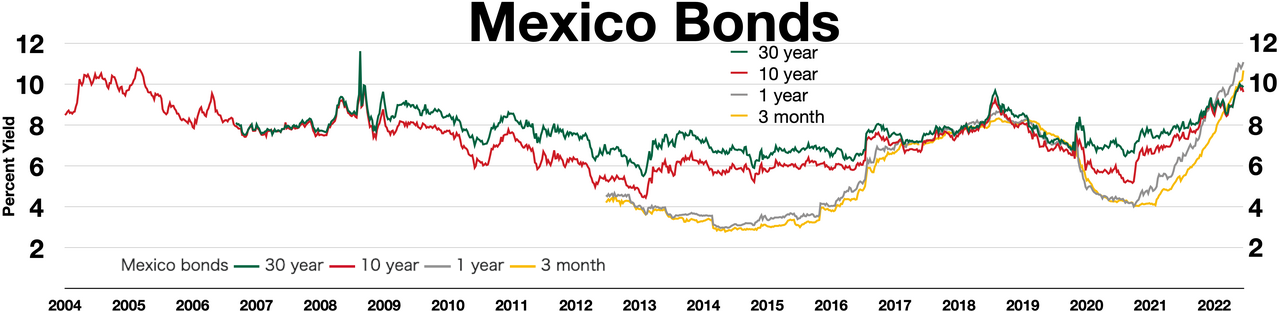 Trends in Mexican Government Bonds |
メキシコ国債の推移 |
| Economy of New Spain, 1521–1821 See also: New Spain Diego Rivera Mural of exploitation of Mexico by Spanish conquistadors, Palacio Nacional, Mexico City (1929–1945) Mexico's economy in the colonial period was based on resource extraction (mainly silver), on agriculture and ranching, and on trade, with manufacturing playing a minor role. In the immediate post-conquest period (1521–40), the dense indigenous and hierarchically organized central Mexican peoples were employed as labor and producers of tribute goods for Spanish conquerors. The tribute and labor of Indigenous communities (though not their land) were granted to individual conquerors in an arrangement called encomienda. Conquerors built private fortunes not so much through plunder as through the labor and tribute and the acquisition of land in areas where they held encomiendas, translating that into long-term sustainable wealth.[4][5] The colonial landscape in central Mexico became a patchwork of different sized holdings by Spaniards and indigenous communities. As the crown began limiting the encomienda in the mid-sixteenth century to prevent the development of an independent seigneurial class through the New Laws, Spaniards who had become landowners acquired permanent and part-time labor from Indigenous and mixed-race workers. Although the encomienda was a major economic institution of the early period, it was gradually abandoned due to the drop in indigenous populations, economic growth and the expansion of the number of Spaniards in New Spain.[6] |
ヌエバ・エスパーニャの経済、1521年–1821年 関連項目:ヌエバ・エスパーニャ スペインの征服者によるメキシコの搾取を描いたディエゴ・リベラの壁画、メキシコシティ国立宮殿(1929年–1945年) 植民地時代のメキシコ経済は、資源採掘(主に銀)、農業および牧畜、そして貿易に基づいており、製造業はごくわずかな役割しか果たしていなかった。征服直 後の時期(1521–40年)には、人口密度が高く階層的な組織を持つメキシコ中部の先住民たちが、スペインの征服者たちのために労働力として、また貢納 品の生産者として動員された。先住民コミュニティからの貢納品と労働力(土地そのものではない)は、「エンコミエンダ」と呼ばれる制度の下で個々の征服者 に与えられた。征服者たちは略奪というよりは、エンコミエンダを保有する地域における労働力や貢納品、そして土地の取得を通じて私財を築き、それを長期的 に持続可能な富へと転換した。[4][5] メキシコ中部の植民地時代の景観は、スペイン人と先住民コミュニティによる異なる大きさの所有地がモザイク状に広がるものとなった。16世紀半ば、王室が 「新法」を通じて独立した領主階級の形成を防ぐためエンコミエンダを制限し始めると、土地所有者となったスペイン人は、先住民や混血の労働者から常勤およ び臨時労働力を確保するようになった。エンコミエンダは初期の主要な経済制度であったが、先住民人口の減少、経済成長、およびヌエバ・エスパーニャにおけ るスペイン人の増加に伴い、徐々に廃れていった。[6] |
Mining Miner's gear from the colonial period in Mexico on display at the Historical Archive and Museum of Mining in Pachuca, Mexico. Silver became the motor of the Spanish colonial economy both in New Spain and in Peru. It was mined under license from the crown, with a fifth of the proceeds (quinto real) rendered to the crown.[7] Although the Spaniards sought gold, and there were some small mines in Oaxaca and Michoacán, the big transformation in New Spain's economy came in the mid-sixteenth century with discoveries of large deposits of silver.[8] Near Mexico City, the Nahua settlement of Taxco was found in 1534 to have silver.[9] The largest silver deposits were found north of the densely populated zones of Indigenous communities and Spanish settlements. Zacatecas and later Guanajuato became the most important centers of silver production, but there were many others, including in Parral (Chihuahua) and later strikes in San Luis Potosí, optimistically named after the Potosí silver mine of Bolivia.[8] Spaniards established of cities in the mining region as well as agrarian enterprises supplying foodstuffs and material goods necessary for the mining economy. For Mexico, which did not have a vast supply of trees to use as fuel to extract silver from ore by high heat, the invention in 1554 of the patio process that used mercury to chemically extract the silver from ore was a breakthrough.[10] Spain had a mercury mine in Almadén whose mercury was exported to Mexico. (Peru had its own local source of mercury at Huancavelica). The higher the proportion of mercury in the process meant the higher the extraction of silver.  Almadén mercury mine in Spain  Cinnabar mercury amalgam from Almaden The crown had a monopoly on mercury and set its price. During the Bourbon reforms of the eighteenth century, the crown increased mercury production at Almadén and lowered the price to miners by half resulting in a huge increase in Mexico's silver production.[11] As production costs dropped, mining became less risky so that there was a new surge of mine openings and improvements.[12] In the eighteenth century, mining was professionalized and elevated in social prestige with the establishment of the royal college of mining and a miners' guild (consulado), making mining more respectable. The crown promulgated a new mining code limiting liability and protecting patents for technical improvements.[13] Highly successful miners purchased titles of nobility in the eighteenth century, valorizing their status in society as well as bringing revenues to the crown.[14][15] Wealth from Spanish mining fueled the transatlantic economy, with silver becoming the main precious metal in circulation worldwide. Although the northern mining did not itself become the main center of power in New Spain, the silver extracted there was the most important export from the colony.[16] The control that the royal mints exerted over the uniform weight and quality of silver bars and coins made Spanish silver the most accepted and trusted currency. Many of the laborers in the silver mines were free wage earners drawn by high wages and the opportunity to acquire wealth for themselves through the pepena system[17] which allowed miners to take especially promising ore for themselves.[18] There was a brief period of mining in central and southern Mexico that mobilized indigenous men's involuntary labor by the repartimiento, but Mexico's mines developed in the north outside of the zone of dense indigenous settlement. They were ethnically mixed and mobile, becoming culturally part of the Hispanic sphere even if their origins were indigenous. Mine workers were generally well paid with a daily wage of 4 reales per day plus a share of the ore produced, the partido. In some cases, the partido was worth more than the daily wage. Mine owners sought to terminate the practice.[14] Mine workers pushed back against mine owners, particularly in a 1766 strike at the Real del Monte mine, owned by the Conde de Regla, in which they closed down the mine and murdered a royal official.[19] In the colonial period, mine workers were the elites of free workers,[20] |
鉱業 メキシコ・パチューカにある歴史資料館兼鉱業博物館に展示されている、メキシコ植民地時代の鉱夫の装備。 銀は、ヌエバ・エスパーニャとペルーの両方で、スペイン植民地経済の原動力となった。銀は王室の許可の下で採掘され、収益の5分の1(クイント・レアル) が王室に納められていた。[7] スペイン人は金を求めていたが、オアハカやミチョアカンには小規模な鉱山がいくつかあったものの、ヌエバ・エスパーニャ経済の大きな変革は、16世紀半ば に大規模な銀鉱床が発見されたことで訪れた。[8] メキシコシティ近郊のナワ族の集落タスコでは、1534年に銀が発見された。[9] 最大の銀鉱床は、先住民コミュニティやスペイン人入植地が密集する地域の北側で発見された。サカテカス、そして後にグアナフアトが銀生産の最重要拠点と なったが、他にも多くの産地が存在した。チワワ州のパラルや、後に発見されたサン・ルイス・ポトシなどがそれにあたる。サン・ルイス・ポトシは、ボリビア のポトシ銀山にちなんで名付けられた。[8] スペイン人は鉱山地帯に都市を建設するとともに、鉱業経済に必要な食料や物資を供給する農業事業も展開した。高温で鉱石から銀を抽出するための燃料となる 木材を豊富に持たなかったメキシコにとって、1554年に水銀を用いて鉱石から化学的に銀を抽出する「パティオ法」が発明されたことは画期的な出来事で あった。[10] スペインにはアルマデンに水銀鉱山があり、そこから採掘された水銀はメキシコへ輸出されていた。(ペルーにはワンカベリカに独自の水銀産地があった)。こ の工程における水銀の割合が高ければ高いほど、銀の抽出量も増えた。 スペインのアルマデン水銀鉱山 アルマデン産の水銀アマルガム(辰砂) 王室は水銀の独占権を持ち、その価格を決定していた。18世紀のブルボン改革の際、王室はアルマデンでの水銀生産を増大させ、鉱夫への販売価格を半額に引 き下げた。その結果、メキシコの銀生産量は飛躍的に増加した。[11] 生産コストが低下したことで採掘のリスクが軽減され、鉱山の開設や改良が新たに急増した。[12] 18世紀には、王立鉱山大学や鉱夫組合(コンスラード)の設立により、採掘業は専門化され社会的地位も向上し、より尊敬される職業となった。王室は、責任 を限定し技術的改良の特許を保護する新たな鉱業法を公布した。[13] 18世紀、大成功を収めた鉱山主たちは貴族の称号を購入し、社会的な地位を高めるとともに、王室に収入をもたらした。[14][15] スペインの鉱業から生み出された富は大西洋横断経済を牽引し、銀は世界中で流通する主要な貴金属となった。北部の鉱業自体はニュー・スペインにおける主要 な権力中心地にはならなかったが、そこで採掘された銀は植民地からの最重要輸出品であった。[16] 王立造幣局が銀地金や銀貨の重量と品質の統一に対して行使した統制により、スペインの銀は最も広く受け入れられ、信頼される通貨となった。 銀鉱山の労働者の多くは、高賃金と、ペペナ制度[17]を通じて自ら富を築く機会に惹かれた自由な賃金労働者であった。この制度により、鉱夫は特に有望な 鉱石を自分のものにすることを許されていた。[18] メキシコ中部および南部では、レパルティミエントによって先住民男性の強制労働が動員された短期間の採掘期があったが、メキシコの鉱山は、先住民の密集居 住地域外である北部で発展した。鉱山労働者は混血で流動的であり、たとえ先住民出身であっても、文化的にはヒスパニック圏の一部となっていった。鉱山労働 者は一般的に高給で、日給4レアルに加え、産出された鉱石の分け前であるパルティードが支給された。場合によっては、パルティードの日当よりも価値が高 かった。鉱山所有者はこの慣行を廃止しようとした。[14] 鉱山労働者は鉱山所有者に対して抵抗し、特に1766年にはレグラ伯爵が所有するレアル・デル・モンテ鉱山でストライキを起こし、鉱山を閉鎖して王室高官 を殺害した。[19] 植民地時代、鉱山労働者は自由労働者のエリートであった。[20] |
Agriculture and ranching View of the Valley of Mexico by José María Velasco  Indigenous man collecting cochineal with a deer tail by José Antonio de Alzate y Ramírez (1777). Cochineal was New Spain's most important export product after silver and its production was almost exclusively in the hands of indigenous cultivators Although pre-Hispanic Mexico produced surpluses of corn (maize) and other crops for tribute and subsistence use, Spaniards began commercial agriculture, cultivating wheat, sugar, fruit trees, and even for a period, mulberry trees for silk production in Mexico.[21][22] Areas that had never seen indigenous cultivation became important for commercial agriculture, particularly what has been called the "near North" of Mexico, just north of indigenous settlement in central Mexico. Wheat cultivation using oxen and Spanish plows was done in the Bajío, a region that includes a number of states of modern Mexico, Querétaro, Jalisco, and San Luis Potosí. The system of land tenure has been cited as one of the reasons that Mexico failed to develop economically during the colonial period, with large estates inefficiently organized and run and the "concentration of land ownership per se caused waste and misallocation of resources."[23] These causes were posited before a plethora of studies of the hacienda and smaller agrarian enterprises as well as broader regional studies were done in the 1960s and 1970s. These studies of individual haciendas and regions over time postulate that hacienda owners were profit-seeking entrepreneurs. They had the advantage of economies of scale that smaller holders and indigenous villages did not in cultivation of grains, pulque, sugar, and sisal and in ranching, with cattle and sheep.[24] Great haciendas did not completely dominate the agrarian sector, since there were products that could be efficiently produced by smaller holders and indigenous villages, such as fruits and vegetables, cochineal red dye, and animals that could be raised in confined spaces, such as pigs and chickens.[25] Small holders also produced wine, cotton and tobacco.[25] In the eighteenth century, the crown created a tobacco monopoly on both cultivation and manufacturing of tobacco products.[26] As Spanish agrarian enterprises developed, acquiring title to land became important. As the size of the indigenous labor force dropped and as the number of Spaniards seeking land and access to labor increased, a transitional labor institution called repartimiento ("allotment") developed, in which the crown allotted indigenous labor to Spaniards on a temporary basis. Many Spanish landowners found the system unsatisfactory since they could not count on receiving an allocation that suited their needs. The repartimiento for agriculture was abolished in 1632.[27] Large-scale landed estates or haciendas developed, and most needed both a small permanent labor force supplemented by temporary labor at peak times, such as planting and harvesting.[28][29] Cattle ranching needed less labor than agriculture but did need sufficient grazing land for their herds to increase. As more Spaniards settled in the central areas of Mexico where there were already large numbers of indigenous settlements, the number of ranching enterprises declined, and ranching was pushed north. Northern Mexico was mainly dry and its indigenous population nomadic or semi-nomadic, allowing Spanish ranching activities to expand largely without competition. As mining areas developed in the north, Spanish haciendas and ranches supplied products from cattle, not just meat, but hides and tallow, for the silver mining areas. Spaniards also grazed sheep, which resulted in ecological decline since sheep cropped grass to its roots preventing regeneration.[30] Central Mexico attracted a larger proportion of Spanish settlement and landed enterprises there shifted from mixed agriculture and ranching to solely agriculture. Ranching was more widespread in the north, with its vast expanses and little access to water. Spaniards imported seeds for production of wheat for their own consumption. Both Spaniards and the indigenous produced native products commercially, particular the color-fast red dye cochineal, as well as the fermented juice of the maguey cactus, pulque. In the early colonial period Mexico was briefly a silk producer. When the transpacific trade with Manila developed in the late sixteenth century, the finer quality Asian silks out-competed locally produced ones.[31] The bulk of luxury yard goods were imported from northern Europe via Spain. For rough cloth for the urban masses, cotton and wool were produced and woven in Mexico in small workshops called obrajes.[32] |
農業と牧畜 ホセ・マリア・ベラスコによるメキシコ盆地の眺め ホセ・アントニオ・デ・アルサテ・イ・ラミレス作、鹿の尾を使ってコチニールを採取する先住民の男(1777年)。コチニールは銀に次ぐニュー・スペインの最重要輸出品であり、その生産はほぼ完全に先住民の農家によって行われていた. 先コロンブス期のメキシコでは、貢納や自給用にトウモロコシ( maize )やその他の作物が余剰生産されていたが、スペイン人は商業農業を開始し、小麦、砂糖、果樹、さらには一時期、メキシコでの絹生産のための桑の木まで栽培 した。[21][22] 先住民による耕作が行われたことのない地域が商業農業にとって重要となり、特にメキシコ中央部の先住民居住地のすぐ北に位置する、いわゆるメキシコの「ニ ア・ノース」地域がそうであった。牛とスペイン式プラウを用いた小麦栽培は、バヒオで行われた。この地域には、現代メキシコのケレタロ州、ハリスコ州、サ ン・ルイス・ポトシ州など、いくつかの州が含まれている。 土地所有制度は、植民地時代にメキシコが経済的に発展できなかった理由の一つとして挙げられてきた。大規模な荘園は非効率的に組織・運営されており、「土 地所有の集中そのものが、資源の浪費と配分の歪みを引き起こした」のである。[23] これらの要因は、1960年代から1970年代にかけて、アシエンダや小規模な農業経営に関する数多くの研究、およびより広範な地域研究が行われる以前に 提唱されたものである。個々のアシエンダや地域を時系列で分析したこれらの研究は、アシエンダ所有者が利益追求型の起業家であったと推定している。彼ら は、穀物、プルケ、砂糖、サイザルの栽培や、牛や羊の牧畜において、小規模農家や先住民の村にはない規模の経済という利点を持っていた。[24] 果物や野菜、コチニール赤色素、豚や鶏など狭い場所で飼育できる家畜など、小規模農家や先住民の村が効率的に生産できる産品が存在したため、大規模アシエ ンダが農業部門を完全に支配していたわけではない。[25] 小規模農家はワイン、綿、タバコも生産していた。[25] 18世紀、王室はタバコの栽培と製品製造の両方においてタバコ独占制度を確立した。[26] スペインの農業事業が発展するにつれ、土地の所有権の取得が重要となった。先住民の労働力人口が減少する一方で、土地と労働力を求めるスペイン人の数が増 加するにつれ、「レパルティミエント」(「割当」)と呼ばれる過渡的な労働制度が発展した。これは、王室が先住民の労働力をスペイン人に一時的に割り当て る制度であった。多くのスペイン人地主は、自らのニーズに合った配分が得られる保証がなかったため、この制度に不満を抱いていた。農業におけるレパルティ ミエントは1632年に廃止された。[27] 大規模な土地所有地、すなわちアシエンダが発展し、その多くは、少数の常勤労働力に加え、作付けや収穫などの繁忙期には臨時労働力を必要としていた。 [28] [29] 牧畜は農業ほど多くの労働力を必要としなかったが、群畜の頭数を増やすには十分な放牧地が必要だった。すでに多数の先住民集落が存在していたメキシコ中部 地域にスペイン人が定住するにつれ、牧畜事業の数は減少し、牧畜は北部へと追いやられた。メキシコ北部は主に乾燥地帯であり、先住民は遊牧民または半遊牧 民であったため、スペイン人の牧畜活動は競合をほとんど受けずに拡大することができた。北部で鉱山地帯が開発されるにつれ、スペイン人のアシエンダや牧場 は、銀鉱山地帯に向けて、肉だけでなく皮革や獣脂といった牛由来の製品を供給した。スペイン人は羊の放牧も行っていたが、羊は草を根元まで食べ尽くし再生 を妨げたため、生態系の悪化を招いた。[30] メキシコ中部にはスペイン人の入植者がより多く集まり、その地の土地所有企業は、農業と牧畜の混合経営から純粋な農業へと移行した。牧畜は、広大な土地が 広がり、水源へのアクセスが乏しい北部でより広く行われた。スペイン人は自家消費用の小麦生産のために種子を輸入した。 スペイン人も先住民も、特に色落ちしない赤い染料であるコチニールや、マゲイサボテンの果汁を発酵させたプルケといった、地元の産物を商業的に生産してい た。植民地時代初期、メキシコは短期間ながら絹の生産地となった。16世紀後半にマニラとの太平洋横断貿易が発展すると、高品質なアジア産の絹が地元産の 絹を市場から駆逐した。[31] 高級な反物類の大部分は、スペインを経由して北ヨーロッパから輸入されていた。都市の大衆向けの粗布については、綿や羊毛がメキシコ国内の「オブラヘス」 と呼ばれる小規模な工房で生産・織られていた。[32] |
Cities, trade and transportation routes Arrieros in Mexico. Mules were the main way cargo was moved overland, engraving by Carl Nebel  Spanish galleon, the mainstay of transatlantic and transpacific shipping, engraving by Albert Durer  16th c. Seville, Spanish port for the transatlantic trade  Acapulco in 1628, Mexican terminus of the Manila galleon Cities had concentrations of crown officials, high ecclesiastical officials, merchants, and artisans, with the viceregal capital of Mexico City, having the largest. Mexico City was founded on the ruins of the Aztec capital of Tenochtitlan and has never given up its primacy in Mexico. The history of Mexico City is deeply entwined in the development of the Mexican economy. Two main ports, Veracruz on the Caribbean coast the served the transatlantic trade and Acapulco on the Pacific coast, the terminus for the Asian trade via the Manila Galleon, allowed the crown to regulate trade. In Spain the House of Trade (Casa de Contratación) in Seville registered and regulated exports and imports as well as issuing licenses for Spaniards emigrating to the New World. Exports were silver and dyestuffs and imported were luxury goods from Europe, while a local economy of high bulk, low value products were produced in Mexico. Artisans and workers of various types provided goods and services to urban dwellers. In Mexico City and other Spanish settlements, the lack of a system of potable water meant that the services of water carriers supplied individual households. A network of cities and towns developed, some were founded on previous indigenous city-states, (such as Mexico City) while secondary cities were established as provincial areas gained population because of economic activity. The main axis was from Veracruz, via the well-situated city of Puebla to Mexico City. Another axis connected Mexico City and Puebla to the mining areas of the north, centered on Guanajuato and Zacatecas. There was a road further north to New Mexico, but Mexico's far north, except for a few mining centers such as Parral, were of little economic interest. California's rich deposits of gold were unknown in the colonial era and had they been discovered that whole region's history would not be one of marginal importance.[33] To the south, trunk lines connected Mexico's center to Oaxaca and the port of Acapulco, the terminus of the Manila galleon. Yucatán was more easily accessed from Cuba than Mexico City, but it had a dense Maya population so there was a potential labor force to produce products such as sugar, cacao, and later henequen (sisal). Bad transportation was a major stumbling block to the movement of goods and people within Mexico, which had generally difficult topography. There were few paved roads and dirt tracks turned impassible during the rainy season. Rather than hauling goods by carts drawn by oxen or mules, the most common mode of transporting goods was via pack mules. Poor infrastructure was coupled with poor security, so that banditry was an impediment to the safe transport of people and goods. In the Northern area, the índios bárbaros or "uncivilized Indians" opposed settlement and travel.[citation needed] The eighteenth century saw New Spain increase the size and complexity of its economy. Silver remained the motor of the economy, and production increased even though few new mines came into production. The key to the increased production was the lowering of the price of mercury, an essential element in refining silver. The larger the amount of mercury used in refining, the greater pure silver was extracted from ore. Another important element for the eighteenth-century economic boom was the number of wealthy Mexicans who were involved in multiple enterprises as owners, investors, or creditors. Mining is an expensive and uncertain extractive enterprise needed large capital investments for digging and shoring up shafts as well as draining water as mines got deeper. Elites invested their fortunes in real estate, mainly in rural enterprises and to a lesser extent urban properties, but often lived in nearby cities or the capital. The Roman Catholic Church functioned as a mortgage bank for elites. The Church itself accrued tremendous wealth, aided by the fact that as a corporation, its holdings were not broken up to distribute to heirs. |
都市、貿易、そして交通路 メキシコのラリエロス。陸路での貨物輸送は主にラバによって行われていた。カール・ネーベル作の版画 大西洋および太平洋横断航海の主力であったスペインのガレオン船。アルブレヒト・デューラー作の版画 16世紀のセビリア。大西洋貿易の拠点となったスペインの港 1628年のアカプルコ。マニラ・ガレオン船のメキシコ側の終着地 都市には王室の役人、高位聖職者、商人、職人が集まり、副王領の首都メキシコシティが最大の規模を誇った。メキシコシティはアステカ帝国の首都テノチティ トランの廃墟の上に築かれ、メキシコにおけるその優位性を一度も譲ったことはない。メキシコシティの歴史は、メキシコ経済の発展と深く絡み合っている。大 西洋貿易を担うカリブ海沿岸のベラクルスと、マニラ・ガレオン船を経由するアジア貿易の終着地である太平洋沿岸のアカプルコという二つの主要港により、王 室は貿易を規制することができた。スペインでは、セビリアの貿易局(カサ・デ・コントラタシオン)が輸出入の登録と規制を行い、新大陸へ移住するスペイン 人への許可証を発行していた。輸出品は銀と染料、輸入品はヨーロッパからの贅沢品であり、一方メキシコ国内では、大量かつ低価値な製品を中心とした地域経 済が形成されていた。様々な職人や労働者が、都市住民に商品やサービスを提供していた。メキシコシティやその他のスペイン人入植地では、上水道システムが 整備されていなかったため、各家庭への給水は水運び人のサービスに依存していた。 都市や町のネットワークが形成され、その一部は以前の先住民都市国家(メキシコシティなど)の上に築かれたが、経済活動によって地方地域の人口が増加する につれ、二次的な都市も設立された。主要な軸は、ベラクルスから、立地条件の良いプエブラを経由してメキシコシティへと続いていた。もう一つの軸は、メキ シコシティとプエブラを、グアナフアトやサカテカスを中心とする北部の鉱山地帯へと結んでいた。さらに北にはニューメキシコへと続く道があったが、パラー ルなどの少数の鉱山拠点を除き、メキシコの最北部は経済的にほとんど関心が持たれていなかった。カリフォルニアの豊富な金鉱床は植民地時代には知られてお らず、もし発見されていたならば、その地域全体の歴史は些細な重要性にとどまるものではなかっただろう。[33] 南方では、幹線道路がメキシコ中部とオアハカ、そしてマニラ・ガレオン船の終着港であるアカプルコを結んでいた。ユカタン半島へはメキシコシティからより もキューバ経由の方がアクセスしやすかったが、そこにはマヤ人が密集して居住していたため、砂糖やカカオ、後にヘネケン(サイザル)などの生産を担う潜在 的な労働力があった。 メキシコ国内における物資や人の移動にとって、劣悪な交通網は大きな障害となっていた。同国は全般的に地形が険しく、舗装された道路は少なく、未舗装の道 は雨季になると通行不能になった。牛やラバが引く荷車で物資を運ぶよりも、荷を積んだラバによる輸送が最も一般的な手段であった。インフラの未整備に加え 治安も悪かったため、盗賊行為が人や物資の安全な輸送を妨げる要因となっていた。北部地域では、「野蛮なインディオ」と呼ばれる先住民たちが、入植や移動 に抵抗した。[出典必要] 18世紀、ヌエバ・エスパーニャの経済は規模と複雑さを増した。銀は依然として経済の原動力であり、新規に操業を開始した鉱山はほとんどなかったにもかか わらず、生産量は増加した。生産増加の鍵となったのは、銀の精錬に不可欠な水銀の価格低下であった。精錬に使用する水銀の量が多ければ多いほど、鉱石から より多くの純銀が抽出された。18世紀の経済ブームにおけるもう一つの重要な要素は、所有者、投資家、あるいは債権者として複数の事業に関与していた富裕 なメキシコ人の数であった。鉱業は費用がかかり不確実な採掘事業であり、坑道を掘削・補強し、鉱山が深くなるにつれて排水を確保するために多額の資本投資 を必要とした。 エリート層は資産を不動産に投資したが、その主な対象は農村部の事業であり、都市部の不動産への投資は比較的少なかった。しかし、彼らはしばしば近隣の都 市や首都に住んでいた。ローマ・カトリック教会は、エリート層にとっての抵当銀行としての役割を果たした。教会自体も莫大な富を蓄積したが、これは法人と してその資産が相続人に分割されずに引き継がれたという事実が後押ししていた。 |
Crown policy and economic development A single-canvas painting showing the casta system in eighteenth-century Mexico. Spaniards were at the top of the system with mixed-race men and women consigned to the bottom ranks, with both engaging in manual labor. Crown policies generally impeded entrepreneurial activity in New Spain, through laws and regulations that were disincentives to the creation of new enterprises.[34] There was no well-defined or enforceable set of property rights,[35][36] but the crown claimed rights over subsoil resources, such as mining. The crown's lack of investment in a good system of paved roads made moving products to market insecure and expensive, so enterprises had a narrower reach for their products, particularly bulky agricultural products.[37] Although many enterprises, such as merchant houses and mining, were highly profitable, they were often family firms. The components of Roman Catholic Church had a considerable number of landed estates and the Church received income from the tithe, a ten percent tax on agricultural output. However, there were no laws that promoted "economies of scale through joint stock companies or corporations."[36] There were corporate entities, particularly the Church and indigenous communities, but also corporate groups with privileges (fueros), such as miners and merchants who had separate courts and exemptions.[38][39][40][41] There was no equal standing before the law, given the exemptions of corporate entities (including indigenous communities) and legal distinctions between races. Only those defined as Spaniards, either peninsular- or American-born of legitimate birth had access to a variety of elite privileges[42] such as civil office holding, ecclesiastical positions, but also entrance of women into convents, which necessitated a significant dowry. A convent for Indigenous women of "pure blood" was established in the eighteenth century. Indigenous men from the mid-sixteenth century had been barred from the priesthood, not only excluding them from empowerment in the spiritual realm, but also depriving them of the honor, prestige, and income that a priest could garner. In the eighteenth century the Bourbon administrative reforms began restricting the number of American-born men appointed to office, which was not only a diminution of their own and their families’ status, but also excluded them from the revenues and other benefits that flowed from office holding. The benefits were not merely the salary, but also the networks of useful connections to do business: The interventionist and pervasively arbitrary nature of the institutional environment forced every enterprise, urban or rural, to operate in a highly politicized manner, using kinship networks, political influence, and family prestige to gain privileged access to subsidized credit, to aid various stratagems for recruiting labor, to collect debts or enforce contracts, to evade taxes or circumvent courts, and to defend titles to land.[43] The most closely controlled commodity from New Spain (and Peru) was the production and transportation of silver. Crown officials monitored each step of the process, from licensing on those who developed mines, to transportation, to minting of uniform size and quality silver bars and coins. The crown established monopolies in other commodities, most importantly mercury from Almadén, the key component in silver refining. But the crown also established monopolies over tobacco production and manufacturing. Guilds (gremios) restricted the practice of certain professions, such as those engaged in painting, gilded framer makers, music instrument makers, and others. Indigenous and mixed–race castas were considered a threat, producing quality products far more cheaply.[44] The crown sought to control trade and emigration to its overseas territories via the House of Trade (Casa de Contratación), based in Seville. Officials in Seville registered ships’ cargoes and passengers bound for the Indies (as the crown to the end of the colonial era called its territories) and upon arrival in New World ports, other crown officials inspected cargo and passengers. In Mexico, the Gulf Coast port of Veracruz, New Spain's oldest Spanish city and main port, and the Pacific coast port of Acapulco, the terminus of the Manila Galleon were busy when ships were in port, but they did not have large numbers of Spanish settlers in large part due to their disagreeable tropical climate. Restricting trade put big merchant houses, largely family businesses, in a privileged position. A consulado, the organization of elite merchants, was established in Mexico City, which raised the status of merchants, and later consulados were established in Veracruz, Guadalajara, and Guatemala City indicating the growth of a core economic group in those cities.[45] Central regions could get imports those firms handled relatively easily, but with a bad transportation network, other regions became economic backwaters and smuggling and other non-sanctioned economic activity took place. The economic policy of comercio libre that was instituted in 1778, it was not full free trade but trade between ports in the Spanish empire and those in Spain; it was designed to stimulate trade. In Mexico, the big merchant families continued to dominate trade, with the main merchant house in Mexico City and smaller outlets staffed by junior members of the family in provincial cities.[46] For merchants in Guatemala City dealing in indigo, they had direct contact with merchants in Cádiz, the main port in Spain, indicating the level of importance of this dye stuff in trade as well as the strengthening of previously remote areas with larger trade networks, in this case by passing Mexico City merchant houses.[47] There was increased commercial traffic between New Spain, New Granada (northern South America), and Peru and during wartime, trade was permitted with neutral countries.[48] |
王室の政策と経済発展 18世紀メキシコのカースタ制度を描いた一枚の絵画。スペイン人が制度の頂点に立ち、混血の男女は最下層に追いやられ、双方が肉体労働に従事していた。 王室の政策は、新規事業の創出を阻害する法律や規制を通じて、一般的にヌエバ・エスパーニャにおける起業活動を妨げていた。[34] 明確に定義され、執行可能な一連の財産権は存在しなかったが[35][36]、王室は鉱業などの地下資源に対する権利を主張していた。王室が舗装道路の整 備に投資しなかったため、製品を市場へ運ぶことは不安定かつ高コストとなり、企業は製品、特にかさばる農産物の販売範囲を狭めざるを得なかった。[37] 商社や鉱山など多くの企業は高い収益性を誇っていたが、それらは往々にして家族経営であった。ローマ・カトリック教会の各組織は相当数の土地所有地を保有 しており、教会は農産物の10%を徴収する什一税から収入を得ていた。しかし、「株式会社や法人を通じた規模の経済」を促進する法律は存在しなかった。 [36] 法人格は存在した。特に教会や先住民コミュニティがそれにあたるが、鉱山業者や商人など、独自の裁判所や免除特権(フエロス)を持つ特権団体も存在した。 [38][39][40] [41] 法人(先住民コミュニティを含む)に対する免除や人種間の法的区別が存在したため、法の下の平等はなかった。半島生まれかアメリカ大陸生まれかを問わず、 嫡出子として「スペイン人」と定義された者だけが、公職や教会職への就任といった様々なエリート特権[42]に加え、多額の持参金を必要とする女子修道院 への入所権も享受できた。18世紀には、「純血」の先住民女性のための修道院が設立された。16世紀半ば以降、先住民の男性は司祭職から締め出されてお り、これは彼らを精神的領域での権力から排除しただけでなく、司祭が得られる名誉、威信、そして収入をも奪うこととなった。 18世紀、ブルボン朝の行政改革により、アメリカ生まれの男性の公職への任命数が制限され始めた。これは彼ら自身やその家族の地位を低下させただけでな く、公職に就くことで得られる収入やその他の恩恵からも彼らを排除することとなった。その恩恵とは単なる給与だけでなく、商売を行う上で有用な人脈のネッ トワークでもあった: 制度的環境の介入主義的かつ遍在する恣意性は、都市部であれ農村部であれ、あらゆる事業を極めて政治化された形で運営することを強いた。親族ネットワー ク、政治的影響力、そして家族の威信を用いて、補助金のついた融資への特権的なアクセスを得たり、労働力確保のための様々な策略を支援したり、債務の回収 や契約の履行を強いたり、税金を逃れ裁判を回避したり、土地の所有権を防衛したりするためである。[43] ニュー・スペイン(およびペルー)において最も厳重に管理されていた商品は、銀の生産と輸送であった。王室の役人は、鉱山開発者の免許付与から輸送、そして統一されたサイズと品質の銀地金や銀貨の鋳造に至るまで、プロセスの各段階を監視していた。 王室は他の商品についても独占権を確立したが、最も重要なのは銀精錬の主要成分であるアルマデンの水銀であった。しかし王室は、タバコの生産と製造につい ても独占権を確立した。ギルド(グレミオス)は、絵画、金箔装飾枠の製作、楽器製作などに従事する者など、特定の職業の営みを制限した。先住民や混血のカ スタは、はるかに安価に高品質な製品を生産するため、脅威と見なされていた。[44] 王室は、セビリアに拠点を置く貿易局(カサ・デ・コントラタシオン)を通じて、海外領土への貿易と移住を統制しようとした。セビリアの役人は、インド諸島 (植民地時代の終わりまで王室がその領土を呼んだ名称)行きの船舶の積荷と乗客を登録し、新世界の港に到着すると、他の王室役人が積荷と乗客を検査した。 メキシコでは、メキシコ湾岸の港湾都市ベラクルス(ニュー・スペイン最古のスペイン人都市であり主要港)や、太平洋岸の港湾都市アカプルコ(マニラ・ガレ オン船の終着地)は、船が停泊している間は活気に満ちていたが、主に不快な熱帯気候のため、スペイン人入植者は多くはなかった。 貿易の制限は、主に家族経営であった大手商社を特権的な立場に置いた。メキシコシティには、エリート商人による組織であるコンスラドが設立され、これによ り商人の地位が向上した。その後、ベラクルス、グアダラハラ、グアテマラシティにもコンスラドが設立され、これらの都市における中核的な経済集団の成長を 示していた。[45] 中央地域では、これらの企業が扱う輸入品を比較的容易に入手できたが、交通網が未整備であったため、他の地域は経済的に取り残され、密輸やその他の非公認 の経済活動が行われるようになった。1778年に導入された「コメルシオ・リブレ(自由貿易)」政策は、完全な自由貿易ではなく、スペイン帝国内の港とス ペイン本土の港との間の貿易を指し、貿易を活性化させることを目的としていた。メキシコでは、大商人一族が引き続き貿易を支配し、メキシコシティに本拠を 置き、地方都市には一族の若手が従事する小規模な支店を展開していた。[46] グアテマラシティで藍を扱う商人たちは、スペインの主要港であるカディス市の商人たちと直接取引を行っていた。これは、この染料が貿易においていかに重要 であったかを示すと同時に、メキシコシティの商社を経由せずに、かつては辺境であった地域がより広範な貿易ネットワークと結びついたことを示している。 [47] ヌエバ・エスパーニャ、ヌエバ・グラナダ(南米北部)、ペルーの間では商業往来が増加し、戦時中には中立国との貿易も許可されていた。[48] |
 Gaspar Melchor de Jovellanos, who proposed a major land reform in Spain that also influenced Mexico. Portrait by Francisco de Goya. Internal trade in Mexico was hampered by taxes and levies by officials. The alcabala or sales tax was established in Spain in the fifteenth and sixteenth centuries, and was especially favored by the crown because in Spain it did not fall under the jurisdiction of the cortes or Spanish assembly.[49] Goods produced by or for indigenous peoples were exempted from the alcabala.[50] In the eighteenth century, with more effective collection of the sales tax, the revenues increased significantly.[51] Other taxes included the tithe, which was a ten percent tax on agricultural production; tributes paid by non-whites (Indigenous, Blacks and mixed-race castas); and fees for licensing and other government regulation. Crown officials (with the exception of the viceroy) often purchased their offices, with the price recouped through fees and other means.[52] During the late eighteenth century with the Bourbon reforms, the crown established a new administrative system, the intendancy, with much better paid crown officials, with the hope that graft and other personal enrichment would not be so tempting.[53] In the eighteenth century, there were new and increased taxes including on maize, wheat flour, and wood.[54] Fluctuations in rainfall and harvests played havoc with the price of maize, which often resulted in civil unrest, such that the crown began establishing granaries (alhondigas) to moderate the fluctuations and to forestall rioting. In a major move to tap what it thought was a major source of revenue, the crown in 1804 promulgated the Act of Consolidation (Consolidación de Vales Reales), in which the crown mandated that the church turn over its funds to the crown, which would in turn pay the church five percent on the principal.[55] Since the church was the major source of credit for hacendados, miners, and merchants, the new law meant that they had to pay the principal to the church immediately. For borrowers who counted on thirty or more year mortgages to repay the principal, the law was a threat to their economic survival. For conservative elements in New Spain that were loyal to the crown, this most recent change in policy was a blow. With the Napoleonic invasion of Iberia in 1808, which placed Napoleon's brother Joseph on the Spanish throne, an impact in New Spain was to suspend the implementation on the deleterious Act of Consolidation.[56][57][58] A Spanish intellectual Gaspar Melchor de Jovellanos wrote a critique of the decline of Spain as an economic power in 1796 that contended the stagnation of Spanish agriculture was a major cause of Spain's economic problems. He recommended that the crown press for major changes in the agrarian sector, including the breakup of entailed estates, sale of common lands to individuals, and other instruments to make agriculture more profitable.[59] In New Spain, the bishop-elect of the diocese of Michoacan, Manuel Abad y Queipo, was influenced by Jovellanos's work and proposed similar measures in Mexico. The bishop-elect's proposal for land reform in Mexico in the early nineteenth century, influenced by Jovellanos's from the late eighteenth century, had a direct impact on Mexican liberals seeking to make the agrarian sector more profitable. Abad y Queipo "fixed upon the inequitable distribution of property as the chief cause of New Spain's social squalor and advocated ownership of land as the chief remedy."[60] At the end of the colonial era, land was concentrated in large haciendas and the vast number of peasants had insufficient land and the agrarian sector stagnated. |
スペインで大規模な土地改革を提唱し、メキシコにも影響を与えたガスパール・メルチョール・デ・ホベジャノス。フランシスコ・デ・ゴヤによる肖像画。 メキシコ国内の貿易は、税や役人による徴収によって妨げられていた。アルカバラ(売上税)は15世紀から16世紀にかけてスペインで制定されたもので、ス ペインではコルテス(スペイン議会)の管轄下に置かれていなかったため、王室から特に好まれていた。[49] 先住民によって、あるいは先住民のために生産された品目は、アルカバラの課税対象から除外されていた。[50] 18世紀には、売上税の徴収体制がより効率的になったことで、税収は大幅に増加した。[51] その他の税金には、農業生産に対する10パーセントの税である什一税、非白人(先住民、黒人、および混血のカスタ)が支払う貢納金、ならびに免許料やその 他の政府規制に伴う手数料などが含まれていた。王室の役人(副王を除く)はしばしば官職を購入しており、その費用は手数料やその他の手段を通じて回収され ていた。[52] 18世紀後半のブルボン改革に伴い、王室は「インテダンシア」という新たな行政制度を確立した。これは、役人の給与を大幅に引き上げ、汚職や個人的な私腹 を肥やす誘惑を減らすことを目的としていた。[53] 18世紀には、トウモロコシ、小麦粉、木材などに対する新たな税や増税が行われた。[54] 降雨量や収穫量の変動はトウモロコシの価格に大混乱をもたらし、しばしば民衆の動乱を引き起こしたため、王室は価格変動を緩和し暴動を未然に防ぐために穀 物倉庫(アルホンディガ)の設置を始めた。 王室は、主要な歳入源と見なしていたものを活用するための大きな動きとして、1804年に「王室証券統合法(Consolidación de Vales Reales)」を公布した。この法律により、王室は教会に対し、その資金を王室に引き渡すよう義務付け、その見返りとして元本の5%を教会に支払うこと とした。[55] 教会はアセンダード、鉱山業者、商人にとって主要な融資源であったため、この新法により、彼らは直ちに元本を教会に返済しなければならなくなった。30年 以上の長期抵当権に依存して元本を返済する予定だった借り手にとって、この法律は経済的存続を脅かすものだった。王室に忠実なヌエバ・エスパーニャの保守 派にとって、この最新の政策変更は打撃であった。1808年のナポレオンによるイベリア半島侵攻により、ナポレオンの弟ジョゼフがスペイン王位に就いたこ とで、ヌエバ・エスパーニャでは有害な「統合法」の施行が停止されるという影響が生じた。[56][57] [58] スペインの知識人ガスパール・メルチョール・デ・ホベジャノスは1796年、スペインの経済大国としての衰退を批判する論考を執筆し、スペイン農業の停滞 が同国の経済問題の主因であると主張した。彼は、王室に対し、世襲領地の解体、共有地の個人への売却、その他農業の収益性を高めるための措置を含む、農業 部門における抜本的な改革を推進するよう提言した。[59] 新スペインでは、ミチョアカン教区の司教に任命されたマヌエル・アバド・イ・ケイポがホベジャノスの著作に影響を受け、メキシコでも同様の措置を提案し た。19世紀初頭のメキシコにおけるこの司教候補者の土地改革案は、18世紀後半のホベジャノスの思想に影響を受けており、農業部門の収益性向上を目指す メキシコの自由主義者たちに直接的な影響を与えた。アバド・イ・ケイポは「ニュー・スペインの社会的貧困の主たる原因を財産の不平等な分配に定め、その主 たる解決策として土地所有を提唱した」[60]。植民地時代の終わりに、土地は巨大なアシエンダに集中し、大多数の農民は十分な土地を持たず、農業部門は 停滞していた。 |
| From the era of independence to the Liberal Reform, 1800–1855 Late colonial era and independence, 1800–1822 In the late colonial era, the Spanish crown had implemented what has been called a "revolution in government", which significantly realigned New Spain's administration with significant economic impacts.[39] When the Napoleonic invasion of Iberia ousted the Bourbon monarch, there was a significant period of political instability in Spain and Spain's overseas possessions, as many elements of society viewed Joseph Napoleon as an illegitimate usurper of the throne. In 1810, with the massive revolt led by secular cleric Miguel Hidalgo rapidly expanded into a social upheaval of Indigenous and mixed-race castas that targeted Spaniards (both peninsular-born and American-born) and their properties. American-born Spaniards who might have opted for political independence retrenched and supported to conservative elements and the insurgency for independence was a small regional struggle. In 1812, Spanish liberals adopted a written constitution that established the crown as a constitutional monarch and limited the power of the Roman Catholic Church. When the Bourbon monarchy was restored in 1814, Ferdinand VII swore allegiance to the constitution, but almost immediately reneged and returned to autocratic rule and asserted his rule being "by the grace of God" as the 8 real silver of coin minted in 1821 asserts.[61] Anti-French forces, particularly the British, had enabled the return of Ferdinand VII to the throne. Ferdinand's armed forces were to be sent to its overseas empire to reverse the gains that many colonial regions had gained. However, the troops mutinied and prevented a renewed assertion of royal control in the Indies.[62] Silver 8 real coin of Ferdinand VII of Spain, 1821  First side of the image:Obverse FERDIN[ANDUS] VII DEI GRATIA 1821"Ferdinand VII by the Grace of God, 1821." Right profile of Ferdinand VII with cloak and laurel wreath. Second side of the image:Reverse HISPAN[IARUM] ET IND[IARUM] REX M[EXICO] 8 R[EALES] I I"King of the Spains and the Indies, Mexico [City Mint], 8 reales." Crowned Spanish arms between the Pillars of Hercules adorned with PLVS VLTRA motto. In 1820, Spanish liberals staged a coup and forced Ferdinand to reinstate the Spanish Constitution of 1812 passed by the Cortes of Cádiz. For elites in New Spain, the specter of liberal policies that would have a deleterious impact on their social and economic position propelled former royalists to join the insurgent cause, thus bringing about Mexican independence in 1821. A pact between former royalist officer Agustín de Iturbide and insurgent Vicente Guerrero unified under the Plan de Iguala and the Army of the Three Guarantees brought about Mexican independence in September 1821. Rather than the insurgency being a social revolution, in the end it allowed conservative forces in now independent Mexico to remain at the top of the social and economic system. Although independence might have brought about rapid economic growth in Mexico since the Spanish crown was no longer the sovereign, Mexico's economic position in 1800 was far better than it would be for over the next hundred years.[63] In many ways the colonial economic system remained largely in place, despite the transition to formal political independence. At the end of the colonial era, there was no national market and only poorly developed regional markets. The largest proportion of the population was poor, both peasants, who worked small holdings for subsistence or worked for low wages, and urban dwellers, most of whom were underemployed or unemployed, with only a small artisan sector. Although New Spain had been the major producer of silver and the greatest source of income for the Spanish crown, Mexico ceased to produce silver in any significant amounts until the late nineteenth century. Poor transportation, the disappearance of a ready source of mercury from Spain, and deterioration and destruction of deep mining shafts meant that the motor of Mexico's economy ground to a halt. A brief period of monarchic rule in the First Mexican Empire ended with a military coup in 1822 and the formation of a weak federated republic under the Constitution of 1824. |
独立から自由主義改革の時代、1800年~1855年 植民地時代後期と独立、1800年~1822年 植民地時代後期、スペイン王室は「統治革命」と呼ばれる政策を実施し、ニュー・スペインの行政体制を大幅に再編し、経済に多大な影響を与えた。[39] ナポレオンによるイベリア半島侵攻でブルボン王家が追放されると、社会の多くの層がジョゼフ・ナポレオンを王位を簒奪した非嫡出の簒奪者と見なしたため、 スペインおよびその海外植民地では長期間にわたり政治的不安定が続いた。1810年、世俗的な聖職者ミゲル・イダルゴが率いた大規模な反乱は急速に拡大 し、先住民や混血のカスタスによる社会的な動乱へと発展した。その標的は、スペイン人(半島生まれとアメリカ生まれの両方)とその財産であった。政治的独 立を選択した可能性のあるアメリカ生まれのスペイン人は後退し、保守派を支持したため、独立を求める反乱は小規模な地域的な闘争にとどまった。1812 年、スペインの自由主義者たちは、王権を立憲君主制とし、ローマ・カトリック教会の権力を制限する成文憲法を採択した。 1814年にブルボン王朝が復古すると、フェルナンド7世は憲法への忠誠を誓ったが、ほぼ直後にこれを反故にし、独裁的な統治に戻った。1821年に鋳造 された8レアル銀貨が示すように、彼は自らの統治を「神の恩寵による」ものと主張した。[61] 反仏勢力、特にイギリスは、フェルナンド7世の王位復帰を可能にした。フェルナンドの軍隊は、多くの植民地地域が獲得した成果を覆すため、海外帝国へ派遣 されることになっていた。しかし、兵士たちは反乱を起こし、インド諸島における王権の再確立を阻止した。[62] スペイン王フェルディナンド7世の8レアル銀貨、1821年 画像の表側:表 FERDIN[ANDUS] VII DEI GRATIA 1821「神の恩寵によるフェルディナンド7世、1821年」。マントと月桂冠をまとったフェルディナンド7世の右横顔。 画像の2枚目:裏面 HISPAN[IARUM] ET IND[IARUM] REX M[EXICO] 8 R[EALES] I I「スペインおよびインド諸島の王、メキシコ[市造幣局]、8レアル」。ヘラクレスの柱の間にある王冠を戴いたスペインの紋章、その上には「PLVS VLTRA」のモットーが刻まれている。 1820年、スペインの自由主義者たちがクーデターを起こし、フェルナンド7世にカディス議会によって可決された1812年スペイン憲法の復活を強いた。 ニュー・スペインのエリート層にとって、自らの社会的・経済的地位に悪影響を及ぼすであろう自由主義政策の脅威は、かつての王党派を反乱勢力への参加へと 駆り立て、こうして1821年にメキシコの独立をもたらした。元王党派将校のアグスティン・デ・イトゥルビデと反乱軍のビセンテ・ゲレロとの間の協定は、 「イグアラ計画」の下で統一され、「三つの保証の軍」によって1821年9月にメキシコの独立をもたらした。この反乱は社会革命というよりは、結局のとこ ろ、独立後のメキシコにおいて保守勢力が社会・経済システムの頂点に留まることを可能にした。 スペイン王室が主権者でなくなったことで独立がメキシコに急速な経済成長をもたらした可能性はあるが、1800年当時のメキシコの経済状況は、その後の 100年以上にわたる状況よりもはるかに良好であった。[63] 形式的な政治的独立への移行にもかかわらず、多くの点で植民地時代の経済体制は概ね維持された。 植民地時代の終わりには、全国的な市場は存在せず、未発達な地域市場しかなかった。人口の大部分は貧困層であり、自給自足のために小規模な農地を耕すか、 低賃金で働く農民と、そのほとんどが不完全雇用または失業状態にあり、ごく少数の職人層しか存在しなかった都市住民から成っていた。ニュー・スペインは銀 の主要生産地であり、スペイン王室にとって最大の収入源であったが、メキシコでは19世紀後半に至るまで、銀を大量に生産することはなくなった。交通手段 の未発達、スペインからの水銀の安定供給源の消失、そして深部坑道の老朽化と崩壊により、メキシコ経済の原動力は完全に停止した。第一メキシコ帝国におけ る短期間の君主制は、1822年の軍事クーデターにより終焉を迎え、1824年憲法に基づく脆弱な連邦共和国が成立した。 |
| Early republic to 1855 Main articles: First Mexican Republic, Centralist Republic of Mexico, and Second Mexican Republic The early post-independence period in Mexican was organized as a federal republic under the Constitution of 1824. The Mexican state was a weak institution, with regional struggles between those favoring federalism and a weak central government versus those favoring a strong central government with states subordinate to it. The weakness of the state contrasts with the strength of Roman Catholic Church in Mexico, which was the exclusive religious institution with spiritual power, but it was also a major holder of real estate and source of credit for Mexican elites. The Mexican military was also a stronger institution than the state, and intervened in politics on a regular basis. Local militias also continued to exist, with the potential for both enforcing order and creating disorder.  Productivity at the Acosta Mine in Mineral del Monte was decimated by the Independence War. The mine was revitalized through new industrial techniques introduced by Cornish miners starting in 1825. The new republic's situation did not promote economic growth and development.[64][65] The British established a network of merchant houses in the major cities. However, according to Hilarie J. Heath, the results were bleak: Trade was stagnant, imports did not pay, contraband drove prices down, debts private and public went unpaid, merchants suffered all manner of injustices and operated at the mercy of weak and corruptible governments, commercial houses skirted bankruptcy.[66]  An 8 escudos coin with Agustín and the Imperial Coat of Arms, minted in 1823, before the end of the First Mexican Empire. The early republic has often been called the "Age of Santa Anna," a military hero, participant in the coup ousting emperor Augustín I during Mexico's brief post-independence monarchy. He was president of Mexico on multiple occasions, seeming to prefer having the job rather than doing the job. Mexico in this period was characterized by the collapse of silver exports, political instability, and foreign invasions and conflicts that lost Mexico a huge area of its North. The social hierarchy in Mexico was modified in the early independence era, such that racial distinctions were eliminated and the formal bars to non-whites' upward mobility were eliminated. When the Mexican republic was established in 1824, noble titles were eliminated, however, special privileges (fueros) of two corporate groups, churchmen and the military, remained in force so that there were differential legal rights and access to courts. Elite Mexicans dominated the agrarian sector, owning large estates. With the Roman Catholic Church still the only religion and its economic power as a source of credit for elites, conservative landowners and the Church held tremendous economic power. The largest percentage of the Mexican population was engaged in subsistence agriculture and many were only marginally engaged in market activities. Foreigners dominated commerce and trade.[67] It was contended by Mexican liberals that the Catholic Church was an obstacle to Mexico's development through its economic activities. The Church was the beneficiary of the tithe, a ten percent tax on agricultural production, until its abolition in 1833. Church properties and Indigenous villages produced a significant proportion of agricultural output and were outside tithe collection, while private agriculturalists' costs were higher due to the tithe. It has been argued that an impact of the tithe was in fact to keep more land in the hands of the Church and Indigenous villages.[68] As for the uses the Church put this ten percent of the agrarian output subject to it, it has been argued that rather being spent on "unproductive" activities that the Church had a greater liquidity that could be translated into credit for enterprises.[69]  Economic stability in the early republic was hindered by a series of successive conflicts, both internal and external. Particularly harmful to the stability of the country was the Spanish attempts to reconquer Mexico. In the first half of the nineteenth century, obstacles to industrialization were largely internal, while in the second half largely external.[70] Internal impediments to industrialization were due to Mexico's difficult topography and lack of secure and efficient transportation, remedied in the late nineteenth century by railroad construction. But the problems of entrepreneurship in the colonial period carried forward into the post-independence period. Internal tariffs, licensing for enterprises, special taxes, lack of legislation to promote joint-stock companies that protected investors, lack of enforcement to collect loans or enforce contracts, lack of patent protections, and the lack of a unified court system or legal framework to promote business made creating an enterprise a lengthy and fraught process.[71] The Mexican government could not count on revenues from silver mining to fund its operations. The exit of Spanish merchants involved in the transatlantic trade was also a blow to the Mexican economy. The division of the former viceroyalty into separate states of a federal system, all needed a source of revenue to function meant that internal tariffs impeded trade.[72] For the weak federal government, a large source of revenue was the customs revenue on imports and exports. The Mexican government floated loans to foreign firms in the form of bonds. In 1824 the Mexican government floated a bond taken up by a London bank, B.A. Goldschmidt and Company; in 1825 Barclay, Herring, Richardson and Company of London not only loaned more money to the Mexican government, but opened a permanent office.[73] The establishment of a permanent branch of Barclay, Herring, Richardson and Co. in Mexico in 1825 and then establishment of the Banco de Londres y Sud América in Mexico set the framework for foreign loans and investment in Mexico. The Banco de Londres issued paper money for private not public debt. Paper money was a first for Mexico which had long used silver coinage.[74] After an extended civil war and foreign invasions, the late nineteenth century saw the more systematic growth of banking and foreign investment during the Porfiriato (1876–1911). |
共和国初期から1855年まで 主な記事:第一メキシコ共和国、中央集権的メキシコ共和国、第二メキシコ共和国 メキシコの独立直後の初期は、1824年憲法の下で連邦共和国として組織された。メキシコ国家は脆弱な体制であり、連邦制と弱体な中央政府を支持する勢力 と、州を従属させる強力な中央政府を支持する勢力との間で、地域間の対立が生じていた。国家の弱体さは、メキシコにおけるローマ・カトリック教会の強大さ と対照的であった。同教会は精神的権威を持つ唯一の宗教機関であるだけでなく、不動産の主要な所有者であり、メキシコのエリート層にとっての資金源でも あった。メキシコ軍もまた国家よりも強力な組織であり、定期的に政治に介入していた。地方の民兵組織も存続しており、秩序を維持する一方で混乱を招く可能 性も秘めていた。 ミネラル・デル・モンテにあるアコスタ鉱山の生産性は、独立戦争によって壊滅的な打撃を受けた。同鉱山は、1825年からコーンウォール出身の鉱夫たちによって導入された新しい産業技術によって再興された。 新共和国の状況は、経済成長や発展を促進するものではなかった。[64][65] 英国は主要都市に商館のネットワークを築いた。しかし、ヒラリー・J・ヒースによれば、その結果は悲惨なものだった: 貿易は停滞し、輸入は採算が合わず、密輸品が物価を押し下げ、民間・公的債務は未払いのままとなり、商人たちはあらゆる不当な扱いを受け、弱体で腐敗しやすい政府の意のままに操られ、商社は破綻の瀬戸際に立たされた。[66] アグスティンと帝国の紋章が刻まれた8エスクード硬貨。第一メキシコ帝国が終焉を迎える前の1823年に鋳造された。 共和制初期はしばしば「サンタ・アナの時代」と呼ばれてきた。サンタ・アナは、メキシコ独立後の短期間続いた君主制において、アグスティン1世皇帝を追放 したクーデターに参加した軍事的英雄である。彼は数度にわたりメキシコ大統領を務めたが、職務を遂行することよりもその地位に就くことの方を好んでいるよ うに見えた。この時期のメキシコは、銀の輸出の崩壊、政治的不安定、そして外国による侵略や紛争によって北部の広大な領土を失ったことが特徴であった。 独立初期のメキシコでは社会階層が改変され、人種的区別が撤廃され、非白人の社会上昇を阻む形式的な障壁が取り除かれた。1824年にメキシコ共和国が樹 立されると、貴族の称号は廃止されたが、聖職者と軍人という二つの団体が持つ特権(フエロス)は依然として有効であり、法的な権利や裁判へのアクセスにお いて格差が存在した。メキシコのエリート層は広大な土地を所有し、農業部門を支配していた。ローマ・カトリック教会が依然として唯一の宗教であり、その経 済力がエリート層への融資源となっていたため、保守的な地主と教会は絶大な経済力を握っていた。メキシコ人口の大部分は自給自足農業に従事しており、市場 活動に関与しているのはごく一部に過ぎなかった。商業と貿易は外国人が支配していた。[67] メキシコの自由主義者たちは、カトリック教会の経済活動がメキシコの発展の妨げになっていると主張した。教会は、1833年に廃止されるまで、農業生産に 対する10パーセントの税である什一税の受益者であった。教会の所有地や先住民の村落は農業生産の相当な割合を占めていたが、什一税の徴収対象外であった のに対し、私有農家のコストは什一税のために高くなっていた。什一税の影響は、実際にはより多くの土地を教会や先住民の村落の手中に留めることだったと論 じられている。[68] 教会が課されたこの農業生産高の10%をどのように活用したかについては、「非生産的」な活動に費やされたというよりは、教会はより大きな流動性を有して おり、それが企業への融資に転化できたと論じられている。[69] 共和国初期の経済的安定は、内外を問わず相次ぐ一連の紛争によって阻害された。特に国の安定にとって有害だったのは、スペインによるメキシコ再征服の試みであった。 19世紀前半、工業化の障害は主に国内的なものであったが、後半には主に国外的なものとなった。[70] 工業化に対する国内的な阻害要因は、メキシコの険しい地形と、安全かつ効率的な輸送手段の欠如に起因していたが、これらは19世紀後半の鉄道建設によって 解消された。しかし、植民地時代の起業家精神に関する問題は、独立後の時代にも引き継がれた。国内関税、企業への免許制度、特別税、投資家を保護する株式 会社を促進する法律の欠如、貸付金の回収や契約履行を強制する執行力の欠如、特許保護の欠如、そしてビジネスを促進するための統一された司法制度や法的枠 組みの欠如により、企業の設立は長期化し、困難を極めるプロセスとなった。[71] メキシコ政府は、その運営資金を銀鉱業からの歳入に頼ることはできなかった。大西洋横断貿易に携わっていたスペイン人商人の撤退も、メキシコ経済にとって 打撃となった。かつての副王領が連邦制の下で個別の州に分割され、各州が機能するために歳入源を必要としたため、国内関税が貿易の妨げとなった。[72] 脆弱な連邦政府にとって、主要な歳入源の一つは輸出入に対する関税収入であった。メキシコ政府は、債券という形で外国企業に融資を行った。1824年、メ キシコ政府はロンドンの銀行B.A.ゴールドシュミット・アンド・カンパニーが引き受けた債券を発行した。1825年には、ロンドンのバークレー・ヘリン グ・リチャードソン・アンド・カンパニーがメキシコ政府にさらなる融資を行っただけでなく、常設事務所を開設した。[73] 1825年にバークレー・ヘリング・リチャードソン・アンド・カンパニーがメキシコに常設支店を開設し、続いてメキシコにバンコ・デ・ロンドレス・イ・ スッド・アメリカーが設立されたことで、メキシコにおける対外借入と投資の枠組みが整った。バンコ・デ・ロンドレスは、公的債務ではなく民間債務のために 紙幣を発行した。紙幣は、長らく銀貨を使用してきたメキシコにとって初めての試みであった。[74] 長期にわたる内戦と外国による侵略を経て、19世紀後半のポルフィリオ政権期(1876–1911)には、銀行業と外国投資がより体系的に発展した。 |
 Lucas Alamán, politician and government official, founder of the Banco de Avío Faced with political disruptions, civil wars, unstable currency, and the constant threat of banditry in the countryside, most wealthy Mexicans invested their assets in the only stable productive enterprises that remained viable: large agricultural estates with access to credit from the Catholic Church. These entrepreneurs were later accused of preferring the symbolic wealth of tangible, secure, and unproductive property to the riskier and more difficult but innovative and potentially more profitable work of investing in industry, but the fact is that agriculture was the only marginally safe investment in times of such uncertainty. Furthermore, with low per capita income and a stagnant, shallow market, agriculture was not very profitable. The Church could have loaned money for industrial enterprises, the costs and risks of starting one in the circumstances of bad transportation and lack of consumer spending power or demand meant that agriculture was a more prudent investment.[75]  Founded in 1835, La Constancia Mexicana was the first textile factory in Latin America to employ automatic machinery. In October, 1835, the Conservative Party intellectual and statesman Lucas Alaman, the Banco de Avío, a state owned bank was established in order to provide pecuniary aid and machinery to Mexico's industry and agriculture.[76] This was the first formal bank in Mexican history[77] but the experiment had limited success, succeeding mainly in the field of textiles.[78] The establishment of a national bank was further decreed in 1837.[77] Despite obstacles to industrialization in the early post-independence period, cotton textiles produced in factories owned by Mexicans date from the 1830s in the central region.[79] The Banco de Avío did loan money to cotton textile factories during its existence, so that in the 1840s, there were close to 60 factories in Puebla and Mexico City to supply the most robust consumer market in the capital.[80] In the colonial era, that region had seen the development of obrajes, small-scale workshops that wove cotton and woolen cloth.[81] In the early republic, other industries developed on a modest scale, including glass, paper, and beer brewing. Other enterprises produced leather footwear, hats, wood-working, tailoring, and bakeries, all of which were small-scale and designed to serve domestic, urban consumers within a narrow market.[82] There were no factories to produce machines used in manufacturing, although there was a small iron and steel industry in the late 1870s before Porfirio Díaz's regime took hold after 1876.[83] Some of the factors that impeded Mexico's own industrial development were also barriers to penetration of British capital and goods in the early republic. Small-scale manufacturing in Mexico could make a modest profit in the regions where it existed, but with high transportation costs and protective import tariffs and internal transit tariffs, there was not enough profit for British to pursue that route.[84] |
ルカーチ・アラマン、政治家兼政府高官、バンコ・デ・アビオの創設者 政治的混乱、内戦、通貨の不安定さ、そして地方における絶え間ない盗賊の脅威に直面し、富裕層のメキシコ人の大半は、唯一安定しており、なおかつ存続可能 な生産事業、すなわちカトリック教会からの融資を受けられる大規模な農園に資産を投じた。こうした起業家たちは後に、リスクが高く困難ではあるが革新的で 潜在的に収益性の高い産業への投資よりも、有形かつ安全で非生産的な資産という象徴的な富を好んだと非難されたが、実際のところ、あのような不確実な時代 において農業こそが、かろうじて安全な唯一の投資先だったのだ。さらに、一人当たりの所得が低く、市場が停滞し規模も小さかったため、農業の収益性は高く なかった。教会が産業企業に融資することもできたが、交通手段が未発達で消費者の購買力や需要が乏しい状況下で事業を立ち上げるコストとリスクを考える と、農業の方がより賢明な投資だったのだ。[75] 1835年に設立されたラ・コンスタンシア・メヒカーナは、ラテンアメリカで初めて自動機械を導入した繊維工場であった。 1835年10月、保守党の知識人であり政治家であるルカーチ・アラマンにより、メキシコの産業と農業に資金援助と機械を提供することを目的として、国営 銀行「バンコ・デ・アビオ」が設立された。[76] これはメキシコ史上初の正式な銀行であった[77]が、この試みは限定的な成功に留まり、主に繊維分野でのみ成果を上げた。[78] 1837年には、国立銀行の設立がさらに布告された。[77] 独立直後の時期には工業化への障害があったにもかかわらず、メキシコ人所有の工場で生産された綿織物は、1830年代には中部地域で既に存在していた。 [79] バンコ・デ・アビオは存続期間中、綿織物工場に融資を行っていたため、1840年代には、首都の最も活況を呈する消費市場に供給するため、プエブラとメキ シコシティに60近い工場が存在した。[80] 植民地時代、同地域では、綿や羊毛の布を織る小規模な工房であるオブラヘスが発展していた。[81] 共和国初期には、ガラス、紙、ビール醸造など、他の産業も小規模ながら発展した。その他、皮革靴、帽子、木工、仕立て、パン屋などの事業も存在したが、こ れらはすべて小規模であり、狭い市場内の都市部における国内消費者を対象としていた。[82] 製造業で使用される機械を生産する工場は存在しなかったが、1876年以降ポルフィリオ・ディアス政権が確立する前の1870年代後半には、小規模な鉄鋼 産業が存在していた。[83] メキシコ自身の産業発展を阻害した要因の一部は、共和国初期における英国資本や商品の市場参入に対する障壁でもあった。メキシコにおける小規模製造業は、 それが存在する地域ではささやかな利益を上げることができたが、高い輸送費や保護的な輸入関税、国内輸送関税により、英国企業がそのルートに参入するには 十分な利益が見込めなかった。[84] |
Liberal reform, French intervention and Restored Republic, 1855–1876 The Constitution incorporated individual laws passed during the Liberal Reforma and touched off an extended conflict between Liberals and Conservatives The Liberals' ouster of conservative Antonio López de Santa Anna in 1854 ushered in a major period of institutional and economic reform. The Liberal Reforma via the lerdo law abolished corporations’ right to own property as corporations, a reform aimed at breaking the economic power of the Catholic Church and Indigenous communities which held land as corporate communities. The Reform also mandated equality before the law, so that legal privileges or fueros that had allowed ecclesiastics and military personnel to be tried by their own courts were abolished. Liberals codified the Reform in the Constitution of 1857. A civil war between Liberals and Conservatives, known as the War of the Reform or the Three Years’ War was won by Liberals, but Mexico plunged again in conflict with the government of Benito Juárez reneging on the payment of foreign loans contracted by the rival conservative government. European powers prepared to intervene for repayment of the loans, but it was France with imperial ambitions that carried out an invasion and the installation of Maximilian of Habsburg as Emperor of Mexico. The seeds of economic modernization were laid under the Restored Republic (1867–76), following the fall of the French-backed empire of Maximilian of Habsburg (1862–67). Mexican conservatives had invited Maximilian to be Mexico's monarch with the expectation that he would implement policies favorable to conservatives. Maximilian held liberal ideas which alienated his conservative supporters. The withdrawal of French military support for Maximilian, alienation of his conservative patrons, and post-Civil War support for Benito Juárez's republican government by the U.S. government precipitated Maximilian's fall. The conservatives' support for the foreign monarch destroyed their credibility and allowed the liberal republicans to dominate economic policy after 1867 until the outbreak of the Mexican Revolution in 1910. President Benito Juárez (1857–72) sought to attract foreign capital to finance Mexico's economic modernization. His government revised the tax and tariff structure to revitalize the mining industry, and improved the transportation and communications infrastructure to allow fuller exploitation of the country's natural resources. The government issued contracts for construction of a new rail line northward to the United States, and in 1873 completed the commercially vital Mexico City–Veracruz railroad, begun in 1837 but disrupted by civil wars and the French invasion from 1850 to 1868. Protected by high tariffs, Mexico's textile industry doubled its production of processed items between 1854 and 1877. Overall, manufacturing grew using domestic capital, though only modestly. Mexican per capita income had fallen during the period 1800 until sometime in the 1860s, but began recovering during the Restored Republic. However, it was during the Porfiriato (the rule of General and President Porfirio Díaz (1876–1911)) that per capita incomes climbed, finally reaching again the level of the late colonial era. "Between 1877 and 1910 national income per capita grew at an annual rate of 2.3 percent—extremely rapid growth by world standards, so fast indeed that per capita income more than doubled in thirty-three years."[85] |
自由主義改革、フランスの介入、そして復古共和国、1855年~1876年 この憲法は、自由主義改革の間に可決された個々の法律を取り入れ、自由主義者と保守派との間に長期にわたる対立を引き起こした 1854年に自由主義者たちが保守派のアントニオ・ロペス・デ・サンタ・アナを追い出したことで、制度面および経済面における大規模な改革の時代が幕を開 けた。「エルド法」による自由主義改革は、法人としての財産所有権を廃止した。これは、土地を共同体として保有していたカトリック教会や先住民共同体の経 済的権力を打破することを目的とした改革であった。また、この改革は法の下の平等を義務付けたため、聖職者や軍人が独自の裁判所で裁かれることを許してい た法的特権(フエロス)は廃止された。自由主義者たちは、1857年憲法にこの改革を明文化した。「改革戦争」または「三年戦争」として知られる自由派と 保守派の内戦は自由派の勝利に終わったが、対立する保守派政権が契約した対外借款の返済をベニート・フアレス政権が反故にしたことで、メキシコは再び紛争 に陥った。欧州列強は借款の返済を求めて介入の準備を進めたが、実際に侵攻を行い、ハプスブルク家のマクシミリアンをメキシコ皇帝として擁立したのは、帝 国主義的野心を抱くフランスであった。 フランスが支援したハプスブルク家のマクシミリアン帝政(1862–67年)の崩壊後、復古共和国(1867–76年)の下で経済近代化の基礎が築かれ た。メキシコの保守派は、マクシミリアンが保守派に有利な政策を実施するとの期待から、彼をメキシコの君主として招いた。しかしマクシミリアンは自由主義 的な思想を持っており、それが保守派の支持者を遠ざける結果となった。フランスによるマクシミリアンへの軍事支援の撤回、保守派の後援者たちとの決裂、そ して南北戦争後の米国政府によるベニート・フアレスの共和制政府への支持が、マクシミリアンの失脚を招いた。外国の君主を支持した保守派の行動は彼らの信 頼性を失わせ、1867年以降、1910年のメキシコ革命勃発に至るまで、自由主義的な共和派が経済政策を主導することを可能にした。 ベニート・フアレス大統領(1857–72)は、メキシコの経済近代化を資金調達するため、外国資本の誘致を図った。彼の政府は鉱業を活性化させるために 税制と関税構造を改定し、国の天然資源をより十分に開発できるよう、交通・通信インフラを改善した。政府は米国へと北上する新鉄道の建設契約を発注し、 1873年には商業的に極めて重要なメキシコシティ・ベラクルス間鉄道を完成させた。この鉄道は1837年に着工されたものの、内戦や1850年から 1868年にかけてのフランス軍による侵攻により中断されていた。高い関税による保護の下、メキシコの繊維産業は1854年から1877年の間に加工品の 生産量を倍増させた。全体として、製造業は国内資本を用いて成長したが、その伸びは緩やかなものに留まった。 メキシコの一人当たり所得は1800年から1860年代のどこかの時期まで低下していたが、復古共和国期に回復し始めた。しかし、一人当たり所得が上昇 し、ついに植民地時代末期の水準に再び達したのは、ポルフィリアート(ポルフィリオ・ディアス将軍兼大統領の統治期(1876–1911))の時代であっ た。「1877年から1910年の間に、国民一人当たり所得は年率2.3%のペースで増加した。これは世界基準で見ても極めて急速な成長であり、実に速い ペースで、33年間で一人当たり所得は2倍以上に増えた。」[85] |
Porfiriato, 1876–1911 Porfirio Díaz, liberal military hero and President of Mexico 1876–1911  A photo of the Metlac railway bridge, an example of engineering achievement that overcame geographical barriers and allowed efficient movement of goods and people. Photo by Guillermo Kahlo.  Map of first Mexican rail line between Veracruz and Mexico City. The creation of a railway network was the key to Mexico's rapid growth in the late nineteenth century When Díaz first came to power, the country was still recovering from a decade of civil war and foreign intervention, and the country was deeply in debt. Díaz saw investment from the United States and Europe as a way to build a modern and prosperous country.[86] During the Porfiriato, Mexico underwent rapid but highly unequal growth. The phrase "order and progress" of the Díaz regime was shorthand for political order laying the groundwork for progress to transform and modernize Mexico on the model of Western Europe or the United States. The apparent political stability of the regime created a climate of trust for foreign and domestic entrepreneurs to invest in Mexico's modernization.[87] Rural banditry, which had increased following the demobilization of republican force, was suppressed by Díaz, using the rural police force, rurales, often transporting them and their horses on trains. Other factors promoting a better economic situation were the elimination of local customs duties that had hindered domestic trade. Changes in fundamental legal principles of ownership during the Porfiriato had a positive effect on foreign investors. During Spanish rule, the crown controlled subsoil rights of its territory so that silver mining, the motor of the colonial economy, was controlled by the crown with licenses to mining entrepreneurs was a privilege and not a right. The Mexican government changed the law to giving absolute subsoil rights to property owners. For foreign investors, protection of their property rights meant that mining and oil enterprises became much more attractive investments. The earliest and most far reaching foreign investment was in the creation of a railway network. Railroads dramatically decreased transportation costs so that heavy or bulky products could be exported to Mexico's Gulf Coast ports as well as rail links on the U.S. border. The railway system expanded from a line from Mexico City to the Gulf Coast port of Veracruz to create an entire network of railways that encompassed most regions of Mexico.[88] Railroads were initially owned almost exclusively by foreign investors, expanded from 1,000 kilometers to 19,000 kilometers of track between 1876 and 1910. Railways have been termed a "critical agent of capitalist penetration,"[89] Railways linked areas of the country that previously suffered from poor transportation capability, that is, they could produce goods, but could not get them to market.[90] When British investors turned their attention to Mexico, they primarily made investments in railways and mines, sending both money and engineers and skilled mechanics.[91]  Oil drilling on Mexico's Gulf Coast was a capital-intensive industry The development of the petroleum industry in Mexico on the Gulf Coast dates from the late nineteenth century. Two prominent foreign investors were Weetman Pearson, who was later knighted by the British crown,[92] and Edward L. Doheny, as well as Rockefeller's Standard Oil. Oil has been an important contributor to the Mexican economy as well as an ongoing political issue, since early development was entirely in the hands of foreigners. Economic nationalism played the key role in the Mexican oil expropriation of 1938.  Mining enterprise 1905, Abel Briquet, photographer. Mining silver continued as an enterprise, but copper emerged as a valuable mining resource as electricity became an important technological innovation. The creation of telephone and telegraph networks meant large-scale demand for copper wiring. Individual foreign entrepreneurs and companies purchased mining sites. Among the owners were Amalgamated Copper Company, American Telephone and Telegraph, American Smelting and Refining Company, and Phelps Dodge.[93] The Greene Consolidated Copper Company became infamous in Mexico when its Cananea mine workers went on strike in 1906 and the rurales in Mexico and Arizona Rangers suppressed it.  The Moctezuma Brewery, near Orizaba. Beer making was an enterprise introduced by Germans. C. B. Waite, photographer Northern Mexico had the greatest concentration of mineral resources as well as closest proximity to a major market for foodstuffs, the United States.[94] As the railroad system improved, and as the population grew in the western U.S., large-scale commercial agriculture became viable. From the colonial period onward, the North had developed huge landed estates devoted mainly to cattle ranching. With the expansion of the rail network northward and with the Mexican government's policies of surveying land and clearing land titles, commercial agriculture expanded enormously, especially along the U.S.-Mexico border. Both U.S. and Mexican entrepreneurs began investing heavily in modernized large-scale agricultural estates along the railroad lines of the north. The family of future Mexican president Francisco I. Madero developed successful enterprises in the Comarca Lagunera region, which spans the states of Coahuila and Durango, where cotton was commercially grown. Madero sought to interest fellow large landowners in the region in pushing for the construction of a high dam to control periodic flooding along the Nazas River, and increase agricultural production there. One was constructed in the post-revolutionary period.[95] The bilingual son of a U.S. immigrant to Mexico and the niece of the powerful Creel-Terrazas family of Chihuahua, Enrique Creel became a banker and intermediary between foreign investors and the Mexican government. As a powerful politician and landowner, Creel "became one of the most hated symbols of the Porfirian regime."[96] |
ポルフィリアート、1876年~1911年 ポルフィリオ・ディアス、自由主義の軍人英雄であり、1876年から1911年までメキシコ大統領を務めた メトラク鉄道橋の写真。地理的な障壁を克服し、物資や人の効率的な移動を可能にした、工学上の偉業の一例である。撮影:ギジェルモ・カーロ。 ベラクルスとメキシコシティを結ぶメキシコ初の鉄道網の地図。鉄道網の整備は、19世紀後半のメキシコの急速な成長の鍵となった ディアスが初めて政権を握った当時、国は10年にわたる内戦と外国の介入からまだ立ち直りつつある最中で、多額の債務を抱えていた。ディアスは、米国や欧 州からの投資を、近代的で繁栄した国を築く手段と見なしていた。[86] ポルフィリオ政権下、メキシコは急速ながらも極めて不平等な成長を遂げた。ディアス政権のスローガン「秩序と進歩」とは、西欧や米国をモデルにメキシコを 変革・近代化するための進歩の土台を築く、政治的秩序を意味する略語であった。政権の表向きの政治的安定は、国内外の起業家がメキシコの近代化に投資する ための信頼の風土を生み出した。[87] 共和派軍の動員解除後に増加していた農村部の山賊行為は、ディアスによって農村警察(ルラレス)を用いて鎮圧された。彼らはしばしば、警察官とその馬を列 車で輸送した。経済状況を改善させた他の要因としては、国内貿易の妨げとなっていた地方関税の撤廃が挙げられる。 ポルフィリオ政権下における所有権に関する基本的法的原則の変更は、外国人投資家に好影響を与えた。スペイン統治下では、王室が領土の地下権を掌握してい たため、植民地経済の原動力であった銀鉱業は王室によって管理され、鉱山業者への採掘許可は権利ではなく特権であった。メキシコ政府は法律を改正し、土地 所有者に絶対的な地下権を与えた。外国人投資家にとって、財産権の保護は、鉱業や石油事業がはるかに魅力的な投資対象となることを意味した。 最も早く、かつ最も広範囲にわたる外国人投資は、鉄道網の整備であった。鉄道は輸送コストを劇的に削減し、重量物やかさばる製品をメキシコのメキシコ湾岸 の港や、米国国境との鉄道連絡線へと輸出することを可能にした。鉄道網は、メキシコシティからメキシコ湾岸のベラクルス港を結ぶ路線から拡大し、メキシコ のほとんどの地域を網羅する鉄道網全体を形成した。[88] 鉄道は当初、ほぼ完全に外国人投資家が所有しており、1876年から1910年の間に線路距離は1,000キロメートルから19,000キロメートルへと 拡大した。鉄道は「資本主義的浸透の決定的な媒介」と称されてきた。[89] 鉄道は、それまで輸送能力の低さに苦悩していた地域、すなわち、製品を生産できても市場へ届けることができなかった地域を結びつけた。[90] 英国の投資家がメキシコに目を向けた際、彼らは主に鉄道と鉱山に投資を行い、資金だけでなく技術者や熟練した整備士も送り込んだ。[91] メキシコ湾岸における石油掘削は資本集約的な産業であった メキシコ湾岸における石油産業の発展は19世紀後半に遡る。著名な外国人投資家としては、後に英国王室から騎士号を授与されたウィートマン・ピアソン [92]やエドワード・L・ドヘニー、そしてロックフェラーのスタンダード・オイルが挙げられる。石油は、初期の開発が完全に外国人の手に委ねられていた ため、メキシコ経済にとって重要な貢献源であると同時に、継続的な政治問題でもあった。1938年のメキシコによる石油国有化において、経済ナショナリズ ムが重要な役割を果たした。 鉱山事業 1905年、アベル・ブリケ撮影。 銀の採掘は事業として継続されたが、電気が重要な技術革新となるにつれ、銅が貴重な鉱物資源として台頭した。電話および電信網の整備は、銅線に対する大規 模な需要を意味した。個々の外国人実業家や企業が鉱山地を購入した。所有者には、アマルガメイト・カッパー・カンパニー、アメリカン・テレフォン・アン ド・テレグラフ、アメリカン・スメルティング・アンド・リファイニング・カンパニー、フェルプス・ドッジなどが含まれていた。[93] グリーン・コンソリデーテッド・カッパー・カンパニーは、1906年にカナネア鉱山の労働者がストライキを起こし、メキシコのルラレスとアリゾナ・レン ジャーズがこれを鎮圧したことで、メキシコにおいて悪名高くなった。 オリサバ近郊のモクテズマ醸造所。ビール製造はドイツ人によって導入された事業である。写真:C. B. ウェイト メキシコ北部は、鉱物資源が最も集中しているだけでなく、食料の主要市場である米国にも最も近接していた。[94] 鉄道網が整備され、米国西部の人口が増加するにつれ、大規模な商業農業が可能となった。植民地時代以降、北部では主に牧畜を目的とした広大な土地所有地が 形成されていた。鉄道網の北への拡大と、メキシコ政府による土地の測量および所有権の明確化政策に伴い、特に米国・メキシコ国境沿いにおいて商業農業は飛 躍的に拡大した。米国とメキシコの両方の実業家たちが、北部の鉄道沿線に近代化された大規模農業地帯への多額の投資を開始した。後のメキシコ大統領フラン シスコ・I・マデロの一族は、コアウイラ州とドゥランゴ州にまたがるコマカ・ラグネラ地域で、綿花の商業栽培を行う成功した企業を築いた。マデロは、ナサ ス川沿いの定期的な洪水を制御し、同地域の農業生産を増加させるため、高ダムの建設を推進するよう、地域の他の大地主たちに働きかけた。革命後の時期に、 実際に1基が建設された。[95] メキシコへの米国移民の息子であり、チワワ州の有力なクリエル=テラサス家の姪でもあるバイリンガルのエンリケ・クリエルは、銀行家となり、外国人投資家 とメキシコ政府との仲介役を務めた。有力な政治家かつ大地主として、クリエルは「ポルフィリオ政権の最も憎悪された象徴の一人となった」[96]。 |
 Building of large-scale infrastructure, such as dams, was part of modernization. Dams allowed for the expansion of irrigated commercial agriculture. Abel Briquet, photographer Mexico was not a favored destination for European immigrants the way the United States, Argentina, and Canada were in the nineteenth century, creating expanded work forces there. Mexico's population in 1800 at 6 million was a million larger than that of the young U.S. republic, but in 1910 Mexico's population was 15 million while that of the U.S. was 92 million. Lack of slow natural increase and higher death rates coupled with lack of immigration meant that Mexico had a much smaller labor force in comparison.[97] Americans moved to Mexico in the largest numbers, but most to pursue ranching and farming themselves, and were the largest group on foreign nationals in Mexico. In 1900, there were only 2800 British citizens living in Mexico, 16,000 Spaniards, 4,000 French, and 2,600 Germans.[91] Foreign enterprises employed significant numbers of foreign workers, especially in skilled, higher paying positions keeping Mexicans in semi-skilled positions with much lower pay. The foreign workers did not generally know Spanish, so business transactions were done in the foreign industrialists' language. The cultural divide extended to religious affiliation (many were Protestants) and different attitudes "about authority and justice."[98] There were few foreigner workers in the central Mexican textile industry, but many in mining and petroleum, where Mexicans had little or no experience with advanced technologies.[99]  French-owned Río Blanco textile factory near Orizaba, the site of a major strike. C. B. Waite, photographer Mexican entrepreneurs also created large enterprises, many of which were vertically integrated. Some of these include steel, cement, glass, explosives, cigarettes, beer, soap, cotton and wool textiles, and paper.[100] Yucatán underwent an agricultural boom with the creation of large-scale henequen (sisal) haciendas. Yucatán's capital of Mérida saw many elites build mansions based on the fortunes they made in henequen.[101] The financing of Mexican domestic industry was accomplished through a small group of merchant-financiers, who could raise the capital for high start up costs of domestic enterprises, which included the importation of machinery. Although industries were created, the national market was yet to be built so that enterprises ran inefficiently well below their capacity.[102] Overproduction was a problem since even a minor downturn in the economy meant the consumers with little buying power had to choose necessities over consumer-goods. Under the surface of all this apparent economic prosperity and modernization, popular discontent was reaching the boiling point. The economic-political elite scarcely noticed the country's widespread dissatisfaction with the political stagnation of the Porfiriato, the increased demands for worker productivity during a time of stagnating or decreasing wages and deteriorating work conditions, the repression of worker's unions by the police and army, and the highly unequal distribution of wealth. When a political opposition to the Porfirian regime developed in 1910, following Díaz's initial statement that he would not run again for the presidency in 1910 and then reneging, there was considerable unrest. As industrial enterprises grew in Mexico, workers organized to assert their rights. Strikes occurred in the mining industry, most notably at the U.S.-owned Cananea Consolidated Copper Company in 1906, in which Mexican workers protested that they were paid half what U.S. nations earned for the same work. U.S. marshals and citizens crossed from Arizona to Sonora to suppress the strike, resulting in 23 deaths. The violent incident was evidence that there was labor unrest in Mexico, something the Díaz regime sought to deny. The enforcement of labor discipline by U.S. nationals was publicly seen as a violation of Mexican sovereignty, but there were no consequences for the government of Sonora for permitting the foreigners' actions. The Díaz regime accused the radical Mexican Liberal Party of fomenting the strike. The significance of the strike is disputed, but one scholar considers it "an important benchmark for the Porfirian labor movement as well as the regime. It raised the social question in a dramatic fashion, and at the same time fused it with Mexican nationalism.[103] In 1907, workers at the French-owned Río Blanco textile factory engaged in a dispute after being locked out from their factory. Díaz sent the Mexican army to suppress the action, resulting in loss of life of an unknown number of Mexicans. Before 1909 most workers were reformist and not anti-Díaz, but did seek government intervention on their behalf against foreign owners' unfair practices, particularly regarding wage differentials.[104] Signs of economic prosperity were apparent in the capital. The Mexican stock exchange was founded in 1895, with headquarters on Plateros Street (now Madero Street) in Mexico City, trading in commodities and stocks. With increasing political stability and economic growth, Mexico's urban populations had more disposable income and spent it on consumer goods. In Mexico City, several French entrepreneurs established department stores stocked with goods form the global economy. Such enterprises promoting consumer culture were taking hold in Paris (the Bon Marché) and London (Harrods), catering to elite urban consumers. They used advertising and innovative ways of displaying and selling goods. Female clerks catered to customers. In Mexico City, the Palacio de Hierro was one example, with its five-story building in downtown was constructed of iron. The flourishing of such stores was a signal of Mexico's modernity and participation in the transnational cosmopolitanism of the era. French immigrants from the Barcelonette region of France established the vast majority of the department stores in Porfirian Mexico. These immigrants had dominated the retail apparel market for increasingly fashion-conscious elites. Two of the biggest enterprises adopted the business model of the joint stock company (sociedad anónima, or S.A.) and were listed on the Mexican stock exchange. Enterprises sourced their merchandise from abroad, using British, German, Belgian, and Swiss suppliers, but they also sold textiles made in their own factories in Mexico, creating a level of vertical integration. The Barcelonettes, as they were called, also innovated by using hydroelectric power in some of their textile factories, and supplied some surrounding communities.[105] |
ダムなどの大規模なインフラの建設は、近代化の一環であった。ダムによって、灌漑を伴う商業農業の拡大が可能になった。写真家アベル・ブリケ 19世紀、メキシコは米国、アルゼンチン、カナダのようにヨーロッパからの移民に好まれる移住先ではなかったため、現地では労働力が拡大していった。 1800年のメキシコの人口は600万人で、建国間もない米国よりも100万人多かったが、1910年にはメキシコの人口は1500万人であるのに対し、 米国は9200万人であった。緩やかな自然増加と高い死亡率に加え、移民の不足が重なり、その結果、メキシコの労働力は比較してはるかに少なかった。 [97] アメリカ人がメキシコへ最も多く移住したが、その大半は自ら牧畜や農業を営むためであり、メキシコ在住の外国人の中で最大のグループを形成していた。 1900年時点で、メキシコに居住する英国人はわずか2,800人、スペイン人は1万6,000人、フランス人は4,000人、ドイツ人は2,600人で あった。[91] 外国企業は多数の外国人労働者を雇用しており、特に熟練で高給な職位に就いていたため、メキシコ人は賃金の遥かに低い半熟練職に留まらざるを得なかった。 外国人労働者は概してスペイン語を話せなかったため、商取引は外国人実業家の言語で行われた。この文化的な隔たりは、宗教的所属(多くはプロテスタントで あった)や、「権威と正義」に対する異なる態度にも及んでいた。[98] メキシコ中部の繊維産業における外国人労働者は少なかったが、鉱業や石油産業では多く見られ、これらの分野ではメキシコ人が高度な技術に関する経験を持っ ていなかったか、あるいはほとんど持っていなかった。[99] オリサバ近郊にあるフランス資本のリオ・ブランコ繊維工場。大規模なストライキが発生した現場。写真:C. B. ウェイト メキシコの起業家たちも大規模な企業を設立し、その多くは垂直統合型であった。これらには、鉄鋼、セメント、ガラス、火薬、タバコ、ビール、石鹸、綿・羊 毛織物、紙などが含まれる。[100] ユカタンでは、大規模なヘネケン(サイザル)アシエンダの設立に伴い、農業ブームが起きた。ユカタン州の州都メリダでは、ヘネケンで得た富を基に、多くの エリート層が豪邸を建設した。[101] メキシコ国内産業への資金供給は、少数の商人兼金融家グループによって行われた。彼らは、機械の輸入を含む国内企業の多額の初期費用を賄う資本を調達する ことができた。産業は創出されたものの、国内市場はまだ形成されておらず、企業は生産能力を大幅に下回る非効率な運営を余儀なくされた。[102] 経済がわずかに低迷しただけでも、購買力の低い消費者は消費財よりも生活必需品を選ばざるを得なかったため、過剰生産が問題となっていた。 こうした一見した経済的繁栄と近代化の表層の下では、民衆の不満が沸点に達しつつあった。経済・政治エリートたちは、ポルフィリアート時代の政治的停滞に 対する国民の広範な不満、賃金の停滞あるいは低下と労働条件の悪化の中で高まる労働生産性の要求、警察や軍による労働組合への弾圧、そして極めて不平等な 富の分配といった事態に、ほとんど気づいていなかった。1910年、ディアスが当初は1910年の大統領選に出馬しないと表明しておきながら、その後これ を翻したことでポルフィリオ政権に対する政治的反対勢力が台頭すると、相当な動揺が生じた。 メキシコで産業企業が成長するにつれ、労働者たちは自らの権利を主張するために組織化した。鉱業ではストライキが発生し、特に1906年の米国資本による カナネア・コンソリデーテッド・カッパー・カンパニーでの事例が顕著であった。そこでは、メキシコ人労働者が、同じ仕事をしている米国人の半分の賃金しか 支払われていないと抗議した。米国連邦保安官や市民がアリゾナ州からソノラ州へ越境してストライキを鎮圧し、その結果23名が死亡した。この暴力事件は、 ディアス政権が否定しようとしていたメキシコ国内の労働不安の存在を証明するものだった。米国人による労働規律の強制は、公にはメキシコの主権侵害と見な されたが、外国人の行動を容認したソノラ州政府には何の責任も問われなかった。ディアス政権は、急進的なメキシコ自由党がストライキを扇動したと非難し た。このストライキの意義については議論があるが、ある学者はこれを「ポルフィリオ時代の労働運動および政権にとって重要な分水嶺」と見なしている。この 事件は社会問題を劇的な形で浮き彫りにすると同時に、それをメキシコナショナリズムと融合させたのである。[103] 1907年、フランス資本のリオ・ブランコ紡績工場の労働者たちは、工場から締め出されたことを受け、争議に突入した。ディアスはメキシコ軍を派遣してこ の行動を鎮圧し、その結果、不明な数のメキシコ人が命を落とした。1909年以前、労働者の大半は改革派であり、反ディアス派ではなかったが、特に賃金格 差に関して、外国人経営者の不当な慣行に対抗するため、政府による介入を求めていた。[104] 首都には経済的繁栄の兆しが見られた。メキシコ証券取引所は1895年に設立され、メキシコシティのプラテロス通り(現在のマデロ通り)に本部を置き、商 品や株式の取引を行っていた。政治的安定と経済成長に伴い、メキシコの都市住民は可処分所得を増やし、それを消費財に費やした。メキシコシティでは、数人 のフランス人実業家が、世界経済から集めた商品を揃えた百貨店を設立した。こうした消費文化を促進する企業は、パリ(ボン・マルシェ)やロンドン(ハロッ ズ)で定着しつつあり、都市部のエリート層の消費者を対象としていた。彼らは広告や、商品の陳列・販売における革新的な手法を用いた。女性店員が顧客の対 応にあたった。メキシコシティでは、ダウンタウンに鉄骨造りの5階建てビルを構えたパラシオ・デ・イエロがその一例である。こうした店舗の繁栄は、メキシ コの近代化と、当時の国境を越えたコスモポリタン主義への参画を示すものだった。フランス・バルセロネット地方からの移民が、ポルフィリオ時代のメキシコ におけるデパートの大部分を設立した。これらの移民は、ファッションへの意識が高まるエリート層向けの衣料品小売市場を支配していた。最大手の2社は株式 会社(sociedad anónima、略称S.A.)というビジネスモデルを採用し、メキシコ証券取引所に上場した。企業は英国、ドイツ、ベルギー、スイスのサプライヤーから 商品を調達したが、メキシコ国内の自社工場で製造した繊維製品も販売し、ある程度の垂直統合を実現していた。「バルセロネット」と呼ばれた彼らは、一部の 繊維工場で水力発電を導入するという革新も行い、周辺のコミュニティにも電力を供給していた。[105] |
| Gallery |
https://en.wikipedia.org/wiki/Economic_history_of_Mexico |
| Era of the Mexican Revolution, 1910–1920 Main article: Mexican Revolution  Revolutionaries outside Cuernavaca 1911. Trains were used to transport men and horses. Trains and tracks were targets in warfare. Photo by Hugo Brehme[106] The outbreak of the Revolution in 1910 began as a political crisis over presidential succession and exploded into civil wars of movement in northern Mexico and guerrilla warfare in the peasant centers near Mexico City. The former working relationship between the Mexican government and foreign and domestic enterprises was nearing an end with the fall of the Díaz government, producing uncertainty for businesses. The upstart challenger to Porfirio Díaz in the 1910 election, Francisco I. Madero, was from a very wealthy, estate-owning family in northern Mexico. After the fraudulent election, Madero issued the Plan of San Luis Potosí, calling for a revolt against Díaz. In his plan he made the vague promise to return stolen village lands, making Madero appear sympathetic to the peasantry and potentially bringing about land reform. For Mexican and foreign large-land owners, Madero's vague promise was a threat to their economic interests. For the peasants in Morelos, a sugar-growing area close to Mexico City, Madero's slowness to make good on his promise to restore village lands prompted a revolt against the government. Under the Plan of Ayala, sweeping land reform was the core of their demands. Earlier, the demands by the Liberal Party of Mexico (PLM) articulated a political and economic agenda, much of which was incorporated into the Constitution of 1917. American-owned enterprises especially were targets during revolutionary violence, but there was generally loss of life and property damage in areas of conflict. Revolutionaries confiscated haciendas with livestock, machinery, and buildings. Railways used for troop movements in northern Mexico were hard hit by the destruction of tracks, bridges, and rolling stock. Significantly, the Gulf Coast petroleum installations were not damaged. They were a vital source of revenue for the Constitutionalist faction that was ultimately victorious in the decade-long civil conflict. The promulgation of the 1917 Constitution of 1917 was one of the first acts of the faction named for the Constitution of 1857.  Constitution of 1917 that set a new framework for the Mexican political and economic systems The Constitutionalist faction of Mexico's North was victorious in 1915–16. Northern revolutionaries were not sympathetic to demands by peasants in central Mexico seeking the return of village land a reversion to small-scale agriculture.[citation needed] The Constitutionalists mobilized organized labor against the peasant uprising in Morelos under Emiliano Zapata. Urban labor needed cheap foodstuffs and sought the expansion of the industrial sector versus subsistence peasant agriculture. Labor's support was rewarded in the new constitution. The drafting of that constitution was major outcome of the nearly decade-long conflict. Organized labor was a big winner, with Article 123 enshrining in the constitution basic worker rights, such as the right to organize and strike, the eight-hour day, and safe working conditions. Organized labor could no longer be simply suppressed by the industrialists or the Mexican state. Although Mexican and foreign industrialists now had to contend with a new legal framework, the Revolution did not, in fact, destroy the industrial sector, either its factories, extractive facilities, or its industrial entrepreneurs, so that once the fighting stopped in 1917, production resumed.[107] Article 27 of the Constitution empowered the state to expropriate private holdings if deemed in the national interest and returned subsoil rights to the state. It enshrined the right of the state could expropriate land and redistribute it to peasant cultivators. Although there could be a major roll back of changes in land tenure, the leader of the Constitutionalists and now President, Venustiano Carranza, was both a politician and large land owner, who was unwilling implement land reform. The state's power regarding subsoil rights meant that the mining and petroleum industries that were developed and owned by foreign industrialists now had less secure title to their enterprises. The industrial sector of Mexico evaded revolutionary violence and many Mexican and foreign industrialists remained in Mexico, but the uncertainty and risk of new investments in Mexican industry meant that it did not expand in the immediate post-Revolutionary period.[108] An empowered labor movement with constitutionally guaranteed rights was a new factor industrialists also had to deal with. However, despite the protections of organized labor's rights to fair wages and working conditions, the constitution restricted laborers' ability to emigrate to the U.S. to work. It "required each Mexican to have a labor contract signed by municipal authorities and the consulate of the country where they intended to work."[109] Since "U.S. law prohibited offering contracts to foreign laborers before they entered the United States," Mexicans migrating without a permission from Mexico did so illegally.[110] |
メキシコ革命期、1910年~1920年 本記事:メキシコ革命 1911年、クエルナバカ郊外の革命軍。兵士や馬の輸送には列車が利用された。列車や線路は戦闘の標的となった。写真:ウーゴ・ブレーム [106] 1910年の革命勃発は、大統領継承をめぐる政治危機として始まり、メキシコ北部での移動型内戦や、メキシコシティ近郊の農民集落でのゲリラ戦へと発展し た。ディアス政権の崩壊に伴い、メキシコ政府と国内外の企業との間の従来の協力関係は終焉を迎えつつあり、企業にとって不確実な状況が生じていた。 1910年の選挙でポルフィリオ・ディアスに挑んだ新鋭の挑戦者、フランシスコ・I・マデロは、メキシコ北部の非常に裕福な大地主の家系に生まれた。不正 選挙の後、マデロは「サン・ルイス・ポトシ計画」を発表し、ディアスに対する反乱を呼びかけた。その計画の中で、彼は奪われた村の土地を返還するという曖 昧な約束を掲げ、マデロを農民に同情的な人物に見せ、土地改革をもたらす可能性を示唆した。メキシコ国内外の大地主たちにとって、マデロの曖昧な約束は彼 らの経済的利益に対する脅威であった。メキシコシティ近郊の砂糖生産地であるモレロス州の農民たちにとって、村の土地を返還するという約束をマデロが履行 するまでの遅れは、政府に対する反乱を引き起こすきっかけとなった。「アヤラ計画」の下、抜本的な土地改革が彼らの要求の中核をなしていた。それ以前、メ キシコ自由党(PLM)の要求は政治的・経済的な政策課題を明確にしており、その多くは1917年憲法に盛り込まれた。 革命期の暴力行為では、特に米国資本の企業が標的となったが、紛争地域では概して人命の損失や財産の損害が生じた。革命派は家畜、機械、建物を含むアシエ ンダを没収した。メキシコ北部での軍隊移動に用いられた鉄道は、線路、橋梁、車両の破壊により甚大な打撃を受けた。重要なことに、メキシコ湾岸の石油施設 は損傷を免れた。これらは、10年に及ぶ内戦で最終的に勝利を収めた立憲派にとって、不可欠な財源であった。1917年憲法の公布は、1857年憲法にち なんで名付けられた派閥による最初の行動の一つであった。 メキシコの政治・経済システムの新たな枠組みを定めた1917年憲法 メキシコ北部の憲法派は1915年から1916年にかけて勝利を収めた。北部の革命家たちは、村の土地の返還や小規模農業への回帰を求めるメキシコ中部の 農民たちの要求に同情的ではなかった。[出典必要] 憲法派は、エミリアーノ・サパタ率いるモレロス州での農民蜂起に対抗するため、組織化された労働者を動員した。都市部の労働者は安価な食料を必要としてお り、自給自足的な農民農業よりも工業部門の拡大を求めていた。労働者の支持は新憲法によって報われた。その憲法の起草は、10年近くに及んだ紛争の主要な 成果であった。組織化された労働者は大きな勝者となり、第123条によって、結社の自由やストライキの権利、8時間労働制、安全な労働条件といった基本的 な労働者の権利が憲法に明記された。組織化された労働者は、もはや実業家やメキシコ政府によって単純に弾圧されることはなくなった。メキシコ国内外の資本 家たちは新たな法的枠組みに対処せざるを得なくなったが、革命は実際には産業部門――工場、採掘施設、あるいは産業家たち――を破壊したわけではなかった ため、1917年に戦闘が終結すると、生産は再開された。[107] 憲法第27条は、国益と認められる場合、国家が私有地を収用する権限を付与し、地下資源権を国家に返還した。同条は、国家が土地を収用し、農民に再分配す る権利を明文化した。土地所有制度における改革が大幅に後退する可能性はあったものの、憲法派の指導者であり、当時大統領であったベヌスティアーノ・カラ ンサは、政治家であると同時に大土地所有者でもあり、土地改革の実施には消極的であった。地下資源権に関する国家の権限は、外国の産業家によって開発・所 有されていた鉱業および石油産業にとって、その事業に対する所有権の安定性が低下したことを意味した。メキシコの産業部門は革命の暴力を免れ、多くのメキ シコ人および外国の産業家がメキシコに残留したが、メキシコ産業への新規投資における不確実性とリスクのため、革命直後の時期には産業は拡大しなかった。 [108] 憲法で権利が保障された、勢力を増した労働運動も、実業家たちが対処しなければならなかった新たな要因であった。しかし、公正な賃金や労働条件に関する組 織労働者の権利が保護されていたにもかかわらず、憲法は労働者が就労のために米国へ移住する能力を制限していた。それは「すべてのメキシコ人が、就労予定 国の領事館および地方自治体の当局によって署名された労働契約書を所持することを義務づけていた」のである。[109] 「米国法は、外国人労働者が米国に入国する前に契約を提示することを禁じていた」ため、メキシコ政府の許可なく移住するメキシコ人は、違法な移住を行って いたのである。[110] |
Consolidating the Revolution and the Great Depression, 1920–1940 Álvaro Obregón, General and President of México (1920–1924) In 1920, Sonoran general Álvaro Obregón was elected president of Mexico. A key task was to secure diplomatic recognition from the United States. The American-Mexican Claims Commission was established to deal with claims by Americans for property-loss during the Revolution. Obregón also negotiated the Bucareli Treaty with the United States, an important step in securing recognition. Concessions made to foreign oil during the Porfiriato were a particularly difficult matter in the post-Revolutionary period, but General and President Alvaro Obregón negotiated a settlement in 1923, the Bucareli Treaty, that guaranteed petroleum enterprises already built in Mexico. It also settled some claims between the U.S. and Mexico stemming from the Revolution. The treaty had an important impact for the Mexican government, since it paved the way for U.S. recognition of Obregón's government. The agreement not only normalized diplomatic relations, but also opened the way for U.S. military aid to the regime and gave Obregón the means to suppress a rebellion. As the Porfiriato had demonstrated, a strong government that could maintain order paved the way for other national benefits; however, the Constitution of 1917 sought to enshrine rights of groups that suffered under that authoritarian regime. General and President Plutarco Elías Calles succeeded Obregón in the presidency; he was another of the revolutionary generals who then became president of Mexico. An important economic achievement of the Calles administration was the 1925 founding of the Banco de México, that became the first permanent government bank (following the nineteenth-century failure of the Banco de Avío). Calles enforced the anticlerical articles of the Constitution of 1917, prompting a major outbreak of violence in the Cristero rebellion of 1926–29. Such violence in the center of the country killed tens of thousands and prompted many living in the region to migrate to the United States. For the United States, the situation was worrisome, since U.S. industrialists continued to have significant investments in Mexico and the U.S. government had a long-term desire for peace along its long southern border with Mexico. The U.S. ambassador to Mexico, Dwight Morrow, a former Wall Street banker, brokered an agreement in 1929 between the Mexican government and the Cristeros, which restored peace. The Mexican political system was again seen as fragile when in 1928 José de León Toral, a Cristero, assassinated president-elect Obregón, who would have returned to the presidency after a four-year hiatus. Calles stepped in to form in 1929 the Partido Nacional Revolucionario, the precursor to the Institutional Revolutionary Party, helped stabilize the political and economic system, creating a mechanism to manage conflicts and set the stage for more orderly presidential elections. Later that year, the U.S. stock market crashed and the Mexican economy suffered as the worldwide Great Depression took hold. It had already slowed in the 1920s, with investor pessimism and the fall of Mexican exports as well as capital flight. Even before the Great Crash of the U.S. stock market in 1929, Mexican export incomes fell between 1926 and 1928 from $334 million to $299 million (approximately 10%) and then fell even further as the Depression took hold, essentially collapsing.[111] In 1932, GDP dropped 16%, after drops in 1927 of 5.9%, in 1928 5.4%, and 7.7%, such that there was a drop in GDP of 30.9% in a six-year period.[112][113] The Great Depression brought Mexico a sharp drop in national income and internal demand after 1929. A complicating factor for Mexico–United States relations in this period was forced Mexican repatriation of undocumented Mexican workers in the U.S. at the time.[114][115] The largest sector of the Mexican economy remained subsistence agriculture so that these fluctuations in the world market and the Mexican industrial sector did not affect all sectors of Mexico equally. In the mid-1930s, Mexico's economy started to recover under the General and President Lázaro Cárdenas (1934–1940), which initiated a new phase of industrialization in Mexico.[116] In 1934, Cárdenas created the National Finance Bank (Nacional Financiera SA (Nafinsa)).[117] as a "semi-private finance company to sell rural real estate" but its mandate was expanded during the term of Cárdenas's successor, Manuel Avila Camacho term to include any enterprise in which the government had an interest.[118] An important achievement of the Cárdenas presidency was "the restoration of social peace"[119] achieved in part by not exacerbating the long simmering post-revolutionary conflict between the Mexican state and the Roman Catholic Church in Mexico, extensive redistribution of land to the peasantry, and re-organizing the party originally created by Plutarco Elías Calles into one with sectoral representation of workers, peasants, the popular sector, and the Mexican army. The Partido de la Revolución Mexicana created the mechanism to manage conflicting economic and political groups and manage national elections. Education had always been a key factor in the nation's development, with liberals enshrining secular, public education in the Constitution of 1857 and the Constitution of 1917 to exclude and counter the Roman Catholic Church from its long-standing role in education. Cárdenas founded the Instituto Politécnico Nacional in 1936 in northern Mexico City, to train professional scientists and engineers to forward Mexico's economic development. The National Autonomous University of Mexico traditionally trained lawyers and doctors, and in its colonial incarnation, it was a religiously affiliated university. UNAM has continued to be the main university for aspiring politicians to attend, at least as undergraduates, but the National Polytechnic Institute marked a significant step in reforming Mexican higher education. The railroads had been nationalized in 1929 and 1930 under Cárdenas's predecessors, but his nationalization of the Mexican petroleum industry was a major move in 1938, which created Petroleos Mexicanos or Pemex. Cárdenas also nationalized the paper industry, whose best-selling product was newsprint. In Mexico the paper industry was controlled by a single firm, the San Rafael y Anexas paper company. Since there was no well-developed capital market in Mexico c. 1900, a single company could dominate the market. But in 1936, Cárdenas considered newsprint a strategic company and nationalized it. By nationalizing it, a company with poor prospects for flourishing could continue via government support.[120] During the 1930s, agricultural production also rose steadily, and urban employment expanded in response to rising domestic demand. The government offered tax incentives for production directed toward the home market. Import-substitution industrialization began to make a slow advance during the 1930s, although it was not yet official government policy.[citation needed] To foster industrial expansion, the administration of Manuel Ávila Camacho (1940–46) in 1941 reorganized the National Finance Bank. During his presidency, Mexico's economy recovered from the Depression and entered a period of sustained growth, known as the Mexican Miracle. |
革命の定着と世界大恐慌、1920年~1940年 アルヴァロ・オブレゴン、将軍兼メキシコ大統領(1920–1924) 1920年、ソノラ州出身の将軍アルヴァロ・オブレゴンがメキシコ大統領に選出された。重要な課題の一つは、米国からの外交的承認を確保することだった。 革命中に財産を失った米国人からの請求に対処するため、米墨請求委員会が設立された。オブレゴンはまた、承認獲得に向けた重要な一歩として、米国との間で ブカレリ条約を交渉した。ポルフィリオ政権時代に外国の石油企業に与えられた権益は、革命後の時期において特に困難な問題であったが、将軍兼大統領のアル ヴァロ・オブレゴンは1923年、メキシコ国内にすでに建設された石油企業を保証するブカレリ条約の締結を交渉した。また、この条約は革命に起因する米国 とメキシコ間のいくつかの請求問題も解決した。同条約は、米国によるオブレゴン政権の承認への道を開いたため、メキシコ政府にとって重要な影響をもたらし た。この合意は外交関係を正常化しただけでなく、米国による政権への軍事援助への道を開き、オブレゴンに反乱を鎮圧する手段を与えた。ポルフィリオ政権が 示したように、秩序を維持できる強固な政府は、その他の国家的利益への道を開くものであった。しかし、1917年憲法は、その権威主義体制下で苦悩した集 団の権利を保障しようとするものであった。 プルタルコ・エリアス・カジェス将軍兼大統領がオブレゴンの後を継いで大統領に就任した。彼は、革命将軍の一人としてメキシコ大統領となった人物である。 カジェス政権の重要な経済的成果の一つは、1925年のメキシコ銀行(Banco de México)の設立であり、これは(19世紀のバンコ・デ・アビオの破綻に続き)初の恒久的な政府系銀行となった。カジェスは1917年憲法の反教権条 項を徹底的に適用し、1926年から29年にかけてのクリステロ反乱という大規模な暴力の勃発を招いた。国内中部で起きたこうした暴力により数万人が死亡 し、同地域に住む多くの人々が米国へ移住することになった。米国にとって、この状況は懸念材料であった。なぜなら、米国の実業家たちは依然としてメキシコ に多額の投資を行っており、米国政府はメキシコとの長い南部国境沿いの平和を長期的に望んでいたからである。元ウォール街の銀行家であったドワイト・モ ロー駐メキシコ米国大使は、1929年にメキシコ政府とクリステロ派の間で合意を仲介し、平和を回復させた。 1928年、クリステロ派のホセ・デ・レオン・トラルが、4年間の空白期間を経て大統領職に復帰する予定だったオブレゴン次期大統領を暗殺した際、メキシ コの政治体制は再び脆弱であると見なされた。カジェスは1929年、制度的革命党の前身となる国民革命党を結成し、政治・経済体制の安定化に寄与した。こ れにより紛争を管理する仕組みが構築され、より秩序ある大統領選挙の舞台が整えられた。その年の後半、米国株式市場が暴落し、世界的な大恐慌が深刻化する につれ、メキシコ経済も苦悩した。1920年代にはすでに、投資家の悲観論やメキシコ輸出の減少、さらには資本逃避により、経済は減速していた。1929 年の米国株式市場の暴落以前から、メキシコの輸出収入は1926年から1928年にかけて3億3400万ドルから2億9900万ドル(約10%)へと減少 し、その後、大恐慌が本格化するにつれてさらに下落し、実質的に崩壊した。[111] 1932年にはGDPが16%減少したが、これに先立ち1927年に5.9%、1928年に5.4%および7.7%の減少が見られ、6年間でGDPは 30.9%も減少した。[112][113] 世界恐慌により、1929年以降、メキシコは国民所得と内需の急激な落ち込みに見舞われた。この時期のメキシコと米国の関係において事態を複雑にした要因 の一つは、当時米国に滞在していた不法滞在のメキシコ人労働者に対する強制送還であった。[114][115] メキシコ経済の最大の部門は依然として自給農業であったため、世界市場やメキシコ工業部門におけるこうした変動が、メキシコの全部門に等しく影響を及ぼし たわけではない。 1930年代半ば、ラサロ・カルデナス将軍兼大統領(1934年~1940年)の下でメキシコ経済は回復し始め、メキシコにおける新たな工業化の段階が始 まった。[116] 1934年、カルデナスは国立金融銀行(Nacional Financiera SA(ナフィンサ))を設立した。[117] 当初は「農村不動産を販売する半民間の金融会社」として設立されたが、カルデナスの後任であるマヌエル・アビラ・カマチョの任期中にその権限が拡大され、 政府が利害関係を持つあらゆる企業を対象とするようになった。[118] カルデナス政権の重要な成果の一つは「社会平和の回復」であった [119]。これは、メキシコ政府とメキシコのローマ・カトリック教会との間で革命後長らくくすぶっていた対立を悪化させなかったこと、農民への広範な土 地再分配、そしてプルタルコ・エリアス・カジェスが創設した政党を、労働者、農民、大衆層、メキシコ軍を代表する部門別構成の政党へと再編したことなどに よって、部分的に達成されたものである。メキシコ革命党は、対立する経済・政治集団を統制し、国政選挙を管理するための仕組みを構築した。 教育は常に国民発展の鍵となる要素であり、自由主義者たちは1857年憲法および1917年憲法において世俗的な公教育を明文化し、教育分野におけるロー マ・カトリック教会の長年の役割を排除し、対抗しようとした。カルデナスは1936年、メキシコシティ北部に国立工科大学(Instituto Politécnico Nacional)を設立し、メキシコの経済発展を推進するための専門的な科学者や技術者を養成した。メキシコ国立自治大学(UNAM)は伝統的に弁護士 や医師を養成しており、植民地時代には宗教系大学であった。UNAMは、少なくとも学部生レベルにおいては、依然として政治家志望者が通う主要な大学であ り続けているが、国立工科大学はメキシコの高等教育改革における重要な一歩となった。 鉄道はカルデナスの前任者たちのもとで1929年と1930年に国有化されていたが、彼が1938年にメキシコ石油産業を国有化したことは大きな動きであ り、これによりペトロレオス・メヒカーノス(ペメックス)が設立された。カルデナスはまた、新聞用紙が主力製品であった製紙産業も国有化した。メキシコで は、製紙産業はサン・ラファエル・イ・アネハス社という単一の企業によって支配されていた。1900年頃、メキシコには十分に発達した資本市場が存在しな かったため、単一の企業が市場を独占することができた。しかし1936年、カルデナスは新聞用紙を戦略的企業と見なし、これを国有化した。国有化により、 発展の見込みが薄かった企業も政府の支援によって存続することができた。[120] 1930年代には農業生産も着実に増加し、国内需要の高まりに応じて都市部の雇用も拡大した。政府は国内市場向けの生産に対して税制上の優遇措置を講じ た。輸入代替工業化は1930年代にゆっくりと進展し始めたが、当時はまだ公式な政府政策ではなかった。[出典必要] 産業の拡大を促進するため、マヌエル・アビラ・カマチョ政権(1940–46年)は1941年に国立金融銀行を再編した。彼の大統領在任中、メキシコ経済は不況から回復し、「メキシコの奇跡」として知られる持続的な成長期に入った。 |
| World War II and the Mexican miracle, 1940–1970 Main article: Mexican miracle 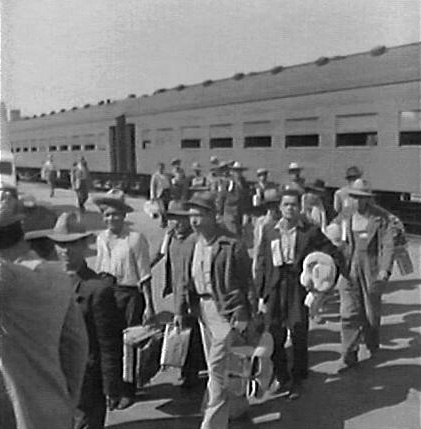 Mexican guest workers arrive in Los Angeles as part of Mexican participation in World War II via the Bracero Program, freeing U.S. labor to fight overseas. Los Angeles, CA, 1942 Mexico's inward-looking development strategy produced sustained economic growth of 3 to 4 percent and modest 3 percent inflation annually from the 1940s until the 1970s.[citation needed] This growth was sustained by the government's increasing commitment to primary education for the general population from the late 1920s through the 1940s. The enrollment rates of the country's youth increased threefold during this period;[121] consequently when this generation was employed by the 1940s their economic output was more productive. Additionally, the government fostered the development of consumer goods industries directed toward domestic markets by imposing high protective tariffs and other barriers to imports. The share of imports subject to licensing requirements rose from 28 percent in 1956 to an average of more than 60 percent during the 1960s and about 70 percent in the 1970s.[citation needed] Industry accounted for 22 percent of total output in 1950, 24 percent in 1960, and 29 percent in 1970.[citation needed] The share of total output arising from agriculture and other primary activities declined during the same period, while services stayed constant. The government promoted industrial expansion through public investment in agricultural, energy, and transportation infrastructure. Cities grew rapidly during these years, reflecting the shift of employment from agriculture to industry and services. The urban population increased at a high rate after 1940 (see Urban Society, ch. 2).  Map of the Papaloapan River drainage basin before construction of the Cerro de Oro Dam, showing the Miguel Alemán Lake(center) Although growth of the urban labor force exceeded even the growth rate of industrial employment, with surplus workers taking low-paying service jobs, many Mexican laborers migrated to the United States where wages were higher. During World War II, Mexico–United States relations had improved significantly from the previous three decades. The Bracero Program was set up with orderly migration flows were regulated by both governments. However, many Mexicans could not qualify for the program and migrated north illegally, without permission from their own government and with no sanction from U.S. authorities.[122] In the post-war period as the U.S. economy boomed and as Mexico's entered a phase of rapid industrialization, the U.S. and Mexico cooperated closely on illegal border crossings by Mexicans. For the Mexican government, this loss of labor was "a shameful exposure of the failure of the Mexican Revolution to provide economic well-being for many of Mexico's citizens, but it also drained the country of one of its greatest natural resources, a cheap and flexible labor supply."[123] The U.S. and Mexico cooperated closely to stop the flow, including the 1954 program called Operation Wetback. In the years following World War II, President Miguel Alemán Valdés's (1946–52) full-scale import-substitution program stimulated output by boosting internal demand. The government raised import controls on consumer goods but relaxed them on capital goods, which it purchased with international reserves accumulated during the war. The government spent heavily on infrastructure. By 1950 Mexico's road network had expanded to 21,000 kilometers, of which some 13,600 were paved. Large-scale dam building for hydroelectric power and flood control were initiated, most prominently the Papaloapan Project in southern Mexico.[124] In recent years, there has been a re-evaluation of such infrastructure projects, particularly their negative impact on the environment.[125] Mexico's strong economic performance continued into the 1960s, when GDP growth averaged about 7 percent overall and about 3 percent per capita. Consumer price inflation averaged only 3 percent annually. Manufacturing remained the country's dominant growth sector, expanding 7 percent annually and attracting considerable foreign investment. Mining grew at an annual rate of nearly 4 percent, trade at 6 percent, and agriculture at 3 percent. By 1970 Mexico had diversified its export base and become largely self-sufficient in food crops, steel, and most consumer goods. Although its imports remained high, most were capital goods used to expand domestic production.[citation needed] |
第二次世界大戦とメキシコの奇跡、1940年~1970年 本記事:メキシコの奇跡 第二次世界大戦へのメキシコの参戦の一環として、ブラセロ計画を通じてメキシコ人出稼ぎ労働者がロサンゼルスに到着し、米国人労働者が海外で戦うために、動員された。カリフォルニア州ロサンゼルス、1942年 メキシコの内向きな開発戦略は、1940年代から1970年代にかけて、年率3~4%の持続的な経済成長と、年率3%という穏やかなインフレをもたらし た。[出典必要] この成長は、1920年代後半から1940年代にかけて、一般国民に対する初等教育への政府の取り組みが強化されたことによって支えられた。この期間中、 国内の若年層の就学率は3倍に増加した[121]。その結果、1940年代にこの世代が労働力として加わった際、彼らの経済生産性はより高かった。さら に、政府は高い保護関税やその他の輸入障壁を設けることで、国内市場向けの消費財産業の発展を促進した。輸入許可の対象となる輸入品の割合は、1956年 の28パーセントから、1960年代には平均60パーセント以上、1970年代には約70パーセントに上昇した。[出典必要] 工業の総生産に占める割合は、1950年に22パーセント、1960年に24パーセント、1970年に29パーセントであった。[出典必要] 同期間中、農業およびその他の第一次産業による総生産に占める割合は低下した一方、サービス業の割合は横ばいだった。政府は、農業、エネルギー、交通イン フラへの公共投資を通じて産業の拡大を推進した。この数年間、都市は急速に成長し、雇用が農業から工業およびサービス業へと移行したことを反映していた。 1940年以降、都市人口は高い割合で増加した(『都市社会』第2章参照)。 セロ・デ・オロダム建設前のパパロアパン川流域地図。ミゲル・アレマン湖(中央)を示す 都市部の労働力増加率は工業部門の雇用増加率さえ上回り、余剰労働者は低賃金のサービス業に就いたが、多くのメキシコ人労働者は賃金が高い米国へ移住し た。第二次世界大戦中、メキシコと米国の関係は過去30年間に比べて著しく改善していた。「ブラセロ計画」が策定され、秩序ある移民の流れが両政府によっ て規制された。しかし、多くのメキシコ人はこのプログラムの資格を得られず、自国政府の許可もなく、米国当局の認可も得ずに、不法に北へ移住した。 [122] 戦後、米国経済が好況を呈し、メキシコが急速な工業化の段階に入った中で、米国とメキシコはメキシコ人による不法越境問題について緊密に協力した。メキシ コ政府にとって、この労働力の流出は「メキシコ革命が多くの国民に経済的繁栄をもたらせなかったという恥ずべき暴露であると同時に、安価で柔軟な労働力と いう同国最大の天然資源の一つを枯渇させるものでもあった」[123]。米国とメキシコは、1954年の「オペレーション・ウェットバック」と呼ばれる作 戦を含め、この流出を阻止するために緊密に協力した。 第二次世界大戦後の数年間、ミゲル・アレマン・バルデス大統領(1946–52年)による本格的な輸入代替政策は、内需を刺激することで生産を拡大させ た。政府は消費財に対する輸入規制を強化したが、資本財については規制を緩和し、戦時中に蓄積した国際準備高を用いてこれらを購入した。政府はインフラ整 備に多額の支出を行った。1950年までに、メキシコの道路網は2万1000キロメートルに拡大し、そのうち約1万3600キロメートルが舗装された。水 力発電と洪水調節を目的とした大規模なダム建設が開始され、中でもメキシコ南部のパパロアパン計画が最も顕著であった。[124] 近年、こうしたインフラプロジェクト、特に環境への悪影響について再評価が行われている。[125] メキシコの堅調な経済成長は1960年代にも続き、GDP成長率は全体で平均約7%、一人当たりでは約3%を記録した。消費者物価上昇率は年平均わずか 3%にとどまった。製造業は依然として同国を牽引する成長分野であり、年率7%の拡大を続け、多額の外国投資を呼び込んだ。鉱業は年率4%近く、貿易は 6%、農業は3%の成長率を示した。1970年までに、メキシコは輸出基盤を多様化し、食糧作物、鉄鋼、およびほとんどの消費財においてほぼ自給自足の状 態を達成した。輸入額は依然として高水準であったが、その大部分は国内生産を拡大するために使用される資本財であった。[出典必要] |
| Labor unions Further information: Mexican labor law Before the 1990s, unions in Mexico had been historically part of a state institutional system. From 1940 until the 1980s, during the worldwide spread of neoliberalism through the Washington Consensus, the Mexican unions did not operate independently, but instead as part of a state institutional system, largely controlled by the ruling party.[126] During these 40 years, the primary aim of the trade unions was not to benefit the workers, but to carry out the state's economic policy under their cosy relationship with the ruling party. This economic policy, which peaked in the 1950s and 60s with the so-called "Mexican Miracle", saw rising incomes and improved standards of living but the primary beneficiaries were the wealthy.[126] In the 1980s, Mexico began adhering to Washington Consensus policies, selling off state industries such as railroad and telecommunications to private industries. The new owners had an antagonistic attitude towards unions, which, accustomed to comfortable relationships with the state, were not prepared to fight back. A movement of new unions began to emerge under a more independent model, while the former institutionalized unions had become very corrupt, violent, and led by gangsters. From the 1990s onwards, this new model of independent unions prevailed, a number of them represented by the National Union of Workers / Unión Nacional de Trabajadores.[126][127] Current old institutions like the Oil Workers Union and the National Education Workers' Union (Sindicato Nacional de Trabajadores de la Educación, or SNTE) are examples of how the use of government benefits are not being applied to improve the quality in the investigation of the use of oil or the basic education in Mexico as long as their leaders show publicly that they are living wealthily. With 1.4 million members, the teachers' union is Latin America's largest; half of Mexico's government employees are teachers. It controls school curriculums, and all teacher appointments. Until recently, retiring teachers routinely "gave" their lifelong appointment to a relative or "sell" it for anywhere in between $4,700 and $11,800.[128] In 2022, Sindicato independiente nacional de trabajadores trabajadoras de la industria automotriz, SINTTIA, a union backed by American and Canadian unions won a union representation election at a General Motors plant in the city of Silao. The Confederation of Mexican Workers (CTM), a union affiliated with the Institutional Revolutionary Party (PRI) which had negotiated sweet-heart contracts with GM since the opening of the plant in 1995, and an allied "independent" union received only small percentages of the vote. A worker at the plant with 10 years service reported wages of 480 pesos ($23.27) for a 12-hour shift. At Volkswagen's plant in Puebla state, the union has negotiated average pay of 600 pesos ($29.15) a day for an eight-hour shift.[129] |
労働組合 詳細情報:メキシコの労働法(Derecho laboral de México) 1990年代以前、メキシコの労働組合は歴史的に国家の制度体系の一部であった。1940年から1980年代にかけて、ワシントン・コンセンサスを通じて 新自由主義が世界的に広まる中、メキシコの労働組合は独立して活動するのではなく、与党によって大部分が支配された国家の制度体系の一部として機能してい た。[126] この40年間、労働組合の主たる目的は労働者の利益を図るのではなく、与党との癒着関係のもとで国家の経済政策を実行することにあった。いわゆる「メキシ コの奇跡」として1950年代から60年代にピークを迎えたこの経済政策は、所得の増加と生活水準の向上をもたらしたが、その恩恵を最も受けたのは富裕層 であった。[126] 1980年代、メキシコはワシントン・コンセンサスの政策を採用し始め、鉄道や通信などの国有産業を民間企業に売却した。新たな所有者たちは労働組合に対 して敵対的な態度を示したが、国家との安泰な関係に慣れきっていた労働組合は、これに対抗する準備ができていなかった。より独立したモデルのもとで新たな 労働組合運動が台頭し始めた一方で、従来の制度化された労働組合は極めて腐敗し、暴力的になり、ギャングが率いるようになっていた。1990年代以降、こ の独立した労働組合という新しいモデルが主流となり、その多くは全国労働者組合(Unión Nacional de Trabajadores)によって代表されるようになった。[126] [127] 石油労働者組合や全国教育労働者組合(Sindicato Nacional de Trabajadores de la Educación、SNTE)といった既存の旧体制組織は、その指導者たちが公然と贅沢な暮らしを誇示している限り、政府からの給付金がメキシコにおけ る石油利用の調査や基礎教育の質の向上に活用されていない実例である。140万人の組合員を擁する教員組合はラテンアメリカ最大規模であり、メキシコの公 務員のうち半数は教員である。同組合は学校のカリキュラムと、すべての教員任用を掌握している。つい最近まで、退職する教員は定年までの終身任用権を親族 に「譲る」か、4,700ドルから11,800ドルの間で「売却」するのが常だった。[128] 2022年、米国およびカナダの労働組合の支援を受ける「全国自動車産業労働者独立組合(SINTTIA)」が、シラオ市のゼネラルモーターズ(GM)工 場で行われた労働組合代表選挙で勝利した。1995年の工場開設以来、ゼネラル・モーターズ(GM)と有利な労働協約を交渉してきた制度的革命党 (PRI)傘下のメキシコ労働者連合(CTM)と、その同盟関係にある「独立」労組は、僅かな得票率しか得られなかった。同工場で10年の勤続歴を持つ労 働者によると、12時間シフトの賃金は480ペソ(23.27ドル)だという。プエブラ州のフォルクスワーゲン工場では、労働組合が8時間シフトで1日平 均600ペソ(29.15ドル)の賃金を交渉で勝ち取っている。[129] |
| Deterioration in the 1970s Although the Mexican economy maintained its rapid growth during most of the 1970s, it was progressively undermined by fiscal mismanagement and by a poor export industrial sector and a resulting deterioration of the investment climate. The GDP grew more than 6 percent annually during the administration of President Luis Echeverría Álvarez (1970–76), and at about a 6 percent rate during that of his successor, José López Portillo (1976–82). But economic activity fluctuated wildly during the decade, with spurts of rapid growth followed by sharp depressions in 1976 and 1982.  José López Portillo, President of Mexico 1976–82, whose government borrowed heavily from foreign banks with loans in dollars against future oil revenues, crashed when oil prices dropped. Fiscal expenditures combined with the 1973 oil shock to exacerbate inflation and upset the balance of payments. Moreover, President Echeverría's leftist rhetoric and actions—such as abetting land seizures by peasants—eroded investor confidence and alienated the private sector.[citation needed] The balance of payments disequilibrium became unsustainable as capital flight intensified, leading the government to devalue the peso by 58 percent in 1976. The action ended Mexico's twenty-year unmodified fixed exchange rate. Mexico implemented an IMF adjustment program and received financial backing from the United States. According to a 2017 study, "Key US and Mexican officials recognized that an IMF program of currency devaluation and austerity would probably fail in its stated objective of reducing Mexico's balance of payments deficit. Nevertheless, US Treasury and Federal Reserve officials, fearing that a Mexican default might lead to bank failures and subsequent global financial crisis, intervened to an unprecedented degree in the negotiations between the IMF and Mexico. The United States offered direct financial support and worked through diplomatic channels to insist that Mexico accept an IMF adjustment program, as a way of bailing out US banks. Mexican president Luis Echeverría's administration consented to IMF adjustment because officials perceived it as the least politically costly option among a range of alternatives."[130] Although significant oil discoveries in 1976 allowed a temporary recovery, the windfall from petroleum sales also allowed continuation of Echeverría's fiscal policies. In the mid-1970s, Mexico went from being a net importer of oil and petroleum products to a significant exporter. Oil and petrochemicals became the economy's most dynamic growth sector. Rising oil income allowed the government to continue its expansionary fiscal policy, partially financed by higher foreign borrowing. Between 1978 and 1981, the economy grew more than 8 percent annually, as the government spent heavily on energy, transportation, and basic industries. Manufacturing output expanded during these years, growing by 8.2 percent in 1978, 9.3 percent in 1979, and 8.2 percent in 1980.[citation needed] This renewed growth rested on shaky foundations. Mexico's external indebtedness mounted, and the peso became increasingly overvalued, hurting non-oil exports in the late 1970s and leading to a second peso devaluation in 1980. Production of basic food crops stagnated and the population increase was skyrocketing, forcing Mexico in the early 1980s to become a net importer of foodstuffs. The portion of import categories subject to controls rose from 20 percent of the total in 1977 to 24 percent in 1979. The government raised tariffs concurrently to shield domestic producers from foreign competition, further hampering the modernization and competitiveness of Mexican industry.[citation needed] |
1970年代の悪化 1970年代の大半において、メキシコ経済は急速な成長を維持していたものの、財政運営の失敗や輸出産業部門の低迷、そしてその結果としての投資環境の悪 化によって、次第にその基盤が揺らぎ始めた。ルイス・エチェベリア・アルバレス大統領(1970~76年)の政権下ではGDPが年率6%以上成長し、後任 のホセ・ロペス・ポルティージョ(1976~82年)の政権下でも約6%のペースで成長した。しかし、この10年間、経済活動は激しく変動し、急速な成長 の波に続いて、1976年と1982年には急激な不況に見舞われた。 1976年から1982年までメキシコ大統領を務めたホセ・ロペス・ポルティージョは、将来の石油収入を担保に外国銀行から多額のドル建て融資を受けたが、原油価格の下落により政権は崩壊した。 財政支出と1973年のオイルショックが相まって、インフレを悪化させ、国際収支を悪化させた。さらに、エチェベリア大統領の左派的な言動――農民による 土地接収を助長したことなど――は、投資家の信頼を損ない、民間部門を疎外した。[出典必要] 資本流出が激化するにつれ、国際収支の不均衡は持続不可能なものとなり、政府は1976年にペソを58%切り下げた。この措置により、メキシコにおける 20年間続いた固定為替相場制は終焉を迎えた。メキシコはIMFの調整プログラムを実施し、米国から財政支援を受けた。2017年の研究によると、「米国 およびメキシコの主要な当局者は、通貨切り下げと緊縮財政を柱とするIMFプログラムが、メキシコの国際収支赤字を削減するという公言された目標を達成で きない可能性が高いことを認識していた。それにもかかわらず、米国財務省および連邦準備制度理事会の当局者は、メキシコの債務不履行が銀行破綻やそれに続 く世界的な金融危機を招くことを恐れ、IMFとメキシコとの交渉に前例のないほど深く介入した。米国は直接的な財政支援を提示し、外交ルートを通じて、米 国銀行を救済する手段としてメキシコにIMF調整プログラムの受け入れを強く求めた。ルイス・エチェベリア大統領政権は、IMF調整を、数ある選択肢の中 で政治的コストが最も低いものと見なしたため、これに同意した。」[130] 1976年の大規模な石油発見により一時的な回復が見られたものの、石油販売による臨時収入はエチェベリアの財政政策の継続も可能にした。1970年代半 ば、メキシコは石油および石油製品の純輸入国から主要な輸出国へと転じた。石油および石油化学製品は、経済において最もダイナミックな成長分野となった。 石油収入の増加により、政府は拡張的な財政政策を継続することができ、その一部は対外借入の増加によって賄われた。1978年から1981年にかけて、政 府がエネルギー、交通、基幹産業に多額の支出を行った結果、経済は年率8%以上成長した。この期間、製造業の生産高は拡大し、1978年に8.2%、 1979年に9.3%、1980年に8.2%の伸びを示した。[出典必要] この新たな成長は、不安定な基盤の上に成り立っていた。メキシコの対外債務は膨らみ、ペソはますます過大評価されるようになり、1970年代後半には非石 油輸出に打撃を与え、1980年には2度目のペソ切り下げにつながった。主要食糧作物の生産は停滞し、人口増加は急激に進んだため、1980年代初頭には メキシコは食糧の純輸入国となることを余儀なくされた。規制対象となる輸入品目の割合は、1977年の総輸入額の20%から、1979年には24%へと上 昇した。政府は同時に関税を引き上げ、国内生産者を外国の競争から守る一方で、メキシコ産業の近代化と競争力をさらに阻害することとなった。[出典必要] |
1982 crisis and recovery Mexico inflation rate 1970–2022 See also: La Década Perdida The macroeconomic policies of the 1970s left Mexico's economy highly vulnerable to external conditions. These turned sharply against Mexico in the early 1980s, and caused the worst recession since the 1930s, with the period known in Mexico as La Década Perdida, "the lost decade", i.e., of economic growth. By mid-1981, Mexico was beset by falling oil prices, higher world interest rates, rising inflation, an overvalued peso, and a deteriorating balance of payments that spurred massive capital flight. This disequilibrium, along with the virtual disappearance of Mexico's international reserves—by the end of 1982 they were insufficient to cover three weeks' imports—forced the government to devalue the peso three times during 1982. Devaluation further fueled inflation and prevented short-term recovery, depressing real wages and increasing the private sector's burden in servicing its dollar-denominated debt. Interest payments on long-term debt alone were equal to 28 percent of export revenue. Cut off from additional credit, the government declared an involuntary moratorium on debt payments in August 1982, and the following month it announced the nationalization of Mexico's private banking system.  Miguel de la Madrid, President of Mexico 1982–88, who dealt with the financial debacle of the 1980s By late 1982, incoming President Miguel de la Madrid reduced public spending drastically and stimulated exports to balance the national accounts. Recovery was slow to materialize, however. The economy stagnated throughout the 1980s as a result of continuing negative terms of trade, high domestic interest rates, and scarce credit. Widespread fears that the government might fail to achieve fiscal balance and have to expand the money supply and raise taxes deterred private investment and encouraged massive capital flight that further increased inflationary pressures. The resulting reduction in domestic savings impeded growth, as did the government's rapid and drastic reductions in public investment and its raising of real domestic interest rates to deter capital flight.[citation needed]  Parque Fundidora (Fundidora Park) with steel mill ruins, east of Monterrey. Mexico's GDP grew at an average rate of just 0.1 percent per year between 1983 and 1988, while inflation on an average of 100%. Public consumption grew at an average annual rate of less than 2 percent, and private consumption not at all. Total investment fell at an average annual rate of 4 percent and public investment at an 11 percent pace. Throughout the 1980s, the productive sectors of the economy contributed a decreasing share to GDP, while the services sectors expanded their share, reflecting the rapid growth of the informal economy and the change from good jobs to bad ones (services jobs). De la Madrid's stabilization strategy imposed high social costs: real disposable income per capita fell 5 percent each year between 1983 and 1988. High levels of unemployment and underemployment, especially in rural areas, stimulated migration to Mexico City and to the United States.  Carlos Slim's business activities have had a significant impact on Mexico's economy, as a business oligarch, investor and philanthropist. By 1988 (de la Madrid's final year as President) inflation was at last under control, fiscal and monetary discipline attained, relative price adjustment achieved, structural reform in trade and public-sector management underway, and the economy was bound for recovery. But these positive developments were inadequate to attract foreign investment and return capital in sufficient quantities for sustained recovery. A shift in development strategy became necessary, predicated on the need to generate a net capital inflow. In April 1989, President Carlos Salinas de Gortari announced his government's national development plan for 1989–94, which called for annual GDP growth of 6 percent and an inflation rate similar to those of Mexico's main trading partners. Salinas planned to achieve this sustained growth by boosting the investment share of GDP and by encouraging private investment through denationalization of state enterprises and deregulation of the economy. His first priority was to reduce Mexico's external debt; in mid-1989 the government reached agreement with its commercial bank creditors to reduce its medium- and long-term debt. The following year, Salinas took his next step toward higher capital inflows by lowering domestic borrowing costs, reprivatizing the banking system, and broaching the idea of a free-trade agreement with the United States. These announcements were soon followed by increased levels of capital repatriation and foreign investment. Due to the financial crisis that took place in 1982, the total public investment on infrastructure plummeted from 12.5% of GDP to 3.5% in 1989. After rising during the early years of Salinas' presidency, the growth rate of real GDP began to slow during the early 1990s. During 1993 the economy grew by a negligible amount, but growth rebounded to almost 4 percent during 1994, as fiscal and monetary policy were relaxed and foreign investment was bolstered by United States ratification of the North American Free Trade Agreement (NAFTA). In 1994 the commerce and services sectors accounted for 22 percent of Mexico's total GDP. Manufacturing followed at 20 percent; transport and communications at 10 percent; agriculture, forestry, and fishing at 8 percent; construction at 5 percent; mining at 2 percent; and electricity, gas, and water at 2 percent (services 80%, industry and mining 12%, agriculture 8%). Some two-thirds of GDP in 1994 (67 percent) was spent on private consumption, 11 percent on public consumption, and 22 percent on fixed investment. During 1994 private consumption rose by 4 percent, public consumption by 2 percent, public investment by 9 percent, and private investment by 8 percent.[citation needed] |
1982年の危機と回復 メキシコのインフレ率 1970–2022 関連項目:ラ・デカダ・ペルディダ 1970年代のマクロ経済政策により、メキシコ経済は外部環境の影響を強く受けやすい状態となっていた。1980年代初頭、こうした外部環境がメキシコに とって極めて不利な方向に急変し、1930年代以来最悪の不況を引き起こした。この期間はメキシコにおいて「ラ・デカダ・ペルディダ」(失われた10 年)、すなわち経済成長の停滞期として知られる。1981年半ばまでに、メキシコは原油価格の下落、世界的な金利の上昇、インフレの加速、ペソ高、そして 巨額の資本流出を招いた国際収支の悪化に直面していた。この不均衡に加え、メキシコの国際準備高が事実上消滅したこと(1982年末には3週間分の輸入代 金を賄うにも不十分だった)により、政府は1982年中に3度にわたりペソの切り下げを余儀なくされた。通貨切り下げはインフレをさらに加速させ、短期的 な回復を阻害し、実質賃金を押し下げ、民間部門のドル建て債務の返済負担を増大させた。長期債務の利払いだけでも、輸出収入の28パーセントに相当した。 追加の融資を断たれた政府は、1982年8月に債務返済の非自発的モラトリアムを宣言し、翌月にはメキシコの民間銀行システムの国有化を発表した。 1980年代の金融危機に対処したメキシコ大統領(1982–88年)、ミゲル・デ・ラ・マドリード 1982年末までに、次期大統領ミゲル・デ・ラ・マドリードは、国家収支の均衡を図るため、公共支出を大幅に削減し、輸出を促進した。しかし、景気回復は なかなか現れなかった。1980年代を通じて、貿易条件の悪化、国内金利の高止まり、信用収縮が続いた結果、経済は停滞した。政府が財政均衡を達成でき ず、マネーサプライの拡大や増税を余儀なくされるのではないかという広範な懸念が、民間投資を萎縮させ、大規模な資本逃避を招き、それがさらにインフレ圧 力を高めた。その結果生じた国内貯蓄の減少は、政府による公共投資の急速かつ大幅な削減や、資本流出を防ぐための実質国内金利の引き上げと同様に、成長を 阻害した。[出典必要] モンテレイの東にある、製鉄所の廃墟が残るパルケ・フンディドーラ(フンディドーラ公園)。 1983年から1988年にかけて、メキシコのGDPは年平均わずか0.1%の伸びにとどまった一方で、インフレ率は平均100%に達した。公共消費は年 平均2%未満の伸びにとどまり、民間消費は全く伸びなかった。総投資は年平均4%減少し、公共投資は11%のペースで減少した。1980年代を通じて、経 済の生産部門がGDPに占める割合は低下し、一方でサービス部門の割合は拡大した。これは、インフォーマル経済の急速な成長と、良質な雇用から劣悪な雇用 (サービス業の雇用)への移行を反映している。デ・ラ・マドリッドの安定化戦略は高い社会的コストを伴った。1983年から1988年の間、1人当たりの 実質可処分所得は毎年5%減少した。特に農村部における高い失業率と不完全雇用は、メキシコシティや米国への移住を促した。 カルロス・スリムは、ビジネス界の寡頭支配者、投資家、そして慈善家として、メキシコ経済に多大な影響を与えてきた。 1988年(デ・ラ・マドリッド大統領の任期最終年)までに、インフレはようやく抑制され、財政・金融規律が確立され、相対価格の調整が達成され、貿易お よび公共部門管理の構造改革が進行中であり、経済は回復軌道に乗っていた。しかし、こうした前向きな進展は、持続的な回復に必要な十分な量の外国投資や資 本の還流を引き寄せるには不十分であった。純資本流入を生み出す必要性を前提とした、開発戦略の転換が必要となった。 1989年4月、カルロス・サリナス・デ・ゴルタリ大統領は、1989年から94年までの政府の国家開発計画を発表し、年間GDP成長率6%と、メキシコ の主要貿易相手国と同水準のインフレ率を掲げた。サリナスは、GDPに占める投資の割合を高め、国有企業の民営化や経済の規制緩和を通じて民間投資を促進 することで、この持続的な成長を達成する計画であった。彼の最優先課題はメキシコの対外債務の削減であった。1989年半ば、政府は商業銀行の債権者らと 合意に達し、中長期債務の削減を図った。翌年、サリナスは国内借入コストの引き下げ、銀行システムの再民営化、そして米国との自由貿易協定の構想を打ち出 すことで、資本流入拡大に向けた次の段階へと進んだ。これらの発表に続き、資本還流と外国投資の水準はすぐに上昇した。 1982年に発生した金融危機により、インフラへの公的投資総額はGDP比12.5%から1989年には3.5%へと急落した。サリナス政権初期には上昇 していた実質GDP成長率は、1990年代初頭にかけて鈍化し始めた。1993年の経済成長率はごくわずかだったが、1994年には財政・金融政策が緩和 され、米国による北米自由貿易協定(NAFTA)の批准により外国投資が後押しされたことで、成長率は4%近くまで回復した。1994年、商業・サービス 部門はメキシコ総GDPの22%を占めた。次いで製造業が20%、運輸・通信が10%、農林水産業が8%、建設業が5%、鉱業が2%、電気・ガス・水道が 2%であった(サービス業80%、工業・鉱業12%、農業8%)。1994年のGDPの約3分の2(67%)は個人消費に、11%は公共消費に、22%は 固定投資に費やされた。1994年、個人消費は4%増加し、公共消費は2%増加、公共投資は9%増加、民間投資は8%増加した。[出典必要] |
NAFTA, economic crisis, and recovery Logo for the North American Free Trade Agreement Main articles: North American Free Trade Agreement and 1994 economic crisis in Mexico The last years of the Salinas administration were turbulent ones. In 1993 when Mexico experienced hyperinflation, Salinas stripped three zeros from the peso, creating a parity of $1 new peso for $1000 of the old ones. On 1 January 1994, the North American Free Trade Agreement (NAFTA) came into effect and on the same day, the Zapatista Army of National Liberation (EZLN) in Chiapas took several small towns, belying Mexico's assurances that the government created the conditions for stability. In March 1994, the Institutional Revolutionary Party's presidential candidate Luis Donaldo Colosio was assassinated and was replaced by Ernesto Zedillo. Salinas was loath to devalue the currency in the final months of his term, leaving to his successor to deal with the economic consequences. In December 1994 Zedillo was inaugurated. The Mexican peso crisis caused the economy to contract by an estimated 7 percent during 1995. Investment and consumption both fell sharply, the latter by some 10 percent. Agriculture, livestock, and fishing contracted by 4 percent; mining by 1 percent; manufacturing by 6 percent; construction by 22 percent; and transport, storage, and communications by 2 percent. The only sector to register positive growth was utilities, which expanded by 3 percent. The Fobaproa contingencies fund, applied during the peso crisis to protect Mexican banks, became a subject of controversy.[131] By 1996 Mexican government and independent analysts saw signs that the country had begun to emerge from its economic recession. The economy contracted by 1 percent during the first quarter of 1996. The Mexican government reported growth of 7 percent for the second quarter, and the Union Bank of Switzerland forecast economic growth of 4 percent for 1996.[citation needed] |
NAFTA、経済危機、そして回復 北米自由貿易協定のロゴ 主な記事:北米自由貿易協定、1994年のメキシコ経済危機 サリナス政権の末期は激動の時期であった。1993年、メキシコがハイパーインフレに見舞われた際、サリナスはペソから3つのゼロを切り捨て、旧ペソ 1000ペソ=新ペソ1ペソの交換比率を設定した。1994年1月1日、北米自由貿易協定(NAFTA)が発効し、同日、チアパス州のサパティスタ民族解 放軍(EZLN)がいくつかの小さな町を占拠した。これは、政府が安定のための条件を整えたというメキシコ側の保証を裏切るものであった。1994年3 月、制度的革命党の大統領候補ルイス・ドナルド・コロシオが暗殺され、エルネスト・セディージョが後任となった。サリナスは任期最後の数ヶ月間、通貨切り 下げを渋り、経済的影響への対処を後任に委ねた。1994年12月、セディージョが就任した。メキシコ・ペソ危機により、1995年の経済は推定7%縮小 した。投資と消費はともに急減し、消費は約10%減少した。農業、畜産、漁業は4%縮小、鉱業は1%、製造業は6%、建設業は22%、運輸・倉庫・通信業 は2%縮小した。プラス成長を記録した唯一の部門は公益事業で、3%の拡大を見せた。 ペソ危機の際にメキシコの銀行を保護するために活用されたフォバプロア(Fobaproa)緊急資金は、論争の的となった。[131] 1996年までに、メキシコ政府および独立系アナリストは、同国が景気後退から脱し始めた兆候を認めていた。1996年第1四半期、経済は1%縮小した。 メキシコ政府は第2四半期の成長率を7%と報告し、スイス連合銀行は1996年の経済成長率を4%と予測した。[出典必要] |
| The USMCA Trade Agreement Main article: USMCA In 2018 negotiations opened between the Donald Trump administration of the United States, the government of Mexico, and the government of Canada to revise and update provisions of the 1994 North American Free Trade Agreement. As of April 2020, Canada and Mexico have notified the U.S. that they are ready to implement the agreement.[132] |
USMCA貿易協定 本記事:USMCA 2018年、米国のドナルド・トランプ政権、メキシコ政府、カナダ政府の間で、1994年の北米自由貿易協定(NAFTA)の条項を改定・更新するための 交渉が開始された。2020年4月現在、カナダとメキシコは米国に対し、協定の実施準備が整ったことを通知している。[132] |
| Current trade Further information: Economy of Mexico Mexico is an integral part of the North American Free Trade Agreement and the U.S. is its top trading partner. As of 2017, Mexico's biggest imports (in U.S. dollars) came from the U.S. $307Billion; Canada $22B; China $8.98B; Germany $8.83; and Japan $5.57. Its biggest imports came from the U.S. $181B; China $52.1B; Germany $14.9B; Japan $14.8B, and South Korea $10.9B. "The economy of Mexico has an Economic Complexity Index (ECI) of 1.1 making it the 21st most complex country. Mexico exports 182 products with revealed comparative advantage (meaning that its share of global exports is larger than what would be expected from the size of its export economy and from the size of a product's global market)."[133] |
現在の貿易 詳細情報:メキシコの経済 メキシコは北米自由貿易協定(NAFTA)の重要な構成国であり、米国が最大の貿易相手国だ。2017年時点で、メキシコの最大の輸入先(米ドルベース) は、米国が3,070億ドル、カナダが220億ドル、中国が89.8億ドル、 ドイツは88.3億ドル、日本は55.7億ドルであった。最大の輸入相手国は米国(1,810億ドル)、中国(521億ドル)、ドイツ(149億ドル)、 日本(148億ドル)、そして韓国(109億ドル)であった。「メキシコ経済の経済複雑性指数(ECI)は1.1であり、これは世界で21番目に複雑な国 であることを示している。メキシコは、顕在的比較優位(つまり、その輸出経済の規模や製品のグローバル市場の規模から予想されるよりも、世界輸出に占める シェアが大きいことを意味する)を持つ182の製品を輸出している。」[133] |
Peso–US dollar exchange 1970–2018  Note: The Mexican peso was revalued in 1993, with $1,000.00 old pesos (MXP) equaling $1.00 new peso (MXN). The peso values with an asterisk (*) are expressed in old pesos (MXP). |
ペソ対米ドル為替レート 1970年~2018年 注:メキシコ・ペソは1993年に改定され、旧ペソ(MXP)1,000.00ペソが新ペソ(MXN)1.00ペソに相当するようになった。アスタリスク(*)が付いたペソの金額は、旧ペソ(MXP)で表示されている。 |
| Corruption Perceptions Index Economy of Mexico Economy of Prehispanic Mexico Latin American economy Economic history of Latin America |
腐敗認識指数 メキシコの経済 先コロンブス期メキシコの経済 ラテンアメリカの経済 ラテンアメリカの経済史 |
 Map of the Corruption Perceptions Index, 2025, as scored by Transparency international. |
トランスペアレンシー・インターナショナルによる2025年の腐敗認識指数(CPI)の地図。 |
| References 01. Garza, Diego Castañeda; Bengtsson, Erik (2024). "Income inequality in Mexico, 1895-1940: industrialisation, revolution, institutions". Revista de Historia Economica - Journal of Iberian and Latin American Economic History. 42 (3): 415–434. doi:10.1017/S021261092400017X. ISSN 0212-6109. John H. Coatsworth, "Obstacles of Economic Growth in Nineteenth-Century Mexico", American Historical Review, vol. 83, no. 1 (Feb. 1978) p. 86. Tracy Wilkinson, "Mexico, buffeted by low oil prices, cuts spending", Los Angeles Times, January 31, 2015, p. A7 James Lockhart, "Encomienda and Hacienda: The Evolution of the Great Estate in the Indies," Hispanic American Historical Review 49:3(1969) 411–29 Ida Altman, Sarah Cline, and Javier Pescador, The Early History of Greater Mexico, Pearson 2003, 163–64. Ida Altman, Sarah Cline, Javier Pescador, The Early History of Greater Mexico, Pearson 2003, p. 162. D.A. Brading and Harry E. Cross, "Colonial Silver Mining: Mexico and Peru," Hispanic American Historical Review 52:4(1972): 545–79. Altman et al, Early History of Greater Mexico p. 169. Robert S. Haskett, "Our Suffering with the Taxco Tribute: Involuntary Mine Labor and Indigenous Society in Central New Spain," Hispanic American Historical Review 71:3(1991): 447–75. 10. Alan Probert, "Bartolomé de Medina: The Patio Process and the Sixteenth Century Silver Crisis" in Bakewell, Peter, ed. Mines of Silver and Gold in the Americas. Variorum: Brookfield, 1997. 20. Altman et al, The Early History of Greater Mexico p. 290. Altman et al, The Early History of Greater Mexico, p. 291. Altman et al., The Early History of Greater Mexico p. 291. Altman et al, The Early History of Greater Mexico p. 292. Doris M. Ladd, The Mexican Nobility at Independence, 1780–1826. Austin: University of Texas Institute of Latin American Studies 1976. Peter Bakewell, Silver Mining and Society in Colonial Mexico: Zacatecas 1546–1700. Cambridge: Cambridge University Press 1971. For their troubles, they were compensated with real salaries and, “far more important,” as Bishop Mota y Escobar perceptively wrote, “with silver ore that they got to keep and which they call among themselves pepena.” Indeed, after doing their daily work, free Indians were permitted to collect any silver-encrusted rocks they wanted. They could then sell this valuable ore in the black market or attempt to refine it into pure silver on their own. The pepena system existed in many mines throughout Mexico... Reséndez, Andrés. The Other Slavery: The Uncovered Story of Indian Enslavement in America (Kindle Locations 1857-1861). Houghton Mifflin Harcourt. Kindle Edition. Already by the late sixteenth century, free wage earners outnumbered forced workers in some mines. More recent studies have revealed a sobering reality, however. While salaried workers did indeed account for a significant percentage of the workforce in many mines— including thirty-six percent of all Indians in Parral— these workers did not replace coerced laborers, but rather coexisted with them. Reséndez, Andrés. The Other Slavery: The Uncovered Story of Indian Enslavement in America (Kindle Locations 1863-1866). Houghton Mifflin Harcourt. Kindle Edition. Doris M. Ladd, The Making of a Strike: Mexican Workers’ Struggles in Real del Monte, 1766–1775. Lincoln: University of Nebraska Press 1988. Altman et al., The Early History of Greater Mexico, p. 293. Altman et al, The Early History of Greater Mexico, pp. 163–168. Woodrow Borah, Silk Raising in Colonial Mexico. Berkeley: University of California Press 1943. Coatsworth, "Obstacles to Economic Growth," p. 86. Coatsworth, "Obstacles of Economic Growth", p. 87. Coatsworth, "Obstacles to Economic Growth," p. 87. Susan Deans-Smith, Bureaucrats, Planters, and Workers: The Making of the Tobacco Monopoly in Bourbon Mexico. Austin: University of Texas Press 1992. Altman et al, Early History of Greater Mexico p. 166. Altman et al, Early History of Greater Mexico, p. 166. James Lockhart and Stuart Schwartz, Early Latin America. Cambridge: Cambridge University Press 1983. 30. Elinor G.K. Melville, A plague of sheep : environmental consequences of the conquest of Mexico. New York: Cambridge University Press 1994. Woodrow W. Borah, Silk Raising in Colonial Mexico. Berkeley: University of California Press 1943. Richard J. Salvucci, Textiles and Capitalism in Mexico: An Economic History of Obrajes, 1539–1840. Princeton: Princeton University Press, 1987. Lockhart, James. "Trunk Lines and Feeder Lines," in Of Things of the Indies: Essays Old and New in Early Latin American History. Stanford: Stanford University Press 1999, 120–57. Coatsworth, "Obstacles to Economic Development", p. 92. Vance, John T., A Guide to the Law and Legal Literature of Mexico. Washington, D.C. 1945. Coatsworth, "Obstacles to Economic Growth", p. 93. Castleman, Bruce A., Building the King's Highway: Labor, Society, and Family on Mexico's Caminos Reales, 1757–1804. Tucson: University of Arizona Press 2005 Farriss, N.M., Crown and Clergy in Colonial Mexico, 1759–1821: The Crisis of Ecclesiastical Privilege. London: Athlone 1968. D.A. Brading, Miners and Merchants in Bourbon Mexico. Cambridge: Cambridge University Press 1971. 40. Lyle McAlister, "The Fuero Militar" in New Spain, 1764–1800. Gainesville: University of Florida Press 1952. Woodrow Borah, Justice by Insurance: The General Indian Court of Mexico and the Legal Aides of the Half-Real. Berkeley: University of California Press 1983. "Colonial Mexico's Racial Hierarchy and Occupational Segregation", Wikipedia, 2025-04-18, retrieved 2025-04-18 Coatsworth, "Obstacles to Economic Growth" p. 94. Manel Carrera Stampa, Los gremios mexicanos: La organización en Nueva España, 1521–1861. Mexico: Edición y Distribución Ibero Americana Publicaciones 1954. Altman et al. The Early History of Greater Mexico, p. 296. Altman et al, The Early History of Greater Mexico, p. 296. Altman et al., The Early History of Greater Mexico, p. 297. Altman et al, The Early History of Greater Mexico, p. 301 Altman et al, The Early History of Greater Mexico, p. 36. 50. Altman et al, The Early History of Greater Mexico, p. 153. Altman et al, The Early History of Greater Mexico, p. 306. J.H. Parry, The Sale of Public Office in the Indies Under the Hapsburgs. Berkeley: University of California Press 1953. Altman et al, Early History of Greater Mexico, p. 306. Altman et al., The Early History of Greater Mexico, p. 310. Lavrin, Asunción (1973). "The Execution of the Law of Consolidacion in New Spain: Economic Aims and Results". The Hispanic American Historical Review. 53 (1): 27–49. doi:10.2307/2512521. ISSN 0018-2168. JSTOR 2512521. Altman et al, The Early History of Greater Mexico, pp. 311–12. Chowning, Margaret. "The Consolidación de Vales Reales in the Bishopric of Michoacan," Hispanic American Historical Review 69(3)(1989) 451–78. Von Wobeser, Gisela. "La consolidación de vales reales como factor determinante de la lucha de independencia en México, 1804-1808." Historia mexicana (2006): 373-425. D.A. Brading, The First America. Cambridge: Cambridge University Press 1991, pp. 510–12. 60. D.A. Brading, The First America, p. 568. image of Ferdinand VII of Spain on the eight real coin. James Lockhart and Stuart Schwartz, Early Latin America. New York and Cambridge: Cambridge University Press 1983, p. 415. John H. Coatsworth, "Obstacles to Economic Growth in Nineteenth-Century Mexico" John H. Coatsworth, "Obstacles to Economic Growth in Nineteenth-Century Mexico," American Historical Review vol. 83, No. 1 (Feb. 1978), pp. 80–100 Stephen Haber, "Assessing the Obstacles to Industrialisation: The Mexican Economy, 1830–1940," Journal of Latin American Studies, 24#1 (1992), pp. 1–32 Hilarie J. Heath, "British Merchant Houses in Mexico, 1821-1860: Conforming Business Practices and Ethics," Hispanic American Historical Review 73#2 (1993), pp. 261-290 online William Schell, Jr. "Banking and Finance: 1821–1910" in Encyclopedia of Mexico, vol. 1, p. 131. Chicago: Fitzroy and Dearborn 1993. Coatsworth, Obstacles to Economic Growth, p. 89. Coatsworth, Obstacles to Economic Growth, p. 90. 70. Haber, "Assessing Obstacles to Industrialisation", pp. 1–2. Haber, "Assessing the Obstacles to Industrialisation", p. 6. Haber, "Assessing Obstacles to Industrialisation," p. 1 Schell, "Banking and Finance", p. 131. Schell, "Banking and Finance" p. 131. Coatsworth, Obstacles to Economic Growth in Nineteenth-Century Mexico. Bancroft 1888, p. 519. Bancroft 1888, p. 551. Bancroft 1888, p. 520. Haber, "Assessing Obstacles to Industrialization", p. 2. Haber, "Assessing Obstacles to Industrialisation," p. 7. Richard J. Salvucci, Textiles and Capitalism in Mexico: an Economic History of the Obrajes, 1539–1840. Princeton: Princeton University Press 1987. Haber, "Assessing Obstacles to Industrialisation," p. 9. Haber, Assessing Obstacles to Industrialisation," p. 9. 80. Haber, "Assessing the Obstacles to Industrialisation," p. 7. John H. Coatsworth, "Obstacles to Economic Growth in Nineteenth-Century Mexico," American Historical Review vol. 83, no. 1 (Feb. 1978) p. 81 Hart, John Mason. Empire and Revolution: The Americans in Mexico since the Civil War. Berkeley: University of California Press Du 2002, p. 73 Schmidt, Arthur, "José Ives Limantour" in Encyclopedia of Mexico, vol. 1, pp. 746–49. Fitzroy and Dearborn 1997. Coatsworth, John H. Growth Against Development: The Economic Impact of Railroads in Porfirian Mexico. DeKalb: Northern Illinois University 1981. Brown, Foreign and Native-Born Workers, p. 811. 90. Brown, "Foreign and Native-Born Workers", map. p. 788 Tenenbaum, Barbara A. and James N. McElveen, "From speculative to substantive boom: the British in Mexico, 1821-1911." in Oliver Marshall, ed. English speaking communities in Latin America (Macmillan, 2000): 51-79, at p 69. Garner, Paul. British Lions and Mexican Eagles: Business, Politics, and Empire in the Career of Weetman Pearson in Mexico, 1889-1919. Stanford: Stanford University Press 2011. Hart, Empire and Revolution, p. 264 Brown, Jonathan C., "Foreign and Native-Born Workers in Porfirian Mexico". Wolfe, Mikael D. Watering the Revolution: An Environmental and Technological History of Agrarian Reform in Mexico. Durham: Duke University Press 2017, pp. 23-25. Wasserman, Mark. "Enrique Clay Creel" in Encyclopedia of Mexico, vol. 1, p. 369. Chicago: Fitzroy and Dearborn 1997. Coatsworth, "Obstacles to Economic Growth," p. 83. Brown, "Foreign and Native-Born Workers", p. 789. Brown, "Foreign and Native-Born Workers," p. 790. 100. Haber, "Assessing Obstacles to Industrialization", 2. Evans, Sterling D. (14 January 2013). Bound in Twine: The History and Ecology of the Henequen-Wheat Complex for Mexico and the American and Canadian Plains, 1880-1950. Texas A&M University Press. ISBN 978-1-62288-001-0. Haber, "Assessing the Obstacles of Industrialisation," 19. Anderson, Rodney D. "Industrial Labor: 1876-1910" in Encyclopedia of Mexico. Chicago: Fitroy Dearborn 1997, pp. 683-84. Anderson, "Industrial Labor: 1876-1910", p. 685. Brunker, Steven. Creating Mexican Consumer Culture in the Age of Porfirio Diaz. Albuquerque: University of New Mexico Press 2012 p. 108-15 Southern Methodist University, Central University Libraries, DeGolyer Library. See:digitalcollections.smu.edu/cdm/ref/collection/mex/id/508 Haber, "Assessing the Obstacles to Industrialisation: the Mexican Economy, 1830–1940," p. 27 Haber, "Assessing the Obstacles to Industrialisation", p. 27–28. Kelly Lytle Hernández, "The Crimes and Consequences of Illegal Immigration: A Cross-Border Examination of Operation Wetback, 1943–1954." The Western Historical Quarterly, vol. 37. no. 4 (Winter, 2006), p.423. 110. Hernández, "The Crimes and Consequences", p. 424. Haber, "Assessing Obstacles to Industrialisation," p. 28. Haber, "Assessing the Obstacles to Industrialisation", pp. 28-29. Enrique Cárdenas, La industrialización mexicana durante la Gran Depresión. Mexico 1987. Abraham Hoffman, Unwanted Mexican Americans in the Great Depression: Repatriation Pressures, 1929–1939. Tucson: University of Arizona Press, 1974. Francisco Balderrama and Raymond Rodríguez, Decade of Betrayal: Mexican Repatriation in the 1930s. Albuquerque: University of New Mexico Press, 1995. Haber, "Assessing Obstacles to Industrialisation," p. 29. es:Nacional Financiera (México) Howard F. Cline, Mexico: Revolution to Evolution: 1940–1960. New York: Oxford University Press 1963, p. 244. Haber, "Assessing Obstacles to Industrialisation," p. 29 120. Haber, "Assessing the Obstacles to Industrialisation," pp. 25–26. Easterlin, R. "Why Isn't the Whole World Developed?", Appendix Table 1. The Journal of Economic History Vol. 41 No. 1, 1981 Hernández, "The Crimes and Consequences of Illegal Immigration," p. 423. Hernández, "The Crimes and Consequences of Immigration," p. 425. Howard F. Cline, The United States and Mexico, revised and enlarged edition. New York: Atheneum 1963, (originally published by Harvard University Press 1953, pp. 374–75, 382–85. Patrick H. Cosby, "Leviathan in the Tropics: A postcolonial environmental history of the Papaloapan Projects in Mexico." PhD diss. University of Florida 2011. Dan La Botz U.S.-supported Economics Spurred Mexican Emigration, pt.1 Archived 19 October 2017 at the Wayback Machine, interview at The Real News, 1 May 2010. Murillo, M. Victoria. "From populism to neoliberalism: Labor unions and market reforms in Latin America." World Politics 52.2 (2000): 135-168 online. Juan Montes; José de Córdoba (21 December 2012). "Mexico Takes On Teachers Over School Control". Wall Street Journal. Daina Beth Solomon (February 3, 2022). "'Fed up' GM workers in Mexico pick new union in historic vote". Reuters. Retrieved February 4, 2022. 130. Kershaw, Paul V. (2017-05-16). "Averting a global financial crisis: the US, the IMF, and the Mexican debt crisis of 1976". The International History Review. 40 (2): 292–314. doi:10.1080/07075332.2017.1326966. ISSN 0707-5332. S2CID 157404519. Cárdenas, Enrique (2015). "Cambio estructural, crisis y rescate: 1989-1995". El largo curso de la economía mexicana : de 1780 a nuestros días (Primera edición ed.). México, D.F.: Fondo de Cultura Económica. pp. 754–771. ISBN 978-607-16-2812-1. OCLC 924299167. CBC News, "Mexico joins Canada, notifies U.S. it's ready to implement new NAFTA" 2020/04/04 accessed 06 April 2020 Observatory of Economic Complexity, Mexico Profile 2017 134. "Serie histórica diaria del tipo de cambio peso-dólar - (CF373)". Sistema de Información Económica Banco de México. Retrieved 2024-10-22. |
参考文献 01. ガルサ、ディエゴ・カスタニェダ;ベンクトソン、エリック(2024)。「メキシコにおける所得格差、1895-1940年:工業化、革命、制度」。 『Revista de Historia Economica - Journal of Iberian and Latin American Economic History』。42 (3): 415–434。doi:10.1017/S021261092400017X. ISSN 0212-6109. ジョン・H・コーツワース、「19世紀メキシコにおける経済成長の障害」、『アメリカン・ヒストリカル・レビュー』、第83巻第1号(1978年2月)、86頁。 トレイシー・ウィルキンソン、「低油価に翻弄されるメキシコ、支出を削減」、『ロサンゼルス・タイムズ』、2015年1月31日、p. A7 ジェームズ・ロックハート、「エンコミエンダとアシエンダ:インド諸島における大領地の変遷」、『ヒスパニック・アメリカン・ヒストリカル・レビュー』49:3(1969) 411–29 アイダ・アルトマン、サラ・クライン、ハビエル・ペスカドール、『グレーター・メキシコの初期史』、ピアソン、2003年、163–64頁。 アイダ・アルトマン、サラ・クライン、ハビエル・ペスカドール、『グレーター・メキシコの初期史』、ピアソン、2003年、162頁。 D.A. ブレイディング、ハリー・E・クロス、「植民地時代の銀鉱業:メキシコとペルー」、『ヒスパニック・アメリカン・ヒストリカル・レビュー』52:4(1972): 545–79. アルトマンら、『大メキシコの初期史』p. 169. ロバート・S・ハスケット、「タスコの貢納による我々の苦悩:中央ニュー・スペインにおける強制鉱山労働と先住民社会」、『ヒスパニック・アメリカン・ヒストリカル・レビュー』71:3(1991): 447–75。 10. アラン・プロバート、「バルトロメ・デ・メディナ:パティオ製法と16世紀の銀危機」ピーター・ベイクウェル編『アメリカ大陸の銀と金の鉱山』ヴァリオラム社、ブルックフィールド、1997年。 20. アルトマン他、『大メキシコの初期史』p. 290。 アルトマン他、『大メキシコの初期史』、291頁。 アルトマン他、『大メキシコの初期史』、291頁。 アルトマン他、『大メキシコの初期史』、292頁。 ドリス・M・ラッド、『独立期のメキシコ貴族、1780–1826年』。オースティン:テキサス大学ラテンアメリカ研究所、1976年。 ピーター・ベイクウェル、『植民地メキシコにおける銀鉱業と社会:サカテカス 1546–1700年』。ケンブリッジ:ケンブリッジ大学出版局 1971年。 その苦労の対価として、彼らは実質的な給与を受け取ったほか、モタ・イ・エスコバル司教が鋭く指摘したように、「はるかに重要なこととし て」、彼らが手元に残すことを許され、互いに「ペペナ」と呼んでいた銀鉱石も与えられた。実際、日々の労働を終えた後、自由なインディオたちは、望むだけ 銀が埋まった岩を拾うことを許されていた。彼らはその後、この貴重な鉱石を闇市場で売ったり、自分たちで精錬して純銀にしようと試みたりできた。ペペナ制 度はメキシコ全土の多くの鉱山に存在していた……レセンデス、アンドレス。『もうひとつの奴隷制:アメリカにおけるインディオ奴隷化の知られざる物語』 (Kindle Locations 1857-1861)。ホートン・ミフリン・ハーコート。Kindle版。 16世紀後半には、すでに一部の鉱山では、自由な賃金労働者が強制労働者の数を上回っていた。しかし、近年の研究は厳しい現実を明らかにして いる。多くの鉱山で、確かに賃金労働者が労働力の相当な割合を占めていた――パラルの全インディアンの36パーセントを含む――が、これらの労働者は強制 労働者に取って代わったのではなく、むしろ彼らと共存していたのである。レセンデス、アンドレス。『もうひとつの奴隷制:アメリカにおける先住民奴隷化の 知られざる物語』(Kindle Locations 1863-1866)。ホートン・ミフリン・ハーコート。Kindle版。 ドリス・M・ラッド、『ストライキの形成:レアル・デル・モンテにおけるメキシコ人労働者の闘争、1766–1775年』。リンカーン:ネブラスカ大学出版局、1988年。 アルトマン他、『大メキシコ初期史』、293ページ。 アルトマン他、『大メキシコ初期史』、163–168ページ。 ウッドロウ・ボラ、『植民地時代のメキシコにおける養蚕』。バークレー:カリフォルニア大学出版局、1943年。 コーツワース、「経済成長の障害」、86頁。 コーツワース、「経済成長の障害」、87頁。 コーツワース、「経済成長の障害」、87頁。 スーザン・ディーンズ=スミス、『官僚、プランター、そして労働者:ブルボン朝メキシコにおけるタバコ独占の形成』。オースティン:テキサス大学出版局、1992年。 アルトマン他、『大メキシコの初期史』、166頁。 アルトマン他、『大メキシコの初期史』、166頁。 ジェームズ・ロックハート、スチュアート・シュワルツ『初期ラテンアメリカ』。ケンブリッジ:ケンブリッジ大学出版局、1983年。 30. エリノア・G・K・メルヴィル『羊の災い:メキシコ征服の環境的影響』。ニューヨーク:ケンブリッジ大学出版局、1994年。 ウッドロウ・W・ボラ『植民地メキシコにおける養蚕』。バークレー:カリフォルニア大学出版局、1943年。 リチャード・J・サルヴッチ、『メキシコの繊維産業と資本主義:オブラヘスの経済史、1539–1840年』。プリンストン:プリンストン大学出版局、1987年。 ロックハート、ジェームズ。「幹線と支線」、『インド諸島の事物:初期ラテンアメリカ史における新旧の論考』所収。スタンフォード:スタンフォード大学出版局、1999年、120–57頁。 コーツワース、「経済発展の障害」、92頁。 ヴァンス、ジョン・T.、『メキシコの法と法学文献ガイド』。ワシントンD.C.、1945年。 コーツワース、「経済成長の障害」、93頁。 キャッスルマン、ブルース・A.、『王の街道の建設:メキシコのカミノス・レアルにおける労働、社会、そして家族、1757–1804年』。ツーソン:アリゾナ大学出版局 2005年 ファリス、N.M.、『植民地メキシコにおける王権と聖職者、1759–1821年:教会特権の危機』。ロンドン:アスローン、1968年。 D.A. ブレイディング、『ブルボン朝メキシコの鉱夫と商人』。ケンブリッジ:ケンブリッジ大学出版局、1971年。 40. ライル・マカリスター、「ニュー・スペインにおける『フエロ・ミリタル』、1764–1800年」。ゲインズビル:フロリダ大学出版局、1952年。 ウッドロウ・ボラ、『保険による正義:メキシコの一般インディアン裁判所とハーフ・レアルの法的援助』。バークレー:カリフォルニア大学出版局、1983年。 「植民地メキシコの人種的階層と職業的分離」、ウィキペディア、2025年4月18日、2025年4月18日閲覧 コーツワース、「経済成長の障害」p. 94. マネル・カレラ・スタンパ、『メキシコのギルド:ヌエバ・エスパーニャにおける組織、1521–1861年』。メキシコ:イベロ・アメリカーナ出版、1954年。 アルトマン他、『大メキシコの初期史』、p. 296。 アルトマン他、『グレーター・メキシコの初期史』、296頁。 アルトマン他、『グレーター・メキシコの初期史』、297頁。 アルトマン他、『グレーター・メキシコの初期史』、301頁 アルトマン他、『グレーター・メキシコの初期史』、36頁。 50. アルトマン他、『大メキシコの初期史』、153頁。 アルトマン他、『大メキシコの初期史』、306頁。 J.H. パリー、『ハプスブルク朝下のインド諸島における公職売買』。バークレー:カリフォルニア大学出版局、1953年。 アルトマン他、『大メキシコの初期史』、306頁。 アルトマン他、『大メキシコの初期史』、310頁。 ラヴリン、アスンシオン(1973)。「ヌエバ・エスパーニャにおけるコンソリダシオン法の施行:経済的目的と結果」。『ヒスパニック・アメリカン・ヒス トリカル・レビュー』。53 (1): 27–49. doi:10.2307/2512521. ISSN 0018-2168. JSTOR 2512521. アルトマン他、『大メキシコの初期史』、311–12頁。 チョーニング、マーガレット。「ミチョアカン司教区における『コンソリダシオン・デ・ヴァレス・レアル』」、『ヒスパニック・アメリカン・ヒストリカル・レビュー』69(3)(1989) 451–78。 フォン・ヴォベザー、ギゼラ。「メキシコ独立闘争の決定的要因としてのレアル紙幣の統合、1804-1808年」。『ヒストリア・メヒカーナ』(2006年):373-425頁。 D.A. ブレイディング、『ファースト・アメリカ』。ケンブリッジ:ケンブリッジ大学出版局、1991年、510–12頁。 60. D.A. ブレイディング、『ファースト・アメリカ』、568頁。 8レアル硬貨に描かれたスペイン王フェルナンド7世の肖像。 ジェームズ・ロックハート、スチュアート・シュワルツ、『初期ラテンアメリカ』。ニューヨークおよびケンブリッジ:ケンブリッジ大学出版局、1983年、415頁。 ジョン・H・コーツワース、「19世紀メキシコにおける経済成長の障害」 ジョン・H・コーツワース、「19世紀メキシコにおける経済成長の障害」、『アメリカ歴史評論』第83巻第1号(1978年2月)、pp. 80–100 スティーブン・ヘイバー、「工業化の障害の評価:メキシコ経済、1830–1940年」、 『ラテンアメリカ研究ジャーナル』第24巻第1号(1992年)、1–32頁 ヒラリー・J・ヒース、「メキシコにおける英国商社、1821–1860年:順応的な商慣行と倫理」、『ヒスパニック・アメリカン・ヒストリカル・レビュー』第73巻第2号(1993年)、261–290頁(オンライン) ウィリアム・シェル・ジュニア「銀行と金融:1821–1910年」『メキシコ百科事典』第1巻、131頁。シカゴ:フィッツロイ・アンド・ディアボーン、1993年。 コーツワース、『経済成長の障害』、89頁。 コーツワース、『経済成長の障害』、90頁。 70. ハーバー、「工業化の障害の評価」、1–2頁。 ハーバー、「工業化の障害の評価」、6頁。 ハーバー、「工業化の障害の評価」、1頁 シェル、「銀行と金融」、131頁。 シェル、「銀行と金融」、131頁。 コーツワース、『19世紀メキシコにおける経済成長の障害』。 バンクロフト 1888年、519頁。 バンクロフト 1888年、551頁。 バンクロフト 1888年、520頁。 ハーバー、『工業化の障害の評価』、2頁。 ハーバー、『工業化の障害の評価』、7頁。 リチャード・J・サルヴッチ、『メキシコにおける繊維産業と資本主義:オブラヘスの経済史、1539–1840年』。プリンストン:プリンストン大学出版局、1987年。 ハーバー、『工業化の障害の評価』、9頁。 ハーバー、「工業化の障害の評価」、9頁。 80. ハーバー、「工業化の障害の評価」、7頁。 ジョン・H・コーツワース、「19世紀メキシコにおける経済成長の障害」、『アメリカ歴史評論』第83巻第1号(1978年2月)、81頁 ハート、ジョン・メイソン。『帝国と革命:南北戦争以降のメキシコにおけるアメリカ人』。バークレー:カリフォルニア大学出版局、2002年、73頁 シュミット、アーサー、「ホセ・イヴェス・リマントゥール」『メキシコ百科事典』第1巻、746–49頁。フィッツロイ・アンド・ディアボーン、1997年。 コーツワース、ジョン・H. 『成長か発展か:ポルフィリオ時代のメキシコにおける鉄道の経済的影響』. ディカルブ:ノーザン・イリノイ大学、1981年. ブラウン、『外国人労働者と国内生まれの労働者』、811頁。 90. ブラウン、「外国人労働者と国内生まれの労働者」、地図、788頁 テネンバウム、バーバラ・A. およびジェームズ・N. マケルヴィーン、「投機的ブームから実質的ブームへ:メキシコにおける英国人、1821-1911年」。オリバー・マーシャル編『ラテンアメリカにおける 英語圏コミュニティ』(マクミラン、2000年):51-79、69頁。 ガーナー、ポール。『英国の獅子とメキシコの鷲:メキシコにおけるウィートマン・ピアソンの経歴に見るビジネス、政治、そして帝国、1889-1919年』。スタンフォード:スタンフォード大学出版局、2011年。 ハート、『帝国と革命』、264頁 ブラウン、ジョナサン・C.、「ポルフィリオ時代のメキシコにおける外国人労働者と国内生まれの労働者」。 ウルフ、ミカエル・D. 『革命に水を注ぐ:メキシコにおける農地改革の環境・技術史』. ダーラム:デューク大学出版局 2017年、23-25頁. ワッサーマン、マーク. 「エンリケ・クレイ・クリール」『メキシコ百科事典』第1巻、369頁. シカゴ:フィッツロイ・アンド・ディアボーン 1997年. コーツワース、「経済成長の障害」、83頁。 ブラウン、「外国人労働者と国内生まれの労働者」、789頁。 ブラウン、「外国人労働者と国内生まれの労働者」、790頁。 100. ハーバー、「工業化の障害の評価」、2。 エヴァンス、スターリング・D.(2013年1月14日)。『麻紐で結ばれて:メキシコおよびアメリカ・カナダ平原におけるヘネケン・小麦複合体の歴史と生態学、1880-1950年』。テキサスA&M大学出版局。ISBN 978-1-62288-001-0。 ハーバー、「工業化の障害の評価」、19頁。 アンダーソン、ロドニー・D. 「産業労働:1876-1910」『メキシコ百科事典』所収。シカゴ:フィトロイ・ディアボーン、1997年、683-84頁。 アンダーソン、「産業労働:1876-1910」、685頁。 ブランカー、スティーブン。『ポルフィリオ・ディアス時代のメキシコ消費文化の形成』。アルバカーキ:ニューメキシコ大学出版局、2012年、108-115頁 サザン・メソジスト大学、中央大学図書館、デゴライヤー図書館。参照:digitalcollections.smu.edu/cdm/ref/collection/mex/id/508 ハーバー、「工業化の障害の評価:メキシコ経済、1830–1940年」、27ページ ハーバー、「工業化の障害の評価」、27–28ページ。 ケリー・ライトル・エルナンデス、「不法移民の犯罪と結果:『オペレーション・ウェットバック』の越境的検証、1943–1954年」。『ウェスタン・ヒストリカル・クォータリー』第37巻第4号(2006年冬)、p.423。 110. エルナンデス、「犯罪と結果」、424頁。 ハーバー、「工業化の障害の評価」、28頁。 ハーバー、「工業化の障害の評価」、28–29頁。 エンリケ・カルデナス、『大恐慌期のメキシコの工業化』。メキシコ、1987年。 アブラハム・ホフマン、『大恐慌下の望まれないメキシコ系アメリカ人:本国送還の圧力、1929–1939年』。ツーソン:アリゾナ大学出版局、1974年。 フランシスコ・バルデラマとレイモンド・ロドリゲス、『裏切りの10年:1930年代のメキシコ人本国送還』。アルバカーキ:ニューメキシコ大学出版局、1995年。 ハーバー、「工業化の障害の評価」、29頁。 es:ナシオナル・フィナンシエラ(メキシコ) ハワード・F・クライン、『メキシコ:革命から進化へ:1940–1960』。ニューヨーク:オックスフォード大学出版局、1963年、244頁。 ハーバー、「工業化の障害の評価」、29頁 120. ハーバー、「工業化の障害の評価」、25–26頁。 イースターリン、R. 「なぜ全世界が発展していないのか?」、付録表1。『経済史ジャーナル』第41巻第1号、1981年 エルナンデス、「不法移民の犯罪と結果」、423頁。 エルナンデス、「移民の犯罪と結果」、425頁。 ハワード・F・クライン、『米国とメキシコ』、改訂増補版。ニューヨーク:アテネウム、1963年(初版はハーバード大学出版局、1953年、374–75頁、382–85頁)。 パトリック・H・コスビー、「熱帯のレヴィアタン:メキシコにおけるパパロアパン・プロジェクトのポストコロニアル環境史」。博士論文。フロリダ大学、2011年。 ダン・ラ・ボッツ、「米国支援の経済政策がメキシコからの移民を促進した、第1部」2017年10月19日ウェイバックマシンにアーカイブ、The Real News でのインタビュー、2010年5月1日。 ムリージョ、M・ビクトリア。「ポピュリズムから新自由主義へ:ラテンアメリカにおける労働組合と市場改革」。『ワールド・ポリティクス』52巻2号(2000年):135-168頁(オンライン)。 フアン・モンテス、ホセ・デ・コルドバ(2012年12月21日)。「メキシコ、学校運営権を巡り教員と対立」。ウォール・ストリート・ジャーナル。 ダイナ・ベス・ソロモン(2022年2月3日)。「メキシコのGM労働者、『うんざり』し、歴史的な投票で新労組を選出」。ロイター。2022年2月4日閲覧。 130. カーショウ、ポール・V.(2017年5月16日)。「世界金融危機の回避:米国、IMF、そして1976年のメキシコ債務危機」。『インターナショナ ル・ヒストリー・レビュー』。40 (2): 292–314。doi:10.1080/07075332.2017.1326966. ISSN 0707-5332. S2CID 157404519. カルデナス、エンリケ(2015)。「構造転換、危機、そして救済:1989-1995年」。『メキシコ経済の長き歩み:1780年から現代 まで』(初版)。メキシコ市:フォンデ・デ・カルチュラ・エコノミカ。754–771頁。ISBN 978-607-16-2812-1. OCLC 924299167. CBCニュース、「メキシコがカナダに続き、米国に対し新NAFTAの実施準備が整ったと通知」 2020年4月4日 2020年4月6日閲覧 経済複雑性観測所、メキシコ・プロファイル2017 134. 「ペソ・ドル為替レートの日次時系列データ - (CF373)」。メキシコ中央銀行経済情報システム。2024年10月22日閲覧。 |
| Further reading Colonial and post-independence Tutino, John. The Mexican Heartland: How Communities Shaped Capitalism, a Nation, and World History, 1500-2000. Princeton University Press 2018. ISBN 978-0-691-17436-5 Salvucci, Richard . “Mexico: Economic History” EH.Net Encyclopedia, edited by Robert Whaples. December 27, 2018.[1] Salvucci, Richard. An Economic History of Mexico:Contested Conquest, Ambiguous Development, 1519-2000. Routledge 2025. ISBN 978-1-032-87419-7 Colonial economy Altman, Ida. Transatlantic Ties in the Spanish Empire. Brihuega, Spain and Puebla, Mexico, 1560–1620. Stanford: Stanford University Press 2000.ISBN 978-0804736633 Altman, Ida and James Lockhart. Provinces of Early Mexico. Los Angeles: UCLA Latin American Center 1976. ISBN 978-0879031107 Altman, Ida, Sarah Cline, and Javier Pescador. The Early History of Greater Mexico. Pearson 2003. ISBN 978-0130915436 Bakewell, Peter. Silver Mining and Society in Colonial Mexico: Zacatecas, 1546–1700. New York: Cambridge University Press 1971. Barrett, Ward. The Sugar Haciendas of the Marqueses del Valle. Minneapolis: University of Minnesota Press 1970. Baskes, Jeremy. Indians, Merchants, and Markets: A Reinterpretation of the Repartimiento and Spanish-Indian Economic Relations in Colonial Oaxaca, 1750–1821. Stanford: Stanford University Press 2000. ISBN 978-0804735124 Booker, Jackie R. Veracruz Merchants, 1770–1829: A Mercantile Elite in Late Bourbon and Early Independent Mexico. Tucson: University of Arizona Press 1988. Borah, Woodrow. Early Colonial Trade and Navigation between Mexico and Peru. Berkeley: University of California Press 1954. Borah, Woodrow. Silk Raising in Colonial Mexico. Berkeley: University of California Press 1943. D.A. Brading, Haciendas and Ranchos in the Mexican Bajío: León, 1700–1860. New York: Cambridge University Press 1987. ISBN 978-0521102360 D.A. Brading Miners and Merchants in Bourbon Mexico, 1763–1810. New York: Cambridge University Press 1971. D.A. Brading "Mexican Silver Mining in the Eighteenth Century: The Revival of Zacatecas." Hispanic American Historical Review 50(2)1970: 665–81. D.A. Brading and Harry Cross. "Colonial Silver Mining: Mexico and Peru," Hispanic American Historical Review, 52:4(1972): 545–79. Chowning, Margaret. "The Consolidación de Vales Reales in the Bishopric of Michoacan," Hispanic American Historical Review 69:3(1989) 451–78. Cline, Sarah.The Book of Tributes. Los Angeles: UCLA Latin American Center Publications 1993. ISBN 0-87903-082-8 Costeloe, Michael P. Church Wealth in Mexico: A Study of the "Juzgado de Capellanías" in the Archbishopric of Mexico, 1800–1856. Cambridge: Cambridge University Press 1967. Costeloe, Michael P. Bubbles and Bonanzas: British Investors and Investments in Mexico, 1824-1860. Lexington Books, 2011. ISBN 978-0739151198 Deans-Smith, Susan. Bureaucrats, Planters, and Workers: The Making of the Tobacco Monopoly in Bourbon Mexico. Austin: University of Texas Press 1992. ISBN 978-0292707863 Garner, Richard and Spiro E. Stafanou. Economic Growth and Change in Bourbon Mexico. Gainesville: University of Florida Press 1993. ISBN 978-0813011837 Gibson, Charles. Aztecs Under Spanish Rule. Stanford: Stanford University Press 1964. ISBN 978-0804709125 Gutierrez Brockington, Lolita. The Leverage of Labor. Managing the Cortés Haciendas in Tehuantepec, 1588–1688. Durham: Duke University Press 1989. ISBN 978-0822308843 Hamnett, Brian R. Politics and Trade in Southern Mexico, 1750–1812. New York: Cambridge University Press 1971. ISBN 978-0521078603 Haskett, Robert S. "Our Suffering with the Taxco Tribute": Involuntary Mine Labor and Indigenous Society in Central New Spain," Hispanic American Historical Review 71:3(1991) 447–75. Himmerich y Valencia, Robert. The Encomenderos of New Spain, 1521–1555. Austin: University of Texas Press 1991. Hoberman, Louisa Schell. Mexico's Merchant Elite, 1590–1660. Durham: Duke University Press 1991. Kicza, John E. Colonial Entrepreneurs: Families and Business in Bourbon Mexico City. Albuquerque: University of New Mexico Press 1983. ISBN 978-0826306555 Ladd, Doris M. The Making of a Strike: Mexican Silver Workers' Struggles in Real del Monte, 1766–1775. Lincoln: University of Nebraska Press 1988. Lavrin, Asunción "The Execution of the Law of Consolidación in New Spain: Economic Aims and Results." Hispanic American Historical Review Vol. 53, No. 1 (Feb., 1973), pp. 27–49 Stable URL: https://www.jstor.org/stable/2512521 Martin, Cheryl English. Rural Society in Colonial Morelos. Albuquerque: University of New Mexico Press 1985. Melville, Elinor G.K. A Plague of Sheep: Environmental Consequences of the Conquest of Mexico. Cambridge: Cambridge University Press 1997. ISBN 978-0521574488 Ouweneel, Arij. Shadows over Anahuac: An Ecological Interpretation of Crisis and Development in Central Mexico, 1730–1800. Albuquerque: University of New Mexico Press 1997. ISBN 978-0826317315 Patch, Robert W. "Agrarian Change in Eighteenth-Century Yucatan," Hispanic American Historical Review 65:1(1985)21-49. Riley, G. Michael. Fernando Cortés and the Marquesado in Morelos, 1522–1547. Albuquerque: University of New Mexico Press 1973. ISBN 978-0826302632. Salvucci, Richard J. Textiles and Capitalism in Mexico: an Economic History of the Obrajes, 1539–1840. Princeton: Princeton University Press 1987. ISBN 978-0691077499 Sampat Assadourian, Carlos. "The Colonial Economy: The Transfer of the European System of Production to New Spain and Peru," Journal of Latin American Studies Vol. 24, Quincentenary Supplement. (1992), pp. 55–68. Schurz, William Lytle. The Manila Galleon. New York: E.P. Dutton & Co. 1959. Schwaller, John Frederick. The Origins of Church Wealth in Mexico. Albuquerque: University of New Mexico Press 1985. Super, John C. "Querétaro Obrajes: Industry and Society in Provincial Mexico, 1600–1810," Hispanic American Historical Review 56 (1976): 197–216. Swann, Michael M. Migrants in the Mexican North. Mobility, Economy, and Society in a Colonial World. Boulder: Westview Press 1989. Taylor, William B. Landlord and Peasant in Colonial Oaxaca. Stanford: Stanford University Press 1979. ISBN 978-0804707961 Thomson, Guy P.C. Puebla de los Angeles. Industry and Society in a Mexican City, 1700–1850. Boulder: Westview Press 1989. Tutino, John. "Life and Labor in North Mexican Haciendas: The Querétaro-San Luis Potosí Region, 1775-1810," in Elsa Cecilia Frost, Michael C. Meyer, and Josefina Zoraida Vázquez, Labor and Laborers in Mexican History. Mexico and Tucson: El Colegio de México and University of Arizona Press 1979. Van Young, Eric. Hacienda and Market in Eighteenth-Century Mexico: The Rural Economy of the Guadalajara Region, 1675–1820. Berkeley: University of California Press 1981. Reprinted 2006, Rowman and Littlefield. ISBN 978-0742553569 West, Robert C. The Mining Community in Northern New Spain: The Parral Mining District. Berkeley: University of California Press 1949. |
追加文献(さらに読む) 植民地時代および独立後 トゥティーノ、ジョン。『メキシコの中心地:コミュニティが資本主義、国家、そして世界史を形作った方法、1500-2000年』。プリンストン大学出版局、2018年。ISBN 978-0-691-17436-5 サルヴッチ、リチャード。「メキシコ:経済史」EH.Net Encyclopedia、ロバート・ワプルズ編。2018年12月27日。[1] サルヴッチ、リチャード。『メキシコの経済史:争われた征服、曖昧な発展、1519-2000年』。ラウトリッジ、2025年。ISBN 978-1-032-87419-7 植民地経済 アルトマン、アイダ。『スペイン帝国における大西洋横断の絆:スペイン・ブリウエガとメキシコ・プエブラ、1560–1620年』。スタンフォード:スタンフォード大学出版局、2000年。ISBN 978-0804736633 アルトマン、アイダ、ジェームズ・ロックハート。『初期メキシコの諸州』。ロサンゼルス:UCLAラテンアメリカセンター、1976年。ISBN 978-0879031107 アルトマン、アイダ、サラ・クライン、ハビエル・ペスカドール。『大メキシコの初期史』。ピアソン、2003年。ISBN 978-0130915436 ベイクウェル、ピーター。『植民地メキシコにおける銀鉱業と社会:サカテカス、1546–1700年』。ニューヨーク:ケンブリッジ大学出版局 1971年。 バレット、ウォード。『マルケセス・デル・ヴァッレ家の砂糖アシエンダ』。ミネアポリス:ミネソタ大学出版局 1970年。 バスクス、ジェレミー。『インディアン、商人、そして市場:植民地時代オアハカにおけるレパルティミエントとスペイン・インディアン経済関係の再解釈、 1750–1821年』。スタンフォード:スタンフォード大学出版局 2000年。ISBN 978-0804735124 ブッカー、ジャッキー・R. 『ベラクルスの商人たち、1770–1829年:ブルボン朝末期および独立初期メキシコにおける商業エリート』. ツーソン:アリゾナ大学出版局 1988年. ボラ、ウッドロウ. 『メキシコとペルーの間の植民地初期の貿易と航海』. バークレー:カリフォルニア大学出版局 1954年. ボラ、ウッドロウ。『植民地時代のメキシコにおける養蚕』。バークレー:カリフォルニア大学出版局、1943年。 D.A. ブレイディング、『メキシコ・バヒオのアシエンダとランチョ:レオン、1700–1860』。ニューヨーク:ケンブリッジ大学出版局、1987年。ISBN 978-0521102360 D.A. ブレイディング『ブルボン朝メキシコの鉱夫と商人、1763–1810年』。ニューヨーク:ケンブリッジ大学出版局、1971年。 D.A. ブレイディング「18世紀のメキシコ銀鉱業:サカテカスの復興」。『ヒスパニック・アメリカン・ヒストリカル・レビュー』50(2)、1970年:665–81頁。 D.A. ブレイディング、ハリー・クロス。「植民地時代の銀鉱業:メキシコとペルー」、『ヒスパニック・アメリカン・ヒストリカル・レビュー』52:4(1972): 545–79。 チョーニング、マーガレット。「ミチョアカン司教区におけるヴァレス・レアルの統合」、『ヒスパニック・アメリカン・ヒストリカル・レビュー』69:3(1989) 451–78。 クライン、サラ。『貢納の書』。ロサンゼルス:UCLAラテンアメリカセンター出版、1993年。ISBN 0-87903-082-8 コステロー、マイケル・P. 『メキシコにおける教会の富:「メキシコ大司教区のカペラニア裁判所」に関する研究、1800–1856年』。ケンブリッジ:ケンブリッジ大学出版局、1967年。 コステロー、マイケル・P. 『バブルと大儲け:メキシコにおける英国の投資家と投資、1824–1860年』 レキシントン・ブックス、2011年。ISBN 978-0739151198 ディーンズ=スミス、スーザン。『官僚、プランター、そして労働者:ブルボン朝メキシコにおけるタバコ独占の形成』。オースティン:テキサス大学出版局、1992年。ISBN 978-0292707863 ガーナー、リチャード、スピロ・E・スタファノウ。『ブルボン朝メキシコにおける経済成長と変容』。ゲインズビル:フロリダ大学出版局、1993年。ISBN 978-0813011837 ギブソン、チャールズ。『スペイン統治下のアステカ』。スタンフォード:スタンフォード大学出版局、1964年。ISBN 978-0804709125 グティエレス・ブロッキントン、ロリータ。『労働のレバレッジ:テワントペックにおけるコルテス家アシエンダの経営、1588–1688年』。ダーラム:デューク大学出版局 1989年。ISBN 978-0822308843 ハムネット、ブライアン・R. 『メキシコ南部の政治と貿易、1750–1812年』。ニューヨーク:ケンブリッジ大学出版局 1971年。ISBN 978-0521078603 ハスケット、ロバート・S. 「タスコの貢納による我々の苦悩」:『ヒスパニック・アメリカン・ヒストリカル・レビュー』71巻3号(1991年)447–75頁。 ヒメリッチ・イ・バレンシア、ロバート。『ニュー・スペインのエンコメンデロス、1521–1555年』。オースティン:テキサス大学出版局、1991年。 ホーバーマン、ルイサ・シェル。『メキシコの商人エリート、1590–1660年』。ダーラム:デューク大学出版局、1991年。 キッツァ、ジョン・E. 『植民地時代の起業家たち:ブルボン朝メキシコシティにおける家族とビジネス』. アルバカーキ:ニューメキシコ大学出版局 1983年. ISBN 978-0826306555 ラッド、ドリス・M. 『ストライキの形成:レアル・デル・モンテにおけるメキシコ銀鉱労働者の闘争、1766–1775年』. リンカーン:ネブラスカ大学出版局 1988年. ラヴリン、アスンシオン「ヌエバ・エスパーニャにおける『コンソリダシオン法』の施行:経済的目標と結果」。『ヒスパニック・アメリカン・ヒストリカル・ レビュー』第53巻第1号(1973年2月)、27–49頁。固定URL:https://www.jstor.org/stable/2512521 マーティン、シェリル・イングリッシュ. 『植民地時代モレロス州の農村社会』. アルバカーキ:ニューメキシコ大学出版局 1985年. メルヴィル、エリノア・G・K. 『羊の災い:メキシコ征服の環境的影響』. ケンブリッジ:ケンブリッジ大学出版局 1997年. ISBN 978-0521574488 オウウェニール、アリジ。『アナワックに降りかかる影:1730–1800年におけるメキシコ中部の危機と発展の生態学的解釈』。アルバカーキ:ニューメキシコ大学出版局、1997年。ISBN 978-0826317315 パッチ、ロバート・W. 「18世紀ユカタンにおける農業の変化」、『ヒスパニック・アメリカン・ヒストリカル・レビュー』65:1(1985)21-49。 ライリー、G・マイケル。『フェルナンド・コルテスとモレロスにおける侯爵領、1522–1547年』。アルバカーキ:ニューメキシコ大学出版局 1973年。ISBN 978-0826302632. サルヴッチ、リチャード・J. 『メキシコにおける繊維産業と資本主義:オブラヘスの経済史、1539–1840年』. プリンストン:プリンストン大学出版局 1987年. ISBN 978-0691077499 サンパット・アサドゥリアン、カルロス。「植民地経済:ニュー・スペインとペルーへのヨーロッパ生産システムの移転」、『ラテン・アメリカ研究誌』第24巻、500周年記念増刊号。(1992年)、55–68頁。 シュルツ、ウィリアム・ライトル。『マニラ・ガレオン』。ニューヨーク:E.P.ダットン社、1959年。 シュワラー、ジョン・フレデリック。『メキシコにおける教会の富の起源』。アルバカーキ:ニューメキシコ大学出版局、1985年。 スーパー、ジョン・C。「ケレタロ・オブラヘス:地方メキシコにおける産業と社会、1600–1810年」、『ヒスパニック・アメリカン・ヒストリカル・レビュー』56号(1976年):197–216頁。 スワン、マイケル・M. 『メキシコ北部の移民。植民地世界における移動、経済、社会』. ボルダー:ウェストビュー・プレス 1989年. テイラー、ウィリアム・B. 『植民地オアハカの地主と農民』. スタンフォード:スタンフォード大学出版局 1979年. ISBN 978-0804707961 トムソン、ガイ・P.C. 『プエブラ・デ・ロス・アンヘレス。1700–1850年のメキシコ都市における産業と社会。ボルダー:ウェストビュー・プレス 1989年。 トゥティーノ、ジョン。「メキシコ北部のアシエンダにおける生活と労働:ケレタロ・サン・ルイス・ポトシ地域、1775–1810年」、エルサ・セシリ ア・フロスト、マイケル・C・マイヤー、ホセフィーナ・ゾライダ・バスケス編『メキシコ史における労働と労働者』。メキシコおよびツーソン:エル・コレヒ オ・デ・メヒコおよびアリゾナ大学出版局 1979年。 ヴァン・ヤング、エリック。『18世紀メキシコのアシエンダと市場:グアダラハラ地域の農村経済、1675–1820年』。バークレー:カリフォルニア大 学出版局 1981年。2006年、ロウマン・アンド・リトルフィールドより再版。ISBN 978-0742553569 ウェスト、ロバート・C. 『ニュー・スペイン北部の鉱山コミュニティ:パラル鉱山地区』。バークレー:カリフォルニア大学出版局、1949 年。 |
| Post-independence economy Alegre, Robert F. Railroad Radicals in Cold War Mexico: Gender, Class, and Memory. Lincoln: University of Nebraska Press 2014. Anderson, Rodney. Outcasts in Their Own Land: Mexican Industrial workers, 1906–1911. DeKalb: Northern Illinois University 1976. Armstrong, Christopher and H.V. Nelles. "A Curious Capital Flow: Canadian Investment in Mexico, 1902–1910," Business History Review 58(1984). Babb, Sarah. Managing Mexico: Economists from Nationalism to Neoliberalism. Princeton: Princeton University Press 2001. Bancroft, Hubert Howe (1888). History of Mexico. Vol. 6. Beatty, Edward. Institutions and Investment: The Political Basis of Industrialization in Mexico Before 1911. Stanford: Stanford University Press 2001. Bernstein, Marvin D. The Mexican Mining Industry, 1890–1950: A Study of the Interaction of Politics, Economics, and Technology. Albany 1964. Bortz, Jeffrey L. and Stephen Haber, eds. The Mexican Economy, 1870-1930: Essays on the Economic History of Institutions, Revolution, and Growth. Stanford: Stanford University Press 2002. Brown, Jonathan C. "Foreign and Native-Born Workers in Porfirian Mexico," American Historical Review vol. 98(June 1993), pp. 786–818. Brown, Jonathan C. "Foreign Investment and Domestic Politics: British Development of Mexican Petroleum during the Porfiriato," Business History Review 61(1987), 387–416. Brown, Jonathan C. Oil and Revolution in Mexico. Berkeley: University of California Press 1992. Brunker, Steven. Creating Mexican Consumer Culture in the Age of Porfirio Diaz. Albuquerque: University of New Mexico Press 2012. ISBN 978-0-8263-4454-0 Challú, Amílcar E.; Solares, Israel García; Gómez‐Galvarriato, Aurora (2024). "Rent–wage inequality in Mexico City, 1770–1930". The Economic History Review. Coatsworth, John H. Growth Against Development: The Economic Impact of Railroads in Porfirian Mexico. DeKalb: Northern Illinois University Press 1981. Coatsworth, John H. "Obstacles to Economic Growth in Nineteenth-Century Mexico", American Historical Review, 83 (February 1978). Coatsworth, John H. "Economic and Institutional Trajectories in Nineteenth-Century Latin America," in Latin America and the World Economy since 1800, John H. Coatsworth and Alan M. Taylor, eds. Cambridge, Massachusetts: David Rockefeller Center for Latin American Studies, Harvard University 1998. Cosío Villegas, Daniel, et al. Historia Moderna de México, 7 vols. El Porfiriato: La vida económica, 2 parts. Mexico 1965. Fowler-Salamini, Heather. Working Women, Entrepreneurs, and the Mexican Revolution: The Coffee Culture of Córdoba, Veracruz. Lincoln: University of Nebraska Press 2013. González Navarro, Moisés. Las huelgas textiles en el porfiriato. Puebla, Mexico 1970. Haber, Stephen H. "Assessing the Obstacles to Industrialisation: The Mexican Economy, 1830–1940," Journal of Latin American Studies 24(1992). Haber, Stephen H. Industry and Underdevelopment: The Industrialization of Mexico, 1890–1940. Stanford: Stanford University Press 1989. Haber, Stephen H., Armando Razo, and Noel Maurer. The Politics of Property Rights: Political Instability, Credible Commitments, and Economic Growth in Mexico, 1876-1929. New York: Cambridge University Press 2003. Hamilton, Nora. The Limits of State Autonomy: Post-Revolutionary Mexico. Princeton: Princeton University Press 1982. Hamilton, Nora. "Banking and Finance, 1910–40" in Encyclopedia of Mexico, vol. 1 pp. 135–138. Chicago: Fitzroy and Dearborn, 1996. Knight, Alan. "The Working Class and the Mexican Revolution, c. 1900-1920," Journal of Latin American Studies, 16 (1984). Kouri, Emilio. A Pueblo Divided: Business, Property, and Community in Papantla, Mexico. Stanford: Stanford University Press 2004. Ludlow, Leonor and Carlos Marichal, eds. Banco y Poder en México, 1800–1925. Mexico: Grijalbo 1986. Lurtz, Casey Marina. From the Grounds Up: Building an Export Economy in Southern Mexico. Stanford: Stanford University Press, 2019. ISBN 978-1-5036-0389-9. Maurer, Noel. The Power and the Money: The Mexican Financial System, 1876-1928. Stanford: Stanford University Press 2002. Maxfield, Sylvia. Governing Capital: International Finance and Mexican Politics. Ithaca: Cornell University Press 1990. McCaleb, Walter Flavius (1920). Present and Past Banking in Mexico. Harper & Brothers. Miller, Richard Ulric. "American Railroad Unions and the National Railways of Mexico: An Exercise in Nineteenth-Century Manifest Destiny," Labor History 15(1974). Moore, O. Ernesto. Evolución de las instituciones financieras en México. Mexico: Centro de Estudios Monetarios Latinomericanos 1963. Pilcher, Jeffrey. The Sausage Rebellion: Public Health, Private Enterprise, and Meat in Mexico City, 1890-1917. Albuquerque: University of New Mexico Press 2006. ISBN 978-0-8263-3796-2 Pletcher, David M. "Mexico Opens the Door to American Capital, 1877–1880", The Americas XVI (1959) 1–14. Pletcher, David M. Rails, Mines, and Progress: Seven American Promoters in Mexico, 1867–1911. Ithaca: Cornell University Press 1958. Potash, Robert A. Mexican Government and Industrial Development: The Banco de Avío. Amherst: University of Massachusetts Press 1983. Ramos Escandón, Carmen. La industria textil y el movimiento obrero en México. Mexico city 1988. Razo, Armando and Stephen Haber, "The Rate of Growth of Productivity in Mexico, 1850-1933: Evidence from the Cotton Textile Industry," Journal of Latin American Studies 30, 3 (1998), 481-517. Reynolds, Clark W. The Mexican Economy: Twentieth Century Structure and Growth. New Haven: Yale University Press 1970. Schell, William, Jr. "Money as Commodity: Mexico's Conversion to the Gold Standard, 1905." Mexican Studies/Estudios Mexicanos 12:1 (1996). Schoonover, Thomas. "Dollars Over Dominion: United States Economic Interests in Mexico, 1861-67," Pacific Historical Review vol 45, No. 1 (Feb. 1976), pp. 23–45. Smith, Robert Freeman. "The Formation and Development of the International Bankers Committee in Mexico." Journal of Economic History 23 (December 1963). Topik, Steven. "the Economic Role of the State in Liberal Regimes: Brazil and Mexico Compared, 1888–1910," in Guiding the Invisible Hand: Economic Liberalism and the State in Latin American History, Joseph L. Love and Nils Jacobsen, eds. New York 1988, 117–44. Tutino, John. Making a New World: Founding Capitalism in the Bajío and Spanish North America. Durham: Duke University Press 2011. ISBN 978-0822349891 Tutino, John. The Mexican Heartland: How Communities Shaped Capitalism,, a Nation, and World History, 1500-2000. Princeton University Press 2017. ISBN 978-0691174365 Wionczek, Miguel S. "Industrialization, Foreign Capital, and Technology Transfer: The Mexican Experience 1930–85," Development and Change (SAGE, London, Beverly Hills, and New Delhi) Vol. 17 (1986), 283–302. Zebadúa, Emilio. Banqueros y revolucionarios: La soberania financiera de México. Mexico: Fondo de Cultura Económico 1994. |
独立後の経済 アレグレ、ロバート・F. 『冷戦期のメキシコにおける鉄道急進派:ジェンダー、階級、そして記憶』. リンカーン:ネブラスカ大学出版局、2014年。 アンダーソン、ロドニー. 『自国における追放者たち:メキシコの産業労働者、1906–1911年』. デカルブ:北イリノイ大学、1976年。 アームストロング、クリストファーおよびH.V. ネレス. 「奇妙な資本流動:1902–1910年のメキシコへのカナダ投資」、『ビジネス・ヒストリー・レビュー』58(1984)。 バブ、サラ。『メキシコの統治:ナショナリズムから新自由主義への経済学者たち』。プリンストン:プリンストン大学出版局、2001年。 バンクロフト、ヒューバート・ハウ(1888)。『メキシコの歴史』。第6巻。 ビーティ、エドワード。『制度と投資:1911年以前のメキシコにおける工業化の政治的基盤』。スタンフォード:スタンフォード大学出版局、2001年。 バーンスタイン、マーヴィン・D。『メキシコの鉱業、1890–1950年:政治、経済、技術の相互作用に関する研究』。オールバニ、1964年。 ボーツ、ジェフリー・L.、スティーブン・ハーバー編。『メキシコ経済、1870–1930年:制度、革命、成長に関する経済史論集』。スタンフォード:スタンフォード大学出版局、2002年。 ブラウン、ジョナサン・C. 「ポルフィリオ時代のメキシコにおける外国人労働者と国内出身労働者」、『アメリカ歴史評論』第98巻(1993年6月)、786–818頁。 ブラウン、ジョナサン・C. 「外国投資と国内政治:ポルフィリオ政権下のメキシコ石油開発における英国の役割」、『ビジネス・ヒストリー・レビュー』61号(1987年)、387–416頁。 ブラウン、ジョナサン・C. 『メキシコの石油と革命』。バークレー:カリフォルニア大学出版局、1992年。 ブランカー、スティーブン。『ポルフィリオ・ディアス時代のメキシコ消費者文化の形成』。アルバカーキ:ニューメキシコ大学出版局 2012年。ISBN 978-0-8263-4454-0 チャルー、アミルカル・E.;ソラレス、イスラエル・ガルシア;ゴメス=ガルバリャート、アウロラ(2024年)。「メキシコシティにおける地代と賃金の不平等、1770–1930年」。『経済史レビュー』。 コーツワース、ジョン・H. 『成長対開発:ポルフィリオ時代のメキシコにおける鉄道の経済的影響』. ディカルブ:ノーザン・イリノイ大学出版局 1981年. コーツワース、ジョン・H. 「19世紀メキシコにおける経済成長の障害」、『アメリカ歴史評論』、83号(1978年2月)。 コーツワース、ジョン・H. 「19世紀ラテンアメリカの経済的・制度的軌跡」、『1800年以降のラテンアメリカと世界経済』、ジョン・H・コーツワース、アラン・M・テイラー編。 マサチューセッツ州ケンブリッジ:ハーバード大学デビッド・ロックフェラー・ラテンアメリカ研究センター、1998年。 コシオ・ビジェガス、ダニエルほか。『メキシコ近代史』全7巻。第7巻『ポルフィリオ時代:経済生活』全2部。メキシコ、1965年。 ファウラー=サラミニ、ヘザー。『働く女性、起業家、そしてメキシコ革命:ベラクルス州コルドバのコーヒー文化』。リンカーン:ネブラスカ大学出版局、2013年。 ゴンサレス・ナバロ、モイセス。『ポルフィリオ政権下の繊維ストライキ』。メキシコ、プエブラ、1970年。 ハーバー、スティーブン・H. 「工業化の障害の評価:メキシコ経済、1830–1940年」、『ラテンアメリカ研究ジャーナル』24号(1992年)。 ハーバー、スティーブン・H. 『産業と未開発:メキシコの工業化、1890–1940年』。スタンフォード:スタンフォード大学出版局 1989年。 ハーバー、スティーブン・H.、アルマンド・ラソ、ノエル・マウラー共著。『財産権の政治学:メキシコにおける政治的不安定、信頼できるコミットメント、および経済成長、1876–1929年』。ニューヨーク:ケンブリッジ大学出版局 2003年。 ハミルトン、ノラ。『国家の自律性の限界:革命後のメキシコ』。プリンストン:プリンストン大学出版局 1982年。 ハミルトン、ノラ。「銀行と金融、1910–40年」『メキシコ百科事典』第1巻、135–138頁。シカゴ:フィッツロイ・アンド・ディアボーン、1996年。 ナイト、アラン。「労働者階級とメキシコ革命、1900年頃~1920年」、『ラテンアメリカ研究ジャーナル』、16号(1984年)。 クーリ、エミリオ。『分断された町:メキシコ、パパントラのビジネス、財産、そしてコミュニティ』。スタンフォード:スタンフォード大学出版局、2004年。 ラドロー、レオノール、カルロス・マリシャル編。『メキシコにおける銀行と権力、1800–1925年』。メキシコ:グリハルボ、1986年。 ラーツ、ケイシー・マリーナ。『土台から:メキシコ南部における輸出経済の構築』。スタンフォード:スタンフォード大学出版局、2019年。ISBN 978-1-5036-0389-9。 モーラー、ノエル。『権力と金:メキシコの金融システム、1876-1928年』。スタンフォード:スタンフォード大学出版局、2002年。 マックスフィールド、シルビア。『資本の統治:国際金融とメキシコ政治』。イサカ:コーネル大学出版局、1990年。 マカレブ、ウォルター・フラヴィウス(1920年)。『メキシコの銀行業の現在と過去』。ハーパー・アンド・ブラザーズ。 ミラー、リチャード・ウルリック。「アメリカの鉄道労働組合とメキシコ国鉄:19世紀の『マニフェスト・デスティニー』の実例」、『労働史』15号(1974年)。 ムーア、O・エルネスト。『メキシコにおける金融機関の変遷』。メキシコ:ラテンアメリカ通貨研究センター、1963年。 ピルチャー、ジェフリー。『ソーセージの反乱:メキシコシティにおける公衆衛生、民間企業、そして食肉、1890-1917年』。アルバカーキ:ニューメキシコ大学出版局、2006年。ISBN 978-0-8263-3796-2 プレッチャー、デビッド・M. 「メキシコ、米国資本への扉を開く、1877–1880年」、『ザ・アメリカズ』第16巻(1959年)1–14頁。 プレッチャー、デビッド・M. 『鉄道、鉱山、そして進歩:メキシコにおける7人のアメリカ人開発者、1867–1911年』。イサカ:コーネル大学出版局、1958年。 ポタッシュ、ロバート・A. 『メキシコ政府と産業開発:バンコ・デ・アビオ』。アマースト:マサチューセッツ大学出版局、1983年。 ラモス・エスカンドン、カルメン。『メキシコの繊維産業と労働者運動』。メキシコシティ、1988年。 ラゾ、アルマンドおよびスティーブン・ヘイバー、「メキシコにおける生産性の成長率、1850–1933年:綿織物産業からの証拠」、『Journal of Latin American Studies』30巻3号(1998年)、481–517頁。 レイノルズ、クラーク・W. 『メキシコ経済:20世紀の構造と成長』。ニューヘイブン:イェール大学出版局、1970年。 シェル、ウィリアム・ジュニア。「商品としての貨幣:1905年のメキシコの金本位制への移行」。『メキシコ研究/エストゥディオス・メヒカーノス』12:1(1996年)。 スクーノバー、トーマス。「ドミニオンよりドル:メキシコにおける米国の経済的利益、1861-67年」、『パシフィック・ヒストリカル・レビュー』第45巻第1号(1976年2月)、23–45頁。 スミス、ロバート・フリーマン。「メキシコにおける国際銀行家委員会の形成と発展」。『経済史ジャーナル』23号(1963年12月)。 トピック、スティーブン。「自由主義体制における国家の経済的役割:ブラジルとメキシコの比較、1888–1910年」、『見えない手を導く:ラテンアメ リカ史における経済自由主義と国家』、ジョセフ・L・ラブ、ニルス・ヤコブセン編。ニューヨーク、1988年、117–144頁。 トゥティーノ、ジョン。『新世界の構築:バヒオとスペイン領北米における資本主義の創出』。ダーラム:デューク大学出版局、2011年。ISBN 978-0822349891 トゥティーノ、ジョン。『メキシコの中心地:コミュニティがいかに資本主義、国家、そして世界史を形作ったか、1500-2000年』。プリンストン大学出版局、2017年。ISBN 978-0691174365 ウィオンチェク、ミゲル・S. 「工業化、外国資本、技術移転:メキシコの経験 1930–85年」、『Development and Change』(SAGE、ロンドン、ビバリーヒルズ、ニューデリー)第17巻(1986年)、283–302頁。 ゼバドゥア、エミリオ。『銀行家と革命家:メキシコの金融主権』。メキシコ:フォンデ・デ・カルチュラ・エコノミコ、1994年。 |
| https://en.wikipedia.org/wiki/Economic_history_of_Mexico |
リ ンク
文 献
そ の他の情報
CC

Copyleft,
CC, Mitzub'ixi Quq Chi'j, 1996-2099
