

メキシコの経済
Economy of Mexico
メ
キシコ銀行統括部/ Panorama de la avenida Paseo de la Reforma en Cuauhtémoc,
Ciudad de México
★2025 年の[メキシコの]経済成長率は0.4%、2026年は1.1%と予測されている。低い失業率とインフレの緩和が消費を下支えする見通しだ。財政再建が継 続していることから、公共消費と投資は低調なままとなるだろう。輸出は、関税、不確実性、世界経済の成長鈍化により抑制される見込みである。投資は金利低 下により支えられるものの、不確実性が高いため、回復は緩やかなものにとどまると予想される。 中期財政計画を実施すれば、赤字を徐々に削減し、教育など生産性を高める投資のための余地を生み出すことができるだろう。インフレ率が目標値に向けて低下 し続けるよう、中央銀行は慎重かつ段階的な金融緩和サイクルを継続すべきである。デュアル職業訓練プログラムを拡大すれば、技術スキルの供給が増え、競争 力が向上し、正規雇用へのアクセスが促進されるだろう。——OECDによる助言より.

網掛け部分は中央銀行のインフレ目標範囲を示している。出典:INEGI、およびBanxico。
| The economy is
projected to grow by 0.4% in 2025 and 1.1% in 2026. Low unemployment
and easing inflation will support consumption. Public consumption and
investment will remain subdued, given ongoing fiscal consolidation.
Exports will be dampened by tariffs, uncertainty and weaker global
growth. Investment will be supported by declining interest rates but is
expected to recover only gradually, reflecting high uncertainty. Implementing a medium-term fiscal plan could help reduce the deficit gradually, creating room for investments that boost productivity, such as education. To ensure that inflation continues to decrease towards target, the central bank should continue its prudent and gradual easing cycle. Expanding dual vocational programmes would enhance technical skills availability, boosting competitiveness and facilitating access to formal jobs. |
2025年の経済成長率は0.4%、2026年は1.1%と予測されて
いる。低い失業率とインフレの緩和が消費を下支えする見通しだ。財政再建が継続していることから、公共消費と投資は低調なままとなるだろう。輸出は、関
税、不確実性、世界経済の成長鈍化により抑制される見込みである。投資は金利低下により支えられるものの、不確実性が高いため、回復は緩やかなものにとど
まると予想される。 中期財政計画を実施すれば、赤字を徐々に削減し、教育など生産性を高める投資のための余地を生み出すことができるだろう。インフレ率が目標値に向けて低下 し続けるよう、中央銀行は慎重かつ段階的な金融緩和サイクルを継続すべきである。デュアル職業訓練プログラムを拡大すれば、技術スキルの供給が増え、競争 力が向上し、正規雇用へのアクセスが促進されるだろう。 |
| Agriculture has recovered but investment is slowing Short-term indicators point to a partial improvement in economic activity during the first quarter of 2025, with GDP growing by 0.2% (quarter on quarter), after the 0.6% contraction in the previous quarter. The improvement was driven entirely by a rebound in the agriculture sector, following weather related disruptions at the end of 2024, while industrial production contracted and services stagnated. Non-residential construction is losing momentum after the completion of major infrastructure projects in the South, while investment in machinery and equipment is also easing amid high uncertainty. Private consumption has slowed, in line with slowing formal job creation. Exports remain subdued, constrained by persistent trade-related uncertainty. Unemployment, at 2.6% in March, remains at historically low levels, although participation has recently declined. Inflationary pressures are easing, although headline and core inflation rose to 3.9% (year-on-year) in April, driven by volatility in some food prices and seasonal variations in tourism-related services. |
農業は回復したが、投資は鈍化している 短期指標によると、2025年第1四半期の経済活動は一部で改善し、GDPは前四半期の0.6%のマイナス成長から、前期比0.2%のプラス成長となっ た。この改善は、2024年末の天候による混乱を受けて農業部門が回復したことに完全に起因するものであり、一方で工業生産は縮小し、サービス業は停滞し た。南部における主要なインフラプロジェクトの完了に伴い、非住宅建設の勢いは失われつつあり、不確実性が高まる中、機械・設備への投資も鈍化している。 正規雇用の創出が鈍化していることに伴い、個人消費も減速している。輸出は、貿易関連の不確実性が続くことで制約を受け、依然として低調なままである。3 月の失業率は2.6%と、依然として歴史的に低い水準にあるが、労働力参加率は最近低下している。インフレ圧力は緩和傾向にあるものの、一部の食品価格の 変動や観光関連サービスの季節的要因により、4月の総合インフレ率およびコアインフレ率は前年同月比3.9%に上昇した。 |
1. The shaded area represents the central bank's inflation target range. Source: INEGI; and Banxico. |
1. 網掛け部分は中央銀行のインフレ目標範囲を示している。出典:INEGI、およびBanxico。 |
 |
|
| Mexico is an open economy with
strong trade linkages to the United States, which accounts for over 80%
of its exports. As a result, Mexico is particularly impacted by rising
trade restrictions and ongoing uncertainty. The projections assume that
Mexico’s exports to the United States that are compliant with the
United States–Mexico–Canada Agreement (USMCA) face a 0% tariff, while
non-compliant exports face a 25% tariff, both in 2025 and 2026. Around
50% of Mexico’s exports to the United States are currently compliant.
Compliance is assumed to gradually rise towards 75% in 2026 by
following the necessary steps, such as completing certifications of
origin. Automobiles and automobile parts are assumed to be subject to a
25% tariff rate in 2025 and 2026, with the share of United States
content excluded from this tariff. The projections also assume a 25%
tariff on United States imports of steel and aluminium products from
Mexico. |
メキシコは開放経済であり、輸出の80%以上を占める米国との間で強固
な貿易関係が築かれている。その結果、メキシコは貿易制限の強化や継続的な不確実性の影響を特に受けやすい。本予測では、2025年および2026年にお
いて、米国・メキシコ・カナダ協定(USMCA)に準拠したメキシコから米国への輸出には0%の関税が課され、非準拠の輸出には25%の関税が課されると
想定している。現在、メキシコから米国への輸出の約50%が準拠している。原産地証明書の取得完了など、必要な手続きを進めることで、適合率は2026年
までに75%へと徐々に上昇すると想定されている。自動車および自動車部品については、2025年および2026年に25%の関税率が適用されると想定さ
れており、この関税からは米国産部品の割合が除外される。また、この予測では、メキシコからの鉄鋼・アルミニウム製品の米国への輸入に対しても25%の関
税が課されると想定している。 |
| Monetary policy easing and fiscal consolidation should be gradual The central bank has continued its monetary easing cycle, lowering the policy rate to 8.5% in May. Easing inflationary pressures, weakening economic activity and well-anchored inflation expectations support a further gradual, data-dependant reduction in the policy rate to 7% by the end of 2025, with additional cuts in 2026. After widening to 4.9% of GDP in 2024, the highest level in 35 years, the budget deficit is expected to fall to 3.5% in 2025, primarily through cuts in public investment, and to 3% in 2026. By the end of 2026, the public debt-to-GDP ratio is expected to be around 52% of GDP. |
金融緩和と財政再建は段階的に進めるべきである 中央銀行は金融緩和サイクルを継続し、5月に政策金利を8.5%に引き下げた。インフレ圧力の緩和、経済活動の減速、そしてインフレ期待の安定化を背景 に、2025年末までに政策金利を7%まで段階的かつ経済指標に応じて引き下げ、2026年にも追加引き下げを行うことが妥当である。財政赤字は2024 年にGDP比4.9%と35年ぶりの高水準に拡大したが、主に公共投資の削減により、2025年には3.5%に、2026年には3%に縮小すると予想され る。2026年末までに、公的債務の対GDP比率はGDP比約52%になると見込まれる。 |
| Growth will slow amid high uncertainty The economy is projected to expand by 0.4% in 2025, before picking up by 1.1% in 2026. Private consumption will be supported by low unemployment and declining inflation. Private investment will gradually benefit from lower interest rates, though it will remain constrained by high domestic and global uncertainty. Public investment is set to stay subdued as part of efforts to reduce the fiscal deficit. Quarterly export growth will be dampened by trade tariffs and high global uncertainty. Both headline and core inflation will continue to fall gradually. However, the outlook for both growth and inflation remain uncertain. Given Mexico’s high exposure to the US market, the projected US slowdown in 2025-26 and tighter financial conditions may weigh further on external and investment demand. Moreover, increased global risk aversion and exchange rate volatility could raise sovereign borrowing costs and further limit fiscal space. On the upside, a reduction in uncertainty, such as through a swift and successful renegotiation of the trade agreement with the United States and Canada, could support investment and exports more strongly than currently anticipated. |
不確実性の高まりにより成長は鈍化する 2025年の経済成長率は0.4%と予測され、2026年には1.1%に回復すると見込まれる。個人消費は、低い失業率とインフレ率の低下に支えられてい く。民間投資は、低金利の恩恵を徐々に受けるものの、国内外の不確実性の高まりにより抑制された状態が続くだろう。財政赤字削減に向けた取り組みの一環と して、公共投資は低調な水準にとどまる見通しだ。四半期ごとの輸出の伸びは、貿易関税や世界的な不確実性の高まりにより鈍化する見込みである。総合インフ レ率とコアインフレ率はいずれも徐々に低下し続けるだろう。しかし、成長とインフレの両方について、見通しは依然として不透明である。メキシコは米国市場 への依存度が高いため、2025年から2026年にかけて予想される米国の景気減速や金融情勢の引き締めが、対外需要や投資需要にさらなる重しとなる可能 性がある。さらに、世界的なリスク回避姿勢の高まりや為替レートの変動性が増すことで、国債発行コストが上昇し、財政の余地がさらに制限される恐れがあ る。一方で、米国およびカナダとの貿易協定の迅速かつ成功裏な再交渉などを通じて不確実性が軽減されれば、投資と輸出が現在の予想以上に力強く支えられる 可能性がある。 |
| Boosting productivity and adapting to climate change are priorities Enhancing immovable property tax collection and improving tax administration, including through digitalisation, could help increase tax revenues and create fiscal space for additional spending in productivity-enhancing areas, such as education or digitalisation. Systematically applying cost-benefit analysis would enhance the efficiency of public spending. A comprehensive early childhood education and care system would facilitate women’s labour market participation. Encouraging private investment in renewable energy through supportive regulations could help turn Mexico's abundant renewable resources into a competitive advantage. Improving water management would strengthen Mexico’s adaptation to climate change, reduce operational risks and help to attract investment. |
生産性の向上と気候変動への適応は優先課題である 不動産税の徴収体制を強化し、デジタル化などを通じて税務行政を改善することは、税収の増加につながり、教育やデジタル化といった生産性向上分野への追加 支出のための財政的余地を生み出す一助となり得る。費用便益分析を体系的に適用することで、公共支出の効率性が向上するだろう。包括的な幼児教育・保育制 度は、女性の労働市場への参加を促進するだろう。支援的な規制を通じて再生可能エネルギーへの民間投資を奨励することは、メキシコが豊富に有する再生可能 資源を競争上の優位性へと転換するのに役立つ可能性がある。水管理の改善は、メキシコの気候変動への適応を強化し、事業リスクを低減させ、投資誘致にも寄 与するだろう。 |
| OECD Economic Outlook, Volume 2025 Issue 1 Tackling Uncertainty, Reviving Growth, Mexico |
https://x.gd/9oYMg |
★メキシコ経済の特色
☆
メキシコは発展途上の混合経済を有している[Economy of
Mexico]。
[21] 2024年時点で、名目GDPおよび購買力平価ベースで世界第13位の規模を誇る。[22]
1994年の危機以降、歴代政権は同国のマクロ経済の基礎的条件を改善してきた。メキシコは2002年の南米危機による大きな影響を受けず、2001年の
短期間の停滞を経て、低水準ながらもプラスの成長率を維持した。しかし、メキシコは2008年の景気後退で最も大きな打撃を受けたラテンアメリカ諸国の一
つであり、その年の国内総生産(GDP)は6%以上縮小した。メキシコの社会支出はOECD加盟国の中で最も低く、GDPの約7.5%である。[23]
[24][25]
メキシコ経済はマクロ経済の安定を維持し、インフレ率と金利を過去最低水準まで引き下げた。それにもかかわらず、都市部と農村部、北部と南部の州、そして
富裕層と貧困層の間には依然として大きな格差が存在する。[26]
未解決の課題には、インフラの整備、税制および労働法の近代化、所得格差の是正などが含まれる。2013年の税収はGDPの19.6%であり、OECD加
盟34カ国の中で最も低かった。[27]
メキシコが直面する主な問題は、依然として高い貧困率と地域間の格差である。正規雇用の不足、金融サービスへのアクセス不足、および汚職が生産性の伸びを
制限している。2015年以降の労働力に占める女性の割合の低さと投資の低迷も、中期的な成長見通しに影響を与えた。
経済には急速に発展する近代的な産業・サービス部門が存在し、民営化が進んでいる。近年の政権は、インフラの整備を目的として、港湾、鉄道、通信、発電、
天然ガス供給、空港における競争を拡大してきた。輸出志向型経済として、メキシコの貿易の90%以上は、欧州連合、日本、イスラエル、および中南米の多く
の国を含む40カ国以上との自由貿易協定(FTA)の下で行われている。最も影響力のあるFTAは、2018年に米国、カナダ、メキシコの3カ国政府に
よって署名され、2020年に発効した米国・メキシコ・カナダ協定(USMCA)である。2006年、メキシコの北に位置する2つのパートナー国との貿易
は、同国の輸出のほぼ90%、輸入の55%を占めていた。[28] 最近、議会は重要な税制、年金、司法改革を承認した。[要明確化]
2023年、メキシコは世界最大手企業ランキング「フォーブス・グローバル2000」に13社をランクインさせた。[29][30]
2015年時点で、メキシコの労働力人口は5,280万人であった。[31]
OECDとWTOはともに、年間労働時間の点でメキシコの労働者を世界で最も勤勉な労働者と位置付けている。時間当たりの賃金は依然として低い水準にあ
る。[32][33][34][35][36]
メキシコは格差の激しい国である。人口の0.2%が国内富の60%を所有する一方で、3,850万人が貧困状態にある(2024年)。[37][38]
| Mexico has a
developing mixed economy.[21] It is the 13th largest in the world in
nominal GDP terms and by purchasing power parity as of 2024.[22] Since
the 1994 crisis, administrations have improved the country's
macroeconomic fundamentals. Mexico was not significantly influenced by
the 2002 South American crisis and maintained positive, although low,
rates of growth after a brief period of stagnation in 2001. However,
Mexico was one of the Latin American nations most affected by the 2008
recession, with its gross domestic product contracting by more than 6%
that year. Mexico has the lowest social expenditure among OECD
countries, roughly 7.5% of GDP.[23][24][25] The Mexican economy has maintained macroeconomic stability, reducing inflation and interest rates to record lows. Despite this, significant gaps persist between the urban and the rural population, the northern and southern states, and the rich and the poor.[26] Some of the unresolved issues include the upgrade of infrastructure, the modernization of the tax system and labor laws, and the reduction of income inequality. Tax revenues, 19.6 per cent of GDP in 2013, were the lowest among the 34 OECD countries.[27] The main problems Mexico faces are poverty rates and regional inequalities remaining high. The lack of formal employment, low access to financial services, and corruption have limited productivity growth. The medium-term growth prospects were also affected by a lower proportion of women in the workforce and low investment since 2015. The economy contains rapidly developing modern industrial and service sectors, with increasing private ownership. Recent administrations have expanded competition in ports, railroads, telecommunications, electricity generation, natural gas distribution, and airports, to upgrade infrastructure. As an export-oriented economy, more than 90% of Mexican trade is under free trade agreements (FTAs) with more than 40 countries, including the European Union, Japan, Israel, and much of Central and South America. The most influential FTA is the United States–Mexico–Canada Agreement (USMCA), which came into effect in 2020 and was signed in 2018 by the governments of the United States, Canada, and Mexico. In 2006, trade with Mexico's two northern partners accounted for almost 90% of its exports and 55% of its imports.[28] Recently, Congress approved important tax, pension, and judicial reforms.[clarification needed] In 2023, Mexico had 13 companies in the Forbes Global 2000 list of the world's largest companies.[29][30] Mexico's labor force consisted of 52.8 million people as of 2015.[31] The OECD and WTO both rank Mexican workers as the hardest-working in the world in terms of the number of hours worked yearly. Pay per hour worked remains low.[32][33][34][35][36] Mexico is a highly unequal country: 0.2% of the population owns 60% of the country's wealth, while 38.5 million people live in poverty (2024).[37][38] |
メキシコは発展途上の混合経済を有している[Economy of
Mexico]。[21]
2024年時点で、名目GDPおよび購買力平価ベースで世界第13位の規模を誇る。[22]
1994年の危機以降、歴代政権は同国のマクロ経済の基礎的条件を改善してきた。メキシコは2002年の南米危機による大きな影響を受けず、2001年の
短期間の停滞を経て、低水準ながらもプラスの成長率を維持した。しかし、メキシコは2008年の景気後退で最も大きな打撃を受けたラテンアメリカ諸国の一
つであり、その年の国内総生産(GDP)は6%以上縮小した。メキシコの社会支出はOECD加盟国の中で最も低く、GDPの約7.5%である。[23]
[24][25] メキシコ経済はマクロ経済の安定を維持し、インフレ率と金利を過去最低水準まで引き下げた。それにもかかわらず、都市部と農村部、北部と南部の州、そして 富裕層と貧困層の間には依然として大きな格差が存在する。[26] 未解決の課題には、インフラの整備、税制および労働法の近代化、所得格差の是正などが含まれる。2013年の税収はGDPの19.6%であり、OECD加 盟34カ国の中で最も低かった。[27] メキシコが直面する主な問題は、依然として高い貧困率と地域間の格差である。正規雇用の不足、金融サービスへのアクセス不足、および汚職が生産性の伸びを 制限している。2015年以降の労働力に占める女性の割合の低さと投資の低迷も、中期的な成長見通しに影響を与えた。 経済には急速に発展する近代的な産業・サービス部門が存在し、民営化が進んでいる。近年の政権は、インフラの整備を目的として、港湾、鉄道、通信、発電、 天然ガス供給、空港における競争を拡大してきた。輸出志向型経済として、メキシコの貿易の90%以上は、欧州連合、日本、イスラエル、および中南米の多く の国を含む40カ国以上との自由貿易協定(FTA)の下で行われている。最も影響力のあるFTAは、2018年に米国、カナダ、メキシコの3カ国政府に よって署名され、2020年に発効した米国・メキシコ・カナダ協定(USMCA)である。2006年、メキシコの北に位置する2つのパートナー国との貿易 は、同国の輸出のほぼ90%、輸入の55%を占めていた。[28] 最近、議会は重要な税制、年金、司法改革を承認した。[要明確化] 2023年、メキシコは世界最大手企業ランキング「フォーブス・グローバル2000」に13社をランクインさせた。[29][30] 2015年時点で、メキシコの労働力人口は5,280万人であった。[31] OECDとWTOはともに、年間労働時間の点でメキシコの労働者を世界で最も勤勉な労働者と位置付けている。時間当たりの賃金は依然として低い水準にあ る。[32][33][34][35][36] メキシコは格差の激しい国である。人口の0.2%が国内富の60%を所有する一方で、3,850万人が貧困状態にある(2024年)。[37][38] |
| History →Economic history of
Mexico |
歴史→「メキシコ経済史」 |
| Macroeconomic, financial and
welfare indicators Main indicators A portion of the port of Veracruz GDP per capita PPP US $16,900 (2012–15) GNI per capita PPP US $16,500 (2012–15) Inflation (CPI) 3.7% (February 2021) Gini index 43.4 (World Bank 2016) Unemployment 4.5% (January 2021) HDI Increase 0.779 (2020) Labor force 78.4 million (2011) Pop. in poverty 13.8% Mexico's Gross Domestic Product (GDP) in purchasing power parity (PPP) was estimated at US$2,143.499 billion in 2014, and $1,261.642 billion in nominal exchange rates.[47] It is the leader of the MINT group. Its standard of living, as GDP in PPP per capita, was US$16,900. The World Bank reported in 2009 that Mexico's Gross National Income in market exchange rates was the second highest in Latin America, after Brazil at US$1,830.392 billion,[56] which lead to the highest income per capita in the region at $14,400.[57] As such, Mexico established itself as an upper middle-income country. After the slowdown of 2001, the country recovered and grown 4.2, 3.0, and 4.8 percent in 2004, 2005, and 2006,[58] even though it is considered to be well below Mexico's potential growth.[53] The Mexican peso is the currency (ISO 4217: MXN; symbol: $). One peso is divided into 100 centavos (cents). MXN replaced MXP in 1993 at a rate of 1000 MXP per 1 MXN. The exchange rate remained stable between 1998 and 2006, oscillating between 10.20 and 11=3.50 MXN per US$. The Mexican peso parity decreased under president Enrique Peña Nieto, lost in a single year 19.87% of its value Archived March 29, 2017, at the Wayback Machine reaching an exchange rate of $20.37 per dollar in 2017. Interest rates in 2007 were situated at around 7 percent,[59] having reached a historic low in 2002 below 5 percent. Inflation rates are also at historic lows; the inflation rate in Mexico in 2006 was 4.1 percent and 3 percent by the end of 2007. Compared against the US Dollar, Mexican Peso has devalued over %7,500 since 1910. [60] Unemployment rates are the lowest of all OECD member countries at 3.2 percent. However, underemployment is estimated at 25 percent.[28] Mexico's Human Development Index was reported at 0.829 in 2008,[61] (comprising a life expectancy index of 0.84, an education index of 0.86 and a GDP index of 0.77), ranking 52 in the world within the group of high-development. |
マクロ経済、金融、および福祉の指標 主な指標 ベラクルス港の一部 1人当たりGDP(購買力平価) 16,900米ドル(2012~15年) 1人当たりGNI(購買力平価) 16,500米ドル(2012~15年) インフレ率(CPI) 3.7%(2021年2月) ジニ係数 43.4(世界銀行 2016年) 失業率 4.5%(2021年1月) 人間開発指数(HDI) 0.779(2020年) 労働力人口 7,840万人(2011年) 貧困層 13.8% メキシコの購買力平価(PPP)ベースの国内総生産(GDP)は、2014年に2兆1,434億9,900万米ドル、名目為替レートベースでは1兆 2,616億4,200万米ドルと推計された。[47] 同国はMINTグループのリーダーである。1人当たりPPPベースのGDPによる生活水準は、1万6,900米ドルであった。世界銀行は2009年、市場 為替レートベースのメキシコの国民総所得が、ブラジル(1兆8,303億9,200万米ドル)に次いでラテンアメリカで2番目に高いと報告した[56]。 これにより、同地域の1人当たり所得は1万4,400米ドルとなり、最高水準となった。[57] こうして、メキシコは上位中所得国としての地位を確立した。2001年の景気減速後、同国は回復し、2004年、2005年、2006年にはそれぞれ 4.2%、3.0%、4.8%の成長を記録した[58]が、これはメキシコの潜在成長率を大きく下回っていると見なされている。[53] メキシコペソが通貨である(ISO 4217: MXN; 記号: $)。1ペソは100センタボ(セント)に分割される。MXNは1993年にMXPに取って代わり、1MXN=1000MXPのレートで導入された。為替 レートは1998年から2006年にかけて安定し、1米ドルあたり10.20~11.350MXNの間で推移した。エンリケ・ペニャ・ニエト大統領の下で メキシコペソの価値は下落し、わずか1年間で19.87%の価値を失い、2017年には1ドル=20.37ペソの為替レートに達した。2007年の金利は 約7%であった[59]が、2002年には5%を下回る過去最低水準を記録していた。インフレ率も過去最低水準にある。2006年のメキシコのインフレ率 は4.1%であり、2007年末には3%となった。米ドルに対して、メキシコペソは1910年以来7,500%以上も切り下がっている。[60] 失業率は3.2%で、OECD加盟国の中で最も低い。しかし、不完全雇用率は25%と推定されている。[28] メキシコの人間開発指数は2008年に0.829と報告された。[61](平均寿命指数0.84、教育指数0.86、GDP指数0.77で構成)、「高開 発」グループ内で世界52位にランクインしている。 |
| Development The following table shows the main economic indicators in 1980–2023 (with IMF staff estimates in 2024–2028). Inflation below 5% is in green.[62] |
経済動向 以下の表は、1980年から2023年までの主要経済指標を示している(2024年から2028年についてはIMFスタッフによる推計値)。インフレ率が 5%未満の場合は緑色で表示されている。[62] |
| Informal economy The informal economy in Mexico is a major structural feature of its labour market, with nearly half of the population (approximately 51-56% nationally as of 2019) engaged in informal work. Informal workers, including street vendors and home-based workers, generally lack social protection and formal contracts. While sometimes associated with lower productivity, it serves as a crucial income source for many. |
インフォーマル経済 メキシコのインフォーマル経済は、同国の労働市場における主要な構造的特徴であり、人口のほぼ半数(2019年時点で全国平均約51~56%)がイン フォーマルな仕事に従事している。露天商や在宅労働者を含むインフォーマル労働者は、一般的に社会保障や正式な雇用契約を欠いている。生産性の低さと結び つけられることもあるが、多くの人々にとって重要な収入源となっている。 |
Poverty Main article: Poverty in Mexico  Poverty headcount ratio at $5.50 a day (2011 PPP) (% of population). Based on World Bank data ranging from 1998 to 2018. Poverty in Mexico is measured under parameters such as nutrition, clean water, housing, education, health care, social security, quality and availability of basic services in households, income, and social cohesion, as defined by social development laws in the country.[63] It is divided into two categories: moderate poverty and extreme poverty. While 2.33% of Mexico's population lives below the international poverty line of $3.00 a day set by the World Bank, as of 2024, Mexico's government estimates that 24.2% of the population lives in moderate poverty and 5.3% lives in extreme poverty,[38] resulting in 29.6% of Mexico's total population living below the national poverty line.[7] The gap might be explained by the government's adoption of the multidimensional poverty method as a way to measure poverty. This method defines a person with income above the "international poverty line" or "welfare line", set by the Mexican government, as "moderately poor" if they have one or more deficiencies related to social rights, such as education (they did not complete their studies), nutrition (malnutrition or obesity), or living standards (access to basic services such as water or electricity, and secondary household goods, such as refrigerators). The Mexican government defines extreme poverty as deficiencies in both social rights and income below the "welfare line".[64] Additional figures from SEDESOL (Mexico's social development agency) estimate that 6% of the population (7.4 million people) lives in extreme poverty and suffers from food insecurity.[65] Recently, significant changes in government economic policy[66] and attempts at reducing government intervention through privatization of various sectors[67] for better[68] or worse,[69] allowed Mexico to remain Latin America's largest economy[70][dubious – discuss] up until 2005, when it became the second largest;[71] and a so-called "trillion dollar club" member.[72] Despite these changes, Mexico continues to suffer from significant social inequality and a lack of opportunities.[73] The Peña Nieto administration attempted to reduce poverty in the country by providing more opportunities to its citizens such as jobs,[74] education, and the installation of universal healthcare.[75][76] |
貧困 本記事:メキシコの貧困[Poverty in Mexico] 1日5.50ドル(2011年購買力平価)に基づく貧困率(人口に占める割合)。1998年から2018年までの世界銀行のデータに基づく。 メキシコにおける貧困は、同国の社会開発法で定義されている通り、栄養、清潔な水、住居、教育、健康、社会保障、世帯における基本サービスの質と利用可能 性、所得、社会的結束といった指標に基づいて測定される。[63] 貧困は「中程度の貧困」と「極度の貧困」の2つのカテゴリーに分類される。 2024年時点で、メキシコ人口の2.33%が世界銀行が設定した1日3.00ドルの国際貧困ラインを下回って生活している一方、メキシコ政府の推計によ ると、人口の24.2%が中程度の貧困状態にあり、5.3%が極度の貧困状態にある[38]。その結果、メキシコ総人口の29.6%が国内貧困ラインを下 回って生活していることになる。[7] この乖離は、政府が貧困を測定する方法として多面的貧困指標を採用していることに起因する可能性がある。この手法では、メキシコ政府が定めた「国際貧困ラ イン」または「福祉ライン」を上回る所得を持つ者であっても、教育(学業を修了していない)、栄養(栄養失調または肥満)、生活水準(水道や電気などの基 本サービス、および冷蔵庫などの二次的な家庭用品へのアクセス)といった社会的権利に関連する欠如が1つ以上ある場合、「中程度の貧困」と定義される。メ キシコ政府は、極度の貧困を、社会権の欠如と「福祉ライン」を下回る所得の両方を満たす状態と定義している。[64] メキシコ社会開発省(SEDESOL)の追加データによると、人口の6%(740万人)が極度の貧困状態にあり、食料不安に苦悩していると推定されてい る。[65] 近年、政府の経済政策における大きな転換[66]や、様々な分野の民営化を通じた政府介入の縮小への試み[67](その成果は良し悪し[68][69]が あったものの)により、メキシコは2005年までラテンアメリカ最大の経済規模を維持し[70][疑わしい – 議論が必要]、同年には第2位となった[71]。また、いわゆる「1兆ドルクラブ」のメンバーとなった。[72] こうした変化にもかかわらず、メキシコは依然として深刻な社会的不平等と機会の欠如に苦悩している。[73] ペニャ・ニエト政権は、雇用[74]、教育、国民皆保険制度の導入[75][76]など、国民により多くの機会を提供することで、国内の貧困削減を試み た。 |
Income inequality The GDP per capita of Mexican States in USD, 2012. A single person in Mexico, Carlos Slim,[77] has a net worth equal to six percent of GDP. Additionally, only ten percent of Mexicans represent 25% of Mexican GDP. A smaller group, 3.5%, represent 12.5% of Mexican GDP.[78] According to the OECD, Mexico is the country with the second highest degree of economic disparity between the extremely poor and extremely rich, after Chile – although this gap has been diminishing over the last decade. The bottom ten percent of the income rung disposes 1.36% of the country's resources, whereas the upper 10% dispose of almost 36%. OECD also notes that Mexico's budgeted expenses for poverty alleviation and social development are only about a third of the OECD average – in absolute and relative numbers.[79] According to the World Bank 2004, 17.6% of Mexico's population lived in extreme poverty, while 21% lived in moderate poverty.[80] |
所得格差 2012年のメキシコ各州の一人当たりGDP(米ドル)。 メキシコでは、カルロス・スリム[77]という一人の人物の純資産が、GDPの6%に相当する。さらに、メキシコ人のわずか10%が、メキシコGDPの 25%を占めている。さらに狭い層である3.5%が、メキシコGDPの12.5%を占めている。[78] OECDによると、メキシコはチリに次いで、極貧層と超富裕層の間の経済格差が世界で2番目に大きい国である。ただし、この格差は過去10年間で縮小傾向 にある。所得階層の下位10%が国内資源の1.36%を保有しているのに対し、上位10%は36%近くを保有している。OECDはまた、メキシコの貧困緩 和および社会開発のための予算支出が、絶対額および相対額の両面で、OECD平均の約3分の1に過ぎないと指摘している。[79] 世界銀行の2004年の報告によると、メキシコの人口の17.6%が極度の貧困状態にあり、21%が中程度の貧困状態にあった。[80] |
| Remittances Mexico was the fourth-largest receiver of remittances in the world in 2017. Remittances, or contributions sent by Mexicans living abroad, mostly in the United States, to their families at home in Mexico comprised $28.5 billion in 2017.[81] In 2015, remittances overtook oil to become the single largest foreign source of income for Mexico, larger than any other sector.[82] The growth of remittances has more than doubled since 1997.[83] Recorded remittance transactions exceeded 41 million in 2003, of which 86 percent were made by electronic transfer.[84] The Mexican government, cognizant of the needs of migrant workers, began issuing an upgraded version of the Matrícula Consular de Alta Seguridad (MACS, High Security Consular Identification), an identity document issued at Mexican consulates abroad. This document is now accepted as a valid identity card in 32 US states, as well as thousands of police agencies, hundreds of cities and counties, and banking institutions.[84] The main states receiving remittances in 2014 were Michoacán, Guanajuato, Jalisco, the State of Mexico and Puebla, which jointly captured 45% of total remittances in that year.[85] Several state governments, with the support of the federal government, have implemented programs to use part of the remittances to finance public works. This program, called Dos por Uno (Two for everyone), is designed so that for each peso contributed by migrants from their remittances, the state, and the federal governments will invest two pesos in building infrastructure at their home communities.[86] |
送金 2017年、メキシコは世界で4番目に大きな送金受入国であった。主に米国在住のメキシコ人がメキシコ国内の家族に送る送金は、2017年に285億ドル に達した。[81] 2015年、送金額は石油収入を上回り、メキシコにとって最大の単一の対外収入源となり、他のどの部門よりも大きくなった。[82] 送金額の伸びは1997年以来2倍以上となっている。[83] 2003年の記録された送金取引件数は4,100万件を超え、そのうち86%が電子送金によるものであった。[84] メキシコ政府は、移民労働者のニーズを認識し、在外メキシコ領事館で発行される身分証明書「Matrícula Consular de Alta Seguridad(MACS、高セキュリティ領事身分証明書)」の改良版の発行を開始した。この書類は現在、米国の32州をはじめ、数千の警察機関、数 百の市や郡、および金融機関において有効な身分証明書として認められている。[84] 2014年に送金を受け取った主な州は、ミチョアカン州、グアナフアト州、ハリスコ州、メヒコ州、プエブラ州であり、これら5州で同年の送金総額の45% を占めた。[85] いくつかの州政府は、連邦政府の支援を受けて、送金の一部を公共事業の資金に充てるプログラムを実施している。「ドス・ポル・ウノ(全員のための2対 1)」と呼ばれるこのプログラムは、移民が送金から1ペソ拠出するごとに、州政府と連邦政府が2ペソを拠出し、出身地域のインフラ整備に投資するという仕 組みになっている。[86] |
| Regional economies Further information: List of Mexican states by GDP and List of Mexican states by GDP per capita  Mexican States by Human Development Index, 2015. Regional disparities and income inequality are a feature of the Mexican economy. While all constituent states of the federation have a Human Development Index (HDI) higher than 0.70 (medium to high development), the northern and central states have higher levels of HDI than the southern states. Nuevo León, Jalisco and the Federal District have HDI levels similar to European countries, whereas that of Oaxaca and Chiapas is similar to that of China or Vietnam.[87] At the municipal level, economic disparities are even greater: Benito Juárez borough in Mexico City has an HDI similar to that of Germany or New Zealand, whereas Metlatónoc in Guerrero, would have an HDI identical to that of Malawi. The majority of the federal entities in the north have a high development (higher than 0.80), as well as the entities Colima, Jalisco, Aguascalientes, the Federal District, Querétaro and the southeastern states of Quintana Roo and Campeche). The less developed states (with medium development in terms of HDI higher than 0.70) are located along the southern Pacific coast. In terms of share of the GDP by economic sector (in 2004), the largest contributors in agriculture are Jalisco (9.7%), Sinaloa (7.7%), and Veracruz (7.6%); the greatest contributors in industrial production are the Federal District (15.8%), State of México (11.8%) and Nuevo León (7.9%); the greatest contributors in the service sector are also the Federal District (25.3%), State of México (8.9%) and Nuevo León (7.5%).[88] Since the 1980s, the economy has slowly become less centralized; the Federal District's annual rate of GDP growth from 2003 to 2004 was the smallest of all federal entities at 0.2%, with drastic drops in the agriculture and industrial sectors. Nonetheless, it still accounts for 21.8% of the nation's GDP. The states with the highest GDP growth rates are Quintana Roo (9.0%), Baja California (8.9%), and San Luis Potosí (8.2%).[89] In 2000, the federal entities with the highest GDP per capita in Mexico were the Federal District (US$26,320), Campeche (US$18,900) and Nuevo León (US$30,250); the states with the lowest GDP per capita were Chiapas (US$3,302), Oaxaca (US$4,100) and Guerrero (US$6,800).[90] |
地域経済 詳細情報:GDP別メキシコ州一覧および一人当たりGDP別メキシコ州一覧 人間開発指数別メキシコ州(2015年)。 地域格差と所得格差は、メキシコ経済の特徴である。連邦を構成するすべての州の人間開発指数(HDI)は0.70(中程度から高度な開発)を上回っている が、北部および中部の州は南部諸州よりもHDIの水準が高い。ヌエボ・レオン州、ハリスコ州、および連邦区のHDI水準は欧州諸国と同程度であるのに対 し、オアハカ州やチアパス州のそれは中国やベトナムと同程度である。[87] 自治体レベルでは、経済格差はさらに大きい。メキシコ市のベニート・フアレス区のHDIはドイツやニュージーランドと同程度であるのに対し、ゲレロ州のメ トラトノックはマラウイと同等のHDIとなる。北部の連邦構成州の大半は高度な開発水準(0.80以上)にあり、コリマ州、ハリスコ州、アグアスカリエン テス州、連邦区、ケレタロ州、および南東部のキンタナ・ロー州とカンペチェ州も同様である。開発水準の低い州(HDIが0.70を超える中程度の開発水 準)は、南部の太平洋沿岸に位置している。 経済部門別のGDP構成比(2004年)を見ると、農業分野での最大の貢献州はハリスコ州(9.7%)、シナロア州(7.7%)、ベラクルス州 (7.6%)である。工業生産における最大の貢献州は、連邦区(15.8%)、メヒコ州(11.8%)、ヌエボ・レオン州(7.9%)である。サービス部 門における最大の貢献州も、連邦区(25.3%)、メヒコ州(8.9%)、ヌエボ・レオン州(7.5%)である。[88] 1980年代以降、経済は徐々に中央集権化から脱却しつつある。2003年から2004年にかけての連邦区のGDP成長率は0.2%と、全連邦構成単位の 中で最も低く、農業および工業部門では急激な落ち込みが見られた。それにもかかわらず、同区は依然として国内総生産(GDP)の21.8%を占めている。 GDP成長率が最も高い州は、キンタナ・ロー(9.0%)、バハ・カリフォルニア(8.9%)、サン・ルイス・ポトシ(8.2%)である。[89] 2000年、メキシコで1人当たりGDPが最も高かった連邦管轄区は、連邦区(26,320米ドル)、カンペチェ州(18,900米ドル)、ヌエボ・レオ ン州(30,250米ドル)であった。一人当たりGDPが最も低かった州は、チアパス州(3,302米ドル)、オアハカ州(4,100米ドル)、ゲレロ州 (6,800米ドル)であった。[90] |
| Companies See also: List of companies of Mexico and List of largest Mexican companies Of the world's 2000 largest companies, ranked in the Forbes Global 2000, 13 are headquartered in Mexico. Three are also among the 500 largest, measured by the Fortune Global 500.  América Móvil headquarters in Mexico City The list includes the largest Mexican companies in 2023: Rank Forbes 2000 rank Name Headquarters Revenue (billions US$) Industry 1 177 América Móvil Mexico City 43.57 Telecommunications 2 312 Fomento Económico Mexicano Monterrey 35.86 Beverages 3 375 Banorte Monterrey 16.82 Finance 4 496 Grupo México Mexico City 13.93 Mining 5 610 Grupo Bimbo Mexico City 20.74 Food processing 6 1048 Inbursa Mexico City 4 Financial services 7 1071 Cemex Monterrey 15.93 Building material 8 1130 Arca Continental Monterrey 10..8 Beverages 9 1188 Grupo Carso Mexico City 10.18 Conglomerate 10 1384 ALFA Monterrey 18.27 Conglomerate 11 1558 El Puerto de Liverpool Mexico City 8.75 Retail 12 1606 Grupo Elektra Mexico City 8.19 Finance 13 1743 Fibra Uno Mexico City 1.17 Real Estate |
企業 関連項目:メキシコの企業一覧、メキシコの大企業一覧 フォーブス・グローバル2000にランクインする世界の大企業2000社のうち、13社がメキシコに本社を置いている。そのうち3社は、フォーチュン・グ ローバル500で測定された上位500社にも名を連ねている。 メキシコシティにあるアメリカー・モビルの本社 このリストには、2023年のメキシコ最大手企業が含まれている: 順位 フォーブス 2000順位 社名 本社 売上高 (10億 米ドル) 業種 1 177 アメリカー・モビル メキシコシティ 43.57 電気通信 2 312 フォメント・エコノミコ・メヒカーノ モンテレイ 35.86 飲料 3 375 バノルテ モンテレイ 16.82 金融 4 496 グルポ・メヒコ メキシコシティ 13.93 鉱業 5 610 グルポ・ビンボ メキシコシティ 20.74 食品加工 6 1048 インブルサ メキシコシティ 4 金融サービス 7 1071 セメックス モンテレイ 15.93 建材 8 1130 アルカ・コンチネンタル モンテレイ 10.8 飲料 9 1188 グルポ・カルソ メキシコシティ 10.18 コングロマリット 10 1384 ALFA モンテレイ 18.27 コングロマリット 11 1558 エル・プエルト・デ・リバプール メキシコシティ 8.75 小売 12 1606 グルポ・エレクトラ メキシコシティ 8.19 金融 13 1743 フィブラ・ウノ メキシコシティ 1.17 不動産 |
Economic sectors Hacienda of San Antonio Coapa by José María Velasco Gómez. Gross Domestic Product (GDP) in purchasing power parity (PPP) in 2024 was estimated at US$3,43 trillion, and GDP per capita in PPP at US$25,963.[22] The service sector is the largest component of GDP at 70.5%, followed by the industrial sector at 25.7% (2006 est.). Agriculture represents only 3.9% of GDP (2006 est.). The Mexican labor force is estimated at 38 million, of which 18% is occupied in agriculture, 24% in the industry sector, and 58% in the service sector (2003 est.). Mexico's largest source of foreign income is remittances.[91] Agriculture Further information: Agriculture in Mexico See also: Avocado production in Mexico, Coconut production in Mexico, Coffee production in Mexico, Lime production in Mexico, and Forests of Mexico Agriculture as a percentage of total GDP has been steadily declining and now resembles that of developed nations in that it plays a smaller role in the economy. In 2006, agriculture accounted for 3.9% of GDP,[28] down from 7% in 1990,[92] and 25% in 1970.[93] Given the historic structure of ejidos, it employs a considerably high percentage of the workforce: 18% in 2003,[28] mostly of which grows basic crops for subsistence, compared to 2–5% in developed nations in which production is highly mechanized. History  Farmers in Puebla Food and agriculture Product Quantity (Tm) World Rank1 Avocados 1,040,390 1 Onions and chayote 1,130,660 1 Limes and lemons 1,824,890 1 Sunflower seed 212,765 1 Dry fruits 95,150 2 Papaya 955,694 2 Chillies and peppers 1,853,610 2 Whole beans 93 000 3 Oranges 3,969,810 3 Anise, badian, fennel 32 500 3 Chicken meat 2,245,000 3 Asparagus 67,247 4 Mangoes 1.503.010 4 Corn 20,000,000 4 1Source:FAO[94] After the Mexican Revolution, Mexico began an agrarian reform, based on the 27th article of the Mexican Constitution than included transfer of land and/or free land distribution to peasants and small farmers under the concept of the ejido.[95] This program was further extended during President Cárdenas' administration during the 1930s[96] and continued into the 1960s at varying rates.[97] The cooperative agrarian reform, which guaranteed small farmers a means of subsistence livelihood, also caused land fragmentation and lack of capital investment, since commonly held land could not be used as collateral. To raise rural productivity and living standards, this constitutional article was amended in 1992 to allow for the transfer of property rights of communal lands to farmers cultivating it.[98] With the ability to rent or sell it, a way was open for the creation of larger farms and the advantages of economies of scale. Large mechanized farms are now operating in some northwestern states (mainly in Sinaloa). However, privatization of ejidos continues to be very slow in the central and southern states where the great majority of peasants produce only for subsistence.[citation needed] Until the 1980s, the government encouraged the production of basic crops (mainly corn and beans) by maintaining support prices and controlling imports through the National Company for Popular Subsistence (CONASUPO). With trade liberalization, however, CONASUPO was gradually dismantled, and two new mechanisms were implemented: Alianza and Procampo. Alianza provides income payments and incentives for mechanization and advanced irrigation systems. Procampo is an income transfer subsidy to farmers. This support program offers 3.5 million farmers who produce basic commodities (mostly corn), representing 64% of all farmers, with a fixed income transfer payment per unit of cropland area. This subsidy increased substantially during President Fox's administration, mainly to white corn producers, to reduce imports from the United States. This program has been successful, and in 2004, roughly only 15% of corn imports were white corn –the one used for human consumption and the type that is mostly grown in Mexico– as opposed to 85% of yellow and crashed corn –the one used for feeding livestock, and which is barely produced in Mexico.[99] Crops In spite of corn being a staple in the Mexican diet, Mexico's comparative advantage in agriculture is not in corn, but in horticulture, tropical fruits, and vegetables. Negotiators of NAFTA expected that through liberalization and mechanization of agriculture, two-thirds of Mexican corn producers would naturally shift from corn production to horticultural and other labor-intensive crops such as fruits, nuts, vegetables, coffee, and sugar cane.[100] While horticultural trade has drastically increased due to NAFTA, it has not absorbed displaced workers from corn production (estimated at 600,000).[99] Corn production has remained stable (at 20 million metric tons), arguably as a result of income support to farmers or a reluctance to abandon a millenarian tradition in Mexico: not only have peasants grown corn for millennia; corn originated in Mexico. Mexico is the seventh largest corn producer in the world.[94] Potatoes The area dedicated to potatoes has changed little since 1980 and average yields have almost tripled since 1961. Production reached a record 1.7 million tonnes in 2003. Per capita consumption of potato in Mexico stands at 17 kg a year, very low compared to its maize intake of 400 kg.[101] On average, potato farms in Mexico are larger than those devoted to more basic food crops. Potato production in Mexico is mostly for commercial purposes; the production for household consumption is very small.[102] Avocado  Mexico is the world's leading producer of avocados as of 2020, supplying nearly 30% of the global harvest in that year. Mexico is the world's largest avocado growing country, producing several times more than the second largest producer. In 2013, the total area dedicated to avocado production was 188,723 hectares (466,340 acres), and the harvest was 2.03 million tonnes in 2017. The state that produces the most is Michoacán, which produces nearly 75% of all Mexican avocados.[103] Sugar cane Approximately 160,000 medium-sized farmers grow sugar cane in 15 Mexican states; currently there are 54 sugar mills around the country that produced 4.96 million tons of sugar in the 2010 crop, compared to 5.8 million tons in 2001.[104] Mexico's sugar industry is characterized by high production costs and lack of investment. Mexico produces more sugar than it consumes.[105] Sugar cane is grown on 700,000 farms in Mexico with a yield of 72 metric tons per farm.[106] |
経済部門 ホセ・マリア・ベラスコ・ゴメス作『サン・アントニオ・コアパのアシエンダ』。 2024年の購買力平価(PPP)ベースの国内総生産(GDP)は3兆4300億米ドルと推計され、PPPベースの一人当たりGDPは2万5963米ドル であった。[22] サービス部門はGDPの70.5%を占め最大の構成要素であり、次いで工業部門が25.7%となっている(2006年推計)。農業はGDPのわずか 3.9%を占める(2006年推計)。メキシコの労働力人口は3,800万人と推定され、そのうち18%が農業、24%が工業部門、58%がサービス部門 に従事している(2003年推計)。メキシコの最大の対外収入源は送金である。[91] 農業 詳細情報:メキシコの農業 関連項目:メキシコのアボカド生産、メキシコのココナッツ生産、メキシコのコーヒー生産、メキシコのライム生産、およびメキシコの森林 GDPに占める農業の割合は着実に低下しており、現在では経済における役割が小さくなっている点で先進国と同様となっている。2006年、農業はGDPの 3.9%を占めた[28]。これは1990年の7%[92]、1970年の25%から低下した数値である。[93] エヒードの歴史的な構造を考えると、農業は労働力のかなり高い割合を占めている。2003年には18%[28]であり、その大部分は自給用の基礎作物を栽 培している。これに対し、生産が高度に機械化されている先進国では2~5%である。 歴史 プエブラ州の農家 食糧と農業 品目 生産量(トン) 世界順位1 アボカド 1,040,390 1 タマネギおよびチャヨテ 1,130,660 1 ライムおよびレモン 1,824,890 1 ヒマワリの種 212,765 1 ドライフルーツ 95,150 2 パパイヤ 955,694 2 唐辛子およびピーマン 1,853,610 2 豆(丸ごと) 93,000 3 オレンジ 3,969,810 3 アニス、八角、フェンネル 32,500 3 鶏肉 2,245,000 3 アスパラガス 67,247 4 マンゴー 1,503,010 4 トウモロコシ 20,000,000 4 1出典:FAO[94] メキシコ革命後、メキシコはメキシコ憲法第27条に基づき、エヒードの概念の下で農民や小規模農家への土地の譲渡および/または無償の土地分配を含む農地 改革を開始した。[95] このプログラムは、1930年代のカルデナス大統領政権下でさらに拡大され[96]、1960年代まで様々なペースで継続された。[97] 小規模農家に生計手段を保証した協同組合による農地改革は、共同所有地を担保として利用できなかったため、土地の細分化や資本投資の不足も招いた。農村の 生産性と生活水準を向上させるため、1992年にこの憲法条項が改正され、共同所有地の財産権を、その土地を耕作する農民に移転することが可能となった [98]。土地を賃貸または売却できるようになったことで、大規模農場の創設と規模の経済による利点を得る道が開かれた。現在、北西部のいくつかの州(主 にシナロア州)では、大規模な機械化農場が運営されている。しかし、農民の大多数が自給自足のみを目的として生産を行っている中部および南部の州では、エ ヒードの民営化は依然として極めて緩慢である。[出典必要] 1980年代まで、政府は「国民生活支援公社(CONASUPO)」を通じて支持価格を維持し、輸入を規制することで、主食作物(主にトウモロコシと豆) の生産を奨励していた。しかし、貿易自由化に伴い、CONASUPOは徐々に解体され、代わりに「アリアンサ」と「プロカンポ」という2つの新たな制度が 導入された。アリアンサは、所得補助や、機械化および先進的な灌漑システムへの導入に対する奨励金を提供する。プロカンポは、農家への所得移転補助であ る。この支援プログラムは、主要農産物(主にトウモロコシ)を生産する350万人の農家(全農家の64%を占める)に対し、耕作面積単位あたりの固定所得 移転給付を提供している。この補助金はフォックス政権下で大幅に増額され、主に米国からの輸入を削減するため、白トウモロコシ生産者を対象とした。このプ ログラムは成功を収め、2004年にはトウモロコシ輸入の約15%のみが白トウモロコシ(人間が食用とするもので、メキシコで主に栽培されている品種)で あったのに対し、85%は黄トウモロコシおよび砕きトウモロコシ(家畜飼料用で、メキシコではほとんど生産されていない品種)であった。[99] 農作物 トウモロコシはメキシコ人の食生活において主食であるが、メキシコの農業における比較優位はトウモロコシではなく、園芸作物、熱帯果物、野菜にある。 NAFTAの交渉担当者は、農業の自由化と機械化を通じて、メキシコのトウモロコシ生産者の3分の2が、自然とトウモロコシ生産から園芸作物や、果物、 ナッツ、野菜、コーヒー、サトウキビといったその他の労働集約型作物へと移行すると予想していた。[100] NAFTAにより園芸作物の貿易は劇的に増加したが、トウモロコシ生産から追われた労働者(推定60万人)を吸収することはできなかった。[99] トウモロコシの生産量は(2,000万トンで)安定している。これは、農家への所得支援の結果であるとも、メキシコにおける千年にわたる伝統を放棄するこ とに抵抗があるためとも考えられる。農民が数千年にわたりトウモロコシを栽培してきただけでなく、トウモロコシはメキシコ原産であるからだ。メキシコは世 界第7位のトウモロコシ生産国である。[94] ジャガイモ ジャガイモの作付面積は1980年以降ほとんど変化しておらず、平均収量は1961年以降ほぼ3倍になった。生産量は2003年に過去最高の170万トン に達した。メキシコにおけるジャガイモの一人当たり消費量は年間17kgであり、トウモロコシの400kgと比較すると極めて低い。[101] 平均的に、メキシコのジャガイモ農場は、より基本的な食用作物を栽培する農場よりも規模が大きい。メキシコにおけるジャガイモ生産は主に商業目的であり、 自家消費向けの生産量はごくわずかである。[102] アボカド 2020年時点で、メキシコは世界最大のアボカド生産国であり、同年の世界収穫量の30%近くを供給している。 メキシコは世界最大のアボカド生産国であり、第2位の生産国の数倍の量を生産している。2013年のアボカド生産用総面積は188,723ヘクタール (466,340エーカー)であり、2017年の収穫量は203万トンであった。最大の生産地はミチョアカン州で、メキシコ産アボカドの75%近くを生産 している。[103] サトウキビ メキシコの15州で、約16万の中規模農家がサトウキビを栽培している。現在、国内には54の製糖工場があり、2010年の収穫期には496万トンの砂糖 を生産したが、2001年には580万トンだった。[104] メキシコの砂糖産業は、生産コストが高く、投資不足が特徴である。メキシコは消費量よりも多くの砂糖を生産している。[105] メキシコ国内の70万軒の農場でサトウキビが栽培されており、1農場あたりの収量は72トンである。[106] |
| Mining Mexico is the world's leading producer of silver. The former Acosta mine, now a museum in Hidalgo Main article: Mining in Mexico In 2019, the country was the world's largest producer of silver[107] 9th largest producer of gold,[108] the 8th largest producer of copper,[109] the world's 5th largest producer of lead,[110] the world's 6th largest producer of zinc,[111] the world's 5th largest producer of molybdenum,[112] the world's 3rd largest producer of mercury,[113] the world's 5th largest producer of bismuth,[114] the world's 13th largest producer of manganese[115] and the 23rd largest world producer of phosphate.[116] It is also the 8th largest world producer of salt.[117] In April 2022, the Senate passed a law that nationalizes the lithium mining industry in the country. The federal government will monopolize all new lithium mines in the country, but existing operations will be allowed to continue in private hands.[118] Critics of the move argue that the constitution already does this[118] and that the government lacks the technical capacity to mine the major reserves, which are mostly in clay deposits that are difficult to mine. The government made a similar failed attempt to nationalize uranium mining in the 1980s.[119] |
鉱業 メキシコは世界最大の銀生産国である。 イダルゴ州にある、現在は博物館となっている旧アコスタ鉱山 本記事:メキシコの鉱業 2019年、同国は世界最大の銀生産国[107]、第9位の金生産国[108]、第8位の銅生産国[109]、世界第5位の鉛生産国[110]、世界第6 位の亜鉛生産国[111]、世界第5位のモリブデン生産国、 [112] 水銀生産量で世界第3位[113]、ビスマス生産量で世界第5位[114]、マンガン生産量で世界第13位[115]、リン酸塩生産量で世界第23位 [116]であった。また、食塩生産量でも世界第8位である[117]。 2022年4月、上院は国内のリチウム採掘産業を国有化する法案を可決した。連邦政府は国内のすべての新規リチウム鉱山を独占するが、既存の事業について は民間による運営が認められる。[118] この動きに対する批判派は、憲法上すでにこれが規定されている[118]こと、また主要な埋蔵量の採掘には高度な技術が必要だが、政府にはその能力が欠如 していることを指摘している。主要な埋蔵量は主に採掘が困難な粘土鉱床にある。政府は1980年代にも、ウラン採掘の国有化を試みたが失敗に終わってい る。[119] |
| Industry Industrial production Main industries Aircraft, automobile industry, petrochemicals, cement and construction, textiles, food and beverages, mining, consumer durables, tourism Industrial growth rate 3.6% (2006) Labor force 29% of total labor force GDP of sector 25.7% of total GDP Osito Bimbo, the corporate mascot of Grupo Bimbo The industrial sector has benefited from trade liberalization; in 2000, it accounted for almost 50% of all export earnings.[55] A Cemex plant on the outskirts of Monterrey. Among Mexico's most important industrial manufacturers is the automotive industry, whose standards of quality are internationally recognized. The automobile sector in Mexico differs from that in other Latin American countries and developing nations in that it does not function as a mere assembly manufacturer. The industry produces technologically complex components and engages in some research and development activities, an example of that is the new Volkswagen Jetta model with up to 70% of parts designed in Mexico.[55][120] The "Big Three" (General Motors, Ford and Chrysler) have been operating in Mexico since the 1930s, while Volkswagen and Nissan built their plants in the 1960s.[121] Later, Toyota, Honda, BMW, and Mercedes-Benz have also participated. Given the high requirements of North American components in the industry, many European and Asian parts suppliers have also moved to Mexico: in Puebla alone, 70 industrial part-makers cluster around Volkswagen.[55] The relatively small domestic car industry is represented by DINA Camiones, a manufacturer of trucks, busses and military vehicles, which through domestic production and purchases of foreign bus manufacturers has become the largest bus manufacturer in the world; Vehizero that builds hybrid trucks[122] and the new car companies Mastretta design that builds the Mastretta MXT sports car and Autobuses King that plans to build 10000 microbuses by 2015,[123][124][125] nevertheless new car companies are emerging among them CIMEX that has developed a sport utility truck, the Conin, and it is to be released in September 2010 in Mexico's national auto show,[126] And the new electric car maker Grupo Electrico Motorizado.[127] Some large industries of Mexico include Cemex, the world's largest construction company and the third largest cement producer[128] the alcohol beverage industries, including world-renowned players like Grupo Modelo; conglomerates like FEMSA, which apart from being the largest single producer of alcoholic beverages and owning multiple commercial interests such OXXO convenience store chain, is also the second-largest Coca-Cola bottler in the world; Gruma, the largest producer of corn flour and tortillas in the world; and Grupo Bimbo, Telmex, Televisa, among many others. In 2005, according to the World Bank, high-tech industrial production represented 19.6% of total exports.[129] The original Cuauhtémoc Moctezuma Brewery in Monterrey, founded in 1889. Today, it still operates as a brewery and houses two museums. Maquiladoras (manufacturing plants that take in imported raw materials and produce goods for domestic consumption and export on behalf of foreign companies) have become the landmark of trade in Mexico. This sector has benefited from NAFTA, in that real income in the maquiladora sector has increased 15.5% since 1994, though the non-maquiladora industry has grown much faster.[53] Contrary to popular belief, this should be no surprise since maquiladora's products could enter the US duty-free since a 1960s industry agreement. Other sectors now benefit from the free trade agreement, and the share of exports from non-border states has increased in the last 5 years while the share of exports from maquiladora-border states has decreased. Currently, Mexico is focusing on developing an aerospace industry, and the assembly of helicopter and regional jet aircraft fuselages is taking place. Foreign firms such as MD Helicopters,[130] Bell,[131] Cessna[132] and Bombardier[133] build helicopter, aircraft and regional jets fuselages in Mexico. Although the Mexican aircraft industry is mostly foreign, as is its car industry, Mexican firms have been founded such as Aeromarmi,[134] which builds light propeller airplanes, and Hydra Technologies, which creates Unmanned Aerial Vehicles such as the S4 Ehécatl, other important companies are Frisa Aerospace that manufactures jet engine parts for the new Mitsubishi Regional jet and supplies Prat&whittney and Rolls-Royce jet engine manufacturers of casings for jet engines[135][136][137] and Kuo Aerospace that builds parts for aircraft landing gear and Supplies bombardier plant in Querétaro.[138] As compared with the United States or countries in Western Europe, a larger sector of Mexico's industrial economy is food manufacturing, which includes several world-class companies, but the regional industry is undeveloped. Some national brands have become international and local Mom and Pop producers but little manufacturing in between.[139] |
産業 工業生産 主要産業 航空機、自動車産業、石油化学、セメント・建設、繊維、食品・飲料、鉱業、耐久消費財、観光 工業成長率 3.6%(2006年) 労働力 総労働力の29% 同セクターのGDP 総GDPの25.7% グルポ・ビンボの企業マスコット「オシト・ビンボ」 工業部門は貿易自由化の恩恵を受けており、2000年には輸出総額のほぼ50%を占めていた。[55] モンテレイ郊外にあるセメックスの工場。 メキシコで最も重要な製造業の一つが自動車産業であり、その品質基準は国際的に認められている。メキシコの自動車セクターは、単なる組立工場として機能す るだけではないという点で、他のラテンアメリカ諸国や発展途上国とは異なる。同産業は技術的に複雑な部品を生産し、研究開発活動にも取り組んでおり、その 一例として、部品の最大70%がメキシコで設計された新型フォルクスワーゲン・ジェッタが挙げられる。[55] [120] 「ビッグスリー」(ゼネラルモーターズ、フォード、クライスラー)は1930年代からメキシコで操業しており、フォルクスワーゲンと日産は1960年代に 工場を建設した。[121] その後、トヨタ、ホンダ、BMW、メルセデス・ベンツも参入した。同産業における北米向け部品への高い需要を踏まえ、多くの欧州およびアジアの部品サプラ イヤーもメキシコに進出している。プエブラ州だけでも、70社の工業用部品メーカーがフォルクスワーゲンの周辺に集積している。[55] 比較的小規模な国内自動車産業を代表するのは、トラック、バス、軍用車両のメーカーであるDINA Camionesだ。同社は国内生産と海外バスメーカーからの購入を通じて、世界最大のバスメーカーとなっている。また、ハイブリッドトラックを製造する Vehizero[122]や、スポーツカー「マストレッタMXT」を製造する新興自動車メーカーのMastretta Design、2015年までに1万台のマイクロバスを製造する計画を持つAutobuses Kingなどが挙げられる。[123][124][125] それにもかかわらず、新たな自動車メーカーも台頭している。その中には、スポーツユーティリティトラック「コニン」を開発し、2010年9月にメキシコ国 内の自動車ショーで発表予定のCIMEX[126]や、新興の電気自動車メーカーであるGrupo Electrico Motorizadoなどが含まれる。[127] メキシコの大手産業には、世界最大の建設会社であり第3位のセメント生産者であるセメックス[128]、グルポ・モデロのような世界的に有名な企業を含む アルコール飲料産業、アルコール飲料の最大手生産者であるだけでなく、OXXOコンビニエンスストアチェーンなどの多角的な事業を展開し、世界第2位のコ カ・コーラボトラーでもあるFEMSAのようなコングロマリット、 世界最大のコーンフラワーおよびトルティーヤ生産者であるグルマ;そしてグルポ・ビンボ、テルメックス、テレヴィサなど、他にも多数ある。2005年、世 界銀行によると、ハイテク産業の生産高は総輸出額の19.6%を占めていた。[129] 1889年にモンテレイで創業された、オリジナルのクアウテモック・モクテズマ醸造所。現在も醸造所として操業しており、2つの博物館を併設している。 マキラドーラ(輸入原材料を受け入れ、外国企業の委託を受けて国内消費および輸出向けの製品を生産する製造工場)は、メキシコの貿易の象徴となっている。 この部門はNAFTAの恩恵を受けており、1994年以降、マキラドーラ部門の実質所得は15.5%増加したが、マキラドーラ以外の産業の方がはるかに急 速に成長している。[53] 一般的な認識とは裏腹に、これは驚くべきことではない。1960年代の産業協定以来、マキラドーラの製品は関税なしで米国に輸入できるからだ。現在では他 のセクターも自由貿易協定の恩恵を受けており、過去5年間で国境州以外の州からの輸出シェアは増加した一方で、マキラドーラ産業が集中する国境州からの輸 出シェアは減少している。 現在、メキシコは航空宇宙産業の育成に注力しており、ヘリコプターやリージョナルジェット機の機体組み立てが行われている。MDヘリコプターズ [130]、ベル[131]、セスナ[132]、ボンバルディア[133]といった外国企業が、メキシコでヘリコプター、航空機、リージョナルジェットの 機体を製造している。メキシコの航空機産業は自動車産業と同様、その大部分が外資系であるものの、軽プロペラ機を製造するアエロマルミ[134]や、S4 エヘカトルなどの無人航空機を開発するハイドラ・テクノロジーズといったメキシコ企業も設立されている。その他の重要な企業としては、新型三菱リージョナ ルジェット用のジェットエンジン部品を製造するフリサ・エアロスペースがある。[134](軽プロペラ機を製造)や、S4エヘカトルなどの無人航空機を開 発するハイドラ・テクノロジーズといったメキシコ企業が設立されているほか、重要な企業としては、新型三菱リージョナルジェット用のジェットエンジン部品 を製造し、プラット・アンド・ホイットニーやロールス・ロイスといったジェットエンジンメーカーにジェットエンジンケーシングを供給するフリサ・エアロス ペース[135][136] [137]、また航空機の着陸装置用部品を製造し、ケレタロにあるボンバルディア工場に供給するクオ・エアロスペース[138]などがある。 米国や西欧諸国と比較すると、メキシコの産業経済において食品製造業が占める割合は大きく、世界クラスの企業もいくつか存在するが、地域産業は未発達であ る。一部の国内ブランドは国際的な規模に成長し、地元の小規模な家族経営の生産者も存在するが、その中間に位置する製造業はほとんどない。[139] |
| Electronics A tablet PC and touch screen computer / television made by Mexican Meebox Mexico's electronics industry has grown enormously within the last decade. Mexico has the sixth largest electronics industry in the world after China, United States, Japan, South Korea, and Taiwan. Mexico is the second largest exporter of electronics to the United States, and it exported $71.4 billion worth of electronics in 2011.[140] The Mexican electronics industry is dominated by the manufacture and OEM design of televisions, displays, computers, mobile phones, circuit boards, semiconductors, electronic appliances, communications equipment and LCD modules. The Mexican electronics industry grew 20% between 2010 and 2011, up from its constant growth rate of 17% between 2003 and 2009.[140] Electronics represent 30% of Mexico's exports.[140] Televisions The design and manufacture of flat panel plasma, LCD, and LED televisions is the single largest sector of the Mexican electronics industry, representing 25% of Mexico's electronics export revenue.[140] In 2009 Mexico surpassed South Korea and China as the largest manufacturer of televisions,[141][142] with Sony,[143] Toshiba,[144] Samsung,[145] Sharp (through Semex),[146][147] Zenith[148] LG,[149] Lanix,[150] TCL,[151] RCA,[152] Phillips,[153] Elcoteq,[154] Tatung,[155] Panasonic,[156] and Vizio[146][157] manufacturing CRT, LCD, LED and Plasma televisions in Mexico. Due to Mexico's position as the largest manufacturer of televisions, it is known as the television capital of the world in the electronics industry.[146] Computers Mexico is the third largest manufacturers of computers in the world with both domestic companies such as Lanix,[158] Texa,[159] Meebox,[160] Spaceit,[161] Kyoto[162] and foreign companies such as Dell,[163][164] Sony, HP,[165] Acer[166] Compaq,[167] Samsung and Lenovo[168][169] manufacturing various types of computers across the country. Most of the computers manufactured in Mexico are from foreign companies. Mexico is Latin America's largest producer of electronics and appliances made by domestic companies. OEM and ODM manufacturing A Lanix LT10.1 high definition LCD assembled under OEM contract by Lanix for use in a Sharp LCD television. Mexico is also home to many OEM and ODM manufacturers, both foreign and domestic. Among them include Foxconn,[170] Celestica, Sanmina-SCI,[171][172] Jabil,[173] Elcoteq,[174][175] Falco,[176] Kimball International, Compal,[177] Benchmark Electronics,[178] Plexus, Lanix[179] and Flextronics.[180][181] These companies assemble finished electronics or design and manufacture electronic components on behalf of larger companies such as Sony or Microsoft using locally sourced components, for example the ODM, Flextronics manufactures Xbox video games systems in Guadalajara, Mexico[182][183] for Microsoft using components such as power systems and printed circuit boards from a local company, Falco Electronics which acts as the OEM. Engineering and design The success and rapid growth of the Mexican electronics sector are driven primarily by the relatively low cost of manufacturing and design in Mexico, its strategic position as a major consumer electronics market coupled with its proximity to both the large North American and South American markets, whom Mexico shares free trade agreements with; government support in the form of low business taxes, simplified access to loans and capital for both foreign multinational and domestic startup tech-based firms; and a very large pool of highly skilled, educated labor across all sectors of the tech industry. For example, German multinational engineering and electronics conglomerate Siemens has a significant Mexican base, which also serves as its business and strategy hub for Central American countries and the Caribbean region.[184] The Monterrey Institute of Technology and Higher Education is one of Mexico's most prestigious technology and engineering universities and is ranked one of the leading engineering institutions in Latin America.[185] There are almost half a million (451,000) students enrolled in electronics engineering programs[186] with an additional 114,000 electronics engineers entering the Mexican workforce each year[140] and Mexico had over half a million (580,000) certified electronic engineering professionals employed in 2007.[142] From the late 1990s, the Mexican electronics industry began to shift away from simple line assembly to more advanced work such as research, design, and the manufacture of advanced electronics systems such as LCD panels, semiconductors, printed circuit boards, microelectronics, microprocessors, chipsets and heavy electronic industrial equipment and in 2006 the number of certified engineers being graduated annually in Mexico surpassed that of the United States.[187] Many Korean, Japanese and American appliances sold in the US are actually of Mexican design and origin but sold under the OEM's client names.[188][189] In 2008 one out of every four consumer appliances sold in the United States was of Mexican design.[190] Joint production While many foreign companies like Phillips, Vizio and LG simply install wholly owned factories in Mexico; a number of foreign companies have set up semi-independent joint venture companies with Mexican businesses to manufacture and design components in Mexico. These companies are independently operated from their foreign parent companies and are registered in Mexico. These local companies function under Mexican law and retain a sizable portion of the revenue. These companies typically function dually as in-company OEM development and design facilities and manufacturing centers and usually produce most components needed to manufacture the finished products. An example would by Sharp which has formed Semex.[191] Semex was founded as a joint venture between Sharp and Mexican investors which acts as an autonomous independent company which Sharp only maintains partial control over. The company manufactures whole products such televisions and designs individual components on behalf of Sharp such as LCD modules and in return Semex is granted access to Sharp capital, technology, research capacity and branding. Notable foreign companies which have set up joint venture entities in Mexico include Samsung which formed Semex,[192] a local designer and manufacturer of finished televisions, white goods and individual electronic components like printed circuit boards, LCD panels and semiconductors,[193] Toshiba, who formed Toshiba de México, S.A. de C.V., an administratively autonomous subsidiary which produces electronics parts, televisions and heavy industrial equipment.[194] Some of these subsidiaries have grown to expand into multiple branches effectively becoming autonomous conglomerates within their own parent companies. Sony for example started operations in Mexico in 1976 with a group of Mexican investors, and founded the joint venture, Sony de Mexico[195] which produces LED panels, LCD modules, automotive electronics, appliances and printed circuit boards amongst other products for its Japanese parent company, Sony KG. Sony de Mexico has research facilities in Monterrey and Mexico City, designs many of the Sony products manufactured in Mexico and has now expanded to create its own finance, music and entertainment subsidiaries which are Mexican registered and independent of their Japanese parent corporation.[196] Domestic industry Lanix W10 Ilium tablet PC. Although much of Mexico's electronics industry is driven by foreign companies, Mexico also has a sizeable domestic electronics industry and a number of electronics companies including Mabe, a major appliance manufacturer and OEM which has been functioning since the nineteen fifties and has expanded into the global market, Meebox, a designer and manufacturer desktop and tablet computers, solar power panels and electronics components, Texa, which manufactures computers laptops and servers, Falco, a major international manufacturer of electronic components such as printed circuitboards, power systems, semiconductors, gate drives and which has production facilities in Mexico, India and China, and Lanix, Mexico's largest electronics company which manufactures products such as computers, laptops, smartphones, LED and LCDs, flash memory, tablets, servers, hard drives, RAM, optical disk drives, and printed circuitboards and employs over 11,000 people in Mexico and Chile and distributes its products throughout Latin America.[197][198][199] Another area being currently developed in Mexico is Robotics, Mexico's new Mexone robot has been designed with the idea that in future years develop a commercial application for such advanced robots[200] |
エレクトロニクス メキシコのMeebox社が製造するタブレットPCおよびタッチスクリーン式コンピュータ/テレビ メキシコのエレクトロニクス産業は、過去10年間で飛躍的に成長した。メキシコのエレクトロニクス産業の規模は、中国、米国、日本、韓国、台湾に次いで世 界第6位である。メキシコは米国へのエレクトロニクス製品の輸出額で第2位であり、2011年には714億ドル相当のエレクトロニクス製品を輸出した。 [140] メキシコの電子機器産業は、テレビ、ディスプレイ、コンピュータ、携帯電話、回路基板、半導体、家電製品、通信機器、およびLCDモジュールの製造と OEM設計が中心となっている。メキシコの電子機器産業は2010年から2011年にかけて20%成長し、2003年から2009年までの年間平均成長率 17%を上回った。[140] 電子機器はメキシコの輸出の30%を占めている。[140] テレビ フラットパネル(プラズマ、LCD、LED)テレビの設計・製造は、メキシコ電子産業の中で最大のセクターであり、メキシコの電子機器輸出収入の25%を 占めている。[140] 2009年、メキシコはテレビの最大製造国として韓国と中国を抜き、 [141][142] ソニー[143]、東芝[144]、サムスン[145]、シャープ(Semexを通じて)[146][147]、ゼニス[148]、LG[149]、ラ ニックス[150]、TCL[151]、RCA、 [152] フィリップス[153]、エルコテック[154]、タトゥン[155]、パナソニック[156]、ヴィジオ[146][157]などが、メキシコで CRT、LCD、LED、プラズマテレビを製造している。メキシコはテレビの最大生産国という立場にあるため、エレクトロニクス業界において「世界のテレ ビの首都」として知られている。[146] コンピュータ メキシコは世界第3位のコンピュータ製造国であり、Lanix[158]、Texa[159]、Meebox[160]、Spaceit[161]、 Kyoto[162]といった国内企業に加え、Dell[163][164]、ソニー、HP[165]、Acer[166]、Compaq、 [167] サムスン、レノボ[168][169]といった国内外の企業が、全国各地で様々な種類のコンピュータを製造している。メキシコで製造されるコンピュータの 大部分は、外資系企業によるものである。メキシコは、国内企業による電子機器および家電製品の生産において、ラテンアメリカ最大の生産国である。 OEMおよびODM製造 シャープ製液晶テレビに搭載されるため、ラニックスがOEM契約に基づき組み立てた高解像度液晶ディスプレイ「Lanix LT10.1」。 メキシコには、国内外を問わず多くのOEMおよびODMメーカーが存在する。その中には、Foxconn[170]、Celestica、Sanmina -SCI[171][172]、Jabil[173]、Elcoteq[174][175]、Falco[176]、Kimball International、Compal[177]、Benchmark Electronics、 [178] プレクサス、ラニックス[179]、フレクストロニクス[180][181]などが挙げられる。これらの企業は、ソニーやマイクロソフトといった大手企業 に代わって、現地調達した部品を用いて完成品の組み立てや電子部品の設計・製造を行っている。例えば、ODMであるフレクストロニクスは、メキシコ・グア ダラハラでXboxゲーム機を製造している[182] [183] マイクロソフト向けに、現地のファルコ・エレクトロニクス(OEMとして機能)から供給される電源システムやプリント基板などの部品を使用して製造してい る。 エンジニアリングと設計 メキシコの電子機器セクターの成功と急速な成長は、主に以下の要因によって牽引されている。メキシコにおける製造・設計コストの相対的な低さ、主要な家電 市場としての戦略的位置付け、そしてメキシコが自由貿易協定を結んでいる北米および南米の大規模市場への近接性; また、低税率による政府支援、多国籍企業や国内のテック系スタートアップ企業に対する融資や資本調達の簡素化、そしてテクノロジー産業の全分 野にわたる高度な技能と教育を受けた労働力の豊富な供給源も要因となっている。例えば、ドイツの多国籍エンジニアリング・エレクトロニクス複合企業である シーメンスは、メキシコに重要な拠点を有しており、同拠点は中米諸国およびカリブ海地域向けの事業・戦略拠点としても機能している。[184] モンテレイ工科大学は、メキシコで最も権威ある技術・工学系大学の一つであり、ラテンアメリカ有数の工学系教育機関としてランク付けされている。 [185] 電子工学プログラムには約50万人(45万1,000人)の学生が在籍しており[186]、さらに毎年11万4,000人の電子工学技術者がメキシコの労 働市場に参入している[140]。また、2007年には50万人以上(58万人)の認定電子工学技術者がメキシコで雇用されていた。[142] 1990年代後半から、メキシコの電子産業は単純なライン組立から、研究、設計、およびLCDパネル、半導体、プリント基板、マイクロエレクトロニクス、 マイクロプロセッサ、チップセット、大型電子産業機器といった高度な電子システムの製造といった、より高度な業務へと移行し始め、2006年にはメキシコ で毎年卒業する認定エンジニアの数が米国を上回った。[187] 米国で販売されている多くの韓国、日本、米国の家電製品は、実際にはメキシコで設計・製造されたものであるが、OEM契約先のブランド名で販売されてい る。[188][189] 2008年には、米国で販売された家電製品の4台に1台がメキシコ設計であった。[190] 共同生産 フィリップス、ヴィジオ、LGのような多くの外国企業は、単にメキシコに完全子会社の工場を設立しているが、一部の外国企業は、メキシコ企業と半独立型の 合弁会社を設立し、メキシコ国内で部品の製造や設計を行っている。これらの会社は、外国の親会社とは独立して運営されており、メキシコで登記されている。 これらの現地法人はメキシコ法の下で機能し、収益のかなりの部分を留保している。これらの企業は通常、社内OEM開発・設計拠点および製造拠点という二重 の役割を果たしており、完成品の製造に必要な部品の大部分を生産している。その一例として、セメックスを設立したシャープが挙げられる。[191] セメックスは、シャープとメキシコの投資家との合弁事業として設立され、シャープが部分的な支配権のみを維持する自律的な独立企業として機能している。同 社はテレビなどの完成品を製造し、液晶モジュールなどの個々の部品をシャープに代わって設計しており、その見返りとして、セメックスはシャープの資本、技 術、研究能力、およびブランドへのアクセスを認められている。メキシコに合弁事業体を設立した著名な外国企業には、サムスンがある。同社はセメックス [192]を設立した。セメックスは、完成品のテレビ、白物家電、およびプリント基板、液晶パネル、半導体などの個々の電子部品を現地で設計・製造してい る[193]。また、東芝は、電子部品、テレビ、重工業用機器を生産する管理上自律的な子会社である「Toshiba de México, S.A. de C.V.」を設立した。[194] こうした子会社の中には、複数の事業部門へと拡大し、実質的に親会社内の自律的なコングロマリットとなったものもある。例えばソニーは、1976年にメキ シコの投資家グループと共にメキシコでの事業を開始し、合弁会社「ソニー・デ・メヒコ」[195]を設立した。同社は、日本の親会社であるソニーKG向け に、LEDパネル、LCDモジュール、車載用電子機器、家電製品、プリント基板などの製品を生産している。ソニー・デ・メキシコはモンテレイとメキシコシ ティに研究施設を構え、メキシコで製造されるソニー製品の多くを設計しており、現在では独自の金融、音楽、エンターテインメント子会社を設立するまでに拡 大している。これらの子会社はメキシコに登記されており、日本の親会社からは独立している。[196] 国内産業 Lanix W10 Ilium タブレットPC。 メキシコの電子産業の多くは外資系企業によって牽引されているが、メキシコには相当規模の国内電子産業も存在し、1950年代から操業し世界市場へと拡大 してきた主要家電メーカー兼OEMであるMabe、デスクトップおよびタブレットコンピュータ、太陽光発電パネル、電子部品の設計・製造を行う Meebox、コンピュータ、ノートパソコン、サーバーを製造するTexa、 ファルコ(Falco)は、プリント基板、電源システム、半導体、ゲートドライバなどの電子部品を製造する主要な国際メーカーであり、メキシコ、インド、 中国に生産拠点を有している。また、ラニックス(Lanix)はメキシコ最大の電子機器企業であり、コンピュータ、ノートパソコン、スマートフォン、 LEDやLCD、フラッシュメモリ、タブレット、サーバー、ハードドライブ、RAM、光学ドライブ、プリント基板などを製造し、メキシコとチリで1万 1,000人以上を雇用し、ラテンアメリカ全域に製品を販売している。[197][198][199] メキシコで現在開発が進められているもう一つの分野はロボティクスであり、メキシコの新型ロボット「メクソン」は、将来的にこのような高度なロボットの商 用アプリケーションを開発するという構想のもとで設計された [200] |
| Oil Further information: Petroleum industry in Mexico A Pemex offshore oil platform just off the coast of Ciudad del Carmen. Mineral resources are public property by constitution. As such, the energy sector is administered by the government with varying degrees of private investment. Mexico is the fourteenth-largest oil producer in the world, with 1,710,303 barrels per day (271,916.4 m3/d).[201] Pemex, the state-owned company in charge of administering research, exploration and sales of oil, is the largest company in Mexico, and the second largest in Latin America after Brazil's Petrobras.[202] Pemex is heavily taxed of almost 62 per cent of the company's sales, a significant source of revenue for the government.[43] Without enough money to continue investing in finding new sources or upgrading infrastructure, and being protected constitutionally from private and foreign investment, some have predicted the company may face institutional collapse.[43] While the oil industry is still relevant for the government's budget, its importance in GDP and exports has steadily fallen since the 1980s.[203] In 1980 oil exports accounted for 61.6% of total exports; by 2000 it was only 7.3%.[55] Energy Further information: Energy in Mexico and Electricity sector in Mexico Mexico's installed electricity capacity in 2008 was 58 GW. Of the installed capacity, 75% is thermal, 19% hydro, 2% nuclear and 3% renewable other than hydro.[204] The general trend in thermal generation is a decline in petroleum-based fuels and a growth in natural gas and coal. Since Mexico is a net importer of natural gas, higher levels of natural gas consumption (i.e. for power generation) will likely depend upon higher imports from either the United States or via liquefied natural gas (LNG).[205] Manufacturing Further information: Manufacturing in Mexico  A maquiladora assembly plant in Mexico. Manufacturing in Mexico grew rapidly in the late 1960s with the end of the US farm labor agreement known as the bracero program. This sent many farm laborers back into the Northern border region with no source of income. As a result, the US and Mexican governments agreed to The Border Industrialization Program, which permitted US companies to assemble products in Mexico using raw materials and components from the US with reduced duties. The Border Industrialization Program became known popularly as The Maquiladora Program or shortened to The Maquila Program. Over the years, simple assembly operations in Mexico have evolved into complex manufacturing operations including televisions, automobiles, industrial and personal products. While inexpensive commodity manufacturing has flown to China, Mexico attracts U.S. manufacturers that need low-cost solutions near-by for higher value end products and just-in-time components. Automobiles Further information: Automotive industry in Mexico Mastretta-MXT-lg a lightweight and agile two-seat sports car, notable for its sleek design and performance capabilities. The automotive sector accounts for 17.6% of Mexico's manufacturing sector. General Motors, Chrysler, Ford, Nissan, Fiat, Renault, Honda, Toyota, and Volkswagen produce 2.8 million vehicles annually at 20 plants across the country, mostly in Puebla.[206] Mexico manufactures more automobiles of any North American nation.[207] The industry produces technologically complex components and engages in research and development.[55] The "Big Three" (General Motors, Ford and Chrysler) have been operating in Mexico since the 1930s, while Volkswagen and Nissan built their plants in the 1960s.[121] In Puebla 70 industrial part-makers cluster around Volkswagen.[55] In the 2010s expansion of the sector was surging. In 2014 more than $10 billion in investment was committed in the first few months of the year. Kia in August 2014 announced plans for a $1 billion factory in Nuevo León. At the time Mercedes-Benz and Nissan were already building a $1.4 billion plant near Aguascalientes, while BMW was planning a $1-billion assembly plant in San Luis Potosí. Additionally, Audi began building a $1.3 billion factory at San José Chiapa near Puebla in 2013.[208] |
石油 詳細情報:メキシコの石油産業 シウダ・デル・カルメンの沖合にあるペメックスの海洋石油プラットフォーム。 鉱物資源は憲法により公有財産とされている。そのため、エネルギー部門は政府によって管理されており、民間投資の関与度は様々である。メキシコは世界第 14位の石油生産国であり、1日あたり1,710,303バレル(271,916.4 m³/日)を生産している。[201] 石油の研究、探査、販売を管轄する国営企業ペメックスは、メキシコ最大の企業であり、ブラジルのペトロブラスに次ぐラテンアメリカ第2位の規模を誇る。 [202] ペメックスは売上高の約62%という重税を課されており、これは政府にとって重要な歳入源となっている。[43] 新たな資源の探査やインフラの近代化に投資し続けるための資金が不足しており、かつ憲法によって民間および外国からの投資から保護されていることから、同 社は組織的な崩壊に直面する可能性があるとの予測もある。[43] 石油産業は依然として政府予算にとって重要であるが、GDPや輸出に占めるその割合は1980年代以降、着実に低下している。[203] 1980年には石油輸出が総輸出の61.6%を占めていたが、2000年にはわずか7.3%にまで低下した。[55] エネルギー 詳細情報:メキシコのエネルギーおよびメキシコの電力部門 2008年のメキシコの発電設備容量は58GWであった。このうち、75%が火力、19%が水力、2%が原子力、3%が水力以外の再生可能エネルギーであ る。[204] 火力発電の一般的な傾向としては、石油系燃料の減少と、天然ガスおよび石炭の増加が見られる。メキシコは天然ガスの純輸入国であるため、天然ガス消費量の 増加(すなわち発電用)は、米国からの輸入増、あるいは液化天然ガス(LNG)経由の輸入増に依存する可能性が高い。[205] 製造業 詳細情報:メキシコの製造業 メキシコにあるマキラドーラ組立工場。 メキシコの製造業は、1960年代後半、ブラセロ計画として知られる米国の農業労働者協定の終了に伴い急速に成長した。これにより、多くの農業労働者が収 入源を失い、北部の国境地域に戻ることとなった。その結果、米国とメキシコ政府は「国境工業化計画」に合意し、これにより米国企業は、米国産の原材料や部 品を使用し、関税を軽減してメキシコで製品を組み立てることが許可された。この「国境工業化プログラム」は、一般に「マキラドーラ・プログラム」、あるい は略して「マキラ・プログラム」として知られるようになった。 長年にわたり、メキシコにおける単純な組立作業は、テレビ、自動車、産業用および個人的な製品を含む複雑な製造業務へと発展した。安価な汎用製品の製造は 中国へと移った一方で、メキシコは、高付加価値の最終製品やジャスト・イン・タイムの部品を、近隣で低コストに調達する必要がある米国メーカーを惹きつけ ている。 自動車 詳細情報:メキシコの自動車産業 マストレッタ-MXT-lgは、軽量で機敏な2人乗りスポーツカーであり、その流線型のデザインと性能で知られる。 自動車部門はメキシコの製造業全体の17.6%を占める。ゼネラルモーターズ、クライスラー、フォード、日産、フィアット、ルノー、ホンダ、トヨタ、フォ ルクスワーゲンは、国内20カ所の工場(主にプエブラ州)で年間280万台の車両を生産している。[206] メキシコは北米諸国の中で最も多くの自動車を生産している。[207] この産業は技術的に複雑な部品を生産し、研究開発にも取り組んでいる。[55] 「ビッグスリー」(ゼネラルモーターズ、フォード、クライスラー)は1930年代からメキシコで操業しており、フォルクスワーゲンと日産は1960年代に 工場を建設した。[121] プエブラ州では、70社の部品メーカーがフォルクスワーゲンを中心に集積している。[55] 2010年代には、このセクターの拡大が急ピッチで進んだ。2014年には、年の最初の数ヶ月間で100億ドル以上の投資が約束された。2014年8月、 起亜自動車はヌエボ・レオン州に10億ドル規模の工場を建設する計画を発表した。当時、メルセデス・ベンツと日産はすでにアグアスカリエンテス近郊に14 億ドルの工場を建設中で、BMWはサン・ルイス・ポトシに10億ドルの組立工場を計画していた。さらに、アウディは2013年にプエブラ近郊のサン・ホ セ・チアパで13億ドルの工場建設を開始した。[208] |
| Services Camino Real Hotels In 2013 the tertiary sector was estimated to account for 59.8% of Mexico's GDP.[28] In 2011 services employed 61.9% of the working population.[28] This section includes transportation, commerce, warehousing, restaurant and hotels, arts and entertainment, health, education, financial and banking services, telecommunications as well as public administration and defense. Mexico's service sector is strong, and in 2001 replaced Brazil's as the largest service sector in Latin America in dollar terms.[209] Retail Further information: List of supermarket chains in Mexico, E-commerce in Mexico, and List of Mexican brands Oxxo store in Cancún Grupo Sanborns opened in the early 20th century Mexico has a MXN 4.027 trillion retail sector (2013, about US$300 billion at the 2013 exchange rate)[210] including an estimated US$12 billion (2015) in e-commerce.[211] The largest retailer is Walmart de México, while the largest Mexico-based retailers are Soriana, FEMSA including its Oxxo convenience stores, Coppel (department store), Liverpool department stores, Chedraui, and Comercial Mexicana super/hypermarkets.[210] Tourism Further information: Tourism in Mexico A beach in Cancún Tourism is one of the most important industries in Mexico. It is the fourth largest source of foreign exchange.[84] In 2024, Mexico was the sixth most visited country, with 45 million international arrivals.[212] Finance Banking system Further information: List of banks in Mexico BBVA Bancómer Tower According to the IMF the Mexican banking system is strong, in which private banks are profitable and well-capitalized.[213] The financial and banking sector is increasingly dominated by foreign companies or mergers of foreign and Mexican companies with the notable exception of Banorte. The acquisition of Banamex, one of the oldest surviving financial institutions in Mexico, by Citigroup was the largest US-Mexico corporate merger, at US$12.5 billion.[214] The largest financial institution in Mexico is Bancomer associated to the Spanish BBVA.[215] The process of institution building in the financial sector in Mexico has evolved hand in hand with the efforts of financial liberalization.[216] Ove recent years, there has been a wave of acquisitions by foreign institutions such as US-based Citigroup, Spain's BBVA and the UK's HSBC. Their presence, along with a better regulatory framework, contributed to the recovery of Mexico's banking system from the 1994–95 peso crisis. Lending to the public and private sector is increasing and so is activity in the areas of insurance, leasing and mortgages.[217] However, bank credit accounts for only 22% of GDP, which is significantly low compared to 70% in Chile.[218] Credit to the Agricultural sector has fallen 45.5% in six years (2001 to 2007), and now represents about 1% of total bank loans.[219] Other important institutions include savings and loans, credit unions (known as "cajas populares"),[220] government development banks, "non-bank banks", bonded warehouses, bonding companies and foreign-exchange firms.[221] A wave of acquisitions has left Mexico's financial sector in foreign hands. Their foreign-run affiliates compete with independent financial firms operating as commercial banks, brokerage and securities houses, insurance companies, retirement-fund administrators, mutual funds, and leasing companies. Securities market The Mexican Stock Exchange Mexico has a single securities market, the Mexican Stock Exchange. The market has grown steadily, with its main indices increasing by more than 600% in the 2000s. It is Latin America's second largest exchange, after Brazil's. The total value of the domestic market capitalization of the BMV was calculated at US$409 billion at the end of 2011, and raised to US$451 billion by the end of February this year.[222] Pacific Alliance-Logo Since 2014 it is part of the Mercado Integrado Latinoamericano, as part of a unified bag of The Pacific Alliance. The Indice de Precios y Cotizaciones (IPC) is the benchmark stock index on the Bolsa. In 2005 the IPC surged 37.8%, to 17,802.71 from 12,917.88, backed by a stronger Mexican economy and lower interest rates. It continued its steep rise through the beginning of 2006, reaching 19,272.63 points at end-March 2006. The stockmarket also posted a record low vacancy rate, according to the central bank. Local stockmarket capitalisation totalled US$236bn at end-2005, up from US$170 bn at end-2004. As of March 2006 there were 135 listed companies, down from 153 a year earlier. Only a handful of the listed companies are foreign. Most are from Mexico City or Monterrey; companies from these two cities compose 67% of the total listed companies. The IPC consists of a sample of 35 shares weighted according to their market capitalisation. The largest companies include America Telecom, the holding company that manages Latin America's largest mobile company, América Móvil; Telmex, Mexico's largest telephone company; Grupo Bimbo, the world's biggest baker; and Wal-Mart de México, a subsidiary of the US retail company. The makeup of the IPC is adjusted every six months, with selection aimed at including the most liquid shares in terms of value, volume and number of trades. Mexico's stock market is closely linked to developments in the US. Thus, volatility in the New York and Nasdaq stock exchanges, as well as interest-rate changes and economic expectations in the US, can steer the performance of Mexican equities. This is both because of Mexico's economic dependence on the US and the high volume of trading in Mexican equities through American Depositary Receipts (ADRs). Currently, the decline in the value of the dollar is making non-US markets, including Mexico's, more attractive. Despite the recent gains, investors remain wary of making placements in second-tier initial public offerings (IPOs). Purchasers of new issues were disappointed after prices fell in numerous medium-sized companies that made offerings in 1996 and 1997. IPO activity in Mexico remains tepid and the market for second-tier IPOs is barely visible. There were three IPOs in 2005.[223] |
サービス カミノ・レアル・ホテルズ 2013年、第三次産業はメキシコのGDPの59.8%を占めると推定された。[28] 2011年、サービス業は労働人口の61.9%を雇用していた。[28] このセクションには、運輸、商業、倉庫業、飲食店・ホテル、芸術・娯楽、健康、教育、金融・銀行サービス、電気通信、および行政・防衛が含まれる。メキシ コのサービス部門は堅調であり、2001年にはドル換算でラテンアメリカ最大のサービス部門としてブラジルに取って代わった。[209] 小売 詳細情報:メキシコのスーパーマーケットチェーン一覧、メキシコの電子商取引、メキシコのブランド一覧 カンクンのオクソ(Oxxo)店舗 グルポ・サンボルンスは20世紀初頭に開業した メキシコの小売部門の規模は4兆270億メキシコペソ(2013年、2013年の為替レートで約3,000億米ドル)[210]であり、これには電子商取 引の推定120億米ドル(2015年)が含まれる。[211] 最大の小売業者はウォルマート・デ・メヒコであり、メキシコに本拠を置く主要小売業者としては、ソリアナ、Oxxoコンビニエンスストアを含むフェムサ、 コッペル(百貨店)、リバプール百貨店、チェドラウイ、コメルシアル・メヒカーナ(スーパー/ハイパーマーケット)などが挙げられる。[210] 観光 詳細情報:メキシコの観光 カンクンのビーチ 観光はメキシコで最も重要な産業の一つである。外貨獲得源としては第4位を占める。[84] 2024年、メキシコは4,500万人の外国人訪問者数を記録し、訪問者数で世界第6位となった。[212] 金融 銀行システム 詳細情報:メキシコの銀行一覧 BBVAバンコメル・タワー IMFによると、メキシコの銀行システムは堅調であり、民間銀行は収益性が高く、十分な資本を保有している。[213] 金融・銀行セクターは、バノルテ(Banorte)を顕著な例外として、外資系企業や外資系企業とメキシコ企業の合併によってますます支配されるように なっている。メキシコで現存する最も古い金融機関の一つであるバナメックス(Banamex)のシティグループによる買収は、125億米ドル規模で、米墨 間の企業合併としては最大のものだった。[214] メキシコ最大の金融機関は、スペインのBBVAと提携するバンコメルである。[215] メキシコの金融セクターにおける制度構築のプロセスは、金融自由化の取り組みと並行して進展してきた。[216] 近年、米国を拠点とするシティグループ、スペインのBBVA、英国のHSBCといった外国機関による買収の波が押し寄せている。こうした金融機関の進出 と、規制枠組みの改善が相まって、1994年から95年にかけてのペソ危機からのメキシコ銀行システムの回復に寄与した。公共部門および民間部門への融資 は増加しており、保険、リース、住宅ローン分野の活動も活発化している。[217] しかし、銀行信用はGDPのわずか22%を占めるに過ぎず、チリの70%と比較すると著しく低い水準である。[218] 農業部門への融資は6年間(2001年から2007年)で45.5%減少し、現在では銀行融資総額の約1%を占めるに過ぎない。[219] その他の重要な金融機関には、貯蓄貸付組合、信用組合(「カハス・ポプラレス」として知られる)、[220] 政府系開発銀行、「ノンバンク銀行」、保税倉庫、保証会社、外国為替会社などが含まれる。[221] 一連の買収により、メキシコの金融セクターは外国資本の手に渡った。これらの外国資本系子会社は、商業銀行、証券会社、保険会社、年金基金運用会社、投資 信託、リース会社として事業を行う独立系金融企業と競合している。 証券市場 メキシコ証券取引所 メキシコには、メキシコ証券取引所という単一の証券市場がある。市場は着実に成長しており、主要指数は2000年代に600%以上上昇した。ブラジルに次 ぐ、ラテンアメリカ第2位の規模を誇る。BMV(メキシコ証券取引所)の国内時価総額は、2011年末時点で4,090億米ドルと算出され、今年2月末ま でに4,510億米ドルに増加した。[222] パシフィック・アライアンスのロゴ 2014年以降、同取引所はパシフィック・アライアンスの一体化枠組みの一環として、ラテンアメリカ統合市場(Mercado Integrado Latinoamericano)に加盟している。 インディセ・デ・プレシオス・イ・コティサシオン(IPC)は、同取引所の主要株価指数である。2005年、IPCはメキシコ経済の好調と低金利を背景 に、12,917.88から17,802.71へと37.8%急騰した。2006年初頭にかけても急上昇を続け、2006年3月末には19,272.63 ポイントに達した。中央銀行によると、株式市場の空売り比率も過去最低を記録した。2005年末時点での国内株式市場の時価総額は2,360億米ドルで、 2004年末の1,700億米ドルから増加した。2006年3月時点で上場企業数は135社であり、前年同月の153社から減少した。上場企業のうち外国 企業はごくわずかだ。大半はメキシコシティまたはモンテレイに拠点を置き、これら2都市の企業が上場企業全体の67%を占めている。 IPCは、時価総額に応じて加重された35銘柄のサンプルで構成されている。主要企業には、ラテンアメリカ最大の携帯電話会社であるアメリカー・モビルを 傘下に持つ持株会社、アメリカー・テレコム; メキシコ最大の電話会社であるテルメックス(Telmex);世界最大の製パン会社であるグルポ・ビンボ(Grupo Bimbo);そして米国の小売企業の子会社であるウォルマート・デ・メヒコ(Wal-Mart de México)などが挙げられる。IPCの構成は6ヶ月ごとに調整され、選定にあたっては、時価総額、出来高、取引件数の観点から最も流動性の高い銘柄が 含まれるよう配慮されている。 メキシコの株式市場は、米国の動向と密接に関連している。したがって、ニューヨークやナスダック証券取引所の変動、および米国の金利変動や経済見通しは、 メキシコ株のパフォーマンスを左右し得る。これは、メキシコが経済的に米国に依存していること、そして米国預託証券(ADR)を通じたメキシコ株の取引量 が多いことの双方に起因する。現在、ドル安が進んでいるため、メキシコを含む非米国市場の魅力が高まっている。 最近の上昇にもかかわらず、投資家は二流の新規株式公開(IPO)への投資に依然として慎重だ。1996年と1997年に上場した多くの中堅企業の株価が 下落したため、新規株式の購入者は失望した。メキシコにおけるIPO活動は依然として低調であり、二流IPOの市場はほとんど見られない。2005年には 3件のIPOがあった。[223] |
| Education Further information: Education in Mexico This section is an excerpt from Education in Mexico.[edit] Education in Mexico has a long history. Indigenous peoples in Central Mexico created institutions such as the telpochcalli and the calmecac before the Spanish conquest. The Royal and Pontifical University of Mexico, the second oldest university in the Americas, was founded by royal decree in 1551. Education in Mexico was, until the early twentieth century, largely confined to males from urban and wealthy segments and under the auspices of the Catholic Church. The Mexican state has been directly involved in education since the nineteenth century, promoting secular education. Control of education was a source of an ongoing conflict between the Mexican state and the Catholic Church, which since the colonial era had exclusive charge of education.[224][225][226][227] The mid-nineteenth-century Liberal Reform separated church and state, which had a direct impact on education. President Benito Juárez sought the expansion of public schools. During the long tenure of President Porfirio Díaz, the expansion of education became a priority under a cabinet-level post held by Justo Sierra; Sierra also served President Francisco I. Madero in the early years of the Mexican Revolution. The 1917 Constitution strengthened the Mexican state's power in education. During the presidency of Álvaro Obregón in the early 1920s, his Minister of Public Education José Vasconcelos implemented a massive expansion of access to public, secular education and expanded access to secular schooling in rural areas. This work was built on and expanded in the administration of Plutarco Elías Calles by Moisés Sáenz. In the 1930s, the Mexican government under Lázaro Cárdenas mandated socialist education in Mexico and there was considerable push back from the Catholic Church. Socialist education was repealed during the 1940s, with the administration of Manuel Ávila Camacho. A number of private universities have opened since the mid-twentieth century. The Mexican Teachers' Union (SNTE), founded in the late 1940s, has had significant political power. The Mexican federal government has undertaken measures to reform education, which have been opposed by the SNTE. Education in Mexico is currently regulated by the Secretariat of Public Education (Spanish: Secretaría de Educación Pública) (SEP). Education standards are set by this Ministry at all levels except in "autonomous" universities chartered by the government (e.g., Universidad Nacional Autónoma de México). Accreditation of private schools is accomplished by mandatory approval and registration with this institution. Religious instruction is prohibited in public schools; however, religious associations are free to maintain private schools, which receive no public funds. In the same fashion as other education systems, education has identifiable stages: primary school, junior high school (or "secondary school"), high school, higher education, and postgraduate education. |
教育 詳細情報:メキシコの教育[Education in Mexico] この節は「メキシコの教育」からの抜粋である。[編集] メキシコの教育には長い歴史がある。スペインによる征服以前、メキシコ中部の先住民はテルポチカリやカルメカックといった教育機関を創設していた。アメリ カ大陸で2番目に古い大学であるメキシコ王立・教皇大学は、1551年に王令によって設立された。20世紀初頭まで、メキシコの教育は主に都市部の富裕層 の男性に限定され、カトリック教会の庇護下にあった。 メキシコ政府は19世紀以来、教育に直接関与し、世俗教育を推進してきた。教育の管理権をめぐっては、植民地時代以来教育を独占的に担ってきたカトリック 教会とメキシコ政府との間で、継続的な対立が生じていた。[224][225][226] [227] 19世紀半ばの自由主義改革により政教分離が実現し、これは教育に直接的な影響を与えた。ベニート・フアレス大統領は公立学校の拡大を目指した。ポルフィ リオ・ディアス大統領の長期政権下では、フスト・シエラが担当した閣僚級ポストの下で教育の拡大が優先課題となった。シエラはメキシコ革命初期にはフラン シスコ・I・マデロ大統領の下でも仕えた。 1917年の憲法は、教育におけるメキシコ国家の権限を強化した。1920年代初頭のアルヴァロ・オブレゴン大統領時代、公教育大臣ホセ・バスコンセロス は、公立の世俗教育へのアクセスを大幅に拡大し、農村地域における世俗教育への機会を広げた。この取り組みは、プルタルコ・エリアス・カジェス政権下でモ イセス・サエンツによって継承・拡大された。1930年代、ラサロ・カルデナス政権下のメキシコ政府は社会主義教育を義務化したが、カトリック教会からは 相当な反発があった。社会主義教育は1940年代、マヌエル・アビラ・カマチョ政権下で廃止された。20世紀半ば以降、数多くの私立大学が開校している。 1940年代後半に設立されたメキシコ教員組合(SNTE)は、大きな政治的権力を持っている。メキシコ連邦政府は教育改革に向けた措置を講じてきたが、 これらはSNTEによって反対されてきた。 現在、メキシコの教育は公教育省(スペイン語:Secretaría de Educación Pública、SEP)によって規制されている。政府から認可を受けた「自治」大学(例:メキシコ国立自治大学)を除き、すべての教育段階における基準 は同省によって定められている。私立学校の認可は、同省への義務的な承認および登録によって行われる。公立学校での宗教教育は禁止されている。しかし、宗 教団体は公立資金を受け取らない私立学校を自由に運営することができる。 他の教育制度と同様に、教育には明確な段階がある。小学校、中学校(または「中等学校」)、高等学校、高等教育、そして大学院教育である。 |
| Healthcare Further information: Healthcare in Mexico This section is an excerpt from Healthcare in Mexico.[edit] Secretary of Health, Mexico City, Mexico. Healthcare in Mexico is a multifaceted system comprising public institutions overseen by government departments, private hospitals and clinics, and private physicians. It is distinguished by a unique amalgamation of coverage predominantly contingent upon individuals' employment statuses. Rooted in the Mexican constitution's principles, every Mexican citizen is entitled to cost-free access to healthcare and medication. This constitutional mandate was translated into reality through the auspices of the Instituto de Salud para el Bienestar (English: Institute of Health for Well-being), abbreviated as INSABI;[228] however, INSABI was discontinued in 2023.[229] The 1917 Mexican Federal Constitution delineates the fundamental principles and structure of the Mexican government, including its obligations to its citizens in various sectors, notably health care. Within its provisions, the Constitution allocates primary responsibility to the state for ensuring the provision of national health services to the populace.[230][dead link] The segmentation within the Mexican healthcare system has facilitated the emergence of private organizations and medical practices operated by physicians, thereby offering a diverse array of healthcare options to individuals with the means and inclination to procure such services.[231] In the realm of epidemiological research focused on Mexico's healthcare landscape, Jorge L. León-Cortés has conducted significant investigations into the historical backdrop of the nation, particularly spanning the years 2012 to 2018. León-Cortés' studies have illuminated a concerning trend characterized by a marked increase in the prevalence of communicable diseases and chronic conditions within the Mexican populace, exerting considerable impact on life expectancies and mortality rates during this period.[232] The structural configuration of the Mexican health system is characterized by ongoing evolution and considerable heterogeneity, manifesting in diverse national health statistics and varying accessibility standards observed across the country.[233][234] |
健康 詳細情報:メキシコの健康 このセクションは「メキシコの健康」からの抜粋である。[編集] メキシコ保健省、メキシコシティ、メキシコ。 メキシコの健康制度は、政府機関が管轄する公的機関、私立病院や診療所、そして開業医からなる多面的なシステムである。この制度の特徴は、主に個人の雇用 状況に基づいて適用範囲が決まるという、独特な仕組みにある。メキシコ憲法の原則に基づき、すべてのメキシコ国民は、健康関連サービスおよび医薬品を無償 で受ける権利を有する。この憲法上の義務は、Instituto de Salud para el Bienestar(英語:Institute of Health for Well-being、略称INSABI)[228]の管轄下で実現されたが、INSABIは2023年に廃止された。[229] 1917年のメキシコ連邦憲法は、メキシコ政府の基本原則と構造を規定しており、特に健康分野をはじめとする様々な分野における市民への義務も含まれてい る。その規定において、憲法は国民への国民保健サービスの提供を確保する第一義的な責任を国家に課している。[230][リンク切れ] メキシコの医療制度における分業化は、民間組織や医師が運営する診療所の出現を促進し、それによって、そのようなサービスを利用するための経済的余裕と意 欲を持つ個人に対し、多様な医療選択肢を提供している。[231] メキシコの医療情勢に焦点を当てた疫学研究の分野において、ホルヘ・L・レオン=コルテスは、同国の歴史的背景、特に2012年から2018年にかけての 期間について、重要な調査を実施した。レオン=コルテスの研究は、メキシコ国民の間で感染症や慢性疾患の有病率が著しく増加するという懸念すべき傾向を明 らかにしており、この期間における平均寿命や死亡率に多大な影響を及ぼしている。[232] メキシコの医療制度の構造的構成は、継続的な進化と著しい不均一性を特徴としており、それは多様な国家保健統計や、国内各地で見られるアクセス基準のばら つきとして表れている。[233][234] |
| Telecommunications Further information: Telecommunications in Mexico and Internet in Mexico This section is an excerpt from Mass media in Mexico.[edit]  Telmex retail store in Puerto Vallarta Mass media in Mexico, including telecommunications and digital media, are regulated primarily by the Secretariat of Communications and Transportation (Secretaría de Comunicaciones y Transportes, SCT) and the autonomous Federal Telecommunications Institute (Instituto Federal de Telecomunicaciones, IFT), which replaced the former Federal Commission of Telecommunications (Cofetel) in 2013. Mexico's telecommunications market is among the largest in Latin America and underwent significant liberalization in the 1990s following the privatization of the state-owned monopoly Teléfonos de México (Telmex), acquired by Carlos Slim's América Móvil group in 1990.[235] Despite liberalization, Telmex continued to dominate fixed-line telecommunications and broadband internet access sectors for decades. By 2023, its fixed broadband market share had declined from 51.7% in 2019 to 38.6%, reflecting growing competition from operators like Totalplay, Megacable, and Izzi.[236] Digital and mobile internet access has accelerated media diversification, with over 90% of users accessing the internet via mobile devices as of 2024.[237] Social media platforms such as Facebook, Twitter, and TikTok have become primary sources of news and political commentary, contributing to media pluralism and facilitating investigative journalism and independent reporting.[238] Nonetheless, challenges persist including political interference, disinformation campaigns, and urban-rural disparities in broadband access. In 2024, the IFT imposed a record fine of ₱1.78 billion pesos on Telcel for monopolistic practices before its powers were transferred to the newly created Agency for Digital Transformation and Telecommunications (ATDT), as part of controversial institutional reforms.[239] |
電気通信 詳細情報:メキシコの電気通信およびメキシコのインターネット このセクションは「メキシコのマスメディア」からの抜粋である。[編集] プエルト・バジャルタにあるテルメックスの小売店 メキシコのマスメディア(通信およびデジタルメディアを含む)は、主に通信運輸省(Secretaría de Comunicaciones y Transportes, SCT)および2013年に旧連邦通信委員会(Cofetel)に代わって設立された独立機関である連邦通信研究所(Instituto Federal de Telecomunicaciones, IFT)によって規制されている。メキシコの通信市場はラテンアメリカ最大級であり、1990年にカルロス・スリム率いるアメリカー・モビル・グループに 買収された国営独占企業テレフォノス・デ・メヒコ(Telmex)の民営化に続き、1990年代に大幅な自由化が進められた。[235] 自由化にもかかわらず、Telmexは数十年にわたり固定通信およびブロードバンド・インターネット接続分野で支配的な地位を維持し続けた。2023年ま でに、同社の固定ブロードバンド市場シェアは2019年の51.7%から38.6%へと低下し、トタルプレイ、メガケーブル、イジといった事業者からの競 争激化を反映している。[236] デジタルおよびモバイルインターネットへのアクセスはメディアの多様化を加速させ、2024年時点でユーザーの90%以上がモバイル端末を介してインター ネットにアクセスしている。[237] Facebook、Twitter、TikTokなどのソーシャルメディアプラットフォームは、ニュースや政治評論の主要な情報源となり、メディアの多元 性に寄与するとともに、調査報道や独立した報道を促進している。[238] それにもかかわらず、政治的干渉、偽情報キャンペーン、ブロードバンドアクセスにおける都市部と農村部の格差といった課題は依然として残っている。 2024年、IFTは、物議を醸した制度改革の一環としてその権限が新設されたデジタル変革・電気通信庁(ATDT)に移管される前に、独占的行為を理由 としてTelcelに対し過去最高額となる17億8000万ペソの罰金を科した。[239] |
| Infrastructure Transportation Further information: Transport in Mexico This section is an excerpt from Transportation in Mexico.[edit] icon This article may incorporate text from a large language model, which is prohibited in Wikipedia articles. It may include hallucinated information, copyright violations, claims not verified in cited sources, original research, or fictitious references. Any such material should be removed. (August 2025) (Learn how and when to remove this message) Mezcala Bridge on Highway 95 in Mexico. As the third largest and second most populous country in Latin America, Mexico has developed an extensive transportation network. Regulated by the Secretariat of Communications and Transportation (Secretaría de Comunicaciones y Transportes, SCT), a federal executive cabinet branch, the system includes modern highways, a well-connected bus network, railways primarily used for freight, and a network of domestic and international airports. These infrastructures facilitate trade, tourism, and domestic travel, connecting México's diverse regions. However, challenges such as maintenance, traffic congestion, and safety concerns persist, particularly in urban centers, highlighting ongoing efforts to improve and expand the country's transportation capabilities. Water supply and sanitation Further information: Water supply and sanitation in Mexico This section is an excerpt from Water supply and sanitation in Mexico.[edit] Water supply and sanitation in Mexico is characterized by achievements and challenges. Among the achievements is a significant increase in access to piped water supply in urban areas (88% to 93%) as well as in rural areas (50% to 74%) between 1990 and 2010. Additionally, a strong nationwide increase in access to improved sanitation (64% to 85%) was observed in the same period.[240] Other achievements include the existence of a functioning national system to finance water and sanitation infrastructure with a National Water Commission as its apex institution; and the existence of a few well-performing utilities such as Aguas y Drenaje de Monterrey.[241] The challenges include water scarcity in the northern and central parts of the country; inadequate water service quality (drinking water quality; 55% of Mexicans receiving water only intermittently according to results of the 2000 census); poor technical and commercial efficiency of most utilities (with an average level of non-revenue water of 51% in 2003); an insufficient share of wastewater receiving treatment (36% in 2006); and still inadequate access in rural areas. In addition to on-going investments to expand access, the government has embarked on a large investment program to improve wastewater treatment. |
インフラ 交通 詳細情報:メキシコの交通 この節は「メキシコの交通」からの抜粋である。[編集] アイコン この記事には、ウィキペディアの記事で禁止されている大規模言語モデルからのテキストが含まれている可能性がある。これには、虚偽の情報、著作権侵害、引 用元で検証されていない主張、独自研究、または架空の参考文献が含まれている可能性がある。そのような内容はすべて削除すべきである。(2025年8月) (このメッセージの削除方法と削除時期について) メキシコの国道95号線にあるメスカラ橋。 ラテンアメリカで3番目に大きく、人口では2番目に多い国であるメキシコは、広範な交通網を整備している。連邦行政機関である通信運輸省 (Secretaría de Comunicaciones y Transportes, SCT)によって規制されているこのシステムには、近代的な高速道路、網の目のように張り巡らされたバス網、主に貨物輸送に使用される鉄道、そして国内お よび国際空港のネットワークが含まれる。 これらのインフラは、貿易、観光、国内旅行を促進し、メキシコの多様な地域をつないでいる。しかし、特に都市部では、維持管理、交通渋滞、安全上の懸念と いった課題が依然として残っており、同国の交通能力を改善・拡大するための継続的な取り組みが求められている。 水道・衛生 詳細情報:メキシコの水道・衛生 このセクションは「メキシコの水道・衛生」からの抜粋である。[編集] メキシコの給水・衛生事情は、成果と課題の両面を備えている。成果としては、1990年から2010年の間に、都市部(88%から93%)および農村部 (50%から74%)における水道へのアクセスが大幅に増加したことが挙げられる。さらに、同期間には、改良型衛生施設へのアクセスが全国的に大幅に増加 (64%から85%)したことが確認された。[240] その他の成果としては、国家水委員会を最高機関とする、上下水道インフラへの資金供給を行う機能的な国家システムの存在や、アグアス・イ・ドレナヘ・デ・ モンテレイのような、良好な実績を持つ公益事業体がいくつか存在することが挙げられる。[241] 課題としては、同国北部および中部における水不足、不十分な水道サービスの質(飲料水の水質;2000年国勢調査の結果によると、メキシコ人の55%が断 続的にしか水を受け取っていないこと)、 大半の公益事業における技術的・経営的効率の低さ(2003年の平均無収水率は51%)、下水処理率が不十分であること(2006年は36%)、そして農 村地域における依然として不十分なアクセス状況などが挙げられる。アクセスの拡大に向けた継続的な投資に加え、政府は下水処理の改善に向けた大規模な投資 プログラムに着手している。 |
| Government Monetary and financial system and regulation Banco de México Banco de México headquarters Financial indicators Currency exchange rate 17.08 MXN per US$1 (February 27, 2024) Reserves US $214.413 billion (2023) [242] Government budget US $196.5 billion (revenues) Public debt 20.7% of GDP (2006) External debt US $178.3 billion (2006) Bank funding rate 5.25% (May 15, 2009) Banco de México is the national central bank, an internally autonomous public institution whose governor is appointed by the president and approved by the legislature to which it is fully responsible. Banco de México's functions are outlined in the 28th article of the constitution and further expanded in the Monetary Law of the United Mexican States.[243] Banco de México's main objective is to achieve price stability and serve as lender of last resort. It became independent in 1994. Currency policy Mexico has a floating exchange rate regime. The floating exchange rate originated with reforms initiated after the December 1994 peso crash, which followed unsustainable adherence to a short band. Under the new system, Banco de México no longer commits to the level of the peso exchange rate, although it does employ an automatic mechanism to accumulate foreign reserves. It also offers tools to smooth volatility. The Exchange Rate Commission sets policy; it is composed of six members—three each from the Ministry of Finance and Public Credit (Secretaría de Hacienda y Crédito Público—SHCP) and the central bank, with the SHCP holding the deciding vote. In August 1996, Banco de México initiated a mechanism to acquire foreign reserves when the peso was strong, providing the market with signals about a target range for the exchange rate. The resulting high levels of reserves, mostly from petroleum revenues, have helped improve the terms and conditions of debt that Mexico places in foreign markets. However, there is concern that the government relies too heavily on oil income to build a healthy reserve base. According to the central bank, international reserves stood at US$75.8 billion in 2007.[244] In May 2003, Banco de México launched a program that sells U.S. dollars via a monthly auction, to maintain a stable, but moderate, level of reserves. From April 1, 1998, through April 1, 2008, the Peso traded around a peso varying from $46 MXN per US$1.00 on April 21, 1998, to $11.69 MXN per US$1.00 on May 11, 2004, a 10-year peak depreciation of 38.18% between the two reference date extremes before recovering. After the onset of the US credit crisis that accelerated in October 2008, the Peso had an exchangePesoe during October 1, 2008, through April 1, 2009, fluctuating from lowest to highest between $10.96 MXN per US$1.00 on October 1, 2008, to $15.42 MXN per US$1.00 on March 9, 2009, a peak depreciation ytd of 28.92% during those six months between the two reference date extremes before recovering. From the $11.69 rate during 2004's low to the $15.42 rate during 2009's low, the peso depreciated by 1% in that span, coinciding with the Iraq War and the Great Recession. Monetary and fiscal system Further information: Taxation in Mexico  Old hall of the Treasury at the National Palace. Mexico's monetary policy was revised following the 1994–95 financial crisis, when officials decided that maintaining general price stability was the best way to contribute to the sustained growth of employment and economic activity. As a result, Banco de México has as its primary objective maintaining stability in the purchasing power of the peso. It sets an inflation target, which requires it to establish corresponding quantitative targets for the growth of the monetary base and for the expansion of net domestic credit. The central bank also monitors the evolution of several economic indicators, such as the exchange rate, differences between observed and projected inflation, the results of surveys on the public and specialists' inflation expectations, revisions on collective employment contracts, producer prices, and the balances of the current and capital accounts. A debate continues over whether Mexico should switch to a US-style interest rate-targeting system. Government officials in favor of a change say that the new system would give them more control over interest rates, which are becoming more important as consumer credit levels rise.[citation needed] Until 2008[citation needed],[245] Mexico used a unique system, amongst the OECD countries,[217] to control inflation in a mechanism known as the corto (lit. "shortage") a mechanism that allowed the central bank to influence market interest rates by leaving the banking system short of its daily demand for money by a predetermined amount. If the central bank wanted to push interest rates higher, it increased the corto. If it wished to lower interest rates, it decreased the corto. In April 2004, the Central Bank began setting a referential overnight interest rate as its monetary policy.[citation needed] |
政府 通貨・金融制度および規制 メキシコ銀行 メキシコ銀行本部 金融指標 為替レート 1米ドル=17.08メキシコペソ(2024年2月27日) 外貨準備高 2,144億1,300万米ドル(2023年) [242] 政府予算 1,965億米ドル(歳入) 公的債務 GDP比20.7%(2006年) 対外債務 1,783億米ドル(2006年) 銀行資金調達金利 5.25%(2009年5月15日) メキシコ銀行(Banco de México)は、国内の中央銀行であり、内部的に自律した公的機関である。総裁は大統領によって任命され、議会によって承認され、議会に対して全面的に 責任を負う。メキシコ銀行の機能は憲法第28条に概説されており、メキシコ合衆国通貨法においてさらに詳細に規定されている。[243] メキシコ銀行の主な目的は、物価の安定を達成し、最終貸し手としての役割を果たすことである。1994年に独立した。 通貨政策 メキシコは変動相場制を採用している。 変動相場制は、狭い変動幅への持続不可能な拘束に続く1994年12月のペソ暴落後に開始された改革に端を発する。新制度の下、メキシコ中央銀行はもはや ペソの為替レート水準を約束しないが、外貨準備を積み増すための自動メカニズムを採用している。また、変動を緩和するための手段も提供している。為替委員 会が政策を決定する。同委員会は6名の委員で構成され、財務・公的信用省(Secretaría de Hacienda y Crédito Público—SHCP)と中央銀行からそれぞれ3名ずつが選出され、SHCPが決定票を握っている。 1996年8月、メキシコ中央銀行はペソ高時に外貨準備を積み増す仕組みを導入し、市場に対し為替レートの目標レンジに関するシグナルを送った。その結 果、主に石油収入に由来する高水準の外貨準備が形成され、メキシコが海外市場で調達する債務の条件改善に寄与した。しかし、健全な外貨準備基盤を構築する ために政府が石油収入に過度に依存しているのではないかという懸念がある。中央銀行によると、2007年の国際準備高は758億米ドルであった。 [244] 2003年5月、メキシコ中央銀行は、安定的かつ適度な水準の準備高を維持するため、月次オークションを通じて米ドルを売却するプログラムを開始した。 1998年4月1日から2008年4月1日にかけて、 ペソは1米ドル=46メキシコペソ(1998年4月21日)から1米ドル=11.69メキシコペソ(2004年5月11日)の間で推移し、この2つの基準 日の極端な値の間で10年間で38.18%のピーク下落を記録した後、回復した。 2008年10月に加速した米国の信用危機の発生後、2008年10月1日から2009年4月1日にかけて、ペソの為替レートは 2008年10月1日の1米ドル=10.96メキシコペソから、2009年3月9日の1米ドル=15.42メキシコペソまで変動し、この2つの基準日の間 の6ヶ月間で年初来の最大下落率は28.92%に達したが、その後回復した。 2004年の安値である11.69ペソから2009年の安値である15.42ペソまで、ペソは同期間に1%下落した。これはイラク戦争および世界金融危機 と時期を同じくしている。 金融・財政制度 詳細情報:メキシコの税制 国立宮殿内の旧財務省庁舎。 メキシコの金融政策は、1994年から95年にかけての金融危機を受けて見直された。当局は、物価の全般的な安定を維持することが、雇用と経済活動の持続 的な成長に寄与する最善の道であると判断した。その結果、メキシコ中央銀行(Banco de México)は、ペソの購買力の安定維持を第一の目的としている。同銀行はインフレ目標を設定しており、これに伴い、マネーサプライの伸びおよび国内純 信用の拡大に関する相応の量的目標を定める必要がある。 中央銀行はまた、為替レート、観測インフレ率と予測インフレ率の異なる値、一般市民および専門家のインフレ期待に関する調査結果、労働協約の改定、生産者 物価、経常収支および資本収支の動向など、いくつかの経済指標の推移を監視している。 メキシコが米国式の金利目標制度に移行すべきかどうかについて、議論が続いている。変更を支持する政府当局者は、消費者信用残高の増加に伴い重要性が増し ている金利について、新制度によりより強固なコントロールが可能になると主張している。[出典必要] 2008年まで[出典必要]、[245] メキシコはOECD諸国の中でも[217] 独自のシステムを採用し、「コルト(corto、直訳「不足」)」と呼ばれる仕組みを通じてインフレを抑制していた。これは、中央銀行が銀行システムにお ける日々の資金需要に対し、あらかじめ定めた金額分だけ不足させることで、市場金利に影響を与えることを可能にする仕組みであった。中央銀行が金利を引き 上げたい場合は、コルトーを増額した。金利を引き下げたい場合は、コルトーを減額した。2004年4月、中央銀行は金融政策として基準となる翌日物金利の 設定を開始した。[出典必要] |
| Business regulation Corruption Further information: Corruption in Mexico  Facade of the former convent and current Interactive Museum of Economics on Tacuba Street Petty corruption based on exercise of administrative discretion in matters of zoning and business permits is endemic in Mexico[246] adding about 10% to the cost of consumer goods and services.[247] An April 2012 article in The New York Times reporting payment of bribes to officials throughout Mexico in order to obtain construction permits, information, and other favors[248] resulted in investigations in both the United States and Mexico.[249][250] Using relatively recent night light data and electricity consumption in comparison with Gross County Product, the informal sector of the local economy in Veracruz state is shown to have grown during the period of the Fox Administration though the regional government remained PRI. The assumption that the informal economy of Mexico is a constant 30% of total economic activity is not supported at the local level. The small amount of local spatial autocorrelation that was found suggests a few clusters of high and low literacy rates amongst municipios in Veracruz but not enough to warrant including an I-statistic as a regressor. Global spatial autocorrelation is found especially literacy at the macro-regional level which is an area for further research beyond this study.[251] Improved literacy bolsters both the informal and formal economies in Veracruz indicating policies designed to further literacy are vital for growing the regional economy. While indigenous people are relatively poor, little evidence was found that the informal economy is a higher percentage of total economic activity in a municipio with a high share of indigenous people. While the formal economy might have been expanding relative to the informal economy in 2000, by 2006 this process had been reversed with growing informality. While rural municipios have smaller economies, they are not different than urban municipios in the share of the economy that is informal. Programs in the past that might move economic activity from the informal to the formal sector have not succeeded, suggesting public finance issues such as tax evasion will continue to plague the state with low government revenues.[251] Welfare system Further information: Social welfare in Mexico and Pensions in Mexico |
ビジネス規制 汚職 詳細情報:メキシコの汚職[Corruption in Mexico] タクバ通りにある、かつての修道院で現在はインタラクティブ経済博物館となっている建物の外観 ゾーニングや営業許可に関する行政裁量権の行使に基づく小規模な汚職は、メキシコでは蔓延しており[246]、消費財やサービスのコストを約10%押し上 げている。[247] 2012年4月のニューヨーク・タイムズ紙の記事は、建設許可や情報、その他の便宜を得るためにメキシコ全土の役人への賄賂支払いが行われていると報じ [248]、その結果、米国とメキシコの両方で捜査が行われた。[249] [250] 比較的最近の夜間照明データと電力消費量を州内総生産と比較した結果、ベラクルス州の地域経済におけるインフォーマル経済は、州政府が依然としてPRI (メキシコ革命党)の支配下にあったにもかかわらず、フォックス政権の期間中に拡大したことが示されている。メキシコのインフォーマル経済が経済活動全体 の30%で一定であるという仮定は、地方レベルでは支持されない。確認されたわずかな局所的空間自己相関は、ベラクルス州の各自治体(ムニシピオ)間に識 字率の高低を示すいくつかのクラスターが存在することを示唆しているが、回帰変数としてI統計量を含めるほど十分なものではない。特にマクロ地域レベルで は、識字率において全体的な空間自己相関が認められており、これは本研究を超えてさらなる研究が必要な領域である。[251] 識字率の向上はベラクルス州のインフォーマル経済と公式経済の両方を後押ししており、地域経済の成長には識字率向上を目的とした政策が不可欠であることを 示している。先住民は比較的貧困であるが、先住民の割合が高い自治体において、インフォーマル経済が総経済活動に占める割合が高いという証拠はほとんど見 られなかった。2000年には公式経済がインフォーマル経済に対して拡大傾向にあった可能性があるが、2006年までにこの傾向は逆転し、インフォーマル 経済の拡大が進んでいた。農村部の自治体は経済規模が小さいものの、経済に占めるインフォーマル経済の割合については都市部の自治体と異なることはない。 過去に経済活動をインフォーマル経済から公式部門へ移行させることを目的としたプログラムは成功しておらず、脱税などの公的財政問題が、政府の歳入不足と いう形で州を今後も悩ませ続けることが示唆される。[251] 福祉制度 詳細情報:メキシコの社会福祉およびメキシコの年金[Social welfare in Mexico and Pensions in Mexico] |
| Trade World Trade Center in Mexico City International trade Exports US $248.8 billion f.o.b. (2006) Imports US $253.1 billion f.o.b. (2006) Current account Decrease US $400.1 million (2006) Export partners US 90.9%, Canada 2.2%, Spain 1.4%, Germany 1.3%, Colombia 0.9% (2006) Import partners US 53.4%, China 8%, Japan 5.9% (2005) Mexico is a trade-oriented economy, with imports and exports totaling a 78% share of the GDP in 2019.[252] It is an important trade power as measured by the value of merchandise traded, and the country with the greatest number of free trade agreements.[253] In 2020, Mexico was the world's eleventh largest merchandise exporter and thirteenth largest merchandise importer, representing 2.4% and 2.2% of world trade, respectively (and those rankings increased to 7th and 9th if the EU is considered a single trading entity).[254] From 1991 to 2005, Mexican trade increased fivefold.[255] Mexico is the biggest exporter and importer in Latin America; in 2020, Mexico alone exported US$417.7 billion, roughly equivalent to the sum of the exports of the next 5 largest exporters (Brazil, Chile, Argentina, Peru, and Colombia).[254] Mexican trade is fully integrated with that of its North American partners: as of 2019, approximately 80% of Mexican exports and 50% of its imports were traded with the United States and Canada.[256] Nonetheless, NAFTA has not produced trade diversion.[53] While trade with the United States increased 183% from 1993 to 2002, and that with Canada 165%, other trade agreements have shown even more impressive results: trade with Chile increased 285%, with Costa Rica 528% and Honduras 420%.[55] Trade with the European Union increased 105% over the same time period.[55] Free trade agreements Mexico joined the General Agreement on Tariffs and Trade (GATT) in 1986, and today is an active and constructive participant of the World Trade Organization. Fox's administration promoted the establishment of a Free Trade Area of the Americas; Puebla served as temporary headquarters for the negotiations, and several other cities are now candidates for its permanent headquarters if the agreement is reached and implemented. Mexico has signed 12 free trade agreements with 44 countries: The North American Free Trade Agreement (NAFTA) (1992-2019) later United States–Mexico–Canada Agreement (USMCA) (2020 -present) with the United States and Canada; Grupo de los tres, Group of the three [countries], or G-3 (1994) with Colombia and Venezuela; the latter decided to terminate the agreement in 2006; Free Trade Agreement with Costa Rica (1994); superseded by the 2011 integrated Free Trade Agreement with the Central American countries; Free Trade Agreement with Bolivia (1994); terminated in 2010; Free Trade Agreement with Nicaragua (1997); superseded by the 2011 integrated Free Trade Agreement with the Central American countries; Countries with which Mexico has signed an FTA Free Trade Agreement with Chile (1998); Free Trade Agreement with the European Union (2000); Free Trade Agreement with Israel (2000); Northern Triangle Free Trade Agreement (2000), with Guatemala, El Salvador and Honduras; superseded by the 2011 integrated Free Trade Agreement with the Central American countries; Free Trade Agreement with the European Free Trade Association (EFTA), integrated by Iceland, Norway, Liechtenstein and Switzerland (2001); Free Trade Agreement with Uruguay (2003); Free Trade Agreement with Japan (2004); Free Trade Agreement with Peru (2011); The integrated Free Trade Agreement with Costa Rica, El Salvador, Guatemala, Honduras and Nicaragua (2011); Free Trade Agreement with Panama (2014); and The Comprehensive and Progressive Agreement for Trans-Pacific Partnership (CPTPP) (2018). Mexico has shown interest in becoming an associate member of Mercosur.[257] The Mexican government has also started negotiations with South Korea, Singapore and Peru,[258] and also wishes to start negotiations with Australia for a trade agreement between the two countries. North American Trade Agreement and the USMCA Agreement Main articles: North American Free Trade Agreement and USMCA The NAFTA emblem The 1994 North American Free Trade Agreement (NAFTA) is by far the most important Trade Agreement Mexico has signed both in the magnitude of reciprocal trade with its partners as well as in its scope. Unlike the rest of the Free Trade Agreements that Mexico has signed, NAFTA is more comprehensive in its scope and was complemented by the North American Agreement for Environmental Cooperation (NAAEC) and the North American Agreement on Labor Cooperation (NAALC). An updating of the 1994 NAFTA, the U.S., Mexico, Canada (USMCA) is pending in early 2020, awaiting the ratification by Canada; the U.S. and Mexico have ratified it. The NAAEC agreement was a response to environmentalists' concerns that companies would relocate to Mexico or the United States would lower its standards if the three countries did not achieve a unanimous regulation on the environment. The NAAEC, in an aim to be more than a set of environmental regulations, established the North American Commission for Environmental Cooperation (NACEC), a mechanism for addressing trade and environmental issues, the North American Development Bank (NADBank) for assisting and financing investments in pollution reduction and the Border Environmental Cooperation Commission (BECC). The NADBank and the BECC have provided economic benefits to Mexico by financing 36 projects, mostly in the water sector. By complementing NAFTA with the NAAEC, it has been labeled the "greenest" trade agreement.[259] The NAALC supplement to NAFTA aimed to create a foundation for cooperation among the three members for the resolution of labor problems, as well as to promote greater cooperation among trade unions and social organizations in all three countries, in order to fight for the improvement of labor conditions. Though most economists agree that it is difficult to assess the direct impact of the NAALC, it is agreed that there has been a convergence of labor standards in North America. Given its limitations, however, NAALC has not produced (and in fact was not intended to achieve) convergence in employment, productivity and salary trend in North America.[260] The agreement fell short in liberalizing movement of people across the three countries. In a limited way, however, immigration of skilled Mexican and Canadian workers to the United States was permitted under the TN status. NAFTA allows for a wide list of professions, most of which require at least a bachelor's degree, for which a Mexican or a Canadian citizen can request TN status and temporarily immigrate to the United States. Unlike the visas available to other countries, TN status requires no sponsorship, but simply a job offer letter. Outgoing Mexican President Enrique Peña Nieto, U.S. President Donald Trump, and Canadian Prime Minister Justin Trudeau sign the agreement during the G20 summit in Buenos Aires, Argentina, on November 30, 2018. The overall benefits of NAFTA have been quantified by several economists, whose findings have been reported in several publications like the World Bank's Lessons from NAFTA for Latin America and the Caribbean,[260] NAFTA's Impact on North America,[261] and NAFTA revisited by the Institute for International Economics.[53] They assess that NAFTA has been positive for Mexico, whose poverty rates have fallen, and real income salaries have risen even after accounting for the 1994–1995 economic crisis. Nonetheless, they also state that it has not been enough, or fast enough, to produce an economic convergence nor to reduce the poverty rates substantially or to promote higher rates of growth. Beside this the textile industry gain hype with this agreement and the textile industry in Mexico gained open access to the American market, promoting exports to the United States. The value of Mexican cotton and apparel exports to the U.S. grew from $3 billion in 1995 to $8.4 billion in 2002, a record high of $9.4 billion in 2000. At the same time, the share of Mexico's cotton textile market the U.S. has increased from 8 percent in 1995 to 13 percent in 2002.[citation needed] Some have suggested that in order to fully benefit from the agreement Mexico should invest in education and promote innovation as well as in infrastructure and agriculture.[260] Contrary to popular belief, the maquiladora program existed far before NAFTA, dating to 1965. A maquiladora manufacturer operates by importing raw materials into Mexico either tariff free (NAFTA) or at a reduced rate on a temporary basis (18 months) and then using Mexico's relatively less expensive labor costs to produce finished goods for export. Prior to NAFTA maquiladora companies importing raw materials from anywhere in the world were given preferential tariff rates by the Mexican government so long as the finished good was for export. The US, prior to NAFTA, allowed Maquiladora manufactured goods to be imported into the US with the tariff rate only being applied to the value of non US raw materials used to produce the good, thus reducing the tariff relative to other countries. NAFTA has eliminated all tariffs on goods between the two countries, but for the maquiladora industry significantly increased the tariff rates for goods sourced outside of NAFTA.[citation needed] Given the overall size of trade between Mexico and the United States, there are remarkably few trade disputes, involving relatively small dollar amounts. These disputes are generally settled in WTO or NAFTA panels or through negotiations between the two countries. The most significant areas of friction involve trucking, sugar, high-fructose corn syrup, and a number of other agricultural products.[93] Mexican trade facilitation and competitiveness Polanco has one of the most expensive streets in the Americas Avenida Presidente Masaryk. The buildings to the left of the Scotiabank tower are not in Polanco, they are in Lomas de Chapultepec. A 2008 research brief published by the World Bank[262] as part of its Trade Costs and Facilitation Project suggested that Mexico had the potential to substantially increase trade flows and economic growth through trade facilitation reform. The study examined the potential impacts of trade facilitation reforms in four areas: port efficiency, customs administration, information technology, and regulatory environment (including standards). The study projected overall increments from domestic reforms to be on the order of $31.8 billion, equivalent to 22.4 percent of total Mexican manufacturing exports for 2000–03. On the imports side, the corresponding figures are $17.1 billion and 11.2 percent, respectively. Increases in exports, including textiles, would result primarily from improvements in port efficiency and the regulatory environment. Exports of transport equipment would be expected to increase by the greatest increment from improvements in port efficiency, whereas exports of food and machinery would largely be the result of improvements in the regulatory environment. On the imports side, Mexican improvements in port efficiency would appear to be the most important factor, although for imports of transport equipment, improvements in service sector infrastructure would also be of relative importance.[262] Major trade partners The following table shows the largest trading partners for Mexico in 2021 by total trade value in billions of USD.[263] Country Trade Value Import Value Export Value Balance United States 609.67 221.31 388.36 167.05 China 120.16 101.02 19.14 -81.88 Canada 37.93 11.22 26.71 15.49 South Korea 26.85 18.96 7.89 -11.08 Germany 26.50 17.21 9.29 -7.93 Japan 22.85 17.08 5.78 -11.30 Brazil 13.49 8.72 4.77 -3.95 Malaysia 12.95 12.39 0.556 -11.83 Spain 10.10 4.58 5.52 0.935 India 10.06 5.92 4.14 -1.78 |
貿易 メキシコシティの世界貿易センター 国際貿易 輸出 2,488億米ドル(FOB、2006年) 輸入 2,531億米ドル(FOB) (2006年) 経常収支 4億100万米ドルの赤字 (2006年) 輸出先 米国 90.9%、カナダ 2.2%、スペイン 1.4%、ドイツ 1.3%、コロンビア 0.9% (2006年) 輸入相手国 米国 53.4%、中国 8%、日本 5.9% (2005年) メキシコは貿易主導型の経済であり、2019年の輸出入総額はGDPの78%を占めた。[252] 貿易額で測れば重要な貿易大国であり、自由貿易協定を最も多く締結している国でもある。[253] 2020年、メキシコは世界第11位の商品輸出国であり、第13位の商品輸入国であり、それぞれ世界貿易の2.4%と2.2%を占めた(EUを単一の貿易 主体とみなした場合、これらの順位は第7位と第9位に上昇する)。[254] 1991年から2005年にかけて、メキシコの貿易額は5倍に増加した。[255] メキシコはラテンアメリカ最大の輸出国および輸入国である。2020年、メキシコ単独の輸出額は4,177億米ドルに達し、これは次点となる5カ国(ブラ ジル、チリ、アルゼンチン、ペルー、コロンビア)の輸出額の合計とほぼ同額である。[254] メキシコの貿易は北米のパートナー諸国と完全に統合されている。2019年時点で、メキシコの輸出の約80%、輸入の50%が米国およびカナダとの間で行 われていた。[256] それにもかかわらず、NAFTAは貿易の転換をもたらしていない。[53] 1993年から2002年にかけて、米国との貿易は183%、カナダとの貿易は165%増加したが、他の貿易協定ではさらに目覚ましい成果が見られた。チ リとの貿易は285%、コスタリカとは528%、ホンジュラスとは420%増加した。[55] 同期間における欧州連合(EU)との貿易は105%増加した。[55] 自由貿易協定 メキシコは1986年に関税及び貿易に関する一般協定(GATT)に加盟し、現在は世界貿易機関(WTO)において積極的かつ建設的な役割を果たしてい る。フォックス政権は米州自由貿易圏(FTAA)の設立を推進した。プエブラは交渉の暫定本部として機能し、協定が締結・実施された場合、他のいくつかの 都市が恒久本部の候補地となっている。 メキシコは44カ国と12の自由貿易協定を締結している: 北米自由貿易協定(NAFTA)(1992年)、後に米国・メキシコ・カナダ協定(USMCA)(2019年)として米国およびカナダと締結; コロンビアおよびベネズエラとの「3カ国グループ(G-3)」(1994年)。ベネズエラは2006年に協定の終了を決定した; コスタリカとの自由貿易協定(1994年)。2011年の中米諸国との統合自由貿易協定に取って代わられた; ボリビアとの自由貿易協定(1994年);2010年に終了した; ニカラグアとの自由貿易協定(1997年);2011年の中米諸国との統合自由貿易協定に取って代わられた; メキシコがFTAを締結した国々 チリとの自由貿易協定(1998年); 欧州連合(EU)との自由貿易協定(2000年); イスラエルとの自由貿易協定(2000年); グアテマラ、エルサルバドル、ホンジュラスとの「北部三角自由貿易協定」(2000年);2011年の中米諸国との統合自由貿易協定により置き換えられ た; アイスランド、ノルウェー、リヒテンシュタイン、スイスで構成される欧州自由貿易連合(EFTA)との自由貿易協定(2001年); ウルグアイとの自由貿易協定(2003年); 日本との自由貿易協定(2004年); ペルーとの自由貿易協定(2011年); コスタリカ、エルサルバドル、グアテマラ、ホンジュラス、ニカラグアとの統合自由貿易協定(2011年); パナマとの自由貿易協定(2014年);および 環太平洋パートナーシップに関する包括的かつ先進的な協定(CPTPP)(2018年)。 メキシコはメルコスールの準加盟国となることに関心を示している。[257] メキシコ政府はまた、韓国、シンガポール、ペルーとの交渉を開始しており[258]、オーストラリアとの二国間貿易協定に向けた交渉も開始したい意向であ る。 北米自由貿易協定(NAFTA)およびUSMCA協定 主な記事:北米自由貿易協定およびUSMCA NAFTAのエンブレム 1994年の北米自由貿易協定(NAFTA)は、パートナー国との相互貿易の規模および範囲の両面において、メキシコが締結した貿易協定の中で群を抜いて 最も重要なものである。メキシコが締結した他の自由貿易協定とは異なり、NAFTAは適用範囲がより包括的であり、北米環境協力協定(NAAEC)および 北米労働協力協定(NAALC)によって補完された。1994年のNAFTAを改定した「米国・メキシコ・カナダ協定(USMCA)」は、2020年初頭 現在、カナダによる批准待ちの状態にある。米国とメキシコはすでに批准済みだ。 NAAEC協定は、3カ国が環境に関する規制で合意に達しない場合、企業がメキシコへ移転したり、米国が基準を引き下げたりするのではないかという環境保 護活動家の懸念に応えるものであった。NAAECは、単なる環境規制の枠組みにとどまらないことを目指し、貿易・環境問題に対処するための機構である北米 環境協力委員会(NACEC)、汚染削減への投資を支援・融資するための北米開発銀行(NADBank)、および国境環境協力委員会(BECC)を設立し た。NADBankとBECCは、主に水分野における36のプロジェクトに資金を提供することで、メキシコに経済的利益をもたらした。NAFTAを NAAECで補完したことにより、この協定は「最も環境に配慮した」貿易協定と称されている。[259] NAFTAを補完するNAALCは、労働問題の解決に向けた3カ国間の協力の基盤を築くとともに、労働条件の改善を求めて闘うため、3カ国すべての労働組 合や社会組織間のより一層の協力を促進することを目的としていた。大半の経済学者はNAALCの直接的な影響を評価することは困難であるという点で一致し ているが、北米において労働基準の収斂が見られたことは認められている。しかし、その限界ゆえに、NAALCは北米における雇用、生産性、賃金動向の収斂 をもたらさなかった(実際、それを達成することを意図していなかった)。[260] この協定は、3カ国間の人々の移動の自由化において不十分であった。しかし、限定的な形ではあるが、TNステータスに基づき、熟練したメキシコ人およびカ ナダ人労働者の米国への移民は認められた。NAFTAは幅広い職種を認めており、その大半は少なくとも学士号を必要とするが、メキシコ人またはカナダ人市 民はこれらについてTNステータスを申請し、一時的に米国へ移住することができる。他国向けのビザとは異なり、TNステータスにはスポンサーは必要なく、 単に雇用内定書があればよい。 2018年11月30日、アルゼンチンのブエノスアイレスで開催されたG20サミットにおいて、メキシコのエンリケ・ペニャ・ニエト大統領(当時)、米国 のドナルド・トランプ大統領、カナダのジャスティン・トルドー首相が協定に署名した。 NAFTAの全体的な利益は、複数の経済学者によって定量化されており、その調査結果は、世界銀行の『NAFTAからラテンアメリカ・カリブ海地域が得る 教訓』[260]、『NAFTAの北米への影響』[261]、および国際経済研究所による『NAFTA再考』などの出版物で報告されている。[53] 彼らは、NAFTAがメキシコにとってプラスであったと評価している。メキシコでは貧困率が低下し、1994年から1995年の経済危機を考慮した後でも 実質所得は上昇した。とはいえ、彼らはまた、経済の収斂をもたらすには不十分であり、またその速度も遅すぎたため、貧困率を大幅に削減したり、より高い成 長率を促進したりするには至らなかったとも述べている。これに加え、この協定により繊維産業が注目を集め、メキシコの繊維産業は米国市場への自由なアクセ スを獲得し、対米輸出が促進された。メキシコから米国への綿花およびアパレル製品の輸出額は、1995年の30億ドルから2002年には84億ドルへと増 加し、2000年には過去最高の94億ドルを記録した。同時に、米国におけるメキシコ産綿織物市場のシェアは、1995年の8%から2002年には13% へと増加した。[出典必要] 一部からは、この協定の恩恵を十分に受けるためには、メキシコはインフラや農業だけでなく、教育やイノベーションの促進にも投資すべきだと指摘されてい る。[260] 一般的な認識とは異なり、マキラドーラ制度はNAFTAよりはるかに以前から存在しており、その起源は1965年に遡る。マキラドーラ製造業者は、原材料 をメキシコへ関税免除(NAFTA)または一時的な減税措置(18ヶ月間)で輸入し、メキシコの比較的安価な労働力を活用して輸出向けの完成品を生産す る。NAFTA発効以前、世界中のどこからでも原材料を輸入するマキラドーラ企業は、完成品が輸出向けである限り、メキシコ政府から優遇関税率を適用され ていた。NAFTA発効以前、米国はマキラドーラで製造された製品の輸入を認めており、関税は製品の製造に使用された非米国産原材料の価値に対してのみ適 用されたため、他国に比べて関税負担が軽減されていた。NAFTAは両国間の物品に対するすべての関税を撤廃したが、マキラドーラ産業にとっては、 NAFTA域外から調達された物品に対する関税率が大幅に引き上げられた。[出典必要] メキシコと米国の間の貿易規模全体を考慮すると、貿易紛争は驚くほど少なく、その金額も比較的小さい。これらの紛争は、一般的にWTOやNAFTAのパネ ル、あるいは両国間の交渉を通じて解決される。最も大きな摩擦が生じている分野は、トラック輸送、砂糖、高果糖コーンシロップ、およびその他の多くの農産 物である。[93] メキシコの貿易円滑化と競争力 ポランコには、アメリカ大陸で最も高級な通りの一つであるアベニーダ・プレジデンテ・マサリクがある。スコシアバンク・タワーの左側にある建物はポランコ ではなく、ロマス・デ・チャプルテペックにある。 世界銀行が「貿易コスト・円滑化プロジェクト」の一環として2008年に発表した調査概要[262]は、メキシコが貿易円滑化改革を通じて貿易流量と経済 成長を大幅に拡大する潜在能力を有していると示唆した。同調査は、港湾の効率性、税関行政、情報技術、規制環境(基準を含む)の4分野における貿易円滑化 改革の潜在的な影響を検証した。 同研究は、国内改革による総増加額を318億ドル程度と予測しており、これは2000年から2003年のメキシコ製造業総輸出額の22.4%に相当する。 輸入側では、それぞれ171億ドル、11.2%となる。繊維製品を含む輸出の増加は、主に港湾の効率化と規制環境の改善によるものである。輸送用機器の輸 出は、港湾の効率化による増加分が最も大きくなると予想される一方、食品および機械の輸出は、主に規制環境の改善によるものとなる。輸入側においては、メ キシコにおける港湾の効率化が最も重要な要因となるようだが、輸送用機器の輸入に関しては、サービス部門のインフラ整備も相対的に重要となる。[262] 主要貿易相手国 以下の表は、2021年のメキシコの主要貿易相手国を、貿易総額(単位:10億米ドル)順に示したものである。[263] 国名 貿易額 輸入額 輸出額 収支 アメリカ合衆国 609.67 221.31 388.36 167.05 中国 120.16 101.02 19.14 -81.88 カナダ 37.93 11.22 26.71 15.49 韓国 26.85 18.96 7.89 -11.08 ドイツ 26.50 17.21 9.29 -7.93 日本 22.85 17.08 5.78 -11.30 ブラジル 13.49 8.72 4.77 -3.95 マレーシア 12.95 12.39 0.556 -11.83 スペイン 10.10 4.58 5.52 0.935 インド 10.06 5.92 4.14 -1.78 |
| Small and medium enterprises in
Mexico List of companies of Mexico List of largest Mexican companies List of companies traded on the Mexican Stock Exchange List of Mexican billionaires by net worth List of hotels in Mexico List of Mexican brands Science and technology in Mexico Mexico and the International Monetary Fund Mexico and the World Bank Poverty in Mexico Confederation of Mexican Workers |
メキシコの中小企業 メキシコの企業一覧 メキシコの大手企業一覧 メキシコ証券取引所に上場している企業一覧 純資産別メキシコの億万長者一覧 メキシコのホテル一覧 メキシコのブランド一覧 メキシコの科学技術 メキシコと国際通貨基金 メキシコと世界銀行 メキシコの貧困 メキシコ労働者連合 |
| References
(1-263) |
https://en.wikipedia.org/wiki/Economy_of_Mexico |
| Further reading Merrill, Tim and Ramón Miró. Mexico: a country study (Library of Congress. Federal Research Division, 1996) US government document; not copyright online free |
追加文献(さらに読む) メリル、ティム、ラモン・ミロ著『メキシコ:国別研究』(米国議会図書館・連邦調査局、1996年)米国政府刊行物。オンラインでは著作権フリー。 |
| https://en.wikipedia.org/wiki/Economy_of_Mexico |
★North American Free Trade Agreement (NAFTA) (1992-2019)からUnited States–Mexico–Canada Agreement (USMCA) (2020 -present) へ
| The Agreement between the United States of America, the United Mexican States, and Canada
(USMCA)[1][Note 1] is a free trade agreement among the United States,
Mexico, and Canada, in effect from July 1, 2020. It replaced the North
American Free Trade Agreement (NAFTA) implemented in 1994.[2][3][4]
Further, it is sometimes characterized as "NAFTA 2.0",[5][6][7] or "New
NAFTA",[8][9] since it largely maintains or updates the provisions of
its predecessor.[10] The region including the United States, Mexico,
and Canada is one of the world's largest free trade zones,[11] with a
population of more than 510 million people and an economy of US$30.997
trillion in nominal GDP – nearly 30 percent of the global economy, and
the largest of any trade bloc in the world. All sides came to a formal agreement on October 1, 2018[12] and U.S. president Donald Trump proposed USMCA during the G20 Summit the following month, where he, Mexican president Enrique Peña Nieto, and Canadian prime minister Justin Trudeau signed it. A revised version reflecting additional consultations was signed on December 10, 2019. It was ratified by all three countries, with Canada being the last to ratify on March 13, 2020. Following notification by all three governments that the provisions were ready for domestic implementation, the agreement came into effect on July 1, 2020.[13][14][15][16][17] USMCA is primarily a modernization of NAFTA, namely concerning intellectual property and digital trade,[18][19] and borrows language from the Comprehensive and Progressive Agreement for Trans-Pacific Partnership (CPTPP), of which Canada and Mexico are signatories. Key changes from its predecessor include increased environmental and working regulations; greater incentives for automobile production in the U.S. (with quotas for Canadian and Mexican automotive production); more access to Canada's dairy market; and an increased duty-free limit for Canadians who buy U.S. goods online.[19][20][Note 2] The USMCA contains a provision for review and adjustment in 2026.[21] The 2025 United States trade war with Canada and Mexico began on February 1, 2025, when at the beginning of his second, non-consecutive term, President Trump cited an "extraordinary threat posed by illegal aliens and drugs" and imposed an additional 25% tariff on imports from Canada and Mexico.[22] One day before they were set to take effect, the tariffs were paused for 30 days (from February 4 to March 4), after Canada and Mexico agreed to increase national security measures at their respective borders with the U.S., and to allow for negotiations on economic agreements.[23] Canada and Mexico accused the United States of violating the USMCA when 25% tariffs went into effect on March 4, 2025.[24][25] On March 6, 2025, two days after the tariffs took effect, Trump announced that all USMCA compliant products would be exempt from the tariffs until April 2, 2025.[26] |
「アメリカ合衆国、メキシコ合衆国、およびカナダ間の協定(USMCA)」
[1][注1]は、アメリカ合衆国、メキシコ、カナダの3カ国間で締結された自由貿易協定であり、2020年7月1日より発効している。これは、1994
年に発効した北米自由貿易協定(NAFTA)に取って代わるものである。[2][3][4]
さらに、前身の協定の規定を大部分維持または更新しているため、「NAFTA 2.0」[5][6][7] あるいは「新NAFTA」[8][9]
と称されることもある。[10]
米国、メキシコ、カナダを含むこの地域は、世界最大級の自由貿易圏の一つであり[11]、人口は5億1000万人以上、名目GDPは30兆9970億米ド
ルに達する。これは世界経済の約30%を占め、世界のどの貿易ブロックよりも大きい。 2018年10月1日に全当事者が正式合意に達し[12]、翌月のG20サミットにおいてドナルド・トランプ米大統領がUSMCAを提案し、同サミットで トランプ大統領、エンリケ・ペニャ・ニエト・メキシコ大統領、ジャスティン・トルドー・カナダ首相が署名した。追加協議を反映した改訂版は2019年12 月10日に署名された。3カ国すべてで批准され、カナダが2020年3月13日に最後に批准した。3カ国政府すべてから国内実施の準備が整ったとの通知を 受けた後、同協定は2020年7月1日に発効した。[13][14][15][16] [17] USMCAは主にNAFTAの現代化版であり、特に知的財産権やデジタル貿易に関する部分において[18][19]、カナダとメキシコが署名国である「環 太平洋パートナーシップに関する包括的かつ先進的な協定(CPTPP)」の文言を借用している。前身協定からの主な変更点としては、環境規制および労働規 制の強化、米国における自動車生産へのインセンティブ拡大(カナダおよびメキシコの自動車生産に対する割当枠の設定)、カナダの乳製品市場へのアクセス拡 大、ならびにカナダ人がオンラインで米国製品を購入する際の免税枠の拡大などが挙げられる。[19][20][注2] USMCAには、2026年における見直しおよび調整に関する条項が含まれている。[21] 2025年の米国とカナダ・メキシコとの貿易戦争は、2025年2月1日に始まった。トランプ大統領は、2期目(非連続)の任期開始にあたり、「不法移民 と麻薬がもたらす極めて深刻な脅威」を理由に挙げ、カナダおよびメキシコからの輸入品に25%の追加関税を課した。[22] 発効予定日の1日前、カナダとメキシコが米国との国境における国家安全保障措置を強化し、経済協定に関する交渉を行うことに合意したことを受け、関税は 30日間(2月4日から3月4日まで)停止された。[23] 2025年3月4日に25%の関税が発効すると、カナダとメキシコは米国がUSMCAに違反していると非難した。[24][25] 関税発効の2日後となる2025年3月6日、トランプ氏は、USMCAに準拠するすべての製品について、2025年4月2日まで関税を免除すると発表し た。[26] |
| Background and nomenclature Main articles: Economy of the United States, Economy of Mexico, and Economy of Canada The United States–Mexico–Canada Agreement is based substantially on the North American Free Trade Agreement (NAFTA), which came into effect on January 1, 1994. The present agreement was the result of more than a year of negotiations including possible tariffs by the United States against Canada in addition to the possibility of separate bilateral deals instead.[27] During the 2016 U.S. presidential election, Donald Trump's campaign included the promise to renegotiate NAFTA or cancel it if renegotiations were to fail.[28] Upon election, Trump proceeded to make a number of changes affecting trade relations with other countries[29] — withdrawing from the Paris Agreement, ceasing to be part of negotiations for the Trans-Pacific Partnership, and significantly increasing tariffs with China — reinforcing that he was serious about seeking changes to NAFTA, while drawing wide criticism as well.[30] One journal article noted that much of the debate surrounding the virtues and faults of the USMCA is similar to that surrounding all free trade agreements (FTAs); for instance, the nature of FTAs as public goods, potential infringements of national sovereignty, and the role of business, labor, environmental, and consumer interests in shaping the language of trade deals.[31] The agreement is referred to differently by each signatory—in the United States, it is called the United States–Mexico–Canada Agreement (USMCA);[1][32] in Canada, it is officially known as the Canada–United States–Mexico Agreement (CUSMA) in English[33] and the Accord Canada–États-Unis–Mexique (ACEUM) in French;[34] and in Mexico, it is called Tratado entre México, Estados Unidos y Canadá (T-MEC).[35][36] The agreement is sometimes referred to as "New NAFTA"[37][38] about the previous trilateral agreement it is meant to supersede, the North American Free Trade Agreement (NAFTA). |
背景と名称 主な記事:アメリカ合衆国の経済、メキシコの経済、カナダの経済 米国・メキシコ・カナダ協定(USMCA)は、1994年1月1日に発効した北米自由貿易協定(NAFTA)を大幅に踏襲したものである。本協定は、米国 によるカナダへの関税賦課の可能性や、代わりに個別の二国間協定を結ぶ可能性なども含め、1年以上にわたる交渉の末に成立したものである。[27] 2016年の米国大統領選挙において、ドナルド・トランプの選挙公約には、NAFTAの再交渉を行うこと、あるいは再交渉が失敗した場合は協定を破棄する ことが含まれていた。[28] 当選後、トランプ氏は他国との貿易関係に影響を与える数々の変更を進めた[29]――パリ協定からの離脱、環太平洋パートナーシップ(TPP)交渉からの 離脱、中国に対する関税の大幅引き上げなど――。これにより、NAFTAの変更を真剣に追求している姿勢を強めた一方で、広範な批判も招いた。[30] ある学術論文は、USMCAの長所と短所をめぐる議論の多くが、あらゆる自由貿易協定(FTA)をめぐる議論と類似していると指摘している。例えば、 FTAが公共財としての性質を持つこと、国家主権の侵害となる可能性、そして貿易協定の文言形成における企業、労働、環境、消費者各層の利害関係者の役割 などが挙げられる。[31] この協定は署名国ごとに異なる名称で呼ばれている。米国では「米国・メキシコ・カナダ協定(USMCA)」と呼ばれ、 [1][32] カナダでは、英語では正式に「カナダ・米国・メキシコ協定(CUSMA)」[33]、フランス語では「Accord Canada–États-Unis–Mexique(ACEUM)」[34]と呼ばれ、メキシコでは「メキシコ、米国、カナダ間の条約(T-MEC)」 [35]と呼ばれている。[36] 本協定は、これに取って代わることを意図した以前の三カ国間協定である北米自由貿易協定(NAFTA)にちなみ、「新NAFTA」[37][38]と呼ば れることもある。 |
Country comparison |
国別比較 |
| Negotiations This section may be confusing or unclear to readers. Please help clarify the section. There might be a discussion about this on the talk page. (April 2022) (Learn how and when to remove this message) 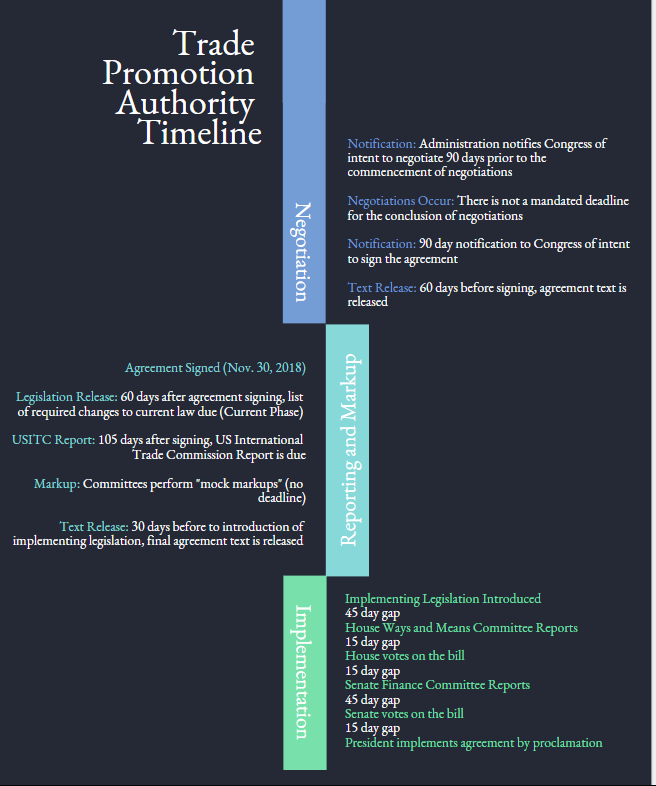 A visualization of the timeline for the USMCA ratification process in the U.S., as prescribed by Trade Promotion Authority The formal process to renegotiate NAFTA began on May 18, 2017, when U.S. Trade Representative Robert Lighthizer notified Congress of the U.S. intent to start talks within 90 days.[43] Under Trade Promotion Authority statutes, the USTR released its key negotiating objectives on July 7, 2017. Negotiations officially commenced on August 16, 2017, with eight formal rounds of talks held until April 8, 2018. By May 2, 2018, no resolution had been reached. Lighthizer warned that talks would pause until 2019 if no deal were finalized by the end of May, citing concerns over Mexico’s incoming president, Andrés Manuel López Obrador, who opposed parts of the negotiated terms.[43] Separately, U.S. House Speaker Paul Ryan set a May 17, 2018, deadline for Congressional action, but this was ignored. A U.S.-Mexico deal was finally reached on August 27, 2018,[43] though Canada still had not agreed. With Mexico’s outgoing president, Enrique Peña Nieto, leaving office on December 1, 2018, and a mandatory 60-day review period required, the deadline to finalize the text was September 30. Negotiators worked intensely and completed the draft just before midnight on September 30, 2018. The USMCA text was published as finalized on October 1, 2018, with Lighthizer crediting Jared Kushner for salvaging the deal multiple times.[44] The agreement was signed by all three countries’ leaders on November 30, 2018, during the G20 summit in Buenos Aires.[45] The English, Spanish, and French versions were declared equally authentic. Ratification required the passage of enabling legislation in each country.[46] U.S. Ambassador to Canada Kelly Craft played a critical role in bridging U.S.-Canada differences,[47] boosting her standing within the Trump administration.[48] Behind the scenes, Blackstone CEO Stephen Schwarzman—retained by Trump—reportedly urged Canadian Prime Minister Justin Trudeau to compromise on dairy market protections during a January 2017 meeting with Canada’s Liberal Cabinet at a Calgary retreat, where civil servants were absent. Schwarzman claimed Trudeau feared a recession ahead of the 2019 Canadian election.[49] On December 9, 2019, Fox News reported a breakthrough: negotiators agreed to enforce a $16/hour minimum wage for Mexican auto workers via a neutral third party. Mexico, which imports all its aluminum, opposed U.S. steel/aluminum content rules for vehicles but conceded to finalize ratification by year’s end.[50] |
交渉 この節は、読者にとって分かりにくいか、不明確な可能性があります。この節の内容を明確にするようご協力ください。トークページでこれに関する議論が行われている可能性があります。(2022年4月)(このメッセージを削除する方法とタイミングについて) 貿易促進権限(TPA)に基づき定められた、米国におけるUSMCA批准プロセスのタイムラインの視覚化 NAFTAの再交渉に向けた正式なプロセスは、2017年5月18日、ロバート・ライトハイザー米国通商代表が、90日以内に交渉を開始する意向を議会に 通知したことで始まった。[43] 貿易促進権限法に基づき、米国通商代表部(USTR)は2017年7月7日に主要な交渉目標を公表した。交渉は2017年8月16日に正式に開始され、 2018年4月8日までに8回の正式な協議が行われた。2018年5月2日時点で、合意には至っていなかった。ライトハイザー氏は、交渉条件の一部に反対 していたメキシコの次期大統領アンドレス・マヌエル・ロペス・オブラドール氏への懸念を理由に、5月末までに合意が成立しなければ交渉は2019年まで中 断されると警告した。[43] これとは別に、米下院議長のポール・ライアンは2018年5月17日を議会措置の期限として設定したが、これは無視された。2018年8月27日、ようや く米国とメキシコの間で合意が成立した[43]が、カナダはまだ合意に至っていなかった。メキシコのエンリケ・ペニャ・ニエト大統領が2018年12月1 日に退任すること、および60日間の義務的な審査期間が設けられていたことから、協定文の最終決定期限は9月30日となった。交渉担当者は猛烈な勢いで作 業を進め、2018年9月30日の深夜直前に草案を完成させた。USMCAの条文は2018年10月1日に最終版として公表され、ライトハイザーはジャ レッド・クシュナーが合意を何度も救ったと称賛した[44]。 同協定は、2018年11月30日にブエノスアイレスで開催されたG20サミットにおいて、3カ国の首脳によって署名された。[45] 英語、スペイン語、フランス語の各版が同等に正本であると宣言された。批准には、各国での関連法の成立が必要であった。[46] 在カナダ米国大使のケリー・クラフトは、米国とカナダの意見の相違を埋める上で重要な役割を果たし[47]、トランプ政権内での地位を高めた。[48] 舞台裏では、トランプ氏に起用されたブラックストーンのCEOスティーブン・シュワルツマンが、2017年1月にカルガリーで行われたカナダ自由党内閣と の会合(公務員は同席しなかった)において、ジャスティン・トルドー首相に対し、乳製品市場の保護措置について妥協するよう促したと報じられている。シュ ワルツマンは、トルドー首相が2019年のカナダ総選挙を前に景気後退を懸念していたと主張した。[49] 2019年12月9日、フォックス・ニュースは交渉の進展を報じた。交渉担当者は、中立的な第三者機関を通じてメキシコの自動車労働者に時給16ドルの最 低賃金を適用することで合意した。アルミニウムをすべて輸入に依存するメキシコは、自動車に対する米国の鉄鋼・アルミニウム含有率規制に反対していたが、 年末までに批准手続きを完了させることに同意した。[50] |
| Provisions Provisions of the agreement cover a wide range, including agricultural produce, homelessness, manufactured products, labor conditions, and digital trade, among others. Some of the more prominent aspects of the agreement include giving U.S. dairy farmers greater access to the Canadian market, guidelines to have a higher proportion of automobiles manufactured among the three nations rather than imported from elsewhere, and retention of the dispute resolution system similar to that included in NAFTA.[46][51] Dairy The dairy provisions give the U.S. tariff-free access to 3.6%, up from 3.25% under the never-ratified Trans-Pacific Partnership, of the $15.2 billion (as of 2016) Canadian dairy market.[52][53] Canada agreed to eliminate Class 7 pricing provisions on certain dairy products, while Canada's domestic supply management system remains in place.[54] Automobiles Automobile rules of origin (ROO) requirements mandate that a certain portion of an automobile's value must come from within the governed region. In NAFTA, the required portion was 62.5 percent. The USMCA increases this requirement to 75 percent of the automobile's value. The initial proposal from the Trump administration was to increase this to 85 percent and add a stipulation that 50 percent of the automotive content be made by U.S. carmakers,[43] but in the end, the deal's text did not include this version of the provision. There is concern that the increased domestic sourcing requirements, aimed at promoting U.S. employment, will cause higher input costs and disruptions to supply chains deriving outside of certain developing or once more industrious zones, for example the "Rust" Belt.[55] De minimis To facilitate cross-border trade, Mexico and Canada agreed to raise their de minimis exemption thresholds for the application of taxes and customs duties.[56] (In 2016, the United States raised its de minimis threshold for all countries to US$800 (from US$200) per person per day to save on enforcement costs.[57]) For goods transported to Canada by courier from the United States or Mexico, Canada increased the threshold from C$20 (approximately US$16) to C$40 for taxes (GST, HST, PST), and to C$150 for customs duties (tariffs).[58][59][60] Some goods do not have an exemption, such as alcohol and tobacco.[60] Mexico maintained its de minimis threshold at US$50 for taxes, and it agreed to provide duty-free shipments up to the equivalent of US$117.[61] Labor U.S. Vice President Mike Pence speaks about the USMCA at a Uline distribution center in Pleasant Prairie, Wisconsin in October 2019. USMCA Annex 23-A requires Mexico to pass legislation that improves the collective bargaining capabilities of labor unions.[62] The specific standards Mexico is required to comply with are detailed in the International Labour Organization's Convention 98 on freedom of association and collective bargaining. The administration of Mexico's president, Andrés Manuel López Obrador, introduced legislation in late 2018 that pursues compliance with these international standards. Other labor-related measures include a minimum wage requirement in the automotive industry. Specifically, 40 to 45 percent of the automobiles manufactured in North America must be made in a factory that pays a minimum of US$16 per hour.[55] This measure will be phased in during the first five years after USMCA ratification. Intellectual property The USMCA extends the copyright length in Canada to life plus 70 years, and 75 years for sound recordings.[63] Furthermore, biotechnological firms would have at least 10 years exclusivity period for agricultural chemicals (double the current 5), and industrial designs' period would "jump" from current 10 to 15 years. Compared to NAFTA, USMCA would require criminal penalties and civil remedies to be available for both satellite and cable theft, reaffirm the Doha Declaration on the TRIPS agreement and public health, contain the strongest due process and transparency requirements for geographic indicator protection systems in any FTA, require criminal procedures and penalties for recording copyrighted movies in movie theaters, and require ex officio authority for customs officials to stop suspected counterfeit goods.[64] Pharmaceuticals USMCA provides for a patent term extension where there is an "unreasonable curtailment" of a pharmaceutical's patent term stemming from delays in the regulatory or marketing approval process.[65] USMCA accounts for the data exclusivity of new pharmaceutical products. New pharmaceutical products are those that do not contain a chemical entity that has been previously approved by that party.[1] Generic manufacturers are prohibited from relying on the innovator's previously undisclosed safety/efficacy testing for at least five years from the date marketing approval was first granted.[66] Mexico agreed to extend its data protection of new pharmaceutical products.[67] Canada's data protection regime already offered an eight-year exclusivity period for innovative drugs and thus was not required to make changes.[68] Initially, the parties contemplated creating an exclusivity period for new products containing biologics for at least ten years from the approval date. Biologics are defined as a product that is "produced using biotechnology processes and that is, or contains, a virus, therapeutic serum, toxin, antitoxin, vaccine, blood, blood component or derivative, allergenic product, protein, or analogous product, for use in human beings for the prevention, treatment, or cure of a disease or condition".[1] This period would have been longer than the exclusivity periods of both Canada and Mexico, but shorter than that of the United States. This provision was heavily criticized for its potential to limit access to biological medications and make them unaffordable.[66][69] Thus, biologics were covered in the definition of "new pharmaceutical products" and are instead eligible for a minimum five-year protection period.[70] Elimination of foreign office and local presence requirements The USMCA would eliminate the need for companies to establish headquarters in any other USMCA country. It will encourage cross-border business by excluding U.S. companies from the need to localize data and open a Canadian or Mexican HQ. For example, McDonald's Canada or Apple Canada could both cease to exist, and the surviving entities would be a North American McDonald's or Apple. Dispute settlement mechanisms There are three primary dispute settlement mechanisms contained in NAFTA. Chapter 20 is the country-to-country resolution mechanism. It is often regarded as the least contentious of the three mechanisms, and it was sustained in its original NAFTA form in USMCA. Such cases would involve complaints between USMCA member states that a term of the agreement had been violated.[71] Chapter 19 disputes manage the justifications of anti-dumping or countervailing duties. Without Chapter 19, the legal recourse for managing these policies would be through the domestic legal system. Chapter 19 specifies that a USMCA Panel will hear the case and act as an International Trade Court in arbitrating the dispute.[71] The Trump administration attempted to remove Chapter 19 from the new USMCA text, though it has thus far endured in the agreement. Chapter 11 is the third mechanism, known as investor-state dispute settlement, wherein multinational corporations are enabled to sue participating governments over allegedly discriminatory policies. Chapter 11 is broadly considered the most controversial of the settlement mechanisms.[72] The Canadian negotiators effectively removed themselves from Chapter 11 in the USMCA version of this measure, Chapter 14.[73] Canada will have a full exemption from ISDS three years after NAFTA has been terminated.[72][73] Beyond the Border accord In addition to building on the existing NAFTA fused with elements from the Trans-Pacific Partnership, the USMCA also incorporates elements from the "Beyond the Border" accord signed by former Prime Minister Stephen Harper and former president Barack Obama, most notably the "single window" initiative and folding the "Regulatory Cooperation Council" into the "Good Regulatory Governance" chapter 28 of the new accord.[74] Sunset clause Additionally, there is a stipulation that the agreement itself must be reviewed by the three nations every six years, with a 16-year sunset clause. The agreement can be extended for an additional 16-year term during the six-year reviews.[75] The introduction of the sunset clause places more control in shaping the future of the USMCA in the hands of domestic governments. However, there is concern that this can create greater uncertainty. Sectors such as automotive manufacturing require significant investment in cross-border supply chains.[76] Given the dominance of the United States consumer market, this will likely pressure firms to locate more production in the U.S., with a greater likelihood of increased production costs for those vehicles.[77] Local production has always been tied to increased demand for local skill-based acquisition which is another form of human-rights particularly with laterally transferable skills and specific categories of educational attainment. Local skill demand and supply serve to enfranchise working populations in their abilities to sustain locally interdependent markets, adding to the ability of skilled individuals to respond to stressors while generally altering other areas of demand/supply in the market materially and in a community. Wider phenomena that are associated with skill-based labor enfranchisement include benefits socioeconomically to that of domestic relationships and children, public safety and crime reported or not, and resilience, and hopefully, within any extant skill-deprived regions. |
協定内容 本協定の規定は、農産物、ホームレス問題、製造品、労働条件、デジタル貿易など、幅広い分野を網羅している。協定の主な内容としては、米国の酪農家に対す るカナダ市場へのアクセス拡大、他国からの輸入車ではなく、3カ国間で製造される自動車の割合を高めるための指針、NAFTAと同様の紛争解決システムの 維持などが挙げられる。[46] [51] 乳製品 乳製品に関する規定により、米国は、152億ドル(2016年時点)規模のカナダ乳製品市場に対し、批准されなかった環太平洋パートナーシップ協定 (TPP)下での3.25%から引き上げられた3.6%の無関税アクセス権を獲得した。[52][53] カナダは、国内の供給管理制度を維持しつつ、特定の乳製品に対するクラス7価格規定を撤廃することに合意した。[54] 自動車 自動車の原産地規則(ROO)の要件では、自動車の価値の一定割合が対象地域内で生み出されたものでなければならないと定められている。NAFTAでは、 この要件は62.5%であった。USMCAでは、この要件が自動車の価値の75%に引き上げられた。トランプ政権による当初の提案では、これを85%に引 き上げ、自動車部品の50%を米国自動車メーカーが製造することを条件に加えることになっていた[43]が、最終的に合意文にはこの条項は盛り込まれな かった。米国の雇用促進を目的とした国内調達要件の引き上げにより、投入コストの上昇や、いわゆる「ラストベルト」など、特定の発展途上地域やかつての工 業地帯以外からの供給網への混乱が生じるのではないかという懸念がある。[55] デミニミス 国境を越えた貿易を円滑化するため、メキシコとカナダは、税金および関税の適用に関するデミニミス(微量免除)の基準額を引き上げることに合意した。 [56](2016年、米国は執行コストを削減するため、すべての国に対するデミニミスの基準額を1人1日あたり200米ドルから800米ドルに引き上げ た。[57])米国またはメキシコから宅配便でカナダへ輸送される物品について、カナダは税金(GST、HST、PST)の免税基準額を20カナダドル (約16米ドル)から40カナダドルへ、関税(関税)については150カナダドルへ引き上げた。[58][59][60] アルコールやタバコなど、一部の品目には免税措置が適用されない。[60] メキシコは税金のデミニミス基準額を50米ドルに据え置き、117米ドル相当までの貨物について関税免除を適用することに合意した。[61] 労働 2019年10月、ウィスコンシン州プレザントプレーリーにあるUlineの物流センターで、USMCAについて演説するマイク・ペンス米副大統領。 USMCA附属書23-Aは、メキシコに対し、労働組合の団体交渉能力を向上させるための法律を制定することを求めている。[62] メキシコが遵守を求められる具体的な基準は、結社の自由および団体交渉に関する国際労働機関(ILO)第98号条約に詳述されている。アンドレス・マヌエ ル・ロペス・オブラドール大統領率いるメキシコ政府は、2018年末にこれらの国際基準への準拠を目指す法案を提出した。 その他の労働関連措置には、自動車産業における最低賃金要件が含まれる。具体的には、北米で製造される自動車の40~45%は、時給16米ドル以上を支払う工場で生産されなければならない。[55] この措置は、USMCA批准後の最初の5年間に段階的に導入される。 知的財産 USMCAは、カナダにおける著作権の保護期間を著作者死後70年まで、音源については75年まで延長する。[63] さらに、バイオテクノロジー企業は農薬について少なくとも10年間の独占期間(現在の5年の2倍)を認められ、意匠権の保護期間は現在の10年から15年 に「引き上げられる」。NAFTAと比較して、USMCAは衛星放送およびケーブル放送の盗用に対して刑事罰と民事救済措置を適用することを義務付け、 TRIPS協定と公衆衛生に関するドーハ宣言を再確認し、地理的表示保護制度に関してあらゆるFTAの中で最も強力な適正手続きおよび透明性要件を盛り込 み、映画館での著作権保護映画の録画に対して刑事手続きと罰則を義務付け、税関職員が偽造品と疑われる物品を差し止めるための職権を義務付ける。[64] 医薬品 USMCAは、規制または販売承認プロセスの遅延に起因して医薬品の特許期間が「不当に短縮」された場合、特許期間の延長を規定している。[65] USMCAは、新医薬品のデータ独占権を規定している。新医薬品とは、当該締約国によって以前に承認された化学物質を含まないものを指す。[1] ジェネリック医薬品メーカーは、販売承認が最初に付与された日から少なくとも5年間、先発メーカーが以前に非公開としていた安全性・有効性試験の結果に依 拠することを禁じられている。[66] メキシコは、新医薬品のデータ保護期間を延長することに合意した。[67] カナダのデータ保護制度は、すでに革新的な医薬品に対して8年間の独占期間を設けていたため、変更を行う必要はなかった。[68] 当初、当事者は、生物学的製剤を含む新製品に対し、承認日から少なくとも10年間の独占期間を設けることを検討していた。生物学的製剤とは、「バイオテク ノロジープロセスを用いて製造され、かつ、疾病または病状の予防、治療、または治癒のためにヒトに使用される、ウイルス、治療用血清、毒素、抗毒素、ワク チン、血液、血液成分またはその派生物、アレルギー誘発性製品、タンパク質、または類似の製品である、あるいはそれらを含む製品」と定義される。[1] この期間は、カナダおよびメキシコの独占期間よりも長かったが、米国のものよりは短かった。この規定は、生物学的製剤へのアクセスを制限し、それらを手頃 な価格では入手できなくする可能性があるとして、激しい批判を受けた。[66][69] そのため、生物学的製剤は「新規医薬品」の定義に含まれ、代わりに最低5年間の保護期間の対象となることとなった。[70] 海外事務所および現地拠点の設置要件の撤廃 USMCAは、企業が他のUSMCA加盟国に本社を設立する必要性をなくすものである。これにより、米国企業がデータを現地化したり、カナダやメキシコに 本社を開設したりする必要がなくなるため、国境を越えたビジネスが促進される。例えば、マクドナルド・カナダやアップル・カナダは消滅し、存続する事業体 は北米マクドナルドまたは北米アップルとなる可能性がある。 紛争解決メカニズム NAFTAには3つの主要な紛争解決メカニズムが含まれている。第20章は国対国の解決メカニズムである。これは3つのメカニズムの中で最も争点が少ない と見なされることが多く、USMCAにおいてもNAFTAの当初の形態が維持された。このような事案では、協定の条項に違反があったとするUSMCA加盟 国間の申し立てが対象となる。[71] 第19章の紛争は、アンチダンピング関税や相殺関税の正当性を扱うものである。第19章がなければ、これらの政策を管理するための法的救済手段は国内法制 度を通じたものとなる。第19章では、USMCAパネルが案件を審理し、紛争の仲裁において国際貿易裁判所としての役割を果たすことが規定されている。 [71] トランプ政権は、新たなUSMCA条文から第19章を削除しようと試みたが、現時点では協定内に残されている。 第11章は、投資家対国家紛争解決(ISDS)として知られる第3のメカニズムであり、多国籍企業が、差別的であると主張される政策について参加国政府を 提訴することを可能にするものである。第11章は、紛争解決メカニズムの中で最も物議を醸しているものと広く見なされている。[72] カナダの交渉担当者は、USMCA版におけるこの措置である第14章において、事実上、第11章の適用対象から自らを排除した。[73] カナダは、NAFTAが終了してから3年後に、ISDS(投資家対国家紛争解決)から完全に免除されることになる。[72] [73] 「ビヨンド・ザ・ボーダー」協定 USMCAは、既存のNAFTAを基盤とし、環太平洋パートナーシップ協定(TPP)の要素を取り入れただけでなく、スティーブン・ハーパー元首相とバラ ク・オバマ元大統領が署名した「ビヨンド・ザ・ボーダー」協定の要素も組み込んでいる。特に注目すべきは、「シングルウィンドウ」イニシアチブと、「規制 協力理事会」を新協定の第28章「適切な規制ガバナンス」に統合した点である。[74] サンセット条項 さらに、協定自体を3カ国が6年ごとに見直すことが規定されており、16年間のサンセット条項が設けられている。6年ごとの見直し期間中に、協定はさらに 16年間延長することができる。[75] サンセット条項の導入により、USMCAの将来像を形作る主導権は、各国の政府により強く委ねられることになる。しかし、これが不確実性を増大させるので はないかという懸念もある。自動車製造などの分野では、国境を越えたサプライチェーンへの多額の投資が必要とされる。[76] 米国の消費者市場が支配的であることを踏まえると、これにより企業は生産拠点をより米国に集中させるよう圧力を受ける可能性が高く、その結果、当該車両の 生産コストが増加する可能性が高まる。[77] 現地生産は常に、現地の技能に基づく人材獲得への需要増加と結びついており、これは特に汎用性の高い技能や特定の教育水準において、人権のもう一つの形態 となる。現地の技能需要と供給は、労働人口が地域相互依存型市場を維持する能力を保障する役割を果たし、熟練した個人がストレス要因に対応する能力を高め る一方で、市場や地域社会における需要・供給の他の領域を実質的に変容させる。技能に基づく労働者のエンパワーメントに関連するより広範な現象には、家庭 内関係や子供への社会経済的利益、公衆安全や犯罪(通報の有無にかかわらず)、レジリエンス(回復力)への恩恵が含まれ、ひいては、既存の技能不足地域に おいても同様の効果が期待される。 |
| Currency A new addition to the USMCA is the inclusion of Chapter 3,3, which covers Macroeconomic Policies and Exchange Rate Matters. This is considered significant because it could set a precedent for future trade agreements.[78] Chapter 33 establishes requirements for currency and macroeconomic transparency which, if violated, would constitute grounds for a Chapter 20 dispute appeal.[78] The U.S., Canada, and Mexico are all currently in compliance with these transparency requirements in addition to the substantive policy requirements which align with the International Monetary Fund Articles of Agreement.[79] Article 32.10 The USMCA will affect how member countries negotiate future free trade deals. Article 32.10 requires USMCA countries to notify USMCA members three months in advance if they intend to begin free trade negotiations with non-market economies. Article 32.10 permits USMCA countries the ability to review any new free trade deals members agree to go forward with. Article 32.10 is widely speculated to be targeting China in intent.[80] In fact, a senior White House official said in connection to the NAFTA deal that "We have been very concerned about the efforts of China to essentially undermine the U.S. position by entering into arrangements with others."[81] Against exchange rate manipulation The USMCA countries are to abide by IMF standards aimed at preventing the manipulation of exchange rates. The agreement calls for public disclosure of market interventions. The IMF can be summoned to act as a referee if the parties dispute.[81] Against state-owned enterprises State-owned enterprises, which are favored by China as levers for exercising its dominance, are prevented from receiving unfair subsidies when compared to private enterprises.[81] Against import and export restrictions None of the parties is permitted to implement restrictions/prohibitions of imports and exports other than those specified in the General Agreement on Tariffs and Trade (GATT 1994) or specified within USMCA.[1] GATT 1994 specifies cases such as shortages, failure to meet local regulatory or licencing standards, and certain Animal Agricultural considerations.[82] This condition does not apply to any party outside of the three USMCA parties. A party can call the parties to review a restriction or prohibition imposed by another party on a non-party if the restriction or prohibition causes pricing or other types of distortions for any of the parties. Canadian Exemptions from USMCA Import and Export Restrictions Logs Unprocessed fish Goods produced by forced or slave labour Firearms deemed illegal by the Canadian Government Literature and other material that constitute terrorist propaganda, depict violence or crime, child pornography, and other material not legal in Canada Commercial marine activity in Canadian waters Volumes of ethyl alcohol Mexican Exemptions from USMCA Import and Export Restrictions Certain hydrocarbon and petroleum-based products Used vehicles and used vehicle components Used clothing United States Exemptions from USMCA Import and Export Restrictions Logs |
通貨 USMCAに新たに追加されたのは、マクロ経済政策および為替問題を取り扱う第33章である。これは、将来の貿易協定における先例となる可能性があるた め、重要な意味を持つと見なされている。[78] 第33章は、通貨およびマクロ経済の透明性に関する要件を定めており、これに違反した場合は、第20章に基づく紛争申立ての根拠となる。[78] 米国、カナダ、メキシコの3カ国は現在、国際通貨基金(IMF)の協定条項に沿った実質的な政策要件に加え、これらの透明性要件も遵守している。[79] 第32条10項 USMCAは、加盟国が将来の自由貿易協定を交渉する方法に影響を与えることになる。第32条10項は、USMCA加盟国が非市場経済国との自由貿易交渉 を開始する意向がある場合、3ヶ月前に他のUSMCA加盟国に通知することを義務付けている。第32条10項は、USMCA加盟国に対し、加盟国が合意し て進める新たな自由貿易協定を審査する権限を認めている。第32条10項は、その意図において中国を標的としていると広く推測されている。[80] 実際、ホワイトハウスの高官はNAFTA協定に関連して、「我々は、中国が他国と協定を結ぶことで、実質的に米国の立場を弱体化させようとする動きを非常 に懸念してきた」と述べた。[81] 為替操作への対抗 USMCA加盟国は、為替操作を防止することを目的としたIMFの基準を遵守しなければならない。本協定は、市場介入の公開を求めている。当事者間で紛争が生じた場合、IMFを仲裁人として招請することができる。[81] 国有企業への対抗 中国が支配力を行使するための手段として重用する国有企業は、民間企業と比較して不当な補助金を受けることが禁止される。[81] 輸出入制限への反対 いずれの締約国も、関税及び貿易に関する一般協定(GATT 1994)またはUSMCA内で規定されているもの以外の輸出入制限・禁止措置を実施することは認められない。[1] GATT 1994では、物資不足、現地の規制や認可基準への不適合、および特定の畜産・農業上の考慮事項などの事例が規定されている。[82] この条件は、USMCAの3つの締約国以外のいかなる当事者にも適用されない。 ある締約国が、他の締約国によって非締約国に対して課された制限または禁止措置が、いずれかの締約国に価格その他の歪みをもたらす場合、当該締約国は、他の締約国に対し、その制限または禁止措置の見直しを求めることができる。 USMCAの輸出入制限に対するカナダの免除事項 丸太 未加工の魚 強制労働または奴隷労働によって生産された物品 カナダ政府によって違法とみなされる銃器 テロ宣伝、暴力や犯罪の描写、児童ポルノ、およびカナダ国内で違法とされるその他の資料 カナダ水域における商業海洋活動 エチルアルコールの数量 USMCAの輸出入制限に対するメキシコの適用除外 特定の炭化水素および石油由来製品 中古車両および中古車両部品 中古衣類 USMCAの輸出入制限に対する米国の適用除外 丸太 |
Ratification and legal status Outgoing Mexican president Enrique Peña Nieto, U.S. president Donald Trump, and Canadian prime minister Justin Trudeau sign the agreement during the G20 summit in Buenos Aires, Argentina, on November 30, 2018. The USMCA was signed on November 30, 2018, by all three parties at the G20 summit in Buenos Aires, as had been planned in the preceding months.[83][84] However, continued disputes over labor rights, steel, and aluminium prevented ratification of this version of the agreement.[85][86] Consequently, Canadian Deputy Prime Minister Chrystia Freeland, U.S. Trade Representative Robert Lightizer and Mexican Undersecretary for North America Jesus Seade formally signed a revised agreement on December 10, 2019, which was ratified by all three countries by March 13, 2020. |
批准と法的地位 2018年11月30日、アルゼンチンのブエノスアイレスで開催されたG20サミットにおいて、メキシコのエンリケ・ペニャ・ニエト大統領(当時)、米国のドナルド・トランプ大統領、カナダのジャスティン・トルドー首相が協定に署名した。 USMCAは、前数ヶ月間の計画通り、2018年11月30日にブエノスアイレスで開催されたG20サミットにおいて、3カ国すべてによって署名された。 [83][84] しかし、労働権、鉄鋼、アルミニウムをめぐる紛争が継続したため、このバージョンの協定の批准は阻止された。[85][86] その結果、2019年12月10日、カナダのクリスティア・フリーランド副首相、米国のロバート・ライトハイザー通商代表、メキシコのヘスス・セアデ北米 担当次官が改定協定に正式に署名し、2020年3月13日までに3カ国すべてで批准された。 |
| United States Domestic procedures for ratification of the agreement are governed by the Trade promotion authority legislation, otherwise known as "fast track" authority. Growing objections within the member states about U.S. trade policy and various aspects of the USMCA affected the signing and ratification process. Mexico stated it would not sign the USMCA if steel and aluminium tariffs remained.[87] There was speculation after the results of the November 6, 2018 U.S. midterm elections that the Democrats' increased power in the House of Representatives might interfere with the passage of the USMCA agreement.[88][89] Senior Democrat Bill Pascrell argued for changes to the USMCA to enable it to pass Congress.[90] Republicans opposed USMCA provisions requiring labor rights for LGBTQ and pregnant workers.[91] Forty Congressional Republicans urged Trump against signing a deal that contained "the unprecedented inclusion of sexual orientation and gender identity language"; as a result, Trump ultimately signed a revised version that committed each nation only to "policies that it considers appropriate to protect workers against employment discrimination" and clarified that the United States would not be required to introduce any additional nondiscrimination laws.[92] The Canadian government expressed concern about the changes evolving within the USMCA agreement.[93] On December 2, 2018, Trump announced he would begin the six-month process to withdraw from NAFTA, adding that Congress needed either to ratify the USMCA or else revert to pre-NAFTA trading rules. Academics had debated whether the president can unilaterally withdraw from the pact without Congressional approval.[94] On March 1, 2019, organizations representing the U.S. agricultural sector announced their support for the USMCA and urged Congress to ratify the agreement. They also urged the Trump administration to continue upholding NAFTA until the new trade agreement is ratified.[95] However, on March 4, House Ways and Means chairman Richard Neal predicted a "very hard" path through Congress for the deal.[96] Starting March 7, senior White House officials met with House Ways and Means members, as well as moderate caucuses from both parties, such as the Problem Solvers Caucus, the Tuesday Group, and the Blue Dog Coalition in their efforts to gain support for ratification. The Trump administration has also backed down from the threat of withdrawing from NAFTA as the negotiations with Congress continued.[97] On May 30, 2019, USTR Lighthizer submitted to Congress a draft statement on administrative measures concerning the implementation of the U.S.-Mexico-Canada Agreement (USMCA and the new NAFTA under the Presidential Trade Promotion Authority (TPA) Act of 2015 (Statement of Administrative Action). The draft would allow USMCA implementation legislation to be submitted to Congress after 30 days, thus on or after June 29. In a letter[98] sent to Nancy Pelosi, Speaker of the House of Representatives, and Kevin McCarthy, House Minority Leader, Lighthizer said that the USMCA is the gold standard in U.S. trade policy, modernizing U.S. competitive digital trade, intellectual property, and services provisions and creating a level playing field for U.S. companies, workers and farmers, an agreement that represents a fundamental rebalancing of trade relations between Mexico and Canada. With the draft statement on administrative measures submitted, Speaker Pelosi stated that U.S. Trade Representative Lighthizer should confirm that the draft wording of the USMCA would benefit U.S. workers and farmers and that, although she agreed on the need to revise NAFTA, stricter enforcement of labor and environmental protection standards was needed.[99] President Donald Trump warned on September 25, 2019, that an impeachment inquiry against him could derail congressional approval of USMCA, dragging down Mexico's peso and stock market as investors fled riskier assets.[100] The U.S. House of Representatives was proceeding with work on USMCA, U.S. House Speaker Nancy Pelosi said on September 26, 2019.[101] Bloomberg News reported on October 29, 2019, that the Trump administration planned to include in the legislation approving the pact a provision that would allow the USTR to directly control how and where cars and parts are made by global automakers.[102] On December 19, 2019, the United States House of Representatives passed the USMCA with bipartisan support by a vote of 385 (Democratic 193, Republican 192) to 41 (Democratic 38, Republican 2, Independent 1).[103][104] On January 16, 2020, the United States Senate passed the trade agreement by a vote of 89 (Democratic 38, Republican 51) to 10 (Democratic 8, Republican 1, Independent 1)[105] and the bill was forwarded to the White House for Trump's signature.[106] On January 29, 2020, Trump signed the agreement into law (Public Law No: 116–113).[107] It officially amended NAFTA[108] but not the 1989 Canada–United States Free Trade Agreement which is only "suspended", so in case parties fail to extend or renew it in 6 years, FTA would become the law.[109][110] On April 24, 2020, Lighthizer gave official notice to Congress that the new trade deal was set to come into force on July 1, 2020, and notified Canada and Mexico to that effect.[111][112] On June 1, 2020, the USTR released the "Uniform Regulations",[113] which help interpret the different chapters of the USMCA, primarily chapters 4–7, paving the way for the Agreement to take effect domestically; NAFTA was consequently replaced the following month, on July 1, 2020.[114] |
アメリカ合衆国 本協定の国内批准手続きは、「ファストトラック」権限としても知られる貿易促進権限法に基づいて行われる。 米国の通商政策やUSMCAの様々な側面に対する加盟国内での反対意見の高まりが、署名および批准のプロセスに影響を及ぼした。メキシコは、鉄鋼・アルミ ニウム関税が維持される場合はUSMCAに署名しないと表明した。[87] 2018年11月6日の米国中間選挙の結果を受けて、下院における民主党の勢力拡大がUSMCA協定の成立を妨げるのではないかとの憶測が流れた。 [88][89] 民主党の上級議員ビル・パスクレルは、USMCAが議会を通過できるよう、協定の修正を主張した。[90] 共和党は、LGBTQや妊婦の労働者の権利を義務付けるUSMCAの条項に反対した。[91] 40人の共和党議員が、トランプ大統領に対し、「性的指向および性自認に関する文言が前例のない形で盛り込まれた」協定への署名を控えるよう求めた。その 結果、トランプ大統領は最終的に、各国が「雇用差別から労働者を保護するために適切と考える政策」のみを約束し、米国が追加の差別禁止法を制定する必要は ないことを明確化した改訂版に署名した。[92] カナダ政府は、USMCA協定内で生じている変更について懸念を表明した。[93] 2018年12月2日、トランプ大統領はNAFTAからの離脱に向けた6カ月の手続きを開始すると発表し、議会はUSMCAを批准するか、さもなければ NAFTA以前の貿易ルールに戻る必要があると付け加えた。学界では、大統領が議会の承認なしに一方的に協定から離脱できるかどうかについて議論されてい た。[94] 2019年3月1日、米国の農業部門を代表する団体はUSMCAへの支持を表明し、議会に対し協定の批准を求めた。また、新たな貿易協定が批准されるま で、トランプ政権に対しNAFTAの維持を継続するよう求めた。[95] しかし、3月4日、下院歳入委員会のリチャード・ニール委員長は、この協定が議会を通過する道のりは「非常に厳しい」ものになると予測した。[96] 3月7日から、ホワイトハウスの高官らは、批准への支持を得るべく、下院歳入委員会の議員や、「問題解決議員連盟(Problem Solvers Caucus)」、「チューズデイ・グループ(Tuesday Group)」、「ブルードッグ連合(Blue Dog Coalition)」など、両党の穏健派議員グループと会談を行った。また、議会との交渉が続く中、トランプ政権はNAFTAからの離脱という脅しを撤 回した。[97] 2019年5月30日、ライトハイザー通商代表部(USTR)代表は、2015年大統領通商促進権限法(TPA法)に基づく米国・メキシコ・カナダ協定 (USMCA、新NAFTA)の実施に関する行政措置に関する声明案を議会に提出した(行政措置声明)。この草案により、USMCA実施法案は30日後、 すなわち6月29日以降に議会に提出されることになる。ライトハイザー氏は、下院議長のナンシー・ペロシ氏および下院少数党院内総務のケビン・マッカー シー氏に送付した書簡[98]の中で、USMCAは米国の通商政策における最高水準の協定であり、米国の競争力あるデジタル貿易、知的財産、およびサービ スに関する規定を近代化し、米国企業、労働者、農家にとって公平な競争環境を創出するものであり、メキシコおよびカナダとの貿易関係の根本的な再均衡を表 す協定であると述べた。行政措置に関する声明案が提出されたことを受け、ペロシ下院議長は、ライトハイザー通商代表がUSMCAの草案文言が米国の労働者 や農家に利益をもたらすことを確認すべきであると述べた。また、彼女はNAFTAの改定の必要性には同意するものの、労働および環境保護基準のより厳格な 執行が必要であると指摘した。[99] ドナルド・トランプ大統領は2019年9月25日、自身に対する弾劾調査がUSMCAの議会承認を頓挫させる恐れがあると警告し、投資家がリスクの高い資 産から逃げ出したことで、メキシコのペソと株式市場が下落した。[100] ナンシー・ペロシ下院議長は2019年9月26日、米下院がUSMCAに関する作業を進めていると述べた。[101] ブルームバーグ・ニュースは2019年10月29日、トランプ政権が協定承認法案に、米通商代表部(USTR)が世界の自動車メーカーによる自動車および 部品の製造方法や製造場所を直接管理できるようにする条項を盛り込む計画であると報じた。[102] 2019年12月19日、米国下院は超党派の支持を得て、賛成385票(民主党193票、共和党192票)、反対41票(民主党38票、共和党2票、無所 属1票)でUSMCAを可決した。[103][104] 2020年1月16日、米国上院は89票(民主党38票、共和党51票)対10票(民主党8票、共和党1票、無所属1票)[105]でこの貿易協定を可決 し、法案はトランプ大統領の署名を得るためホワイトハウスに送付された。[106] 2020年1月29日、トランプ大統領は同協定に署名し、法律として成立させた(公法第116–113号)。[107] これによりNAFTAは正式に改正された[108]が、1989年のカナダ・米国自由貿易協定(FTA)は「一時停止」されただけであり、6年以内に当事 国が同協定の延長または更新に失敗した場合、FTAが法律として発効することになる。[109][110] 2020年4月24日、ライトハイザーは、新たな貿易協定が2020年7月1日に発効する予定であることを議会に正式に通知し、その旨をカナダおよびメキ シコにも通告した。[111][112] 2020年6月1日、米国通商代表部(USTR)は「統一規則」[113]を公表した。これはUSMCAの各章、主に第4章から第7章の解釈を助けるもの であり、同協定が国内で発効するための道筋を整えた。その結果、NAFTAは翌月の2020年7月1日に置き換えられた。[114] |
| Mexico On November 27, 2018, the government of Mexico said it would give to Jared Kushner its highest civilian honor, the Order of the Aztec Eagle, for his work in negotiating the USMCA.[115] On June 19, 2019, the Senate of Mexico passed the treaty's ratification bill on first reading in a 114–4 vote, with three abstentions.[116] The treaty was passed on its second and final reading by the Senate on December 12, 2019, by a vote of 107–1.[117] Manufacturing in Mexico, as of 2018, accounts for 17% of its GDP.[118] However, Andrés Manuel López Obrador, then president of Mexico, believed that this trade deal would be a net positive for the Mexican economy by growing foreign investments, creating jobs, and expanding trade.[119] On April 3, 2020, Mexico announced it was ready to implement the agreement, joining Canada,[17] though it requested that its automotive industry be given extra time to comply.[120] |
メキシコ 2018年11月27日、メキシコ政府は、USMCAの交渉における功績を称え、ジャレッド・クシュナー氏に民間人への最高勲章である「アステカ鷲勲章」を授与すると発表した。[115] 2019年6月19日、メキシコ上院は、114対4、棄権3票の賛成多数で、同条約の批准法案を第一読会にて可決した。[116] 同条約は2019年12月12日、上院での第2読会(最終読会)において、賛成107票、反対1票で可決された。[117] 2018年時点で、メキシコの製造業はGDPの17%を占めている。[118] しかし、当時のメキシコ大統領アンドレス・マヌエル・ロペス・オブラドールは、この貿易協定が外国投資の増加、雇用の創出、貿易の拡大を通じて、メキシコ 経済にとって正味のプラスになると考えていた。[119] 2020年4月3日、メキシコはカナダに続き[17]、協定の実施準備が整ったと発表した。ただし、自動車産業については順守のための猶予期間を要請した。[120] |
| Canada On May 29, 2019, prime minister Justin Trudeau introduced a CUSMA implementation bill[121] in the House of Commons.[122] On June 20, it passed second reading in the House of Commons and was referred to the Standing Committee on International Trade.[123] Governor General of Canada Julie Payette declared the dissolution of the 42nd Canadian Parliament on September 11, 2019, and formally issued the writs of election for the 2019 Canadian federal election.[124] All pending legislation is scrapped upon any dissolution of Parliament, meaning that the CUSMA implementation bill needed to be re-introduced in the 43rd Canadian Parliament which began on December 5, 2019.[125][126] On December 10, 2019, a revised CUSMA agreement was reached by the three countries. On January 29, 2020, Deputy Prime Minister and Minister of Intergovernmental Affairs Chrystia Freeland introduced CUSMA implementation bill C-4[121] in the House of Commons and it passed its first reading without a recorded vote. On February 6, the bill passed second reading in the House of Commons on a vote of 275 to 28, with the Bloc Québécois voting against and all other parties voting in favor, and it was referred to the Standing Committee on International Trade.[127][128][129] On February 27, 2020, the committee voted to send the bill to the full House for third reading, without amendments. On March 13, 2020, the House of Commons passed Bill C-4 to implement CUSMA before suspending itself for 6 weeks due to the COVID-19 pandemic. Due to the "extraordinary circumstances", the third and final reading of the bill was deemed to be approved without a recorded vote, as part of an omnibus adjournment motion unanimously approved by all members present.[130] Prime Minister Justin Trudeau was not present, since he was in self-isolation at home after his wife Sophie Grégoire Trudeau tested positive for COVID-19 infection. On the same day, the Senate passed first, second, and third readings of the bill without recorded votes,[131] and Governor General Julie Payette granted royal assent and it became law, thus completing Canada's ratification of the legislation.[127][128][4] On April 3, 2020, Canada notified the United States and Mexico that it had completed its domestic ratification process of the agreement.[132] |
カナダ 2019年5月29日、ジャスティン・トルドー首相は下院においてCUSMA実施法案[121]を提出した[122]。6月20日、同法案は下院で第2読会を通過し、国際貿易常任委員会に付託された[123]。 2019年9月11日、カナダ総督ジュリー・ペイエットは第42回カナダ議会の解散を宣言し、2019年カナダ連邦選挙の選挙令状を正式に発布した。 [124] 議会の解散に伴い、審議中のすべての法案は白紙に戻されるため、CUSMA実施法案は、2019年12月5日に開会した第43回カナダ議会で再提出される 必要があった。[125][126] 2019年12月10日、3カ国間でCUSMAの改定合意が成立した。2020年1月29日、クリスティア・フリーランド副首相兼政府間関係担当大臣は、 CUSMA実施法案C-4[121]を下院に提出し、同法案は採決記録なしに第一読会を通過した。2月6日、同法案は下院で275対28の賛成多数で二読 を通過した(ブロック・ケベコワが反対、その他の全政党が賛成)。その後、国際貿易常任委員会に付託された。[127][128][129] 2020年2月27日、同委員会は修正なしで本法案を本会議に送付し、第三読会を行うことを可決した。 2020年3月13日、下院はCUSMAを実施するための法案C-4を可決した後、COVID-19パンデミックにより6週間の休会に入った。「異常事 態」のため、同法案の第3読会(最終読会)は、出席議員全員の満場一致で可決された包括的休会動議の一環として、採決記録なしに承認されたものとみなされ た。[130] ジャスティン・トルドー首相は、妻のソフィー・グレゴワール・トルドー氏が新型コロナウイルス感染症の陽性判定を受けたため自宅で自主隔離中であり、出席 していなかった。同日、上院も記録投票を行わずに同法案の第一読会、第二読会、第三読会を通過させ[131]、ジュリー・ペイエット総督が国王裁可を行 い、同法は成立し、これによりカナダにおける同法の批准手続きが完了した。[127][128][4] 2020年4月3日、カナダは米国およびメキシコに対し、同協定の国内批准手続きを完了したことを通知した。[132] |
| Effects and analysis Similarities to NAFTA During his 2016 election campaign and presidency, Trump was highly critical of NAFTA (oftentimes describing it as "perhaps the worst trade deal ever made")[133] while extolling USMCA as "a terrific deal for all of us".[134] The USMCA is very similar to NAFTA, carrying over many of the same provisions and making only modest, mostly cosmetic changes,[135] and is expected to have only a minor economic effect.[136] Former U.S. Trade Representative Mickey Kantor, who oversaw the signing of NAFTA during the Bill Clinton administration, said, "It's the original NAFTA."[137] Response Representatives from the American Federation of Labor and Congress of Industrial Organizations (AFL–CIO) have criticized the labor standards in the USMCA as unenforceable and toothless.[138] Senator Elizabeth Warren of Massachusetts said "the new rules will make it harder to bring down drug prices for seniors and anyone else who needs access to life-saving medicine",[139] reflecting on the measure that expands the patent length for biological substances to 10 years, limiting access for new generic drugs to enter the market. In a 2018 fact sheet, the Trump administration's Office of the U.S. Trade Representative cited new digital trade measures, the strengthening of protection for trade secrets, and the automobile rules-of-origin adjustments as some of the benefits of the proposed trade agreement.[140] In 2018 Jim Balsillie, former chair of once-dominant handheld telephone firm Research in Motion, wrote that the "colonial supplicant attitude" of Canadian politicians was a wrong-headed approach to the data and IP provisions of the USMCA.[18] A report published in the summer of 2018 was that the National Research Council of Canada feared that domestic firms run the risk of becoming "data cows" of foreign big data under the provisions of the USMCA.[18] On January 30, 2020, Trump said: "The USMCA is the fairest, most balanced, and beneficial trade agreement we have ever signed into law. It’s the best agreement we’ve ever made".[141] By contrast, on February 24, 2025, during Trump's second term, he said that Mexico and Canada "made these great deals with the United States, took advantage of the United States on manufacturing ... I look at some of these agreements, I'd read them at night, and I'd say, 'Who would ever sign a thing like this?'"[142] Economic effects USMCA is projected to have a very small effect on the economy.[136] An International Monetary Fund (IMF) working paper issued in late March 2019 found that the agreement would have "negligible" effects on the broad economy.[136][143] The IMF study projected that the USMCA "would adversely affect trade in the automotive, textiles and apparel sectors, while generating modest aggregate gains in terms of welfare, mostly driven by improved goods market access, with a negligible effect on real GDP."[143] The IMF study noted that the USMCA's economic benefits would be greatly enhanced if there were a repeal of the tariffs enacted by President Trump (i.e., if the U.S. eliminated tariffs on steel and aluminium imports from Canada and Mexico, and Canada and Mexico dropped retaliatory tariffs on imports from the U.S.)[143] An April 2019 International Trade Commission analysis on the likely effect of the USMCA estimated that the agreement, when fully implemented (six years following ratification), would increase U.S. real GDP by 0.35% and would increase U.S. total employment by 0.12% (176,000 jobs).[144][145] The analysis cited by another study from the Congressional Research Service found the agreement would not have a measurable effect on jobs, wages, or overall economic growth.[144] In the summer of 2019, Trump's top economic advisor Larry Kudlow (the director of the National Economic Council in the Trump White House) made unsupported claims regarding the likely economic benefits of the agreement, overstating projections related to jobs and GDP growth.[144] In December 2019, Thea M. Lee and Robert E. Scott of the Economic Policy Institute criticized USMCA as "weak tea, at best" because it would have "virtually no measurable impacts on wages or incomes for U.S. workers," noting that "The benefits are tiny, and it's highly uncertain whether the deal will be a net winner or loser, in the end."[146] In June 2020, the Nikkei Asian Review reported that Japanese auto companies are opting to "triple Mexican pay rather than move to the US" to avoid tariffs on automotive parts.[147] |
影響と分析 NAFTAとの類似点 2016年の選挙運動および大統領在任中、トランプ氏はNAFTAを強く批判し(しばしば「おそらく史上最悪の貿易協定」と表現した)[133]、一方で USMCAを「我々全員にとって素晴らしい協定」と称賛した。[134] USMCAはNAFTAと非常に類似しており、多くの条項を引き継いでおり、変更点はごくわずかで、そのほとんどが表面的なものに過ぎない[135]た め、経済への影響は軽微にとどまると予想されている[136]。ビル・クリントン政権下でNAFTAの調印を監督した元米国通商代表のミッキー・カントー ル氏は、「これは本来のNAFTAだ」と述べた[137]。 反応 全米労働総同盟(AFL–CIO)の代表者らは、USMCAの労働基準について、執行不能で実効性がないと批判している。[138] マサチューセッツ州のエリザベス・ウォーレン上院議員は、「新たな規則により、高齢者や命を救う医薬品を必要とする人々にとって、薬価を引き下げることが より困難になるだろう」と述べ[139]、生物学的製剤の特許期間を10年に延長し、新規ジェネリック医薬品の市場参入を制限する措置について言及した。 2018年のファクトシートにおいて、トランプ政権の米国通商代表部(USTR)は、新たなデジタル貿易措置、営業秘密保護の強化、および自動車の原産地 規則の調整を、提案されている貿易協定の利点の一部として挙げた。[140] 2018年、かつて市場を席巻した携帯端末メーカー、リサーチ・イン・モーション(RIM)の元会長ジム・バルシリーは、カナダの政治家たちの「植民地的 な請願者のような態度」は、USMCAのデータおよび知的財産に関する条項に対する誤ったアプローチであると記した。[18] 2018年夏に発表された報告書によると、カナダ国立研究評議会は、USMCAの規定の下で、国内企業が外国のビッグデータ企業にとっての「データ牛」と なるリスクを懸念していた。[18] 2020年1月30日、トランプ氏は次のように述べた。「USMCAは、我々がこれまでに法制化した中で最も公正で、最も均衡が取れており、有益な貿易協定だ。これは我々が結んだ中で最高の協定だ」と述べた。[141] 対照的に、2025年2月24日、トランプ氏の第2期政権下において、同氏はメキシコとカナダについて「米国とこれらの素晴らしい協定を結んだが、製造業 において米国を搾取した……私はこれらの協定のいくつかを夜に読み、こう言ったものだ。『 一体誰がこんなものに署名するんだ?」と言っていた」[142] 経済的影響 USMCAが経済に与える影響は極めて小さいと予測されている。[136] 2019年3月下旬に発表された国際通貨基金(IMF)のワーキングペーパーは、この協定が経済全体に与える影響は「無視できる程度」であると結論づけ た。[136][143] IMFの調査では、USMCAは「自動車、繊維、アパレル部門の貿易に悪影響を及ぼす一方で、主に物品市場へのアクセス改善に牽引され、福祉の面でわずか な総利益を生み出すが、実質GDPへの影響は無視できる程度である」と予測された。[143] IMFの調査では、トランプ大統領が導入した関税が撤廃されれば(すなわち、米国がカナダおよびメキシコからの鉄鋼・アルミニウム輸入関税を撤廃し、カナ ダとメキシコが米国からの輸入に対する報復関税を撤廃すれば)、USMCAの経済的利益は大幅に増大すると指摘された。[143] 2019年4月の米国国際貿易委員会によるUSMCAの予想される影響に関する分析では、同協定が完全に実施された場合(批准から6年後)、米国の実質 GDPは0.35%増加し、米国の総雇用は0.12%(17万6,000人)増加すると推定された。[144][145] 議会調査局(CRS)の別の研究で引用された分析によると、同協定は雇用、賃金、あるいは経済成長全体に測定可能な影響を与えないとされた。[144] 2019年夏、トランプ政権の首席経済顧問であるラリー・クドロー(トランプ政権下での国家経済会議(NEC)議長)は、同協定の予想される経済的利益に ついて根拠のない主張を行い、雇用やGDP成長に関する予測を過大評価した。[144] 2019年12月、経済政策研究所(EPI)のテア・M・リーとロバート・E・スコットは、USMCAについて「せいぜい『薄茶』程度」と批判した。その 理由は、同協定が「米国の労働者の賃金や所得に実質的に測定可能な影響を与えない」ためであり、「恩恵はごくわずかであり、最終的にこの協定が正味の勝者 となるか敗者となるかは極めて不透明である」と指摘した。[146] 2020年6月、日経アジアレビューは、日本の自動車メーカーが自動車部品への関税を回避するため、「米国への移転よりもメキシコでの賃金を3倍にする」方を選択していると報じた。[147] |
| North American integration Comprehensive and Progressive Agreement for Trans-Pacific Partnership (CPTPP) North American Free Trade Agreement (NAFTA) North American Leaders' Summit (NALS) Trans-Pacific Partnership (TPP) U.S. public opinion on the North American Free Trade Agreement China–United States trade war |
北米統合 包括的・先進的な環太平洋パートナーシップ協定(CPTPP) 北米自由貿易協定(NAFTA) 北米首脳会議(NALS) 環太平洋パートナーシップ協定(TPP) 北米自由貿易協定に関する米国の世論 米中貿易戦争 |
| Notes 1. Each signatory has a different name for the agreement—in the United States, it is called the United States–Mexico–Canada Agreement (USMCA); in Canada, it is the Canada–United States–Mexico Agreement (CUSMA) in English and the Accord Canada–États-Unis–Mexique (ACEUM) in French; and in Mexico, it is called Tratado entre México, Estados Unidos y Canadá (T-MEC) in Spanish. 2. The full list of differences between USMCA and NAFTA is listed on the website of the United States Trade Representative (USTR): "UNITED STATES–MEXICO–CANADA TRADE FACT SHEET Modernizing NAFTA into a 21st Century Trade Agreement". ustr.gov. 2020. Archived from the original on November 26, 2020. Retrieved February 18, 2020. |
注記 1. 署名国ごとにこの協定の名称が異なります。米国では「米国・メキシコ・カナダ協定(USMCA)」と呼ばれ、 カナダでは、英語では「Canada–United States–Mexico Agreement(CUSMA)」、フランス語では「Accord Canada–États-Unis–Mexique(ACEUM)」と呼ばれています。また、メキシコでは、スペイン語で「Tratado entre México, Estados Unidos y Canadá(T-MEC)」と呼ばれています。 2. USMCAとNAFTAの相違点の完全なリストは、米国通商代表部(USTR)のウェブサイト「米国・メキシコ・カナダ貿易ファクトシート:NAFTAを 21世紀の貿易協定へと刷新する」に掲載されている。ustr.gov. 2020年。2020年11月26日にオリジナルからアーカイブ。2020年2月18日に閲覧。 |
| References 01. "Agreement between the United States of America, the United Mexican States, and Canada 12/13/19 Text". ustr.gov. Office of the United States Trade Representative. December 13, 2019. Archived from the original on June 8, 2020. Retrieved June 15, 2020. "Mexico first to ratify USMCA trade deal, Trump presses U.S. Congress to do same". Reuters. June 19, 2019. Archived from the original on November 26, 2020. Retrieved January 29, 2020. "Trump Signs Trade Deal With Canada and Mexico". The New York Times. January 29, 2020. Archived from the original on June 29, 2020. Retrieved January 29, 2020. "Canadian Parliament rushes through ratification of USMCA trade pact". Reuters. March 13, 2020. Archived from the original on November 26, 2020. Retrieved March 14, 2020. Long, Heather. "The USMCA is finally done. Here's what is in it". The Washington Post. Archived from the original on November 26, 2020. Retrieved February 18, 2020. Lea, Brittany De (November 30, 2018). "NAFTA 2.0: What to know". FOXBusiness. Archived from the original on November 26, 2020. Retrieved February 18, 2020. Montes, Juan (February 13, 2019). "Strikes at Low-Wage Plants Signal Revival of Labor Demands in Mexico". The Wall Street Journal. Archived from the original on November 26, 2020. Retrieved February 18, 2020. Swanson, Ana; Tankersley, Jim (January 29, 2020). "Trump Just Signed the U.S.M.C.A. Here's What's in the New NAFTA". The New York Times. ISSN 0362-4331. Archived from the original on November 26, 2020. Retrieved July 2, 2020. "Under USMCA, Canada rolls with 'new NAFTA'". FreightWaves. July 1, 2020. Archived from the original on November 26, 2020. Retrieved July 2, 2020. 10. Swanson, Ana; Tankersley, Jim (January 29, 2020). "Trump Just Signed the U.S.M.C.A. Here's What's in the New NAFTA. (Published 2020)". The New York Times. ISSN 0362-4331. Retrieved March 12, 2021. Canada, Global Affairs (April 21, 2022). "The Canada-United States-Mexico Agreement". GAC. Retrieved October 13, 2022. Dangerfield, Katie (August 30, 2018). "NAFTA deal reached: Canada, U.S., Mexico reach trade agreement under new name". Global News. Archived from the original on November 26, 2020. Retrieved October 1, 2018. "New North American trade pact to take effect July 1: USTR". Reuters. April 24, 2020. Archived from the original on November 26, 2020. Retrieved April 26, 2020. Rodriguez, Sabrina (April 24, 2020). "North American trade deal to take effect on July 1". Politico. Archived from the original on November 26, 2020. Retrieved April 26, 2020. "U.S. seals the deal on USMCA, says trade agreement can now take effect July 1". Canadian Broadcasting Corporation. April 24, 2020. Archived from the original on November 26, 2020. Retrieved April 26, 2020. "New North American trade deal to come into effect in July". Deutsche Welle. April 25, 2020. Archived from the original on November 26, 2020. Retrieved April 26, 2020. CBC News, "Mexico joins Canada, notifies U.S. it's ready to implement new NAFTA" 2020/04/04 Archived November 26, 2020, at the Wayback Machine accessed 6 April 2020 "Are You Afraid of Google? BlackBerry Cofounder Jim Balsillie Says You Should Be". The Walrus. April 10, 2019. Archived from the original on November 26, 2020. Retrieved September 21, 2019. "USMCA v NAFTA: What's changed and what it means for IP in Canada | Smart & Biggar/Fetherstonhaugh". www.smart-biggar.ca. October 2, 2018. Archived from the original on July 25, 2019. Retrieved January 27, 2019. 20. "Labour, environment standards key to getting USMCA through: Canadian ambassador". National Post. The Canadian Press. December 3, 2018. Retrieved May 18, 2019. |url= Zhang, Ye; Contreras, Julieta; Hufbauer, Gary Clyde; Schott, Jeffrey (January 30, 2025). "The future of the USMCA". piie.com. Retrieved February 3, 2025. "Fact Sheet: President Donald J. Trump Imposes Tariffs on Imports from Canada, Mexico and China". The White House. February 2, 2025. Retrieved February 3, 2025. Garcia, David Alire; Hunnicutt, Trevor; Ljunggren, David (February 3, 2025). "Trump pauses tariffs on Mexico and Canada, but not China". Reuters. Retrieved February 4, 2025. "Trudeau slams Trump for starting 'very dumb' trade war with Canada while appeasing Russia's Putin". PBS News. March 4, 2025. Retrieved March 6, 2025. "Mexico says it will impose retaliatory tariffs on US with details coming Sunday". AP News. March 4, 2025. Retrieved March 6, 2025. "Trump walks back tariffs on a range of goods from Mexico and Canada for one month". NBC News. March 6, 2025. Retrieved March 7, 2025. Wattles, Jackie; Lobosco, Katie (September 1, 2018). "Trump again threatens to leave Canada out of new NAFTA deal". CNN. Archived from the original on November 26, 2020. Retrieved October 3, 2018. Stephenson, Emily; Becker, Amanda (June 28, 2016). "Trump vows to reopen, or toss, NAFTA pact with Canada and Mexico". Reuters. Archived from the original on November 26, 2020. Retrieved October 2, 2018. Gore, Kiran Nasir (2019). "An introduction to the Trump effect on the future of global dispute resolution". George Washington International Law Review. 51 (4): 633. SSRN 3356649. ProQuest 2413997863. 30. Pace, Julie; Colvin, Jill (June 1, 2017). "President Trump pulls the U.S. out of Paris climate accord, sparking global criticism". PBS NewsHour. Archived from the original on November 26, 2020. Retrieved October 2, 2018. Gore, Kiran Nasir (July 2019). "From NAFTA to USMCA: Providing Context for a New Era of Regional Investor-State Dispute Settlement". Young Arbitration Review. 8 (34). SSRN 3412709. Harrup, Anthony; Mackrael, Kim (October 16, 2018). "Goodbye Nafta. Hello...USMCA? Musca? AEUMC? You-Smacka?". The Wall Street Journal. Archived from the original on November 26, 2020. Retrieved October 25, 2020. MacLeod, Meredith (November 30, 2018). "What's in a name? Canada goes with CUSMA for new trade deal". CTV News. Archived from the original on November 26, 2020. Retrieved November 30, 2018. "L'Accord Canada–États-Unis–Mexique (ACEUM)". Gouvernement du Canada (in French). August 15, 2014. Archived from the original on November 16, 2020. Retrieved November 30, 2018. "T-MEC es el nombre con el que se conocerá al nuevo acuerdo comercial". El Universal (in Spanish). October 17, 2018. Archived from the original on August 13, 2020. Retrieved October 19, 2018. "AMLO gana y se queda T-MEC como nombre para acuerdo comercial trilateral". El Financiero (in Spanish). October 17, 2018. Archived from the original on November 9, 2020. Retrieved October 19, 2018. Murphy, Jessica; Sherman, Natalie (October 1, 2018). "USMCA trade deal: Who gets what from 'new Nafta'?". BBC News. Archived from the original on November 26, 2020. Retrieved December 6, 2018. McGregor, Janyce (November 30, 2018). "'Battle' over as Trudeau, Trump, Pena Nieto sign 'new NAFTA'". CBC News. Archived from the original on November 26, 2020. Retrieved December 6, 2018. "Population Pyramids of the World from 1950 to 2100". PopulationPyramid.net. 40. "Population Pyramids of the World from 1950 to 2100". PopulationPyramid.net. "Statistics Canada". December 17, 2024. "Sea Around Us | Fisheries, Ecosystems and Biodiversity". www.seaaroundus.org. Retrieved April 1, 2017. "From NAFTA to USMCA: Understanding Changes to Free Trade in North America". Livingston International. Archived from the original on June 1, 2020. Retrieved March 11, 2019. David Ljunggren, Steve Holland. "How Trump's son-in-law helped salvage the North American trade zone". U.S. Archived from the original on November 8, 2023. Retrieved April 16, 2025. "NAFTA 2.0 is signed — but it's far from finished". POLITICO. November 30, 2018. Retrieved April 16, 2025. Diamond, Jeremy; Liptak, Kevin; Newton, Paula; Borak, Donna (October 1, 2018). "US and Canada reach deal on NAFTA after talks go down to the wire". CNN. Archived from the original on December 11, 2020. Retrieved October 3, 2018. Salama, Vivian; Fassihi, Farnaz (February 22, 2019). "Trump to Nominate Kelly Craft as U.N. Ambassador". Wall Street Journal. ISSN 0099-9660. Retrieved April 16, 2025. "White House considers 2 female ambassadors to replace Haley at U.N." POLITICO. October 12, 2018. Retrieved April 16, 2025. "Blackstone CEO says he advised Trudeau to make dairy concession to reach USMCA deal". The Globe and Mail. September 13, 2019. Retrieved April 16, 2025. 50. Edward Lawrence, Jonathan Garber (December 9, 2019). "USMCA trade agreement reached". FOXBusiness. Archived from the original on December 9, 2019. Retrieved April 16, 2025. "U.S.-Mexico-Canada Trade Agreement: Likely Impact on the U.S. Economy and Specific Industry Sectorsa" (PDF). United States International Trade Commission. April 2019. Archived (PDF) from the original on July 1, 2019. Retrieved July 11, 2019. Dale, Daniel; MacCharles, Tonda (September 30, 2018). "Canada, U.S. reach new NAFTA deal". Toronto Star. Archived from the original on October 1, 2018. Retrieved October 1, 2018. "Canada's Dairy Industry at a Glance". Canadian Dairy Information Centre. Agriculture and Agri-Food Canada. March 26, 2018. Archived from the original on September 24, 2018. Retrieved October 1, 2018. Blanchfield, Mike (October 1, 2018). "Trump approves of the new continental trade deal as winners and losers are assessed". iheartradio.ca. The Canadian Press. Retrieved April 12, 2022. Reinsch, William Alan; Caporal, Jack (October 3, 2018). "From NAFTA to USMCA: What's New and What's Next". csis.org. Archived from the original on February 28, 2019. Retrieved March 11, 2019. Evans, Pete (October 1, 2018). "New free trade deal with the U.S. will see Canada's duty-free limit raised to $150 from $20". CBC News. Archived from the original on October 2, 2018. Retrieved October 2, 2018. "How Chinese goods dodge American tariffs: Policymakers are unsure what to do about a tricky loophole". The Economist. June 27, 2024. Canada Border Services Agency, Government of Canada (May 2, 2020). "Implementation of the Canada-United States-Mexico Agreement (CUSMA) De Minimis Thresholds with Respect to Customs Duties and Taxes for Courier Imports: Customs Notice 20-18". "Memorandum D8-2-16: Courier Imports Remission" (PDF). Canada Border Services Agency. October 21, 2024. 60. Cherniak, Cyndee Todgham (March 3, 2021). "What are Canada's de minimis thresholds for imports by courier?". Canadian Bar Association. "UNITED STATES-MEXICO-CANADA TRADE FACT SHEET Modernizing NAFTA into a 21st Century Trade Agreement". Office of the United States Trade Representative: Executive Office of the President. "Mexico: UPDATE Regarding the USMCA, the Commercial Agreement Between the United States, Mexico and Canada". L&E Global Knowledge Centre. December 13, 2018. Archived from the original on July 13, 2019. Retrieved March 11, 2019. "How the Canadian Music Biz Is Reacting to New Trade Deal With U.S., Mexico". Billboard. October 4, 2018. Archived from the original on July 10, 2019. Retrieved February 14, 2021. Wattles, Jackie; Lobosco, Katie (September 1, 2018). "The full list of the updated IP protocol is posted on USTR Lighthizer's website" (PDF). CNN. Archived (PDF) from the original on February 17, 2020. Retrieved October 3, 2018. Norman, John (May 10, 2018). "THE USMCA: WHAT DOES IT MEAN FOR PATENTS AND THE PHARMACEUTICAL INDUSTRY?". Gowling WLG. Uhthoff; Vega, Gómez; Guerrero, Uhthoff SC-Margarita (March 18, 2020). "Effects of the USMCA (US-Mexico-Canada agreement) in the Mexican pharmaceutical industry | Lexology". www.lexology.com. Retrieved April 10, 2021. "EFFECTS OF THE USMCA (US-MEXICO-CANADA AGREEMENT) IN THE MEXICAN PHARMACEUTICAL INDUSTRY". en.uhthoff.com.mx. Retrieved April 10, 2021. Norman, John (October 5, 2018). "THE USMCA: WHAT DOES IT MEAN FOR PATENTS AND THE PHARMACEUTICAL INDUSTRY?". "USMCA still allows Canadians access to generic pharmaceuticals". CityNews Edmonton. December 10, 2019. Retrieved April 10, 2021. 70. Gutiérrez, Eder (August 13, 2020). "USMCA and Mexico's new IP Law: implications for the pharmaceutical industry". ClarkeModet. Archived from the original on April 10, 2021. Retrieved April 10, 2021. Lester, Simon (July 26, 2017). "Knowing Your NAFTA Dispute Chapters: 11 vs. 19 vs. 20". Cato Institute. Archived from the original on April 11, 2019. Retrieved March 11, 2019. "NAFTA's controversial Chapter 11: What's an ISDS and why does it matter?". Trade Ready. May 27, 2016. Archived from the original on March 7, 2019. Retrieved March 11, 2019. Gore, Kiran Nasir; Camp, Charles (November 27, 2020). "The Rise of NAFTA 2.0: A Case Study in Effective ISDS Reform". In Anderson, Alan M.; Beaumont, Ben (eds.). The Investor-state Dispute Settlement System: Reform, Replace Or Status Quo?. Kluwer Law International. ISBN 978-94-035-1755-1. SSRN 3502291. Smith, Tori K. "An Analysis of the United States–Mexico–Canada Agreement". The Heritage Foundation. Archived from the original on February 17, 2020. Retrieved January 17, 2020. Long, Heather. "U.S., Canada & Mexico just reached a sweeping new NAFTA deal". The Washington Post. Archived from the original on October 1, 2018. Retrieved October 5, 2018. "The renegotiation of NAFTA is a relief. But it is not a success". The Economist. October 4, 2018. ISSN 0013-0613. Archived from the original on February 14, 2021. Retrieved March 11, 2019. "Canada joins North America's revised trade deal". The Economist. October 4, 2018. ISSN 0013-0613. Archived from the original on February 14, 2021. Retrieved March 11, 2019. Segal, Stephanie (October 5, 2018). "USMCA Currency Provisions Set a New Precedent". csis.org. Archived from the original on February 14, 2021. Retrieved February 14, 2021. "Stewart and Stewart – USMCA Side-by-Side". stewartlaw.com. Archived from the original on May 16, 2019. Retrieved March 11, 2019. 80. "Nafta's China Clause Is Latest Blow to Trudeau's Asia Ambitions". bloomberg.com. Archived from the original on August 28, 2020. Retrieved February 14, 2021. "Trump's 'poison pill' in China trade fight". Financial Times. October 8, 2018. Archived from the original on February 14, 2021. Retrieved September 22, 2019. "WTO | legal texts – Marrakesh Agreement". www.wto.org. Retrieved March 7, 2025. "A new Canada-United States-Mexico Agreement". Government of Canada. November 30, 2018. Archived from the original on December 1, 2018. Retrieved November 30, 2018. "Future Mexican minister: Trade deal could be signed at G20". National Post. Associated Press. November 27, 2018. Retrieved November 27, 2018. "Canada, U.S., Mexico sign agreement on USMCA". Toronto Sun. The Canadian Press. December 10, 2019. Archived from the original on February 14, 2021. Retrieved December 10, 2019. Jesse Snyder (December 10, 2019). "Trade Deal Breakthrough as Deal Nears U.S. Vote: Freeland, U.S. negotiators in Mexico". National Post. p. A1. Blanchfield, Mike (October 26, 2018). "No signature on USMCA if U.S. steel and aluminum tariffs stay: Mexican minister". CTVNews. Archived from the original on November 11, 2020. Retrieved February 14, 2021. Salama, William Mauldin and Vivian. "Democrats' House Victory Complicates Passage of New Nafta, Trade Deals". The Wall Street Journal. Archived from the original on November 8, 2020. Retrieved February 14, 2021. "Trump's USMCA trade deal could be upended as Democrats vow to withhold support". Financial Post. November 12, 2018. Archived from the original on February 17, 2020. Retrieved February 14, 2021. 90. "Senior House Democrat Says Trump Must Change USMCA Trade Deal". bloomberg.com. Archived from the original on September 2, 2020. Retrieved February 14, 2021. Press, Jordan (November 18, 2018). "Republican lawmakers question protection for LGBTQ and pregnant workers in USMCA". CBC News. The Canadian Press. Archived from the original on October 2, 2020. Retrieved November 24, 2018. Duffy, Nick (December 3, 2018). "Trump strips LGBT rights from USMCA trade deal with Mexico and Canada". Pink News. Archived from the original on February 14, 2021. Retrieved December 8, 2018. Ljunggren, David (November 8, 2018). "'Not what we agreed to: Canada at odds with U.S. changes to text of USMCA, source says". Financial Post. Reuters. Archived from the original on February 26, 2020. Retrieved November 24, 2018. "Trump says he will withdraw from NAFTA, pressuring Congress to approve new trade deal". Politico. December 2, 2018. Archived from the original on February 14, 2021. Retrieved December 2, 2018. "Producer groups urge ratification of U.S.M.C.A." Baking Business. March 5, 2019. Archived from the original on February 14, 2021. Retrieved March 6, 2019. "Neal: New NAFTA will have 'very hard' path through Congress". Politico. March 4, 2019. Archived from the original on February 14, 2021. Retrieved March 6, 2019. "White House tries to charm Democrats on new NAFTA". Politico. March 7, 2019. Archived from the original on February 14, 2021. Retrieved March 9, 2019. Aides said there were no immediate plans to withdraw from the 25-year-old agreement, though the president hasn't completely ruled out doing it eventually if the negotiations over approving USMCA fall apart. "USTR" (PDF). Archived (PDF) from the original on February 14, 2021. Retrieved July 9, 2019. "Pelosi Statement on the United States-Mexico-Canada Agreement". Speaker Nancy Pelosi. May 30, 2019. Archived from the original on February 14, 2021. Retrieved July 9, 2019. 100. "Trump says impeachment inquiry could derail trade deal, Mexico markets slump". Reuters. September 26, 2019. Archived from the original on February 14, 2021. Retrieved October 3, 2019. "Pelosi says 'moving ahead' on trade deal; Mexico optimistic". Reuters. September 27, 2019. Archived from the original on February 14, 2021. Retrieved October 3, 2019. "Trump White House Wants Direct Control over Where Cars Are Made". Bloomberg.com. October 29, 2019. Retrieved October 29, 2019. "H.R. 5430 (United States-Mexico-Canada Agreement Implementation Act)". United States House of Representatives. Archived from the original on February 14, 2021. Retrieved January 18, 2020. "FINAL VOTE RESULTS FOR ROLL CALL 701". congress. Archived from the original on February 14, 2021. Retrieved January 27, 2020. "H.R. 5430 (United States-Mexico-Canada Agreement Implementation Act)". United States Senate. Archived from the original on February 14, 2021. Retrieved January 18, 2020. 110. Schroeder, Robert. "USMCA heads to Trump's desk for signature after Senate approves pact". MarketWatch. Archived from the original on February 14, 2021. Retrieved January 16, 2020. "President Donald J. Trump's United States-Mexico-Canada Agreement Delivers a Historic Win for American Workers". White House. Retrieved January 29, 2020 – via National Archives. Kirby, Jen (February 4, 2020). "USMCA, Trump's new NAFTA deal, explained in 600 words". Vox. Archived from the original on July 18, 2019. Retrieved February 18, 2020. "On Passage of the Bill (H.R. 5430)". United States Senate. Retrieved January 18, 2020. Schroeder, Robert. "Once Trump signs bill into law, NAFTA is officially canceled but CUFTA is only 'suspended'". MarketWatch. Retrieved January 16, 2020.[dead link] "USMCA To Enter Into Force July 1 After United States Takes Final Procedural Steps For Implementation". ustr.gov. April 24, 2020. Retrieved April 26, 2020. "US Seals the Deal on USMCA. Says Trade Agreement can Now Take Effect". Windsor Star. April 25, 2020. "Uniform Regulations" (PDF). ustr.gov. Office of the United States Trade Representative. Archived from the original on June 5, 2020. Retrieved June 15, 2020. "USMCA Uniform Regulations Issued". The National Law Review. Archived from the original on November 26, 2020. Retrieved August 25, 2020. Kirby, Jen (November 28, 2018). "Jared Kushner is getting an award from Mexico, and Mexicans aren't happy about it". Vox. Perez, D. M. (June 20, 2019), "México ratifica el nuevo TLC con EE UU y Canadá" [Mexico ratifies the new Free Trade Agreement with the U.S. and Canada], El Pais (in Spanish), Madrid, retrieved June 21, 2019 "Mexican Senate ratifies changes to USMCA trade pact". AP News. December 12, 2019. Archived from the original on February 14, 2021. Retrieved December 31, 2019. "The USMCA Could Strengthen Mexico's Hand on Trade". Centre for International Governance Innovation. October 4, 2018. Archived from the original on February 14, 2021. Retrieved August 25, 2020. Sheridan, Mary Beth. "Mexico becomes first country to ratify new North American trade deal". The Washington Post. Retrieved August 25, 2020. 120. "Mexico asks U.S., Canada to grant automakers transition for USMCA rules". Reuters. April 7, 2020. Archived from the original on February 14, 2021. Retrieved April 11, 2020. An Act to implement the Agreement between Canada, the United States of America and the United Mexican States "Freeland heralds new NAFTA, says Canada ready to ratify as MPs begin debate". CTV News. June 11, 2019. Archived from the original on February 14, 2021. Retrieved June 12, 2019. "House Government Bill C-100". Parliament of Canada. Archived from the original on February 14, 2021. Retrieved July 9, 2019. "The Dissolution of Parliament and the Calling of an Election". the Governor General of Canada. September 13, 2019. Archived from the original on February 14, 2021. Retrieved September 14, 2019. Bernstein, Ryan; Eatedali, Mariam (June 18, 2019). "Clock is ticking for ratification of USMCA trade deal". MarketWatch. Archived from the original on February 14, 2021. Retrieved November 4, 2019. "What is dissolution of Parliament?". Senate of Canada. September 6, 2019. Archived from the original on February 14, 2021. Retrieved November 4, 2019. "House Government Bill 43rd Parliament, 1st Session, C-4". House of Commons. Archived from the original on February 14, 2021. Retrieved February 6, 2020. "House Government Bill 43rd Parliament, 1st Session, C-4, Recorded Votes". Archived from the original on February 14, 2021. Retrieved March 14, 2020. "VOTE NO. 13, 43RD PARLIAMENT, 1ST SESSION". Parliament of Canada, House of Commons. February 6, 2020. Archived from the original on February 14, 2021. Retrieved March 14, 2020. 130. Pablo Rodriguez, Leader of the Government in the House of Commons (March 13, 2020). "Business of the House" (PDF). Parliamentary Debates (Hansard). Vol. 149 No. 031. Canada: House of Commons. pp. 3–4. "Routine Proceedings, Orders of the Day". Parliamentary Debates (Hansard). Vol. 151, Issue 17. Canada: Senate. March 13, 2020. "Statement by the Deputy Prime Minister on Canada's ratification of the new NAFTA". Government of Canada. April 3, 2020. Archived from the original on February 14, 2021. Retrieved April 13, 2020. "Trump: We're replacing NAFTA, which was "perhaps the worst trade deal ever made"". CNN. October 1, 2018. Retrieved March 12, 2019. "President Trump announces 'truly historic' trade deal to replace NAFTA". USA Today. October 1, 2018. Archived from the original on February 14, 2021. Retrieved March 12, 2019. Geoffrey Gertz, 5 things to know about USMCA, the new NAFTA Archived February 14, 2021, at the Wayback Machine, Brookings Institution (October 2, 2018). Tory Newmyer, The Finance 202: USMCA isn't expected to have a big impact on the economy Archived February 14, 2021, at the Wayback Machine, Washington Post (December 11, 2019). Wiseman, Paul (November 29, 2018). "Trump's New NAFTA Faces Skeptics In now-Democrat-led House". AP NEWS. Archived from the original on February 14, 2021. Retrieved March 13, 2019. Gruenberg, Mark (November 27, 2018). "AFL-CIO to Feds: 'New NAFTA' enforcement unknown". People'S World. Archived from the original on February 14, 2021. Retrieved March 13, 2019. Dhue, Stephanie (November 29, 2018). "Sen. Elizabeth Warren opposes Trump'S NAFTA replacement deal with Mexico, Canada". CNBC. Archived from the original on February 14, 2021. Retrieved March 12, 2019. 140. "United States–Mexico–Canada Trade Fact Sheet – Rebalancing Trade to Support Manufacturing". ustr.gov. Archived from the original on February 14, 2021. Retrieved March 12, 2019. "Remarks by President Trump at a USMCA Celebration with American Workers | Warren, MI – The White House". trumpwhitehouse.archives.gov. January 30, 2020. Retrieved February 25, 2025. Margaritoff, Marco (February 25, 2025). "Trump Accidentally Insults Himself: 'Who Would Ever Sign A Thing Like This?'". HuffPost. Retrieved February 25, 2025. Mary E. Burfisher, Frederic Lambert & Troy D Matheson, NAFTA to USMCA: What is Gained? Archived February 14, 2021, at the Wayback Machine, International Monetary Fund Working Paper No. 19/73 (March 26, 2019). Gore, D'Angelo (August 21, 2019). "Kudlow's Unsupported USMCA Jobs Claim". FactCheck.org. Archived from the original on August 22, 2019. Retrieved August 27, 2019. United States-Mexico-Canada Agreement: Likely Impact on the U.S. Economy and Specific Industry Sectors Archived February 14, 2021, at the Wayback Machine (with errata), United States International Trade Commission, Publication No. 4889, Investigation No. TPA 105-003 (April 2019). Thea M. Lee & Robert E. Scott, Statement: U.S.-Mexico-Canada Agreement—Weak tea, at best Archived February 14, 2021, at the Wayback Machine, Economic Policy Institution (December 10, 2019). 147. Nakayama, Shuji; Asayama, Ryo (June 28, 2020). "Japan auto companies triple Mexican pay rather than move to US". nikkei.com. Archived from the original on February 14, 2021. Retrieved July 1, 2020. |
参考文献 01. 「アメリカ合衆国、メキシコ合衆国、およびカナダ間の協定 2019年12月13日 本文」。ustr.gov。米国通商代表部。2019年12月13日。2020年6月8日にオリジナルからアーカイブ。2020年6月15日閲覧。 「メキシコがUSMCA貿易協定を最初に批准、トランプ大統領は米国議会にも同様の措置を迫る」。ロイター。2019年6月19日。2020年11月26日にオリジナルからアーカイブ。2020年1月29日閲覧。 「トランプ大統領、カナダおよびメキシコとの貿易協定に署名」。ニューヨーク・タイムズ。2020年1月29日。2020年6月29日にオリジナルからアーカイブ。2020年1月29日閲覧。 「カナダ議会、USMCA貿易協定の批准を急ぐ」。ロイター。2020年3月13日。2020年11月26日にオリジナルからアーカイブ。2020年3月14日閲覧。 ロング、ヘザー。「USMCAがついに成立。その内容は以下の通り」 . ワシントン・ポスト。2020年11月26日にオリジナルからアーカイブ。2020年2月18日閲覧。 リー、ブリタニー・デ(2018年11月30日)。「NAFTA 2.0:知っておくべきこと」。FOXビジネス。2020年11月26日にオリジナルからアーカイブ。2020年2月18日閲覧。 モンテス、フアン(2019年2月13日)。「低賃金工場でのストライキ、メキシコにおける労働要求の復活を示す」。ウォール・ストリート・ジャーナル。2020年11月26日にオリジナルからアーカイブ。2020年2月18日閲覧。 スワンソン、アナ;タンカーズリー、ジム(2020年1月29日)。「トランプ大統領がUSMCAに署名。新NAFTAの内容とは」。ニュー ヨーク・タイムズ。ISSN 0362-4331。2020年11月26日にオリジナルからアーカイブ。2020年7月2日に閲覧。 「USMCAの下、カナダは『新NAFTA』を受け入れる」。FreightWaves。2020年7月1日。2020年11月26日にオリジナルからアーカイブ。2020年7月2日に閲覧。 10. スワンソン、アナ;タンカーズリー、ジム(2020年1月29日)。「トランプ大統領がUSMCAに署名。新NAFTAの内容とは。(2020年公開)」。ニューヨーク・タイムズ。ISSN 0362-4331。2021年3月12日閲覧。 カナダ外務省(2022年4月21日)。「カナダ・米国・メキシコ協定」。GAC。2022年10月13日閲覧。 デンジャーフィールド、ケイティ(2018年8月30日)。「NAFTA合意成立:カナダ、米国、メキシコが新名称の下で貿易協定に合意」。グローバル・ニュース。2020年11月26日にオリジナルからアーカイブ。2018年10月1日閲覧。 「新たな北米貿易協定、7月1日に発効へ:米通商代表部(USTR)」。ロイター。2020年4月24日。2020年11月26日にオリジナルからアーカイブ。2020年4月26日閲覧。 ロドリゲス、サブリナ(2020年4月24日)。「北米貿易協定、7月1日に発効へ」。ポリティコ。2020年11月26日にオリジナルからアーカイブ。2020年4月26日閲覧。 「米国、USMCAを締結。貿易協定は7月1日に発効可能と表明」。カナダ放送協会。2020年4月24日。2020年11月26日にオリジナルからアーカイブ。2020年4月26日に閲覧。 「新たな北米貿易協定、7月に発効へ」。ドイチェ・ヴェレ。2020年4月25日。2020年11月26日にオリジナルからアーカイブ。2020年4月26日に閲覧。 CBCニュース、「メキシコがカナダに合流し、米国に新NAFTAの実施準備完了を通知」2020年4月4日 2020年11月26日ウェイバックマシンにてアーカイブ 2020年4月6日閲覧 「Googleを恐れていますか? ブラックベリー共同創業者ジム・バルシリーは『恐れるべきだ』と語る」 . The Walrus. 2019年4月10日。2020年11月26日にオリジナルからアーカイブ。2019年9月21日閲覧。 「USMCA対NAFTA:何が変わり、カナダの知的財産権にどのような意味を持つか | Smart & Biggar/Fetherstonhaugh」。www.smart-biggar.ca。2018年10月2日。2019年7月25日にオリジナルか らアーカイブ。2019年1月27日に閲覧。 20. 「USMCA成立の鍵は労働・環境基準:カナダ大使」。ナショナル・ポスト。カナディアン・プレス。2018年12月3日。2019年5月18日閲覧。 |url= 張、葉;コントレラス、ジュリエッタ;ハフバウアー、ゲイリー・クライド;ショット、ジェフリー(2025年1月30日)。「USMCAの未来」。piie.com。2025年2月3日閲覧。 「ファクトシート:ドナルド・J・トランプ大統領、カナダ、メキシコ、中国からの輸入品に関税を課す」。ホワイトハウス。2025年2月2日。2025年2月3日閲覧。 ガルシア、デビッド・アリレ;ハニカット、トレバー;リュングレン、デビッド(2025年2月3日)。「トランプ大統領、メキシコとカナダへの関税を一時停止、中国は対象外」。ロイター。2025年2月4日閲覧。 「トルドー首相、ロシアのプーチン大統領を宥和しつつカナダとの『極めて愚かな』貿易戦争を始めたトランプ大統領を非難」。PBSニュース。2025年3月4日。2025年3月6日閲覧。 「メキシコ、米国への報復関税を課すと表明、詳細は日曜日に発表」。AP通信。2025年3月4日。2025年3月6日閲覧。 「トランプ大統領、メキシコおよびカナダからの幅広い品目に対する関税を1ヶ月間撤回」。NBCニュース。2025年3月6日。2025年3月7日閲覧。 ワトルズ、ジャッキー;ロボスコ、ケイティ(2018年9月1日)。「トランプ氏、新たなNAFTA協定からカナダを除外すると再び脅す」。CNN。2020年11月26日にオリジナルからアーカイブ。2018年10月3日閲覧。 ステファンソン、エミリー;ベッカー、アマンダ(2016年6月28日) . 「トランプ氏、カナダ・メキシコとのNAFTA協定の再交渉または破棄を誓う」. ロイター. 2020年11月26日にオリジナルからアーカイブ. 2018年10月2日閲覧. ゴア, キラン・ナシール (2019). 「グローバル紛争解決の未来に対する『トランプ効果』の概説」. ジョージ・ワシントン国際法レビュー. 51 (4): 633. SSRN 3356649. ProQuest 2413997863. 30. ペース、ジュリー;コルビン、ジル(2017年6月1日)。「トランプ大統領、パリ協定から米国を脱退させ、世界的な批判を招く」。PBSニュースアワー。2020年11月26日にオリジナルからアーカイブ。2018年10月2日に閲覧。 ゴア、キラン・ナシール(2019年7月)。「NAFTAからUSMCAへ:地域的な投資家対国家紛争解決の新たな時代に向けた背景」。『ヤング・アービトレーション・レビュー』。8 (34)。SSRN 3412709。 ハラップ、アンソニー;マックレアル、キム(2018年10月16日)。「さよならNAFTA。こんにちは…USMCA?Musca? AEUMC?You-Smacka?」。ウォール・ストリート・ジャーナル。2020年11月26日にオリジナルからアーカイブ。2020年10月25日 閲覧。 マクラウド、メレディス(2018年11月30日)。「名称に何の意味があるのか? カナダは新貿易協定に『CUSMA』を採用」。CTVニュース。2020年11月26日にオリジナルからアーカイブ。2018年11月30日閲覧。 「カナダ・米国・メキシコ協定(ACEUM)」。カナダ政府(フランス語)。2014年8月15日。2020年11月16日にオリジナルからアーカイブ。2018年11月30日に閲覧。 「T-MECは新貿易協定の名称となる」。エル・ユニバーサル(スペイン語)。2018年10月17日。2020年8月13日にオリジナルからアーカイブ。2018年10月19日閲覧。 「AMLOが勝利、三カ国間貿易協定の名称はT-MECに決定」。エル・フィナンシエロ(スペイン語)。2018年10月17日。2020年11月9日にオリジナルからアーカイブ。2018年10月19日閲覧。 マーフィー、ジェシカ;シャーマン、ナタリー(2018年10月1日)。「USMCA貿易協定:『新NAFTA』から誰が何を得るのか?」。BBCニュース。2020年11月26日にオリジナルからアーカイブ。2018年12月6日閲覧。 マクレガー、ジャニス(2018年11月30日)。「トルドー、トランプ、ペニャ・ニエトが『新NAFTA』に署名し『戦い』は終結」。CBCニュース。2020年11月26日にオリジナルからアーカイブ。2018年12月6日閲覧。 「1950年から2100年までの世界の人口ピラミッド」。PopulationPyramid.net. 40. 「1950年から2100年までの世界の年齢構成ピラミッド」。PopulationPyramid.net. 「カナダ統計局」。2024年12月17日。 「Sea Around Us | 漁業、生態系、生物多様性」。www.seaaroundus.org。2017年4月1日閲覧。 「NAFTAからUSMCAへ:北米における自由貿易の変化を理解する」。リビングストン・インターナショナル。2020年6月1日にオリジナルからアーカイブ。2019年3月11日閲覧。 David Ljunggren, Steve Holland. 「トランプ大統領の娘婿が北米貿易圏の救済にどう貢献したか」。U.S. 2023年11月8日にオリジナルからアーカイブ。2025年4月16日閲覧。 「NAFTA 2.0が署名された――だが、まだ終わりの兆しはない」。POLITICO。2018年11月30日。2025年4月16日閲覧。 ダイヤモンド、ジェレミー;リプタック、ケビン;ニュートン、ポーラ;ボラック、ドナ(2018年10月1日)。「交渉が土壇場まで及んだ 末、米国とカナダがNAFTAで合意」。CNN。2020年12月11日にオリジナルからアーカイブ。2018年10月3日閲覧。 サラマ、ヴィヴィアン;ファシヒ、ファルナズ(2019年2月22日)。「トランプ大統領、ケリー・クラフト氏を国連大使に指名へ」。ウォール・ストリート・ジャーナル。ISSN 0099-9660。2025年4月16日閲覧。 「ホワイトハウス、国連大使のヘイリー氏の後任として2人の女性大使を検討」。POLITICO。2018年10月12日。2025年4月16日閲覧。 「ブラックストーンCEO、USMCA合意達成のためトルドー首相に乳製品譲歩を助言したと明かす」。グローブ・アンド・メール。2019年9月13日。2025年4月16日閲覧。 50. エドワード・ローレンス、ジョナサン・ガーバー(2019年12月9日)。「USMCA貿易協定が成立」。FOXBusiness。2019年12月9日にオリジナルからアーカイブ。2025年4月16日閲覧。 「米国・メキシコ・カナダ貿易協定:米国経済および特定産業セクターへの影響」 (PDF). 米国国際貿易委員会. 2019年4月. 2019年7月1日にオリジナル (PDF) からアーカイブ。2019年7月11日閲覧。 デール、ダニエル;マクチャールズ、トンダ(2018年9月30日)。「カナダと米国、新たなNAFTA合意に達する」。トロント・スター。2018年10月1日にオリジナルからアーカイブ。2018年10月1日閲覧。 「カナダの酪農産業の概要」。カナダ酪農情報センター。カナダ農業・農産食品省。2018年3月26日。2018年9月24日にオリジナルからアーカイブ。2018年10月1日に閲覧。 ブランチフィールド、マイク(2018年10月1日)。「勝者と敗者が評価される中、トランプ大統領が新たな大陸間貿易協定を承認」。iheartradio.ca。カナダ・プレス。2022年4月12日に閲覧。 レインシュ、ウィリアム・アラン;カポラル、ジャック(2018年10月3日)。「NAFTAからUSMCAへ:新たな点と今後の展望」。csis.org。2019年2月28日にオリジナルからアーカイブ。2019年3月11日に閲覧。 エヴァンス、ピート(2018年10月1日)。「米国との新たな自由貿易協定により、カナダの免税限度額が20ドルから150ドルに引き上げられる」。CBCニュース。2018年10月2日にオリジナルからアーカイブ。2018年10月2日閲覧。 「中国製品が米国の関税を回避する方法:政策立案者は、厄介な抜け穴に対してどう対処すべきか迷っている」。『エコノミスト』. 2024年6月27日. カナダ国境サービス庁、カナダ政府 (2020年5月2日). 「宅配便輸入品に対する関税および税金に関するカナダ・米国・メキシコ協定(CUSMA)のデミニミス基準の実施:税関通知20-18」. 「覚書 D8-2-16:宅配便輸入の免除」(PDF)。カナダ国境サービス庁。2024年10月21日。 60. シンディー・トッドガム・チェルニアック(2021年3月3日)。「カナダにおける宅配便輸入のデミニミス基準とは?」。カナダ弁護士会。 「米国・メキシコ・カナダ貿易ファクトシート:NAFTAを21世紀の貿易協定へと刷新する」。米国通商代表部:大統領執行部。 「メキシコ:米国・メキシコ・カナダ間の商業協定(USMCA)に関する最新情報」。L&Eグローバル・ナレッジ・センター。2018年12月13日。2019年7月13日にオリジナルからアーカイブ。2019年3月11日閲覧。 「カナダの音楽業界は米国・メキシコとの新貿易協定にどう反応しているか」。ビルボード。2018年10月4日。2019年7月10日にオリジナルからアーカイブ。2021年2月14日閲覧。 ワトルズ、ジャッキー;ロボスコ、ケイティ(2018年9月1日)。「更新された知的財産プロトコルの完全なリストがライトハイザーUSTRのウェブサイ トに掲載されている」(PDF)。CNN。2020年2月17日にオリジナルからアーカイブ(PDF)。2018年10月3日に閲覧。 ノーマン、ジョン(2018年5月10日)。「USMCA:特許および製薬業界にとって何を意味するのか?」。Gowling WLG. ウートフ; ベガ・ゴメス; ゲレロ、ウートフ SC-マルガリータ(2020年3月18日)。「メキシコ製薬業界におけるUSMCA(米国・メキシコ・カナダ協定)の影響 | Lexology」。www.lexology.com。2021年4月10日閲覧。 「USMCA(米国・メキシコ・カナダ協定)がメキシコの製薬業界に与える影響」。en.uhthoff.com.mx。2021年4月10日閲覧。 ノーマン、ジョン(2018年10月5日)。「USMCA:特許と製薬業界にとって何を意味するのか?」。 「USMCAは依然としてカナダ人のジェネリック医薬品へのアクセスを認めている」。CityNews Edmonton。2019年12月10日。2021年4月10日閲覧。 70. グティエレス、エデル(2020年8月13日)。「USMCAとメキシコの新しい知的財産法:製薬業界への影響」。ClarkeModet。2021年4月10日にオリジナルからアーカイブ。2021年4月10日閲覧。 レスター、サイモン(2017年7月26日)。「NAFTAの紛争解決章を理解する:第11章対第19章対第20章」。カト研究所。2019年4月11日にオリジナルからアーカイブ。2019年3月11日に閲覧。 「NAFTAの物議を醸す第11章:ISDSとは何か、なぜ重要なのか?」 . Trade Ready. 2016年5月27日。2019年3月7日にオリジナルからアーカイブ。2019年3月11日閲覧。 ゴア、キラン・ナシール;キャンプ、チャールズ(2020年11月27日)。「NAFTA 2.0の台頭:効果的なISDS改革のケーススタディ」。Anderson, Alan M.; Beaumont, Ben (編). 『投資家対国家紛争解決制度:改革、置き換え、それとも現状維持か?』. Kluwer Law International. ISBN 978-94-035-1755-1. SSRN 3502291. スミス、トリ・K. 「米国・メキシコ・カナダ協定の分析」。ヘリテージ財団。2020年2月17日にオリジナルからアーカイブ。2020年1月17日閲覧。 ロング、ヘザー。「米国、カナダ、メキシコが包括的な新たなNAFTA協定に合意」。ワシントン・ポスト。2018年10月1日にオリジナルからアーカイブ。2018年10月5日に閲覧。 「NAFTAの再交渉は安堵をもたらす。しかし成功とは言えない」。『エコノミスト』。2018年10月4日。ISSN 0013-0613。2021年2月14日にオリジナルからアーカイブ。2019年3月11日に閲覧。 「カナダ、北米の改定貿易協定に加盟」。『エコノミスト』。2018年10月4日。ISSN 0013-0613。2021年2月14日にオリジナルからアーカイブ。2019年3月11日閲覧。 セガル、ステファニー(2018年10月5日)。「USMCAの通貨条項が新たな先例を確立」。csis.org。2021年2月14日にオリジナルからアーカイブ。2021年2月14日に閲覧。 「スチュワート・アンド・スチュワート – USMCA 並列比較」。stewartlaw.com。2019年5月16日にオリジナルからアーカイブ。2019年3月11日に閲覧。 80. 「NAFTAの中国条項は、トルドー首相のアジアへの野望に対する最新の打撃」。bloomberg.com。2020年8月28日にオリジナルからアーカイブ。2021年2月14日閲覧。 「中国との貿易戦争におけるトランプの『毒薬条項』」。Financial Times。2018年10月8日。2021年2月14日にオリジナルからアーカイブ。2019年9月22日閲覧。 「WTO | 法的文書 – マラケシュ協定」。www.wto.org。2025年3月7日閲覧。 「新たなカナダ・米国・メキシコ協定(USMCA)」。カナダ政府。2018年11月30日。2018年12月1日にオリジナルからアーカイブ。2018年11月30日閲覧。 「次期メキシコ貿易相:G20で貿易協定に署名される可能性」。ナショナル・ポスト。AP通信。2018年11月27日。2018年11月27日閲覧。 「カナダ、米国、メキシコがUSMCA協定に署名」。トロント・サン。カナディアン・プレス。2019年12月10日。2021年2月14日にオリジナルからアーカイブ。2019年12月10日閲覧。 ジェシー・スナイダー(2019年12月10日)。「米議会採決を控え貿易協定に突破口:メキシコにいるフリーランド氏と米交渉団」。ナショナル・ポスト。p. A1。 マイク・ブランチフィールド(2018年10月26日)。「米国の鉄鋼・アルミニウム関税が維持されればUSMCAへの署名はない:メキシコ大臣」。CTVニュース。2020年11月11日にオリジナルからアーカイブ。2021年2月14日閲覧。 サラマ、ウィリアム・モールディン、ヴィヴィアン。「民主党の下院勝利が新NAFTAや貿易協定の成立を複雑化」。ウォール・ストリート・ジャーナル。2020年11月8日にオリジナルからアーカイブ。2021年2月14日閲覧。 「民主党が支持を保留すると表明、トランプ氏のUSMCA貿易協定が覆される可能性」. フィナンシャル・ポスト. 2018年11月12日. 2020年2月17日にオリジナルからアーカイブ. 2021年2月14日閲覧. 90. 「下院民主党幹部、トランプ氏にUSMCA貿易協定の修正を要求」. bloomberg.com. 2020年9月2日にオリジナルからアーカイブ. 2021年2月14日閲覧. プレス、ジョーダン (2018年11月18日). 「共和党議員、USMCAにおけるLGBTQおよび妊婦労働者の保護に疑問を呈する」. CBCニュース. カナディアン・プレス. 2020年10月2日にオリジナルからアーカイブ。2018年11月24日閲覧。 ダフィー、ニック(2018年12月3日)。「トランプ大統領、メキシコ・カナダとのUSMCA貿易協定からLGBTの権利を削除」。Pink News。2021年2月14日にオリジナルからアーカイブ。2018年12月8日閲覧。 リュングレン、デビッド(2018年11月8日)。「『合意した内容ではない:カナダ、USMCA条文への米側の変更に反発、情報筋が明かす』」。フィナンシャル・ポスト。ロイター。2020年2月26日にオリジナルからアーカイブ。2018年11月24日閲覧。 「トランプ大統領、NAFTAからの離脱を表明、議会に新貿易協定の承認を迫る」。ポリティコ。2018年12月2日。2021年2月14日にオリジナルからアーカイブ。2018年12月2日閲覧。 「生産者団体、USMCAの批准を要請」。ベーキング・ビジネス。2019年3月5日。2021年2月14日にオリジナルからアーカイブ。2019年3月6日閲覧。 「ニール:新NAFTAの議会通過は『極めて困難』な道のりとなる」。Politico。2019年3月4日。2021年2月14日にオリジナルからアーカイブ。2019年3月6日閲覧。 「ホワイトハウス、新NAFTAで民主党を懐柔しようとしている」。『ポリティコ』。2019年3月7日。2021年2月14日にオリジナル からアーカイブ。2019年3月9日閲覧。 側近らは、25年にわたるこの協定からの離脱を直ちに計画しているわけではないと述べたが、USMCA承認をめぐる交渉が決裂した場合、大統領は将来的に 離脱する可能性を完全に排除してはいない。 「USTR」 (PDF)。(PDF)2021年2月14日時点のオリジナルよりアーカイブ。2019年7月9日閲覧。 「米国・メキシコ・カナダ協定に関するペロシ下院議長の声明」。ナンシー・ペロシ下院議長。2019年5月30日。2021年2月14日時点のオリジナルよりアーカイブ。2019年7月9日閲覧。 100. 「トランプ氏、弾劾調査が貿易協定を頓挫させる可能性を指摘、メキシコ市場は急落」。ロイター。2019年9月26日。2021年2月14日にオリジナルからアーカイブ。2019年10月3日閲覧。 「ペロシ氏、貿易協定について『前進中』と発言、メキシコは楽観的」。ロイター。2019年9月27日。2021年2月14日にオリジナルからアーカイブ。2019年10月3日閲覧。 「トランプ政権、自動車の生産地を直接管理したい意向」。Bloomberg.com。2019年10月29日。2019年10月29日閲覧。 「H.R. 5430(米国・メキシコ・カナダ協定実施法)」。米国下院。2021年2月14日にオリジナルからアーカイブ。2020年1月18日閲覧。 「ロールコール701の最終投票結果」。congress。2021年2月14日にオリジナルからアーカイブ。2020年1月27日閲覧。 「H.R. 5430(米国・メキシコ・カナダ協定実施法)」。米国上院。2021年2月14日にオリジナルからアーカイブ。2020年1月18日閲覧。 110. シュレーダー、ロバート。「上院が協定を承認、USMCAはトランプ大統領の署名待ちへ」。マーケットウォッチ。2021年2月14日にオリジナルからアーカイブ。2020年1月16日閲覧。 「ドナルド・J・トランプ大統領の米国・メキシコ・カナダ協定(USMCA)が、米国の労働者に歴史的な勝利をもたらす」。ホワイトハウス。2020年1月29日閲覧 – 国立公文書館経由。 カービー、ジェン(2020年2月4日)。「USMCA、トランプの新たなNAFTA協定を600語で解説」。Vox。2019年7月18日にオリジナルからアーカイブ。2020年2月18日閲覧。 「法案(H.R. 5430)の可決について」。米国上院。2020年1月18日閲覧。 シュレーダー、ロバート。「トランプ大統領が法案に署名し法律として成立すれば、NAFTAは正式に破棄されるが、CUFTAは『一時停止』されるのみ」。MarketWatch。2020年1月16日閲覧。[リンク切れ] 「米国が実施に向けた最終的な手続きを完了し、USMCAは7月1日に発効へ」。ustr.gov。2020年4月24日。2020年4月26日閲覧。 「米国、USMCAの合意を確定。貿易協定は発効可能に」。ウィンザー・スター。2020年4月25日。 「統一規則」(PDF)。ustr.gov。米国通商代表部。2020年6月5日にオリジナルからアーカイブ。2020年6月15日閲覧。 「USMCA統一規則が公布」。ナショナル・ロー・レビュー。2020年11月26日にオリジナルからアーカイブ。2020年8月25日閲覧。 カービー、ジェン(2018年11月28日)。「ジャレッド・クシュナーがメキシコから賞を受けることになり、メキシコ人はこれに不満を抱いている」。Vox. ペレス、D. M.(2019年6月20日)、「メキシコ、米国およびカナダとの新たな自由貿易協定を批准」[Mexico ratifica el nuevo TLC con EE UU y Canadá]、エル・パイス(スペイン語)、マドリード、2019年6月21日閲覧 「メキシコ上院、USMCA貿易協定の改正を批准」。APニュース。2019年12月12日。2021年2月14日にオリジナルからアーカイブ。2019年12月31日閲覧。 「USMCAはメキシコの貿易交渉力を強化する可能性がある」。国際ガバナンス・イノベーション・センター。2018年10月4日。2021年2月14日にオリジナルからアーカイブ。2020年8月25日閲覧。 シェリダン、メアリー・ベス。「メキシコ、新たな北米貿易協定を批准した最初の国に」。ワシントン・ポスト。2020年8月25日閲覧。 120。「メキシコ、USMCA規則について自動車メーカーへの移行期間を米国・カナダに要請」。ロイター。2020年4月7日。2021年2月14日にオリジナルからアーカイブ。2020年4月11日閲覧。 カナダ、アメリカ合衆国およびメキシコ合衆国間の協定を実施するための法律 「フリーランド外相、新NAFTAを歓迎。下院での審議開始に伴い、カナダは批准の準備が整っていると述べる」。CTVニュース。2019年6月11日。2021年2月14日にオリジナルからアーカイブ。2019年6月12日閲覧。 「下院政府法案C-100」。カナダ議会。2021年2月14日にオリジナルからアーカイブ。2019年7月9日閲覧。 「議会の解散と総選挙の公示」。カナダ総督府。2019年9月13日。2021年2月14日にオリジナルからアーカイブ。2019年9月14日閲覧。 バーンスタイン、ライアン; イーテダリ、マリアム(2019年6月18日)。「USMCA貿易協定の批准に向けた時計は刻々と進んでいる」。マーケットウォッチ。2021年2月14日にオリジナルからアーカイブ。2019年11月4日閲覧。 「議会の解散とは?」。カナダ上院。2019年9月6日。2021年2月14日にオリジナルからアーカイブ。2019年11月4日に閲覧。 「下院政府法案 第43議会第1会期 C-4」。下院。2021年2月14日にオリジナルからアーカイブ。2020年2月6日閲覧。 「第43議会第1会期下院政府法案C-4、採決記録」。2021年2月14日にオリジナルからアーカイブ。2020年3月14日閲覧。 「第43議会第1会期 第13号投票」。カナダ議会、下院。2020年2月6日。2021年2月14日にオリジナルからアーカイブ。2020年3月14日閲覧。 130. パブロ・ロドリゲス、下院政府代表 (2020年3月13日)。「議事日程」(PDF)。議会討論録(ハンスヤード)。第149巻第031号。カナダ:下院。pp. 3–4。 「定例手続き、本日の議題」。議会討論録(ハンスヤード)。第151巻第17号。カナダ:上院。2020年3月13日。 「新NAFTAのカナダによる批准に関する副首相の声明」。カナダ政府。2020年4月3日。2021年2月14日にオリジナルからアーカイブ。2020年4月13日閲覧。 「トランプ氏:『おそらく史上最悪の貿易協定』であったNAFTAを置き換える」。CNN。2018年10月1日。2019年3月12日閲覧。 「トランプ大統領、NAFTAに代わる『真に歴史的な』貿易協定を発表」。USAトゥデイ。2018年10月1日。2021年2月14日にオリジナルからアーカイブ。2019年3月12日閲覧。 ジェフリー・ガーツ、「新しいNAFTAであるUSMCAについて知っておくべき5つのこと」2021年2月14日ウェイバックマシンにアーカイブ、ブルッキングス研究所(2018年10月2日)。 トーリー・ニューマイヤー、「ファイナンス202:USMCAは経済に大きな影響を与えないと予想される」2021年2月14日ウェイバックマシンにてアーカイブ、ワシントン・ポスト(2019年12月11日)。 ポール・ワイズマン(2018年11月29日)。「トランプの新たなNAFTA、民主党主導となった下院で懐疑的な見方に直面」。APニュース。2021年2月14日にオリジナルからアーカイブ。2019年3月13日取得。 グルーエンバーグ、マーク(2018年11月27日)。「AFL-CIO、連邦政府に対し:『新たなNAFTA』の執行は不透明」。ピープルズ・ワールド。2021年2月14日にオリジナルからアーカイブ。2019年3月13日に閲覧。 デュー、ステファニー(2018年11月29日)。「エリザベス・ウォーレン上院議員、メキシコ・カナダとのトランプ政権のNAFTA代替協定に反対」。CNBC。2021年2月14日にオリジナルからアーカイブ。2019年3月12日閲覧。 140. 「米国・メキシコ・カナダ貿易ファクトシート – 製造業を支援するための貿易の再均衡」。ustr.gov。2021年2月14日にオリジナルからアーカイブ。2019年3月12日閲覧。 「 トランプ大統領による米国・メキシコ・カナダ協定(USMCA)祝賀会での演説 | ミシガン州ウォーレン – ホワイトハウス". trumpwhitehouse.archives.gov. 2020年1月30日。2025年2月25日閲覧。 マルガリトフ、マルコ(2025年2月25日)。「トランプ氏、誤って自らを侮辱:『誰がこんなものに署名するだろうか?』 」。ハフポスト。2025年2月25日閲覧。 メアリー・E・バーフィッシャー、フレデリック・ランバート、トロイ・D・マセソン、『NAFTAからUSMCAへ:何が得られたのか?』 2021年2月14日ウェイバックマシンにアーカイブ、国際通貨基金ワーキングペーパーNo. 19/73(2019年3月26日) . ゴア、ディアンジェロ(2019年8月21日)。「クドローの根拠のないUSMCA雇用に関する主張」。FactCheck.org。2019年8月22日にオリジナルからアーカイブ。2019年8月27日閲覧。 米国・メキシコ・カナダ協定:米国経済および特定産業セクターへの予想される影響 2021年2月14日、ウェイバックマシンにアーカイブ(正誤表付き)、米国国際貿易委員会、刊行物番号4889、調査番号TPA 105-003(2019年4月)。 Thea M. Lee & Robert E. Scott, 「声明:米国・メキシコ・カナダ協定(USMCA)—せいぜい『薄茶』程度」2021年2月14日ウェイバックマシンにアーカイブ、経済政策研究所(2019年12月10日)。 147. 中山修司、浅山亮(2020年6月28日)。「日本自動車メーカー、米国移転よりメキシコでの賃金を3倍に」。nikkei.com。2021年2月14日にオリジナルからアーカイブ。2020年7月1日閲覧。 |
| Beaulieu, Eugene, and Dylan
Klemen. "You Say USMCA or T-MEC and I Say CUSMA: The New NAFTA-Let's
Call the Whole Thing On." The School of Public Policy Publications
(2020) online. |
ボーリュー、ユージーン、およびディラン・クレメン。「あなたがUSMCAやT-MECと言うなら、私はCUSMAと言う:新しいNAFTA――この件についてははっきりさせておこう」。『公共政策大学院出版物』(2020年)、オンライン版。 |
| Agreement between the United States of America, the United Mexican States, and Canada 7/1/20 Text |
公式テキスト. |
| https://en.wikipedia.org/wiki/United_States%E2%80%93Mexico%E2%80%93Canada_Agreement |
★メキシコの低成長の理由?:「低速ギアに固定:メキシコの苦境経済」Baker Institute for Public Policy
| 米国への近さ、米国・メキシコ・カナダ
(USMCA)貿易協定を通じた依然として米国市場への有利なアクセス、30年以上にわたって構築された強固な産業基盤などの重要な利点にもかかわらず、
メキシコ経済は一貫して低成長を続けている。メキシコ国立統計地理研究所(INEGI)のデータによると、1990 年以来、平均経済成長率は年間約
2.2% で推移しています。 |
はじめに |
| しかし、アンドレス・マヌエル・ロペス・オブラドール前大統領
(2018~24年)とクラウディア・シャインバウム現大統領(2024~現在)の下での過去7年間で、経済成長率はさらに低下した。 2018
年から 2024 年までのメキシコの平均成長率は年間約 0.9% で、1980 年代のミゲル・デ・ラ・マドリッド政権以来最低となりました。
2025 年の経済成長率は 0.8% でした。したがって、2025 年 6
月以降、輸出が増加しているにもかかわらず、メキシコ経済は低速ギアに固定されているようです。 2026
年については、現在の予測では、今年も現在の傾向に従い、予想成長率は 1.3% を超えないことが示されています。 |
|
| こうした長期的な傾向と最近の経済成長の低下は、2 つの主要な疑問を引き起こします。 Why is the Mexican economy underperforming? なぜメキシコ経済は低迷しているのでしょうか? Are the reasons underlying the slow growth rate structural? 成長率の鈍化の根底にある理由は構造的なものなのでしょうか? |
|
| この要旨は、メキシコの低成長は構造的要因によって引き起こされてお
り、国の経済成長率を高めるためには大幅な政策変更が必要であると主張している。さらに、この概要では、最近の政治的決定がメキシコの現在の低成長傾向を
どのように維持すると予想されるかについても言及しています。これらの観察は目新しいものではないかもしれないが、これらの問題を総合的に検討すると、こ
れらの根本的な障壁が集団的かつ広範囲に対処されなければ、メキシコがさらなる成長を遂げる可能性は低いことが分かる。 |
|
| メキシコの公式セクターと非公式セクターの経済速度は異なり、その速度
はますます大きくなっています。この国は産業基盤を成長させ、工業製品の強力な輸出国となったが、輸出志向型経済への移行はまだ完全に実現しておらず、あ
らゆる経済部門を網羅しているわけではない。この国の非公式経済は、この移行が進行中であることを示しています。 |
フォーマル経済とインフォーマル経済 |
| INEGI
の長期データは、全労働者の半数以上が非公式経済に留まり続けていることを示しており、非公式経済は一般的に政府によって規制、保護、課税されていない仕
事で構成されています。より具体的には、INEGI のデータによると、2024 年には国の労働力の約 54.4%
が非公式経済に従事していると推定されています。その結果、メキシコ経済は高レベルの非公式雇用による課題に直面し続けています。これらの労働者は、正規
経済に統合するための資本、スキル、技術がほとんどなく、正規経済の雇用保護も受けられないため、生産性が最も低い傾向にあります。 |
|
| さらに、現在の非公式雇用レベルは、メキシコが持続可能な社会福祉プロ
グラムを拡大し、インフラ、教育、科学技術、健康に投資するために追加の歳入を集める能力に大きな制限を課している。教育、科学、技術、インフラへの投資
不足は今後も正規部門の成長を妨げる可能性が高く、最近では正規雇用の急激な減少にも寄与している(図1)。このサイクルの根底にある構造的な障壁に対処
しなければ、解決することは困難です。 |
|
| 最近、非公式雇用の増加は、収入徴収慣行の厳格化によって部分的に引き
起こされているようであり、その結果、多くの中小企業が経済活動を正規部門から非公式部門に移管しています。
インフォーマル経済活動の増加は、憲法改正に関連した事業コストの上昇の結果でもあり、これに過去 7
年間の大幅な最低賃金の引き上げがこれまでのところ生産性の向上と一致していないことが組み合わされています。 |
|
| INEGI の 2026
年のデータは、メキシコの正規雇用創出数が 2025
年に減少したことを示しています。これは、現在働いている労働者とこれから来る労働者の両方に十分な雇用を生み出すという経済的課題によってさらに悪化し
ています (図
1)。将来の戦略は、特に非公式経済の労働者が数カ月、場合によっては数年間もこうした職に留まり続ける可能性があるため、労働者を正規経済に維持し、非
公式雇用を増加させる可能性のある外力を軽減することに焦点を当てるべきである。 |
|
| まだ十分に研究されていないが、組織犯罪に対するメキシコの挑戦が、あ
からさまな恐喝にさらされる機会を減らすために、多くの企業が地下事業に事業を移した一因となっている可能性があるという仮説が立てられている。この問題
は、特に中小企業 (SME) にとって、より深刻になっています。 |
|
| トランプ政権の保護貿易政策の強化にも関わらず、民間エコノミストは最
近、経済成長を脅かす主な要因として国民の治安不安を挙げている。メキシコ銀行(Banco de
México)が発行した民間部門予測者調査によると、2025 年 12 月から 2026 年 2
月にかけて国民の不安が最大の懸念事項に移り、対外貿易政策が第 2 位に移りました(図 2)。 |
|
| さらに、2025 年 12 月に関しては、回答者の 49%
が投資には不適当な時期であると考えており、51% は不確実であり、有利な時期であると考えている回答者はいませんでした (図
3)。このレベルの経済的疑念が発生したのは 1999 年以降、他に 9 回だけです。そのうち 6 回はメキシコが穏やかな不況を経験した
2019 年から 2020 年にかけてのもので、後に新型コロナウイルス感染症のパンデミックでさらに深刻化しました。 |
|
| 正規雇用の減少は、メキシコ社会保障協会(IMSS)に登録されている 雇用主の数の減少と並行して発生している。これは、2026 年 1 月時点で 19 か月連続の年間マイナスとなっており、30 か月続いた 2003 年 4 月から 2005 年 9 月以来最長のマイナスとなっています (図 4)。 | |
| メキシコのインフォーマル経済率の上昇は、労働生産性に関する同国の課題に関連している。実際、メキシコは現在、経済協力開発機構 (OECD) の 2022 年各国労働生産性リストの最終位に位置しており、メキシコに先立つ唯一の国はコロンビアです。 |
Workforce Productivity 従業員の生産性 |
| メキシコの順位の低さは、少なくとも部分的には、労働力の生産性を高め
る投資(1)教育とスキル、2)テクノロジーとイノベーション、3)インフラの削減に寄与している。メキシコを低成長軌道に制約しているこれらおよびその
他の要因に対処するのは困難です。国の生産性を向上させ、ひいては経済成長を促進する可能性のあるこれらの重要な変数に資源をシフトする柔軟性が予算では
ほとんど認められていないため、現在の財政政策の引き締めも影響しています。 |
|
| INEGI の 2024
年の「非公式性の尺度」によると、正規経済は労働力の 45.6% と半分にも満たないにもかかわらず、国の総 GDP の 74.6%
を生み出しました。逆に、非公式セクター(労働者の 54.4% を雇用)は GDP に 25.4%
貢献しました。この格差は、生産性の低い活動に労働力が集中していることを浮き彫りにしており、それが経済成長の構造的な限界となっている。 2024
年には、第 2 次および第 3 次経済部門が主導して、全要素生産性が 0.35% 低下しました (図 5)。 2025
年の公式生産性データはまだ発表されていませんが、非正規率の上昇は継続的な低下を示唆しています。
生産性の低下は、労働者の幸福を損ない、課税ベースを制限し、長期的な経済成長を危険にさらすことも示されています。 |
|
| 長年の問題に対処しながら、賃金、報酬、福利厚生を増やすというメキシ
コの最近の決定も、メキシコの低経済成長を促進している可能性がある。前政権(2018~2024年)と現政権(2024~30年)は一貫して最低賃金の
引き上げを追求しており、最近では週労働時間を48時間から40時間に短縮し、有給休暇の数を増やす憲法改正を成立させた。これらの変化は、メキシコを他
の多くのOECD加盟国の労働慣行とさらに連携させるなど、いくつかの利点をもたらしますが、賃金と報酬パッケージの増加は労働者の生産性の向上にもつな
がるはずです。そうしないと、そのギャップが企業、特に中小企業に悪影響を与える可能性があります。低い生産性と、賃金、給与、報酬、その他の福利厚生と
の間の格差が拡大しており、特に中小企業の投資はさらに阻害される可能性があります。 |
|
| 2018年以来、最低賃金は現行価格で256.54%、固定価格で
145.32%上昇しました。入手可能な最新の日付を含む 2019 年から 2024 年までの平均では、生産性は年平均 0.01%
上昇し、労働生産性は平均 0.04% 低下しました (図 6)。同じ 6 年間で、実質最低賃金は年平均 13.02% 増加しました (図 7)。 |
|
| 2018年以降、最低賃金が毎年大幅に引き上げられたことにより、近年
の実質時給は大幅に増加しました(図8)。しかし、メキシコの労働生産性は同時期に低下しており、労働生産性が非効率であることを示している。全体とし
て、これらの傾向は国の競争力と長期的な経済成長を制約します。 |
|
| 生産性向上のもう 1 つの障壁は、インフラ投資の不足です。固定投資が減少しているため、全体の生産性がさらに低下する可能性があり、経済成長だけでなく、メキシコが米国の最も重要な貿易相手国であり続ける可能性にも悪影響を及ぼす可能性があります。 |
|
| 2016
年以来、メキシコでは民間と公的機関の両方で投資が不足しています。しかし、これらの投資は、2024
年の大統領選挙とロペスオブラドール政権のインフラプロジェクトを完了する必要性により、ロペスオブラドール政権の終わりに増加しました。最近では、生産
的な投資が期待に追いついていません。これは、民間投資が技術、研究、開発を促進し、雇用を拡大し、産業の成長と消費を刺激するため、この国の経済の低成
長に寄与する重要な要素を表しています。 |
Private and Public Investment 民間および公的投資 |
| 民間投資の相乗効果は、経済全体の健全性にとって不可欠です。メキシコ
では資本の流れを維持するという課題が経済活動を低下させ、投資不足と低成長のサイクルを生み出している。このシナリオを複雑にしているのは、エネルギー
やその他のインフラなど、投資資金が利用できない戦略的分野への投資を制限するというメキシコ政府の決定である。 |
|
| メキシコは、特に過去 10
年間、公共投資の低水準にも直面しています。したがって、道路、高速道路、港湾、空港、送電網、水道システムなどの基本的なインフラはほとんど資金不足で
す。さらに、学校、大学、医療制度の財政予算は、特に 2018 年から 2024
年にかけて継続的に抑制されてきました。これらの主要部門への公共投資の増加は、インフラの維持および改善により事業コストが削減され、より多くの投資が
促進されるため、相乗効果をもたらすでしょう。これにより、より多くの企業が誘致され、雇用創出が増加し、メキシコの労働力のスキルレベルと幸福度が向上
するでしょう。 |
|
| 公共部門と民間部門の両方で長期にわたる投資不足がイノベーションと生
産性を低下させ、経済全体に構造的な制約を生み出しています。たとえば、メキシコのエネルギー部門では発電への投資不足が発生しており、このままでは海外
直接投資(FDI)がさらに阻害されることになります。人工知能 (AI)
の急速な発展と米国のデータセンターへの多額の投資により、メキシコのコンピュータ機器に対する強い需要が高まっています。しかし、これはまだこの分野で
のFDIの増加にはつながっておらず、メキシコが現在米国からの投資の大幅な増加を活用していないことを示唆している。 |
|
| 2025 年のメキシコへの FDI 総額は 408 億
7,000 万米ドルで、2024 年と比較して 7.74% 増加しましたが、この年は穏やかな結果で終わりました。 2025 年の第 4
四半期には、純額 50 億 2000 万ドルの売却が行われ、記録上初めての売却となりました (図 9)。さらに、2025
年には新規投資が全体の 18.05% にとどまり、2021 年と 2022 年の 45 ~ 50% の水準から大幅に減少しました (図 10)。 |
|
| 石油および電力セクターにおける現在のインセンティブは、企業がこれら
の重要な産業に参加することを効果的に奨励する可能性は低いです。さらに、前政権と現政権に比べてかなりの割合の公的資金が、メキシコシティ郊外の新空
港、南東部のさまざまな鉄道プロジェクト、タバスコ州の新しい製油所など、ほとんど生産性のないプロジェクトに割り当てられてきました。これらのプロジェ
クトはいずれもまだ利益を上げていないか、近い将来利益を得る可能性が低いです。しかし、これらのプロジェクトを支える補助金は中期的な将来まで継続する
ため、政府の公共投資拡大能力はさらに制限されることになる。以下では、国有企業への補助金も公共投資増加の可能性を制約するものとして議論する。 |
|
| 最後に、投資総額も気になるところです。 2024 年と 2025
年には、公共投資と民間投資の合計が大幅に減少しました。 2025 年、固定投資に対する公的支出は 28.4% 減少し、2021
年以来最大の減少となりました。2025 年 10 月、財務公信用省は、固定投資に対する 9,600 億ペソの 2026
年度予算を発表しました。これは実質ベースで 22% の増加に相当しますが、依然として 2024 年の支出水準を下回っています。 |
|
| さらに、現在の歳入と歳出の経済前提は過大評価されている可能性が高い
ため、政府は財政赤字の拡大を防ぐために予算のさらなる引き締めを余儀なくされる可能性があります。したがって、2026
年の固定投資目標の実現は依然としてリスクにさらされています。
2月初旬、メキシコ政府は2026年に向けて7,220億ペソの追加投資を発表した。ただし、混合投資として分類されているため、追加資金が財政に与える
影響は依然として不透明です。 |
|
| 公共部門と民間部門の両方を含む総固定投資は、11 月まで年初から
7% 減少しました。この縮小を超えたのは、同様の期間で 1995 年 (-35.32%)、2001 年 (-7.08%)、2009 年
(-12.81%)、2020 年 (-18.42%) のみであり、これらはすべて景気後退時に発生しました (図
11)。総固定投資率の低下は生産能力に影響を与え、潜在的なGDPと長期的な経済成長を低下させます。これらの数字を考慮すると、メキシコ経済の鍵を握
るような種類の投資は、短期的には実現しない可能性が高い。 |
|
| メキシコの財政状況は悪化している。前政権も現政権も過去数年よりもか
なり多くの歳入を集めてきましたが、連邦予算はますます硬直化しています。言い換えれば、すでに予算に組み込まれている項目の数と金額が増加し続けている
ため、公共投資を増やす柔軟性はほとんど、あるいはまったくありません。メキシコの予算が限られている理由はいくつかあります。 Rigid federal budget. 厳格な連邦予算。 Rising debt. 膨らむ借金。 Subsidies to state-owned corporations. 国有企業への補助金。 |
Fiscal Position 財政状況 |
| メキシコ政府は近年、歳入徴収を強化している一方、過去 7
年間で歳出の硬直性も大幅に増大しており、潜在的に財政の健全性を損なう可能性があります。 2025 年には、税収の 70%
が社会プログラム、年金、債務返済費に充てられ、医療、教育、防衛、インフラなどの重要な分野に残るのはほんの一部にすぎませんでした(表 1
および図 12)。 |
Rigid Federal Budget 厳格な連邦予算 |
| この予算の硬直性は経済成長を制限する一方、信用格付け引き下げのリス クを高め、歳入増加に向けた財政改革への圧力も生み出す可能性がある。しかし、メキシコの高度な労働非正規化と積極的な税制執行を考慮すると、このような 改革は雇用をさらに弱め、経済の停滞を深刻化させる可能性がある。 | |
| 全体として、メキシコの最近増加した歳入は主に社会プログラム、債務、
年金に割り当てられていますが、同国は拡大する財政赤字を補うために資金を借り入れざるを得ず、財政赤字は効果的に管理されておらず、是正するのが困難で
す。特に、社会制度や年金は経済の流動性を高めますが、これらの資金は主に消費目的であり、長期的な経済成長には寄与しません。 |
|
| 現在、財政予算に盛り込まれたメキシコ政府の約束は簡単には覆せない。
その結果、シャインバウム政権による財政赤字削減努力にもかかわらず、財政赤字は依然として高水準にある。さらに、国の厳格な財政支出に対応するために、
政府は特に過去 2 年間にさらに広範囲に資金を借り入れてきました。 |
Rising Debt 増加する借金 |
| 現在の支出率が維持される場合、GDP
に占める債務総額は、2030 年の現政権の終わりまでに 60% に近づく可能性があります(図
13)。これは重要なしきい値です。政府が効果的に支出を管理したり、成長を促す構造改革を実施しなければ、国際市場はメキシコの財政状況をさらに否定的
に見る可能性が高い。このような構造改革は、政府とそのイデオロギー的プロジェクトに政治的コストをもたらす可能性が高い。したがって、大規模な構造改革
は連立与党からのかなりの抵抗に直面すると予想される。 |
|
| 政府は歳入のより多くの割合を債務返済に充てなければならないため、国
の債務が増大すると連邦予算の柔軟性が低下します。これは、拡大された現金給付プログラムの維持と、自立年金と非拠出年金の両方の引き上げに加えて行われ
ます。債務増加の余力はいくらか残っているように見えるが、主な懸念は、債務が主に財政赤字やその他の経常支出のファイナンスではなく、非生産的な投資に
向けられていることである。 |
|
| 追加債務がある場合、その収入の最小限は中長期の生産的な投資に割り当
てられます。重要なのは、メキシコの債務対GDP比が60%の基準に近づいているにもかかわらず、国際市場の反応による悪影響のリスクがあるにもかかわら
ず、重大な軌道修正の取り組みがまだ講じられていないことである。むしろ、メキシコ政府は近い将来も借入慣行を継続する可能性が高い。 |
|
| 国有企業への補助金も債務配分の持続可能な部分を占めており、連邦予算
から実質的な財源を引き出し続けている。しかし、メキシコ政府は、戦略的と考える特定の経済セクターの実質的な管理を確保することに尽力している。これに
は、エネルギー産業、特に石油と発電が含まれます。エネルギー部門の現在の憲法、立法、規制条件は、民間および外国からの投資を大幅に制約し、意欲を阻害
しています。この記録は、投資家がエネルギー部門が間もなく黒字化することに低い信頼を寄せる傾向があることを示している。 |
Subsidies to State-Owned Corporations 国営企業への補助金 |
| さらに、国営石油会社であるペメックスと国営電力会社である連邦電力委
員会(CFE)の両方が多額の補助金を受けており、連邦予算の大幅な負担を増しています。連邦予算全体の重要な項目を構成するこれらの補助金は、政府が最
近発表した規制枠組みが投資界で注目を集めていないようであるため、短期的には継続される可能性が高い。エネルギー分野への民間投資や外国投資を誘致し、
奨励し、促進するさらなる改革がなければ、メキシコはエネルギー需要と新たな投資家の需要を満たす上で課題に直面する可能性が高い。これもメキシコの成長
に対するさらなる構造的ブレーキとなるだろう。 |
|
| メキシコのインフレ率は依然として管理可能だが、粘り強い。
2026 年 1 月のインフレ率は 3.79% に上昇し、Banxico の目標である 3%
を大きく上回りました。さらに、同月のコアインフレ率は 4.52% で、食品および飲料のインフレ率は 6.13% でした。 |
スティッキー・インフレーション |
| もう一つの懸念点は、Banxico
の予測とその自主性の信頼性が低下していることです。Banxico の予測は、3% のインフレ目標達成に向けた予想スケジュールを 9
回延期することで楽観的すぎることが判明しています (表 2)。 Banxico の最新の予測によると、インフレ率は 2027 年の第 2
四半期までにその目標に達すると予想されています。しかし、Banxico の副知事である Jonathan Heath
が述べているように、結果は保証されていません。 |
|
| 3% 目標を上回るインフレ率の持続と、Banxico
の現在のインフレ率に対する許容度の認識により、民間部門の期待が変化しました。 Banxico による 2026 年 1
月の民間予測者調査によると、市場はその目標への短期的な収束を予測しておらず、年間インフレ率の中央値は 1 ~ 4 年間で 3.75%、5 ~
8 年間で 3.60%
と推定されています。予想される収束日の延期と非常に楽観的な公式予測は、金融政策当局がインフレ率の上昇を容認していることを示唆している。 |
|
| Banxico の 3% 目標には、年間インフレの自然変動に対応するためにプラスまたはマイナス 1% の変動幅が含まれており、持続的な偏差の許容範囲ではないことに注意することが重要です。 |
|
| Banxico の信頼性の低下は、2
つの要因により、メキシコの経済活動に対する構造的な逆風となる可能性があります。1)
インフレに積極的に対処できないことが、許容インフレ水準の上昇につながる、2)
インフレ期待チャネルがメキシコにおける最も重要な金融政策伝達メカニズムの 1
つであること。したがって、インフレ目標の達成に対する信頼が失われると、金融政策の全体的な有効性が弱まる可能性があります。 |
|
| 実質事前金利(名目金利から予想インフレ率を引いたもの)は、現在の金
融政策スタンスを測定する方法を提供します。Banxico のレポートによれば、この金利は 2026 年 1 月時点で 2.94%
であり、1.8% から 3.6% の中立範囲内にありました(図
14)。これは、特にインフレ率が2026年2月前半には前年比3.92%まで上昇しており、目標の3%を大きく上回っていることから、金融政策がインフ
レ圧力に積極的に対処していないことを示している。同時に、飲料および食品価格の影響でコアインフレ率は4.52%に上昇し、年間インフレ率は6.28%
となり、2023年12月前半以来の高水準となった。インフレ上昇は消費の制限に寄与しており、したがって、短期的な経済成長に対する新たな制約となる可
能性が高い。 |
|
| さらに、メキシコ政府は2019年以来税制の改革を目指しておらず、代
わりに積極的な歳入徴収方法に依存し、タバコ、砂糖入り飲料、ガソリンなど弾力性の低い特定の製品に対する物品税を維持または引き上げています。これらの
物品税は一般に販売時に消費者に転嫁されるため、インフレにも寄与しています。 |
|
| ロペスオブラドール政権とシャインバウム政権の間、メキシコは一連の憲法、法律、規制改革を経て、おそらく同国をさらに低成長ギアに固定したと思われる。 |
構造変化の影響:司法改革と規制改革 |
| 最も広範な変化の 1 つは、司法制度の再構築です。最高裁判所判事、巡回裁判所判事、連邦判事に至るまで、司法官全体が現在、昇進、競争試験、議会の承認によって任命されるのではなく、一般選挙で選ばれています。この変化には主に次の 3 つの影響があります。 1. 選挙後、政府与党が司法において優位に立ったため、司法は行政府の政治計画に基づいて、憲法上および法律上の問題と、潜在的な告訴人に対するそれらの影響について決定を下すことが期待されている。 2. 現在ではすべての裁判官が立候補することが義務付けられており、参入障壁が比較的低いため、技術的専門知識よりも政治的関心が主に取って代わられている。この変更により、司法が組織犯罪の影響を受ける可能性もある。 3. 企業が訴訟を回避するために支出を増やすことは例外であり、代わりに仲裁または調停を選択することになります。これにより営業利益率が縮小し、その 結果、投資や雇用に利用できる資本が減少します。このような状況下では、企業、特に中堅企業はより脆弱な状況に陥り、市場からの撤退やインフォーマルセク ターへの移行を余儀なくされる可能性があります。 |
|
| 2
番目の構造変化は、いくつかの規制当局の解散です。現在、広範な経済部門の規制はさまざまな政府省庁の手に委ねられており、その主な構成要素は経済関係
者、規制当局、紛争解決者です。したがって、これまでは独立した規制機関が結果を審査し決定していたが、告発者は規制上の意思決定を担う影響力のある閣僚
と連携することが求められることになる。 |
|
| この規制政策の大幅な変更は、経営陣が戦略的と考えるセクターに投資を
振り向け、他の事業からの投資を排除するために利用される可能性もある。これは、行政府がエネルギーやその他のインフラストラクチャーなど、政府が所有す
る経済セクターへの投資を選択できる状況において特に顕著です。 |
|
| これらの変更は、すべての投資家にとって平等な競争条件を完全に保証す
るものではありません。これらの改革の下では、経験豊富な司法機関や独立した規制機構によって、立法、行政、行政の決定が効果的かつ公正に上訴できるとい
う期待は弱まっています。司法と規制の変更は投資家にかなりの不確実性をもたらし、それがおそらく国内への資本の流れを減少させている。 |
|
| シャインバウム政権は最近、比例代表制のルールや政党の公的資金調達の議定書を変更する可能性のある選挙改革も導入した。具体的な詳細は依然として流動的だが、この改革は民主的なプロセスに挑戦するリスクがある。 |
|
| ドナルド・トランプ大統領の関税と貿易システムの方向性に影響を与えよ
うとする意図によって生じた不確実性は、メキシコに直接的な影響を与えています。この政策は次期米国政権で変更される可能性があるが、トランプ政権下での
政策転換により、メキシコが米国の通商政策に過度にさらされていることが明らかになった。 |
貿易と投資の不確実性 |
| ドナルド・トランプ大統領の関税と貿易システムの方向性に影響を与えよ
うとする意図によって生じた不確実性は、メキシコに直接的な影響を与えています。この政策は次期米国政権で変更される可能性があるが、トランプ政権下での
政策転換により、メキシコが米国の通商政策に過度にさらされていることが明らかになった。 |
|
| トランプ政権の関税スケジュールを考慮すると、メキシコは最も影響が少
ない国の 1
つです。しかし、その重大な影響の1つはメキシコへの投資の減速であり、ほとんどの企業が関税の影響を理解し、各国間の差異や将来の関税スケジュールの潜
在的な変更を計算するために保留パターンにあるようです。トランプ政権の関税に関する最近の米国最高裁判所の判決により、この不確実性がさらに高まった可
能性があります。 |
|
| メキシコでは、この不確実性が主にブラウンフィールド投資を推進してお
り、国内に流入するグリーンフィールド投資は最小限に抑えられています。この力関係は、業界を比較するとはっきりと浮き彫りになります。コンピューター
(コンピューター機器や自動データ処理機械)と医療機器の輸出が増加する一方で、自動車の輸出は 2025 年に減少し、2026 年の USMCA
審査の結果と改訂の可能性を待っているようです(図 15)。 |
|
| 重要なのは、固定投資の減少はUSMCA審査を巡る不確実性だけが原因
ではないということだ。メキシコにおけるリスク認識は、構造改革によって引き起こされた貿易関連の懸念に先立って変化し始めた。 2025 年 11
月の時点で、民間の機械や設備への投資は、司法改革が承認される直前の時期である 2024 年 8 月と比較して 15.68% 減少しました。 |
|
| コンピューター機器の輸出により、2025
年の総輸出額の減少は回避されましたが、2026
年には、高生産能力の利用によりこの成長が危険にさらされることになります。コンピュータ機器および電子部品のサブセクターは、94.6%
の生産能力で稼働しています。さらに、特にコンピュータ機器部門の稼働率は 99.4%
に達しており、生産または輸出のさらなる拡大は新たな投資に大きく依存していることが示唆されています。 |
|
| 最近では、メキシコの輸出部門が経済の維持に貢献しています。トランプ
政権が課した関税はUSMCAに準拠した輸出品に対して免除されており、メキシコは他国、特に主な競争相手の1つである中国に対して有利になっている(図
16)。これが、メキシコの米国への輸出が好調を維持している理由を主に説明している。 |
輸出の強みとトレードオフ |
| トランプ政権の関税政策の状況次第では、メキシコと他の主要輸出国との
間の関税の差は近い将来も残る可能性が高い。同時に、メキシコの構造的な貿易上の優位性は、米国の資本と市場へのアクセスへのメキシコの構造的依存も示し
ています。したがって、これらの経済的要因により、いくつかの政策分野でメキシコが米国の圧力にさらされる可能性が高まる可能性がある。 |
|
| メキシコの輸出の伸びは、サーバーや自動データ処理機械などの電子製品
やコンピューターによってますます牽引されており、拡大し続けています。しかし、トランプ政権の関税政策と通商政策によって生じた不確実性は、歴史的にメ
キシコで最も重要な製造部門である自動車産業に大きな影響を与えています。 |
|
| 2024
年まで、自動車産業はメキシコの米国への輸出の最大のシェアを占め、小型車と大型車の両方が最大の輸出製品でした。この傾向は 2025
年に終わり、自動車の輸出はコンピューター機器に抜かれて第 2
位に転落しました。この変化は当初、限定された影響を伴う一時的な発展のように見えるかもしれませんが、雇用と投資のトレードオフが直接的に対応していな
いため、そうではない可能性があります。 |
|
| メキシコの自動車産業は米国のサプライチェーンに深く組み込まれてお
り、雇用創出と設備投資を促進し、それが生産性の向上につながります。逆に、コンピュータ機器セクターのかなりの部分には積み替えが含まれており、自動車
業界よりも経済的波及効果は小さいです。したがって、コンピュータ機器セクターは、自動車産業ほどの割合で固定投資や雇用創出の成長を刺激することはあり
ません。さらに、大型車両の総輸出量は最近減少しており、現在の関税環境がなければ生産的であったはずの部門が減速している(図17)。 |
|
| メキシコ経済は、他の多くの経済と同様、経済活動の多くを国内消費に依存しています。 2025 年には、国内消費は GDP の約 71% でした。しかし、メキシコの個人消費はある程度の回復力を示しているものの、不安定な状況が続いています。 |
弱い国内市場と多様化 |
| 特に、サービス部門の変動は、理論的には消費の増加につながるはずの強
力な現金給付プログラムにもかかわらず、比較的抑制された消費者信頼感を反映しています。メキシコのほとんどの世帯は、収入と富が不均等に分配されている
だけでなく、信用が比較的不足しており、ほとんどの補助金や送金が基本的な家計消費を維持するために使用されているため、消費レベルを上げることができま
せん。以前の時点では、輸出経済は改善し、国内市場に焦点を当てた経済よりも高いレベルで消費できるようになりました。 |
|
| 1990
年代初頭にメキシコ政府が実施した経済モデルは、北米自由貿易協定 (後に USMCA となる)
を通じてメキシコと米国の経済を統合し、地域貿易に多大な利益をもたらしました。過去 35
年にわたり、メキシコの米国への輸出は、中国やカナダなど他の国の輸出と競合するまでに成長しました。しかし、米国の現在の保護主義的で変動する通商政策
の下では、この政策の力は弱まっています。 |
|
| メキシコは経済と貿易関係の多様化を目指しているが、現在、商品輸出の
83%が米国に送られているため、多数の貿易協定にもかかわらず、効果的にそれを実現できていない。むしろ、その経済は米国の資本と市場への依存を高めて
いる。たとえば、過去 10 年間、メキシコの FDI 総額の 39.7%
が米国に依存しており、今後もその傾向が続く可能性があります。同時に、メキシコの米国との経済統合により、特に関税による不確実性が投資家による長期投
資の妨げとなっているため、米国の通商政策の変化にメキシコがさらされる可能性が高まっている。 |
|
| さらに、メキシコ市場への中国の投資に対する米国政府の圧力、特に中国
が米国市場に間接的にアクセスする手段としてメキシコを利用する可能性を軽減するために、2026年1月1日付けで、メキシコは中国を含む貿易協定のない
国からの1,400品目以上の商品に50%の輸入関税を課した。これらの関税は収入増加のメカニズムとしても見られていました。 |
|
| 9月初旬の発表から1月の追加関税までの間に企業が中国からの輸入品の
在庫を増やしたことなどさまざまな理由により、メキシコの消費者に予想されるコストはまだインフレ率に反映されていない。しかし、これらの輸入品の大部分
は消費財ではなく中間産業投入品であるため、これらの関税はメキシコ産業に影響を与える可能性が高い。この動きは固定投資を阻害する可能性もあるが、近い
将来、米国の通商政策変更に対するメキシコの脆弱性を高める可能性が高い。 |
|
| メキシコが景気後退に陥る可能性は低いが、経済はほぼすべての分野で減速状態にあるようだ。この状態は、次の 2 つの力の積として理解する必要があります。 1. Increasingly competitive international environment, which has largely occurred without fundamental adjustments to Mexico’s economy, as well as alongside the uncertainty introduced by the Trump administration into the world trade system. 競争の激化する国際環境は、主にメキシコ経済の根本的な調整を伴わないままに生じており、また、トランプ政権によって世界貿易システムに導入された不確実性も伴っている。 2. Reconsideration of the fundamentals of the country’s economy, which is a manageable prospect for Mexico. メキシコ経済のファンダメンタルズの再検討。これはメキシコにとって管理可能な見通しです。 |
今後の主な経済的課題 |
| メキシコ経済が直面している課題の多くは、国内要因、特に最近の構造改
革に起因しています。現代経済の重要な足場を大幅に変更することによって、とりわけ教育改革を逆転させ、独立した規制機関を廃止し、エネルギーやその他の
インフラストラクチャーなどの主要な戦略的部門を国営に移管することによって、この国は自らを制約された立場に閉じ込めてきました。 |
|
| さらに、アンパロ法の改革と併せて、司法機関が行政の影響を受ける部門
に再編されたことにより、政府の行為に異議を唱えることがより困難になっています。これは特に投資家に当てはまります。投資家が政府の規則、規制、行政上
の決定に同意しない場合には、ほとんど救済策が得られない可能性があります。 |
|
| メキシコ経済を低成長ギアに固定させている構造的な問題は、現在の政策方針に沿って解決するのは困難です。 Reconsider the judiciary reform. 司法改革をもう一度考えてみましょう。 Open energy and other infrastructure markets to encourage private and foreign investment. エネルギーおよびその他のインフラ市場を開放し、民間および外国からの投資を促進します。 Restore independent regulatory agencies. 独立した規制機関を復活させます。 Revise budget priorities. 予算の優先順位を見直します。 |
政策に関する推奨事項 |
| より具体的には、メキシコの財政予算は、現金給付プログラムと年金を制
限するとともに、教育および技能プログラム、科学、技術、重要なインフラ、ヘルスケアなど、将来の生産性を向上させる戦略的セクターにさらなる資源を振り
向けることを目指すべきである。これらの修正は、国の投資適格の地位を維持するために財政赤字を削減し、国債をGDPの60%未満に保つ努力と並行して行
われるべきである。 メキシコのもう 1 つの解決策は FDI にあります。これは 2022 年まで顕著な推進力であり、新規投資が総流入額の 50% を占めていました (図 10)。新規投資がその割合に戻り、利益の再投資が安定したままであれば、GDP成長率が1.5%ポイント増加する直接の引き金となるだろう。これを実現 するには、次のことが必要です。 Promote Mexico abroad, tasks formerly managed by ProMéxico and currently by several individual state governments. メキシコの海外宣伝。以前はプロメヒコが管理し、現在は複数の州政府が管理しています。 Upgrade public infrastructure, specifically highways and electricity generation. 公共インフラ、特に高速道路と発電をアップグレードします。 Establish a climate of legal and economic certainty, particularly regarding labor costs, fiscal policy, and the rule of law. 特に人件費、財政政策、法の支配に関して、法的および経済的に確実な環境を確立する。 |
|
| 最後に、メキシコにとって貿易関係は容易には多様化できないが、同国は
追加の商業パートナーを探し続けることができる。米国の非対称的な相互依存関係は変わる可能性が低いため、これは米国との経済補完政策を維持しながら達成
できる。新たなパートナーの追求は貿易協定を超えて拡大されるべきである。メキシコが前進する可能性のある道には、半導体における台湾の戦略的優位性を反
映して、メキシコ経済への世界的な依存を促進するために輸出の複雑性を高めることが含まれます。 |
|
| この変化は米国との非対称な相互依存を完全に相殺するわけではないかも
しれないが、長期的には大きな利益をもたらし、貿易リスクを軽減するだろう。しかし、産業と輸出の複雑さが増す中、メキシコは今後数年間、制度変更、戦略
計画、高水準の持続的な固定投資を通じて、現在の低ギア経済状況に対処する必要がある。 |
|
| Locked in Low Gear: Mexico’s Struggling Economy. |
|
リ ンク
文 献
そ の他の情報
CC
Copyleft,
CC, Mitzub'ixi Quq Chi'j, 1996-2099
