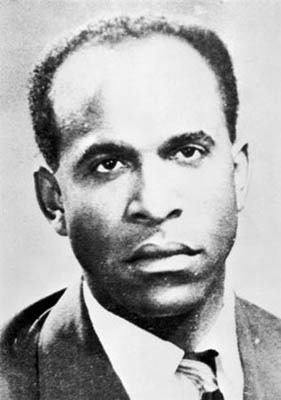

フランツ・オマー・ファノン
Frantz Omar Fanon, 1925-61
★フ ランツ・オマー・ファノン(/ˈfænən/,[1] 米国: /1925年7月20日 - 1961年12月6日)は、フランスの植民地マルティニーク(現在はフランスの県)出身のフランス語圏のアフロカリブ人、精神科医、政 治哲学者、マルクス主義者。知識人であると同時に、ファノンは植民地化の精神病理学と脱植民地化の人間的、社会的、文化的帰結 に関心を持つ政治的急進主義者、汎アフリカ主義者、マルクス主義的ヒューマニストでもあった。 医師、精神科医としての活動の過程で、ファノンはフランスからのアルジェリア独立戦争を支持し、アルジェリア民族解放戦線のメンバーであった。ファノンは 「同時代で最も影響力のある反植民地思想家」と評されている。50年以上もの間、ファノンの生涯と作品はパレスチナ、スリランカ、南アフリカ、ア メリカにおける民族解放運動やその他の自由運動、政治運動に影響を与えた。また、サン・アルバンでフランソワ・トスケルとジャ ン・オリーの下で働きながら、施設精神療法の分野の創設にも貢献した(→「ファノン年譜」)。
☆ウィキペディアにおけるフランツ・ファ ノンのエントリー項目

☆ファノンの社会理論
★ファノンと同時代人の医師2人の3人
| Frantz Omar Fanon Frantz Omar Fanon (/ˈfænən/,[2] US: /fæˈnɒ̃/;[3] French: [fʁɑ̃ts fanɔ̃]; 20 July 1925 – 6 December 1961) was a Franchophone Afro-Caribbean[4][5][6] psychiatrist, political philosopher, and Marxist from the French colony of Martinique (today a French department). His works have become influential in the fields of post-colonial studies, critical theory, and Marxism.[7] As well as being an intellectual, Fanon was a political radical, Pan-Africanist, and Marxist humanist concerned with the psychopathology of colonization[8] and the human, social, and cultural consequences of decolonization.[9][10][11] In the course of his work as a physician and psychiatrist, Fanon supported the Algerian War of independence from France and was a member of the Algerian National Liberation Front. Fanon has been described as "the most influential anticolonial thinker of his time".[12] For more than five decades, the life and works of Fanon have inspired national liberation movements and other freedom and political movements in Palestine, Sri Lanka, South Africa, and the United States.[13][14][15] He formulated a model for community psychology, believing that many mental health patients would do better if they were integrated into their family and community instead of being treated with institutionalized care. He also helped found the field of institutional psychotherapy while working at Saint-Alban under Francois Tosquelles and Jean Oury.[16] |
フランツ・オマール・ファノン フランツ・オマール・ファノン (/ˈfænən/,[2] 米国: /fæˈnɒ̃/;[3] フランス語: [fʁɑ̃ts fanɔ̃]; 1925年7月20日 – 1961年12月6日)は、フランス語圏のアフリカ系カリブ人[4][5][6]の精神科医、政治哲学者、マルクス主義者で、フランスの植民地だったマル ティニーク島(現在はフランスの県)出身。彼の著作は、ポストコロニアル研究、批判理論、マルクス主義の分野で大きな影響を与えている。[7] 知識人であるだけでなく、ファノンは政治的急進派、汎アフリカ主義者、マルクス主義的人道主義者であり、植民地化の精神病理学[8]および脱植民地化の人 間的、社会的、文化的影響に懸念を抱いていた。[9][10][11] 医師および精神科医としての活動の中で、ファノンはフランスからのアルジェリア独立戦争を支持し、アルジェリア民族解放戦線のメンバーでした。ファノンは 「その時代で最も影響力のある反植民地思想家」と評されています[12]。50 年以上にわたり、ファノンの生涯と著作は、パレスチナ、スリランカ、南アフリカ、米国における民族解放運動やその他の自由と政治の運動に影響を与えてきま した。[13][14][15] 彼は、多くの精神保健患者は、施設での治療を受けるよりも、家族やコミュニティに溶け込むほうがより良くなるだろうと信じ、コミュニティ心理学のモデルを 策定した。また、フランソワ・トスケルとジャン・ウーリーのもとでサン・アルバンで働いていた間、施設内心理療法の分野の確立にも貢献した。[16] |
| Francesc
Tosquelles (Reus, August 22, 1912 – Granges-sur-Lot, September
25, 1994), also known as François Tosquelles due to having lived in
France for many years, was a Catalan psychiatrist.[1] During the
Spanish Civil War, he fought on the Republican side for the Workers'
Party of Marxist Unification.[2] During World War II, he was the doctor
at the psychiatric hospital of Saint-Alban-sur-Limagnole, Lozère,
France. He is credited as one of the creators of institutional
psychotherapy, an influential movement in the second half of the 20th
century. His 1948 doctoral thesis for the University of Paris was
titled 'The Psychopathology of Lived Experience' - "Part gestalt
psychology, part phenomenology, part neurobiology, part psychoanalysis,
it revived the Hippocratic notion of the medic–philosopher – iatros
philosophos." After experiencing military occupations throughout his
lifetime (German in France, Spanish in Catalonia, Francoist in Spain,
and Stalinist in the Spanish communist parties), he concluded that
"occupation" was not simply a historical reality but created a psychic
structure in the individual, and that to achieve freedom, one must
proceed by "disoccupation". The Martinican doctor and later revolutionary activist Frantz Fanon was one of his students, who then used his techniques to some degree of success while living in Blida, Algeria, in the mid-1950s. |
フランセスク・トスケレス(Francesc
Tosquelles、1912年8月22日 -
1994年9月25日)は、フランスで長年暮らしたことからフランソワ・トスケレス(François
Tosquelles)としても知られる、カタルーニャ出身の精神科医だ。[1]
スペイン内戦では、マルクス主義統一労働者党(PUM)の共和派として戦った。[2]
第二次世界大戦中、彼はフランス・ロゼール県のサン=アルバン=シュル=リマニョールにある精神病院の医師を務めた。彼は、20世紀後半に大きな影響を与
えた「機関内心理療法」の創始者の一人として知られている。1948年にパリ大学で提出した博士論文のタイトルは『経験の精神病理学』で、「ゲシュタルト
心理学、現象学、神経生物学、精神分析を融合させたこの著作は、ヒポクラテスの『医者は哲学者である』という概念を復活させた」と評価されている。生涯に
わたって軍事占領を経験した(フランスでのドイツ占領、カタルーニャでのスペイン占領、スペインでのフランコ政権占領、スペイン共産党でのスターリン主義
占領)彼は、「占領」は単なる歴史的現実ではなく、個人に心理的構造を築くものだと結論付け、自由を達成するためには「占領からの解放」を進める必要があ
ると主張した。 マルティニーク出身の医師で後に革命活動家となったフランツ・ファノンは彼の弟子の一人で、1950年代半ばにアルジェリアのブリダで生活していた際、彼 の技法を一定程度の成功を収めて活用した。 |
| Jean Oury (5 March 1924 – 15 May 2014) was a French psychiatrist and psychoanalyst who helped found the school of institutional psychotherapy.[1][2] He was the founder and director of the psychiatric hospital La Borde clinic at Cour-Cheverny, France where he worked until he died. He was a member of the Freudian School of Paris, founded by Jacques Lacan from inception until its dissolution. His brother, Fernand Oury, founded the school of institutional pedagogy. | ジャン・ウリー(1924年3月5日 -
2014年5月15日)は、フランスの精神科医、精神分析医であり、制度精神療法の学派を創設した人物です。[1][2]
彼は、フランス・クール・シュヴェルニーにある精神病院「ラ・ボルドクリニック」の創設者であり、同病院の院長を務め、亡くなるまでそこで働きました。彼
は、ジャック・ラカンによって設立されたパリのフロイト学派の創設メンバーであり、その解散までメンバーとして活動しました。彼の兄、フェルナン・ウー
リーは、機関教育学派を設立した。 |
★ファノンリンク集
★ファノン生涯(英語ウィキペディア)
| Biography | バイオグラフィー |
| Early life Frantz Fanon was born on the Caribbean island of Martinique, which was then a French colony and is now a French single territorial collectivity. His father, Félix Casimir Fanon, was a descendant of African slaves, and worked as a customs agent. His mother, Eléanore Médélice, was of Afro-Martinican and white Alsatian descent, and worked as a shopkeeper.[16] Frantz was the third of four sons in a family of eight children. Two of them died young, including his sister Gabrielle, with whom Frantz was very close. His family was socio-economically middle-class. They could afford the fees for the Lycée Schoelcher, at the time the most prestigious high school in Martinique, where Fanon came to admire one of the school's teachers, poet and writer Aimé Césaire.[17] Fanon left Martinique in 1943, when he was 18 years old, in order to join the Free French forces.[18] |
生い立ち フランツ・ファノンはカリブ海に浮かぶマルティニーク島(当時はフランスの植民地、現在はフランスの単一領土)で生まれた。父はアフリカ人奴隷の子孫で、 税関職員として働いていた。母親のエレノア・メデリスはアフロ・マルティニカ人とアルザス系白人の血を引いており、商店主をしていた[16]。そのうちの 2人は若くして亡くなっており、そのうちの1人はフランツと非常に親しかった妹のガブリエルであった。彼の家庭は社会経済的には中流階級であった。当時、 マルティニークで最も権威のある高校であったリセ・ショエルシェの学費を払う余裕があり、ファノンは同校の教師の一人であった詩人で作家のエメ・セゼール を敬愛するようになる[17]。ファノンは1943年、18歳の時に自由フランス軍に参加するためにマルティニークを離れる[18]。 |
| Martinique and World War II After France fell to the Nazis in 1940, Vichy French naval troops were blockaded on Martinique. Forced to remain on the island, French sailors took over the government from the Martiniquan people and established a collaborationist Vichy regime. In the face of economic distress and isolation under the blockade, they instituted an oppressive regime; Fanon described them as taking off their masks and behaving like "authentic racists".[19] Residents made many complaints of harassment and sexual misconduct by the sailors. The abuse of the Martiniquan people by the French Navy influenced Fanon, reinforcing his feelings of alienation and his disgust with colonial racism. At the age of seventeen, Fanon fled the island as a "dissident" (a term used for Frenchmen joining Gaullist forces), traveling to Dominica to join the Free French Forces.[20]: 24 After three attempts, he made it to Dominica, but it was too late to enlist. After the pro-Vichy Robert regime was deposed in Martinique in June 1943, Fanon returned to Fort-de-France to join the newly created, all black 5e Bataillon de marche des Antilles [fr].[21] He enlisted in the Free French army and joined an Allied convoy that reached Casablanca. He was later transferred to an army base at Béjaïa on the Kabylia coast of Algeria. Fanon left Algeria from Oran and served in France, notably in the battles of Alsace. In 1944 he was wounded at Colmar and received the Croix de guerre.[22] When the Nazis were defeated and Allied forces crossed the Rhine into Germany along with photojournalists, Fanon's regiment was "bleached" of all non-white troops as Fanon and his fellow Afro-Caribbean soldiers were sent to Toulon (Provence).[13] Later, they were transferred to Normandy to await repatriation.[23] During the war, Fanon was exposed to more white European racism. For example, European women liberated by black soldiers often preferred to dance with fascist Italian prisoners, rather than fraternize with their liberators.[16] In 1945, Fanon returned to Martinique. He lasted a short time there. He worked for the parliamentary campaign of his friend and mentor Aimé Césaire, who would be a major influence in his life. Césaire ran on the communist ticket as a parliamentary delegate from Martinique to the first National Assembly of the Fourth Republic. Fanon stayed long enough to complete his baccalaureate and then went to France, where he studied medicine and psychiatry. |
マルティニークと第二次世界大戦 1940年にフランスがナチスに陥落した後、ヴィシー・フランス海軍はマルティニーク島を封鎖した。島に留まることを余儀なくされたフランスの船員たち は、マルティニーク人から政府を引き継ぎ、協力主義のヴィシー政権を樹立した。経済的困窮と封鎖下での孤立に直面し、彼らは抑圧的な体制を築いた。ファノ ンは彼らを、仮面を脱ぎ捨て「本物の人種差別主義者」のように振る舞ったと評した。フランス海軍によるマルティニカン人への虐待はファノンに影響を与え、 疎外感と植民地人種差別への嫌悪感を強めた。17歳のとき、ファノンは「反体制派」(ゴーリスム勢力に参加するフランス人を指す言葉)として島を脱出し、 自由フランス軍に参加するためにドミニカに向かった[20]: 24。3回の挑戦の末、ドミニカにたどり着いたが、入隊するには遅すぎた。1943年6月に親ヴィシー・ロベール政権がマルティニークで退陣すると、ファ ノンはフォール・ド・フランスに戻り、新たに創設された黒人だけの5e Bataillon de marche des Antilles [fr]に入隊した[21]。 彼は自由フランス軍に入隊し、カサブランカに到着した連合軍の輸送隊に加わった。その後、アルジェリアのカビリア海岸にあるベジャイアの陸軍基地に移され た。ファノンはオランからアルジェリアを離れ、フランスで特にアルザスの戦いに従軍した。1944年、コルマールで負傷し、クロワ・ド・ゲールを授与され た[22]。ナチスが敗北し、連合軍がフォトジャーナリストとともにライン川を越えてドイツに入ると、ファノンの連隊は白人以外の兵士を「漂白」され、 ファノンと仲間のアフロ・カリビアン兵はトゥーロン(プロヴァンス)に送られた[13]。 戦争中、ファノンはより多くのヨーロッパ白人の人種差別にさらされた。例えば、黒人兵士によって解放されたヨーロッパの女性たちは、解放者と友好的になる よりも、ファシストのイタリア人捕虜と踊ることを好むことが多かった[16]。 1945年、ファノンはマルティニークに戻った。ファノンがマルティニークに戻ったのは短い期間だった。彼は、彼の人生に大きな影響を与えることになる友 人であり師であるエメ・セゼールの国会議員選挙キャンペーンに参加した。セゼールはマルティニークから第四共和制の第一回国民議会に共産党員として立候補 した。ファノンはバカロレアを取得するのに十分な期間滞在し、その後フランスに渡り、医学と精神医学を学んだ。 |
| France Fanon was educated in Lyon, where he also studied literature, drama and philosophy, sometimes attending Merleau-Ponty's lectures. During this period, he wrote three plays, of which two survive.[24] After qualifying as a psychiatrist in 1951, Fanon did a residency in psychiatry at Saint-Alban-sur-Limagnole under the radical Catalan psychiatrist François Tosquelles, who invigorated Fanon's thinking by emphasizing the role of culture in psychopathology. In 1948 Fanon started a relationship with Michelle, a medical student, who soon became pregnant. He left her for an 18-year-old high school student, Josie, whom he married in 1952. At urging of his friends he later recognized his daughter, Mireille, although he did not have contact with her.[25] In France while completing his residency, Fanon wrote and published his first book, Black Skin, White Masks (1952), an analysis of the negative psychological effects of colonial subjugation upon black people. Originally, the manuscript was the doctoral dissertation, submitted at Lyon, entitled "Essay on the Disalienation of the Black", which was a response to the racism that Fanon experienced while studying psychiatry and medicine at university in Lyon; the rejection of the dissertation prompted Fanon to publish it as a book. For his doctor of philosophy degree, he submitted another dissertation of narrower scope and different subject. Left-wing philosopher Francis Jeanson, leader of the pro-Algerian independence Jeanson network, read Fanon's manuscript and as a senior book editor at Éditions du Seuil in Paris, gave the book its new title and wrote its epilogue.[26] After receiving Fanon's manuscript at Seuil, Jeanson invited him to an editorial meeting. Amid Jeanson's praise of the book, Fanon exclaimed: "Not bad for a nigger, is it?" Insulted, Jeanson dismissed Fanon from his office. Later, Jeanson learned that his response had earned him the writer's lifelong respect, and Fanon acceded to Jeanson's suggestion that the book be entitled Black Skin, White Masks.[26] In the book, Fanon described the unfair treatment of black people in France and how they were disapproved of by white people. Black people also had a sense of inferiority when facing white people. Fanon believed that even though they could speak French, they could not fully integrate into the life and environment of white people. (See further discussion of Black Skin, White Masks under Work, below.) |
フランス リヨンで教育を受けたファノンは、文学、演劇、哲学も学び、時にはメルロ=ポンティの講義にも出席した。1951年に精神科医の資格を得たファノンは、サ ン・アルバン・シュル・リマニョールの精神科で、急進的なカタルーニャ人精神科医フランソワ・トスケルのもとで研修医を務めた。 1948年、ファノンは医学生のミシェルと交際を始めたが、彼女はすぐに妊娠した。1952年に結婚した18歳の女子高生ジョシーと別れた。友人の勧めも あり、後に娘のミレーユを認知するが、彼女とは連絡を取っていなかった[25]。 ファノンはフランスで研修医をしながら、最初の著書『黒い肌、白い仮面』(1952年)を執筆、出版した。もともとは、リヨンの大学で精神医学と医学を学 んでいたファノンが経験した人種差別への反論として提出した「黒人の剥奪に関する試論」というタイトルの博士論文であった。哲学博士号を取得するために、 彼はより狭い範囲と異なるテーマの別の論文を提出した。左翼哲学者のフランシス・ジャンソン(親アルジェリア独立ジャンソンネットワークのリーダー)は ファノンの原稿を読み、パリのエディシオン・デュ・スイユの上級書籍編集者として、この本に新しいタイトルをつけ、エピローグを執筆した[26]。 スィユ社でファノンの原稿を受け取ったジャンソンは、彼を編集会議に招いた。ジャンソンがこの本を賞賛する中、ファノンはこう叫んだ: "黒人にしては悪くないだろう?"と。侮辱されたジャンソンはファノンをオフィスから追い出した。後日、ジャンソンは彼の返答が作家の生涯の尊敬を得たこ とを知り、ファノンはジャンソンの提案に応じ、本のタイトルを『黒い肌、白い仮面』とした[26]。 この本の中でファノンは、フランスにおける黒人の不当な扱いと、彼らがいかに白人から嫌われているかを述べた。黒人はまた、白人と対峙する際に劣等感を抱 いていた。ファノンは、たとえフランス語を話せても、白人の生活や環境に完全に溶け込むことはできないと考えた。(黒い肌、白い仮面』については、後述の 『仕事』の項を参照)。 |
| Algeria After his residency, Fanon practised psychiatry at Pontorson, near Mont Saint-Michel, for another year and then (from 1953) in Algeria. He was chef de service at the Blida-Joinville Psychiatric Hospital in Algeria. He worked there until his deportation in January 1957.[27] Fanon's methods of treatment started evolving, particularly by beginning socio-therapy to connect with his patients' cultural backgrounds. He also trained nurses and interns. Following the outbreak of the Algerian revolution in November 1954, Fanon joined the Front de Libération Nationale, after having made contact with Pierre Chaulet at Blida in 1955. Working at a French hospital in Algeria, Fanon became responsible for treating the psychological distress of the French soldiers and officers who carried out torture in order to suppress anti-colonial resistance. Additionally, Fanon was also responsible for treating Algerian torture victims. Fanon made extensive trips across Algeria, mainly in the Kabylia region, to study the cultural and psychological life of Algerians. His lost study of "The marabout of Si Slimane" is an example. These trips were also a means for clandestine activities, notably in his visits to the ski resort of Chrea which hid an FLN base. |
アルジェリア 研修医として働いた後、ファノンはモン・サン・ミッシェル近くのポントルソンでさらに1年間、そして(1953年から)アルジェリアで精神科医として働い た。アルジェリアのブリダ・ジョインヴィル精神病院でシェフを務めた。1957年1月の国外追放までそこで働いた[27]。 ファノンの治療方法は進化し始め、特に患者の文化的背景とつながるための社会療法を始めた。彼はまた、看護師やインターンを訓練した。1954年11月の アルジェリア革命勃発後、ファノンは1955年にブリダでピエール・ショーレと接触した後、国民解放戦線に参加した。アルジェリアのフランス人病院に勤務 していたファノンは、反植民地レジスタンスを弾圧するために拷問を行ったフランス軍兵士や将校の精神的苦痛の治療を担当するようになった。さらに、ファノ ンはアルジェリアの拷問被害者の治療も担当した。 ファノンは、アルジェリア人の文化的・心理的生活を研究するため、カビリア地方を中心にアルジェリア全土を旅した。失われた『シ・スリマンの放蕩者』の研 究はその一例である。こうした旅はまた、秘密活動の手段でもあり、特にFLNの拠点が隠されていたスキーリゾート、シュレアを訪れた。 |
| Joining the FLN and exile from
Algeria By summer 1956 Fanon realized that he could no longer continue to support French efforts, even indirectly via his hospital work. In November he submitted his "Letter of resignation to the Resident Minister", which later became an influential text of its own in anti-colonialist circles.[28] There comes a time when silence becomes dishonesty. The ruling intentions of personal existence are not in accord with the permanent assaults on the most commonplace values. For many months my conscience has been the seat of unpardonable debates. And the conclusion is the determination not to despair of man, in other words, of myself. The decision I have reached is that I cannot continue to bear a responsibility at no matter what cost, on the false pretext that there is nothing else to be done. Shortly afterwards, Fanon was expelled from Algeria and moved to Tunis where he joined the FLN openly. He was part of the editorial collective of Al Moudjahid, for which he wrote until the end of his life. He also served as Ambassador to Ghana for the Provisional Algerian Government (GPRA). He attended conferences in Accra, Conakry, Addis Ababa, Leopoldville, Cairo and Tripoli. Many of his shorter writings from this period were collected posthumously in the book Toward the African Revolution. In this book Fanon reveals war tactical strategies; in one chapter he discusses how to open a southern front to the war and how to run the supply lines.[27] Upon his return to Tunis, after his exhausting trip across the Sahara to open a Third Front, Fanon was diagnosed with leukemia. He went to the Soviet Union for treatment and experienced some remission of his illness. When he came back to Tunis once again, he dictated his testament The Wretched of the Earth. When he was not confined to his bed, he delivered lectures to Armée de Libération Nationale (ALN) officers at Ghardimao on the Algerian–Tunisian border. He traveled to Rome for a three-day meeting with Jean-Paul Sartre who had greatly influenced his work. Sartre agreed to write a preface to Fanon's last book, The Wretched of the Earth.[29] |
FLNへの参加とアルジェリアからの亡命 1956年夏までにファノンは、病院勤務を通じて間接的にでもフランスの活動を支援し続けることはもはやできないと悟った。11月、彼は「駐在大臣への辞 表」を提出したが、この辞表は後に反植民地主義界で影響力のある文章となった[28]。 沈黙が不誠実となる時が来る。個人的存在の支配的意図は、最もありふれた価値観に対する恒常的な攻撃とは一致しない。何カ月もの間、私の良心は許されざる 議論の場であった。そしてその結論は、人間、言い換えれば自分自身に絶望しないという決意であった。私が下した決断は、他になすすべがないという偽りの口 実で、どんな代償を払っても責任を負い続けることはできないということである。 その直後、ファノンはアルジェリアから追放され、チュニスに移り、FLNに公然と参加した。アル・ムジャヒド』誌の編集に参加し、同誌で生涯を終えるまで 執筆を続けた。アルジェリア臨時政府(GPRA)の駐ガーナ大使も務めた。アクラ、コナクリ、アディスアベバ、レオポルドヴィル、カイロ、トリポリでの会 議に出席。この時期の短い著作の多くは、死後に『アフリカ革命に向けて』という本にまとめられた。この本の中でファノンは戦争の戦術的戦略を明らかにして おり、ある章では戦争の南方戦線をどのように切り開くか、補給線をどのように運営するかについて論じている[27]。 第三戦線を開くためにサハラ砂漠を横断する疲弊した旅を終えてチュニスに戻ると、ファノンは白血病と診断された。彼は治療のためにソ連に行き、病気の寛解 を経験した。再びチュニスに戻ると、『地の哀れ』を書き上げた。寝たきりでないときは、アルジェリアとチュニジアの国境にあるガルディマオで、国民解放軍 (ALN)の将校たちに講義を行った。ローマに行き、彼の仕事に多大な影響を与えたジャン=ポール・サルトルと3日間会談。サルトルは、ファノンの遺作 『The Wretched of the Earth』に序文を書くことに同意した[29]。 |
| Death and aftermath With his health declining, Fanon's comrades urged him to seek treatment in the U.S. as his Soviet doctors had suggested.[30] In 1961, the CIA arranged a trip under the promise of stealth for further leukemia treatment at a National Institutes of Health facility.[30][31] During his time in the United States, Fanon was handled by CIA agent Oliver Iselin.[32] As Lewis R. Gordon points out, the circumstances of Fanon's stay are somewhat disputed: "What has become orthodoxy, however, is that he was kept in a hotel without treatment for several days until he contracted pneumonia."[30] Fanon subsequently died from double pneumonia in Bethesda, Maryland, on 6 December 1961 after finally having begun his leukemia treatment.[33] He had been admitted under the name of Ibrahim Omar Fanon, a Libyan nom de guerre he had assumed in order to enter a hospital in Rome after being wounded in Morocco during a mission for the Algerian National Liberation Front.[34] He was buried in Algeria after lying in state in Tunisia. Later, his body was moved to a martyrs' (Chouhada) graveyard at Aïn Kerma in eastern Algeria. |
死とその後 健康状態が悪化する中、ファノンの同志たちは、ソ連の医師たちが提案したように、アメリカで治療を受けるよう促した[30]。 1961年、CIAは、国立衛生研究所(National Institutes of Health)の施設で白血病の治療を受けるため、極秘裏に渡航を手配した[30][31]。 アメリカ滞在中、ファノンはCIA諜報員のオリヴァー・イゼリンに扱われた[32]。ルイス・R・ゴードンが指摘するように、ファノンの滞在の経緯にはや や異論がある: 「しかし、正統派となっているのは、彼が肺炎に罹患するまで数日間、治療も受けずにホテルに監禁されていたということである」[30]。 ファノンはその後、ようやく白血病の治療を開始した後、1961年12月6日にメリーランド州ベセスダで二重の肺炎により死亡した[33]。彼はイブラヒ ム・オマール・ファノンという名で入院していたが、これはアルジェリア民族解放戦線の任務中にモロッコで負傷した後、ローマの病院に入るために名乗ったリ ビア人の名であった[34]。その後、遺体はアルジェリア東部のアイン・ケルマにある殉教者の墓地に移された。 |
★ファノン著作関連
 Fanon's final resting place in Aïn Kerma, Algeria Fanon's grave in Aïn Kerma, Algeria |
アルジェリアのアイン・ケルマにあるファノンの終焉の地 アルジェリアのアイン・ケルマにあるファノンの墓 |
| Wikispore has a related page:
Bio:Josie Fanon Frantz Fanon was survived by his French wife, Josie (née Dublé), their son, Olivier Fanon, and his daughter from a previous relationship, Mireille Fanon-Mendès France. Josie Fanon later became disillusioned with the government and after years of depression and drinking died by suicide in Algiers in 1989.[27][35] Mireille became a professor of international law and conflict resolution and serves as president of the Frantz Fanon Foundation. Olivier became president of the Frantz Fanon National Association, which was created in Algiers in 2012.[36] |
ウィキスポアに関連ページあり:
バイオグラフィー:ジョジー・ファノン フランツ・ファノンには、フランス人の妻ジョシー(旧姓デュブレ)、息子のオリヴィエ・ファノン、以前交際していた娘ミレイユ・ファノン=メンデス=フラ ンスがいる。ミレイユは国際法と紛争解決の教授となり、フランツ・ファノン財団の会長を務める。オリヴィエは、2012年にアルジェで創設されたフラン ツ・ファノン全国協会の会長となった[36]。 |
| Work Black Skin, White Masks Black Skin, White Masks was first published in French as Peau noire, masques blancs in 1952 and is one of Fanon's most important works. In Black Skin, White Masks, Fanon psychoanalyzes the oppressed Black person who is perceived to have to be a lesser creature in the White world that they live in, and studies how they navigate the world through a performance of Whiteness.[16] Particularly in discussing language, he talks about how the black person's use of a colonizer's language is seen by the colonizer as predatory, and not transformative, which in turn may create insecurity in the black's consciousness.[37] He recounts that he himself faced many admonitions as a child for using Creole French instead of "real French", or "French French", that is, "white" French.[16] Ultimately, he concludes that "mastery of language [of the white/colonizer] for the sake of recognition as white reflects a dependency that subordinates the black's humanity".[37] The reception of his work has been affected by English translations which are recognized to contain numerous omissions and errors, while his unpublished work, including his doctoral thesis, has received little attention. As a result, it has been argued Fanon has often been portrayed as an advocate of violence (it would be more accurate to characterize him as a dialectical opponent of nonviolence) and that his ideas have been extremely oversimplified. This reductionist vision of Fanon's work ignores the subtlety of his understanding of the colonial system. For example, the fifth chapter of Black Skin, White Masks translates, literally, as "The Lived Experience of the Black" ("L'expérience vécue du Noir"), but Markmann's translation is "The Fact of Blackness", which leaves out the massive influence of phenomenology on Fanon's early work.[38] |
著作 黒い肌、白い仮面 『黒い肌、白い仮面』は、1952年に『Peau noire, masques blancs』としてフランス語で出版されたファノンの最も重要な作品のひとつである。黒い肌、白い仮面』の中でファノンは、抑圧された黒人が、自分たち の住む白人の世界では劣った生き物でなければならないと認識されることを精神分析し、彼らが白人性のパフォーマンスを通してどのように世界をナビゲートす るかを研究している。 [最終的に彼は、「白人として認識されるための(白人/植民者の)言語の習得は、黒人の人間性を従属させる依存を反映している」と結論付けている [37]。 博士論文を含む彼の未発表の著作はほとんど注目されていない一方で、彼の著作の受容は、多くの脱落や誤りを含むと認識されている英訳によって影響を受けて いる。その結果、ファノンはしばしば暴力の擁護者として描かれ(非暴力の弁証法的反対者というのがより正確だろう)、彼の思想は極端に単純化されすぎてい ると論じられてきた。ファノンの著作に対するこのような還元主義的な見方は、植民地体制に対する彼の理解の繊細さを無視している。例えば、『黒い肌、白い 仮面』の第5章は、文字どおり「黒人の生きた経験」("L'expérience vécue du Noir")と訳されているが、マークマンの訳は「黒人の事実」であり、ファノンの初期の仕事に現象学が与えた多大な影響を省いている[38]。 |
| "The Negro and Language" Chapter 1 of Black Skin, White Masks is entitled "The Negro and Language".[39] In this chapter, Fanon discusses how colored people were perceived by the whites. He says that the black man has two dimensions: One with his fellows, the other with the white man. A Negro behaves differently with a white man than with another Negro. Fanon claimed that whether this self-division is a direct result of colonialist subjugation is beyond question. To speak a language is to take on a world, a culture. The Antilles Negro who wants to be white will be the whiter as he gains greater mastery of the cultural tool that language is. Fanon concludes his theorizing by saying: "Historically, it must be understood that the Negro wants to speak French because it is the key that can open doors which were still barred to him fifty years ago. In the Antilles Negro who comes within this study we find a quest for subtleties, for refinements of language—so many further means of proving to himself that he has measured up to the culture." |
黒人(ニグロ)と言語 『黒 い肌、白い仮面』の第1章のタイトルは「黒人と言語」である。彼は、黒人には二つの次元があると言う: ひとつは仲間との関係、もうひとつは白人との関係である。黒人は白人と接するときと、他の黒人と接するときとでは、異なる行動をとる。ファノンは、この自 己分裂が植民地支配の直接的な結果であるかどうかは疑問の余地がないと主張する。ある言語を話すことは、ある世界、ある文化を引き受けることである。白人 になりたいと願うアンティル黒人は、言語という文化的道具をより使いこなすことで、より白くなる。ファノンは理論化の最後をこう締めくくっている: 「歴史的に見れば、黒人がフランス語を話したいと思うのは、それが50年前にはまだ閉ざされていた扉を開く鍵だからである。この研究の対象であるアンティ ル黒人の中には、繊細さや洗練された言語への探求が見られる。 |
| "The Woman of Color and the
White Man" Chapter 2 of Black Skin, White Masks is entitled “The woman of color and the white man”.[39] The focus of the chapter is on the extent to which authentic love between women of color and European males is hindered by unconscious tensions. It discusses how a feeling of inferiority has manifested in women of color because of colonialism. Fanon introduces the reader to the cases of two women from novels, Mayotte Capécia's semi-autobiographical I Am a Martinican Woman (1948) and Abdoulaye Sadji's Nini, mulâtresse du Sénégal (1954). Mayotte Capécia is a black woman who Fanon claims has idealized whiteness. She wants above all to be with a white man, and strives to be as close to communities of white people as possible. Fanon also discusses how mulatto women see themselves as superior to black men. This is the case with the black man Mactar´s love letter to Nini (a mulatto woman), where he acknowledges his inferiority as a black man, but argues that his devotion to her is reason enough to choose him. The idealization of whiteness both in white people and people of color is discussed. |
「有色の女と白人の男」 『黒 い肌、白い仮面』の第2章は「有色人種の女性と白人男性」と題されている[39]。この章の焦点は、有色人種の女性とヨーロッパ人男性との間の本物の愛 が、無意識の緊張によってどの程度妨げられているかにある。植民地主義のせいで、有色人種の女性にどのような劣等感が現れているかを論じている。ファノン は、マヨット・カペシアの半自伝的作品『私はマルティニカの女』(1948年)と、アブドゥライェ・サジの『セネガルの女、ニニ』(1954年)という小 説から、二人の女性のケースを読者に紹介する。マヨット・カペシアは、ファノンが白人性を理想化したと主張する黒人女性である。彼女は何よりも白人男性と 一緒になることを望み、白人の共同体にできるだけ近づこうと努力する。ファノンはまた、混血の女性が黒人男性よりも自分たちの方が優れていると考えている ことについても論じている。黒人男性マクターがニニ(混血女性)に宛てたラブレターがそうで、彼は黒人男性としての劣等感を認めながらも、彼女への献身は 自分を選ぶ十分な理由になると主張している。白人と有色人種の両方における白人の理想化について論じている。 |
| "The Man of Color and the White
Woman" Chapter 3 of Black Skin, White Masks is entitled “The man of color and the white woman”.[39] In this chapter Fanon discusses the desire of the black man to be white. Firstly by telling the story of the Antillean man who upon arrival has one goal: to sleep with a white woman. For the black man, an unconscious need to prove that their worth is similar to the white man is fulfilled through sexual interaction with the white woman. Fanon then analyzes the story of Jean Veneuse written by René Maran, a work believed to be autobiographic. Jean Veneuse is a black man from the Antilles living in Bourdeaux. He is a part of the social and cultural elite and falls in love with a white woman. He is aware of the stereotype of the black man´s desire to sleep with a white woman and is therefore hesitant to become one of them thereby confirming the stereotype. Fanon goes on to explore the psychodynamics of Venuese´s personality type – the negative-aggressive abandonment-neurotic, and what role his personality type has in his romantic interactions. The negative-aggressive abandonment-neurotic displays a “fear of showing oneself as one actually is” resulting from a doubt that one can be loved as one is, as they had experiences of abandonment in childhood. Towards the end of the chapter, Fanon emphasizes the lack of generalizability for the findings on Jean Veneuse to the experiences of all black men in France, as the course of his development to a great extent is also part of his personality type. As Fanon writes “… we would like to think that we have discouraged any attempt to connect the failure of Jean Veneuse to the amount of melanin in his epidermis.” |
「有色の男と白人の女」 『黒 い肌、白い仮面』の第3章は「有色人種の男と白い女」と題されている。まず、アンティル諸島に到着したときに、白人女性と寝るという一つの目標を持ったア ンティル諸島の男性の話をする。黒人にとって、自分の価値が白人と同じであることを証明したいという無意識の欲求は、白人女性との性的交流によって満たさ れる。続いてファノンは、ルネ・マランが書いた自伝的作品とされる『ジャン・ヴェヌーズ』の物語を分析する。ジャン・ヴェヌーズはブルドーに住むアンティ ル諸島出身の黒人男性である。彼は社会的、文化的エリートの一員であり、白人女性と恋に落ちる。彼は、黒人は白人女性と寝たがるというステレオタイプに気 づいており、そのため黒人の仲間になることをためらい、ステレオタイプを確認する。ファノンはさらに、ヴェヌースの性格タイプ(否定的-攻撃的放棄-神経 症)の心理力学を探求し、彼の性格タイプが恋愛関係においてどのような役割を果たすかを考察する。否定的攻撃的放棄神経症の人は、幼少期に見捨てられた経 験があるため、ありのままの自分を愛せるのかという疑念から、「ありのままの自分を見せることへの恐れ」を示す。この章の終わりでファノンは、ジャン・ ヴェヌーズに関する発見が、フランスにおけるすべての黒人男性の経験に一般化できるわけではないことを強調している。ファノンが書いているように、 「......我々は、ジャン・ヴェヌーズの失敗を表皮のメラニンの量と結びつけるいかなる試みも思いとどまらせたと思いたい」。 |
| "The So-Called Dependency
Complex of the Colonized" Chapter 4 of Black Skin, White Masks is entitled “The So-Called Dependency Complex of the Colonized”.[39] The chapter envelopes Fanon´s critique of Octave Mannoni's book “Prospero and Caliban: The Psychology of Colonization”. Mannoni launches a theory that the colonized Malagasies suffer from an inferiority complex which further leads to a dependency complex. Fanon criticizes the implication that this inferiority complex is innate in the colonized, and argues for the effect of human attitudes. He sees this complex as an effect of interactions in the colony: “The feelings of inferiority in the colonized are correlative to the feelings of superiority in the European… Let´s have the courage to say it upright. It is the racist who creates his inferior”, he writes. Mannoni is further criticized for not considering the Malagasies´ agency and ability to choose action for their own independence. |
「被
植民者のいわゆる依存コンプレックス」 『黒い肌、白い仮面』の第4 章は「被植民者のいわゆる依存コンプレックス」と題されている: 植民地化の心理学』である。マンノニ(マノーニ)は、植民地化されたマラガ人は劣等コンプレックスに苦しみ、それがさらに依存コンプレックスにつながると いう説を展開している。ファノンは、この劣等コンプレックスが植民地化された人々に生まれつき備わっているという含意を批判し、人間の態度の影響を主張す る。彼はこのコンプレックスを植民地での相互作用の影響と見ている: 「被植民者の劣等感は、ヨーロッパ人の優越感と相関している。劣等感を作り出しているのは人種差別主義者なのだ」と書いている。マンノーニはさらに、マラ ガ人の主体性や自立のための行動を選択する能力を考慮していないと批判している。 |
| "The Fact of Blackness" Chapter 5 of Black Skin, White Masks is entitled "The Fact of Blackness".[39] In this chapter, Fanon tackles many theories. One theory he addresses is the different schemas that are said to exist within a person, and how they exist differently for Black people. He talks about one's "bodily schema" (83), and theorizes that because of both the "historical-racial schema" (84),-- one that exists because of the history of racism and makes it so there is no one bodily-schema because of the context that comes with Blackness—and one's "epidermal-racial schema" (84), -- where Black people cannot be seen for their single bodily-schema because they are seen to represent their race and the history and therefore cannot be seen past their flesh—there is no universal Black schema. He describes this experience as "no longer a question of being aware of my body in the third person but in a triple person." Fanon concludes this theorizing by saying: "As long as the black man is among his own, he will have no occasion, except in minor internal conflicts, to experience his being through others." Fanon also addresses Ontology, stating that it "—does not permit us to understand the being of the black man" (82). He says that because Blackness was created in, and continues to exist in, negation to whiteness, that ontology is not a philosophy that can be used to understand the Black experience. Fanon states that this ontology can't be used to understand the Black experience because it ignores the "lived experience". He argues that a black man has to be black, while also being black in relation to the white man. (90) |
「ブラックネスの事実」 『黒 い肌、白い仮面』の第5章のタイトルは「黒さの事実」である。彼が取り上げた理論の一つは、人の中に存在すると言われるさまざまなスキーマであり、それが 黒人にとってどのように異なる存在であるかということである。彼は人の「身体的スキーマ」(83)について語り、「歴史的-人種的スキーマ」(84)-- 人種差別の歴史のために存在し、黒人に付随する文脈のために一つの身体的スキーマが存在しないようにするもの--と人の「表皮的-人種的スキーマ」 (84)--の両方があるためだと理論化している、 -- 黒人はその人種と歴史を象徴していると見なされるため、その単一の身体的スキーマを見ることができず、その肉体を超えて見ることはできない。彼はこの経験 を、「もはや自分の身体を三人称で意識するのではなく、三人称で意識することが問題なのだ」と表現している。ファノンはこの理論化をこう結んでいる: 「黒人が自分自身の中にいる限り、些細な内的葛藤を除いて、他者を通して自分の存在を経験する機会はない。 ファノンはまた、存在論を取り上げ、「黒人の存在を理解することはでき ない」(82)と述べている。黒人は白人性に対して否定される中で生まれ、否定される中で存在し続けているのだから、存在論は黒人の経験を理解するために 使える哲学ではないと言うのである。ファノンは、この存在論は「生きた経験」を無視しているため、黒人の経験を理解するためには使えないと述べる。彼は、 黒人は黒人であると同時に、白人との関係においても黒人でなければならないと主張する。 |
| "The Negro and Psychopathology" Chapter 6 of Black Skin, White Masks is entitled "The Negro and Psychopathology".[39] In this chapter, Fanon discussed how being Black can and does affect one's psyche. He makes it clear that the treatment of Black people causes emotional trauma. Fanon argues that as a result of one's skin color being Black, Black people are unable to truly process this trauma or "make it unconscious" (466). Black people are unable to not think about the fact that they are Black and all of the historical and current stigma that come with that. Fanon's work in this chapter specifically shows the short-comings of major names in psychology such as Sigmund Freud. However, Fanon repeatedly mentions the importance of Jacques Lacan's theory of language.[40] Fanon discusses the mental health of Black people to show that "traditional" psychology was created and founded without thinking about Black people and their experiences. Although Fanon wrote Black Skin, White Masks while still in France, most of his work was written in North Africa. It was during this time that he produced works such as L'An Cinq, de la Révolution Algérienne in 1959 (Year Five of the Algerian Revolution), later republished as Sociology of a Revolution and later still as A Dying Colonialism. Fanon's original title was "Reality of a Nation"; however the publisher, François Maspero, refused to accept this title. Fanon is best known for the classic analysis of colonialism and decolonization, The Wretched of the Earth.[41] The Wretched of the Earth was first published in 1961 by Éditions Maspero, with a preface by Jean-Paul Sartre.[42] In it Fanon analyzes the role of class, race, national culture and violence in the struggle for national liberation. The book includes an article which focuses on the ideas of violence and decolonization. He claims that decolonization is inherently a violent process, because the relationship between the settler and the native is a binary of opposites. In fact, he uses the Biblical metaphor, "The last shall be first, and the first, last", to describe the moment of decolonization. The situation of settler colonialism creates within the native a tension which grows over time and in many ways is fostered by the settler. This tension is initially released among the natives, but eventually it becomes a catalyst for violence against the settler. His work would become an academic and theoretical foundation for many revolutions.[43] Fanon uses the Jewish people to explain how the prejudice expressed towards blacks can not be generalized to other races or ethnicities. He discusses this in Black Skin, White Masks, and pulls from Jean-Paul Sartre's Reflections on the Jewish Question to inform his understanding of French colonialism's relationship with the Jewish people and how it can be compared and contrasted with the oppressions of Blacks across the world. In his seminal book, Fanon issues many rebuttals to Octave Mannoni's Prospero and Caliban: The Psychology of Colonization. Mannoni asserts that "colonial exploitation is not the same as other forms of exploitation, and colonial racialism is different from other kinds of racialism." Fanon responds by arguing that racism or anti-Semitism, colonial or otherwise, are not different because they rip away a person's ability to feel human. He says: "I am deprived of the possibility of being a man. I cannot disassociate myself from the future that is proposed for my brother. Every one of my acts commits me as a man. Every one of my silences, every one of my cowardices reveals me as a man." In this same vein, Fanon echoes the philosophies of Maryse Choisy, who believed that remaining neutral in times of great injustice implied unforgivable complicity. Specifically, Fanon mentions the ravages of racism and anti-Semitism because he believes that those who are one are necessarily the other as well. Yet he is careful to distinguish between the causes of the two. Fanon argues that the reasons for hating "The Jew" are born from a different fear than those for hating Blacks. Bigots are scared of Jews because they are threatened by what the Jew represents. The many tropes and stereotypes of Jewish cruelty, laziness, and cunning are the antithesis of the Western work ethic. The Black man is feared for perhaps similar traits, but the impetus is different. Essentially, "The Jew" is simply an idea, but Blacks are feared for their physical attributes. Jewishness is not easily detectable to the naked eye, but race is.[44] Both books established Fanon in the eyes of much of the Third World as the leading anti-colonial thinker of the 20th century. Fanon's three books were supplemented by numerous psychiatry articles as well as radical critiques of French colonialism in journals such as Esprit and El Moudjahid. The reception of his work has been affected by English translations which are recognized to contain numerous omissions and errors, while his unpublished work, including his doctoral thesis, has received little attention. As a result, it has been argued Fanon has often been portrayed as an advocate of violence (it would be more accurate to characterize him as a dialectical opponent of nonviolence) and that his ideas have been extremely oversimplified. This reductionist vision of Fanon's work ignores the subtlety of his understanding of the colonial system. For example, the fifth chapter of Black Skin, White Masks translates, literally, as "The Lived Experience of the Black" ("L'expérience vécue du Noir"), but Markmann's translation is "The Fact of Blackness", which leaves out the massive influence of phenomenology on Fanon's early work.[45] |
「ニグロと精神病理学」 『黒 い肌、白い仮面』の第6章は「黒人と精神病理学」と題されている[39] 。彼は黒人の扱いが感情的なトラウマを引き起こすことを明らかにしている。ファノンは、肌の色が黒人であることの結果として、黒人はこのトラウマを真に処 理することができない、あるいは「無意識にする」ことができないと論じている(466)。黒人は、自分が黒人であるという事実と、それに伴う歴史的・現在 のスティグマについて考えないことができないのだ。この章におけるファノンの仕事は、ジークムント・フロイトのような心理学の主要人物の欠点を具体的に示 している。しかし、ファノンはジャック・ラカンの言語理論の重要性に繰り返し言及している。ファノンは黒人の精神衛生について論じ、「伝統的な」心理学が 黒人とその経験について考えることなく創造され、創設されたことを示す。 ファノンはフランス滞在中に『黒い肌、白い仮面』を執筆したが、作品の大半は北アフリカで書かれた。1959年の『アルジェリア革命の5年目』(L'An Cinq, de la Révolution Algérienne)、後に『革命の社会学』(Sociology of a Revolution)、さらに後に『滅びゆく植民地主義』(A Dying Colonialism)として再出版された『アルジェリア革命の5年目』(L'An Cinq, de la Révolution Algérienne)などはこの時期の作品である。ファノンの原題は "Reality of a Nation "であったが、出版社のフランソワ・マスペロはこのタイトルを拒否した。 ファノンは植民地主義と脱植民地化に関する古典的な分析書『大地に呪われたること/人』(The Wretched of the Earth)で最もよく知られている[41]。『大地に呪われた人』はジャン=ポール・サルトルの序文付きで1961年にマスペロ出版社から刊行された。 この本には、暴力と脱植民地化の考え方に焦点を当てた論文が含まれている。彼は、入 植者と先住民の関係は対立の二項対立であるため、脱植民地化は本質的に 暴力的なプロセスであると主張する。実際、彼は聖書の比喩「最後の者が最初になり、最初の者が最後になる」を使って、脱植民地化の瞬間を表 現している。入 植者の植民地主義という状況は、先住民の中に緊張を生み、それは時とともに高まり、多くの点で入植者によって助長される。この緊張は、最初は先住民の間で 解放されるが、やがて入植者に対する暴力のきっかけとなる。彼の研究は、多くの革命の学問的・理論的基礎となった[43]。 ファノンはユダヤ人を使って、黒人に対する偏見が他の人種や民族に一般化できないことを説明している。彼は『黒い肌、白い仮面』の中でこのことを論じ、 ジャン=ポール・サルトルの『ユダヤ人問題についての考察』から、フランスの植民地主義とユダヤ人との関係、そしてそれが世界中の黒人に対する抑圧とどの ように比較対照されうるかについて理解を深めている。その代表的な著書の中で、ファノンはオクターヴ・マンノーニの『プロスペロとカリバン』に対して多く の反論を展開している: 植民地化の心理学』である。マンノニは、"植民地搾取は他の形態の搾取と同じではなく、植民地人種主義は他の種類の人種主義とは異なる "と主張する。ファノンは、人種差別や反ユダヤ主義は、植民地であろうとなかろうと、人間が人間であると感じる能力を奪うものであり、異なるものではない と反論する。私は人間である可能性を奪われている。私は、兄のために提案された未来から自分を切り離すことはできない。私の行為のひとつひとつが、私を人 間として裁いている。私の沈黙のひとつひとつが、私の臆病さのひとつひとつが、私を人間として明らかにしているのだ」。この同じ流れの中で、ファノンは、 大きな不正義の時代に中立を保つことは許されざる加担を意味すると考えていたマリーズ・ショワジーの哲学に共鳴している。具体的には、ファノンは人種差別 と反ユダヤ主義の弊害について言及している。しかし、彼はこの2つの原因を区別することに注意を払っている。ファノンは、「ユダヤ人」を憎む理由は、黒人 を憎む理由とは異なる恐怖から生まれると主張する。偏屈者がユダヤ人を恐れるのは、ユダヤ人が象徴するものに脅かされているからである。ユダヤ人の残酷 さ、怠惰さ、狡猾さといった多くの典型やステレオタイプは、西洋の労働倫理に対するアンチテーゼである。黒人が恐れられているのは、おそらく似たような特 徴によるものだろうが、きっかけは異なる。基本的に、"ユダヤ人 "は単なる観念であるが、黒人はその身体的特徴によって恐れられている。ユダヤ人であることは肉眼では容易に見分けられないが、人種は見分けられる。 この2冊の著書によって、ファノンは20世紀を代表する反植民地思想家として、第三世界の多くの人々の目にその地位を確立した。 ファノンの3冊の著書は、『エスプリ』や『エル・ムジャヒド』といった雑誌に掲載された数多くの精神医学論文やフランスの植民地主義に対する急進的な批評 によって補完された。 その一方で、博士論文を含む未発表の著作はほとんど注目されていない。その結果、ファノンはしばしば暴力の擁護者として描かれ(非暴力の弁証法的反対者と いうのがより正確だろう)、彼の思想は極端に単純化されすぎていると論じられてきた。ファノンの著作に対するこのような還元主義的な見方は、植民地体制に 対する彼の理解の繊細さを無視している。例えば、『黒い肌、白い仮面』の第5章は、文字どおり「黒人の生きた経験」("L'expérience vécue du Noir")と訳されているが、マークマンの訳は「黒人の事実」であり、ファノンの初期の仕事に現象学が与えた多大な影響を省いている。 |
| Fanon and the Lived Experiences
of the Black Subject. In Frantz Fanon’s first book, Black Skin, White Masks, he tasks himself with exploring the experiences of the black subject. Fanon does not look at the lived experiences in the ordinary sense of the term, but rather considers a domain of experience that is rooted in the context of the world the experience takes place in.[46] The Lived experiences of the black person is the profound sense of feeling and living through the social conditions that define a particular time and place.[47] Fanon navigates the lived experiences of the black subject by drawing inspiration from psychoanalysis, literary texts, medical terminology, philosophy, negritude, and political consciousness.[46] Fanon placed emphasis on the concepts of Political Consciousness and Negritude in the navigation of the experiences of black subjects. Political Consciousness is the way in which one is crucially a part of the world and its conditions, and how one should attempt to change the world through carefully considered political projects.[46] Political consciousness thus includes a careful consideration of facticity. These include the concrete factors that define your situation in the world, such as the actual physical environment in which you live, the place and time of birth, class membership, nationality, gender, and race, which cannot be transcended.[47] Fanon used the concept of political consciousness to show that the field of psychological phenomena, and the experiences of the black individual, always deserve a political level of analysis.[46] Negritude is both the celebration of black culture and forms of expression, as well as a resistance to the politics of assimilation.[48][46] Fanon is aware that the colonised individual accepts art of their white -scripted history and in some ways actively participate in it.[48] However, he rejects the idea that human freedom and the capacity for resistance are extinguished in structurally oppressive social circumstances, such as those in which the colonized and enslaved people lived. Fanon recognises Negritudes positive reinvention of “blackness” as social reality, constructed by the oppressed for specific socio-political, emancipatory, and therapeutic aims.[48] In Black Skin, White Masks, Fanon echoes the concepts of Political Consciousness and Negritude by recounting the experiences of the colonised individual. The entirety of the book is a recounting of the lived experiences of a black subject. In the book Fanon places importance on the freedom and agency that the black subject maintains.[48] |
ファノンと黒人主体の生きた経験。 フランツ・ファノンの最初の著書『黒い肌、白い仮面』において、彼は黒人主体の経験を探求することを自らに課している。ファノンは普通の意味での生きた経 験を見るのではなく、その経験が起こる世界の文脈に根ざした経験の領域を考察している[46]。黒人の生きた経験とは、特定の時代と場所を規定する社会的 条件を通して感じ、生きることの深い感覚である。 [ファノンは精神分析、文学テクスト、医学用語、哲学、ネグリチュード、政治的意識からインスピレーションを得ることによって、黒人主体の生きた経験をナ ビゲートしている。 政治的意識とは、自分が世界とその状況の決定的に一部であり、注意深く考慮された政治的プロジェクトを通じて世界をどのように変えようとすべきかという方 法である。政治的意識はこのように、事実性を注意深く考慮することを含む。これらには、自分が住んでいる実際の物理的環境、生まれた場所と時間、階級への 所属、国籍、ジェンダー、人種といった、超越することのできない、世界における自分の状況を規定する具体的な要因が含まれる[47]。ファノンは政治的意 識という概念を用いて、心理現象の分野、黒人個人の経験が常に政治的なレベルの分析に値することを示した[46]。 ファノンは、植民地化された個人は、白人に規定された歴史の芸術を受け入れ、ある意味では積極的にそれに参加していることを認識している[48] [46]。しかし彼は、植民地化され奴隷化された人々が生きていたような構造的に抑圧的な社会状況において、人間の自由と抵抗の能力が消滅するという考え を否定している。ファノンは、特定の社会政治的、解放的、治療的な目的のために被抑圧者によって構築された社会的現実としての「黒人性」のネグリトゥード による肯定的な再発明を認めている[48]。 『黒い肌、白い仮面』の中でファノンは、植民地化された個人の経験を語ることで、政治的意識とネグリチュードの概念と呼応している。この本の全体が、黒人 主体の生きた経験の再現である。ファノンはこの本の中で、黒人主体が維持する自由と主体性を重要視している[48]。 |
| A Dying Colonialism A Dying Colonialism is a 1959 book by Fanon that provides an account of how, during the Algerian Revolution, the people of Algeria changed centuries-old cultural patterns and embraced certain ancient cultural practices long derided by their colonialist oppressors as “primitive,” in order to destroy those oppressors. Fanon uses the fifth year of the Algerian Revolution as a point of departure for an explication of the inevitable dynamics of colonial oppression. The militant book describes Fanon's understanding that for the colonized, “having a gun is the only chance you still have of giving a meaning to your death.”[49] It also contains one of his most influential articles, "Unveiled Algeria", that signifies the fall of imperialism and describes how oppressed people struggle to decolonize their "mind" to avoid assimilation. |
死にゆく植民地主義 『死 にゆく植民地主義』はファノンによる1959年の著作で、アルジェリア革命の間、アルジェリアの人々が、植民地主義による抑圧者を滅ぼすために、何世紀に もわたって続いてきた文化的パターンをどのように変化させ、植民地主義による抑圧者から長い間「原始的」と蔑まれてきたある古代の文化的慣習をどのように 受け入れたかを説明している。ファノンはアルジェリア革命の5年目を出発点として、植民地抑圧の必然的な力学を説明する。この戦闘的な本には、植民地化さ れた人々にとって「銃を持つことが、自分の死に意味を与える唯一の機会である」というファノンの理解が記されている。 |
| The Wretched of the Earth In The Wretched of the Earth (1961, Les damnés de la terre), published shortly before Fanon's death, Fanon defends the right of a colonized people to use violence to gain independence. In addition, he delineated the processes and forces leading to national independence or neocolonialism during the decolonization movement that engulfed much of the world after World War II. In defence of the use of violence by colonized peoples, Fanon argued that human beings who are not considered as such (by the colonizer) shall not be bound by principles that apply to humanity in their attitude towards the colonizer. His book was censored by the French government. For Fanon in The Wretched of the Earth, the colonizer's presence in Algeria is based on sheer military strength. Any resistance to this strength must also be of a violent nature because it is the only "language" the colonizer speaks. Thus, violent resistance is a necessity imposed by the colonists upon the colonized. The relevance of language and the reformation of discourse pervades much of his work, which is why it is so interdisciplinary, spanning psychiatric concerns to encompass politics, sociology, anthropology, linguistics and literature.[50] His participation in the Algerian Front de Libération Nationale from 1955 determined his audience as the Algerian colonized. It was to them that his final work, Les damnés de la terre (translated into English by Constance Farrington as The Wretched of the Earth) was directed. It constitutes a warning to the oppressed of the dangers they face in the whirlwind of decolonization and the transition to a neo-colonialist, globalized world.[51] An often overlooked aspect of Fanon's work is that he did not like to physically write his pieces. Instead, he would dictate to his wife, Josie, who did all of the writing and, in some cases, contributed and edited.[38] |
地に呪われたる者 ファノンが亡くなる直前に出版された『地に呪われたる者』(1961年、Les damnés de la terre)の中で、ファノンは植民地化された人々が独立を勝ち取るために暴力を行使する権利を擁護している。さらに、第二次世界大戦後、世界の大半を巻 き込んだ脱植民地化運動において、国家の独立や新植民地主義に至る過程と力を明らかにした。植民地化された人々による暴力の行使を擁護するために、ファノ ンは、(植民地化した側から)そのようにみなされていない人間は、植民地化した側に対する態度において、人類に適用される原則に拘束されることはないと主 張した。彼の著書はフランス政府によって検閲された。 地に呪われたる者』におけるファノンにとって、アルジェリアにおける植民者の存在は、圧倒的な軍事力に基づいている。この力に対する抵抗もまた暴力的なも のでなければならない。なぜなら、それが植民者が話す唯一の「言語」だからである。したがって、暴力的な抵抗は、植民地主義者が被植民者に課す必然なので ある。言語と言説の改革との関連性は、彼の作品の多くを貫いており、それゆえ彼の作品は、政治学、社会学、人類学、言語学、文学など、精神医学的な関心に またがる学際的なものとなっている[43]。 1955年からアルジェリアの国民解放戦線に参加したことで、彼の読者はアルジェリアの被植民者となった。彼の最後の作品である『Les damnés de la terre』(コンスタンス・ファリントンが英訳した『The Wretched of the Earth』)は、彼らに向けて書かれた。この作品は、被抑圧者が脱植民地化の渦中で直面する危険と、新植民地主義的でグローバル化された世界への移行に 対する警告である[44]。 ファノンの作品で見落とされがちな点は、彼が物理的に作品を書くことを好まなかったことである。その代わりに、彼は妻のジョジーに口述筆記をさせ、ジョ ジーはすべての執筆を行い、場合によっては寄稿や編集も行った[37]。 |
| Fanon, Violence and Apartheid In the first chapter of Fanon's book, The Wretched of the Earth he writes about violence and how this is a tool to fight against colonisation. Fanon expresses in this chapter that freedom can not be achieved if violence is not a part of the process. Fanon made this claim by arguing that the nature of colonisation was violent, in the way that black individuals were stripped of their land and treated as lesser people, so the retaliation for achieving freedom needed to be violent.[52] Fanon argued that for colonisers to expect the colonised to achieve freedom through peaceful means was a double standard. Fanon continued to argue that there were two types of violence in a colonial setting. One, he claimed, was the violence that the colonisers had used and the counter-violence which was used by the colonised.[52] Drawing reference to the Apartheid era in South Africa, this bookmark in history will be used as an example to express the thinking of Fanon. Apartheid was legislation put in place by the white minority in South Africa to oppress the black majority of South Africa. The legislation was used to implement racial segregation between whites and non-whites. This practice was done through the group areas act of 1950, which eventually, along with two other acts, was known as the land acts. The land acts led to people of colour being removed from specific areas that were now considered white occupations. The acts were used to set aside 80% of the land in South Africa for the white minority.[53] The fight against apartheid is often resembled by one major party, the ANC. During this period, many protests were organised in order to fight against the apartheid laws; however, many of these protests were met with violent retaliation from the South African police.[53] One of the most remembered protests was the Sharpeville massacre. The Sharpeville massacre was an organised protest in retaliation to the pass law, which stated that individuals of colour were required to carry a pass in South Africa. The protest led to a total of 249 victims who were attacked by the police. Sixty-nine people of colour were killed, while 180 were injured during this protest.[54] With protests making no progress in combating apartheid, the ANC had concluded that another method would be violence and terrorist acts, which led to the ANC forming their militant group. In 1961 the Umkhonto we Sizwe military group was formed. The head of the group was Nelson Mandela. The first acts of violence were intended to be non-lethal, as bombings occurred in buildings related to the apartheid legislation but were empty at the time of the bombings. Later the MK group continued to commit more acts of violence to combat apartheid.[55] The estimate states that the incident rate of violent attacks ranged from 23 incidents in 1977 to an estimated 136 incidents in 1985. During the latter half of the 1980s, the group continued to commit acts of violence in which South African citizens were killed. Fatal attacks include the church street boming of 1983, the Amanzimtoti bombing of 1985, the Magoo's Bar bombing of 1986 and the Johannesburg Magistrate Court boming of 1987.[56] These acts of violence contrast significantly with the earlier point, which states that the ANC were reluctant to use violence in the fight against apartheid. The acts of violence also led to the ANC being branded a terrorist group by the Government.[57] Apartheid is mentioned in this piece on Fanon because it incorporates Fanon's philosophy on violence, showing that to break colonisation, it must be met with violence due to the nature of the oppression. Apartheid is a clear example of this as the ANC, whose initial methods were to steer away from violence; however, this had not shown any results. Instead, their non-violent protests were met with mass shootings by the South African police force. The mass shootings and killing of people of colour led to the ANC and their turn to violence to fight against apartheid and break the cycle of oppression and colonisation. |
ファノン、暴力と人種隔離 ファノンの著書『The Wretched of the Earth(地に呪われたる者)』の第1章で、彼は暴力について、そして暴力がいかに植民地化に対抗する手段であるかについて書いている。ファノンはこの 章で、 暴力がプロセスの一部でなければ自由は達成できないと表現している。ファノンは、植民地化の本質が暴力的であり、黒人が土地を剥奪され、劣った人間として 扱われたことから、自由を達成するための報復は暴力的である必要があると主張した。ファノンは続けて、植民地には2種類の暴力が存在すると主張した。ひと つは、植民地支配者が行使した暴力であり、もうひとつは、被植民者が行使した反暴力であると主張した[52]。南アフリカにおけるアパルトヘイトの時代を 引き合いに出しながら、この歴史のしおりを例として、ファノンの考え方を表現する。 アパルトヘイトとは、南アフリカの少数派である白人が、南アフリカの多数派である黒人を抑圧するために導入した法律である。この法律は、白人と非白人の間 の人種隔離を実施するために使われた。この慣行は1950年の集団地域法によって行われ、最終的には他の2つの法律とともに土地法として知られるように なった。土地法によって、有色人種は白人の職業とされた特定の地域から排除されることになった。この法律は、南アフリカの土地の80%を少数派の白人のた めに確保するために使用された。この時期、アパルトヘイト法に反対するために多くの抗議活動が組織されたが、これらの抗議活動の多くは南アフリカ警察から の暴力的な報復を受けた。シャープヴィルの虐殺は、有色人種は南アフリカで通行証を携帯する必要があるという通行証法に対する報復として組織された抗議活 動であった。この抗議行動により、警察に襲撃された犠牲者は合計249人に上った。抗議活動がアパルトヘイトとの闘いに何の進展ももたらさない中、ANC は別の方法として暴力とテロ行為が必要であると結論づけ、ANCは武装集団を結成するに至った。 1961年、軍事グループ「ウムホント・ウィ・シズウェ」が結成された。グループのリーダーはネルソン・マンデラだった。最初の暴力行為は、アパルトヘイ ト法制に関連する建物で爆弾テロが起きたが、爆弾テロの時点では誰もいなかったため、非殺傷的なものであることを意図したものであった。その後、MKグ ループはアパルトヘイトと闘うためにより多くの暴力行為を続けた[55]。推定によれば、暴力攻撃の発生率は1977年の23件から1985年の推定 136件に及んだ。1980年代後半、グループは南アフリカ市民が殺害される暴力行為を続けた。これらの暴力行為は、アパルトヘイトとの闘いにおいて ANCが暴力の行使に消極的であったとする先の指摘とは大きく対照的である。暴力行為は、ANCが政府によってテロリスト集団の烙印を押されることにもつ ながった[57]。 アパルトヘイトがファノンを扱ったこの作品で言及されるのは、ファノンの暴力哲学が盛り込まれているからであり、植民地化を断ち切るには、抑圧の性質上、 暴力で対抗しなければならないことを示している。アパルトヘイトがその明確な例であり、ANCは当初、暴力から遠ざかる方法をとっていた。それどころか、 彼らの非暴力的な抗議活動は、南アフリカ警察による大量射殺に見舞われた。有色人種が大量に射殺されたことで、ANCはアパルトヘイトと闘い、抑圧と植民 地化の連鎖を断ち切るために暴力に転じた。 |
https://en.wikipedia.org/wiki/Frantz_Fanon |
https://en.wikipedia.org/wiki/Frantz_Fanon
|
| Frantz Fanon,
né le 20 juillet 1925 à Fort-de-France (Martinique) et mort le 6
décembre 1961 à Bethesda dans un hôpital militaire de la banlieue de
Washington aux États-Unis1, est un psychiatre et essayiste de
nationalité française se considérant comme citoyen algérien2, fortement
impliqué dans la lutte pour l'indépendance de l'Algérie et dans un
combat international dressant une solidarité entre « frères » opprimés. Il est l'un des fondateurs du courant de pensée tiers-mondiste, et une figure majeure de l'anticolonialisme. Il a inspiré les études postcoloniales. Il cherche à analyser les conséquences psychologiques de la colonisation à la fois sur le colon et sur le colonisé. Dans ses livres les plus connus comme Les Damnés de la Terre, il analyse le processus de décolonisation sous les angles sociologique, philosophique et psychiatrique. |
1925年7月20日にフォール・ド・フランス(マルティニーク)で生
まれ、1961年12月6日に米国ワシントン郊外の軍病院のベセスダで死去したフランツ・ファノンは、フランスの精神科医、エッセイストであり、自らをア
ルジェリア市民2であると考え、アルジェリア独立の闘いと、抑圧された「兄弟」の連帯を求める国際的な闘いに深く関わった。 彼は第三世界主義思想の創始者の一人であり、反植民地主義における重要人物である。ポストコロニアル研究に影響を与えた。植民地化が被植民者と植民地主義 者の双方に及ぼす心理的影響を分析しようとした。Les Damnés de la Terre』などの代表的な著作では、脱植民地化のプロセスを社会学的、哲学的、精神医学的な角度から分析している。 |
| Biographie Période française Frantz Fanon, né à Fort-de-France en Martinique, est le cinquième enfant d’une famille métissée (afro-caribéenne) de huit enfants. Il reçoit son instruction au lycée Victor-Schœlcher de Fort-de-France, où Aimé Césaire enseigne à l’époque3. En 1943, il s'engage dans l'Armée française de la Libération après le ralliement des Antilles françaises au général de Gaulle. Il explique ce choix par le fait que « chaque fois que la liberté et la dignité de l’homme sont en question, nous sommes tous concernés, Blancs, Noirs ou Jaunes ». Combattant sous les ordres du général de Lattre de Tassigny, il est blessé dans les Vosges. Parti se battre pour un idéal, il est confronté à « la discrimination ethnique, à des nationalismes au petit pied »4. Toujours membre de l'armée française, il est ensuite envoyé quelques semaines en Algérie, qui sont pour lui l'occasion d'observer la structure de la société coloniale qu'il conçoit comme « pyramidale » (colons riches, petits-blancs, juifs, indigènes évolués, masse du peuple) et intrinsèquement raciste5. De retour en Martinique, il passe le baccalauréat et s'engage avec son frère Joby dans le soutien à la candidature d'Aimé Césaire qui se présente aux élections législatives d'octobre 1945 pour le Parti communiste français. Ayant reçu une citation par le général Salan, il obtient une bourse d'enseignement supérieur au titre d'ancien combattant, ce qui lui permet de faire des études de médecine en France métropolitaine, tout en suivant des leçons de philosophie et de psychologie à l'université de Lyon, notamment celles de Maurice Merleau-Ponty6. Sur le plan politique, il dirige le journal étudiant Tam-Tam et participe à différentes mobilisations anticolonialistes avec les Jeunesses communistes, dont il n'est cependant pas membre5. Fanon soutient sa thèse en psychiatrie à Lyon en 19517. Il part faire son apprentissage à l'hôpital de Saint-Alban, à Saint-Alban-sur-Limagnole en Lozère, pendant quinze mois. C'est là qu'il rencontre le psychiatre François Tosquelles au printemps 19528. « Cette formation est déterminante tant sur le plan de la psychiatrie que sur celui de ses futurs engagements politiques. Aux côtés de Tosquelles, il interroge l’aliénation dans tous ses registres, haut-lieu de rencontre entre physiologique et historique »9. Ses études en psychiatrie lui sont très utiles car elles lui permettent de soutenir ses idées et les causes de celles-ci. Grâce à ses études et ses rencontres, il va commencer à construire la défense de ses futures idées et thèses. En effet, Fanon explique certains problèmes psychologiques des minorités et des colonisés par l'étude de cas des victimes du colonialisme. Fanon et son équipe insistent sur la nécessité d’analyser les traumatismes coloniaux passés, pour expliquer l’état psychologique, émotionnel et physique des générations à ce jour10. Ils examinent l’histoire des opprimés et étudient les aspects psychologiques pour pouvoir démontrer les liens qui y sont associés aux générations d’aujourd’hui. Fanon affirme que plusieurs troubles à ce jour sont les résultats des traumatismes coloniaux d’autrefois. Dans ces études, se trouve la « justification » des troubles mentaux, physiques et sexuels qui seraient causés par la violence coloniale. Ce sont des études très détaillées qui tiennent à défendre le fait qu’étudier l’état psychologique, émotionnel et sexuel des opprimés d’autrefois, prouverait les traces qui ont été gardées sur les libres d’aujourd’hui[réf. nécessaire]. À partir de son expérience de noir minoritaire au sein de la société française et de ses observations en Algérie, il rédige Peau noire, masques blancs, dénonciation du racisme et de la « colonisation linguistique » dont il s'estime lui-même une des victimes en Martinique. Ce livre est mal perçu à sa publication en 1952[réf. nécessaire]. Frantz Fanon évoquera à de multiples reprises le racisme dont il se sent victime dans les milieux intellectuels parisiens, affirmant ainsi que « le Sud américain est pour le nègre un doux pays à côté des cafés de Saint-Germain »11. |
バイオグラフィー フランス時代 フランツ・ファノンはマルティニークのフォール・ド・フランスで、8人家族の混血(アフロ・カリビアン)家族の5番目の子供として生まれた。当時エメ・セ ゼールが教鞭をとっていたフォール・ド・フランスのリセ・ヴィクトル・シュルシュで教育を受ける3。 1943年、フランス領西インド諸島がド・ゴール将軍に結集した後、彼はフランス解放軍に入隊した。彼はこの選択について、「人間の自由と尊厳が危機に瀕 しているときはいつでも、白人であろうと黒人であろうと黄色人種であろうと、われわれはみな関係者なのだ」と説明している。ド・ラトル・ド・タッシニー将 軍の下で戦った彼は、ヴォージュで負傷した。理想のために戦いに出かけた彼は、「民族差別と卑小なナショナリズム」に直面した4。植民地社会の構造は「ピ ラミッド型」(富裕な入植者、小白人、ユダヤ人、上級原住民、大衆)であり、本質的に人種差別的であると彼は考えた5。 マルティニークに戻った彼は、バカロレアに合格し、兄のジョビーとともに、1945年10月の議会選挙でエメ・セゼールのフランス共産党への立候補を支援 するようになる。サラン将軍から表彰を受けた彼は、退役軍人として高等教育補助金を授与され、フランス本土で医学を学ぶ一方、リヨン大学で哲学と心理学、 特にモーリス・メルロ=ポンティの教えを受けた6。政治的には、学生新聞『Tam-Tam』を編集し、メンバーではなかったが、ジュネス・コミュニストと ともにさまざまな反植民地主義的動員に参加した5。 ファノンは1951年にリヨンで精神医学の論文を発表した17。彼はロゼール地方のサン・アルバン・シュル・リマニョールにあるサン・アルバン病院で 15ヵ月間修業することになった。1928年春、そこで精神科医フランソワ・トスケルに出会った。「この研修は、精神医学の面でも、彼の将来の政治的コ ミットメントの面でも決定的なものとなった。トスケレスとともに働きながら、彼は生理学と歴史学が出会う疎外のあらゆる側面を探求した」9。 精神医学の勉強は、彼の思想とその背景にある大義を支えることができ、彼にとって非常に有益であった。研究と出会いのおかげで、ファノンは自分の将来の思 想や論文を守るための土台を築き始めたのである。ファノンは、植民地主義の犠牲者の事例を研究することで、少数民族や被植民者のある種の心理的問題を説明 した。ファノンと彼のチームは、今日までの世代の心理的、感情的、身体的状態を説明するために、過去の植民地時代のトラウマを分析する必要性を主張した 10。 彼らは、抑圧された人々の歴史を検証し、心理的側面を研究することで、今日の世代におけるその関連性を示すことができる。ファノンは、今日の障害の多くは 過去の植民地時代のトラウマの結果であると主張している。これらの研究は、植民地時代の暴力によって引き起こされたとされる精神的、身体的、性的障害を 「正当化」するものである。これらは非常に詳細な研究であり、かつての抑圧された人々の心理的、感情的、性的状態を研究することが、今日の自由な人々に残 された痕跡を証明することになるという事実を擁護しようと躍起になっている[要参照]。 フランス社会における黒人マイノリティとしての経験とアルジェリアでの観察に基づき、マルティニークで自身が被害者であると考えた人種差別と「言語的植民 地化」を糾弾する『黒い肌、白い仮面』を執筆した。この本は1952年に出版されたが、酷評された[要参照]。フランツ・ファノンは、パリの知識人サーク ルにおいて、自身が被害者であると感じていた人種差別についてしばしば言及し、「黒人にとって、アメリカ南部はサンジェルマンのカフェの隣にある優しい国 である」と述べている11。 |
| Période algérienne Analyse des effets de la colonisation  Fanon et son équipe médicale à l'hôpital psychiatrique de Blida-Joinville. En 1953, il devient médecin-chef d'une division de l'hôpital psychiatrique de Blida-Joinville en Algérie et y introduit des méthodes modernes de « sociothérapie » ou « psychothérapie institutionnelle », qu'il adapte à la culture des patients musulmans algériens ; ce travail sera explicité dans la thèse de son élève, le futur psychiatre et psychanalyste Jacques Azoulay. Il entreprend ensuite, avec ses internes, une exploration des mythes et rites traditionnels de la culture algérienne. Sa volonté de désaliénation et de décolonisation du milieu psychiatrique algérien s'oppose de front aux thèses racistes de l'École algérienne de psychiatrie d'Antoine Porot : « Hâbleur, menteur, voleur et fainéant, le Nord-Africain musulman se définit comme un débile hystérique, sujet, de surcroît, à des impulsions homicides imprévisibles »12. « L’indigène nord-africain, dont le cortex cérébral est peu évolué, est un être primitif dont la vie essentiellement végétative et instinctive est surtout réglée par le diencéphale »13. « L’Algérien n’a pas de cortex, ou, pour être plus précis, il est dominé, comme chez les vertébrés inférieurs, par l’activité du diencéphale »14,15. Pour Fanon, c'est bien plutôt la colonisation qui entraîne une dépersonnalisation, qui fait de l'homme colonisé un être « infantilisé, opprimé, rejeté, déshumanisé, acculturé, aliéné », propre à être pris en charge par l'autorité colonisatrice15. « La première chose que l’indigène apprend, c’est à rester à sa place, à ne pas dépasser les limites ; c’est pourquoi les rêves de l’indigène sont des rêves musculaires, des rêves d’action, des rêves agressifs. Je rêve que je saute, que je nage, que je cours, que je grimpe. Je rêve que j'éclate de rire, que je franchis le fleuve d’une enjambée, que je suis poursuivi par une meute de voitures qui ne me rattrapent jamais. Pendant la colonisation, le colonisé n'arrête pas de se libérer entre neuf heures du soir et six heures du matin. Cette agressivité sédimentée dans ses muscles, le colonisé va d'abord la manifester contre les siens. C'est la période où les nègres se bouffent entre eux et où les policiers, les juges d’instruction ne savent plus où donner de la tête devant l’étonnante criminalité nord-africaine16. » Aux côtés du Front de libération nationale Dès le début de la guerre d'Algérie, en 1954, il s'engage auprès de la résistance nationaliste et noue des contacts avec certains officiers de l'Armée de libération nationale ainsi qu'avec la direction politique du Front de libération nationale (FLN), Abane Ramdane et Benyoucef Benkhedda en particulier. Il remet au gouverneur Robert Lacoste sa démission de médecin-chef de l'hôpital de Blida-Joinville en novembre 1956 puis est expulsé d'Algérie en janvier 1957. Il décide de rompre avec sa nationalité française17 et se définit comme Algérien18. Il rejoint le FLN à Tunis, où il collabore à l'organe central de presse du FLN, El Moudjahid, comme spécialiste des problèmes de torture parce qu'il avait soigné plusieurs tortionnaires en tant que psychiatre à l'hôpital de Blida. En 1958, il se fait établir un vrai-faux passeport tunisien au nom d'Ibrahim Omar Fanon19. En 1959, il fait partie de la délégation algérienne au congrès panafricain d'Accra ; il publie la même année L'An V de la révolution algérienne publié par François Maspero. En mars 1960, il est nommé ambassadeur du Gouvernement provisoire de la République algérienne (GPRA) au Ghana. Il échappe durant cette période à plusieurs attentats au Maroc et en Italie. Il entame à la même époque l'étude du Coran, sans pour autant se convertir20. Très critique sur les dirigeants africains ralliés à la Communauté française (association entre la France et ses colonies), il s'interroge sur les causes de l'attitude des bourgeoisies nationales devant le système colonial. Selon lui, le colonialisme façonne au sein de la société indigène une classe de nature bourgeoise en raison de ses privilèges matériels mais qui n'aurait aucun rôle économique (pas de "capitaines d'industrie") et serait confinée à des activités de types intermédiaires. Elle se trouve dès lors uniquement dédiée à la défense des intérêts du colonialisme. Ainsi, au moment de concéder l’indépendance, les puissances coloniales transmettent le pouvoir à des bourgeoisies asservies qui prennent le rôle de « gérantes des entreprises de l'Occident ». Pour lui, la décolonisation ne serait effective dans ces pays que sur le plan culturel (retour aux anciennes traditions) alors que le colonialisme se maintiendrait sur le plan économique5. Il considère par ailleurs que l'indépendance nationale n'a de sens qu'en intégrant les questions sociales, qui déterminent ce qu'il nomme le « degré de réalité » de cette indépendance (accès au pain, à la terre, au pouvoir pour les classes populaires). Cette approche le conduit à associer l'indépendance au socialisme, qu'il définit comme un « régime tout entier tourné vers l'ensemble du peuple, basé sur le principe que l'homme est le bien le plus précieux ». Il milite également en faveur du panafricanisme. La rencontre avec Sartre Dès ses premiers écrits, Fanon ne cesse de se référer au philosophe Jean-Paul Sartre (notamment à Réflexions sur la question juive, Orphée noir, et L'Être et le Néant). À la publication de la Critique de la raison dialectique (1960), il se fait envoyer une copie de l'ouvrage et il parvient à le lire malgré son état de faiblesse provoqué par sa leucémie. Il fait même une conférence sur la Critique de la raison dialectique aux combattants algériens de l'Armée de libération nationale. C'est en 1960 qu'il demande à Claude Lanzmann et Marcel Péju, venus à Tunis pour parler au dirigeant du GPRA, de rencontrer le philosophe. Il veut également que Sartre préface son dernier ouvrage, Les Damnés de la Terre. Ainsi écrit-il à l'éditeur François Maspéro : « Demandez à Sartre de me préfacer. Dites-lui que chaque fois que je me mets à ma table, je pense à lui »21. La rencontre a lieu à Rome, pendant l'été 1961n 1. Sartre interrompt son strict régime de travail pour passer trois jours entiers à parler avec Fanon. Comme le raconte Claude Lanzmann, « pendant trois jours, Sartre n’a pas travaillé. Nous avons écouté Fanon pendant trois jours. […] Ce furent trois journées éreintantes, physiquement et émotionnellement. Je n’ai jamais vu Sartre aussi séduit et bouleversé par un homme »22. L'admiration est réciproque, comme le rapporte Simone de Beauvoir : « Fanon avait énormément de choses à dire à Sartre et de questions à lui poser. « Je paierais vingt mille francs par jour pour parler avec Sartre du matin au soir pendant quinze jours », dit-il en riant à Lanzmann »23. La mort de Fanon Tombe de Frantz-Fanon à Aïn Kerma. Atteint d'une leucémie, il se fait soigner à Moscou, puis, en octobre 1961, à Bethesda près de Washington, où il meurt le 6 décembre 1961 à l'âge de 36 ans, quelques mois avant l'indépendance algérienne, sous le nom d'Ibrahim Omar Fanon24. Dans une lettre laissée à ses amis, il demandera à être inhumé en Algérie. Son corps est transféré à Tunis, et sera transporté par une délégation du GPRA à la frontière. Son corps sera inhumé par Chadli Bendjedid, qui devient plus tard président algérien, dans le cimetière de Sifana près de Sidi Trad, en Algérie. Avec lui, sont inhumés trois de ses ouvrages : Peau noire, masques blancs, L'an V de la révolution algérienne et Les Damnés de la Terre. Sa dépouille sera transférée en 1965, et inhumée au cimetière des « Chouhadas » (cimetière des martyrs de la guerre) près de la frontière algéro-tunisienne, dans la commune d'Aïn El Kerma (wilaya d'El Tarf). Il laisse derrière lui son épouse, Marie-Josèphe Dublé, dite Josie (morte le 13 juillet 1989 et inhumée au cimetière d'El Kettar au centre d'Alger), et deux enfants : Olivier, né en 1955, et Mireille, qui épousera Bernard Mendès France (fils de Pierre Mendès France).  Hôpital Frantz Fanon de Béjaïa En hommage à son travail en psychiatrie et à son soutien à la cause algérienne, trois hôpitaux en Algérie, l'hôpital psychiatrique de Blida, où il a travaillé, un des hôpitaux de Béjaïa et un hôpital à Annaba, portent son nom. |
アルジェリア時代 植民地化の影響を分析する ファノンとブリダ・ジョインヴィル精神病院の医療チーム 1953年、ファノンはアルジェリアのブリダ=ジョワンヴィル精神病院の医師長に就任し、「社会療法」あるいは「施設精神療法」と呼ばれる近代的な方法を 導入し、アルジェリアのイスラム教徒の患者の文化に適応させた。 この研究は、彼の弟子で後に精神科医・精神分析医となるジャック・アズレイの論文で説明されることになる。その後、彼は住民たちとともに、アルジェリア文 化の神話や伝統的な儀式の探求に乗り出した。アルジェリアの精神医学界を脱領域化し、脱植民地化しようとする彼の願望は、アントワーヌ・ポロのアルジェリ ア精神医学学派の人種差別的理論とはまったく対照的であった。「大脳皮質が高度に発達していない土着の北アフリカ人は、原始的な存在であり、その本質的に 植物的で本能的な生活は、主に間脳によって制御されている」13。「アルジェリア人には大脳皮質がない。もっと正確に言えば、下等脊椎動物と同じように、 間脳の活動によって支配されている」14,15。 ファノンにとって、植民地化とはむしろ非人格化をもたらすものであり、植民地化された人間を「幼稚化され、抑圧され、拒絶され、非人間化され、文化化さ れ、疎外された」存在にし、植民地化する権威に乗っ取られる準備をさせるものである15。 「先住民の夢が筋肉質の夢、行動の夢、攻撃的な夢であるのはそのためだ。跳んだり、泳いだり、走ったり、登ったりする夢だ。笑い出す夢、川を闊歩する夢、 追いつけない車の群れに追いかけられる夢。植民地化の間、被植民者は夜の9時から朝の6時までの間、決して息が切れることはなかった。彼らの筋肉に蓄積さ れたこの攻撃性は、植民地化された人々が同胞に対して最初に示すものである。この時期は、ニガーたちが互いに食べ合っていた時期であり、警察や審査判事が 北アフリカの驚くべき犯罪性にどう対処すべきか途方に暮れていた時期であった16。 民族解放戦線とともに活動する 1954年にアルジェリア戦争が始まると、彼は民族主義レジスタンスと関わりを持ち、民族解放軍の将校や民族解放戦線(FLN)の政治指導者たち、特にア バネ・ラムダンとベンユセフ・ベンクヘッダと接点を持つようになった。1956年11月、ブリダ・ジョインヴィル病院の医師長の辞表をロベール・ラコスト 知事に提出し、1957年1月にアルジェリアから追放された。 彼はフランス国籍を放棄し17、自らをアルジェリア人と定義した18。チュニスでFLNに参加し、ブリダ病院で精神科医として何人もの拷問者を治療したこ とから、拷問問題の専門家としてFLNの中央報道機関紙『エル・ムジャヒド』に寄稿した。1958年、イブラヒム・オマール・ファノン19の名前でチュニ ジアの偽パスポートを発行させた。1959年、アクラで開催された汎アフリカ会議にアルジェリア代表団の一員として参加し、同年、フランソワ・マスペロ社 から『アルジェリア革命の5年』(L'An V de la révolution algérienne)を出版した。1960年3月、ガーナのアルジェリア共和国臨時政府(GPRA)大使に任命される。この間、モロッコとイタリアで爆 弾テロを逃れた。同時に、改宗することなくコーランの勉強を始めた。 彼は、フランス共同体(フランスとその植民地との連合体)に結集したアフリカの指導者たちを強く批判し、植民地体制に対する各国のブルジョワジーの態度の 原因に疑問を呈した。彼の見解では、植民地主義は、その物質的特権のために土着社会にブルジョア階級を生み出したが、それは経済的役割を持たず(「産業界 の大将」もいない)、中間的な活動に限られていた。その唯一の目的は、植民地主義の利益を守ることだった。こうして独立が認められると、植民地権力は権力 を奴隷化されたブルジョワジーに譲り渡し、彼らは「西洋企業の経営者」の役割を担うようになった。彼の考えでは、これらの国々において脱植民地化が有効な のは文化的な面(古代の伝統への回帰)だけであり、植民地主義は経済的な面では継続する5。 彼はまた、国家の独立は社会問題を含んで初めて意味をなすと考え、その独立の「現実の程度」(労働者階級にとってのパン、土地、権力へのアクセス)を決定 づけた。このようなアプローチから、彼は独立を社会主義と結びつけた。社会主義とは、「人間が最も貴重な資産であるという原則に基づき、完全に人民全体に 向けられた体制」と定義した。彼はまた、汎アフリカ主義のキャンペーンも行った。 サルトルとの出会い 初期の著作から、ファノンは常に哲学者ジャン=ポール・サルトルに言及していた(特に『Réflexions sur la question juive』、『Orphée noir』、『L'Être et le Néant』)。弁証法的理性批判』が出版されたとき(1960年)、彼はそのコピーを送ってもらい、白血病で弱っていたにもかかわらず、何とか読むこと ができた。アルジェリアの民族解放軍の戦士たちに『弁証法的理性批判』の講義をしたこともある。 1960年には、GPRAの指導者と話すためにチュニスに来たクロード・ランズマンとマルセル・ペジュに、哲学者と会うように頼んだ。また、最新作 『Les Damnés de la Terre』の序文をサルトルに依頼した。彼は出版社のフランソワ・マスペロにこう書いた。私が食卓につくたびに、彼のことを思い出すと伝えてくれ」 21。 サルトルは厳しい仕事のスケジュールを中断して、丸3日間ファノンと語り合った。クロード・ランズマンが回想するように、「サルトルは3日間仕事をしな かった。私たちは3日間ファノンの話を聞いた。[肉体的にも精神的にも過酷な3日間だった。サルトルがこれほどまでに男に誘惑され、圧倒されるのを見たこ とがない」22。シモーヌ・ド・ボーヴォワールが「ファノンはサルトルに言いたいこと、聞きたいことがたくさんあった。「サルトルと朝から晩まで2週間話 すためなら、1日2万フラン払ってもいい」と彼は笑いながらランツマンに語った23。 ファノンの死 アイン・ケルマにあるフランツ=ファノンの墓。 白血病に冒された彼はモスクワで治療を受け、1961年10月にはワシントン近郊のベセスダで治療を受け、1961年12月6日、アルジェリア独立の数カ 月前にイブラヒム・オマール・ファノン24の名で36歳の生涯を閉じた。友人たちに宛てた手紙の中で、彼はアルジェリアでの埋葬を希望していた。彼の遺体 はチュニスに移され、GPRAの代表団によって国境まで運ばれた。彼の遺体は、後にアルジェリア大統領となるチャドリ・ベンジディッドによって、アルジェ リアのシディ・トラッド近郊のシファナ墓地に埋葬された。黒い肌、白い仮面』(Peau noire, masques blancs)、『アルジェリア革命5年目』(L'an V de la révolution algérienne)、『地の哀れ』(Les Damnés de la Terre)の3作品が埋葬された。彼の遺骨は1965年に移送され、アルジェリアとチュニジアの国境近く、アイン・エル・ケルマ(エル・タルフのウィラ ヤ)のコミューンにある「シュハダス」墓地(戦争殉教者のための墓地)に埋葬された。 妻のマリー=ジョゼフ・デュブレ、通称ジョジー(1989年7月13日に死去、アルジェ中心部のエル・ケタール墓地に埋葬)と2人の子供が残された: オリヴィエは1955年生まれ、ミレイユはベルナール・メンデス・フランス(ピエール・メンデス・フランスの息子)と結婚した。 ベジャイアのフランツ・ファノン病院 彼の精神医学の仕事とアルジェリアの大義への支援に敬意を表し、アルジェリアの3つの病院--彼が働いていたブリダの精神病院、ベジャイアの病院、アンナ バの病院--に彼の名前がつけられている。 |
| Reconnaissance tardive Selon sa biographe, Alice Cherki, Fanon devient en France — « le pays pour lequel la guerre d'Algérie n'a pas eu lieu » —, « un philosophe maudit »25. Il est occulté pour sa condamnation radicale du colonialisme français : « En redonnant à la colonie son rôle dans la construction de la nation, de l’identité nationale et de la république française, Fanon fait apparaître comment la notion de « race » n’est pas extérieure au corps républicain et comment elle le hante »26. Mettant en cause un clivage racial au fondement du système colonial, Fanon gêne le républicanisme d'une France qui se dit indifférente aux différences mais qui, dans son propre empire colonial, a dénié des droits à des populations au motif de leur « race » dite inférieure.  Plaque de la rue Frantz Fanon dans le XXe arrondissement de Paris. La reconnaissance de Frantz Fanon en France fut tardive. Fort-de-France possède désormais une avenue à son nom bien que la proposition qu'en avait faite son maire Aimé Césaire, en 1965, eût été rejetée pendant des années. Il faut attendre 1982 pour que s'organise, sous l'impulsion de Marcel Manville, un mémorial international (colloque) en son honneur en Martinique27. Peu à peu, plusieurs hommages lui sont rendus dans son île natale. Le lycée de La Trinité est baptisé en son honneur, la ville de Rivière-Pilote lui consacre une avenue et une bibliothèque28. En France métropolitaine toutefois, s'il existe de nombreuses rues portant ce nom, David Macey signale n'avoir trouvé aucune avenue Frantz Fanon29. L'établissement public de santé mental (EPSM) de la Sarthe à Allonnes, hôpital village inauguré en 1968, a donné son nom à une de ses unités30. L'Unité de Soins Intensifs Psychiatriques (USIP) de l'EPSM de Haute Savoie à La Roche sur Foron a donné son nom à l'unité mais cette nomination n'est matérialisée que par une affichette dans l'unité et n'est utilisée ni dans le balisage ni dans les documents internes, de ce fait l'USIP est la seule unité désignée par son acronyme [archive]. En Algérie, dès 1963, une avenue Frantz Fanon est inaugurée à Alger31. La reconnaissance dépasse désormais ces deux pays et la mémoire de Frantz Fanon est honorée dans de nombreux pays (Italie, Nigeria, États-Unis) où des centres de recherche ont été baptisés à sa mémoire32. Postérité de l’œuvre littéraire  Graffiti « En una cultura con racismo, el racismo es, pues, la norma » à San Francisco Son livre le plus connu, Les Damnés de la Terre, publié quelques jours avant sa mort33, est un manifeste pour la lutte anticolonialiste, y compris par la violence, et l'émancipation du tiers-monde. Cet ouvrage et, peut-être plus encore la préface écrite par Jean-Paul Sartre, qui radicalise l'analyse de Fanon sur la violence34, ont été perçus rétrospectivement comme fondateurs de la critique tiers-mondisten 2 : « Quand les paysans touchent des fusils, les vieux mythes pâlissent, les interdits sont un à un renversés : l'arme d'un combattant, c'est son humanité. Car, en le premier temps de la révolte, il faut tuer : abattre un Européen c'est faire d'une pierre deux coups, supprimer un oppresseur et un opprimé : restent un homme mort et un homme libre ; le survivant, pour la première fois, sent un sol national sous la plante de ses pieds. »35. Il a inspiré des mouvements de libération en Afrique ou encore les mouvements noirs aux États-Unis. Les principales universités anglo-saxonnes le tiennent pour un penseur majeur du postcolonialisme36. Aujourd'hui encore, Frantz Fanon est pris en considération par de nombreux auteurs37. Le courant des critiques post-coloniales a notamment initié une relecture de l'auteur palestino-américain Edward Saïd qui, dans Culture et impérialisme, a très souvent repris les écrits de Fanon. D'autres auteurs contemporains se sont intéressés à son œuvre, comme Stuart Hall, Homi Bhabha et Judith Butler, et en particulier à Peau noire, masques blancs. Des représentants de la scène dite du « rap de fils d'immigrés » tels Casey ou La Rumeur, dont les textes sont centrés sur la dénonciation de la colonisation, font référence à Fanon et à son œuvre, parfois ouvertement comme dans le titre Nature morte de La Rumeur38. On peut ainsi voir sur la pochette du street-CD Nord Sud Est Ouest du rappeur Ekoué une réédition du livre Les Damnés de la Terre. Son livre Peau noire, masques blancs contient une critique de l'ouvrage Psychologie de la colonisation39 d'Octave Mannoni. Frantz Fanon adopte une attitude d'observateur extérieur au système colonial. Il n'admet pas l'analyse psychologique de Mannoni. En particulier l'élaboration du « complexe de Prospero » du colonisateur lui paraît « non fondée »40. Les philosophes multiculturalistes (Charles Taylor, Will Kymlicka) ont plusieurs fois affirmé dans leurs articles s'inspirer des travaux de Fanon, précurseur du multiculturalisme. Claude Lanzmann, dans son livre Le Lièvre de Patagonie, narre sur de nombreuses pages sa rencontre avec Fanon et comment celle-ci a été la plus marquante de sa vie. C'est lui qui le présentera ensuite à Sartre. En 1996, le film documentaire Frantz Fanon : peau noire, masque blanc, du réalisateur Isaac Julien (production Arts Council England, Normal Film, 57 minutes), constitue « une tentative de figurer sa pensée, ses contradictions philosophiques, sa complexité existentielle »41. En 2001, un film biographique, Frantz Fanon, une vie, un combat, une œuvre, retrace son parcours. En 2014, le film Concerning Violence, du réalisateur Göran Olsson, met en scène sous forme de documentaire les enseignements du livre Les Damnés de la Terre au travers des luttes de libération africaines contre le joug colonial. L'actrice et chanteuse Lauryn Hill y prête sa voix pour la narration. En 2018, le rappeur Rocé publie une compilation de chanson contestataire intitulées Par les damné.e.s de la terre42. Depuis 2007, il existe une fondation Frantz Fanon, dont sa fille aînée, Mireille Fanon-Mendès-France, assure la présidence43. En 2020, un roman graphique de Frédéric Ciriez et Romain Lamy, Frantz Fanon, La Découverte, livre une biographie de Frantz Fanon en s'inspirant librement de sa rencontre avec Jean-Paul Sartre en août 196144. En 2020, Cynthia Fleury, dans son livre Ci-gît l'amer. Guérir du ressentiment45, consacre la troisième partie de son essai à l'expérience de Frantz Fanon. Elle envisage le ressentiment que peuvent induire les innombrables petits signes de racisme, et comment le sublimer… Avec le soutien du journal Mediapart46, le réalisateur Mehdi Lallaoui réalise en 2021 le film documentaire Sur les traces de Frantz Fanon, une biographie illustrée d'images d'archives et de témoignages divers. Y participent notamment Alice Cherki, Marie-Jeanne Manuellan, l'historien Jean Khalfa, les écrivains Patrick Chamoiseau, René Depestre, etc47. En 2021, Audrey Maurion et Mathieu Glissant écrivent et réalisent le documentaire Frantz Fanon, trajectoire d'un révolté, produit par Fanny Glissant et Gaël Leiblang pour la société Elephant Doc 48. Egalement en 2021, publication du documentaire de Hassan Mezine 'Franz Fanon, hier et aujourd'hui' publié avec le soutien des éditions La découverte Son rôle de porte-voix dénonçant l'oppression raciale est salué par de nombreux rappeurs et groupes musicaux (La Souris Déglinguée49, Justin(e)50, Nekfeu51, Kery James52, Casey53, Disiz La Peste54, groupe MAP avec Keny Arkana55, Demi Portion56, Rocé, etc.) |
遅れて認知される 伝記作家のアリス・チェルキによれば、ファノンはフランスで「呪われた哲学者」となった。彼は、フランスの植民地主義を過激に非難したことで見過ごされて いる。「国民、国民的アイデンティティ、フランス共和国の建設における植民地の役割を回復することで、ファノンは、『人種』という概念がいかに共和国の身 体の外部にあるものではなく、いかに共和国につきまとうものであるかを示している」26。植民地システムの根底にある人種的分裂に疑問を投げかけたファノ ンは、差異に無関心であると主張しながらも、自国の植民地帝国においては、いわゆる劣った「人種」を理由に住民の権利を否定してきたフランスの共和主義を ひっくり返した。 パリ20区のフランツ・ファノン通りのプレート。 フランスにおけるフランツ・ファノンの認知は遅れた。フォール・ド・フランスには現在、彼の名を冠した通りがあるが、1965年にエメ・セゼール市長が提 案した建物は何年も拒否されていた。マルセル・マンヴィル27の呼びかけで、マルティニークでファノンにちなんだ国際的な記念式典(コロキウム)が開催さ れたのは1982年のことである。徐々に、彼の母国であるマルティニーク島でもいくつかの追悼式典が行われるようになった。ラ・トリニテの中等学校は彼に 敬意を表して命名され、リヴィエール=ピロテの町は大通りと図書館を彼に捧げた28。しかし、フランス本土では、彼の名を冠した通りは数多くあるが、フラ ンツ・ファノン通りは見つかっていないとダヴィッド・マシーは報告している29。1968年に開設された村立病院であるアロンヌのサルト公立精神衛生施設 (EPSM)は、その病棟のひとつに彼の名を冠している30。ラ・ロッシュ・シュル・フォロンにあるオート・サヴォワのEPSMの精神科集中治療室 (USIP)は、その病棟に名前をつけているが、この名前は病棟内のポスターに表示されているだけで、看板にも内部文書にも使用されていないため、 USIPはその頭文字で指定された唯一の病棟である[archive]。アルジェリアでは、196331年にアルジェでフランツ・ファノン通りが開通し た。現在では、その認知はこの2カ国にとどまらず、多くの国(イタリア、ナイジェリア、米国)で、フランツ・ファノンを記念する研究センターが設立されて いる32。 文学作品の後世 サンフランシスコの落書き「人種差別のある文化では、人種差別は当たり前である」。 亡くなる数日前に出版された彼の最も有名な著書『Les Damnés de la Terre(大地の哀れな人々)』33は、暴力によるものも含めた反植民地主義闘争と第三世界の解放のためのマニフェストである。この作品、そしておそら くはそれ以上に、ファノンの暴力分析を先鋭化させたジャン=ポール・サルトルによる序文34は、振り返ってみると、第三世界主義批判の創始者と見なされて いる。ヨーロッパ人を射殺することは一石二鳥であり、抑圧者と被抑圧者を排除することである。死んだ人間と自由な人間が残り、生き残った人間は初めて、足 の裏に国土を感じるのだ」35。アフリカの解放運動やアメリカの黒人運動に影響を与えた。アングロサクソンの主要大学は、彼をポストコロニアリズムの主要 な思想家とみなしている36。 今日でも、フランツ・ファノンは多くの著者に考慮されている37。特に、ポストコロニアル批評の潮流は、パレスチナ系アメリカ人の作家エドワード・サイー ドによる再読を促し、彼は『文化と帝国主義』の中で、ファノンの著作をしばしば取り上げている。他にも、スチュアート・ホール、ホミ・バーバ、ジュディ ス・バトラー、特に『黒い肌、白い仮面』(Peau noire, masques blancs)など、現代の作家たちがファノンの著作に関心を寄せている。ケーシーやラ・ルミュールといった、いわゆる「移民の息子たちによるラップ」 シーンの代表者たちは、植民地化を糾弾する歌詞を中心に、時にはラ・ルミュールの『Nature morte』というタイトルのように、公然とファノンとその作品に言及している38。ラッパーのエクエのストリートCD『Nord Sud Est Ouest』のジャケットには、彼の著書『Les Damnés de la Terre』の復刻版が使われている。 彼の著書『Peau noire, masques blancs』には、オクターヴ・マンノーニの『Psychologie de la colonisation』への批判が含まれている39。フランツ・ファノンは植民地システムの外からの観察者の態度をとった。彼はマンノニの心理分析を 受け入れなかった。特に、植民者の「プロスペロー・コンプレックス」の精緻な分析は、彼にとって「根拠がない」と思われた40。多文化主義の哲学者たち (チャールズ・テイラー、ウィル・キムリッカ)は、多文化主義の先駆者であるファノンの著作に触発されたと論文で何度か主張している。 クロード・ランズマンは著書『Le Lièvre de Patagonie(パタゴニアのうさぎ)』の中で、ファノンとの出会いが彼の人生において最も重要な出来事であったことを何ページにもわたって語ってい る。後にファノンをサルトルに紹介したのはランズマンだった。 1996年、アイザック・ジュリアン監督によるドキュメンタリー映画『Frantz Fanon: peau noire, masque blanc(フランツ・ファノン:黒い肌、白い仮面)』(アーツ・カウンシル・イングランド製作、ノーマルフィルム、57分)は、「彼の思想、哲学的矛 盾、実存的複雑さを描く試み」であった41。 2001年には、伝記映画『Frantz Fanon, une vie, un combat, une œuvre』が彼の経歴を辿った。 2014年、ヨラン・オルソン監督による映画『Concerning Violence(暴力について)』は、植民地のくびきに対するアフリカ解放闘争を通して、『Les Damnés de la Terre(大地の哀れな者たち)』の教訓を描いたドキュメンタリーである。女優で歌手のローリン・ヒルがナレーションを担当している。 2018年には、ラッパーのロセが『Par les damné.e.s de la terre42』と題した抗議歌のコンピレーションを発表した。 2007年からは、長女のミレイユ・ファノン=メンデス=フランス43が理事長を務めるフランツ・ファノン財団が設立されている。 2020年には、フレデリック・シリエスとロマン・ラミによるグラフィック・ノベル『フランツ・ファノン、発見』(Frantz Fanon, La Découverte)が出版され、1966年8月のジャン=ポール・サルトルとの面会に基づいたフランツ・ファノンの伝記が発表された144。 2020年、シンシア・フルーリーは自著『Ci-gît l'amer.』の中で、次のように述べている。Guérir du ressentiment45』では、エッセイの第3部をフランツ・ファノンの経験に充てている。彼女は、人種差別の無数の小さな兆候によって引き起こさ れる憤慨と、それを昇華させる方法について考察している。 メディ・ララウイ監督は、新聞『メディアパート46』の支援を受けて、2021年にドキュメンタリー映画『フランツ・ファノンの足跡』(Sur les traces de Frantz Fanon)を制作する。この映画には、アリス・チェルキ、マリー=ジャンヌ・マヌエラン、歴史家ジャン・カルファ、作家パトリック・シャモワゾー、ル ネ・デペストルなどが参加している47。 2021年には、オードリー・モーリオンとマチュー・グリッサンが脚本と監督を手がけたドキュメンタリー映画『フランツ・ファノン、革命の軌跡』が、ファ ニー・グリッサンとガエル・ライブランによって『エレファント・ドック』48のために製作された。また2021年には、Editions La découverteの支援により、ハッサン・メジーヌのドキュメンタリー『Franz Fanon, hier et aujourd'hui』が出版される。 人種抑圧を告発する彼の役割は、多くのラッパーや音楽グループ(La Souris Déglinguée49、Justin(e)50、Nekfeu51、Kery James52、Casey53、Disiz La Peste54、Keny ArkanaとのグループMAP55、Demi Portion56、Rocéなど)から称賛されている。 |
| Œuvre écrite Articles « L’expérience vécue du Noir [archive] », 1951, texte publié dans la revue Esprit, 1951, vol. 19, no 5. « Antillais et Africains [archive] », texte publié dans la revue Esprit, février 1955, pages 261 à 269. Livres L'Œil se noie, Les Mains parallèles et La Conspiration, trois pièces de théâtre inédites écrites entre 1949 et 1950. Peau noire, masques blancs, 1952, rééd., Le Seuil, col. « Points », 2001. L'An V de la révolution algérienne, 1959, rééd., La Découverte, 2011. Les Damnés de la Terre, 1961, rééd., La Découverte, 2002. Pour la révolution africaine [archive]. Écrits politiques, 1964, rééd., La Découverte, 2006. Œuvres, La Découverte, 2011. Écrits sur l’aliénation et la liberté, La Découverte, 2015. Recueil d'écrits psychiatriques : articles scientifiques, thèse, articles du journal intérieur du pavillon de l’hôpital de Blida-Joinville de 1953 à 1956, deux pièces de théâtre écrites à Lyon durant ses études de médecine (L’Œil se noie et Les Mains parallèles), correspondance et textes publiés dans El Moudjahid après 1958, non repris dans Pour la révolution africaine. Écrits sur l’aliénation et la liberté. Œuvres II, La Découverte, 2018. |
著作物(→「フ
ランツ・ファノン書誌」をみてください) 論文 L'expérience vécue du Noir [archive]」、1951年、『エスプリ』誌1951年5号掲載。19, no. Antillais et Africains [archive]」、『エスプリ』誌1955年2月号261~269ページに掲載。 書籍 L'Œil se noie, Les Mains parallèles, La Conspiration, 1949年から1950年に書かれた3つの未発表戯曲。 Peau noire, masques blancs, 1952, Le Seuil, 「Points」 series, 2001. L'An V de la révolution algérienne, 1959, 再出版:La Découverte, 2011. Les Damnés de la Terre, 1961, 再出版:La Découverte, 2002. Pour la révolution africaine [archive]. Écrits politiques, 1964, 再出版:La Découverte, 2006. 著作集、La Découverte、2011年。 Écrits sur l'aliénation et la liberté, La Découverte, 2015. 精神医学の著作集:学術論文、学位論文、1953年から1956年までのブリダ・ジョインヴィル病院の病棟の内部雑誌の記事、医学生時代にリヨンで書かれ た2つの戯曲(L'Œil se noieとLes Mains parallèles)、書簡、1958年以降にEl Moudjahidに掲載されたテキスト(『Pour la révolution africaine』には収録されていない)。 Écrits sur l'aliénation et la liberté. Œuvres II, La Découverte, 2018. |
| https://fr.wikipedia.org/wiki/Frantz_Fanon |
++++++++++++++
★ファノンの伝記(Frantz Fanon)

| Frantz Fanon
is a 2023 critical biography of the Martinican psychiatrist and
anti-colonial thinker Frantz Fanon by British scholar of modern French
literature and cinema James S. Williams. The book was published by
Reaktion Books,[1] part of its Critical Lives series,[2] and
distributed by the University of Chicago Press,[3] the biography covers
Fanon's World War II service, his role in the Algerian War of
Independence, and his work as both a physician and political figure and
activist. |
『フランツ・ファノン』は、イギリスの現代フランス文学・映画研究者
ジェームズ・S・ウィリアムズによる、マルティニーク出身の精神科医であり反植民地主義思想家であるフランツ・ファノンの2023年刊の批評的伝記であ
る。本書はリアクション・ブックス[1]より、同社の「クリティカル・ライブズ」シリーズ[2]の一環として出版され、シカゴ大学出版局[3]が販売を担
当している。この伝記では、ファノンの第二次世界大戦時の従軍経験、アルジェリア独立戦争における役割、そして医師、政治家、活動家としての活動について
扱っている。 |
| Summary Williams presents Frantz Fanon as a psychiatrist, militant, and writer whose life spanned multiple worlds and political contexts. In the opening, the book sets out Fanon's background as both doctor and revolutionary, followed by a closer look at his early years in colonial Martinique and his enlistment in the Free French forces during the Second World War. Subsequent sections portray his postwar student experiences in Lyon, where his interactions with Négritude and existentialism shaped his early thinking on race and identity. Williams then illustrates Fanon's pioneering medical practice at Saint-Alban in southern France and Blida in northern Algeria,[4] emphasizing the social dimensions of psychiatry and the ways Fanon's encounters with colonial violence informed his approach to treatment. Later chapters depict his work in Tunis and his increasing engagement with the National Liberation Front, culminating in discussions of his ambassadorship in Accra and his advocacy for broader African unity. Concluding parts describe Fanon's final days and the evolution of his legacy, tracing how his ideas found resonance in later movements and debates. Throughout, Williams integrates biographical narrative with Fanon's theoretical development, aligning each stage of Fanon's life with a corresponding shift in his political and clinical perspectives. |
概要 ウィリアムズは、フランツ・ファノンを、複数の世界や政治的文脈を生き抜いた精神科医、活動家、そして作家として描いている。本書の冒頭では、医師であり 革命家でもあるファノンの経歴が紹介され、続いて植民地時代のマルティニークでの青年期や、第二次世界大戦中の自由フランス軍への従軍について詳しく考察 されている。続く章では、リヨンでの戦後の学生時代が描かれる。そこでのネグリチュードや実存主義との関わりは、人種やアイデンティティに関する彼の初期 の思想を形成した。その後、ウィリアムズは、南フランスのサン=アルバンやアルジェリア北部のブリダにおけるファノンの先駆的な医療活動[4]を詳述し、 精神医学の社会的側面や、植民地支配による暴力との遭遇が、いかにして彼の治療アプローチに影響を与えたかを強調する。後半の章では、チュニスでの活動と 国民解放戦線への関与の深化を描き、最終的にアクラでの大使としての活動や、より広範なアフリカ統一への提唱について論じている。結末部分では、ファノン の最期と彼の遺産の変遷を描き、その思想が後の運動や議論においていかに共鳴を呼んだかを追っている。全編を通じて、ウィリアムズは伝記的叙述とファノン の理論的展開を統合し、ファノンの人生の各段階を、彼の政治的・臨床的視点における対応する転換と結びつけている。 |
| Reviews Marjorie Mayo described the book as a remarkable account, an encouragement to read Fanon's works ourselves. Mayo noted how the book cleverly outlined how Fanon developed his innovative approaches to treating colonialism throughout the years as he goes through different phases of his life; from his assumption of French education enabling Black students like himself to be assimilated, his role in the struggle of Algeria's independence, his contribution to psychiatry and his books, specifically Black Skin, White Masks (1952), the spread of European ‘civilisation’ and "the wretched of the earth". She particularly admired how the criticisms on Fanon by the left, his contribution to some Pan-African leaders and his personal shortcomings were covered in the book.[5] This book exhibits Fanon's lifelong search for a genuinely progressive humanism and his commitment to movement and change commended Miron Clay-Gilmore in his review of James S. Williams' Frantz Fanon. Clay-Gilmore found the book to have meticulously explored Fanon's themes of violence, sociogeny and Pan-Africanism especially for students who are interested in Fanonian thoughts across disciplines. He also found William's exploration of Fanon's life through the women in his life to be a refreshing thing. Miron Clay-Gilmore critiqued Williams' biography for overly emphasizing Fanon's ideas on sociogeny and violence, suggesting these are not central to contemporary Black/Africana Studies or Africana Philosophy. While Fanon remains influential, Clay-Gilmore argued that Williams' optimistic assessment of these themes might not align with current scholarship. However, he appreciated Williams' exploration of Fanon's evolving views on violence and universal humanism, seeing it as a valuable starting point for new debates.[6] Liam Johnston wrote widely on Fanon while reviewing the biography by James Williams. Because of the multiple events of life that surrounded him and the temptations to psychoanalyze him, Johnston wrote how Williams resisted such temptations and penned how Fanon not merely reacted to the events around him but rather influenced them. From his role in the French army against the Nazis where he found himself in racial unease in the racial hierarchy of the supposedly free army, his stay at Lyon where he faced racism, his coining of the term sociogeny where he argued no racial group possessed any inherent characteristics but rather was determined by social factors, his contribution to psychiatry and his role in the FLN, Johnston found the analysis of Fanon impressive. Johnston also pointed out how William saw Fanon as a performer able to inhabit convincingly the roles required of him in politics and writing. He remarked further how, for Williams, Sartre's preface of Fanon's last book The Wretched of The Earth (1961) complicated to the point of distortion Fanon's assessment of violence's role in liberation and decolonization. Johnston found the biography and the works of Fanon to remain relevant in today's resistance of Palestinians.[7] Tunku Varadarajan praised the work for providing "an account of the life and ideas of its protagonist that was sharply focused and wise," noting in particular that, while concise, it nonetheless offered detailed insight into Frantz Fanon's personal and political dimensions. He highlighted how the author succinctly wove essential biographical material into the narrative without losing sight of the complexities that shaped Fanon's revolutionary stance. Varadarajan also commended the book's clarity and thoroughness, contrasting it with more expansive treatments while emphasizing that it remained rich in specifics about Fanon's life and thought.[8] In his essay, T.J. Clark highlighted how the book challenges entrenched misconceptions about Fanon's life and work. Clark singled out Williams' correct identification of a famous photograph – long misattributed to a 1959 "writers' conference" – as actually capturing Fanon in 1957 at an FLN press conference in Tunis. Clark values Williams' book for "bearing down hard on many items of received wisdom," commending its incisive approach in debunking myths such as the notion that Fanon had time in 1959 to attend literary gatherings. By pointing to Williams’ careful research and his precise attention to detail, Clark underscores the importance of Williams’ scholarship in clarifying misreadings of Fanon's life and in offering a tighter, more accurate picture of the revolutionary psychiatrist's commitments and constraints.[9] |
書評 マージョリー・メイヨーは、この本を「傑出した記録」と評し、ファノンの著作を自ら読むよう読者に促している。メイヨーは、本書がファノンが人生の様々な 段階を経て、長年にわたり植民地主義に対処するための革新的なアプローチをいかにして発展させていったかを巧みに概説している点を指摘した。具体的には、 自身のような黒人学生が同化できるようフランス式教育を受け入れた時期、アルジェリア独立闘争における役割、精神医学への貢献、そして著書、特に『黒い 肌、白い仮面』(1952年)、 ヨーロッパの「文明」の拡散、そして『地の底の人々』といった著作に至るまで、ファノンが長年にわたり植民地主義に対処するための革新的なアプローチをい かに発展させてきたかを巧みに概説している点を指摘した。彼女は特に、左派によるファノンへの批判、一部の汎アフリカ主義指導者たちへの彼の貢献、そして 彼の個人的な欠点が本書で扱われている点を高く評価した。[5] この本は、真に進歩的なヒューマニズムを求めるファノンの生涯にわたる探求と、運動や変革への献身を描いており、ジェームズ・S・ウィリアムズの『フラン ツ・ファノン』に対する書評で、ミロン・クレイ=ギルモアはこれを称賛した。クレイ=ギルモアは、この本が、特に学際的な分野でファノンの思想に関心を持 つ学生のために、ファノンのテーマである暴力、社会発生論、汎アフリカ主義を綿密に探求していると評価した。また、ウィリアムズがファノンの人生における 女性たちを通じて彼の人生を探求した点についても、新鮮な試みであると評価した。ミロン・クレイ=ギルモアは、ウィリアムズの伝記が社会発生論と暴力に関 するファノンの思想を過度に強調している点を批判し、これらは現代のブラック・スタディーズ/アフリカーナ・スタディーズやアフリカーナ哲学の中心的な テーマではないと指摘した。ファノンの影響力は依然として大きいものの、クレイ=ギルモアは、ウィリアムズによるこれらのテーマに対する楽観的な評価は、 現在の学術研究とは一致しない可能性があると論じた。しかし、彼は、暴力と普遍的人道主義に関するファノンの変遷する見解をウィリアムズが探求した点を評 価し、それを新たな議論のための貴重な出発点と見なした。[6] リアム・ジョンストンは、ジェームズ・ウィリアムズによる伝記を評する中で、ファノンについて幅広く論じた。彼を取り巻く数々の出来事や、彼を精神分析し ようとする誘惑があったにもかかわらず、ジョンストンは、ウィリアムズがそのような誘惑に抗った様子を描き、ファノンが単に周囲の出来事に反応しただけで なく、むしろそれらに影響を与えたと記した。ナチスに対するフランス軍での役割において、いわゆる自由な軍隊の人種的階層の中で人種的な居心地の悪さを味 わったこと、人種差別に直面したリヨンでの滞在、いかなる人種集団も固有の特性を持つのではなく社会的要因によって決定されると論じた「社会発生 (sociogeny)」という用語の造語、精神医学への貢献、そしてFLN(アルジェリア民族解放戦線)における役割など、ジョンストンはファノンの分 析を印象的だと感じた。ジョンストンはまた、ウィリアムズがファノンを、政治や執筆において求められる役割を説得力を持って演じきれる「パフォーマー」と して見ていた点も指摘した。さらに彼は、ウィリアムズにとって、ファノンの最後の著作『地の底の人々』(1961年)へのサルトルの序文が、解放と脱植民 地化における暴力の役割に関するファノンの評価を、歪曲するほど複雑化させてしまったと述べた。ジョンストンは、ファノンの伝記と著作が、今日のパレスチ ナ人の抵抗運動においても依然として関連性を持つと見なした。[7] トゥンク・ヴァラダラジャンは、本書が「主人公の人生と思想について、鋭く焦点を絞り、賢明な記述」を提供していると称賛し、特に、簡潔でありながら、フ ランツ・ファノンの個人的および政治的な側面について詳細な洞察を提供している点を指摘した。彼は、著者がファノンの革命的立場を形作った複雑さを失うこ となく、本質的な伝記的資料を物語に簡潔に織り込んだ点を強調した。ヴァラダラジャンはまた、より大がかりな扱いを対比させつつ、本書の明快さと徹底性を 称賛し、ファノンの生涯と思想に関する具体的な記述が豊かに盛り込まれている点を強調した。[8] T.J.クラークは自身の論考で、本書がファノンの生涯と業績に関する根強い誤解にどのように挑んでいるかを強調した。クラークは、ウィリアムズが有名な 写真を正しく特定した点を特筆した。その写真は長年、1959年の「作家会議」のものだと誤って伝えられてきたが、実際には1957年にチュニスで行われ たFLNの記者会見でのファノンを捉えたものだった。クラークは、ウィリアムズの著書を「定説とされてきた多くの事柄に鋭く切り込む」点で高く評価し、 1959年にファノンが文学集会に出席する時間があったという通説のような神話を暴く際の、その鋭いアプローチを称賛した。クラークは、ウィリアムズの綿 密な調査と細部への緻密な配慮を指摘することで、ファノンの生涯に関する誤解を解き明かし、この革命的な精神科医の献身と制約について、より緻密で正確な 像を提示する上で、ウィリアムズの学術的業績がいかに重要であるかを強調している。[9] |
| References 1. "Frantz Fanon". Reaktion Books. Retrieved 2025-04-18. 2. "Critical Lives Archives". Reaktion Books. Retrieved 2025-04-18. 3. Williams, James S. Frantz Fanon. Critical Lives. Reaktion Books. 4. Tosquelles, François (2001). "Frantz Fanon et la psychothérapie institutionnelle". Sud/Nord (in French). 14 (1): 167–174. doi:10.3917/sn.014.0167. ISSN 1265-2067. 5. Mayo, Marjorie (2023-10-25). "A remarkable life". Morning Star. Retrieved 2025-04-18. 6. Clay-Gilmore, Miron. "James S. Williams, Frantz Fanon. London: Reaktion Books, 2023. £12.99 (pb). ISBN 9781789148312; £12.99 (eb). ISBN 9781789148350" (PDF). H-France Review. 24 (2024). 7. "Beyond the Clinic". The Oxonian Review. Retrieved 2025-04-18. 8. Varadarajan, Tunku. "'The Rebel's Clinic' and 'Frantz Fanon' Review: His Rx Was Revolution". WSJ. Retrieved 2025-04-18. 9. Clark, T. J. (2024-09-26). "Knife at the Throat". London Review of Books. Vol. 46, no. 18. ISSN 0260-9592. Retrieved 2025-04-18. |
参考文献 1. 「フランツ・ファノン」。Reaktion Books。2025年4月18日閲覧。 2. 「Critical Lives Archives」。Reaktion Books。2025年4月18日閲覧。 3. ウィリアムズ、ジェームズ・S. 『フランツ・ファノン』。Critical Lives。Reaktion Books。 4. トスケル、フランソワ(2001)。「フランツ・ファノンと施設内精神療法」。『Sud/Nord』(フランス語)。14 (1): 167–174. doi:10.3917/sn.014.0167. ISSN 1265-2067. 5. メイヨー、マージョリー(2023年10月25日)。「注目すべき生涯」。モーニング・スター。2025年4月18日閲覧。 6. クレイ=ギルモア、ミロン。「ジェームズ・S・ウィリアムズ著『フランツ・ファノン』」。ロンドン:リアクション・ブックス、2023年。12.99ポン ド(ペーパーバック)。ISBN 9781789148312;12.99ポンド(電子書籍)。ISBN 9781789148350」 (PDF). H-France Review. 24 (2024). 7. 「Beyond the Clinic」. The Oxonian Review. 2025年4月18日閲覧。 8. ヴァラダラジャン、トゥンク. 「『The Rebel's Clinic』と『Frantz Fanon』の書評: 彼の処方箋は革命だった」。WSJ。2025年4月18日閲覧。 9. クラーク、T. J. (2024年9月26日)。「喉元に突きつけられたナイフ」。London Review of Books。第46巻、第18号。ISSN 0260-9592。2025年4月18日閲覧。 |
| James Williams James S. Williams studied French at University College London and was awarded a PhD by Queen Mary, University of London. He taught first at Rutgers University, Princeton and Fordham University in the United States, then at University of Kent (Canterbury), before joining Royal Holloway in 2004 as Professor of Modern French Literature and Film. He is currently Director of the Centre for Visual Cultures. Prof Williams has published widely on French/Francophone and European film and literature. He is the author of The Erotics of Passage: Pleasure, Politics, and Form in the Later Work of Marguerite Duras (St Martin’s Press/Liverpool UP, 1997), Albert Camus’s La Peste: A Critical Guide (Grant and Cutler, 2000), The Cinema of Jean Cocteau (Manchester UP, 2006), Jean Cocteau (a ‘Critical Life’) (Reaktion, 2008), Space and Being in Contemporary French Cinema (Manchester UP, 2013), and Encounters with Godard: Ethics, Aesthetics, Politics (SUNY Press, 2016), and Ethics and Aesthetics of Contemporary African Cinema: The Politcs of Beauty (Bloomsbury, 2019). The latter won the 2020 R. Gapper Prize, awarded by the Society for French Studies (UK) for the best book in French Studies published in 2019. His most recent books are Frantz Fanon (Reaktion 'Critical Lives' series, 2023), and a monograph on Ousmane Sembene's Xala (1974) for the BFI Film Classics series (2024). Prof Williams is also co-editor of Gay Signatures: Gay and Lesbian Theory, Fiction and Film, 1945-1995 (Berg, 1998), Revisioning Duras: Film, Race, Sex (Liverpool UP, 2000), The Cinema Alone: essays on the work of Jean-Luc Godard 1985-2000 (Amsterdam UP, 2000), Gender and French Cinema (Berg, 2001), FOR EVER GODARD (Black Dog Press, 2004), Jean-Luc Godard. Documents (2006) (catalogue of the Godard exhibition held in 2006 at the Centre Pompidou, Paris), May ’68: Rethinking France’s Last Revolution (Palgrave, 2011), and Queering The Migrant in Contemporary European Cinema (Routledge, 2020). In 2011 he recorded an audio commentary for a new DVD/Blu-ray edition of Cocteau's Orphée by Criterion. He is currently preparing for Bloomsbury a book entitled Archives of Resistance: Race, History and Violence in Contemporary Film and Television (forthcoming in 2026-27). He is also guest editing a special issue of Studies in World Cinema (March 2025) entitled 'Queer World Cinema', and co-editing (with Simone Giglotti) a collection entilted The Zone of Interest: Remapping Sound, Space, and the Archive in Holocaust Film (forthcoming with SUNY Press in 2027). Prof Williams frequently collaborates with cultural institutions such as the Centre Pompidou in Paris and Tate Modern, the Institut Français and English National Opera in London. He is a contributor to The Guardian and his recent media work includes appearances on TRT (Turkish national television) and Radio 4 ('Last Word'). Prof Williams is currently Director of the Centre for Visual Cultures and Director of Research for the Department of Languages, Literatures, and Cultures. https://pure.royalholloway.ac.uk/en/persons/james-williams/ |
ジェームズ・S・ウィリアムズ(James Williams) ジェームズ・S・ウィリアムズは、ユニバーシティ・カレッジ・ロンドンでフランス語を学び、ロンドン大学クイーン・メアリー校で博士号を取得した。米国で はラトガース大学、プリンストン大学、フォーダム大学で教鞭を執り、その後ケント大学(カンタベリー)を経て、2004年にロイヤル・ホロウェイ大学に現 代フランス文学・映画学教授として着任した。現在はビジュアル・カルチャーズ・センターの所長を務めている。 ウィリアムズ教授は、フランス/フランコフォンおよびヨーロッパの映画・文学に関する著作を数多く発表している。著書に『The Erotics of Passage: マルグリット・デュラスの晩年の作品における快楽、政治、そして形式』(セント・マーティンズ・プレス/リヴァプール大学出版局、1997年)、『アル ベール・カミュの『ペスト』:批評ガイド』(グラント・アンド・カトラー、2000年)、『ジャン・コクトーの映画』(マンチェスター大学出版局、 2006年)、『ジャン・コクトー(「批評的生涯」)』 (リアクション、2008年)、『現代フランス映画における空間と存在』(マンチェスター大学出版局、2013年)、『ゴダールとの出会い:倫理、美学、 政治』(SUNYプレス、2016年)、『現代アフリカ映画の倫理と美学:美の政治学』(ブルームズベリー、2019年)の著者である。後者は、2019 年に出版されたフランス研究分野の最優秀著作に対して英国フランス研究協会が授与する2020年度R. ガッパー賞を受賞した。近著には『フランツ・ファノン』(Reaktion「Critical Lives」シリーズ、2023年)、およびBFIフィルム・クラシック・シリーズ(2024年)のためのウスマン・センベネ監督『シャラ』(1974 年)に関する単著がある。 ウィリアムズ教授はまた、『Gay Signatures: Gay and Lesbian Theory, Fiction and Film, 1945-1995』(Berg、1998年)、『Revisioning Duras: Film, Race, Sex』(リヴァプール大学出版局、2000年)、 『The Cinema Alone: essays on the work of Jean-Luc Godard 1985-2000』(アムステルダム大学出版局、2000年)、『Gender and French Cinema』(Berg、2001年)、『FOR EVER GODARD』(Black Dog Press、2004年)、『Jean-Luc Godard. ドキュメンツ(2006年)(2006年にパリのポンピドゥー・センターで開催されたゴダール展のカタログ)、『5月革命:フランスの最後の革命を再考す る』(パルグレイブ、2011年)、『現代ヨーロッパ映画における移民のクィア化』(ラウトリッジ、2020年)。2011年には、クリテリオン社から発 売されたコクトーの『オルフェ』の新しいDVD/ブルーレイ版のためにオーディオ・コメンタリーを収録した。 現在は、ブルームズベリー社から出版予定の『Archives of Resistance: Race, History and Violence in Contemporary Film and Television』(2026-27年刊行予定)を執筆中である。また、『Studies in World Cinema』(2025年3月号)の特集号「Queer World Cinema」のゲスト編集を担当しており、シモーネ・ジグロッティとの共編で『The Zone of Interest: Remapping Sound, Space, and the Archive in Holocaust Film』(SUNY Pressより2027年刊行予定)を編集中である。 ウィリアムズ教授は、パリのポンピドゥー・センターやテート・モダン、ロンドンのフランス文化院(Institut Français)やイングリッシュ・ナショナル・オペラといった文化機関と頻繁に共同研究を行っている。『ガーディアン』紙への寄稿者でもあり、最近の メディア活動としては、TRT(トルコ国営テレビ)やラジオ4(『ラスト・ワード』)への出演がある。 ウィリアムズ教授は現在、ビジュアル・カルチャーズ・センターの所長および言語・文学・文化学科の研究部長を務めている。 |
| https://en.wikipedia.org/wiki/Frantz_Fanon_(book) |
フランツ・ファノン年譜: Chronology of Franz Fanon, 1925-1961
+++++++++++++++
1925 西インド諸島マルチニーク島に生まれる
1943 レジスタンス運動に参加、ドミニカ島へ渡る
1944 志願部隊員としてカサブランカに上陸(〜45年)
1946 フランス留学
1940-50 戯曲(Les mains paralle`les, L'oeil se noie, La conspiration)
1951 サン・ティリ病院(リヨン郊外)に勤務:「遺伝性脊髄小脳失調における精神錯乱と精神 病的症候群:憑霊錯乱をともなうフリードライヒ氏病の一事例」
1952 サン・タルバン病院勤務、ジョジー・デュプレと結婚
1952 『黒い皮膚・白い仮面』(→4.「植民地原住民のいわゆる依存コンプレックスについ て」;6.「ニグロと精神医学」)
++++++++++++++++++++++++++++++++++++++++++++++
☆1952 『黒い皮膚・白い仮面』(→4.「植民地原 住民のいわゆる依存コンプレックスについ て」;6.「ニグロと精神医学」)
1953 トスケル他と「機構療法の枠組におけるビニ療法の症状」ほか3論文を口頭発表(フラン スならびにフランス語圏諸国精神神経医学会)7月[海老坂(1981:134-6)に詳細な説明あり]:アルジェリアのブリダ精神病院に精神科医としてわ たる10-11月
1954 「イスラム教徒男子病棟における社会療法」(アセラとの共著)『精神医学情報』誌
1955 「アルジェリアにおける精神医療の現状」(共著)『精神医学情報』誌:「北アフリカに おける自白行動」(ラカトンとの共同);「民族精神医学への反省」(Conscience Maghrebine. No.3)
1956 病院を辞職、アルジェリア国民戦解放線(FLN)の機関誌の編集に着手:「イスラム教 徒におけるTAT:知覚と想像力の社会学」(ジェノニミとの共同)、「マグレブ・イスラム教徒の狂気に対する態度」(フランソワ・サンシェとの共同)
1957 「精神医学的環境における狂躁現象*」(Asselahとの共著)『モロッコ医学Maroc Me'deical』誌:スイス経由でチュニスにわたる、亡命(チュニジアは56年5月よりフランスから独立)。ファレス医師の偽名でチュニス・ マヌバ病院勤務。(*Le Phe'nome`ne de l'agitation en milieu psychiatrique: Conside'rations g'ne'rales-signification psychopathologique, Maroc Me'deical, 巻号不詳)
1958 シャルル・ニコル病院(チュニス)に勤務。カイロにアルジェリア共和国臨時政府成立 (9月)
1959 「精神医学における昼間入院:その価値と限界」(ジェジニミとの共著)『医学チュニジ アLa Tunisie Me'dicale』第37巻10号
1961 『地に呪われたる者』 (→5.「植 民地戦争と精神障害」)、白血病にて死亡
| Francis Jeanson
(7 July 1922 – 1 August 2009) was a French political activist known for
his commitment to the FLN during the Algerian war. |
フランシス・ジャンソン(1922年7月7日 -
2009年8月1日)は、アルジェリア戦争中にFLN(アルジェリア民族解放戦線)に献身したことで知られるフランスの政治活動家。 |
| Life Although his father's name was Henri, Francis Jeanson was not related to the Henri Jeanson who was a journalist at Le Canard enchaîné, Le Crapouillot, and a screenwriter. During the Second World War, he escaped through Spain to flee the Service du travail obligatoire and joined the Armée française de la Libération in 1943.[1] A reporter for the Alger républicain in 1945, he met Albert Camus and Jean-Paul Sartre and the latter entrusted to him the management of the magazine Les Temps modernes from 1951 to 1956. He wrote the critique of The Rebel, which eventually led to ending for good the relationship between Sartre and Camus. He became acquainted with Emmanuel Mounier, who in 1948 opened for him the doors of the magazine Esprit, where there was a certain 'philocommunism' and who facilitated his entry into the intellectual seraglio of the post-war period. Mounier also invited him to the reading committee of the Éditions du Seuil and recommended him to its literary director, Paul Flamand. At the death of Mounier in March 1950, Jeanson took over the direction of the series "Écrivains de Toujours".[2] Beginning in 1957, at the height of the Algerian war, he put his anti-colonial ideals into practice by creating the Jeanson network to transport funds to the National Liberation Front of Algeria. This clandestine network of militants was disbanded in 1960. Fleeing abroad, Francis Jeanson was tried in absentia, convicted of high treason, and sentenced in October 1960 to ten years' imprisonment. He returned to Paris on the occasion of his amnesty in 1966, then worked with the Théâtre de Bourgogne (directed by Jacques Fornier) and was in charge of prefiguring the cultural policy of the Maison de la culture in Chalon-sur-Saône (1967–1971). He proposed and elaborated through this experience the notion of "non-public", which will be resumed in May 1968 in the Declaration of Villeurbanne, of which he was the main editor. Solicited by psychiatrists, he then led interventions for an open psychiatry, a psychiâtrie du sujet, ("psychiatry of the subject") and created in particular the SOFOR (Sud Ouest Formation Recherche), which developed training activities for caregivers. In 1992, he became president of the Sarajevo Association, in support of the Bosnian people, and was a candidate on the list Europe Begins at Sarajevo of professor Léon Schwartzenberg [fr] for the 1994 European Parliament election. |
人生 父親の名前はアンリだったが、フランシス・ジャンソンは、ル・カナール・アンシェネ、ル・クラプイヨの記者であり、脚本家でもあったアンリ・ジャンソンと は無関係だった。 第二次世界大戦中、強制労働を免れるためスペインに逃亡し、1943年にフランス解放軍に加わった。[1] 1945年にアルジェ・レピュブリカン紙の記者として、アルベール・カミュとジャン=ポール・サルトルと出会い、後者は1951年から1956年まで雑誌 『レ・タン・モデルヌ』の編集長を任せた。彼は『反逆者』の批評を書き、それが結局、サルトルとカミュの関係を完全に終わらせることになった。 彼はエマニュエル・ムニエと知り合い、1948年にムニエが彼に雑誌『エスプリ』の門戸を開き、そこには一定の「フィロコミューニズム」が存在し、戦後期 の知的エリート層への彼の参入を容易にした。ムニエはまた、彼を『エディション・デュ・セイル』の読書委員会に招き、同社の文学部長ポール・フラマンに推 薦した。ムニエが1950年3月に死去すると、ジャンソンはシリーズ「エクリヴァン・ド・トゥジュール」の編集長を引き継いだ。[2] 1957 年、アルジェリア戦争が最盛期に達した頃、彼は反植民地主義の理想を実践に移し、アルジェリア民族解放戦線への資金輸送を行うジャンソン・ネットワークを 設立した。この秘密の過激派ネットワークは 1960 年に解散した。海外に逃亡したフランシス・ジャンソンは、欠席裁判で反逆罪で有罪判決を受け、1960 年 10 月に 10 年の懲役刑を言い渡された。 1966年の恩赦を機にパリに戻り、ジャック・フォルニエが率いるブルゴーニュ劇場で働き、シャロン=シュル=ソーヌの文化会館(1967~1971年) の文化政策の立案を担当した。この経験を通じて「非公共」という概念を提唱し、1968年5月のヴィルルバン宣言で再提唱し、その主要編集者となった。 精神科医たちの要請を受けて、彼は「開かれた精神医学」、つまり「主体的な精神医学」のための介入活動を主導し、特に介護者向けの研修活動を展開する SOFOR(Sud Ouest Formation Recherche)を設立した。 1992 年、ボスニア人民を支援するサラエボ協会の会長に就任し、1994 年の欧州議会選挙では、レオン・シュヴァルツェンベルク教授の「ヨーロッパはサラエボから始まる」というリストの候補者となった。 |
| Bibliography 1950: Signification humaine du rire, Éditions du Seuil 1951: Montaigne par lui-même, Seuil, Collections Microcosme [fr] "Écrivains de toujours", Prix Fénéon in 1953 1952: La Phénoménologie 1954: La vraie vérité, followed by La Récrimination 1955: Sartre par lui-même 1955: L'Algérie hors la loi, in collaboration with Colette Jeanson (his wife) 1960: Notre guerre, Éditions de Minuit 1962: La Révolution algérienne, problèmes et perspectives 1963: Lignes de départ 1963 :La Foi d'un incroyant, Seuil - ISBN 2020043998 1965: Lettre aux femmes 1965: Problème le moral et la pensée de Sartre followed by Un quidam nommé Sartre, Seuil 1966: Sartre 1966: Simone de Beauvoir ou l'entreprise de vivre, Seuil 1969: La Foi, with Paul Toinet 1973: L'action culturelle dans la cité, Seuil - ISBN 2020021900 1974: Sartre dans sa vie : biographie, Seuil - ISBN 2020021161 1978: Discours sans méthode, interviews with Henri Laborit 1979 Éloge de la psychiatrie, Seuil - ISBN 202005311X 1987 La Psychiatrie au tournant, Seuil - ISBN 2020097516 1991: Algéries, Seuil - ISBN 2020128616 1997: Une exigence de sens (three conversations with Dominique-Emmanuel Blanchard), at Le Bord de l'eau [fr] 2000: Sartre, Seuil 2000: Entre-deux, entretiens avec Christiane Philip, Éditions Le Bord de l'eau 2001: Notre guerre, Berg International [fr] - ISBN 2911289358 2004: Quelle formation, pour quelle psychiatrie ? Vingt ans d'expérience de la SOFOR. Erès, ISBN 978-2749203621. Collective work under the direction of F. Jeanson. 2005: La culture pratique du monde, avec Philippe Forest et Patrick Champagne, Editions Cécile Defaut 2005 2008–2009: Escales, inédits, Éditions Le Bord de l'eau |
参考文献 1950: 『笑いの意味』Éditions du Seuil 1951: 『モンテーニュ自身によるモンテーニュ』Seuil、Collections Microcosme [fr] 「永遠の作家たち」、1953年フェネオン賞 1952年:『現象学』 1954年:『真の真実』、続いて『反論』 1955年:『サルトル自身による』 1955年:『アルジェリア、法の外で』、コレット・ジャンソン(彼の妻)との共著 1960年:『私たちの戦争』、ミニュイ出版社 1962年:『アルジェリア革命、問題と展望』 1963年:『出発点』 1963年:『不信仰者の信仰』、Seuil - ISBN 2020043998 1965年:『女性たちへの手紙』 1965年:『サルトルの道徳と思想の問題』、続いて『サルトルという男』、Seuil 1966年:サルトル 1966年:シモーヌ・ド・ボーヴォワール、あるいは生きるという事業、Seuil 1969年:信仰、ポール・トワネと共著 1973年:都市における文化活動、Seuil - ISBN 2020021900 1974年:サルトルの生涯:伝記、Seuil - ISBN 2020021161 1978年:『方法のない談話』、アンリ・ラボリットとのインタビュー 1979年:『精神医学の賛歌』、Seuil - ISBN 202005311X 1987年:『精神医学の転換期』、Seuil - ISBN 2020097516 1991年:『アルジェリア』、Seuil - ISBN 2020128616 1997年:『意味の要求』(ドミニク・エマニュエル・ブランシャールとの3回の対談)、ル・ボル・ド・ロ [フランス語] 2000年:『サルトル』、Seuil 2000年:『中間、クリスティーヌ・フィリップとの対談』、Éditions Le Bord de l'eau 2001年:『私たちの戦争』、Berg International [フランス語] - ISBN 2911289358 2004年:『Quelle formation, pour quelle psychiatrie ? Vingt ans d'expérience de la SOFOR』 Erès、ISBN 978-2749203621。F. ジャンソン監修の共著。 2005年:『世界の実践文化』、フィリップ・フォレスト、パトリック・シャンパーニュとの共著、Éditions Cécile Defaut 2005 2008年~2009年:『エスカール、未発表作品』、Éditions Le Bord de l'eau |
| About Francis Jeanson Marie-Pierre Ulloa, Francis Jeanson. Un intellectuel en dissidence de la Résistance à la guerre d'Algérie, Berg International Editeurs, Paris, 2001, 286 p. Marie-Pierre Ulloa, Francis Jeanson: A Dissident Intellectual from the French Resistance to the Algerian War (Palo Alto, Stanford UP, 2008) ISBN 978-0804755085. Itinéraire d'un intellectuel engagé, documentary film directed by Catherine de Grissac and Bernard Vrigon of the APDFJ. Les valises du professeur Jeanson, biographical essay by Dominique-Emmanuel Blanchard, Éditions Ovadia [fr], 2015 |
フランシス・ジャンソンについて マリー=ピエール・ウロア、フランシス・ジャンソン。アルジェリア戦争におけるレジスタンスの反体制知識人、ベルグ・インターナショナル・エディテュー ル、パリ、2001年、286ページ。 マリー=ピエール・ウロア、フランシス・ジャンソン:フランス抵抗運動からアルジェリア戦争までの反体制知識人(パロアルト、スタンフォード大学出版局、 2008年)ISBN 978-0804755085。 『Itinéraire d'un intellectuel engagé』(活動的な知識人の軌跡)、キャサリン・ド・グリサックとベルナール・ヴリゴン(APDFJ)監督によるドキュメンタリー映画。 『Les valises du professeur Jeanson』(ジャンソン教授の鞄)、ドミニク・エマニュエル・ブランシャール著、Éditions Ovadia [fr]、2015年。 |
| Filmography La Chinoise, by Jean-Luc Godard, 1967 (Jeanson plays his own role in a discussion with Anne Wiazemsky) |
フィルモグラフィー 『中国娘』ジャン=リュック・ゴダール、1967年(ジャンソンはアンヌ・ヴィアゼムスキーとの議論で自分自身を演じている) |
| 1. Jeanson, dissident de la
gauche intellectuelle, Marie-Pierre Ulloa 2. Francis Jeanson et la revue Esprit 1. Entre Sartre et Mounier. Les intellectuels et la guerre d'Algérie Archived 2012-04-01 at the Wayback Machine, Marie-Pierre Ulloa, esprit.presse.fr, 16 mars 2012 Jeanson appears under the pseudonym "Alexandre" in Maurienne's book Le déserteur, a book forbidden when it was published in 1960, reissued in 2005 by Éditions L'Echappée. |
1. ジャンソン、知的左派の反体制派、マリー=ピエール・ウロア 2. フランシス・ジャンソンと雑誌『エスプリ』 1. サルトルとムニエの間。知識人とアルジェリア戦争 Archived 2012-04-01 at the Wayback Machine、マリー=ピエール・ウロア、esprit.presse.fr、2012年3月16日 ジャンソンは、モーリエンヌの著書『Le déserteur』に「アレクサンドル」というペンネームで登場している。この本は1960年の出版時に発禁となり、2005年にÉditions L'Echappéeから再版された。 |
| https://en.wikipedia.org/wiki/Francis_Jeanson |

| Toward
the African Revolution
(French: Pour la Revolution Africaine) is a collection of essays
written by Frantz Fanon, which was published in 1964,[1] after Fanon's
death. The essays in the book were written from 1952 to 1961, between
the publication of his two most famous works, Black Skin, White Masks
and The Wretched of the Earth. Fanon expands on the themes of
colonization, racism, decolonization, African unity, and the Algerian
Revolution in the essays, most of which come from his time writing for
El Moudjahid, the official newspaper of the FLN. |
『アフリカ革命に向けて』(原題:Pour la
Révolution
Africaine)は、フランツ・ファノンによるエッセイ集であり、ファノンの死後である1964年に出版された[1]。本書に収められたエッセイは、
彼の最も有名な2つの著作『黒い肌、白い仮面』と『地の底の人々』の出版の合間である1952年から1961年にかけて執筆されたものである。ファノンは
これらのエッセイにおいて、植民地化、人種差別、脱植民地化、アフリカの統一、そしてアルジェリア革命といったテーマを掘り下げている。その大半は、
FLN(アルジェリア民族解放戦線)の公式機関紙『エル・ムジャヒド』に寄稿していた時期に書かれたものである。 |
| Summary The essays in Toward the African Revolution are split into five sections, roughly grouped by topic and manner of original publication. They help to trace the evolution of Fanon's thought over time, from his years working as a psychiatrist through the period when he actively worked for the FLN and his exile from Algeria in Tunisia. Most of the writing involves his political theory of opposition to colonialism as a dehumanizing force that cannot be reformed, as well as the ways in which he thought Africans ought to resist colonialism. 1. Le colonisé en question 2. Racisme et culture 3. Pour l'Algérie 4. Vers la libération de l'Afrique 5. Unité africaine |
概要 『アフリカ革命への道』に収められたエッセイは、テーマや初出の媒体によって大まかに分類され、5つの章に分かれている。これらのエッセイは、精神科医と して働いていた時代から、FLN(アルジェリア民族解放戦線)で積極的に活動した時期、そしてアルジェリアからチュニジアへの亡命に至るまで、ファノンの 思想が時とともにどのように変遷していったかを追う手助けとなる。これらの著作の大部分は、改革不可能な非人間化の力としての植民地主義への反対という彼 の政治理論、およびアフリカ人が植民地主義にどのように抵抗すべきかという彼の考えを扱っている。 1)被植民者の問題 2)人種主義と文化 3)アルジェリアのために 4)アフリカ解放にむけて 5)アフリカの統一 |
| The Problem of the Colonized The first section of the book (French: Le colonisé en question) deals with the views that outsiders hold of North Africans. Fanon ostensibly wrote only two other essays on this topic, but one of them, "West Indians and Africans," was actually written by Pierre Chaulet.[2] Fanon did not want to write the article, but it was incorrectly attributed to him after it was published anonymously in El Moudjahid.[citation needed] In his essay "The North African Syndrome," Fanon challenged the prejudices of French doctors against Algerians and other North Africans, whose complaints of illness or pain were often dismissed as whining or laziness.[2] Many European psychiatrists had concluded that Africans were destined to be less intelligent and less emotionally stable than Europeans, and this approach tainted their professional practice.[3] Written while Fanon was still studying to become a psychiatrist, he constructs the imagined, stereotypical Arab in the minds of the French doctors, who would have considered themselves more civilized:[4] "Who are they, those creatures starving for humanity who stand buttressed against the frontiers (though I know them from experience to be terribly distinct) of complete recognition?"[5] This is one of Fanon's early works, and it represents some of his original thinking on the institutional and societal nature of colonialism that was most dangerous to Africans, as well as a blend of the political thought and psychological expertise that he would blend throughout his life.[4][6] |
被植民地化された者の問題 本書の第一部(原題:Le colonisé en question)は、北アフリカ人に対する外部からの見方について論じている。ファノンは表向きこのテーマについて他に2編のエッセイしか執筆していな いが、そのうちの一編である「西インド諸島人とアフリカ人」は、実際にはピエール・ショレによって執筆されたものである。[2] ファノンはこの記事を執筆するつもりはなかったが、『エル・ムジャヒド』誌に匿名で掲載された後、誤って彼に帰属することとなった。[出典必要] エッセイ『北アフリカ症候群』において、ファノンはアルジェリア人やその他の北アフリカ人に対するフランス人医師たちの偏見に異議を唱えた。彼らの病気や 痛みの訴えは、しばしば愚痴や怠惰として一蹴されていたのである。[2] 多くのヨーロッパ人精神科医は、アフリカ人はヨーロッパ人よりも知能が低く、情緒的に不安定である運命にあると結論づけており、この考え方は彼らの診療行 為に悪影響を及ぼしていた。[3] ファノンがまだ精神科医になるための勉強をしていた頃に書かれたこの文章では、自らをより文明化されていると考えていたであろうフランス人医師たちの心の 中に描かれた、想像上のステレオタイプ的なアラブ人の像が構築されている。[4] 「 「彼らは一体何者なのか。完全な承認という境界線(経験上、それが極めて明確なものであることは承知しているが)に背を預けて立ち、人間性を渇望するあの 存在たちは?」[5] これはファノンの初期の著作の一つであり、アフリカ人にとって最も危険な植民地主義の制度的・社会的本質に関する彼の独自の思考を示すとともに、彼が生涯 を通じて融合させていくことになる政治思想と心理学的専門知識の融合を体現している。[4][6] |
| Racism and Culture The second section, Racism and Culture (French: Racisme et culture), is a single speech given by Fanon in 1956 at the first Congress of Black Writers and Artists, and it was originally published in a special edition of Présence Africaine.[7] His central point is that racism "is only one element of a vaster whole: that of the systematized oppression of a people."[5] His target is the attempts by many European colonial governments (notably the French) to prove that they do not hold racist prejudices while they continued to colonize foreign lands and export their own cultures as the superior choice. Fanon saw a logical impossibility in someone abandoning racist ideas while also participating in a system or institution built upon racism, like colonialism. |
人種差別と文化 第2章「人種差別と文化」(フランス語:Racisme et culture)は、1956年に開催された第1回黒人作家・芸術家大会でファノンが行った単独演説であり、当初は『プレザンス・アフリカン』の特別号に 掲載されたものである。[7] 彼の中心的な主張は、人種差別は「より広範な全体、すなわちある民族に対する組織的な抑圧の一部に過ぎない」というものである。[5] 彼が批判の矛先を向けているのは、多くのヨーロッパの植民地政府(特にフランス)が、他国の土地を植民地化し続け、自国の文化を「より優れた選択肢」とし て輸出している一方で、自分たちは人種差別的な偏見を持っていないことを証明しようとする試みである。ファノンは、植民地主義のような人種差別に基づいて 構築された制度や体制に加担しながら、人種差別的な思想を放棄することには論理的な矛盾があると見なしていた。 |
| For Algeria This brief section (French: Pour l'Algérie) consists of a pair of letters that Fanon wrote to French residents of Algeria detailing the problems of how they viewed the country. The first, "Letter to a Frenchman," explains the "essential ignorance" that the French had of native Algerians, whom they generally dismissed as helpless beasts and never formed close relationships with.[5] This was likely sent to R. Lacaton, a French psychiatrist who worked at the same mental hospital as Fanon in Blida (the hospital has since been named for Fanon).[2] The second half of this section is the letter of resignation that Fanon sent in 1956 to announce that he could no longer practice psychiatry for the French colonial government in good faith.[5] The central problem he faced was, as one scholar put it, "the futility of practicing psychiatry in such a colonial situation."[8] Fanon did not see any practical benefit to helping individual Algerians when the colonial system he worked in was harming the mental health of the entire population. Working at the hospital likely sped up or influenced his decision to formally abandon the colonial enterprise and join the FLN outright, as his duties at the hospital forced him to see firsthand the mental and physical effects that the war, especially the torture used by the French forces, had on Algerian independence fighters.[3] |
アルジェリアのために この短い章(フランス語:Pour l'Algérie)は、ファノンがアルジェリア在住のフランス人に向けて書いた2通の手紙で構成されており、彼らがこの国をどう捉えていたかという問題 について詳述している。最初の手紙「あるフランス人への手紙」では、フランス人が先住民のアルジェリア人に対して抱いていた「本質的な無知」について説明 している。フランス人は彼らを概して無力な獣として見下し、決して親密な関係を築こうとはしなかったのだ。[5] この手紙は、ブリダでファノンと同じ精神病院に勤務していたフランス人精神科医R・ラカトンに送られたものと思われる(同病院はその後、ファノンの名を冠 することとなった)。[2] このセクションの後半は、ファノンが1956年に送った辞表であり、フランス植民地政府のために誠意を持って精神医学を実践することはもはやできないと告 げるものである。[5] 彼が直面した中心的な問題は、ある学者が指摘したように、「そのような植民地状況下で精神医学を実践することの無益さ」であった。[8] ファノンは、自身が働く植民地体制が全住民の精神的健康を損なっている状況下では、個々のアルジェリア人を助けることに何の実益も見出せなかった。病院で の勤務は、彼が植民地体制を正式に放棄し、FLN(アルジェリア民族解放戦線)に全面的に参加するという決断を早めたり、影響を与えたりした可能性が高 い。というのも、病院での職務を通じて、戦争、とりわけフランス軍による拷問がアルジェリアの独立闘士たちに及ぼした精神的・身体的影響を、彼は目の当た りにせざるを得なかったからである。[3] |
| Toward the Liberation of Africa Twenty of Fanon's essays that explain the movement from opposing colonialism to actively working to end it, in Algeria and elsewhere, are collected in a section titled Toward the Liberation of Africa (French: Vers la libération de l'Afrique) that takes up most of Toward the African Revolution. Most of these essays were originally published anonymously in El Moudjahid, both to protect his identity and as "an expression of revolutionary solidarity."[9] Especially troubling to Fanon in this portion of the book is the use of torture by French colonial authorities against Algerians.[9] He argued that torture was not an exceptional flaw of the war, but "an expression and a means of the occupant-occupied relationship."[5] Torture was an extreme feature of the colonial relationship, but there was no way to justify colonialism without tacitly accepting the use of torture, according to Fanon. He particularly criticized the French who opposed torture in Algeria on the grounds that it creates, in Fanon's words, "a vast dehumanization of French youth," by turning French soldiers into monsters, instead of saying that the central problem of torture was the injustice wrought upon Algerians.[5] This position was somewhat controversial when Fanon originally published it in El Moudjahid, as it would likely alienate many on the French left who might otherwise be more supportive of the revolutionaries in Algeria.[9] Fanon warned in other essays of the dangers neocolonialism posed to nominally free states: European leaders exhibited "The acceptance of a nominal sovereignty and the absolute refusal of real independence" when their colonies tried to break away.[5] Economic domination would replace the formal political control, so that the former colonies still survived at the mercy of the old powers, and this would be justified under preserving the rights of the settlers.[5] The competition for resources and occasional military interventions by the powerful states in their former colonies justifies even more neocolonialism, as they perceive a strategic need to create and maintain spheres of influence. |
『アフリカの解放に向けて』 アルジェリアをはじめとする各地で、植民地主義への反対から、その終結に向けた積極的な活動へと至る過程を解説したファノンのエッセイ20編が、「アフリ カの解放に向けて」(原題:Vers la libération de l'Afrique)と題された章にまとめられており、この章は『アフリカ革命に向けて』の大部分を占めている。これらのエッセイのほとんどは、当初『エ ル・ムジャヒド』誌に匿名で掲載された。これは、自身の身元を隠すためであると同時に、「革命的連帯の表現」としての意図もあったからである。[9] 本書のこの部分において、ファノンが特に懸念していたのは、フランス植民地当局によるアルジェリア人への拷問であった。[9] 彼は、拷問は戦争における例外的な欠陥ではなく、「占領者と被占領者の関係そのものの表現であり、手段である」と論じた。[5] 拷問は植民地関係における極端な特徴であったが、ファノンによれば、拷問の使用を暗黙のうちに容認することなくして、植民地主義を正当化することは不可能 であった。彼は特に、アルジェリアにおける拷問に反対するフランス人を批判した。彼らは、拷問がフランス兵を怪物に変えてしまうことで、ファノンの言葉を 借りれば「フランス青年たちの広範な非人間化」を招くという理由で反対していたが、拷問の核心的な問題はアルジェリア人に対して加えられた不正義にあると 指摘しなかったからである。[5] この立場は、ファノンが当初『エル・ムジャヒド』紙に発表した際、多少の物議を醸した。なぜなら、そうでなければアルジェリアの革命家たちをより支持して いたであろうフランスの左派の多くを、遠ざけてしまう可能性があったからである。[9] ファノンは他のエッセイにおいて、名目上は自由な国家に対して新植民地主義がもたらす危険性について警告した。すなわち、植民地が離脱を試みた際、ヨー ロッパの指導者たちは「名目上の主権の受容と、真の独立の絶対的な拒否」を示したのである。[5] 形式的な政治的支配に代わって経済的支配が確立されることで、旧植民地は依然として旧宗主国の意のままに生き延びることになり、これは入植者の権利を守る という名目で正当化されることになる。[5] 資源をめぐる競争や、強大国による旧植民地への時折の軍事介入は、影響圏を構築・維持するという戦略的必要性を彼らが認識しているがゆえに、新植民地主義 をさらに正当化するものである。 |
| African Unity The final section, African Unity (French: Unité africaine), includes two works about the ways that African nations could work together militarily during and after the end of formal European colonialism.[5] The first part is a log of Fanon's travels around Africa while working as a diplomat for the FLN during the Algerian War. He concludes that colonialism can only be fully defeated through a commitment to African unity and Marxist ideologies,[10] or the powerful citizens in each newly independent country will start wars with each other: "The triumphant middle classes are the most impetuous, the most enterprising, the most annexationist in the world."[5] Fanon also discusses the overthrow and murder of Patrice Lumumba, the first prime minister of the Democratic Republic of the Congo.[5] The critical mistake in the African response to the Belgian-engineered rebel movement in the Congo was to work with the United Nations to maintain peace in the country, since the United Nations, in Fanon's words, "is the legal card used by the imperialist interests when the card of brute force has failed."[5] African nations needed their own instrument for military and diplomatic unity, so that they could respond to African problems without relying upon the institutions created and dominated by colonial powers. |
アフリカの統一 最後のセクション「アフリカの統一」(フランス語:Unité africaine)には、ヨーロッパによる公式な植民地支配の終結時およびその後、アフリカ諸国が軍事的にどのように協力し合うことができるかについて 論じた2つの著作が含まれている[5]。最初の部分は、アルジェリア戦争中にFLNの外交官として活動していたファノンが、アフリカ各地を旅した際の記録 である。彼は、植民地主義を完全に打ち破るには、アフリカの統一とマルクス主義のイデオロギーへの献身が不可欠であると結論づけている[10]。さもなけ れば、新たに独立した各国の有力者たちが互いに戦争を始めることになるだろう。「勝利を収めた中産階級は、世界で最も衝動的で、最も進取的であり、最も併 合主義的である」[5] ファノンはまた、コンゴ民主共和国初代首相パトリス・ルムンバの転覆と暗殺についても論じている[5]。コンゴにおけるベルギー主導の反乱運動に対するア フリカ側の対応における決定的な過ちは、国連と協力して同国の平和を維持しようとした点にあった。ファノンの言葉を借りれば、国連とは「武力というカード が失敗した際に、帝国主義の利害関係者が用いる法的カード」だからである。[5] アフリカ諸国には、植民地勢力によって創設され、支配されている機関に依存することなく、アフリカの問題に対処できるよう、軍事的・外交的な結束を図るた めの独自の手段が必要であった。 |
| Reception Toward the African Revolution was published a few years after Fanon's death. He had become an especially popular thinker in the English-speaking world around this time, and the combination of his popularity and the revolutionary nature of his ideas led one contemporary commentator to title him "a modern Marx."[11] That reviewer particularly noted the evolution of Fanon's thought throughout the book, as the Algerian War progressed.[11] His popularity was especially visible at American universities, as it remains today, and his works are primarily read in English.[12] Another writer called him "a legendary hero" just three years after his death from cancer.[13] The book itself was not highly praised, as it was more of a collection of loose essays than Black Skin, White Masks or The Wretched of the Earth, but reviewers noted that Fanon's writing was still excellent, and that the individual essays were still valuable.[13] Others said that because the scope of this collection gave a more complete picture of Fanon and his growth throughout time, it would serve as a good primer on Fanon's life until an actual, comprehensive biography was written.[11] Like Fanon's other works, Toward the African Revolution had influenced the thought of black leaders in the United States. Stokely Carmichael directly referenced Fanon's predictions about neocolonialism and the fundamental racism of colonialism in warning that individuals who were not themselves racist could not be trusted if they were still part of institutions built on racism.[14] George Jackson and Bobby Seale also regularly quoted Fanon in their own work.[15] |
評価 『アフリカ革命へ』は、ファノンの死後数年を経て出版された。当時、彼は英語圏において特に人気のある思想家となっており、その人気と彼の思想の革命的な 性質が相まって、ある当時の評論家は彼を「現代のマルクス」と呼んだ。[11] その評論家は、アルジェリア戦争の進展に伴い、本書を通じてファノンの思想がどのように変容していったかを特に指摘した。[11] 彼の人気は、今日と同様にアメリカの大学で特に顕著であり、彼の著作は主に英語で読まれている。[12] 別の著者は、彼が癌で亡くなってからわずか3年後、彼を「伝説的な英雄」と呼んだ。[13] 本書自体は、『黒い肌、白い仮面』や『地の底の人々』ほど高く評価されなかった。それは、本書がそれらの著作よりも散文的なエッセイの寄せ集めに近いもの であったためである。しかし、批評家たちは、ファノンの文章は依然として優れており、個々のエッセイも価値があることを指摘した。[13] また、このエッセイ集の網羅性によってファノンとその変遷の全体像がより明確に示されているため、本格的な包括的な伝記が執筆されるまでの間、ファノンの 生涯を知るための優れた入門書となるだろうと指摘する声もあった。[11] ファノンの他の著作と同様、『アフリカ革命への道』は、米国の黒人指導者たちの思想にも影響を与えていた。ストークリー・カーマイケルは、新植民地主義や 植民地主義の根底にある人種差別に関するファノンの予測を直接引用し、自身は人種差別主義者ではないとしても、人種差別に基づいて構築された制度の一部で ある限り、その人物は信頼できないと警告した。[14] ジョージ・ジャクソンやボビー・シールも、自身の著作の中で定期的にファノンを引用していた。[15] |
| References 01. C., Onwuanibe, Richard (1983). A critique of revolutionary humanism : Frantz Fanon. St. Louis, Mo., U.S.A.: W.H. Green. ISBN 978-0875272962. OCLC 10430937. Alice., Cherki (2006). Frantz Fanon : a portrait. Benabid, Nadia. Ithaca, N.Y.: Cornell University Press. ISBN 978-0801440380. OCLC 62282087. Bulhan, Hussein Abdillahi (1985). Frantz Fanon and the psychology of oppression. New York: Plenum Press. ISBN 978-0306419508. OCLC 12421581. Allen, Mazi (Summer 2007). "A Statement of Conscience: Frantz Fanon's Le Syndrôme Nord-Africain". Human Architecture. 5: 83–88. ProQuest 210148480. 05. Fanon, Frantz (1967). Toward the African revolution : political essays. Chevalier, Haakon, 1902-1985, Maspero, François, 1932- (New Evergreen ed.). New York: Grove Press. ISBN 978-0802130907. OCLC 17353319. McCulloch, Jock (1983). Black soul white artifact : Fanon's clinical psychology and social theory. Cambridge [Cambridgeshire]: Cambridge University Press. ISBN 978-0521247009. OCLC 8709295. Fanon, Frantz (1964). Pour la révolution africaine : écrits politiques. Paris: F. Maspero. ISBN 978-2707100658. OCLC 11199338. Hansen, Emmanuel (1976). "Freedom and Revolution in the Thought of Frantz Fanon" (PDF). Ufahamu: A Journal of African Studies. 7: 114–142. Gendzier, Irene L. (1973). Frantz Fanon : a critical study (1st Evergreen rev. ed.). New York: Grove Press. ISBN 978-0394624532. OCLC 9196966. 10. Said, Edward (1994). "Travelling Theory Reconsidered". Critical reconstructions : the relationship of fiction and life. Polhemus, Robert M., Henkle, Roger B. Stanford, Calif.: Stanford University Press. ISBN 978-0804722438. OCLC 28292867. Johnson, R.W. (July 1968). "Reviewed Work: Toward the African Revolution by Frantz Fanon and Haakon Chevalier". African Affairs. 67 (268): 260–261. doi:10.1093/oxfordjournals.afraf.a095766. JSTOR 719917. Rethinking Fanon : the continuing dialogue. Gibson, Nigel C. Amherst, N.Y.: Humanity Books. 1999. ISBN 978-1573927086. OCLC 40744369. Alport, Z.A. (July 1965). "Reviewed Work". International Affairs. 41 (3): 568–571. doi:10.2307/2609869. JSTOR 2609869. Joseph, Peniel E. (2014). Stokely : a life. New York: Basic Civitas Books. ISBN 9780465013630. OCLC 858672469. 15. Howe, Stephen (1998). Afrocentrism : mythical pasts and imagined homes. London: Verso. ISBN 978-1859848739. OCLC 39218052. |
参考文献 01. C., Onwuanibe, Richard (1983). 『革命的人間主義の批判:フランツ・ファノン』. 米国ミズーリ州セントルイス:W.H. Green. ISBN 978-0875272962. OCLC 10430937. Alice., Cherki (2006). 『フランツ・ファノン:肖像』。ナディア・ベナビッド。ニューヨーク州イサカ:コーネル大学出版局。ISBN 978-0801440380。OCLC 62282087。 フセイン・アブディラヒ・ブルハン(1985)。『フランツ・ファノンと抑圧の心理学』。ニューヨーク:プレナム・プレス。ISBN 978-0306419508. OCLC 12421581. アレン、マジ(2007年夏)。「良心の声明:フランツ・ファノンの『北アフリカ症候群』」。『ヒューマン・アーキテクチャー』。5: 83–88. ProQuest 210148480. 05. ファノン、フランツ(1967年)。『アフリカ革命へ:政治論集』。シュヴァリエ、ハーコン(1902-1985)、マスペロ、フランソワ(1932-) (新エバーグリーン版)。ニューヨーク:グローブ・プレス。ISBN 978-0802130907。OCLC 17353319。 マッカロック、ジョック(1983)。『黒い魂、白い人工物:ファノンの臨床心理学と社会理論』。ケンブリッジ[ケンブリッジシャー]:ケンブリッジ大学 出版局。ISBN 978-0521247009。OCLC 8709295。 ファノン, フランツ (1964). 『アフリカ革命のために:政治論集』. パリ: F. マスペロ. ISBN 978-2707100658. OCLC 11199338. ハンセン, エマニュエル (1976). 「フランツ・ファノンの思想における自由と革命」 (PDF). 『ウファハム:アフリカ研究ジャーナル』7号:114–142頁。 ジェンジエ、アイリーン・L.(1973)。『フランツ・ファノン:批判的研究』(第1版、エバーグリーン改訂版)。ニューヨーク:グロー ブ・プレス。ISBN 978-0394624532。OCLC 9196966。 10. サイード, エドワード (1994). 「『旅する理論』の再考」. 『クリティカル・リコンストラクションズ:フィクションと人生の関係』. ポルヘムス, ロバート・M., ヘンクル, ロジャー・B. カリフォルニア州スタンフォード: スタンフォード大学出版局. ISBN 978-0804722438. OCLC 28292867. ジョンソン, R.W. (1968年7月). 「書評:フランツ・ファノンとホーコン・シュヴァリエ著『アフリカ革命への道』」. 『アフリカン・アフェアーズ』. 67 (268): 260–261. doi:10.1093/oxfordjournals.afraf.a095766. JSTOR 719917. 『ファノンの再考:続く対話』. ギブソン, ナイジェル・C. ニューヨーク州アマースト: ヒューマニティ・ブックス. 1999. ISBN 978-1573927086. OCLC 40744369. アルポート, Z.A. (1965年7月). 「書評」. 『インターナショナル・アフェアーズ』. 41 (3): 568–571. doi:10.2307/2609869. JSTOR 2609869. ジョセフ, ペニエル・E. (2014). 『ストークリー:その生涯』. ニューヨーク: ベーシック・シビタス・ブックス. ISBN 9780465013630. OCLC 858672469. 15. ハウ, スティーブン (1998). 『アフロセントリズム:神話的な過去と想像上の故郷』. ロンドン: ヴェルソ. ISBN 978-1859848739. OCLC 39218052. |
| https://en.wikipedia.org/wiki/Toward_the_African_Revolution |
|
| Said W. Edward, Travelling
Theory Reconsidered, DOI: 10.5040/9798881842116.ch-7 |
|
| Over sixty years after his
death, the social philosopher and psychiatrist Frantz Fanon (1925-1961)
remains a towering intellectual figure. Born in Martinique and trained
as a psychiatrist in France, Fanon rejected his French citizenship to
join the Algerian liberation movement in the 1950s. In the short decade
from 1952 to 1961 this brilliant and engaged intellectual composed
three books Black Skin, White Masks, A Dying Colonialism, and The
Wretched of the Earth, which continue to spur intellectual awakenings
across the world. The rebirth of Fanonism today in universities and the
English-speaking world is a testament to his relevance. Edited by
distinguished Fanon scholar Nigel C. Gibson, Rethinking Fanon: The
Continuing Dialogue, first published in 1999, has become a classic,
grounding new discussions of Fanon and cultural, postcolonial, Africana
and gender studies with earlier African and African American dialogues.
The bookopens with an authoritative biography by the Ghanaian political
scientist Emmanuel Hansen, which corrects fallacious assertions about
Fanon's life, situating him in Marxism, Negritude, Pan-Africanism, and
the historical context of postwar decolonization, specifically the
Algerian revolution. Section one is highlighted by extended discussions
of Fanon's theories on revolution and "true liberation," including
Fanon’s revolutionary psychiatry by Hussein A. Bulhan, now the
President of the Frantz Fanon University, and discussions of Fanon’s
dialectic of liberation by African American theorist Tony Martin, and
Marxist-Humanists, John Alan and Lou Turner. The next section examines
Fanon's re-emergence in postcolonial studies in British and American
universities with now classic chapters by Homi K. Bhabha, Henry Louis
Gates Jr., Edward W. Said and Benita Parry. The third section, “Fanon,
Gender, and National Consciousness” includes chapters by Anne
McClintock, Diana Fuss and T. Denean Sharpley-Whiting remain important
to the ongoing debates about identity and agency. This excellent
collection reflects the continuing impact of Fanon's thought on
Africana studies, feminism and sexuality studies, postcolonialism,
decolonial, and cultural studies. |
死去から60年以上が経過した今も、社会哲学者であり精神科医でも
あったフランツ・ファノン(1925-1961)は、依然として傑出した知識人としての存在感を放っている。マルティニーク島に生まれ、フランスで精神科
医としての研鑽を積んだファノンは、1950年代にアルジェリア解放運動に参加するため、フランス国籍を放棄した。1952年から1961年までのわずか
10年の間に、この才気煥発で社会に深く関与した知識人は、『黒い肌、白い仮面』、『死にかけている植民地主義』、『地の底の人々』という3冊の著作を著
し、それらは今もなお世界中で知的覚醒を促し続けている。今日、大学や英語圏においてファノン主義が再興していることは、彼の思想がいかに現代的であるか
を物語っている。著名なファノン研究者ナイジェル・C・ギブソンが編集を手掛けた『ファノンの再考:続く対話』(1999年初版)は、今や古典的な地位を
確立しており、ファノンに関する新たな議論や、文化研究、ポストコロニアル研究、アフリカナ研究、ジェンダー研究を、アフリカおよびアフリカ系アメリカ人
の過去の対話と結びつける基盤となっている。本書は、ガーナの政治学者エマニュエル・ハンセンによる権威ある伝記で幕を開ける。この伝記は、ファノンの生
涯に関する誤った主張を正し、彼をマルクス主義、ネグリチュード、汎アフリカ主義、そして戦後の脱植民地化、特にアルジェリア革命という歴史的文脈の中に
位置づけている。第1部では、現在フランツ・ファノン大学の学長を務めるフセイン・A・ブルハンによるファノンの革命的精神医学、アフリカ系アメリカ人の
理論家トニー・マーティンやマルクス主義ヒューマニストのジョン・アラン、ルー・ターナーによるファノンの解放の弁証法に関する論考など、革命と「真の解
放」に関するファノンの理論についての詳細な議論が取り上げられている。続く第2部では、ホミ・K・バブハ、ヘンリー・ルイス・ゲイツ・ジュニア、エド
ワード・W・サイード、ベニータ・パリーによる、今や古典と化した論考を通じて、英米の大学におけるポストコロニアル研究におけるファノンの再評価を検証
している。第3部「ファノン、ジェンダー、そして国民意識」には、アン・マクリントック、ダイアナ・ファス、T・デネアン・シャープリー=ホイティングに
よる章が含まれており、これらはアイデンティティと主体性に関する現在進行中の議論において依然として重要な位置を占めている。この優れたアンソロジー
は、アフリカ研究、フェミニズムおよびセクシュアリティ研究、ポストコロニアル主義、脱植民地主義、そして文化研究に対するファノンの思想の継続的な影響
を反映している。 |
| https://x.gd/8JGcX |

| A Dying
Colonialism
(French: L'an V de la révolution algérienne) is a 1959 book by the
psychiatrist Frantz Fanon, in which the author provides an account of
the Algerian War. The book details cultural and political changes that
emerge due to the rejection of French colonial oppression by the
Algerian. Issues discussed include the role of women in the liberation
struggle, changes to family life, the role of the radio, language, and
medicine both as tools of oppression and complicity on one hand as well
as tools of freedom and liberation, and Algeria's European minority and
their role as potential allies in the conflict. |
『死滅しつつある植民地主義』(原題:L'an V de la
révolution
algérienne)は、精神科医フランツ・ファノンが1959年に著した書籍であり、著者はこの中でアルジェリア戦争について詳述している。本書は、
アルジェリア人によるフランスの植民地支配への拒絶から生じた文化的・政治的変容を詳述している。論じられている課題には、解放闘争における女性の役割、
家庭生活の変化、ラジオの役割、言語や医療が、抑圧や加担の手段である一方で、自由と解放の手段としても機能すること、そしてアルジェリアのヨーロッパ系
少数派と、彼らが紛争における潜在的な同盟者としての役割などが含まれる。 |
| Publication history The book was originally published in France by Maspero as L'An V de la Révolution Algérienne (Year Five of the Algerian Revolution). It was translated into English in 1965 and published by Monthly Review under the title Studies In A Dying Colonialism, which was shortened to A Dying Colonialism when appearing as a mass-market paperback by Grove Press in 1967. |
出版の経緯 本書は当初、フランスでマスペロ社より『L'An V de la Révolution Algérienne(アルジェリア革命の第五年)』として刊行された。1965年に英語に翻訳され、『Monthly Review』誌より『Studies In A Dying Colonialism』というタイトルで出版されたが、1967年にグローブ・プレス社から大衆向けペーパーバックとして刊行された際には、タイトルが 『A Dying Colonialism』に短縮された。 |
| https://en.wikipedia.org/wiki/A_Dying_Colonialism |
|
| L’An
V de la révolution algérienne est un ouvrage de Frantz Fanon publié
en 1959 aux éditions de François Maspero, réédité en 1966 sous le titre
Sociologie d'une révolution. Ce recueil d'essais étudie la Guerre
d’Algérie à travers différents points de vue et études sociologiques,
comme la place de la médecine, des femmes ou encore de la radio dans la
société franco-algérienne. |
『アルジェリア革命の第五年』は、フランツ・ファノンによる著作で、
1959年にフランソワ・マスペロ社から出版され、1966年に『革命の社会学』というタイトルで再版された。このエッセイ集は、アルジェリア戦争を、医
学、女性、あるいはラジオがフランス・アルジェリア社会において果たした役割など、様々な視点や社会学的考察を通じて考察している。 |
| Contexte Frantz Fanon, médecin français martiniquais, est affecté en tant que médecin psychiatre et chef de service à Blida-Joinville, en 1953. À ce moment-là, Fanon ne connaît rien à l’Algérie : il ne parle ni l’arabe, ni le berbère. Ce n’est qu’au fil des ans, soignant les torturés algériens et les officiers français tortionnaires[1], que son sentiment d’appartenance à la France et à sa nationalité s’estompe. Lors des débuts de la Guerre d’Algérie, Fanon fait le choix de s’engager dans la résistance aux côtés des Algériens : s’annonce alors une rupture identitaire et idéologique. Sa démission de son poste de chef de service de l'hôpital de Blida-Joinville en 1956, son virage politique décisif ainsi que son implication avec le Front de libération nationale (FLN) font de lui un homme recherché par l'Etat français. En janvier 1957, le gouvernement français l'expulse du territoire avec un délai de 48 heures pour quitter le sol algérien. Il est recherché par les services de renseignement français et essuie plusieurs tentatives d'assassinat de colons franco-algériens[1]. Sa réputation de théoricien révolutionnaire est faite. Fanon n'est donc plus en Algérie mais à Tunis, avec le FLN sur place : il devient éditeur au El Moudjahid et fait des conférences à l'université de Tunis. Il fait partie de la délégation algérienne au congrès panafricain d'Accra. C'est pendant cette période qu'il écrit L'An V de la révolution algérienne[2], publié ensuite en janvier 1959 aux éditions de François Maspero. Cet ouvrage est d'autant plus important que l'analyse de la révolution algérienne par Fanon a un lien avec sa propre identité : rompant avec sa nationalité française, il se considère comme Algérien[3], se faisant même un faux-passeport au nom d'Ibrahim Omar Fanon. C'est également l'un des trois ouvrages avec lesquels il sera inhumé, avec Les Damnés de la Terre et Peau noire, masques blancs. |
背景 マルティニーク出身のフランス人医師、フランツ・ファノンは、1953年にブリダ=ジョインヴィルに精神科医兼診療部長として赴任した。当時、ファノンは アルジェリアについて何も知らなかった。アラビア語もベルベル語も話せなかった。 アルジェリア人の拷問被害者や、拷問を行うフランス人将校[1]の治療に携わる中で、年月が経つにつれて、フランスへの帰属意識や自身の国籍に対する思い は薄れていった。アルジェリア戦争の勃発時、ファノンはアルジェリア人と共に抵抗運動に参加することを決意し、これによりアイデンティティとイデオロギー における断絶がもたらされた。1956年のブリダ=ジョインヴィル病院の診療部長職からの辞任、決定的な政治的転向、そして民族解放戦線(FLN)への関 与により、彼はフランス政府から指名手配される身となった。1957年1月、フランス政府は彼に対し、48時間以内にアルジェリア領土を離れるよう命じ、 国外追放を執行した。彼はフランス情報機関に追われ、フランス系アルジェリア人入植者による数度の暗殺未遂に遭った[1]。こうして、革命理論家としての 彼の評判は確立された。 こうしてファノンはアルジェリアを離れ、FLNが拠点を置くチュニスへと移った。そこで『エル・ムジャヒド』紙の編集者となり、チュニス大学で講義を行っ た。彼はアクラで開催された汎アフリカ会議のアルジェリア代表団の一員となった。この時期に彼は『アルジェリア革命の第五年』[2]を執筆し、その後 1959年1月にフランソワ・マスペロ社から出版された。この著作が特に重要なのは、ファノンによるアルジェリア革命の分析が彼自身のアイデンティティと 結びついている点にある。フランス国籍を放棄し、自らをアルジェリア人[3]と見なした彼は、イブラヒム・オマール・ファノン名義の偽造パスポートまで作 成していた。また、この著作は『地の呪われた者たち』および『黒い肌、白い仮面』と並んで、彼の埋葬時に棺に納められた3冊の著作の一つでもある。 |
| Contexte historique Lorsque Frantz Fanon écrit L'An V de la révolution algérienne, la Guerre d'Algérie a déjà débuté depuis 6 ans. En 1954, les Algériens musulmans, soumis à un statut différent des autres populations en présence, décident de prendre les armes. La lutte armée s'organise autour du CRUA, fondé en mars 1954. Très vite, le Front de libération nationale (FLN) et le Mouvement national algérien (MNA) se disputent la future représentation de l'Etat à venir. Lors des premiers mois de lutte, les hommes du FLN attaquent surtout des musulmans proches des Européens. Rapidement, devant l’essoufflement du mouvement, Youcef Zighoud organise les massacres du Constantinois où environ 150 personnes perdent la vie. En mars 1956, la Tunisie et le Maroc sont rendus indépendants par les accords de La Celle-Saint-Cloud. Plusieurs événements jalonnent ainsi le conflit, jusqu'à son intensification en 1957 avec la Bataille d'Alger entre janvier et septembre 1957, puis le Massacre de Melouza en mai 1957. En 1958, avec le départ de Felix Gaillard, quelques généraux prennent le pouvoir à Alger : c'est le fameux Putsch d'Alger. En conséquence, De Gaulle prend la tête de l'Etat et crée la Cinquième République. En 1958, le conflit s'étend en métropole et la France connait une série d'attentats, pendant qu'en Algérie, le MNA et le FLN se livrent une véritable guerre civile. En mars 1959, le colonel Amirouche, qui voulait se présenter à Tunis pour rencontrer le Gouvernement provisoire de la République algérienne (GPRA), est assassiné par des troupes françaises. |
歴史的背景 フランツ・ファノンが『アルジェリア革命第5年』を執筆した当時、アルジェリア戦争はすでに6年前に始まっていた。 1954年、他の住民とは異なる地位に置かれていたアルジェリアのイスラム教徒たちは、武装闘争を決意した。武装闘争は、1954年3月に設立された CRUA(アルジェリア革命統一委員会)を中心に組織化された。間もなく、民族解放戦線(FLN)とアルジェリア民族運動(MNA)は、将来の国家の代表 権をめぐって対立した。 闘争の初期の数ヶ月間、FLNの兵士たちは主にヨーロッパ人に親しいイスラム教徒を攻撃した。しかし、運動の勢いが衰えるにつれ、ユーセフ・ジグードはコ ンスタンティーヌ地方での虐殺を組織し、約150人が命を落とした。 1956年3月、ラ・セル=サン=クルー協定により、チュニジアとモロッコは独立を果たした。 このように、いくつかの出来事が紛争の節目となり、1957年には1月から9月にかけてのアルジェの戦い、そして1957年5月のメルーザの虐殺により、 紛争は激化していった。 1958年、フェリックス・ガイヤールの退陣に伴い、数名の将軍がアルジェで権力を掌握した。これが有名なアルジェのクーデターである。その結果、ド・ ゴールが国家元首に就任し、第五共和政を樹立した。 1958年、紛争は本土にも波及し、フランスでは一連のテロ事件が発生した。一方、アルジェリアでは、MNAとFLNが本格的な内戦を繰り広げていた。 1959年3月、チュニスへ向かいアルジェリア共和国暫定政府(GPRA)と会談しようとしていたアミルーシュ大佐が、フランス軍によって暗殺された。 |
| Contexte littéraire À partir des années 1920, on peut remarquer l’apparition d’une « littérature de protestation », grâce au roman Batouala de René Maran, et véritablement émergée grâce à Aimé Césaire (dont Fanon a été l’élève), Léopold Sédar Senghor et le mouvement de la négritude ; mais son importance est moindre dans les années 1950-1960, alors que le Nouveau Roman (représenté par Michel Butor, Nathalie Sarraute ou encore Alain Robbe-Grillet) domine. En 1956 se tient le Premier Congrès des écrivains et artistes noirs à Paris ; le deuxième se tient à Rome à 1958, sans que cela ne se ressente réellement sur les publications françaises de l’époque. La littérature algérienne, à cette même période, ne réussit pas à se détacher de l’influence culturelle française ; les maisons d’édition des auteurs algériens sont françaises. Mais à partir de 1954, au vu du début de la guerre, elle se fait plus militante et plus engagée : mais son émancipation ne se profile qu’à la fin des années 1980, encore empreinte de la culture et de la littérature française[4]. |
書誌的背景 1920年代以降、ルネ・マランの小説『バトゥアラ』を契機として「抗議文学」の萌芽が見られ、エイメ・セゼール(ファノンは彼の教え子であった)や レオポール・セダール・センゴール、そしてネグリチュード運動によって確固たるものとなった。しかし、1950年代から1960年代にかけては、ミシェ ル・ビュトー、ナタリー・サロー、あるいはアラン・ロブ=グリエらに代表される「ヌーヴォー・ロマン」が主流となり、その重要性は低下した。1956年、 パリで第1回黒人作家・芸術家会議が開催された。第2回は1958年にローマで開催されたが、当時のフランスの出版界には実質的な影響は及ばなかった。 同時期のアルジェリア文学は、フランスの文化的影響から脱却することに成功しなかった。アルジェリア人作家の出版元はフランス系であった。しかし1954 年以降、戦争の勃発を背景に、アルジェリア文学はより闘争的かつ社会派的な色彩を強めていった。とはいえ、その自立が具体化するのは1980年代末になっ てからであり、依然としてフランス文化や文学の影響を色濃く残していた[4]。 |
| Contenu Introduction L'introduction est écrite par Frantz Fanon lui-même en juillet 1959, après presque 6 ans de Guerre d'Algérie. Il explique à travers ces quelques pages l'évolution du conflit. Il commence par rappeler les propensions des différents organes révolutionnaires, comme le Gouvernement provisoire de la République algérienne ou bien le FLN (Algérie), à condamner dans un premier temps les actions violentes tout en mettant en lumière la difficulté pour ces organismes de condamner des "frères" ayant agi de façon autonome. Il rapporte ensuite comment la violence est créée par le colon par son entêtement à maintenir cette dernière colonie de peuplement, à la fois pour protéger les européens d’Algérie et pour continuer d'exploiter le Sahara, et par son attitude colonialiste visant à imposer sa domination et à exploiter les ressources humaine et économique de l'Algérie. Selon lui, au moment où il écrit, le conflit est déjà allé trop loin. L'émergence d'un sentiment national algérien avec les attributs qui lui sont propres, à savoir un drapeau de l'Algérie et un Gouvernement provisoire de la République algérienne, la médiatisation de la guerre sur la scène internationale, le soutien de la part de nombreux autres peuples, sont autant de raisons qui ne permettent plus le recul des algériens. Il précise vouloir exposer dans les paragraphes suivants la fissure qui s'est établie dans les consciences algériennes, entraînant par là le renouvellement de la société algérienne mais aussi l'étiolement de la mentalité coloniale.[5 |
目次 序文 この序文は、アルジェリア戦争が始まってからほぼ6年が経過した1959年7月、フランツ・ファノン自身によって執筆されたものである。彼はこの数ページ を通じて、紛争の変遷を説明している。まず、アルジェリア共和国暫定政府やFLN(アルジェリア)といった様々な革命組織が、当初は暴力行為を非難する傾 向にあったことを振り返りつつ、一方で、自律的に行動した「同胞」を非難することの難しさを浮き彫りにしている。 続いて、植民地支配者が、アルジェリアのヨーロッパ系住民を保護し、サハラ砂漠の搾取を継続するため、この最後の入植地を維持しようとする頑なな姿勢、そ して支配を強要し、アルジェリアの人材や経済資源を搾取しようとする植民地主義的な態度によって、いかに暴力が生み出されたかを報告している。 彼によれば、執筆時点ですでに紛争は手遅れな段階に達していた。アルジェリア独自の国旗やアルジェリア共和国暫定政府といった独自の要素を備えたアルジェ リアの国民意識の台頭、国際社会における戦争の報道、そして多くの他民族からの支持は、いずれもアルジェリア人が後退することを許さない理由となってい る。 彼は、以下の段落において、アルジェリア人の意識の中に生じた亀裂について論じ、それによってアルジェリア社会の刷新だけでなく、植民地主義的思考の衰退 ももたらされたと述べている。[5] |
| L'Algérie se dévoile Frantz Fanon propose ici une analyse sociologique de l'évolution du voile, car il est pour lui un prisme visible de l'évolution des mentalités algériennes. Il explique comment, dans un premier temps, le haïk est présenté par les occidentaux comme un signe d’oppression patriarcal et comment tout un programme est mis en place pour amener les femmes à le retirer (espérant ainsi créer une brèche dans les familles algériennes à travers elles). Il explique comment le "dévoilement" des femmes est perçu comme une victoire par le colonisateur et comment la "voilée" frustre, voire le rend agressif. Le voile est donc approprié par les femmes algériennes comme un moyen de résister au colon. Ensuite, avec le recrutement de femmes dans la résistance, dès 1956, et les exigences des missions qui leur sont demandées (transporter des armes, de l'argent ou des bombes, faire le guet ou bien escorter des chefs militaires révolutionnaires connus des services de police), celles-ci sont amenées à se dévoiler afin de ne pas être repérées et d'évoluer dans les quartiers européens sans éveiller les soupçons. Fanon évoque la difficulté des femmes à se dévoiler, le ressenti de certaines d'être nues qui s'accompagne de la peur d'être vues par un parent ou un ami de la famille. D'un autre côté, il explique que la découverte des hommes et femmes de la révolution permet une évolution de la société. Enfin, à partir de 1957, et parce que certaines femmes ont avoué sous la torture, tout le monde devient de nouveau coupable, le voile réapparaît pour ne pas soulever de questions de la part des autorités et les Européens se voient contrôlés comme les Algériens, réduisant ainsi leur sentiment de sécurité. À partir du 13 mai 1958 et à la suite d'une nouvelle campagne d'occidentalisation, le voile est définitivement repris. Fanon y voit un moyen pour l’Algérienne d'affirmer que si elle se dévoile, ce n'est ni à l'appel de Charles de Gaulle et ni à celui de la France.[6 |
アルジェリアのベールが剥がれる フランツ・ファノンはここで、ベールの変遷に関する社会学的分析を展開している。彼にとって、ベールはアルジェリア人の意識の変遷を映し出す明確な指標だ からである。 彼は、当初、ハイク(ベール)が西洋人によって家父長制による抑圧の象徴として提示され、女性たちにそれを脱がせるための包括的な計画が立案された経緯を 説明している (それによってアルジェリアの家族に亀裂を生じさせようとしたのである)。彼は、女性の「ベール脱ぎ」が植民地支配者によって勝利と見なされ、一方で 「ベールをまとった女性」が支配者を苛立たせ、さらには攻撃的にさえさせることを説明している。したがって、ベールはアルジェリアの女性たちによって、植 民地支配者に抵抗する手段として取り入れられたのである。 その後、1956年以降、抵抗運動への女性の参加が進み、彼女たちに課された任務(武器、資金、爆弾の運搬、見張り、あるいは警察に身元が知られている革 命軍の指導者の護衛など)により、彼女たちは発見されないよう、またヨーロッパ人居住区で不審がられないよう、ベールを脱ぐことを余儀なくされた。ファノ ンは、女性がベールを脱ぐことの困難さ、親や家族の友人に見られることへの恐怖を伴う「裸である」という感覚を抱く者たちの心情について言及している。一 方で、革命に関わる男女の存在が明らかになることが、社会の変革を可能にするとも説明している。 最後に、1957年以降、一部の女性が拷問の下で自白したため、再び誰もが罪人扱いされるようになり、当局からの疑念を招かないようベールが復活した。そ の結果、ヨーロッパ人もアルジェリア人と同様に監視されることとなり、彼らの安心感は損なわれた。 1958年5月13日以降、新たな西洋化キャンペーンを受けて、ベールは完全に復活した。ファノンは、これこそがアルジェリア人女性が、もしベールを外す としても、それはシャルル・ド・ゴールやフランスの呼びかけによるものではないと主張する手段であると見なしている。[6] |
| Annexe : les femmes dans la
Révolution Cette section est vide, insuffisamment détaillée ou incomplète. Votre aide est la bienvenue ! Comment faire ? |
付録:革命における女性 このセクションは空欄、詳細が不足している、または不完全です。皆様のご協力をお待ちしています! どうすればよいですか? |
| « Ici la voix de l'Algérie » L'auteur rapporte ici l'évolution de la place du poste de radio TSF dans les foyers en Algérie ainsi que dans les mentalités algériennes. Fanon commence par rappeler que, avant 1945, les postes de radio sont possédés en Algérie à 95 % par des Européens, les 5 % restants appartenant à une "bourgeoisie algérienne évoluée" ou bien à des Kabyles anciennement émigrés en métropole. Il rappelle que Radio-Alger exprime tout d'abord la société coloniale et ses valeurs. Elle est à la fois un moyen de résistance contre l'arabisation pour l'Européen et un moyen de pression culturel sur la société algérienne. À partir de 1945, avec les Massacres de Sétif, Guelma et Kherrata, l'Algérie rentre sur le devant de la scène internationale et se voit offrir la solidarité des peuples américains, européens et africains. La création de stations émettrices en Syrie, au Liban ou encore en Égypte voit l'introduction massive du poste TSF en Algérie afin de capter des radios étrangères et arabes. Dans le même temps, Radio-Alger tente de trouver des représentants algériens à faire passer sur leurs ondes. Avec les premiers événements en Tunisie en 1951-1952 puis la guerre de libération du Maroc en 1952-1953, l'entrée de l’Algérie le 1er novembre 1954 au sein du Front Maghrébin Anticolonialiste et le début de la révolution algérienne, l'attitude des arabes d'Algérie face à l'information change. On voit circuler de nombreuses rumeurs, toujours favorables à la révolution, qui changent l'attitude des Algériens et les rendent plus confiants. Dans un même temps, ceux-ci développent un intérêt pour la presse écrite de métropole mais très vite, ils se rendent compte que l'achat de ladite presse les compromet. Ils développent donc une technique qui consiste à faire acheter ces journaux par des enfants. Les autorités françaises répliquent en interdisant la vente de L'Express, de L’Humanité et de Libération à des mineurs. Dans un même temps, le comité de révolution appelle à boycotter Radio-Alger. Dès fin 1956, des tracts sont distribués dans les rues pour appeler à écouter la Voix de l'Algérie libre, en un rien de temps les marchands sont dévalisé. Les ventes de postes de radio sont donc interdites par les Français (sauf certificat délivré par la sécurité militaire) et les postes à piles sont complètement prohibés, ce qui donne lieu au développement d'un énorme marché de contrebande. Le colon tente donc aussi de brouiller les signaux récepteurs de cette radio pirate entraînant contre son gré la création d'un sentiment national d'une Algérie qui se retrouve le soir, devant le poste TSF. À partir de 1957, les troupes françaises en opération prennent l'habitude de confisquer les postes de radio TSF. Mais avec la multiplication des émissions en provenance du Caire, de Damas, de Rabat ou encore de Tunis, les autorités mettent fin au système de brouillage. Enfin, pour conclure ce chapitre Fanon explique comment la perception des voix françaises par les Algériens auparavant hostiles évolue vers une vision plus protectrice de ces mêmes voix (sentiment créé par la diffusion en trois langues de la Voix de l'Algérie libre) tandis que, de son côté, l'Européen, lui, perçoit dorénavant une sorte d'animosité dans les voix arabes (chose qui n'existait pas avant 1964)[7]. Le médecin Fanon remarque qu'avant 1954, les hallucinations auditives chez les Arabes montraient comme négatives les voix provenant de radio. Après cette année, au contraire, elles deviennent positives et aidantes. |
「こちらはアルジェリアの声」 著者はここで、アルジェリアの家庭におけるラジオ(TSF)の位置づけの変遷、およびアルジェリア人の意識の変化について述べている。 ファノンはまず、1945年以前、アルジェリアにおけるラジオの所有者の95%がヨーロッパ系であり、残りの5%は「進歩的なアルジェリアのブルジョワ ジー」あるいはかつて本国へ移住していたカビル人であったことを指摘する。彼は、ラジオ・アルジェが当初、植民地社会とその価値観を代弁していたことを想 起させる。同局は、ヨーロッパ人にとってはアラブ化に対する抵抗の手段であると同時に、アルジェリア社会に対する文化的圧力の手段でもあった。 1945年以降、セティフ、ゲルマ、ケラッタでの虐殺を契機に、アルジェリアは国際社会の表舞台に躍り出て、アメリカ、ヨーロッパ、アフリカの諸民族から 連帯の意を示すようになった。シリア、レバノン、さらにはエジプトに送信局が設置されると、外国やアラブのラジオ放送を受信するために、アルジェリア国内 でラジオ受信機が大量に普及した。同時に、ラジオ・アルジェは、自局の放送に出演させるアルジェリア人代表者を探し始めた。 1951年から1952年にかけてのチュニジアでの最初の出来事、続いて1952年から1953年のモロッコ解放戦争、1954年11月1日のアルジェリ アによるマグレブ反植民地主義戦線への加盟、そしてアルジェリア革命の始まりにより、アルジェリアのアラブ人たちの情報に対する姿勢は変化していった。革 命に常に好意的な多くの噂が広まり、アルジェリア人の態度を変え、彼らをより自信に満ちたものにした。同時に、彼らは本国の新聞に関心を寄せ始めたが、す ぐにそうした新聞を購入することが自分たちの立場を危うくすることに気づいた。そこで彼らは、子供たちにこれらの新聞を買わせるという手法を編み出した。 これに対しフランス当局は、『レクスプレス』、『リュマニテ』、『リベラシオン』の未成年者への販売を禁止する措置を講じた。同時に、革命委員会はラジ オ・アルジェのボイコットを呼びかけた。 1956年末には、街頭で「自由アルジェリアの声」を聴くよう呼びかけるビラが配布され、瞬く間に販売店は品切れとなった。そのため、フランス当局はラジ オの販売を禁止し(軍事保安局発行の証明書を持つ場合を除く)、電池式ラジオは完全に禁止された。その結果、巨大な密輸市場が形成された。植民地支配者は この海賊放送の受信信号を妨害しようとしたが、かえって、夜になるとラジオの前に集まるアルジェリア人たちの間に、意図せずして国民意識を育むこととなっ た。 1957年以降、作戦中のフランス軍部隊はTSFラジオを没収する習慣を身につけた。しかし、カイロ、ダマスカス、ラバト、さらにはチュニスからの放送が 増えるにつれ、当局は妨害電波のシステムを中止した。 最後に、この章を締めくくるにあたり、ファノンは、かつて敵対的だったアルジェリア人によるフランス人の声への認識が、より保護的な視点へと変化していく 過程(『自由アルジェリアの声』の3カ国語放送によって生み出された感情)を説明する一方で、 ヨーロッパ人は、アラブの声に一種の敵意を感じるようになった(これは1964年以前には存在しなかった現象である)[7]。医師であるファ ノンは、1954年以前、アラブ人の聴覚幻覚においてラジオからの声が否定的に捉えられていたと指摘している。しかし、この年以降、それらは逆に肯定的で 助けとなるものへと変化した。 |
| La famille algérienne Fanon revient sur la création d'une société nouvelle qui oblige les différents membres de la famille à prendre position et à s'émanciper du père de famille. Pour le fils qui s'engage dans la révolution, très vite, les autorités révolutionnaires se substituent au père (le même phénomène se produit vis-à-vis du frère aîné, qui perd sa pré-séance, car il est au même niveau que les autres au sein de la révolution). La fille, elle, qui avant était évitée par le père dès la puberté (donc mariée rapidement) s'émancipe. Le militantisme dont les filles font preuve mute leur image de femme en « sœur » (on voit même poindre, à cette époque, de nombreux discours glorifiant les femmes algériennes révolutionnaires). Les femmes se permettent de traiter leurs maris de lâche quand elles sont mariées à des hommes dont elles ne savent pas s’ils participent activement à la lutte. Quand elles sont avec des hommes engagés, elles les motivent, les rejoignent même parfois. La lutte cimente le couple tout en l'ouvrant sur l'extérieur. Au maquis, il n'est pas rare que des hommes demandent des « sœurs » en mariage. Même si la direction de la révolution au début refuse (ne voulant pas se substituer au père), elle accepte rapidement, imposant néanmoins un délai de trois mois. Le père, quand il apprend le mariage de sa fille, ne s'offusque pas, demande des photos et va même jusqu'à recevoir et choyer chez lui les enfants du jeune couple. Enfin, dû au nombre important d'hommes emprisonnés, déportés ou exilés au Maroc ou en Tunisie, les femmes sont désormais amenées à subvenir seules aux besoins de leurs enfants et donc à sortir seules de chez elles sans protection. Toutes ces mutations entraînent une émancipation des femmes et de la société tout entière.[8 |
アルジェリアの家族 ファノンは、家族の一人ひとりに立場を明確にし、家長からの自立を迫る新たな社会の形成について論じている。 革命に参加した息子にとって、すぐに革命当局が父親の代わりとなる(同じ現象は長兄に対しても起こり、彼は革命の中で他の者と同じ立場となるため、その優 位性を失う)。 一方、思春期になると父親から避けられ(したがって早婚させられていた)娘たちは、自立を果たす。娘たちが示す活動家としての姿勢は、彼女たちの女性とし てのイメージを「姉妹」へと変容させる(当時、アルジェリアの革命的な女性たちを称賛する多くの言説が台頭し始めていたことさえ見受けられる)。 女性は、夫が闘争に積極的に参加しているかどうかわからない場合、結婚していても夫を「臆病者」と呼ぶことをためらわない。活動家である夫と結婚している 場合、女性は夫を鼓舞し、時には自らも戦列に加わる。闘争は夫婦の絆を強固にする一方で、外部への開放性も生み出す。 ゲリラの拠点では、男性が「姉妹」に結婚を申し込むことも珍しくなかった。革命指導部は当初、父親の代わりになることを望まなかったためこれを拒否した が、すぐに承諾した。ただし、3ヶ月の猶予期間を設けることを条件とした。父親は、娘の結婚を知っても不快に思うことはなく、写真を求め、さらには若い夫 婦の子供たちを自宅に招いて可愛がることさえあった。 さらに、多くの男性が投獄、強制送還、あるいはモロッコやチュニジアへの追放を余儀なくされたため、女性たちはもはや子供たちの生計を一人で支えることに なり、その結果、保護者のいない状態で一人で家を出ざるを得なくなった。 こうした一連の変化は、女性および社会全体の解放をもたらした。[8 |
| Médecine et colonialisme Frantz Fanon explique la méfiance des musulmans d'Algérie face aux colons et donc face à la médecine moderne (méfiance augmentée par les rumeurs, parfois fondées, d'expériences médicales sur les Algériens). De plus, l'acceptation de ce système est interprété par les occidentaux comme une acceptation du colonialisme tout entier. Lorsque l'Algérien rencontre le médecin, il ne le considère que comme un technicien et refuse de lui parler. Quand un diagnostic est arrêté, le patient ne prend pas ou mal les médicaments et les mélangent à la médecine traditionnelle. Il ne se rend pas non plus aux rendez-vous qui lui sont donnés. Quand le médecin est un autochtone, et malgré la fierté tue de voir un des siens réussir, les mêmes choses se produisent. Celui-ci n'est plus considéré comme appartenant au groupe, est taxé de "maître" et n'est de surcroît jamais consulté par des Européens. Certains médecins européens sont complètement acquis au colonialisme. Ils signalent (conformément aux lois) les blessés (à la même époque, les pharmaciens se voient interdits de vendre des médicaments sans ordonnance et sont aussi sollicités à signaler leurs clients), ils ne mentionnent pas, lors de procès, les tortures subies par les victimes, ils dissimulent des morts par torture en morts naturelles, ils utilisent des sérums de vérité malgré les interdictions internationales et n'ont aucune conscience médicale. C'est pourquoi, dit Fanon, ceux-ci sont exécutés malgré les lois de la guerre. L'embargo sur les médicaments et l'obligation de signaler les blessés entraînent une fraude importante. Des stocks de médicaments sont envoyés de Tunisie et du Maroc à partir de 1956-1957. Au sein des maquis sont mis en place des cellules médicales et dès 1954, les médecins autochtones sont réintégrés. Peu à peu, les Algériens se soucient du médical et vont même à l'hôpital sur les conseils du médecin autochtone. Ce changement de point de vue s'accompagne même d'une baisse de leurs croyances anciennes.[9 |
医学と植民地主義 フランツ・ファノンは、アルジェリアのイスラム教徒が植民者、ひいては近代医学に対して抱く不信感について説明している(この不信感は、アルジェリア人を 対象とした医学実験に関する、時に根拠のある噂によってさらに強められていた)。さらに、この医療制度を受け入れることは、西洋人によって植民地主義その ものへの受容と解釈されてしまう。 アルジェリア人が医師と対面しても、彼を単なる技術者としか見なさず、話すことを拒む。診断が下されても、患者は薬を服用しないか、あるいは不適切に服用 し、伝統医学の薬と混ぜてしまう。また、指定された診察の予約にも行かない。 医師が現地人である場合でも、同族の成功を密かに誇りに思う気持ちはあるものの、同様の事態が起きる。その医師はもはや集団の一員とは見なされず、「主 人」と罵られ、さらにヨーロッパ人からは決して相談を受け付けない。 一部のヨーロッパ人医師は、植民地主義に完全に同調している。彼らは(法律に従って)負傷者を報告し(同時期、薬剤師は処方箋なしでの薬の販売を禁じら れ、顧客の通報も求められていた)、 裁判では被害者が受けた拷問について言及せず、拷問による死を自然死として隠蔽し、国際的な禁止令にもかかわらず真実血清を使用し、医療者としての良心を 全く持ち合わせていない。だからこそ、ファノンによれば、彼らは戦争法規にもかかわらず処刑されるのである。 医薬品の禁輸措置と負傷者の通報義務は、大規模な不正を招いた。1956年から1957年にかけて、チュニジアやモロッコから医薬品の備蓄が送られた。ゲ リラ組織内には医療班が設置され、1954年からは現地の医師たちが復帰した。 次第にアルジェリア人たちは医療に関心を持ち始め、現地の医師の助言に従って病院へ通うようになる。この視点の変化に伴い、彼らの古い迷信も薄れていっ た。[9] |
| La minorité européenne d'Algérie Fanon rappelle que même si certains colons acquis à la colonisation sont odieux (médecins acquis aux méthodes de la police judiciaire, prêtres dans les centres de regroupement qui procèdent à de véritables lavages de cerveaux...), tous les Européens ne sont pas à ranger dans le même sac. Certains sont des soutiens important du FLN, du MTLD ou même membres de l’UDMA et apportent une aide qu'ils savent illégale, en dépit du danger pesant sur leurs propres vies. Les minorités européennes sont morcelées et il les classe en diverses catégories. Les juifs d'Algérie, tout d'abord, représentent 1/5ème de la population non-musulmane d'Algérie. Fanon dit que souvent, les juifs sont des commerçants du côté du capitalisme, car ceux-ci sont avantagés par leur statut français. Néanmoins certains aident et approvisionnent le FLN et sont même parfois arrêtés pour leur affiliation au mouvement. De plus, les trois quarts d'entre eux se sentent algériens. Certains participent à la libération nationale, dès la création des milices urbaine et rurale, ils contactent le FLN pour le rejoindre et celui-ci leur donne pour mission de devenir ses yeux et ses oreilles. Ils renseignent sur les itinéraires des milices, leurs armements, donnent parfois de l'argent à la lutte. Ces juifs d'Algérie, lorsqu'ils sont appelés par la révolution, la rejoignent et se revendiquent algériens. Les colons d'Algérie ensuite, pareils aux juifs, ne sont pas tous colonialistes. Certains apportent de l'aide lorsqu'elle leur est demandée, et même s’ils refusent, ne signalent jamais la demande aux autorités. Ils stockent du blé pour les Algériens, des armes pour L'ALN, offrent une aide financière, refusent d'aider l'armée et renseignent le FLN des mouvements de miliciens et de militaires. Malgré leur aide, ils doivent être insoupçonnables au risque d’être pris pour cible par leurs pairs lorsque les assauts de l'ALN ne les touchent pas. Les Européens des villes, enfin, travaillent au sein des cellules politiques. Les médecins soignent sans signaler, forment les futurs infirmiers et médecins militaires de l'ALN, volent du matériel et des médicaments pour la lutte. D'autres impriment les tracts, cachent des fugitifs, procurent des passeports, transportent des médicaments, armes et personnes. Parfois, ce sont même des membres de la police qui aident la révolution en la renseignant[10]. Annexe : Témoignage de Charles Géromini Cette section est vide, insuffisamment détaillée ou incomplète. Votre aide est la bienvenue ! Comment faire ? Annexe : Témoignage de Yvon Bresson Cette section est vide, insuffisamment détaillée ou incomplète. Votre aide est la bienvenue ! Comment faire ? |
アルジェリアのヨーロッパ系少数派 ファノンは、植民地化に賛同する一部の入植者が忌まわしい存在である(司法警察の手法に同調する医師や、収容所で事実上の洗脳を行う司祭など)としても、 すべてのヨーロッパ人を同じ括りにすべきではないと指摘している。中にはFLNやMTLDの重要な支援者、あるいはUDMAのメンバーさえおり、自らの命 が危険にさらされているにもかかわらず、違法であることを承知の上で支援を行っている。 ヨーロッパ系少数派は分断されており、彼はそれらを様々なカテゴリーに分類している。まず、アルジェリアのユダヤ人は、アルジェリアの非イスラム教徒人口 の5分の1を占めている。ファノンは、ユダヤ人はしばしば資本主義側に立つ商人であると述べている。なぜなら、彼らはフランス人としての地位によって有利 な立場にあるからだ。それにもかかわらず、中にはFLNを支援し物資を供給する者もおり、運動への関与を理由に逮捕されることさえある。さらに、彼らの4 分の3は自らをアルジェリア人だと感じている。都市部や農村部の民兵組織が結成されるとすぐに、一部の者は民族解放運動に参加し、FLNに連絡を取って合 流した。FLNは彼らに、組織の「目」と「耳」となるよう任務を与えた。彼らは民兵の移動ルートや武装状況に関する情報を提供し、時には闘争資金を寄付す ることもあった。アルジェリアのユダヤ人たちは、革命の呼びかけに応じ、それに加わり、自らをアルジェリア人であると主張した。 また、アルジェリアの入植者たちも、ユダヤ人と同様、全員が植民地主義者というわけではない。中には、助けを求められれば支援する者もおり、たとえ断った としても、その要請を当局に通報することは決してなかった。彼らはアルジェリア人のために小麦を蓄え、ALN(アルジェリア民族解放軍)のために武器を蓄 え、資金援助を行い、軍への協力を拒否し、民兵や軍人の動きをFLN(アルジェリア民族解放戦線)に知らせる。彼らの支援にもかかわらず、ALNの攻撃が 自分たちに及ばない場合でも、同輩から標的にされるリスクを避けるため、疑われないようにしなければならない。 最後に、都市部のヨーロッパ人たちは政治細胞の中で活動している。医師たちは通報せずに治療を行い、ALNの将来の看護士や軍医を育成し、闘争のために物 資や医薬品を盗み出す。他の人々はビラを印刷し、逃亡者を匿い、パスポートを手配し、医薬品や武器、そして人々を輸送する。 時には、警察官さえも情報提供を通じて革命を支援している[10]。 付録:シャルル・ジェロミニの証言 このセクションは空欄、詳細が不十分、または不完全です。ご協力をお願いします!どうすればよいですか? 付録:イヴォン・ブレッソンの証言 このセクションは空欄、詳細が不十分、または不完全です。ご協力をお願いします!どうすればよいですか? |
| Conclusion Frantz Fanon conclut que les changements sociologiques déjà entamés par le peuple au sein de la révolution algérienne sont d'ores et déjà des victoires qui appellent à un changement démocratique radical. Les mutations vécues par la société, les hommes et femmes algériens, s'entourent de la construction d'un sentiment national. Il rappelle fermement que le colonialisme français, qui s'est installé et développé avec un désir de pérennité éternelle, et son caractère oppressif et raciste certain, ont entraîné une rupture ferme de la part des Algériens et un espoir de libération nationale. Il s'interroge sur la réponse à venir du gouvernement français, la rupture étant désormais trop avancé pour un retour en arrière. Il dit qu'il est impossible de la mater, mais que si la France décide de prêter l'oreille aux revendications du peuple algérien, alors rien n'est encore perdu. Il termine par cette phrase : « La révolution en profondeur, la vraie, parce que précisément elle change l'homme et renouvelle la société, est très avancée. Cet oxygène qui invente et dispose une nouvelle humanité, c'est cela aussi la révolution algérienne »[11]. Annexe : Pourquoi nous employons la violence Cette section est vide, insuffisamment détaillée ou incomplète. Votre aide est la bienvenue ! Comment faire ? |
結論 フランツ・ファノンは、アルジェリア革命の中で民衆によってすでに始まっている社会学的変化は、それ自体がすでに勝利であり、抜本的な民主的変革を求める ものであると結論づけている。社会やアルジェリアの男女が経験した変容は、国民意識の形成と密接に結びついている。 彼は、永遠の存続を望んで定着・発展したフランス植民地主義と、その紛れもない抑圧的かつ人種差別的な性質が、アルジェリア人による断固たる決別と、民族 解放への希望をもたらしたことを力強く指摘する。 彼は、断絶がもはや後戻りできないほど進んでいる今、フランス政府が今後どのような対応を示すのかについて考察している。彼は、この動きを鎮圧することは 不可能だと述べつつも、もしフランスがアルジェリア国民の要求に耳を傾けることを決心すれば、まだ何も失われてはいないと語っている。 彼は次の一文で締めくくっている: 「真の、すなわち人間を変革し社会を刷新する深遠な革命は、すでに大きく進展している。新たな人類を創造し、その基盤を築くこの活力が、まさにアルジェリ ア革命そのものである」[11]。 付録:なぜ我々は暴力に訴えるのか このセクションは空欄、詳細が不十分、または不完全です。ご協力をお願いします! 編集方法 |
| Réception de l'ouvrage Six mois après sa publication, le livre est interdit d'édition par le gouvernement français. Il est réédité de nouveau par Maspero en 1966 sous le titre Sociologie d’une révolution[12]. Si Fanon est vite tombé dans l’oubli en France après sa mort, son œuvre est très vite débattue peu de temps après son décès. Dans l’imagerie populaire, Fanon est une sorte de prophète de la violence, image très vite critiquée par des marxistes comme Jack Woddis ou des libéraux comme Hannah Arendt. On peut, pour résumer l’œuvre de Fanon, citer Immanuel Wallerstein (toujours par Alessandrini)[13] : « the aspects of Fanon’s work that ‘‘shocked the most, and were meant to shock the most’’ were those that posited the need for a total, violent break with colonialism ». D’après Anthony C. Alessandrini[14], ce débat porte surtout autour de la question de l’appropriation de l’héritage de Fanon et de son usage dans les études ultérieures, jalonnées de tensions internes entre principalement les études culturelles post-modernes et post-coloniales, qu’on interchangerait trop facilement, selon lui. Malgré cela, il est reconnu très rapidement comme un théoricien majeur du postcolonialisme ainsi qu’un penseur révolutionnaire pilier : son œuvre est utilisée et appliquée par d’autres penseurs révolutionnaires tels que Fidel Castro, Che Guevara, Huey Newton ou encore Paulo Freire[1]. La lecture de L’An V de la révolution algérienne par Homi Bhabha dans Remembering Fanon : Self, Psyche and the Colonial Condition nous donne également l’image d’un homme qui, au-delà d’un promoteur de la violence, a su voir entre les « insterstices of historical change »[15]. Outre cela, L’An V de la révolution algérienne serait l’ouvrage le plus à même de montrer l’expérience traumatique du racisme chez Fanon[16], et de fait le traumatisme dans la société algérienne. On parle plus précisément de L’an V de la révolution algérienne comme l’un de ouvrages de Fanon les plus aboutis, « one of Fanon‘s most meticulous works on the Algerian Revolution »[17] du fait de ses analyses socio-culturelles de la société algérienne sous emprise française. Il est aussi l’un des plus détaillés sur les horreurs de la guerre algérienne et de la répression française, l’ouvrage où l’on peut voir en même temps l’acculturation des Algériens et la destruction de la culture algérienne par la société française. En somme, Fanon est surtout étudié pour son œuvre globale plus que pour cet ouvrage en particulier : nombreuses sont les études transversales de l’œuvre de Fanon, plus rares sont celles spécifiques à cet ouvrage. On cite L’An V de la révolution algérienne principalement pour se pencher sur le phénomène de destruction culturelle dont sont victimes les colonies et l’oppression coloniale. |
本書の受容 出版から6か月後、本書はフランス政府によって出版禁止処分を受けた。1966年、マスペロ社により『革命の社会学』[12]というタイトルで再版され た。 ファノンは死後、フランスではすぐに忘れ去られてしまったが、その著作は彼の死後まもなく議論の対象となった。大衆のイメージにおいて、ファノンは一種の 「暴力の預言者」と見なされていたが、このイメージはジャック・ウォディスといったマルクス主義者や、ハンナ・アーレントのようなリベラル派から早々に批 判された。ファノンの著作を要約するにあたり、イマニュエル・ウォラーシュタイン(これもアレッサンドリーニによる引用)[13]の言葉を引用することが できる。「ファノンの著作の中で『最も衝撃を与え、かつ最も衝撃を与えることを意図していた』側面は、植民地主義との全面的かつ暴力的な決別が必要である と主張した点であった」。 アンソニー・C・アレッサンドリーニ[14]によれば、この議論は主に、ファノンの遺産の受容と、その後の研究におけるその活用という問題をめぐるもので あり、主にポストモダン文化研究とポストコロニアル研究の間の内部的な緊張に彩られている。彼は、これら二つの研究領域があまりにも安易に混同されがちで あると指摘している。それにもかかわらず、彼はポストコロニアル主義の主要な理論家であり、革命思想の柱となる人物として、極めて早くから認められた。彼 の著作は、フィデル・カストロ、チェ・ゲバラ、ヒューイ・ニュートン、さらにはパウロ・フレイレ[1]といった他の革命思想家たちによって引用され、応用 されている。ホミ・バブハが『Remembering Fanon: Self, Psyche and the Colonial Condition』の中で『アルジェリア革命の第五年』を論じた記述からは、ファノンが単なる暴力の提唱者にとどまらず、「歴史的変革の隙間 (insterstices of historical change)」[15]を見抜くことができた人物であったという像も浮かび上がる。 さらに、『アルジェリア革命第5年』は、ファノンにおける人種差別のトラウマ的体験[16]、ひいてはアルジェリア社会におけるトラウマを最も的確に示す 著作であると言える。より具体的には、『アルジェリア革命の第五年』は、フランスの支配下にあったアルジェリア社会に対する社会文化的分析を行っているこ とから、ファノンの著作の中でも最も完成度の高いものの一つ、「アルジェリア革命に関するファノンの最も綿密な著作の一つ」[17]として言及されてい る。また、アルジェリア戦争の惨状やフランスの弾圧について最も詳細に記された著作の一つでもあり、アルジェリア人の同化と、フランス社会によるアルジェ リア文化の破壊を同時に見ることができる作品である。 要するに、ファノンはこの特定の著作というよりも、その全作品群として研究されることが多く、ファノンの作品全般を横断的に論じた研究は数多くある一方 で、本書に特化した研究は比較的少ない。『アルジェリア革命第5年』が引用されるのは、主に植民地が被る文化的破壊という現象や、植民地支配の抑圧につい て考察するためである。 |
| Notes et références 01. Alessandrini 1998, p. 3. Alessandrini 1998, p. 4. Michel 2012, p. 323. Khatibi 1968. 05. Fanon 2011, p. 4-14. Fanon 2011, p. 17-50. Fanon 2011, p. 53-82. Fanon 2011, p. 85-105. Fanon 2011, p. 109-133. 10. Fanon 2011, p. 137-152. Fanon 2011, p. 167-168. Zahar 1974, p. 115. Cité dans A. C. Alessandrini, Fanon : Critical Perspectives, « Introduction : Fanon studies, cultural studies, cultural politics », Taylor & Francis, 1998, p. 2 Alessandrini 1998, p. 2. 15. Alessandrini 1998, p. 6. (en) E. Ann Kaplan, « Fanon, Trauma and Cinema », dans A. C. Alessandrini (dir.), Fanon : Critical Perspectives, Taylor & Francis, 1998, p. 155 17. Hilton 2011, p. 50. |
注釈および参考文献 01. アレッサンドリーニ 1998, p. 3. アレッサンドリーニ 1998, p. 4. ミシェル 2012, p. 323. ハティビ 1968. 05. ファノン 2011, p. 4-14. ファノン 2011, p. 17-50. ファノン 2011, p. 53-82. ファノン 2011, p. 85-105. ファノン 2011, p. 109-133. 10. ファノン 2011, p. 137-152. ファノン 2011, p. 167-168. ザハル 1974, p. 115. A. C. アレッサンドリーニ編『ファノン:クリティカル・パースペクティブス』「序論:ファノン研究、文化研究、文化政治」Taylor & Francis, 1998, p. 2 に引用 アレッサンドリーニ 1998, p. 2. 15. アレッサンドリーニ 1998, p. 6. (en) E. アン・カプラン, 「ファノン、トラウマ、そして映画」, A. C. アレッサンドリーニ編, 『ファノン:クリティカル・パースペクティブズ』, Taylor & Francis, 1998, p. 155 17. ヒルトン 2011, p. 50. |
| Annexes Bibliographie Monographies Abdelkébir Khatibi, Le roman maghrébin, Paris, François Maspero, 1968 (non consulté). Anthony C. Alessandrini, Frantz Fanon : Critical Perspectives, Taylor & Francis, 1998. David Macey, Frantz Fanon, une vie, Paris, La Découverte, 2013. Frantz Fanon, L'an V de la révolution algérienne, La Découverte, 2011. Renate Zahar (trad. Willfried F. Feuser), Frantz Fanon : Colonialism and Alienation, Monthly Review Press Classics, 1974, p. 115 (non consulté). Articles et chapitres Achille Mbembe, « De la scène coloniale chez Frantz Fanon », Rue Descartes, no 4, 2007, p. 37-55 (lire en ligne [archive]) Beno Sternberg-Sarel, « Franz Fanon. « Ici la voix de l'Algérie » in L'An V de la révolution algérienne [compte-rendu] », Communications, no 1, 1961, p. 208-209 (lire en ligne [archive]) Blake T. Hilton, « Frantz Fanon and Colonialism : A Psychology of Oppression », Journal of Scientific Psychology, 2011, p. 45, 50 (lire en ligne [archive]) Jean-Pierre Durix et Jean-Pierre Joubert, « POSTCOLONIALES Littératures », Encyclopedia Universalis [archive], consulté le 30 avril 2019 (lire en ligne [archive]) Marc Michel, « Macey David, Frantz Fanon, une vie, traduit de l’anglais par Christophe Jacquet et Marc Saint-Upéry, 2011 ; Fanon Frantz, Œuvres, Peaux noires, masques blancs, L’An V de la Révolution algérienne, Les Damnées de la Terre, Pour la révolution africaine, 2011 [compte-rendu] », Outre-Mers. Revue d'histoire, nos 374-375, 2012, p. 355-358 (lire en ligne [archive]) |
付録 参考文献 単行本 アブデルケビール・ハティビ『マグレブ小説』、パリ、フランソワ・マスペロ、1968年(未参照)。 アンソニー・C・アレッサンドリーニ『フランツ・ファノン:批判的視点』、テイラー&フランシス、1998年。 デヴィッド・メイシー『フランツ・ファノン、その生涯』、パリ、ラ・デクーヴェルト、2013年。 フランツ・ファノン、『アルジェリア革命第5年』、ラ・デクーヴェルト、2011年。 レナーテ・ザハール(ウィルフリート・F・フォイザー訳)、『フランツ・ファノン:植民地主義と疎外』、マンスリー・レビュー・プレス・クラシックス、 1974年、115頁(未参照)。 論文および章 アシル・ムベンベ、「フランツ・ファノンにおける植民地的場面について」、『Rue Descartes』第4号、2007年、37-55頁(オンラインで読む [アーカイブ]) ベノ・シュテルンベルク=サレル、「フランツ・ファノン。『アルジェリア革命第5年』所収「ここにアルジェリアの声あり」[書評]」、 『Communications』第1号、1961年、208-209頁(オンラインで読む [アーカイブ]) ブレイク・T・ヒルトン、「フランツ・ファノンと植民地主義:抑圧の心理学」、『Journal of Scientific Psychology』、 2011年、45、50頁(オンラインで読む [アーカイブ]) ジャン=ピエール・デュリックスおよびジャン=ピエール・ジュベール、「ポストコロニアル文学」、『エンサイクロペディア・ユニヴェルサリス』[アーカイ ブ]、 2019年4月30日閲覧(オンラインで読む [アーカイブ]) マルク・ミシェル、「メイシー・デイヴィッド著『フランツ・ファノン、その生涯』(クリストフ・ジャケ、マルク・サン=ウペリ訳、2011年);フラン ツ・ファノン著『作品集』、『黒い肌、白い仮面』、『アルジェリア革命第5年』、『大地の呪われた者たち』、『アフリカ革命のために』、2011年 [書評]」、『Outre-Mers. Revue d'histoire』第374-375号、2012年、355-358頁(オンラインで読む [アーカイブ]) |
| Lien externe « Frantz Fanon : Sociologie d'une révolution [archive] », sur Les Classiques des sciences sociales (DOI 10.1522/030294684). |
外部リンク 「フ ランツ・ファノン:革命の社会学 [アーカイブ]」、『社会科学の古典』(DOI 10.1522/030294684)より。 |
| Frantz Fanon Guerre d’Algérie Peau noire, masques blancs Etudes post-coloniales Front de libération nationale (Algérie) |
フランツ・ファノン アルジェリア戦争 『黒い肌、白い仮面』 ポストコロニアル研究 アルジェリア民族解放戦線 |
| https://fr.wikipedia.org/wiki/L%27An_V_de_la_r%C3%A9volution_alg%C3%A9rienne |
☆ウィキペディアにおけるフランツ・ファ ノンのエントリー項目
■ リンク (Hyper-Fanon)
■ 文献
■ 関連テーマ
植民地アイデンティティ、ポスト植民地主義、「人種」の精神医学・心理 学、アイデンティティ 形成、カリブ海地域研究
その他の情報
Copyleft,
CC, Mitzub'ixi Quq Chi'j, 1996-2099
