Genba-ryoku, empowerment faculty and sensibility in practice
現場力
Genba-ryoku, empowerment faculty and sensibility in practice
現場力(げんばりょく)とは、実践の現場で人が協働する時に育まれ、伝達することが可能な技能で あり、またそれと不可分な対人関係的能力などの総称のことをさす。
■現場(げんば;genba, on site, in situ) とは、私たちが何かの活動を行なっているときに、その前に広がる時空間のことである。現場は、英語では、オンサイト(on site)、ラテン語ではイン・シチュ[イン・サイチュ:in situ]という。現場という時空間で発揮される人間の力(コナトゥス:conatus)のことを、現場力と いう。
しかしながら、現場力の多くは、その当事者の中に身体化され、本人が気付かないものとして、しば しば表現される。ウィリアム・ジェイムズ(William James)の次のことばは、現場力の当人にとっての「非自覚性」を見事に表現している。
「何かを上手く成し遂げるためのやり方とは、逆説的に聞こえるかもしれないが、自分がその何
かを行っているかどうかを、まったく気にかけないことである」(The Gospel of Reflection, Talks to
teachers and to students. p.131)[source
from Internet]
現場力は、現場にある物理的な力だけでも、個人に備わる能力だけでもない。その両方 の性質を有するものである。言い換えると、現場力は、現場にあるのでも、個人にあるのではなく、現場と個人がマッチした場に現れる、つまり現場と個人の間 の場に生み出される、人間の具体的な技能ないしは具体的な能力のことである。
現場力が観察できる場と条件とは次のようなものである。(括弧内)はその条件の抽象的属性をさ す。
(1)人々が共同して動いたり、働いたりする場所、(場所性・状況性)
(2)人々が共同して働いているという必要最低限の身体の意識やアイデンティティ、(意識 性)
(3)作業を遂行する場所や物理的道具、(物理性・道具性)
(4)人々が相互にコミュニケーションすることを可能にするメディア[共通言語ないしはそれ に類似するコミュニケーションツール]、(媒介性)
そして最後に
(5)参加する人たちの個々の身体、(身体性)である。
従って、人がある具体的な現場力について言及しようとする時には、上記の場と条件に関する記述が 不可欠となる。
現場力は、現場で働く人の意識や行動を通して理解されることもあるし(=現場力理解の受動性)、 その場に居合わせた観察者が理解することもある(=現場力理解の能動性)。
他方、当事者には認識されていないが、観察者が発見できる可能性がある。その場合には上記の現場 力の場と条件に関する要素に着目すれば、現場力についての大まかな説明を得られることができる。(「大まかな説明が得られる」とは、その具体的な現場力 を、その現場にいない人が記述や解釈を通して理解することができるという意味である)。
人間の技能や能力のひとつである「現場力」を、あえてこのような記述概念をもって説明しないとな らない理由は次のとおりである。つまり、
(1)現場力は、人間個人ないしは集団に所有されるような技能や能力として把握することがで きない。
(2)現場力は、コミュニケーション能力あるいは、その延長上に位置づけられる性質をもつ。
(3)現場力は、きわめて社会的な概念である。
以下、この3つの観点について説明してみよう。
【1】現場力の非所有的性格
現場力は、単純に人間主体に帰属するようなものではない。(1)人間の技能や能力(ともに faculty)は、しばしばその人の個人の身体や意識に内在するという考え方があるが、現場力という概念はそれを拒絶する。現場力の研究は、そのような 考え方をとらず、対人関係性の中や現場にある空間的特性や機械との協調行動に関連づけられる技能や能力が、実際に存在する経験的事実から出発する。
しかしながら、他方で、現場力は、たんじゅんにみんなの協働能力であると理解することも正確 ではない。なぜなら、それはこの技能・能力(=現場力)が、個人ではなく集団にある、というふうに理解されてしまいそうだが、そうなると今度は、技能や能 力を集団が「所有」しているという考えに帰着するからである(なぜなら現場力は商品のようにトレードすることができないから)。経営学分野で経験主義の理 論的抽象度が低い(つまり粗雑な)現場力に関する業績の中には、このような見解をとるものもあるが、集団の能力の積算は、個人の能力の積算以上ものがある という経験的事実以上のものを分析する能力は欠けている。
【2】現場力の伝達可能性(→現場力はよくノンバーバルコミュニケーションと錯認されるが、実際 は、バーバルとノンバーバルとの混成コミュニケーションである)
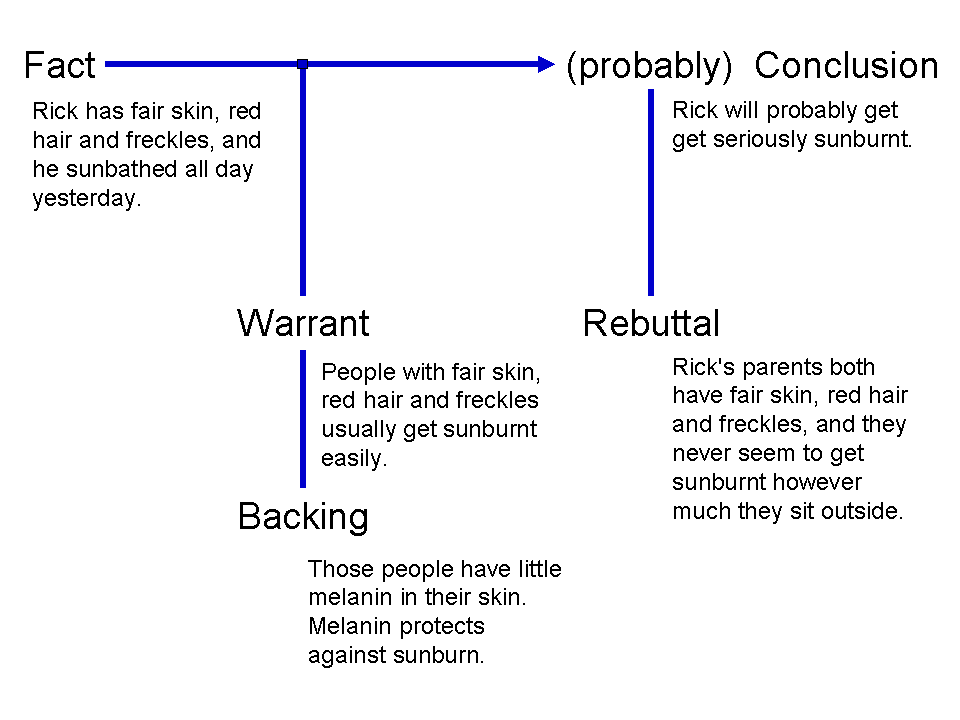
(2)現場力は、その現場で構成される概念であると同時に[冒頭で書いたように]伝達するこ とが可能なものである。もちろん、伝達することが可能であるから「所有」することができるという考え方に戻ってしまう可能性がある。従って現場力は伝達可 能だが、所有は不可能であるというイメージでとらえ直すには、現場力を次のようなイメージで捉えることを提案する。つまり、現場力とはコミュニケーション におけるメッセージそのもの、ないしはメッセージ理解力であると考えるのである(引用図はスティーヴン・トゥールミンの『議論の技法』モデル)。

【3】社会的な概念としての現場力
口頭における伝達とその理解を、現場力における要素のひとつであると考えてみよう[→〈聴覚優位〉の問題]。その場合の現場力を決定する要因は、言語の理解力、文脈決定性、 そして音声能力や聴力などの身体特性などである。現場力を単にメッセージと考えると、その伝達的側面だけが過度に協調されるが、メッセージが社会性——冒 頭で対人関係的能力と書いたのは社会性に関与することである——をもちうるのは、技能を評価し、再生産——世代を超えて伝達される——されるからにほかな らい。そうすると、(3)現場力はなんらかの社会的な概念である、ということにもなる。
したがって、現場力を研究する研究は、次のような分野の横断的な協力がなければならないだろう。
心理学、認知科学、哲学、社会学、文化 人類学、生物学、経営学、医学、看護学、福祉学、コミュニケーション科学、インターフェイス人文学などである。
なお、現場力(げんばりょく)は日本語の語感が不可欠な文化的に特異的な概念(local knowledge)である。したがって、英語に翻訳する場合は、Genba-Ryoku と呼ぶしか、現時点では説明できない概念である。もし、上記のことが文化の相違を超えて人間一般に通用する技能や能力であると仮定すると、その翻訳は、 (1)そこに参与する(in practice)人たちを(2)力づける(empower)もの、つまり(3)技能(faculty)的なるものであるということが記されなければなら ない。[→ハーバート・サイモン(1999)のいうところの「パターン認識」 と現場力には何らかの関係があるかもしれない]
現場力をデザイン力という観点から問い直せばどうなるだろうか? ドナルド・A・ノーマンは、デ ザインの手順が複雑化することに対して、7つの対応策を提案している(その中の3番目はいわゆる「見える化」である)。日本の経営学者たちの理論的センス のまったくないアドバイスに比べてはるかに、現場的センスがすぐれていないだろうか? 私たちは大いに恥じなければならない。[→「CO*-DESIGN 用語集」]
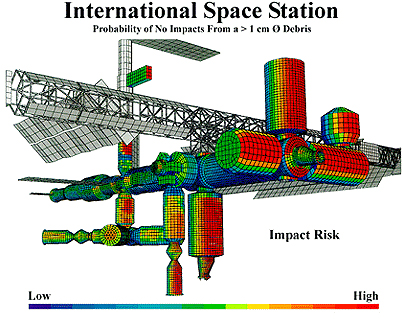
見える化とは、現場で触知できないこともふくめて図の形で示してやることである。下記は、NASA が作った国際宇宙ステーション(ISS)の衝突リスクの分布(青[low]←→赤 [high])を見事に「見える化」して表現している——宇宙船の中で居住するものにはこれはわかりにくいので、居住区と作業区などを内部の色分けが必要 になる。
★結論:現場力は見える化(みえるか)できる
また、上記の説明において、技能を所有するという観点や説明を弱めて、コミュニケーション・メッ セージそのものないしは、それに与る能力という観点から考えると現場力によって力づけられるのは、他者のみならず自分じしんであるので、力づけるという他 動詞がもつ行為を、自動詞ないしは再帰動詞のように自分に自身にも振り向けるという意味で、力づける[力づけられる]ことの感受性 (sensibility)も現場力に含まれよう。それらを総合すると、現時点での「現場力」の[文化特異的な]翻訳としては、Genba-ryoku, empowerment faculty and sensibility in practice、あるいはempower in situ, situated empowerment process ということに落ち着く。
現場(Genba)+力(ryoku):Genba-ryoku, empowerment faculty and sensibility in practice; empower in situ, situated empowerment process. なお人によっては「げんばりき」と読ませる向きもありますが、これは耳で聞いたときに、日本語を母語とする人以外には 混乱をまねくので、ここでは「げんばりき」とは発音せず、「げんばりょく」と読ませます。
☆現場と精神保健ケア(The Genba and Mental Health)| Finding New Genba in East Asian Workplace Fields Kwanwook Kim |
Finding New Genba in East Asian Workplace Fields, Society for Medical Anthropology, AAA Kwanwook Kim |
| The
literal meaning of the Japanese term genba (げんば) is a place where
things are done at the present moment (現場). While this term has a
meaning similar to that of an anthropological field or fieldsite, it is
also widely used in East Asian industrial spaces to denote a workplace:
hyun-jang in Korean and xiànchǎng in Chinese. Genba is everywhere and
all different, but there is a common question often hidden in the
shadow of hyper-industrial success: Why do hardworking people die at
their workplaces? By approaching genba as not merely a physical space
but a living knowledge site where the effects of work on workers’
bodies and the environment are negotiated through multiple languages
and practices, we can better connect what is too often treated as
separate in East Asia and find better answers to this pressing
question. This lens surfaced sharply in the East Asian Medical
Anthropology Network (EAMAN) session, “Workplace, Labor, and Mental
Health in East Asia,” where placing Taiwan’s semiconductor sector,
South Korea’s call center industry, and Japan’s long debate on karoshi
(death by work) in one conversation made clear that worker health must
be addressed beyond national borders, within a broader East Asian
context of tightly entangled industries, supply chains, expert
knowledge, and legal categories |
日
本語の「現場(げんば)」という言葉の字義的な意味は、物事が「今」行われている場所(現場)である。この用語は、人類学におけるフィールドやフィールド
サイトと似た意味を持つ一方で、東アジアの産業現場において「職場」を指す言葉としても広く使われている。韓国語では「現場(ヒョンジャン)」、中国語で
は「現場(シエンチャン)」と呼ばれる。「現場」は至る所に存在し、その様相は様々だが、過度な産業的成功の陰に隠されがちな共通の問いがある。それは、
「なぜ勤勉な人々が職場で命を落とすのか」という問いである。「現場」を単なる物理的な空間ではなく、労働が労働者の身体や環境に及ぼす影響が、多様な言
語や実践を通じて交渉される「生きた知識の場」として捉えることで、東アジアにおいてしばしば別個のものとして扱われてきた事象をより深く結びつけ、この
差し迫った問いに対するより良い答えを見出すことができるだろう。この視点は、東アジア医療人類学ネットワーク(EAMAN)のセッション
「東アジアにおける職場、労働、およびメンタルヘルス」と題されたセッションにおいて、この視点は鮮明に浮き彫りになった。台湾の半導体産業、韓国のコー
ルセンター産業、そして日本における「過労死」をめぐる長年の議論を同一の議論の場に置くことで、産業、サプライチェーン、専門知識、法的カテゴリーが密
接に絡み合う広範な東アジアの文脈において、労働者の健康問題は国境を越えて取り組まなければならないことが明らかになった。 |
| Bringing Together Different Fields in East Asia Yi-Cheng Wu, a psychiatrist trained in Taiwan, presented on the psychological distress experienced by engineers at Taiwan Semiconductor Manufacturing Company (TSMC), the largest semiconductor foundry in the world. Observing the intense pressure cooker environment in Taiwan’s semiconductor sector, he consistently brought up the mental health crisis at TSMC, drawing regional parallels to South Korea’s struggle with “Samsung leukemia” and the subsequent civil movements like SHARPS (Supporters for the Health And Rights of People in the Semiconductor industry). Yi-Cheng paid close attention to corporate culture and “obedience,” often framed in Confucian terms, as a key feature of the workplace. This was also evident in his clinical encounters: some workers showed excellent compliance even with treatment, while others—despite having medical benefits—avoided seeking care to hide psychological difficulties. In his account, to work at TSMC one must be obedient, show servility, and possess personal resilience; he captured this with the provocative phrase “voluntary slavery?” This framing resonates with a broader discussion of Confucian-based corporate culture, while also sharpening a specifically workplace-based question: how does corporate discipline shape what workers can reveal, and what remains hidden, when distress emerges at the genba? My Korean case entered through a different genba: the call center. I began with the film Next Sohee and news articles about suicide cases of female counselors in the Korean call center industry, describing the humiliating work environment that drove some counselors to suicide attempts and deaths. I pointed out how their suffering was repeatedly reduced to depression. My fieldwork suggested that this reduction was inadequate. They were not simply depressed, but oppressed, and the Korean term eok-ul (억울 , 抑鬱) conveys the sense of being wronged or unjustly treated; unlike the Taiwanese workers Yi-Cheng described, the Korean female counselors I observed—though also forced into a form of voluntary slavery—chose to resist by organizing labor unions to address injustice, and although their unions’ scale and tangible results were limited, their refusal to be slaves was unmistakable, making the workplace genba not only a site of suffering but also a site of contestation where moral injury and structural violence were named and politicized. At the same time, the Korean case revealed another kind of compliance among medical professionals: when counselors sought to locate psychological suffering in the work environment, psychiatrists did not actively intervene in the way that Japanese psychiatrists did in debates on karoshi and workplace depression; it was extremely difficult to find psychiatrists willing to “medically” testify to workers’ suffering, and companies easily dismissed worker depression as individual psychological vulnerability, so the absence of expert testimony became a structural condition of invisibility shaping what could be recognized as work-related harm. Japan entered this comparative picture through Junko Kitanaka’s in-depth ethnography on karoshi and depression in Japanese society and related occupational health discussions. As Korea also suffers from an endless cycle of overwork, depression, and widespread suicide, I realized that Japan had experienced these issues decades earlier. What surprised me was that Japanese psychiatrists, under the banner of “psychiatric science of work,” actively participated in the debate and worked to prove that worker depression and subsequent suicides were direct results of industrial accidents caused by the work environment. In contrast to the Korean pattern of easy individualization, the Japanese trajectory highlights how the same kinds of suffering can be made publicly legible—medically and legally—through the mobilization of expertise. The point is not that Japan “solved” overwork and suicide, but that the institutional pathway differs, and that difference shapes what becomes actionable at the genba. |
東アジアにおける異分野の融合 台湾で研修を受けた精神科医の呉怡成氏は、世界最大の半導体ファウンドリである台湾積体電路製造(TSMC)のエンジニアが抱える心理的苦痛について発表 した。台湾の半導体業界における過酷な「圧力鍋」のような環境を観察し、彼は一貫してTSMCにおけるメンタルヘルスの危機を取り上げ、韓国における「サ ムスン白血病」問題や、それに続くSHARPS(半導体産業従事者の健康と権利を支援する会)のような市民運動との地域的な類似点を指摘した。イー・チェ ン氏は、職場の重要な特徴として、企業文化と、しばしば儒教的な文脈で語られる「服従」に細心の注意を払った。これは彼の臨床現場でも明らかであった。治 療に対して極めて従順な従業員がいる一方で、医療給付があるにもかかわらず、心理的な困難を隠すために受診を避ける従業員もいた。彼の記述によれば、 TSMCで働くには従順であり、卑屈さを示し、個人的なレジリエンス(回復力)を備えていなければならない。彼はこれを「自発的な奴隷制?」という挑発的 なフレーズで捉えた。この枠組みは、儒教に基づく企業文化に関するより広範な議論と共鳴する一方で、職場特有の問いを鋭く浮き彫りにしている。すなわち、 現場(ゲンバ)で苦痛が生じた際、企業の規律は、労働者が何を明かすことができ、何が隠されたままになるかをどのように形作るのか、という問いである。 私の韓国での事例は、別の現場、すなわちコールセンターから入り込んだ。私は映画『ネクスト・ソヒ』と、韓国のコールセンター業界における女性カウンセ ラーの自殺事例に関するニュース記事から調査を始めた。それらは、一部のカウンセラーを自殺未遂や死へと追いやった屈辱的な労働環境を描写していた。私 は、彼女たちの苦しみがいかにして繰り返し「うつ病」へと還元されてきたかを指摘した。私のフィールドワークは、この単純化が不十分であることを示唆し た。彼女たちは単にうつ状態だったのではなく、抑圧されていたのである。韓国語の「억울(オックル)」という言葉は、不当な扱いを受けたり、理不尽な目に 遭ったりしているという感覚を伝える。イ・チェンが記述した台湾の労働者とは異なり、私が観察した韓国の女性カウンセラーたちは――ある種の自発的な奴隷 状態に追い込まれていたとはいえ――不正に対処するために労働組合を結成することで抵抗することを選んだ。組合の規模や具体的な成果は限定的であったもの の、奴隷となることを拒絶した姿勢は明白であり、それによって職場の「現場」は単なる苦痛の場にとどまらず、道徳的損傷や構造的暴力が名指しされ、政治化 される闘争の場となったのである。同時に、韓国の事例は医療専門家の間にある別の種類の服従を浮き彫りにした。カウンセラーたちが職場環境における心理的 苦痛を特定しようとした際、精神科医たちは、過労死や職場うつ病をめぐる議論において日本の精神科医たちが行ったような積極的な介入を行わなかった。労働 者の苦痛を「医学的に」証言しようとする精神科医を見つけることは極めて困難であり、企業は労働者のうつ病を個人の心理的脆弱性として容易に片付けてし まった。そのため、専門家の証言の欠如は、労働関連の危害として何が認識され得るかを形作る「不可視性の構造的条件」となった。日本がこの比較研究の枠組 みに加わったのは、北中順子による日本社会における過労死とうつ病に関する詳細な民族誌研究、および関連する労働衛生論議を通じてであった。韓国もまた、 過労、うつ病、そして広範な自殺という終わりのない悪循環に苦しんでいるが、私は日本がこれらの問題を数十年も前に経験していたことに気づいた。私が驚い たのは、日本の精神科医たちが「労働精神医学」という旗印の下、議論に積極的に参加し、労働者のうつ病やそれに続く自殺が、労働環境によって引き起こされ た労働災害の直接的な結果であることを立証しようと尽力していたことである。韓国における安易な個人化の傾向とは対照的に、日本の軌跡は、専門知識の動員 を通じて、同じような苦しみがいかにして医学的・法的に公的に可読化され得るかを浮き彫りにしている。重要なのは、日本が過労や自殺を「解決」したという ことではなく、制度的な経路が異なり、その違いが現場(ゲンバ)で何が実行可能となるかを形作っているという点である。 |
| The New Genba and Academic Responsibility The session widened the frame beyond “stress” and “mental health” alone. The series of suicides among Chinese laborers at Foxconn, documented in Dying for an iPhone, together with similar issues facing female counselors in the Korean call center industry, show how harm can be routinized within the very logics of industrial success. Work in science and technology studies has demonstrated that contamination and exposure are not simply “found” but become visible through contested infrastructures of knowledge. Genba, then, is where invisibility is produced and maintained as much as where suffering is experienced. Chen Hsin-hsing’s Seeing the Unclean is instructive because it follows how environmental and industrial pollution becomes “seen” (or kept unseen) through institutional routines, scientific/administrative categories, and public disputes; read through the lens of genba, this is not a story outside the workplace but one in which the worksite, the surrounding environment, and the evidentiary practices that define “pollution” are co-produced, allowing “unclean” conditions to persist as a managed normality rather than an acknowledged emergency. Building on this insight, historian of science Lisa Onaga has explored how the relationship between toxic exposure and health emerged in Asian history through the concept of genba (reconstruction of the site), which clarifies why workplace fields must be treated as knowledge sites: genba is not only a site of pollution exposure or psychological distress but where interpretations, evidence, and responsibilities are negotiated across institutions, thereby making both the TSMC site in Taiwan and the Korean call center site places where labor is “visibly” displayed yet invisible knowledge and medical/legal controversies are continuously produced. When the session ended, I sketched some graphs on my notepad, questioning why each field had a different trajectory for its genba. I examined how meaning about labor and health is produced in the medical, legal, political, and academic spheres. I noted that in Korea there has been strong political activity through labor unions; in Japan, there has been strong testimony from medical experts; and in Taiwan, while less politically active than Korea, there have been more testimonies from medical experts, including Yi-Cheng’s own work. I then showed the area that remained a question mark in my sketch: the academic sphere. As medical anthropologists and historians, what kind of academic debates have we contributed to in East Asia? None of us could confidently answer this for our respective countries. |
「新しい現場」と学問的責任 このセッションでは、議論の枠組みを単なる「ストレス」や「メンタルヘルス」にとどまらず、さらに広げた。『Dying for an iPhone』で記録されたフォックスコンの中国人労働者による一連の自殺や、韓国のコールセンター業界で働く女性カウンセラーが直面する同様の問題は、 産業的成功の論理そのものの中で、いかにして被害が日常化され得るかを示している。科学技術研究における諸研究は、汚染や曝露が単に「発見」されるもので はなく、争点となる知識のインフラを通じて可視化されることを示してきた。したがって、「現場(ゲンバ)」とは、苦痛が経験される場所であると同時に、不 可視性が生産され維持される場所でもある。陳心星の『Seeing the Unclean』が示唆に富むのは、環境汚染や産業汚染が、制度的なルーチン、科学的・行政的なカテゴリー、そして公的な論争を通じていかに「見える化」 されるか(あるいは見えないままにされるか)を追跡しているからである。「現場」というレンズを通して読み解けば、これは職場の外で起こる物語ではなく、 職場、その周辺環境、そして「汚染」を定義する証拠の実践が共生産される物語であり、それによって「不浄」な状態は、認識された緊急事態ではなく、管理さ れた常態として存続し続けるのである。この洞察に基づき、科学史家のリサ・オナガは、「現場(genba)」という概念を通じて、アジアの歴史において有 害物質への曝露と健康との関係がどのように形成されてきたかを探求しており、これにより、職場の現場がなぜ「知識の現場」として扱われなければならないの かが明らかになる。現場(ゲンバ)は、単に汚染への曝露や心理的苦痛が生じる場所であるだけでなく、機関を越えて解釈、証拠、責任が交渉される場でもあ る。それゆえ、台湾のTSMCの現場も韓国のコールセンターの現場も、労働が「可視化」されている一方で、不可視の知識や医学的・法的な論争が絶えず生み 出されている場所となるのである。 セッションが終わると、私はノートにいくつかの図を描き、なぜ各分野で現場(ゲンバ)の軌跡が異なるのかという疑問を投げかけた。私は、医療、法、政治、 そして学術の各領域において、労働と健康に関する意味がいかに生成されるかを検証した。韓国では労働組合を通じた強力な政治活動が見られ、日本では医療専 門家による強力な証言があり、台湾では韓国ほど政治的活動は活発ではないものの、イ・チェン自身の研究を含め、医療専門家による証言がより多く見られるこ とに気づいた。そして、スケッチの中で疑問符のまま残っていた領域、すなわち学術領域について示した。医療人類学者や歴史学者として、我々は東アジアにお いてどのような学術的議論に貢献してきたのだろうか。我々の誰一人として、それぞれの国についてこの問いに自信を持って答えることはできなかった。 |
| This
question mark should not be treated as a minor gap. In my research, the
new introduction of AI in the Korean call center industry is causing
unexpected labor distress, which I termed techno-moral distress. As of
today, we have yet to see sustained academic discussion on this topic,
while a new socio-technical imaginary around AI is emerging. This
matters because AI can reorganize what counts as “evidence” and what
becomes visible in workplaces—potentially rendering workers’ health
issues, which have not been properly made visible until now, invisible
again. Broader debates on how technology reorganizes social life and
responsibility make this point explicit: visibility is not merely
descriptive but politically consequential. |
この疑問符を些細な隔たりとして扱
うべきではない。私の研究によれば、韓国のコールセンター業界におけるAIの新たな導入は、私が「テクノ・モラル・ディストレス」と名付けた予期せぬ労働
上の苦痛を引き起こしている。今日に至るまで、このテーマに関する持続的な学術的議論は見られない一方で、AIをめぐる新たな社会技術的想像力が台頭しつ
つある。これは重要な問題である。なぜなら、AIは「証拠」として何が見なされ、職場において何が可視化されるかを再編成し得るからであり、それによっ
て、これまで適切に可視化されてこなかった労働者の健康問題が、再び不可視化される可能性があるからだ。技術がいかにして社会生活や責任を再編成するかに
関するより広範な議論は、この点を明確に示している。すなわち、可視性とは単なる記述的なものではなく、政治的に重大な意味を持つものであるということ
だ。 |
| Conclusion: Reconnecting Existing genba Finding “new genba” does not only mean identifying new workplace sites; it also means linking existing sites—semiconductor cleanrooms, call-center floors, clinical offices, compensation boards, and policy arenas—by tracing how harm travels across industries, disciplines, and jurisdictions, and this East Asian comparative approach has concrete advantages: it clarifies legal similarities and divergences in how work-related harm is recognized (or denied) as industrial injury; it makes visible industrial connectivity in tightly coupled ecologies—supply chains, subcontracting structures, platformized management—through which risks and responsibilities are redistributed; and it reveals recurring patterns in medical response, whether distress is individualized as vulnerability, collectivized as injustice, or transformed into actionable injury through expert testimony. If there was one certainty we gained from the session, it was our responsibility to address the academic question mark as part of this reconnection by identifying the scenarios that bring environmental, occupational, and health-related problems to the surface and mapping the actors within them—medical institutions, legal forums, labor organizations, and policy actors—so that an East Asian network of scholars can expand its influence across medical, legal, and political spheres, not as isolated commentators but as a collective academic genba that stabilizes shared vocabularies, comparative evidence, and public responsibilities. |
結論:既存の「現場」を再接続する 「新たな現場」を見つけるということは、単に新しい職場を特定することだけを意味するのではない。それはまた、半導体クリーンルーム、コールセンターのフ ロア、診療所、補償委員会、政策の場といった既存の現場を、産業、分野、管轄区域を越えて被害がどのように伝播するかを追跡することで結びつけることを意 味する。この東アジア比較アプローチには具体的な利点がある。それは、労働関連の被害が労働災害として認定(あるいは否認)される過程における法的な類似 点と相違点を明らかにすることである。リスクと責任が再配分される、密接に結合した生態系(サプライチェーン、下請け構造、プラットフォーム化された管 理)における産業的連関を可視化する;そして、苦痛が脆弱性として個人化されるか、不正義として集団化されるか、あるいは専門家証言を通じて法的措置の対 象となる傷害へと転換されるかにかかわらず、医療的対応における反復的なパターンを明らかにする。本セッションから得られた確かなことが一つあるとすれ ば、それは、環境・労働・健康関連の問題を表面化させるシナリオを特定し、その中にある主体——医療機関、法廷、 労働組織、政策関係者——をマッピングすることである。そうすることで、東アジアの研究者ネットワークは、孤立した論評者ではなく、共有された語彙、比較 可能な証拠、そして公共的責任を定着させる「集合的な学術的現場」として、医療、法、政治の各領域にその影響力を拡大することができるだろう。 |
| Author bio: Kwanwook Kim, M.D.,
Ph.D., is an Assistant Professor in the Department of Cultural
Anthropology at Duksung Women’s University, Seoul, South Korea. Trained
in both anthropology and medicine, he serves as President of the Korean
Society for Medical Anthropology. His research examines how structural
violence, labour, and technology shape health in Korea—covering
call-center emotional labor, migrant health, smoking and addiction,
post-disaster mourning, cancer screening, state violence, and illness
among North Korean defectors, with recent work on AI’s impact on work
and health. |
著者略歴:キム・クァンウク(医学博士・博士)は、韓国ソウルにある徳 成女子大学文化人類学科の助教授である。人類学と医学の両分野で研鑽を積んだ彼は、韓国医療人類学会の会長を務めている。彼の研究は、構造的暴力、労働、 技術が韓国における健康をどのように形成しているかを検証するものであり、コールセンターにおけるエモーショナル・レイバー、移民の健康、喫煙と依存症、 災害後の喪、がん検診、国家による暴力、北朝鮮脱北者の疾病などを網羅しており、最近ではAIが労働と健康に与える影響についても研究を行っている。 |
| Series Introduction: East Asian Medical Anthropology for a Transformative Time |
Kwanwook Kim,Finding New Genba in East Asian Workplace Fields |
文献
サイト内リンク
キーワード
ゆらぎ、即興、老人力*、実践知、臨床知、場(ゲシュタルト心理学ないしはクルト・レヴィ ン)、フィールドワーク、建設現場、現場監督、現場の豊かさ、現場の猥雑さ、……
*老人力(ろうじんりょく)=「加齢による衰えを肯定 的に捕らえる言葉。慣用句として「最近あなた耳が遠くなったわね」「ほう、ワタシにも老人力がついてきたようだな」というように使う」(出典:はてなダイアリー「老人力」、 2006年11月10日)
※ただし、この用法における力は、あくまでも個人に備 わる/身に付く能力という点で所有可能なものをさしており、私が文中で説明した現場力概念の非所有的性格からは、ほど遠い用法であることは指摘しておきた い。このような〈力〉を所有できるかのような錯認に関しては、本サイト内の私のエッセー「現 場力について」の中の「ひとはなぜ〈現場力〉の把握に失敗するのか」を参照の こと。
ビジネス(経営学)分野における現場力の用語法が、問題含みのものであるとあるという指摘は 下記の文献中に掲載しました。
[著者紹介 author]池田光穂(大阪大学名 誉教授)
中央アメリカ地域をフィールドにする文化人類学(とくに医療人類学)が専門です。
国際保健医療協力のボランティアとしての活動経験から、多元的医療体系についての文化人類学的 理解について長年研究をしてきました。保健医療協力の現場は、異文化を含めたさまざまな社会的背景をもった人たちとの交渉が欠かせません。そのため臨床コ ミュニケーションプロジェクトの活動メンバーであると同時にそのマネージメントの仕事をしています。研究関心はどんどん広がってゆくほうがよいというのが 私のモットーです。最近は「現場力」に関する理論的考察や、中央アメリカの先住民族の人たちの文化的アイデンティティと国民国家の関係、資本主義経済システムの土着的展開、さらには生物医学の研究室の民族誌方法論の開発も手がけ ています。一見難しそうな研究テーマですが、論理立ててみると現代社会の諸問題に取り組まれている他の研究と多くの共通点が見つかります。



Copyleft,
CC, Mitzub'ixi Quq Chi'j, 1996-2099
