逆プラセボ効果
Inverse placebo effect
Christiaan Tonnis ~ William S. Burroughs 3 / Oil on Canvas / 61 x 72.8 inches / 1999 Print
解説:池田光穂
逆プラセボ効果
Inverse placebo effect
Christiaan Tonnis ~ William S. Burroughs 3 / Oil on Canvas / 61 x 72.8 inches / 1999 Print
解説:池田光穂
☆逆プラセボ 効果(inverse placebo effect)
逆プラセボ効果[inverse
placebo effect](別名「ノウセボ」効果、あるいは「ノウ・セボ」効果、抑制されたプラセボ効果とも呼ばれる)とは、心理学および
医学における現象であり、
盲検化された臨床試験において、機能的な盲検解除の問題により被験者がプラセボを投与されたことを知ってしまった結果、その被験者がプラセボ効果の減弱を
経験する現象である。[1][2][3][4] この効果は、サイケデリック薬のような強力な向精神薬の試験において特に重要である。[1][2][3]逆プラセボ効果は、サイロシビンなどのサイケデリック薬、ケタミンなどの他の幻覚剤、MDMA
などのエンタクタジェンなど、明らかな精神作用があり、盲検
化が不可能な治療法の臨床試験において顕著に発生することが知られている。[3][1][2]
こうした状況下では、期待された心理的変化が見られないため、被験者にとって薬剤ではなくプラセボを投与されたことが通常は極めて明白であり、その結果、
失望感が生じ、プラセボ反応が弱まる。[3][1][2]
従来の抗うつ薬試験ではプラセボがうつ症状を通常約8ポイント軽減するのに対し、サイケデリック薬の試験では約4ポイントの軽減にとどまることが判明して
おり、この減少、すなわち改善度の低下は約50%が逆プラセボ効果に起因する。[3][2][7][8]
一般的に、例えばしばしば明らかな副作用による機能的アンブラインド化は、従来の抗うつ薬の場合を含め、実薬とプラセボ間の改善度の差を異なるものにする
ことが知られている。[1][5][9][10]
逆プラセボ効果は、実薬とプラセボの改善度の差において効果サイズを過大評価させる可能性があり、それによって臨床試験の結果を歪める恐れがある。[3]
[1][2][8]
サイケデリック薬は、臨床試験において通常10~12ポイント程度、うつ症状を改善する可能性があるが、これは従来の抗うつ薬による改善度と同程度であ
る。[3][2]
しかし、逆プラセボ効果とプラセボ群の改善の鈍化により、サイケデリック薬とプラセボ間の改善の差は、従来の抗うつ薬の場合よりもはるかに大きくなる可能
性がある(例:2ポイントではなく6~7ポイント)。[3][11][1][2][8]
これが結果として、異常に大きな効果サイズという錯覚をもたらす。[3][1][2] [8]
サイケデリック薬とプラセボ間の改善度の差の約55%は、逆プラセボ効果またはプラセボ抑制によるものであることが判明している。[2]
| The inverse
placebo effect, also known as the "knowcebo" effect (or "know-cebo"
effect) or suppressed placebo effect, is a phenomenon in psychology and
medicine in which a person in a blinded clinical trial knows that they
have received placebo due to functional unblinding problems and this
results in the person experiencing diminished placebo
effects.[1][2][3][4] The effect is especially relevant in trials of
strongly psychoactive drugs such as psychedelics.[1][2][3] There are large placebo responses and effects in clinical trials of psychiatric drugs such as antidepressants and anxiolytics.[3][5][6][1] For example, traditional antidepressants typically improve depressive symptoms by about 10 points on a depression rating scale, whereas placebos improve symptoms by about 8 points on the scale, with about a 2-point advantage for antidepressant over placebo and at least 80% of the treatment benefit being attributable to the placebo response.[3][5][6][1] The placebo response consists of the placebo effect (i.e., positive expectations) and of other components such as regression to the mean, spontaneous remission, and methodological bias.[5][1] The inverse placebo effect is known to occur prominently in clinical trials of treatments that have overt psychoactive effects and are impossible to blind such as psychedelic drugs like psilocybin, other hallucinogens like ketamine, and entactogens like MDMA.[3][1][2] In these kinds of contexts, it is usually very obvious to a person when they receive a placebo instead of the drug due to the lack of expected psychological changes, and this results in disappointment and a diminished placebo response.[3][1][2] Whereas placebos in traditional antidepressant trials reduce depressive symptoms typically by around 8 points, they have been found to reduce symptoms by around 4 points in psychedelic drug trials, a decrease and hence diminished improvement of approximately 50% attributable to the inverse placebo effect.[3][2][7][8] In general, functional unblinding, for instance due to often obvious side effects, is known to amplify differences in improvement between active drugs and placebos, including in the case of traditional antidepressants.[1][5][9][10] The inverse placebo effect can result in inflated effect sizes in terms of differences in improvement between active drug and placebo and can thereby distort clinical trial findings.[3][1][2][8] Psychedelic drugs may improve depressive symptoms typically by around 10 to 12 points in clinical trials, similar to the improvement with traditional antidepressants.[3][2] Due to the inverse placebo effect and blunted placebo-group improvement however, the difference in improvement between the psychedelic drug and placebo can be much greater than with a traditional antidepressant (e.g., 6–7 points instead of 2 points).[3][11][1][2][8] This in turn results in an illusion of unusually large effect sizes.[3][1][2][8] It has been found that the inverse placebo effect or placebo suppression accounts for approximately 55% of the difference in improvement between psychedelics and placebo.[2] When psychedelics have instead been indirectly compared to open-label traditional antidepressants rather than to placebos and hence there are equal unblinding conditions, it has been found that there is no difference in effectiveness between psychedelics and traditional antidepressants.[3][11][2] Similarly, in a direct head-to-head trial with no placebo group, psilocybin was no more effective than the selective serotonin reuptake inhibitor (SSRI) and traditional antidepressant escitalopram (Lexapro) for treating depression.[11][2][12][13] Due to their strong psychoactive effects and unblinding, psychedelics themselves have been found to effectively always be open-label (~90–95% correct treatment-allocation guess rate).[2] Concerns about functional unblinding and consequent amplified placebo and inverse placebo effects prominently contributed to the rejection of the MDMA for the treatment of post-traumatic stress disorder (PTSD) by the Food and Drug Administration (FDA) in the United States in 2024.[1][2][14][15][16][17][18] On the other hand, the FDA approved esketamine (Spravato) for treatment-resistant depression in 2019 despite significant albeit less marked problems with unblinding and potential amplified placebo effects as well.[17][19][20][21][8] |
逆プラセボ効果[inverse
placebo effect](別名「ノウセボ」効果、あるいは「ノウ・セボ」効果、抑制されたプラセボ効果とも呼ばれる)とは、心理学および
医学における現象であり、盲検化された臨床試験において、機能的な盲検解除の問題により被験者がプラセボを投与されたことを知ってしまった結果、その被験
者がプラセボ効果の減弱を経験する現象である。[1][2][3][4]
この効果は、サイケデリック薬のような強力な向精神薬の試験において特に重要である。[1][2][3] 抗うつ薬や抗不安薬などの精神科薬の臨床試験では、大きなプラセボ反応と効果が認められる。[3][5][6][1] 例えば、従来の抗うつ薬は通常、うつ病評価尺度において約10ポイントの症状改善をもたらすのに対し、プラセボは約8ポイントの改善にとどまる。抗うつ薬 はプラセボより約2ポイント優位であるが、治療効果の少なくとも80%はプラセボ反応に起因するとされる。[3][5][6][1] プラセボ反応は、プラセボ効果(すなわち、肯定的な期待)と、平均への回帰、自然寛解、方法論的バイアスなどの他の要素から構成される。[5][1] 逆プラセボ効果は、サイロシビンなどのサイケデリック薬、ケタミンなどの他の幻覚剤、MDMAなどのエンタクタジェンなど、明らかな精神作用があり、盲検 化が不可能な治療法の臨床試験において顕著に発生することが知られている。[3][1][2] こうした状況下では、期待された心理的変化が見られないため、被験者にとって薬剤ではなくプラセボを投与されたことが通常は極めて明白であり、その結果、 失望感が生じ、プラセボ反応が弱まる。[3][1][2] 従来の抗うつ薬試験ではプラセボがうつ症状を通常約8ポイント軽減するのに対し、サイケデリック薬の試験では約4ポイントの軽減にとどまることが判明して おり、この減少、すなわち改善度の低下は約50%が逆プラセボ効果に起因する。[3][2][7][8] 一般的に、例えばしばしば明らかな副作用による機能的アンブラインド化は、従来の抗うつ薬の場合を含め、実薬とプラセボ間の改善度の差を異なるものにする ことが知られている。[1][5][9][10] 逆プラセボ効果は、実薬とプラセボの改善度の差において効果サイズを過大評価させる可能性があり、それによって臨床試験の結果を歪める恐れがある。[3] [1][2][8] サイケデリック薬は、臨床試験において通常10~12ポイント程度、うつ症状を改善する可能性があるが、これは従来の抗うつ薬による改善度と同程度であ る。[3][2] しかし、逆プラセボ効果とプラセボ群の改善の鈍化により、サイケデリック薬とプラセボ間の改善の差は、従来の抗うつ薬の場合よりもはるかに大きくなる可能 性がある(例:2ポイントではなく6~7ポイント)。[3][11][1][2][8] これが結果として、異常に大きな効果サイズという錯覚をもたらす。[3][1][2] [8] サイケデリック薬とプラセボ間の改善度の差の約55%は、逆プラセボ効果またはプラセボ抑制によるものであることが判明している。[2] プラセボではなく、非盲検の従来の抗うつ薬と間接的に比較した場合、つまり盲検解除の条件が同等である場合、サイケデリック薬と従来の抗うつ薬の間に有効 性の差はないことが判明している。[3][11][2] 同様に、プラセボ群を設けない直接比較試験においても、うつ病治療においてシロシビンは、選択的セロトニン再取り込み阻害薬(SSRI)であり従来の抗う つ薬であるエスシタロプラム(レクサプロ)と同等の有効性しか示さなかった。[11][2][12][13] サイケデリック薬は、その強力な精神作用と盲検解除のため、実質的に常にオープンラベル状態にあることが判明している(治療割付の推測正答率は約 90~95%)。[2] 機能的盲検解除およびそれに伴うプラセボ効果の増幅や逆プラセボ効果への懸念が、2024年に米国食品医薬品局(FDA)が心的外傷後ストレス障害 (PTSD)の治療薬としてのMDMAを承認しなかった主な要因となった。[1][2][14][15][16][17] [18] 一方、FDAは2019年、エスケタミン(スプラバト)を治療抵抗性うつ病の治療薬として承認したが、これには、それほど顕著ではないものの、盲検化の解 除や潜在的なプラセボ効果の増幅といった重大な問題も存在していた。[17][19][20][21][8] |
| Lessebo effect Amplified placebo effect |
レッセボ効果 増幅されたプラセボ効果 |
| References 01. Ansari M, Elliott SI, Holmes SE, Sanacora G (February 2026). "Placebo Effects in the Treatment of Depression-Implications for the Psychedelic Renaissance". Neurol Clin. 44 (1): 63–75. doi:10.1016/j.ncl.2025.08.009. PMID 41232997. Williams ZJ, Barnett H, Szigeti B (March 2026). "Psychedelic Therapy vs Antidepressants for the Treatment of Depression Under Equal Unblinding Conditions: A Systematic Review and Meta-Analysis". JAMA Psychiatry. doi:10.1001/jamapsychiatry.2025.4809. PMID 41848744. Hamzelou, Jessica (20 March 2026). "Mind-altering substances are (still) falling short in clinical trials". MIT Technology Review. Retrieved 20 March 2026. But with psychedelics, the difference between active drug and placebo is much greater. That's partly because people who get the psychedelic drug know they're getting it and are expecting the drug to improve their symptoms, [...] But it's also partly because of the effect on those who know they're not getting it. It's pretty obvious when you're getting a placebo, says Szigeti, and it can be disappointing. Scientists have long recognized the "nocebo" effect as placebo's "evil twin"—essentially, when you expect to feel worse, you will. The disappointment of getting a placebo is slightly different, and Szigeti calls it the "knowcebo effect." "It's kind of like a negative psychedelic effect, because you have figured out that you're taking the placebo," he says. This phenomenon can distort the results of psychedelic drug trials. While a placebo in a traditional antidepressant drug trial improves symptoms by eight points, placebos in psychedelic trials improve symptoms by a mere four points, says Szigeti. If the active drug similarly improves symptoms by around 10 points, that makes it look as though the psychedelic is improving symptoms by around six points compared with a placebo. It "gives the illusion" of a huge effect, says Szigeti. Leader, John Francis (2009). The 'knowcebo' effect; an investigation into the relationship between knowledge, anticipation and the placebo effect (Thesis). Retrieved 20 March 2026. 05. Kirsch I (2019). "Placebo Effect in the Treatment of Depression and Anxiety". Front Psychiatry. 10: 407. doi:10.3389/fpsyt.2019.00407. PMC 6584108. PMID 31249537. Hengartner MP, Plöderl M (July 2018). "False Beliefs in Academic Psychiatry: The Case of Antidepressant Drugs". Ethical Human Psychology and Psychiatry. 20 (1): 6–16. doi:10.1891/1559-4343.20.1.6. eISSN 1938-9000. ISSN 1559-4343. S2CID 149608377. Hsu TW, Tsai CK, Kao YC, Thompson T, Carvalho AF, Yang FC, Tseng PT, Hsu CW, Yu CL, Tu YK, Liang CS (August 2024). "Comparative oral monotherapy of psilocybin, lysergic acid diethylamide, 3,4-methylenedioxymethamphetamine, ayahuasca, and escitalopram for depressive symptoms: systematic review and Bayesian network meta-analysis". BMJ. 386 e078607. doi:10.1136/bmj-2023-078607. PMC 11337322. PMID 39168500. Hieronymus F, López E, Werin Sjögren H, Lundberg J (July 2025). "Control Group Outcomes in Trials of Psilocybin, SSRIs, or Esketamine for Depression: A Meta-Analysis". JAMA Netw Open. 8 (7): e2524119. doi:10.1001/jamanetworkopen.2025.24119. PMC 12311713. PMID 40736734. Hengartner MP, Plöderl M (2018). "Statistically Significant Antidepressant-Placebo Differences on Subjective Symptom-Rating Scales Do Not Prove That the Drugs Work: Effect Size and Method Bias Matter!". Front Psychiatry. 9: 517. doi:10.3389/fpsyt.2018.00517. PMC 6199395. PMID 30386270. 10. Kirsch I (2014). "The Emperor's New Drugs: Medication and Placebo in the Treatment of Depression". Placebo. Handbook of Experimental Pharmacology. Vol. 225. Springer Berlin Heidelberg. pp. 291–303. doi:10.1007/978-3-662-44519-8_16. eISSN 1865-0325. ISBN 978-3-662-44518-1. ISSN 0171-2004. PMID 25304538. Busby, Mattha (18 March 2026). "Psychedelics may be no better than antidepressants for depression". New Scientist. Retrieved 20 March 2026. Wang SM, Kim S, Choi WS, Lim HK, Woo YS, Pae CU, Bahk WM (May 2024). "Current Understanding on Psilocybin for Major Depressive Disorder: A Review Focusing on Clinical Trials". Clin Psychopharmacol Neurosci. 22 (2): 222–231. doi:10.9758/cpn.23.1134. PMC 11024689. PMID 38627070. Carhart-Harris R, Giribaldi B, Watts R, Baker-Jones M, Murphy-Beiner A, Murphy R, Martell J, Blemings A, Erritzoe D, Nutt DJ (April 2021). "Trial of Psilocybin versus Escitalopram for Depression". New England Journal of Medicine. 384 (15): 1402–1411. doi:10.1056/NEJMoa2032994. PMID 33852780. Morland LA, Rothbaum BO, Sippel LM, Maples-Keller J, Schnurr PP (March 2026). "State of the Science: MDMA-assisted psychotherapy for the treatment of posttraumatic stress disorder". J Trauma Stress. doi:10.1002/jts.70060. PMID 41820235. Singh B (April 2025). "MDMA-Assisted Therapy for Post-Traumatic Stress Disorder: Regulatory Challenges and a Path Forward". CNS Drugs. 39 (4): 339–343. doi:10.1007/s40263-025-01162-y. PMID 39955464. Jacobs E, Zahid Z, Hinkle J, Nayak S, Yaden DB (February 2026). "Psychedelic medicine: mechanisms, evidence, and translation to practice". BMJ. 392 e081723. doi:10.1136/bmj-2024-081723. PMID 41730563. Wilkinson ST, Sanacora G (June 2025). "Issues in Clinical Trial Design-Lessons From the FDA's Rejection of MDMA". JAMA Psychiatry. 82 (6): 545–546. doi:10.1001/jamapsychiatry.2025.0442. PMID 40238126. Szigeti B, Bradley ER, Woolley J (September 2025). "Too big to fail? Comparing effect sizes of MDMA assisted therapy to unmasking bias". Psychopharmacology (Berl). doi:10.1007/s00213-025-06886-9. PMID 40906191. Horowitz MA, Moncrieff J (May 2020). "Are we repeating mistakes of the past? A review of the evidence for esketamine". Br J Psychiatry. 219 (5): 614–617. doi:10.1192/bjp.2020.89. PMID 32456714. S2CID 218910799. 20. McIntyre RS, Rosenblat JD, Nemeroff CB, Sanacora G, Murrough JW, Berk M, Brietzke E, Dodd S, Gorwood P, Ho R, Iosifescu DV, Lopez Jaramillo C, Kasper S, Kratiuk K, Lee JG, Lee Y, Lui LM, Mansur RB, Papakostas GI, Subramaniapillai M, Thase M, Vieta E, Young AH, Zarate CA, Stahl S (May 2021). "Synthesizing the Evidence for Ketamine and Esketamine in Treatment-Resistant Depression: An International Expert Opinion on the Available Evidence and Implementation". Am J Psychiatry. 178 (5): 383–399. doi:10.1176/appi.ajp.2020.20081251. PMC 9635017. PMID 33726522. S2CID 232262694. 21. Ballard ED, Zarate CA (December 2020). "The role of dissociation in ketamine's antidepressant effects". Nat Commun. 11 (1): 6431. Bibcode:2020NatCo..11.6431B. doi:10.1038/s41467-020-20190-4. PMC 7755908. PMID 33353946. |
参考文献 01. Ansari M, Elliott SI, Holmes SE, Sanacora G (2026年2月). 「うつ病治療におけるプラセボ効果――サイケデリック・ルネサンスへの示唆」. Neurol Clin. 44 (1): 63–75. doi:10.1016/j.ncl.2025.08.009. PMID 41232997. Williams ZJ, Barnett H, Szigeti B (2026年3月). 「同等の盲検解除条件下におけるうつ病治療のためのサイケデリック療法と抗うつ薬の比較:系統的レビューおよびメタ分析」. JAMA Psychiatry. doi:10.1001/jamapsychiatry.2025.4809. PMID 41848744. ハムゼロウ、ジェシカ(2026年3月20日)。「精神作用物質は(依然として)臨床試験で期待外れに終わっている」。MITテクノロジーレ ビュー。2026年3月20日閲覧。しかし、サイケデリック薬の場合、有効成分とプラセボははるかに異なる。その理由の一つは、サイケデリック薬を投与さ れた人々がそれを投与されていることを認識しており、薬が症状を改善すると期待しているからである、[...] しかし、もう一つの理由は、投与されていないと知っている人々への影響によるものでもある。「プラセボを投与されていることは、かなり明白だ」とシゲティ は言う。そしてそれは失望を招くこともある。科学者たちはかねてより、「ノセボ」効果をプラセボの「邪悪な双子」として認識してきた。要するに、悪化する だろうと予想すれば、実際に悪化するのだ。プラセボを投与されたことによる失望は少し異なり、シゲティはこれを「ノウセボ効果」と呼んでいる。「自分がプ ラセボを服用していると気づいてしまうため、ある種のネガティブなサイケデリック効果のようなものだ」と彼は言う。この現象は、サイケデリック薬の臨床試 験結果を歪める可能性がある。従来の抗うつ薬の臨床試験ではプラセボが症状を8ポイント改善するのに対し、サイケデリック薬の試験におけるプラセボはわず か4ポイントの改善にとどまると、シゲティは述べる。もし有効成分を含む薬剤も同様に症状を約10ポイント改善する場合、サイケデリック薬はプラセボと比 較して約6ポイント症状を改善しているように見えることになる。これは「巨大な効果があるかのような錯覚」を与えると、シゲティは言う。 リーダー、ジョン・フランシス(2009)。『「ノウセボ」効果:知識、予期、およびプラセボ効果の関係に関する調査』(学位論文)。 2026年3月20日閲覧。 05. Kirsch I (2019). 「Placebo Effect in the Treatment of Depression and Anxiety」. Front Psychiatry. 10: 407. doi:10.3389/fpsyt.2019.00407. PMC 6584108. PMID 31249537. ヘンガートナー MP、プローデル M(2018年7月)。「学術的精神医学における誤った信念:抗うつ薬の事例」。Ethical Human Psychology and Psychiatry. 20 (1): 6–16. doi:10.1891/1559-4343.20.1.6. eISSN 1938-9000. ISSN 1559-4343. S2CID 149608377. Hsu TW, Tsai CK, Kao YC, Thompson T, Carvalho AF, Yang FC, Tseng PT, Hsu CW, Yu CL, Tu YK, Liang CS (2024年8月)。「うつ症状に対するサイロシビン、リゼルグ酸ジエチルアミド、3,4-メチレンジオキシメタンフェタミン、アヤワスカ、およびエスシ タロプラムの経口単剤療法の比較:システマティック・レビューおよびベイジアン・ネットワーク・メタ解析」。BMJ. 386 e078607. doi:10.1136/bmj-2023-078607. PMC 11337322. PMID 39168500. Hieronymus F, López E, Werin Sjögren H, Lundberg J (2025年7月)。「うつ病に対するサイロシビン、SSRI、またはエスケタミンの臨床試験における対照群の転帰:メタ解析」。JAMA Netw Open. 8 (7): e2524119. doi:10.1001/jamanetworkopen.2025.24119. PMC 12311713. PMID 40736734. Hengartner MP, Plöderl M (2018). 「主観的症状評価尺度における抗うつ薬とプラセボの統計的に有意な差は、薬剤が有効であることを証明しない:効果量と方法バイアスが重要だ!」. Front Psychiatry. 9: 517. doi:10.3389/fpsyt.2018.00517. PMC 6199395. PMID 30386270. 10. Kirsch I (2014). 「皇帝の新しい薬:うつ病治療における薬物とプラセボ」. Placebo. Handbook of Experimental Pharmacology. Vol. 225. Springer Berlin Heidelberg. pp. 291–303. doi:10.1007/978-3-662-44519-8_16. eISSN 1865-0325. ISBN 978-3-662-44518-1. ISSN 0171-2004. PMID 25304538. バスビー、マッタ(2026年3月18日)。「うつ病に対するサイケデリック薬は抗うつ薬と同等かそれ以下かもしれない」。『ニュー・サイエ ンティスト』。2026年3月20日閲覧。 ワン・SM、キム・S、チェ・WS、リム・HK、ウー・YS、ペ・CU、バク・WM(2024年5月)。「大うつ病性障害に対するサイロシビ ンの現状:臨床試験に焦点を当てた総説」。『Clin Psychopharmacol Neurosci』22 (2): 222–231. doi:10.9758/cpn.23.1134. PMC 11024689. PMID 38627070. Carhart-Harris R, Giribaldi B, Watts R, Baker-Jones M, Murphy-Beiner A, Murphy R, Martell J, Blemings A, Erritzoe D, Nutt DJ (2021年4月)。「うつ病に対するサイロシビンとエスシタロプラムの比較試験」。ニューイングランド・ジャーナル・オブ・メディシン。384 (15): 1402–1411. doi:10.1056/NEJMoa2032994. PMID 33852780. Morland LA、Rothbaum BO、Sippel LM、Maples-Keller J、Schnurr PP(2026年3月)。「科学の現状:心的外傷後ストレス障害の治療におけるMDMA支援心理療法」。J Trauma Stress。doi:10.1002/jts.70060。PMID 41820235。 Singh B (2025年4月). 「心的外傷後ストレス障害に対するMDMA支援療法:規制上の課題と今後の道筋」. CNS Drugs. 39 (4): 339–343. doi:10.1007/s40263-025-01162-y. PMID 39955464. Jacobs E, Zahid Z, Hinkle J, Nayak S, Yaden DB (2026年2月). 「サイケデリック医療:メカニズム、エビデンス、および臨床への応用」. BMJ. 392 e081723. doi:10.1136/bmj-2024-081723. PMID 41730563. Wilkinson ST, Sanacora G (2025年6月). 「臨床試験設計における課題――FDAによるMDMAの却下から得た教訓」. JAMA Psychiatry. 82 (6): 545–546. doi:10.1001/jamapsychiatry.2025.0442. PMID 40238126. Szigeti B, Bradley ER, Woolley J (2025年9月). 「大きすぎて失敗できない? MDMA支援療法の効果サイズとアンマスキングバイアスの比較」. Psychopharmacology (Berl). doi:10.1007/s00213-025-06886-9. PMID 40906191. Horowitz MA, Moncrieff J (2020年5月). 「我々は過去の過ちを繰り返しているのか? エスケタミンのエビデンスに関するレビュー」. Br J Psychiatry. 219 (5): 614–617. doi:10.1192/bjp.2020.89. PMID 32456714. S2CID 218910799. 20. McIntyre RS, Rosenblat JD, Nemeroff CB, Sanacora G, Murrough JW, Berk M, Brietzke E, Dodd S, Gorwood P, Ho R、Iosifescu DV、Lopez Jaramillo C、Kasper S、Kratiuk K、Lee JG、Lee Y、Lui LM、Mansur RB、Papakostas GI、Subramaniapillai M、Thase M、Vieta E、Young AH、Zarate CA、Stahl S(2021年5月)。「治療抵抗性うつ病におけるケタミンおよびエスケタミンのエビデンスの統合:利用可能なエビデンスと実施に関する国際的な専門家の 見解」。Am J Psychiatry. 178 (5): 383–399. doi:10.1176/appi.ajp.2020.20081251. PMC 9635017. PMID 33726522. S2CID 232262694. 21. Ballard ED, Zarate CA (2020年12月). 「ケタミンの抗うつ効果における解離の役割」. Nat Commun. 11 (1): 6431. Bibcode:2020NatCo..11.6431B. doi:10.1038/s41467-020-20190-4. PMC 7755908. PMID 33353946. |
| https://en.wikipedia.org/wiki/Inverse_placebo_effect |
|
| A nocebo effect is said
to occur when a patient's expectations for a treatment cause the
treatment to have a worse effect than it otherwise would have.[1][2]
For example, when a patient anticipates a side effect of a medication,
they can experience that effect even if the "medication" is actually an
inert substance.[1] The complementary concept, the placebo effect, is
said to occur when expectations improve an outcome. More generally, the nocebo effect is falling ill simply by consciously or subconsciously anticipating a harmful event. This definition includes anticipated events other than medical treatment. It has been applied to Havana syndrome, where purported victims were anticipating attacks by foreign adversaries.[3][4][5] This definition also applies to cases of electromagnetic hypersensitivity. Both placebo and nocebo effects are presumably psychogenic but can induce measurable changes in the body.[1] One article that reviewed 31 studies on nocebo effects reported a wide range of symptoms that could manifest as nocebo effects, including nausea, stomach pains, itching, bloating, depression, sleep problems, loss of appetite, sexual dysfunction, and severe hypotension.[1] |
ノセボ効果/あるいはノ
シーボ効果[nocebo effect]とは、患者の治療に対する期待が、本来よりも治療の効果を悪 化させる現象とされる。[1][2]
例えば、患者が薬の副作用を予期している場合、たとえその「薬」が実際には無効な物質であっても、その副作用を経験することがある。[1]
これと対をなす概念であるプラセボ効果は、期待によって結果が改善される場合に生じるとされる。 より一般的には、ノセボ効果とは、有害な出来事を意識的または無意識的に予期するだけで病気になる現象を指す。この定義には、医療行為以外の予期される出 来事も含まれる。これは、被害者とされる人々が外国の敵対勢力による攻撃を予期していたとされる「ハバナ症候群」にも適用されてきた。[3][4][5] この定義は、電磁波過敏症の症例にも当てはまる。 プラセボ効果もノセボ効果も、おそらく心因性のものであるが、身体に測定可能な変化を引き起こし得る。[1] ノセボ効果に関する31の研究をレビューしたある論文では、吐き気、腹痛、かゆみ、腹部膨満感、うつ、睡眠障害、食欲不振、性機能障害、重度の低血圧な ど、ノセボ効果として現れる可能性のある幅広い症状が報告されている。[1] |
| https://en.wikipedia.org/wiki/Nocebo |
プ ラシーボとは、偽薬のことである。「鰯(イワシ)の頭も信心から」ということわざがあるように、人は偽の薬を与えても「効いた効いた」と吹聴 するようになることがある。これは、自覚症状の改善がみられたという。他方、偽薬のはずなのに、望まない副作用(有害作用)が現われることをノシーボ(ノ セボ)ある いは、ノシーボ(ノセボ)効果という。
★ノセボ[nocebo]効果とは、患者の治療に対する期待 が、本来よりも治療の効果を悪化させる現象とされ る。[1][2] 例えば、患者が薬の副作用を予期している場合、たとえその「薬」が実際には無効な物質であっても、その副作用を経験することがある。[1] これと対をなす概念であるプラセボ効果は、期待によって結果が改善される場合に生じるとされる。 より一般的には、ノセボ効果とは、有害な出来事を意識的または無意識的に予期するだけで病気になる現象を指す。この定義には、医療行為以外の予期される出 来事も含まれる。これは、被害者とされる人々が外国の敵対勢力による攻撃を予期していたとされる「ハバナ症候群」[Havana syndrome] にも適用されてきた。[3][4][5] この定義は、電磁波過敏症の症例にも当てはまる。 プラセボ効果もノセボ効果も、おそらく心因性のものであるが、身体に測定可能な変化を引き起こし得る。[1] ノセボ効果に関する31の研究をレビューしたある論文では、吐き気、腹痛、かゆみ、腹部膨満感、うつ、睡眠障害、食欲不振、性機能障害、重度の低血圧な ど、ノセボ効果として現れる可能性のある幅広い症状が報告されている。[1]
| A nocebo effect is
said to occur when a patient's expectations for a treatment cause the
treatment to have a worse effect than it otherwise would have.[1][2]
For example, when a patient anticipates a side effect of a medication,
they can experience that effect even if the "medication" is actually an
inert substance.[1] The complementary concept, the placebo effect, is
said to occur when expectations improve an outcome. More generally, the nocebo effect is falling ill simply by consciously or subconsciously anticipating a harmful event. This definition includes anticipated events other than medical treatment. It has been applied to Havana syndrome, where purported victims were anticipating attacks by foreign adversaries.[3][4][5] This definition also applies to cases of electromagnetic hypersensitivity. Both placebo and nocebo effects are presumably psychogenic but can induce measurable changes in the body.[1] One article that reviewed 31 studies on nocebo effects reported a wide range of symptoms that could manifest as nocebo effects, including nausea, stomach pains, itching, bloating, depression, sleep problems, loss of appetite, sexual dysfunction, and severe hypotension.[1] |
ノセボ効果[nocebo
effect]とは、患者の治療に対する期待が、本来よりも治療の効果を悪
化させる現象とされる。[1][2]
例えば、患者が薬の副作用を予期している場合、たとえその「薬」が実際には無効な物質であっても、その副作用を経験することがある。[1]
これと対をなす概念であるプラセボ効果は、期待によって結果が改善される場合に生じるとされる。 より一般的には、ノセボ効果とは、有害な出来事を意識的または無意識的に予期するだけで病気になる現象を指す。この定義には、医療行為以外の予期される出 来事も含まれる。これは、被害者とされる人々が外国の敵対勢力による攻撃を予期していたとされる「ハバナ症候群」にも適用されてきた。[3][4][5] この定義は、電磁波過敏症の症例にも当てはまる。 プラセボ効果もノセボ効果も、おそらく心因性のものであるが、身体に測定可能な変化を引き起こし得る。[1] ノセボ効果に関する31の研究をレビューしたある論文では、吐き気、腹痛、かゆみ、腹部膨満感、うつ、睡眠障害、食欲不振、性機能障害、重度の低血圧な ど、ノセボ効果として現れる可能性のある幅広い症状が報告されている。[1] |
| Etymology and usage Walter Kennedy coined the term nocebo (Latin nocēbō, "I shall harm", from noceō, "I harm")[6] in 1961 to denote the counterpart of placebo (Latin placēbō, "I shall please", from placeō, "I please"),[7] a substance that may produce a beneficial, healthful, pleasant, or desirable effect. Kennedy emphasized that his use of the term nocebo refers strictly to a subject-centered response, a quality "inherent in the patient rather than in the remedy".[8] That is, he rejected the use of the term for pharmacologically induced negative side effects such as the ringing in the ears caused by quinine.[8] That is not to say that the patient's psychologically induced response may not include physiological effects. For example, an expectation of pain may induce anxiety, which in turn causes the release of cholecystokinin, which facilitates pain transmission.[9] |
語源と用法 ウォルター・ケネディは1961年、プラセボ(ラテン語 placēbō、「喜ばせる」、placeō「喜ばせる」に由来)[7]の対極となる概念を表すために、ノセボ(ラテン語 nocēbō、「害を与える」、noceō「害を与える」に由来)[6]という用語を造語した。プラセボとは、有益で、健康的な効果をもたらす可能性のあ る物質を指す。ケネディは、自身が用いる「ノセボ」という用語が、厳密には被験者中心の反応、すなわち「治療法ではなく患者に内在する」性質を指すもので あると強調した[8]。つまり、彼はキニーネによる耳鳴りのような、薬理学的に誘発された負の副作用に対してこの用語を用いることを否定した[8]。とは いえ、患者の心理的に誘発された反応に生理学的効果が含まれないとは限らない。例えば、痛みに対する予期は不安を誘発し、それが胆嚢収縮ホルモン (CCK)の放出を引き起こし、痛みの伝達を促進する可能性がある。[9] |
| Response In the narrowest sense, a nocebo response occurs when a drug-trial subject's symptoms are worsened by the administration of an inert, sham,[10] or dummy (simulator) treatment, called a placebo. Placebos contain no chemicals (or any other agents) that could cause any of the observed worsening in the subject's symptoms, so any change for the worse must be due to some subjective factor. Adverse expectations can also cause anesthetic medications' analgesic effects to disappear.[11] The worsening of the subject's symptoms or reduction of beneficial effects is a direct consequence of their exposure to the placebo, but the placebo has not chemically generated those symptoms. Because this generation of symptoms entails a complex of "subject-internal" activities, we can never speak in the strictest sense in terms of simulator-centered "nocebo effects", but only in terms of subject-centered "nocebo responses". Some observers attribute nocebo responses (or placebo responses) to a subject's gullibility, but there is no evidence that someone who manifests a nocebo/placebo response to one treatment will manifest a nocebo/placebo response to any other treatment; i.e., there is no fixed nocebo/placebo-responding trait or propensity.[12] Based on a biosemiotic model (2022), Goli explains how harm and/or healing expectations lead to a multimodal image and form transient allostatic or homeostatic interoceptive feelings, demonstrating how repetitive experiences of a potential body induce epigenetic changes and form new attractors, such as nocebos and placeboes, in the actual body.[13] |
反応 最も狭義において、ノセボ反応とは、薬物試験の被験者が、プラセボと呼ばれる不活性な偽薬[10]、あるいはダミー(模擬)治療の投与によって症状が悪化 した場合に生じる現象である。プラセボには、被験者の症状の悪化を引き起こしうる化学物質(またはその他の薬剤)は含まれていないため、症状の悪化はすべ て何らかの主観的要因によるものでなければならない。否定的な予期は、麻酔薬の鎮痛効果を消失させる原因にもなり得る[11]。 被験者の症状の悪化や有益な効果の減退は、プラセボへの曝露による直接的な結果であるが、プラセボが化学的にそれらの症状を引き起こしたわけではない。こ の症状の発生には「被験者内部」の活動が複合的に関与しているため、厳密な意味においてシミュレーター中心の「ノセボ効果」とは決して言えず、被験者中心 の「ノセボ反応」としてのみ語ることができる。一部の観察者は、ノセボ反応(またはプラセボ反応)を被験者の騙されやすさに帰する。しかし、ある治療に対 してノセボ/プラセボ反応を示す者が、他のいかなる治療に対しても同様の反応を示すという証拠はない。すなわち、ノセボ/プラセボ反応を示す固定的な特性 や傾向は存在しないのだ。[12] ゴリは、バイオセミオティック・モデル(2022年)に基づき、害や治癒への期待がいかにしてマルチモーダルなイメージを生み出し、一過性のアロスタ ティックあるいはホメオスタティックな内受容感覚を形成するかを説明している。また、潜在的な身体における反復的な経験がいかにしてエピジェネティックな 変化を誘発し、実際の身体においてノセボやプラセボといった新たなアトラクタを形成するかを示している。[13] |
| Effects Side effects of drugs It has been shown that, due to the nocebo effect, warning patients about drugs' side effects can contribute to the causation of such effects, whether the drug is real or not.[14][15] This effect has been observed in clinical trials: according to a 2013 review, the dropout rate among placebo-treated patients in a meta-analysis of 41 clinical trials of Parkinson's disease treatments was 8.8%.[16] A 2013 review found that nearly 1 out of 20 patients receiving a placebo in clinical trials for depression dropped out due to adverse events, which were believed to have been caused by the nocebo effect.[17] In January 2022, a systematic review and meta-analysis concluded that nocebo responses accounted for 72% of adverse effects after the first COVID-19 vaccine dose and 52% after the second dose.[18][19] Many studies show that the formation of nocebo responses are influenced by inappropriate health education, media work, and other discourse makers who induce health anxiety and negative expectations.[20] Researchers studying the side effects of statins in UK determined that a large proportion of reported side effects were related not to any pharmacological cause but to the nocebo effect. In the UK, publicity in 2013 about the apparent side effects caused hundreds of thousands of patients to stop taking statins, leading to an estimated 2,000 additional cardiovascular events in the subsequent years.[3] Electromagnetic hypersensitivity Evidence suggests that the symptoms of electromagnetic hypersensitivity are caused by the nocebo effect.[21][22] Pain Verbal suggestion can cause hyperalgesia (increased sensitivity to pain) and allodynia (perception of a tactile stimulus as painful) as a result of the nocebo effect.[23] Nocebo hyperalgesia is believed to involve the activation of cholecystokinin receptors.[24] |
影響 薬物の副作用 ノセボ効果により、薬剤が実在するか否かにかかわらず、患者に副作用について警告することが、そのような副作用の発生に寄与し得ることが示されている。 [14][15] この効果は臨床試験でも観察されている。2013年の総説によると、パーキンソン病治療に関する41件の臨床試験のメタ分析において、プラセボ投与群の脱 落率は8.8%であった。[16] 2013年の総説では、うつ病の臨床試験においてプラセボを投与された患者の約20人に1人が、ノセボ効果によるものと見られる有害事象を理由に脱落した ことが判明した。[17] 2022年1月、ある系統的レビューおよびメタ分析では、COVID-19ワクチンの初回接種後の有害事象の72%、2回目接種後の52%がノセボ反応に よるものであると結論づけられた。[18][19] 多くの研究が、不適切な健康教育やメディアの報道、その他健康不安や否定的な予期を誘発する言説形成者によって、ノセボ反応の形成が影響を受けることを示 している。[20] 英国でスタチンの副作用を研究している研究者らは、報告された副作用の大部分が薬理学的な原因ではなく、ノセボ効果に関連していると断定した。英国では、 2013年に副作用と思われる事象が報じられたことで、数十万人の患者がスタチンの服用を中止し、その結果、その後の数年間で推定2,000件の心血管イ ベントが追加で発生した。[3] 電磁波過敏症 証拠によれば、電磁波過敏症の症状はノセボ効果によって引き起こされている。[21] [22] 痛み 言葉による暗示は、ノセボ効果の結果として、痛覚過敏(痛みに対する感受性の増大)や異痛症(触覚刺激を痛みとして知覚すること)を引き起こすことがあ る。[23] ノセボ性痛覚過敏には、コレシストキニン受容体の活性化が関与していると考えられている。[24] |
| Ambiguity of medical usage Stewart-Williams and Podd argue that using the contrasting terms "placebo" and "nocebo" for inert agents that produce pleasant, health-improving, or desirable outcomes and unpleasant, health-diminishing, or undesirable outcomes (respectively) is extremely counterproductive.[25] For example, precisely the same inert agents can produce analgesia and hyperalgesia, the first of which, on this definition, would be a placebo, and the second a nocebo.[26] A second problem is that the same effect, such as immunosuppression, may be desirable for a subject with an autoimmune disorder, but undesirable for most other subjects. Thus, in the first case, the effect would be a placebo, and in the second a nocebo.[25] A third problem is that the prescriber does not know whether the relevant subjects consider the effects they experience desirable or undesirable until some time after the drugs have been administered.[25] A fourth is that the same phenomena are generated in all the subjects, and generated by the same drug, which is acting in all of the subjects through the same mechanism. Yet because the phenomena in question have been subjectively considered desirable to one group but not the other, the phenomena are now being labeled in two mutually exclusive ways (i.e., placebo and nocebo), giving the false impression that the drug in question has produced two different phenomena.[25] |
医学用語の曖昧さ スチュワート=ウィリアムズとポッドは、快い・健康増進・望ましい結果をもたらす不活性物質と、不快・健康悪化・望ましくない結果をもたらす不活性物質に 対して、対照的な用語である「プラセボ」と「ノセボ」を用いることは、極めて逆効果であると主張している。[25] 例えば、まったく同じ不活性物質が鎮痛作用と痛覚過敏を引き起こすことがあるが、この定義によれば、前者はプラセボ、後者はノセボとなる。[26] 第二の問題は、免疫抑制のような同一の効果が、自己免疫疾患を持つ被験者にとっては望ましいものであっても、他のほとんどの被験者にとっては望ましくない ものである可能性があることだ。したがって、前者の場合、その効果はプラセボとなり、後者の場合はノセボとなる。[25] 第三の問題は、処方者が、対象者が経験する効果を望ましいとみなすか望ましくないとするかを、薬剤投与からしばらく経たないと把握できない点にある。 [25] 第四の問題は、すべての被験者に同じ現象が生じ、かつ同じ薬剤によって引き起こされており、その薬剤はすべての被験者において同じメカニズムを通じて作用 しているという点だ。しかし、問題となっている現象が一方のグループでは主体的に望ましいとみなされたが、もう一方のグループではそうではなかったため、 その現象は現在、互いに排他的な2つの方法(すなわちプラセボとノセボ)で分類されており、問題の薬剤が2つの異なる現象を引き起こしたという誤った印象 を与えている。[25] |
| Ambiguity of anthropological
usage Some people maintain that belief can kill (e.g., voodoo death: Cannon in 1942 describes a number of instances from a variety of different cultures) and or heal (e.g., faith healing).[27] A self-willed death (due to voodoo hex, evil eye, pointing the bone procedure,[28][29] etc.) is an extreme form of a culture-specific syndrome or mass psychogenic illness that produces a particular form of psychosomatic or psychophysiological disorder resulting in psychogenic death. Rubel in 1964 spoke of "culture-bound" syndromes, those "from which members of a particular group claim to suffer and for which their culture provides an etiology, diagnosis, preventive measures, and regimens of healing".[30] Certain anthropologists, such as Robert Hahn and Arthur Kleinman, have extended the placebo/nocebo distinction into this realm to allow a distinction to be made between rituals, such as faith healing, performed to heal, cure, or bring benefit (placebo rituals) and others, such as "pointing the bone", performed to kill, injure or bring harm (nocebo rituals). As the meaning of the two interrelated and opposing terms has extended, we now find anthropologists speaking, in various contexts, of nocebo or placebo (harmful or helpful) rituals:[31] that might entail nocebo or placebo (unpleasant or pleasant) procedures; about which subjects might have nocebo or placebo (harmful or beneficial) beliefs; that are delivered by operators that might have nocebo or placebo (pathogenic, disease-generating or salutogenic, health-promoting) expectations; that are delivered to subjects that might have nocebo or placebo (negative, fearful, despairing or positive, hopeful, confident) expectations about the ritual; that are delivered by operators who might have nocebo or placebo (malevolent or benevolent) intentions, in the hope that the rituals will generate nocebo or placebo (lethal, injurious, harmful or restorative, curative, healthy) outcomes; and, that all of this depends upon the operator's overall beliefs in the nocebo ritual's harmful nature or the placebo ritual's beneficial nature. Yet it may become even more terminologically complex, for as Hahn and Kleinman indicate, there can also be cases of paradoxical nocebo outcomes from placebo rituals and placebo outcomes from nocebo rituals (see also unintended consequences).[31] In 1973, writing from his extensive experience of treating cancer (including more than 1,000 melanoma cases) at Sydney Hospital, Milton warned of the impact of the delivery of a prognosis, and how many of his patients, upon receiving their prognosis, gave up hope and died a premature death: "there is a small group of patients in whom the realization of impending death is a blow so terrible that they are quite unable to adjust to it, and they die rapidly before the malignancy seems to have developed enough to cause death. This problem of self-willed death is in some ways analogous to the death produced in primitive peoples by witchcraft ('pointing the bone')".[32] |
人類学における用語の曖昧さ 信念によって人が死ぬこともある(例:ヴードゥー教による死:キャノンは1942年に、異なる文化における多くの事例を記述している)あるいは治癒するこ ともある(例:信仰による治癒)と主張する人々もいる。[27] 自発的な死(ヴードゥー教の呪い、邪眼、骨を指す儀式[28] [29]など)は、文化特異的症候群あるいは集団心理性疾患の極端な形態であり、特定の心身症または心理生理学的障害を引き起こし、心理性死に至るもので ある。1964年のルーベルは、「文化結合症候群」について言及しており、それは「特定の集団の構成員が苦悩し、その文化が病因、診断、予防策、および治 療法を提示する」ものである。[30] ロバート・ハーンやアーサー・クラインマンといった一部の人類学者は、プラセボ/ノセボの区別をこの領域にまで拡張し、治癒、治療、または利益をもたらす ために実施される信仰治療などの儀礼(プラセボ儀礼)と、殺害、負傷、または危害を加えるために実施される「骨を指す」などの儀礼(ノセボ儀礼)とを区別 できるようにした。これら相互に関連しつつ対立する二つの用語の意味が拡大するにつれ、現在では、様々な文脈において、人類学者がノセボまたはプラセボ (有害または有益)な儀礼について言及するようになっている。[31] ノセボまたはプラセボ(不快または快)な処置を伴う可能性のあるもの; それについて被験者がノセボまたはプラセボ(有害または有益)な信念を抱いている場合; それを実施する者がノセボまたはプラセボ(病原性、疾病誘発性、あるいはサルトジェネティック、健康増進性)な期待を抱いている場合; それを受ける被験者が、その儀礼に対してノセボまたはプラセボ(否定的、恐怖、絶望的、あるいは肯定的、希望的、自信に満ちた)な期待を抱いている場合; それらは、儀礼がノセボまたはプラセボ(致死的、傷害的、有害、あるいは回復的、治癒的、健康的な)結果をもたらすことを期待して、ノセボまたはプラセボ (悪意ある、あるいは善意ある)意図を持つ可能性のある実施者によって行われる;そして、これらすべては、ノセボ儀礼の有害性またはプラセボ儀礼の有益性 に対する実施者の全体的な信念に依存している。 しかし、ハーンとクラインマンが指摘するように、プラセボ儀礼から逆説的なノセボ結果が生じたり、ノセボ儀礼からプラセボ結果が生じたりするケースもあり 得るため(意図しない結果も参照)、用語的にはさらに複雑になる可能性がある。[31] 1973年、シドニー病院におけるがん治療(1,000例以上の黒色腫症例を含む)の豊富な経験に基づき、ミルトンは予後の告知が及ぼす影響について警告 し、多くの患者が予後を告げられると希望を捨て、早すぎる死を迎えてしまったと述べた: 「死が迫っているという現実があまりにも大きな打撃となり、それに適応することが全くできず、悪性腫瘍が死を引き起こすほど進行する前に急速に死に至る患 者が、ごく少数ながら存在する。この『自発的な死』の問題は、ある意味で、原始民族において妖術(『骨を指す』)によって引き起こされる死と類似してい る」。[32] |
| Ethics Some researchers have pointed out that the harm caused by communicating with patients about potential treatment adverse events raises an ethical issue. To respect their autonomy, one must inform a patient about harms a treatment may cause. Yet the way in which potential harms are communicated could cause additional harm, which may violate the ethical principle of non-maleficence.[33] It is possible that nocebo effects can be reduced while respecting autonomy using different models of informed consent, including the use of a framing effect[34] and the authorized concealment. |
倫理 一部の研究者は、治療に伴う潜在的な有害事象について患者に伝えることで生じる害が、倫理的な問題を引き起こすと指摘している。患者の自律性を尊重するた めには、治療が引き起こしうる害について患者に説明しなければならない。しかし、潜在的な害を伝える方法が、さらなる害をもたらす可能性があり、それは 「不害の原則」に反する恐れがある。[33] フレーミング効果[34]や「許可された隠蔽」を含む、異なるインフォームド・コンセントのモデルを用いることで、自律性を尊重しつつノセボ効果を軽減で きる可能性がある。 |
| Amplified placebo effect Autosuggestion Clinical trial Inverse placebo effect Lessebo effect Placebo studies Psychosomatic illness Scientific control Self-fulfilling prophecy Subject-expectancy effect Suggestibility Suggestion Therapeutic effect Thomas theorem |
増幅されたプラセボ効果 自己暗示 臨床試験 逆プラセボ効果 レッセボ効果 プラセボ研究 心身症 科学的対照 自己成就予言 被験者の期待効果 暗示性 暗示 治療効果 トーマスの定理 |
| Notes 01. Häuser, Hansen & Enck 2012. Enck & Häuser 2012. "Nocebo: the placebo effect's evil twin" The Pharmaceutical Journal, PJ, March 2018, Vol 300, No 7911;300(7911):DOI:10.1211/PJ.2018.20204524 https://pharmaceutical-journal.com/article/feature/nocebo-the-placebo-effects-evil-twin "Sonic Scares: Havana Syndrome" May 3, 2024 book preview in Mayo Clinic Press https://mcpress.mayoclinic.org/research-innovation/sonic-scares-havana-syndrome/ Baloh, Robert W.; Bartholomew, Robert E. (2020). Havana Syndrome: Mass Psychogenic Illness and the Real Story Behind the Embassy Mystery and Hysteria. Springer. ISBN 978-3-030-40745-2. "Merriam-Webster Online Dictionary". Merriam-Webster. noceo. Charlton T. Lewis and Charles Short. A Latin Dictionary on Perseus Project. Harper, Douglas. "placebo". Online Etymology Dictionary. placeo. Charlton T. Lewis and Charles Short. A Latin Dictionary on Perseus Project. Kennedy 1961. Benedetti et al. 2007. 10. Miller 2003. Bingel et al. 2011. Bishop, Felicity L.; Aizlewood, Lizzi; Adams, Alison E. M. (9 July 2014). Newman, Christy Elizabeth (ed.). "When and Why Placebo-Prescribing Is Acceptable and Unacceptable: A Focus Group Study of Patients' Views". PLOS ONE. 9 (7) e101822. Bibcode:2014PLoSO...9j1822B. doi:10.1371/journal.pone.0101822. ISSN 1932-6203. PMC 4089920. PMID 25006673. 20. Goli, Farzad (2022), Nadin, Mihai (ed.), "Body, Meaning, and Time: Healing Response as a Transtemporal and Multimodal Meaning-Making Process", Epigenetics and Anticipation, Cognitive Systems Monographs, vol. 45, Cham: Springer International Publishing, pp. 79–97, doi:10.1007/978-3-031-17678-4_6, ISBN 978-3-031-17677-7 Colloca & Miller 2011. Barsky et al. 2002. Stathis et al. 2013. Mitsikostas, Mantonakis & Chalarakis 2014. Haas, Julia W.; Bender, Friederike L.; Ballou, Sarah; Kelley, John M.; Wilhelm, Marcel; Miller, Franklin G.; Rief, Winfried; Kaptchuk, Ted J. (18 January 2022). "Frequency of Adverse Events in the Placebo Arms of COVID-19 Vaccine Trials: A Systematic Review and Meta-analysis". JAMA Network Open. 5 (1): e2143955. doi:10.1001/jamanetworkopen.2021.43955. ISSN 2574-3805. PMC 8767431. PMID 35040967. Smith, Ian (19 January 2022). "'Nocebo effect' cause of most COVID vaccine side effects, study says". euronews. Goli, Farzad; Monajemi, Alireza; Ahmadzadeh, Gholam Hossein; Malekian, Azadeh (2016), Goli, Farzad (ed.), "How to Prescribe Information: Health Education Without Health Anxiety and Nocebo Effects", Biosemiotic Medicine, vol. 5, Cham: Springer International Publishing, pp. 151–193, doi:10.1007/978-3-319-35092-9_7, ISBN 978-3-319-35091-2 Rubin, Nieto-Hernandez & Wessely 2009. Geary, James (4 March 2010). "The Man Who Was Allergic to Radio Waves". Popular Science. Retrieved 1 December 2014. Colloca, Luana (May 2008). "The role of learning in nocebo and placebo effects". Pain. 136 (1–2): 211–218. doi:10.1016/j.pain.2008.02.006. PMID 18372113. S2CID 44220488. Enck, Benedetti & Schedlowski 2008. Stewart-Williams & Podd 2004. Colloca & Benedetti 2007. Cannon 1942. Zusne & Jones 1989, p. 57. Róheim 1925. 30. Rubel 1964. Hahn & Kleinman 1983. Milton 1973. Alfano, Mark (2015). "Placebo effects and informed consent". Am J Bioeth. 15 (10): 3–12. doi:10.1080/15265161.2015.1074302. ISSN 1745-6215. PMID 26479091. S2CID 45271769. 34. Colloca, Luana; Finniss, Damien (8 February 2012). "Nocebo effects, patient-clinician communication, and therapeutic outcomes". JAMA. 307 (6): 567–568. doi:10.1001/jama.2012.11. PMC 6909539. PMID 22318275. |
注 01. Häuser, Hansen & Enck 2012. Enck & Häuser 2012. 「ノセボ:プラセボ効果の邪悪な双子」『The Pharmaceutical Journal』, PJ, 2018年3月、第300巻、第7911号;300(7911):DOI:10.1211/PJ.2018.20204524 https://pharmaceutical-journal.com/article/feature/nocebo-the-placebo-effects-evil-twin 「音波の恐怖:ハバナ症候群」2024年5月3日、メイヨー・クリニック・プレスによる書籍プレビュー https://mcpress.mayoclinic.org/research-innovation/sonic-scares-havana-syndrome/ バロー、ロバート・W.;バーソロミュー、ロバート・E. (2020). 『ハバナ症候群:集団心因性疾患と大使館の謎とヒステリーの真実』。Springer。ISBN 978-3-030-40745-2。 「メリアム・ウェブスターオンライン辞書」。メリアム・ウェブスター。noceo。チャールトン・T・ルイスとチャールズ・ショート。パーセウス・プロ ジェクトのラテン語辞書。 ハーパー、ダグラス。「プラセボ」。オンライン語源辞典。placeo。チャールトン・T・ルイスおよびチャールズ・ショート。『ペルセウス・プロジェク ト』所収ラテン語辞典。 ケネディ 1961。 ベネデッティら 2007。 10. ミラー 2003。 ビンゲルら 2011。 ビショップ、フェリシティ・L.;アイズルウッド、リジ;アダムス、アリソン・E. M. (2014年7月9日)。ニューマン、クリスティ・エリザベス(編)。「プラセボ処方が容認され、容認されない場合とその理由:患者の見解に関するフォー カスグループ研究」。PLOS ONE。9 (7) e101822。Bibcode:2014PLoSO...9j1822B. doi:10.1371/journal.pone.0101822. ISSN 1932-6203. PMC 4089920. PMID 25006673. 20. Goli, Farzad (2022), Nadin, Mihai (編), 「身体、意味、そして時間:時間を超え、多感覚的な意味形成プロセスとしての治癒反応」, 『エピジェネティクスと予期』, Cognitive Systems Monographs, vol. 45, Cham: Springer International Publishing, pp. 79–97, doi:10.1007/978-3-031-17678-4_6, ISBN 978-3-031-17677-7 Colloca & Miller 2011. Barsky et al. 2002. Stathis et al. 2013. Mitsikostas, Mantonakis & Chalarakis 2014. Haas, Julia W.; Bender, Friederike L.; Ballou, Sarah; Kelley, John M.; Wilhelm, Marcel; Miller, Franklin G.; Rief, Winfried; Kaptchuk, Ted J. (2022年1月18日). 「COVID-19ワクチン試験におけるプラセボ群での有害事象の頻度:系統的レビューおよびメタ分析」。JAMA Network Open. 5 (1): e2143955. doi:10.1001/jamanetworkopen.2021.43955. ISSN 2574-3805. PMC 8767431. PMID 35040967. スミス、イアン(2022年1月19日)。「『ノセボ効果』がCOVIDワクチンの副作用の大部分の原因、研究が示す」。euronews。 ゴリ、ファルザド;モナジェミ、アリレザ;アフマドザデ、ゴラム・ホセイン;マレキアン、アザデ(2016年)、ゴリ、ファルザド(編)、『情報の処方 法:健康不安とノセボ効果のない健康教育』、『Biosemiotic Medicine』、第5巻、シャム:Springer International Publishing、pp. 151–193、 doi:10.1007/978-3-319-35092-9_7, ISBN 978-3-319-35091-2 ルービン、ニエト=エルナンデス、ウェッセリー 2009年。 ギアリー、ジェームズ(2010年3月4日)。「電波にアレルギーがあった男」。ポピュラー・サイエンス。2014年12月1日取得。 コロッカ、ルアナ(2008年5月)。「ノセボ効果およびプラセボ効果における学習の役割」。『ペイン』。136 (1–2): 211–218. doi:10.1016/j.pain.2008.02.006. PMID 18372113. S2CID 44220488. エンク、ベネデッティ、シェドロウスキー 2008年。 スチュワート=ウィリアムズ&ポッド 2004年。 コロッカ&ベネデッティ 2007年。 キャノン 1942年。 ズスネ&ジョーンズ 1989年、p. 57。 Róheim 1925. 30. Rubel 1964. Hahn & Kleinman 1983. Milton 1973. Alfano, Mark (2015). 「Placebo effects and informed consent」. Am J Bioeth. 15 (10): 3–12. doi:10.1080/15265161.2015.1074302. ISSN 1745-6215. PMID 26479091. S2CID 45271769. 34. Colloca, Luana; Finniss, Damien (2012年2月8日). 「ノセボ効果、患者と臨床医のコミュニケーション、および治療転帰」。JAMA. 307 (6): 567–568. doi:10.1001/jama.2012.11. PMC 6909539. PMID 22318275. |
| References Barber, Theodore Xenophon (1961). "Death by suggestion. A critical note". Psychosomatic Medicine. 23: 153–155. doi:10.1097/00006842-196103000-00006. PMID 13686785. S2CID 5451746. Barker, J.C. (1968). Scared to Death: An Examination of Fear, its Cause and Effects. London: Frederick Muller. Barrett, G. V.; Franke, R. H. (1970). "'Psychogenic' Death: A Reappraisal". Science. 167 (3916): 304–306. Bibcode:1970Sci...167..304B. doi:10.1126/science.167.3916.304. PMID 5460605. S2CID 31798499. Barsky, Arthur J.; Saintfort, R.; Rogers, M. P.; Borus, J. F. (2002). "Nonspecific Medication Side Effects and the Nocebo Phenomenon". JAMA. 287 (5): 622–7. doi:10.1001/jama.287.5.622. PMID 11829702. Benedetti, F.; Lanotte, M.; Lopiano, L.; Colloca, L. (2007). "When words are painful: Unraveling the mechanisms of the nocebo effect". Neuroscience. 147 (2): 260–271. doi:10.1016/j.neuroscience.2007.02.020. PMID 17379417. S2CID 7737716. Cannon, Walter B. (1942). "'Voodoo' Death". American Anthropologist. 44 (2): 169–181. doi:10.1525/aa.1942.44.2.02a00010. Charcot, J.M. (January 1893). "The Faith-Cure". The New Review. 8 (44): 18–31. Cohen, Sanford I. (1985). "Psychosomatic death: Voodoo death in a modern perspective". Integrative Psychiatry. 3 (1): 46–51. Colloca, Luana; Miller, Franklin G. (2011). "The Nocebo Effect and its Relevance for Clinical Practice". Psychosomatic Medicine. 73 (7): 598–603. doi:10.1097/PSY.0b013e3182294a50. PMC 3167012. PMID 21862825. Colloca, Luana; Benedetti, Fabrizio (2007). "Nocebo hyperalgesia: How anxiety is turned into pain". Current Opinion in Anesthesiology. 20 (5): 435–439. doi:10.1097/aco.0b013e3282b972fb. PMID 17873596. S2CID 24905510. Dein, Simon (2003). "Psychogenic death: Individual effects of sorcery and taboo violation". Mental Health, Religion & Culture. 6 (3): 195–202. doi:10.1080/13674670310001633478. S2CID 144763261. Blasi, Zelda Di; Harkness, Elaine; Ernst, Edzard; Georgiou, Amanda; Kleijnen, Jos (2001). "Influence of context effects on health outcomes: A systematic review". The Lancet. 357 (9258): 757–762. doi:10.1016/S0140-6736(00)04169-6. PMID 11253970. S2CID 6740675. Enck, Paul; Benedetti, Fabrizio; Schedlowski, Manfred (2008). "New Insights into the Placebo and Nocebo Responses". Neuron. 59 (2): 195–206. doi:10.1016/j.neuron.2008.06.030. PMID 18667148. S2CID 2614166. Enck, Paul; Häuser, Winfried (10 August 2012). "Beware the Nocebo Effect". The New York Times. Goddard, Henry H. (1899). "The Effects of Mind on Body as Evidenced by Faith Cures". The American Journal of Psychology. 10 (3): 431–502. doi:10.2307/1412143. JSTOR 1412143. Hahn, Robert A. (1997). "The Nocebo Phenomenon: Concept, Evidence, and Implications for Public Health". Preventive Medicine. 26 (5): 607–611. doi:10.1006/pmed.1996.0124. PMID 9327466. S2CID 42723963. Hahn, Robert A.; Kleinman, Arthur (1983). "Perspectives of the Placebo Phenomenon: Belief as Pathogen, Belief as Medicine: 'Voodoo Death' and the 'Placebo Phenomenon' in Anthropological Perspective". Medical Anthropology Quarterly. 14 (4): 3–19. doi:10.1525/maq.1983.14.4.02a00030. Harrington, E.R. (1998), The Nocebo Effect: A Meta-Analysis of the Effect of Suggestion on Reports of Physical Symptoms (PhD Dissertation), Temple University Häuser, Winfried; Hansen, Ernil; Enck, Paul (2012). "Nocebo Phenomena in Medicine". Deutsches Ärzteblatt Online. 109 (26): 459–465. doi:10.3238/arztebl.2012.0459. PMC 3401955. PMID 22833756. Houston, W. R. (1938). "The Doctor Himself as a Therapeutic Agent". Annals of Internal Medicine. 11 (8): 1416–1425. doi:10.7326/0003-4819-11-8-1416. Kennedy, WP (1961). "The nocebo reaction". Medical World. 95: 203–205. PMID 13752532. Kirsch, Irving (1985). "Response expectancy as a determinant of experience and behavior". American Psychologist. 40 (11): 1189–1202. doi:10.1037/0003-066X.40.11.1189. Kirsch, Irving (1997). "Response expectancy theory and application: A decennial review". Applied and Preventive Psychology. 6 (2): 69–79. doi:10.1016/S0962-1849(05)80012-5. Lasagna, Louis; Mosteller, Frederick; von Felsinger, John M.; Beecher, Henry K. (1954). "A study of the placebo response". The American Journal of Medicine. 16 (6): 770–779. doi:10.1016/0002-9343(54)90441-6. PMID 13158365. Lorenz, Jürgen; Hauck, Michael; Paur, Robert C.; Nakamura, Yoko; Zimmermann, Roger; Bromm, Burkhart; Engel, Andreas K. (2005). "Cortical correlates of false expectations during pain intensity judgments—a possible manifestation of placebo/nocebo cognitions". Brain, Behavior, and Immunity. 19 (4): 283–295. doi:10.1016/j.bbi.2005.03.010. PMID 15890494. S2CID 40078373. McGlashan, Thomas; Evans, Frederick J.; Orne, Martin (May 1969). "The nature of hypnotic analgesia and placebo response to experimental pain". Psychosomatic Medicine. 31 (3): 227–246. doi:10.1097/00006842-196905000-00003. PMID 4892726. S2CID 45824998. Merton, Robert K. (1936). "The Unanticipated Consequences of Purposive Social Action". American Sociological Review. 1 (6): 894–904. doi:10.2307/2084615. JSTOR 2084615. S2CID 8005707. Miller, Franklin G. (2005). "William James, Faith, and the Placebo Effect". Perspectives in Biology and Medicine. 48 (2): 273–281. doi:10.1353/pbm.2005.0059. PMID 15834199. S2CID 37123891. Miller, Franklin G. (2003). "Sham Surgery: An Ethical Analysis". The American Journal of Bioethics. 3 (4): 41–48. doi:10.1162/152651603322614580. PMID 14744332. S2CID 2223466. Milton, G.W. (1973). "Self-Willed Death or the Bone-Pointing Syndrome". The Lancet. 301 (7817): 1435–1436. doi:10.1016/S0140-6736(73)91754-6. PMID 4122997. Mitsikostas, Dimos D.; Mantonakis, Leonidas; Chalarakis, Nikolaos (2014). "Nocebo in clinical trials for depression: A meta-analysis". Psychiatry Research. 215 (1): 82–86. doi:10.1016/j.psychres.2013.10.019. PMID 24210741. S2CID 24653639. Murray, Danielle; Stoessl, A. Jon (2013). "Mechanisms and therapeutic implications of the placebo effect in neurological and psychiatric conditions". Pharmacology & Therapeutics. 140 (3): 306–318. doi:10.1016/j.pharmthera.2013.07.009. PMID 23880289. Perlman, Lawrence M. (2001). "Nonspecific, unintended, and serendipitous effects in psychotherapy". Professional Psychology: Research and Practice. 32 (3): 283–288. doi:10.1037/0735-7028.32.3.283. Phillips, D. P.; Liu, G. C.; Kwok, K.; Jarvinen, J. R.; Zhang, W.; Abramson, I. S. (2001). "The Hound of the Baskervilles effect: Natural experiment on the influence of psychological stress on timing of death". BMJ. 323 (7327): 1443–1446. doi:10.1136/bmj.323.7327.1443. PMC 61045. PMID 11751347. Pyysiainen, Ilkka (2002). "Mind and Miracles". Zygon. 37 (3): 729–740. doi:10.1111/1467-9744.00449. Rief, Winfried; Avorn, Jerry; Barsky, Arthur J. (2006). "Medication-Attributed Adverse Effects in Placebo Groups". Archives of Internal Medicine. 166 (2): 155–160. doi:10.1001/archinte.166.2.155. PMID 16432082. Richter, Curt P. (1957). "On the Phenomenon of Sudden Death in Animals and Man". Psychosomatic Medicine. 19 (3): 191–198. CiteSeerX 10.1.1.536.1405. doi:10.1097/00006842-195705000-00004. PMID 13432092. S2CID 41952151. Róheim, G (1925). "The Pointing Bone". The Journal of the Royal Anthropological Institute of Great Britain and Ireland. 55: 90–114. doi:10.2307/2843694. JSTOR 2843694. Rubel, Authur J. (1964). "The Epidemiology of a Folk Illness: Susto in Hispanic America". Ethnology. 3 (3): 268–283. doi:10.2307/3772883. JSTOR 3772883. Rubin, G. James; Nieto-Hernandez, Rosa; Wessely, Simon (2009). "Idiopathic environmental intolerance attributed to electromagnetic fields (formerly 'electromagnetic hypersensitivity'): An updated systematic review of provocation studies". Bioelectromagnetics. 31 (1): 1–11. doi:10.1002/bem.20536. PMID 19681059. S2CID 10993481. Shapiro, Arthur K. (2007). "A contribution to a history of the placebo effect". Behavioral Science. 5 (2): 109–135. doi:10.1002/bs.3830050202. Shapiro, Arthur K. (1968). "Semantics of the placebo". The Psychiatric Quarterly. 42 (4): 653–695. doi:10.1007/BF01564309. PMID 4891851. S2CID 2733947. South, Robert (1727). "A Sermon Delivered at Christ-Church, Oxon., Before the University, Octob. 14. 1688: Prov.XII.22 Lying Lips are abomination to the Lord". Twelve Sermons Preached Upon Several Occasions. Vol. I (6th ed.). London: J. Bettenham. pp. 458–500. Spiegel, Herbert (1997). "Nocebo: The Power of Suggestibility". Preventive Medicine. 26 (5): 616–621. doi:10.1006/pmed.1997.0229. PMID 9327468. S2CID 7017712. Staats, Peter; Hekmat, Hamid; Staats, Arthur (1998). "Suggestion/Placebo Effects on Pain". Journal of Pain and Symptom Management. 15 (4): 235–243. doi:10.1016/S0885-3924(97)00363-1. PMID 9601159. Stam, Henderikus (1982). Hypnotic analgesia and the placebo effect: controlling ischemic pain (PhD thesis). Carleton University. doi:10.22215/etd/1982-00726. Stam, Henderikus J.; Spanos, Nicholas P. (1987). "Hypnotic analgesia, placebo analgesia, and ischemic pain: The effects of contextual variables". Journal of Abnormal Psychology. 96 (4): 313–320. doi:10.1037/0021-843X.96.4.313. PMID 3693680. Stathis, P.; Smpiliris, M.; Konitsiotis, S.; Mitsikostas, D. D. (2013). "Nocebo as a potential confounding factor in clinical trials for Parkinson's disease treatment: A meta-analysis". European Journal of Neurology. 20 (3): 527–533. doi:10.1111/ene.12014. PMID 23145482. S2CID 41163200. Stewart-Williams, Steve; Podd, John (2004). "The Placebo Effect: Dissolving the Expectancy Versus Conditioning Debate". Psychological Bulletin. 130 (2): 324–340. doi:10.1037/0033-2909.130.2.324. PMID 14979775. S2CID 10297875. Bingel, U.; Wanigasekera, V.; Wiech, K.; Ni Mhuircheartaigh, R.; Lee, M. C.; Ploner, M.; Tracey, I. (2011). "The Effect of Treatment Expectation on Drug Efficacy: Imaging the Analgesic Benefit of the Opioid Remifentanil". Science Translational Medicine. 3 (70): 70ra14. doi:10.1126/scitranslmed.3001244. PMID 21325618. S2CID 207775719. Wilson, Ian (1991). The Bleeding Mind: An Investigation into the Mysterious Phenomenon of Stigmata. London: Paladin. ISBN 978-0-586-09014-5. Zusne, L.; Jones, W.H. (1989). Anomalistic Psychology: A Study of Magical Thinking (2nd ed.). New York: Lawrence Erlbaum Associates. |
参考文献 バーバー、セオドア・クセノフォン (1961). 「暗示による死。批判的考察」. 『Psychosomatic Medicine』. 23: 153–155. doi:10.1097/00006842-196103000-00006. PMID 13686785. S2CID 5451746. バーカー, J.C. (1968). 『恐怖による死:恐怖、その原因と影響の考察』. ロンドン:フレデリック・ミュラー. バレット, G. V.; フランケ, R. H. (1970). 「『心因性』死:再評価」. Science. 167 (3916): 304–306. Bibcode:1970Sci...167..304B. doi:10.1126/science.167.3916.304. PMID 5460605. S2CID 31798499. Barsky, Arthur J.; Saintfort, R.; Rogers, M. P.; Borus, J. F. (2002). 「非特異的な薬剤の副作用とノセボ現象」. JAMA. 287 (5): 622–7. doi:10.1001/jama.287.5.622. PMID 11829702. ベネデッティ, F.; ラノッテ, M.; ロピアーノ, L.; コロッカ, L. (2007). 「言葉が痛みをもたらすとき:ノセボ効果のメカニズムの解明」. Neuroscience. 147 (2): 260–271. doi:10.1016/j.neuroscience.2007.02.020. PMID 17379417. S2CID 7737716. キャノン, ウォルター・B. (1942). 「『ヴードゥー』による死」. American Anthropologist. 44 (2): 169–181. doi:10.1525/aa.1942.44.2.02a00010. シャルコ, J.M. (1893年1月). 「信仰による治癒」. 『ザ・ニュー・レビュー』. 8 (44): 18–31. コーエン, サンフォード・I. (1985). 「心身症による死:現代的視点から見たヴードゥー教の死」. 『Integrative Psychiatry』. 3 (1): 46–51. Colloca, Luana; Miller, Franklin G. (2011). 「ノセボ効果と臨床実践におけるその意義」. 『Psychosomatic Medicine』. 73 (7): 598–603. doi:10.1097/PSY.0b013e3182294a50. PMC 3167012. PMID 21862825. コロッカ、ルアナ;ベネデッティ、ファブリツィオ(2007)。「ノセボ性痛覚過敏:不安がどのように痛みへと変わるか」。Current Opinion in Anesthesiology. 20 (5): 435–439. doi:10.1097/aco.0b013e3282b972fb. PMID 17873596. S2CID 24905510. Dein, Simon (2003). 「心因性死:邪術とタブー違反の個別的影響」. 『メンタルヘルス、宗教、文化』6(3): 195–202. doi:10.1080/13674670310001633478. S2CID 144763261. ブラジ、ゼルダ・ディ; ハークネス、エレイン; エルンスト、エザード; ゲオルギウ、アマンダ; クライネン、ヨス (2001). 「健康アウトカムに対する文脈効果の影響:系統的レビュー」. The Lancet. 357 (9258): 757–762. doi:10.1016/S0140-6736(00)04169-6. PMID 11253970. S2CID 6740675. エンク, ポール; ベネデッティ, ファブリツィオ; シェドルスキ, マンフレッド (2008). 「プラセボおよびノセボ反応に関する新たな知見」. ニューロン. 59 (2): 195–206. doi:10.1016/j.neuron.2008.06.030. PMID 18667148. S2CID 2614166. エンク, ポール; ハウザー, ウィンフリード (2012年8月10日). 「ノセボ効果に注意せよ」. ニューヨーク・タイムズ. ゴダード、ヘンリー・H. (1899). 「信仰による治癒が示す、心による身体への影響」. 『アメリカン・ジャーナル・オブ・サイコロジー』. 10 (3): 431–502. doi:10.2307/1412143. JSTOR 1412143. ハーン、ロバート・A. (1997). 「ノセボ現象:概念、証拠、および公衆衛生への示唆」. 『予防医学』. 26 (5): 607–611. doi:10.1006/pmed.1996.0124. PMID 9327466. S2CID 42723963. ハーン、ロバート・A.;クラインマン、アーサー(1983)。「プラセボ現象の視点:病原体としての信念、薬としての信念:人類学的視点から見た『ヴー ドゥー死』と『プラセボ現象』」。『メディカル・アンソロポロジー・クォータリー』。14 (4): 3–19. doi:10.1525/maq.1983.14.4.02a00030. ハリントン, E.R. (1998), 『ノセボ効果:身体症状の報告に対する暗示の影響に関するメタ分析』(博士論文), テンプル大学 ハウザー, ウィンフリード; ハンセン, エルニル; エンク, ポール (2012). 「医学におけるノセボ現象」. 『ドイツ医師会報オンライン』. 109 (26): 459–465. doi:10.3238/arztebl.2012.0459. PMC 3401955. PMID 22833756. ヒューストン, W. R. (1938). 「治療因子としての医師自身」. 『Annals of Internal Medicine』. 11 (8): 1416–1425. doi:10.7326/0003-4819-11-8-1416. ケネディ, WP (1961). 「ノセボ反応」. 『メディカル・ワールド』. 95: 203–205. PMID 13752532. キルシュ、アーヴィング(1985)。「経験と行動の決定要因としての反応期待」。『アメリカン・サイコロジスト』。40 (11): 1189–1202. doi:10.1037/0003-066X.40.11.1189. キルシュ、アーヴィング(1997)。「反応期待理論とその応用:10年間のレビュー」。『応用・予防心理学』。6 (2): 69–79. doi:10.1016/S0962-1849(05)80012-5. ラザニア、ルイス;モステラー、フレデリック;フォン・フェルシンガー、ジョン・M.; ビーチャー、ヘンリー・K. (1954). 「プラセボ反応に関する研究」. 『アメリカン・ジャーナル・オブ・メディシン』. 16 (6): 770–779. doi:10.1016/0002-9343(54)90441-6. PMID 13158365. ローレンツ、ユルゲン;ハウク、ミヒャエル;パウアー、ロバート・C.;中村、陽子;ツィマーマン、ロジャー;ブロム、ブルクハルト;エンゲル、アンドレ アス・K. (2005). 「痛みの強さの判断における誤った期待の皮質相関――プラセボ/ノセボ認知の現れとして」. 『Brain, Behavior, and Immunity』. 19 (4): 283–295. doi:10.1016/j.bbi.2005.03.010. PMID 15890494. S2CID 40078373. McGlashan, Thomas; Evans, Frederick J.; Orne, Martin (1969年5月). " 実験的疼痛に対する催眠鎮痛とプラセボ反応の性質」。『Psychosomatic Medicine』31巻3号、227–246頁。doi:10.1097/00006842-196905000-00003。PMID 4892726。S2CID 45824998。 マートン、ロバート・K. (1936). 「意図的な社会行動の予期せぬ帰結」. 『アメリカ社会学レビュー』. 1 (6): 894–904. doi:10.2307/2084615. JSTOR 2084615. S2CID 8005707. ミラー、フランクリン・G. (2005). 「ウィリアム・ジェームズ、信仰、そしてプラセボ効果」. 『Perspectives in Biology and Medicine』. 48 (2): 273–281. doi:10.1353/pbm.2005.0059. PMID 15834199. S2CID 37123891. ミラー、フランクリン・G. (2003). 「偽手術:倫理的分析」. 『アメリカン・ジャーナル・オブ・バイオエシックス』. 3 (4): 41–48. doi:10.1162/152651603322614580. PMID 14744332. S2CID 2223466. Milton, G.W. (1973). 「自発的死、あるいは骨を指し示す症候群」. The Lancet. 301 (7817): 1435–1436. doi:10.1016/S0140-6736(73)91754-6. PMID 4122997. ミツィコスタス, ディモス・D.; マントナキス, レオニダス; チャララキス, ニコラオス (2014). 「うつ病の臨床試験におけるノセボ効果:メタ分析」. 『Psychiatry Research』. 215 (1): 82–86. doi:10.1016/j.psychres.2013.10.019. PMID 24210741. S2CID 24653639. マレー, ダニエル; ストースル, A. ジョン (2013). 「神経学的および精神医学的疾患におけるプラセボ効果のメカニズムと治療的意義」。『Pharmacology & Therapeutics』。140 (3): 306–318. doi:10.1016/j.pharmthera.2013.07.009. PMID 23880289. パールマン、ローレンス・M. (2001)。「心理療法における非特異的、意図しない、および偶然の作用」。『Professional Psychology: Research and Practice』。32 (3): 283–288. doi:10.1037/0735-7028.32.3.283. フィリップス, D. P.; リウ, G. C.; クォック, K.; ヤルヴィネン, J. R.; チャン, W.; アブラムソン, I. S. (2001). 「バスカーヴィルの犬効果:心理的ストレスが死亡時期に及ぼす影響に関する自然実験」. BMJ. 323 (7327): 1443–1446. doi:10.1136/bmj.323.7327.1443. PMC 61045. PMID 11751347. ピイサイネン, イルッカ (2002). 「心と奇跡」. Zygon. 37 (3): 729–740. doi:10.1111/1467-9744.00449. Rief, Winfried; Avorn, Jerry; Barsky, Arthur J. (2006). 「プラセボ群における薬剤起因の有害事象」. 『Archives of Internal Medicine』. 166 (2): 155–160. doi:10.1001/archinte.166.2.155. PMID 16432082. リヒター、カート・P. (1957). 「動物および人間における突然死の現象について」. 『Psychosomatic Medicine』. 19 (3): 191–198. CiteSeerX 10.1.1.536.1405. doi:10.1097/00006842-195705000-00004. PMID 13432092. S2CID 41952151. Róheim, G (1925). 「指し示す骨」. 『英国・アイルランド王立人類学協会誌』. 55: 90–114. doi:10.2307/2843694. JSTOR 2843694. ルベル、アーサー・J. (1964). 「民間病の疫学:ヒスパニック系アメリカにおけるススト」. 『エスノロジー』. 3 (3): 268–283. doi:10.2307/3772883. JSTOR 3772883. ルービン、G. ジェームズ;ニエト=エルナンデス、ローザ;ウェッセリー、サイモン(2009)。「電磁界に起因する特発性環境不耐症(旧称『電磁過敏症』):誘発試験 に関する最新の系統的レビュー」。『Bioelectromagnetics』。31 (1): 1–11. doi:10.1002/bem.20536. PMID 19681059. S2CID 10993481. シャピロ、アーサー・K. (2007). 「プラセボ効果の歴史への一考察」. Behavioral Science. 5 (2): 109–135. doi:10.1002/bs.3830050202. シャピロ、アーサー・K. (1968). 「プラセボの意味論」. 『精神医学季刊』. 42 (4): 653–695. doi:10.1007/BF01564309. PMID 4891851. S2CID 2733947. サウス、ロバート (1727). 「1688年10月14日、オックスフォードのクライスト・チャーチにて大学の前で説かれた説教:箴言12章22節『偽りの唇は主の憎むところであ る』」。『様々な機会に説かれた12の説教』第1巻(第6版)。ロンドン:J. ベッテンハム。pp. 458–500。 シュピーゲル、ハーバート(1997)。「ノセボ:暗示の力」。『予防医学』。26巻(5号):616–621頁。doi: 10.1006/pmed.1997.0229。PMID 9327468。S2CID 7017712。 スタッツ、ピーター;ヘクマット、ハミド;スタッツ、アーサー(1998)。「疼痛に対する暗示/プラセボ効果」。『Journal of Pain and Symptom Management』。15 (4): 235–243. doi:10.1016/S0885-3924(97)00363-1. PMID 9601159. スタム、ヘンデリクス(1982)。催眠鎮痛とプラセボ効果:虚血性疼痛の制御(博士論文)。カールトン大学。doi: 10.22215/etd/1982-00726. スタム、ヘンデリクス・J.;スパノス、ニコラス・P.(1987)。「催眠鎮痛、プラセボ鎮痛、および虚血性疼痛:文脈的変数の影響」。 『Journal of Abnormal Psychology』96巻4号:313–320頁。doi:10.1037/0021-843X.96.4.313。PMID 3693680。 スタシス, P.; スミピリス, M.; コニツィオティス, S.; ミツィコスタス, D. D. (2013). 「パーキンソン病治療の臨床試験における潜在的な交絡因子としてのノセボ効果:メタ分析」. 『European Journal of Neurology』. 20 (3): 527–533. doi:10.1111/ene.12014. PMID 23145482. S2CID 41163200. スチュワート=ウィリアムズ, スティーブ; ポッド, ジョン (2004). 「プラセボ効果:期待対条件付け論争の解消」. 『Psychological Bulletin』. 130 (2): 324–340. doi:10.1037/0033-2909.130.2.324. PMID 14979775. S2CID 10297875. Bingel, U.; Wanigasekera, V.; ヴィーク, K.; ニ・ムイアカータイ, R.; リー, M. C.; プロナー, M.; トレーシー, I. (2011). 「治療期待が薬剤の有効性に及ぼす影響:オピオイド製剤レミフェンタニルの鎮痛効果の画像化」. 『Science Translational Medicine』. 3 (70): 70ra14. doi:10.1126/scitranslmed.3001244. PMID 21325618. S2CID 207775719. Wilson, Ian (1991). 『The Bleeding Mind: An Investigation into the Mysterious Phenomenon of Stigmata』. ロンドン:パラディン. ISBN 978-0-586-09014-5. ズスネ, L.; ジョーンズ, W.H. (1989). 『Anomalistic Psychology: A Study of 呪術的思考』(第2版). ニューヨーク:ローレンス・アーバウム・アソシエイツ. |
| https://en.wikipedia.org/wiki/Nocebo |
薬 学研究では、偽薬か本当の薬かを検査する薬剤師や臨床医が「分かっているだけで」影響をもたらす可能性を消去するために、臨床実験に携わるひ とたちにも投与される薬が、臨床実験薬なのか偽薬であるのかをわからなくしている。これをダブルブラインドテスト(二重盲検試験)という。臨床薬学では、 実験する薬が効いているか否かを検討するので、偽薬をプラシーボと呼ぶ。ただし、この場合は、イワシの頭として想定されているのではなく、あくまでも「偽 薬を与えている状態をベースライン」とみなす実験的な手続きにすぎない。
そ れに対して、シャーマニズムや、偽医者(いんちき医者)を研究対象にする医療人類学者は、プラシーボないしは、プラシーボ効果のなかに、いわ ゆる「文化的治癒(cultural healing)」の概念を導入しようと努力する傾向がある。下記の、アラン・ヤングの図式の病気・病い・疾患の違いを検証してほしい。

プラシーボについては、プラシーボの効果 を薬学研究者が考えるベースライン以上の考察をすべきだというヘンリー・ビーチャーのような立場と、偽 薬は偽薬意味がないと頭ごなしに断罪して、さまざまなデータからプラシーボを信じるものは迷信なしは幼児的だとみなす厳格派の2つに別れるように思われ る。日本のウィキペディア「偽薬」が解説しているので対位法的にわけてみよ う。
| Henry K. Beecher,
1904-1976 |
Norup M.
Hrobjartsson, "The use
of placebo interventions in medical practice--a national questionnaire
survey of Danish clinicians." Evaluation & the Health Professions
2003 Jun 26(2):153-65. PMID 12789709 |
| 1955年にヘンリー・ビーチャー(英語
版)が研究報告をして[2][3]、広く知られるようになった。近年、喘息患者を対象にした研究で、偽薬や偽の鍼治療などをしても何ら病状(最大呼気流
速)は改善されないが、主観的な呼吸苦は西洋医学的な吸入薬(アルブテロール)と同等の改善が見られた[4](無論、それは良くなった「気がする」だけで
あって病気自体は何ら改善してはいない)。これにより、偽薬だけでなく「無介入群」を設定することの必要性も提唱されている[5]。
偽薬効果が存在する可能性は広く知られている。特に痛みや下痢、不眠などの症状に対しては、偽薬にもかなりの効果があるとも言われており、治療法のない患
者や、副作用などの問題のある患者に対して安息をもたらすために、本人や家族の同意を前提として、時に処方されることがある。医師法にも、暗示的効果を期
待し、処方箋を発行することがその暗示的効果の妨げになる場合に、処方箋を交付する義務がない事が規定されている。
多くの場合、重要で意味のある偽薬効果を得るために欺瞞や隠蔽は必要ない。驚いたことに、偽薬であることがわかっていても、偽薬は機能する[6]。 |
2001年にNew England
Journal of
Medicineに掲載されたHrobjartssonらの論文は、治療手段としての偽薬の効果が限られていると主張し、反響を呼んだ。この論文で著者ら
は、過去に行われた偽薬と無治療との比較試験100編以上の論文をレビューして、痛みの症状は偽薬によって若干改善されるが、それ以外では、偽薬が自覚症
状や他覚症状を改善する証拠はなかったと述べている。
「偽薬効果は客観的にも有意な改善が見られ、積極的に用いて良い治療法である」「客観的な改善はなくても自覚的・精神的な安息が得られるから認められるべ
きである」という肯定的な意見がある一方で、「偽薬には一切症状を改善する効果はない」「いずれにせよ、いかなる場合も倫理的に認められない治療法であ
る」など、様々な意見が対立している。2006年現在、少なくとも標準的な治療法とはなり得ていない状況といえる。
デンマークで行われたある調査では臨床医のうち、30%が偽薬効果による客観的な症状の改善を信じており、86%が最低1度偽薬を使った事があり、46%
が倫理的に偽薬の使用を認めると考えていた[7]。 |
★プラセボあ るいはプラ シーボ
プラセボ (/pləˈsiːboʊ/ プラシーボ)[placebo]と は、受け手には本物のように見えるが、薬理学的効果を持たない薬や治療法のことである。[1][2] 一般的なプラセボには、無効な錠剤(砂糖錠など)、無効な注射(生理食塩水など)、偽手術[3]、その他の処置などがある。[4] プラセボは、医療処置の有効性を検証するための無作為化臨床試験で使用される。プラセボ対照試験において、対照群に見られる変化はプラセボ反応と呼ばれ、 これと無治療の結果との差がプラセボ効果である。[5] 臨床試験におけるプラセボは、理想的には、調査対象となっているいわゆる実薬(ベラム)治療と、後者の特定の仮説上の薬理作用を除いては区別がつかないも のであるべきだ。[6] これは、(被験者の同意を得た上で)誰がプラセボを投与され、誰が試験中の治療を受けているかを知られないようにするためである。なぜなら、患者や臨床医 の有効性に対する期待が結果に影響を与える可能性があるからである。[7][8] 「プラセボ効果」という概念は18世紀の心理学において議論されていたが[9]、20世紀に入ってより注目されるようになった。現代の研究では、プラセボ は痛みや吐き気などの一部の結果に影響を与える可能性があるものの、それ以外では一般的に重要な臨床的効果を持たないことが分かっている。[10] プラセボ投与後に患者が感じる改善は、平均への回帰(異常なほど高いまたは低い測定値の後に、それほど極端ではない値が続く傾向があるという統計的効果) など、無関係な要因によるものかもしれない。[11] 臨床医学におけるプラセボの使用は、特に有効な治療薬として偽装されている場合、医師と患者の関係に不誠実さを持ち込み、インフォームド・コンセントを迂 回することになるため、倫理的な懸念を引き起こす。[12] プラセボが広く用いられるのは、心理的メカニズムを通じて症状の緩和をもたらすことがあるためでもある(これは「プラセボ効果」として知られる現象だ)。 プラセボは、患者が自身の病状をどう認識するかに影響を与え、痛み[11]やその他のいくつかの症状[13]を和らげるための体内の化学的プロセスを促進 することはできるが、疾患そのものには何の影響も及ぼさない。
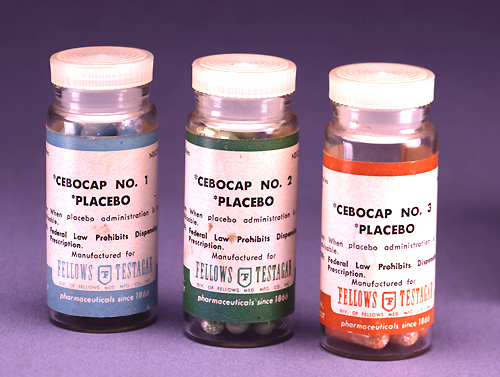
Placebos
are typically inert tablets, such as sugar
pills./プラセボとは、通常、砂糖の錠剤のような無効な錠剤のことだ。
| A placebo
(/pləˈsiːboʊ/ pluh-SEE-boh) is a medicine or treatment intended to
appear genuine to its recipient, but which has no pharmaceutical
effect.[1][2] Common placebos include inert tablets (like sugar pills),
inert injections (like saline), sham surgery,[3] and other
procedures.[4] Placebos are used in randomized clinical trials to test the efficacy of medical treatments. In a placebo-controlled trial, any change in the control group is known as the placebo response, and the difference between this and the result of no treatment is the placebo effect.[5] Placebos in clinical trials should ideally be indistinguishable from so-called verum treatments under investigation, except for the latter's particular hypothesized medicinal effect.[6] This is to shield test participants (with their consent) from knowing who is getting the placebo and who is getting the treatment under test, as patients' and clinicians' expectations of efficacy can influence results.[7][8] The idea of a "placebo effect" was discussed in 18th century psychology,[9] but became more prominent in the 20th century. Modern studies find that placebos can affect some outcomes such as pain and nausea, but otherwise do not generally have important clinical effects.[10] Improvements that patients experience after being treated with a placebo can also be due to unrelated factors, such as regression to the mean (a statistical effect where an unusually high or low measurement is likely to be followed by a less extreme one).[11] The use of placebos in clinical medicine raises ethical concerns, especially if they are disguised as an active treatment, as this introduces dishonesty into the doctor–patient relationship and bypasses informed consent.[12] Placebos are also popular because they can sometimes produce relief through psychological mechanisms (a phenomenon known as the "placebo effect"). They can affect how patients perceive their condition and encourage the body's chemical processes for relieving pain[11] and a few other symptoms,[13] but have no impact on the disease itself.[10][11] |
プラセボ(/pləˈsiːboʊ/
プラシーボ)[placebo]とは、受け
手には本物のように見えるが、薬理学的効果を持たない薬や治療法のことである。[1][2]
一般的なプラセボには、無効な錠剤(砂糖錠など)、無効な注射(生理食塩水など)、偽手術[3]、その他の処置などがある。[4] プラセボは、医療処置の有効性を検証するための無作為化臨床試験で使用される。プラセボ対照試験において、対照群に見られる変化はプラセボ反応と呼ばれ、 これと無治療の結果との差がプラセボ効果である。[5] 臨床試験におけるプラセボは、理想的には、調査対象となっているいわゆる実薬(ベラム)治療と、後者の特定の仮説上の薬理作用を除いては区別がつかないも のであるべきだ。[6] これは、(被験者の同意を得た上で)誰がプラセボを投与され、誰が試験中の治療を受けているかを知られないようにするためである。なぜなら、患者や臨床医 の有効性に対する期待が結果に影響を与える可能性があるからである。[7][8] 「プラセボ効果」という概念は18世紀の心理学において議論されていたが[9]、20世紀に入ってより注目されるようになった。現代の研究では、プラセボ は痛みや吐き気などの一部の結果に影響を与える可能性があるものの、それ以外では一般的に重要な臨床的効果を持たないことが分かっている。[10] プラセボ投与後に患者が感じる改善は、平均への回帰(異常なほど高いまたは低い測定値の後に、それほど極端ではない値が続く傾向があるという統計的効果) など、無関係な要因によるものかもしれない。[11] 臨床医学におけるプラセボの使用は、特に有効な治療薬として偽装されている場合、医師と患者の関係に不誠実さを持ち込み、インフォームド・コンセントを迂 回することになるため、倫理的な懸念を引き起こす。[12] プ ラセボが広く用いられるのは、心理的メカニズムを通じて症状の緩和をもたらすことがあるためでもある(これは「プラセボ効果」として知られる現象だ)。プ ラセボは、患者が自身の病状をどう認識するかに影響を与え、痛み[11]やその他のいくつかの症状[13]を和らげるための体内の化学的プロセスを促進す ることはできるが、病気そのものには何の影響も及ぼさない。[10][11] |
| Etymology and definition The Latin term placebo means [I] shall be pleasing.[14][15] The definition of placebo has been debated.[16] One definition states that a treatment process is a placebo when none of the characteristic treatment factors are effective (remedial or harmful) in the patient for a given disease.[17] In a clinical trial, a placebo response is the measured response of subjects to a placebo; the placebo effect is the difference between that response and no treatment.[5] The placebo response may include improvements due to natural healing, declines due to natural disease progression, the tendency for people who were temporarily feeling either better or worse than usual to return to their average situations (regression toward the mean), and errors in the clinical trial records, which can make it appear that a change has happened when nothing has changed.[18] It is also part of the recorded response to any active medical intervention.[19] Measurable placebo effects may be either objective (e.g. lowered blood pressure) or subjective (e.g. a lowered perception of pain).[1] |
語源と定義 ラテン語の「プラセボ」は、「[私は]喜ばせるであろう」という意味である。[14] [15] プラセボの定義については議論がある。[16] ある定義によれば、特定の疾患に対して、その治療に特徴的な要因のいずれもが患者に対して有効(治療的または有害)でない場合、その治療過程はプラセボで あるとする。[17] 臨床試験において、プラセボ反応とは被験者がプラセボに対して示す測定可能な反応であり、プラセボ効果とはその反応と無治療との差を指す。[5] プラセボ反応には、自然治癒による改善、疾患の自然経過による悪化、一時的に普段より体調が良かったり悪かったりしていた人が平均的な状態に戻る傾向(平 均への回帰)、および臨床試験記録の誤り(実際には変化がないにもかかわらず変化があったように見える場合)が含まれることがある。[18] また、それはいかなる能動的な医療介入に対する記録された反応の一部でもある。[19] 測定可能なプラセボ効果は、客観的なもの(例:血圧の低下)または主観的なもの(例:痛みの知覚の軽減)のいずれかである。[1] |
| Effects "Placebo effect" redirects here. For other uses, see Placebo effect (disambiguation). Further information: Alternative medicine § Perceived mechanism of effect The placebo effect is a well-documented phenomenon, though it remains widely misunderstood and surrounded by misconceptions.[2] Several studies have questioned its clinical relevance, fueling ongoing debate about its actual effectiveness. A 2001 meta-analysis of the placebo effect looked at trials in 40 different medical conditions, and concluded the only one where it had been shown to have a significant effect was for pain.[20] Another Cochrane review in 2010 suggested that placebo effects are apparent only in subjective, continuous measures, and in the treatment of pain and related conditions. The review found that placebos do not appear to affect the actual diseases, or outcomes that are not dependent on a patient's perception. The authors, Asbjørn Hróbjartsson and Peter C. Gøtzsche, concluded that their study "did not find that placebo interventions have important clinical effects in general."[10] This interpretation has been subject to criticism, particularly due to concerns about the adequacy of the methodology used.[21][22][23][24][25] Recent research has linked placebo interventions to improved motor functions in patients with Parkinson's disease.[13][26][27] Other objective outcomes affected by placebos include immune and endocrine parameters,[28][29] end-organ functions regulated by the autonomic nervous system,[30] and sport performance.[31] Measuring the extent of the placebo effect is difficult due to confounding factors.[32] For example, a patient may feel better after taking a placebo due to regression to the mean (i.e. a natural recovery or change in symptoms),[33][34][35] but this can be ruled out by comparing the placebo group with a no treatment group (as all the placebo research does). It is harder still to tell the difference between the placebo effect and the effects of response bias, observer bias and other flaws in trial methodology, as a trial comparing placebo treatment and no treatment will not be a blinded experiment.[10][33] In their 2010 meta-analysis of the placebo effect, Asbjørn Hróbjartsson and Peter C. Gøtzsche argue that "even if there were no true effect of placebo, one would expect to record differences between placebo and no-treatment groups due to bias associated with lack of blinding."[10] One way in which the magnitude of placebo analgesia can be measured is by conducting "open/hidden" studies, in which some patients receive an analgesic and are informed that they will be receiving it (open), while others are administered the same drug without their knowledge (hidden). Such studies have found that analgesics are considerably more effective when the patient knows they are receiving them.[36] |
効果 「プラセボ効果」はここへリダイレクトされる。その他の用法については、「プラセボ効果 (曖昧さ回避)」を参照のこと。 詳細情報:代替医療 § 効果のメカニズムに関する見解 プラセボ効果は十分に実証された現象であるが、依然として広く誤解されており、誤った認識に囲まれている。[2] いくつかの研究がその臨床的意義に疑問を呈しており、その実際の有効性について議論が続いている。2001年のプラセボ効果に関するメタ分析では、40種 類の異なる病態を対象とした試験を検討し、有意な効果が示されたのは疼痛のみであると結論付けた。[20] 2010年の別のコクラン・レビューでは、プラセボ効果は主観的かつ継続的な測定においてのみ認められ、疼痛および関連する病態の治療においてのみ現れる ことが示唆された。このレビューでは、プラセボは実際の疾患や、患者の認識に依存しない転帰には影響を及ぼさないようだとされた。著者であるアスビョル ン・フロビャルツソンとピーター・C・ゲッツシェは、彼らの研究において「プラセボ介入が一般的に重要な臨床的効果を持つとは認められなかった」と結論付 けた。[10] この解釈は、特に用いられた方法論の妥当性に関する懸念から、批判の対象となっている。[21][22][23][24][25] 最近の研究では、プラセボ介入がパーキンソン病患者の運動機能の改善と関連していることが示されている。[13][26][27] プラセボの影響を受けるその他の客観的転帰には、免疫および内分泌パラメータ[28][29]、自律神経系によって調節される末梢臓器機能[30]、ス ポーツパフォーマンスなどが含まれる。[31] 交絡因子の存在により、プラセボ効果の程度を測定することは困難である。[32] 例えば、患者は平均への回帰(すなわち自然回復や症状の変化)により、プラセボ服用後に体調が良くなったと感じる可能性がある。[33][34][35] しかし、これはプラセボ群と無治療群を比較することで排除できる(すべてのプラセボ研究がそうしているように)。さらに、プラセボ効果と、反応バイアス、 観察者バイアス、その他の試験方法論上の欠陥による効果との区別をつけることはより困難である。なぜなら、プラセボ治療と無治療を比較する試験は、盲検化 された実験ではないからである。[10][33] アスビョルン・フロビャルツソンとピーター・C・ゲッツシェは、2010年のプラセボ効果に関するメタ分析において、「たとえプラセボに真の効果がなかっ たとしても、盲検化の欠如に伴うバイアスにより、プラセボ群と無治療群の間に差異が記録されることが予想される」と論じている。[10] プラセボ鎮痛効果の大きさを測定する方法の一つとして、「オープン/隠蔽」試験が挙げられる。この試験では、一部の患者には鎮痛薬が投与され、その旨が伝 えられる(オープン)一方、他の患者には本人の知らないうちに同じ薬が投与される(隠蔽)。こうした研究により、患者が鎮痛薬の投与を受けていることを 知っている場合、その効果は著しく高まることが判明している。[36] |
| Factors influencing the power of
the placebo effect A review published in JAMA Psychiatry found that, in trials of antipsychotic medications, the change in response to receiving a placebo had increased significantly between 1960 and 2013. The review's authors identified several factors that could be responsible for this change, including inflation of baseline scores and enrollment of fewer severely ill patients.[37] Another analysis published in Pain in 2015 found that placebo responses had increased considerably in neuropathic pain clinical trials conducted in the United States from 1990 to 2013. The researchers suggested that this may be because such trials have "increased in study size and length" during this time period.[38] Individual differences in personality traits may influence susceptibility to placebo and nocebo (negative placebo) effects. People with a more optimistic outlook tend to exhibit stronger placebo responses, while those with higher levels of anxiety are more likely to experience nocebo effects.[39] Children seem to have a greater response than adults to placebos.[40] The administration of the placebos can determine the placebo effect strength. Studies have found that taking more pills would strengthen the effect. Capsules appear to be more influential than pills, and injections are even stronger than capsules.[41] Some studies have investigated the use of placebos where the patient is fully aware that the treatment is inert, known as an open-label placebo. Clinical trials found that open-label placebos may have positive effects in comparison to no treatment, which may open new avenues for treatments,[42] but a review of such trials noted that they were done with a small number of participants and hence should be interpreted with "caution" until further, better-controlled trials are conducted.[43] An updated 2021 systematic review and meta-analysis based on 11 studies also found a significant, albeit slightly smaller overall effect of open-label placebos, while noting that "research on OLPs is still in its infancy."[44] If the person dispensing the placebo shows their care towards the patient, is friendly and sympathetic, or has a high expectation of a treatment's success, then the placebo is more effectual.[41] |
プラセボ効果の強さに影響を与える要因 『JAMA Psychiatry』に掲載された総説によると、抗精神病薬の臨床試験において、プラセボ投与に対する反応の変化が1960年から2013年の間に著し く増加していたことが判明した。同総説の著者らは、この変化の原因となり得るいくつかの要因を特定しており、その中にはベースラインスコアの過大評価や、 重症患者の登録数が減少したことなどが含まれている。[37] 2015年に『Pain』誌に掲載された別の分析では、1990年から2013年にかけて米国で実施された神経因性疼痛の臨床試験において、プラセボ反応 が著しく増加していることが判明した。研究者らは、この期間中にこうした試験の「規模と期間が拡大した」ことが原因である可能性を示唆した。[38] 性格特性の個人差は、プラセボ効果やノセボ(負のプラセボ)効果に対する感受性に影響を与える可能性がある。楽観的な見方をする人はより強いプラセボ反応 を示す傾向がある一方、不安レベルが高い人はノセボ効果を経験しやすい。[39] 子供は大人よりもプラセボに対する反応が強いようだ。[40] プラセボの投与方法は、プラセボ効果の強さを左右する。研究によると、錠剤の服用量を増やすと効果が強まることが分かっている。カプセルは錠剤よりも影響 力が強く、注射はカプセルよりもさらに強い。[41] 一部の研究では、患者が治療が無効であることを完全に認識している状況でのプラセボの使用、いわゆるオープンラベル・プラセボについて調査されている。臨 床試験では、オープンラベル・プラセボは未治療と比較して肯定的な効果をもたらす可能性があり、これが治療の新たな道を開くかもしれないことが判明した [42]。しかし、こうした試験のレビューでは、参加者が少数であったため、より厳密に管理された追加の試験が行われるまでは「慎重」に解釈すべきである と指摘されている。[43] 11件の研究に基づく2021年の最新系統的レビューおよびメタ分析でも、オープンラベル・プラセボの全体的な効果は有意であるものの、その大きさはわず かに小さいことが示された。ただし、「OLPに関する研究はまだ初期段階にある」と指摘されている。[44] プラセボを投与する者が患者への配慮を示し、親しみやすく共感的であるか、あるいは治療の成功に対する期待が高い場合、プラセボの効果はより高くなる。 [41]a |
| Depression In 2008, a meta-analysis led by psychologist Irving Kirsch, analyzing data from the Food and Drug Administration (FDA), concluded that 82% of the response to antidepressants was accounted for by placebos.[45] However, other authors expressed doubts about the used methods and the interpretation of the results, especially the use of 0.5 as the cut-off point for the effect size.[46] A complete reanalysis and recalculation based on the same FDA data found that the Kirsch study had "important flaws in the calculations."[47] The authors concluded that although a large percentage of the placebo response was due to expectancy, this was not true for the active drug.[47] Besides confirming drug effectiveness, they found that the drug effect was not related to depression severity.[47] Another meta-analysis found that 79% of depressed patients receiving placebo remained well (for 12 weeks after an initial 6–8 weeks of successful therapy) compared to 93% of those receiving antidepressants. In the continuation phase however, patients on placebo relapsed significantly more often than patients on antidepressants.[48] |
うつ病 2008年、心理学者アーヴィング・カーシュが主導したメタ分析では、米国食品医薬品局(FDA)のデータを分析した結果、抗うつ薬への反応の82%はプ ラセボ効果によるものであると結論づけられた。[45] しかし、他の研究者たちは、用いられた手法や結果の解釈、特に効果量のカットオフ値として0.5を採用したことについて疑問を呈した。[46] 同じFDAのデータに基づく完全な再分析と再計算の結果、キルシュの研究には「計算上の重大な欠陥」があることが判明した。[47] 著者らは、プラセボ反応の大部分は期待効果によるものであるものの、実薬についてはそうではないと結論付けた。[47] 薬物の有効性を裏付けるだけでなく、薬物効果はうつ病の重症度とは関連していないことも明らかになった。[47] 別のメタ分析では、プラセボを投与されたうつ病患者の79%が(最初の6~8週間の治療成功後、さらに12週間)良好な状態を維持したのに対し、抗うつ薬 を投与された患者では93%であった。しかし、継続治療段階では、プラセボ群の患者は抗うつ薬群の患者よりも有意に高い頻度で再発した。[48]a |
| Negative effects Main article: Nocebo A phenomenon opposite to the placebo effect has also been observed. When an inactive substance or treatment is administered to a recipient who has an expectation of it having a negative impact, this intervention is known as a nocebo (Latin nocebo = "I shall harm").[49] A nocebo effect occurs when the recipient of an inert substance reports a negative effect or a worsening of symptoms, with the outcome resulting not from the substance itself, but from negative expectations about the treatment.[50][51] Another negative consequence is that placebos can cause side-effects associated with real treatment.[52] Withdrawal symptoms can also occur after placebo treatment. This was found, for example, after the discontinuation of the Women's Health Initiative study of hormone replacement therapy for menopause. Women had been on placebo for an average of 5.7 years. Moderate or severe withdrawal symptoms were reported by 4.8% of those on placebo compared to 21.3% of those on hormone replacement.[53] |
負の効果 本記事:ノセボ プラセボ効果とは逆の現象も観察されている。無効な物質や治療法を、それが悪影響を及ぼすと期待している被験者に投与した場合、この介入はノセボ(ラテン 語のnocebo=「害を与える」)として知られる。[49] ノセボ効果とは、不活性物質の投与を受けた被験者が、その物質自体によるものではなく、治療に対する否定的な期待によって、悪影響や症状の悪化を報告する 現象である。[50][51] もう一つの悪影響として、プラセボが実際の治療に伴う副作用を引き起こすことがある。[52] プラセボ治療の後にも離脱症状が生じることがある。例えば、更年期障害に対するホルモン補充療法に関する「女性健康イニシアティブ(Women's Health Initiative)」研究の中止後に、このことが確認された。女性たちは平均5.7年間プラセボを服用していた。中等度または重度の離脱症状は、プラ セボ群の4.8%が報告したのに対し、ホルモン補充療法群では21.3%であった。[53] |
| Ethics See also: Medical ethics and Philosophy of medicine In research trials Knowingly giving a person a placebo when there is an effective treatment available is a bioethically complex issue. While placebo-controlled trials might provide information about the effectiveness of a treatment, it denies some patients what could be the best available (if unproven) treatment. Informed consent is usually required for a study to be considered ethical, including the disclosure that some test subjects will receive placebo treatments. The ethics of placebo-controlled studies have been debated in the revision process of the Declaration of Helsinki. Of particular concern has been the difference between trials comparing inert placebos with experimental treatments, versus comparing the best available treatment with an experimental treatment; and differences between trials in the sponsor's developed countries versus the trial's targeted developing countries.[54] Some suggest that existing medical treatments should be used instead of placebos, to avoid having some patients not receive medicine during the trial.[55] In medical practice The practice of doctors prescribing placebos that are disguised as real medication is controversial. A chief concern is that it is deceptive and could harm the doctor–patient relationship in the long run. While some say that blanket consent, or the general consent to unspecified treatment given by patients beforehand, is ethical, others argue that patients should always obtain specific information about the name of the drug they are receiving, its side effects, and other treatment options.[56] This view is shared by some on the grounds of patient autonomy.[57] There are also concerns that legitimate doctors and pharmacists could open themselves up to charges of fraud or malpractice by using a placebo.[58] Critics also argued that using placebos can delay the proper diagnosis and treatment of serious medical conditions.[59] Despite the abovementioned issues, 60% of surveyed physicians and head nurses reported using placebos in an Israeli study, with only 5% of respondents stating that placebo use should be strictly prohibited.[60] A British Medical Journal editorial said, "that a patient gets pain relief from a placebo does not imply that the pain is not real or organic in origin ...the use of the placebo for 'diagnosis' of whether or not pain is real is misguided."[61] A survey in the United States of more than 10,000 physicians came to the result that while 24% of physicians would prescribe a treatment that is a placebo simply because the patient wanted treatment, 58% would not, and for the remaining 18%, it would depend on the circumstances.[62] Referring specifically to homeopathy, the House of Commons of the United Kingdom Science and Technology Committee has stated: In the Committee's view, homeopathy is a placebo treatment and the Government should have a policy on prescribing placebos. The Government is reluctant to address the appropriateness and ethics of prescribing placebos to patients, which usually relies on some degree of patient deception. Prescribing of placebos is not consistent with informed patient choice—which the Government claims is very important—as it means patients do not have all the information needed to make choice meaningful. A further issue is that the placebo effect is unreliable and unpredictable.[63] In his 2008 book Bad Science, Ben Goldacre argues that instead of deceiving patients with placebos, doctors should use the placebo effect to enhance effective medicines.[64] Edzard Ernst has argued similarly that "As a good doctor you should be able to transmit a placebo effect through the compassion you show your patients."[65] In an opinion piece about homeopathy, Ernst argues that it is wrong to support alternative medicine on the basis that it can make patients feel better through the placebo effect.[66] His concerns are that it is deceitful and that the placebo effect is unreliable.[66] Goldacre also concludes that the placebo effect does not justify alternative medicine, arguing that unscientific medicine could lead to patients not receiving prevention advice.[64] Placebo researcher Fabrizio Benedetti also expresses concern over the potential for placebos to be used unethically, warning that there is an increase in "quackery" and that an "alternative industry that preys on the vulnerable" is developing.[67] |
倫理 関連項目:医療倫理、医学哲学 臨床試験において 有効な治療法が存在するにもかかわらず、意図的に被験者にプラセボを投与することは、生命倫理上、複雑な問題である。プラセボ対照試験は治療法の有効性に 関する情報を提供し得る一方で、一部の患者に対して、現時点で最良(未検証ではあるが)の治療法を受けられる機会を奪うことになる。研究が倫理的であると 認められるためには、通常、インフォームド・コンセントが必要であり、これには一部の被験者がプラセボ治療を受けることについての開示も含まれる。 プラセボ対照試験の倫理については、『ヘルシンキ宣言』の改訂過程において議論されてきた。特に懸念されているのは、無効なプラセボと実験的治療を比較す る試験と、最善の既存治療と実験的治療を比較する試験との違い、および試験のスポンサーである先進国と、試験の対象となる発展途上国との間の違いである。 [54] 一部の意見では、試験中に一部の患者が薬を受けられない事態を避けるため、プラセボの代わりに既存の医療処置を用いるべきだとされている。[55] 医療現場において 医師が本物の薬に見せかけたプラセボを処方する慣行は、物議を醸している。主な懸念は、それが欺瞞的であり、長期的には医師と患者の関係を損なう可能性が あるという点だ。事前に患者から与えられた「包括的同意」、すなわち不特定の治療に対する一般的な同意は倫理的であるとする意見がある一方で、患者は常 に、投与される薬剤の名称、副作用、その他の治療選択肢に関する具体的な情報を得るべきだと主張する者もいる。[56] この見解は、患者の自律性を理由として一部の人々にも共有されている。[57] また、正当な医師や薬剤師がプラセボを使用することで、詐欺や医療過誤の告発を受けるリスクが生じるという懸念もある。[58] 批判派はさらに、プラセボの使用が重篤な疾患の適切な診断や治療を遅らせる可能性があると主張した。[59] 上述の問題があるにもかかわらず、イスラエルでの調査では、回答した医師および看護主任の60%がプラセボを使用していると報告し、プラセボの使用を厳格 に禁止すべきだと答えたのは回答者のわずか5%であった。[60] 『ブリティッシュ・メディカル・ジャーナル』の社説は、「患者がプラセボによって痛みが和らぐからといって、その痛みが現実のものでない、あるいは器質的 な原因によるものではないことを意味するわけではない……痛みが現実のものかどうかを『診断』するためにプラセボを使用することは誤った考え方である」と 述べている。[61] 米国で1万人以上の医師を対象に行った調査では、患者が治療を望んでいるという理由だけでプラセボ治療を処方すると答えた医師は24%であった一方、 58%は処方しないと答え、残りの18%は状況次第であると回答した。[62] ホメオパシーに特に言及して、英国下院科学技術委員会は次のように述べている: 委員会の見解では、ホメオパシーはプラセボ療法であり、政府はプラセボの処方に関する方針を持つべきである。政府は、通常ある程度の患者への欺瞞を伴うプ ラセボの処方について、その適切性や倫理性を検討することに消極的である。プラセボの処方は、政府が極めて重要だと主張する「患者による十分な情報に基づ く選択」と矛盾する。なぜなら、それは患者が有意義な選択を行うために必要な情報をすべて持っていないことを意味するからである。さらなる問題は、プラセ ボ効果が信頼できず、予測不可能であるという点だ。[63] ベン・ゴールドアカーは2008年の著書『Bad Science』において、医師はプラセボで患者を欺くのではなく、プラセボ効果を利用して有効な医薬品の効果を高めるべきだと論じている。[64] エドザード・エルンストも同様に、「優れた医師であれば、患者に示す思いやりを通じてプラセボ効果を伝えることができるはずだ」と主張している。[65] ホメオパシーに関する論説の中で、エルンストは、プラセボ効果によって患者の気分が良くなるという理由で代替医療を支持するのは誤りだと論じている。 [66] 彼の懸念は、それが欺瞞的であり、プラセボ効果が信頼できないという点にある。[66] ゴールドアカーもまた、プラセボ効果は代替医療を正当化するものではないと結論付けており、非科学的な医療は患者が予防に関する助言を受けられなくなる可 能性があると主張している。[64] プラセボ研究者のファブリツィオ・ベネデッティも、プラセボが非倫理的に使用される可能性について懸念を表明し、「偽医療」の増加や、「弱者を食い物にす る代替医療産業」が台頭していることを警告している。[67] |
| Mechanisms The mechanism for how placebos could have effects is uncertain. From a sociocognitive perspective, intentional placebo response is attributed to the "ritual effect" that induces anticipation for transition to a better state.[68] A placebo presented as a stimulant may trigger an effect on heart rhythm and blood pressure, but when administered as a depressant, the opposite effect.[69] Psychology  The subjective effects of placebos may be related to expectations, yet similar effects have been noted in open-label studies. In psychology, the two main hypotheses of the placebo effect are expectancy theory and classical conditioning.[70] In 1985, Irving Kirsch hypothesized that placebo effects are produced by the self-fulfilling effects of response expectancies, in which the belief that one will feel different leads a person to actually feel different.[71] According to this theory, the belief that one has received an active treatment can produce the subjective changes thought to be produced by the real treatment. Similarly, the appearance of effect can result from classical conditioning, wherein a placebo and an actual stimulus are used simultaneously until the placebo is associated with the effect from the actual stimulus.[72] Both conditioning and expectations play a role in placebo effect,[70] and make different kinds of contributions. Conditioning has a longer-lasting effect,[73] and can affect earlier stages of information processing.[74] Those who think a treatment will work display a stronger placebo effect than those who do not, as evidenced by a study of acupuncture.[75] Additionally, motivation may contribute to the placebo effect. The active goals of an individual changes their somatic experience by altering the detection and interpretation of expectation-congruent symptoms, and by changing the behavioral strategies a person pursues.[76] Motivation may link to the meaning through which people experience illness and treatment. Such meaning is derived from the culture in which they live and which informs them about the nature of illness and how it responds to treatment.[citation needed] Placebo analgesia Functional imaging upon placebo analgesia suggests links to the activation, and increased functional correlation between this activation, in the anterior cingulate, prefrontal, orbitofrontal and insular cortices, nucleus accumbens, amygdala, the brainstem's periaqueductal gray matter,[77][78] and the spinal cord.[79][80][81] Since 1978, it has been known that placebo analgesia depends upon the release of endogenous opioids in the brain.[82] Such analgesic placebos activation changes processing lower down in the brain by enhancing the descending inhibition through the periaqueductal gray on spinal nociceptive reflexes, while the expectations of anti-analgesic nocebos acts in the opposite way to block this.[79] Functional imaging upon placebo analgesia has been summarized as showing that the placebo response is "mediated by 'top-down' processes dependent on frontal cortical areas that generate and maintain cognitive expectancies. Dopaminergic reward pathways may underlie these expectancies."[83] "Diseases lacking major 'top-down' or cortically based regulation may be less prone to placebo-related improvement."[84] Brain and body Further information: Neural top–down control of physiology In conditioning, a neutral stimulus saccharin is paired in a drink with an agent that produces an unconditioned response. For example, that agent might be cyclophosphamide, which causes immunosuppression. After learning this pairing, the taste of saccharin by itself is able to cause immunosuppression, as a new conditioned response via neural top-down control.[85] Such conditioning has been found to affect a diverse variety of not just basic physiological processes in the immune system but ones such as serum iron levels, oxidative DNA damage levels, and insulin secretion. Recent reviews have argued that the placebo effect is due to top-down control by the brain for immunity[29] and pain.[86] Pacheco-López and colleagues have raised the possibility of "neocortical-sympathetic-immune axis providing neuroanatomical substrates that might explain the link between placebo/conditioned and placebo/expectation responses."[29]: 441 There has also been research aiming to understand underlying neurobiological mechanisms of action in pain relief, immunosuppression, Parkinson's disease and depression.[87] Dopaminergic pathways have been implicated in the placebo response in pain and depression.[88] |
メカニズム プラセボがどのように効果を発揮するかというメカニズムは定かではない。社会認知的観点からは、意図的なプラセボ反応は、より良い状態への移行に対する期 待を誘発する「儀礼的効果」に起因するとされる。[68] 興奮剤として提示されたプラセボは心拍数や血圧に影響を与える可能性があるが、鎮静剤として投与された場合は逆の効果が生じる。[69] 心理学 プラセボの主観的効果は期待に関連している可能性があるが、非盲検試験でも同様の効果が認められている。 心理学において、プラセボ効果の主な仮説は、期待理論と古典的条件付けの2つである。[70] 1985年、アーヴィング・カーシュは、プラセボ効果は反応期待の自己成就的効果によって生じると仮説を立てた。これは、自分が異なる気分になると信じる ことで、実際に異なる気分になるというものである。[71] この理論によれば、有効な治療を受けたという信念が、実際の治療によってもたらされると考えられる主観的な変化を引き起こし得る。同様に、効果の表れは古 典的条件付けに起因し得る。これは、プラセボと実際の刺激を同時に用いて、プラセボが実際の刺激による効果と関連付けられるようになるまで繰り返すもので ある。[72] 条件付けと期待の両方がプラセボ効果に関与しており[70]、それぞれ異なる形で寄与している。条件付けはより長期的な効果を持ち[73]、情報処理の初 期段階に影響を及ぼし得る[74]。鍼治療に関する研究が示すように、治療が効くと考える人は、そう思わない人よりも強いプラセボ効果を示す[75]。 さらに、動機付けもプラセボ効果に寄与する可能性がある。個人の能動的な目標は、期待と一致する症状の検知や解釈を変化させ、またその人が追求する行動戦 略を変えることで、身体的体験を変化させる。[76] 動機付けは、人々が病気や治療を経験する上での意味と結びついている可能性がある。そのような意味は、彼らが生活する文化から派生しており、その文化は病 気の本質や治療への反応について彼らに情報を与えている。[出典必要] プラセボ鎮痛 プラセボ鎮痛に関する機能的画像診断は、前帯状皮質、前頭前野、眼窩前頭皮質、島皮質、側坐核、扁桃体、脳幹の導水管周囲灰白質[77][78]、および 脊髄[79][80]における活性化との関連、およびこれらの活性化間の機能的相関の増大を示唆している。[81] 1978年以来、プラセボ鎮痛は脳内での内因性オピオイドの放出に依存することが知られている。[82] このような鎮痛性プラセボは、中脳水道周囲灰白質を介した下降性抑制を強化することで、脳の下位領域における処理を変化させ、脊髄の侵害受容反射を抑制す る一方、鎮痛を阻害するノセボへの期待は、これを遮断するために逆の作用を及ぼす。[79] プラセボ鎮痛に関する機能的画像診断の研究は、プラセボ反応が「認知的期待を生成・維持する前頭前皮質領域に依存する『トップダウン』プロセスによって媒 介される」ことを示していると要約されている。[83] 「主要な『トップダウン』調節や皮質に基づく調節を欠く疾患は、プラセボ関連の改善が見られにくい可能性がある。」[84] 脳と身体 詳細情報:生理機能に対する神経系のトップダウン制御 条件付けにおいて、中立刺激であるサッカリンは、無条件反応を引き起こす薬剤と飲料の中で結びつけられる。例えば、その物質は免疫抑制を引き起こすシクロ ホスファミドである可能性がある。このペアリングを学習した後、サッカリンの味そのものが、神経系のトップダウン制御を介した新たな条件反応として、免疫 抑制を引き起こすようになる。[85] このような条件付けは、免疫系の基本的な生理的プロセスだけでなく、血清鉄濃度、DNAの酸化損傷レベル、インスリン分泌など、多岐にわたるプロセスに影 響を及ぼすことが判明している。最近の総説では、プラセボ効果は、免疫[29]および疼痛[86]に対する脳によるトップダウン制御に起因すると論じられ ている。Pacheco-Lópezらは、「新皮質-交感神経-免疫軸が、プラセボ/条件付け反応とプラセボ/期待反応の関連性を説明し得る神経解剖学的 基盤を提供している」可能性を提起している。[29]: 441 また、疼痛緩和、免疫抑制、パーキンソン病、うつ病における作用の根底にある神経生物学的メカニズムの解明を目指す研究も行われている。[87] ドーパミン作動性経路は、疼痛およびうつ病におけるプラセボ反応に関与していることが示唆されている。[88] |
| Confounding factors Placebo-controlled studies, as well as studies of the placebo effect itself, often fail to adequately identify confounding factors.[11][89] False impressions of placebo effects are caused by many factors including:[11][33][89][70][90] Regression to the mean (natural recovery or fluctuation of symptoms) Additional treatments Response bias from subjects, including scaling bias, answers of politeness, experimental subordination, conditioned answers; Reporting bias from experimenters, including misjudgment and irrelevant response variables. Non-inert ingredients of the placebo medication having an unintended physical effect. |
交絡因子 プラセボ対照試験や、プラセボ効果そのものを対象とした研究では、交絡因子が十分に特定されていないことがよくある。[11][89] プラセボ効果に対する誤った印象は、以下のような多くの要因によって引き起こされる。[11][33][89][70][90] 平均への回帰(自然治癒または症状の変動) 追加治療 被験者による反応バイアス(評価バイアス、礼儀的な回答、実験への従属、条件付けられた回答など) 実験者による報告バイアス(誤判断や無関係な反応変数など) プラセボ薬剤に含まれる非不活性成分による意図しない身体的影響。 |
| History Main article: Placebo in history  A quack treating a patient with Perkins Patent Tractors by James Gillray, 1801. John Haygarth used this remedy to illustrate the power of the placebo effect. The word placebo was used in a medicinal context in the late 18th century to describe a "commonplace method or medicine" and in 1811 it was defined as "any medicine adapted more to please than to benefit the patient." Although this definition contained a derogatory implication[91] it did not necessarily imply that the remedy had no effect.[92] It was recognized in the 18th and 19th centuries that drugs or remedies often were perceived to work best while they were still novel:[93] We know that, in Paris, fashion imposes its dictates on medicine just as it does with everything else. Well, at one time, pyramidal elm bark[94] had a great reputation; it was taken as a powder, as an extract, as an elixir, even in baths. It was good for the nerves, the chest, the stomach—what can I say?— it was a true panacea. At the peak of the fad, one of Bouvard's [sic] patients asked him if it might not be a good idea to take some: "Take it, Madame", he replied, "and hurry up while it [still] cures." [dépêchez-vous pendant qu'elle guérit] — Gaston de Lévis quoting Michel-Philippe Bouvart in the 1780s[95] Placebos have featured in medical use until well into the twentieth century.[96] An influential 1955 study entitled The Powerful Placebo firmly established the idea that placebo effects were clinically important,[20] and were a result of the brain's role in physical health. A 1997 reassessment found no evidence of any placebo effect in the source data, as the study had not accounted for regression to the mean.[33][32][97] Placebo-controlled studies Main article: Placebo-controlled study The placebo effect makes it more difficult to evaluate new treatments. Clinical trials control for this effect by including a group of subjects that receives a sham treatment. The subjects in such trials are blinded as to whether they receive the treatment or a placebo. If a person is given a placebo under one name, and they respond, they will respond in the same way on a later occasion to that placebo under that name but not if under another.[98] Clinical trials are often double-blinded so that the researchers also do not know which test subjects are receiving the active or placebo treatment. The placebo effect in such clinical trials is weaker than in normal therapy since the subjects are not sure whether the treatment they are receiving is active.[99] |
歴史 主な記事:歴史におけるプラセボ ジェームズ・ギルレイ作『パーキンス特許トラクターで患者を治療する偽医者』(1801年)。ジョン・ヘイガースは、プラセボ効果の力を示すためにこの治 療法を用いた。 「プラセボ」という言葉は、18世紀後半に医学的文脈で「ありふれた方法や薬」を表すために用いられ、1811年には「患者に利益をもたらすというより は、単に喜ばせるために適したあらゆる薬」と定義された。この定義には蔑視的な含みがあったものの[91]、必ずしもその治療法に効果がないことを意味し ていたわけではない。[92] 18世紀から19世紀にかけて、薬や治療法は、まだ目新しいうちに最も効果があると見なされることが多いことが認識されていた[93]: パリでは、他のあらゆるものと同様に、流行が医学にもその掟を押し付けていることは周知の事実だ。さて、かつてはピラミッドニレの樹皮[94]が絶大な評 判を博していた。粉末として、抽出液として、エリキシルとして、さらには入浴剤としても用いられた。神経にも、胸にも、胃にも効く――何と言えばいいだろ うか――まさに万能薬だったのだ。その流行の絶頂期、ブーヴァール[sic]の患者の一人が、これを服用するのは良い考えではないか、と彼に尋ねた。「ど うぞお飲みください、奥様」と彼は答えた。「そして、それが[まだ]治すうちに急いでください。」[dépêchez-vous pendant qu'elle guérit] — 1780年代、ガストン・ド・レヴィがミシェル=フィリップ・ブヴァールを引用[95] プラセボは20世紀半ばまで医療現場で使用されていた。[96] 1955年の影響力ある研究『The Powerful Placebo』は、プラセボ効果が臨床的に重要であり[20]、身体の健康における脳の役割の結果であることを確固たるものにした。1997年の再評価 では、当該研究が平均への回帰を考慮していなかったため、原データにプラセボ効果の証拠は認められなかった。[33][32][97] プラセボ対照試験 本記事:プラセボ対照試験 プラセボ効果により、新しい治療法の評価はより困難になる。臨床試験では、偽治療を受ける被験者グループを設けることで、この効果をコントロールしてい る。こうした試験の被験者は、自分が治療を受けているのかプラセボを受けているのかを知らされていない。ある名称でプラセボを投与され、それに反応した人 は、後日同じ名称のプラセボを投与された場合には同様に反応するが、別の名称のプラセボを投与された場合には反応しない。[98] 臨床試験では、研究者もどの被験者が有効成分を含む治療を受けているか、あるいはプラセボ治療を受けているかを知らないようにするため、しばしば二重盲検 法が採用される。このような臨床試験におけるプラセボ効果は、通常の治療よりも弱い。なぜなら、被験者は自分が受けている治療が有効なものかどうか確信が 持てないからである。[99] |
| Cultural influences Anthropologists argue that culture affects the ways in which individuals perceive medication, from different rituals and methods of healing, leading to placebo. Hahn and Kleinman (1983) propose an "ethnomedicogenic thesis" of placebo, wherein the ethnomedical system generates a feedback loop: cultural beliefs influence the disease state produced and effective treatments reinforce the belief system.[100] "Symbolic effectiveness," a term coined by Claude Levi-Strauss relating to Shamanism, can result in a placebo effect as symbols displayed by the Shaman provide the patient with a form of "verbal expression" that can create a healing response within the patient.[101] Apud and Romaní say that Shamans are a sort of psychoanalytical therapist, while many other cultural rituals and practices such as religion provide a psychological effect on the medical outcome of the patient, resulting in a placebo effect.[102] Hyland and Whalley conclude that carrying out a ritual, rather than believing in the ritual, may be an important factor in long-term placebo effects.[103] One anthropological perspective of rituals describe them as repetitive activities that intend to provide a sense of significance to one's life, giving them a sense that their bodily experience is in the hands of the world, out of their control as a result of patterns and rules, external to their own body.[104] Rituals are an attempt to "control nature," meaning that they can heal which results in the individual experience of placebo.[105] 100. Hahn, R. A., & Kleinman, A. (1983). Belief as Pathogen, Belief as Medicine: "Voodoo Death" and the "Placebo Phenomenon" in Anthropological Perspective. Medical Anthropology Quarterly, 14(4), 3–19. 101. Apud, I., & Romaní, O. (2019). Medical anthropology and symbolic cure: from the placebo to cultures of meaningful healing. Anthropology & Medicine, 27(2), 160–175. 102. Apud, I., & Romaní, O. (2019). Medical anthropology and symbolic cure: from the placebo to cultures of meaningful healing. Anthropology & Medicine, 27(2), 160–175. 103. Ostenfeld-Rosenthal, A. M. (2012). Energy healing and the placebo effect. An anthropological perspective on the placebo effect. Anthropology & Medicine, 19(3), 327–338. 104. Brody, H. (2010). Ritual, medicine, and the placebo response. The problem of ritual efficacy, 151, 167. 105. Brody, H. (2010). Ritual, medicine, and the placebo response. The problem of ritual efficacy, 151, 167. |
文化的影響 人類学者は、文化が、異なる儀礼や治療法を通じて個人が薬物を認識する方法に影響を与え、それがプラセボ効果につながると主張している。ハーンとクライン マン(1983)は、プラセボに関する「民族医学的仮説」を提唱しており、そこでは民族医学的システムがフィードバックループを生み出すとしている。すな わち、文化的信念が引き起こされる病状に影響を与え、効果的な治療がその信念体系を強化するのである。[100] クロード・レヴィ=ストロースがシャーマニズムに関連して造語した「象徴的有効性」は、シャーマンが示す象徴が患者に一種の「言語的表現」を提供し、患者 の内部に治癒反応を生み出すことで、プラセボ効果をもたらす可能性がある。[101] アプードとロマニは、シャーマンは一種の精神分析療法士であると述べている。一方、宗教など他の多くの文化的儀礼や慣行も、患者の医療的転帰に心理的効果 をもたらし、プラセボ効果を引き起こす。[102] ハイランドとウォリーは、儀礼を信じるということよりも、儀礼を行うこと自体が、長期的なプラセボ効果における重要な要因である可能性があると結論づけて いる。[103] 儀礼に関するある人類学的視点では、儀礼は人生に意義を与えることを意図した反復的な活動であり、自身の身体的経験が、自身の身体の外にあるパターンや規 則の結果として、自身の制御の及ばない世界の手に委ねられているという感覚を与えると説明している。[104] 儀礼は「自然を制御する」試みであり、つまり、それらが治癒をもたらし、その結果として個人がプラセボを経験することになる。[105] 100. Hahn, R. A., & Kleinman, A. (1983). 病原体としての信念、治療薬としての信念:「ヴードゥーの死」と「プラセボ現象」の人類学的視点. Medical Anthropology Quarterly, 14(4), 3–19. 101. Apud, I., & Romaní, O. (2019). 医療人類学と象徴的治癒:プラセボから意味ある治癒の文化へ。Anthropology & Medicine, 27(2), 160–175. 102. Apud, I., & Romaní, O. (2019). 医療人類学と象徴的治癒:プラセボから意味ある癒しの文化へ。Anthropology & Medicine, 27(2), 160–175. 103. オステンフェルド=ローゼンタール, A. M. (2012). エネルギー・ヒーリングとプラセボ効果。プラセボ効果に関する人類学的視点。Anthropology & Medicine, 19(3), 327–338. 104. Brody, H. (2010). 儀礼、医療、そしてプラセボ反応。儀礼の有効性という問題, 151, 167. 105. Brody, H. (2010). 儀礼、医療、そしてプラセボ反応。儀礼の有効性という問題, 151, 167. |
| E. Morton Jellinek § Recognition
of placebo effect List of effects List of topics characterized as pseudoscience Amplified placebo effect Inverse placebo effect Lessebo effect Placebo button Self-fulfilling prophecy[106] |
E. モートン・ジェリネック § プラセボ効果の認識 効果の一覧 疑似科学とみなされるトピックの一覧 増幅されたプラセボ効果 逆プラセボ効果 レッセボ効果 プラセボボタン 自己成就予言[106] |
| References 01. Ashar YK, Chang LJ, Wager TD (2017). "Brain Mechanisms of the Placebo Effect: An Affective Appraisal Account". Annual Review of Clinical Psychology. 13: 73–98. doi:10.1146/annurev-clinpsy-021815-093015. PMID 28375723. Lombardi F (2025). "Shedding Light on the Placebo Effect". Think. 24 (70). Cambridge University Press: 43–48. doi:10.1017/S1477175625000223. Gottlieb S (18 February 2014). "The FDA Wants You for Sham Surgery". Wall Street Journal. Retrieved 8 January 2015. Lanotte M, Lopiano L, Torre E, Bergamasco B, Colloca L, Benedetti F (November 2005). "Expectation enhances autonomic responses to stimulation of the human subthalamic limbic region". Brain, Behavior, and Immunity. 19 (6): 500–509. doi:10.1016/j.bbi.2005.06.004. PMID 16055306. S2CID 36092163. Chaplin S (2006). "The placebo response: an important part of treatment". Prescriber. 17 (5): 16–22. doi:10.1002/psb.344. S2CID 72626022. Blease C, Annoni M (April 2019). "Overcoming disagreement: a roadmap for placebo studies". Biology & Philosophy. 34 (2) 18. doi:10.1007/s10539-019-9671-5. ISSN 0169-3867. "placebo". Dictionary.com. 9 April 2016. Retrieved 21 January 2017. "placebo". TheFreeDictionary.com. Retrieved 21 January 2017. Schwarz, K. A., & Pfister, R.: Scientific psychology in the 18th century: a historical rediscovery. In: Perspectives on Psychological Science, Nr. 11, pp. 399–407. 10. Hróbjartsson A, Gøtzsche PC (January 2010). Hróbjartsson A (ed.). "Placebo interventions for all clinical conditions" (PDF). The Cochrane Database of Systematic Reviews. 106 (1) CD003974. doi:10.1002/14651858.CD003974.pub3. PMC 7156905. PMID 20091554. Archived from the original (PDF) on 2019-04-02. Retrieved 2018-06-25. "Placebo Effect". American Cancer Society. 10 April 2015. Archived from the original on 2020-05-22. Retrieved 2021-06-27. Newman DH (2008). Hippocrates' Shadow. Scribner. pp. 134–159. ISBN 978-1-4165-5153-9. Quattrone A, Barbagallo G, Cerasa A, Stoessl AJ (August 2018). "Neurobiology of placebo effect in Parkinson's disease: What we have learned and where we are going". Movement Disorders. 33 (8): 1213–1227. doi:10.1002/mds.27438. ISSN 1531-8257. PMID 30230624. S2CID 52294141. "Placebo (origins of technical term)". TheFreeDictionary.com. Retrieved 2021-02-07. Jacobs B (April 2000). "Biblical origins of placebo". Journal of the Royal Society of Medicine. 93 (4): 213–214. doi:10.1177/014107680009300419. PMC 1297986. PMID 10844895. Blease C, Annoni M (2019-03-14). "Overcoming disagreement: a roadmap for placebo studies". Biology & Philosophy. 34 (2): 18. doi:10.1007/s10539-019-9671-5. ISSN 1572-8404. S2CID 254281187. Howick J (2017). "The relativity of 'placebos': defending a modified version of Grünbaum's definition". Synthese. 194 (4): 1363–1396. doi:10.1007/s11229-015-1001-0. Kaptchuk TJ, Hemond CC, Miller FG (2020-07-20). "Placebos in chronic pain: evidence, theory, ethics, and use in clinical practice". BMJ. 370 m1668. doi:10.1136/bmj.m1668. ISSN 1756-1833. PMID 32690477. S2CID 220633770. Eccles R (2002). "The powerful placebo in cough studies?". Pulmonary Pharmacology & Therapeutics. 15 (3): 303–308. doi:10.1006/pupt.2002.0364. PMID 12099783. 20. Hróbjartsson A, Gøtzsche PC (May 2001). "Is the placebo powerless? An analysis of clinical trials comparing placebo with no treatment". The New England Journal of Medicine. 344 (21): 1594–1602. doi:10.1056/NEJM200105243442106. PMID 11372012. Vase L, Petersen GL, Riley JL, Price DD (2009-09-01). "Factors contributing to large analgesic effects in placebo mechanism studies conducted between 2002 and 2007". PAIN. 145 (1): 36–44. doi:10.1016/j.pain.2009.04.008. ISSN 0304-3959. PMID 19559529. S2CID 5790594. Spiegel D, Kraemer H, Carlson RW (2001-10-01). "Is the placebo powerless". The New England Journal of Medicine. 345 (17): 1276, author reply 1278–9. doi:10.1056/nejm200110253451712. ISSN 1533-4406. PMID 11680452. "Apples, oranges, and placebos: Heterogeneity in a meta-analysis of placebo effects". Advances in Mind-Body Medicine. Wampold BE, Imel ZE, Minami T (April 2007). "The story of placebo effects in medicine: Evidence in context". Journal of Clinical Psychology. 63 (4): 379–390. doi:10.1002/jclp.20354. PMID 17279527. Wampold BE, Minami T, Tierney SC, Baskin TW, Bhati KS (July 2005). "The placebo is powerful: Estimating placebo effects in medicine and psychotherapy from randomized clinical trials". Journal of Clinical Psychology. 61 (7): 835–854. doi:10.1002/jclp.20129. ISSN 0021-9762. PMID 15827993. Gross L (February 2017). "Putting placebos to the test". PLOS Biology. 15 (2) e2001998. doi:10.1371/journal.pbio.2001998. ISSN 1545-7885. PMC 5319646. PMID 28222121. Enck P, Bingel U, Schedlowski M, Rief W (March 2013). "The placebo response in medicine: minimize, maximize or personalize?". Nature Reviews Drug Discovery. 12 (3): 191–204. doi:10.1038/nrd3923. ISSN 1474-1776. PMID 23449306. S2CID 24556504. Tekampe J, van Middendorp H, Meeuwis SH, van Leusden JW, Pacheco-López G, Hermus AR, Evers AW (2017-02-10). "Conditioning Immune and Endocrine Parameters in Humans: A Systematic Review". Psychotherapy and Psychosomatics. 86 (2): 99–107. doi:10.1159/000449470. hdl:2066/170318. ISSN 0033-3190. PMID 28183096. S2CID 40594851. Pacheco-López G, Engler H, Niemi MB, Schedlowski M (September 2006). "Expectations and associations that heal: Immunomodulatory placebo effects and its neurobiology". Brain, Behavior, and Immunity. 20 (5): 430–46. doi:10.1016/j.bbi.2006.05.003. PMID 16887325. S2CID 11897104. 30. Meissner K (2011-06-27). "The placebo effect and the autonomic nervous system: evidence for an intimate relationship". Philosophical Transactions of the Royal Society B: Biological Sciences. 366 (1572): 1808–1817. doi:10.1098/rstb.2010.0403. ISSN 0962-8436. PMC 3130407. PMID 21576138. Hurst P, Schipof-Godart L, Szabo A, Raglin J, Hettinga F, Roelands B, Lane A, Foad A, Coleman D, Beedie C (2020-03-15). "The Placebo and Nocebo effect on sports performance: A systematic review". European Journal of Sport Science. 20 (3): 279–292. doi:10.1080/17461391.2019.1655098. hdl:2436/622641. ISSN 1746-1391. PMID 31414966. S2CID 199662279. Hróbjartsson A, Gøtzsche PC (August 2004). "Is the placebo powerless? Update of a systematic review with 52 new randomized trials comparing placebo with no treatment". Journal of Internal Medicine. 256 (2): 91–100. doi:10.1111/j.1365-2796.2004.01355.x. PMID 15257721. S2CID 21244034. Gøtzsche's biographical article has further references related to this work. Kienle GS, Kiene H (December 1997). "The powerful placebo effect: fact or fiction?". Journal of Clinical Epidemiology. 50 (12): 1311–8. doi:10.1016/s0895-4356(97)00203-5. PMID 9449934. McDonald CJ, Mazzuca SA, McCabe GP (1983). "How much of the placebo 'effect' is really statistical regression?". Statistics in Medicine. 2 (4): 417–27. doi:10.1002/sim.4780020401. PMID 6369471. Barnett AG, van der Pols JC, Dobson AJ (February 2005). "Regression to the mean: what it is and how to deal with it". International Journal of Epidemiology. 34 (1): 215–20. doi:10.1093/ije/dyh299. PMID 15333621. Price DD, Finniss DG, Benedetti F (2008). "A comprehensive review of the placebo effect: recent advances and current thought". Annual Review of Psychology. 59 (1): 565–90. doi:10.1146/annurev.psych.59.113006.095941. PMID 17550344. Rutherford BR, Pott E, Tandler JM, Wall MM, Roose SP, Lieberman JA (December 2014). "Placebo response in antipsychotic clinical trials: a meta-analysis". JAMA Psychiatry. 71 (12): 1409–21. doi:10.1001/jamapsychiatry.2014.1319. PMC 4256120. PMID 25321611. Tuttle AH, Tohyama S, Ramsay T, Kimmelman J, Schweinhardt P, Bennett GJ, Mogil JS (December 2015). "Increasing placebo responses over time in U.S. clinical trials of neuropathic pain". Pain. 156 (12): 2616–26. doi:10.1097/j.pain.0000000000000333. PMID 26307858. S2CID 23246031. Lay summary in: Dahl M (October 9, 2015). "The Placebo Effect Is Getting Stronger — But Only in the U.S." The Cut. Kern A, Kramm C, Witt CM, Barth J (2020). "The influence of personality traits on the placebo/nocebo response" (PDF). Journal of Psychosomatic Research. 128 109866. Elsevier BV. doi:10.1016/j.jpsychores.2019.109866. ISSN 0022-3999. PMID 31760341. Retrieved 2025-04-09. 40. Rheims S, Cucherat M, Arzimanoglou A, Ryvlin P (August 2008). Klassen T (ed.). "Greater response to placebo in children than in adults: a systematic review and meta-analysis in drug-resistant partial epilepsy". PLOS Medicine. 5 (8) e166. doi:10.1371/journal.pmed.0050166. PMC 2504483. PMID 18700812. Rosenberg R, Kosslyn S (2010). Abnormal Psychology. Worth Publishers. p. 176. ISBN 978-1-4292-6356-6. Retrieved 7 December 2020. Blease CR, Bernstein MH, Locher C (26 June 2019). "Open-label placebo clinical trials: is it the rationale, the interaction or the pill?". BMJ Evidence-Based Medicine (Review). 25 (5): bmjebm–2019–111209. doi:10.1136/bmjebm-2019-111209. PMC 6930978. PMID 31243047. Charlesworth JE, Petkovic G, Kelley JM, Hunter M, Onakpoya I, Roberts N, Miller FG, Howick J (2017). "Effects of placebos without deception compared with no treatment: A systematic review and meta-analysis". Journal of Evidence-Based Medicine. 10 (2): 97–107. doi:10.1111/jebm.12251. PMID 28452193. S2CID 4577402. von Wernsdorff M, Loef M, Tuschen-Caffier B, Schmidt S (2023). "Effects of open-label placebos in clinical trials: a systematic review and meta-analysis". Scientific Reports. 11 (1): 3855. Bibcode:2021NatSR..11.3855V. doi:10.1038/s41598-021-83148-6. PMC 7887232. PMID 33594150. Kirsch I, Deacon BJ, Huedo-Medina TB, Scoboria A, Moore TJ, Johnson BT (February 2008). "Initial severity and antidepressant benefits: a meta-analysis of data submitted to the Food and Drug Administration". PLOS Medicine. 5 (2) e45. doi:10.1371/journal.pmed.0050045. PMC 2253608. PMID 18303940. Turner EH, Rosenthal R (March 2008). "Efficacy of antidepressants". BMJ. 336 (7643): 516–7. doi:10.1136/bmj.39510.531597.80. PMC 2265347. PMID 18319297. Fountoulakis KN, Möller HJ (April 2011). "Efficacy of antidepressants: a re-analysis and re-interpretation of the Kirsch data". The International Journal of Neuropsychopharmacology. 14 (3): 405–12. doi:10.1017/S1461145710000957. PMID 20800012. Khan A, Redding N, Brown WA (August 2008). "The persistence of the placebo response in antidepressant clinical trials". Journal of Psychiatric Research. 42 (10): 791–6. doi:10.1016/j.jpsychires.2007.10.004. PMID 18036616. "nocebo". Merriam-Webster Incorporated. Retrieved 22 January 2017. 50. Häuser W, Hansen E, Enck P (June 2012). "Nocebo phenomena in medicine: their relevance in everyday clinical practice". Deutsches Ärzteblatt International. 109 (26): 459–65. doi:10.3238/arztebl.2012.0459. PMC 3401955. PMID 22833756. "The Nocebo Effect". Priory.com. 10 February 2007. Retrieved 2009-07-08. Shapiro AK, Chassan J, Morris LA, Frick R (1974). "Placebo induced side effects". Journal of Operational Psychiatry. 6: 43–6. Ockene JK, Barad DH, Cochrane BB, Larson JC, Gass M, Wassertheil-Smoller S, Manson JE, Barnabei VM, Lane DS, Brzyski RG, Rosal MC, Wylie-Rosett J, Hays J (July 2005). "Symptom experience after discontinuing use of estrogen plus progestin". JAMA. 294 (2): 183–93. doi:10.1001/jama.294.2.183. PMID 16014592. Kottow M (December 2010). "The improper use of research placebos". Journal of Evaluation in Clinical Practice. 16 (6): 1041–4. doi:10.1111/j.1365-2753.2009.01246.x. PMID 20663001. Michels KB (April 2000). "The placebo problem remains". Archives of General Psychiatry. 57 (4): 321–2. doi:10.1001/archpsyc.57.4.321. PMID 10768689. Asai A, Kadooka Y (May 2013). "Reexamination of the ethics of placebo use in clinical practice". Bioethics. 27 (4): 186–93. doi:10.1111/j.1467-8519.2011.01943.x. PMID 22296589. S2CID 11300075. Chua SJ, Pitts M (June 2015). "The ethics of prescription of placebos to patients with major depressive disorder". Chinese Medical Journal. 128 (11): 1555–7. doi:10.4103/0366-6999.157699. PMC 4733778. PMID 26021517. Malani A (2008). "Regulation with Placebo Effects". Chicago Unbound. 58 (3): 411–72. PMID 19353835. Retrieved 30 March 2018. Altunç U, Pittler MH, Ernst E (January 2007). "Homeopathy for childhood and adolescence ailments: systematic review of randomized clinical trials". Mayo Clinic Proceedings. 82 (1): 69–75. doi:10.4065/82.1.69. PMID 17285788. 60. Nitzan U, Lichtenberg P (2004-10-23). "Questionnaire survey on use of placebo". BMJ: British Medical Journal. 329 (7472): 944–946. doi:10.1136/bmj.38236.646678.55. ISSN 0959-8138. PMC 524103. PMID 15377572. Spiegel D (October 2004). "Placebos in practice". BMJ. 329 (7472): 927–8. doi:10.1136/bmj.329.7472.927. PMC 524090. PMID 15499085. Doctors Struggle With Tougher-Than-Ever Dilemmas: Other Ethical Issues Author: Leslie Kane. 11/11/2010 UK Parliamentary Committee Science, Technology Committee. "Evidence Check 2: Homeopathy". Archived from the original on 2012-02-24. Goldacre B (2008). "5: The Placebo Effect". Bad Science. Fourth Estate. ISBN 978-0-00-724019-7. Rimmer A (January 2018). "Empathy and ethics: five minutes with Edzard Ernst". The BMJ. 360 (1): k309. doi:10.1136/bmj.k309. PMID 29371199. S2CID 3511158. "No to homeopathy placebo". The Guardian. 22 February 2010. Retrieved 29 April 2019. Benedetti F (3 March 2022). "The science of placebos is fuelling quackery". Knowable Magazine. doi:10.1146/knowable-030222-3. S2CID 247265071. Retrieved 17 March 2022. Goli F, Farzanegan M (2016), "The Ritual Effect: The Healing Response to Forms and Performs", Biosemiotic Medicine, Studies in Neuroscience, Consciousness and Spirituality, vol. 5, Cham: Springer International Publishing, pp. 117–132, doi:10.1007/978-3-319-35092-9_5, ISBN 978-3-319-35091-2 Kirsch I (1997). "Specifying non-specifics: Psychological mechanism of the placebo effect". In Harrington A (ed.). The Placebo Effect: An Interdisciplinary Exploration. Cambridge: Harvard University Press. pp. 166–86. ISBN 978-0-674-66986-4. 70. Stewart-Williams S, Podd J (March 2004). "The placebo effect: dissolving the expectancy versus conditioning debate". Psychological Bulletin. 130 (2): 324–40. doi:10.1037/0033-2909.130.2.324. PMID 14979775. S2CID 10297875. Kirsch I (1985). "Response expectancy as a determinant of experience and behavior". American Psychologist. 40 (11): 1189–1202. doi:10.1037/0003-066X.40.11.1189. Voudouris NJ, Peck CL, Coleman G (July 1989). "Conditioned response models of placebo phenomena: further support". Pain. 38 (1): 109–16. doi:10.1016/0304-3959(89)90080-8. PMID 2780058. S2CID 40356035. Klinger R, Soost S, Flor H, Worm M (March 2007). "Classical conditioning and expectancy in placebo hypoalgesia: a randomized controlled study in patients with atopic dermatitis and persons with healthy skin". Pain. 128 (1–2): 31–9. doi:10.1016/j.pain.2006.08.025. PMID 17030095. S2CID 27747260. Colloca L, Tinazzi M, Recchia S, Le Pera D, Fiaschi A, Benedetti F, Valeriani M (October 2008). "Learning potentiates neurophysiological and behavioral placebo analgesic responses". Pain. 139 (2): 306–14. doi:10.1016/j.pain.2008.04.021. PMID 18538928. S2CID 27342664. Linde K, Witt CM, Streng A, Weidenhammer W, Wagenpfeil S, Brinkhaus B, Willich SN, Melchart D (April 2007). "The impact of patient expectations on outcomes in four randomized controlled trials of acupuncture in patients with chronic pain". Pain. 128 (3): 264–71. doi:10.1016/j.pain.2006.12.006. PMID 17257756. S2CID 25561695. Geers AL, Weiland PE, Kosbab K, Landry SJ, Helfer SG (August 2005). "Goal activation, expectations, and the placebo effect". Journal of Personality and Social Psychology. 89 (2): 143–59. doi:10.1037/0022-3514.89.2.143. PMID 16162050. Oken BS (November 2008). "Placebo effects: clinical aspects and neurobiology". Brain. 131 (Pt 11): 2812–23. doi:10.1093/brain/awn116. PMC 2725026. PMID 18567924. Lidstone SC, Stoessl AJ (2007). "Understanding the placebo effect: contributions from neuroimaging". Molecular Imaging and Biology. 9 (4): 176–85. doi:10.1007/s11307-007-0086-3. PMID 17334853. S2CID 28735246. Goffaux P, Redmond WJ, Rainville P, Marchand S (July 2007). "Descending analgesia--when the spine echoes what the brain expects". Pain. 130 (1–2): 137–43. doi:10.1016/j.pain.2006.11.011. PMID 17215080. S2CID 20841668. 80. Qiu YH, Wu XY, Xu H, Sackett D (October 2009). "Neuroimaging study of placebo analgesia in humans". Neuroscience Bulletin. 25 (5): 277–82. doi:10.1007/s12264-009-0907-2. PMC 5552608. PMID 19784082. Zubieta JK, Stohler CS (March 2009). "Neurobiological mechanisms of placebo responses". Annals of the New York Academy of Sciences. 1156 (1): 198–210. Bibcode:2009NYASA1156..198Z. doi:10.1111/j.1749-6632.2009.04424.x. PMC 3073412. PMID 19338509. Levine JD, Gordon NC, Fields HL (September 1978). "The mechanism of placebo analgesia". Lancet. 2 (8091): 654–7. doi:10.1016/s0140-6736(78)92762-9. PMID 80579. S2CID 45403755. Faria V, Fredrikson M, Furmark T (July 2008). "Imaging the placebo response: a neurofunctional review". European Neuropsychopharmacology. 18 (7): 473–85. doi:10.1016/j.euroneuro.2008.03.002. PMID 18495442. S2CID 40020867. Diederich NJ, Goetz CG (August 2008). "The placebo treatments in neurosciences: New insights from clinical and neuroimaging studies". Neurology. 71 (9): 677–84. doi:10.1212/01.wnl.0000324635.49971.3d. PMID 18725593. S2CID 29547923. Ader R, Cohen N (1975). "Behaviorally conditioned immunosuppression". Psychosomatic Medicine. 37 (4): 333–40. doi:10.1097/00006842-197507000-00007. PMID 1162023. S2CID 15306042. Colloca L, Benedetti F (July 2005). "Placebos and painkillers: is mind as real as matter?". Nature Reviews. Neuroscience. 6 (7): 545–52. doi:10.1038/nrn1705. PMID 15995725. S2CID 9353193. Benedetti F, Mayberg HS, Wager TD, Stohler CS, Zubieta JK (November 2005). "Neurobiological mechanisms of the placebo effect". The Journal of Neuroscience. 25 (45): 10390–402. doi:10.1523/JNEUROSCI.3458-05.2005. PMC 6725834. PMID 16280578. Murray D, Stoessl AJ (December 2013). "Mechanisms and therapeutic implications of the placebo effect in neurological and psychiatric conditions". Pharmacology & Therapeutics. 140 (3): 306–18. doi:10.1016/j.pharmthera.2013.07.009. PMID 23880289. Hróbjartsson A, Kaptchuk TJ, Miller FG (November 2011). "Placebo effect studies are susceptible to response bias and to other types of biases". Journal of Clinical Epidemiology. 64 (11): 1223–9. doi:10.1016/j.jclinepi.2011.01.008. PMC 3146959. PMID 21524568. 90. Golomb BA, Erickson LC, Koperski S, Sack D, Enkin M, Howick J (October 2010). "What's in placebos: who knows? Analysis of randomized, controlled trials". Annals of Internal Medicine. 153 (8): 532–5. doi:10.7326/0003-4819-153-8-201010190-00010. PMID 20956710. S2CID 30068755. Shapiro AK (1968). "Semantics of the placebo". Psychiatric Quarterly. 42 (4): 653–695. doi:10.1007/BF01564309. PMID 4891851. S2CID 2733947. Kaptchuk TJ (June 1998). "Powerful placebo: the dark side of the randomised controlled trial". The Lancet. 351 (9117): 1722–1725. doi:10.1016/S0140-6736(97)10111-8. PMID 9734904. S2CID 34023318. Arthur K. Shapiro, Elaine Shapiro, The Powerful Placebo: From Ancient Priest to Modern Physician, 2006, ISBN 1421401347, chapter "The Placebo Effect in Medical History" the inner bark of Ulmus campestris: Simon Morelot, Cours élémentaire d'histoire naturelle pharmaceutique..., 1800, p. 349 "the elm, pompously named pyramidal...it had an ephemeral reputation"; Georges Dujardin-Beaumetz, Formulaire pratique de thérapeutique et de pharmacologie, 1893, p. 260 Gaston de Lévis, Souvenirs et portraits, 1780–1789, 1813, p. 240 de Craen AJ, Kaptchuk TJ, Tijssen JG, Kleijnen J (October 1999). "Placebos and placebo effects in medicine: historical overview". Journal of the Royal Society of Medicine. 92 (10): 511–515. doi:10.1177/014107689909201005. PMC 1297390. PMID 10692902. Stoddart, Charlotte, How placebo effect went mainstream, Knowable Magazine, June 27, 2023 Whalley B, Hyland ME, Kirsch I (May 2008). "Consistency of the placebo effect". Journal of Psychosomatic Research. 64 (5): 537–541. doi:10.1016/j.jpsychores.2007.11.007. PMID 18440407. Vase L, Riley JL, Price DD (October 2002). "A comparison of placebo effects in clinical analgesic trials versus studies of placebo analgesia". Pain. 99 (3): 443–452. doi:10.1016/S0304-3959(02)00205-1. PMID 12406519. S2CID 21391210. 100. Hahn, R. A., & Kleinman, A. (1983). Belief as Pathogen, Belief as Medicine: "Voodoo Death" and the "Placebo Phenomenon" in Anthropological Perspective. Medical Anthropology Quarterly, 14(4), 3–19. Apud, I., & Romaní, O. (2019). Medical anthropology and symbolic cure: from the placebo to cultures of meaningful healing. Anthropology & Medicine, 27(2), 160–175. https://doi-org.ezproxy-f.deakin.edu.au/10.1080/13648470.2019.1649542 Apud, I., & Romaní, O. (2019). Medical anthropology and symbolic cure: from the placebo to cultures of meaningful healing. Anthropology & Medicine, 27(2), 160–175. https://doi-org.ezproxy-f.deakin.edu.au/10.1080/13648470.2019.1649542 Ostenfeld-Rosenthal, A. M. (2012). Energy healing and the placebo effect. An anthropological perspective on the placebo effect. Anthropology & Medicine, 19(3), 327–338. https://doi-org.ezproxy-f.deakin.edu.au/10.1080/13648470.2011.646943 Brody, H. (2010). Ritual, medicine, and the placebo response. The problem of ritual efficacy, 151, 167. Brody, H. (2010). Ritual, medicine, and the placebo response. The problem of ritual efficacy, 151, 167. 106. Benedetti F (2008-10-16). Placebo Effects. Oxford University Press. doi:10.1093/acprof:oso/9780199559121.001.0001. ISBN 978-0-19-955912-1. |
参考文献 01. Ashar YK, Chang LJ, Wager TD (2017). 「プラセボ効果の脳メカニズム:情動的評価説」. Annual Review of Clinical Psychology. 13: 73–98. doi:10.1146/annurev-clinpsy-021815-093015. PMID 28375723. Lombardi F (2025). 「プラセボ効果の解明」. Think. 24 (70). ケンブリッジ大学出版局: 43–48. doi:10.1017/S1477175625000223. ゴットリーブ S (2014年2月18日). 「FDAが偽手術の被験者を募集している」. ウォール・ストリート・ジャーナル. 2015年1月8日閲覧. ラノッテ M、ロピアーノ L、トーレ E、ベルガマスコ B、コロッカ L、 ベネデッティ F(2005年11月)。「期待はヒトの視床下部辺縁領域への刺激に対する自律神経反応を増強する」。『Brain, Behavior, and Immunity』。19 (6): 500–509. doi:10.1016/j.bbi.2005.06.004. PMID 16055306. S2CID 36092163. Chaplin S (2006). 「プラセボ反応:治療の重要な要素」. Prescriber. 17 (5): 16–22. doi:10.1002/psb.344. S2CID 72626022. Blease C, Annoni M (2019年4月). 「意見の相違を克服する:プラセボ研究のためのロードマップ」. Biology & Philosophy. 34 (2) 18. doi:10.1007/s10539-019-9671-5. ISSN 0169-3867. 「プラセボ」。Dictionary.com。2016年4月9日。2017年1月21日閲覧。 「プラセボ」。TheFreeDictionary.com。2017年1月21日閲覧。 Schwarz, K. A., & Pfister, R.: 18世紀の科学心理学:歴史的再発見。In: Perspectives on Psychological Science, No. 11, pp. 399–407. 10. Hróbjartsson A, Gøtzsche PC (2010年1月). Hróbjartsson A (編). 「あらゆる臨床状態に対するプラセボ介入」 (PDF). コクラン・システマティック・レビュー・データベース。106 (1) CD003974. doi:10.1002/14651858.CD003974.pub3. PMC 7156905. PMID 20091554。2019年4月2日にオリジナル(PDF)からアーカイブされた。2018年6月25日に閲覧。 「プラセボ効果」。米国癌協会。2015年4月10日。2020年5月22日にオリジナルからアーカイブされた。2021年6月27日に閲覧。 Newman DH (2008). 『ヒポクラテスの影』. Scribner. pp. 134–159. ISBN 978-1-4165-5153-9. Quattrone A, Barbagallo G, Cerasa A, Stoessl AJ (2018年8月). 「パーキンソン病におけるプラセボ効果の神経生物学:これまでの知見と今後の展望」. Movement Disorders. 33 (8): 1213–1227. doi:10.1002/mds.27438. ISSN 1531-8257. PMID 30230624. S2CID 52294141. 「プラセボ(専門用語の由来)」。TheFreeDictionary.com。2021年2月7日閲覧。 Jacobs B (2000年4月). 「プラセボの聖書的起源」. Journal of the Royal Society of Medicine. 93 (4): 213–214. doi:10.1177/014107680009300419. PMC 1297986. PMID 10844895. ブリーズ C、アノニ M(2019年3月14日)。「意見の相違を克服する:プラセボ研究のためのロードマップ」。『Biology & Philosophy』。34 (2): 18. doi:10.1007/ s10539-019-9671-5. ISSN 1572-8404. S2CID 254281187. Howick J (2017). 「『プラセボ』の相対性:Grünbaumの定義の修正版を擁護する」. Synthese. 194 (4): 1363–1396. doi:10.1007/s11229-015-1001-0. Kaptchuk TJ, Hemond CC, Miller FG (2020-07-20). 「慢性疼痛におけるプラセボ:エビデンス、理論、倫理、および臨床実践における使用」. BMJ. 370 m1668. doi:10.1136/bmj.m1668. ISSN 1756-1833. PMID 32690477. S2CID 220633770. Eccles R (2002). 「咳の研究における強力なプラセボ?」. Pulmonary Pharmacology & Therapeutics. 15 (3): 303–308. doi:10.1006/pupt.2002.0364. PMID 12099783. 20. Hróbjartsson A, Gøtzsche PC (2001年5月). 「プラセボは無力なのか? プラセボと無治療を比較した臨床試験の分析」. The New England Journal of Medicine. 344 (21): 1594–1602. doi:10.1056/NEJM200105243442106. PMID 11372012. Vase L、Petersen GL、Riley JL、Price DD (2009-09-01). 「2002年から2007年にかけて実施されたプラセボメカニズム研究における大きな鎮痛効果に寄与する要因」. 『PAIN』. 145 (1): 36–44. doi:10.1016/j.pain.2009.04.008. ISSN 0304-3959. PMID 19559529. S2CID 5790594. Spiegel D, Kraemer H, Carlson RW (2001-10-01). 「プラセボは無力なのか」。『ニューイングランド・ジャーナル・オブ・メディシン』。345 (17): 1276、著者回答 1278–9。doi:10.1056/nejm200110253451712。ISSN 1533-4406。PMID 11680452。 「リンゴ、オレンジ、そしてプラセボ:プラセボ効果のメタ分析における不均一性」。『Advances in Mind-Body Medicine』。 Wampold BE、Imel ZE、Minami T(2007年4月)。「医学におけるプラセボ効果の物語:文脈におけるエビデンス」。『Journal of Clinical Psychology』。63 (4): 379–390。doi:10.1002/jclp.20354. PMID 17279527. Wampold BE, Minami T, Tierney SC, Baskin TW, Bhati KS (2005年7月). 「プラセボは強力である:無作為化臨床試験から医学および心理療法におけるプラセボ効果を推定する」. Journal of Clinical Psychology. 61 (7): 835–854. doi:10.1002/jclp.20129. ISSN 0021-9762. PMID 15827993. Gross L (2017年2月). 「プラセボの検証」. PLOS Biology. 15 (2) e2001998. doi:10.1371/journal.pbio.2001998. ISSN 1545-7885. PMC 5319646. PMID 28222121. Enck P, ビンゲル U、シェドルスキ M、リーフ W(2013年3月)。「医学におけるプラセボ反応:最小化、最大化、それとも個人的なアプローチ?」。Nature Reviews Drug Discovery。12 (3): 191–204. doi:10.1038/nrd3923. ISSN 1474-1776. PMID 23449306. S2CID 24556504. テカンペ J、ファン・ミッデンドルプ H、メウウィス SH、ファン・レウスデン JW、パチェコ=ロペス G、ヘルムス AR、エバース AW(2017年2月10日)。「ヒトにおける免疫および内分泌パラメータの調整:系統的レビュー」。Psychotherapy and Psychosomatics. 86 (2): 99–107. doi:10.1159/000449470. hdl:2066/170318. ISSN 0033-3190. PMID 28183096. S2CID 40594851. Pacheco-López G, Engler H, Niemi MB, Schedlowski M (2006年9月). 「治癒をもたらす期待と連想:免疫調節プラセボ効果とその神経生物学」. Brain, Behavior, and Immunity. 20 (5) : 430–46. doi:10.1016/j.bbi.2006.05.003. PMID 16887325. S2CID 11897104. 30. マイスナー K (2011年6月27日). 「プラセボ効果と自律神経系:密接な関係を示す証拠」 . 王立協会紀要B:生物科学. 366 (1572): 1808–1817. doi:10.1098/rstb.2010.0403. ISSN 0962-8436. PMC 3130407. PMID 21576138. Hurst P, Schipof-Godart L, Szabo A, Raglin J, Hettinga F, Roelands B, Lane A, Foad A, Coleman D, Beedie C (2020-03-15). 「スポーツパフォーマンスに対するプラセボおよびノセボ効果:系統的レビュー」. European Journal of Sport Science. 20 (3): 279 –292. doi:10.1080/17461391.2019.1655098. hdl:2436/622641. ISSN 1746-1391. PMID 31414966. S2CID 199662279. Hróbjartsson A, Gøtzsche PC (2004年8月). 「プラセボは無力なのか? プラセボと無治療を比較した52件の新規ランダム化試験を含む系統的レビューの更新」 . Journal of Internal Medicine. 256 (2): 91–100. doi:10.1111/j.1365-2796.2004.01355.x. PMID 15257721. S2CID 21244034. Gøtzscheの伝記記事には、この研究に関連するさらなる参考文献が掲載されている。 Kienle GS, Kiene H (1997年12月). 「強力なプラセボ効果:事実か虚構か?」. Journal of Clinical Epidemiology. 50 (12): 1311–8. doi:10.1016/s0895-4356(97)00203-5. PMID 9449934. McDonald CJ, Mazzuca SA, McCabe GP (1983). 「プラセボ『効果』のうち、どれだけが実際には統計的回帰なのか?」. Statistics in Medicine. 2 (4): 417–27. doi:10.1002/sim.4780020401. PMID 6369471. バーネット AG、ファン・デル・ポルス JC、ドブソン AJ(2005年2月)。「平均への回帰:その正体と対処法」。『International Journal of Epidemiology』。34 (1): 215–20. doi:10.1093/ije/dyh299. PMID 15333621. Price DD, Finniss DG, Benedetti F (2008). 「プラセボ効果の包括的レビュー:最近の進展と現在の考え方」. Annual Review of Psychology. 59 (1): 565–90. doi:10.1146/annurev.psych.59.113006.095941. PMID 17550344. Rutherford BR, Pott E, Tandler JM, Wall MM, Roose SP, Lieberman JA (2014年12月). 「抗精神病薬の臨床試験におけるプラセボ反応:メタ分析」。『JAMA Psychiatry』71巻12号:1409–21頁。doi:10.1001/jamapsychiatry.2014.1319。PMC 4256120。PMID 25321611。 Tuttle AH、Tohyama S、Ramsay T、Kimmelman J、Schweinhardt P、Bennett GJ、Mogil JS(2015年12月)。「米国における神経因性疼痛の臨床試験における、時間の経過に伴うプラセボ反応の増加」。Pain. 156 (12): 2616–26. doi:10.1097/j.pain.0000000000000333. PMID 26307858. S2CID 23246031. 一般向け要約:Dahl M (2015年10月9日). 「プラセボ効果は強まっている――しかしそれは米国に限られる」. The Cut. Kern A, Kramm C, Witt CM, Barth J (2020). 「プラセボ/ノセボ反応に対する人格特性の影響」(PDF)。Journal of Psychosomatic Research. 128 109866. Elsevier BV. doi:10.1016/j.jpsychores.2019.109866. ISSN 0022-3999. PMID 31760341。2025年4月9日閲覧。 40. Rheims S, Cucherat M, Arzimanoglou A, Ryvlin P (2008年8月)。Klassen T (編)。「成人よりも小児におけるプラセボ反応が優れていること:薬剤抵抗性部分てんかんにおける系統的レビューおよびメタ分析」。PLOS Medicine。5 (8) e166. doi:10.1371/journal.pmed.0050166. PMC 2504483. PMID 18700812. Rosenberg R, Kosslyn S (2010) . 『Abnormal Psychology』. Worth Publishers. p. 176. ISBN 978-1-4292-6356-6. 2020年12月7日閲覧。 Blease CR, Bernstein MH, Locher C (2019年6月26日). 「非盲検プラセボ臨床試験:その根拠、相互作用、それとも錠剤か?」. BMJ Evidence-Based Medicine (レビュー). 25 (5): bmjebm–2019–111209. doi:10.1136/bmjebm-2019-111209. PMC 6930978. PMID 31243047. チャールズワース JE、ペトコビッチ G、 ケリー JM、ハンター M、オナクポヤ I、ロバーツ N、ミラー FG、ハウイック J (2017). 「欺瞞を伴わないプラセボと無治療を比較した効果:系統的レビューおよびメタ分析」. Journal of Evidence-Based Medicine. 10 (2): 97–107. doi:10.1111/jebm.12251. PMID 28452193. S2CID 4577402. von Wernsdorff M, Loef M, Tuschen-Caffier B, Schmidt S (2023). 「臨床試験における非盲検プラセボの効果:系統的レビューおよびメタ解析」。Scientific Reports. 11 (1): 3855. Bibcode:2021NatSR..11.3855V. doi:10.1038/s41598-021-83148-6. PMC 7887232. PMID 33594150. Kirsch I, Deacon BJ, Huedo-Medina TB, Scoboria A, Moore TJ, Johnson BT (2008年2月). 「初期の重症度と抗うつ薬の有効性:米国食品医薬品局(FDA)に提出されたデータのメタ分析」. PLOS Medicine. 5 (2) e45. doi:10.1371/journal.pmed.0050045. PMC 2253608. PMID 18303940. Turner EH, Rosenthal R (2008年3月). 「抗うつ薬の有効性」。BMJ. 336 (7643): 516–7. doi:10.1136/bmj.39510.531597.80. PMC 2265347. PMID 18319297. Fountoulakis KN, Möller HJ (2011年4月)。「抗うつ薬の有効性:Kirschデータの再分析と再解釈」。『The International Journal of Neuropsychopharmacology』。14 (3): 405–12. doi:10.1017/S1461145710000957. PMID 20800012. Khan A, Redding N, Brown WA (2008年8月). 「抗うつ薬の臨床試験におけるプラセボ反応の持続性」. 『Journal of Psychiatric Research』. 42 (10): 791–6. doi:10.1016/j.jpsychires.2007.10.004. PMID 18036616. 「ノセボ」。メリアム・ウェブスター社。2017年1月22日閲覧。 50. ハウザー W、ハンセン E、エンク P(2012年6月)。「医学におけるノセボ現象:日常の臨床実践におけるその意義」。『Deutsches Ärzteblatt International』。109 (26): 459–65. doi:10.3238/arztebl.2012.0459. PMC 3401955. PMID 22833756. 「ノセボ効果」。Priory.com。2007年2月10日。2009年7月8日閲覧。 Shapiro AK, Chassan J, Morris LA, Frick R (1974). 「プラセボによる副作用」. Journal of Operational Psychiatry. 6: 43–6. Ockene JK, Barad DH, Cochrane BB, Larson JC, Gass M, Wassertheil-Smoller S, Manson JE, Barnabei VM, Lane DS, Brzyski RG, Rosal MC, Wylie-Rosett J, ヘイズ J(2005年7月)。「エストロゲン+プロゲスチン製剤の中止後の症状体験」。『JAMA』。294 (2): 183–93. doi:10.1001/jama.294.2.183. PMID 16014592. コットウ M (2010年12月). 「研究用プラセボの不適切な使用」. Journal of Evaluation in Clinical Practice. 16 (6): 1041–4. doi:10.1111/j.1365-2753.2009.01246.x. PMID 20663001. Michels KB (2000年4月). 「プラセボ問題は依然として残る」. Archives of General Psychiatry. 57 (4): 321–2. doi:10.1001/archpsyc.57.4.321. PMID 10768689. Asai A, Kadooka Y (2013年5月) . 「臨床現場におけるプラセボ使用の倫理の再検討」. Bioethics. 27 (4): 186–93. doi:10.1111/j.1467-8519.2011.01943.x. PMID 22296589. S2CID 11300075. Chua SJ, Pitts M (2015年6月). 「大うつ病性障害患者へのプラセボ処方に関する倫理」. Chinese Medical Journal. 128 (11): 1555–7. doi:10.4103/0366-6999.157699. PMC 4733778. PMID 26021517. Malani A (2008). 「プラセボ効果を伴う規制」. 『Chicago Unbound』. 58 (3): 411–72. PMID 19353835. 2018年3月30日閲覧. アルトゥンチ U、ピットラー MH、エルンスト E (2007年1月). 「小児および思春期の疾患に対するホメオパシー:無作為化臨床試験の系統的レビュー」. Mayo Clinic Proceedings. 82 (1): 69–75. doi:10.4065/82.1.69. PMID 17285788. 60. Nitzan U, Lichtenberg P (2004年10月23日). 「プラセボの使用に関するアンケート調査」. BMJ: British Medical Journal. 329 (7472): 944–946. doi:10.1136/bmj.38236.646678.55. ISSN 0959-8138. PMC 524103. PMID 15377572. Spiegel D (2004年10月). 「臨床現場におけるプラセボ」. BMJ. 329 (7472): 927–8. doi:10.1136/bmj.329.7472.927. PMC 524090. PMID 15499085. 医師たちはかつてないほど厳しいジレンマに直面している:その他の倫理的問題 著者:レスリー・ケイン。2010年11月11日 英国議会科学技術委員会。「エビデンス・チェック2:ホメオパシー」。2012年2月24日にオリジナルからアーカイブされた。 ゴールドアカー B (2008). 「5: プラセボ効果」. 『バッド・サイエンス』. フォース・エステート. ISBN 978-0-00-724019-7. リマー A (2018年1月). 「共感と倫理:エザード・エルンストとの5分間」. 『BMJ』. 360 (1): k309. doi:10.1136/bmj.k309. PMID 29371199. S2CID 3511158. 「ホメオパシーのプラセボにはノー」。『ガーディアン』。2010年2月22日。2019年4月29日閲覧。 ベネデッティ F (2022年3月3日)。「プラセボの科学が偽医療を助長している」。『Knowable Magazine』。doi:10.1146/knowable-030222-3。S2CID 247265071。2022年3月17日閲覧。 Goli F, Farzanegan M (2016), 「儀礼効果:形態と行為に対する治癒反応」, 『Biosemiotic Medicine, Studies in Neuroscience, Consciousness and Spirituality』第5巻、Cham:Springer International Publishing、pp. 117–132、doi:10.1007/978-3-319-35092-9_5、ISBN 978-3-319-35091-2 Kirsch I (1997)。「非特異的要因の特定:プラセボ効果の心理的メカニズム」。Harrington A(編)『プラセボ効果:学際的探求』。ケンブリッジ:ハーバード大学出版局。pp. 166–86。ISBN 978-0-674-66986-4。 70. Stewart-Williams S, Podd J (2004年3月). 「プラセボ効果:期待対条件付けの議論の解消」. Psychological Bulletin. 130 (2): 324–40. doi:10.1037/0033-2909.130.2.324. PMID 14979775. S2CID 10297875. キルシュ I (1985). 「経験と行動の決定要因としての反応期待」. 『アメリカン・サイコロジスト』. 40 (11): 1189–1202. doi:10.1037/0003-066X.40.11.1189. Voudouris NJ, Peck CL, Coleman G (1989年7月). 「プラセボ現象の条件付け反応モデル:さらなる支持」. 『Pain』. 38 (1): 109–16. doi:10.1016/0304-3959(89)90080-8. PMID 2780058. S2CID 40356035. Klinger R, Soost S, Flor H, Worm M (2007年3月). 「プラセボ鎮痛における古典的条件付けと期待:アトピー性皮膚炎患者および健常皮膚者を対象とした無作為化比較試験」. Pain. 128 (1–2): 31–9. doi:10.1016/j.pain.2006.08.025. PMID 17030095. S2CID 27747260. Colloca L, Tinazzi M, Recchia S, Le Pera D, Fiaschi A, Benedetti F, Valeriani M (2008年10月). 「学習は神経生理学的および行動学的プラセボ鎮痛反応を増強する」. Pain. 139 (2): 306–14. doi:10.1016/j.pain.2008.04.021. PMID 18538928. S2CID 27342664. リンデ K、ヴィット CM、シュトレンク A、ヴァイデンハンマー W、ヴァーゲンファイエル S、ブリンクハウス B、ヴィリッヒ SN、メルチャート D(2007年4月)。「慢性疼痛患者を対象とした4つの無作為化比較試験における、患者の期待が治療結果に与える影響」。Pain. 128 (3): 264–71. doi:10.1016/j.pain.2006.12.006. PMID 17257756. S2CID 25561695. Geers AL, Weiland PE, Kosbab K, Landry SJ, Helfer SG (2005年8月)。「目標の活性化、期待、およびプラセボ効果」。Journal of Personality and Social Psychology. 89 (2): 143–59. doi:10.1037/0022-3514.89.2.143. PMID 16162050. Oken BS (2008年11月)。「プラセボ効果:臨床的側面と神経生物学」。『Brain』。131 (Pt 11): 2812–23. doi:10.1093/brain/awn116. PMC 2725026. PMID 18567924. リドストーン SC、ストースル AJ (2007). 「プラセボ効果の理解:神経画像診断からの知見」. Molecular Imaging and Biology. 9 (4): 176–85. doi:10.1007/s11307-007-0086-3. PMID 17334853. S2CID 28735246. Goffaux P, Redmond WJ, Rainville P, Marchand S (2007年7月). 「下降性鎮痛――脊髄が脳の予測に応答するとき」. Pain. 130 (1–2): 137–43. doi:10.1016/j.pain.2006.11.011. PMID 17215080. S2CID 20841668. 80. Qiu YH, Wu XY, Xu H, Sackett D (2009年10月) . 「ヒトにおけるプラセボ鎮痛の神経画像研究」. Neuroscience Bulletin. 25 (5): 277–82. doi:10.1007/s12264-009-0907-2. PMC 5552608. PMID 19784082. ズビエタ JK、ストラー CS(2009年3月)。「プラセボ反応の神経生物学的メカニズム」。『ニューヨーク科学アカデミー紀要』。1156 (1): 198–210. Bibcode:2009NYASA1156. .198Z. doi:10.1111/j.1749-6632.2009.04424.x. PMC 3073412. PMID 19338509. Levine JD, Gordon NC, Fields HL (1978年9月). 「プラセボ鎮痛のメカニズム」. Lancet. 2 (8091): 654–7. doi:10.1016/s0140-6736(78)92762-9. PMID 80579. S2CID 45403755. Faria V, Fredrikson M, Furmark T (2008年7月). 「プラセボ反応のイメージング:神経機能学的レビュー」。European Neuropsychopharmacology. 18 (7): 473–85. doi:10.1016/j.euroneuro.2008.03.002. PMID 18495442. S2CID 40020867. Diederich NJ, Goetz CG (2008年8月). 「神経科学におけるプラセボ治療:臨床および神経画像研究からの新たな知見」. Neurology. 71 (9): 677–84. doi:10.1212/01.wnl.0000324635.49971.3d. PMID 18725593. S2CID 29547923. Ader R, Cohen N (1975). 「行動的に条件付けられた免疫抑制」。Psychosomatic Medicine. 37 (4): 333–40. doi:10.1097/00006842-197507000-00007. PMID 1162023. S2CID 15306042. Colloca L, Benedetti F (2005年7月). 「プラセボと鎮痛剤:心は物質と同じくらい実在するのか?」. Nature Reviews. Neuroscience. 6 (7): 545–52. doi:10.1038/nrn1705. PMID 15995725. S2CID 9353193. Benedetti F, Mayberg HS, Wager TD, Stohler CS, Zubieta JK (2005年11月). 「プラセボ効果の神経生物学的メカニズム」. The Journal of Neuroscience. 25 (45): 10390–402. doi:10.1523/JNEUROSCI.3458-05.2005. PMC 6725834. PMID 16280578. Murray D, Stoessl AJ (2013年12月). 「神経学的および精神医学的疾患におけるプラセボ効果のメカニズムと治療的意義」. Pharmacology & Therapeutics. 140 (3): 306–18. doi:10.1016/j.pharmthera.2013.07.009. PMID 23880289. Hróbjartsson A、Kaptchuk TJ、Miller FG(2011年11月)。「プラセボ効果の研究は、回答バイアスやその他の種類のバイアスを受けやすい」。Journal of Clinical Epidemiology. 64 (11): 1223–9. doi:10.1016/j.jclinepi.2011.01.008. PMC 3146959. PMID 21524568. 90. Golomb BA, Erickson LC, Koperski S, Sack D, Enkin M, Howick J (2010年10月). 「プラセボには何が含まれているのか:誰が知っているのか?無作為化比較試験の分析」. Annals of Internal Medicine. 153 (8): 532–5. doi:10.7326/0003-4819-153-8-201010190-00010. PMID 20956710. S2CID 30068755. シャピロ AK (1968). 「プラセボの意味論」. 『Psychiatric Quarterly』. 42 (4): 653–695. doi:10.1007/BF01564309. PMID 4891851. S2CID 2733947. キャプチュク TJ (1998年6月). 「強力なプラセボ:無作為化比較試験のダークサイド」. The Lancet. 351 (9117): 1722–1725. doi:10.1016/S0140-6736(97)10111-8. PMID 9734904. S2CID 34023318. アーサー・K・シャピロ、エレイン・シャピロ、『強力なプラセボ:古代の司祭から現代の医師まで』、2006年、ISBN 1421401347、章「医学史におけるプラセボ効果」 Ulmus campestrisの内皮:シモン・モレロ、『薬用植物学入門』…、1800年、349ページ「ニレ、大げさにピラミダリスと名付けられた…それは一時 の評判に過ぎなかった」;ジョルジュ・デュジャルダン=ボメッツ、『治療学・薬理学実践手引』、1893年、260ページ ガストン・ド・レヴィス、『回想と肖像、1780–1789』、1813年、240ページ de Craen AJ, Kaptchuk TJ, Tijssen JG, Kleijnen J (1999年10月). 「医学におけるプラセボとプラセボ効果:歴史的概観」 . 『王立医学会誌』. 92 (10): 511–515. doi:10.1177/014107689909201005. PMC 1297390. PMID 10692902. ストッダート、シャーロット、「プラセボ効果が主流になった経緯」、Knowable Magazine、2023年6月27日 Whalley B, Hyland ME, Kirsch I (2008年5月). 「プラセボ効果の一貫性」. Journal of Psychosomatic Research. 64 (5): 537–541. doi:10.1016/j.jpsychores.2007.11.007. PMID 18440407. Vase L、Riley JL、Price DD(2002年10月)。「臨床鎮痛試験とプラセボ鎮痛研究におけるプラセボ効果の比較」。『Pain』。99 (3): 443–452. doi:10.1016/S0304-3959(02)00205-1. PMID 12406519. S2CID 21391210. 100. Hahn, R. A., & Kleinman, A. (1983). 病原体としての信念、治療薬としての信念:「ヴードゥー死」と「プラセボ現象」の人類学的視点. Medical Anthropology Quarterly, 14(4), 3–19. Apud, I., & Romaní, O. (2019). 医療人類学と象徴的治癒:プラセボから意味ある癒しの文化へ。Anthropology & Medicine, 27(2), 160–175. https://doi-org.ezproxy-f.deakin.edu.au/10.1080/13648470.2019.1649542 Apud, I., & Romaní, O. (2019). 医療人類学と象徴的治癒:プラセボから意味ある癒しの文化へ。Anthropology & Medicine, 27(2), 160–175. https://doi-org.ezproxy-f.deakin.edu.au/10.1080/13648470.2019.1649542 Ostenfeld-Rosenthal, A. M. (2012). エネルギーヒーリングとプラセボ効果。プラセボ効果に関する人類学的視点。Anthropology & Medicine, 19(3), 327–338. https://doi-org.ezproxy-f.deakin.edu.au/10.1080/13648470.2011.646943 Brody, H. (2010). 儀礼、医療、そしてプラセボ反応。儀礼の有効性の問題、151、167. ブロディ、H. (2010). 儀礼、医療、そしてプラセボ反応。儀礼の有効性の問題、151、167. 106. ベネデッティ, F (2008-10-16). 『プラセボ効果』. オックスフォード大学出版局. doi:10.1093/acprof:oso/9780199559121.001.0001. ISBN 978-0-19-955912-1. |
| Further reading Benedetti, Fabrizio (2009). Placebo Effects. Oxford University Press. ISBN 978-0-19-920764-6. Benedetti, Fabrizio (2020). The Patient's Brain: The Neuroscience Behind the Doctor-Patient Relationship. Oxford University Press. ISBN 978-0-19-968071-5 {{isbn}}: Check isbn value: checksum (help) Hall KT (2022). Placebos. The MIT Press. ISBN 978-0-262-54425-2. Colloca L (2018-04-20). Neurobiology of the placebo effect. Part I. Cambridge, MA. ISBN 978-0-12-814326-1. OCLC 1032303151. Colloca L (2018-08-23). Neurobiology of the placebo effect. Part II (1st ed.). Cambridge, MA, United States. ISBN 978-0-12-815417-5. OCLC 1049800273. Raz, Amir, and Campbell, Cory (2016). Placebo Talk: How Talking About Placebos Influences Their Effects. Oxford University Press. ISBN 978-0-19-968070-8. Raz, Amir (2023). The Suggestible Brain: Unraveling the Influence of Belief and Expectation on the Mind and Body. Cambridge University Press. ISBN 978-1-316-51497-6. Erik V (2016). Suggestible You: The Curious Science of Your Brain's Ability to Deceive, Transform, and Heal. National Geographic. ISBN 978-1-4262-1789-0. Francis, Gavin, "What Do You Expect?" (review of Kathryn T. Hall, Placebos, MIT Press, 2022; 201 pp; and Jeremy Howick, The Power of Placebos: How the Science of Placebos and Nocebose Can Improve Health Care, Johns Hopkins University Press, 2023; 304 pp.), The New York Review of Books, vol. LXXII, no. 11 (26 June 2025), pp. 30–32. "[O]ur culture has become so medicalized and reductionistic that warm and empathetic care, with its immense proven benefits for the way that a patient feels and heals, has been deprioritized to an optional extra rather than a core element of medicine. A rebalancing is in order: doctors need more time with their patients and, yes, more use of honest placebos – because they work." (p. 32.) |
追加文献(さらに読む) ベネデッティ、ファブリツィオ(2009)。『プラセボ効果』。オックスフォード大学出版局。ISBN 978-0-19-920764-6。 ベネデッティ、ファブリツィオ(2020)。『患者の脳:医師と患者の関係の背後にある神経科学』。オックスフォード大学出版局。ISBN 978-0-19-968071-5 {{isbn}}: ISBN値の確認: チェックサム (ヘルプ) ホール K.T. (2022). 『プラセボ』. MITプレス. ISBN 978-0-262-54425-2. コッロカ L (2018-04-20). 『プラセボ効果の神経生物学』第1部。マサチューセッツ州ケンブリッジ。ISBN 978-0-12-814326-1。OCLC 1032303151。 Colloca L (2018-08-23). 『プラセボ効果の神経生物学』第2部(第1版)。米国マサチューセッツ州ケンブリッジ。ISBN 978-0-12-815417-5。OCLC 1049800273。 Raz, Amir, and Campbell, Cory (2016). 『プラセボ・トーク:プラセボについて語ることがその効果に与える影響』. オックスフォード大学出版局. ISBN 978-0-19-968070-8. ラズ, アミール (2023). 『暗示に弱い脳:信念と期待が心身に及ぼす影響の解明』. ケンブリッジ大学出版局. ISBN 978-1-316-51497-6. エリック・V(2016)。『暗示に弱いあなた:脳が人を欺き、変容させ、癒す能力をめぐる奇妙な科学』。ナショナルジオグラフィック。ISBN 978-1-4262-1789-0。 フランシス、ギャビン、「何を期待するか?」(キャサリン・T・ホール著『プラセボ』、MITプレス、2022年; 201頁;およびジェレミー・ハウイック『プラセボの力:プラセボとノセボの科学が健康医療をどう改善するか』、ジョンズ・ホプキンス大学出版局、 2023年;304頁)、『ニューヨーク・レビュー・オブ・ブックス』、第LXXII巻、第11号(2025年6月26日)、30–32頁。「我々の文化 は、あまりにも医療化され、還元主義的になってしまい、患者の気分や治癒に計り知れない実証済みの利益をもたらす、温かく共感的なケアが、医療の中核的要 素ではなく、単なるオプション的な付加物へと優先順位を下げられてしまった。バランスを取り戻す必要がある。医師は患者と過ごす時間をより多く持つべきで あり、そして、そう、正直なプラセボをより多く用いるべきだ――なぜなら、それらは効果があるからだ。」(32頁) |
| Program in Placebo Studies
& Therapeutic Encounter (PiPS) - Beth Israel Deaconess Medical
Center / Harvard Medical School |
|
| https://en.wikipedia.org/wiki/Placebo |
***
以下は「治療効果の認知概念について」からのエッセーです。
効く・効かないについてのメモ → 類似 のページ「非西洋医学の有効性 をめぐる議論」「治療効果の認知概念について」「いろいろなマジナイや御祓い、 あるいは祈祷がありますが、ほんとうに効くのでしょうか?」 呪術的医療について調査をおこなっている際に、しばしば人びとから、このような質問を受ける。この問題に(正確に)答えることは、実はきわめて難しい。 私自身は「効かないものもありますが、効くものもかなりあります」とお答え することにしている。これが、正直のところ、もっとも公平な見解だからである。この問題にかんして、大きな貢献をしたのが民族植物学者であると同時に薬理 学者でもあるアンドリュー・ワイル(Andrew Weil, 1942- ) である。彼は、世界中で 行われているさまざまな伝統的、近代的、正統的、および非正統的——このなかにはニセ医術も含まれる——医療において行われている多くの療法について、そ の「治療効果」の有無を調べた。その結果、次のようなことが明らかにされた。すなわち、あらゆる治療法には、その程度の差こそあれ何らかの「効果」があ る。その際、 治療を受けようとする人がその療法に抱く期待が高いほど、患者の生理学的な治癒に効果的に反映される、と。
すべての治療法に共通するもの(A・ワイル「人はなぜ治るのか」pp.258- 262)
| 1.絶対に効かないという治療法はない |
| 2.絶対に効くという治療法もない |
| 3.各治療法は互いにつじつまが会わない |
| 4.草創期の新興治療法はよく効く |
| 5.信念だけでも治ることがある |
| 6.以上の結論を包括する統一変数は治療に対する 信仰心である |
ふつうの人びとが、ある治療法をもって、 効果があったと判断する状況を想像してみよう。そこでは、治療者、患者、患者を取り囲む家族 や人びとが、それぞれ各々の判断を下していることに気づかされる。世界のいろいろな伝統社会における治療においても、それは当てはまる。
患者本人がずいぶん良くなったと主張して も、呪術師はまだまだ完全には治ってないと判断したり、病人がいまだ苦しんでいるのに、呪術 師や周囲の者が治ったと大騒ぎすることもある。このように「効く」という言葉を正確に理解するためには——誰が効いたと判定したのか?——ということにつ いて 明確でなければならない。「呪術師」の代わりに「医師」という言葉を置き換えてみると、それは、まさに現代人にとっての治療効果云々の議論になる。
したがって、日常生活において頻繁に行な われている「効く/効かない」という判定は、判断する人間の尺度や基準が反映されることをあ らわしている。
近代医学では、このような偏りを除くよう な工夫がなされている。例えば、ある薬を与えることが、特定の病気に対して効果があるかない かを判定する手段として、二重盲検法が開発された。具体的には、効果を確かめたい薬でできた錠剤と、それと姿かたちはそっくりだが無害で薬効のない成分を 含む錠剤を、別々の患者たちのグループに与える。患者たちに対して効果があったか、なかったかを判定する者は、投与された内容について知らされていない医 療者がおこなう。要するに治療効果を判定する際に、人為的な偏りをなくし、より「客観性」を持たせようとしたものである。
しかしながら、この方法は、先に述べたよ うに、効く/効かないという判断の大半は、社会的な脈絡のなかで行なわれ、きわめて自由気ま まに(すなわち恣意的に)判断される、という状況を考慮しない。むしろ、二重盲検法が、そのような恣意性を排除するために開発された科学的方法と見なされ ているからである。
毒にも薬にもならない物質を、「よく効く 薬」として患者に与えると、生理学的な薬物作用(=薬効)がないにもかかわらず、しばしば「効果」があ らわれる。このような現象は、ラテン語の「喜ばせる」という動詞に由来して「プラシーボ効果」と言われ、そのような気休め薬を「プラシーボ」 と呼ぶ。
プラシーボは、薬物がどのような状況で用 いられるかによって、薬物の——総合的な——効力が変わりうることを我々に教えたが、これは重要 なことである。にもかかわらず、近代医療における薬の「客観的」判定をおこなう二重盲検法では、害を及ぼさないニセ薬のことをプラシーボとよんで、プラ シーボ効果については一般的に顧慮しない。
厄介なことに近代医学では、「病人に対し てある操作をおこなったときに、病人に一定の効果があらわれる」ということを証明するには、 煩雑な手続きが必要とされている。いっぱんに、近代医学では、人体に起こる現象を微少な物理化学的反応の積み重ねの結果として見なす傾向がある。
そのため、ある呪術的な治療が「効果を もつ」と近代医学の立場から評価される際に、その治療の要素は分解され、それらの断片に個別な 説明をもって臨むことになる。すなわち、ある薬草の主成分である××は、薬理学的には○○の作用がある、といった類の説明である。この種の説明は、伝統的 な医療の解説によく使われており、我々にお馴染みのものである。
例えば、呪術的治療の心理学的効果は、精 神的に落ち込んでいる病人に活力を与えたり、病気の原因が心理的なものに由来する時には直接 に作用すると説明される。また、心身医学的効果は、——こころ——が身体的な状態に影響を与えている——事実——を前提にする。すなわちストレス性の疾患 に対し て、ストレスを解消させる呪術的治療は効果的であると、説明されるのである。最近では精神のはたらきが、身体の防御機構である免疫の能力に効果を及ぼすと いう観察結果——精神免疫学という——が報告されており、これも呪術的治療が効果をもつことの有望な仮説として注目されている。 どのような説明が試みられるにせよ、人びとの関心は医療のあり方そのものにあるのではなく、具体的にどの医療や療法が「よく効くか」というところにある ようだ。 近代医療が医療の中心となった現在においても、「よく効く」ということに対する人びとの関心があるかぎり、人びとの健康に対する固有の態度や信条——す なわち健康フォークロア——は、維持されてゆくのである。
【覚書】
リンク
文献
病 気の認知概念
こどもの病気の認知概念にかんする実験的 研究は、M・シーガル『子どもは誤解されている:「発達」の神話に隠された能力』鈴木敦子ほか 訳、新曜社、1993年、のpp.92-106にあります。
Copyleft, CC, Mitzub'ixi Quq Chi'j, 1996-2099

☆
 ☆
☆

