
リビドー
☆ 心理学において、リビドー(libido; ラテン語の libīdō、「欲望」に由来)とは、精神的な原動力やエネルギーであり、通常は性的性質を持つものと見なされるが、時には他の形態の欲望も含むものと見 なされることもある。リビドーという用語は、神経学者であり先駆的な精神分析学者であったジークムント・フロイトが、当初は単に性的欲望を示すために用い たのが始まりである。やがてそれは性的衝動の精神的なエネルギーを表すようになり、精神分析理論において重要な概念となった。フロイトの後の概念は、愛、 喜び、自己保存のあらゆる表現の基本的なエネルギーを含むように拡大された。 一般的な、あるいは口語的な用法では、人の全体的な性的衝動はしばしばその人の「リビドー」と呼ばれる。この意味では、リビドーは生物学的な、心理的な、 社会的要因の影響を受ける。生物学的には、側坐核に作用する性ホルモンと関連する神経伝達物質(主にテストステロン、エストロゲン、ドーパミン)が、人間 の性欲を調節している。性欲は、仕事や家族といった社会的要因、性格やストレスといった心理的要因、また、病状、投薬、ライフスタイル、人間関係、年齢な どの影響を受ける(→「報酬系」)。
| In psychology,
libido (/lɪˈbiːdoʊ/; from the Latin libīdō, 'desire') is psychic drive
or energy, usually conceived as sexual in nature, but sometimes
conceived as including other forms of desire.[1] The term libido was
originally used by the neurologist and pioneering psychoanalyst Sigmund
Freud who began by employing it simply to denote sexual desire. Over
time it came to signify the psychic energy of the sexual drive, and
became a vital concept in psychoanalytic theory. Freud's later
conception was broadened to include the fundamental energy of all
expressions of love, pleasure, and self-preservation.[2][3] In common or colloquial usage, a person's overall sexual drive is often referred to as that person's "libido". In this sense, libido is influenced by biological, psychological, and social factors. Biologically, the sex hormones and associated neurotransmitters that act upon the nucleus accumbens (primarily testosterone, estrogen, and dopamine, respectively) regulate sex drive in humans.[4] Sexual drive can be affected by social factors such as work and family; psychological factors such as personality and stress; also by medical conditions, medications, lifestyle, relationship issues, and age. |
心理学において、リビドー(/lɪˈbiːdoʊ/;ラテン語の
libīdō、「欲望」に由来)とは、精神的な原動力やエネルギーであり、通常は性的性質を持つものと見なされるが、時には他の形態の欲望も含むものと見
なされることもある[1]。リビドーという用語は、神経学者であり先駆的な精神分析学者であったジークムント・フロイトが、当初は単に性的欲望を示すため
に用いたのが始まりである。やがてそれは性的衝動の精神的なエネルギーを表すようになり、精神分析理論において重要な概念となった。フロイトの後の概念
は、愛、喜び、自己保存のあらゆる表現の基本的なエネルギーを含むように拡大された[2][3]。 一般的な、あるいは口語的な用法では、人の全体的な性的衝動はしばしばその人の「リビドー」と呼ばれる。この意味では、リビドーは生物学的な、心理的な、 社会的要因の影響を受ける。生物学的には、側坐核に作用する性ホルモンと関連する神経伝達物質(主にテストステロン、エストロゲン、ドーパミン)が、人間 の性欲を調節している[4]。性欲は、仕事や家族といった社会的要因、性格やストレスといった心理的要因、また、病状、投薬、ライフスタイル、人間関係、 年齢などの影響を受ける(→「報酬系」)。 |
Freud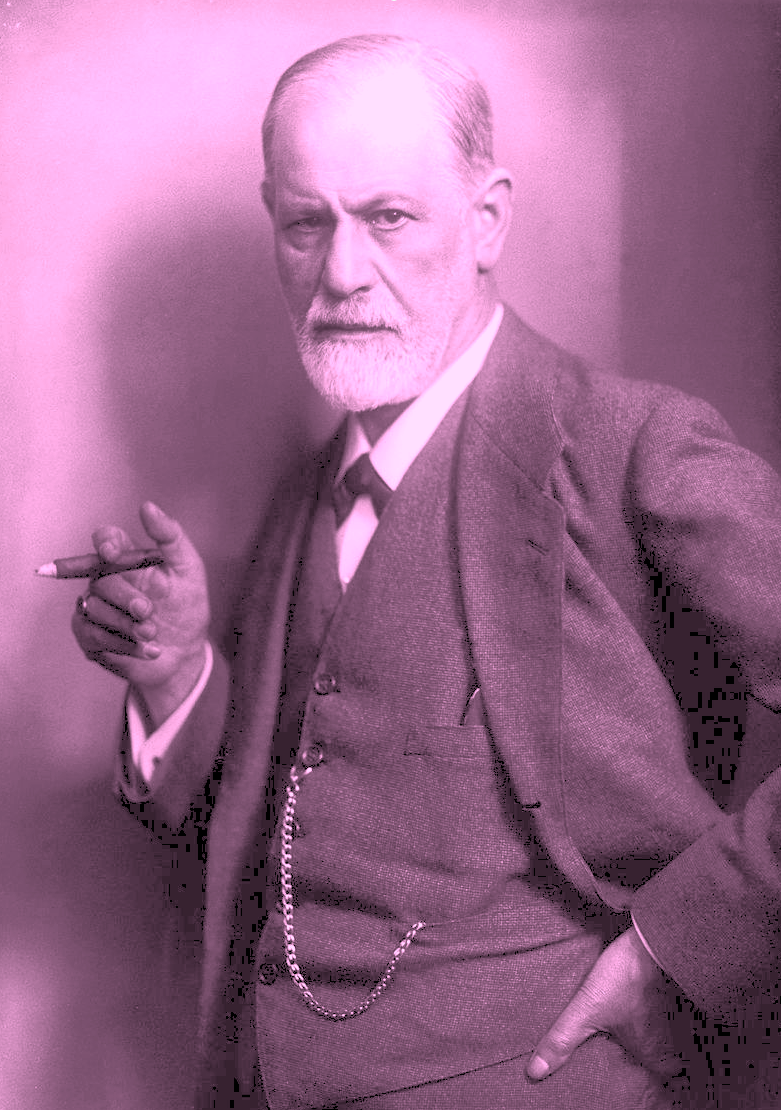 Sigmund Freud, who is considered the originator of the modern use of the term,[5] defined libido as "the energy, regarded as a quantitative magnitude... of those instincts which have to do with all that may be comprised under the word 'love'."[6] It is the instinctual energy or force, contained in what Freud called the id, the strictly unconscious structure of the psyche. He also explained that it is analogous to hunger, the will to power, and so on[7] insisting that it is a fundamental instinct that is innate in all humans.[8] Freud pointed out that these libidinal drives can conflict with the conventions of civilised behavior, represented in the psyche by the superego. It is this need to conform to society and control the libido that leads to tension and anxiety in the individual, prompting the use of ego defenses which channel the psychic energy of the unconscious drives into forms that are acceptable to the ego and superego. Excessive use of ego defenses results in neurosis, so a primary goal of psychoanalysis is to make the drives accessible to consciousness, allowing them to be addressed directly, thus reducing the patient's automatic resort to ego defenses.[9] Freud viewed libido as passing through a series of developmental stages in the individual, in which the libido fixates on different erogenous zones: first the oral stage (exemplified by an infant's pleasure in nursing), then the anal stage (exemplified by a toddler's pleasure in controlling his or her bowels), then the phallic stage, through a latency stage in which the libido is dormant, to its reemergence at puberty in the genital stage[10] (Karl Abraham would later add subdivisions in both oral and anal stages.).[11] Failure to adequately adapt to the demands of these different stages could result in libidinal energy becoming 'dammed up' or fixated in these stages, producing certain pathological character traits in adulthood. Jung Swiss psychiatrist Carl Gustav Jung identified the libido with psychic energy in general. According to Jung, 'energy', in its subjective and psychological sense, is 'desire', of which sexual desire is just one aspect.[12][13] Libido thus denotes "a desire or impulse which is unchecked by any kind of authority, moral or otherwise. Libido is appetite in its natural state. From the genetic point of view it is bodily needs like hunger, thirst, sleep, and sex, and emotional states or affects, which constitute the essence of libido."[14] It is "the energy that manifests itself in the life process and is perceived subjectively as striving and desire."[15] Duality (opposition) creates the energy (or libido) of the psyche, which Jung asserts expresses itself only through symbols. These symbols may manifest as "fantasy-images" in the process of psychoanalysis, giving subjective expression to the contents of the libido, which otherwise lacks any definite form.[16] Desire, conceived generally as a psychic longing, movement, displacement and structuring, manifests itself in definable forms which are apprehended through analysis. Other psychological and social perspectives A person may have a desire for sex, but not have the opportunity to act on that desire, or may on personal, moral or religious reasons refrain from acting on the urge. Psychologically, a person's urge can be repressed or sublimated. Conversely, a person can engage in sexual activity without an actual desire for it. Multiple factors affect human sex drive, including stress, illness, pregnancy, and others. A 2001 review found that, on average, men have a higher desire for sex than women.[17] Certain psychological or social factors can reduce the desire for sex. These factors can include lack of privacy or intimacy, stress or fatigue, distraction, or depression. Environmental stress, such as prolonged exposure to elevated sound levels or bright light, can also affect libido. Other causes include experience of sexual abuse, assault, trauma, or neglect, body image issues, and anxiety about engaging in sexual activity.[18] Individuals with post-traumatic stress disorder (PTSD) may find themselves with reduced sexual desire. Struggling to find pleasure, as well as having trust issues, many with PTSD experience feelings of vulnerability, rage and anger, and emotional shutdowns, which have been shown to inhibit sexual desire in those with PTSD.[19] Reduced sex drive may also be present in trauma victims due to issues arising in sexual function. For women, it has been found that treatment can improve sexual function, thus helping restore sexual desire.[20] Depression and libido decline often coincide, with reduced sex drive being one of the symptoms of depression.[21] Those with depression often report the decline in libido to be far reaching and more noticeable than other symptoms.[21] In addition, those with depression often are reluctant to report their reduced sex drive, often normalizing it with cultural/social values, or by the failure of the physician to inquire about it. Sexual desires are often an important factor in the formation and maintenance of intimate relationships in humans. A lack or loss of sexual desire can adversely affect relationships. Changes in the sexual desires of any partner in a sexual relationship, if sustained and unresolved, may cause problems in the relationship. The infidelity of a partner may be an indication that a partner's changing sexual desires can no longer be satisfied within the current relationship. Problems can arise from disparity of sexual desires between partners, or poor communication between partners of sexual needs and preferences.[22] |
フロイト この用語の現代的な使用法の創始者と見なされているジークムント・フロイトは、リビドーを「『愛』という言葉で表現されるものすべてに関係する本能の、量 的な大きさとして考えられるエネルギー」と定義した[6]。これは、フロイトがイドと呼んだ、精神の厳密に無意識的な構造に含まれる本能的なエネルギーま たは力である。また、彼は、それは飢えや権力への欲求などと同類であると説明し[7]、それはすべてのヒトに先天的に備わっている根源的な本能であると主 張した[8]。 フロイトは、これらのリビドー的衝動は、精神の中で超自我によって表される文明化された行動の慣習と対立する可能性があると指摘した。社会に適合し、リビ ドーをコントロールしたいという欲求が、個人に緊張や不安をもたらし、無意識の衝動の精神エネルギーを自我や超自我が受容できる形に変える自我防衛の使用 を促す。自我防衛の過剰な使用は神経症を引き起こすため、精神分析の主な目的は、衝動を自覚できるようにし、直接対処できるようにすることで、患者の無意 識的な自我防衛への依存を軽減することである[9]。 フロイトは、リビドーが個人の中で一連の成長段階を経ていくものと考えていた。この段階では、リビドーは異なる性感帯に定着する。 異なる性感帯に定着する。まず口腔期(乳児が母乳を飲む喜びがこれに相当する)、次に肛門期(幼児が自分の排便をコントロールする喜びがこれに相当す る)、次にファルス期、そして性欲が休眠する潜伏期を経て、思春期における生殖器期で性欲が再び現れる 思春期には生殖器期[10](カール・アブラハムは後に口腔期と肛門期の両方に細分化を加えた[11])で再び現れる。これらの異なる段階の要求に適切に 順応できない場合、リビドーのエネルギーが「堰き止められた」状態になったり、これらの段階に固定されてしまったりし、成人期に特定の病的な性格特性が現 れる可能性がある。 ユング スイスの精神科医カール・グスタフ・ユングは、リビドーを精神エネルギー全般とみなした。ユングによれば、「エネルギー」とは主観的・心理的な意味で「欲 望」であり、性的欲望はその一側面である[12][13]。したがって、リビドーとは「道徳的あるいはその他の権威によって抑制されない欲望や衝動」を意 味する。リビドーは自然な状態の食欲である。遺伝学的な観点から見ると、リビドーの本質は、空腹、渇き、睡眠、性欲といった身体的欲求や、情緒状態や情動 である。これらのシンボルは、精神分析の過程で「空想イメージ」として現れる可能性があり、それにより、明確な形を持たないリビドーの内容に主観的な表現 を与えることができる[16]。一般的に精神的な憧れ、動き、置き換え、構造として考えられている欲望は、分析を通じて理解される定義可能な形で現れる。 その他の心理学的および社会的観点 人はセックスをしたいという欲求を抱くかもしれないが、その欲求を行動に移す機会がないかもしれない。あるいは、個人的な理由、道徳的な理由、宗教的な理 由から、その衝動を抑えるかもしれない。心理学的観点では、人の衝動は抑圧されたり昇華されたりすることがある。逆に、人は実際にセックスをしたいと思っ ていなくても、セックスを行うこともある。人間の性欲には、ストレス、病気、妊娠など、さまざまな要因が影響する。2001年の調査によると、平均的に、 男性は女性よりも性への欲求が強いことがわかった[17]。 特定の心理的または社会的要因が、性への欲求を減少させることがある。 このような要因には、プライバシーや親密性の欠如、ストレスや疲労、気晴らし、うつ病などが含まれる。 長時間にわたる高音量や明るい光への曝露などの環境的ストレスも、性欲に影響を与えることがある。その他の原因としては、性的虐待、暴行、トラウマ、ネグ レクトの経験、ボディイメージの問題、性行為に対する不安などが挙げられる[18]。 心的外傷後ストレス障害(PTSD)を患う人は、性欲減退に悩まされる可能性がある。快楽を見いだすのに苦労し、信頼の問題を抱える PTSD 患者は、多くが脆弱性や怒り、怒りの感情を経験し、感情が閉ざされてしまう。これは、PTSD 患者の性的欲求を抑制することが示されている[19]。性的機能に問題が生じるため、トラウマ被害者には性欲減退が見られることもある。女性の場合、治療 によって性的機能が改善され、性的欲求が回復することが分かっている[20]。うつ病と性欲減退はしばしば同時に起こり、性欲減退はうつ病の症状の1つで ある[21]。うつ病の人は、性欲減退が [21] さらに、うつ病患者は性欲減退を報告することをためらう傾向があり、文化や社会的な価値観によって性欲減退を正常化したり、医師が性欲減退について尋ねな かったために性欲減退を正常化したりすることが多い。 性的欲求は、人間における親密な関係の形成と維持において重要な要素であることが多い。性的欲求の欠如や喪失は、関係に悪影響を及ぼす可能性がある。性的 関係にあるパートナーのいずれかの性的欲求の変化が持続し、解決されない場合、関係に問題が生じる可能性がある。パートナーの不貞は、パートナーの性的欲 求の変化が現在の関係ではもはや満たされないことを示す可能性がある。パートナー間の性的欲求の不一致や、性的欲求や嗜好に関するパートナー間のコミュニ ケーション不足が問題を引き起こす可能性がある[22]。 |
| Biological perspectives Endogenous compounds See also: Sexual motivation and hormones Libido is governed primarily by activity in the mesolimbic dopamine pathway (ventral tegmental area and nucleus accumbens).[4] Consequently, dopamine and related trace amines (primarily phenethylamine)[23] that modulate dopamine neurotransmission play a critical role in regulating libido.[4] Other neurotransmitters, neuropeptides, and sex hormones that affect sex drive by modulating activity in or acting upon this pathway include: Testosterone[4] (directly correlated) – and other androgens[24][25][26][27] Estrogen[4] (directly correlated) – and related female sex hormones[28][29][30][31][32] Progesterone[31] (inversely correlated) Oxytocin[33] (directly correlated) Serotonin[34][35][36] (inversely correlated) Norepinephrine[34] (directly correlated) Acetylcholine[37] Sex hormone levels and the menstrual cycle A woman's desire for sex is correlated to her menstrual cycle, with many women experiencing a heightened sexual desire in the several days immediately before ovulation,[38] which is her peak fertility period, which normally occurs two days before and until two days after the ovulation.[39] This cycle has been associated with changes in a woman's testosterone levels during the menstrual cycle. According to Gabrielle Lichterman, testosterone levels have a direct impact on a woman's interest in sex. According to her, testosterone levels rise gradually from about the 24th day of a woman's menstrual cycle until ovulation on about the 14th day of the next cycle, and during this period the woman's desire for sex increases consistently. The 13th day is generally the day with the highest testosterone levels. In the week following ovulation, the testosterone level is the lowest and as a result women will experience less interest in sex.[24][better source needed] Also, during the week following ovulation, progesterone levels increase, resulting in a woman experiencing difficulty achieving orgasm. Although the last days of the menstrual cycle are marked by a constant testosterone level, women's libido may get a boost as a result of the thickening of the uterine lining which stimulates nerve endings and makes a woman feel aroused.[40] Also, during these days, estrogen levels decline, resulting in a decrease of natural lubrication. Although some specialists disagree with this theory, menopause is still considered by the majority a factor that can cause decreased sexual desire in women. The levels of estrogen decrease at menopause and this usually causes a lower interest in sex and vaginal dryness which makes sex painful. However, the levels of testosterone increase at menopause and this may be why some women may experience a contrary effect of an increased libido.[41] Physical factors Physical factors that can affect libido include endocrine issues such as hypothyroidism, the effect of certain prescription medications (for example flutamide), and the attractiveness and biological fitness of one's partner, among various other lifestyle factors.[42] Anemia is a cause of lack of libido in women due to the loss of iron during the period.[43] Smoking tobacco, alcohol use disorder, and the use of certain drugs can also lead to a decreased libido.[44] Moreover, specialists suggest that several lifestyle changes such as exercising, quitting smoking, lowering consumption of alcohol or using prescription drugs may help increase one's sexual desire.[45][46] Medications Some people purposefully attempt to decrease their libido through the usage of anaphrodisiacs.[47] Aphrodisiacs, such as dopaminergic psychostimulants, are a class of drugs which can increase libido. On the other hand, a reduced libido is also often iatrogenic and can be caused by many medications, such as hormonal contraception, SSRIs and other antidepressants, antipsychotics, opioids, beta blockers and isotretinoin. Isotretinoin, finasteride and many SSRIs uncommonly can cause a long-term decrease in libido and overall sexual function, sometimes lasting for months or years after users of these drugs have stopped taking them. These long-lasting effects have been classified as iatrogenic medical disorders, respectively termed post-retinoid sexual dysfunction/post-Accutane syndrome (PRSD/PAS), post-finasteride syndrome (PFS) and post-SSRI sexual dysfunction (PSSD).[21][48] These three disorders share many overlapping symptoms in addition to reduced libido, and are thought to share a common etiology, but collectively remain poorly-understood and lack effective treatments. Multiple studies have shown that with the exception of bupropion (Wellbutrin), trazodone (Desyrel) and nefazodone (Serzone), antidepressants generally will lead to lowered libido.[21] SSRIs that typically lead to decreased libido are fluoxetine (Prozac), paroxetine (Paxil), fluvoxamine (Luvox), citalopram (Celexa) and sertraline (Zoloft).[21] Some antidepressant users have tried decreasing their dosage in the hopes of maintaining an adequate sex drive.[examples needed][citation needed] Other users try enrolling in psychotherapy to solve depression-related issues of libido. However, the effectiveness of this therapy is mixed, with many reporting that it had no or little effect on sexual drive.[21] Testosterone is one of the hormones controlling libido in human beings. Emerging research[49] is showing that hormonal contraception methods like oral contraceptive pills (which rely on estrogen and progesterone together) are causing low libido in females by elevating levels of sex hormone-binding globulin (SHBG). SHBG binds to sex hormones, including testosterone, rendering them unavailable. Research is showing that even after ending a hormonal contraceptive method, SHBG levels remain elevated and no reliable data exists to predict when this phenomenon will diminish.[50] Oral contraceptives lower androgen levels in users, and lowered androgen levels generally lead to a decrease in sexual desire. However, usage of oral contraceptives has shown to typically not have a connection with lowered libido in women.[51][52] Effects of age Males reach the peak of their sex drive in their teenage years [dubious – discuss], while females reach it in their thirties.[53][54] The surge in testosterone hits the male at puberty resulting in a sudden and extreme sex drive which reaches its peak at age 15–16, then drops slowly over their lifetime.[disputed – discuss] In contrast, a female's libido increases slowly during adolescence and peaks in their mid-thirties.[why?][55] Actual testosterone and estrogen levels that affect a person's sex drive vary considerably. Some boys and girls will start expressing romantic or sexual interest by age 10–12. The romantic feelings are not necessarily sexual, but are more associated with attraction and desire for another. For boys and girls in their preteen years (ages 11–12), at least 25% report "thinking a lot about sex".[56] By the early teenage years (ages 13–14), however, boys are much more likely to have sexual fantasies than girls. In addition, boys are much more likely to report an interest in sexual intercourse at this age than girls.[56] Masturbation among youth is common, with prevalence among the population generally increasing until the late 20s and early 30s. Boys generally start masturbating earlier, with less than 10% boys masturbating around age 10, around half participating by age 11–12, and over a substantial majority by age 13–14.[56] This is in sharp contrast to girls where virtually none are engaging in masturbation before age 13, and only around 20% by age 13–14.[56] People in their 60s and early 70s generally retain a healthy sex drive, but this may start to decline in the early to mid-70s.[57] Older adults generally develop a reduced libido due to declining health and environmental or social factors.[57] In contrast to common belief, postmenopausal women often report an increase in sexual desire and an increased willingness to satisfy their partner.[58] Women often report family responsibilities, health, relationship problems, and well-being as inhibitors to their sexual desires. Aging adults often have more positive attitudes towards sex in older age due to being more relaxed about it, freedom from other responsibilities, and increased self-confidence. Those exhibiting negative attitudes generally cite health as one of the main reasons. Stereotypes about aging adults and sexuality often regard seniors as asexual beings, doing them no favors when they try to talk about sexual interest with caregivers and medical professionals.[58] Non-western cultures often follow a narrative of older women having a much lower libido, thus not encouraging any sort of sexual behavior for women. Residence in retirement homes has effects on residents' libidos. In these homes, sex occurs, but it is not encouraged by the staff or other residents. Lack of privacy and resident gender imbalance are the main factors lowering desire.[58] Generally, for older adults, being excited about sex, good health, sexual self-esteem and having a sexually talented partner can be factors.[59] |
生物学的な観点 内因性化合物 関連項目: 性的欲求とホルモン 性欲は主に中脳辺縁系ドーパミン経路(腹側被蓋野および側坐核)の活動によって制御されている[4]。そのため、ドーパミン神経伝達を調整するドーパミンおよび関連微量アミン(主にフェニルエチルアミン)[23]は、性欲の調節において重要な役割を果たしている[4]。 この経路の活動を調整したり、この経路に作用したりすることで性欲に影響を与えるその他の神経伝達物質、神経ペプチド、性ホルモンには、以下が含まれる。 テストステロン[4](直接相関) - およびその他のアンドロゲン[24][25][26][27] エストロゲン[4](直接相関) - および関連する女性ホルモン[28][29][30][31][32] プロゲステロン[31](逆相関 逆相関 オキシトシン[33](直接相関) セロトニン[34][35][36](逆相関) ノルエピネフリン[34](直接相関) アセチルコリン[37] 性ホルモンレベルと月経周期 女性の性欲は月経周期と相関関係にある。女性の性欲は月経周期と相関しており、多くの女性は排卵期(通常は排卵の2日前から排卵後2日までの期間)の直前 数日間、性欲が高まることを経験している[38]。この周期は、月経周期中の女性のテストステロン値の変化と関連付けられている。ガブリエル・リヒターマ ンによると、テストステロン値は女性のセックスへの関心に直接影響する。彼女によると、テストステロン値は女性の月経周期の24日目頃から次の周期の14 日目頃の排卵まで徐々に上昇し、この期間中は女性のセックスへの欲求が常に高まる。一般的に13日目が最もテストステロン値が高い日である。排卵後の1週 間はテストステロンレベルが最も低くなり、その結果、女性はセックスへの関心が薄れる[24][より確かな情報源が必要]。 また、排卵後の1週間はプロゲステロンレベルが増加し、女性がオーガズムに達しにくくなる。月経周期の最終日はテストステロン値が一定に保たれるが、子宮 内膜が厚くなることで神経終末が刺激され、女性が性的興奮を感じるようになるため、女性の性欲が高まる可能性がある[40]。また、この期間中はエストロ ゲン値が低下し、自然な潤滑液の分泌量が減少する。 一部の専門家はこの説に反対しているが、閉経は女性の性欲減退を引き起こす要因として、大多数の専門家が依然として認めている。閉経期にはエストロゲンの レベルが低下し、通常、セックスへの関心が薄れ、膣が乾燥してセックスが苦痛になる。しかし、閉経期にはテストステロンのレベルが増加するため、性欲が増 すという逆の効果が現れる女性もいるのかもしれない[41]。 身体的要因 性欲に影響を与える身体的要因には、甲状腺機能低下症などの内分泌系の問題、特定の処方薬(フルタミドなど)の影響、パートナーの魅力や生物学的適合性 。 貧血は、生理中の鉄分不足により女性の性欲減退の原因となる[43]。 喫煙、アルコール依存症、特定の薬物の使用も性欲減退につながる可能性がある[44]。さらに、専門家は、運動、禁煙、 アルコール摂取量を減らす、処方薬を使用するなど、いくつかの生活習慣の改善が性欲を高めるのに役立つ可能性がある[45][46]。 薬物 一部の人は、性欲減退剤を意図的に使用して性欲を減退させようとする[47]。ドーパミン作動性精神刺激薬などの性欲増進剤は、性欲を高めることができる 薬物のクラスである。一方、性欲減退は多くの場合、薬物の副作用によるものであり、ホルモン避妊薬、SSRIや他の抗うつ薬、抗精神病薬、オピオイド、β 遮断薬、イソトレチノインなどの多くの薬物が原因となる可能性がある。 イソトレチノイン、フィナステリド、多くのSSRIは、まれに長期間にわたって性欲や性的機能の低下を引き起こす可能性があり、これらの薬物の服用を中止 した後も、数か月から数年間にわたってその影響が続くことがある。これらの長期的な影響は、それぞれ「レチノイド後性機能障害/アクネ後症候群 (PRSD/PAS)」、「フィナステリド後症候群(PFS)」、「SSRI後性機能障害(PSSD)」と呼ばれる、医原性医学的障害に分類されている [21][48]。 [21][48]。これらの3つの障害は、性欲減退に加えて多くの症状が重複しており、共通の病因を持つと考えられているが、全体としてはまだ十分に解明 されておらず、効果的な治療法も確立されていない。 複数の研究により、ブプロピオン(ウェルブトリン)、トラゾドン(デシレル)、ネファゾドン(セルゾン)を除く抗うつ薬は概して性欲減退を引き起こすとい うことが示されている[21]。一般的に性欲減退を引き起こすSSRIには、フルオキセチン(プロザック)、パロキセチン(パキシル )、フルボキサミン(ルボックス)、シタロプラム(セレクサ)、セルトラリン(ゾロフト)などである[21]。抗うつ薬の使用者の一部は、性欲を適切に維 持できることを期待して、服用量を減らそうとしている[例が必要][出典が必要]。また、他の使用者は、性欲に関するうつ病関連の問題を解決するために心 理療法を受けようとしている。しかし、この療法の有効性については意見が分かれており、性欲にほとんど影響がなかった、あるいはほとんど影響がなかったと 報告する人も少なくない[21]。 テストステロンは、人間の性欲を司るホルモンのひとつである。最新の研究[49]によると、経口避妊薬(エストロゲンとプロゲステロンを併用)のようなホ ルモン避妊法は、性ホルモン結合グロブリン(SHBG)のレベルを上昇させることによって、女性の性欲低下を引き起こしていることが明らかになっている。 SHBGは、テストステロンを含む性ホルモンと結合し、それらを不活性化させる。研究によると、ホルモン避妊法を中止した後も SHBG レベルは上昇したままとなり、この現象がいつ収まるかを予測できる信頼できるデータはない[50]。 経口避妊薬は使用者のアンドロゲンレベルを下げ、アンドロゲンレベルが低下すると一般的に性欲が減退する。しかし、経口避妊薬の使用は、一般的に女性の性欲減退とは関連がないことが示されている[51][52]。 年齢による影響 男性は10代で性欲のピークに達する[疑わしい – 議論する]一方、女性は30代でピークに達する[53][54]。思春期の男性ではテストステロンの急増により、 思春期の男性にテストステロンの急激な増加が起こり、15~16歳でピークに達した後、生涯を通じて徐々に減少する[議論の余地あり]。一方、女性の性欲 は思春期を通じて徐々に増加し、30代半ばでピークに達する[なぜ?][55]。人の性欲に影響を与える実際のテストステロンとエストロゲンのレベルには 大きな違いがある。 10~12歳までに恋愛や性的興味を示すようになる少年少女もいる。恋愛感情は必ずしも性的感情ではないが、他者への魅力や欲望とより関連している。 11~12歳(10代前半)の少年少女のうち、少なくとも25%が「セックスについてよく考える」と回答している[56]。しかし、13~14歳(10代 前半)になると、少女よりも少年の方が性的空想を抱く可能性が高くなる。さらに、この年齢の少年は少女よりも性交渉に興味があると報告する傾向が強い [56]。青少年の自慰行為は一般的であり、人口全体での普及率は一般的に20代後半から30代前半まで増加する。一般的に、男子は女子よりも早く自慰行 為を始める傾向があり、10歳までに自慰行為を行う男子の割合は10%未満であるのに対し、11~12歳までに自慰行為を行う男子の割合は約半数、 13~14歳までに自慰行為を行う男子の割合は過半数を大きく上回る[56]。13歳までに自慰行為を行う者はほぼ皆無であり、13~14歳までに自慰行 為を行う者は約20%にすぎない[56]。 60代および70代前半の人々は一般的に健全な性欲を維持しているが、70代前半から半ばにかけて性欲が低下し始める可能性がある[57]。高齢者は一般 的に、 健康状態の低下や環境的・社会的要因により、性欲が低下する傾向にある[57]。一般的な考えとは対照的に、閉経後の女性は性欲が増し、パートナーを満足 させたいという意欲も高まることが多い[58]。女性は、家族に対する責任、健康状態、人間関係の問題、幸福感を性欲の阻害要因として挙げることが多い。 高齢者は、年齢を重ねるにつれ、性に対してよりリラックスした姿勢で臨むようになり、他の責任から解放され、自信が増すため、性に対してより前向きな姿勢 を持つようになることが多い。否定的な態度を示す人は、一般的に健康を主な理由のひとつとして挙げる。高齢者と性に関する固定観念では、高齢者は無性愛で あると見なされることが多く、介護者や医療従事者に性的関心について話そうとしても、何の役にも立たない[58]。非西洋文化では、高齢女性は性欲がはる かに低いという物語が一般的であり、そのため女性の性的行動は一切奨励されない。老人ホームでの居住は入居者の性欲に影響を与える。老人ホームでは性行為 は行われるが、スタッフや他の入居者によって奨励されることはない。プライバシーの欠如と入居者の男女比のアンバランスさが、性欲の低下の主な要因となっ ている[58]。一般的に、高齢者がセックスに興奮し、健康で、性的自尊心を持ち、セックスのうまいパートナーを持つことは、要因となりうる[59]。 |
| Sexual desire disorders See also: Hyposexuality and Hypersexuality Sexual desire disorders are more common in women than in men,[60] and women tend to exhibit less frequent and less intense sexual desires than men.[61] Erectile dysfunction may happen to the penis because of lack of sexual desire, but these two should not be confused since the two can commonly occur simultaneously.[62] For example, moderate to large recreational doses of cocaine, amphetamine or methamphetamine can simultaneously cause erectile dysfunction (evidently due to vasoconstriction) while still significantly increasing libido due to heightened levels of dopamine.[63] Although conversely, excessive or very regular/repeated high-dose amphetamine use may damage leydig cells in the male testes, potentially leading to markedly lowered sexual desire subsequently due to hypogonadism. However in contrast to this, other stimulants such as cocaine and even caffeine appear to lack negative impacts on testosterone levels, and may even increase their concentrations in the body. Studies on cannabis however seem to be exceptionally mixed, with some claiming decreased levels on testosterone, others reporting increased levels, and with some showing no measurable changes at all. This varying data seems to coincidence with the almost equally conflicting data on cannabis' effects on sex drive as well, which may be dosage or frequency-dependent, due to different amounts of distinct cannabinoids in the plant, or based on individual enzyme properties responsible for metabolism of the drug. Evidence on alcohol's effects on testosterone however invariably show a clear decrease, however (like amphetamine, albeit to a lesser degree); temporary increases in libido and related sexual behavior have long been observed during alcohol intoxication in both sexes, but likely most noticeable with moderation, particularly in males. Additionally, men often also naturally experience a decrease in their libido as they age due to decreased productions in testosterone. The American Medical Association has estimated that several million US women have a female sexual arousal disorder, though arousal is not at all synonymous with desire, so this finding is of limited relevance to the discussion of libido.[43] Some specialists claim that women may experience low libido due to some hormonal abnormalities such as lack of luteinising hormone or androgenic hormones, although these theories are still controversial. |
性的欲求障害 関連項目: 性欲減退症と性欲亢進症 性欲減退症は男性よりも女性に多く見られる[60]傾向があり、女性は男性よりも性欲の頻度や強度が低い傾向にある[61]。性欲減退症のために陰茎の勃 起不全が起こる可能性もあるが、この2つは同時に起こる場合が多いため、混同すべきではない[62]。例えば、中程度から大量の娯楽用量の コカイン、アンフェタミン、メタンフェタミンの適量から多量の娯楽用摂取は、血管収縮が原因で勃起不全を引き起こす可能性がある一方で、ドーパミンレベル の上昇により性欲を著しく高める可能性がある[63]。逆に、過剰な、あるいは非常に定期的に繰り返される高用量のアンフェタミン使用は、男性の精巣のラ イディッヒ細胞を損傷し、潜在的に性腺機能低下症による性欲の著しい低下につながる可能性がある。しかしこれとは対照的に、コカインやカフェインなどの他 の興奮剤は、テストステロンレベルに悪影響を及ぼさないばかりか、体内のテストステロン濃度を増加させる可能性もある。大麻に関する研究は、非常に矛盾し た結果が報告されている。テストステロンレベルが低下したという報告がある一方で、レベルが上昇したという報告もあり、測定可能な変化が全く見られないと いう報告もある。このばらつきのあるデータは、大麻が性欲に及ぼす影響に関するほぼ同等の相反するデータと一致しているように見える。これは、大麻に含ま れるさまざまなカンナビノイドの量が異なることによる用量依存性、または薬物の代謝を担う個々の酵素特性に基づくものである可能性がある。しかし、アル コールがテストステロンに及ぼす影響については、常に明確な減少を示す証拠がある(アンフェタミンも同様だが、程度は低い)。アルコール中毒時には、男女 ともに性欲やそれに関連する性的行動の一時的な増加が長い間観察されているが、おそらく節度ある飲酒で、特に男性において最も顕著になると思われる。さら に、男性は加齢に伴い、テストステロンの分泌低下により、自然に性欲の低下を経験することが多い。 米国医師会は、数百万人の米国人女性が女性性興奮障害を抱えていると推定しているが、興奮と欲望はまったく同義ではないため、この発見は性欲に関する議論 にはあまり関連性がない[43]。一部の専門家は、黄体形成ホルモンやアンドロゲンホルモンの欠乏などのホルモン異常により、女性が性欲低下を経験する可 能性があると主張しているが、これらの理論は依然として議論の的となっている。 |
| Desire Lust Sexual arousal Sexual attraction Sexual desire Sexual motivation and hormones |
欲望 情欲 性的興奮 性的魅力 性的欲求 性的動機付けとホルモン |
| https://en.wikipedia.org/wiki/Libido |
|
Dynamics
of libidinal energy (death- and life drive) in Freud's structural model
of the soul, referring to his rider metaphor: The head symbolizes the
ego (principle of reality); the animal body the id (pleasure
principle). Dual in the same way, the libido branches out from the id
into two main areas: the mental urge to know (up), and the bodily urge
to act (down). Both combine to act through the ego in order to fulfil
the needs of the id. This includes perception and assessment of
inner/outer reality, and is based on unpleasant increase and
pleasurable reduction of tension in libidinal energy ( “hunger” and
“satiety” in general).[11] Ultimately, satisfaction of the needs leads
to experiences (by muscle control) that the superego internalises
through imprinting. The superego contains our socialisation, that takes
place during childhood. If it support the id's instinctual needs, the
organism remains mentally healthy – the 'rider' carries out the will of
his 'animal' "as if it were his own".[12]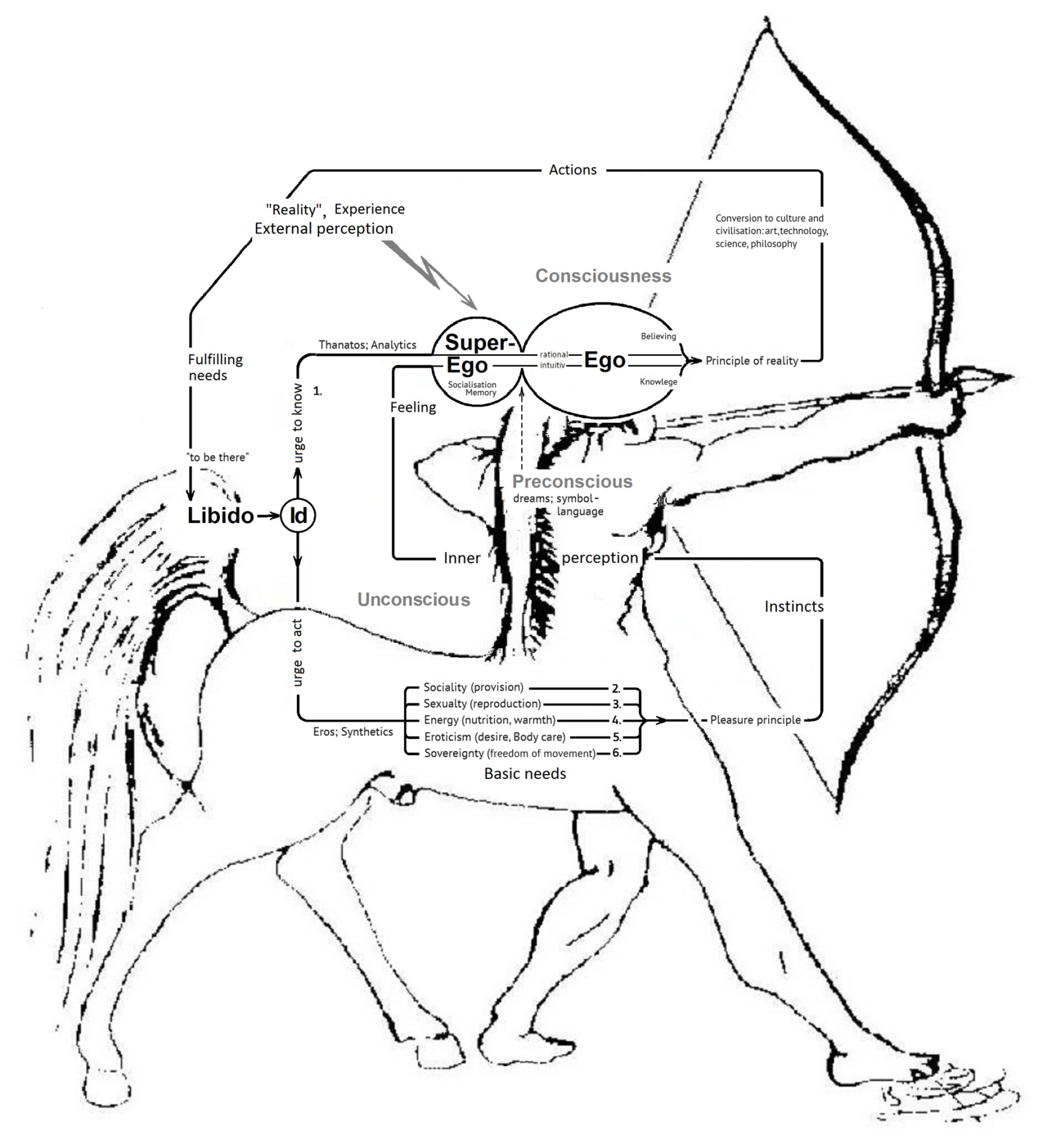 |
フロイトの精神構造モデルにおけるリビドー的エネルギー
(死の欲動と生の欲動)の力学について、彼の「騎手」の比喩を参照すると、頭部は自我(現実原則)を、動物的な身体はイド(快楽原則)を象徴している。同
様に二元的な性質を持つリビドーは、イドから二つの主要な領域へと分岐する。すなわち、知ろうとする精神的な衝動(上向き)と、行動しようとする身体的な
衝動(下向き)である。これら両者は、イドの欲求を満たすために自我を通じて作用する。これには内面・外面の現実の知覚と評価が含まれ、リビドー的エネル
ギーにおける不快な緊張の増大と快楽的な緊張の緩和(一般に「飢餓」と「満腹」)に基づいている。[11]
最終的に、欲求の充足は(筋制御による)経験をもたらし、超自我は刷り込みを通じてこれを内面化する。超自我には、幼少期に形成される社会化が含まれてい
る。もし超自我がイドの本能的欲求を支えるならば、有機体は精神的に健全な状態を保つ――「騎手」は「まるで自分の意志であるかのように」、その「動物」
の意志を実行するのだ。[12] |
| References "libido". Oxford English Dictionary (Online ed.). Oxford University Press. (Subscription or participating institution membership required.) Sex and Society. Marshall Cavendish. 2010. p. 462. ISBN 978-0-7614-7905-5.[unreliable source?] Freud, Sigmund. Massenpsychologie und Ich-Analyse. p. 99. Sigmund Freud, The Ego and the Id, On Metapsychology (Penguin Freud Library 11) p. 369. "Libido". APA Dictionary of Psychology. American Psychological Association. Retrieved 19 April 2023. Akhtar, Salman (2009). A Comprehensive Dictionary of Psychoanalysis. London: Karnac. p. 159. Platon. Symposion. Sigmund Freud: Jenseits des Lustprinzips. In: Sigmund Freud: Psychologie des Unbewußten (= Studienausgabe Band 3), Frankfurt am Main 1975, S. 213–272, hier: 266. Vgl. Gerasimos Santas: Plato and Freud. Two Theories of Love, Oxford 1988, S. 160–162. Sigmund Freud, "1 Das Lustprinzip und seine Einschränkung durch das Realitätsprinzip", Jenseits des Lustprinzips Fisher HE, Aron A, Brown LL (December 2006). "Romantic love: a mammalian brain system for mate choice". Philos. Trans. R. Soc. Lond. B Biol. Sci. 361 (1476): 2173–86. doi:10.1098/rstb.2006.1938. PMC 1764845. PMID 17118931. Freud, Sigmund. "1". Jenseits des Lustprinzips. Freud, Sigmund (1978). The Standard Edition of the Complete Psychological Works of Sigmund Freud. Volume XIX (1923–26) The Ego and the Id and Other Works. Strachey, James, Freud, Anna, Rothgeb, Carrie Lee, Richards, Angela, Scientific Literature Corporation. London: Hogarth Press. p. 19. ISBN 0701200677. OCLC 965512. S. Freud, Group Psychology and the Analysis of the Ego, 1959 Malabou, Catherine (2012). The New Wounded: From Neurosis to Brain Damage. New York: Fordham University Press. p. 103. ISBN 978-0-8232-3967-2. Klages, Mary (2017). Literary Theory: The Complete Guide. London: Bloomsbury Publishing. p. 245. ISBN 978-1-4725-9276-7. Reber, Arthur S.; Reber, Emily S. (2001). Dictionary of Psychology. New York: Penguin Reference. ISBN 0-14-051451-1. Sigmund Freud, New Introductory Lectures on Psychoanalysis (PFL 2) p. 131 Otto Fenichel, The Psychoanalytic Theory of Neurosis (1946)p. 101 P. Gay, Freud (1989) p. 397 Sharp, Daryl (15 October 2011). "Libido". frithluton.com. “The Concept of Libido” Collected Works Vol. 5, par. 194. Ellenberger, Henri (1970). The Discovery of the Unconscious. New York: Basic Books. p. 697. "Psychological factors determining human behavior" (PDF). 1936. p. 5. Retrieved 29 November 2025. “The Technique of Differentiation,” Collected Works Vol. 7, par. 345. Frankenbach, Julius; Weber, Marcel; Loschelder, David D.; Kilger, Helena; Friese, Malte (September 2022). "Sex drive: Theoretical conceptualization and meta-analytic review of gender differences". Psychological Bulletin. 148 (9–10): 621–661. doi:10.1037/bul0000366. PMID 36227317. Touraille, Priscille; Ågmo, Anders (March 2024). "Sex Differences in Sexual Motivation in Humans and Other Mammals: The Role of Conscious and Unconscious Processes". Behavioral Sciences. 14 (4): 277. doi:10.3390/bs14040277. PMC 11047354. PMID 38667073. Alexander, Michele G.; Fisher, Terri D. (February 2003). "Truth and consequences: Using the bogus pipeline to examine sex differences in self-reported sexuality". Journal of Sex Research. 40 (1): 27–35. doi:10.1080/00224490309552164. PMID 12806529. Mark, Kristen P.; Murray, Sarah H. (March 2012). "Gender Differences in Desire Discrepancy as a Predictor of Sexual and Relationship Satisfaction in a College Sample of Heterosexual Romantic Relationships". Journal of Sex & Marital Therapy. 38 (2): 198–215. doi:10.1080/0092623X.2011.606877. PMID 22390532. van Anders, Sari M. (December 2012). "Testosterone and Sexual Desire in Healthy Women and Men". Archives of Sexual Behavior. 41 (6): 1471–1484. doi:10.1007/s10508-012-9946-2. PMID 22552705. Yalom, I.D., Love's Executioner and Other Tales of Psychotherapy. New York: Basic Books, 1989. ISBN 0-06-097334-X. Yehuda, Rachel; Lehrner, A.m.y.; Rosenbaum, Talli Y. (May 2015). "PTSD and Sexual Dysfunction in Men and Women". The Journal of Sexual Medicine. 12 (5): 1107–1119. doi:10.1111/jsm.12856. PMID 25847589. Wells, Stephanie Y.; Glassman, Lisa H.; Talkovsky, Alexander M.; Chatfield, Miranda A.; Sohn, Min Ji; Morland, Leslie A.; Mackintosh, Margaret-Anne (January 2019). "Examining Changes in Sexual Functioning after Cognitive Processing Therapy in a Sample of Women Trauma Survivors". Women's Health Issues. 29 (1): 72–79. doi:10.1016/j.whi.2018.10.003. PMID 30455090. Phillips, R. L.; Slaughter, J. R. (15 August 2000). "Depression and sexual desire". American Family Physician. 62 (4): 782–786. PMID 10969857. "Low sex drive in women". Mayo Clinic. Mayo Foundation for Medical Education and Research. Retrieved July 28, 2010. Miller GM (January 2011). "The emerging role of trace amine-associated receptor 1 in the functional regulation of monoamine transporters and dopaminergic activity". J. Neurochem. 116 (2): 164–176. doi:10.1111/j.1471-4159.2010.07109.x. PMC 3005101. PMID 21073468. Lichterman, Gabrielle (November 2004). 28 Days: What Your Cycle Reveals about Your Love Life, Moods, and Potential. Adams Media Corporation. ISBN 978-1-59337-345-0.[page needed] Harding SM, Velotta JP (May 2011). "Comparing the relative amount of testosterone required to restore sexual arousal, motivation, and performance in male rats". Horm Behav. 59 (5): 666–73. doi:10.1016/j.yhbeh.2010.09.009. PMID 20920505. Davis SR, Moreau M, Kroll R, Bouchard C, Panay N, Gass M, Braunstein GD, Hirschberg AL, Rodenberg C, Pack S, Koch H, Moufarege A, Studd J (November 2008). "Testosterone for low libido in postmenopausal women not taking estrogen". N. Engl. J. Med. 359 (19): 2005–17. doi:10.1056/NEJMoa0707302. PMID 18987368. Renneboog B (2012). "[Andropause and testosterone deficiency: how to treat in 2012?]". Revue Médicale de Bruxelles. 33 (4): 443–9. PMID 23091954. DeLamater, J.D.; Sill, M. (2005). "Sexual Desire in Later Life". The Journal of Sex Research. 42 (2): 138–149. doi:10.1080/00224490509552267. PMID 16123844. Heiman JR, Rupp H, Janssen E, Newhouse SK, Brauer M, Laan E (May 2011). "Sexual desire, sexual arousal and hormonal differences in premenopausal US and Dutch women with and without low sexual desire". Horm. Behav. 59 (5): 772–779. doi:10.1016/j.yhbeh.2011.03.013. PMID 21514299. Warnock JK, Swanson SG, Borel RW, Zipfel LM, Brennan JJ (2005). "Combined esterified estrogens and methyltestosterone versus esterified estrogens alone in the treatment of loss of sexual interest in surgically menopausal women". Menopause. 12 (4): 359–60. doi:10.1097/01.GME.0000153933.50860.FD. PMID 16037752. Ziegler, T. E. (2007). Female sexual motivation during non-fertile periods: a primate phenomenon. Hormones and Behavior, 51(1), 1–2 Simerly, Richard B. (March 2002). "Wired for Reproduction: Organization and Development of Sexually Dimorphic Circuits in the Mammalian Forebrain". Annual Review of Neuroscience. 25 (1): 507–536. doi:10.1146/annurev.neuro.25.112701.142745. PMID 12052919. McGregor IS, Callaghan PD, Hunt GE (May 2008). "From ultrasocial to antisocial: a role for oxytocin in the acute reinforcing effects and long-term adverse consequences of drug use?". Br. J. Pharmacol. 154 (2): 358–368. doi:10.1038/bjp.2008.132. PMC 2442436. PMID 18475254. Recent evidence suggests that popular party drugs such as MDMA and gamma-hydroxybutyrate (GHB) may preferentially activate brain oxytocin systems to produce their characteristic prosocial and prosexual effects. Oxytocin interacts with the mesolimbic dopamine system to facilitate sexual and social behaviour, and this oxytocin-dopamine interaction may also influence the acquisition and expression of drug-seeking behaviour. Clayton AH (July 2010). "The pathophysiology of hypoactive sexual desire disorder in women". Int J Gynaecol Obstet. 110 (1): 7–11. doi:10.1016/j.ijgo.2010.02.014. PMID 20434725. Hu XH, Bull SA, Hunkeler EM, et al. (July 2004). "Incidence and duration of side effects and those rated as bothersome with selective serotonin reuptake inhibitor treatment for depression: patient report versus physician estimate". The Journal of Clinical Psychiatry. 65 (7): 959–65. doi:10.4088/JCP.v65n0712. PMID 15291685. Landén M, Högberg P, Thase ME (January 2005). "Incidence of sexual side effects in refractory depression during treatment with citalopram or paroxetine". The Journal of Clinical Psychiatry. 66 (1): 100–6. doi:10.4088/JCP.v66n0114. PMID 15669895. Andersson, K-E (October 2000). "Neurotransmitters: central and peripheral mechanisms". International Journal of Impotence Research. 12 (S4): S26–S33. doi:10.1038/sj.ijir.3900574. PMID 11035383. Bullivant, Susan B.; Sellergren, Sarah A.; Stern, Kathleen; Spencer, Natasha A.; Jacob, Suma; Mennella, Julie A.; McClintock, Martha K. (February 2004). "Women's sexual experience during the menstrual cycle: Identification of the sexual phase by noninvasive measurement of luteinizing hormone". Journal of Sex Research. 41 (1): 82–93. doi:10.1080/00224490409552216. PMID 15216427. "My Fertile Period". DuoFertility.com. Archived from the original on 2008-12-21. Retrieved 2008-09-22. "Women Can Now Predict When They Will Have The Best Sex". emaxhealth.com. Archived from the original on July 5, 2019. Retrieved July 28, 2010. Roney, James R.; Simmons, Zachary L. (April 2013). "Hormonal predictors of sexual motivation in natural menstrual cycles". Hormones and Behavior. 63 (4): 636–645. Bibcode:2013HoBeh..63..636R. doi:10.1016/j.yhbeh.2013.02.013. PMID 23601091. Cappelletti, Maurand; Wallen, Kim (February 2016). "Increasing women's sexual desire: The comparative effectiveness of estrogens and androgens". Hormones and Behavior. 78: 178–193. doi:10.1016/j.yhbeh.2015.11.003. PMC 4720522. PMID 26589379. Reed, Beverly G.; Bou Nemer, Laurice; Carr, Bruce R. (Jun 3, 2016). "Has testosterone passed the test in premenopausal women with low libido? A systematic review". International Journal of Women's Health. 8: 599–607. doi:10.2147/IJWH.S116212. PMC 5066846. PMID 27785108. "The enduring enigma of female sexual desire | U-M LSA Department of Psychology". Lsa.umich.edu. Shearer, Jasmin L; Salmons, Nabeel; Murphy, Damian J; Gama, Rousseau (January 2017). "Postmenopausal hyperandrogenism: the under-recognized value of inhibins". Annals of Clinical Biochemistry: International Journal of Laboratory Medicine. 54 (1): 174–177. doi:10.1177/0004563216656873. PMID 27278937. "The Orgasm Wars". Psychology Today. December 31, 1996. Retrieved August 19, 2023. "Lack of sex drive in men (lack of libido)". netdoctor.co.uk. Archived from the original on October 16, 2015. Retrieved July 28, 2010. "Low sex drive in women: symptoms and causes". mayoclinic.org. Mayo Foundation for Medical Education and Research (MFMER). Retrieved 14 January 2020. Finley, Nicola (2017). "Lifestyle Choices Can Augment Female Sexual Well-Being". American Journal of Lifestyle Medicine. 12 (1): 38–41. doi:10.1177/1559827617740823. PMC 6125014. PMID 30283244. "Low sex drive in women: Diagnosis and Treatment". mayoclinic.org. Mayo Foundation for Medical Education and Research (MFMER). Retrieved 14 January 2020. Rebal, Ronald F.; Faguet, Robert A.; Woods, Sherwyn M. (1982). "Unusual Sexual Syndromes". Extraordinary Disorders of Human Behavior. pp. 121–154. doi:10.1007/978-1-4615-9251-8_8. ISBN 978-1-4615-9253-2. Bala, Areeg; Nguyen, Hoang Minh Tue; Hellstrom, Wayne J.G. (January 2018). "Post-SSRI Sexual Dysfunction: A Literature Review". Sexual Medicine Reviews. 6 (1): 29–34. doi:10.1016/j.sxmr.2017.07.002. PMID 28778697. Montejo-González, A L; Llorca, G; Izquierdo, J A (Fall 1997). "SSRI-induced sexual dysfunction: fluoxetine, paroxetine, sertraline, and fluvoxamine in a prospective, multicenter, and descriptive clinical study of 344 patients". J Sex Marital Ther. 23 (3): 176–194. doi:10.1080/00926239708403923. PMID 9292833. Warnock, Julia K.; Clayton, Anita; Croft, Harry; Segraves, Robert; Biggs, Faye C. (September 2006). "Comparison of Androgens in Women with Hypoactive Sexual Desire Disorder: Those on Combined Oral Contraceptives (COCs) vs. Those Not on COCs". The Journal of Sexual Medicine. 3 (5): 878–882. doi:10.1111/j.1743-6109.2006.00294.x. PMID 16942531. Panzer, Claudia; Wise, Sarah; Fantini, Gemma; Kang, Dongwoo; Munarriz, Ricardo; Guay, Andre; Goldstein, Irwin (January 2006). "Impact of Oral Contraceptives on Sex Hormone-Binding Globulin and Androgen Levels: A Retrospective Study in Women with Sexual Dysfunction". The Journal of Sexual Medicine. 3 (1): 104–113. doi:10.1111/j.1743-6109.2005.00198.x. PMID 16409223. Burrows, Lara J.; Basha, Maureen; Goldstein, Andrew T. (September 2012). "The Effects of Hormonal Contraceptives on Female Sexuality: A Review". The Journal of Sexual Medicine. 9 (9): 2213–2223. doi:10.1111/j.1743-6109.2012.02848.x. PMID 22788250. Davis, Anne R.; Castaño, Paula M. (March 2004). "Oral Contraceptives and Libido in Women". Annual Review of Sex Research. 15 (1): 297–320. doi:10.1080/10532528.2004.10559822. PMID 16913282. Oaks, Laury (2009). "Manhood and Meaning in the Marketing of the 'Male Pill'". In Inhorn, Marcia C.; Tjørnhøj-Thomsen, Tine; Goldberg, Helene; La Cour Mosegaard, Maruska (eds.). Reconceiving the Second Sex. pp. 139–159. doi:10.3167/9781845454722. ISBN 978-1-84545-472-2. Beare, Patricia Gauntlett; Myers, Judith L. (1990). Principles and Practice of Adult Health Nursing. Mosby. ISBN 978-0-8016-0386-0.[page needed] Shlain, Leonard (July 27, 2004). Sex, Time, and Power. Penguin (Non-Classics). p. 140. ISBN 978-0-14-200467-8. OL 7360364M. Fortenberry, J. Dennis (July 2013). "Puberty and adolescent sexuality". Hormones and Behavior. 64 (2): 280–287. doi:10.1016/j.yhbeh.2013.03.007. PMC 3761219. PMID 23998672. Lehmiller, Justin J. (2019). The Psychology of Human Sexuality. John Wiley & Sons. pp. 621–626. ISBN 978-1-119-16469-2. Sinković, Matija; Towler, Lauren (July 2019). "Sexual Aging: A Systematic Review of Qualitative Research on the Sexuality and Sexual Health of Older Adults". Qualitative Health Research. 29 (9): 1239–1254. doi:10.1177/1049732318819834. PMID 30584788. Kontula, Osmo; Haavio-Mannila, Elina (3 February 2009). "The Impact of Aging on Human Sexual Activity and Sexual Desire". Journal of Sex Research. 46 (1): 46–56. doi:10.1080/00224490802624414. PMID 19090411. Segraves, K. B.; Segraves, R. T. (March 1991). "Hypoactive Sexual Desire Disorder: Prevalence and Comorbidity in 906 Subjects". Journal of Sex & Marital Therapy. 17 (1): 55–58. doi:10.1080/00926239108405469. PMID 2072405. Baumeister, Roy F.; Catanese, Kathleen R.; Vohs, Kathleen D. (August 2001). "Is There a Gender Difference in Strength of Sex Drive? Theoretical Views, Conceptual Distinctions, and a Review of Relevant Evidence". Personality and Social Psychology Review. 5 (3): 242–273. doi:10.1207/S15327957PSPR0503_5. "Lack of sex drive in men (lack of libido)". Archived from the original on September 24, 2015. Retrieved July 28, 2010. Gunne, L.-M. "Effects of Amphetamines in Humans". pp. 247–275. in: Änggård, E.; Lewander, T.; Gunne, L.-M. (1973). "General Pharmacology of Amphetamine-Like Drugs". Drug Addiction II. pp. 3–275. doi:10.1007/978-3-642-66709-1_1. ISBN 978-3-642-66711-4. |
参考文献 「libido」『オックスフォード英語辞典』(オンライン版)。オックスフォード大学出版局。(購読または提携機関の会員資格が必要。) 『Sex and Society』。マーシャル・キャベンディッシュ。2010年。462頁。ISBN 978-0-7614-7905-5。[信頼性の低い出典?] フロイト, ジークムント. 『大衆心理学と自我分析』. p. 99. ジークムント・フロイト, 『自我とイド』, 『メタ心理学について』(ペンギン・フロイト・ライブラリー 11)p. 369. 「リビドー」. 『APA心理学辞典』. アメリカ心理学会. 2023年4月19日閲覧. アクタル、サルマン(2009)。『精神分析総合辞典』。ロンドン:カーナック。p. 159。 プラトン。『饗宴』。 ジークムント・フロイト:『快楽原則の彼方』。収録:ジークムント・フロイト:『無意識の心理学』(=研究版第3巻)、フランクフルト・アム・マイン 1975年、213–272頁、本稿では266頁。参照:ゲラシモス・サンタス:『プラトンとフロイト』。『愛の二つの理論』、オックスフォード、 1988年、160–162頁。 ジークムント・フロイト、「1 快楽原則と現実原則によるその制限」、『快楽原則の彼方』 Fisher HE, Aron A, Brown LL (2006年12月). 「Romantic love: a mammalian brain system for mate choice」. Philos. Trans. R. Soc. Lond. B Biol. Sci. 361 (1476): 2173–86. doi:10.1098/rstb.2006.1938. PMC 1764845. PMID 17118931. フロイト、ジークムント。「1」。『快楽原則の彼方』。 フロイト, ジグムント (1978). 『ジグムント・フロイト全集』第19巻 (1923–26) 『自我とイドおよびその他の著作』. ストラチェイ, ジェームズ, フロイト, アンナ, ロスゲブ, キャリー・リー, リチャーズ, アンジェラ, サイエンティフィック・リテラチャー・コーポレーション. ロンドン: ホガース・プレス. p. 19. ISBN 0701200677. OCLC 965512. S. フロイト、『集団心理学と自我の分析』、1959年 マラブー、カトリーヌ(2012年)。『新たな傷ついた者たち:神経症から脳損傷へ』。ニューヨーク:フォーダム大学出版局。p. 103。ISBN 978-0-8232-3967-2。 クラゲス、メアリー(2017)。『文学理論:完全ガイド』。ロンドン:ブルームズベリー・パブリッシング。p. 245。ISBN 978-1-4725-9276-7。 リーバー、アーサー・S.;リーバー、エミリー・S.(2001)。『心理学辞典』。ニューヨーク:ペンギン・リファレンス。ISBN 0-14-051451-1. ジークムント・フロイト、『精神分析入門』(PFL 2)p. 131 オットー・フェニケル、『神経症の精神分析理論』(1946年)p. 101 P. ゲイ、『フロイト』(1989年)p. 397 シャープ、ダリル(2011年10月15日)。「リビドー」。frithluton.com。 「リビドーの概念」『全集』第5巻、パラグラフ194。 エレンベルガー、アンリ(1970)。『無意識の発見』。ニューヨーク:ベーシック・ブックス。p. 697。 「人間の行動を決定する心理的要因」(PDF)。1936年。p. 5。2025年11月29日閲覧。 「分化の技法」、『全集』第7巻、パラグラフ345。 フランケンバッハ、ユリウス;ウェーバー、マルセル;ロシェルダー、デビッド・D.;キルガー、ヘレナ;フリーゼ、マルテ(2022年9 月)。「性欲:理論的概念化と性差に関するメタ分析的レビュー」。『Psychological Bulletin』. 148 (9–10): 621–661. doi:10.1037/bul0000366. PMID 36227317. トゥーライユ, プリシユ; オーグモ, アンデルス (2024年3月). 「ヒトおよびその他の哺乳類における性的動機付けの性差:意識的および無意識的プロセスの役割」. 『Behavioral Sciences』. 14 (4): 277. doi:10.3390/bs14040277. PMC 11047354. PMID 38667073. アレクサンダー, ミシェル・G.; フィッシャー, テリー・D. (2003年2月). 「真実と結果:ボグス・パイプラインを用いた自己申告による性行動における性差の検討」. 『Journal of Sex Research』. 40 (1): 27–35. doi:10.1080/00224490309552164. PMID 12806529. マーク, クリステン・P.; マレー, サラ・H. (2012年3月). 「異性愛の恋愛関係にある大学生サンプルにおける、性的および関係満足度の予測因子としての欲求の不一致における性差」。『Journal of Sex & Marital Therapy』. 38 (2): 198–215. doi:10.1080/0092623X.2011.606877. PMID 22390532. ヴァン・アンダース、サリ・M. (2012年12月). 「健康な女性および男性におけるテストステロンと性的欲求」. 『性行動アーカイブ』. 41 (6): 1471–1484. doi:10.1007/s10508-012-9946-2. PMID 22552705. ヤロム, I.D., 『愛の処刑人 その他の心理療法の物語』. ニューヨーク: ベーシック・ブックス, 1989. ISBN 0-06-097334-X. イェフダ, レイチェル; レールナー, A.M.Y.; ローゼンバウム, タリ・Y. (2015年5月). 「男性および女性におけるPTSDと性機能障害」. 『The Journal of Sexual Medicine』. 12 (5): 1107–1119. doi:10.1111/jsm.12856. PMID 25847589. ウェルズ, ステファニー・Y.; グラスマン, リサ・H.; タルコフスキー, アレクサンダー・M.; チャットフィールド, ミランダ・A.; ソン, ミン・ジ; モールランド, レスリー・A.; マッキントッシュ, マーガレット・アン (2019年1月). 「トラウマ体験者である女性サンプルにおける認知処理療法後の性機能の変化の検討」. 『Women's Health Issues』. 29 (1): 72–79. doi:10.1016/j.whi.2018.10.003. PMID 30455090. フィリップス, R. L.; スローター, J. R. (2000年8月15日). 「うつ病と性的欲求」. American Family Physician. 62 (4): 782–786. PMID 10969857. 「女性の性欲減退」. メイヨー・クリニック. メイヨー医学教育研究財団. 2010年7月28日閲覧. Miller GM (2011年1月). 「モノアミン輸送体およびドーパミン作動性活動の機能的調節におけるトレースアミン関連受容体1の新たな役割」. J. Neurochem. 116 (2): 164–176. doi:10.1111/j.1471-4159.2010.07109.x. PMC 3005101. PMID 21073468. リヒターマン、ガブリエル(2004年11月) . 『28 Days: What Your Cycle Reveals about Your Love Life, Moods, and Potential』. Adams Media Corporation. ISBN 978-1-59337-345-0.[ページ番号不明] Harding SM, Velotta JP (2011年5月). 「雄ラットにおける性的興奮、動機付け、およびパフォーマンスの回復に必要なテストステロンの相対量の比較」. Horm Behav. 59 (5): 666–73. doi:10.1016/j.yhbeh.2010.09.009. PMID 20920505. Davis SR, Moreau M, Kroll R, Bouchard C, Panay N, Gass M, Braunstein GD, Hirschberg AL, Rodenberg C, Pack S, Koch H, Moufarege A, Studd J (2008年11月). 「エストロゲンを服用していない閉経後女性の性欲減退に対するテストステロン」. N. Engl. J. Med. 359 (19): 2005–17. doi:10.1056/NEJMoa0707302. PMID 18987368. Renneboog B (2012). 「[アンドロポーズとテストステロン欠乏症:2012年における治療法は?]」。Revue Médicale de Bruxelles. 33 (4): 443–9. PMID 23091954. DeLamater, J.D.; Sill, M. (2005). 「高齢期の性的欲求」。The Journal of Sex Research. 42 (2): 138–149. doi:10.1080/00224490509552267. PMID 16123844. Heiman JR, Rupp H, Janssen E, Newhouse SK, Brauer M, Laan E (2011年5月). 「性欲低下を伴うおよび伴わない閉経前の米国およびオランダ人女性における性欲、性的興奮、およびホルモン差」『Horm. Behav.』59 (5): 772–779. doi:10.1016/j.yhbeh.2011.03.013. PMID 21514299. Warnock JK, Swanson SG, Borel RW, Zipfel LM, Brennan JJ (2005). 「外科的閉経女性における性的関心の喪失の治療における、エステル化エストロゲンとメチルテストステロンの併用療法と、エステル化エストロゲン単独療法の 比較」. Menopause. 12 (4): 359–60. doi:10.1097/01.GME.0000153933.50860.FD. PMID 16037752. Ziegler, T. E. (2007). 非受胎期における女性の性的動機:霊長類に見られる現象. Hormones and Behavior, 51(1), 1–2 Simerly, Richard B. (2002年3月). 「生殖のための配線:哺乳類前脳における性二型回路の組織と発達」. Annual Review of Neuroscience. 25 (1): 507–536. doi:10.1146/annurev.neuro.25.112701.142745. PMID 12052919. McGregor IS, Callaghan PD, Hunt GE (2008年5月). 「超社会的から反社会的へ:薬物使用の急性強化効果および長期的な悪影響におけるオキシトシンの役割?」 . Br. J. Pharmacol. 154 (2): 358–368. doi:10.1038/bjp.2008.132. PMC 2442436. PMID 18475254. 最近の証拠は、MDMAやγ-ヒドロキシ酪酸 (GHB)といった一般的なパーティードラッグは、脳内のオキシトシン系を優先的に活性化させ、その特徴的な親社会的および親性的効果を生み出している可 能性がある。オキシトシンは中脳辺縁系ドーパミン系と相互作用して性的および社会的行動を促進し、このオキシトシンとドーパミンの相互作用は、薬物探索行 動の獲得と発現にも影響を及ぼす可能性がある。 Clayton AH (2010年7月). 「女性における性欲減退障害の病態生理」. Int J Gynaecol Obstet. 110 (1): 7–11. doi:10.1016/j.ijgo.2010.02.014. PMID 20434725. Hu XH, Bull SA, Hunkeler EM, et al. (2004年7月). 「うつ病に対する選択的セロトニン再取り込み阻害薬(SSRI)治療における副作用および煩わしいと評価された副作用の発生率と持続期間:患者報告と医師 の推定の比較」. The Journal of Clinical Psychiatry. 65 (7): 959–65. doi:10.4088/JCP.v65n0712. PMID 15291685. Landén M, Högberg P, Thase ME (2005年1月). 「シタロプラムまたはパロキセチンによる治療中の難治性うつ病における性機能に関する副作用の発生率」. The Journal of Clinical Psychiatry. 66 (1): 100–6. doi:10.4088/JCP.v66n0114. PMID 15669895. Andersson, K-E (2000年10月). 「神経伝達物質:中枢および末梢のメカニズム」. International Journal of Impotence Research. 12 (S4): S26–S33. doi:10.1038/sj.ijir.3900574. PMID 11035383. Bullivant, Susan B.; Sellergren, Sarah A.; Stern, Kathleen; Spencer, Natasha A.; Jacob, Suma; Mennella, Julie A.; McClintock, Martha K. (2004年2月). 「月経周期における女性の性的体験:黄体形成ホルモンの非侵襲的測定による性的な段階の特定」. Journal of Sex Research. 41 (1) : 82–93. doi:10.1080/00224490409552216. PMID 15216427. 「私の排卵期」。DuoFertility.com。2008年12月21日にオリジナルからアーカイブ。2008年9月22日に取得。 「女性は今、いつ最高のセックスができるかを予測できるようになった」。emaxhealth.com。2019年7月5日にオリジナルからアーカイブ。2010年7月28日に閲覧。 Roney, James R.; Simmons, Zachary L. (2013年4月). 「自然月経周期における性的動機付けのホルモン的予測因子」。Hormones and Behavior. 63 (4): 636–645. Bibcode:2013HoBeh..63..636R. doi:10.1016/j.yhbeh.2013.02.013. PMID 23601091. カペレッティ, モーランド; ウォーレン, キム (2016年2月). 「女性の性的欲求を高める:エストロゲンとアンドロゲンの有効性の比較」. 『Hormones and Behavior』. 78: 178–193. doi:10.1016/j.yhbeh.2015.11.003. PMC 4720522. PMID 26589379. リード、ビバリー・G.; ブー・ネマー、ローリス; カー、ブルース・R. (2016年6月3日). 「性欲低下の閉経前女性において、テストステロンは有効性を証明したか? 系統的レビュー」. 『International Journal of Women's Health』. 8: 599–607. doi:10.2147/IJWH.S116212. PMC 5066846. PMID 27785108. 「女性の性的欲求をめぐる長年の謎 | ミシガン大学LSA心理学部」. Lsa.umich.edu. Shearer, Jasmin L; Salmons, Nabeel; Murphy, Damian J; Gama, Rousseau (2017年1月). 「閉経後アンドロゲン過剰症:インヒビンの過小評価されている価値」. 『臨床生化学年報:国際臨床検査医学誌』. 54 (1): 174–177. doi:10.1177/0004563216656873. PMID 27278937. 「オルガスム・ウォーズ」. サイコロジー・トゥデイ. 1996年12月31日. 2023年8月19日閲覧. 「男性の性欲減退(リビドー低下)」。netdoctor.co.uk。2015年10月16日にオリジナルからアーカイブ。2010年7月28日閲覧。 「女性の性欲減退:症状と原因」。mayoclinic.org。メイヨー医学教育研究財団(MFMER)。2020年1月14日閲覧。 フィンリー、ニコラ(2017年)。「ライフスタイルの選択は女性の性的ウェルビーイングを高めることができる」。『American Journal of Lifestyle Medicine』12(1): 38–41. doi:10.1177/1559827617740823. PMC 6125014. PMID 30283244. 「女性の性欲減退:診断と治療」。mayoclinic.org。メイヨー医学教育研究財団(MFMER)。2020年1月14日閲覧。 レバル、ロナルド・F.;ファゲット、ロバート・A.; Woods, Sherwyn M. (1982). 「特異な性症候群」. 『人間の行動における異常な障害』. pp. 121–154. doi:10.1007/978-1-4615-9251-8_8. ISBN 978-1-4615-9253-2. バラ、アリーグ;グエン、ホアン・ミン・トゥエ;ヘルストロム、ウェイン・J・G. (2018年1月). 「SSRI投与後の性機能障害:文献レビュー」. Sexual Medicine Reviews. 6 (1): 29–34. doi:10.1016/j.sxmr.2017.07.002. PMID 28778697. Montejo-González, A L; Llorca, G; Izquierdo, J A (1997年秋). 「SSRI誘発性性機能障害:344名の患者を対象とした前向き多施設共同記述的臨床研究におけるフルオキセチン、パロキセチン、セルトラリン、およびフ ルボキサミン」. J Sex Marital Ther. 23 (3): 176–194. doi:10.1080/00926239708403923. PMID 9292833. ワーノック, ジュリア・K.; クレイトン, アニタ; クロフト, ハリー; セグレイブス, ロバート; ビッグス, フェイ・C. (2006年9月). 「性欲減退障害を有する女性におけるアンドロゲンの比較:経口避妊薬(COCs)服用群と非服用群の比較」. The Journal of Sexual Medicine. 3 (5): 878–882. doi:10.1111/j.1743-6109.2006.00294.x. PMID 16942531. パンザー, クラウディア; ワイズ, サラ; ファンティーニ, ジェマ; カン, ドンウ; ムナリス, リカルド; グアイ, アンドレ; ゴールドスタイン, アーウィン (2006年1月). 「経口避妊薬が性ホルモン結合グロブリンおよびアンドロゲン濃度に及ぼす影響:性機能障害を有する女性を対象とした後ろ向き研究」. 『The Journal of Sexual Medicine』. 3 (1): 104–113. doi:10.1111/j.1743-6109.2005.00198.x. PMID 16409223. バロウズ, ララ・J.; バシャ, モーリーン; ゴールドスタイン, アンドルー・T. (2012年9月). 「ホルモン避妊薬が女性の性機能に及ぼす影響:総説」. 『The Journal of Sexual Medicine』. 9 (9): 2213–2223. doi:10.1111/j.1743-6109.2012.02848.x. PMID 22788250. Davis, Anne R.; Castaño, Paula M. (2004年3月). 「経口避妊薬と女性の性欲」. 『Annual Review of Sex Research』. 15 (1): 297–320. doi:10.1080/10532528.2004.10559822. PMID 16913282. オークス, ローリー (2009). 「『男性用ピル』のマーケティングにおける男らしさと意味」. インホーン, マーシア・C.; ティョーンホイ=トムセン, ティネ; ゴールドバーグ, ヘレーネ; ラ・クール・モセガード, マルスカ (編). 『第二の性の再考』. pp. 139–159. doi:10.3167/9781845454722. ISBN 978-1-84545-472-2. ベア、パトリシア・ガントレット;マイヤーズ、ジュディス・L. (1990). 『成人健康看護の原理と実践』. モスビー. ISBN 978-0-8016-0386-0。[ページ番号不明] シュレイン、レナード(2004年7月27日)。『セックス、時間、そして権力』。ペンギン(ノン・クラシック)。p. 140。ISBN 978-0-14-200467-8。OL 7360364M。 フォーテンベリー、J・デニス(2013年7月)。「思春期と青少年のセクシュアリティ」。『Hormones and Behavior』64巻2号:280–287頁。doi:10.1016/j.yhbeh.2013.03.007。PMC 3761219。PMID 23998672。 レミラー, ジャスティン・J. (2019). 『人間の性行動の心理学』. ジョン・ワイリー・アンド・サンズ. pp. 621–626. ISBN 978-1-119-16469-2. シンコヴィッチ, マティヤ; トウラー, ローレン (2019年7月). 「性的加齢:高齢者のセクシュアリティと性的健康に関する質的研究の系統的レビュー」. Qualitative Health Research. 29 (9): 1239–1254. doi:10.1177/1049732318819834. PMID 30584788. コントゥラ、オスモ; ハヴィオ=マンニラ、エリナ(2009年2月3日)。「加齢が人間の性的活動および性的欲求に与える影響」。『Journal of Sex Research』。46 (1): 46–56. doi:10.1080/00224490802624414. PMID 19090411. セグレイブス, K. B.; セグレイブス, R. T. (1991年3月). 「性欲減退障害:906名の被験者における有病率と併存疾患」. 『Journal of Sex & Marital Therapy』. 17 (1): 55–58. doi:10.1080/00926239108405469. PMID 2072405. Baumeister, Roy F.; Catanese, Kathleen R.; Vohs, Kathleen D. (2001年8月). 「性欲の強さに性差はあるか?理論的見解、概念的区別、および関連する証拠のレビュー」. 『パーソナリティ・アンド・ソーシャル・サイコロジー・レビュー』. 5 (3): 242–273. doi:10.1207/S15327957PSPR0503_5. 「男性の性欲減退(リビドー欠如)」。2015年9月24日にオリジナルからアーカイブ。2010年7月28日閲覧。 Gunne, L.-M. 「ヒトにおけるアンフェタミンの作用」。pp. 247–275. in: Änggård, E.; Lewander, T.; Gunne, L.-M. (1973). 『アンフェタミン様薬物の一般薬理学』. Drug Addiction II. pp. 3–275. doi:10.1007/978-3-642-66709-1_1. ISBN 978-3-642-66711-4. |
| Further reading Ellenberger, Henri (1970). The Discovery of the Unconscious: The History and Evolution of Dynamic Psychiatry. New York: Basic Books. Hardcover ISBN 0-465-01672-3, softcover ISBN 0-465-01672-3. Froböse, Gabriele, and Froböse, Rolf. Lust and Love: Is It More than Chemistry? Michael Gross (trans. and ed.). Royal Society of Chemistry, ISBN 0-85404-867-7 (2006). Giles, James (2008). The Nature of Sexual Desire. Bloomsbury Publishing PLC. ISBN 978-0-7618-4041-1. |
参考文献 エレンバーガー、アンリ(1970)。『無意識の発見:動的精神医学の歴史と進化』。ニューヨーク:ベーシック・ブックス。ハードカバー ISBN 0-465-01672-3、ペーパーバック ISBN 0-465-01672-3。 フロボーゼ、ガブリエレ、およびフロボーゼ、ロルフ。『欲望と愛:それは単なる化学反応以上のものか?』 マイケル・グロス(訳・編)。王立化学協会、ISBN 0-85404-867-7 (2006)。 ジャイルズ、ジェームズ(2008)。『性的欲求の本質』。ブルームズベリー・パブリッシングPLC。ISBN 978-0-7618-4041-1。 |
★ リビドー(ラテン語のlibīdo「欲望、衝動」、厳密には「好色」に由来)とは、医学や精神分析において、一般的に人の性的欲求を指す用語である。
[1]
性的行動として、リビドーは、個体が特定の行動様式を発達させることで潜在的なパートナーへの接近を試みる「欲求段階」に位置づけられる。[2]
しかし、この概念にはより専門的な定義も存在し、例えばジークムント・フロイトやカール・グスタフ・ユングの著作に見られるように、精神的な力やエネル
ギーを指すものもある。これらの著者は、リビドー的エネルギーを、それぞれ、原初的な目標としての顕著な性的性格を持つ衝動(フロイト)や、個人の全般的
な発達を動かす不確定な精神的エネルギー(ユング)と結びつけている。一方、ジークムント・フロイトは、1898年に『性欲に関する研究
(Untersuchungen über die Libido
sexualis)』においてこの用語を用いたアルベルト・モルから、この用語を取り入れたと考えられている。[3]
リビドー(ラテン語のlibīdo「欲望、衝動」、厳密には「好色」に由来)とは、医学や精神分析において、一般的に人の性的欲求を指す用語である。
[1]
性的行動として、リビドーは、個体が特定の行動様式を発達させることで潜在的なパートナーへの接近を試みる「欲求段階」に位置づけられる。[2]
しかし、この概念にはより専門的な定義も存在し、例えばジークムント・フロイトやカール・グスタフ・ユングの著作に見られるように、精神的な力やエネル
ギーを指すものもある。これらの著者は、リビドー的エネルギーを、それぞれ、原初的な目標としての顕著な性的性格を持つ衝動(フロイト)や、個人の全般的
な発達を動かす不確定な精神的エネルギー(ユング)と結びつけている。一方、ジークムント・フロイトは、1898年に『性欲に関する研究
(Untersuchungen über die Libido
sexualis)』においてこの用語を用いたアルベルト・モルから、この用語を取り入れたと考えられている。[3]
1. Santamaría Hernández, María Teresa (2018). «Libido», en Diccionario Latino de Andrología, Ginecología y Embriología desde la Antigüedad hasta el siglo XVI (DILAGE). Roma - Turnhout: Brepols. pp. 512-513.
2. Nelson, Randy J. (2005). An Introduction to Behavioral Endocrinology (en inglés). Sunderland: Sinauer Associates. ISBN 0-87893-617-3.
3. Untersuchungen über die libido sexualis. por Moll, Albert, 1862-
| Libido
(del latín libīdo ‘deseo, pulsión’ y en sentido estricto ‘lascivia’) es
un término que se usa en medicina y psicoanálisis de manera general
para denominar al deseo sexual de una persona.[1] Como comportamiento
sexual, la libido ocuparía la fase apetitiva en la cual un individuo
trata de acceder a una pareja potencial mediante el desarrollo de
ciertas pautas etológicas.[2] No obstante, existen definiciones más
técnicas del concepto, como las encontradas en las obras de Sigmund
Freud y Carl Gustav Jung que hacen referencia a la fuerza o energía
psíquica. Estos autores vinculan la energía libidinal, respectivamente,
a las pulsiones y a su carácter eminentemente sexual como meta primaria
(Freud) o a una energía mental indeterminada que mueve el desarrollo
personal general de un individuo (Jung). Sigmund Freud, a su vez,
habría tomado el término de Albert Moll, quien lo utilizó en 1898 en la
obra Untersuchungen über die Libido sexualis [«Investigaciones acerca
de la Libido sexualis»].[3 |
リビドー(ラテン語のlibīdo「欲望、衝動」、厳密には「好色」に
由来)とは、医学や精神分析において、一般的に人の性的欲求を指す用語である。[1]
性的行動として、リビドーは、個体が特定の行動様式を発達させることで潜在的なパートナーへの接近を試みる「欲求段階」に位置づけられる。[2]
しかし、この概念にはより専門的な定義も存在し、例えばジークムント・フロイトやカール・グスタフ・ユングの著作に見られるように、精神的な力やエネル
ギーを指すものもある。これらの著者は、リビドー的エネルギーを、それぞれ、原初的な目標としての顕著な性的性格を持つ衝動(フロイト)や、個人の全般的
な発達を動かす不確定な精神的エネルギー(ユング)と結びつけている。一方、ジークムント・フロイトは、1898年に『性欲に関する研究
(Untersuchungen über die Libido
sexualis)』においてこの用語を用いたアルベルト・モルから、この用語を取り入れたと考えられている。[3] |
| En medicina En medicina, el término libido se aplica para designar específicamente el deseo sexual. La mayoría de los médicos, psicólogos y psiquiatras consideran que un nivel de libido inferior a lo «normal» representa una patología. El criterio que más comúnmente se aplica es el de atribuir la disminución de la libido a algún trastorno emocional, considerándola con frecuencia un síntoma de cuadros o trastornos afectivos de corte depresivo.[4] |
医学において 医学において、「リビドー」という用語は、特に性的欲求を指すために用いられる。医師、心理学者、精神科医の多くは、「正常」とされる水準を下回るリビ ドーは病態であると見なしている。最も一般的に適用される基準は、リビドーの低下を何らかの情緒的障害に起因させることであり、しばしばうつ病性の気分障 害や精神障害の症状と見なされる。[4] |
| En psicoanálisis y psicología analítica Según Freud Libido es también un concepto descrito en la teoría psicoanalítica de Sigmund Freud.[5] Se refiere a la energía de la pulsión, o más propiamente, al afecto ligado a la transformación energética de las pulsiones, cuya meta original sería siempre sexual (si bien puede ser «desexualizada» secundariamente, lo que implicaría inexorablemente renuncia o compromiso y un esfuerzo para canalizarla de manera diversa). La mente es un sistema cuyo equilibrio resulta del conflicto entre tendencias o instancias opuestas: se trata de fuerzas o pulsiones (‘energía psíquica profunda que orienta el comportamiento hacia un fin y se descarga al conseguirlo’). Esta energía que opera en la dialéctica interna de la psique se la llama libido.[6] Desde la óptica freudiana (del psicoanálisis clásico), la libido es el afecto que se encuentra ligado a determinada pulsión: en el primer marco teórico que regía hasta 1914, la energía de las pulsiones sexuales; después de 1915, pero aún en el marco de la «primera tópica» (hasta 1920), es la energía tanto de las pulsiones sexuales como de las pulsiones yoicas; y en el tercer marco teórico (la segunda tópica, a partir de 1920), este término es transformado en Eros.[7] Si bien los trabajos iniciales de Freud la definieron desde un punto de vista únicamente sexual, sus últimas obras reconsideraron este concepto y lo ampliaron, aplicándolo no sólo a ese ámbito, sino también a la energía productiva y vital de todo ser humano.[cita requerida] En Esquema del psicoanálisis (1940 [1938]), Freud sostiene que la libido, cuyo monto íntegro se concentra al principio sobre el yo, es luego utilizada para investir o catectizar representaciones de objeto, lo cual supone una superación de la etapa narcisista y la trasposición de libido narcisista en libido de objeto. Sin embargo, el yo seguirá cumpliendo la función de almacenarla: de él partirán las nuevas investiduras objetales y a él regresarán cuando un objeto sea resignado o desinvestido. Se requerirá del más profundo enamoramiento para que el componente objetal se granjee para sí la mayor parte de esta energía en perjuicio del yo. Freud destaca la naturaleza móvil de la libido, que es cedida de un objeto a otro e incluso al propio yo, considerado por el psicoanálisis como un objeto más. Tal movilidad, sin embargo, dista de ser absoluta dado que la libido muestra una tendencia contrapuesta a permanecer fijada a ciertos objetos, constatándose fijaciones que pueden durar toda la vida.[8] Para Freud, la libido tiene origen somático y es reconducida al yo desde numerosas partes del cuerpo, lo cual puede apreciarse con mayor facilidad en el caso de aquella porción de la libido que se exterioriza como excitación sexual. Si bien el autor reconoce la existencia de regiones somáticas cuya contribución libidinal es más importante ―y que son llamadas zonas erógenas―, ninguna parte de aquel se encuentra excluida de la propiedad de la erogeneidad: “en verdad el cuerpo íntegro es una zona erógena tal.” La función sexual ―que en psicoanálisis no coincide con Eros, sino que se subsume a él como uno de sus elementos― habría permitido realizar los principales descubrimientos sobre los que se desarrolló la teoría de la libido, que establece que una pulsión sexual más o menos integrada tendría por antecesor en la ontogenia individual cierto número de tendencias pulsionales fragmentarias, adscrita cada una de ellas a una u otra zona erógena.[9 |
精神分析および分析心理学において フロイトによれば リビドーは、ジークムント・フロイトの精神分析理論においても記述されている概念である[5]。これは、衝動のエネルギー、あるいはより正確には、衝動の エネルギー的変換に結びついた情動を指し、その本来の目標は常に性的である(ただし、二次的に「脱性化」されることもあり、それは必然的に放棄や妥協、そ してそれを異なる方向へと導くための努力を伴うことになる)。精神とは、対立する傾向や要素間の葛藤によって均衡が保たれるシステムである。それは力や衝 動(「行動をある目的へと向け、その達成によって放出される深層の精神エネルギー」)のことである。精神の内的弁証法において作用するこのエネルギーは、 リビドーと呼ばれる。[6] フロイト的(古典的精神分析の)観点から言えば、リビドーとは特定の衝動と結びついた情動である。1914年まで支配的だった最初の理論的枠組みにおいて は、性衝動のエネルギーであり、 1915年以降、しかし依然として「第一トピカ」(1920年まで)の枠組みにおいては、性的衝動と自我的衝動の両方のエネルギーである。そして第三の理 論的枠組み(1920年以降の「第二トピカ」)において、この用語はエロスへと変容する。[7] フロイトの初期の著作では、この概念はもっぱら性的な観点から定義されていたが、晩年の著作ではこの概念が見直され、拡大され、性的な領域だけでなく、す べての人間の生産的かつ生命的なエネルギーにも適用されるようになった。[出典必要] 『精神分析の概説』(1940年[1938年])において、フロイトは、その全量が当初は自我に集中しているリビドーが、後に対象表象への投資(カテクシ ス)に用いられると主張している。これは、ナルシシズム段階の克服と、ナルシシスティックなリビドーの対象リビドーへの転移を意味する。しかし、自我はリ ビドーを貯蔵する機能を果たし続ける。新たな対象への投資は自我から出発し、対象が放棄されたり投資が解除されたりした際には、リビドーは自我へと戻って くる。対象的要素が自我を犠牲にしてこのエネルギーの大部分を獲得するためには、最も深い恋に落ちる必要がある。フロイトは、リビドーの流動的な性質を強 調している。リビドーは対象から対象へと移り変わり、さらには精神分析において単なる一つの対象とみなされる自我自身へとさえ向けられる。しかし、リビ ドーには特定の対象に固定されようとする相反する傾向も見られ、生涯にわたって持続する固定化が確認されることから、その流動性は決して絶対的なものでは ない。[8] フロイトによれば、リビドーは身体的な起源を持ち、身体の多くの部位から自我へと導かれる。これは、性的興奮として表出するリビドーの部分において、より 容易に確認できる。著者は、リビドーの寄与がより重要な身体的領域――いわゆる「性感帯」――の存在を認めているものの、身体のどの部分も性感性という性 質から除外されることはない。「実のところ、身体全体がまさにそのような性感帯なのである」。性的機能――精神分析においてこれはエロスそのものではな く、その構成要素の一つとして包含される――は、リビドー理論の発展の基盤となった主要な発見を可能にした。同理論によれば、多かれ少なかれ統合された性 的衝動は、個体の個体発生において、それぞれ特定の性感帯に帰属する断片的な衝動的傾向の数々を前駆体として持つとされる。[9 |
| Según Jung Para el psiquiatra y psicólogo Carl Gustav Jung la naturaleza de la libido representó uno de los primeros puntos de sus discrepancias con Freud. En desacuerdo con el carácter eminentemente sexual enfatizó una energía vital amplia e indiferenciada, se trataría de una «energía psíquica indiferenciada», el «élan vital de Bergson», no atada a un sustrato biologicista (Freud).[10] A la hora de explicar el funcionamiento de la energía psíquica propondrá tres ideas básicas derivadas de la física:[11][12] Principio de los opuestos. Principio omnipresente en todo el sistema junguiano, del mismo modo que existen opuestos o polaridades en la energía física (calor/frío, altura/profundidad, creación/deterioro), lo mismo acontece con la energía psíquica. Es precisamente este conflicto entre polaridades el principal motivador del comportamiento y generador de energía. Dicho de otro modo, a mayor conflicto entre opuestos mayor energía psíquica, no hay energía sin oposición. Principio de equivalencia. Jung aplicará a todo acontecer psíquico el principio físico de la conservación de la energía, es decir, la energía no puede crearse ni destruirse, solo se puede cambiar de una forma a otra. Tal y como lo describe citando a Ludwig Busse,[13] La suma total de la energía no varía y no puede aumentar ni disminuir. Con lo cual, siempre se produce una continua redistribución de la energía dentro de la personalidad. Si la energía gastada o invertida en originar alguna condición se debilita o desaparece, esta no se pierde, sino que es transferida a otra parte de la psique. Toda energía invertida o consumida para lograr un efecto determinado provoca la aparición de la misma cantidad de esa o de otra forma de energía en otro punto.[14] Así, la pérdida de interés en una persona genera que la energía psíquica antes invertida en esa área cambie a una nueva, o que se produzca un intercambio energético entre la actividad consciente de vigilia y la onírica inconsciente al dormir. Dicha nueva área ha de tener un valor psíquico equivalente, sino el exceso de energía fluirá al inconsciente. Principio de entropía. En física el principio de entropía alude a la igualación de las diferencias de energía. Por ejemplo, tendencia al equilibrio térmico al unir dos cuerpos a diferente temperatura. Aplicando idéntica ley a la energía psíquica Jung propuso la existencia de una tendencia al balance o equilibrio dentro de la personalidad. Así, si existen dos deseos de diferente intensidad o valor psíquico, la energía fluirá del más intenso al más débil. Según la ley física de la entropía, la energía fluye de niveles más altos a niveles más bajos hacia estados más probables de intensidad.[15] La distribución equitativa de energía psíquica en toda la personalidad nunca se alcanza, dado que si fuera así, este tercer principio, el principio de entropía, entraría en contradicción con el primer principio, o principio de los opuestos. Un equilibrio excesivo evitaría el conflicto entre opuestos, fuente de la energía. Son así mismo de vital importancia los términos regresión y progresión de la libido, haciendo referencia a la dirección del movimiento de la energía,[16] así como la función del símbolo, emergido de la base arquetípica de la personalidad, es decir, lo inconsciente colectivo, como gran organizador y transformador de la libido, a diferencia del concepto psicoanalítico de sublimación sustitutiva.[17 |
ユングによれば 精神科医であり心理学者でもあるカール・グスタフ・ユングにとって、リビドーの本質は、フロイトとの意見の相違点の一つであった。リビドーが極めて性的な ものであるという見解に異議を唱え、彼は広範かつ未分化な生命エネルギー、すなわち「未分化な精神エネルギー」、あるいは「ベルクソンのエラン・ヴィタ ル」を強調し、それを生物学的基盤(フロイト)に縛られないものとした。[10] 精神エネルギーの働きを説明するにあたり、彼は物理学に由来する3つの基本的な考え方を提唱した:[11][12] 対立の原理。ユングの体系全体に遍在する原理であり、物理的エネルギー(熱/冷、高さ/深さ、創造/破壊)に対立や極性が存在するのと同様に、精神エネル ギーにおいても同様のことが起こる。まさにこの極性間の対立こそが、行動の主な動機付けであり、エネルギーの発生源である。言い換えれば、対立間の葛藤が 大きければ大きいほど、精神エネルギーも大きくなり、対立なくしてエネルギーは存在しない。 等価の原理。ユングは、あらゆる精神的な事象に、物理学におけるエネルギー保存の原理を適用する。すなわち、エネルギーは創造も破壊もできず、ある形態から別の形態へと変化するのみである。ルートヴィヒ・ブッセを引用して彼が記述しているように、 [13] エネルギーの総量は変化せず、増減することはない。 したがって、人格の内部では常にエネルギーの再分配が継続的に生じている。ある状態を生み出すために消費された、あるいは投入されたエネルギーが弱まったり消滅したりしても、それは失われるのではなく、精神の別の部分へと移行する。 特定の効果を得るために投入または消費されたエネルギーはすべて、別の地点において、同量のその形態のエネルギー、あるいは別の形態のエネルギーの出現を引き起こす。[14] このように、ある人物への関心の喪失は、以前その領域に投入されていた精神エネルギーが新たな領域へと移行すること、あるいは、覚醒時の意識的活動と睡眠 時の無意識的な夢の活動との間でエネルギーの交換が生じることをもたらす。その新たな領域は、同等の心理的価値を持たなければならない。さもなければ、余 剰エネルギーは無意識へと流れ込むことになる。 エントロピーの原理。物理学において、エントロピーの原理とは、エネルギーの差の平準化を指す。例えば、異なる温度の二つの物体を結合させた際の熱平衡へ の傾向などである。この法則を精神エネルギーに適用し、ユングは人格内部における均衡への傾向の存在を提唱した。したがって、強度や精神的な価値が異なる 二つの欲求が存在する場合、エネルギーはより強い方から弱い方へと流れる。 物理学のエントロピーの法則によれば、エネルギーはより高いレベルからより低いレベルへと、強度の面でより確率の高い状態に向かって流れる。[15] 人格全体における精神エネルギーの均等な分配は決して達成されない。なぜなら、もしそうであれば、この第三の原理、すなわちエントロピーの原理は、第一の 原理、すなわち対立の原理と矛盾することになるからである。過度な均衡は、エネルギーの源である対立間の葛藤を妨げてしまうだろう。 また、リビドーの「退行」と「進行」という用語も極めて重要であり、これらはエネルギーの動きの方向性を指す[16]。さらに、人格のアーキタイプ的な基 盤、すなわち集合的無意識から生じる「象徴」の機能も重要である。それは、精神分析学における「代償的昇華」という概念とは異なり、リビドーを組織化し変 容させる大きな役割を担っている[17]。 |
| Perspectivas biológicas Compuestos endógenos Véase también: Hormonas y motivación sexual La libido se rige principalmente por la actividad en la vía mesolímbica de la dopamina (área tegmental ventral y núcleo accumbens).[18] En consecuencia, la dopamina y las aminas traza relacionadas (principalmente la fenetilamina)[19] que modulan la neurotransmisión dopaminérgica desempeñan un papel fundamental en la regulación de la libido.[18] Otros neurotransmisores, neuropéptidos y hormonas sexuales que afectan al deseo sexual modulando la actividad en esta vía o actuando sobre ella son: Testosterona[18] (directamente correlacionada) y otros andrógenos[20][21][22][23] Estrógeno[18] (directamente correlacionado) y hormonas sexuales femeninas relacionadas[24][25][26][27][28] Progesterona[27] (correlación inversa) Oxitocina[29] (directamente correlacionada) Serotonina[30][31][32] (correlación inversa) Norepinefrina[30] (directamente correlacionada) Acetilcolina[33 |
生物学的観点 内因性化合物 関連項目:ホルモンと性的動機 性欲は、主に中脳辺縁系ドーパミン経路(腹側被蓋野および側坐核)の活動によって制御されている。[18] したがって、ドーパミンおよびドーパミン作動性神経伝達を調節する関連する微量アミン(主にフェネチルアミン)[19]は、性欲の調節において重要な役割 を果たしている。[18] この経路の活動を調節したり、それに作用したりして性欲に影響を与えるその他の神経伝達物質、神経ペプチド、および性ホルモンには、以下のものがある: テストステロン[18](正の相関)およびその他のアンドロゲン[20][21][22][23] エストロゲン[18](正の相関)および関連する女性性ホルモン[24][25][26][27] [28] プロゲステロン[27](逆相関) オキシトシン[29](正の相関) セロトニン[30][31][32](逆相関) ノルエピネフリン[30](正の相関) アセチルコリン[33] |
| Errores comunes sobre el término libido Según el diccionario de la Real Academia Española, la palabra debe pronunciarse como llana (li bi do) y no como esdrújula (lí bido) porque deriva del latín libído, con i: larga. La pronunciación extendida, aunque incorrecta líbido, probablemente se deba a la influencia de la palabra lívido (que no tiene relación semántica con el concepto y que significa «amoratado» o «pálido»).[34] Igualmente erróneo es el artículo singular masculino el («el libido»), puesto que se trata de un sustantivo de género femenino, lo correcto es «la libido». |
「リビドー」という用語に関するよくある誤解 スペイン王立アカデミー(RAE)の辞書によると、この単語はラテン語の「libído」(iが長音)に由来するため、アクセントは強勢 (esdrújula)ではなく弱勢(llana)で発音されるべきであり、「lí bido」ではなく「li bi do」と発音する。広く普及している「líbido」という発音は誤りであるが、これはおそらく「lívido」(この概念とは意味上の関係がなく、「あ ざ」や「青白い」を意味する)という言葉の影響によるものと考えられる。[34] 同様に、「el libido」という男性単数形の定冠詞の使用も誤りである。これは女性名詞であるため、正しいのは「la libido」である。 |
| Comportamiento sexual humano Ello, yo y superyó Asexualidad |
人間の性的行動 イド、エゴ、超自我 アセクシュアリティ |
| Referencias 01. Santamaría Hernández, María Teresa (2018). «Libido», en Diccionario Latino de Andrología, Ginecología y Embriología desde la Antigüedad hasta el siglo XVI (DILAGE). Roma - Turnhout: Brepols. pp. 512-513. Nelson, Randy J. (2005). An Introduction to Behavioral Endocrinology (en inglés). Sunderland: Sinauer Associates. ISBN 0-87893-617-3. Consultado el 12 de enero de 2012. Untersuchungen über die libido sexualis Investigación Universitaria "Destinos de la libido en musicoterapia en pacientes con trastornos de la subjetividad", elaborado por la Universidad Peruana de Ciencias Aplicadas (UPC) https://repositorioacademico.upc.edu.pe/ Jean Laplanche & Jean-Bertrand Pontalis, bajo la dirección de Daniel Lagache. Diccionario de psicoanálisis. Barcelona: Paidós. p. 210. ISBN 978-84-493-0256-5. «Energía postulada por Freud como substrato de las transformaciones de la pulsión sexual en cuanto al objeto (desplazamiento de las catexis), en cuanto al fin (por ejemplo, sublimación) y en cuanto a la fuente de la excitación sexual (diversidad de las zonas erógenas). En Jung, el concepto «libido» se amplía hasta designar la «energía psíquica» en general presente en todo lo que es «tendencia a», appetitus.» «Libido». Freud, Sigmund (1921). Psicología de las masas y análisis del yo. Obras completas, Vol. XVIII. Amorrortu. p. 87. ISBN 950-518-594-4. «Por su origen, su operación y su vínculo con la vida sexual, el Eros del filósofo Platón se corresponde totalmente con la fuerza amorosa (Liebeskraft), la libido del psicoanálisis... y cuando el apóstol Pablo, en su famosa epístola a los Corintios, apreciaba el amor por sobre todo lo demás, lo entendía sin duda en ese mismo sentido "ampliado".» Freud, 2013, pp. 148-149. Freud, 2013, p. 149. 10. C. G. Jung. O.C. 4. Freud y el psicoanálisis. Madrid: Trotta. pp. 233, § 568. ISBN 978-84-8164-395-4. «Desde un punto de vista más amplio puede entenderse la libido como energía vital en general o como el élan vital de Bergson.» C. G. Jung. «1. Sobre la energética del alma (1928)». O.C. 8. La dinámica de lo inconsciente. Madrid: Trotta. ISBN 978-84-8164-587-3. Duane P. Schultz, Sydney Ellen Schultz (2002). Teorías de la personalidad. Cengage Learning Editores. ISBN 9789706861122. Consultado el 12 de enero de 2012. Gregg M. Furth (1992, 2005). El secreto mundo de los dibujos. Barcelona: Luciérnaga. p. 31. ISBN 9788487232329. Ibíd. Murray Stein (2004). El mapa del alma según Jung. Barcelona: Luciérnaga. pp. 103. ISBN 9788489957640. Consultado el 12 de enero de 2012. (requiere registro). Ibíd. 112. Ibíd. 117-118. Fisher HE, Aron A, Brown LL (December 2006). «Romantic love: a mammalian brain system for mate choice». Philos. Trans. R. Soc. Lond. B Biol. Sci. 361 (1476): 2173-86. PMC 1764845. PMID 17118931. doi:10.1098/rstb.2006.1938. Miller GM (January 2011). «The emerging role of trace amine-associated receptor 1 in the functional regulation of monoamine transporters and dopaminergic activity». J. Neurochem. 116 (2): 164-176. PMC 3005101. PMID 21073468. doi:10.1111/j.1471-4159.2010.07109.x. 20. Lichterman, Gabrielle (November 2004). 28 Days: What Your Cycle Reveals about Your Love Life, Moods, and Potential. ISBN 978-1-59337-345-0. Harding SM, Velotta JP (May 2011). «Comparing the relative amount of testosterone required to restore sexual arousal, motivation, and performance in male rats». Horm Behav 59 (5): 666-73. PMID 20920505. S2CID 1577450. doi:10.1016/j.yhbeh.2010.09.009. Davis SR, Moreau M, Kroll R, Bouchard C, Panay N, Gass M, Braunstein GD, Hirschberg AL, Rodenberg C, Pack S, Koch H, Moufarege A, Studd J (November 2008). «Testosterone for low libido in postmenopausal women not taking estrogen». N. Engl. J. Med. 359 (19): 2005-17. PMID 18987368. S2CID 181727. doi:10.1056/NEJMoa0707302. Renneboog B (2012). «[Andropause and testosterone deficiency: how to treat in 2012?]». Revue Médicale de Bruxelles 33 (4): 443-9. PMID 23091954. DeLamater, J.D.; Sill, M. (2005). «Sexual Desire in Later Life». The Journal of Sex Research 42 (2): 138-149. PMID 16123844. S2CID 15894788. doi:10.1080/00224490509552267. Heiman JR, Rupp H, Janssen E, Newhouse SK, Brauer M, Laan E (May 2011). «Sexual desire, sexual arousal and hormonal differences in premenopausal US and Dutch women with and without low sexual desire». Horm. Behav. 59 (5): 772-779. PMID 21514299. S2CID 20807391. doi:10.1016/j.yhbeh.2011.03.013. Warnock JK, Swanson SG, Borel RW, Zipfel LM, Brennan JJ (2005). «Combined esterified estrogens and methyltestosterone versus esterified estrogens alone in the treatment of loss of sexual interest in surgically menopausal women». Menopause 12 (4): 359-60. PMID 16037752. S2CID 24557071. doi:10.1097/01.GME.0000153933.50860.FD. Ziegler, T. E. (2007). Female sexual motivation during non-fertile periods: a primate phenomenon. Hormones and Behavior, 51(1), 1–2 Simerly, Richard B. (27 de marzo de 2002). «Wired for reproduction: organization and development of sexually dimorphic circuits in the mammalian forebrain». Annu. Rev. Neurosci. 25: 507-536. PMID 12052919. doi:10.1146/annurev.neuro.25.112701.142745. Archivado desde el original el 1 de octubre de 2008. Consultado el 7 de marzo de 2007. McGregor IS, Callaghan PD, Hunt GE (May 2008). «From ultrasocial to antisocial: a role for oxytocin in the acute reinforcing effects and long-term adverse consequences of drug use?». Br. J. Pharmacol. 154 (2): 358-368. PMC 2442436. PMID 18475254. doi:10.1038/bjp.2008.132. «Recent evidence suggests that popular party drugs such as MDMA and gamma-hydroxybutyrate (GHB) may preferentially activate brain oxytocin systems to produce their characteristic prosocial and prosexual effects. Oxytocin interacts with the mesolimbic dopamine system to facilitate sexual and social behaviour, and this oxytocin-dopamine interaction may also influence the acquisition and expression of drug-seeking behaviour.» 30. Clayton AH (July 2010). «The pathophysiology of hypoactive sexual desire disorder in women». Int J Gynaecol Obstet 110 (1): 7-11. PMID 20434725. S2CID 29172936. doi:10.1016/j.ijgo.2010.02.014. Hu XH, Bull SA, Hunkeler EM, etal (July 2004). «Incidence and duration of side effects and those rated as bothersome with selective serotonin reuptake inhibitor treatment for depression: patient report versus physician estimate». The Journal of Clinical Psychiatry 65 (7): 959-65. PMID 15291685. doi:10.4088/JCP.v65n0712. Landén M, Högberg P, Thase ME (January 2005). «Incidence of sexual side effects in refractory depression during treatment with citalopram or paroxetine». The Journal of Clinical Psychiatry 66 (1): 100-6. PMID 15669895. doi:10.4088/JCP.v66n0114. Int J Impot Res. 2000 Oct;12 Suppl 4:S26-33. 34. Real Academia Española (1ª edición, 2005). «Lema: Libido». Diccionario panhispánico de dudas. Consultado el 28 de noviembre de 2010. |
参考文献 01. サンタマリア・エルナンデス, マリア・テレサ (2018). 「リビドー」、『古代から16世紀までの男性学・婦人科・胚胎学ラテン語辞典(DILAGE)』所収。ローマ・ターンハウト:ブレポルス。pp. 512-513. ネルソン、ランディ・J. (2005). 『行動内分泌学入門』(英語)。サンダーランド:シナウアー・アソシエイツ。ISBN 0-87893-617-3。2012年1月12日閲覧。 『性欲に関する研究』 ペルー応用科学大学(UPC)による大学研究「主観性障害患者における音楽療法における性欲の行方」 https://repositorioacademico.upc.edu.pe/ ジャン・ラプランシュ & ジャン=ベルトラン・ポンタリス、ダニエル・ラガッシュ監修。『精神分析辞典』。バルセロナ:パイドス。p. 210。ISBN 978-84-493-0256-5。「フロイトによって提唱されたエネルギー。これは、対象に関する性的衝動の変容(カテクシスの転移)、目的に関する 変容(例えば昇華)、および性的興奮の源に関する変容(性感帯の多様性)の基盤となるものである。ユングにおいては、「リビドー」という概念は、あらゆる 「傾向(アペティトゥス)」に存在する一般的な「精神エネルギー」を指すまで拡大されている。」 「リビドー」。 フロイト、ジークムント(1921)。『集団心理学と自我の分析』。全集、第18巻。アモロルト。p. 87。ISBN 950-518-594-4。「その起源、作用、そして性生活との関連において、哲学者プラトンのエロスは、精神分析における愛の力 (Liebeskraft)、すなわちリビドーと完全に一致している……そして使徒パウロが、その有名なコリント人への手紙の中で、愛を他のすべてに優先 して称賛したとき、彼は間違いなく、その同じ『拡張された』意味においてそれを理解していたのである。」 フロイト、2013年、pp. 148-149。 フロイト、2013年、p. 149。 10. C. G. ユング。O.C. 4. 『フロイトと精神分析』。マドリード:トロッタ。pp. 233、§ 568。ISBN 978-84-8164-395-4。「より広い観点から、リビドーは一般的な生命エネルギー、あるいはベルクソンの『エラン・ヴィタル』として理解する ことができる。」 C. G. ユング。「1. 魂のエネルギーについて(1928年)」。O.C. 8. 『無意識の力学』。マドリード:トロッタ。ISBN 978-84-8164-587-3。 デュアン・P・シュルツ、シドニー・エレン・シュルツ(2002)。『人格理論』。Cengage Learning Editores。ISBN 9789706861122。2012年1月12日閲覧。 グレッグ・M・ファース(1992年、2005年)。『絵の秘密の世界』。バルセロナ:ルシエルナガ。p. 31。ISBN 9788487232329。 同上。 マレー・スタイン(2004年)。『ユングによる魂の地図』。バルセロナ:ルシエルナガ。pp. 103。ISBN 9788489957640. 2012年1月12日閲覧。(登録が必要)。 同上 112. 同上 117-118. Fisher HE, Aron A, Brown LL (2006年12月). 「ロマンチック・ラブ:配偶者選択のための哺乳類の脳システム」. Philos. Trans. R. Soc. Lond. B Biol. Sci. 361 (1476): 2173-86. PMC 1764845. PMID 17118931. doi:10.1098/rstb.2006.1938. Miller GM (2011年1月). 「モノアミン輸送体およびドーパミン作動性活性の機能的調節におけるトレースアミン関連受容体1の新たな役割」. J. Neurochem. 116 (2): 164-176. PMC 3005101. PMID 21073468. doi:10.1111/j.1471-4159.2010.07109.x. 20. Lichterman, Gabrielle (2004年11月). 『28 Days: What Your Cycle Reveals about Your Love Life, Moods, and Potential』. ISBN 978-1-59337-345-0. Harding SM, Velotta JP (2011年5月). 「雄ラットにおける性的興奮、動機付け、およびパフォーマンスを回復するために必要なテストステロンの相対量の比較」. Horm Behav 59 (5): 666-73. PMID 20920505. S2CID 1577450. doi:10.1016/j.yhbeh.2010.09.009. Davis SR, Moreau M, Kroll R, Bouchard C, Panay N, Gass M, Braunstein GD, Hirschberg AL, Rodenberg C, Pack S, Koch H, Moufarege A, Studd J (2008年11月). 「エストロゲンを服用していない閉経後女性の性欲減退に対するテストステロン」。N. Engl. J. Med. 359 (19): 2005-17. PMID 18987368. S2CID 181727. doi:10.1056/NEJMoa0707302. Renneboog B (2012). 「[アンドロポーズとテストステロン欠乏症:2012年の治療法は?]」。Revue Médicale de Bruxelles 33 (4): 443-9. PMID 23091954. DeLamater, J.D.; Sill, M. (2005). 「高齢期の性的欲求」. The Journal of Sex Research 42 (2): 138-149. PMID 16123844. S2CID 15894788. doi:10.1080/00224490509552267. Heiman JR, Rupp H, Janssen E, Newhouse SK, Brauer M, Laan E (2011年5月). 「性欲低下を伴うおよび伴わない閉経前の米国およびオランダ人女性における性欲、性的興奮、およびホルモン差」. Horm. Behav. 59 (5): 772-779. PMID 21514299. S2CID 20807391. doi:10.1016/j.yhbeh.2011.03.013. Warnock JK, Swanson SG, Borel RW, Zipfel LM, Brennan JJ (2005). 「外科的閉経女性における性関心の喪失の治療における、エステル化エストロゲンとメチルテストステロンの併用療法と、エステル化エストロゲン単独療法の比 較」。Menopause 12 (4): 359-60. PMID 16037752. S2CID 24557071. doi:10.1097/01.GME.0000153933.50860.FD. Ziegler, T. E. (2007). 非受胎期における女性の性的動機:霊長類に見られる現象. Hormones and Behavior, 51(1), 1–2 Simerly, Richard B. (2002年3月27日). 「生殖のための配線:哺乳類前脳における性二型回路の組織と発達」. Annu. Rev. Neurosci. 25: 507-536. PMID 12052919. doi:10.1146/annurev.neuro.25.112701.142745. 2008年10月1日にオリジナルからアーカイブ。2007年3月7日閲覧。 McGregor IS, Callaghan PD, Hunt GE (2008年5月). 「超社会的から反社会的へ:薬物使用の急性強化効果および長期的な有害な結果におけるオキシトシンの役割?」. Br. J. Pharmacol. 154 (2): 358-368. PMC 2442436. PMID 18475254. doi:10.1038/bjp.2008.132. 「最近の証拠は、MDMAやガンマヒドロキシ酪酸(GHB)などの一般的なパーティー用薬物が、その特徴的な親社会的および親性的効果を生み出すために、 脳内のオキシトシン系を優先的に活性化させる可能性があることを示唆している。オキシトシンは中脳辺縁系ドーパミン系と相互作用して性的および社会的行動 を促進し、このオキシトシンとドーパミンの相互作用は、薬物探索行動の獲得と発現にも影響を及ぼす可能性がある。」 30. Clayton AH (2010年7月). 「女性における性欲減退障害の病態生理学」。Int J Gynaecol Obstet 110 (1): 7-11. PMID 20434725. S2CID 29172936. doi:10.1016/j.ijgo.2010.02.014. Hu XH, Bull SA, Hunkeler EM, et al (2004年7月). 「うつ病に対する選択的セロトニン再取り込み阻害薬(SSRI)治療における副作用および煩わしいと評価された副作用の発生率と持続期間:患者報告と医師 の推定の比較」. The Journal of Clinical Psychiatry 65 (7): 959-65. PMID 15291685. doi:10.4088/JCP.v65n0712. Landén M, Högberg P, Thase ME (2005年1月). 「シタロプラムまたはパロキセチンによる難治性うつ病治療中の性機能に関する副作用の発生率」. The Journal of Clinical Psychiatry 66 (1): 100-6. PMID 15669895. doi:10.4088/JCP.v66n0114. Int J Impot Res. 2000年10月;12 Suppl 4:S26-33. 34. スペイン王立アカデミー(第1版、2005年)。「見出し語:Libido」。Diccionario panhispánico de dudas。2010年11月28日閲覧。1 |
| Bibliografía Freud, Sigmund (2013). «Esquema del psicoanálisis». Obras completas (José Luis Etcheverry, trad.). XXIII - Moisés y la religión monoteísta, Esquema del psicoanálisis y otras obras (1937-1939). Buenos Aires: Amorrortu Editores. pp. 133-209. ISBN 978-950-518-599-3. |
参考文献 フロイト, ジークムント (2013). 「精神分析の概説」. 全集 (ホセ・ルイス・エチェベリ訳). 第23巻 - モーセと一神教、精神分析の概説およびその他の著作 (1937-1939). ブエノスアイレス:アモロルトゥ出版社。pp. 133-209。ISBN 978-950-518-599-3。 |
| https://es.wikipedia.org/wiki/Libido |
リ ンク
文 献
そ の他の情報
Copyleft, CC, Mitzub'ixi Quq Chi'j, 1996-2099

☆
 ☆
☆
