神経ダーウィニズム
Neural Darwinism,
Theory of Neuronal Group Selection, TNGS
☆ 《注 意》この記事は、ウィキペディアの編集者の個人的な感想を述べたり、あるトピックについて独自の主張を展開したりする、個人的な考察やエッセイ、論説文の ような書き方になっている。百科事典的なスタイルに書き直して、改善に協力してほしい。(2021年7月)(このメッセージを削除する方法とタイミングに ついて)
★ニューラル・ダーウィニズム[Neural Darwinism] とは、脳の全体的な機能を理解するための生物学的、より具体的にはダーウィニズム的かつ選択主義的なアプローチであり、元々はアメリカの生物学者、研究 者、そしてノーベル賞受賞者[1]であるジェラルド・モーリス・エデルマン(1929年7月1日 – 2014年5月17日)によって提唱されたものである。エデルマンの1987年の著書『ニューラル・ダーウィニズム』[2]は、脳の全体的な機能を説明し ようとする理論である「ニューロン集団選択理論(TNGS)」を世に広めた。 ニューロン集団選択理論=TNGS(ニューラル・ダーウィニズム理論とも呼ばれる)の起源は、エデルマンとマウントキャッスルの1978年の著書『The Mindful Brain – Cortical Organization and the Group-selective Theory of Higher Brain Function』にまで遡る。同書は新皮質内の皮質群の柱状構造について記述し[3]、神経細胞群の退行性一次レパートリー間で作用する選択的プロセス を論じている。[4] 神経ダーウィニズムの発展は、免疫学、発生学、神経科学の各分野における研究に加え、生物科学の統一的な基盤として「選択」という概念を重視するエデルマ ンの方法論的姿勢に深く影響を受けた。
| Neural Darwinism
is
a biological, and more specifically Darwinian and selectionist,
approach to understanding global brain function, originally proposed by
American biologist, researcher and Nobel-Prize recipient[1] Gerald
Maurice Edelman (July 1, 1929 – May 17, 2014). Edelman's 1987 book
Neural Darwinism[2] introduced the public to the theory of neuronal
group selection (TNGS), a theory that attempts to explain global brain
function. TNGS (also referred to as the theory of neural Darwinism) has roots going back to Edelman and Mountcastle's 1978 book, The Mindful Brain – Cortical Organization and the Group-selective Theory of Higher Brain Function, which describes the columnar structure of the cortical groups within the neocortex,[3] and argues for selective processes operating among degenerate primary repertoires of neuronal groups.[4] The development of neural Darwinism was deeply influenced by work in the fields of immunology, embryology, and neuroscience, as well as Edelman's methodological commitment to the idea of selection as the unifying foundation of the biological sciences. |
ニューラル・ダーウィニズム[Neural Darwinism]
とは、脳の全体的な機能を理解するための生物学的、より具体的にはダーウィニズム的かつ選択主義的なアプローチであり、元々はアメリカの生物学者、研究
者、そしてノーベル賞受賞者[1]であるジェラルド・モーリス・エデルマン(1929年7月1日 –
2014年5月17日)によって提唱されたものである。エデルマンの1987年の著書『ニューラル・ダーウィニズム』[2]は、脳の全体的な機能を説明し
ようとする理論である「ニューロン集団選択理論(TNGS)」を世に広めた。 ニューロン集団選択理論=TNGS(ニューラル・ダーウィニズム理論とも呼ばれる)の起源は、エデルマンとマウントキャッスルの1978年の著書『The Mindful Brain – Cortical Organization and the Group-selective Theory of Higher Brain Function』にまで遡る。同書は新皮質内の皮質群の柱状構造について記述し[3]、神経細胞群の退行性一次レパートリー間で作用する選択的プロセス を論じている。[4] 神経ダーウィニズムの発展は、免疫学、発生学、神経科学の各分野における研究に加え、生物科学の統一的な基盤として「選択」という概念を重視するエデルマ ンの方法論的姿勢に深く影響を受けた。 |
| Introduction to neural Darwinism Neural Darwinism is really the neural part of the natural philosophical and explanatory framework Edelman employs for much of his work – Somatic selective systems. Neural Darwinism is the backdrop for a comprehensive set of biological hypotheses and theories Edelman, and his team, devised that seek to reconcile vertebrate and mammalian neural morphology, the facts of developmental and evolutionary biology, and the theory of natural selection[5] into a detailed model of real-time neural and cognitive function that is biological in its orientation. It is built from the bottom-up utilizing the variation that shows up in nature. This is in contrast to computational and algorithmic approaches that view variation as noise in a system of logic circuits with point-to-point connectivity. The book, Neural Darwinism – The Theory of Neuronal Group Selection (1987), is the first in a trilogy of books that Edelman wrote to delineate the scope and breadth of his ideas on how a biological theory of consciousness and animal body plan evolution could be developed in a bottom-up fashion. In accordance with principles of population biology and Darwin's theory of natural selection – as opposed to the top-down algorithmic and computational approaches that dominated a nascent cognitive psychology at the time. The other two volumes are Topobiology – An Introduction to Molecular Embryology [6] (1988) with its morpho-regulatory hypothesis of animal body plan development and evolutionary diversification via differential expression of cell surface molecules during development; and The Remembered Present – A Biological Theory of Consciousness[7] (1989) – a novel biological approach to understanding the role and function of "consciousness" and its relation to cognition and behavioral physiology. Edelman would write four more books for the general lay public, explaining his ideas surrounding how the brain works and consciousness arises from the physical organization of the brain and body – Bright Air, Brilliant Fire – On the Matter of the Mind[8] (1992), A Universe of Consciousness – How Matter Becomes Imagination[9] (2000) with Giulio Tononi, Wider Than The Sky – The Phenomenal Gift of Consciousness[10] (2004), and Second Nature – Brain Science and Human Knowledge[11] (2006). Neural Darwinism is an exploration of biological thought and philosophy as well as fundamental science; Edelman being well-versed in the history of science, natural philosophy & medicine, as well as robotics, cybernetics, computing & artificial intelligence. In the course of laying out the case for neural Darwinism, or more properly TNGS, Edelman delineates a set of concepts for rethinking the problem of nervous system organization and function – all-the-while, demanding a rigorously scientific criteria for building the foundation of a properly Darwinian, and therefore biological, explanation of neural function, perception, cognition, and global brain function capable of supporting primary and higher-order consciousness. |
神経ダーウィニズム入門 神経ダーウィニズムとは、実際には、エデルマンが自身の研究の多くで採用している自然哲学的・説明的枠組み――体性選択システム――における神経的な側面 である。ニューラル・ダーウィニズムは、エデルマンとそのチームが考案した一連の包括的な生物学的仮説および理論の背景となるものであり、脊椎動物および 哺乳類の神経形態、発生生物学および進化生物学の事実、そして自然選択説[5]を、生物学的指向性を持つリアルタイムの神経および認知機能の詳細なモデル へと統合しようとするものである。これは、自然界に見られる変異を利用し、ボトムアップ方式で構築されている。これは、変異を点対点接続を持つ論理回路シ ステムにおけるノイズとみなす計算論的・アルゴリズム的アプローチとは対照的である。 著書『ニューラル・ダーウィニズム――ニューロン集団選択の理論』(1987年)は、意識および動物の体計画の進化に関する生物学的理論をいかにしてボト ムアップ的に構築できるかというエデルマンの構想の範囲と広がりを明らかにするために彼が執筆した三部作の第一巻である。これは、当時萌芽期にあった認知 心理学を支配していたトップダウンのアルゴリズム的・計算論的アプローチとは対照的に、個体群生物学の原理およびダーウィンの自然選択説に則ったものであ る。 残りの2巻は、『トポバイオロジー――分子発生学入門』 [6](1988年)——これは、発生過程における細胞表面分子の発現の差異を通じて、動物の体計画の発達と進化的多様化を説明する形態調節仮説を提示し たものである——および『記憶された現在——意識の生物学的理論』[7](1989年)——これは、「意識」の役割と機能、および認知や行動生理学との関 係を解明するための斬新な生物学的アプローチである。 エデルマンはその後、一般読者向けにさらに4冊の著書を執筆し、脳の働きや、脳と身体の物理的構造から意識がどのように生じるかに関する自身の考えを解説 した。すなわち、『明るい空気、輝く炎――心の物質について』 [8](1992年)、ジュリオ・トノーニとの共著『意識の宇宙――物質はいかにして想像力となるか』[9](2000年)、『空よりも広い――意識とい う驚異の賜物』[10](2004年)、そして『セカンド・ネイチャー――脳科学と人間の知識』[11](2006年)である。 ニューラル・ダーウィニズムは、基礎科学だけでなく、生物学的思考や哲学の探求でもある。エデルマンは、科学史、自然哲学、医学に加え、ロボット工学、サ イバネティクス、コンピューティング、人工知能にも精通している。ニューラル・ダーウィニズム、あるいはより正確にはTNGSの論拠を提示する過程におい て、エデルマンは神経系の組織と機能という問題を再考するための一連の概念を提示する。その一方で、一次意識および高次意識を支えることのできる神経機 能、知覚、認知、そしてグローバルな脳機能について、真にダーウィニアン的、ひいては生物学的な説明の基礎を築くために、厳格な科学的基準を求めている。 |
Population thinking – somatic
selective systems Illustration of disulfide bridges (red) linking the light (L, green) and heavy (H, purple) chains of Immunoglobulin G (IgG) antibody. The variable (V) regions are located at the antigen-binding end; and, the constant (C) domains form the primary frame of the IgG molecule. Another disulfide bridge holds the two symmetrical units made up of a light chain (VL+CL) and a heavy chain (VH+CH1+CH2+CH3) together to form the completed antibody.[a]  Clonal selection theory (CST): hematopoietic stem cells (1) differentiate and undergo genetic rearrangement to produce a population of cells possessing a wide range of pre-existing diversity with respect to antibody expression (2). Lymphocytes expressing antibodies that would lead to autoimmunity are filtered from the population (3), while the rest of the population represents a degenerate pool of diversity (4) where antigen-selected variants (5) can be differentially amplified in response (6). Once the antigen has been cleared, the responding population will decrease, but not by as much as it was amplified, leaving behind a boosted capacity to respond to future incursions by the antigen – a form of enhanced recognition and memory within the system. Edelman was inspired by the successes of fellow Nobel laureate[12] Frank MacFarlane Burnet and his clonal selection theory (CST) of acquired antigen immunity by differential amplification of pre-existing variation within the finite pool of lymphocytes in the immune system. The population of variant lymphocytes within the body mirrored the variant populations of organisms in the ecology. Pre-existing diversity is the engine of adaption in the evolution of populations. "It is clear from both evolutionary and immunological theory that in facing an unknown future, the fundamental requirement for successful adaption is preexisting diversity".[13] – Gerald M. Edelman (1978) Edelman recognizes the explanatory range of Burnet's utilization of Darwinian principles in describing the operations of the immune system - and, generalizes the process to all cell populations of the organism. He also comes to view the problem as one of recognition and memory from a biological perspective, where the distinction and preservation of self vs. non-self is vital to organismal integrity. Neural Darwinism, as TNGS, is a theory of neuronal group selection that retools the fundamental concepts of Darwin and Burnet's theoretical approach. Neural Darwinism describes the development and evolution of the mammalian brain and its functioning by extending the Darwinian paradigm into the body and nervous system. Antibodies and NCAM – the emerging understanding of somatic selective systems Edelman was a medical researcher, physical chemist, immunologist, and aspiring neuroscientist when he was awarded the 1972 Nobel Prize in Physiology or Medicine (shared with Rodney Porter of Great Britain). Edelman's part of the prize was for his work revealing the chemical structure of the vertebrate antibody by cleaving the covalent disulfide bridges that join the component chain fragments together, revealing a pair of two-domain light chains and four-domain heavy chains. Subsequent analysis revealed the terminal domains of both chains to be variable domains responsible for antigen recognition.[14] The work of Porter and Edelman revealed the molecular and genetic foundations underpinning how antibody diversity was generated within the immune system. Their work supported earlier ideas about pre-existing diversity in the immune system put forward by the pioneering Danish immunologist Niels K. Jerne (December 23, 1911 – October 7, 1994); as well as supporting the work of Frank MacFarlane Burnet describing how lymphocytes capable of binding to specific foreign antigens are differentially amplified by clonal multiplication of the selected preexisting variants following antigen discovery. Edelman would draw inspiration from the mechano-chemical aspects of antigen/antibody/lymphocyte interaction in relation to recognition of self-nonself; the degenerate population of lymphocytes in their physiological context; and the bio-theoretical foundations of this work in Darwinian terms. By 1974, Edelman felt that immunology was firmly established on solid theoretical grounds descriptively, was ready for quantitative experimentation, and could be an ideal model for exploring evolutionary selection processes within an observable time period.[15] His studies of immune system interactions developed in him an awareness of the importance of the cell surface and the membrane-embedded molecular mechanisms of interactions with other cells and substrates. Edelman would go on to develop his ideas of topobiology around these mechanisms – and, their genetic and epigenetic regulation under the environmental conditions. During a foray into molecular embryology and neuroscience, in 1975, Edelman and his team went on to isolate the first neural cell-adhesion molecule (N-CAM), one of the many molecules that hold the animal nervous system together. N-CAM turned out to be an important molecule in guiding the development and differentiation of neuronal groups in the nervous system and brain during embryogenesis. To the amazement of Edelman, genetic sequencing revealed that N-CAM was the ancestor of the vertebrate antibody[16] produced in the aftermath of a set of whole genome duplication events at the origin of vertebrates[17] that gave rise to the entire super-family of immunoglobulin genes. Edelman reasoned that the N-CAM molecule which is used for self-self recognition and adherence between neurons in the nervous system gave rise to their evolutionary descendants, the antibodies, who evolved self-nonself recognition via antigen-adherence at the origins of the vertebrate antibody-based immune system. If clonal selection was the way the immune system worked, perhaps it was ancestral and more general – and, operating in the embryo and nervous system. |
集団思考 – 体細胞の選択システム 免疫グロブリンG(IgG)抗体の軽鎖(L、緑)と重鎖(H、紫)をつなぐジスルフィド結合(赤)の図解。可変(V)領域は抗原結合末端に位置し、定常 (C)領域はIgG分子の主骨格を形成している。別のジスルフィド結合が、軽鎖(VL+CL)と重鎖(VH+CH1+CH2+CH3)からなる2つの対称 的な単位を結合させ、完成した抗体を形成する。[a] クローン選択説(CST):造血幹細胞(1)は分化し、遺伝的再構成を経て、抗体発現に関して広範な既存の多様性を有する細胞集団を生成する(2)。自己 免疫を引き起こす可能性のある抗体を発現するリンパ球は集団から選別される(3)。一方、残りの集団は多様性の退化プール(4)を形成し、そこで抗原に よって選択された変異体(5)が応答に応じて選択的に増幅される(6)。抗原が排除されると、応答細胞集団は減少するが、増幅された分だけ減少するわけで はない。その結果、将来の抗原侵入に応答する能力が高まった状態が残り、これはシステム内における認識能力と記憶の強化の一形態である。 エデルマンは、同じくノーベル賞受賞者[12]であるフランク・マクファーレン・バーネットの成功と、免疫系内の有限なリンパ球プール内に存在する既存の 変異を差別的に増幅させることで獲得抗原免疫が成立するという彼のクローン選択説(CST)に触発された。体内の変異リンパ球の集団は、生態系における生 物の変異集団を反映していた。既存の多様性は、集団の進化における適応の原動力である。 「進化論と免疫学の両方の理論から明らかなように、未知の未来に直面する際、適応を成功させるための根本的な要件は、既存の多様性である」。[13] – ジェラルド・M・エデルマン(1978年) エデルマンは、免疫系の働きを説明する上でバーネットがダーウィンの原理を応用した説明の範囲を認め、そのプロセスを生物のすべての細胞集団へと一般化し ている。また彼は、この問題を生物学的観点からの認識と記憶の問題として捉えるに至り、そこで「自己」と「非自己」の区別と維持が、生物の完全性にとって 不可欠であるとしている。 ニューラル・ダーウィニズムは、TNGSと同様に、ダーウィンとバーネットの理論的アプローチの基本概念を再構築した、ニューロン集団選択の理論である。 ニューラル・ダーウィニズムは、ダーウィンのパラダイムを身体および神経系へと拡張することで、哺乳類の脳の発達と進化、およびその機能を説明するもので ある。 抗体とNCAM――体細胞選択システムの新たな理解 エデルマンは、1972年にノーベル生理学・医学賞(英国のロドニー・ポーターと共同受賞)を受賞した当時、医学研究者、物理化学者、免疫学者、そして新 進の神経科学者であった。エデルマンが受賞した功績は、構成する鎖の断片を結合する共有結合のジスルフィド結合を切断することで、脊椎動物の抗体の化学構 造を解明した研究にある。これにより、2ドメインからなる軽鎖と4ドメインからなる重鎖のペアが明らかになった。その後の分析により、両鎖の末端ドメイン が抗原認識を担う可変ドメインであることが判明した。[14] ポーターとエデルマンの研究は、免疫系内で抗体の多様性がどのように生成されるかを支える分子的・遺伝的基盤を明らかにした。彼らの研究は、先駆的なデン マークの免疫学者ニールス・K・イェルネ(1911年12月23日 – 1994年10月7日)が提唱した、免疫系に予め存在する多様性に関する以前の考えを裏付けるものであった。また、特定の外来抗原に結合できるリンパ球 が、抗原発見後に選択された既存の変異体のクローン増殖によってどのように差別的に増幅されるかを記述したフランク・マクファーレン・バーネットの研究を 支持するものでもあった。 エデルマンは、自己・非自己の認識に関連する抗原/抗体/リンパ球相互作用の機械化学的側面、生理学的文脈におけるリンパ球の縮退集団、そしてダーウィニ ズムの観点から見たこの研究の生物理論的基礎からインスピレーションを得た。 1974年までに、エデルマンは、免疫学が記述的に堅固な理論的基盤の上に確立され、定量的実験を行う準備が整い、観察可能な時間枠内での進化的選択過程 を探求するための理想的なモデルとなり得ると感じていた。[15] 免疫系の相互作用に関する研究を通じて、彼は細胞表面の重要性、および他の細胞や基質との相互作用における膜に埋め込まれた分子メカニズムの重要性を認識 するようになった。エデルマンはその後、これらのメカニズム、そして環境条件下におけるそれらの遺伝的・エピジェネティックな制御をめぐって、トポバイオ ロジーの概念を展開していくことになる。 1975年、分子発生学と神経科学への進出の中で、エデルマンとそのチームは、動物の神経系を結びつける数多くの分子の一つである、最初の神経細胞接着分 子(N-CAM)を単離することに成功した。N-CAMは、胚発生過程において、神経系や脳内の神経細胞群の発達と分化を誘導する重要な分子であることが 判明した。エデルマンを驚かせたのは、遺伝子配列解析により、N-CAMが脊椎動物の起源における一連の全ゲノム重複イベント[17]の後に産生された脊 椎動物抗体の祖先[16]であり、それが免疫グロブリン遺伝子のスーパーファミリー全体を生み出したということだった。 エデルマンは、神経系において自己-自己認識やニューロン間の接着に用いられるN-CAM分子が、その進化上の子孫である抗体を生み出したと推論した。抗 体は、脊椎動物の抗体に基づく免疫系の起源において、抗原への接着を介して自己-非自己認識へと進化したのである。もしクローン選択が免疫系の働き方であ るならば、それはおそらく祖先的なものであり、より普遍的なものであった――そして、胚や神経系においても機能していたのである。 |
Variation in biological systems
– degeneracy, complexity, robustness, and evolvability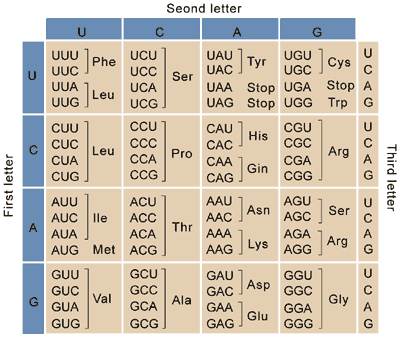 The degeneracy of the genetic code buffers biological systems from the effects of random mutation. The ingenuous 1964 Nirenberg and Leder experiment would identify the mRNA codons, a triplet sequence of ribonucleotides, that coded for each amino acid; thus elucidating the universal genetic code within the DNA when the transcription process was taken into account. Changes in the third position of the codon, the wobble position, often result in the same amino acid, and oftentimes the choice comes down to purine or pyrimidine only when a choice must be made. Similar, but variant, codon sequences tend to yield similar classes of amino acid – polar to polar, non-polar to non-polar, acidic to acidic, and basic to basic residues.  The four major classes of biological amino acids – polar (hydrophilic), nonpolar (hydrophobic), acidic, and basic side chain residues. The amino acid backbone is amino group linked to an alpha carbon, on which resides the side chain residue and a hydrogen atom, that is connected to a terminal carboxylate group. Aside from the disulfide bridge, there are quite a number of degenerate combinations of sidechain residues that make up the tertiary structure (H-bonding, hydrophobic, and ionic bridges) in the determination of protein structure.  Relationships between degeneracy, complexity, robustness, and evolvability – 1) degeneracy is the source of robustness. 2) degeneracy is positively correlated with complexity. 3) degeneracy increases evolvability. 4) evolvability is a prerequisite for complexity. 5) complexity increases to improve robustness. 6) evolvability emerges from robustness. Degeneracy, and its relationship to variation, is a key concept in neural Darwinism. The more we deviate from an ideal form, the more we are tempted to describe the deviations as imperfections. Edelman, on the other hand, explicitly acknowledges the structural and dynamic variability of the nervous system. He likes to contrast the differences between redundancy in an engineered system and degeneracy in a biological system. He proceeds to demonstrate how the "noise" of the computational and algorithmic approach is actually beneficial to a somatic selective system by providing a wide, and degenerate, array of potential recognition elements.[18] Edelman's argument is that in an engineered system, a known problem is confronted a logical solution is devised an artifice is constructed to implement the resolution to the problem To insure the robustness of the solution, critical components are replicated as exact copies. Redundancy provides a fail-safe backup in the event of catastrophic failure of an essential component but it is the same response to the same problem once the substitution has been made. If the problem is predictable and known ahead of time, redundancy works optimally. But biological systems face an open and unpredictable arena of spacetime events of which they have no foreknowledge of. In this arena, redundancy fails - a response might be designed to the wrong problem. Variation fuels degeneracy; degeneracy provides somatic selective systems with more than one way to solve a problem and the propensity to reuse a solution on other problems. This property of degeneracy makes the system more adaptively robust in the face of unforeseen contingencies: When one particular solution fails unexpectedly, there are other unaffected pathways that can be engaged in pursuit of the same end. Early on, Edelman spends considerable time contrasting degeneracy vs. redundancy, bottom-up vs. top-down processes, and selectionist vs. instructionist explanations of biological phenomena. Rejection of computational models, codes, and point-to-point wiring Edelman was well aware of the earlier debate in immunology between the instructionists, who believed the lymphocytes of the immune system learned or was instructed about the antigen and then devised a response; and the selectionists, who believed that the lymphocytes already contained the response to the antigen within the existing population that was differentially amplified within the population upon contact with the antigen. And, he was well aware that the selectionist had the evidence on their side. Edelman's theoretical approach in Neural Darwinism was conceived of in opposition to top-down algorithmic, computational, and instructionist approaches to explaining neural function. Edelman seeks to turn the problems of that paradigm to advantage instead; thereby highlighting the difference between bottom-up processes like we see in biology vis a vis top-down processes like we see in engineering algorithms. He sees neurons as living organisms working in cooperative and competitive ways within their local ecology and rejects models that see the brain in terms of computer chips or logic gates in an algorithmically organized machine. Edelman's commitment to the Darwinian underpinnings of biology, his emerging understanding of the evolutionary relationships between the two molecules he had worked with, and his background in immunology lead him to become increasingly critical and dissatisfied with attempts to describe the operation of the nervous system and brain in computational or algorithmic terms. Edelman explicitly rejects computational approaches to explaining biology as non-biological. Edelman acknowledges that there is a conservation of phylogenetic organization and structure within the vertebrate nervous system, but also points out that locally natural diversity, variation and degeneracy abound. This variation within the nervous system is disruptive for theories based upon strict point-to-point connectivity, computation, or logical circuits based upon codes. Attempts to understand this noise present difficulties for top-down algorithmic approaches – and, deny the fundamental facts of the biological nature of the problem. Edelman perceived that the problematic and annoying noise of the computational circuit-logic paradigm could be reinterpreted from a population biology perspective – where that variation in the signal or architecture was actually the engine of ingenuity and robustness from a selectionist perspective. |
生物学的システムにおける多様性――縮退性、複雑性、頑健性、そして進
化可能性 遺伝暗号の縮退性は、生物学的システムをランダムな突然変異の影響から守っている。1964年にニレンバーグとレダーが行った独創的な実験により、各アミ ノ酸をコードするmRNAコドン(リボヌクレオチドの3塩基配列)が特定され、転写過程を考慮に入れることで、DNA内の普遍的な遺伝暗号が解明された。 コドンの第3位、すなわちウォブル位置での変化は、多くの場合同じアミノ酸をもたらし、選択を迫られる場合でも、その選択はしばしばプリンかピリミジンか のいずれかに絞られる。類似しているが変異のあるコドン配列は、同様のアミノ酸のクラス――極性から極性へ、非極性から非極性へ、酸性から酸性へ、そして 塩基性から塩基性残基へと――を生み出す傾向がある。 生物学的アミノ酸の4つの主要な分類――極性(親水性)、非極性(疎水性)、酸性、および塩基性の側鎖残基である。アミノ酸の主鎖は、α炭素に結合したア ミノ基であり、その上には側鎖残基と水素原子が存在し、これは末端のカルボキシル基に接続されている。ジスルフィド結合以外にも、タンパク質の構造決定に おいて三次構造(水素結合、疎水性結合、イオン結合)を構成する側鎖残基の縮退的な組み合わせは数多く存在する。 縮退性、複雑性、堅牢性、および進化可能性の関係――1) 縮退性は堅牢性の源である。2) 縮退性は複雑性と正の相関関係にある。3) 縮退性は進化可能性を高める。4) 進化可能性は複雑性の前提条件である。5) 複雑性は堅牢性を高めるために増大する。6) 進化可能性は堅牢性から生じる。 縮退性、およびそれの変異との関係は、神経ダーウィニズムにおける重要な概念である。理想的な形態から逸脱すればするほど、その逸脱を不完全性として説明 したくなる。一方、エデルマンは神経系の構造的・動的な可変性を明確に認めている。彼は、人工システムにおける冗長性と生物学的システムにおける縮退性の 異なる点を対比させることを好む。彼はさらに、計算論的・アルゴリズム的アプローチの「ノイズ」が、潜在的な認識要素の広範かつ縮退的な配列を提供するこ とで、体細胞的選択システムにとって実際に有益であることを実証する。[18] エデルマンの主張は、人工システムにおいては、 既知の問題に直面し 論理的な解決策が考案され その問題の解決策を実装するための仕掛けが構築される というものである。解決策の堅牢性を確保するため、重要な構成要素は完全な複製として複製される。冗長性は、必須構成要素が壊滅的な故障を起こした場合の フェイルセーフなバックアップを提供するが、代替が行われた後は、同じ問題に対して同じ応答をするに過ぎない。 問題が予測可能で事前に知られている場合、冗長性は最適に機能する。しかし、生物学的システムは、事前の知識を持たない、開かれた予測不可能な時空間事象 の領域に直面している。この領域において、冗長性は機能しない――誤った問題に対して反応が設計されてしまう可能性がある。 変異は縮退性を促進する。縮退性は、体細胞の選択システムに問題を解決する複数の方法と、他の問題において解決策を再利用する傾向をもたらす。この縮退性 の特性により、システムは予期せぬ不測の事態に直面しても適応的に強靭になる。ある特定の解決策が予期せず失敗しても、同じ目的を追求するために動員でき る、影響を受けていない他の経路が存在するからだ。エデルマンは序盤で、縮退性と冗長性、ボトムアップとトップダウンのプロセス、そして生物学的現象に関 する選択主義的説明と指示主義的説明を対比させることにかなりの時間を費やしている。 計算モデル、コード、およびポイント・トゥ・ポイント配線の否定 エデルマンは、免疫学における以前の議論をよく認識していた。それは、免疫系のリンパ球が抗原について学習または指示を受け、その後応答を考案すると信じ る「指示説」と、リンパ球は既存の集団内にすでに抗原への応答を含んでおり、抗原との接触によって集団内で差動増幅されると信じる「選択説」との間の議論 である。そして、彼は選択論派の方が証拠を味方につけていることもよく認識していた。 『ニューラル・ダーウィニズム』におけるエデルマンの理論的アプローチは、神経機能を説明するトップダウン型のアルゴリズム的、計算論的、および指示論的 アプローチに対抗して構想されたものである。エデルマンは、そのパラダイムの問題をむしろ利点に変えようとしている。それによって、生物学に見られるよう なボトムアップのプロセスと、工学的なアルゴリズムに見られるようなトップダウンのプロセスとの違いを浮き彫りにするのだ。彼はニューロンを、局所的な生 態系の中で協調的かつ競争的に機能する生物と見なし、脳をアルゴリズム的に組織化された機械内のコンピュータチップや論理ゲートとして捉えるモデルを拒否 する。 生物学のダーウィニズム的基盤へのエデルマンのこだわり、彼が研究してきた2つの分子間の進化的関係に対する新たな理解、そして免疫学のバックグラウンド が相まって、彼は神経系や脳の働きを計算論的あるいはアルゴリズム的な用語で記述しようとする試みに対し、ますます批判的になり、不満を抱くようになっ た。 エデルマンは、生物学を説明する計算論的アプローチを非生物学的であるとして明確に拒否する。エデルマンは、脊椎動物の神経系内に系統発生的な組織と構造 の保存があることを認めつつも、局所的には自然な多様性、変異、および冗長性が豊富に存在することを指摘する。神経系内のこの変異は、厳格な点対点の接続 性、計算、あるいはコードに基づく論理回路に依拠する理論にとって破壊的である。この「ノイズ」を理解しようとする試みは、トップダウン型のアルゴリズム 的アプローチにとって困難をもたらすものであり、かつ、問題の生物学的本質という根本的な事実を否定することになる。 エデルマンは、計算回路論理パラダイムにおける問題視され、厄介な「ノイズ」が、個体群生物学の視点から再解釈できると捉えた。すなわち、信号やアーキテ クチャにおけるその変異こそが、選択主義の観点からは、独創性と頑健性の原動力であるというのだ。 |
| Completing Darwin's program –
the problems of evolutionary and developmental morphology In Topobiology, Edelman reflects upon Darwin's search for the connections between morphology and embryology in his theory of natural selection. He identifies four unresolved problems in the development and evolution of morphology that Darwin thought important:[19] Explaining the finite number of body plans manifested since the Precambrian. Explaining large-scale morphological changes over relatively short periods of geological time. Understanding body size and the basis of allometry. How adaptive fitness can explain selection that leads to emergence of complex body structures. Later, In Bright Air, Brilliant Fire, Edelman describes what he calls Darwin's Program for obtaining a complete understanding of the rules of behavior and form in evolutionary biology.[20] He identifies four necessary requirements: An account of the effects of heredity on behavior – and behavior, on heredity. An account of how selection influences behavior – and, how behavior influences selection. An account of how behavior is enabled and constrained by morphology. An account of how morphogenesis occurs in development and evolution. It is important to notice that these requirements are not directly stated in terms of genes, but heredity instead. This is understandable considering that Darwin himself appears to not be directly aware of the importance Mendelian genetics. Things had changed by the early 1900s, the Neodarwinian synthesis had unified the population biology of Mendelian inheritance with Darwinian natural selection. By the 1940s, the theories had been shown to be mutually consistent and coherent with paleontology and comparative morphology. The theory came to be known as the modern synthesis on the basis of the title of the 1942 book Evolution: The Modern Synthesis by Julian Huxley.[21] The modern synthesis really took off with the discovery of the structural basis of heredity in the form of DNA. The modern synthesis was greatly accelerated and expanded with the rise of the genomic sciences, molecular biology, as well as, advances in computational techniques and the power to model population dynamics. But, for evolutionary-developmental biologists, there was something very important missing... – and, that was the incorporation of one of the founding branches of biology, embryology. A clear understanding of the pathway from germ to zygote to embryo to juvenile and adult was the missing component of the synthesis. Edelman, and his team, were positioned in time and space to fully capitalize on these technical developments and scientific challenges – as his research progressed deeper and deeper into the cellular and molecular underpinnings of the neurophysiological aspects of behavior and cognition from a Darwinian perspective. Edelman reinterprets the goals of "Darwin's program" in terms of the modern understanding about genes, molecular biology, and other sciences that weren't available to Darwin. One of his goals is reconciling the relationships between genes in a population (genome) which lie in the germ line (sperm, egg, and fertilized egg); and the individuals in a population who develop degenerate phenotypes (soma) as they transform from an embryo into an adult who will eventually procreate if adaptive. Selection acts on phenotypes (soma), but evolution occurs within the species genome (germ). Edelman follows the work of the highly influential American geneticist and evolutionary biologist Richard Lewontin (March 29, 1929 – July 4, 2021), drawing particular inspiration from his 1974 book, The Genetic Basis of Evolutionary Change.[22] Edelman, like Lewontin, seeks a complete description of the transformations (T) that take us from:[23] Genome-germ (zygotes) – the paternal and maternal gene contributions are recombined in the fertilized egg, along with the maternal endowment of proteins, and mRNAs, and other developmental components, but the individuals newly formed diploid genetic complement is not in control of the zygote yet; it needs to be activated, or bootstrapped, into the zygotes ongoing maternally-inherited metabolism and physiology. Shortly after recombination the zygote proceeds through transformation (T1) to the point where genetic control of the zygote has been handed off to the individual, Phenotype-soma (embryo) – the embryo, which transforms (T2) according to the rules that govern the relationship between the genes, cellular behavior, and the epigenetic contingencies of nature, into Phenotype-soma (adult) – an adult, who procreates (T3) with another individual to bring together a new genetic recombination by each introducing a gamete in the form of Genome-germ (gametes) – sperm and egg, which contain the haploid genetic contribution of each parent which is transformed (T4)... Genome-germ (zygotes) -into a diploid set genes in a fertilized egg, soon to be a newly individual zygote . Lewontin's exploration of these transformations between genomic and phenotypic spaces was in terms of key selection pressures that sculpt the organism over geological evolutionary time scales; but, Edelmans approach is more mechanical, and in the here and now – focusing on the genetically constrained mechano-chemistry of the selection processes that guide epigenetic behaviors on the part of cells within the embryo and adult over developmental time. |
ダーウィンのプログラムの完結――進化形態学と発生形態学の課題 『トポバイオロジー』において、エデルマンは、ダーウィンが自然選択説の中で形態学と発生学の関連性を探求した経緯について考察している。彼は、ダーウィ ンが重要視した形態の発生と進化に関する未解決の問題を4つ挙げている[19] 先カンブリア時代以降に現れた体型の数が有限であることへの説明。 地質学的に比較的短い期間における大規模な形態学的変化の説明。 体の大きさおよびアロメトリーの基礎の理解。 適応度がいかにして、複雑な体構造の出現につながる選択を説明できるか。 その後、『In Bright Air, Brilliant Fire』において、エデルマンは、進化生物学における行動と形態の法則を完全に理解するための、彼が「ダーウィンのプログラム」と呼ぶものを記述してい る。[20] 彼は、4つの必要条件を挙げている: 遺伝が行動に及ぼす影響、および行動が遺伝に及ぼす影響に関する説明。 選択が行動にどのように影響するか、および行動が選択にどのように影響するかに関する説明。 形態が行動をどのように可能にし、また制約するかに関する説明。 発生と進化において形態形成がどのように起こるかについての説明。 これらの要件が遺伝子ではなく、遺伝という用語で直接述べられている点に留意することが重要だ。これは、ダーウィン自身がメンデル遺伝学の重要性を直接認 識していなかったようであることを考えれば理解できる。1900年代初頭までに状況は変化し、新ダーウィン主義の統合により、メンデル遺伝の集団生物学と ダーウィンの自然選択が統合された。1940年代までに、これらの理論は互いに整合しており、古生物学や比較形態学とも整合することが示された。この理論 は、ジュリアン・ハクスリーによる1942年の著書『進化:現代の統合(Evolution: The Modern Synthesis)』の題名に基づき、「現代の統合」として知られるようになった。[21] 現代総合説は、DNAという形での遺伝の構造的基盤の発見によって、本格的に飛躍した。ゲノム科学や分子生物学の台頭、さらには計算技術の進歩や個体群動 態をモデル化する能力の向上により、現代総合説は大きく加速し、拡大した。しかし、進化発生生物学者にとって、非常に重要なものが欠けていた……それは、 生物学の創設的分野の一つである発生学の統合であった。生殖細胞から受精卵、胚、幼体、そして成体へと至る経路を明確に理解することこそが、この統合理論 に欠けていた要素であった。エデルマンとそのチームは、時間的にも場所的にも、これらの技術的進展と科学的課題を最大限に活用できる立場にあった――彼の 研究は、ダーウィニズムの視点から、行動や認知の神経生理学的側面の細胞的・分子的基盤へと、ますます深く掘り下げていったのである。 エデルマンは、ダーウィンには利用できなかった遺伝子、分子生物学、その他の科学に関する現代的な理解に基づき、「ダーウィンのプログラム」の目標を再解 釈している。彼の目標の一つは、生殖細胞系列(精子、卵子、受精卵)に存在する集団内の遺伝子(ゲノム)と、適応的であれば最終的に子孫を残すことになる 成体へと胚から変容する過程で退化した表現型(体細胞)を発現する個体との関係を調和させることである。自然選択は表現型(体細胞)に作用するが、進化は 種のゲノム(生殖細胞)の中で起こる。 エデルマンは、極めて影響力のあるアメリカの遺伝学者兼進化生物学者リチャード・レウォンティン(1929年3月29日 – 2021年7月4日)の研究を踏襲しており、特に1974年の著書『The Genetic Basis of Evolutionary Change』から大きな着想を得ている。[22] エデルマンはレウォンティンと同様に、以下の段階から私たちを導く変容(T)の完全な記述を求めている。[23] ゲノム・生殖細胞(受精卵)――受精卵内では父方および母方の遺伝的寄与が再結合され、母方由来のタンパク質、mRNA、その他の発生成分も加わるが、新 たに形成された個体の二倍体遺伝的構成は、まだ受精卵を制御していない。それは活性化され、あるいはブートストラップされ、母方から継承された受精卵の代 謝および生理機能へと組み込まれる必要がある。再結合の直後、受精卵は変容(T1)を経て、受精卵の遺伝的制御が個体に引き継がれる段階に至る。 表現型-体細胞(胚) – 胚は、遺伝子、細胞の挙動、および自然界のエピジェネティックな不確実性の関係を支配する規則に従って変容(T2)し、 表現型-体細胞(成体)――成体となり、別の個体と生殖(T3)を行うことで、それぞれが ゲノム-生殖細胞(配偶子)――精子と卵子――の形で配偶子を導入し、新たな遺伝的再結合をもたらす。これらは各親の半数体遺伝的寄与を含み、変容 (T4)する…… ゲノム・生殖細胞(受精卵)――受精卵内の二倍体遺伝子セットへと、まもなく新たな個体となる受精卵へと変容する。 ゲノム空間と表現型空間の間のこうした変容に関するレウォンティンの考察は、地質学的進化の時間スケールにおいて生物を形作る主要な選択圧という観点から なされた。しかし、エデルマンのアプローチはより機械的であり、現在という時点に焦点を当てている。すなわち、発生過程を通じて胚や成体内の細胞における エピジェネティックな挙動を導く選択プロセスの、遺伝的に制約された機械化学的メカニズムに注力しているのだ。 |
Mechano-chemistry, mesenchyme,
and epithelia – CAMs & SAMs in morphoregulatory spacetime Mesenchymal-epithelial transitions – epithelia to mesenchyme (EMT) and mesenchyme to epithelia (MET) transitions utilizing CAMs and SAMs to form epethelia; and, growth factors and inducers to mediate the transition to mesenchyme as the CAMs and SAMs are withdrawn or localized on the cell membrane. Edelman's isolation of NCAM lead him to theorize on the role of cell adhesion molecules (CAMs) and substrate adhesion molecules (SAMs) in the formation of the animal bodyplan in both realtime and over evolutionary time. Topobiology is primarily dedicated to this issue that is foundational to the understanding of neural Darwinism and the formation of the primary repertoire of TNGS. In his regulator hypothesis, Edelman hypothesizes about the role of cell surface molecules in embryogenesis and how shifting expression of these molecules in time and place within the embryo can guide the development of pattern.[24] Later, he will expand the hypothesis into the morpho-regulatory hypothesis.[25] He describes the embryonic cell populations as either organized as mesenchyme or epetheilia. Edelman characterizes the two population types as follows: Epithelia – a population of cells that are organized into coherent tissues, that have well established CAM patterns; as well as a stable pattern of substrate adhesion between the cells and the extracellular matrix. Mesenchyme – a population of cells that are loosely associated and migratory, that have retracted (or localized) their CAM and SAM molecules such that they can follow homophilic and heterophilic gradients within other cell populations of the embryo. He envisages a CAM, and SAM, driven cycle where cell populations transform back and forth between mesenchyme and epithelia via epithelial-mesenchymal transformations,[26] as the development of the embryo proceeds through to the fetal stage. The expression of the CAMs and SAMs is under genetic control, but the distribution of these molecules on the cell membrane and extracellular matrix is historically contingent upon epigenetic events, serving as one of the primary bases for generating pre-existing diversity within the nervous system and other tissues. |
メカノケミストリー、間葉組織、および上皮組織――形態調節時空間にお
けるCAMsとSAMs 間葉-上皮移行――上皮から間葉(EMT)および間葉から上皮(MET)への移行において、CAMsおよびSAMsを利用して上皮を形成する。また、 CAMsおよびSAMsが細胞膜から消失または局在化されるにつれ、成長因子や誘導因子が間葉への移行を媒介する。 エデルマンによるNCAMの単離は、リアルタイムおよび進化の時間スケールの両面において、動物の体計画形成における細胞接着分子(CAMs)および基質 接着分子(SAMs)の役割に関する理論へと彼を導いた。トポバイオロジーは、神経ダーウィニズムの理解およびTNGSの主要なレパートリーの形成の基礎 となるこの問題に主に取り組んでいる。 エデルマンは自身の「レギュレーター仮説」において、胚発生における細胞表面分子の役割、および胚内での時間と場所に応じたこれらの分子の発現変化がいか にしてパターンの形成を導くかについて仮説を立てた[24]。その後、彼はこの仮説を「形態調節仮説」へと発展させた[25]。彼は胚の細胞集団を、間葉 組織として組織化されたものと上皮組織として組織化されたもののいずれかであると記述している。 エデルマンは、これら2つの細胞集団を次のように特徴づけている: 上皮 – 一貫性のある組織へと組織化された細胞集団であり、確立されたCAMパターンを有する。また、細胞と細胞外マトリックスとの間に安定した基質接着パターン を有する。 間葉 – 緩やかに結合し遊走性を持つ細胞集団であり、胚内の他の細胞集団内における同型および異型グラデーションを追跡できるよう、CAMおよびSAM分子を収縮 (または局在化)させている。 彼は、胚の発達が胎児期に至る過程において、上皮間葉転換を介して細胞集団が間葉と上皮の間を行き来する、CAMおよびSAMに駆動されたサイクルを想定 している[26]。CAMおよびSAMの発現は遺伝的に制御されているが、細胞膜および細胞外マトリックス上におけるこれらの分子の分布は、歴史的にエピ ジェネティックな事象に依存しており、神経系やその他の組織内に既存の多様性を生み出す主要な基盤の一つとなっている。 |
| The developmental genetic
question There are many developmental questions to be considered, but Edelman is able to succinctly summarize the problem in a way that will show a clear explanatory path forward for him. The developmental genetic question defines the problem – and, the theoretical approach for him. "How does a one-dimensional genetic code specify a three-dimensional animal?"[27] – Gerald M. Edelman, from the glossary of Topobiology By 1984, Edelman would be ready to answer this question and combine it with his earlier ideas on degeneracy and somatic selection in the nervous system. Edelman would revisit this issue in Topobiology and combine it with an evolutionary approach, seeking a comprehensive theory of body plan formation and evolution. The regulator hypothesis In 1984, Edelman published his regulator hypothesis of CAM and SAM action in the development and evolution of the animal body plan. Edelman would reiterate this hypothesis in his Neural Darwinism book in support of the mechanisms for degenerate neuronal group formation in the primary repertoire. The regulator hypothesis was primarily concerned with the action of CAMs. He would later expand the hypothesis in Topobiology to include a much more diverse and inclusive set of morphoregulatory molecules. The evolutionary question Edelman realized that in order to truly complete Darwin's program, he would need to link the developmental question to the larger issues of evolutionary biology. "How is an answer to the developmental genetic question (q.v.) reconciled with the relatively rapid changes in form occurring in relatively short evolutionary times?"[28] – Gerald M. Edelman, from the glossary of Topobiology The morphoregulator hypothesis Shortly after publishing his regulator hypothesis, Edelman expanded his vision of pattern formation during embryogenesis - and, sought to link it to a broader evolutionary framework. His first and foremost goal is to answer the developmental genetic question followed by the evolutionary question in a clear, consistent, and coherent manner. |
発生遺伝学の問い 検討すべき発生学上の問いは数多くあるが、エデルマンは、自身にとって明確な説明の道筋を示す形で、この問題を簡潔に要約している。発生遺伝学の問いは、 問題そのものを定義するものであり、彼にとっての理論的アプローチでもある。 「一次元の遺伝暗号は、いかにして三次元の動物を規定するのか?」[27] – ジェラルド・M・エデルマン、『トポバイオロジー』用語集より 1984年までに、エデルマンはこの問いに答える準備が整い、神経系における縮退性と体細胞選択に関する自身の以前の考えとこれを統合することになる。エ デルマンは『トポバイオロジー』においてこの問題を再検討し、進化論的アプローチと組み合わせることで、体計画の形成と進化に関する包括的な理論を模索し た。 レギュレーター仮説 1984年、エデルマンは動物の体計画の発達と進化におけるCAMおよびSAMの作用に関するレギュレーター仮説を発表した。 エデルマンは『ニューラル・ダーウィニズム』において、一次レパートリーにおける神経細胞群の退化形成メカニズムを支持する形で、この仮説を再提示した。 レギュレーター仮説は主にCAMの作用を扱っていた。彼は後に『トポバイオロジー』において、この仮説を拡張し、はるかに多様で包括的な形態調節分子群を 取り込むこととなる。 進化論的問い エデルマンは、ダーウィンのプログラムを真に完結させるためには、発生に関する問いを、より広範な進化生物学の課題と結びつける必要があると気づいた。 「発生遺伝学の問い(同項参照)に対する答えは、比較的短い進化の時間軸の中で生じる形態の比較的急速な変化と、どのように整合するのだろうか?」 [28] – ジェラルド・M・エデルマン、『トポバイオロジー』用語集より 形態調節因子仮説 調節因子仮説を発表した直後、エデルマンは胚発生におけるパターン形成に関する自身の見解を拡大し、それをより広範な進化論的枠組みと結びつけようとし た。彼の第一かつ最優先の目標は、発生遺伝学的な問い、そしてそれに続く進化論的な問いに、明確かつ一貫性があり、首尾一貫した形で答えることである。 |
| TNGS – the theory of neuronal
group selection Edelman's motivation for developing the theory of neuronal group selection (TNGS) was to resolve "a number of apparent inconsistencies in our knowledge of the development, anatomy, and physiological function of the central nervous system."[29] A pressing issue for Edelman was explaining perceptual categorization without reference to a central observing homunculus or "assuming that the world is prearranged in an informational fashion."[29] To free himself of the demands, requirements, and contradictions of information processing model; Edelman proposes that perceptual categorization operates by the selection of neuronal groups organized into variant networks that are differentially amplified of their responses in conjunction with hedonic feedback over the course of experience, from within a massive population of neuronal groups being confronted by a chaotic array of sensory input of differing degrees of significance and relevance to the organism. Edelman outright rejects the notion of a homunculus, describing it as a "close cousin of the developmental electrician and the neural decoder", artifacts of the observer-centralized top-down design logic of information processing approaches. Edelman properly points out that "it is probably a safe guess that most neurobiologists would view the homunculus as well as dualist solutions (Popper and Eccles 1981) to the problems of subjective report as being beyond scientific consideration."[30] Necessary criteria for a selectionist theory of higher brain function Edelman's first theoretical contribution to neural Darwinism came in 1978, when he proposed his group selection and phasic reentrant signalling.[31] Edelman lays out five necessary requirements that a biological theory of higher brain function must satisfy.[32] The theory should be consistent with the fields of embryology, neuroanatomy, and neurophysiology. The theory should account for learning and memory, and temporal recall in a distributed system. The theory should account how memory is updated on the basis of realtime experience. The theory should account for how higher brain systems mediate experience and action. The theory should account for the necessary, if not sufficient, conditions for the emergence of awareness. Organization of the TNGS theory Neural Darwinism organizes the explanation of TNGS into three parts – somatic selection, epigenetic mechanisms, and global functions. The first two parts are concerned with how variation emerges through the interaction of genetic and epigenetic events at the cellular level in response to events occurring at the level of the developing animal nervous system. The third part attempts to build a temporally coherent model of globally unitary cognitive function and behavior that emerges from the bottom up through the interactions of the neuronal groups in real-time. Edelman organized key ideas of the TNGS theory into three main tenets: Primary repertoire – developmental formation and selection of neuronal groups; Secondary repertoire – behavioral and experiential selection leading to changes in the strength of connections between synaptic populations that bind together neuronal groups; Reentrant signaling – the synchronous entrainment of reciprocally connected neuronal groups within sensorimotor maps into ensembles of coherent global activity. The primary repertoire is formed during the period from the beginning of neurulation to the end of apoptosis. The secondary repertoire extends over the period synaptogenesis and myelination, but will continue to demonstrate developmental plasticity throughout life, albeit in a diminished fashion compared to early development. The two repertoires deal with the issue of the relationship between genetic and epigenetic processes in determining the overall architecture of the neuroanatomy – seeking to reconcile nature, nurture, and variability in the forming the final phenotype of any individual nervous system. There is no point-to-point wiring that carries a neural code through a computational logic circuit that delivers the result to the brain because firstly, the evidence does not lend support to such notion in a manner that is not problematic, secondly, the noise in the system is too great for a neural code to be coherent, and third, the genes can only contribute to, and constrain, developmental processes; not determine them in all their details. Variation is the inevitable outcome of developmental dynamics. Reentrant signalling is an attempt to explain how "coherent temporal correlations of the responses of sensory receptor sheets, motor ensembles, and interacting neuronal groups in different brain regions occur".[33] Primary repertoire- developmental selection The first tenet of TNGS concerns events that are embryonic and run up to the neonatal period. This part of the theory attempts to account for the unique anatomical diversification of the brain even between genetically identical individuals. The first tenet proposes the development of a primary repertoire of degenerate neuronal groups with diverse anatomical connections are established via the historical contingencies of the primary processes of development. It seeks to provide an explanation of how the diversity of neuronal group phenotypes emerge from the organism's genotype via genetic and epigenetic influences that manifest themselves mechano-chemically at the cell surface and determine connectivity. Edelman list the following as vital to the formation of the primary repertoire of neuronal groups but, also contributing to their anatomical diversification and variation: Cell division – there are repeated rounds of cell division in the formation of neuronal populations Cell death – there is extensive amounts of pre-programmed cell death that occurs via apoptosis within the neuronal populations. Process extension and elimination – the exploratory probing of the embryonic environment by developing neurons involve process extension and elimination as the neurons detect molecular gradients on neighboring cell surface membranes and the substrate of the extracellular matrix. CAM & SAM action – the mechanochemistry of cell and surface adhesion molecules plays a key role in the migration and connectivity of neurons as they form neuronal groups within the overall distributed population. Two key questions with respect to this issue that Edelman is seeking to answer "in terms of developmental genetic and epigenetic events" are:[34] "How does a one-dimensional genetic code specify a three-dimensional animal?" "How is the answer to this question consistent with the possibility of relatively rapid morphological change in relatively short periods of evolutionary time?" Secondary repertoire – experiential selection The second tenet of TNGS regards postnatal events that govern the development of a secondary repertoire of synaptic connectivity between higher-order populations of neuronal groups whose formation is driven by behavioral or experiential selection acting on synaptic populations within and between neuronal groups. Edelman's notion of the secondary repertoire heavily borrows from work of Jean-Pierre Changeux, and his associates Philippe Courrège and Antoine Danchin – and, their theory of selective stabilization of synapses.[35] Synaptic modification Once the basic variegated anatomical structure of the primary repertoire of neuronal groups is laid down, it is more or less fixed. But given the numerous and diverse collection of neuronal group networks, there are bound to be functionally equivalent albeit anatomically non-isomorphic neuronal groups and networks capable of responding to certain sensory input. This creates a competitive environment where neuronal groups proficient in their responses to certain inputs are "differentially amplified" through the enhancement of the synaptic efficacies of the selected neuronal group network. This leads to an increased probability that the same network will respond to similar or identical signals at a future time. This occurs through the strengthening of neuron-to-neuron synapses. These adjustments allow for neural plasticity along a fairly quick timetable. Reentry Main article: Reentry (neural circuitry) The third, and final, tenet of TNGS is reentry. Reentrant signalling "is based on the existence of reciprocally connected neural maps."[33] These topobiological maps maintain and coordinate the real-time responses of multiple responding secondary repertoire networks, both unimodal and multimodal – and their reciprocal reentrant connections allow them to "maintain and sustain the spatiotemporal continuity in response to real-world signals."[33] The last part of the theory attempts to explain how we experience spatiotemporal consistency in our interaction with environmental stimuli. Edelman called it "reentry" and proposes a model of reentrant signaling whereby a disjunctive, multimodal sampling of the same stimulus event correlated in time that make possible sustained physiological entrainment of distributed neuronal groups into temporally stable global behavioral units of action or perception. Put another way, multiple neuronal groups can be used to sample a given stimulus set in parallel and communicate between these disjunctive groups with incurred latency. |
TNGS – ニューロン集団選択理論 エデルマンが神経群選択理論(TNGS)を提唱した動機は、「中枢神経系の発達、解剖学、および生理機能に関する我々の知識に見られる、いくつかの明らか な矛盾」を解決することにあった。[29] エデルマンにとって喫緊の課題は、中枢的な観察者ホムンクルスに言及することなく、あるいは「世界が情報的な形で予め整えられていると仮定すること」なし に、知覚的分類を説明することだった。[29] 情報処理モデルの要求、制約、矛盾から自らを解放するため、エデルマンは次のように提唱する。すなわち、知覚的分類は、生物にとって重要度や関連性の異な る混沌とした感覚入力の配列に直面する膨大な数のニューロン群の中から、経験の過程において快楽的フィードバックと連動して反応が差別的に増幅された、多 様なネットワークへと組織化されたニューロン群の選択によって機能するのだ。 エデルマンはホムンクルスの概念をきっぱりと退け、それを「発達電気工や神経デコーダーの近縁種」と表現し、情報処理アプローチにおける観察者中心のトッ プダウン設計論理が生み出した産物であると述べている。エデルマンは、「主観的報告の問題に対するホムンクルスや二元論的解決策(ポッパーとエクルズ 1981)を、ほとんどの神経生物学者が科学的検討の対象外と見なしているだろうと推測するのは妥当だろう」と正しく指摘している。[30] 高次脳機能の選択主義理論に必要な基準 エデルマンが神経ダーウィニズムに対して行った最初の理論的貢献は1978年に遡り、彼はそこで集団選択と相性再帰的シグナリングを提唱した。[31] エデルマンは、高次脳機能に関する生物学的理論が満たさなければならない5つの必要条件を提示している。[32] 理論は、発生学、神経解剖学、神経生理学の各分野と整合していなければならない。 理論は、分散システムにおける学習、記憶、および時間的想起を説明できなければならない。 理論は、リアルタイムの経験に基づいて記憶がどのように更新されるかを説明できなければならない。 理論は、高次脳系が経験と行動をどのように仲介するかを説明できなければならない。 理論は、意識の創発に必要な(十分条件ではないにせよ)条件を説明できなければならない。 TNGS理論の構成 ニューラル・ダーウィニズムは、TNGSの説明を「体細胞選択」、「エピジェネティックなメカニズム」、「グローバルな機能」の3つの部分に分類してい る。最初の2つの部分は、発達中の動物の神経系レベルで起こる事象に応答して、細胞レベルでの遺伝的およびエピジェネティックな事象の相互作用を通じて、 いかにして変異が生じるかについて扱う。第3の部は、神経細胞群のリアルタイムな相互作用を通じてボトムアップで生じる、全体として統一された認知機能と 行動の、時間的に一貫性のあるモデルを構築しようとするものである。 エデルマンは、TNGS理論の主要な考え方を以下の3つの主要な原則に整理した: 一次レパートリー – 神経細胞群の発達的形成と選択; 二次レパートリー――神経群を結びつけるシナプス集団間の接続強度の変化をもたらす、行動的・経験的な選択; 再入性シグナリング――感覚運動マップ内で相互接続された神経群が、一貫性のある全体的な活動アンサンブルへと同期的に同調すること。 一次レパートリーは、神経管形成の開始からアポトーシスの終了までの期間に形成される。二次レパートリーはシナプス形成および髄鞘形成の期間に及ぶが、初 期の発達と比較してその程度は低下するものの、生涯を通じて発達的可塑性を示し続ける。 これら2つのレパートリーは、神経解剖学の全体的な構造を決定する上で、遺伝的プロセスとエピジェネティックなプロセスの関係という課題に取り組んでい る。すなわち、個々の神経系の最終的な表現型を形成する上で、先天性、後天性、および変動性を調和させようとしているのである。 神経コードを運ぶ点対点の配線が存在し、それが計算論理回路を通じて結果を脳に届けるという仕組みは存在しない。なぜなら 第一に、証拠がそのような概念を問題なく支持するものではないからであり、 第二に、システム内のノイズが大きすぎて神経コードが首尾一貫したものにはなり得ないからであり、 第三に、遺伝子は発達過程に寄与し、それを制約することはできても、その詳細のすべてを決定づけることはできないからである。 変異は、発生ダイナミクスの必然的な結果である。 再帰的シグナリングは、「異なる脳領域における感覚受容体シート、運動アンサンブル、および相互作用するニューロン群の応答の、一貫した時間的相関がどの ように生じるか」を説明しようとする試みである。[33] 一次レパートリー-発生学的選択 TNGSの第一の定理は、胚発生期から新生児期に至るまでの事象に関するものである。理論のこの部分は、遺伝的に同一の個体間であっても見られる脳の独特 な解剖学的多様性を説明しようとするものである。第一の定理は、多様な解剖学的接続を持つ縮退神経群からなる一次レパートリーが、発生の一次過程における 歴史的偶然性を通じて確立されることを提唱している。この理論は、細胞表面で機械化学的に現れ、接続性を決定づける遺伝的およびエピジェネティックな影響 を通じて、個体の遺伝子型から神経細胞群の表現型の多様性がどのように生じるかを説明しようとするものである。 エデルマンは、神経細胞群の一次レパートリーの形成に不可欠であり、かつその解剖学的多様化と変異にも寄与する要因として、以下を挙げている: 細胞分裂 – 神経細胞集団の形成には、繰り返される細胞分裂の過程がある 細胞死 – 神経細胞集団内では、アポトーシスを介して広範なプログラムされた細胞死が生じる 突起の伸長と除去 – 発達中の神経細胞による胚環境の探索的探査には、神経細胞が隣接する細胞表面膜や細胞外マトリックスの基質上の分子勾配を感知する過程として、突起の伸長 と除去が伴う CAMおよびSAMの作用 – 細胞および表面接着分子のメカノケミストリーは、分散した集団全体の中で神経細胞群を形成する際、神経細胞の移動と接続において重要な役割を果たす。 この問題に関して、エデルマンが「発生遺伝学的およびエピジェネティックな事象の観点から」答えようとしている2つの重要な問いは以下の通りである [34] 「一次元的な遺伝コードは、どのようにして三次元的な動物を規定するのか?」 「この問いへの答えは、比較的短い進化の時間スケールにおける比較的急速な形態変化の可能性と、どのように整合するのか?」 二次レパートリー – 経験的選択 TNGSの第二の原則は、出生後の事象に関するものである。それは、神経細胞群内および群間のシナプス集団に作用する行動的または経験的選択によって形成 が駆動される、高次神経細胞群集団間のシナプス接続性の二次レパートリーの発達を支配するものである。エデルマンの二次レパートリーに関する概念は、ジャ ン=ピエール・シャンジュおよびその共同研究者であるフィリップ・クールレージュとアントワーヌ・ダンシャンらの研究、ならびに彼らのシナプスの選択的安 定化理論から多大な影響を受けている。[35] シナプスの修飾 神経集団の一次レパートリーの基本的で多様な解剖学的構造が確立されると、それは多かれ少なかれ固定される。しかし、神経集団ネットワークの集合は数多く 多様であるため、解剖学的には非同型であっても機能的に同等であり、特定の感覚入力に応答できる神経集団やネットワークが存在するのは必然である。これに より、特定の入力に対する応答に長けた神経群が、選択された神経群ネットワークのシナプス効力の増強を通じて「差別的に増幅」される競争環境が生まれる。 これにより、将来、同じネットワークが類似または同一の信号に応答する確率が上昇する。これは、ニューロン間のシナプスの強化を通じて起こる。これらの調 整により、比較的短期間での神経可塑性が可能となる。 再入 本記事:再入(神経回路) TNGSの3つ目にして最後の原則は再入である。再入性シグナリングは「相互に接続された神経マップの存在に基づいている」。[33] これらのトポバイオロジカルなマップは、単一感覚および多感覚の複数の反応する二次レパートリーネットワークのリアルタイムな反応を維持・調整しており、 それらの相互的な再入接続によって、ネットワークは「現実世界の信号に対する時空間的な連続性を維持・持続させる」ことができる。[33] この理論の最後の部分は、環境刺激との相互作用において、我々がどのように時空間的な一貫性を経験するかを説明しようとするものである。エデルマンはこれ を「再入(reentry)」と呼び、再入シグナリングのモデルを提唱した。それによれば、同一の刺激事象に対する時間的に相関した非結合的かつ多感覚的 なサンプリングにより、分散した神経細胞群が、時間的に安定した行動や知覚の全体的な単位へと持続的に生理学的同調することが可能になる。言い換えれば、 複数の神経細胞群を用いて特定の刺激セットを並行してサンプリングし、これらの非結合的なグループ間で遅延を伴って通信することができる。 |
| The extended theory of neuronal
group selection – the dynamic core hypothesis In the aftermath of his publication of Neural Darwinism, Edelman continued to develop and extend his TNGS theory as well as his regulator hypothesis. Edelman would deal with the morphological issues in Topobiology and begin to extend the TNGS theory in The Remembered Present. Periodically over the intervening years, Edelman would release a new update on his theory and the progress made. In The Remembered Present, Edelman would observe that the mammalian central nervous system seemed to have two distinct morphologically organized systems – one the limbic-brain stem system which is primarily dedicated to "appetitive, consumatory, and defensive behavior";[36] The other system is the highly reentrant thalamocortical system, consisting of the thalamus along with the "primary and secondary sensory areas and association cortex"[36] which are "linked strongly to exteroceptors and is closely and extensively mapped in a polymodal fashion."[36] The limbic-brain stem system – the interior world of signals The neural anatomy of the hedonic feedback system resides in the brain stem, autonomic, endocrine, and limbic systems. This system communicates its evaluation of the visceral state to the rest of the central nervous system. Edelman calls this system the limbic-brain stem system. The thalamocortical system - the exterior world of signals The thalamus is the gateway to the neocortex for all senses except olfactory. The spinothalamic tracts bring sensory information from the periphery to the thalamus, where multimodal sensory information is integrated and triggers the fast response subcortical reflexive motor responses via the amygdala, basal ganglia, hypothalamus and brainstem centers. Simultaneously, each sensory modality is also being sent to the cortex in parallel, for higher-order reflective analysis, multimodal sensorimotor association, and the engagement of the slow modulatory response that will fine-tune the subcortical reflexes. The cortical appendages – the organs of succession In The Remembered Present, Edelman acknowledges the limits of his TNGS theory to model the temporal succession dynamics of motor behavior and memory. His early attempts at replication automata proved inadequate to the task of explaining the realtime sequencing and integration of the neuronal group interactions with other systems of the organism. "Neither the original theory nor simulated recognition automata deal in satisfactory detail with the successive ordering of events in time mediated by the several major brain components that contribute to memory, particularly as it relates to consciousness."[37] This problem lead him to focus on what he called the organs of succession; the cerebellum, basal ganglia, and hippocampus. |
神経集団選択の拡張理論――動的コア仮説 『ニューラル・ダーウィニズム』の出版後、エデルマンはTNGS理論とレギュレーター仮説の展開と拡張を続けた。エデルマンは『トポバイオロジー』におい て形態学的な問題に取り組み、『記憶された現在』においてTNGS理論の拡張に着手した。その後の数年間、エデルマンは定期的に自身の理論と進捗状況に関 する新たな更新を発表していた。 『記憶された現在』において、エデルマンは、哺乳類の中枢神経系には、形態学的に組織化された2つの異なるシステムが存在するように見えると指摘した。1 つは、主に「欲求、摂取、および防御行動」に特化した辺縁系・脳幹系であり、 [36] もう一つのシステムは、高度に再帰的な視床皮質系であり、視床に加え、「一次および二次感覚野と連合皮質」[36] から構成され、これらは「体外受容器と強く結びついており、多感覚的な様式で密接かつ広範にマッピングされている」[36]。 辺縁系・脳幹系――信号の内なる世界 快楽的フィードバック系の神経解剖学的基盤は、脳幹、自律神経系、内分泌系、および辺縁系にある。この系は、内臓状態の評価を中枢神経系の他の部分に伝達 する。エデルマンはこの系を辺縁系・脳幹系と呼んでいる。 視床皮質系――信号の外在世界 視床は、嗅覚を除くすべての感覚にとって新皮質への玄関口である。脊髄視床路は末梢から視床へ感覚情報を運び、そこで多感覚情報が統合され、扁桃体、大脳 基底核、視床下部、脳幹中枢を介して、皮質下での反射的運動反応を迅速に引き起こす。同時に、各感覚モダリティの情報は並行して皮質へも送られ、高次レベ ルの反射的分析、多感覚的な感覚運動連合、そして皮質下反射を微調整する遅延性調節反応の作動が行われる。 皮質の付属器官――連続性の器官 『記憶された現在』において、エデルマンは、運動行動と記憶の時間的連続性のダイナミクスをモデル化する上で、自身のTNGS理論には限界があることを認 めている。彼の初期の複製オートマトンへの試みは、神経細胞群の相互作用と生物の他のシステムとのリアルタイムな順序付けおよび統合を説明するという課題 には不十分であった。「元の理論も、シミュレーションされた認識オートマトンも、記憶に寄与するいくつかの主要な脳構成要素によって媒介される、時間にお ける事象の連続的な順序付けについて、特にそれが意識に関連する場合において、満足のいく詳細さで扱っていない。」[37] この問題により、彼は自身が「連続性の器官」と呼んだ小脳、大脳基底核、海馬に焦点を当てるようになった。 |
| Reception An early review of the book Neural Darwinism in The New York Review of Books[38] by Israel Rosenfield invited a lively response on the part of the neurosciences community.[39] Edelman's views would be seen as an attack on the dominant paradigm of computational algorithms in cognitive psychology and computational neuroscience – inviting criticism from many corners. There would be copious complaints about the language difficulty. Some would see Edelman coming across as arrogant, or an interloper into the field of neuroscience, from neighboring molecular biology. There were legitimate arguments raised as to how much experimental and observational data had been gathered in support of the theory at that time. Or, if the theory was even original or not. But more often, rather than dealing with Edelman's critique of computational approaches, the criticism would be centered around whether Edelman's system was a truly proper Darwinian explanation. Nonetheless, Neural Darwinism, both the book and the concept, received fairly broad critical acclaim. One of the most famous critiques of Neural Darwinism would be the 1989 critical review by Francis Crick, Neural Edelmanism.[40] Francis Crick based his criticism on the basis that neuronal groups are instructed by the environment rather than undergoing blind variation. In 1988, the neurophysiologist William Calvin had proposed true replication in the brain,[41] whereas Edelman opposed the idea of true replicators in the brain. Stephen Smoliar published another review in 1989.[42] England, and its neuroscience community, would have to rely on bootleg copies of the book until 1990, but once the book arrived on English shores, the British social commentator and neuroscientist Steven Rose was quick to offer both praise and criticism of its ideas, writing style, presumptions and conclusions.[43] The New York Times writer George Johnson published "Evolution Between the Ears", a critical review of Gerald Edelman's 1992 book Brilliant Air, Brilliant Fire.[44] In 2014, John Horgan wrote to Gerald Edelman in Scientific American, highlighting both his arrogance, brilliance, and idiosyncratic approach to science.[45] It has been suggested by Chase Herrmann-Pillath that Friedrich Hayek had earlier proposed a similar idea in his book The Sensory Order: An Inquiry into the Foundations of Theoretical Psychology, published in 1952.[46] Other leading proponents of a selectionist proposals include Jean-Pierre Changeux (1973, 1985),[35][47] Daniel Dennett, and Linda B. Smith. Reviews of Edelman's work would continue to be published as his ideas spread. A recent review by Fernando, Szathmary and Husbands explains why Edelman's neural Darwinism is not Darwinian because it does not contain units of evolution as defined by John Maynard Smith. It is selectionist in that it satisfies the Price equation, but there is no mechanism in Edelman's theory that explains how information can be transferred between neuronal groups.[48] A recent theory called evolutionary neurodynamics being developed by Eors Szathmary and Chrisantha Fernando has proposed several means by which true replication may take place in the brain.[49] These neuronal models have been extended by Fernando in a later paper.[50] In the most recent model, three plasticity mechanisms i) multiplicative STDP, ii) LTD, and iii) Heterosynaptic competition, are responsible for copying of connectivity patterns from one part of the brain to another. Exactly the same plasticity rules can explain experimental data for how infants do causal learning in the experiments conducted by Alison Gopnik. It has also been shown that by adding Hebbian learning to neuronal replicators the power of neuronal evolutionary computation may actually be greater than natural selection in organisms.[51] |
反響 『ニューヨーク・レビュー・オブ・ブックス』[38]に掲載されたイスラエル・ローゼンフィールドによる『ニューラル・ダーウィニズム』の初期書評は、神 経科学界から活発な反応を招いた[39]。エデルマンの見解は、認知心理学や計算神経科学における計算アルゴリズムという支配的なパラダイムへの攻撃と見 なされ、各方面から批判を浴びることとなった。 難解な表現に対する不満も数多く寄せられた。エデルマンを傲慢だと見なす者もいれば、隣接する分子生物学の分野から神経科学の領域に割り込んできた異分子 だと見なす者もいた。当時、この理論を裏付ける実験データや観察データがどれほど集められていたのか、あるいはそもそもその理論が独創的なものなのかどう かについて、正当な議論も提起された。 しかし、多くの場合、エデルマンによる計算論的アプローチへの批判に対処するよりも、エデルマンの体系が真に適切なダーウィニズム的説明であるかどうかと いう点に批判の焦点は当てられた。それにもかかわらず、『ニューラル・ダーウィニズム』は、書籍としても概念としても、かなり広範な批評的称賛を受けた。 『ニューラル・ダーウィニズム』に対する最も有名な批判の一つは、1989年にフランシス・クリックが発表した批判的書評『ニューラル・エデルマニズム』 だろう。[40] フランシス・クリックは、神経細胞群が盲目的な変異を経るのではなく、環境によって指示されているという点を批判の根拠とした。1988年、神経生理学者 のウィリアム・カルヴィンは脳内における真の複製を提唱していたが[41]、エデルマンは脳内に真の複製子が存在するという考えに反対していた。スティー ブン・スモリアーは1989年に別の書評を発表した。[42] イギリスとその神経科学コミュニティは、1990年までこの本の海賊版に頼らざるを得なかったが、本が英国に上陸すると、英国の社会評論家であり神経科学 者でもあるスティーブン・ローズは、その思想、文体、前提、結論に対して、称賛と批判の両方を即座に提示した。[43] 『ニューヨーク・タイムズ』の記者ジョージ・ジョンソンは、ジェラルド・エデルマンの1992年の著書『Brilliant Air, Brilliant Fire』に対する批判的な書評「Evolution Between the Ears」を発表した。[44] 2014年、ジョン・ホーガンは『サイエンティフィック・アメリカン』誌上でジェラルド・エデルマンに宛てた文章を執筆し、彼の傲慢さ、卓越した才能、そ して科学に対する独特なアプローチの双方を強調した。[45] チェイス・ハーマン=ピラスによれば、フリードリヒ・ハイエクは1952年に出版された著書『感覚秩序:理論心理学の基礎に関する探究』において、より以 前に同様の考えを提唱していたとされる。[46] 選択主義的提案の他の主要な提唱者には、ジャン=ピエール・シャンジュ(1973年、1985年)、[35] [47] ダニエル・デネット、そしてリンダ・B・スミスなどが挙げられる。エデルマンの考えが広まるにつれ、彼の研究に関する書評も引き続き発表されることにな る。 フェルナンド、サトマリー、ハズバンドによる最近の総説では、エデルマンの神経ダーウィニズムが、ジョン・メイナード・スミスが定義した「進化の単位」を 含まないため、ダーウィニズムではない理由が説明されている。プライスの式を満たすという点では選択主義的だが、エデルマンの理論には、神経細胞群間で情 報がどのように伝達されるかを説明するメカニズムが存在しない。[48] エオルス・サトマリーとクリサンタ・フェルナンドによって開発されている「進化的ニューロダイナミクス」と呼ばれる最近の理論は、脳内で真の複製がどのよ うに行われるかについて、いくつかの手段を提案している。[49] これらのニューロンモデルは、後の論文においてフェルナンドによって拡張された。[50] 最新のモデルでは、i) 乗法的なSTDP、ii) LTD、iii) 異シナプス間競合という3つの可塑性メカニズムが、脳のある部分から別の部分への接続パターンの複製を担っている。まさに同じ可塑性の法則が、アリソン・ ゴプニックが実施した実験において、乳児がどのように因果学習を行うかに関する実験データを説明できる。また、ニューロナル・レプリケーターにヘブ式学習 を加えることで、ニューロナル進化計算の能力は、生物における自然選択よりも実際には優れている可能性があることも示されている。[51] |
| Anthropic mechanism Complex adaptive system Darwinism Evolutionary psychology Genetic programming Long-term potentiation Meme Modern Synthesis Neurodevelopment Psychological nativism Society of mind theory The Neurosciences Institute Universal Darwinism |
人類学的メカニズム 複雑適応系 ダーウィニズム 進化心理学 遺伝的プログラミング 長期増強 ミーム 現代総合説 神経発達 心理学的先天論 心の社会理論 神経科学研究所 普遍的ダーウィニズム |
| Notes a. Work by Rodney Porter with the enzyme papain resulted in cleavage of the antibody into Fab and Fc fragments, while work by Gerald Edelman lead to the reduction of the disulfide bridges so as to separate the molecule into light- and heavy-chain fragments. Together, this work allowed the antibody structure to be sequenced and reconstructed, resulting in the awarding of the Nobel Prize in Physiology or Medicine in 1972. |
注 a. ロドニー・ポーターによるパパインを用いた研究では、抗体がFab断片とFc断片に切断された。一方、ジェラルド・エデルマンによる研究では、ジスルフィ ド結合が還元され、分子が軽鎖断片と重鎖断片に分離された。これらの研究により、抗体の構造の配列決定と再構築が可能となり、1972年にノーベル生理 学・医学賞が授与された。 |
| Citations 01. Edelman & Porter 1972. Edelman 1987b. Mountcastle & Edelman 1978, p. 7-50, An Organizing Principle For Cerebral Function: The Unit Module And The Distributed System. Mountcastle & Edelman 1978, p. 51-100, Group Selection and Phasic Reentrant Signalling: A Theory of Higher Brain Function. Darwin 1859. Edelman 1988. Edelman 1989. Edelman 1992. Edelman & Tononi 2000. 10. Edelman 2004. Edelman 2006. Burnet & Medawar 1960. Mountcastle & Edelman 1978, p. 56. Edelman 1972. Edelman 1974. Edelman 1987a. Dehal & Boore 2005. Tononi, Sporns & Edelman 1999. Edelman 1988, p. 45. 20. Edelman 1992, Chapter 5 Morphology and Mind: Completing Darwin's Program. Huxley 1942. Lewontin 1974. Edelman 1988, p. 45-47. Edelman 1987b, p. 93-100, The Regulatory Hypothesis. Edelman 1988, p. 127–172, The Morphoregulator Hypothesis: Mechanochemistry linked to developmental genetics. Edelman 1988, p. 67-71,219. Edelman 1988, p. 217. Edelman 1988, p. 219. Edelman 1987b, p. 4. 30. Edelman 1987b, p. 41. Mountcastle & Edelman 1978, p. 51–100, Group Selection and Phasic Reentrant Signalling: A Theory of Higher Brain Function. Mountcastle & Edelman 1978, p. 52. Edelman 1987b, p. 5. Edelman 1987b, p. 75. Changeux, Courrège & Danchin 1973. Edelman 1989, p. 152. Edelman 1989, p. 112. Rosenfield 1986. Young, Ayala & Szentagothai 1987. 40. Crick 1989. Calvin 1988. Smoliar 1989. Rose 1990. Johnson 1992. Horgan 2014. Herrmann-Pillath 2006. Changeux 1985. Fernando, Szathmáry & Husbands 2012. Fernando, Karishma & Szathmáry 2008. 50. Fernando 2013. Fernando, Goldstein & Szathmáry 2010. |
参考文献 01. Edelman & Porter 1972. Edelman 1987b. Mountcastle & Edelman 1978, p. 7-50, 「脳機能の組織化原理:ユニット・モジュールと分散システム」。 マウントキャッスル&エデルマン 1978, p. 51-100, 「集団選択と相性再入性シグナリング:高次脳機能の理論」。 ダーウィン 1859. エデルマン 1988. エデルマン 1989. エデルマン 1992. エデルマン&トノーニ 2000. 10. エデルマン 2004。 エデルマン 2006。 バーネット & メダワー 1960。 マウントキャッスル & エデルマン 1978, p. 56。 エデルマン 1972。 エデルマン 1974。 エデルマン 1987a。 デハル & ブーア 2005。 トノーニ、スポーンズ & エデルマン 1999. エデルマン 1988, p. 45. 20. エデルマン 1992, 第5章 形態と心:ダーウィンのプログラムの完成。 ハクスリー 1942. ルウォンティン 1974. エデルマン 1988, p. 45-47. Edelman 1987b, p. 93-100, 「制御仮説」。 Edelman 1988, p. 127–172, 「形態制御仮説:発生遺伝学と結びついたメカノケミストリー」。 Edelman 1988, p. 67-71,219. Edelman 1988, p. 217. エデルマン 1988, p. 219. エデルマン 1987b, p. 4. 30. エデルマン 1987b, p. 41. マウントキャッスル & エデルマン 1978, p. 51–100, 集団選択と位相的再帰的シグナリング:高次脳機能の理論。 マウントキャッスル&エデルマン 1978, p. 52. エデルマン 1987b, p. 5. エデルマン 1987b, p. 75. シャンジュ、クールレージュ&ダンシャン 1973. エデルマン 1989, p. 152. エデルマン 1989, p. 112. Rosenfield 1986. Young, Ayala & Szentagothai 1987. 40. Crick 1989. Calvin 1988. Smoliar 1989. Rose 1990. Johnson 1992. Horgan 2014. ヘルマン=ピラート 2006. シャンジュ 1985. フェルナンド、サトマーリ、ハズバンド 2012. フェルナンド、カリシュマ、サトマーリ 2008. 50. フェルナンド 2013. フェルナンド、ゴールドスタイン、サトマーリ 2010. |
| References This section may require cleanup to meet Wikipedia's quality standards. The specific problem is: remove quotation marks and extra text from title parameters. Please help improve this section if you can. (July 2021) (Learn how and when to remove this message) Burnet, Frank MacFarlane; Medawar, Peter Brian (1960). "The Nobel Prize in Physiology or Medicine 1960". NobelPrize.org. Calvin, William (June 24, 1988). "Neural Darwinism: The Theory of Neuronal Group Selection". Science. Changeux, Jean-Pierre (1985). Neuronal Man – The Biology of Mind. Translated by Laurence Carey. Pantheon Books, New York. ISBN 0-394-53692-4. Changeux, Jean-Pierre; Courrège, Philippe; Danchin, Antoine (1973). "A theory of the epigenesis of neural networks by selective stabilization of synapses". Proc. Natl. Acad. Sci. USA. 70 (10): 2974–2978. Bibcode:1973PNAS...70.2974C. doi:10.1073/pnas.70.10.2974. PMC 427150. PMID 4517949. Crick, Francis (1989). "Neural Edelmanism". Trends Neurosci. 12 (7): 240–248. doi:10.1016/0166-2236(89)90019-2. PMID 2475933. S2CID 3947768. Darwin, Charles (1859). On the Origin of Species by Means of Natural Selection, or the Preservation of Favoured Races in the Struggle for Life. D. Appleton and Company, New York, 1869. Darwin, Charles (1872). The Expression of the Emotions in Man and Animals – with a preface by Konrad Lorentz. The University of Chicago Press, Chicago & London, 1965. ISBN 0-226-13656-6. Darwin, Charles (1887). The Autobiography of Charles Darwin 1809–1882. With the Original Omissions Restored. Edited and with Appendix and Notes by his Granddaughter Nora Barlow. W.W. Norton & Company, 1969. ISBN 0-393-00487-2. Dehal, Paramvir; Boore, Jeffrey L. (2005-09-06). "Two Rounds of Whole Genome Duplication in the Ancestral Vertebrate". PLOS Biology. 3 (10): e314. doi:10.1371/journal.pbio.0030314. ISSN 1545-7885. PMC 1197285. PMID 16128622. Edelman, Gerald M. (1972). Jan Lindsten (ed.). Antibody Structure and Molecular Immunology (In: Nobel Lectures, Physiology or Medicine 1971-1980). World Scientific Publishing Co., Singapore 1992. ISBN 978-9810207915. Edelman, Gerald M. (1974). Gerald M. Edelman (ed.). Origins and Mechanisms of Specificity in Clonal Selection (In: Cellular Selection and Regulation in the Immune Response). Vol. 29. Raven Press, New York 1974. ISBN 0-911216-71-5. {{cite book}}: |journal= ignored (help) Edelman, Gerald M. (1992b). "Molecular Recognition in the Immune and Nervous Systems". In Worden, F.G.; Swazey, J.P.; Adelman, G. (eds.). The Neurosciences: Paths of Discovery, I. Boston: I. Birkhäuser (published 1990). pp. 65–74. doi:10.1007/978-1-4684-6817-5_4. ISBN 978-1-4684-6817-5. Edelman, Gerald M. (1984). "Cell adhesion and morphogenesis: The regulator hypothesis" (PDF). Proceedings of the National Academy of Sciences, USA. 81 (5): 1460–1464. Bibcode:1984PNAS...81.1460E. doi:10.1073/pnas.81.5.1460. PMC 344856. PMID 6584892. Edelman, Gerald M. (1987a). "CAMs and Igs: cell adhesion and the evolutionary origins of immunity". Immunological Reviews. 100: 11–45. doi:10.1111/j.1600-065x.1987.tb00526.x. PMID 3326819. S2CID 24972419. Edelman, Gerald M. (1987b). Neural Darwinism – The Theory of Neuronal Group Selection. Basic Books, New York. ISBN 0-465-04934-6. Edelman, Gerald M. (1988). Topobiology – An Introduction to Molecular Embryology. Basic Books, New York. ISBN 978-0-465-08653-5. Edelman, Gerald M. (1989). The Remembered Present – A Biological Theory of Consciousness. Basic Books, New York. ISBN 0-465-06910-X. Edelman, Gerald M. (1992). Bright Air, Brilliant Fire – On the Matter of the Mind. Basic Books, Inc. ISBN 0-465-05245-2. Edelman, Gerald M. (1993). "Neural Darwinism: selection and reentrant signaling in higher brain function" (PDF). Neuron. 10 (2): 115–25. doi:10.1016/0896-6273(93)90304-a. PMID 8094962. S2CID 8001773. Edelman, Gerald M. (1998). GM. Edelman; J-P Changuex (eds.). Building A Picture of the Brain (In: The Brain). Routledge, Taylor & Francis Group, London and New York 2000. ISBN 978-0-7658-0717-5. Edelman, Gerald M. (2004). Wider Than The Sky – The Phenomenal Gift of Consciousness. Yale University Press. ISBN 978-0-300-10761-6. Edelman, Gerald M. (2006). Second Nature – Brain Science and Human Knowledge. Yale University Press. ISBN 978-0-300-12594-8. Edelman, Gerald M.; Gally, Joseph A. (2001). "Degeneracy and Complexity in Biological Systems". Proceedings of the National Academy of Sciences, USA. 98 (24): 13763–13768. Bibcode:2001PNAS...9813763E. doi:10.1073/pnas.231499798. PMC 61115. PMID 11698650. Edelman, Gerald M.; Gally, Joseph A. (2013). "Reentry: a key mechanism for integration of brain function". Frontiers in Integrative Neuroscience. 7 (63): 63. doi:10.3389/fnint.2013.00063. PMC 3753453. PMID 23986665. Edelman, Gerald M.; Porter, Rodney R. (1972). "The Nobel Prize in Physiology or Medicine 1972". NobelPrize.org. Edelman, Gerald M.; Tononi, Giulio (2000). A Universe of Consciousness – How Matter Becomes Imagination. Basic Books, Inc. ISBN 978-0-465-01377-7. Eriksson, Peter S.; et al. (1998). "Neurogenesis in the Adult Human Hippocampus". Nature Medicine. 4 (11): 1313–1317. Bibcode:1998NatMe...4.1313E. doi:10.1038/3305. PMID 9809557. Fernando, C.; Karishma, K.K.; Szathmáry, E. (2008). "Copying and Evolution of Neuronal Topology". PLOS ONE. 3 (11): 3775. Bibcode:2008PLoSO...3.3775F. doi:10.1371/journal.pone.0003775. PMC 2582483. PMID 19020662. Fernando, C.; Goldstein, R.; Szathmáry, E. (2010). "The Neuronal Replicator Hypothesis". Neural Computation. 22 (11): 2809–2857. doi:10.1162/NECO_a_00031. PMID 20804380. S2CID 17940175. Fernando, C.; Szathmáry, E.; Husbands, P. (2012). "Selectionist and evolutionary approaches to brain function: a critical appraisal". Frontiers in Computational Neuroscience. 6 (24): 24. doi:10.3389/fncom.2012.00024. PMC 3337445. PMID 22557963. Fernando, C. (2013). "From Blickets to Synapses: Inferring Temporal Causal Networks by Observation". Cognitive Science. 37 (8): 1426–1470. doi:10.1111/cogs.12073. PMID 23957457. Hayek, F.A. (1952). The Sensory Order: An Inquiry into the Foundations of Theoretical Psychology. Routledge & Kegan Paul, London. ISBN 0-226-32094-4. Herrmann-Pillath, Carsten (2006-12-10). "The Brain, Its Sensory Order and the Evolutionary Concept of Mind, On Hayek's Contribution to Evolutionary Epistemology". Journal of Social and Evolutionary Systems. 15 (2): 145–187. doi:10.1016/1061-7361(92)90003-v. SSRN 950592. Hill, Charlotte; Wang, YYihua (2020). "The importance of epithelial-mesenchymal transition and autophagy in cancer drug resistance". Cancer Drug Resistance. 3 (1): 38–47. doi:10.20517/cdr.2019.75. PMC 7100899. PMID 32226927. Horgan, John (May 22, 2014). "My Testy Encounter with the Late, Great Gerald Edelman". Scientific American. Retrieved April 30, 2021. Huttenlocher, P.R. (1990). "Morphometric study of human cerebral cortical development". Neuropsychologia. 28 (6): 517–527. doi:10.1016/0028-3932(90)90031-i. PMID 2203993. S2CID 45697561. Huxley, Julian (1942). Evolution: The Modern Synthesis. London, G. Allen & Unwin ltd. Johnson, George (April 19, 1992). "Evolution Between the Ears". New York Times. Lewontin, Richard C. (1974). The Genetic Basis of Evolutionary Change. Columbia University Press. ISBN 0231033923. Mountcastle, Vernon Benjamin; Edelman, Gerald M. (1978). The Mindful Brain – Cortical Organization and the Group-selective Theory of Higher Brain Function. MIT Press. ISBN 978-0-262-55007-9. Rose, Steven (June 9, 1990). "Review: Darwin on the brain". www.newscientist.com. New Scientist. Retrieved 18 April 2021. Rosenfield, Israel (October 9, 1986). "Neural Darwinism: A New Approach to Memory and Perception". The New York Review of Books. 33 (15). Retrieved April 27, 2021. Smoliar, Stephen W. (1989). "Review of G.M. Edelman (book review)". In William J. Clancey; Stephen W. Smoliar; Mark Stefik (eds.). Contemplating minds: a forum for artificial intelligence. MIT Press (published 1996). pp. 431–446. ISBN 978-0-262-53119-1. (originally published in Artificial Intelligence 39 (1989) 121–139.) "In Memoriam: Gerald Edelman (1929–2014)". News & Views - Vol 14, Issue 17. The Scripps Research Institute (TSRI). June 2, 2014. Retrieved July 21, 2021. Tononi, Giulio; Sporns, Olaf; Edelman, Gerald M. (1999). "Measures of degeneracy and redundancy in biological networks". PNAS. 96 (6): 3257–3262. Bibcode:1999PNAS...96.3257T. doi:10.1073/pnas.96.6.3257. PMC 15929. PMID 10077671. Young, J.Z.; Ayala, Francisco J.; Szentagothai, J. (March 12, 1987). "Neural Darwinism: An Exchange (reply by Israel Rosenfield)". The New York Review of Books. 34 (4). Retrieved April 27, 2021. |
参考文献 この節は、ウィキペディアの品質基準を満たすために整理が必要かもしれない。具体的な問題は、タイトルパラメータから引用符や余分なテキストを削除するこ とだ。可能であれば、この節の改善に協力してほしい。(2021年7月)(このメッセージを削除する方法とタイミングについて) バーネット、フランク・マクファーレン;メダワー、ピーター・ブライアン(1960年)。「1960年ノーベル生理学・医学賞」 . NobelPrize.org. カルビン, ウィリアム (1988年6月24日). 「神経ダーウィニズム:ニューロン集団選択の理論」. Science. シャンジュ, ジャン=ピエール (1985). 『ニューロナル・マン ― 心の生物学』. ローレンス・キャリー訳. パンテオン・ブックス, ニューヨーク. ISBN 0-394-53692-4. シャンジュ、ジャン=ピエール;クールレージュ、フィリップ;ダンシャン、アントワーヌ(1973年)。「シナプスの選択的安定化による神経ネットワーク のエピジェネシスに関する理論」。『Proc. Natl. Acad. Sci. USA』。70 (10): 2974–2978。Bibcode:1973PNAS...70.2974C。doi:10.1073/pnas.70.10.2974. PMC 427150. PMID 4517949. Crick, Francis (1989). 「Neural Edelmanism」. Trends Neurosci. 12 (7): 240–248. doi:10.1016/0166-2236(89)90019-2. PMID 2475933. S2CID 3947768. ダーウィン, チャールズ (1859). 『種の起源、すなわち自然選択による、あるいは生存競争における適者生存』. D. アプルトン・アンド・カンパニー、ニューヨーク、1869年。 ダーウィン、チャールズ(1872年)。『人間と動物の感情表現』―コンラート・ローレンツによる序文付き。シカゴ大学出版局、シカゴおよびロンドン、 1965年。ISBN 0-226-13656-6。 ダーウィン、チャールズ(1887年)。『チャールズ・ダーウィンの自伝 1809–1882』。当初の削除箇所を復元。孫娘ノラ・バーロウによる編集、付録および注釈付き。W.W.ノートン・アンド・カンパニー、1969年。 ISBN 0-393-00487-2。 デハル、パラムヴィル;ブーア、ジェフリー・L. (2005年9月6日)。「脊椎動物の祖先における全ゲノム重複の2回のサイクル」。PLOS Biology. 3 (10): e314. doi:10.1371/journal.pbio.0030314. ISSN 1545-7885. PMC 1197285. PMID 16128622. エデルマン、ジェラルド・M. (1972). ヤン・リンドステン (編). 『抗体の構造と分子免疫学』(収録:『ノーベル講演集、生理学・医学 1971-1980』)。ワールド・サイエンティフィック・パブリッシング社、シンガポール 1992. ISBN 978-9810207915. エデルマン、ジェラルド・M. (1974). ジェラルド・M・エデルマン(編). 『クローン選択における特異性の起源とメカニズム』(『免疫応答における細胞選択と調節』所収). 第29巻. レイヴン・プレス、ニューヨーク 1974. ISBN 0-911216-71-5. {{cite book}}: |journal= が無視された (ヘルプ) エデルマン, ジェラルド・M. (1992b). 「免疫系および神経系における分子認識」. ワーデン, F.G.; スウェージー, J.P.; アデルマン, G. (編). 『神経科学:発見の道、I』. ボストン: I. ビルクハウザー (1990年刊). pp. 65–74. doi:10.1007/978-1-4684-6817-5_4. ISBN 978-1-4684-6817-5. エデルマン, ジェラルド・M. (1984). 「細胞接着と形態形成:調節因子仮説」 (PDF). 米国科学アカデミー紀要. 81 (5): 1460–1464. Bibcode:1984PNAS...81.1460E. doi:10.1073/pnas.81.5.1460. PMC 344856. PMID 6584892. エデルマン、ジェラルド・M. (1987a). 「CAMsとIg:細胞接着と免疫の進化的起源」. 『Immunological Reviews』. 100: 11–45. doi:10.1111/j.1600-065x.1987.tb00526.x. PMID 3326819. S2CID 24972419. エデルマン, ジェラルド・M. (1987b). 『ニューラル・ダーウィニズム――ニューロン集団選択の理論』. ベーシック・ブックス, ニューヨーク. ISBN 0-465-04934-6. エデルマン、ジェラルド・M. (1988). 『トポバイオロジー ― 分子発生学入門』. ベーシック・ブックス、ニューヨーク. ISBN 978-0-465-08653-5. エデルマン、ジェラルド・M. (1989). 『記憶された現在 ― 意識の生物学的理論』. ベーシック・ブックス、ニューヨーク. ISBN 0-465-06910-X. エデルマン, ジェラルド・M. (1992). 『明るい空気、輝く炎 ― 心の物質について』. ベーシック・ブックス社. ISBN 0-465-05245-2. エデルマン, ジェラルド・M. (1993). 「ニューラル・ダーウィニズム:高次脳機能における選択と再入性シグナル伝達」 (PDF). Neuron. 10 (2): 115–25. doi:10.1016/0896-6273(93)90304-a. PMID 8094962. S2CID 8001773. エデルマン、ジェラルド・M. (1998)。GM. エデルマン; J-P シャンゲ (編)。『Building A Picture of the Brain』(『The Brain』所収)。Routledge, Taylor & Francis Group, ロンドンおよびニューヨーク 2000年。ISBN 978-0-7658-0717-5。 エデルマン、ジェラルド・M. (2004)。『空よりも広い――意識という驚異の賜物』. イェール大学出版局. ISBN 978-0-300-10761-6. エデルマン, ジェラルド・M. (2006). 『セカンド・ネイチャー――脳科学と人間の知識』. イェール大学出版局. ISBN 978-0-300-12594-8. エデルマン、ジェラルド・M.;ギャリー、ジョセフ・A. (2001). 「生物学的システムにおける縮退性と複雑性」. 『米国科学アカデミー紀要』. 98 (24): 13763–13768. Bibcode:2001PNAS...9813763E. doi:10.1073/pnas.231499798. PMC 61115. PMID 11698650. エデルマン, ジェラルド・M.; ギャリー, ジョセフ・A. (2013). 「リエントリー:脳機能統合の鍵となるメカニズム」. 『Frontiers in Integrative Neuroscience』. 7 (63): 63. doi:10.3389/fnint.2013.00063. PMC 3753453. PMID 23986665. エデルマン, ジェラルド・M.; ポーター, ロドニー・R. (1972). 「1972年ノーベル生理学・医学賞」. NobelPrize.org. エデルマン, ジェラルド・M.; トノーニ, ジュリオ (2000). 『意識の宇宙――物質がいかにして想像力となるか』. ベーシック・ブックス社. ISBN 978-0-465-01377-7. エリクソン, ピーター・S.; 他 (1998). 「成人ヒト海馬における神経新生」. Nature Medicine. 4 (11): 1313–1317. Bibcode:1998NatMe...4.1313E. doi:10.1038/3305. PMID 9809557. フェルナンド, C.; カリシュマ, K.K.; サトマーリ, E. (2008). 「ニューロンのトポロジーの複製と進化」. PLOS ONE. 3 (11): 3775. Bibcode:2008PLoSO...3.3775F. doi:10.1371/journal.pone.0003775. PMC 2582483. PMID 19020662. フェルナンド, C.; ゴールドスタイン, R.; サトマーリ, E. (2010). 「ニューロナル・レプリケーター仮説」。Neural Computation. 22 (11): 2809–2857. doi:10.1162/NECO_a_00031. PMID 20804380. S2CID 17940175. Fernando, C.; Szathmáry, E.; ハズバンド, P. (2012). 「脳機能に対する選択主義的および進化的アプローチ:批判的評価」. Frontiers in Computational Neuroscience. 6 (24): 24. doi:10.3389/fncom.2012.00024. PMC 3337445. PMID 22557963. フェルナンド, C. (2013). 「ブリケットからシナプスへ:観察による時間的因果ネットワークの推論」. Cognitive Science. 37 (8): 1426–1470. doi:10.1111/cogs.12073. PMID 23957457. Hayek, F.A. (1952). 『感覚秩序:理論心理学の基礎に関する探究』. Routledge & Kegan Paul, ロンドン. ISBN 0-226-32094-4. Herrmann-Pillath, Carsten (2006-12-10). 「脳、その感覚秩序、そして心の進化的概念――ハイエクの進化的認識論への貢献について」。『Journal of Social and Evolutionary Systems』. 15 (2): 145–187. doi:10.1016/1061-7361(92)90003-v. SSRN 950592. ヒル、シャーロット;ワン、YYihua(2020年)。「がんの薬剤耐性における上皮間葉転換とオートファジーの重要性」。『Cancer Drug Resistance』。3 (1): 38–47. doi:10.20517/cdr.2019.75. PMC 7100899. PMID 32226927. ホーガン、ジョン(2014年5月22日)。「故ジェラルド・エデルマンとの気難しい出会い」。『サイエンティフィック・アメリカン』。2021年4月 30日閲覧。 ハッテンロッハー、P.R.(1990)。「ヒト大脳皮質の発達に関する形態計測学的研究」。『ニューロサイコロジア』。28 (6): 517–527. doi:10.1016/0028-3932(90)90031-i. PMID 2203993. S2CID 45697561. ハクスリー、ジュリアン (1942). 『進化:現代の統合』. ロンドン、G. アレン・アンド・アンウィン社. ジョンソン、ジョージ (1992年4月19日). 「耳の間の進化」. ニューヨーク・タイムズ. ルウォンティン、リチャード・C. (1974). 『進化変化の遺伝的基礎』. コロンビア大学出版局. ISBN 0231033923. マウントキャッスル、ヴァーノン・ベンジャミン;エデルマン、ジェラルド・M.(1978)。『マインドフル・ブレイン――大脳皮質の組織と高次脳機能の 集団選択説』。MITプレス。ISBN 978-0-262-55007-9。 ローズ、スティーブン(1990年6月9日)。「書評:『ダーウィン・オン・ザ・ブレイン』」。www.newscientist.com。ニュー・サイ エンティスト。2021年4月18日閲覧。 ローゼンフィールド、イスラエル(1986年10月9日)。「ニューラル・ダーウィニズム:記憶と知覚への新たなアプローチ」。『ニューヨーク・レ ビュー・オブ・ブックス』。33巻15号。2021年4月27日閲覧。 スモリアー、スティーブン・W.(1989年)。「G.M. エデルマンの書評(書評)」。ウィリアム・J・クランシー、スティーブン・W・スモリアー、マーク・ステフィック(編)。『Contemplating minds: a forum for artificial intelligence』。MITプレス(1996年刊)。pp. 431–446。ISBN 978-0-262-53119-1。(原著は『Artificial Intelligence』39号(1989年)121–139頁に掲載。) 「追悼:ジェラルド・エデルマン(1929–2014)」。『News & Views』第14巻第17号。スクリプス研究所(TSRI)。2014年6月2日。2021年7月21日閲覧。 トノーニ、ジュリオ;スポルンス、オラフ;エデルマン、ジェラルド・M. (1999)。「生物学的ネットワークにおける縮退性と冗長性の尺度」。PNAS。96 (6): 3257–3262。Bibcode:1999PNAS...96.3257T。doi:10.1073/pnas.96.6.3257。PMC 15929。PMID 10077671。 Young, J.Z.; Ayala, Francisco J.; Szentagothai, J. (1987年3月12日). 「ニューラル・ダーウィニズム:意見交換(イスラエル・ローゼンフィールドによる反論)」. The New York Review of Books. 34 (4). 2021年4月27日閲覧。 |
| https://en.wikipedia.org/wiki/Neural_Darwinism |
リ ンク
文 献
そ の他の情報
CC
Copyleft,
CC, Mitzub'ixi Quq Chi'j, 1996-2099
