Niche
theories
ニッチ理論
Niche
theories
ニッチ(niche)あるいは生態学的ニッチ/地位 (ecological niche)とは、ある特定の生物の種が、生態的環境のなかで占める位置づけである。この位置とはただ単に空間的なもの(例えば、深海の砂の低地に住ま う、3000メートル以上の高地の上空や山壁を生活の場所にする)のみならず、食物連鎖の位置づけ(例えば、どのような種を捕食するか/被食されるか) や、共生関係(動物間のみならず植物やバクテリアなどの関係)の位置づけなどでも、表現されるものである。ちなみに、ニッチとは、共同墓地における墓場の 位置や納棺のための棚(セル)のことを表現するのに使われるので、空間的占有という比喩表現に 由来するものである。
これを踏まえて、ニッチ構 築(niche contruction)とは、生物種が同一種ないしは関連する生物種と共同して、固有の環境をつくりだして、生存の可能性を広げることを意味す る。端的 にいうと、ビーバー(Castoridae, Castor sp.)のダム構築は、典型的なニッチ構築といえる。
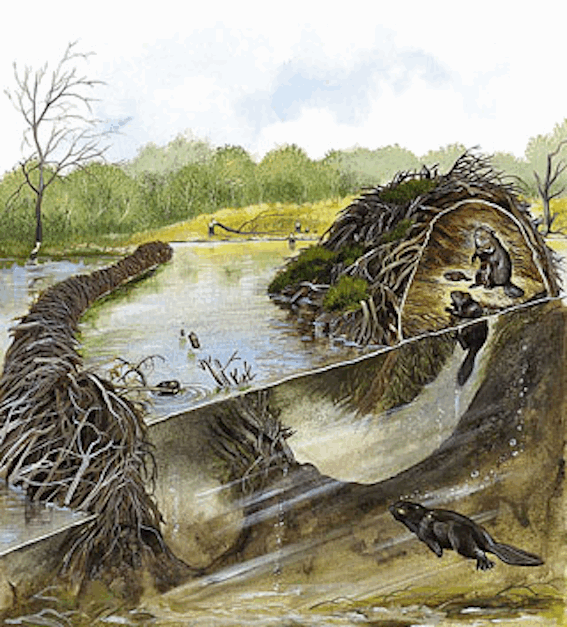

出典は:http: //www.thecanadianencyclopedia.ca/en/article/beaver/ およびhttp: //biblicalisraeltours.com/2013/03/the-arcasolium-tomb/
Beaver dam in Hesse, Germany. By exploiting the resource of available wood, beavers are affecting biotic conditions for other species that live within their habitat.
| In ecology, a niche is the
match of a species to a specific environmental condition.[1][2] It
describes how an organism or population responds to the distribution of
resources and competitors (for example, by growing when resources are
abundant, and when predators, parasites and pathogens are scarce) and
how it, in turn, alters those same factors (for example, limiting
access to resources by other organisms, acting as a food source for
predators and a consumer of prey). "The type and number of variables
comprising the dimensions of an environmental niche vary from one
species to another [and] the relative importance of particular
environmental variables for a species may vary according to the
geographic and biotic contexts".[3] A Grinnellian niche is determined by the habitat in which a species lives and its accompanying behavioral adaptations. An Eltonian niche emphasizes that a species not only grows in and responds to an environment, it may also change the environment and its behavior as it grows. The Hutchinsonian niche uses mathematics and statistics to try to explain how species coexist within a given community. The concept of ecological niche is central to ecological biogeography, which focuses on spatial patterns of ecological communities.[4] "Species distributions and their dynamics over time result from properties of the species, environmental variation..., and interactions between the two—in particular the abilities of some species, especially our own, to modify their environments and alter the range dynamics of many other species."[5] Alteration of an ecological niche by its inhabitants is the topic of niche construction.[6] The majority of species exist in a standard ecological niche, sharing behaviors, adaptations, and functional traits similar to the other closely related species within the same broad taxonomic class, but there are exceptions. A premier example of a non-standard niche filling species is the flightless, ground-dwelling kiwi bird of New Zealand, which feeds on worms and other ground creatures, and lives its life in a mammal-like niche. Island biogeography can help explain island species and associated unfilled niches. |
生態学において、ニッチとは、ある種が特定の
環境条件に適応した状態を指す。[1][2]
これは、生物や個体群が資源や競合相手の分布にどのように反応するか(例えば、資源が豊富で、捕食者、寄生虫、病原体が少ないときに増殖するなど)、そし
てそれらが逆にそれらの要因をどのように変化させるか(例えば、他の生物による資源へのアクセスを制限したり、捕食者にとっては餌源となり、被食者にとっ
ては捕食者となったりするなど)を説明するものである。「環境ニッチの構成要素となる変数の種類や数は種によって異なり、特定の環境変数が種にとって持つ
相対的な重要性は、地理的および生物学的文脈によって異なる場合がある」。[3] グリネル的ニッチは、種が生息する生息地とそれに伴う行動的適応によって決定される。エルトン的ニッチは、種が環境の中で成長しそれに反応するだけでな く、成長するにつれて環境や自身の行動をも変化させ得ることを強調する。ハッチンソン的ニッチは、数学と統計学を用いて、特定の群集内で種がどのように共 存しているかを説明しようとするものである。 生態的ニッチの概念は、生態群集の空間的パターンに焦点を当てる生態生物地理学の中心的な概念である。[4] 「種の分布とその経時的な動態は、種の特性、環境の変動……、およびこれら両者の相互作用、とりわけ一部の種(特に私たち人間)が環境を改変し、他の多く の種の分布動態を変化させる能力に起因する。」[5] 生息者による生態的ニッチの改変は、ニッチ構築の主題である。[6] 大多数の種は標準的な生態的ニッチに存在し、同じ広義の分類階級内の近縁種と類似した行動、適応、機能的形質を共有しているが、例外も存在する。非標準的 なニッチを占める種の代表的な例として、ニュージーランドの飛べない地生鳥であるキウイが挙げられる。キウイはミミズやその他の地生生物を餌とし、哺乳類 のようなニッチで生活している。島嶼生物地理学は、島嶼の種やそれに関連する未占拠のニッチを説明するのに役立つ。 |
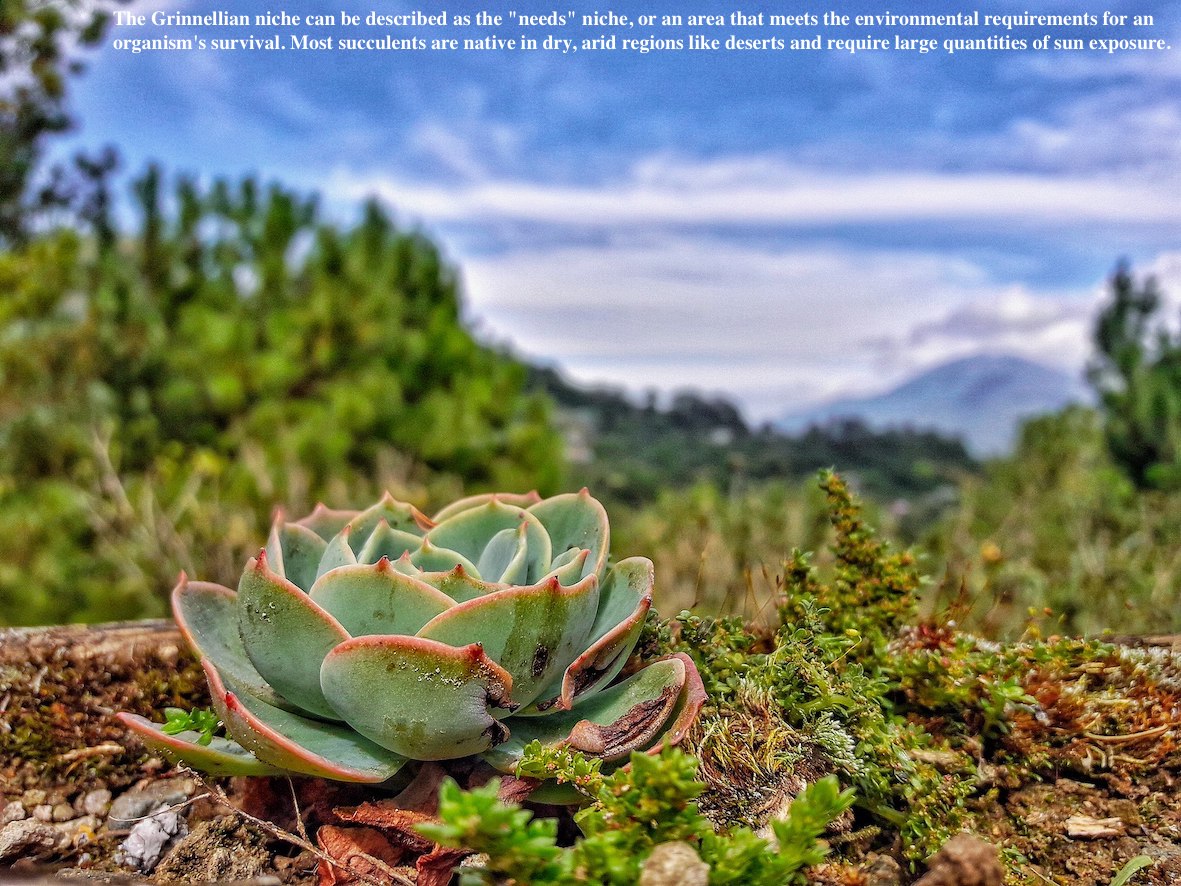
| Grinnellian niche The ecological meaning of niche comes from the meaning of niche as a recess in a wall for a statue,[7] which itself is probably derived from the Middle French word nicher, meaning to nest.[8][7] The term was coined by the naturalist Roswell Hill Johnson[9] but Joseph Grinnell was probably the first to use it in a research program in 1917, in his paper "The niche relationships of the California Thrasher".[10][1] The Grinnellian niche concept embodies the idea that the niche of a species is determined by the habitat in which it lives and its accompanying behavioral adaptations. In other words, the niche is the sum of the habitat requirements and behaviors that allow a species to persist and produce offspring. For example, the behavior of the California thrasher is consistent with the chaparral habitat it lives in—it breeds and feeds in the underbrush and escapes from its predators by shuffling from underbrush to underbrush. Its 'niche' is defined by the felicitous complementing of the thrasher's behavior and physical traits (camouflaging color, short wings, strong legs) with this habitat.[10] 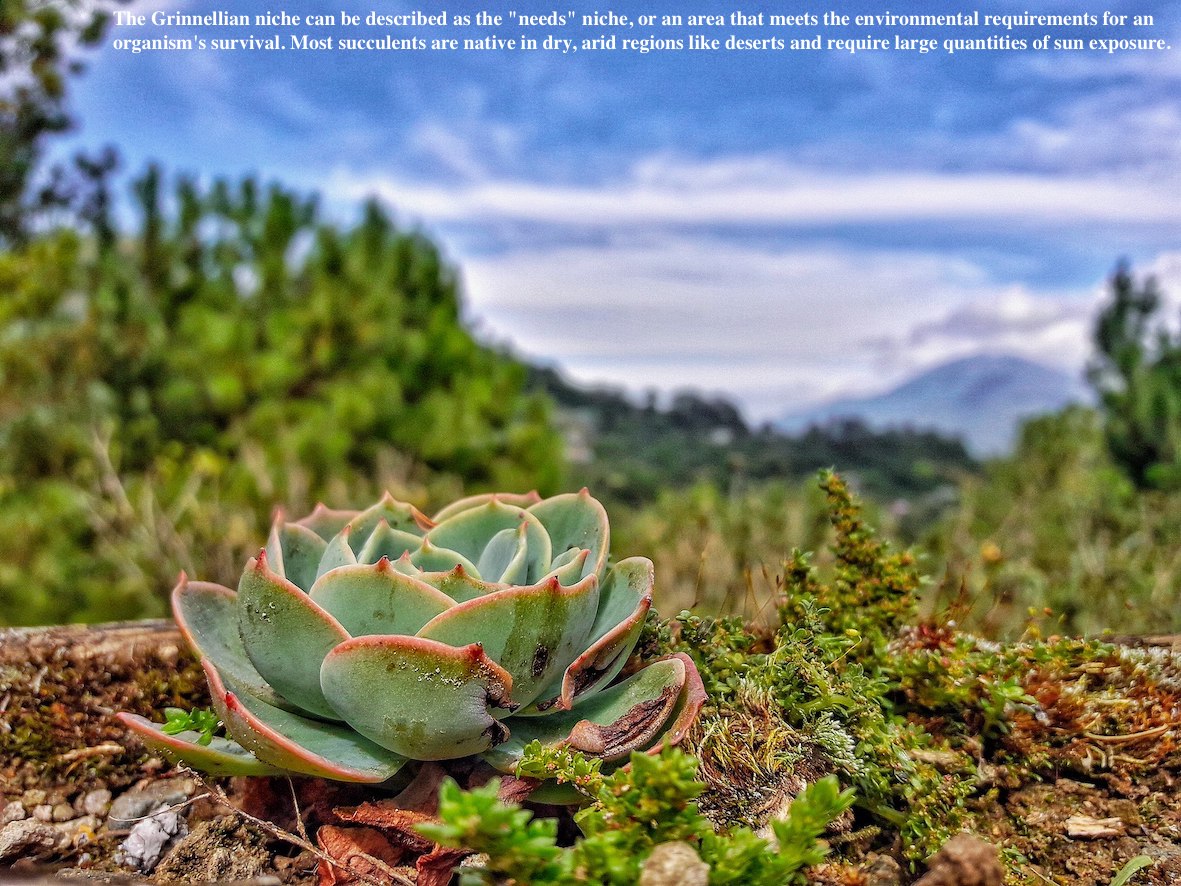 The Grinnellian niche can be described as the "needs" niche, or an area that meets the environmental requirements for an organism's survival. Most succulents are native in dry, arid regions like deserts and require large quantities of sun exposure. Grinnellian niches can be defined by non-interactive (abiotic) variables and environmental conditions on broad scales.[11] Variables of interest in this niche class include average temperature, precipitation, solar radiation, and terrain aspect which have become increasingly accessible across spatial scales. Most literature has focused on Grinnellian niche constructs, often from a climatic perspective, to explain distribution and abundance. Current predictions on species responses to climate change strongly rely on projecting altered environmental conditions on species distributions.[12] However, it is increasingly acknowledged that climate change also influences species interactions and an Eltonian perspective may be advantageous in explaining these processes. This perspective of niche allows for the existence of both ecological equivalents and empty niches. An ecological equivalent to an organism is an organism from a different taxonomic group exhibiting similar adaptations in a similar habitat, an example being the different succulents found in American and African deserts, cactus and euphorbia, respectively.[13] As another example, the anole lizards of the Greater Antilles are a rare example of convergent evolution, adaptive radiation, and the existence of ecological equivalents: the anole lizards evolved in similar microhabitats independently of each other and resulted in the same ecomorphs across all four islands. |
グリネルのニッチ ニッチの生態学的意味は、壁に彫られた彫像用のくぼみとしてのニッチの意味に由来する[7]。この言葉自体は、おそらく「巣を作る」を意味する中世フラン ス語の「nicher」に由来する[8]。[7] この用語は自然学者ロスウェル・ヒル・ジョンソンによって造語された[9]が、1917年に論文「カリフォルニア・スラッシャーのニッチ関係」[10] [1]において、研究プログラムの中で初めて使用したのはおそらくジョセフ・グリネルであった。 グリネルのニッチ概念は、ある種のニッチが、その種が生息する生息地と、それに伴う行動的適応によって決定されるという考えを体現している。言い換えれ ば、ニッチとは、ある種が存続し、子孫を残すことを可能にする生息地要件と行動の総和である。例えば、カリフォルニア・スラッシャーの行動は、その生息地 であるチャパラルと一致している。すなわち、低木林の中で繁殖や採食を行い、低木林から低木林へと足を引きずるように移動することで捕食者から逃れるので ある。その「ニッチ」は、スラッシャーの行動と身体的特徴(擬態色、短い翼、強い脚)が、この生息地と見事に補完し合うことによって定義される。[10] グリネルのニッチは、「ニーズ」ニッチ、すなわち生物の生存に必要な環境要件を満たす領域として説明できる。多肉植物の多くは砂漠のような乾燥した地域に 自生しており、大量の日照を必要とする。 グリネルのニッチは、非相互作用的(非生物的)な変数や広域的な環境条件によって定義できる。[11] このニッチ分類において注目される変数には、平均気温、降水量、日射量、地形の向きなどがあり、これらは空間スケールを問わず入手しやすくなっている。こ れまでの文献の多くは、分布や個体数を説明するために、しばしば気候学的観点からグリネル的ニッチの概念に焦点を当ててきた。気候変動に対する種の反応に 関する現在の予測は、変化した環境条件を種の分布に投影することに大きく依存している。[12] しかし、気候変動が種の相互作用にも影響を及ぼすこと、そしてこれらのプロセスを説明するにはエルトン的視点が有利である可能性が、ますます認識されつつ ある。 このニッチの視点では、生態学的同等種と空ニッチの両方の存在が認められる。ある生物の生態学的同等種とは、異なる分類群に属しながら、類似した生息地で 同様の適応を示す生物を指す。例として、アメリカとアフリカの砂漠に見られる異なる多肉植物、すなわちサボテンとユーフォルビアが挙げられる。[13] 別の例として、大アンティル諸島のアノールトカゲは、収斂進化、適応放散、そして生態学的同等物の存在を示す稀な事例である。アノールトカゲは、互いに独 立して類似した微生息地で進化し、4つの島すべてにおいて同一のエコモルフを生み出した。 |
| Eltonian niche In 1927 Charles Sutherland Elton, a British ecologist, defined a niche as follows: "The 'niche' of an animal means its place in the biotic environment, its relations to food and enemies."[14] Elton classified niches according to foraging activities ("food habits"):[15] For instance there is the niche that is filled by birds of prey which eat small animals such as shrews and mice. In an oak wood this niche is filled by tawny owls, while in the open grassland it is occupied by kestrels. The existence of this carnivore niche is dependent on the further fact that mice form a definite herbivore niche in many different associations, although the actual species of mice may be quite different.[14]  Beaver dam in Hesse, Germany. By exploiting the resource of available wood, beavers are affecting biotic conditions for other species that live within their habitat. Conceptually, the Eltonian niche introduces the idea of a species' response to and effect on the environment. Unlike other niche concepts, it emphasizes that a species not only grows in and responds to an environment based on available resources, predators, and climatic conditions, but also changes the availability and behavior of those factors as it grows.[16] In an extreme example, beavers require certain resources in order to survive and reproduce, but also construct dams that alter water flow in the river where the beaver lives. Thus, the beaver affects the biotic and abiotic conditions of other species that live in and near the watershed.[17] In a more subtle case, competitors that consume resources at different rates can lead to cycles in resource density that differ between species.[18] Not only do species grow differently with respect to resource density, but their own population growth can affect resource density over time. Eltonian niches focus on biotic interactions and consumer–resource dynamics (biotic variables) on local scales.[11] Because of the narrow extent of focus, data sets characterizing Eltonian niches typically are in the form of detailed field studies of specific individual phenomena, as the dynamics of this class of niche are difficult to measure at a broad geographic scale. However, the Eltonian niche may be useful in the explanation of a species' endurance of global change.[16] Because adjustments in biotic interactions inevitably change abiotic factors, Eltonian niches can be useful in describing the overall response of a species to new environments. |
エルトンのニッチ 1927年、イギリスの生態学者チャールズ・サザーランド・エルトンは、ニッチを次のように定義した。「動物の『ニッチ』とは、生物環境におけるその動物の位置、すなわち食物や天敵との関係のことを指す。」[14] エルトンは、採食活動(「食性」)に基づいてニッチを分類した: [15] 例えば、トガリネズミやネズミなどの小動物を捕食する猛禽類が占めるニッチがある。オーク林ではこのニッチをコノハズクが占め、一方、開けた草原ではチョ ウゲンボウが占めている。この肉食動物のニッチの存在は、ネズミが多くの異なる群集において明確な草食動物のニッチを形成しているという事実に依存してい る。ただし、実際に生息するネズミの種は全く異なる場合もある。[14] ドイツ・ヘッセン州のビーバーのダム。ビーバーは利用可能な木材という資源を活用することで、その生息域内に住む他の種の生物的条件に影響を与えている。 概念的に、エルトンのニッチは、種が環境に反応し、環境に影響を与えるという考え方を導入する。他のニッチ概念とは異なり、この概念は、種が利用可能な資 源、捕食者、気候条件に基づいて環境の中で成長し、それに反応するだけでなく、成長するにつれてそれらの要因の利用可能性や挙動をも変化させることを強調 している。[16] 極端な例を挙げれば、ビーバーは生存と繁殖のために特定の資源を必要とするが、同時にダムを築くことで、生息する川の水流を変化させる。したがって、ビー バーは、その流域内および周辺に生息する他の種の生物的・非生物的条件に影響を与える。[17] より微妙なケースでは、資源を異なる速度で消費する競合種によって、種ごとに異なる資源密度の変動が生じることがある。[18] 種は資源密度に応じて異なる成長を示すだけでなく、その個体群の増加自体が時間の経過とともに資源密度に影響を与える。 エルトニアン・ニッチは、局所的なスケールにおける生物間相互作用および消費者・資源の動態(生物学的変数)に焦点を当てる。[11] 焦点の範囲が狭いため、エルトニアン・ニッチを特徴づけるデータセットは、通常、特定の個別の現象に関する詳細な野外調査の形式をとっている。なぜなら、 この種のニッチの動態は、広範な地理的スケールでは測定が困難だからである。しかし、エルトニアン・ニッチは、地球規模の変化に対する種の適応能力を説明 する上で有用である可能性がある。[16] 生物間相互作用の調整は必然的に非生物的要因を変化させるため、エルトニアン・ニッチは、新しい環境に対する種の全体的な反応を記述する上で有用となり得 る。 |
Hutchinsonian niche The shape of the bill of this purple-throated carib is complementary to the shape of the flower and coevolved with it, enabling it to exploit the nectar as a resource. The Hutchinsonian niche is an "n-dimensional hypervolume", where the dimensions are environmental conditions and resources, that define the requirements of an individual or a species to practice its way of life, more particularly, for its population to persist.[2] The "hypervolume" defines the multi-dimensional space of resources (e.g., light, nutrients, structure, etc.) available to (and specifically used by) organisms, and "all species other than those under consideration are regarded as part of the coordinate system."[19] The niche concept was popularized by the zoologist G. Evelyn Hutchinson in 1957.[19] Hutchinson inquired into the question of why there are so many types of organisms in any one habitat. His work inspired many others to develop models to explain how many and how similar coexisting species could be within a given community, and led to the concepts of 'niche breadth' (the variety of resources or habitats used by a given species), 'niche partitioning' (resource differentiation by coexisting species), and 'niche overlap' (overlap of resource use by different species).[20] 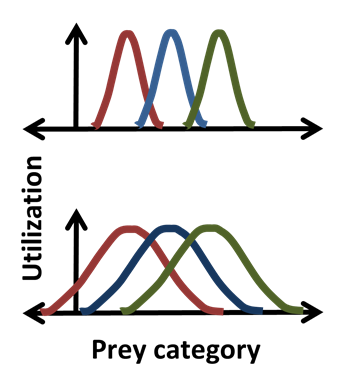 Where three species eat some of the same prey, a statistical picture of each niche shows overlap in resource usage between three species, indicating where competition is strongest. Statistics were introduced into the Hutchinson niche by Robert MacArthur and Richard Levins using the 'resource-utilization' niche employing histograms to describe the 'frequency of occurrence' as a function of a Hutchinson coordinate.[2][21] So, for instance, a Gaussian might describe the frequency with which a species ate prey of a certain size, giving a more detailed niche description than simply specifying some median or average prey size. For such a bell-shaped distribution, the position, width and form of the niche correspond to the mean, standard deviation and the actual distribution itself.[22] One advantage in using statistics is illustrated in the figure, where it is clear that for the narrower distributions (top) there is no competition for prey between the extreme left and extreme right species, while for the broader distribution (bottom), niche overlap indicates competition can occur between all species. The resource-utilization approach postulates that not only can competition occur, but that it does occur, and that overlap in resource utilization directly enables the estimation of the competition coefficients.[23] This postulate, however, can be misguided, as it ignores the impacts that the resources of each category have on the organism and the impacts that the organism has on the resources of each category. For instance, the resource in the overlap region can be non-limiting, in which case there is no competition for this resource despite niche overlap.[1][20][23] 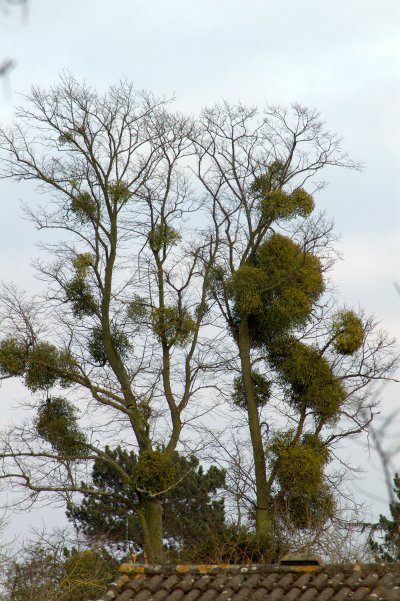 As a hemi-parasitic plant, the mistletoe in this tree exploits its host for nutrients and as a place to grow. An organism free of interference from other species could use the full range of conditions (biotic and abiotic) and resources in which it could survive and reproduce which is called its fundamental niche.[24] However, as a result of pressure from, and interactions with, other organisms (i.e. inter-specific competition) species are usually forced to occupy a niche that is narrower than this, and to which they are mostly highly adapted; this is termed the realized niche.[24] Hutchinson used the idea of competition for resources as the primary mechanism driving ecology, but overemphasis upon this focus has proved to be a handicap for the niche concept.[20] In particular, overemphasis upon a species' dependence upon resources has led to too little emphasis upon the effects of organisms on their environment, for instance, colonization and invasions.[20] The term "adaptive zone" was coined by the paleontologist George Gaylord Simpson to explain how a population could jump from one niche to another that suited it, jump to an 'adaptive zone', made available by virtue of some modification, or possibly a change in the food chain, that made the adaptive zone available to it without a discontinuity in its way of life because the group was 'pre-adapted' to the new ecological opportunity.[25] Hutchinson's "niche" (a description of the ecological space occupied by a species) is subtly different from the "niche" as defined by Grinnell (an ecological role, that may or may not be actually filled by a species—see vacant niches). A niche is a very specific segment of ecospace occupied by a single species. On the presumption that no two species are identical in all respects (called Hardin's 'axiom of inequality'[26]) and the competitive exclusion principle, some resource or adaptive dimension will provide a niche specific to each species.[24] Species can however share a 'mode of life' or 'autecological strategy' which are broader definitions of ecospace.[27] For example, Australian grasslands species, though different from those of the Great Plains grasslands, exhibit similar modes of life.[28] Once a niche is left vacant, other organisms can fill that position. For example, the niche that was left vacant by the extinction of the tarpan has been filled by other animals (in particular a small horse breed, the konik). Also, when plants and animals are introduced into a new environment, they have the potential to occupy or invade the niche or niches of native organisms, often outcompeting the indigenous species. Introduction of non-indigenous species to non-native habitats by humans often results in biological pollution by the exotic or invasive species. The mathematical representation of a species' fundamental niche in ecological space, and its subsequent projection back into geographic space, is the domain of niche modelling.[29] |
ハッチンソン的ニッチ このムラサキノドカリブのくちばしの形状は、花の形状と互いに補完し合い、共に進化してきたものであり、これにより、この鳥は花蜜を資源として利用することができる。 ハッチンソン的ニッチとは、「n次元の超空間」であり、その次元は環境条件や資源を指す。これは、個体や種がその生活様式を実践するために、より具体的に はその個体群が存続するために必要な要件を定義するものである。[2] この「超空間」は、生物が利用可能(かつ具体的に利用している)な資源(光、栄養素、構造など)の多次元空間を定義するものであり、「検討対象以外のすべ ての種は座標系の一部と見なされる」[19]。 ニッチの概念は、1957年に動物学者のG・エヴェリン・ハッチンソンによって広められた。[19] ハッチンソンは、なぜ一つの生息地の中にこれほど多くの種類の生物が存在するのかという疑問を追求した。彼の研究は、特定の群集内にどれだけの数の共存種 が存在し、それらがどれほど類似しているかを説明するモデルの開発に多くの研究者に影響を与え、「ニッチの幅」(特定の種が利用する資源や生息地の多様 性)、「ニッチの分割」(共存種による資源の分化)、「ニッチの重なり」(異なる種による資源利用の重なり)といった概念の確立につながった。[20] 3種の生物が一部同じ獲物を食べる場合、各ニッチの統計的図像は3種間の資源利用における重複を示し、競争が最も激しい箇所を明らかにする。 ハッチンソン・ニッチへの統計学の導入は、ロバート・マッカーサーとリチャード・レヴィンスによって行われた。彼らは「資源利用」ニッチを用い、ヒストグ ラムを用いてハッチンソン座標の関数としての「出現頻度」を記述した。[2] [21] 例えば、ガウス分布を用いれば、ある種が特定の大きさの獲物を捕食する頻度を記述でき、単に獲物の大きさの中央値や平均値を指定するよりも詳細なニッチ記 述が可能となる。このようなベル型分布において、ニッチの位置、幅、形状は、それぞれ平均値、標準偏差、および実際の分布そのものに相当する。[22] 統計を用いる利点の一つは図に示されている。そこでは、分布が狭い場合(上段)には、左端と右端の種の間で獲物をめぐる競争は生じないことが明らかである 一方、分布が広い場合(下段)には、ニッチの重なりにより、すべての種の間で競争が生じ得ることが示されている。資源利用アプローチは、競争が生じ得るだ けでなく実際に生じていることを前提とし、資源利用の重なりによって競争係数を直接推定できるとしている。[23] しかし、この仮定は誤った方向へ導く恐れがある。なぜなら、各カテゴリーの資源が生物に与える影響、および生物が各カテゴリーの資源に与える影響を無視し ているからである。例えば、重なり合う領域の資源が非制限的である場合、ニッチの重なりがあっても、その資源をめぐる競争は生じない。[1][20] [23] 半寄生植物であるこの木のヤドリギは、栄養分や生育場所として宿主を利用している。 他の種からの干渉を受けない生物は、生存および繁殖が可能なあらゆる条件(生物的および非生物的)と資源を利用することができ、これを基礎ニッチと呼ぶ。 [24] しかし、他の生物からの圧力や相互作用(すなわち種間競争)の結果、種は通常、これよりも狭いニッチを占めることを余儀なくされ、そのニッチに高度に適応 している。これを「実現ニッチ」と呼ぶ。[24] ハッチンソンは、資源をめぐる競争を生態学を駆動する主要なメカニズムとして用いたが、この点への過度な強調は、ニッチ概念にとっての足かせとなることが 判明した。[20] 特に、資源への依存を過度に強調した結果、生物が環境に及ぼす影響、例えば定着や侵入といった点への注目が不十分になった。[20] 「適応域(adaptive zone)」という用語は、古生物学者ジョージ・ゲイロード・シンプソンによって造語された。これは、個体群がいかにしてあるニッチから、より適した別の ニッチへと移行し、ある種の変容、あるいは食物連鎖の変化によって利用可能となった「適応域」へと飛躍できるかを説明するためのものである。この際、その 集団は新たな生態学的機会に「事前適応」していたため、生活様式に不連続性をもたらすことなく適応域を利用できた。[25] ハッチンソンの「ニッチ」(種が占める生態学的空間の記述)は、グリネルが定義した「ニッチ」(種によって実際に占められているかどうかにかかわらず存在する生態学的役割——空ニッチを参照)とは微妙に異なる。 ニッチとは、単一の種が占める生態空間の極めて特定の区画である。いかなる2つの種もあらゆる点で同一ではないという前提(ハーディンの「不平等公理」 [26]と呼ばれる)と、競合排除の原理に基づき、何らかの資源や適応的側面が、各種に固有のニッチを提供することになる。[24] しかし、種は生態空間のより広範な定義である「生活様式」や「自己生態学的戦略」を共有し得る。[27] 例えば、オーストラリアの草原に生息する種は、グレートプレーンズ(大平原)の草原の種とは異なるものの、類似した生活様式を示している。[28] ニッチが空くと、他の生物がその位置を占めることができる。例えば、タルパンの絶滅によって空いたニッチは、他の動物(特に小型の馬の品種であるコニッ ク)によって埋められた。また、植物や動物が新しい環境に導入されると、それらは在来生物のニッチを占有または侵入する可能性があり、しばしば在来種を駆 逐してしまう。人間による非在来生息地への非在来種の導入は、しばしば外来種や侵略的外来種による生物学的汚染をもたらす。 生態空間における種の基礎的ニッチの数学的表現、およびその後の地理空間への投影は、ニッチモデリングの領域である。[29] |
| Contemporary niche theory Contemporary niche theory (also called "classic niche theory" in some contexts) is a framework that was originally designed to reconcile different definitions of niches (see Grinnellian, Eltonian, and Hutchinsonian definitions above), and to help explain the underlying processes that affect Lotka–Volterra relationships within an ecosystem. The framework centers around "consumer-resource models" which largely split a given ecosystem into resources (e.g. sunlight or available water in soil) and consumers (e.g. any living thing, including plants and animals), and attempts to define the scope of possible relationships that could exist between the two groups.[30] In contemporary niche theory, the "impact niche" is defined as the combination of effects that a given consumer has on both a). the resources that it uses, and b). the other consumers in the ecosystem. Therefore, the impact niche is equivalent to the Eltonian niche since both concepts are defined by the impact of a given species on its environment.[30] The range of environmental conditions where a species can successfully survive and reproduce (i.e. the Hutchinsonian definition of a realized niche) is also encompassed under contemporary niche theory, termed the "requirement niche". The requirement niche is bounded by both the availability of resources as well as the effects of coexisting consumers (e.g. competitors and predators).[30] |
現代のニッチ理論 現代のニッチ理論(文脈によっては「古典的ニッチ理論」とも呼ばれる)は、もともとニッチの異なる定義(上記のグリネル的、エルトン的、ハッチンソン的定 義を参照)を統合し、生態系内のロトカ・ヴォルテラ関係に影響を与える根本的なプロセスを説明するために考案された枠組みである。この枠組みは「消費者- 資源モデル」を中心に据えており、これは特定の生態系を主に資源(例:日光や土壌中の利用可能な水)と消費者(例:植物や動物を含むあらゆる生物)に分類 し、これら2つのグループ間に存在し得る関係の範囲を定義しようとするものである。[30] 現代のニッチ理論において、「インパクト・ニッチ」とは、特定の消費者が a) 自身が利用する資源、および b) 生態系内の他の消費者の双方に及ぼす影響の組み合わせとして定義される。したがって、インパクト・ニッチはエルトニアン・ニッチと同等である。なぜなら、 両概念とも、特定の種がその環境に及ぼす影響によって定義されるからである。[30] ある種が生存し繁殖できる環境条件の範囲(すなわち、ハッチンソンによる実現ニッチの定義)も、現代のニッチ理論において「要件ニッチ」と呼ばれる概念に 含まれる。要件ニッチは、資源の利用可能性と、共存する消費者(例えば競合種や捕食者)の影響の両方によって制限される。[30] |
| Coexistence under contemporary niche theory Contemporary niche theory provides three requirements that must be met in order for two species (consumers) to coexist:[30] 1. The requirement niches of both consumers must overlap. 2. Each consumer must outcompete the other for the resource that it needs most. For example, if two plants (P1 and P2) are competing for nitrogen and phosphorus in a given ecosystem, they will only coexist if they are limited by different resources (P1 is limited by nitrogen and P2 is limited by phosphorus, perhaps) and each species must outcompete the other species to get that resource (P1 needs to be better at obtaining nitrogen and P2 needs to be better at obtaining phosphorus). Intuitively, this makes sense from an inverse perspective: If both consumers are limited by the same resource, one of the species will ultimately be the better competitor, and only that species will survive. Furthermore, if P1 was outcompeted for the nitrogen (the resource it needed most) it would not survive. Likewise, if P2 was outcompeted for phosphorus, it would not survive. 3. The availability of the limiting resources (nitrogen and phosphorus in the above example) in the environment are equivalent. These requirements are interesting and controversial because they require any two species to share a certain environment (have overlapping requirement niches) but fundamentally differ the ways that they use (or "impact") that environment. These requirements have repeatedly been violated by nonnative (i.e. introduced and invasive) species, which often coexist with new species in their nonnative ranges, but do not appear to be constricted these requirements.[clarification needed] In other words, contemporary niche theory predicts that species will be unable to invade new environments outside of their requirement (i.e. realized) niche, yet many examples of this are well-documented.[31][32] Additionally, contemporary niche theory predicts that species will be unable to establish in environments where other species already consume resources in the same ways as the incoming species, however examples of this are also numerous.[33][32] |
現代のニッチ理論における共存 現代のニッチ理論では、2つの種(消費者)が共存するために満たすべき3つの要件を提示している:[30] 1. 両消費者の要求ニッチが重なり合っていなければならない。 2. 各消費者は、自らが最も必要とする資源をめぐって、相手よりも優位に立たなければならない。例えば、ある生態系において2つの植物(P1とP2)が窒素と リンを競合している場合、それらが共存するのは、異なる資源によって制限されている場合(例えば、P1は窒素に、P2はリンに制限されている)に限られ、 かつ各種がその資源を得るために他種を競合で上回らなければならない(P1は窒素の獲得に、P2はリンの獲得に優れている必要がある)。直感的には、これ を逆の視点から見れば理にかなっている。もし両方の消費者が同じ資源によって制限されている場合、いずれかの種が最終的により優れた競争者となり、その種 だけが生き残るからだ。さらに、もしP1が窒素(最も必要とする資源)の獲得競争に敗れた場合、それは生き残れない。同様に、もしP2がリンの獲得競争に 敗れた場合、それも生き残れない。 3. 環境における制限資源(上記の例では窒素とリン)の利用可能性は同等である。 これらの要件は興味深く、かつ議論の的となっている。なぜなら、任意の2つの種が特定の環境を共有すること(要件ニッチが重なること)を必要とする一方 で、その環境の利用(あるいは「影響」)の仕方は根本的に異なるからだ。これらの要件は、外来種(すなわち、導入され侵入した種)によって繰り返し破られ てきた。外来種は、非原産地においてしばしば新種と共存するが、これらの要件に制約されているようには見えない。[説明が必要] 言い換えれば、現代のニッチ理論は、種がその要求(すなわち実現)ニッチの範囲外の新しい環境に侵入することはできないと予測しているが、これに反する多 くの事例が十分に記録されている。[31][32] さらに、現代のニッチ理論は、他の種がすでに侵入種と同じ方法で資源を消費している環境では、種が定着することはできないと予測しているが、これにも反す る事例は数多く存在する。[33][32] |
| Niche differentiation In ecology, niche differentiation (also known as niche segregation, niche separation and niche partitioning) refers to the process by which competing species use the environment differently in a way that helps them to coexist.[34] The competitive exclusion principle states that if two species with identical niches (ecological roles) compete, then one will inevitably drive the other to extinction.[35] This rule also states that two species cannot occupy the same exact niche in a habitat and coexist together, at least in a stable manner.[36] When two species differentiate their niches, they tend to compete less strongly, and are thus more likely to coexist. Species can differentiate their niches in many ways, such as by consuming different foods, or using different areas of the environment.[37] As an example of niche partitioning, several anole lizards in the Caribbean islands share common diets—mainly insects. They avoid competition by occupying different physical locations. Although these lizards might occupy different locations, some species can be found inhabiting the same range, with up to 15 in certain areas.[38] For example, some live on the ground while others are arboreal. Species who live in different areas compete less for food and other resources, which minimizes competition between species. However, species who live in similar areas typically compete with each other.[39] |
ニッチの分化 生態学において、ニッチの分化(ニッチの分離、ニッチの分断、ニッチの分割とも呼ばれる)とは、競合する種が共存できるよう、環境を異なる方法で利用する プロセスを指す。[34] 競合排除の原理によれば、同一のニッチ(生態学的役割)を持つ2つの種が競合した場合、一方が他方を必然的に絶滅に追いやることになる。[35] この法則はまた、少なくとも安定した状態においては、2つの種が生息地内で全く同じニッチを占めて共存することはできないとも述べている。[36] 2つの種がニッチを分化させると、競争は弱まり、その結果、共存する可能性が高くなる。種は、異なる食物を摂取したり、環境内の異なる領域を利用したりす るなど、様々な方法でニッチを分化させることができる。[37] ニッチの分業の例として、カリブ海の島々に生息するいくつかのアナオトカゲは、主に昆虫という共通の食性を持ちながら、異なる物理的な場所を占めることで 競争を回避している。これらのトカゲは異なる場所に生息しているものの、特定の地域では最大15種もの種が同じ生息域に共存している場合もある。[38] 例えば、地上で生活する種もいれば、樹上性の種もいる。異なる地域に生息する種は、餌やその他の資源をめぐる競争が少なくなるため、種間の競争が最小限に 抑えられる。しかし、類似した地域に生息する種は、通常、互いに競合することになる。[39] |
| Detection and quantification The Lotka–Volterra equation states that two competing species can coexist when intra-specific (within species) competition is greater than inter-specific (between species) competition.[40] Since niche differentiation concentrates competition within-species, due to a decrease in between-species competition, the Lotka-Volterra model predicts that niche differentiation of any degree will result in coexistence. In reality, this still leaves the question of how much differentiation is needed for coexistence.[41] A vague answer to this question is that the more similar two species are, the more finely balanced the suitability of their environment must be in order to allow coexistence. There are limits to the amount of niche differentiation required for coexistence, and this can vary with the type of resource, the nature of the environment, and the amount of variation both within and between the species. To answer questions about niche differentiation, it is necessary for ecologists to be able to detect, measure, and quantify the niches of different coexisting and competing species. This is often done through a combination of detailed ecological studies, controlled experiments (to determine the strength of competition), and mathematical models.[42][43] To understand the mechanisms of niche differentiation and competition, much data must be gathered on how the two species interact, how they use their resources, and the type of ecosystem in which they exist, among other factors. In addition, several mathematical models exist to quantify niche breadth, competition, and coexistence (Bastolla et al. 2005). However, regardless of methods used, niches and competition can be distinctly difficult to measure quantitatively, and this makes detection and demonstration of niche differentiation difficult and complex. |
検出と定量化 ロトカ・ヴォルテラ方程式によれば、種内(同一種内)の競争が種間(種間)の競争よりも強い場合、競合する2つの種は共存し得る。[40] ニッチ分化は種間競争の減少により種内競争を集中させるため、ロトカ・ヴォルテラモデルは、いかなる程度のニッチ分化であっても共存をもたらすと予測す る。 現実には、共存のためにどの程度の分化が必要かという疑問が残る。[41] この問いに対する大まかな答えは、2つの種が類似しているほど、共存を可能にするためには生息環境の適合性がより微妙なバランスを保たなければならないと いうものだ。共存に必要なニッチ分化の程度には限界があり、これは資源の種類、環境の性質、および種内および種間の変異の程度によって異なる。 ニッチ分化に関する疑問に答えるためには、生態学者が共存・競合する異なる種のニッチを検出し、測定し、定量化できる必要がある。これは多くの場合、詳細 な生態学的調査、競合の強さを決定するための統制実験、および数学的モデルの組み合わせによって行われる。[42][43] ニッチ分化と競合のメカニズムを理解するためには、2つの種がどのように相互作用するか、どのように資源を利用するか、そしてそれらが存在する生態系の種 類など、多くのデータを収集しなければならない。さらに、ニッチの幅、競合、および共存を定量化するための数学的モデルがいくつか存在する (Bastolla et al. 2005)。しかし、どのような手法を用いるにせよ、ニッチや競争を定量的に測定することは極めて困難であり、これがニッチ分化の検出と実証を難しく複雑 なものにしている。 |
| Development Over time, two competing species can either coexist, through niche differentiation or other means, or compete until one species becomes locally extinct. Several theories exist for how niche differentiation arises or evolves given these two possible outcomes. Current competition (The Ghost of Competition Present) Niche differentiation can arise from current competition. For instance, species X has a fundamental niche of the entire slope of a hillside, but its realized niche is only the top portion of the slope because species Y, which is a better competitor but cannot survive on the top portion of the slope, has excluded it from the lower portion of the slope. With this scenario, competition will continue indefinitely in the middle of the slope between these two species. Because of this, detection of the presence of niche differentiation (through competition) will be relatively easy. Importantly, there is no evolutionary change of the individual species in this case; rather this is an ecological effect of species Y out-competing species X within the bounds of species Y's fundamental niche. Via past extinctions (The Ghost of Competition Past) Another way by which niche differentiation can arise is via the previous elimination of species without realized niches. This asserts that at some point in the past, several species inhabited an area, and all of these species had overlapping fundamental niches. However, through competitive exclusion, the less competitive species were eliminated, leaving only the species that were able to coexist (i.e. the most competitive species whose realized niches did not overlap). Again, this process does not include any evolutionary change of individual species, but it is merely the product of the competitive exclusion principle. Also, because no species is out-competing any other species in the final community, the presence of niche differentiation will be difficult or impossible to detect. Evolving differences Finally, niche differentiation can arise as an evolutionary effect of competition. In this case, two competing species will evolve different patterns of resource use so as to avoid competition. Here too, current competition is absent or low, and therefore detection of niche differentiation is difficult or impossible. Types Below is a list of ways that species can partition their niche. This list is not exhaustive, but illustrates several classic examples. 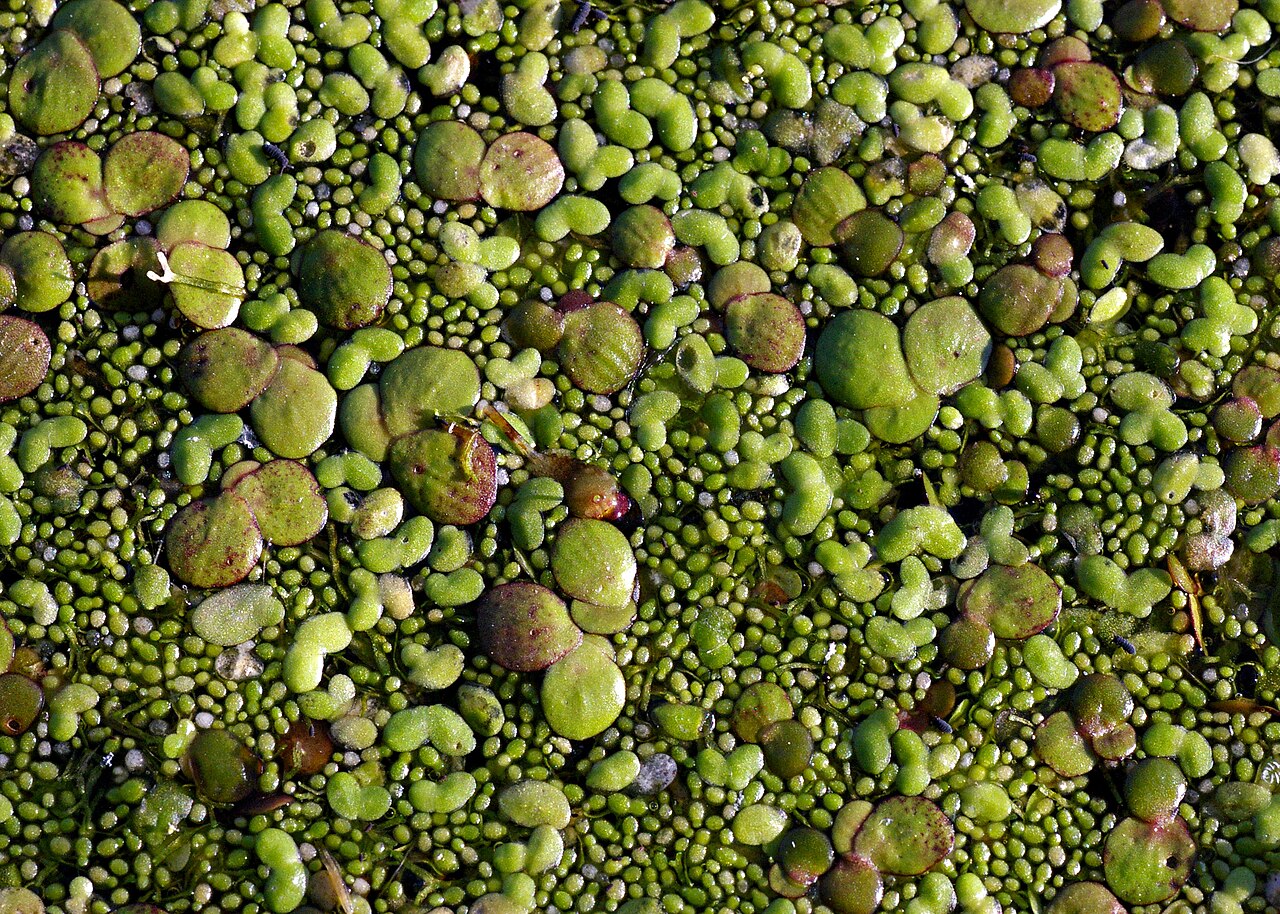 Duckweed on a pond. Niche differentiation by size: greater duckweed, lesser duckweed and rootless dwarf duckweed Resource partitioning Resource partitioning is the phenomenon where two or more species divides out resources like food, space, resting sites etc. to coexist. For example, some lizard species appear to coexist because they consume insects of differing sizes.[44] Alternatively, species can coexist on the same resources if each species is limited by different resources, or differently able to capture resources. Different types of phytoplankton can coexist when different species are differently limited by nitrogen, phosphorus, silicon, and light.[45] In the Galapagos Islands, finches with small beaks are more able to consume small seeds, and finches with large beaks are more able to consume large seeds. If a species' density declines, then the food it most depends on will become more abundant (since there are so few individuals to consume it). As a result, the remaining individuals will experience less competition for food. Although "resource" generally refers to food, species can partition other non-consumable objects, such as parts of the habitat. For example, warblers are thought to coexist because they nest in different parts of trees.[46] Species can also partition habitat in a way that gives them access to different types of resources. As stated in the introduction, anole lizards appear to coexist because each uses different parts of the forests as perch locations.[39] This likely gives them access to different species of insects as well. Research has determined that plants can recognize each other's root systems and differentiate between a clone, a plant grown from the same mother plants seeds, and other species. Based on the root secretions, also called exudates, plants can make this determination.[47] The communication between plants starts with the secretions from plant roots into the rhizosphere. If another plant that is kin is entering this area the plant will take up exudates. The exudate, being several different compounds, will enter the plants root cell and attach to a receptor for that chemical halting growth of the root meristem in that direction, if the interaction is kin.[48] Simonsen discusses how plants accomplish root communication with the addition of beneficial rhizobia and fungal networks and the potential for different genotypes of the kin plants, such as the legume M. Lupulina, and specific strains of nitrogen fixing bacteria and rhizomes can alter relationships between kin and non-kin competition.[49] This means there could be specific subsets of genotypes in kin plants that selects well with specific strains that could outcompete other kin.[47] What might seem like an instance in kin competition could just be different genotypes of organisms at play in the soil that increase the symbiotic efficiency. Predator partitioning Predator partitioning occurs when species are attacked differently by different predators (or natural enemies more generally). For example, trees could differentiate their niche if they are consumed by different species of specialist herbivores, such as herbivorous insects. If a species density declines, so too will the density of its natural enemies, giving it an advantage. Thus, if each species is constrained by different natural enemies, they will be able to coexist.[50] Early work focused on specialist predators;[50] however, more recent studies have shown that predators do not need to be pure specialists, they simply need to affect each prey species differently.[51][52] The Janzen–Connell hypothesis represents a form of predator partitioning.[53] Conditional differentiation Conditional differentiation (sometimes called temporal niche partitioning) occurs when species differ in their competitive abilities based on varying environmental conditions. For example, in the Sonoran Desert, some annual plants are more successful during wet years, while others are more successful during dry years.[54] As a result, each species will have an advantage in some years, but not others. When environmental conditions are most favorable, individuals will tend to compete most strongly with member of the same species. For example, in a dry year, dry-adapted plants will tend to be most limited by other dry-adapted plants.[54] This can help them to coexist through a storage effect. Competition-predation trade-off Species can differentiate their niche via a competition-predation trade-off if one species is a better competitor when predators are absent, and the other is better when predators are present. Defenses against predators, such as toxic compounds or hard shells, are often metabolically costly. As a result, species that produce such defenses are often poor competitors when predators are absent. Species can coexist through a competition-predation trade-off if predators are more abundant when the less defended species is common, and less abundant if the well-defended species is common.[55] This effect has been criticized as being weak, because theoretical models suggest that only two species within a community can coexist because of this mechanism.[56] |
進展 時間の経過とともに、競合する2つの種は、ニッチ分化やその他の手段を通じて共存するか、あるいは一方の種が局地的に絶滅するまで競合し続けることにな る。これら2つの可能性のある結果を踏まえ、ニッチ分化がどのように生じ、あるいは進化するかについては、いくつかの理論が存在する。 現在の競合(現在進行形の競合の影) ニッチ分化は、現在の競合から生じ得る。例えば、種Xの基本ニッチは丘の斜面全体であるが、その実現ニッチは斜面の上部のみである。これは、より優れた競 争相手である種Yが、斜面の上部では生存できないため、種Xを斜面の下部から排除したためである。このシナリオでは、斜面の中間部において、これら2つの 種間の競合が無限に続くことになる。このため、(競争による)ニッチ分化の存在を検出するのは比較的容易である。重要な点として、このケースでは個々の種 に進化的な変化は生じていない。むしろ、これは種Yが自身の基本的ニッチの範囲内で種Xを競合で圧倒したことによる生態学的効果である。 過去の絶滅を通じて(過去の競争の亡霊) ニッチ分化が生じるもう一つの経路は、実現ニッチを持たない種が過去に排除されたことによるものである。これは、過去のある時点で、ある地域に複数の種が 生息しており、それらの種の根本的ニッチはすべて重なっていたと仮定するものである。しかし、競合排除を通じて、競争力の低い種が淘汰され、共存可能な種 (すなわち、実現ニッチが重ならない最も競争力の高い種)のみが残った。繰り返しになるが、この過程には個々の種の進化的変化は含まれず、単に競合排除の 原理による結果に過ぎない。また、最終的な群集においては、どの種も他の種を駆逐していないため、ニッチ分化の存在を検出することは困難、あるいは不可能 となる。 進化による差異 最後に、ニッチ分化は競争の進化的効果として生じ得る。この場合、競合する2つの種は、競争を回避するために、資源利用の異なるパターンを進化させる。ここでも、現在の競争は存在しないか、あるいは低いため、ニッチ分化の検出は困難、あるいは不可能である。 種類 以下は、種がニッチを分割する方法の一覧である。このリストは網羅的なものではないが、いくつかの典型的な例を示している。 池に浮かぶウキクサ。大きさによるニッチ分化:オオウキクサ、コウキクサ、および根のないドワーフウキクサ 資源の分割 資源の分割とは、2種以上の種が、食物、空間、休息場所などの資源を分け合い、共存する現象である。例えば、一部のトカゲ種は、異なる大きさの昆虫を捕食 するため共存しているように見える。[44] また、各種が異なる資源によって制約を受けている場合、あるいは資源を獲得する能力が異なる場合、種は同じ資源上で共存できる。異なる種類の植物プランク トンは、種ごとに窒素、リン、ケイ素、光によって異なる制約を受けることで共存できる。[45] ガラパゴス諸島では、くちばしの小さいフィンチは小さな種子を、くちばしの大きいフィンチは大きな種子をより効率的に摂取できる。ある種の個体数が減少す ると、その種が最も依存している餌はより豊富になる(それを摂取する個体が極端に少なくなるためである)。その結果、残存する個体は餌をめぐる競争を軽減 できる。 「資源」とは一般的に食物を指すが、種は生息地の一部など、他の非消費可能な対象を分割することもできる。例えば、ウグイス類は木の異なる部分に巣を作る ため、共存していると考えられている。[46] 種はまた、異なる種類の資源にアクセスできるように生息地を分割することもできる。序文で述べたように、アノールトカゲは、それぞれが森の異なる部分を止 まり木として利用するため、共存しているように見える。[39] これにより、異なる種類の昆虫にもアクセスできるようになる可能性が高い。 研究により、植物は互いの根系を認識し、クローン(同じ親植物の種子から育った植物)と他の種とを区別できることが判明している。植物は、根からの分泌物 (エキスダートとも呼ばれる)に基づいて、この判断を下すことができる。[47] 植物間のコミュニケーションは、植物の根から根圏へ分泌される物質から始まる。もし近縁の別の植物がこの領域に入ってきた場合、植物は分泌物を吸収する。 複数の異なる化合物からなるこの分泌物は、植物の根細胞に入り、その化学物質の受容体に結合する。そして、相互作用が近縁種間のものである場合、その方向 への根分生組織の成長を停止させる。[48] シモンセンは、有益な根粒菌や菌類のネットワークを加えることで植物がどのように根のコミュニケーションを実現するか、また、マメ科植物M. Lupulinaのような近縁植物の異なる遺伝子型や、特定の窒素固定細菌株、根茎が、近縁種と非近縁種との間の競争関係を変える可能性について論じてい る。[49] これは、近縁植物の中に特定の遺伝子型のサブセットが存在し、それが特定の菌株と相性が良く、他の近縁種を競合で凌駕し得ることを意味する。[47] 親族間競争のように見える現象も、実際には土壌内で作用する生物の異なる遺伝子型が共生効率を高めているだけかもしれない。 捕食者の分業 捕食者の分業とは、種が異なる捕食者(あるいはより一般的には天敵)によって異なる攻撃を受ける際に生じる現象である。例えば、樹木は、草食性昆虫のよう な異なる種の専門的草食動物に食害されることで、そのニッチを分化させることができる。ある種の密度が低下すれば、その天敵の密度も低下するため、その種 には有利になる。したがって、各種が異なる天敵によって制約を受けている場合、それらは共存できることになる。[50] 初期の研究は専門的な捕食者に焦点を当てていたが[50]、近年の研究では、捕食者は純粋な専門家でなくてもよく、単に各獲物種に異なる影響を与えるだけ でよいことが示されている。[51][52] ジャンゼン・コンネル仮説は、捕食者のニッチ分割の一形態である。[53] 条件付き分化 条件付き分化(一時的ニッチ分割とも呼ばれる)は、環境条件の変化に応じて種間の競争能力に差異が生じる場合に起こる。例えば、ソノラ砂漠では、ある一年 生植物は雨の多い年に繁栄し、別の種は乾燥した年に繁栄する。[54] その結果、各種は特定の年には優位性を示すが、他の年にはそうではない。環境条件が最も好ましい場合、個体は同種の個体と最も激しく競合する傾向がある。 例えば、乾燥年には、乾燥適応した植物は、他の乾燥適応した植物によって最も制約を受ける傾向がある。[54] これは、貯蔵効果を通じて共存するのに役立つ。 競争と捕食のトレードオフ ある種が捕食者がいない時に競争に強く、別の種が捕食者がいる時に競争に強ければ、種は競争と捕食のトレードオフを通じてニッチを分化させることができ る。有毒物質や硬い殻などの捕食者に対する防御機構は、しばしば代謝コストが高い。その結果、そのような防御機構を持つ種は、捕食者がいない状況では競争 力が低いことが多い。防御能力の低い種が一般的であるときは捕食者が多く、防御能力の高い種が一般的であるときは捕食者が少ない場合、種は競争-捕食ト レードオフを通じて共存できる。[55] この効果は弱いと批判されてきた。なぜなら、理論モデルによれば、このメカニズムによって共存できるのは群集内の2種のみであると示唆されているからであ る。[56] |
Segregation versus restriction Shorebirds with long legs and long bills, such as these two dowitchers, can feed in slightly deeper water than the semipalmated sandpiper at the water's edge (lower left) Two ecological paradigms deal with the problem. The first paradigm predominates in what may be called "classical" ecology. It assumes that niche space is largely saturated with individuals and species, leading to strong competition. Niches are restricted because "neighbouring" species, i.e., species with similar ecological characteristics such as similar habitats or food preferences, prevent expansion into other niches or even narrow niches down. This continual struggle for existence is an important assumption of natural selection introduced by Darwin as an explanation for evolution. The other paradigm assumes that niche space is to a large degree vacant, i.e., that there are many vacant niches. It is based on many empirical studies [57][58][59] and theoretical investigations especially of Kauffman 1993.[60] Causes of vacant niches may be evolutionary contingencies or brief or long-lasting environmental disturbances. Both paradigms agree that species are never "universal" in the sense that they occupy all possible niches; they are always specialized, although the degree of specialization varies. For example, there is no universal parasite which infects all host species and microhabitats within or on them. However, the degree of host specificity varies strongly. Thus, Toxoplasma (Protista) infects numerous vertebrates including humans, Enterobius vermicularis infects only humans. The following mechanisms for niche restriction and segregation have been proposed: Niche restriction: 1. Species must be specialized in order to survive. They may survive for a while in less optimal habitats under favourable conditions, but they will be extinguished when conditions become less favourable, for example due to changed weather conditions (this aspect was especially emphasized by Price 1983).[61] 2. Niches remain narrow or become narrower as the result of natural selection in order to enhance the chances of mating. This "mating theory of niche restriction"[62] is supported by the observation that niches of asexual stages are often wider than those of sexually mature stages; that niches become narrower at the time of mating; and that microhabitats of sessile species and of species with small population sizes often are narrower than those of non-sessile species and of species with large population sizes. Niche segregation: 1. The random selection of niches in largely empty niche space will often automatically lead to segregation (this mechanism is of particular importance in the second paradigm). 2. Niches are segregated due to interspecific competition (this mechanism is of particular importance in the first paradigm). 3. Niches of similar species are segregated (as the result of natural selection) in order to prevent interspecific hybridisation, because hybrids are less fit. (Many cases of niche segregation explained by interspecific competition are better explained by this mechanism, i.e., "reinforcement of reproductive barriers") (e.g., Rohde 2005b).[59] |
分離対制限 この2羽のダウチカーのように、長い脚とくちばしを持つシギ類は、水際(左下)にいるセミパメイトシギよりも、やや深い水域で採餌することができる この問題については、2つの生態学的パラダイムが存在する。最初のパラダイムは、いわゆる「古典的」生態学において主流である。これは、ニッチ空間が個体 や種によってほぼ飽和状態にあり、その結果、激しい競争が生じると仮定している。ニッチが制限されるのは、「近縁」種、すなわち生息地や食性などの生態的 特徴が類似した種が、他のニッチへの拡大を阻んだり、あるいはニッチそのものを狭めたりするためである。この絶え間ない生存競争は、進化の説明としてダー ウィンが提唱した自然選択の重要な前提となっている。 もう一方のパラダイムは、ニッチ空間が大部分空いている、すなわち多くの空いているニッチが存在すると仮定する。これは多くの実証研究[57][58] [59]、特にカウフマン(1993)[60]による理論的考察に基づいている。ニッチが空いている原因は、進化上の偶発的要因、あるいは短期的または長 期的な環境撹乱である可能性がある。 どちらのパラダイムも、種がすべての可能なニッチを占めるという意味で「普遍的」であることは決してないという点で一致している。種は常に特化している が、その特化の程度は様々である。例えば、すべての宿主種や、その内部・表面の微小生息環境に感染する「普遍的な」寄生虫は存在しない。しかし、宿主特異 性の程度には大きなばらつきがある。例えば、トキソプラズマ(原生生物)は人間を含む多数の脊椎動物に感染するが、回虫(Enterobius vermicularis)は人間のみに感染する。 ニッチの制限と分離に関する以下のメカニズムが提唱されている: ニッチの制限: 1. 種は生存するために特化していなければならない。好条件の下では、最適とはいえない生息地でも一時的に生き延びることはできるが、例えば気象条件の変化などにより条件が悪化すると絶滅してしまう(この点は特にプライス(1983)によって強調された)。[61] 2. ニッチは、交配の機会を高めるために、自然選択の結果として狭いまま維持されるか、あるいはさらに狭くなる。この「ニッチ制限の交配理論」[62]は、無 性生殖段階のニッチが有性生殖段階のそれよりも広いことが多いこと、交配時にニッチが狭くなること、そして固着性種や個体群サイズの小さい種の微生息域 が、非固着性種や個体群サイズの大きい種のそれよりも狭いことが多いという観察結果によって支持されている。 ニッチの分離: 1. ほとんど空いているニッチ空間におけるニッチの無作為な選択は、しばしば自動的に分離をもたらす(このメカニズムは第2のパラダイムにおいて特に重要である)。 2. ニッチは種間競争によって分離される(このメカニズムは第1のパラダイムにおいて特に重要である)。 3. 類似した種のニッチは(自然選択の結果として)、雑種が適応度が低いため、種間交雑を防ぐために分離される。(種間競争によって説明されるニッチ分離の多 くの事例は、このメカニズム、すなわち「生殖障壁の強化」によってよりよく説明される)(例:Rohde 2005b)。[59] |
| Relative significance of the mechanisms Both paradigms acknowledge a role for all mechanisms (except possibly for that of random selection of niches in the first paradigm), but emphasis on the various mechanisms varies. The first paradigm stresses the paramount importance of interspecific competition, whereas the second paradigm tries to explain many cases which are thought to be due to competition in the first paradigm, by reinforcement of reproductive barriers and/or random selection of niches. – Many authors believe in the overriding importance of interspecific competition. Intuitively, one would expect that interspecific competition is of particular importance in all those cases in which sympatric species (i.e., species occurring together in the same area) with large population densities use the same resources and largely exhaust them. However, Andrewartha and Birch (1954,1984)[63][64] and others have pointed out that most natural populations usually don't even approach exhaustion of resources, and too much emphasis on interspecific competition is therefore wrong. Concerning the possibility that competition has led to segregation in the evolutionary past, Wiens (1974, 1984)[65][66] concluded that such assumptions cannot be proven, and Connell (1980)[67] found that interspecific competition as a mechanism of niche segregation has been proven only for some pest insects. Barker (1983),[68] in his review of competition in Drosophila and related genera, which are among the best known animal groups, concluded that the idea of niche segregation by interspecific competition is attractive, but that no study has yet been able to show a mechanism responsible for segregation. Without specific evidence, the possibility of random segregation can never be excluded, and assumption of such randomness can indeed serve as a null-model. – Many physiological and morphological differences between species can prevent hybridization. Evidence for niche segregation as the result of reinforcement of reproductive barriers is especially convincing in those cases in which such differences are not found in allopatric but only in sympatric locations. For example, Kawano (2002)[69] has shown this for giant rhinoceros beetles in Southeast Asia. Two closely related species occur in 12 allopatric (i.e., in different areas) and 7 sympatric (i.e., in the same area) locations. In the former, body length and length of genitalia are practically identical, in the latter, they are significantly different, and much more so for the genitalia than the body, convincing evidence that reinforcement is an important factor (and possibly the only one) responsible for niche segregation. - The very detailed studies of communities of Monogenea parasitic on the gills of marine and freshwater fishes by several authors have shown the same. Species use strictly defined microhabitats and have very complex copulatory organs. This and the fact that fish replicas are available in almost unlimited numbers, makes them ideal ecological models. Many congeners (species belonging to the same genus) and non-congeners were found on single host species. The maximum number of congeners was nine species. The only limiting factor is space for attachment, since food (blood, mucus, fast regenerating epithelial cells) is in unlimited supply as long as the fish is alive. Various authors, using a variety of statistical methods, have consistently found that species with different copulatory organs may co-occur in the same microhabitat, whereas congeners with identical or very similar copulatory organs are spatially segregated, convincing evidence that reinforcement and not competition is responsible for niche segregation.[70][71][72][73][74][75] For a detailed discussion, especially of competition and reinforcement of reproductive barriers, see[59] |
メカニズムの相対的な重要性 どちらのパラダイムも、すべてのメカニズム(第一のパラダイムにおけるニッチのランダムな選択を除く)の役割を認めているが、各メカニズムへの重点の置き 方には違いがある。第一のパラダイムは種間競争の極めて重要な役割を強調する一方、第二のパラダイムは、第一のパラダイムでは競争に起因すると考えられて いる多くの事例を、生殖障壁の強化および/またはニッチのランダムな選択によって説明しようとする。– 多くの著者は、種間競争の圧倒的な重要性を信じている。直感的には、個体群密度の高い同域種(すなわち、同じ地域に共存する種)が同じ資源を利用し、それ をほぼ枯渇させるような場合において、種間競争が特に重要であると予想されるだろう。しかし、AndrewarthaとBirch(1954,1984) [63][64]らは、ほとんどの自然個体群は通常、資源の枯渇にさえ至らないことを指摘しており、したがって種間競争を過度に強調するのは誤りであると している。進化の過去において競争が分離をもたらした可能性について、ウィーンズ(1974、1984)[65][66]は、そのような仮定は証明できな いと結論づけた。また、コネル(1980)[67]は、ニッチ分離のメカニズムとしての種間競争が証明されているのは、一部の害虫に限られることを明らか にした。Barker (1983)[68]は、最もよく知られた動物群の一つであるショウジョウバエおよび関連属における競争に関する総説において、種間競争によるニッチ分離 の考え方は魅力的であるものの、分離の原因となるメカニズムを示した研究は未だ存在しないと結論付けた。具体的な証拠がなければ、ランダムな分離の可能性 を排除することは決してできず、そのようなランダム性を仮定することは、実際にヌルモデルとして機能し得る。– 種間の多くの生理学的・形態学的差異は、交雑を妨げ得る。生殖的隔壁の強化によるニッチ分離の証拠は、そのような差異が地理的に隔離された地域(異所分 布)では見られず、同所分布の地域でのみ認められる場合において、特に説得力がある。例えば、Kawano (2002)[69]は、東南アジアのオオクワガタ類についてこれを示している。近縁な2種が、12の異所的(すなわち異なる地域)および7の同所的(す なわち同一地域)な生息地に分布している。前者の場合、体長と生殖器の長さは実質的に同一であるが、後者では有意に異なり、体長よりも生殖器の方がはるか にその差が大きい。これは、生殖障壁の強化がニッチ分離の重要な要因(そしておそらく唯一の要因)であることを示す説得力のある証拠である。- 複数の著者による、海洋魚および淡水魚の鰓に寄生する単生類(Monogenea)の群集に関する極めて詳細な研究も、同様の結果を示している。種は厳密 に定義された微小生息地を利用し、非常に複雑な交尾器官を持つ。この点と、魚のレプリカがほぼ無制限に入手可能であるという事実が相まって、単生類は理想 的な生態学的モデルとなっている。単一の宿主種において、多くの同属種(同一属に属する種)および異属種が確認された。同属種の最大数は9種であった。唯 一の制限要因は付着のための空間であり、魚が生きている限り、餌(血液、粘液、急速に再生する上皮細胞)は無限に供給されるからだ。様々な著者が多様な統 計手法を用いて一貫して示したように、交尾器官が異なる種は同一の微小生息域に共存し得る一方で、同一または極めて類似した交尾器官を持つ同属種は空間的 に分離している。これは、ニッチの分離が競争ではなく補強によってもたらされることを示す説得力のある証拠である。[70][71][72][73] [74][75] 詳細な議論、特に生殖障壁の競合と強化については[59]を参照のこと |
| Coexistence without niche differentiation: exceptions to the rule Some competing species have been shown to coexist on the same resource with no observable evidence of niche differentiation and in "violation" of the competitive exclusion principle. One instance is in a group of hispine beetle species.[42] These beetle species, which eat the same food and occupy the same habitat, coexist without any evidence of segregation or exclusion. The beetles show no aggression either intra- or inter-specifically. Coexistence may be possible through a combination of non-limiting food and habitat resources and high rates of predation and parasitism, though this has not been demonstrated. This example illustrates that the evidence for niche differentiation is by no means universal. Niche differentiation is also not the only means by which coexistence is possible between two competing species.[76] However, niche differentiation is a critically important ecological idea which explains species coexistence, thus promoting the high biodiversity often seen in many of the world's biomes. Research using mathematical modelling is indeed demonstrating that predation can indeed stabilize lumps of very similar species. Willow warbler and chiffchaff and other very similar warblers can serve as an example. The idea is that it is also a good strategy to be very similar to a successful species or have enough dissimilarity. Other examples of nearly identical species clusters occupying the same niche were water beetles, prairie birds and algae. The basic idea is that there can be clusters of very similar species all applying the same successful strategy and between them open spaces. Here the species cluster takes the place of a single species in the classical ecological models.[77] |
ニッチ分化のない共存:規則の例外 競合する種の中には、ニッチ分化の明らかな証拠がなく、競争排除の原理に「反する」形で、同じ資源上で共存していることが示されているものがある。その一 例が、ヒスピンカブトムシの種群である[42]。同じ餌を食べ、同じ生息地を占めるこれらのカブトムシの種は、分離や排除の兆候を全く見せずに共存してい る。これらのカブトムシは、同種間でも異種間でも攻撃性を示さない。共存は、食料や生息地の資源が制限要因とならないことと、高い捕食率や寄生率との組み 合わせによって可能となっている可能性があるが、これは実証されていない。 この例は、ニッチ分化の証拠が決して普遍的なものではないことを示している。また、ニッチ分化は、競合する2つの種間の共存を可能にする唯一の手段でもな い。[76] しかし、ニッチ分化は種の共存を説明する極めて重要な生態学的概念であり、それによって世界の多くの生物群系でしばしば見られる高い生物多様性が促進され ている。 数理モデルを用いた研究は、捕食が実際に非常に類似した種の集団を安定化させ得ることを実証している。ヤブムシクイやコヨシキリ、その他の非常に類似した ムシクイ類がその例として挙げられる。その考え方は、成功している種と非常に似通っていること、あるいは十分な差異を持つことも、優れた戦略になり得ると いうものだ。同じニッチを占める、ほぼ同一の種群の他の例としては、水生甲虫、草原の鳥類、藻類が挙げられる。基本的な考え方は、非常に似た種群がすべて 同じ成功戦略を採用し、その間に空白地帯が存在し得るというものだ。ここで、種群は古典的な生態学的モデルにおける単一の種の役割を果たす。[77] |
Niche and Geographic Range Diagram representation of the effects of competitive exclusion on the barnacle Chthamalus stellatus in the intertidal zone. The fundamental and realized geographic ranges of C. stellatus are represented by the dark blue and light blue bars, respectively. (in Basque)  Graph depicting how a realized niche fits within a fundamental niche depending on varying abiotic factors The geographic range of a species can be viewed as a spatial reflection of its niche, along with characteristics of the geographic template and the species that influence its potential to colonize. The fundamental geographic range of a species is the area it occupies in which environmental conditions are favorable, without restriction from barriers to disperse or colonize.[4] A species will be confined to its realized geographic range when confronting biotic interactions or abiotic barriers that limit dispersal, a more narrow subset of its larger fundamental geographic range. An early study on ecological niches conducted by Joseph H. Connell analyzed the environmental factors that limit the range of a barnacle (Chthamalus stellatus) on Scotland's Isle of Cumbrae.[78] In his experiments, Connell described the dominant features of C. stellatus niches and provided explanation for their distribution on intertidal zone of the rocky coast of the Isle. Connell described the upper portion of C. stellatus's range is limited by the barnacle's ability to resist dehydration during periods of low tide. The lower portion of the range was limited by interspecific interactions, namely competition with a cohabiting barnacle species and predation by a snail.[78] By removing the competing B. balanoides, Connell showed that C. stellatus was able to extend the lower edge of its realized niche in the absence of competitive exclusion. These experiments demonstrate how biotic and abiotic factors limit the distribution of an organism. |
ニッチと地理的分布 潮間帯におけるフジツボ Chthamalus stellatus に対する競合排除の影響を図示したものである。C. stellatus の基礎的地理的分布範囲と実現的地理的分布範囲は、それぞれ濃い青と薄い青の棒で表されている。(バスク語) 様々な非生物的要因に応じて、実現ニッチが基礎ニッチ内にどのように収まるかを示すグラフ 種の地理的分布範囲は、そのニッチの空間的な反映と見なすことができる。これには、地理的テンプレートの特性や、その種の定着可能性に影響を与える種自体 の特性も含まれる。種の基礎地理的分布範囲とは、分散や定着を妨げる障壁による制限がなく、環境条件が好ましい状態でその種が占有する領域である。[4] 種は、分散を制限する生物的相互作用や非生物的障壁に直面すると、そのより広範な基本的地理的分布域よりも狭い部分集合である、実現された地理的分布域に 限定されることになる。 ジョセフ・H・コネルによる生態的ニッチに関する初期の研究では、スコットランドのカンブレイ島におけるフジツボ(Chthamalus stellatus)の分布域を制限する環境要因が分析された。[78] 実験において、コネルはC. stellatusのニッチの主要な特徴を記述し、同島の岩礁海岸の潮間帯におけるその分布について説明した。コネルは、C. stellatusの分布域の上限は、干潮時に脱水に耐えるこのフジツボの能力によって制限されていると述べた。生息範囲の下限は、種間相互作用、すなわ ち共生するフジツボ種との競合および巻貝による捕食によって制限されていた。[78] 競合相手であるB. balanoidesを除去することで、コネルは、競合排除がない状況下では、C. stellatusが実現ニッチの下限を拡大できることを示した。これらの実験は、生物的要因と非生物的要因がいかにして生物の分布を制限するかを示して いる。 |
| Parameters The different dimensions, or plot axes, of a niche represent different biotic and abiotic variables. These factors may include descriptions of the organism's life history, habitat, trophic position (place in the food chain), and geographic range. According to the competitive exclusion principle, no two species can occupy the same niche in the same environment for a long time. The parameters of a realized niche are described by the realized niche width of that species.[26] Some plants and animals, called specialists, need specific habitats and surroundings to survive, such as the spotted owl, which lives specifically in old growth forests. Other plants and animals, called generalists, are not as particular and can survive in a range of conditions, for example the dandelion.[79] |
パラメータ ニッチの異なる次元、すなわちプロット軸は、生物的および非生物的変数を表す。これらの要因には、生物の生活史、生息地、栄養段階(食物連鎖における位 置)、および地理的分布などが含まれる。競合排除の原理によれば、同じ環境において、2つの種が長期にわたり同じニッチを占めることはできない。実現ニッ チのパラメータは、その種の実現ニッチ幅によって記述される。[26] スペシャリストと呼ばれる一部の植物や動物は、生存するために特定の生息地や環境を必要とする。例えば、原生林にのみ生息するアメリカフクロウなどが挙げ られる。一方、ジェネラリストと呼ばれる他の植物や動物はそれほど個別主義的ではなく、さまざまな条件下で生存できる。例えばタンポポなどがそれにあた る。[79] |
 Ontogenetic niche shift Marginal distribution (biology) Fitness landscape Niche differentiation Overpopulation Phylogenetic niche conservatism Unified neutral theory of biodiversity Character displacement |
個体発生的ニッチシフト 境界分布(生物学) 適応度ランドスケープ ニッチ分化 過密状態 系統発生的ニッチ保守性 生物多様性の統一中立説 形質の変位 |
| References 01. Pocheville, Arnaud (2015). "The Ecological Niche: History and Recent Controversies". In Heams, Thomas; Huneman, Philippe; Lecointre, Guillaume; et al. (eds.). Handbook of Evolutionary Thinking in the Sciences. Dordrecht: Springer. pp. 547–586. ISBN 978-94-017-9014-7. Three variants of ecological niche are described by Thomas W. Schoener (2009). "§I.1 Ecological niche". In Simon A. Levin; Stephen R. Carpenter; H. Charles J. Godfray; Ann P. Kinzig; Michel Loreau; Jonathan B. Losos; Brian Walker; David S. Wilcove (eds.). The Princeton Guide to Ecology. Princeton University Press. pp. 3 ff. ISBN 9781400833023. A Townsend Peterson; Jorge Soberôn; RG Pearson; Roger P Anderson; Enrique Martínez-Meyer; Miguel Nakamura; Miguel Bastos Araújo (2011). "Species-environment relationships". Ecological Niches and Geographic Distributions (MPB-49). Princeton University Press. p. 82. ISBN 9780691136882. See also Chapter 2: Concepts of niches, pp. 7 ff Mark V Lomolino; Brett R Riddle; James H Brown (2009). "The geographic range as a reflection of the niche". Biogeography (3rd ed.). Sunderland, Mass: Sinauer Associates. p. 73. ISBN 978-0878934867. The geographic range of a species can be viewed as a spatial reflection of its niche Viewable on line via Amazon's 'look-inside' feature. Mark V Lomolino; Brett R Riddle; James H Brown (2009). "Areography: Sizes, shapes and overlap of ranges". Biogeography (3rd ed.). Sunderland, Mass: Sinauer Associates. p. 579. ISBN 978-0878934867. Viewable on line via Amazon's 'look-inside' feature. A Townsend Peterson; Jorge Soberôn; RG Pearson; Roger P Anderson; Enrique Martínez-Meyer; Miguel Nakamura; Miguel Bastos Araújo (2011). "Major themes in niche concepts". Ecological Niches and Geographic Distributions (MPB-49). Princeton University Press. p. 11. ISBN 9780691136882. We will make the crucial distinction between variables that are dynamically modified (linked) by the presence of the species versus those that are not. ... [Our construction] is based upon variables not dynamically affected by the species...in contrast to...those that are subject to modification by niche construction. "Niche". Oxford English Dictionary (subscription required). Retrieved 8 June 2013. "Niche". Merriam-Webster Dictionary. Merriam-Webster. Retrieved 30 October 2014. Johnson, Roswell (1910). Determinate evolution in the color-pattern of the lady-beetles. Washington: Carnegie Institution of Washington. doi:10.5962/bhl.title.30902. 10. Joseph Grinnell (1917). "The niche-relationships of the California Thrasher" (PDF). The Auk. 34 (4): 427–433. doi:10.2307/4072271. JSTOR 4072271. Archived from the original (PDF) on 2016-03-10. Soberón, Jorge (2007). "Grinnellian and Eltonian niches and geographic distributions of species". Ecology Letters. 10 (12): 1115–1123. Bibcode:2007EcolL..10.1115S. doi:10.1111/j.1461-0248.2007.01107.x. ISSN 1461-0248. PMID 17850335. Van der Putten, Wim H.; Macel, Mirka; Visser, Marcel E. (2010-07-12). "Predicting species distribution and abundance responses to climate change: why it is essential to include biotic interactions across trophic levels". Philosophical Transactions of the Royal Society B: Biological Sciences. 365 (1549): 2025–2034. doi:10.1098/rstb.2010.0037. PMC 2880132. PMID 20513711. Richard J. Huggett (2004). Fundamentals of Biogeography. Psychology Press. p. 76. ISBN 9780415323475. Elton, Charles Sutherland (2001). Animal Ecology. University of Chicago Press. p. 64. ISBN 978-0226206394. Retrieved May 14, 2014. "Elton focused on the niche of a species as its functional role within the food chain and its impact upon the environment" Jonathan M. Chase; Mathew A. Leibold (2003). Ecological Niches: Linking Classical and Contemporary Approaches. University of Chicago Press. p. 7. ISBN 9780226101804. oldenlab (2015-12-19). "Niche conservatism: which niche matters most?". Olden Research Lab. Retrieved 2021-02-20. Pollock, Michael M.; Naiman, Robert J.; Erickson, Heather E.; Johnston, Carol A.; Pastor, John; Pinay, Gilles (1995). Jones, Clive G.; Lawton, John H. (eds.). Beaver as Engineers: Influences on Biotic and Abiotic Characteristics of Drainage Basins. Springer. pp. 117–126. doi:10.1007/978-1-4615-1773-3_12. ISBN 978-1-4613-5714-8. Armstrong, Robert A.; McGehee, Richard (February 1980). "Competitive Exclusion". The American Naturalist. 115 (2): 151–170. Bibcode:1980ANat..115..151A. doi:10.1086/283553. JSTOR 2460592. S2CID 222329963. Hutchinson, G.E. (1957). "Concluding remarks" (PDF). Cold Spring Harbor Symposia on Quantitative Biology. 22 (2): 415–427. doi:10.1101/sqb.1957.022.01.039. Archived from the original (PDF) on 2007-09-26. Retrieved 2007-07-24. 20. Jonathan M. Chase; Mathew A. Leibold (2003). Ecological Niches: Linking Classical and Contemporary Approaches. University of Chicago Press. p. 11. ISBN 9780226101804. Robert H. MacArthur (1958). "Population ecology of some warblers of northeastern coniferous forests" (PDF). Ecology. 39 (4): 599–619. Bibcode:1958Ecol...39..599M. doi:10.2307/1931600. JSTOR 1931600. Archived from the original (PDF) on 2014-05-19. Retrieved 2014-05-18. Rory Putman; Stephen D. Wratten (1984). "§5.2 Parameters of the niche". Principles of ecology. University of California Press. p. 107. ISBN 9780520052543. Schoener, Thomas W. (1986). "The Ecological Niche". In Cherret, J. M. (ed.). Ecological concepts: the contribution of ecology to an understanding of the natural world. Cambridge: Blackwell Scientific Publications. James R. Griesemer (1994). "Niche: Historical perspectives". In Evelyn Fox Keller; Elisabeth A. Lloyd (eds.). Keywords in Evolutionary Biology. Harvard University Press. p. 239. ISBN 9780674503137. Dolph Schluter (2000). "§4.2: The ecological theory". The Ecology of Adaptive Radiation. Oxford University Press. p. 69. ISBN 9780191588327. Garrett Hardin (1960). "The competitive exclusion principle" (PDF). Science. 131 (3409): 1292–1297. Bibcode:1960Sci...131.1292H. doi:10.1126/science.131.3409.1292. PMID 14399717. Archived from the original (PDF) on 2017-11-17. Retrieved 2014-05-19. Sahney, S., Benton, M.J. and Ferry, P.A. (2010). "Links between global taxonomic diversity, ecological diversity and the expansion of vertebrates on land". Biology Letters. 6 (4): 544–547. doi:10.1098/rsbl.2009.1024. PMC 2936204. PMID 20106856. Glossary for the Nature of Alberta On the logic of the relation between the niche and the corresponding geographic environment, see: Smith, Barry; Varzi, Achille C. (1999). "The Niche" (PDF). Noûs. 33 (2): 214–238. doi:10.1111/0029-4624.00151. 30. Letten, Andrew D.; Ke, Po-Ju; Fukami, Tadashi (2017). "Linking modern coexistence theory and contemporary niche theory". Ecological Monographs. 87 (2): 161–177. Bibcode:2017EcoM...87..161L. doi:10.1002/ecm.1242. ISSN 1557-7015. Tingley, Reid; Vallinoto, Marcelo; Sequeira, Fernando; Kearney, Michael R. (2014-07-15). "Realized niche shift during a global biological invasion". Proceedings of the National Academy of Sciences. 111 (28): 10233–10238. Bibcode:2014PNAS..11110233T. doi:10.1073/pnas.1405766111. ISSN 0027-8424. PMC 4104887. PMID 24982155. MacDougall, Andrew S.; Gilbert, Benjamin; Levine, Jonathan M. (2009). "Plant invasions and the niche". Journal of Ecology. 97 (4): 609–615. Bibcode:2009JEcol..97..609M. doi:10.1111/j.1365-2745.2009.01514.x. ISSN 1365-2745. S2CID 49234920. Funk, Jennifer L.; Vitousek, Peter M. (April 2007). "Resource-use efficiency and plant invasion in low-resource systems". Nature. 446 (7139): 1079–1081. Bibcode:2007Natur.446.1079F. doi:10.1038/nature05719. ISSN 1476-4687. PMID 17460672. S2CID 4430919. Jessica Harwood, Douglas Wilkin (August, 2018). "Habitat and Niche". Retrieved from https://www.ck12.org/biology/habitat-and-niche/lesson/Habitat-and-Niche-MS-LS/. Hardin, Garrett (29 April 1960). "The Competitive Exclusion Principle". Science. 131 (3409): 1292–1297. Bibcode:1960Sci...131.1292H. doi:10.1126/science.131.3409.1292. PMID 14399717. Khan Academy. "Niches & Competition". https://www.khanacademy.org/science/biology/ecology/community-ecosystem-ecology/a/niches-competition. "Niche differentiation and mechanisms of exploitation". Ecology Center. January 27, 2023. Archived from the original on 2019-09-15. Joshua Anderson. "Interspecific Competition, Competitive Exclusion, and Niche Differentiation". Retrieved from https://study.com/academy/lesson/interspecific-competition-competitive-exclusion-niche-differentiation.html. Pacala, Stephen W.; Roughgarden, Jonathan (February 1985). "Population Experiments with the Anolis Lizards of St. Maarten and St. Eustatius". Ecology. 66 (1): 129–141. Bibcode:1985Ecol...66..129P. doi:10.2307/1941313. JSTOR 1941313. 40. Armstrong, R.A., McGehee, R. (1980). "Competitive exclusion". American Naturalist. 115 (2): 151–170. Bibcode:1980ANat..115..151A. doi:10.1086/283553. S2CID 222329963. Hutchinson, G.E. (1959). "Homage to Santa Rosalia or Why are there so many kinds of animals?". American Naturalist. 93 (870): 145–159. Bibcode:1959ANat...93..145H. doi:10.1086/282070. S2CID 26401739. Strong, D.R.J. (1982). "Harmonious coexistence of hispine beetles on Heliconia in experimental and natural communities". Ecology. 63 (4): 1039–49. Bibcode:1982Ecol...63.1039S. doi:10.2307/1937243. JSTOR 1937243. Leibold, M.A. (1995). "The niche concept revisited: mechanistic models and community context". Ecology. 76 (5): 1371–82. Bibcode:1995Ecol...76.1371L. doi:10.2307/1938141. JSTOR 1938141. Caldwell, Janalee P; Vitt, Laurie J (1999). "Dietary asymmetry in leaf litter frogs and lizards in a transitional northern Amazonian rain forest". Oikos. 84 (3): 383–397. Bibcode:1999Oikos..84..383C. doi:10.2307/3546419. JSTOR 3546419. Grover, James P. (1997). Resource competition (1st ed.). London: Chapman & Hall. ISBN 978-0412749308.[page needed] MacArthur, Robert H. (October 1958). "Population Ecology of Some Warblers of Northeastern Coniferous Forests". Ecology. 39 (4): 599–619. Bibcode:1958Ecol...39..599M. doi:10.2307/1931600. JSTOR 1931600. Biedrzycki, M. L.; Bais, H. P. (2010-08-08). "Kin recognition in plants: a mysterious behaviour unsolved". Journal of Experimental Botany. 61 (15): 4123–4128. doi:10.1093/jxb/erq250. ISSN 0022-0957. PMID 20696656. Witzany, Günther (July 2006). "Plant Communication from Biosemiotic Perspective". Plant Signaling & Behavior. 1 (4): 169–178. Bibcode:2006PlSiB...1..169W. doi:10.4161/psb.1.4.3163. ISSN 1559-2324. PMC 2634023. PMID 19521482. S2CID 5036781. Simonsen, Anna K.; Chow, Theresa; Stinchcombe, John R. (December 2014). "Reduced plant competition among kin can be explained by Jensen's inequality". Ecology and Evolution. 4 (23): 4454–4466. Bibcode:2014EcoEv...4.4454S. doi:10.1002/ece3.1312. ISSN 2045-7758. PMC 4264895. PMID 25512842. 50. Grover, James P (1994). "Assembly Rules for Communities of Nutrient-Limited Plants and Specialist Herbivores". The American Naturalist. 143 (2): 258–82. Bibcode:1994ANat..143..258G. doi:10.1086/285603. JSTOR 2462643. S2CID 84342279. Chesson, Peter; Kuang, Jessica J. (13 November 2008). "The interaction between predation and competition". Nature. 456 (7219): 235–238. Bibcode:2008Natur.456..235C. doi:10.1038/nature07248. PMID 19005554. S2CID 4342701. Sedio, Brian E.; Ostling, Annette M.; Ris Lambers, Janneke Hille (August 2013). "How specialised must natural enemies be to facilitate coexistence among plants?" (PDF). Ecology Letters. 16 (8): 995–1003. Bibcode:2013EcolL..16..995S. doi:10.1111/ele.12130. hdl:2027.42/99082. PMID 23773378. Gilbert, Gregory (2005). Burlesem, David; Pinard, Michelle; Hartley, Sue (eds.). Biotic interactions in the tropics: their role in the maintenance of species diversity. Cambridge, UK: Cambridge University Press. pp. 141–164. ISBN 9780521609852. Angert, Amy L.; Huxman, Travis E.; Chesson, Peter; Venable, D. Lawrence (14 July 2009). "Functional tradeoffs determine species coexistence via the storage effect". Proceedings of the National Academy of Sciences. 106 (28): 11641–11645. Bibcode:2009PNAS..10611641A. doi:10.1073/pnas.0904512106. PMC 2710622. PMID 19571002. Holt, Robert D.; Grover, James; Tilman, David (November 1994). "Simple Rules for Interspecific Dominance in Systems with Exploitative and Apparent Competition". The American Naturalist. 144 (5): 741–771. Bibcode:1994ANat..144..741H. doi:10.1086/285705. S2CID 84641233. Chase, Jonathan M.; Abrams, Peter A.; Grover, James P.; Diehl, Sebastian; Chesson, Peter; Holt, Robert D.; Richards, Shane A.; Nisbet, Roger M.; Case, Ted J. (March 2002). "The interaction between predation and competition: a review and synthesis". Ecology Letters. 5 (2): 302–315. Bibcode:2002EcolL...5..302C. CiteSeerX 10.1.1.361.3087. doi:10.1046/j.1461-0248.2002.00315.x. Rohde, K. 1980. Warum sind ökologische Nischen begrenzt? Zwischenartlicher Antagonismus oder innerartlicher Zusammenhalt? Naturwissenschaftliche Rundschau, 33, 98–102. Rohde, Klaus (2005). "Eine neue Ökologie - Aktuelle Entwicklungen der evolutionären Ökologie". Naturwissenschaftliche Rundschau (in German). hdl:1959.11/1633. Rohde, Klaus (2005). Nonequilibrium ecology. Ecology, biodiversity, and conservation. Cambridge ; New York: Cambridge University Press. ISBN 978-0-521-85434-4. 60. Kauffman, Stuart A (1993-06-10). The Origins of Order: Self-Organization and Selection in Evolution. New York, NY: Oxford University Press. doi:10.1093/oso/9780195079517.001.0001. ISBN 978-0-19-507951-7. Price, Peter W. (1984-12-31). Strong, Donald R.; Simberloff, Daniel; Abele, Lawrence G.; Thistle, Anne B. (eds.). Ecological Communities. Princeton University Press. pp. 510–524. doi:10.1515/9781400857081.510. ISBN 978-1-4008-5708-1. Rohde, K. 1977. A non-competitive mechanism responsible for restricting niches. Zoologischer Anzeiger 199, 164–172. Andrewartha, H. G.; Birch, L. Charles (1974). The distribution and abundance of animals (6. impr ed.). Chicago: Univ. of Chicago Press. ISBN 978-0-226-02026-6. Andrewartha, H. G.; Birch, Louis Charles (1986). The ecological web: more on the distribution and abundance of animals. Chicago: University of Chicago Press. ISBN 978-0-226-02034-1. Wiens, J.A. 1974. Habitat heterogeneity and avian community structure in North American grasslands. American Midland Naturalist 91,195-213. Wiens, J.A. 1984. Resource systems, populations, and communities. In: Price, P.W., Slobodchikoff, C.N. and Gaud, W.S. Eds. A new ecology. Novel approaches to interactive systems. John Wiley & Sons, New York, Chichester, Brisbane, Toronto, Singapore, pp. 397–436. Connell, Joseph H. (1980). "Diversity and the Coevolution of Competitors, or the Ghost of Competition Past". Oikos. 35 (2): 131–138. Bibcode:1980Oikos..35..131C. doi:10.2307/3544421. ISSN 0030-1299. JSTOR 3544421. Barker, J.S.F. (1983). Interspecific Competition. In: Ashburner, M., Carson, H.L., & Thompson, J.N. (eds), The Genetics and Biology of Drosophila. Vol. 3c, pp. 285-341 (Report). Academic Press. doi:10.5281/zenodo.10735126. Kawano, Kazuo (March 2002). "Character Displacement in Giant Rhinoceros Beetles". The American Naturalist. 159 (3): 255–271. Bibcode:2002ANat..159..255K. doi:10.1086/338512. ISSN 0003-0147. PMID 18707378. 70. Rohde, Klaus (February 1991). "Intra- and Interspecific Interactions in Low Density Populations in Resource-Rich Habitats". Oikos. 60 (1): 91–104. Bibcode:1991Oikos..60...91R. doi:10.2307/3544997. JSTOR 3544997. Rohde, K. (1994). "Niche restriction in parasites: proximate and ultimate causes". Parasitology. 109 Suppl (S1): S69–84. Bibcode:1994Paras.109S..69R. doi:10.1017/s0031182000085097. ISSN 0031-1820. PMID 7854853. Simková, A.; Desdevises, Y.; Gelnar, M.; Morand, S. (September 2000). "Co-existence of nine gill ectoparasites (Dactylogyrus: monogenea) parasitising the roach (Rutilus rutilus l.): history and present ecology". International Journal for Parasitology. 30 (10): 1077–1088. doi:10.1016/s0020-7519(00)00098-9. ISSN 0020-7519. PMID 10996326. Simková, A.; Gelnar, M.; Morand, S. (September 2001). "Order and disorder in ectoparasite communities: the case of congeneric gill monogeneans (Dactylogyrus spp.)". International Journal for Parasitology. 31 (11): 1205–1210. doi:10.1016/s0020-7519(01)00245-4. ISSN 0020-7519. PMID 11513889. Simková, A.; Gelnar, M.; Sasal, P. (December 2001). "Aggregation of congeneric parasites (Monogenea: Dactylogyrus) among gill microhabitats within one host species (Rutilus rutilus L.)". Parasitology. 123 (Pt 6): 599–607. doi:10.1017/s0031182001008782. ISSN 0031-1820. PMID 11814047. Simková, A.; Desdevise, Y.; Gelnar, M.; Morand, S. (August 2001). "Morphometric correlates of host specificity in Dactylogyrus species (Monogenea) parasites of European Cyprinid fish". Parasitology. 123 (Pt 2): 169–177. doi:10.1017/s0031182001008241. ISSN 0031-1820. PMID 11510682. Shmida, A., Ellner, S. (1984). "Coexistence of plant species with similar niches". Vegetatio. 58: 29–55. doi:10.1007/BF00044894. S2CID 22861648. Scheffer, Marten; van Nes, Egbert H. (2006). "Self-organized similarity, the evolutionary emergence of groups of similar species". Proceedings of the National Academy of Sciences. 103 (16): 6230–5. Bibcode:2006PNAS..103.6230S. doi:10.1073/pnas.0508024103. PMC 1458860. PMID 16585519. Connell, Joseph H. (1961). "The Influence of Interspecific Competition and Other Factors on the Distribution of the Barnacle Chthamalus Stellatus". Ecology. 42 (4): 710–723. Bibcode:1961Ecol...42..710C. doi:10.2307/1933500. ISSN 1939-9170. JSTOR 1933500. 79. Moseley, William; Perramond, Eric; Hapke, Holly; Laris, Paul (2014). An Introduction to Human-Environment Geography. West Sussex, UK: Wiley Blackwell. p. 81. ISBN 978-1-4051-8932-3. |
参考文献 01. Pocheville, Arnaud (2015). 「生態的ニッチ:歴史と最近の論争」. Heams, Thomas; Huneman, Philippe; Lecointre, Guillaume; et al. (編). 『科学における進化思考ハンドブック』. ドルドレヒト:Springer. pp. 547–586. ISBN 978-94-017-9014-7. 生態的ニッチの3つの変種については、Thomas W. Schoener (2009) が記述している。「§I.1 生態的ニッチ」。Simon A. Levin; Stephen R. Carpenter; H. Charles J. Godfray; Ann P. Kinzig; Michel Loreau; Jonathan B. Losos; ブライアン・ウォーカー、デビッド・S・ウィルコブ(編)。『プリンストン生態学ガイド』。プリンストン大学出版局。pp. 3 ff. ISBN 9781400833023. A・タウンゼンド・ピーターソン、ホルヘ・ソベロン、RG・ピアソン、ロジャー・P・アンダーソン、エンリケ・マルティネス=マイヤー、ミゲ ル・ナカムラ、ミゲル・バストス・アラウージョ(2011)。「種と環境の関係」。『生態的ニッチと地理的分布』(MPB-49)。プリンストン大学出版 局。p. 82。ISBN 9780691136882。第2章「ニッチの概念」、pp. 7 ffも参照 マーク・V・ロモリノ;ブレット・R・リドル;ジェームズ・H・ブラウン(2009)。「ニッチを反映する地理的分布範囲」 . 『生物地理学』(第3版)。マサチューセッツ州サンダーランド:シナウアー・アソシエイツ。73頁。ISBN 978-0878934867。種の地理的分布範囲は、そのニッチの空間的反映と見なすことができる。Amazonの「中身を見る」機能でオンライン閲覧 可能。 マーク・V・ロモリノ、ブレット・R・リドル、ジェームズ・H・ブラウン(2009年)。「アレオグラフィー:分布域の大きさ、形状、および 重なり」。『生物地理学』(第3版)。マサチューセッツ州サンダーランド:シナウアー・アソシエイツ。579頁。ISBN 978-0878934867。Amazonの「中身を覗く」機能でオンライン閲覧可能。 A・タウンゼンド・ピーターソン;ホルヘ・ソベロン;RG・ピアソン;ロジャー・P・アンダーソン;エンリケ・マルティネス=マイヤー; ミゲル・ナカムラ; ミゲル・バストス・アラウージョ (2011). 「ニッチ概念における主要なテーマ」. 『生態学的ニッチと地理的分布』(MPB-49). プリンストン大学出版局. p. 11. ISBN 9780691136882. 我々は、種の存在によって動的に修正(関連付け)される変数と、そうでない変数との間において、決定的な区別を行う。... [我々の構築]は、種によって動的に影響を受けない変数に基づいている……これに対し……ニッチ構築によって改変される変数とは対照的である。 「ニッチ」。オックスフォード英語辞典(購読が必要)。2013年6月8日閲覧。 「ニッチ」。メリアム・ウェブスター辞典。メリアム・ウェブスター。2014年10月30日閲覧。 Johnson, Roswell (1910). 『テントウムシの色彩パターンにおける決定的な進化』. ワシントン: カーネギー研究所. doi:10.5962/bhl.title.30902. 10. Joseph Grinnell (1917). 「カリフォルニア・スラッシャーのニッチ関係」 (PDF). 『The Auk』. 34 (4): 427–433. doi:10.2307/4072271. JSTOR 4072271. 2016年3月10日にオリジナル (PDF) からアーカイブされた。 ソベロン、ホルヘ (2007). 「グリネル的およびエルトン的ニッチと種の地理的分布」. 『Ecology Letters』. 10 (12): 1115–1123. Bibcode:2007EcolL..10.1115S. doi:10.1111/j.1461-0248.2007.01107.x. ISSN 1461-0248. PMID 17850335. ヴァン・デル・プッテン, ウィム・H.; マセル, ミルカ; ヴィッサー, マルセル・E. (2010-07-12). 「気候変動に対する種の分布と個体数の反応の予測:栄養段階を超えた生物間相互作用を含めることが不可欠な理由」. Philosophical Transactions of the Royal Society B: Biological Sciences. 365 (1549): 2025–2034. doi:10.1098/rstb.2010.0037. PMC 2880132. PMID 20513711. リチャード・J・ハゲット (2004). 『生物地理学の基礎』. サイコロジー・プレス. p. 76. ISBN 9780415323475. エルトン、チャールズ・サザーランド (2001). 『動物生態学』. シカゴ大学出版局. p. 64. ISBN 978-0226206394. 2014年5月14日閲覧. 「エルトンは、食物連鎖における機能的役割および環境への影響として、種のニッチに焦点を当てた」 ジョナサン・M・チェイス; マシュー・A・ライボールド (2003) . 『生態学的ニッチ:古典的アプローチと現代的アプローチの架け橋』. シカゴ大学出版局. p. 7. ISBN 9780226101804. oldenlab (2015-12-19). 「ニッチ保守性:どのニッチが最も重要か?」. Olden Research Lab. 2021-02-20 閲覧. ポロック, マイケル・M.; ナイマン, ロバート・J.; エリクソン, ヘザー・E.; ジョンストン, キャロル・A.; パストール, ジョン; ピネイ, ジル (1995). ジョーンズ, クライヴ・G.; ロートン, ジョン・H. (編). 『ビーバーというエンジニア:流域の生物的・非生物的特性への影響』. スプリンガー. pp. 117–126. doi: 10.1007/978-1-4615-1773-3_12. ISBN 978-1-4613-5714-8. アームストロング, ロバート・A.; マクギー, リチャード (1980年2月). 「競合排除」. 『アメリカン・ナチュラリスト』. 115 (2): 151–170. Bibcode:1980ANat..115..151A. doi:10.1086/283553. JSTOR 2460592. S2CID 222329963. ハッチンソン, G.E. (1957). 「総括」 (PDF). 『コールド・スプリング・ハーバー定量生物学シンポジウム』. 22 (2): 415–427. doi:10.1101/sqb.1957.022.01.039. 2007年9月26日にオリジナル (PDF) からアーカイブされた。2007年7月24日に取得。 20. ジョナサン・M・チェイス; マシュー・A・ライボールド (2003). 『生態学的ニッチ:古典的アプローチと現代的アプローチの架け橋』. シカゴ大学出版局. p. 11. ISBN 9780226101804. ロバート・H・マッカーサー (1958). 「北東部針葉樹林に生息する一部のウグイス類の個体群生態学」 (PDF). Ecology. 39 (4): 599–619. Bibcode:1958Ecol...39..599M. doi:10.2307/1931600. JSTOR 1931600. 2014年5月19日にオリジナル (PDF) からアーカイブされた。2014年5月18日に閲覧。 ロリー・パットマン; スティーブン・D・ラッテン (1984). 「§5.2 ニッチのパラメータ」. 『生態学の原理』. カリフォルニア大学出版局. p. 107. ISBN 9780520052543. ショナー, トーマス・W. (1986). 「生態的ニッチ」. シェレット, J. M. (編). 『生態学的概念:自然界の理解への生態学の貢献』. ケンブリッジ: ブラックウェル・サイエンティフィック・パブリケーションズ. ジェームズ・R・グリーゼマー(1994)。「ニッチ:歴史的展望」。エヴェリン・フォックス・ケラー、エリザベス・A・ロイド(編)。『進化生物学のキーワード』。ハーバード大学出版局。p. 239。ISBN 9780674503137。 ドルフ・シュルター(2000)。「§4.2:生態学的理論」。『適応的放射の生態学』。オックスフォード大学出版局。p. 69。ISBN 9780191588327。 ギャレット・ハーディン (1960). 「競争排除の原理」 (PDF). 『サイエンス』. 131 (3409): 1292–1297. Bibcode:1960Sci...131.1292H. doi:10.1126/science.131.3409.1292. PMID 14399717. 2017年11月17日にオリジナル (PDF) からアーカイブされた。2014年5月19日に閲覧。 サーニー, S., ベントン, M.J. および フェリー, P.A. (2010). 「地球規模の分類学的多様性、生態学的多様性、および陸上における脊椎動物の拡大との関連」. Biology Letters. 6 (4): 544–547. doi:10.1098/rsbl.2009.1024. PMC 2936204. PMID 20106856. 『Nature of Alberta』用語集 ニッチとそれに対応する地理的環境との関係の論理については、以下を参照のこと:Smith, Barry; Varzi, Achille C. (1999). 「The Niche」 (PDF). Noûs. 33 (2): 214–238. doi:10.1111/0029-4624.00151. 30. Letten, Andrew D.; Ke, Po-Ju; Fukami, Tadashi (2017). 「Linking modern coexistence theory and contemporary niche theory」. Ecological Monographs. 87 (2): 161–177. Bibcode:2017EcoM...87..161L. doi:10.1002/ecm.1242. ISSN 1557-7015. ティングリー、リード;ヴァリノト、マルセロ;セケイラ、フェルナンド;カーニー、マイケル・R. (2014-07-15). 「世界的な生物侵入におけるニッチシフトの実証」。『米国科学アカデミー紀要』。111 (28): 10233–10238. Bibcode:2014PNAS..11110233T. doi:10.1073/pnas.1405766111. ISSN 0027-8424. PMC 4104887. PMID 24982155. マクドゥガル、アンドルー・S.; ギルバート、ベンジャミン; レヴィーン、ジョナサン・M. (2009). 「植物の侵入とニッチ」. 『Journal of Ecology』. 97 (4): 609–615. Bibcode:2009JEcol..97..609M. doi:10.1111/j.1365-2745.2009.01514.x. ISSN 1365-2745. S2CID 49234920. ファンク, ジェニファー・L.; ヴィトウセック, ピーター・M. (2007年4月). 「資源利用効率と低資源系における植物の侵入」. Nature. 446 (7139): 1079–1081. Bibcode:2007Natur.446.1079F. doi:10.1038/nature05719. ISSN 1476-4687. PMID 17460672. S2CID 4430919. ジェシカ・ハーウッド、ダグラス・ウィルキン(2018年8月)。「生息地とニッチ」。https: //www.ck12.org/biology/habitat-and-niche/lesson/Habitat-and-Niche-MS-LS/ より取得。 ハーディン、ギャレット(1960年4月29日)。「競争的排除の原理」。『サイエンス』。131 (3409): 1292–1297。Bibcode:1960Sci...131.1292H。doi:10.1126/science.131.3409.1292. PMID 14399717. カーン・アカデミー。「ニッチと競争」。https://www.khanacademy.org/science/biology/ecology/community-ecosystem-ecology/a/niches-competition. 「ニッチの分化と利用のメカニズム」。エコロジー・センター。2023年1月27日。2019年9月15日にオリジナルからアーカイブされた。 ジョシュア・アンダーソン。「種間競争、競合排除、およびニッチ分化」。https: //study.com/academy/lesson/interspecific-competition-competitive-exclusion-niche-differentiation.html から取得。 パカラ、スティーブン・W.;ラフガーデン、ジョナサン(1985年2月)。「セント・マーチン島およびセント・ユースタティウス島のアナオリス属トカゲ を用いた個体群実験」。『Ecology』。66 (1): 129–141. Bibcode:1985Ecol...66..129P. doi:10.2307/1941313. JSTOR 1941313. 40. アームストロング, R.A., マクギー, R. (1980). 「競合排除」. American Naturalist. 115 (2): 151–170. Bibcode:1980ANat..115..151A. doi:10.1086/283553. S2CID 222329963. ハッチンソン, G.E. (1959). 「サンタ・ロザリアへの賛辞、あるいはなぜこれほど多くの種類の動物が存在するのか?」. 『アメリカン・ナチュラリスト』. 93 (870): 145–159. Bibcode:1959ANat...93..145H. doi:10.1086/282070. S2CID 26401739. ストロング, D.R.J. (1982). 「実験的および自然の群集におけるヘリコニア上のヒスピン甲虫の調和的な共存」. 『エコロジー』. 63 (4): 1039–49. Bibcode:1982Ecol...63.1039S. doi:10.2307/1937243. JSTOR 1937243. Leibold, M.A. (1995). 「ニッチ概念の再考:メカニズムモデルと群集の文脈」. Ecology. 76 (5): 1371–82. Bibcode:1995Ecol...76.1371L. doi:10.2307/1938141. JSTOR 1938141. Caldwell, Janalee P; Vitt, Laurie J (1999). 「アマゾン北部遷移期熱帯雨林における落葉層生息のカエルとトカゲの食性の非対称性」. Oikos. 84 (3): 383–397. Bibcode:1999Oikos..84..383C. doi:10.2307/3546419. JSTOR 3546419. グローバー, ジェームズ・P. (1997). 『資源競争』(第1版). ロンドン: チャップマン・アンド・ホール. ISBN 978-0412749308.[ページ番号不明] マッカーサー, ロバート・H. (1958年10月). 「北東部針葉樹林に生息するいくつかのウグイス類の個体群生態学」。『Ecology』. 39 (4): 599–619. Bibcode:1958Ecol...39..599M. doi:10.2307/1931600. JSTOR 1931600. ビエドジツキ, M. L.; Bais, H. P. (2010-08-08). 「植物における親族認識:未解決の謎めいた行動」. Journal of Experimental Botany. 61 (15): 4123–4128. doi:10.1093/jxb/erq250. ISSN 0022-0957. PMID 20696656. Witzany, Günther (2006年7月). 「生物記号論的視点からの植物コミュニケーション」. 『Plant Signaling & Behavior』. 1 (4): 169–178. Bibcode:2006PlSiB...1..169W. doi:10.4161/psb.1.4.3163. ISSN 1559-2324. PMC 2634023. PMID 19521482. S2CID 5036781. シモンセン, アンナ・K.; チョウ, テレサ; スティンチコム, ジョン・R. (2014年12月). 「近親間における植物の競争減少は、ジェンセンの不等式によって説明できる」。Ecology and Evolution. 4 (23): 4454–4466. Bibcode:2014EcoEv...4.4454S. doi:10.1002/ece3.1312. ISSN 2045-7758. PMC 4264895. PMID 25512842. 50. Grover, James P (1994). 「栄養制限下にある植物群集と専門的草食動物の形成規則」. 『The American Naturalist』. 143 (2): 258–82. Bibcode:1994ANat..143..258G. doi:10.1086/285603. JSTOR 2462643. S2CID 84342279. チェッソン、ピーター;クアン、ジェシカ・J.(2008年11月13日)。「捕食と競争の相互作用」。『ネイチャー』。456 (7219): 235–238. Bibcode:2008Natur.456..235C. doi:10.1038/nature07248. PMID 19005554. S2CID 4342701. セディオ、ブライアン・E.; オストリング、アネット・M.; リス・ランバース、ヤンネケ・ヒレ(2013年8月)。「植物間の共存を促進するために、天敵はどれほど特化していなければならないか?」(PDF)。 『Ecology Letters』。16 (8): 995–1003. Bibcode:2013EcolL..16..995S. doi:10.1111/ele.12130. hdl:2027.42/99082. PMID 23773378. ギルバート、グレゴリー(2005年)。バーレセム、デビッド;ピナール、ミシェル; ハートリー、スー(編)。『熱帯における生物間相互作用:種多様性の維持におけるその役割』。英国ケンブリッジ:ケンブリッジ大学出版局。pp. 141–164。ISBN 9780521609852。 アンガート、エイミー・L.;ハクスマン、トラヴィス・E.;チェッソン、ピーター;ベナブル、D. ローレンス(2009年7月14日) 。「機能的トレードオフが貯蔵効果を介して種の共存を決定する」。『米国科学アカデミー紀要』。106 (28): 11641–11645。Bibcode:2009PNAS..10611641A。doi:10.1073/pnas.0904512106。PMC 2710622。PMID 19571002. ホルト, ロバート・D.; グローバー, ジェームズ; ティルマン, デビッド (1994年11月). 「搾取的競争および表見的競争が存在するシステムにおける種間優位の単純な法則」. 『アメリカン・ナチュラリスト』. 144 (5): 741–771. Bibcode:1994ANat..144..741H. doi:10.1086/285705. S2CID 84641233. チェイス, ジョナサン・M.; アブラムス, ピーター・A.; グローバー, ジェームズ・P.; ディール, セバスチャン; チェッソン, ピーター; ホルト, ロバート・D.; リチャーズ, シェーン・A.; ニスベット, ロジャー・M.; ケース、テッド・J. (2002年3月). 「捕食と競争の相互作用:レビューと統合」. Ecology Letters. 5 (2): 302–315. Bibcode:2002EcolL...5..302C. CiteSeerX 10.1.1.361.3087. doi:10.1046/j.1461-0248.2002.00315.x. ローデ, K. 1980. なぜ生態的ニッチは限定されているのか?種間対立か、それとも種内結束か?『Naturwissenschaftliche Rundschau』, 33, 98–102. ローデ, クラウス (2005). 「 新しい生態学 - 進化生態学の最新動向」。Naturwissenschaftliche Rundschau(ドイツ語)。hdl:1959.11/1633. ローデ、クラウス(2005)。『非平衡生態学:生態学、生物多様性、および保全』。ケンブリッジ;ニューヨーク:ケンブリッジ大学出版局。ISBN 978-0-521-85434-4。 60. カウフマン、スチュアート・A(1993年6月10日)。『秩序の起源:進化における自己組織化と選択』。ニューヨーク州ニューヨーク:オックスフォード 大学出版局。doi:10.1093/oso/9780195079517.001.0001。ISBN 978-0-19-507951-7. プライス、ピーター・W. (1984-12-31). ストロング、ドナルド・R.; シンバーロフ、ダニエル; アベレ、ローレンス・G.; シスル、アン・B. (編). 『Ecological Communities』. プリンストン大学出版局. pp. 510–524. doi:10.1515/9781400857081.510. ISBN 978-1-4008-5708-1. ローデ, K. 1977. ニッチを制限する非競合的メカニズム. 『Zoologischer Anzeiger』199, 164–172. アンドレワルタ, H. G.; バーチ, L. チャールズ (1974). 『動物の分布と個体数』(第6刷). シカゴ: シカゴ大学出版局. ISBN 978-0-226-02026-6. アンドレワルタ, H. G.; バーチ、ルイス・チャールズ(1986)。『生態学的網:動物の分布と個体数に関するさらなる考察』。シカゴ:シカゴ大学出版局。ISBN 978-0-226-02034-1。 ウィーンズ、J.A. 1974. 北米草原における生息地の不均一性と鳥類群集構造。『アメリカン・ミッドランド・ナチュラリスト』91,195-213. ウィーンズ, J.A. 1984. 「資源系、個体群、および群集」。In: Price, P.W., Slobodchikoff, C.N. and Gaud, W.S. Eds. 『A new ecology. Novel approaches to interactive systems』. John Wiley & Sons, New York, Chichester, Brisbane, Toronto, Singapore, pp. 397–436. Connell, Joseph H. (1980). 「多様性と競合者の共進化、あるいは過去の競争の亡霊」。『Oikos』35 (2): 131–138. Bibcode:1980Oikos..35..131C. doi:10.2307/3544421. ISSN 0030-1299. JSTOR 3544421. Barker, J.S.F. (1983). 種間競争。In: Ashburner, M., Carson, H.L., & Thompson, J.N. (編), 『ショウジョウバエの遺伝学と生物学』. 第3c巻, pp. 285-341 (報告). Academic Press. doi:10.5281/zenodo.10735126. 川野和夫 (2002年3月). 「オオクワガタの形質置換」. 『The American Naturalist』. 159 (3): 255–271. Bibcode:2002ANat..159..255K. doi:10.1086/338512. ISSN 0003-0147. PMID 18707378. 70. ローデ、クラウス(1991年2月)。「資源豊富な生息地における低密度個体群内の種内および種間相互作用」。『オイコス』。60 (1): 91–104. Bibcode:1991Oikos..60...91R. doi:10.2307/3544997. JSTOR 3544997. ローデ, K. (1994). 「寄生虫におけるニッチ制限:近因と究極的原因」. Parasitology. 109 Suppl (S1): S69–84. Bibcode:1994Paras.109S..69R. doi:10.1017/s0031182000085097. ISSN 0031-1820. PMID 7854853. Simková, A.; Desdevises, Y.; Gelnar, M.; Morand, S. (2000年9月). 「ローチ(Rutilus rutilus L.)に寄生する9種の鰓外部寄生虫(Dactylogyrus: 単生虫)の共存:歴史と現在の生態学」. International Journal for Parasitology. 30 (10): 1077–1088. doi:10.1016/s0020-7519(00)00098-9. ISSN 0020-7519. PMID 10996326. Simková, A.; Gelnar, M.; Morand, S. (2001年9月) . 「外部寄生虫群集における秩序と無秩序:同属の鰓単生虫(Dactylogyrus spp.)の事例」. International Journal for Parasitology. 31 (11): 1205–1210. doi:10.1016/s0020-7519(01)00245-4. ISSN 0020-7519. PMID 11513889. Simková, A.; Gelnar, M.; Sasal, P. (2001年12月). 「同一宿主種(Rutilus rutilus L.)内の鰓微生息域における同属寄生虫(単生類:Dactylogyrus)の集積」 . Parasitology. 123 (Pt 6): 599–607. doi:10.1017/s0031182001008782. ISSN 0031-1820. PMID 11814047. Simková, A.; Desdevise, Y.; Gelnar, M.; Morand, S. (2001年8月). 「ヨーロッパ産コイ科魚類に寄生するダクティロギルス属(単生類)における宿主特異性の形態測定学的相関」. Parasitology. 123 (第2部): 169–177. doi:10.1017/s0031182001008241. ISSN 0031-1820. PMID 11510682. シュミダ, A., エルナー, S. (1984). 「類似したニッチを持つ植物種の共存」. Vegetatio. 58: 29–55. doi:10.1007/BF00044894. S2CID 22861648. シェファー, マーテン; ファン・ネス, エグベルト H. (2006). 「自己組織化された類似性:類似した種群の進化的出現」. Proceedings of the National Academy of Sciences. 103 (16): 6230–5. Bibcode:2006PNAS..103.6230S. doi:10.1073/pnas.0508024103. PMC 1458860. PMID 16585519. コネル、ジョセフ・H. (1961). 「種間競争およびその他の要因がフジツボ Chthamalus Stellatus の分布に及ぼす影響」。『Ecology』。42 (4): 710–723. Bibcode:1961Ecol...42..710C. doi:10.2307/1933500. ISSN 1939-9170. JSTOR 1933500. 79. モーズリー, ウィリアム; ペラモンド, エリック; ハプケ, ホリー; ラリス, ポール (2014). 『人間・環境地理学入門』. 英国ウェスト・サセックス: ワイリー・ブラックウェル. p. 81. ISBN 978-1-4051-8932-3. |
| Further reading Bastolla, U., Lässig, M., Manrubia, S.C., Valleriani, A. (August 2005). "Biodiversity in model ecosystems, I: coexistence conditions for competing species". J. Theor. Biol. 235 (4): 521–30. arXiv:q-bio/0502021. Bibcode:2005JThBi.235..521B. doi:10.1016/j.jtbi.2005.02.005. PMID 15935170. S2CID 14121298. Kronfeld-Schor, N., Dayan, T. (1999). "The dietary basis for temporal partitioning: food habits of coexisting Acomys species". Oecologia. 121 (1): 123–8. Bibcode:1999Oecol.121..123K. doi:10.1007/s004420050913. PMID 28307881. S2CID 20184760. Lawler, S.P., Morin, P.J. (1993). "Temporal overlap, competition, and priority effects in larval anurans". Ecology. 74 (1): 174–182. Bibcode:1993Ecol...74..174L. doi:10.2307/1939512. JSTOR 1939512. Pyke, G.H. (1982). "Local geographic distributions of bumblebees near Crested Butte, Colorado: competition and community structure". Ecology. 63 (2): 555–573. Bibcode:1982Ecol...63..555P. doi:10.2307/1938970. JSTOR 1938970. Tilman, David (1990). "Mechanisms of plant competition for nutrients: the elements of a predictive theory of competition". In Grace, James; Tilman, David (eds.). Perspectives on Plant Competition. New York: Academic Press. pp. 117–141. ISBN 978-0-323-14810-8. |
追加文献(さらに読む) Bastolla, U., Lässig, M., Manrubia, S.C., Valleriani, A. (2005年8月). 「モデル生態系における生物多様性、I:競合する種の共存条件」. J. Theor. Biol. 235 (4): 521–30. arXiv:q-bio/0502021. Bibcode:2005JThBi.235..521B. doi:10.1016/j.jtbi.2005.02.005. PMID 15935170. S2CID 14121298. Kronfeld-Schor, N., Dayan, T. (1999). 「時間的分画の食性基盤:共存するAcomys属種の食性」. Oecologia. 121 (1): 123–8. Bibcode:1999Oecol.121..123K. doi:10.1007/s004420050913. PMID 28307881. S2CID 20184760. Lawler, S.P., Morin, P.J. (1993). 「無尾類幼生の時間的重なり、競合、および優先効果」. Ecology. 74 (1): 174–182. Bibcode:1993Ecol...74..174L. doi:10.2307/1939512. JSTOR 1939512. Pyke, G.H. (1982). 「コロラド州クレステッド・ビュート近郊におけるマルハナバチの局所的地理的分布:競合と群集構造」. Ecology. 63 (2): 555–573. Bibcode:1982Ecol...63..555P. doi:10.2307/1938970. JSTOR 1938970. ティルマン、デビッド (1990). 「栄養分をめぐる植物間競争のメカニズム:競争の予測理論の要素」. グレース、ジェームズ; ティルマン、デビッド (編). 『植物間競争の展望』. ニューヨーク: アカデミック・プレス. pp. 117–141. ISBN 978-0-323-14810-8. |
| https://en.wikipedia.org/wiki/Ecological_niche |

Where three species eat some of the same prey, a statistical picture of each niche shows overlap in resource usage between three species, indicating where competition is strongest.
★

The flightless dung beetle occupies an
ecological niche: exploiting animal droppings as a food source./
飛べない糞虫は、動物の排泄物を食料源として利用する生態的ニッチを占めている。
リンク
文献
For all undergraduate students! - Do not paste our message to your homework reports, You SHOULD [re]think the message in this page!!


++

Copyleft,
CC, Mitzub'ixi Quq Chi'j, 1996-2099
