哲学的ゾンビ1.0
p-zombie or philosophical
zombie, 1.0

哲学的ゾンビ1.0
p-zombie or philosophical
zombie, 1.0
| But
philosophers use
the term zombie for a different category of imaginary human being.
According to common agreement among philosophers, a zombie is or would
be a human being who exhibits perfectly natural, alert, loquacious,
vivacious behavior but is in fact not conscious at all, but rather
some sort of automaton. The whole point of the philosopher's notion
of zombie is that you can't tell a zombie from a normal person by
examining external behavior. Since that is all we ever get to see of
our friends and neighbors, some of your best friends may be zombies.
That, at any rate, is the tradition I must be neutral about at the outset. |
し
かし、哲学者が「ゾンビ」という用語を使うのは、別の種類の架空の人間を指す場合だ。哲学者の間で広く受け入れられている見解によれば、ゾンビとは、ごく
自然で、機敏で、おしゃべりで、活気あふれる振る舞いを見せるが、実際には全く意識を持たず、ある種の自動人形のような存在である。哲学者が提唱するゾンビという概念の核心は、外見上の振る舞いだけではゾンビと普通の人間を見分けることができないという点にある。友人や隣人の姿として私たちが目にするのはあくまでその外見だけである以上、あなたの親友の中にはゾンビがいるかもしれない。いずれにせよ、これは私が最初から中立の立場をとらなければならない伝統的な見解である。 |
| Consciousness
explained / Daniel C. Dennett ; illustrated by Paul Weiner, Boston :
Little, Brown and Co. , c1991. - (Back Bay Books), p.73. |
ダニエル・デネット『解明される意識』山口泰司訳, 東京 : 青土社 , 1998年。95ページ |
★哲学的ゾンビ(philosophical zombie)あるいはP-ゾンビ(p-zombie argument)とは、通常の人間と物理的に同一で区別がつかないが、意識経験、クオリア、感覚を持たない仮想の存在を想像する心の哲学における思考実 験である。 例えば、哲学的ゾンビが鋭いもので突かれた場合、内面では痛みを感じないが、外面では痛みを感じるように振る舞い、痛みを表現する言葉も発せられるとする ものである(→行動的ゾンビ Behavioral Zombie)。また、ゾンビの世界とは、私たちの世界と区別がつかないが、すべての生物が意識を持たない仮想的な世界のことである(→出典「ゾンビ学入門」→「哲学的ゾンビ 2.0」「君はゾンビを見たか?」)。
☆哲学的ゾンビ(Neurological Zombie)とは「脳の神経細胞の状態まで含む、すべての観測可能な物理的状態に関して、普通の人間と区別する事が出来ないゾンビ」で「心の哲学の分野 における純粋な理論的なアイデアであって、単なる議論の道具であり、「外面的には普通の人間と全く同じように振る舞うが、その際に内面的な経験(意識やク オリア)を持たない人間」という形で定義された仮想の存在である。哲学的ゾンビが実際にいる、と信じている人は哲学者の中にもほとんどおらず「哲学的ゾン ビは存在可能なのか」「なぜ我々は哲学的ゾンビではないのか」などが心の哲学の他の諸問題と絡めて議論される」そうである(→出典「哲学的ゾンビ」)。
| ゾンビ問題("philosophical zombie"
または「意識のゾンビ」問題)について言及したことで最も有名な哲学者は デイヴィッ
ド・チャーマーズ(David Chalmers) である。 デイヴィッド・チャーマーズとゾンビ問題 チャーマーズは1990年代に、「意識のハード・プロブレム(hard problem of consciousness)」
を提起したことで知られている。その文脈で彼は「哲学的ゾンビ(philosophical zombie)」という思考実験を使った。
ゾンビとは何か? 哲学的ゾンビとは: 1)外見や行動は完全に普通の人間と同じ。
2)内的な意識(クオリア)がまったくない存在。 この思考実験の目的は、意識は物理的な事実だけでは説明できない可能性を示すことである。つまり、ゾンビが物理的には私たちと同一でありながら、意識を持 たないとしたら、意識は何か別のものによって成立しているのではないか、という問題提起である。 ちなみに、チャーマーズ以前にも類似のアイデアを語った哲学者はいたが、「哲学的ゾンビ」という明確な用語とその有名な形での使用は、チャーマーズが決定 的な役割を果たした。 |
★哲学的ゾンビは難問の議論でよく使われる思考実験である[38][39]。デイヴィッド・チャー
マーズ、
ジョセフ・レヴィン(Joseph
Levine)、フランシス・クリプキなどの哲学者はゾンビ
を自然の範囲では不可能だが論理の範囲では可能だと考えている[41]。これは経験に関する事実は「物理的」事実によって論理的に内包されていないことを
意味しているのであろう。それゆえ、意識は還元可能である。チャルマーズの言葉を借りれば、「神が(仮に)世界を創造した後、彼にはもっとやるべきことが
あった」[42][page needed]
心の哲学者であるダニエル・デネットはこの分野の「ゾンビの予感」の使用を批判し、彼は「ジャガイモのように捨てられる」べき「恥」だと考えている
[43][20](出典「赤をみる:意識のハード・プロブレム」)。
+++++++++++++++++++
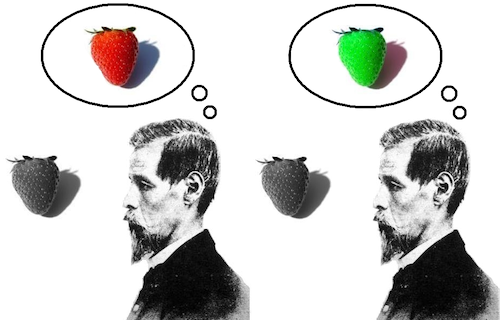
【クオリアとは何か?】意識経験には質的な側面がある。意識にともなう質的な状態をクオリア
(gualia)と名づけられている。クオリアの語形は複数形で、その単数
形表現はクアリ(guale)であり、個々の質的な状態を表現する用語となる。「クオリアとは意識をともなう個人的な主観的な体験、感情、感覚のすべてで
ある」(エーデルマン 1995:135)
☆(さまざまな民衆文化における)ゾンビの定義は、何者かによって蘇った死人であり、肉体と
精神(精神が後退して無知あるいは人工知能なしのロボットとして描かれる)が外部のエージェント(=先の何者か)によって支配されており、また他の生きて
いる人間を襲うために特化した人造人間兵器でもある。ま
た、吸血鬼伝説のように、ゾンビが襲った人間もまた、今度は一旦死んだあとにゾンビとして蘇り、再生産をするという側面もある。
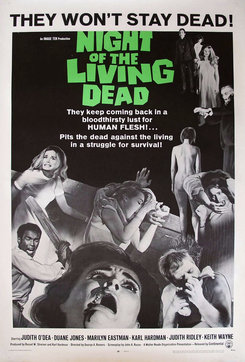
☆1968年のジョージ・A・ロメロのアメリカ映画『ナイト・オブ・ザ・リビングデッド(Night of the Living Dead)』(上掲)で、ゾンビに「噛んだ相手もゾンビになる」という吸血鬼 の特徴が混ぜ込まれ、これが以後のゾンビ映画の基本構造となった。また、ゾンビ作品に触発され、噛まれると感染する蘇った死体としてのキョンシーが香港映 画で1980年代に確立したといわれている。
+++++++++++++++++++
以下、哲 学的ゾンビの目次
+++
| A philosophical
zombie or p-zombie argument is a thought experiment in
philosophy of mind that imagines a hypothetical being that is
physically identical to and indistinguishable from a normal person but
does not have conscious experience, qualia, or sentience.[1] For
example, if a philosophical zombie were poked with a sharp object it
would not inwardly feel any pain, yet it would outwardly behave exactly
as if it did feel pain, including verbally expressing pain. Relatedly,
a zombie world is a hypothetical world indistinguishable from our world
but in which all beings lack conscious experience. Philosophical zombie arguments are used in support of mind-body dualism against forms of physicalism such as materialism, behaviorism and functionalism. These arguments aim to resist the possibility of any physicalist solution to the "hard problem of consciousness" (the problem of accounting for subjective, intrinsic, first-person, what-it's-like-ness). Proponents of philosophical zombie arguments, such as the philosopher David Chalmers, argue that since a philosophical zombie is by definition physically identical to a conscious person, even its logical possibility would refute physicalism, because it would establish the existence of conscious experience as a further fact.[2] Such arguments have been criticized by many philosophers. Some physicalists like Daniel Dennett argue that philosophical zombies are logically incoherent and thus impossible;[3][4] other physicalists like Christopher Hill argue that philosophical zombies are coherent but not metaphysically possible.[5] |
哲
学的ゾンビ(philosophical zombie、p-zombie
argument)とは、通常の人間と物理的に同一で区別がつかないが、意識経験、クオリア、感覚を持たない仮想の存在を想像する心の哲学における思考実
験である[1]。
例えば、哲学的ゾンビが鋭いもので突かれた場合、内面では痛みを感じないが、外面では痛みを感じるように振る舞い、痛みを表現する言葉も発せられるとする
ものである。また、ゾンビの世界とは、私たちの世界と区別がつかないが、すべての生物が意識を持たない仮想的な世界のことである。 哲学的ゾンビ論は、唯物論、行動主義、機能主義などの物理主義に対して、心身二元論を支持するために使われるものである。これらの主張は、「意識の難問」 (主観的、内在的、一人称的、何それっぽい、という問題を説明する問題)に対する物理主義的解決の可能性に抵抗することが目的である。哲学者であるデイ ヴィッド・チャルマーズのような哲学的ゾンビ論の支持者は、哲学的ゾンビは定義上、意識のある人間と同一であるため、その論理的可能性すら物理主義に反論 することになると主張しており、それは意識経験の存在をさらなる事実として立証することになるからだ[2]。このような主張は多くの哲学者から批判されて きた。ダニエル・デネットのような一部の物理学者は哲学的ゾンビは論理的に支離滅裂であり、したがって不可能であると主張している[3][4]。クリスト ファー・ヒルのような他の物理学者は哲学的ゾンビは一貫しているが形而上的に可能ではないと言っている[5]。 (→「ゾンビ・イン・フィロソフィー」「哲学的ゾンビ 2.0」も参考のこと) |
| History Philosophical zombies are associated with David Chalmers, but it was philosopher Robert Kirk who first used the term "zombie" in this context in 1974. Prior to that, Keith Campbell made a similar argument in his 1970 book Body and Mind, using the term "Imitation Man."[6] Chalmers further developed and popularized the idea in his work. In his 1911 Oxford "Life and consciousness" Lectures, Henri Bergson already argues to his audience that it is impossible to prove with mathematical certainty that he is in fact an I, a creature enstowed with consciousness: "I might be a well constructed automaton - going, coming, speaking - without internal consciousness, and the very words by which I declare at this moment that I am conscious being might be words pronounced without conciousness."(Bergson, 1911). Bergson proceeds to argue that we infer from analogy between this other being and ourselves. Following this thought experiment further, Bergson proceeds to argue against the idea that conciousness is restricted to the brain - which he conceives as an organ of choice -, but instead resides in the whole body. (Bergson, 1911) There has been a lively debate about what the zombie argument shows.[6] Critics who primarily argue that zombies are not conceivable include Daniel Dennett, Nigel J. T. Thomas,[7] David Braddon-Mitchell,[8] and Robert Kirk;[9] critics who assert mostly that conceivability does not entail possibility include Katalin Balog,[10] Keith Frankish,[11] Christopher Hill,[5] and Stephen Yablo;[12] and critics who question the logical validity of the argument include George Bealer.[13] In his 2019 update to the article on philosophical zombies in the Stanford Encyclopedia of Philosophy, Kirk summed up the current state of the debate: In spite of the fact that the arguments on both sides have become increasingly sophisticated — or perhaps because of it — they have not become more persuasive. The pull in each direction remains strong.[14] A 2013 survey of professional philosophers conducted by Bourget and Chalmers produced the following results: 35.6% said P Zombies were conceivable but not metaphysically possible; 23.3% said they were metaphysically possible; 16.0% said they were inconceivable; and 25.1% responded "other."[15] In 2020, the same survey yielded "inconceivable" 16%, "conceivable but not possible" 37%, "metaphysically possible" 24%, and "other" 23%.[16] +++++++++++++++++++++++++++++++++++++ Robert Kirk (born 1933)[1] is a British philosopher. He is emeritus professor in the Department of Philosophy at the University of Nottingham. Kirk is best known for his work on philosophical zombies—putatively unconscious beings physically and behaviourally identical to human beings. Although Kirk did not invent this idea, he introduced the term zombie in his 1974 papers "Sentience and Behaviour"[2] and "Zombies v. Materialists".[3] In the latter he offered a formulation of physicalism that aimed to make clear that if zombies are possible, physicalism is false: an argument that was not much noticed until David Chalmers's development of it in The Conscious Mind.[4] Kirk himself had reversed his position earlier,[5] and has argued against the zombie idea in a number of books and articles on physicalism and consciousness.[6][7][8][9][10] As well as working on other topics in the philosophy of mind, Kirk has published on the question of how far translation and interpretation are determined by objective facts (see W. V. Quine's Word and Object (1960)). His own book on this topic, Translation Determined,[11] appeared in 1986. Another main interest is relativism.[12] |
歴史 哲学的ゾンビはデイヴィッド・チャルマーズと関連しているが、1974年にこの文脈で初めて「ゾンビ」という言葉を使ったのは哲学者のロバート・カークで あった。それ以前にはキース・キャンベルが1970年の著書『身体と心』の中で「模倣人間」という言葉を使って同様の議論をしていた[6]。チャルマーズ はその考えをさらに発展させて彼の作品の中で一般化させたのであった。アンリ・ベル クソンは1911年のオックスフォードでの「生命と意識」講義の中で、すでに聴衆に対して、自分が実際に私であり、意識を付与された生物であることを数学 的に確実に証明することは不可能であると論じている。 「私は、内的な意識を持たない、よくできた自動人形かもしれないし、私がこの瞬間、意識的存在であると宣言した言葉も、意識なしに発音された言葉かもしれ ない」(Bergson, 1911).と。ベルクソンは、この他の存在と自分との間のアナロジーから推論することを進めている。この思考実験をさらに進めると、ベルクソンは、意識 が脳に限定される——彼はそれを選択する器官と考える——のではなく、全身に存在するという考え方に反論を進める。(ベルクソン、1911) ゾンビの議論が示すものについては活発な議論がなされてきた[6]。Thomas、[7] David Braddon-Mitchell、[8] Robert Kirk、[9] 考えられることは可能性を伴わないと主に主張する批評家にはKatalin Balog、[10] Keith Frankish、[11] Christopher Hill、[5] Stephen Yablo、[12] 議論の論理的妥当性を疑う批評家にはGeorge Bealer、[13]が含まれる。 スタンフォード哲学百科事典の哲学的ゾンビに関する記事の2019年の更新で、カークは議論の現状を総括している(→「哲学的ゾンビ 2.0」にある)。 両者の議論がますます洗練されてきているにもかかわらず、あるいはそのために、説得力が増しているわけではありません。それぞれの方向への引きは依然とし て強いのです[14]。 BourgetとChalmersによって行われたプロの哲学者を対象とした2013年の調査では、次のような結果が得られている。 35.6%がゾンビは考えられるが形而上学的に可能ではないと答え、23.3%が形而上学的に可能と答え、16.0%が考えられないと答え、25.1%が 「その他」と答えている[15]。 2020年の同調査では、「考えられない」16%、「考えられるが可能ではない」37%、「形而上学的に可能」24%、「その他」23%という結果だった [16]。 +++++++++++++++++++++++++++++++++++++ ロバート・カーク(1933年生まれ)[1]はイギリスの哲学者である。ノッティンガム大学哲学科の名誉教授である。 カークは、哲学的ゾンビ-物理的にも行動的にも人間と同じ、仮に無意識の存在-に関する研究で最もよく知られている。カークはこの考えを発明したわけでは ないが、1974年の論文「感覚と行動」[2]と「ゾンビ対唯物論者」[3]でゾンビという言葉を紹介した。後者では、ゾンビが可能であるならば、唯物論 は誤りであることを明らかにすることを目的とした物理主義の定式化を提示した。 [4]。カーク自身はそれ以前に立場を逆転させており[5]、物理主義と意識に関する多くの本や論文でゾンビの考えに対して反論している[6][7] [8][9][10]。 心の哲学における他のトピックに取り組むだけでなく、カークは翻訳と解釈が客観的事実によってどこまで決定されるかという問題について発表している(W. V. クワインの『言葉と対象』(1960年)を参照)。このテーマに関する自著『Translation Determined』[11]は1986年に出版された。もう一つの主な関心は相対主義である[12]。 |
| Types of zombies Though philosophical zombies are widely used in thought experiments, the detailed articulation of the concept is not always the same. P-zombies were introduced primarily to argue against specific types of physicalism such as behaviorism, according to which mental states exist solely as behavior. Belief, desire, thought, consciousness, and so on, are only behavior (whether external behavior or internal behavior) or tendencies towards behaviors. A p-zombie that is behaviorally indistinguishable from a normal human being but lacks conscious experiences is therefore not logically possible according to the behaviorist,[17] so an appeal to the logical possibility of a p-zombie furnishes an argument that behaviorism is false. Proponents of zombie arguments generally accept that p-zombies are not physically possible, while opponents necessarily deny that they are metaphysically or, in some cases, even logically possible. The unifying idea of the zombie is that of a human completely lacking conscious experience. It is possible to distinguish various zombie sub-types used in different thought experiments as follows: - A behavioral zombie that is behaviorally indistinguishable from a human. - A neurological zombie that has a human brain and is generally physiologically indistinguishable from a human.[18] - A soulless zombie that lacks a soul. - An imperfect zombie or imp-zombie that is like a p-zombie but has slightly different behavior than a regular human. They are important in the context of the mind-evolution problem.[19] - A zombie universe that is identical to our world in all physical ways, except no being in that world has qualia. |
ゾンビの種類 哲学的ゾンビは思考実験に広く使われているが、その概念の詳細な表現方法は必ずしも同じではない。P-ゾンビは、主に行動主義のような特定のタイプの物理 主義に反対するために導入された。行動主義によると、精神状態は行動としてのみ存在する。信念、願望、思考、意識などは、行動(外的行動か内的行動かにか かわらず)あるいは行動への傾向でしかない。したがって、行動主義者によれば、行動的には普通の人間と区別がつかないが、意識的な経験を持たないp- zombieは論理的に不可能であり[17]、p-zombieの論理的可能性への訴えは行動主義が誤りであるという論拠を提供するものである。ゾンビ論 の支持者は一般的にp-ゾンビが物理的に不可能であることを受け入れるが、反対者は形而上学的に、あるいは場合によっては論理的にさえ可能であることを否 定する。 ゾンビの統一的なアイデアは、意識的な経験を完全に欠いた人間というものである。さまざまな思考実験に使われるゾンビは、次のように区別することができ る。 - 行動的には人間と見分けがつかない行動的ゾンビ。 - 人間の脳を持ち、一般的に人間と区別がつかない生理学的なゾンビ[18]。 - 魂がないゾンビ - P-ゾンビに似ているが、普通の人間とは少し違う行動をする不完全なゾンビまたはインプ・ゾンビー。これらは、心進化問題の文脈で重要である[19]。 - ゾンビ宇宙は、クオリアを持たないことを除けば、すべての物理的な面で私たちの世界と同じである。 |
| Zombie arguments Zombie arguments often support lines of reasoning that aim to show that zombies are metaphysically possible in order to support some form of dualism – in this case the view that the world includes two kinds of substance (or perhaps two kinds of property): the mental and the physical.[20] In contrast to dualism, in physicalism, material facts determine all other facts. Since any fact other than that of consciousness may be held to be the same for a p-zombie and for a normal conscious human, it follows that physicalism must hold that p-zombies are either not possible or are the same as normal humans. The zombie argument is a version of general modal arguments against physicalism such as that of Saul Kripke.[21][page needed] Further such arguments were notably advanced in the 1970s by Thomas Nagel (1970; 1974) and Robert Kirk (1974) but the general argument was most famously developed in detail by David Chalmers in The Conscious Mind (1996). According to Chalmers one can coherently conceive of an entire zombie world, a world physically indistinguishable from this world but entirely lacking conscious experience. The counterpart of every conscious being in our world would be a p-zombie. Since such a world is conceivable, Chalmers claims, it is metaphysically possible, which is all the argument requires. Chalmers states: "Zombies are probably not naturally possible: they probably cannot exist in our world, with its laws of nature."[22] The outline structure of Chalmers' version of the zombie argument is as follows; 1. According to physicalism, all that exists in our world (including consciousness) is physical. 2. Thus, if physicalism is true, a metaphysically possible world in which all physical facts are the same as those of the actual world must contain everything that exists in our actual world. In particular, conscious experience must exist in such a possible world. 3. Chalmers argues that we can conceive being outside of a world physically indistinguishable from our world but in which there is no consciousness (a zombie world). From this (so Chalmers argues) it follows that such a world is metaphysically possible. Therefore, physicalism is false. (The conclusion follows from 2. and 3. by modus tollens.) 4. The above is a strong formulation of the zombie argument. There are other formulations of the zombies-type argument which follow the same general form. The premises of the general zombies argument are implied by the premises of all the specific zombie arguments. A general zombies argument is in part motivated by potential disagreements between various anti-physicalist views. For example, an anti-physicalist view can consistently assert that p-zombies are metaphysically impossible but that inverted qualia (such as inverted spectra) or absent qualia (partial zombiehood) are metaphysically possible. Premises regarding inverted qualia or partial zombiehood can substitute premises regarding p-zombies to produce variations of the zombie argument. The metaphysical possibility of a physically indistinguishable world with either inverted qualia or partial zombiehood would imply that physical truths do not metaphysically necessitate phenomenal truths. To formulate the general form of the zombies argument, take the sentence 'P' to be true if and only if the conjunct of all microphysical truths of our world obtain, take the sentence 'Q' to be true if some phenomenal truth, that obtains in the actual world, obtains. The general argument goes as follows. 1. It is conceivable that P is true and Q is not true. 2. If it is conceivable that P is true and Q is not true then it is metaphysically possible that P is true and Q not true. 3. If it is metaphysically possible that P is true and Q is not true then physicalism is false. 4. Therefore, physicalism is false.[23] Q can be false in a possible world if any of the following obtains: (1) there exists at least one invert relative to the actual world (2) there is at least one absent quale relative to the actual world (3) all actually conscious beings are p-zombies (all actual qualia are absent qualia). Another way to construe the zombie hypothesis is epistemically – as a problem of causal explanation, rather than as a problem of logical or metaphysical possibility. The "explanatory gap" – also called the "hard problem of consciousness" – is the claim that (to date) no one has provided a convincing causal explanation of how and why we are conscious. It is a manifestation of the very same gap that (to date) no one has provided a convincing causal explanation of how and why we are not zombies.[24] The philosophical zombie argument can also be seen through the counterfeit bill example brought forth by Amy Kind. Amy Kind’s example centers around the idea that you have to imagine a counterfeit 20 dollar bill was made to be exactly like an authentic 20 dollar bill. This is logically possible. And yet the counterfeit bill would not really have the same value. Like the critique against Descartes conceivability argument, are people really logically conceiving of zombies when they say they are? When philosophers claim that zombies are conceivable, they invariably underestimate the task of conception, and end up imagining something that violates their own definition. According to Amy Kind, in her book “Philosophy of Mind: the basics”>, The Zombie Argument can be put in this standard form from a dualist point of view: Zombies, creatures that are microphysically identical to conscious beings but that lack consciousness entirely, are conceivable. If zombies are conceivable then they are possible. Therefore, zombies are possible. If zombies are possible, then consciousness is non-physical. Therefore, consciousness is non-physical.[25] |
ゾンビの議論 ゾンビ論はしばしば、ある種の二元論(この場合、世界は精神と肉体という2種類の物質(あるいは2種類の性質)を含むという見解)を支持するために、ゾン ビが形而上学的に可能であることを示すことを目的とした推論のラインを支持している[20]。 二元論とは対照的に、物理主義では物質的な事実が他のすべての事実を決定している。意識以外のあらゆる事実は、p-ゾンビと普通の意識ある人間にとって同 じであるとすることができるので、物理主義はp-ゾンビはありえないか、普通の人間と同じであるとしなければならないことになる。 21][page needed]このような議論は1970年代にThomas Nagel (1970; 1974) とRobert Kirk (1974) によって進められましたが、一般的な議論はDavid ChalmersがThe Conscious Mind (1996) で詳細に展開したことが最も有名な例です。 チャルマーズによれば、この世界と物理的に区別できないが、意識的な経験がまったくないゾンビの世界というものを首尾よく考えることができる。この世界の すべての意識的存在と対をなすのは、P-ゾンビであろう。このような世界は考えられるので、形而上学的に可能である、とチャルマースは主張する。チャル マースはこう言っている。「ゾンビはおそらく自然にはありえない。自然の法則があるこの世界にはおそらく存在できない」[22] チャルマーズ版のゾンビ論の概略構造は以下の通りである。 1. 物理主義によれば、我々の世界に存在するもの(意識を含む)はすべて物理的である。 2. 物理主義が正しいとすれば、物理的事実がすべて現実の世界と同じである形而上学的に可能な世界には、現実の世界に存在するものがすべて含まれるはずであ る。特に、意識的な経験は、そのような可能な世界に存在するはずである。 3. チャルマースは、私たちの世界と物理的に区別できないが、意識のない世界(ゾンビ世界)の外に存在することを考えることができると主張する。このことから (チャルマースは)、そのような世界は形而上学的に可能であることが導かれる。(結論は、2.と3.からモーダス・トレンスで導かれる)。 4. 上記はゾンビ論証の強い定式化である。ゾンビ型論証の定式化は他にもあり、同じ一般的な形式を踏襲している。一般的なゾンビ論証の前提は、すべての特定の ゾンビ論証の前提によって暗示される。 一般的なゾンビ論は、様々な反物理主義者の見解の間の潜在的な不一致に動機づけられている部分がある。例えば、ある反物理主義者は、p-ゾンビは形而上学 的に不可能だが、反転クオリア(反転スペクトルなど)や欠落クオリア(部分的ゾンビ化)は形而上学的に可能だと一貫して主張することができます。反転クオ リアや部分的ゾンビ性についての前提は、p-ゾンビについての前提の代わりになり、ゾンビ論のバリエーションを生み出すことができる。 物理的に区別できない世界に逆クオリアや部分的なゾンビが存在する形而上学的可能性は、物理的真理が現象的真理を形而上学的に必要としないことを意味する ことになる。 ゾンビ論の一般的な形式を定式化すると、我々の世界のすべての微物理的真理の結合が得られる場合にのみ、文「P」が真であるとし、実際の世界で得られる何 らかの現象的真理が得られる場合に、文「Q」が真であるとする。一般的な論法は次のようになる。 1. Pが真でQが真でないことは考えうる。 2. Pが真でQが真でないことが考えられるなら、Pが真でQが真でないことは形而上学的に可能である。 3. もしPが真でQが真でないことが形而上学的に可能なら、物理主義は偽である。 4. したがって、物理主義は偽である[23]。 Qは次のいずれかが得られる場合、可能世界において偽となりうる:(1)現実世界に対して少なくとも一つの反転が存在する(2)現実世界に対して少なくと も一つの不在クオールが存在する(3)実際に意識を持つ存在はすべてp-ゾンビ(すべての実際のクオリアが不在クオリア)である。 ゾンビ仮説のもう一つの解釈は、認識論的なもので、論理的・形而上学的な可能性の問題ではなく、因果的な説明の問題である。説明のギャップ」(「意識の ハードプロブレム」とも呼ばれる)とは、人間がどのように、そしてなぜ意識を持つのかについて、納得のいく因果的な説明を誰もしていないという主張です。 これは、(現在に至るまで)私たちがどのように、そしてなぜゾンビではないのかということについて、誰も説得力のある因果的な説明をしていないというのと 全く同じギャップの現れである[24]。 哲学的なゾンビの議論はエイミー・カインドによってもたらされた偽札の例を通しても見ることができる。エイミー・カインドの例は、20ドル札の偽札が本物 の20ドル札と全く同じように作られたと想像しなければならないという考えを中心に据えたものである。これは論理的に可能である。しかし、その偽札が本当 に同じ価値を持つとは限らない。デカルトの想起可能性論に対する批判と同じように、人々がゾンビを論理的に想起していると言うとき、本当にそうなのだろう か?哲学者が「ゾンビは想起可能である」と主張するとき、彼らは必ずといっていいほど想起という作業を軽視し、自らの定義に反するものを想起してしまうの です。 エイミー・カインドが著書『心の哲学:基礎編』>で述べているように、『ゾンビ論』は二元論者の立場からすると、このような標準的な形になるのである。 ゾンビは、微物理的には意識ある存在と同じだが、意識を完全に欠いている生物であり、考えうるものである。もしゾンビが考えうるものであるなら、それは可 能である。したがって、ゾンビは可能である。もしゾンビが可能であるなら、意識は非物理的である。したがって、意識は非物理的である[25]。 |
| Responses Galen Strawson argues that it is not possible to establish the conceivability of zombies, so that the argument, lacking its first premise, can never get going.[26] Chalmers has argued that zombies are conceivable, saying "it certainly seems that a coherent situation is described; I can discern no contradiction in the description."[27] Many physicalist philosophers[who?] have argued that this scenario eliminates itself by its description; the basis of a physicalist argument is that the world is defined entirely by physicality; thus, a world that was physically identical would necessarily contain consciousness, as consciousness would necessarily be generated from any set of physical circumstances identical to our own. The zombie argument claims that one can tell by the power of reason that such a "zombie scenario" is metaphysically possible. Chalmers states; "From the conceivability of zombies, proponents of the argument infer their metaphysical possibility"[22] and argues that this inference, while not generally legitimate, is legitimate for phenomenal concepts such as consciousness since we must adhere to "Kripke's insight that for phenomenal concepts, there is no gap between reference-fixers and reference (or between primary and secondary intentions)." That is, for phenomenal concepts, conceivability implies possibility. According to Chalmers, whatever is logically possible is also, in the sense relevant here, metaphysically possible.[28] Another response is the denial of the idea that qualia and related phenomenal notions of the mind are in the first place coherent concepts. Daniel Dennett and others argue that while consciousness and subjective experience exist in some sense, they are not as the zombie argument proponent claims. The experience of pain, for example, is not something that can be stripped off a person's mental life without bringing about any behavioral or physiological differences. Dennett believes that consciousness is a complex series of functions and ideas. If we all can have these experiences the idea of the p-zombie is meaningless. Dennett argues that "when philosophers claim that zombies are conceivable, they invariably underestimate the task of conception (or imagination), and end up imagining something that violates their own definition".[3][4] He coined the term "zimboes" – p-zombies that have second-order beliefs – to argue that the idea of a p-zombie is incoherent;[29] "Zimboes thinkZ they are conscious, thinkZ they have qualia, thinkZ they suffer pains – they are just 'wrong' (according to this lamentable tradition), in ways that neither they nor we could ever discover!".[4] Michael Lynch agrees with Dennett, arguing that the zombie conceivability argument forces us to either question whether or not we actually have consciousness or accept that zombies are not possible. If zombies falsely believe they are conscious, how can we be sure we are not zombies? We may believe we are experiencing conscious mental states when, in fact, we merely hold a false belief. Lynch thinks denying the possibility of zombies is more reasonable than questioning our own consciousness.[30] Furthermore, when concept of self is deemed to correspond to physical reality alone (reductive physicalism), philosophical zombies are denied by definition. When a distinction is made in one's mind between a hypothetical zombie and oneself (assumed not to be a zombie), the hypothetical zombie, being a subset of the concept of oneself, must entail a deficit in observables (cognitive systems), a "seductive error"[4] contradicting the original definition of a zombie. Thomas Metzinger dismisses the argument as no longer relevant to the consciousness community, calling it a weak argument that covertly relies on the difficulty in defining "consciousness", calling it an "ill-defined folk psychological umbrella term". [31] Verificationism[1] states that, for words to have meaning, their use must be open to public verification. Since it is assumed that we can talk about our qualia, the existence of zombies is impossible. Artificial intelligence researcher Marvin Minsky saw the argument as circular. The proposition of the possibility of something physically identical to a human but without subjective experience assumes that the physical characteristics of humans are not what produces those experiences, which is exactly what the argument was claiming to prove.[32] Richard Brown agrees that the zombie argument is circular. To show this, he proposes "zoombies", which are creatures nonphysically identical to people in every way and lacking phenomenal consciousness. If zoombies existed, they would refute dualism because they would show that consciousness is not nonphysical, i.e., is physical. Paralleling the argument from Chalmers: It is conceivable that zoombies exist, so it is possible they exist, so dualism is false. Given the symmetry between the zombie and zoombie arguments, we cannot arbitrate the physicalism/dualism question a priori.[33] Similarly, Gualtiero Piccinini argues that the zombie conceivability argument is circular. Piccinini’s argument questions whether the possible worlds where zombies exist are accessible from our world. If physicalism is true in our world, then physicalism is one of the relevant facts about our world for determining whether a possible zombie world is accessible from our world. Therefore, asking whether zombies are metaphysically possible in our world is equivalent to asking whether physicalism is true in our world. [34] Stephen Yablo's (1998) response is to provide an error theory to account for the intuition that zombies are possible. Notions of what counts as physical and as physically possible change over time so conceptual analysis is not reliable here. Yablo says he is "braced for the information that is going to make zombies inconceivable, even though I have no real idea what form the information is going to take."[35] The zombie argument is difficult to assess because it brings to light fundamental disagreements about the method and scope of philosophy itself and the nature and abilities of conceptual analysis. Proponents of the zombie argument may think that conceptual analysis is a central part of (if not the only part of) philosophy and that it certainly can do a great deal of philosophical work. However, others, such as Dennett, Paul Churchland and W.V.O. Quine, have fundamentally different views. For this reason, discussion of the zombie argument remains vigorous in philosophy. Some accept modal reasoning in general but deny it in the zombie case. Christopher S. Hill and Brian P. Mclaughlin suggest that the zombie thought experiment combines imagination of a "sympathetic" nature (putting oneself in a phenomenal state) and a "perceptual" nature (imagining becoming aware of something in the outside world). Each type of imagination may work on its own, but they're not guaranteed to work when both used at the same time. Hence Chalmers's argument need not go through.[36]: 448 Moreover, while Chalmers defuses criticisms of the view that conceivability can tell us about possibility, he provides no positive defense of the principle. As an analogy, the generalized continuum hypothesis has no known counterexamples, but this does not mean we must accept it. And indeed, the fact that Chalmers concludes we have epiphenomenal mental states that do not cause our physical behavior seems one reason to reject his principle.[36]: 449–51 |
レスポンス(反応) Galen Strawsonはゾンビの想起可能性を確立することは不可能であると主張しており、そのためその第一前提を欠いた議論は決して進行することができない [26]。 チャルマースは「確かに首尾一貫した状況が記述されているようであり、私はその記述に矛盾を見出すことができない」と述べ、ゾンビは考え得るものであると 主張している[27]。 多くの物理主義の哲学者[who?]はこのシナリオがその記述によってそれ自体を排除していると主張している。物理主義の議論の基礎は、世界は完全に物理 性によって定義されるということであり、したがって物理的に同一の世界は、意識が我々のものと同一のあらゆる物理的状況の集合から必然的に発生するため、 意識を含むことになるであろう。 ゾンビ論は、このような「ゾンビ・シナリオ」が形而上学的に可能であることを理性の力で言い当てることができると主張する。チャルマースは「ゾンビの想起 可能性から、この議論の支持者はその形而上学的可能性を推論する」[22]と述べ、この推論は一般的には正当ではないが、意識などの現象的概念については 「現象的概念については、参照修正者と参照(あるいは一次意図と二次意図)の間にギャップはないというクリプキの洞察」に従う必要があるから正当だと論じ ている。 つまり、現象的な概念については、conceivabilityはpossibilityを意味するのである。チャルマースによれば、論理的に可能なもの は、ここでいう意味において、形而上学的に可能でもある[28]。 もう一つの反応は、そもそもクオリアやそれに関連する心の現象的概念が首尾一貫した概念であるという考え方の否定である。ダニエル・デネットなどは、意識 や主観的経験はある意味で存在するが、ゾンビ論提唱者が主張するようなものではないとしている。例えば、痛みの経験は、行動や生理的な違いをもたらすこと なく、人の精神生活を剥奪できるようなものではありません。 デネットは、意識は複雑な機能と観念の積み重ねであると考えている。デネットは「哲学者がゾンビが考えられると主張するとき、彼らは必ず構想 (あるいは想像)のタスクを過小評価しており、結局は彼ら自身の定義に違反するものを想像している」と論じている[3][4]。 [3][4] 彼は「ジンボーズ」(二次的信念を持つp-ゾンビ)という言葉を作り、p-ゾンビの考えが支離滅裂であることを論じている[29] 「ジンボーズは意識があると思い、クオリアを持っていると思い、苦痛を受けると思う-彼らはただ(この嘆かわしい伝統に従って)『間違って』いて、彼らも 我々も発見できない方法で!」 [4] と言っているのだ。 マイケル・リンチはデネットに同意し、ゾンビの想起可能性の議論では、私たちが実際に意識を持っているかどうかを問うか、ゾンビが存在しないことを受け入 れるかのどちらかを迫られると主張している。もしゾンビが自分の意識を偽っているとしたら、私たちがゾンビでないとどうして言い切れるのだろうか。私たち は、意識的な精神状態を経験していると信じているかもしれないが、実際には誤った信念を持っているに過ぎないのである。リンチはゾンビの可能性を否定する ことは、自分自身の意識を疑うことよりも合理的であると考えている[30]。 さらに、自己の概念が物理的な現実だけに対応するとみなされるとき(還元的物理主義)、哲学的なゾンビは定義によって否定される。仮定のゾンビと自分(ゾ ンビではないと仮定)を頭の中で区別するとき、仮定のゾンビは自分という概念の部分集合であるため、観察可能なもの(認知システム)の欠損を伴わなければ ならず、ゾンビの本来の定義と矛盾する「誘惑的な誤り」[4]である。 トーマス・メッツィンガーはこの議論を、「意識」の定義の難しさに隠然と依拠した弱い議論であるとし、「定義が不明確な民間心理学の総称」と呼んで、意識 のコミュニティにはもはや関係ないものとして退けている。[31] 検証主義[1]は、言葉が意味を持つためには、その使われ方が公に検証されうるものでなければならないとしている。私たちがクオリアについて語ることがで きると仮定しているため、ゾンビの存在は不可能である。 人工知能研究者のマービン・ミンスキーは、この議論を循環的なものであると考えた。人間と物理的に同じだが主観的な経験を持たないものの可能性という命題 は、人間の物理的特性がそれらの経験を生み出すものではないことを仮定しており、それはまさにこの議論が証明しようと主張していたものであった[32]。 リチャード・ブラウンはゾンビの議論が循環的であることに同意している。これを示すために、彼は「zoombies」を提案し、それはあらゆる点で人間と 非物理的に同一であり、現象的な意識を持たない生物であるとしている。もしズームズービーが存在すれば、意識は非物理的ではなく、すなわち物理的であるこ とを示すので、二元論に反駁できる。チャルマーズの議論と並行する。ズームビーが存在することは考えられるので、存在する可能性があり、二元論が偽であ る。ゾンビの議論とズームの議論の対称性を考えると、物理主義/二元論の問題を先験的に裁定することはできない[33]。 同様に、Gualtiero Piccininiはゾンビの想起可能性の議論が循環的であることを論じている。ピッチニーニの議論は、ゾンビが存在する可能な世界が我々の世界からアク セス可能であるかどうかを問うている。もし物理主義が我々の世界において真であるならば、物理主義は、可能なゾンビの世界が我々の世界からアクセス可能か どうかを決定するための、我々の世界に関する関連する事実の一つである。したがって、我々の世界でゾンビが形而上学的に可能かどうかを問うことは、我々の 世界で物理主義が真であるかどうかを問うことと等価である。[34] Stephen Yablo (1998)の回答は、ゾンビが可能であるという直観を説明するためのエラー理論を提供することである。何が物理的で、何が物理的に可能であるかという概 念は時代とともに変化するので、概念的な分析はここでは信頼できない。Yabloは「ゾンビを考えられないようにする情報に対して身構えているが、その情 報がどのような形を取るのかについては全く考えていない」と述べている[35]。 ゾンビ論は、哲学の方法と範囲、概念分析の性質と能力に関する根本的な不一致を浮き彫りにするため、評価が困難である。ゾンビ論の支持者は概念分析が哲学 の中心的な部分であり(唯一の部分ではないにしても)、確かに多くの哲学的な仕事をすることができると考えているかもしれない。しかし、デネット、ポー ル・チャーチランド、W.V.O.クワインなど、根本的に異なる見解の持ち主もいる。このため、哲学の世界では、ゾンビ論議は依然として活発な議論が行わ れている。 一般に様相推論を認めながらも、ゾンビの場合は否定する者もいる。クリストファー・S・ヒルとブライアン・P・マクラフリンは、ゾンビの思考実験は「共 感」的な想像(自分を現象的な状態に置くこと)と「知覚」的な想像(外界の何かに気づくことを想像すること)が組み合わされていると提案している。それぞ れのタイプの想像力は単独で機能するかもしれないが、両方が同時に使われたときに機能する保証はない。したがってチャルマーズの議論はスルーする必要がな い[36]。 448 さらに、チャルマーズは、発想力が可能性について語ることができるという見解に対する批判をかわす一方で、この原則に対する積極的な擁護は行っていない。 このような場合、一般化された連続体仮説は反例を持たないが、だからといって、それを受け入れなければならないわけではない。そして実際、チャルマースが 我々の物理的行動を引き起こさない表在的な精神状態を持っていると結論付けていることは、彼の原理を否定する一つの理由になっているようだ[36]。 449-51 |
| Related thought experiments Frank Jackson's Mary's room argument is based around a hypothetical scientist, Mary, who is forced to view the world through a black-and-white television screen in a black and white room. Mary is a brilliant scientist who knows everything about the neurobiology of vision. Even though Mary knows everything about color and its perception (e.g. what combination of wavelengths makes the sky seem blue), she has never seen color. If Mary were released from this room and were to experience color for the first time, would she learn anything new? Jackson initially believed this supported epiphenomenalism (mental phenomena are the effects, but not the causes, of physical phenomena) but later changed his views to physicalism, suggesting that Mary is simply discovering a new way for her brain to represent qualities that exist in the world. Swampman is an imaginary character introduced by Donald Davidson. If Davidson goes hiking in a swamp and is struck and killed by a lightning bolt while nearby another lightning bolt spontaneously rearranges a bunch of molecules so that, entirely by coincidence, they take on exactly the same form that Davidson's body had at the moment of his untimely death then this being, 'Swampman', has a brain structurally identical to that which Davidson had and will thus presumably behave exactly like Davidson. He will return to Davidson's office and write the same essays he would have written, recognize all of his friends and family and so forth.[37] John Searle's Chinese room argument deals with the nature of artificial intelligence: it imagines a room in which a conversation is held by means of written Chinese characters that the subject cannot actually read, but is able to manipulate meaningfully using a set of algorithms. Searle holds that a program cannot give a computer a "mind" or "understanding", regardless of how intelligently it may make it behave. Stevan Harnad argues that Searle's critique is really meant to target functionalism and computationalism, and to establish neuroscience as the only correct way to understand the mind.[38] Physicist Adam Brown has suggested constructing a type of philosophical zombie using counterfactual quantum computation, a technique in which a computer is placed into a superposition of running and not running. If the program being executed is a brain simulation, and if one makes the further assumption that brain simulations are conscious, then the simulation can have the same output as a conscious system, yet not be conscious.[39] |
関連する思考実験 フランク・ジャクソンのメアリーの部屋の議論は、白黒の部屋で白黒のテレビ画面を通して世界を見ることを強いられる仮想の科学者、メアリーを中心に展開さ れる。メアリーは、視覚の神経生物学について何でも知っている優秀な科学者である。メアリーは色とその知覚(例えば、どのような波長の組み合わせで空が青 く見えるか)について何でも知っているにもかかわらず、色を見たことがない。もし、メアリーがこの部屋から解放されて、初めて色を体験したら、何か新しい ことを学べるだろうか?ジャクソンは当初、このことはエピフェノメンタル主義(精神現象は物理現象の原因ではなく結果である)を支持すると考えていたが、 後に物理主義に変更し、メアリーは世界に存在する性質を表現する新しい方法を脳が発見しているだけだと示唆する。 スワンプマンとは、ドナルド・デビッドソンが登場させた想像上の人物である。もしデイヴィッドソンが沼地にハイキングに行き、稲妻に打たれて死んだとした ら、その近くで別の稲妻が自然発生的に分子の束を再編成し、まったくの偶然から、デイヴィッドソンの体が早死にした瞬間に持っていた形とまったく同じに なったとしたら、この存在「スワンプマン」は構造的にデイビッドソンと同じ脳を持っていて、おそらくデイビッドソンのように振る舞うと思われます。彼はデ イヴィッドソンのオフィスに戻り、彼が書いたであろうのと同じエッセイを書き、彼の友人や家族のすべてを認めるなどする[37]。 John SearleのChinese room argumentは人工知能の性質を扱っており、被験者が実際には読むことができないが、一連のアルゴリズムを使って意味のある操作をすることができる書 かれた漢字によって会話が行われる部屋を想像している。サールは、プログラムがコンピュータにいかに知的な振る舞いをさせようとも、コンピュータに「心」 や「理解」を与えることはできないとしている。Stevan Harnadはサールの批判は機能主義と計算主義をターゲットにしたものであり、心を理解するための唯一の正しい方法として神経科学を確立することを意図 していると論じている[38]。 物理学者のアダム・ブラウンは、反実仮想的量子計算(コンピュータが実行されたりされなかったりする重ね合わせの状態に置かれる技術)を用いて、一種の哲 学的ゾンビを構築することを提案している。実行されているプログラムが脳のシミュレーションであり、さらに脳のシミュレーションが意識を持つと仮定すれ ば、シミュレーションは意識を持つシステムと同じ出力を持つことができるが、意識を持つことはできない[39]。 |
| Begging the question Blindsight Causality Chinese Room Consciousness Dual-aspect theory Explanatory gap Functionalism (philosophy of mind) Hard problem of consciousness Inverted spectrum Map–territory relation Mind Mind-body problem Neutral monism NPC (meme) No true Scotsman Philosophy of mind Problem of other minds Quantum Night Reverse engineering Sentience Ship of Theseus Solipsism Turing test Zombie Blues |
論点先取 ブラインドサイト 因果関係 中国人の部屋 意識 デュアルアスペクト理論 説明のギャップ 機能主義(心の哲学) 意識の難問 逆スペクトル 地図と領域の関係 心 心身問題 中立的一元論 NPC(ミーム) 真のスコットランド人なし 心の哲学 他の心の問題 量子ナイト リバース・エンジニアリング 感覚 テセウスの船 独我論 チューリングテスト ゾンビ・ブルース |
| https://en.wikipedia.org/wiki/Philosophical_zombie |
https://www.deepl.com/ja/translator |
| Bibliography Alter, T., 2007, ‘On the Conditional Analysis of Phenomenal Concepts’, Philosophical Studies, 134: 235–53. Aranyosi, I., 2010, ‘Powers and the Mind-Body Problem’, International Journal of Philosophy, 18: 57–72. Ball, D., 2009, ‘There Are No Phenomenal Concepts’, Mind, 122: 935–62. Balog, K., 1999, ‘Conceivability, Possibility, and the Mind-Body Problem’, Philosophical Review, 108: 497–528. –––, 2012, ‘In Defense of the Phenomenal Concept Strategy‘, Philosophy and Phenomenological Research, 84: 1–23. Block, N., 1980a, ‘Troubles with Functionalism’, in Readings in the Philosophy of Psychology, Volume 1, Ned Block (ed.), Cambridge, MA: Harvard University Press, 268–305. –––, 1980b, ‘Are Absent Qualia Impossible?’ Philosophical Review, 89: 257–274. –––, 1981, ‘Psychologism and Behaviorism’, Philosophical Review, 90: 5–43. –––, 1995, ‘On a Confusion about a Function of Consciousness’, Behavioral and Brain Sciences, 18: 227–247. –––, 2002, ‘The Harder Problem of Consciousness’, Journal of Philosophy, 99: 391–425. –––, O. Flanagan and G. Güzeldere (eds.), 1997, The Nature of Consciousness: Philosophical Debates, Cambridge, MA and London: MIT Press. ––– and R. Stalnaker, 1999, ‘Conceptual Analysis, Dualism, and the Explanatory Gap’, Philosophical Review, 108: 1–46. Braddon-Mitchell, D., 2003, ‘Qualia and Analytical Conditionals’, Journal of Philosophy, 100: 111–135. Brown, R., 2010, ‘Deprioritizing the A Priori Arguments Against Physicalism’, Journal of Consciousness Studies, 17 (3–4): 47–69. Brueckner, A., 2001. ‘Chalmers’s Conceivability Argument for Dualism’, Analysis, 61: 187–193. Campbell, K., 1970, Body and Mind, London: Macmillan. Campbell, D., J. Copeland and Z-R Deng 2017. ‘The Inconceivable Popularity of Conceivability Arguments’, The Philosophical Quarterly, 67: 223—240. Carruth, A., 2016, ‘Powerful qualities, zombies and inconceivability’, The Philosophical Quarterly, 66: 25—46. Carruthers, P., 2005, Consciousness: Essays from a Higher-Order Perspective, Oxford: Clarendon Press. Chalmers, D. J., 1996, The Conscious Mind: In Search of a Fundamental Theory, New York and Oxford: Oxford University Press. –––, 1999, ‘Materialism and the Metaphysics of Modality’, Philosophy and Phenomenological Research, 59: 475–496. –––, 2002, ‘Does Conceivability Entail Possibility?’, in Gendler and Hawthorne 2002. –––, 2003, ‘The Content and Epistemology of Phenomenal Belief’, in Q. Smith and A. Jokic (eds.), Consciousness: New Philosophical Perspectives, Oxford: Oxford University Press. –––, 2007, ‘Phenomenal Concepts and the Explanatory Gap’, in T. Alter and S. Walter (eds.), Phenomenal Concepts and Phenomenal Knowledge, New York and Oxford: Oxford University Press, 167–94. –––, 2010, ‘The Two-Dimensional Argument against Materialism’, in his The Character of Consciousness, New York and Oxford: Oxford University Press. ––– and F. Jackson, 2001, ‘Conceptual Analysis and Reductive Explanation’, Philosophical Review, 110: 315–61. Cottrell, A., 1999, ‘Sniffing the Camembert: on the Conceivability of Zombies’, Journal of Consciousness Studies, 6: 4–12. Crane, T., 2005, ‘Papineau on Phenomenal Consciousness’, Philosophy and Phenomenological Research, 71: 155–62 . Cutter, B, 2020, ‘The Modal Argument Improved’, Analysis, 80: 629–639. Dennett, D. C., 1991, Consciousness Explained, Boston, Toronto, London: Little, Brown. –––, 1995, ‘The Unimagined Preposterousness of Zombies’, Journal of Consciousness Studies, 2: 322–6. –––, 1999, ‘The Zombic Hunch: Extinction of an Intuition?’ Royal Institute of Philosophy Millennial Lecture. Descartes, R., Discourse on the Method; The Objections and Replies, in The Philosophical Writings Of Descartes, 3 vols., translated by J. Cottingham, R. Stoothoff, and D. Murdoch (volume 3, including A. Kenny), Cambridge: Cambridge University Press, 1988. Flanagan, O., and T. Polger, 1995, ‘Zombies and the Function of Consciousness’, Journal of Consciousness Studies, 2: 313–321. Frankish, K., 2007, ‘The Anti-Zombie Argument’, Philosophical Quarterly, 57: 650–666 . Garrett, B. J., 2009, ‘Causal Essentialism versus the Zombie Worlds’, Canadian Journal of Philosophy, 39: 93–112 . Gendler, T., and J. Hawthorne (eds.), 2002, Conceivability and Possibility, Oxford: Oxford University Press. Goff, P., 2010, ‘Ghosts and Sparse Properties: Why Physicalists Have More to Fear from Ghosts than Zombies’, Philosophy and Phenomenological Research, 81: 119–37. –––, 2017, Consciousness and Fundamental Reality, Oxford: Oxford University Press. Harnad, S., 1995, ‘Why and How We Are Not Zombies’, Journal of Consciousness Studies, 1: 164–167. Hawthorne, J. P., 2002a, ‘Advice to Physicalists’, Philosophical Studies, 108: 17–52. –––, 2002b. ‘Blocking Definitions of Materialism’, Philosophical Studies, 110: 103–13. Hill, C. S., 1997, ‘Imaginability, Conceivability, Possibility and the Mind-Body Problem’, Philosophical Studies, 87: 61–85. Hill, C. S., and B. P. McLaughlin, 1999, ‘There are Fewer Things in Reality Than Are Dreamt of in Chalmers’s Philosophy’, Philosophy and Phenomenological Research, 59: 446–454. Howell, R. J., 2013, Consciousness and the Limits of Objectivity: the Case for Subjective Physicalism, Oxford: Oxford University Press. Jackson, F., 1982, ‘Epiphenomenal Qualia’, Philosophical Quarterly, 32: 127–136. Jackson, F., 1998, From Metaphysics to Ethics, New York: Oxford University Press. James, W., 1890, The Principles of Psychology, New York: Dover (originally published by Holt). Kirk, R., 1974a, ‘Sentience and Behaviour’, Mind, 83: 43–60. –––, 1974b, ‘Zombies v. Materialists’, Proceedings of the Aristotelian Society, 48 (Supplementary): 135–152. –––, 2005, Zombies and Consciousness, Oxford: Clarendon Press. –––, 2008, ‘The Inconceivability of Zombies’, Philosophical Studies, 139: 73–89. –––, 2013, The Conceptual Link from Physical to Mental, Oxford: Oxford University Press. –––, 2017, Robots, Zombies and Us: Understanding Consciousness, London: Bloomsbury. Kriegel, U., 2011, Subjective Consciousness: a self-representational theory, Oxford: Oxford University Press. Kripke, S., 1972/80, Naming and Necessity, Oxford: Blackwell. (Revised and enlarged version of ‘Naming and Necessity’, in Semantics of Natural Language, D. Davidson and G. Harman (eds.), Dordrecht: D. Reidel, 253–355. Latham, Noa, 2000, ‘Chalmers on the Addition of Consciousness to the Physical World’, Philosophical Studies, 98: 71–97. Leuenberger, S., 2008, ‘Ceteris Absentibus Physicalism’, Oxford Studies in Metaphysics, Volume 4, D. Zimmerman (ed.), Oxford: Oxford University Press, 145–170. Levine, J., 2001, Purple Haze: The Puzzle of Consciousness, Oxford and New York: Oxford University Press. Loar, B., 1990/1997, ‘Phenomenal States’, in Philosophical Perspectives, Volume 4, J. Tomberlin (ed.), Atascadero: Ridgeview. Revised version repr. in Block, et al. 1997, 597–616. –––, 1999, ‘David Chalmers’s The Conscious Mind’, Philosophy and Phenomenological Research, 59: 465–472. Lyons, J. C., 2009, Perception and Basic Beliefs: Zombies, Modules and the Problem of the External World, New York and Oxford: Oxford University Press. McLaughlin, B. P., 2005, ‘A Priori versus A Posteriori Physicalism’, in Philosophy-Science-Scientific Philosophy, Main Lectures and Colloquia of GAP 5, Fifth International Congress of the Society for Analytical Philosophy (C. Nimtz & A. Beckermann eds.), Mentis. Marcus, E., 2004, ‘Why Zombies are Inconceivable’, Australasian Journal of Philosophy, 82: 477–90. Marton, P., 1998, ‘Zombies vs. materialists: The battle for conceivability’, Southwest Philosophy Review, 14: 131–38. Nagel, T., 1970, ‘Armstrong on the Mind’, Philosophical Review, 79: 394–403. –––, 1974, ‘What is it Like to Be a Bat?’ Philosophical Review, 83: 435–450, reprinted in his Mortal Questions, Cambridge: Cambridge University Press, 1979. –––, 1998, ‘Conceiving the Impossible and the Mind-Body Problem’, Philosophy, 73: 337-352. Papineau, D., 2002, Thinking about Consciousness, Oxford: Clarendon Press. Pelczar, M., 2021, ‘Modal arguments against materialism‘, Noûs, 55: 426–444. Pereboom, D., 2011, Consciousness and the Prospects of Physicalism, Oxford: Oxford University Press. Piccinini, G., 2017, ‘Access Denied to Zombies,’ Topoi, 36: 81–93. Russell, B., 1927, The Analysis of Matter, London: Routledge. Searle, J. R., 1992, The Rediscovery of the Mind, Cambridge, MA: MIT Press. Sebastián, Miguel Ángel, 2017, ‘On a Confusion About Which Intuitions to Trust: From the Hard Problem to a Not Easy One’, Topoi, 36: 31–40. Shoemaker, S., 1975, ‘Functionalism and Qualia’, Philosophical Studies, 27: 291–315. –––, 1999, ‘On David Chalmers’s The Conscious Mind,’ Philosophy and Phenomenological Research, 59: 439–444. Stalnaker, R., 2002, ‘What is it Like to Be a Zombie?’, in Gendler and Hawthorne 2002. Stoljar, D., 2000, ‘Physicalism and the Necessary a Posteriori’, Journal of Philosophy, 97: 33–54. –––, 2001, ‘The Conceivability Argument and Two Conceptions of the Physical’, in Philosophical Perspectives, Volume 15, James E. Tomberlin (ed.), Oxford: Blackwell, 393–413. –––, 2005, ‘Physicalism and Phenomenal Concepts’, Mind and Language, 20: 469–94. –––, 2006, Ignorance and Imagination: The Epistemic Origin of the Problem of Consciousness, Oxford: Oxford University Press. –––, 2020, ‘The Epistemic Approach to the Problem of Consciousness’, in Uriah Kriegel (ed.), The Oxford Handbook of the Philosophy of Consciousness, Oxford: Oxford University Press. Stout, G. F., 1931, Mind and Matter, Cambridge: Cambridge University Press. Strawson, G., 2008, Real Materialism: and Other Essays, Oxford: Oxford University Press. Sturgeon, S., 2000, Matters of Mind: Consciousness, reason and nature, London and New York: Routledge. Taylor, Henry, 2017, ‘Powerful qualities, the conceivability argument and the nature of the physical’, Philosophical Studies, 174: 1895–1910. Thomas, N. J. T., 1998, ‘Zombie Killer’, in S. R. Hameroff, A. W. Kaszniak, and A. C. Scott (eds.), Toward a Science of Consciousness II: The Second Tucson Discussions and Debates. Cambridge, MA: MIT Press, pp. 171–177. Tye, M., 2006. ‘Absent Qualia and the Mind-Body Problem’, Philosophical Review, 115: 139–68. –––, 2008, Consciousness Revisited: Materialism without Phenomenal Concepts, Cambridge, MA: MIT Press. Webster, W. R., 2006, ‘Human Zombies are Metaphysically Impossible’, Synthese, 151: 297–310. Yablo, S., 1993, ‘Is conceivability a guide to possibility?’, Philosophy and Phenomenological Research, 53: 1–42. –––, 1999, ‘Concepts and Consciousness’, Philosophy and Phenomenological Research, 59: 455–463. Zhong, L., 2021, ‘Physicalism without supervenience’, Philosophical Studies, 178: 1529–1544. |
参考文献 アルター、T.、2007年、「現象的概念の条件分析について」、『哲学研究』、134: 235–53。 アラニョシ、I.、2010年、「力と心身問題」、『国際哲学ジャーナル』、18: 57–72。 ボール、D.、2009年、「現象的概念は存在しない」、Mind、122: 935–62。 バログ、K.、1999年、「想像可能性、可能性、そして心身問題」、Philosophical Review、108: 497–528。 ―――、2012、『現象的概念戦略の擁護』哲学と現象学研究、84: 1–23。 ブロック、N.、1980a、『機能主義の諸問題』心理学哲学の研究論文集第1巻、ネッド・ブロック編、ケンブリッジ、MA: ハーバード大学出版、268–305。 ―――、1980b、「不在のクオリアはありえないか?」Philosophical Review、89: 257–274。 ―――、1981、「心理主義と行動主義」Philosophical Review、90: 5–43。 ―――、1995年、「意識の機能に関する混乱について」、Behavioral and Brain Sciences、18: 227–247。 ―――、2002年、「意識のより困難な問題」、Journal of Philosophy、99: 391–425。 ―――、O. Flanagan、G. Güzeldere(編)、1997、『意識の本質:哲学的論争』、マサチューセッツ州ケンブリッジおよびロンドン:MIT Press。 ―――、R. Stalnaker、1999、『「概念分析、二元論、そして説明のギャップ」』、『Philosophical Review』、108: 1–46。 Braddon-Mitchell, D., 2003, ‘Qualia and Analytical Conditionals’, Journal of Philosophy, 100: 111–135. Brown, R., 2010, ‘Deprioritizing the A Priori Arguments Against Physicalism’, Journal of Consciousness Studies, 17 (3–4): 47–69. Brueckner, A., 2001. ‘Chalmers’s Conceivability Argument for Dualism’, Analysis, 61: 187–193. Campbell, K., 1970, Body and Mind, London: Macmillan. キャンベル、D.、J. コープランド、Z-R デン 2017. 「想像可能性の議論の想像を絶する人気」『哲学評論』67: 223—240. キャルス、A. 2016. 「強力な性質、ゾンビ、そして想像不可能性」『哲学評論』66: 25—46. Carruthers, P., 2005, Consciousness: Essays from a Higher-Order Perspective, Oxford: Clarendon Press. Chalmers, D. J., 1996, The Conscious Mind: In Search of a Fundamental Theory, New York and Oxford: Oxford University Press. ―――、1999年、「唯物論と様相の形而上学」、『哲学・現象学研究』、59: 475–496。 –––, 2002, 「想定可能性は可能性を必然とするか?」Gendler and Hawthorne 2002 所収。 –––, 2003, 「現象的信念の内容と認識論」Q. Smith and A. Jokic (eds.), Consciousness: New Philosophical Perspectives, Oxford: Oxford University Press 所収。 2007年、「現象的概念と説明のギャップ」T. アルターとS. ウォルター(編)『現象的概念と現象的知識』ニューヨークおよびオックスフォード:オックスフォード大学出版、167-194ページ。 2010年、「唯物論に対する二次元論」『意識の本質』ニューヨークおよびオックスフォード:オックスフォード大学出版。 ―――と F. Jackson、2001、『概念分析と還元論的説明』、Philosophical Review、110: 315–61。 Cottrell, A.、1999、『カマンベールチーズの匂いを嗅ぐ:ゾンビの想像可能性について』、Journal of Consciousness Studies、6: 4–12。 クレーン、T、2005、『パピノーの現象的意識について』哲学と現象学研究、71: 155–62. カッター、B、2020、『様相論証の改善』分析、80: 629–639. デネット、D. C.、1991、『意識の説明』、ボストン、トロント、ロンドン:リトル・ブラウン。 ―――、1995、『「ゾンビ」の想像を絶する馬鹿らしさ』、『意識研究ジャーナル』、2: 322–6。 ―――、1999年、「ゾンビ的直感:直感の消滅?」ロイヤル・インスティテュート・オブ・フィロソフィー・ミレニアム・レクチャー。 デカルト、R.、『方法序説;異議と反論』、J. コットン、R. ストトフ、D. マードック(第3巻、A. ケニーを含む)訳、『デカルトの哲学著作』全3巻、ケンブリッジ大学出版局、1988年。ケンブリッジ大学出版局、1988年。 Flanagan, O., and T. Polger, 1995, ‘Zombies and the Function of Consciousness’, Journal of Consciousness Studies, 2: 313–321. Frankish, K., 2007, ‘The Anti-Zombie Argument’, Philosophical Quarterly, 57: 650–666 . Garrett, B. J., 2009, ‘Causal Essentialism versus the Zombie Worlds’, Canadian Journal of Philosophy, 39: 93–112 . Gendler, T., and J. Hawthorne (eds.), 2002, Conceivability and Possibility, Oxford: Oxford University Press. Goff, P., 2010, ‘Ghosts and Sparse Properties: Why Physicalists Have More to Fear from Ghosts than Zombies’, Philosophy and Phenomenological Research, 81: 119–37. –––, 2017, Consciousness and Fundamental Reality, Oxford: Oxford University Press. Harnad, S., 1995, ‘Why and How We Are Not Zombies’, Journal of Consciousness Studies, 1: 164–167. Hawthorne, J. P., 2002a, ‘Advice to Physicalists’, Philosophical Studies, 108: 17–52. ―――、2002b. 「唯物論の定義の阻止」、Philosophical Studies、110: 103–13. Hill, C. S., 1997, 「想像可能性、想定可能性、可能性と心身問題」、Philosophical Studies、87: 61–85. Hill, C. S., and B. P. McLaughlin, 1999, ‘There are Fewer Things in Reality Than Are Dreamt of in Chalmers’s Philosophy’, Philosophy and Phenomenological Research, 59: 446–454. Howell, R. J., 2013, Consciousness and the Limits of Objectivity: the Case for Subjective Physicalism, Oxford: Oxford University Press. ジャクソン、F.、1982年、「付随現象としてのクオリア」、『哲学評論』、32: 127–136。 ジャクソン、F.、1998年、『形而上学から倫理学へ』、ニューヨーク:オックスフォード大学出版局。 ジェームズ、W.、1890年、『心理学原理』、ニューヨーク:ドーヴァー(初版はホルト社より刊行)。 カーク、R.、1974a、「感覚と行動」、Mind、83: 43–60。 ――――、1974b、「ゾンビ対唯物論者」、Proceedings of the Aristotelian Society、48(補遺):135–152。 ――――、2005、『ゾンビと意識』、オックスフォード:Clarendon Press。 ―――、2008、『ゾンビの非可思議性』、Philosophical Studies、139: 73–89。 ―――、2013、『物理から精神への概念的つながり』、オックスフォード:オックスフォード大学出版。 ―――、2017、『ロボット、ゾンビ、そして私たち:意識を理解する』、ロンドン:ブルームズベリー。 Kriegel, U., 2011, Subjective Consciousness: a self-representational theory, Oxford: Oxford University Press. Kripke, S., 1972/80, Naming and Necessity, Oxford: Blackwell. (Revised and enlarged version of ‘Naming and Necessity’, in Semantics of Natural Language, D. Davidson and G. Harman (eds.), Dordrecht: D. Reidel, 253–355. Latham, Noa, 2000, ‘Chalmers on the Addition of Consciousness to the Physical World’, Philosophical Studies, 98: 71–97. Leuenberger, S., 2008, ‘Ceteris Absentibus Physicalism’, Oxford Studies in Metaphysics, Volume 4, D. Zimmerman (ed.), Oxford: Oxford University Press, 145–170. Levine, J., 2001, Purple Haze: The Puzzle of Consciousness, Oxford and New York: Oxford University Press. Loar, B., 1990/1997, 「現象状態」、『哲学的視点』第4巻、J. Tomberlin(編)、アタスカデロ:Ridgeview。改訂版はBlock, et al. 1997, 597–616に再録。 ―――、1999年、「デイヴィッド・チャーマーズ著『意識の心』」、『哲学と現象学研究』59: 465–472。 ライオンズ、J. C.、2009年、『知覚と基本信念:ゾンビ、モジュール、外界の問題』、ニューヨークおよびオックスフォード:オックスフォード大学出版局。 マクローリン、B. P.、2005年、「ア・プリオリな物理主義とア・ポステリオリな物理主義」、『哲学・科学・科学的哲学:GAP 5の主要講義およびコロキアム、分析哲学学会第5回国際会議』(C. ニムツ&A. ベッケルマン編)、メンティス。 マーカス、E.、2004年、「なぜゾンビは考えられないのか」、『オーストラレーシア哲学ジャーナル』、82: 477–90。 マートン、P.、1998年、「ゾンビ対唯物論者:考えられるかどうかをめぐる戦い」、『南西部哲学レビュー』、14: 131–38。 ネーゲル、T.、1970年、『アームストロングの心について』Philosophical Review、79: 394–403。 ―――、1974年、「コウモリになるとはどういうことか?」Philosophical Review、83: 435–450、Mortal Questions(ケンブリッジ大学出版、1979年)に再録。 ―――、1998年、「不可能の想像と心身問題」Philosophy、73: 337-352。 パピノー、D.、2002、『意識について考える』、オックスフォード:Clarendon Press。 ペルツァー、M.、2021、『唯物論に対する様相論的論拠』、Noûs、55: 426–444。 ペレブーム、D.、2011、『意識と物理主義の展望』、オックスフォード:オックスフォード大学出版局。 Piccinini, G., 2017, ‘Access Denied to Zombies,’ Topoi, 36: 81–93. Russell, B., 1927, The Analysis of Matter, London: Routledge. Searle, J. R., 1992, The Rediscovery of the Mind, Cambridge, MA: MIT Press. Sebastián, Miguel Ángel, 2017, ‘On a Confusion About Which Intuitions to Trust: From the Hard Problem to a Not Easy One’, Topoi, 36: 31–40. Shoemaker, S., 1975, ‘Functionalism and Qualia’, Philosophical Studies, 27: 291–315. ―――、1999年、「デビッド・チャーマーズ著『意識の心』について」、『哲学と現象学研究』、59: 439–444。 スタルネイカー、R、2002年、「ゾンビであるとはどういうことか?」、ジェンドラーとホーソン編、2002年。 Stoljar, D., 2000, ‘Physicalism and the Necessary a Posteriori’, Journal of Philosophy, 97: 33–54. –––, 2001, ‘The Conceivability Argument and Two Conceptions of the Physical’, in Philosophical Perspectives, Volume 15, James E. Tomberlin (ed.), Oxford: Blackwell, 393–413. 2005年、「物理主義と現象的概念」『Mind and Language』20: 469–94。 2006年、『無知と想像力:意識の問題の認識論的起源』オックスフォード大学出版局。 ――――、2020年、『意識の問題に対する認識論的アプローチ』、ユリア・クリーゲル編、『オックスフォード・ハンドブック・オブ・ザ・フィロソ フィー・オブ・コンシャスネス』、オックスフォード:オックスフォード大学出版局。 スタウト、G. F.、1931年、『マインド・アンド・マター』、ケンブリッジ:ケンブリッジ大学出版局。 ストローソン、G.、2008年、『リアル・マテリアリズム:アンド・アザー・エッセイ』、オックスフォード:オックスフォード大学出版局。 スタージョン、S.、2000、『Matters of Mind: Consciousness, reason and nature』(『心の諸問題:意識、理性、自然』)、ロンドンおよびニューヨーク:Routledge。 テイラー、ヘンリー、2017、『「強力な性質、想像可能性の議論、および物理の本質」』、『Philosophical Studies』、174: 1895–1910。 Thomas, N. J. T., 1998, ‘Zombie Killer’, in S. R. Hameroff, A. W. Kaszniak, and A. C. Scott (eds.), Toward a Science of Consciousness II: The Second Tucson Discussions and Debates. Cambridge, MA: MIT Press, pp. 171–177. Tye, M., 2006. 『不在のクオリアと心身問題』Philosophical Review, 115: 139–68. –––, 2008, 『意識の再考:現象的概念なき唯物論』マサチューセッツ州ケンブリッジ:MIT Press. ウェブスター、W. R.、2006年、「人間ゾンビは形而上学的に不可能である」、『シンセーゼ』、151: 297–310。 ヤブロ、S.、1993年、「想像可能性は可能性の指針となるか?」、『哲学と現象学研究』、53: 1–42。 ―――、1999年、「概念と意識」、哲学と現象学研究、59: 455–463。 Zhong, L., 2021, ‘Physicalism without supervenience’, Philosophical Studies, 178: 1529–1544. |
| References Notes Kirk, Robert (2009). "Zombie". In Zalta, Edward N. (ed.). The Stanford Encyclopedia of Philosophy (Summer 2009s ed.). Chalmers, D. (1996): The Conscious Mind, Oxford University Press, New York. Stoljar, Daniel (October 11, 2018). "The Epistemic Approach to the Mind-Body Problem. Daniel Stoljar". YouTube. Dennett, Daniel C. (1991). Consciousness Explained. Boston, Toronto, London: Little, Brown and Co. ISBN 0-316-18065-3. Dennett, Daniel C. (1995). Darwin's Dangerous Idea. New York: Simon & Schuster. p. 322. ISBN 0-684-82471-X. Hill, Christopher (1997). "Imaginability, conceivability, possibility, and the mind-body problem". Philosophical Studies. 87 (1): 61–85. doi:10.1023/A:1017911200883. S2CID 170606123. Chalmers, David (21 March 2019). "Zombies and the Conceivability Argument". Phil Papers. Thomas, Nigel (1998). Zombie killer. MIT Press. Retrieved 15 March 2019. Braddon-Mitchell, David (2003). "Qualia and Analytical Conditionals". Journal of Philosophy. 100 (3): 111–135. doi:10.5840/jphil2003100321. Kirk, Robert (2005). Zombies and Consciousness. Oxford University Press. ISBN 9780199229802. Balog, Katalin (1999). "Conceivability, Possibility, and the Mind-Body Problem". Philosophical Review. 108 (4): 497–528. doi:10.2307/2998286. JSTOR 2998286. S2CID 170702148. Frankish, Keith (2007). "The anti-zombie argument" (PDF). Philosophical Quarterly. 57 (229): 650–666. doi:10.1111/j.1467-9213.2007.510.x. Yablo, Stephen (1999). "Concepts and Consciousness". Philosophy and Phenomenological Research. 59 (2): 455–463. doi:10.2307/2653683. JSTOR 2653683. Bealer, G. (2002). Gendler, Tamar; Hawthorne, John (eds.). Conceivability and Possibility. Kirk, Robert (21 March 2019). "Zombies". Stanford Encyclopedia of Philosophy. Bourget, David; Chalmers, David. "What Do Philosophers Believe?∗". PhilPapers. Retrieved 21 March 2019. Weinberg, Justin (November 1, 2021). "What Philosophers Believe: Results from the 2020 PhilPapers Survey". Retrieved March 20, 2022. Hauser, Larry (2006). "Zombies, Blade Runner and the Mind-Body Problem". In Greene, Richard; Mohammad, K. Silem (eds.). The Undead and Philosophy. Open Court. p. 55. ISBN 978-0-8126-9601-1. Philosophy zombies "eat brains" by seeming to be counterexamples to every attempt to identify mental states with adaptive behavioral output. Behavioralists propose to identify mental states with adaptive behavioral output. Nikolov, Nikita (2018-11-30). "ONE-, TWO-DIMENSIONAL MODEL OF PERSONAL IDENTITY AND PERSONAL BEING, AS AN ACCUMULATOR OF "ZOMBIES" ONTOLOGY (REGRESSIVE TENDENCY OF COMBINING A LIVING BODY AND A CORPSE WITHIN A SEMANTIC FIELD OF THE "BODY" CONCEPT IN 19 EUROPEAN LANGUAGES AND IN ALL HIE". EUREKA: Social and Humanities (6): 56–62. doi:10.21303/2504-5571.2018.00812. ISSN 2504-5571. Birch, Jonathan (2022-10-01). "Materialism and the Moral Status of Animals". The Philosophical Quarterly. 72 (4): 795–815. doi:10.1093/pq/pqab072. ISSN 0031-8094. Mashour, George A.; LaRock, Eric (2008-12-01). "Inverse zombies, anesthesia awareness, and the hard problem of unconsciousness". Consciousness and Cognition. 17 (4): 1163–1168. doi:10.1016/j.concog.2008.06.004. ISSN 1053-8100. Robinson, Howard. "Dualism". The Stanford Encyclopedia of Philosophy (Fall 2009 Edition), Edward N. Zalta (ed.). Kripke, Saul. Naming and Necessity (1972). Chalmers, 2003, p. 5. Chalmers, 2010, pp. 106–109. Harnad, Stevan (1995). "Why and How We Are Not Zombies". Journal of Consciousness Studies. 1: 164–167. Kind, A. (2020). Philosophy of Mind: The Basics, Routledge. Strawson, Galen (1999). Hameroff, S.; Kaszniak, A.; Chalmers, D. (eds.). Towards a Science of Consciousness III. Chalmers, 1996, p. 96. Chalmers, 1996, pp. 67–68. Dennett 1995; 1999 Lynch, Michael P. (2006). Zombies and the case of the phenomenal pickpocket. Synthese 149 (1):37-58. Harris, Sam; Metzinger, Thomas (September 10, 2017). "The Nature of Consciousness". Making Sense. Sam Harris. Retrieved 27 August 2020. (25.45) TM:I think it will not be a mystery. Life is not a mystery anymore, but a hundred and fifty years ago many people thought that this is an irreducible mystery. (25:57) SH:So you're not a fan anymore, if you ever were, of the framing by David Chalmers of the Hard Problem of Consciousness? TM: No, that's so boring. I mean, that's last century. I mean, you know, we all respect Dave [Chalmers], and we know he is very smart and has got a very fast mind, no debate about that. But Conceivability Arguments are just very, very weak. If you have an ill-defined folk psychological umbrella term like "consciousness", then you can pull off all kinds of scenarios and zombie thought experiments. It doesn't really… It helped to clarify some issues in the mid 90's, but the consciousness community has listened to this and just moved on. I mean nobody of the serious researchers in the field thinks about this anymore, but it has taken on like a folkloristic life of its own. A lot of people talk about the Hard Problem who wouldn't be able to state what it consists in now. Brockman, John (27 February 1998). "Consciousness is a Big Suitcase - A Talk with Marvin Minsky [page 2]". The Third Culture. edge.com. Archived from the original on May 24, 2023. Brown, Richard (2010). "Deprioritizing the A Priori Arguments Against Physicalism" (PDF). Journal of Consciousness Studies. 17 (3–4): 47–69. Archived (PDF) from the original on Jan 26, 2024 – via PhilPapers. Piccinini, Gualtiero (2017). Access Denied to Zombies. Topoi 36 (1):81-93. Yablo, 2000, §XV. Christopher S. Hill; Brian P. Mclaughlin (Jun 1999). "There are Fewer Things in Reality Than are Dreamt of in Chalmers's Philosophy". Philosophy and Phenomenological Research. 59 (2): 445–454. doi:10.2307/2653682. JSTOR 2653682. Davidson, Donald (1987). "Knowing One's Own Mind". Proceedings and Addresses of the American Philosophical Association. 60 (3): 441–458. doi:10.2307/3131782. ISSN 0065-972X. JSTOR 3131782. Harnad, Stevan (2001), "What's Wrong and Right About Searle's Chinese Room Argument", in M.; Preston, J., Essays on Searle's Chinese Room Argument, Oxford University Press. Musser, George. "Schrödinger's Zombie: Adam Brown at the 6th FQXi Meeting". FQXi.org. Retrieved 9 September 2019. |
参考文献 注 カーク、ロバート(2009).「ゾンビ」.ザルタ、エドワード・N.(編)『スタンフォード哲学百科事典』(2009年夏版)所収. チャーマーズ、D.(1996):『意識の心』,オックスフォード大学出版局,ニューヨーク. ストルジャー、ダニエル(2018年10月11日).「心身問題に対する認識論的アプローチ。ダニエル・ストルジャール」。YouTube。 デネット、ダニエル・C.(1991)。『意識の解明』。ボストン、トロント、ロンドン:リトル・ブラウン・アンド・カンパニー。ISBN 0-316-18065-3。 デネット、ダニエル・C.(1995)。『ダーウィンの危険な思想』。ニューヨーク:サイモン&シュスター。p. 322. ISBN 0-684-82471-X. ヒル、クリストファー(1997年)。「想像可能性、想定可能性、可能性、および心身問題」。『Philosophical Studies』。87 (1): 61–85. doi:10.1023/A:1017911200883. S2CID 170606123. チャルマーズ、デヴィッド(2019年3月21日)。「ゾンビと想定可能性の論証」。『Phil Papers』。 トーマス、ナイジェル(1998)。『ゾンビ・キラー』。MITプレス。2019年3月15日閲覧。 ブラドン=ミッチェル、デヴィッド(2003)。「クオリアと分析的条件文」。『Journal of Philosophy』。100 (3): 111–135. doi:10.5840/jphil2003100321. カーク、ロバート(2005年)。『ゾンビと意識』。オックスフォード大学出版局。ISBN 9780199229802。 バログ、カタリン(1999)。「想像可能性、可能性、および心身問題」。『フィロソフィカル・レビュー』。108 (4): 497–528. doi:10.2307/2998286. JSTOR 2998286. S2CID 170702148. フランクイッシュ、キース(2007)。「アンチ・ゾンビ論証」(PDF)。『フィロソフィカル・クォーターリー』。57 (229): 650–666. doi:10.1111/j.1467-9213.2007.510.x. ヤブロ、スティーブン(1999)。「概念と意識」。『Philosophy and Phenomenological Research』. 59 (2): 455–463. doi:10.2307/2653683. JSTOR 2653683. ビーラー, G. (2002). ゲンドラー, タマル; ホーソーン, ジョン (編). 『想定可能性と可能性』. カーク, ロバート (2019年3月21日). 「ゾンビ」. 『スタンフォード哲学百科事典』. ブルジェ, デビッド; チャルマーズ, デビッド. 「哲学者は何を信じているのか?∗」. PhilPapers. 2019年3月21日閲覧。 ワインバーグ, ジャスティン (2021年11月1日). 「哲学者は何を信じているか:2020年PhilPapers調査の結果」. 2022年3月20日閲覧。 ハウザー, ラリー (2006). 「ゾンビ、『ブレードランナー』、そして心身問題」. グリーン、リチャード;モハマド、K・シレム(編)。『アンデッドと哲学』。オープン・コート。55頁。ISBN 978-0-8126-9601-1。哲学上のゾンビは、精神状態を適応的な行動の結果と同一視しようとするあらゆる試みに対する反例であるかのように見 えることで、「脳を食べる」。行動主義者は、精神状態を適応的な行動の結果と同一視することを提唱している。 ニコロフ、ニキータ(2018年11月30日)。「『ゾンビ』の蓄積体としての、個人同一性と個人存在の一次元・二次元モデル」 オントロジー(19のヨーロッパ言語およびすべてのHIEにおける「身体」概念のセマンティック・フィールド内で、生体と死体を結合させる逆行的傾 向)」。『EUREKA: Social and Humanities』 (6): 56–62. doi:10.21303/2504-5571.2018.00812. ISSN 2504-5571. バーチ、ジョナサン (2022-10-01). 「唯物論と動物の道徳的地位」. 『The Philosophical Quarterly』. 72 (4): 795–815. doi:10.1093/pq/pqab072. ISSN 0031-8094. マショール, ジョージ・A.; ラロック, エリック (2008年12月1日). 「逆ゾンビ、麻酔下覚醒、および無意識の難問」. 『Consciousness and Cognition』. 17 (4): 1163–1168. doi:10.1016/j.concog.2008.06.004. ISSN 1053-8100. ロビンソン, ハワード. 「二元論」. 『スタンフォード哲学百科事典』(2009年秋版), エドワード・N・ザルタ(編). クリプキ, ソール. 『命名と必然性』(1972年). チャルマーズ, 2003, p. 5. チャルマーズ, 2010, pp. 106–109. ハーナッド, スティーヴン (1995). 「なぜ、そしてどのようにして我々はゾンビではないのか」. 『Journal of Consciousness Studies』. 1: 164–167. カインド, A. (2020). 『心の哲学:基礎』、Routledge。 ストローソン、ガレン(1999)。ハメロフ、S.;カズニアック、A.;チャルマーズ、D.(編)。『意識の科学に向けて III』。 チャルマーズ、1996年、p. 96。 チャルマーズ、1996年、pp. 67–68。 デネット 1995; 1999 リンチ、マイケル・P. (2006). 『ゾンビと現象的スリの事例』. 『シンテゼ』149 (1):37-58. ハリス、サム; メッツィンガー、トーマス (2017年9月10日). 「意識の本質」. 『メイキング・センス』. サム・ハリス. 2020年8月27日閲覧。(25:45)TM:それは謎ではないと思うよ。生命はもはや謎ではない。だが150年前、多くの人々はこれが還元不可能な謎 だと考えていた。(25:57)SH:では、かつてそうだったとしても、今やあなたはデヴィッド・チャルマーズによる「意識のハード・プロブレム」という 枠組みのファンではないということか? TM: いいえ、あれは本当に退屈です。つまり、それは前世紀の話ですから。もちろん、私たちは皆、デイブ[チャルマーズ]を尊敬していますし、彼が 非常に聡明で思考が極めて速いことも承知しています。その点については異論の余地はありません。しかし、「想定可能性の議論」は、ただただ極めて弱いので す。「意識」のような、定義が曖昧な民俗心理学的な包括的用語があれば、あらゆる種類のシナリオやゾンビの思考実験をでっち上げることができます。それは 実際には……90年代半ばにはいくつかの問題を明確にする助けにはなったが、意識研究のコミュニティはそれに耳を傾けた後、すでに次の段階へと進んでい る。つまり、この分野の真剣な研究者で、もはやこれについて考えている人は誰もいないのだが、それはまるで民話のような独自の生命を帯びてしまったのだ。 「ハード・プロブレム」について語る人の多くは、今となってはそれが具体的に何を指すのかさえ説明できないだろう。 ブロックマン、ジョン(1998年2月27日)。「意識は大きなスーツケース――マービン・ミンスキーとの対談[2ページ]」。『ザ・サード・カルチャー』。edge.com。2023年5月24日にオリジナルからアーカイブ。 ブラウン、リチャード(2010年)。「物理主義に対する先験的議論の優先順位を下げる」(PDF)。『Journal of Consciousness Studies』. 17 (3–4): 47–69. 2024年1月26日にオリジナルからアーカイブ(PDF) – PhilPapers経由。 ピッチニーニ、グアルティエロ(2017年)。『ゾンビへのアクセス拒否』。Topoi 36 (1):81-93. ヤブロ、2000年、§XV。 クリストファー・S・ヒル、ブライアン・P・マクラフリン(1999年6月)。「現実には、チャルマーズの哲学で夢想されるものよりも少ない ものしか存在しない」。『Philosophy and Phenomenological Research』. 59 (2): 445–454. doi:10.2307/2653682. JSTOR 2653682. デビッドソン、ドナルド(1987)。「自身の心を知ること」。『アメリカ哲学協会会議録および講演集』。60 (3): 441–458. doi:10.2307/3131782. ISSN 0065-972X. JSTOR 3131782. ハーナッド、スティーヴン(2001)、「シアールの『中国の部屋』論証の正誤」, M.・プレストン、J. 編『シアールの『中国の部屋』論証に関する論考』, オックスフォード大学出版局. Musser, George. 「シュレーディンガーのゾンビ:第6回FQXi会議におけるアダム・ブラウン」. FQXi.org. 2019年9月9日閲覧。 |
| https://en.wikipedia.org/wiki/Philosophical_zombie | スタンフォード哲学事典「ゾンビ」の解説は 哲学的ゾンビ 2.0 で解説. |
☆自分がゾンビであるかもしれないという「自覚的懐疑論」は、自己の現象的意識を減退させる
| Thus,
to the extent that "seemings" of your own phenomenal states are
constituted by self a scriptive judgments, beliefs, thoughts, memories,
expectations, and so forth about those states (and no doubt there is a
significant extent to which such seemings are so constituted), it would
be warranted to say that your inner life would continue to seem the
same to you, despite the fact that you would cease to have any genuine
phenomenal states once you turned into a zombie. Put differently,
according to the zombie hypothesis, you could now be "hallucinating"
your own phenomenology. You would, ex hypothesi, be confidently judging
that nothing changed in your inner life, and be mistaken about it, but
you would never be able to find this out. Indeed, for all you know,
your present existence on earth could be continuing in alternating
phases of hwnanhood versus zombiehood, switching every other minute.
Hmm . . . . |
したがっ
て、自身の現象的状態の「見かけ」が、それらの状態に関する自己による記述的判断、信念、思考、記憶、期待などによって構成されている限り(そして、その
ような見かけがそうした要素によって構成されている割合は間違いなく相当大きい)、
ゾンビになった時点で、あなたが真の現象的状態を一切持たなくなってしまうという事実にもかかわらず、あなたの内面生活はあなたにとって依然として同じよ
うに感じられると言い得るだろう。言い換えれば、ゾンビ仮説によれば、あなたは今、自身の現象学を「幻覚」している可能性がある。仮説上、あなたは内面生
活に何の変化もないと確信を持って判断し、その点で誤っていることになるが、そのことに気づくことは決してないだろう。実際、あなたの知る限りでは、地球
上の現在の存在は、人間としての状態とゾンビとしての状態を1分おきに切り替えながら、交互に続いている可能性さえあるのだ。うーん……。 |
| Coming
back to a distinction I introduced at the beginning of this chapter, it
is also important to note that the segregationist intuition plays into
the hands of epiphenomenalism and the possibility of zombiehood.
Characterizing consciousness in essentially noncausal (nonfunctional,
nonrepresentational) terms leaves no epistemic hook for making it
possible to detect the presence or absence of phenomenal consciousness,
even from a first-person perspective. |
こ
の章の冒頭で提示した区別に立ち返ると、分離主義的な直観が、随伴現象論や「ゾンビ状態」の可能性を助長している点にも留意することが重要である。意識を
本質的に非因果的(非機能的、非表象的)な用語で特徴づけることは、たとえ第一人称の視点からであっても、現象的意識の有無を検知することを可能にする認
識論的な手がかりを一切残さないことになる。 |
| But
if we are to accept the possibility that any one of us can be a zombie
and not know it, that is, if any one of us can be totally lacking
phenomenal consciousness while not being able to find out about it, how
can we possibly expect a stalemate over the ontology of phenomenon
consciousness to be resolved, while fundamentally relying on ostention
for its presence? |
し
かし、もし私たちの一人ひとりが、自覚することなくゾンビになっている可能性がある、つまり、現象的意識を完全に欠いていながら、そのことに気づくことさ
えできない可能性があるという可能性を受け入れるとすれば、現象的意識の存在を証明するために根本的に「指し示し」に依存している状況において、現象的意
識の存在論をめぐる膠着状態がどのようにして解決されることを期待できるというのだろうか。 |
| The
stalemate seems unresolvable under the proposed terms. Perhaps, then,
there is something fundamentally misleading here, and it is time to
start looking for ways of building .an alternative conception of
phenomenal consciousness based on the integrationist intuition-not one
that eliminates phenomenal consciousness but not one that renders it
completely inefficacious, or opaque even from the first-person
perspective either. Rather, the conception should take the first-person
characterization of experience seriously and support the commonsense
understanding of phenomenal consciousness. |
提
案された条件の下では、この膠着状態は解決不能であるように思われる。それならば、ここには根本的に誤解を招く何かがあるのかもしれない。今こそ、統合主
義的な直感に基づいた現象的意識の代替的な概念を構築する方法を模索し始めるべき時である。それは、現象的意識を排除するものでもなければ、それを完全に
無効なものにしたり、第一人称の視点からしても不透明なものにしたりするものでもない。むしろ、その概念は、経験に対する第一人称的な特徴付けを真剣に受
け止め、現象的意識に関する常識的な理解を支持するものでなければならない。 |
| The bottom line of what seems
most unacceptable here is the fact that under a framework that allows
for the possibility of zombies, phenomenal consciousness is to be
regarded as making no difference, in an epistemically significant
sense, even in the first person. That is, a wellintended effort to
promote phenomenal consciousness by conceptually separating it from all
causal and representational properties actually yields a position with
the opposite theoretical consequence: the demotion of phenomenal
consciousness to a ghostly existence. If it is this sort of a property
that we talk about when we consider phenomenal consciousness, would we
really lose much (anything) by doing away with it?83 And if we are
committed to (internal) "pointing" as the only reliable way to verify
the existence of phenomenal consciousness, the knowledge of the absence
or presence of which is hidden even from the first-person perspective,
that is, to the person who has it, should we perhaps not reconsider our
very concept of phenomenal consciousness? |
ここで最も受け入れがたいと思われる点の本質は、ゾンビの存在を許容す
る枠組みの下では、現象的意識が、認識論的に重要な意味において、第一人称の視点においても何の違いも生じないものと見なされるという事実にある。つま
り、現象的意識をあらゆる因果的・表象的性質から概念的に分離することで、それを重視しようとする善意の試みは、実際には正反対の理論的帰結をもたらすこ
とになる。すなわち、現象的意識を幽霊のような存在へと格下げしてしまうのである。もし私たちが現象的意識について論じる際に、このような性質について
語っているのであれば、それを排除したところで、本当に何か(あるいは何か)を失うことになるのだろうか?83
そして、もし私たちが、現象的意識の存在を検証する唯一の信頼できる方法として(内部的な)「指し示し」に固執しているならば――その存在の有無に関する
知識は、第一人称の視点、すなわちそれを有する本人からさえも隠されているものだが――、私たちは現象的意識という概念そのものを再考すべきではないだろ
うか? |
| The nature of consciousness :
philosophical debates / edited by Ned Block, Owen Flanagan, and Güven
Güzeldere, p.44. Cambridge, Mass. : MIT Press , c1997. - (Bradford book) |
Guven Giizeldere, Introduction: the many faces of consciousness. pp.1-67., 引用箇所はp.44. |
☆上掲のコラムの出典は「人工知能と宗教」である
★意識問題(→「哲学的ゾンビ 2.0 の理解に必要な用語集」)
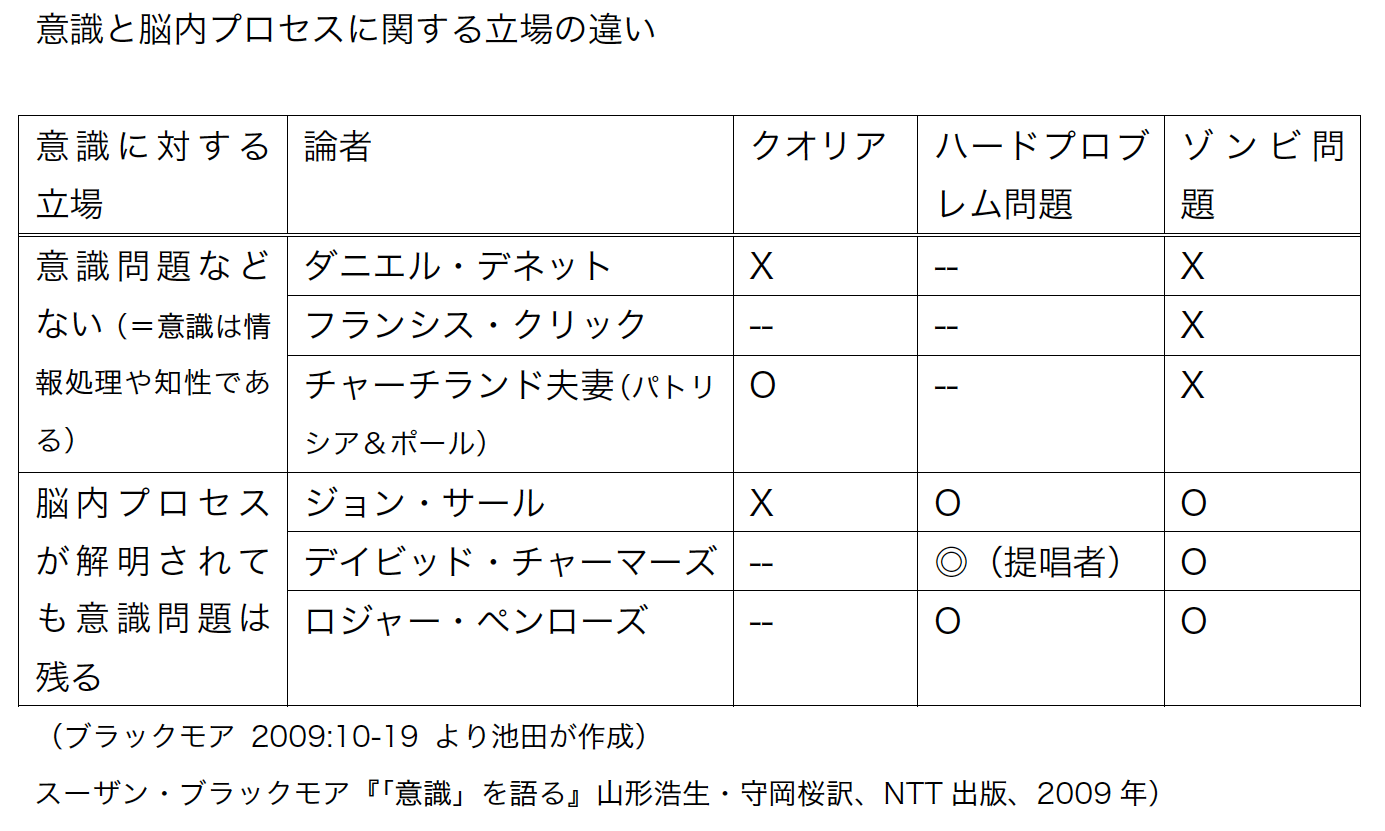
※ダニエル・デネットは、ゾンビ問題をそれほど重要な哲学者の中心的な課題にはしない。しか
し、「真顔で」議論する同業者がいるために、それに答えるべきだとは考えている(デネット
1998:122)。デネットに言わせれば、ゾンビが意識がないことをどのように証明すればいいのかという思考実験で再帰性をもつゾンビをジンポ
(Zimpo)と言い換える(デネット
1998:369)。そのことで意識問題を呼び起こすことがデネットの言説戦略である。ゾンビの正体は、意識がない実体概念がない排除すべきステレオタイ
プだという。つまり、ゾンビは、かつての、ユダヤ人やシャイロックと同じだと主張する(デネット
1998:480)。ゾンビに比肩されるのが「意識をもったテディ・ベア」であるとも表現する(デネット 1998:489)
★哲学的ゾンビ(日本 語ウィキペディア)
| 哲学的ゾンビ(てつがくてきゾンビ、英語: Philosophical
zombie、略:
p-zombie)とは、心の哲学で使われる言葉である。物理的化学的電気的反応としては、普通の人間と全く同じであるが、我々の意識にのぼってくる感覚
意識やそれにともなう経験(クオリア)を全く持っていない存在と定義されている。 デイヴィッド・チャーマーズが1990年代にクオリアの説明に用いた思考実験であり心の哲学者たちの間で有名になった。 ホラー映画に出てくるゾンビと区別するために、現象ゾンビ(Phenomenal Zombie)とも呼ばれる。おもに性質二元論(または中立一元論)の立場から物理主義(または唯物論)の立場を攻撃する際に用いられる。ゾンビの概念を 用いて物理主義を批判するこの論証のことをゾンビ論法(Zombie Argument)、または想像可能性論法(Conceivability Argument)と呼ぶ。 |
https://x.gd/rH1hN |
| 概要 哲学的ゾンビの概念を紹介するにあたり、まず次のことを明らかにしておく。 罪悪感の希薄な人や、冷たい人などの人間の性格を表す言葉ではない。 精神疾患を意味する精神医学関連の用語ではない。 議論の混乱を防ぐために、次のような2つの区分がある。 行動的ゾンビ(Behavioral Zombie) 外面の行動だけ見ていては、普通の人間と区別できないゾンビ。解剖すれば人間との違いが分かる可能性がある、という含みを持つ。例として、SF映画に出て くる精巧なアンドロイドは、「機械は内面的な経験など持っていない」という前提で考えれば、行動的ゾンビに当たる。 哲学的ゾンビ(Neurological Zombie) 脳の神経細胞の状態まで含む、すべての観測可能な物理的状態に関して、普通の人間と区別する事が出来ないゾンビ。 哲学的ゾンビという言葉は、心の哲学の分野における純粋な理論的なアイデアであって、単なる議論の道具であり、「外面的には普通の人間と全く同じように振 る舞うが、その際に内面的な経験(意識やクオリア)を持たない人間」という形で定義された仮想の存在である。哲学的ゾンビが実際にいる、と信じている人は 哲学者の中にもほとんどおらず「哲学的ゾンビは存在可能なのか」「なぜ我々は哲学的ゾンビではないのか」などが心の哲学の他の諸問題と絡めて議論される。 仮に“哲学的ゾンビが存在する”として、哲学的ゾンビとどれだけ長年付き添っても、普通の人間と区別することは誰にも出来ない。それは、普通の人間と全く 同じように、笑いもするし、怒りもするし、熱心に哲学の議論をしさえする。物理的化学的電気的反応としては、普通の人間とまったく同じであり区別できな い。もし区別できたならば、それは哲学的ゾンビではなく行動的ゾンビである。 しかし普通の人間と哲学的ゾンビの唯一の違いは、哲学的ゾンビにはその際に「楽しさ」の意識も、「怒り」の意識も、議論の厄介さに対する「苛々する」とい う意識も持つことがなく、“我々の意識にのぼってくる感覚意識やそれにともなう経験(クオリア)”というものが全くない、という点である。哲学的ゾンビに とっては、それらは物理的化学的電気的反応の集合体でしかない。 |
|
| ゾンビ論法 ゾンビ論法(zombie argument)または想像可能性論法(Conceivability Argument)とは物理主義を批判する以下の形式の論証を指す。[1] 1. 我々の世界には意識体験がある。 2. 物理的には我々の世界と同一でありながら、我々の世界の意識に関する肯定的な事実が成り立たない、論理的に可能な世界が存在する。 3. したがって意識に関する事実は、物理的事実とはまた別の、われわれの世界に関する更なる事実である。 4. ゆえに唯物論は偽である。 各段階について説明すると 1.我々の世界には意識体験がある。 「意識」「クオリア」「経験」「感覚」など様々な名前で呼ばれるものが、「ある」という主張である。ここは基本的に素朴な主張である。 2.物理的には我々の世界と同一でありながら、我々の世界の意識に関する肯定的な事実が成り立たない、論理的に可能な世界が存在する。 現在の物理学では、意識・クオリア・経験・感覚を全く欠いた世界が想像可能であることを主張する。この哲学的ゾンビだけがいる世界を、ゾンビワールドと言 う。 3.したがって意識に関する事実は、物理的事実とはまた別の、われわれの世界に関する更なる事実である。 ゾンビワールドに欠けているが、私達の現実世界には、意識・クオリア・経験・感覚が備わっているという事実がある。それは、現在の物理法則には含まれてい ない。 4.ゆえに唯物論は偽である。 以上の点から現在の物理法則・物理量ですべての説明ができるという考えは間違っている。 |
|
| 歴史 ゾンビ論法と類似したタイプの議論、つまり「意識体験」と「物質の形や動き」との間に合理的なつながりが見出せない、というタイプの議論は、歴史上様々な 形で論じられている。歴史を下るにつれて議論は洗練されていくが、以下主な例をいくつか列挙する。 |
|
ライプニッツによる風車小屋の思考実験 思考できる機械(現代的に言えば人工知能)があるとして、その機械を風車ほどまで大きくしたとする。このとき、そのなかに入って周りを見渡したら、いった い何が見えるだろうか。ライプニッツはそこを考えた。 17世紀のドイツの哲学者ライプニッツが著書『モナドロジー』の中で、風車小屋(windmill)を引き合いに出して行った次のような論証がある [2]。 ものを考えたり、感じたり、知覚したりできる仕掛けの機械があるとする。その機械全体をおなじ割合で拡大し、風車小屋のなかにでもはいるように、そのなか にはいってみたとする。だがその場合、機械の内部を探って、目に映るものといえば、部分部分がたがいに動かしあっている姿だけで、表象について説明するに たりるものは、けっして発見できはしない。 — ライプニッツ 『モナドロジー』(1714年) 第17節、清水・竹田訳[3] ここで使われている言葉は少々時代がかっているが、表象という言葉が、おおよそ現代でいう所の意識という言葉と対応する。この風車の議論から、ライプニッ ツは、モナド(ライプニッツが存在すると仮定した、それ以上分割することができない、この世界の最小構成要素)の内的な性質、として表象を位置づけてい く。 |
|
| ラッセルによる世界の因果骨格の議論 20世紀前半、哲学者バートランド・ラッセルが『物質の分析(Analysis of Matter)』(1927年)を中心に様々な著作の中で展開した議論の中にも、同種の議論が見られる。ラッセルは物理学はどのようなものか、ということ の分析を行う中で、物理学は対象と対象の間にどのような関係があるかを扱うが、そうした関係をもつ当の対象の内在的性質が扱えない、とし、物理学が行う世 界の記述を外形的なもの、「世界の因果骨格(Causal Skelton of the World)」を扱ったものだとした。 物理学は数学的である。しかしそれは私達が物理的な世界について非常によく知っているためではなく、むしろほんの少ししか知らないためである - 私達が発見しうるのは世界の持つ数学的な性質のみである。物理的世界は、その時空間な構造のある抽象的な特徴と関わってのみ知られうる - そうした特長は、心の世界に関して、その内在的な特徴に関して何か違いがあるのか、またはないのか、を示すのに十分ではない。 — バートランド・ラッセル 『Human knowledge: Its Scope and Limits』(1948年) 私達が直接に経験する心的事象である場合を除いて、物理的な事象の内在的な性質について、私達は何も知らない。 — バートランド・ラッセル 『Mind and Matter』(1956年) |
|
| クリプキの様相論法 1970年代、哲学者ソール・クリプキが様相(modality)の概念を用いて行った様相論法(modal argument)と呼ばれる論証がある。この議論は直感的というよりかなり技巧的なものだが、可能世界論の枠組みの中で、固定指示詞(rigid designator)間の同一性言明は必然的なものでなければならない、という前提にたった上で、神経現象と痛みに代表されるような私たちの持つ心的な 感覚との間の同一性言明(いわゆる同一説)を批判した。この論証はクリプキの講義録『名指しと必然性』で詳細に論じられている。クリプキは、同書の最終章 で論証の結果を以下のような寓話的なストーリで表現している[4][5]。 神様が世界を作ったとする。神様は、この世界にどういう種類の粒子が存在し、かつそれらが互いにどう相互作用するか、そうした事をすべて定め終わったとす る。さて、これで神様の仕事は終わりだろうか?いや、そうではない。神様にはまだやるべき仕事が残されている。神様はある状態にある感覚が伴うよう定める 仕事をしなければならない。 |
|
| その他 ほか逆転スペクトル、メアリーの部屋、中国語の部屋などの思考実験が似た問題を扱っている。 |
|
| 批判 アポステリオリな必然性 →詳細は「アポステリオリな必然性」を参照 物理主義の立場から寄せられるゾンビ論法への批判は、現時点の私たちにゾンビは一見論理的に可能(logically possible)に思えることは認めつつ-これはしばしばゾンビ直感(Zombic Hunch)と呼ばれる-、そうした直感は主に現在の私たちの神経系への無知に起因する、という形で行われる。つまり神経系への理解がまだ中途半端な段階 にあるから現象体験を完全に欠いた人間の機能的同型物などというものを想像できるのであり、もし神経科学の知識が深まっていけば、そうした存在は論理的に 不可能であると理解できるだろう、と。これはアポステリオリな必然性からの議論と呼ばれる[6][7]。こうした主張の説明としてよく使用されるのは次の 例である。 昔の人は、明け方の東の空に見える特定の明るい星を「明けの明星」と呼んでいた。そして夕方の西の空に見える特定の明るい星を「宵の明星」と呼んでいた。 昔の人はこの二つの星を別々の星だと考えていた。こうした知識段階にある人であれば、ある日「明けの明星」が爆発して消滅し、「宵の明星」はそのまま残 る、といった状況を想像することも可能だったはずである。しかし時代が進み科学的知識が深まるにつれ、「明けの明星」と「宵の明星」は実は同じ星「金星」 だったと分かった。つまり明け方に観測される金星を「明けの明星」と呼び、夕方に観測される金星を「宵の明星」と呼んでいただけだったと分かった。こうな ると、「明けの明星」が爆発して消滅し、「宵の明星」はそのまま残る、といった状況を想像することは不可能となる。 |
|
| 現象判断のパラドックス もう一つの主要な批判点として、ゾンビが想定可能(意識体験は物理的な事実に論理的に付随(logical supervenience)しない)という前提を取った時に現れる判断に関する因果の問題がある。意識体験を物理的現象と別のものとし、かつ、物理的世 界が物理法則によって因果的に閉じている(物理領域の因果的閉包性)とした場合に、物理世界で行われている判断に意識体験そのものが関与してこなくなって しまう因果的排除の問題 (The Causal Exclusion Problem)である。ゾンビ論法の提唱者であるチャーマーズ自身は より対象範囲を絞り込む形でこの問題を現象判断のパラドックスと呼んでいる[8][9]。次のような問題である。 ゾンビを想定可能としたとき、「双子のゾンビ世界」の想定が可能となる。つまり一種のパラレル・ワールドのようのものとして、「物理的事実に関して私達の 世界と全く同じだが、意識体験だけを欠いた私達の世界のコピー」が想定可能である。そこにはチャーマーズのゾンビ双子がいるだろう(チャーマーズと物理的 に全く同型だが、意識体験だけを欠いた存在)。チャーマーズのゾンビ双子は、意識体験を全く持っていないにもかかわらず、機能的にはチャーマーズと全く同 じように振舞うはずだから、ハードプロブレムについて論文を書き、意識に関する新しい自然法則を探究すべきだと言い、この世界のチャーマーズと全く同じ主 張をしていなければならない。しかしゾンビ世界のチャーマーズは、意識体験のないゾンビ世界でいったい何について研究しているのだろうか。意識体験のない ゾンビ世界でハードプロブレムを主張するゾンビ双子が想定できるとすると、そのゾンビ双子と全く同じ主張をしているこの世界の本物のチャーマーズの主張に はいったいどういう正当性があるだろうか。 |
|
| 実在としての全人類哲学的ゾンビ スーザン・ブラックモアの考えでは、(一般人が受け入れることは難しいが)意識とは錯覚であり、自我を持つ誰かなどはおらず、「私」が存在するような気が するときはいつも、その「私」は一時的な虚構にすぎず、また脳を構成する物質は物理法則に縛られているので私たちに自由意志はない。もしこの仮定が正しい ものであれば、人間は生まれた時からの環境外部の入力とその反応の出力の積み重ねによっていまここに生きている哲学的ゾンビの存在そのものである。 |
|
| 脚注 01. チャーマーズ著, 林 一訳 「意識する心」 163頁 Kulstad, Mark and Carlin, Laurence, "Leibniz's Philosophy of Mind" 1.Matter and Thought, The Stanford Encyclopedia of Philosophy (Fall 2008 Edition), Edward N. Zalta (ed.) 清水・竹田訳 <中公クラシックス>モナドロジー p.8 クリプキ 『名指しと必然性』 最終章 05. Kirk, Robert "Zombies" 2.Zombies and physicalism, The Stanford Encyclopedia of Philosophy (Spring 2011 Edition), Edward N. Zalta (ed.) 小草 泰 (2007) 佐金武 (2006) 『意識する心』第6章「現象判断のパラドックス」(pp.221-263) 09. 青山拓央 (2005) |
|
| 参考文献 デイヴィッド・チャーマーズ(著), 林 一訳 『意識する心』 128-129頁 白揚社 2001 ISBN 4-8269-0106-2 ダニエル・デネット(著) 『解明される意識』 95-96頁 青土社 1998年 ISBN 4-7917-5596-0 信原幸弘(著) 『意識の哲学 - クオリア序説』「第二章 ゾンビは可能か」 31-63頁 岩波書店 2002年 ISBN 4-00-026588-1 信原幸弘(編)『シリーズ心の哲学Ⅰ 人間篇』133-136頁 勁草書房 2004年 ISBN 978-4-326-19924-2 ライプニッツ(著) 『モナドロジー・形而上学叙説』 <中公クラシックス> 清水富雄、飯塚勝久、竹田篤司(訳) 中央公論新社 2005年 ISBN 4121600746 Bertrand Russell "Analysis of Matter" Routledge (2001) ISBN 0415082978 ソール・クリプキ(著) 『名指しと必然性─様相の形而上学と心身問題』 八木沢敬・野家啓一(訳) 産業図書 1985年 ISBN 4782800223 |
|
| 青山拓央,
「現象報告のパラドックス」『千葉大学社会文化科学研究科研究プロジェクト報告書』 101巻 p.1-5, 千葉大学大学院社会文化科学研究科,
ISSN 1881-7165, NAID 120005908405 小草泰, 「二次元可能世界意味論の展開(1) : 初期の二次元意味論」『哲学論叢』 34巻 p.73-83 2007年, 京都大学哲学論叢刊行会, NAID 120001107721 佐金武「チャーマーズの「意識しない心」について--思考可能性と意識の不在をめぐる問い」『哲学論叢』第33号、京都大学哲学論叢刊行会、2006年、 67-78頁、ISSN 0914-143X、NAID 120000896094。 柴田正良, 「ゾンビは論理的可能性ですらないか: チャルマーズに対する -pros and cons-」『コネクショニズムの哲学的意義の研究』 2000-2002巻, p.47-66, 南山大学人文学部 / 金沢大学文学部、2003年3月。 鈴木貴之「意識のハードプロブレムと思考可能性論法」『哲学』第2004巻第55号、日本哲学会、2004年、193-205,29、doi: 10.11439/philosophy1952.2004.193。 「訂正とお詫び[Correction] Philosophy (Tetsugaku) Vol.2005 No.56 (2005) pp.181-181」『哲学』第2005巻第56号、2005年、181-181頁、doi: 10.11439/philosophy1952.2005.56_181。 鈴木登, 「クリプキの同一説批判」『哲学』 1984巻 34号 1984年 p.173-183, 日本科学哲学会, doi:10.11439/philosophy1952.1984.173 林明弘, 「<短報>心脳同一説に対する様相の観点からのクリプキの批判」 『川崎医療福祉学会誌』 6巻 1号, p.199-202, 1996-06, NAID 110000479155 水本正晴, 「ゾンビの可能性」『科学哲学』 39巻 1号 2006年 p.63-77, 日本科学哲学会, doi:10.4216/jpssj.39.63。 |
https://x.gd/rH1hN |
| 意識 クオリア 随伴現象説 因果的閉鎖性 現象判断のパラドックス 心の哲学 他我問題 独我論 人工意識 チューリング・テスト 中国語の部屋 不気味の谷 スワンプマン なぜ私は私なのか |
|
| https://x.gd/rH1hN |
★人類学者のゾンビ思考インポテンツ
哲学的ゾンビ問題は、相対主義者の人類学者のそれとは異なり、我々自身がゾンビである可能性も含めて、私たちが目の前にしている他者がゾンビかそうでないかは峻別できないことに、まったく我慢がならないのである(→「ゾンビとわれわれ人類学者」「哲学的ゾンビ 2.0 の理解に必要な用語集」)。
☆ネガティブな物活論(nagative Hylozoism)としてのゾンビ論

Sphera volgare, featuring the Sun, the Moon, the winds and the stars as
living. Woodcut illustration from an edition of De sphaera mundi,
Venice, 1537./ 太陽、月、風、星々が生き物として描かれた『Sphera volgare』。1537年にヴェネツィアで刊行された『De sphaera mundi』の版に収録された木版画の挿絵。
| Hylozoism
is the philosophical doctrine according to which all matter is alive or
animated,[1] either in itself or as participating in the action of a
superior principle, usually the world-soul (anima mundi).[2] The theory
holds that matter is unified with life or spiritual activity.[3] The
word is a 17th-century term formed from the Greek words ὕλη (hyle:
"wood, matter") and ζωή (zoē: "life"), which was coined by the English
Platonist philosopher Ralph Cudworth in 1678. |
ヒロゾイズム[物活論][Hylozoism]
とは、あらゆる物質が、それ自体として、あるいは通常は「世界魂(アニマ・ムンディ)」と呼ばれる上位の原理の作用に参与することで、生きている、あるい
は生命力を帯びているとする哲学的学説である[1][2]。この理論は、物質が生命や精神的な活動と一体であるとするものである。[3]
この言葉は、ギリシャ語のὕλη(ヒュレー:「木、物質」)とζωή(ゾエ:「生命」)から成る17世紀の用語であり、1678年にイギリスのプラトン主
義哲学者ラルフ・カドワースによって造語された。 |
| Hylozoism in Ancient Greek philosophy Main article: Ancient Greek philosophy Hylozoism in Western philosophy can be traced back to ancient Greece. The Milesian philosophers Thales, Anaximander, and Anaximenes, can be described as hylozoists. Philosopher David Skrbina states that hylozoism was implicit in early Greek philosophy, and was not a doctrine that was typically challenged. "For the Milesians, matter (hyle) possessed life (zoe) as an essential quality. Something like hylozoism was simply accepted as a brute condition of reality."[4] Though hylozoism was implicit in early Greek thought, the philosopher Heraclitus specifically used the term zoe, making him explicitly hylozoist. The hylozoism of the pre-Socratic philosophers such as Thales and Heraclitus influenced later Greek philosophers such as Plato, Aristotle, and the Stoics. Though hylozoism was common in ancient Greek thought, the term had not been coined yet. In modern literature, hylozoism has tended to carry a negative connotation, and labeling a Greek philosopher as a hylozoist might be a vague disparagement of their thought.[5] |
古代ギリシャ哲学におけるヒロゾイズム 本記事:古代ギリシャ哲学 西洋哲学におけるヒロゾイズムは、古代ギリシャにまで遡ることができる。ミレトスの哲学者タレス、アナクシマンドロス、アナクシメネスは、ヒロゾイストと 見なすことができる。哲学者デビッド・スクルビナは、ヒロゾイズムは初期のギリシャ哲学に暗黙のうちに存在しており、通常は異議を唱えられるような教義で はなかったと述べている。「ミレトスの哲学者たちにとって、物質(ヒュレー)は生命(ゾエ)を本質的な性質として備えていた。ヒロゾイズムに類する考え方 は、単に現実の当然の条件として受け入れられていたのである。」[4] ヒロゾイズムは初期のギリシャ思想に暗黙のうちに存在していたが、哲学者ヘラクレイトスは特に「ゾエ(zoe)」という用語を用いたため、彼は明示的なヒ ロゾイストであった。タレスやヘラクレイトスといった前ソクラテス派の哲学者たちのヒロゾイズムは、プラトン、アリストテレス、ストア派といった後のギリ シャの哲学者たちに影響を与えた。 古代ギリシャ思想においてヒロゾイズムは一般的であったものの、その用語はまだ造語されていなかった。現代の文献では、ヒロゾイズムは否定的な意味合いを 帯びる傾向があり、ギリシャの哲学者をヒロゾイストとレッテル貼りすることは、その思想に対する漠然とした軽蔑となる可能性がある。[5] |
| Renaissance period and early modernity Main article: Renaissance philosophy During the Renaissance period in Western Europe, humanist scholars and philosophers such as Bernardino Telesio, Paracelsus, Cardanus, and Giordano Bruno revived the doctrine of hylozoism. The latter, for example, held a form of Christian pantheism wherein God is conceived as the source, cause, medium, and end of all things, and therefore all things are participatory in the ongoing Godhead. Bruno's ideas were so radical that he was excommunicated by the Catholic Church with the accusation of heresy, as well as from a few Protestant denominations, and he was eventually burned at the stake for various other beliefs that were regarded as heretical. Telesio, on the other hand, began from an Aristotelian basis and, through radical empiricism, came to believe that a living force was what informed all matter. Instead of the intellectual universals of Aristotle, he believed that life generated form. In the Kingdom of England, some of the Cambridge Platonists approached hylozoism as well. Both Henry More and Ralph Cudworth (the Younger, 1617–1688), through their reconciliation of Platonic idealism with Christian doctrines of deific generation, came to see the divine lifeforce as the informing principle in the world. Thus, like Bruno, but not nearly to the extreme, they saw God's generative impulse as giving life to all things that exist. Accordingly, Cudworth, the most systematic metaphysician of the Cambridge Platonist tradition, fought hylozoism. His work is primarily a critique of what he took to be the two principal forms of atheism—materialism and hylozoism. Cudworth singled out Hobbes not only as a defender of the hylozoic atheism "which attributes life to matter", but also as one going beyond it and defending "hylopathian atheism, which attributes all to matter." Cudworth attempted to show that Hobbes had revived the doctrines of Protagoras and was therefore subject to the criticisms which Plato had deployed against Protagoras in the Theaetetus. On the side of hylozoism, Strato of Lampsacus was the official target. However, Cudworth's Dutch friends had reported to him the views which Spinoza was circulating in manuscript. Cudworth remarks in his Preface that he would have ignored hylozoism had he not been aware that a new version of it would shortly be published.[6] Spinoza's idealism also tends toward hylozoism. In order to hold a balance even between matter and mind, Spinoza combined materialistic with pantheistic hylozoism, by demoting both to mere attributes of the one infinite substance. Although specifically rejecting identity in inorganic matter, he, like the Cambridge Platonists, sees a life force within, as well as beyond, all matter. |
ルネサンス期と近世 本記事:ルネサンス哲学 西ヨーロッパのルネサンス期において、ベルナルディーノ・テレシオ、パラケルスス、カルダヌス、ジョルダーノ・ブルーノといった人文主義の学者や哲学者た ちが、ヒロゾイズムの教義を復活させた。例えば、ジョルダーノ・ブルーノは、神を万物の源、原因、媒介、そして目的として捉える一種のキリスト教汎神論を 主張し、それゆえに万物は継続する神性に参加していると見なした。ブルーノの思想はあまりにも過激であったため、異端の罪でカトリック教会から破門され、 いくつかのプロテスタント教派からも破門され、最終的には異端と見なされたその他の様々な信念により、火刑に処された。一方、テレシオはアリストテレス的 な立場を出発点とし、急進的経験論を通じて、すべての物質に活力を与えるのは「生命力」であると信じるに至った。彼は、アリストテレスの知的普遍概念の代 わりに、生命こそが形を生み出すと信じていた。 イングランド王国においても、ケンブリッジ・プラトン学派の一部の思想家たちは、ヒロゾイズムに接近した。ヘンリー・モアとラルフ・カドワース(若き、 1617–1688)は、プラトンの観念論とキリスト教の「神による生成」の教義とを調和させることで、神聖な生命力を世界における形成原理と見なすに 至った。したがって、彼らはブルーノと同様に――ただし、その極端さにはほど遠かったが――神の生成の衝動が、存在するすべてのものに生命を与えていると 見なした。それゆえ、ケンブリッジ・プラトン主義の伝統において最も体系的な形而上学者であったカドワースは、ヒロゾイズムと対峙した。彼の著作は、主 に、彼が無神論の二大形態と見なした唯物論とヒロゾイズムに対する批判である。 カドワースはホッブズを、「物質に生命を帰する」ヒロゾイズム的無神論の擁護者としてだけでなく、さらにそれを超えて「すべてを物質に帰する」ヒロパティ ア的無神論を擁護する人物としても名指しした。カドワースは、ホッブズがプロタゴラスの教義を復活させたものであり、したがって『テアイテトス』において プラトンがプロタゴラスに対して展開した批判の対象となることを示そうとした。ヒロゾイズムの側では、ランプサコスのストラトが公式の標的とされた。しか し、カドワースのオランダ人の友人たちは、スピノザが原稿として流布していた見解を彼に伝えていた。カドワースは序文の中で、その新しい形態がまもなく出 版されることを知っていなければ、ヒロゾイズムを無視していただろうと述べている。[6] スピノザの観念論もまた、ヒロゾイズムに傾いている。物質と精神の間の均衡さえも保つために、スピノザは唯物論的ヒロゾイズムと汎神論的ヒロゾイズムを組 み合わせ、両者を「唯一の無限の実体」の単なる属性へと格下げした。無機物における同一性を明確に否定しているものの、彼はケンブリッジ・プラトン派と同 様に、あらゆる物質の内部だけでなく、その超越した先にも生命力を認めている。 |
| Contemporary hylozoism Immanuel Kant presented arguments against hylozoism in the third chapter of his 1786 book Metaphysische Anfangsgründe der Naturwissenschaften ("First Metaphysical Principles of Natural Science") and also in his 1781 book Kritik der reinen Vernunft ("Critique of Pure Reason"). Yet, in our times, scientific hylozoism – whether modified, or keeping the trend to make all beings conform to some uniform pattern, to which the concept was adhered in modernity by Herbert Spencer, Hermann Lotze, and Ernst Haeckel – was often called upon as a protest against a mechanistic worldview.[7] In the 19th century, Haeckel developed a materialist form of hylozoism, specially against Rudolf Virchow's and Hermann von Helmholtz's mechanical views of humans and nature. In his Die Welträtsel of 1899 (The Riddle of the Universe 1901), Haeckel upheld a unity of organic and inorganic nature and derived all actions of both types of matter from natural causes and laws. Thus, his form of hylozoism reverses the usual course by maintaining that living and nonliving things are essentially the same, and by erasing the distinction between the two and stipulating that they behave by a single set of laws. In contrast, the Argentine-German neurobiological tradition terms hylozoic hiatus all of the parts of nature which can only behave lawfully or nomically and, upon such a feature, are described as lying outside of minds and amid them – i.e. extramentally. Thereby the hylozoic hiatus becomes contraposed to minds deemed able of behaving semoviently, i.e. able of inaugurating new causal series (semovience). Hylozoism in this contemporary neurobiological tradition is thus restricted to the portions of nature behaving nomically inside the minds, namely the minds' sensory reactions (Christfried Jakob's "sensory intonations") whereby minds react to the stimuli coming from the hylozoic hiatus or extramental realm.[8][9] Martin Buber too takes an approach that is quasi-hylozoic. By maintaining that the essence of things is identifiable and separate, although not pre-existing, he can see a soul within each thing. The French Pythagorean and Rosicrucian alchemist, Francois Jollivet-Castelot (1874–1937), established a hylozoic esoteric school which combined the insight of spagyrics, chemistry, physics, transmutations and metaphysics. He published many books, including the 1896 publication "L’Hylozoïsme, l’alchimie, les chimistes unitaires". In his view there was no difference between spirit and matter except for the degree of frequency and other vibrational conditions. The Mormon theologian Orson Pratt taught a form of hylozoism. Alice A. Bailey wrote a book called The Consciousness of the Atom.[10] Influenced by Alice A. Bailey, Charles Webster Leadbeater, and their predecessor Madame Blavatsky, Henry T. Laurency produced voluminous writings describing a hylozoic philosophy.[11] Influenced by George Ivanovich Gurdjieff, the English philosopher and mathematician John Godolphin Bennett, in his four-volume work The Dramatic Universe and his book Energies, developed a six-dimensional framework in which matter-energy takes on 12 levels of hylozoic quality. The English cybernetician Stafford Beer adopted a hylozoism position, arguing that it could be defended scientifically and expending much effort on Biological computing in consequence.[12] This is described as Beer's "spiritually-charged awe at the activity and powers of nature in relation to our inability to grasp them representationally".[12]: 489 Beer claimed that "Nature does not need to make any detours; it does not just exceed our computational abilities, in effect it surpasses them in unimaginable ways. In a poem on the Irish Sea, Beer talks about nature as exceeding our capacities in way that we can only wonder at, ‘shocked’ and ‘dumbfounded.’"[12]: 488 In partnership with his friend Gordon Pask, who was experimenting with various chemical and bio-chemical devices, he explored the possibility for intelligence to be developed in very simple network-complex systems. In one possibly unique experiment led by Pask, they found that such a structure would 'grow' a sensing organization in response to the stimuli of different audio inputs in about half a day.[12]: 488 Ken Wilber embraces hylozoism to explain subjective experience and provides terms describing the ladder of subjective experience experienced by entities from atoms up to Human beings in the upper left quadrant of his Integral philosophy chart.[13] Physicist Thomas Brophy, in The Mechanism Demands a Mysticism, embraces hylozoism as the basis of a framework for re-integrating modern physical science with perennial spiritual philosophy. Brophy coins two additional words to stand with hylozoism as the three possible ontological stances consistent with modern physics. Thus: hylostatism (universe is deterministic, thus "static" in a four-dimensional sense); hylostochastism (universe contains a fundamentally random or stochastic component); hylozoism (universe contains a fundamentally alive aspect). Architect Christopher Alexander has put forth a theory of the living universe, where life is viewed as a pervasive patterning that extends to what is normally considered non-living things, notably buildings. He wrote a four-volume work called The Nature of Order which explicates this theory in detail. Philosopher and ecologist David Abram articulates and elaborates a form of hylozoism grounded in the phenomenology of sensory experience. In his books Becoming Animal and The Spell of the Sensuous, Abram suggests that matter is never entirely passive in our direct experience, holding rather that material things actively "solicit our attention" or "call our focus," coaxing the perceiving body into an ongoing participation with those things. In the absence of intervening technologies, sensory experience is inherently animistic, disclosing a material field that is animate and self-organizing from the get-go. Drawing upon contemporary cognitive and natural science as well as the perspectival worldviews of diverse indigenous, oral cultures, Abram proposes a richly pluralist and story-based cosmology, in which matter is alive through and through. Such an ontology is in close accord, he suggests, with our spontaneous perceptual experience; it calls us back to our senses and to the primacy of the sensuous terrain, enjoining a more respectful and ethical relation to the more-than-human community of animals, plants, soils, mountains, waters and weather-patterns that materially sustains us.[14] Bruno Latour's actor-network theory, in the sociology of science, treats non-living things as active agents and thus bears some metaphorical resemblance to hylozoism.[15] The metaphysics of Gilles Deleuze has been described as a form of hylozoism,[16] and is one of the main criticisms of the rhizome theory put forward by the Slovenian philosopher Slavoj Žižek.[17] |
現代のヒロゾイズム イマヌエル・カントは、1786年の著書『自然科学の形而上学的基礎』(Metaphysische Anfangsgründe der Naturwissenschaften)の第3章および1781年の著書『純粋理性批判』(Kritik der reinen Vernunft)において、ヒロゾイズムに対する反論を展開した。しかし、現代においては、科学的ヒロゾイズム――それが修正されたものであれ、あるい はすべての存在をある画一的なパターンに当てはめようとする傾向を保っているものであれ(この概念は近代においてハーバート・スペンサー、ヘルマン・ロッ ツェ、エルンスト・ヘッケルによって支持されていた)――が、機械論的世界観に対する抗議としてしばしば援用されてきた。[7] 19世紀、ヘッケルは、特にルドルフ・ヴィルヒョウやヘルマン・フォン・ヘルムホルツによる人間と自然に関する機械論的見解に対抗して、唯物論的な形態の ヒロゾイズムを展開した。1899年の著書『Die Welträtsel』(1901年『宇宙の謎』)において、ヘッケルは有機的自然と無機的自然の統一性を主張し、両種類の物質のあらゆる作用を自然的原 因と法則から導き出した。したがって、彼のハイロゾイズムは、生物と非生物が本質的に同一であると主張し、両者の区別をなくして、それらが単一の法則体系 に従って振る舞うと規定することで、従来の考え方を逆転させるものである。 対照的に、アルゼンチン・ドイツの神経生物学的伝統では、自然界のあらゆる部分が、法則的あるいは規範的にしか振る舞うことができず、その特徴から、精神 の外側、すなわち精神の外(extramentally)に位置すると記述されるものを、「ヒロゾイック・ハイアタス(hylozoic hiatus)」と呼んでいる。それにより、「ヒロゾイック・ハイアタス」は、自発的に振る舞う能力、すなわち新たな因果系列を開始する能力(自発性)を 持つとみなされる精神と対比されることになる。したがって、この現代の神経生物学的伝統におけるヒロゾイズムは、精神の内部で法則的に振る舞う自然の一 部、すなわち、ヒロゾイック・ハイアタスや精神外領域から来る刺激に対して精神が反応する感覚的反応(クリストフリード・ヤコブの「感覚的イントネーショ ン」)に限定される。[8][9] マルティン・ブーバーもまた、準ヒロゾイック的なアプローチをとっている。物事の本質は、あらかじめ存在しているわけではないものの、識別可能かつ独立したものであると主張することで、彼はあらゆる物の中に魂を見出すことができる。 フランスのピタゴラス派および薔薇十字派の錬金術師、フランソワ・ジョリヴェ=カステロ(1874–1937)は、スパギリクス、化学、物理学、変容、形 而上学の知見を融合させたヒロゾイズムの秘教学校を設立した。彼は1896年に出版された『L’Hylozoïsme, l’alchimie, les chimistes unitaires』をはじめ、多くの著書を出版した。彼の見解では、周波数の程度やその他の振動状態を除けば、精神と物質の間に違いはなかった。 モルモン教の神学者オーソン・プラットは、ある種のヒロゾイズムを説いた。 アリス・A・ベイリーは、『原子の意識』という本を著した。[10] アリス・A・ベイリー、チャールズ・ウェブスター・リードビーター、そして彼らの先駆者であるブラヴァツキー夫人の影響を受け、ヘンリー・T・ローレンシーは、ヒロゾイズム哲学を説く膨大な著作を残した。[11] ジョージ・イヴァノヴィッチ・グルジェフの影響を受けた英国の哲学者兼数学者ジョン・ゴドルフィン・ベネットは、4巻からなる著作『劇的な宇宙(The Dramatic Universe)』および著書『エネルギー(Energies)』において、物質・エネルギーが12段階のヒロゾイックな性質を帯びる6次元の枠組みを 展開した。 英国のサイバネティクス学者スタッフォード・ビアは、ヒロゾイズムの立場を採用し、それが科学的に擁護可能であると主張し、その結果として「生物学的計 算」に多大な労力を費やした。[12] これは、ビアの「自然の活動と力に対する、私たちがそれを表象的に把握できないことに関連した、精神的に満たされた畏敬の念」として説明されている。 [12]: 489 ビアは、「自然は回り道をする必要などない。自然は単に私たちの計算能力を超えているだけでなく、実際には想像を絶する方法でそれを凌駕している」と主張 した。アイルランド海を題材にした詩の中で、ビアは、自然が私たちの能力を、私たちがただ『衝撃を受け』、『呆然とする』ほどに、ただただ驚嘆するしかな い方法で超えていると述べている。[12]: 488 様々な化学的・生化学的装置の実験を行っていた友人ゴードン・パスクと協力し、彼は極めて単純なネットワーク・複合システムにおいて知性が発達する可能性 を探求した。パスクが主導した、おそらく他に類を見ないある実験において、彼らは、そのような構造が、異なる音声入力の刺激に応答して、約半日で知覚組織 を「成長」させることを発見した。[12]: 488 ケン・ウィルバーは、主観的体験を説明するためにヒロゾイズムを取り入れ、自身の「インテグラル哲学」図表の左上象限において、原子から人間に至るまでの存在が経験する主観的体験の階梯を表す用語を提示している。[13] 物理学者トーマス・ブロフィーは、『The Mechanism Demands a Mysticism』において、現代の物理科学と不朽の精神哲学を再統合するための枠組みの基礎として、ヒロゾイズムを採用している。ブロフィーは、現代 物理学と整合する3つの可能な存在論的立場として、ヒロゾイズムに加え、さらに2つの用語を造語した。すなわち、ヒロスタティズム(宇宙は決定論的であ り、したがって4次元的な意味で「静的」である)、 ヒロストーカスティズム(宇宙には根本的にランダム、あるいは確率論的な要素が含まれる);ヒロゾイズム(宇宙には根本的に「生きている」側面が含まれ る)。 建築家のクリストファー・アレクサンダーは、「生ける宇宙」の理論を提唱している。そこでは、生命は遍在するパターンとして捉えられ、その範囲は通常は非 生物と見なされるもの、とりわけ建築物にまで及ぶ。彼は『秩序の本質』と題する全4巻の著作を執筆し、この理論を詳細に解説している。 哲学者であり生態学者のデヴィッド・エイブラムは、感覚体験の現象学に根ざした一種のヒロゾイズムを明確に表現し、詳細に論じている。著書 『Becoming Animal』および『The Spell of the Sensuous』において、エイブラムは、私たちの直接的な経験において物質が決して完全に受動的ではないと示唆し、むしろ物質的なものは能動的に「私 たちの注意を惹きつける」あるいは「私たちの焦点を呼び起こす」ものであり、知覚する身体をそれらのものとの継続的な関与へと誘い込むと主張している。介 入する技術が存在しない状況下では、感覚的経験は本質的にアニミズム的であり、最初から生命を持ち、自己組織化する物質的領域を明らかにする。エイブラム は、現代の認知科学や自然科学、そして多様な先住民族の口承文化が持つ視点的な世界観を援用し、物質が隅々まで生きているという、豊かで多元主義的かつ物 語に基づく宇宙論を提唱している。このような存在論は、私たちの自発的な知覚体験と密接に調和していると彼は示唆する。それは私たちを五感へと、そして感 覚的な領域の優先性へと立ち返らせ、私たちを実質的に支えている動物、植物、土壌、山、水、気象パターンといった「人間を超えた」共同体に対して、より敬 意に満ちた倫理的な関係を築くよう促すのである。[14] 科学社会学におけるブルーノ・ラトゥールのアクター・ネットワーク理論は、非生物を能動的な主体として扱い、その点でヒロゾイズムと比喩的な類似性を帯びている。[15] ジル・ドゥルーズの形而上学は、一種のヒロゾイズムであると評されており[16]、「リゾーム理論」に対するスロベニアの哲学者スラヴォイ・ジジェクが提起した主要な批判の一つとなっている[17]。 |
| Animism Biocentric universe Biological naturalism Clinamen Daoism Hyle Hylomorphism Hylopathism Organicism Pantheism Pathetic fallacy Vitalism |
アニミズム 生物中心主義 生物学的自然主義 クリナメン 道教 ヒュレ ヒュロモルフィズム ヒュロパティズム 有機体論 汎神論 感情移入の誤謬 バイタリズム |
| References 01. McColley, Diane Kelsey (2007). Poetry and Ecology in the Age of Milton and Marvell. Hampshire, UK: Ashgate Publishing, Ltd. p. 115. ISBN 978-0-7546-6048-4. Strauss, Daniel (January 2014). "Hylozoism and hylomorphism: a lasting legacy of Greek philosophy". Phronimon. 15 (1). Pretoria: University of South Africa on behalf of the South African Society for Greek Philosophy and the Humanities: 32–45. doi:10.25159/2413-3086/2211. ISSN 2413-3086 – via SciELO. Yuasa, Yasuo (2008). Overcoming Modernity: Synchronicity and Image-Thinking. Albany, New York: SUNY Press. pp. 39–40. ISBN 978-0-7914-7401-3. Skrbina, David (2005). Panpsychism in the West. Cambridge, MA: The MIT Press. pp. 24. ISBN 0-262-19522-4. 05. Skrbina, David (2005). Panpsychism in the West. Cambridge, MA: The MIT Press. pp. 34. ISBN 0-262-19522-4. The True Intellectual System of the Universe: The First part; wherein, All the Reason and Philosophy of Atheism is Confuted; and Its Impossibility Demonstrated. By Ralph Cudworth, D.D. London, Printed for Richard Royston, 1678 "Hylozoism and Dogmatism in Kant, Leibniz, and Newton". Archived from the original on 26 March 2007. Retrieved 11 April 2006. Comment l’ hylozoïsme scientifique contemporain aborde-t-il la sélection naturelle du parenchyme neurocognitif? (French) Crocco, M (2004). "On Minds' Localization". Electroneurobiología. 12 (3): 244–257. ISSN 0328-0446. Archived from the original on 10 January 2015. 10. Bailey, Alice A. The Consciousness of the Atom—1922 "Introduction to the Works of Henry T. Laurency". The Official Website of the Henry T. Laurency Publishing Foundation. Henry T. Laurency Publishing Foundation. 12 July 2009 <http://www.laurency.com/introduc.htm> Pickering, Andrew. 2009. Beyond design: Cybernetics, biological computers and hylozoism. Synthese 168:469-491. Wilber Ken A Brief History of Everything, 1st ed. 1996, 2nd ed. 2001: ISBN 1-57062-740-1 Abram, David The Spell of the Sensuous: Perception and Language in a More-than-Human World, Pantheon, 1996; Vintage 1997: ISBN 978-0-679-77639-0 and Abram, David: Becoming Animal: An Earthly Cosmology Pantheon, 2010; Vintage 2011: ISBN 978-0-375-71369-9 Latour, Bruno Pandora's Hope: Essays on the reality of Science Studies, 1999: ISBN 0-674-65335-1 Harris, Wyatt (4 October 2017). "(Review) Rethinking Philosophy and Theology with Deleuze: A New Cartography, Brent Adkins and Paul R. Hinlicky, Bloomsbury, 2013 (ISBN 978-1-4411-8825-0), viii + 253 pp., hb £65". Reviews in Religion and Theology. 24 (4): 643–647. doi:10.1111/rirt.13037. 17. https://x.gd/trGNz |
参考文献 01. マッコリー、ダイアン・ケルシー(2007)。『ミルトンとマーヴェルの時代における詩とエコロジー』。英国ハンプシャー:アッシュゲート・パブリッシング社。115頁。ISBN 978-0-7546-6048-4。 ストラウス、ダニエル(2014年1月)。「ヒロゾイズムとヒロモルフィズム:ギリシャ哲学の永続的な遺産」。『Phronimon』15巻1号。プレト リア:南アフリカ大学(南アフリカ・ギリシャ哲学・人文科学協会を代表して):32–45頁。doi:10.25159/2413-3086/2211. ISSN 2413-3086 – SciELO経由。 湯浅康夫(2008年)。『近代性の克服:シンクロニシティとイメージ思考』。ニューヨーク州オールバニ:SUNY Press。pp. 39–40。ISBN 978-0-7914-7401-3. スクリビナ、デビッド(2005)。『西洋における汎精神論』。マサチューセッツ州ケンブリッジ:MITプレス。24頁。ISBN 0-262-19522-4。 05. スクリビナ、デビッド(2005)。『西洋における汎精神論』. マサチューセッツ州ケンブリッジ:MITプレス. pp. 34. ISBN 0-262-19522-4. 『宇宙の真の知的体系:第一部;無神論のあらゆる理屈と哲学を反駁し、その不可能性を立証する』. ラルフ・カドワース(神学博士)著. ロンドン、リチャード・ロイストン刊、1678年 「カント、ライプニッツ、ニュートンにおけるヒロゾイズムと独断主義」。2007年3月26日にオリジナルからアーカイブ。2006年4月11日閲覧。 現代の科学的ヒロゾイズムは、神経認知実質における自然選択をどのように捉えているか?(フランス語) クロッコ, M (2004). 「心の局在化について」。『エレクトロニューロビオロジア』。12 (3): 244–257. ISSN 0328-0446。2015年1月10日にオリジナルからアーカイブされた。 10. ベイリー、アリス・A. 『原子の意識』—1922年 「ヘンリー・T・ローレンシー著作集への序文」。ヘンリー・T・ローレンシー出版財団公式サイト。ヘンリー・T・ローレンシー出版財団。2009年7月12日 <http://www.laurency.com/introduc.htm> ピッカリング、アンドリュー。2009年。「デザインを超えて:サイバネティクス、生物学的コンピュータ、およびヒロゾイズム」。『Synthese』168:469-491。 ウィルバー、ケン。『万物の簡史』、第1版 1996年、第2版 2001年:ISBN 1-57062-740-1 エイブラム、デヴィッド『感覚の呪縛:人間を超えた世界における知覚と言語』、パンテオン、1996年;ヴィンテージ、1997年:ISBN 978-0-679-77639-0 および エイブラム、デヴィッド『動物となること:地上の宇宙論』、パンテオン、2010年; ヴィンテージ 2011年:ISBN 978-0-375-71369-9 ラトゥール、ブルーノ『パンドラの希望:科学研究の現実に関するエッセイ』、1999年:ISBN 0-674-65335-1 ハリス、ワイアット(2017年10月4日)。「(書評)『ドゥルーズとともに哲学と神学を再考する:新たな地図学』、ブレント・アドキンス、ポール・ R・ヒンリッキー著、ブルームズベリー、2013年(ISBN 978-1-4411-8825-0)、viii + 253ページ、ハードカバー £65」。『Reviews in Religion and Theology』. 24 (4): 643–647. doi:10.1111/rirt.13037. 17. https://x.gd/trGNz |
| https://en.wikipedia.org/wiki/Hylozoism |
Links
リンク
文献
その他の情報
Copyleft, CC, Mitzub'ixi Quq Chi'j, 1996-2099

☆
 ☆
☆
