
プロジェクト・メイヴン
Project Maven

☆ プロジェクト・メイヴン[Project Maven](正式名称:アルゴリズム戦争横断機能チーム)は、2017年に開始された米国防総省のイニシアチブであり、米軍の情報収集ワークフロー全 体、特に情報、監視、目標捕捉、偵察(ISR)および地理空間情報(GSI)分野における機械学習とデータ統合の導入を加速することを目的としている。当 初は、情報収集を目的とした画像や動画の処理にコンピュータビジョンを適用することに重点を置いていた。現在、このプログラムは国家地理空間情報局 (NGA)の下で運営されており、国防総省全体にわたる複数の用途を網羅している。その範囲は、軍事作戦の標的選定支援、分析官向けのデータ統合・可視 化、軍事資産やインフラのラベル付きデータセットを用いた機械学習モデルの訓練などに及ぶ。ドローン、衛星、その他のセンサーからのデータを統合し、潜在 的な標的を特定し、分析官に調査結果を提示し、その決定を運用システムに伝達する。 このプログラムは、ロバート・O・ワーク国防次官が、中国の人工知能の防衛分野への応用における進展について懸念を表明したことを受け、同次官の下で発足 した。プロジェクトリーダーである米海兵隊のドリュー・クコール大佐とジャック・シャナハン中将は、このプログラムを自律型兵器プラットフォームではな く、国防総省内における「人間がループ内(human-in-the-loop)」の意思決定支援として位置づけた。 メイベンを支援する契約業者には、社内の反対を受けて2018年に撤退したグーグルや、その後を引き継いだパランティア、アンドゥリル、アマゾン・ウェ ブ・サービス、アンソロピック(2026年に撤退)などが含まれる。 国防総省は、Mavenが2024年にイラク、シリア、イエメンにおける米国の空爆への標的指定支援を提供したほか、紅海における敵対的な海上資産の探知 にも貢献したと評価している
★ フォレンジック・アーキテクチャーと対称性(対照性)のあるプロジェクト・メイヴン(Project Maven)
| Project Maven
(officially Algorithmic Warfare Cross Functional Team) is a United
States Department of Defense initiative launched in 2017 to accelerate
the adoption of machine learning and data integration across U.S.
military intelligence workflows, specifically in intelligence,
surveillance, target acquisition, and reconnaissance as well as in
geospatial intelligence. It initially focused on applying computer
vision for processing images and videos for intelligence purposes.
Currently, the program operates under the National
Geospatial-Intelligence Agency (NGA) and encompasses multiple
applications across the Department of Defense spanning military
operation targeting support, data integration and visualization for
analysts, and training machine learning models on labeled datasets of
military assets and infrastructure. It integrates data from drones,
satellites, and other sensors to flag potential targets, present
findings to human analysts, and relay their decisions to operational
systems. The program originated under Deputy Secretary Robert O. Work after he raised concerns about China's advances in defense applications of artificial intelligence. Project leaders, Colonel Drew Cukor, USMC, and Lt. Gen. Jack Shanahan, framed the program as human-in-the-loop decision support inside the Department of Defense rather than as an autonomous weapons platform. Contractors supporting Maven have included Google, which withdrew in 2018 after internal protests, and follow-on integrators such as Palantir, Anduril, Amazon Web Services, and Anthropic (withdrew in 2026). The Pentagon credits Maven with providing 2024 targeting support for U.S. airstrikes in Iraq, Syria, and Yemen, along with locating hostile maritime assets in the Red Sea. |
プロジェクト・メイヴン[Project Maven](正
式名称:アルゴリズム戦
争横断機能チーム)は、2017年に開始された米国防総省のイニシアチブであり、米軍の情報収集ワークフロー全体、特に情報、監視、目標捕捉、偵察
(ISR)および地理空間情報(GSI)分野における機械学習とデータ統合の導入を加速することを目的としている。当初は、情報収集を目的とした画像や動
画の処理にコンピュータビジョンを適用することに重点を置いていた。現在、このプログラムは国家地理空間情報局(NGA)の下で運営されており、国防総省
全体にわたる複数の用途を網羅している。その範囲は、軍事作戦の標的選定支援、分析官向けのデータ統合・可視化、軍事資産やインフラのラベル付きデータ
セットを用いた機械学習モデルの訓練などに及ぶ。ドローン、衛星、その他のセンサーからのデータを統合し、潜在的な標的を特定し、分析官に調査結果を提示
し、その決定を運用システムに伝達する。 このプログラムは、ロバート・O・ワーク国防次官が、中国の人工知能の防衛分野への応用における進展について懸念を表明したことを受け、同次官の下で発足 した。プロジェクトリーダーである米海兵隊のドリュー・クコール大佐とジャック・シャナハン中将は、このプログラムを自律型兵器プラットフォームではな く、国防総省内における「人間がループ内(human-in-the-loop)」の意思決定支援として位置づけた。 メイベンを支援する契約業者には、社内の反対を受けて2018年に撤退したグーグルや、その後を引き継いだパランティア、アンドゥリル、アマゾン・ウェ ブ・サービス、アンソロピック(2026 年に撤退)などが含まれる。 国防総省は、Mavenが2024年にイラク、シリア、イエメンにおける米国の空爆への標的指定支援を提供したほか、紅海における敵対的な海上資産の探知 にも貢献したと評価している。 |
| Administrative history Initially, the effort was led by Robert O. Work who was concerned about China's military use of the emerging technology.[1] Reportedly, Pentagon development stops short of acting as an AI weapons system capable of firing on self-designated targets.[2] The project was established in a memo by the U.S. Deputy Secretary of Defense on 26 April 2017 proposing an "Algorithmic Warfare Cross-Functional Team".[3] With the help of Defense Innovation Unit, the project obtained the support of top talents in AI outside of the traditional defense contracting base. It was initially funded for $70 million.[4] Jack Shanahan was the director of the project during April 2017 to December 2018.[5] At the second Defense One Tech Summit in July 2017, Cukor said that the investment in a "deliberate workflow process" was funded by the Department [of Defense] through its "rapid acquisition authorities" for about "the next 36 months".[6] In the defense industry, the standard procedure for the military to acquire hardware is by way of research, development, test, and evaluation (RDT&E), followed by production and sustainment. In 2017, acquiring software was done in the same way as hardware. This created a problem, since software is constantly updated. Project Maven procured software using Broad Agency Announcements, a flexible contracting vehicle that categorized software as consistently RDT&E, allowing constant updating. Another issue was that the government usually acquired the intellectual property (IP) for procured software, and with the project, only parts of the IP of the software was acquired. Cukor used the principle of "platform IP belongs to the vendor, configurations on top are the customer's". For example, Palantir retained IP to their core platform, while the government obtained the IP to Maven-specific logic configured on top of it.[7] According to US Air Force Lt. Gen. Jack Shanahan in November 2017, it is "designed to be that pilot project, that pathfinder, that spark that kindles the flame front of artificial intelligence across the rest of the [Defense] Department".[4] Its chief, U.S. Marine Corps Col. Drew Cukor, said: "People and computers will work symbiotically to increase the ability of weapon systems to detect objects."[8] Project Maven has been noted by allies, such as Australia's Ian Langford, for the ability to identify adversaries by harvesting data from sensors on UAVs and satellites.[9] As of 2017 December, 150,000 images had been manually labelled to establish the first training data sets, and it was projected to reach one million by January 2018.[4] Project Maven was funded for $221 million in fiscal 2020. In 2020, the House and Senate conferees on the National Defense Authorization Act for Fiscal Year 2021, agreed to the Senate's recommendation to fund the Pentagon's $250 million request for Project Maven.[10] At the GEOINT Symposium of 2022, it was announced that Project Maven was transferred from the Office of the Under Secretary of Defense for Intelligence and Security to the NGA, under President Biden’s proposed budget for Fiscal Year 2023.[11][12] It became a Program of Record on 2023 November 7.[13] Frank "Trey" Whitworth, vice admiral, was the director of NGA from June 2022 to November 2025.[14][15] Whitworth was initially skeptical of the program, suspecting it was incautious about the targeting principles, but later regarded it as "important work".[16] As of 2024, the project is jointly administered by the NGA and the CDAO, and its director is Rachel Martin.[17][18] Before 2025, Biden appointees within CDAO had held back AI development for safety and reliability concerns, though as of 2025, this has stopped.[19] As of 2024, Maven provided the cloud infrastructure, software capabilities, and AI for CDAO's Combined Joint All-Domain Command and Control initiatives.[20] As of summer 2025, there were eight Maven initiatives. Of these, five were in the NGA, including analyzing drone feeds and satellite imagery.[16] On 18 September 2025, the UK government announced a new partnership with Palantir to develop AI-powered military capabilities for decision-making and targeting, identifying opportunities worth up to £750 million over five years.[21] On 25 March 2025, the NATO Communications and Information Agency and Palantir finalized the acquisition of the Palantir Maven Smart System NATO (MSS NATO) for employment within NATO's Allied Command Operations. It was planned to be used within 30 days of acquisition.[22] In a letter to Pentagon on 9 March 2026, Steve Feinberg stated that Project Maven will become an official program of record by September 2026, the close of the current fiscal year. The project would transfer from the NGA to the CDAO within 30 days. Future contracting with Palantir would be handled by the US Army.[23] In 2026-03, it was announced that the US Army Combined Arms Command would integrate Maven into its training.[24] |
契約までの歴史 当初、この取り組みは、新興技術の中国による軍事利用を懸念していたロバート・O・ワークが主導した。[1] 報道によると、国防総省による開発は、自ら指定した標的に発砲可能なAI兵器システムとしての機能には至っていない。[2] このプロジェクトは、2017年4月26日に米国防副長官が「アルゴリズム戦争横断機能チーム(Algorithmic Warfare Cross-Functional Team)」の設立を提案した覚書によって発足した。[3] 国防革新ユニット(Defense Innovation Unit)の支援を受け、このプロジェクトは従来の防衛契約基盤の外にあるAI分野のトップ人材の支持を得た。当初の資金は7,000万ドルであった。 [4] 2017年4月から2018年12月まで、ジャック・シャナハンが本プロジェクトのディレクターを務めた。[5] 2017年7月に開催された第2回「Defense One Tech Summit」において、クコールは、「慎重なワークフロープロセス」への投資が、国防総省の「迅速調達権限」を通じて「今後36ヶ月間」程度にわたり資 金提供されると述べた。[6] 防衛産業において、軍がハードウェアを調達する標準的な手順は、研究・開発・試験・評価(RDT&E)を経て、生産および維持管理を行うものであ る。2017年当時、ソフトウェアの調達もハードウェアと同様の方法で行われていた。しかし、ソフトウェアは絶えず更新されるため、これが問題を引き起こ した。プロジェクト・メイヴンは、ソフトウェアを常にRDT&Eに分類し、絶え間ない更新を可能にする柔軟な契約手段である「広範な機関公告 (Broad Agency Announcements)」を用いてソフトウェアを調達した。もう一つの問題は、政府が通常、調達したソフトウェアの知的財産権(IP)を取得するの に対し、このプロジェクトではソフトウェアのIPの一部しか取得されなかった点である。クコールは、「プラットフォームのIPはベンダーに属し、その上に 構築された構成は顧客のもの」という原則を採用した。例えば、パランティアはコアプラットフォームのIPを保持し、政府はその上に構成されたMaven固 有のロジックのIPを取得した。[7] 2017年11月、米空軍のジャック・シャナハン中将によれば、本プロジェクトは「パイロットプロジェクト、先駆者、そして[国防]省全体に人工知能の火 を点ける火花となるよう設計されている」という。[4] 同プロジェクトの責任者である米海兵隊のドリュー・クコール大佐は、「人間とコンピュータが共生的に連携し、兵器システムの物体探知能力を高める」と述べ た。[8] プロジェクト・メイヴンは、UAVや衛星のセンサーからデータを収集して敵を特定する能力について、オーストラリアのイアン・ラングフォード氏をはじめと する同盟国から注目されている。[9] 2017年12月時点で、最初のトレーニングデータセットを構築するために15万枚の画像が手作業でラベル付けされており、2018年1月までに100万 枚に達すると予測されていた。[4] プロジェクト・メイヴンには、2020会計年度に2億2100万ドルの予算が計上された。2020年、2021会計年度国防授権法に関する下院・上院の協 議委員会は、プロジェクト・メイヴンに対する国防総省の2億5000万ドルの要求額について、上院の提案通り予算を計上することで合意した。[10] 2022年のGEOINTシンポジウムにおいて、バイデン大統領の2023会計年度予算案に基づき、プロジェクト・メイヴンが国防総省情報・安全保障担当 次官室からNGAに移管されたことが発表された。[11] [12] 2023年11月7日、本プロジェクトは正式なプログラムとなった。[13] フランク・「トレイ」・ウィットワース海軍中将は、2022年6月から2025年11月までNGA長官を務めた。[14][15] ウィットワースは当初、標的選定の原則について慎重さを欠いていると疑い、本プログラムに懐疑的であったが、後にこれを「重要な取り組み」と評価するよう になった。[16] 2024年現在、このプロジェクトはNGAとCDAOが共同で管理しており、ディレクターはレイチェル・マーティンである。[17][18] 2025年以前、CDAO内のバイデン政権任命者は安全性と信頼性の懸念からAI開発を抑制していたが、2025年時点ではこの動きは止んでいる。 [19] 2024年時点で、MavenはCDAOの「統合全領域指揮統制(CJADC)」イニシアチブに対し、クラウドインフラ、ソフトウェア機能、およびAIを 提供していた。[20] 2025年夏時点で、Mavenのイニシアチブは8件あった。そのうち5件はNGA(国家地理空間情報局)におけるもので、ドローンの映像や衛星画像の分 析などが含まれていた。[16] 2025年9月18日、英国政府は、意思決定および標的指定のためのAIを活用した軍事能力を開発するため、パランティアとの新たな提携を発表した。これ により、5年間で最大7億5000万ポンド規模のビジネスチャンスが見込まれている。[21] 2025年3月25日、NATO通信情報局とパランティアは、NATO連合軍作戦司令部内での運用を目的とした「パランティア・メイブン・スマート・シス テム・NATO(MSS NATO)」の調達を最終決定した。調達後30日以内に運用開始される予定であった。[22] 2026年3月9日、スティーブ・ファインバーグは国防総省宛ての書簡において、プロジェクト・メイヴンが2026年9月、すなわち現行会計年度の終了ま でに正式なプログラム・オブ・レコードとなることを表明した。同プロジェクトは30日以内にNGAからCDAOへ移管される予定である。パランティア社と の今後の契約は、米陸軍が担当することになる。[23] 2026年3月、米陸軍統合兵科司令部がメイブンを訓練に組み込むことが発表された。[24] |
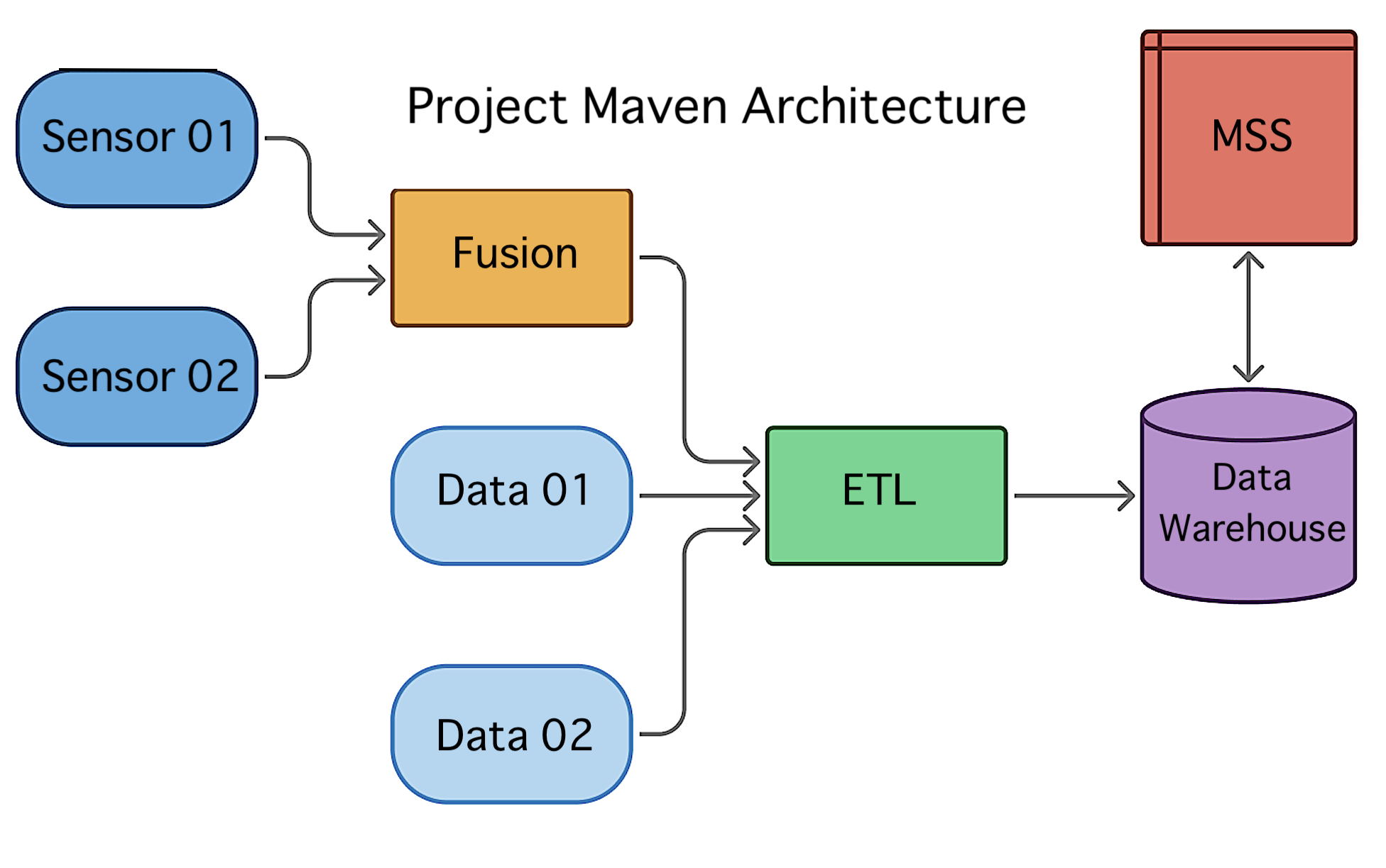
Technology Project Maven analyst view Project Maven uses machine learning algorithms to analyze and fuse vast amounts of surveillance data from multiple sources made possible through data integration using Palantir Technologies.[25][26] Project Maven system architecture diagram The data sources include photographs, satellite imagery, geolocation data (IP address, geotag, metadata, etc) from communications intercepts, infrared sensors, synthetic-aperture radar, and more. The system is mainly used for assisting analysts in intelligence, surveillance, target acquisition, and reconnaissance. Machine learning systems, including object recognition systems, process the data and identify potential targets, such as enemy tanks or location of new military facility. The training dataset included at least 4 million images of military objects such as warships, labelled by humans. The user interface is called Maven Smart System. It could display information such as aircraft movements, logistics, locations of key personnel, locations on the no-strike list, ships, etc. Yellow-outlined boxes show potential targets. Blue-outlined boxes show friendly forces or no-strike zones. It could also transmit, directly to weapons, a human decision to fire weapons.[26] Internal documentation referred to "Maven ATR: automatic target recognition".[16] Initially the project focused on applications of computer vision. The project's leaders were particularly impressed by model performance on ImageNet.[19] As of 2018, the purpose of the system was AI-enabled analysis of full-motion video. In 2022 it expanded to combatant commands under the AI and Data Acceleration Initiative.[27] In 2022, it was reported that the project expanded to non-image data, including captured enemy material, maritime intelligence, and publicly available information.[28] In 2024, it was stated that Maven's key technical contribution was data management: Maven standardizes heterogeneous data through an ontology layer so data can be fused, exchanged across cloud and edge systems, and used by multiple applications. The system was presented as a broader data-centric warfighting system that feeds apps for planning, preparing, and executing operations.[27] In 2024, the Broad Area Surveillance-Targeting (BAS-T) is a part of Maven. The system detects objects in images and uses data fusion to produce a common operational picture containing "priority based, in-depth assessment of the enemy systems present within the commander's area of responsibility" in a unified user interface, suitable for "a low bandwidth tactical network". Data used by BAS-T include commercial and national space based electro-optical (EO) and synthetic-aperture radar (SAR). Another component of Maven was the target workbench, which prioritizes targets and routes the target information to any of the following for prosecution: AFATDS (for artillery), or published as a J series 3.X track via Joint Range Extension Applications Protocol or JREAP-C or JREAP-A. In particular, during the Scarlet Dragon Oasis exercise (Jan. 23 to Feb. 3, 2023),[29] Maven interfaced through JREAP-A via an Air Operations Center, where a B-52 Bomber dropped live ordnance at a training target.[30] Maven can also interface with the Joint Automated Deep Operations Coordination System.[31][30] As of 2024, the Maven used by CENTCOM integrated 179 data sources from land, sea, air, space, and cyber. It could "discern the nearest available weapons, the most suitable ones for the task, flying time, weapons loading details, and the whereabouts of personnel and partners". Operators of Maven's Target Workbench could approve or disapprove targets, sequence them according to priorities, and message directly to weapons systems.[16] As of 25 March 2025, it was reported that the system at the point incorporated LLMs, generative models, and machine learning, to enhance intelligence fusion and targeting, battlespace awareness and planning, and accelerated decision-making.[22] It was reported to have a "model hub" where multiple LLMs were available, including different versions of OpenAI's ChatGPT and Meta's Llama.[32][33] It was reported in 2025 that Maven could interface with the Aviation Mission Planning System through the Tactical Airspace Integration System in the Airspace Coordination Order.[34] As of September 2025, the director of the NGA claimed that by June 2026, Maven will begin to transmit "100 percent machine-generated" intelligence to combatant commanders using LLM technology. Booz Allen was the defense contractor responsible for the LLM-integration phase.[35] In 2025 November, in a disaster response exercise by the Alaska Army National Guard, Maven used publicly available datasets such as road systems and US Geological Survey earthquake data layers into its geospatial intelligence to produce the common operating picture. It was also integrated with Incident Command System Form 213RR, which allowed teams to track requests for assistance and match them with Title 10 or Title 32 resources.[36] Cameron Stanley, the Pentagon's chief digital and artificial intelligence officer, said at a 2026 conference AIPCon 9 that Maven was being "deploying across the entire department".[37] Maven has an AI Asset Tasking Recommender that can propose which bombers and munitions should be assigned to which targets. Maven is integrated with Palantir's Artificial Intelligence Platform (AIP), and Palantir's Army Intelligence Data Platform, an intelligence platform sold to the US Army.[33] During the 2026 Iran war, Maven allowed the striking of over 1000 targets in the first day. It was planned that future Maven would allow striking over 1000 targets in an hour.[38] Maven's computer vision system increased the rate of target-per-day from less than 100 to 1000. After integrating LLMs, the rate increased to 5000 targets per day.[16] |
技術 プロジェクト・メイヴンの分析視点 プロジェクト・メイヴンは、パランティア・テクノロジーズによるデータ統合を通じて可能となった、複数の情報源からの膨大な監視データを、機械学習アルゴ リズムを用いて分析・統合している。[25] [26] プロジェクト・メイヴンのシステムアーキテクチャ図 データソースには、写真、衛星画像、通信傍受からの位置情報データ(IPアドレス、ジオタグ、メタデータなど)、赤外線センサー、合成開口レーダーなどが 含まれる。このシステムは主に、情報分析、監視、目標捕捉、偵察におけるアナリストの支援に使用される。物体認識システムを含む機械学習システムがデータ を処理し、敵の戦車や新たな軍事施設の位置といった潜在的な標的を特定する。訓練用データセットには、人間によってラベル付けされた軍用艦艇などの軍事対 象物の画像が少なくとも400万枚含まれていた。ユーザーインターフェースは「メイブン・スマート・システム」と呼ばれる。航空機の動き、兵站、要員の位 置、攻撃禁止区域、艦船などの情報を表示することができた。黄色の枠で囲まれたボックスは潜在的な標的を示している。青枠は味方部隊または攻撃禁止区域を 示す。また、武器の発射に関する人間の決定を、武器に直接伝達することも可能であった。[26] 内部文書では「Maven ATR:自動目標認識」と記載されていた。[16] 当初、このプロジェクトはコンピュータビジョンの応用に焦点を当てていた。プロジェクトのリーダーたちは、ImageNetにおけるモデルの性能に特に感 銘を受けていた。[19] 2018年時点で、このシステムの目的はフルモーションビデオのAIによる分析であった。2022年には、「AIおよびデータ加速イニシアチブ」の下で、 戦闘指揮部隊へと拡大された。[27] 2022年、同プロジェクトが、敵から押収した資料、海上情報、公開情報など、画像以外のデータにも拡大されたと報じられた。[28] 2024年、Mavenの主要な技術的貢献はデータ管理にあるとされた。Mavenはオントロジー層を通じて異種データを標準化し、データの融合、クラウ ドとエッジシステム間の交換、および複数のアプリケーションによる利用を可能にする。このシステムは、作戦の計画、準備、実行のためのアプリケーションに 情報を提供する、より広範なデータ中心の戦闘システムとして提示された。[27] 2024年現在、広域監視・標的指定(BAS-T)はMavenの一部となっている。このシステムは画像内の物体を検出し、データ融合を用いて、「低帯域 幅の戦術ネットワーク」に適した統一されたユーザーインターフェース上で、「指揮官の責任区域内に存在する敵システムに対する優先順位に基づく詳細な評 価」を含む共通作戦状況図を生成する。BAS-Tが使用するデータには、商用および国家の宇宙ベースの電気光学(EO)および合成開口レーダー(SAR) が含まれる。Mavenのもう一つの構成要素はターゲット・ワークベンチであり、これは標的の優先順位を付け、その情報を以下のいずれかに転送して攻撃を 実行させる:AFATDS(砲兵用)、あるいはJoint Range Extension Applications Protocol(JREAP-CまたはJREAP-A)を介してJシリーズ3.Xトラックとして公開する。特に、「スカーレット・ドラゴン・オアシス」 演習(2023年1月23日~2月3日)[29] では、Mavenは航空作戦センターを経由してJREAP-Aと連携し、そこでB-52爆撃機が訓練目標に対し実弾を投下した[30]。Mavenは、統 合自動深部作戦調整システムとも連携可能である[31]。[30] 2024年時点で、中央軍(CENTCOM)が使用するMavenは、陸・海・空・宇宙・サイバーの各領域から179のデータソースを統合していた。同シ ステムは「利用可能な最も近い兵器、任務に最適な兵器、飛行時間、兵器搭載の詳細、および要員やパートナーの所在」を判別することができた。Mavenの 「ターゲット・ワークベンチ」のオペレーターは、標的の承認・却下、優先順位に基づく順序付け、および兵器システムへの直接メッセージ送信が可能であっ た。[16] 2025年3月25日時点で、同システムはLLM、生成モデル、機械学習を組み込み、情報融合と標的指定、戦場状況認識と計画、意思決定の迅速化を強化し ていると報告された。[22] 同システムには「モデルハブ」が設けられており、OpenAIのChatGPTやMetaのLlamaの異なるバージョンを含む複数のLLMが利用可能で あると報じられた。[32][33] 2025年の報道によると、Mavenは「空域調整指令」における戦術空域統合システムを通じて、航空任務計画システムと連携できるという。[34] 2025年9月時点で、NGA長官は、2026年6月までにMavenがLLM技術を用いて「100%機械生成」の情報を戦闘指揮官へ送信し始めると主張 した。LLM統合段階を担当した防衛請負業者はブーズ・アレンであった。[35] 2025年11月、アラスカ州陸軍州兵による災害対応演習において、Mavenは道路網や米国地質調査所の地震データレイヤーなどの公開データセットを地 理空間情報に取り込み、共通作戦状況図を作成した。また、インシデント・コマンド・システム・フォーム213RRとも統合され、これにより各チームは支援 要請を追跡し、それらをタイトル10またはタイトル32のリソースと照合することが可能となった。[36] 国防総省の最高デジタル・人工知能責任者であるキャメロン・スタンレーは、2026年の会議「AIPCon 9」において、Mavenが「省全体に展開されている」と述べた。[37] Mavenには、どの爆撃機や弾薬をどの標的に割り当てるべきかを提案できる「AI資産任務推奨機能」が備わっている。Mavenは、Palantirの 「人工知能プラットフォーム(AIP)」および、米陸軍に販売された情報プラットフォームである「陸軍情報データプラットフォーム」と統合されている。 [33] 2026年のイラン戦争において、Mavenにより初日に1000以上の標的への攻撃が可能となった。将来のMavenでは、1時間に1000以上の標的 を攻撃できるようになる予定だった。[38] Mavenのコンピュータビジョンシステムにより、1日あたりの標的処理数は100未満から1000へと増加した。LLMを統合した後、その数は1日あた り5000の標的へと増加した。[16] |
| Contractors In 2013, the intelligence community partnered with Amazon to allow classified material to be processed on Amazon Web Services (AWS).[39] Initially, The Pentagon collaborated with Google, but in 2018, Google employees, including Meredith Whittaker, staged walkouts protesting Google's involvement in Project Maven.[40][41] The contract was estimated to be worth around $9 million.[42] Subsequently, Google did not renew the contract with Pentagon and Palantir took over the contract.[43][25] In 2018, Booz Allen Hamilton was awarded a large prime award as part of Project Maven totaling $751.5 Million.[44][45] One of the companies subcontracted for social media analytics as part of this award was Popily, which was caught faking Russian support for the opponent of a Democratic party candidate.[44][45] DigitalGlobe provides images and algorithms to Project Maven. The NGA approached IBM for using its AI systems to analyze videos, though IBM did not sign a contract.[46] Companies that have contributed to the data integration include Palantir, Amazon (through AWS), ECS Federal, L3Harris Technologies, Maxar Technologies, Microsoft and Sierra Nevada Corporation. ECS Federal has served as primary support contractor and led AI integration for Project Maven since 2017.[47][48][49] At least 21 private companies had been involved.[50] Anduril Industries entered the program in 2018 to deploy its sensor fusion platform and edge hardware for data capture.[51] In December 2024 Anduril and Palantir announced a consortium that links Anduril's Lattice Mesh with Maven Smart System and Palantir's AI Platform to move tactical sensor data into AI-supported analyst workflows.[52][53] In May 2025, the Pentagon raised its contract ceiling for Maven Smart System to $1.3 billion through 2029, up from the previous $480 million. NGA also signed a new $28 million contract to expand access.[54] In 2025-11, NGA awarded an indefinite delivery/indefinite quantity contract to Enabled Intelligence for data labeling in support of Maven’s computer vision models, for a ceiling of $708 million over a 7-year ordering period.[55][16] Anthropic In 2023 and 2024, Amazon invested in Anthropic. Also in 2024, Palantir partnered with Anthropic to integrate Claude into Palantir's software. Anthropic stated that Claude was used to help the military to process data and make decisions.[39] In late 2024, the Pentagon began to integrate Claude into Maven.[56] As reported in 2024 November, Claude 3 and 3.5 family of models were integrated into Palantir's AI Platform running on AWS. They received Defense Information Systems Agency Impact Level 6 accreditation.[57] In 2025 June, Anthropic announced "Claude Gov", which runs in classified environments on the AWS by the national security community. In 2025 July, Anthropic announced that the Department of Defense, through Chief Digital and Artificial Intelligence Office, awarded Anthropic a two-year prototype other transaction agreement with a $200 million ceiling to "prototype frontier AI capabilities that advance U.S. national security".[58][59] In February 2026, Jack Shanahan stated that Anthropic is a partner of Project Maven.[60] Separately, in April 2025, Anthropic joined Palantir's FedStart program so Claude could be deployed for government customers at FedRAMP High and DoD Impact Level 5, running on Google Cloud, offering assistance to millions of federal government employees.[61] As of February 2026, Maven was running on Amazon Web Services (AWS), and incorporates a version of Claude, a series of AI systems developed by Anthropic.[62] On March 4, 2026, the Department of Defense designated Anthropic as a supply chain risk, decreeing that all use of Anthropic products to be phased out in all US military within 6 months.[63][64] |
請負業者 2013年、情報機関はアマゾンと提携し、機密情報の処理をAmazon Web Services(AWS)上で可能にした。[39] 当初、国防総省はグーグルと協力していたが、2018年、メレディス・ウィテカーを含むグーグルの従業員らが、「プロジェクト・メイヴン」へのグーグルの 関与に抗議してストライキを行った。[40] [41] この契約額は約900万ドルと見積もられていた。[42] その後、Googleは国防総省との契約を更新せず、パランティアが契約を引き継いだ。[43][25] 2018年、ブーズ・アレン・ハミルトンはプロジェクト・メイヴンの一環として、総額7億5150万ドルに上る大規模な主契約を獲得した。[44] [45] この契約の一環としてソーシャルメディア分析の下請けを担当した企業の一つにポピリー(Popily)があったが、同社は民主党候補の対立候補に対するロ シアの支持を偽装していたことが発覚した。[44][45] デジタルグローブ(DigitalGlobe)は、プロジェクト・メイヴンに画像とアルゴリズムを提供している。国家地理空間情報局(NGA)は、動画分 析にIBMのAIシステムを使用するようIBMに打診したが、IBMは契約を結ばなかった。[46] データ統合に貢献した企業には、Palantir、Amazon(AWSを通じて)、ECS Federal、L3Harris Technologies、Maxar Technologies、Microsoft、Sierra Nevada Corporationが含まれる。ECS Federalは2017年以降、主要支援請負業者としてプロジェクト・メイヴンのAI統合を主導してきた。[47][48][49] 少なくとも21社の民間企業が関与していた。[50] アンドゥリル・インダストリーズは2018年に本プログラムに参加し、データ収集のためのセンサーフュージョンプラットフォームとエッジハードウェアを展 開した。[51] 2024年12月、アンドゥリルとパランティアは、アンドゥリルの「ラティス・メッシュ」を「メイヴン・スマート・システム」およびパランティアのAIプ ラットフォームと連携させるコンソーシアムを発表した。これにより、戦術センサーデータをAI支援型の分析ワークフローに組み込むことが可能となる。 [52] [53] 2025年5月、国防総省は「メイブン・スマート・システム」の契約上限額を、従来の4億8000万ドルから2029年までに13億ドルへと引き上げた。 NGAもまた、アクセス拡大に向けた新たな2800万ドルの契約を締結した。[54] 2025年11月、NGAはMavenのコンピュータビジョンモデルを支援するためのデータラベリングについて、Enabled Intelligence社に無期限納入・無定量契約を授与した。契約上限額は7年間の注文期間で7億800万ドルである。[55] [16] Anthropic 2023年と2024年、AmazonはAnthropicに出資した。また2024年、PalantirはAnthropicと提携し、Claudeを Palantirのソフトウェアに統合した。Anthropicは、Claudeが軍のデータ処理や意思決定を支援するために使用されたと述べた。 [39] 2024年後半、国防総省はClaudeをMavenに統合し始めた。[56] 2024年11月の報道によると、Claude 3および3.5モデル群は、AWS上で稼働するパランティアのAIプラットフォームに統合された。これらは国防情報システム局(DISA)のインパクトレ ベル6認定を取得した。[57] 2025年6月、アンソロピックは「Claude Gov」を発表した。これは国家安全保障コミュニティがAWS上の機密環境で運用するものである。2025年7月、Anthropicは、国防総省がデジ タル・人工知能担当局長室を通じて、Anthropicに対し、「米国の国家安全保障を推進する最先端のAI機能のプロトタイプ開発」を目的とした、上限 2億ドルの2年間のプロトタイプ・オザー・トランザクション契約を授与したと発表した。[58][59] 2026年2月、ジャック・シャナハンは、Anthropicがプロジェクト・メイヴンのパートナーであると述べた。 [60] これとは別に、2025年4月、AnthropicはPalantirのFedStartプログラムに参加した。これにより、ClaudeはGoogle Cloud上で動作し、FedRAMP HighおよびDoD Impact Level 5の要件を満たす形で政府機関の顧客に導入可能となり、数百万人の連邦政府職員に支援を提供できるようになった。[61] 2026年2月時点で、MavenはAmazon Web Services(AWS)上で稼働しており、Anthropicが開発した一連のAIシステムであるClaudeのバージョンを組み込んでいる。 [62] 2026年3月4日、国防総省はAnthropicをサプライチェーン上のリスクと指定し、6ヶ月以内に米軍全組織におけるAnthropic製品のすべ ての使用を段階的に廃止するよう命じた。[63][64] |
| Applications Training exercises The 18th Airborne Corps is the main tester of Project Maven. With collaborating arms organization in US and UK, it has used Maven and weapons systems connected to it to strike targets from bombers, fighter jets and drones.[26] Beginning in 2020, Maven was used for live-fire exercises ("Scarlet Dragon exercises") to improve the technology via a development-security-operations (DevSecOps) cycle.[50] The first took place at Fort Bragg. The test teamed soldiers from the XVIII Airborne Corps with Marines from II Marine Expeditionary Force. An AI system identified a tank in satellite images, the human approved, and the AI system signaled an M142 HIMARS to strike the target (in this case, a tank variously described as either inflated or decommissioned). It was the first AI-enabled artillery strike in the US army.[26] However, the targeting process took 743 minutes.[27][65] It was also used during Project Convergence 2020 training rounds, as one of several AI systems that participated.[66] The Scarlet Dragon exercises were overseen by former XVIII Airborne Corps commander Michael Kurilla, who became the commander of CENTCOM in 2022 April, and installed a data-centric command approach that included Maven.[65] In 2024, it was reported that the Scarlet Dragon exercises were still ongoing in 2024, and was planned throughout 2025.[65] There are 6 steps in the kill chain: identify, locate, filter down to the lawful valid targets, prioritize, assign them to firing units, and fire. In 2024, it was reported that of these 6, Maven can perform 4.[50] A senior targeting officer estimates that with Maven, he could decide on 80 targets per hour, vs 30 targets per hour without Maven.[26] The time for the targeting process has decreased to under 1 minute.[65] The efficiency was comparable with the targeting cell used during Operation Iraqi Freedom, but whereas the OIF used a targeting cell with roughly 2000 staff, the 18th Airborne used a targeting cell with 20 people.[50] It was stated in 2024 that, while deployed in Europe, Maven iterated with industry through 62 capability evolutions in 10 months.[27] By August 2025, NATO's Joint Warfare Centre (JWC) said MSS NATO had been deployed across Allied Command Operations, that JWC staff were being trained on it, and that it had already been incorporated into NATO exercises such as STEADFAST DETERRENCE 2025 May, with broader use planned in 2026. JWC described it as NATO's first AI-enabled warfighting command-and-control system.[67] It was later used at STEADFAST DUEL 2025 October as the primary platform for warfighting integration.[68] In November 2025, the Maven Common Operating Picture was used in SETAF-AF's Lion Deployment Readiness Exercise.[69] It was stated in 2025 by Palantir to be "production-level" across INDOPACOM, EUCOM, CENTCOM, NORAD/NORTHCOM, SPACECOM, TRANSCOM, AFRICOM, and the Joint Staff, with additional deployments at CYBERCOM, STRATCOM, and SOUTHCOM. This was every unified combatant command except SOCOM.[70] During 2023-2025, Maven appeared in 141 exercises and experiments.[16] |
用途 訓練演習 第18空挺軍団は、プロジェクト・メイヴンの主要な試験実施部隊である。米国および英国の関連部隊と協力し、メイヴンおよびそれに接続された兵器システム を用いて、爆撃機、戦闘機、ドローンから目標を攻撃してきた。[26] 2020年から、Mavenは実弾演習(「スカーレット・ドラゴン演習」)に活用され、開発・セキュリティ・運用(DevSecOps)サイクルを通じて 技術の向上を図った。[50] 最初の演習はフォート・ブラッグで行われた。この試験では、第18空挺軍団の兵士と第2海兵遠征軍(II MEF)の海兵隊員が共同で行動した。AIシステムが衛星画像から戦車を識別し、人間が承認すると、AIシステムはM142 HIMARSに対し、標的(この場合は、風船で膨らませたもの、あるいは退役したものと様々な説明がある戦車)を攻撃するよう信号を送った。これは米陸軍 における初のAIを活用した砲撃であった。[26] しかし、標的指定のプロセスには743分を要した。[27] [65] また、2020年の「プロジェクト・コンバージェンス」訓練においても、参加した複数のAIシステムの一つとして使用された。[66] 「スカーレット・ドラゴン」演習は、第18空挺軍団の元司令官マイケル・クリラによって監督された。彼は2022年4月に中央軍(CENTCOM)司令官 に就任し、Mavenを含むデータ中心の指揮アプローチを導入した。[65] 2024年、スカーレット・ドラゴン演習は2024年時点でも継続中であり、2025年を通じて実施される予定であると報じられた。[65] キルチェーンには6つの段階がある:識別、位置特定、合法かつ有効な標的への絞り込み、優先順位付け、射撃部隊への割り当て、そして発射である。2024 年の報道によると、これら6つの段階のうち、Mavenは4つを実行可能である。[50] ある上級標的選定将校は、Mavenを使用すれば1時間あたり80の標的を決定できると推定しており、Mavenなしの場合は1時間あたり30の標的にと どまる。[26] 標的選定プロセスの所要時間は1分未満に短縮された。[65] その効率は「イラクの自由作戦」で運用された標的指定セルに匹敵したが、OIFでは約2000人の要員を擁する標的指定セルが使用されたのに対し、第18 空挺師団では20人の標的指定セルが使用された。[50] 2024年には、欧州に展開中、Mavenが産業界と連携し、10ヶ月間で62回の機能改良を繰り返したと述べられた。[27] 2025年8月までに、NATOの統合戦術センター(JWC)は、MSS NATOが連合軍作戦司令部(Allied Command Operations)全体に配備され、JWCの要員が同システムに関する訓練を受けており、2025年5月の「STEADFAST DETERRENCE 2025」などのNATO演習にすでに組み込まれており、2026年にはより広範な使用が計画されていると述べた。JWCはこれを、NATO初のAI搭載 戦闘指揮統制システムと評した。[67] その後、2025年10月の「STEADFAST DUEL 2025」において、戦闘統合の主要プラットフォームとして使用された。[68] 2025年11月、Maven共通作戦状況図は、SETAF-AFの「Lion Deployment Readiness Exercise」で使用された。[69] 2025年、パランティア社は、INDOPACOM、EUCOM、CENTCOM、NORAD/NORTHCOM、SPACECOM、TRANSCOM、 AFRICOM、および統合参謀本部において「実戦レベル」に達しており、CYBERCOM、STRATCOM、SOUTHCOMにも追加配備されている と述べた。これはSOCOMを除くすべての統合戦闘司令部であった。[70] 2023年から2025年にかけて、Mavenは141件の演習および実験に登場した。[16] |
| Real use The first real use of Maven was in 2017 in East Africa, by Special Forces pursuing the Islamist group al-Shabaab.[19] In early December of 2017, Maven was fielded to defense intelligence analysts to support drone missions against ISIS.[4] In the 2021 Kabul airlift, Maven was used to display the situation on the ground. It could simultaneously display data feeds, such as aircraft movements, logistics, threats and locations of key personnel such as Chris Donahue.[26] In the 2022 Russian invasion of Ukraine, the US used satellite intelligence and Maven Smart System to supply the locations of Russian equipment to Ukrainian forces.[26] Alerted by the October 7 attacks, CENTCOM quickly shifted Maven from exercises to real use in combat.[16] In February 2024, Maven was used for narrowing targets for airstrikes in Iraq and Syria, and was involved in more than 85 airstrikes. It was also used for locating rocket launchers in Yemen and surface vessels in the Red Sea, some of which were destroyed in February 2024, according to CENTCOM.[26][71] During Hurricane Helene in 2024, the public affairs office of XVIII Airborne Corps used Maven to visualize social media sentiment from Sprinklr.[72] It was claimed in 2024 that CENTCOM used it as a shared data/AI system that fused 179 live data feeds and supported command-and-control, fires, force protection, and sustainment workflows. It was used in four-star headquarters with over 20 subordinate headquarters. CENTCOM had ~13,000 Maven accounts, of which ~2,500 were regular users who logged in at least a few times a week.[73][27] The 138th Field Artillery Brigade used it during Operation Spartan Shield and Operation Inherent Resolve.[31] It was reported in May 2025 that Maven had over 20,000 active users.[54] It was reported in March 2026 that at least 32 different companies were working on Maven, and close to 25,000 US personnel were using it. NORAD and NORTHCOM had 2,000 daily users in 2025.[16] In September 2025, Maven was used by the Customs and Border Protection for detecting border crossings on the southern border, and with the US Coast Guard.[16] At an unspecified time, Maven was used by SOUTHCOM "in the detection, classification, and ultimate interdiction of more than three dozen vessels suspected of engaging in illicit or clandestine activity".[16] In November 2025 it was used by the Alaska State Defense Force, during emergency response to Typhoon Halong, in western Alaska to display real-time GPS locations, supply tracking and short messages on a single map (the common operating picture). Maven integrated data from handheld satellite tracking devices called SHOUT Nanos.[74] In January 2026, Maven and Claude were used during the intervention in Venezuela.[62][75] Also in 2026, Maven was used in the 2026 Iran war, Maven allowed the striking of over 1000 targets in the first day.[38] This included the Minab school attack, which killed 156 civilians, including 120 schoolchildren. |
実際の運用 Mavenが初めて実戦投入されたのは2017年、東アフリカにおいて、イスラム過激派組織アル・シャバブを追跡していた特殊部隊によるものであった。 [19] 2017年12月初旬、ISISに対するドローン作戦を支援するため、Mavenが国防情報分析官に配備された。[4] 2021年のカブール空輸作戦では、Mavenが現地の状況表示に活用された。これにより、航空機の動き、兵站、脅威、そしてクリス・ドナヒューのような 重要人物の位置といったデータフィードを同時に表示することができた。[26] 2022年のロシアによるウクライナ侵攻において、米国は衛星情報とMavenスマートシステムを用いて、ロシア軍の装備の位置情報をウクライナ軍に提供 した。[26] 10月7日の攻撃を受けて、中央軍(CENTCOM)はMavenを演習から実戦への運用へと迅速に切り替えた。[16] 2024年2月、Mavenはイラクおよびシリアにおける空爆の標的を絞り込むために使用され、85回以上の空爆に関与した。また、イエメンにおけるロ ケット発射装置や紅海における水上艦艇の位置特定にも使用され、CENTCOMによると、その一部は2024年2月に破壊された。[26] [71] 2024年のハリケーン・ヘレンの際、第18空挺軍団の広報室は、Sprinklrからのソーシャルメディアの感情分析を可視化するためにMavenを使 用した。[72] 2024年には、CENTCOMがMavenを、179のリアルタイムデータフィードを統合し、指揮統制、火力支援、部隊防護、および後方支援のワークフ ローを支援する共有データ/AIシステムとして使用したと報じられた。Mavenは、20以上の下部司令部を擁する四つ星司令部で使用された。 CENTCOMには約13,000のMavenアカウントがあり、そのうち約2,500人が週に数回はログインする常連ユーザーであった。[73] [27] 第138野戦砲兵旅団は、オペレーション・スパルタン・シールドおよびオペレーション・インヘレント・リゾルブにおいてMavenを使用した。[31] 2025年5月の報道によると、Mavenのアクティブユーザー数は2万人を超えていた。[54] 2026年3月の報道では、少なくとも32社の企業がMavenの開発に携わっており、2万5,000人近くの米軍関係者が利用していた。NORADおよ びNORTHCOMでは、2025年に1日あたり2,000人のユーザーが利用していた。[16] 2025年9月、Mavenは米国税関・国境警備局によって南部国境での越境検知に、また米国沿岸警備隊でも使用された。[16] 時期不明だが、MavenはSOUTHCOMによって「違法または秘密活動に関与している疑いのある30隻以上の船舶の検知、分類、および最終的な阻止」 に使用された。[16] 2025年11月、アラスカ州防衛軍は、アラスカ西部を襲った台風ハロンへの緊急対応において、Mavenを使用し、リアルタイムのGPS位置情報、物資 の追跡、およびショートメッセージを単一の地図(共通作戦状況図)上に表示した。Mavenは、SHOUT Nanosと呼ばれる携帯型衛星追跡装置からのデータを統合した。[74] 2026年1月、ベネズエラへの介入作戦において、MavenとClaudeが使用された。[62][75] また2026年には、2026年のイラン戦争でもMavenが使用され、初日に1000以上の標的への攻撃を可能にした。[38] これにはミナブ校への攻撃も含まれており、この攻撃により120人の児童を含む156人の民間人が死亡した。 |
| References 01. Cade Metz. (15 March 2018). "Pentagon Wants Silicon Valley's Help on A.I."; Archived 2022-04-08 at the Wayback Machine. The New York Times. Retrieved 8 March 2022. "Report: Palantir took over Project Maven, the military AI program too unethical for Google". The Next Web. 11 December 2020. Archived from the original on 24 January 2020. Retrieved 17 January 2020. Robert O. Work (26 April 2017). "Establishment of an Algorithmic Warfare Cross-Functional Team (Project Maven)" (PDF). Archived (PDF) from the original on 21 April 2018. Retrieved 3 June 2018. Allen, Gregory C. (21 December 2017). "Project Maven brings AI to the fight against ISIS". Bulletin of the Atomic Scientists. Archived from the original on 4 June 2018. Retrieved 3 June 2018. "Lieutenant General John N. T. 'Jack' Shanahan". U.S. Air Force. June 2020. Retrieved 6 March 2026. Cheryl Pellerin (21 July 2017). "Project Maven to Deploy Computer Algorithms to War Zone by Year's End". DoD News, Defense Media Activity. United States Department of Defense. Archived from the original on 4 June 2018. Retrieved 3 June 2018. Sankar, Shyam; Hart, Madeline (2026). Mobilize: How to Reboot the American Industrial Base and Stop World War III (1st ed.). New York: Post Hill Press. ISBN 979-8-89565-516-0. Ethan Baron (3 June 2018). "Google Backs Off from Pentagon Project After Uproar: Report". Military.com. Mercury.com. Archived from the original on 14 July 2018. Retrieved 3 June 2018. Skinner, Dan (29 January 2020). "Signature Management in Accelerated Warfare | Close Combat in the 21st Century". The Cove. Archived from the original on 15 July 2023. Retrieved 15 July 2023. 10. Wolfe, Frank (11 December 2020). "NDAA Conference Bill Authorizes $250 Million for Project Maven". Defense Daily. Retrieved 25 March 2026. Strout, Nathan (28 April 2022). "Intelligence agency takes over Project Maven, the Pentagon's signature AI scheme". C4ISRNet. Retrieved 6 March 2026. Tucker, Patrick (26 April 2022). "NGA Will Take Over Pentagon's Flagship AI Program". Defense One. Retrieved 2 June 2024. Wolfe, Frank (2 November 2023). "Project Maven Transitions to Program of Record, As NGA Looks to Leverage Program for Other Uses". Defense Daily. Retrieved 6 March 2026. "VADM Frank "Trey" Whitworth". USGIF. Retrieved 25 March 2026. "Bredenkamp Assumes NGA Leadership | National Geospatial-Intelligence Agency". www.nga.mil. Retrieved 25 March 2026. Manson, Katrina. "Meet the Gods of AI Warfare". Wired. ISSN 1059-1028. Retrieved 25 March 2026. "Rachel Martin". USGIF. Retrieved 6 March 2026. Dou, Eva (27 February 2024). "AI benefits, perils in military" (PDF). Stars and Stripes. Vol. 82, no. 224. p. 5. Retrieved 5 March 2026. "In Trump's Washington, Palantir is winning big". The Washington Post. 1 August 2025. ISSN 0190-8286. Retrieved 6 March 2026. 20. "Palantir Expands Maven Smart System AI/ML Capabilities to Military Services". Archived from the original on 20 September 2024. Retrieved 6 March 2026. "New strategic partnership to unlock billions and boost military AI and innovation". GOV.UK. Ministry of Defence. 18 September 2025. Retrieved 6 March 2026. "NATO acquires AI-enabled warfighting system". NCIA NATO. NATO Communications and Information Agency. 14 April 2025. Retrieved 6 March 2026. Jeans, David (20 March 2026). "Exclusive: Pentagon to adopt Palantir AI as core US military system, memo says". Reuters. Retrieved 24 March 2026. Stenson, Randi (10 March 2026). "Army's Combined Arms Command to integrate Maven C2 smart system into training and education". U.S. Army. MCCoE Public Affairs. Retrieved 24 March 2026. Peterson, Becky (11 December 2019). "Palantir grabbed Project Maven defense contract after Google left the program: sources". Business Insider. Manson, Katrina (28 February 2024). "AI Warfare Is Already Here". Bloomberg.com. Retrieved 14 November 2024. "Building the Tech Coalition". YouTube. Center for Security and Emerging Technology. 30 August 2024. Retrieved 5 March 2026. "Pentagon shifting Project Maven, marquee artificial intelligence initiative, to NGA". Federal News Network. 26 April 2022. Retrieved 25 March 2026. Fuentes, Osvaldo (6 February 2023). "Data-centric exercise showcases joint capabilities, lethality". U.S. Army. Retrieved 6 March 2026. 30. Chabrier-Montijo, Christopher A. (2024). "XVIII Airborne Corps BAS-T Employment". Field Artillery Professional Bulletin (1). Retrieved 6 March 2026. Kentucky National Guard Public Affairs Office (29 February 2024). "138th Field Artillery Brigade Incorporates Artificial Intelligence". Defense Visual Information Distribution Service. Doha, Qatar: U.S. Department of Defense. Palantir (5 March 2026). "Maven Smart System: Innovating for the Alliance". Medium. Retrieved 15 March 2026. Haskins, Caroline. "Palantir Demos Show How the Military Could Use AI Chatbots to Generate War Plans". Wired. ISSN 1059-1028. Retrieved 15 March 2026. Badder, Brianna (6 June 2025). "TF Cardinal Innovates with Maven". Defense Visual Information Distribution Service. Iraq: U.S. Department of Defense. Retrieved 6 March 2026. "The AI Doomsday Machine Is Closer to Reality Than You Think". POLITICO. 2 September 2025. Retrieved 2 October 2025. LaCount, Seth (11 July 2025). "AKNG COP manager leads charge on AI integration in disaster response". Defense Visual Information Distribution Service. Joint Base Elmendorf–Richardson, Alaska, United States: U.S. Department of Defense. Retrieved 6 March 2026. Palantir (13 March 2026). Multi-Domain AI: The Future of Command and Control | CDAO at AIPCon 9. Retrieved 15 March 2026 – via YouTube. Manson, Katrina (12 March 2026). "'God, It's Terrifying': How the Pentagon Got Hooked on AI War Machines". Bloomberg Businessweek. Retrieved 6 March 2026. "The hypothetical nuclear attack that escalated the Pentagon's showdown with Anthropic". The Washington Post. 27 February 2026. ISSN 0190-8286. Retrieved 2 March 2026. 40. Greenberg, Andy. "Under Meredith Whittaker, Signal Is Out to Prove Surveillance Capitalism Wrong". Wired. ISSN 1059-1028. Retrieved 29 August 2024. "Google 'to end' Pentagon Artificial Intelligence project". BBC News. 2 June 2018. Archived from the original on 2 June 2018. Retrieved 3 June 2018. Conger, Kate (21 May 2018). "The Pentagon's Controversial Drone AI-Imaging Project Extends Beyond Google". Gizmodo. Retrieved 2 March 2026. "Google Renounces AI Weapons; Will Still Work With Military". Bloomberg.com. 7 June 2018. Retrieved 14 November 2024. "USAspending.gov". www.usaspending.gov. Retrieved 15 March 2026. Poulson, Jack (10 September 2021). "Easy as PAI (Publicly Available Information)" (PDF). Tech Inquiry. Archived from the original (PDF) on 10 September 2021. Retrieved 15 March 2026. Conger, Kate (21 May 2018). "The Pentagon's Controversial Drone AI-Imaging Project Extends Beyond Google". Gizmodo. Retrieved 2 March 2026. Cornillie, Chris (1 June 2021). "AI Experts Needed to Lead 'Project Maven' Move Within DOD". Bloomberg Government. Retrieved 4 August 2025. "Video Interview: ECS President John Heneghan Talks Federal AI Adoption". GovCon Wire. 25 April 2023. Retrieved 4 August 2025. Admin (22 January 2025). "ECS Federal continues its steady growth in high end technology development and services". FedSavvy Strategies. Retrieved 4 August 2025. 50. Building the Tech Coalition: How Project Maven and the U.S. 18th Airborne Corps Operationalized Software and Artificial Intelligence for the Department of Defense. Emelia Probasco, August 2024. Center for Security and Emerging Technology Fang, Lee (9 March 2019). "Defense Tech Startup Founded by Trump's Most Prominent Silicon Valley Supporters Wins Secretive Military AI Contract". The Intercept. Retrieved 19 October 2025. "Anduril and Palantir to Accelerate AI Capabilities for National Security". Anduril Industries. 6 December 2024. Retrieved 19 October 2025. O'Donnell, James (10 December 2024). "We Saw a Demo of the New AI System Powering Anduril's Vision for War". MIT Technology Review. Retrieved 19 October 2025. Farooque, Faizan (22 May 2025). "Palantir (PLTR) Lands $1.3B Pentagon Win as AI Goes to War". Yahoo Finance. Retrieved 1 March 2026. "NGA announces $708M data labeling RFP | National Geospatial-Intelligence Agency". www.nga.mil. Retrieved 25 March 2026. "Anthropic's AI tool Claude central to U.S. campaign in Iran, amid a bitter feud". The Washington Post. 4 March 2026. ISSN 0190-8286. Retrieved 6 March 2026. "Anthropic and Palantir Partner to Bring Claude AI Models to AWS for U.S. Government Intelligence and Defense Operations". Archived from the original on 27 February 2026. Retrieved 6 March 2026. "Claude Gov models for U.S. national security customers". www.anthropic.com. 6 June 2025. Retrieved 2 March 2026. "Anthropic awarded $200M DOD agreement for AI capabilities". www.anthropic.com. 14 July 2025. Retrieved 2 March 2026. 60. Duncan, Ian; Copp, Tara; Dwoskin, Elizabeth (27 February 2026). "Pentagon declares Anthropic a threat to national security". The Washington Post. Retrieved 1 March 2026. "Anthropic Joins Palantir's FedStart Program to Deploy Claude Application". Business Wire. 17 April 2025. Retrieved 6 March 2026. "Pentagon assault on Anthropic sends shock waves across Silicon Valley". The Washington Post. 28 February 2026. ISSN 0190-8286. Retrieved 2 March 2026. Kent, Jo Ling; Watson, Eleanor; Walsh, Joe (5 March 2026). "Pentagon formally designates Anthropic a supply chain risk amid feud over AI guardrails". CBS News. Retrieved 5 March 2026. Amodei, Dario (5 March 2026). "Where things stand with the Department of War". Anthropic. Retrieved 5 March 2026. South, Todd (21 August 2024). "This system may allow small Army teams to probe 1,000 targets per hour". Defense News. Retrieved 6 March 2026. Strout, Nathan (25 September 2020). "Inside the Army's futuristic test of its battlefield artificial intelligence in the desert". C4ISRNet. Retrieved 6 March 2026. "The Joint Warfare Centre Trains to Integrate Maven Smart System". Joint Warfare Centre. Stavanger, Norway: NATO. 25 August 2025. Retrieved 6 March 2026. "NCIA enables Steadfast Duel 25, NATO's largest computer-assisted command post exercise". NCIA NATO. NATO Communications and Information Agency. 29 October 2025. Retrieved 6 March 2026. Birk, Raquel (2 December 2025). "Lion Deployment Readiness Exercise strengthens SETAF-AF's rapid deployment capabilities". U.S. Army. Retrieved 6 March 2026. 70. "Maven Smart System: The Foundational AI-Enabled Software Platform for CJADC2" (PDF). Palantir. Retrieved 6 March 2026. "US Used AI to Help Find Middle East Targets for Airstrikes". Bloomberg.com. 26 February 2024. Retrieved 15 November 2024. Chase, Tucker (22 December 2025). "SETAF-AF public affairs experiment with emerging technology to shape the information environment". U.S. Army. Retrieved 6 March 2026. Freedberg, Sydney J. Jr. (3 September 2024). "'Success begets challenges': NGA struggles to meet rising demand for Maven AI". Breaking Defense. Retrieved 5 March 2026. McFarland, Azavyon (17 November 2025). "AKOM's communication team launches critical connectivity during disaster". Defense Visual Information Distribution Service. Joint Base Elmendorf–Richardson, Alaska, United States: U.S. Department of Defense. Retrieved 6 March 2026. 75. Lawler, Dave; Curi, Maria (14 February 2026). "Pentagon used Anthropic's Claude during Maduro raid". Axios. Retrieved 2 March 2026. |
参考文献 01. Cade Metz. (2018年3月15日). 「国防総省、AI開発でシリコンバレーの協力を求める」; 2022年4月8日、Wayback Machineにてアーカイブ。ニューヨーク・タイムズ。2022年3月8日閲覧。 「報道:パランティアが『プロジェクト・メイヴン』を引き継ぐ。Googleには倫理的に受け入れがたいとされた軍のAIプログラム」。ザ・ ネクスト・ウェブ。2020年12月11日。2020年1月24日にオリジナルからアーカイブ。2020年1月17日閲覧。 ロバート・O・ワーク(2017年4月26日)。「アルゴリズム戦争横断機能チーム(プロジェクト・メイヴン)の設立」(PDF)。 (PDF)2018年4月21日時点のオリジナルよりアーカイブ。2018年6月3日閲覧。 アレン、グレゴリー・C.(2017年12月21日)。「プロジェクト・メイヴン、ISISとの戦いにAIを導入」。『原子科学者会報』。 2018年6月4日時点のオリジナルよりアーカイブ。2018年6月3日閲覧。 「ジョン・N・T・『ジャック』・シャナハン中将」。米国空軍。2020年6月。2026年3月6日に閲覧。 シェリル・ペレリン(2017年7月21日)。「プロジェクト・メイヴン、年末までに戦場にコンピュータアルゴリズムを展開へ」。DoD ニュース、国防メディア活動。米国国防総省。2018年6月4日にオリジナルからアーカイブされた。2018年6月3日閲覧。 シャンカール、シャム;ハート、マデリン(2026年)。『モビライズ:アメリカの産業基盤を再起動し、第三次世界大戦を阻止する方法』(第 1版)。ニューヨーク:ポスト・ヒル・プレス。ISBN 979-8-89565-516-0。 イーサン・バロン (2018年6月3日)。「Google、騒動を受けて国防総省のプロジェクトから撤退:報道」。Military.com。Mercury.com。 2018年7月14日にオリジナルからアーカイブされた。2018年6月3日に閲覧。 スキナー、ダン(2020年1月29日)。「加速する戦争におけるシグネチャ管理 | 21世紀の接近戦」。The Cove。2023年7月15日にオリジナルからアーカイブされた。2023年7月15日に閲覧。 10. ウルフ、フランク(2020年12月11日)。「NDAA会議法案、プロジェクト・メイヴンに2億5000万ドルを承認」。Defense Daily。2026年3月25日に閲覧。 ストラウト、ネイサン(2022年4月28日)。「情報機関が国防総省の看板AI計画『プロジェクト・メイヴン』を引き継ぐ」。 C4ISRNet。2026年3月6日閲覧。 タッカー、パトリック(2022年4月26日)。「NGAが国防総省の旗艦AIプログラムを引き継ぐ」。Defense One。2024年6月2日閲覧。 ウルフ、フランク(2023年11月2日)。「NGAが他の用途への活用を検討する中、『プロジェクト・メイヴン』が正式プログラムへ移 行」。Defense Daily。2026年3月6日閲覧。 「フランク・“トレイ”・ウィットワース海軍中将」。USGIF。2026年3月25日閲覧。 「ブレデンカンプがNGAのトップに就任 | 国家地理空間情報局」。www.nga.mil。2026年3月25日閲覧。 マンソン、カトリーナ。「AI戦争の神々を紹介」。『Wired』。ISSN 1059-1028。2026年3月25日閲覧。 「レイチェル・マーティン」。USGIF。2026年3月6日閲覧。 ドゥー、エヴァ(2024年2月27日)。「軍事におけるAIの利点と危険性」(PDF)。『スターズ・アンド・ストライプス』。第82巻、 第224号。5ページ。2026年3月5日閲覧。 「トランプ政権下のワシントンで、パランティアが大勝している」。『ワシントン・ポスト』。2025年8月1日。ISSN 0190-8286。2026年3月6日閲覧。 20. 「パランティア、MavenスマートシステムのAI/ML機能を軍各部門へ拡大」。2024年9月20日にオリジナルからアーカイブ。2026年3月6日 閲覧。 「数十億ポンドの資金を解放し、軍事AIとイノベーションを促進する新たな戦略的パートナーシップ」。GOV.UK。国防省。2025年9月18日。 2026年3月6日閲覧。 「NATO、AI搭載の戦闘システムを導入」。NCIA NATO。NATO通信情報局。2025年4月14日。2026年3月6日閲覧。 ジーンズ、デビッド(2026年3月20日)。「独占:メモによると、国防総省はパランティアのAIを米軍の基幹システムとして採用する」。 ロイター。2026年3月24日閲覧。 ステンソン、ランディ(2026年3月10日)。「陸軍統合兵科司令部、Maven C2スマートシステムを訓練・教育に統合へ」。米陸軍。MCCoE広報部。2026年3月24日閲覧。 ピーターソン、ベッキー(2019年12月11日)。「Googleがプログラムから撤退した後、PalantirがProject Mavenの防衛契約を獲得:情報筋」。ビジネス・インサイダー。 マンソン、カトリーナ(2024年2月28日)。「AI戦争はすでに始まっている」。Bloomberg.com。2024年11月14日閲 覧。 「テック連合の構築」。YouTube。セキュリティ・新興技術センター。2024年8月30日。2026年3月5日閲覧。 「国防総省、主要AIイニシアチブ『プロジェクト・メイヴン』をNGAに移管」。Federal News Network。2022年4月26日。2026年3月25日閲覧。 フエンテス、オスバルド(2023年2月6日)。「データ中心の演習が共同能力と戦闘力を実証」。米陸軍。2026年3月6日閲覧。 30. シャブリエ=モンティホ、クリストファー・A. (2024年). 「第18空挺軍団におけるBAS-Tの運用」. 『Field Artillery Professional Bulletin』 (1号). 2026年3月6日閲覧。 ケンタッキー州兵広報室 (2024年2月29日). 「第138野戦砲兵旅団、人工知能を導入」. 国防省視覚情報配信サービス. カタール、ドーハ:米国防総省。 パランティア(2026年3月5日)。「Mavenスマートシステム:同盟のためのイノベーション」。Medium。2026年3月15日閲 覧。 ハスキンス、キャロライン。「パランティアのデモが示す、軍がAIチャットボットを用いて作戦計画を策定する方法」。Wired。ISSN 1059-1028。2026年3月15日閲覧。 バダー、ブリアナ(2025年6月6日)。「TFカーディナル、Mavenで革新」。国防省視覚情報配信サービス。イラク:米国防総省。 2026年3月6日閲覧。 「AIによる終末の機械は、あなたが思っているより現実味を帯びている」。POLITICO。2025年9月2日。2025年10月2日閲 覧。 ラカウント、セス(2025年7月11日)。「AKNG COPマネージャー、災害対応におけるAI統合を主導」。国防省視覚情報配信サービス。米国アラスカ州エルメンドルフ・リチャードソン合同基地:米国防総 省。2026年3月6日閲覧。 Palantir(2026年3月13日)。『マルチドメインAI:指揮統制の未来 | AIPCon 9におけるCDAO』。2026年3月15日閲覧 – YouTube経由。 マンソン、カトリーナ(2026年3月12日)。『「神よ、恐ろしい」:ペンタゴンがAI戦争機械に夢中になった経緯』。Bloomberg Businessweek。2026年3月6日閲覧。 「国防総省とアンソロピック社の対立を激化させた、ある仮想の核攻撃」。ワシントン・ポスト。2026年2月27日。ISSN 0190-8286。2026年3月2日閲覧。 40. グリーンバーグ、アンディ。「メレディス・ウィテカー率いるシグナル、監視資本主義の誤りを証明すべく動き出す」。『Wired』。ISSN 1059-1028。2024年8月29日閲覧。 「Google、国防総省の人工知能プロジェクトを『終了』へ」。BBCニュース。2018年6月2日。2018年6月2日にオリジナルからアーカイブ。 2018年6月3日閲覧。 コンガー、ケイト(2018年5月21日)。「国防総省の物議を醸すドローンAI画像処理プロジェクトはGoogleを超えて拡大してい る」。Gizmodo。2026年3月2日閲覧。 「Google、AI兵器から撤退。軍との協力は継続」。Bloomberg.com。2018年6月7日。2024年11月14日閲覧。 「USAspending.gov」。www.usaspending.gov。2026年3月15日閲覧。 ポールソン、ジャック(2021年9月10日)。「PAI(公開情報)ほど簡単なものはない」(PDF)。Tech Inquiry。2021年9月10日にオリジナル(PDF)からアーカイブ。2026年3月15日閲覧。 コンガー、ケイト(2018年5月21日)。「ペンタゴンの物議を醸すドローンAI画像処理プロジェクトはGoogleの枠を超えている」。 Gizmodo。2026年3月2日閲覧。 コーニリー、クリス(2021年6月1日)。「国防総省内での『プロジェクト・メイヴン』移行を主導するAI専門家が必要」。 Bloomberg Government。2025年8月4日閲覧。 「ビデオインタビュー:ECS社長ジョン・ヘネガンが連邦政府のAI導入について語る」。GovCon Wire。2023年4月25日。2025年8月4日閲覧。 Admin(2025年1月22日)。「ECS Federal、ハイエンド技術開発およびサービス分野で着実な成長を続ける」。FedSavvy Strategies。2025年8月4日閲覧。 50. 技術連合の構築:プロジェクト・メイヴンと米第18空挺軍団が国防総省向けにソフトウェアと人工知能を運用化した方法。エメリア・プロバスコ、2024年 8月。セキュリティ・アンド・エマージング・テクノロジー・センター ファン、リー(2019年3月9日)。「トランプ氏の最も著名なシリコンバレー支持者らが設立した防衛技術スタートアップが、極秘の軍事AI 契約を獲得」。『ザ・インターセプト』。2025年10月19日閲覧。 「アンドゥリルとパランティア、国家安全保障のためのAI能力を加速」。アンドゥリル・インダストリーズ。2024年12月6日。2025年10月19日 閲覧。 オドネル、ジェームズ(2024年12月10日)。「アンドゥリルの戦争ビジョンを支える新AIシステムのデモを目撃した」。MITテクノロ ジーレビュー。2025年10月19日閲覧。 ファルーク、ファイザン(2025年5月22日)。「AIが戦場に投入される中、パランティア(PLTR)が国防総省から13億ドルの契約を獲得」。ヤ フー・ファイナンス。2026年3月1日閲覧。 「NGA、7億800万ドルのデータラベリングRFPを発表 | 国家地理空間情報局」。www.nga.mil。2026年3月25日閲覧。 「激しい確執の中、AnthropicのAIツール『Claude』が米国のイラン作戦の要に」。ワシントン・ポスト。2026年3月4日。 ISSN 0190-8286。2026年3月6日閲覧。 「AnthropicとPalantirが提携、米政府の諜報・防衛活動向けにClaude AIモデルをAWSへ提供」。2026年2月27日にオリジナルからアーカイブ。2026年3月6日閲覧。 「米国家安全保障機関向けClaude Govモデル」。www.anthropic.com。2025年6月6日。2026年3月2日閲覧。 「Anthropic、AI機能に関する2億ドルの国防総省契約を獲得」。www.anthropic.com。2025年7月14日。2026年3月2 日閲覧。 60. Duncan, Ian; Copp, Tara; Dwoskin, Elizabeth (2026年2月27日)。「国防総省、Anthropicを国家安全保障上の脅威と宣言」。ワシントン・ポスト。2026年3月1日閲覧。 「Anthropic、Claudeアプリケーションを展開するためPalantirのFedStartプログラムに参加」。ビジネス・ワイヤ。2025 年4月17日。2026年3月6日閲覧。 「Anthropicに対する国防総省の攻撃がシリコンバレーに衝撃波を送る」。ワシントン・ポスト。2026年2月28日。ISSN 0190-8286。2026年3月2日閲覧。 ケント、ジョー・リング;ワトソン、エレノア;ウォルシュ、ジョー(2026年3月5日)。「AIの安全策をめぐる対立の中、国防総省がアン ソロピックをサプライチェーン上のリスクとして正式に指定」。CBSニュース。2026年3月5日閲覧。 アモデイ、ダリオ(2026年3月5日)。「戦争省との現状」。Anthropic。2026年3月5日閲覧。 サウス、トッド(2024年8月21日)。「このシステムにより、陸軍の小規模チームが1時間あたり1,000の標的を偵察できるようになるかもしれな い」。ディフェンス・ニュース。2026年3月6日閲覧。 ストルート、ネイサン(2020年9月25日)。「砂漠で行われた陸軍の戦場用人工知能の未来的な試験の内部」。C4ISRNet。2026年3月6日閲 覧。 「合同戦術センター、Mavenスマートシステムの統合訓練を実施」。合同戦術センター。ノルウェー、スタヴァンゲル:NATO。2025年8月25日。 2026年3月6日閲覧。 「NCIAがNATO最大規模のコンピュータ支援指揮所演習『ステッドファスト・デュエル25』を実現」。NCIA NATO。NATO通信情報局。2025年10月29日。2026年3月6日閲覧。 Birk, Raquel (2025年12月2日). 「『Lion Deployment Readiness Exercise』がSETAF-AFの迅速展開能力を強化」. 米陸軍. 2026年3月6日閲覧. 70. 「Mavenスマートシステム:CJADC2のための基盤となるAI対応ソフトウェアプラットフォーム」 (PDF). Palantir. 2026年3月6日閲覧. 「米国、空爆のための中東の標的特定にAIを活用」。Bloomberg.com。2024年2月26日。2024年11月15日閲覧。 チェイス、タッカー(2025年12月22日)。「SETAF-AF広報部、情報環境を形成するための新興技術を用いた実験」。米国陸軍。 2026年3月6日閲覧。 フリードバーグ、シドニー・J・ジュニア(2024年9月3日)。「『成功は課題を生む』:NGA、Maven AIへの高まる需要への対応に苦慮」。Breaking Defense。2026年3月5日閲覧。 マクファーランド、アザビオン(2025年11月17日)。「AKOMの通信チーム、災害時に重要な通信網を立ち上げる」。国防視覚情報配信 サービス。エルメンドルフ・リチャードソン合同基地、アラスカ州、米国:米国防総省。2026年3月6日閲覧。 75. ローラー、デイブ;キュリ、マリア(2026年2月14日)。「国防総省、マドゥロ襲撃作戦でAnthropic社のClaudeを使用」。Axios。 2026年3月2日閲覧。 |
| Further reading Manson, Katrina (2026). Project Maven: A Marine Colonel, His Team, and the Dawn of AI Warfare (First hardcover ed.). New York: W. W. Norton and Company. ISBN 978-1324123316. OCLC 1535602923. Toh, Amos; Ayoub, Emile (11 March 2026). "The Business of Military AI" (PDF). Brennan Center for Justice. Retrieved 6 March 2026. Appendix contains listings of relevant procurements and their identification. |
参考文献 マンソン、カトリーナ(2026年)。『プロジェクト・メイヴン:海兵隊大佐、そのチーム、そしてAI戦争の幕開け』(初版・ハードカバー)。ニューヨー ク:W. W. ノートン・アンド・カンパニー。ISBN 978-1324123316。OCLC 1535602923。 トー、エイモス;アユーブ、エミール(2026年3月11日)。「軍事AIのビジネス」(PDF)。ブレナン・センター・フォー・ジャスティス。2026 年3月6日閲覧。付録には関連する調達案件の一覧とその識別情報が含まれている。 |
| External links "How Project Maven Put A.I. Into the Kill Chain" by Gideon Lewis-Kraus, The New Yorker, April 15, 2026 Frontdoor Defense (2 October 2024). Ep 22: How Project Maven Delivered AI to the Army. Retrieved 15 November 2024 – via YouTube., interview with Emmy Probasco of CSET, and Joe O'Callaghan, the AI Fires Officer for the 18th Airborne Corps. |
外部リンク 「プロジェクト・メイヴンがキルチェーンにAIを導入した経緯」ギデオン・ルイス=クラウス著、『ニューヨーカー』、2026年4月15日 Frontdoor Defense(2024年10月2日)。第22回:プロジェクト・メイヴンが陸軍にAIをもたらした経緯。2024年11月15日閲覧 – YouTube経由。CSETのエミー・プロバスコおよび第18空挺軍団のAI火力担当将校ジョー・オキャラハンへのインタビュー。 |
| https://en.wikipedia.org/wiki/Project_Maven |
★ プロジェクト・メイヴンのシステムアーキテクチャ図

El tres de mayo de 1808 en Madrid por Francisco de Goya. fuente:https://es.wikipedia.org/wiki/El_3_de_mayo_en_Madrid

Ca. Septiembre de 2025 en Gaza. Ejemplos de Estética investigativa,
fuente: https://www.bbc.com/news/articles/c749q1245pwo

911 - September 11 attacks
★司法的な転換(
"forensic turn" )
| The "forensic turn"
is a paradigmatic shift across humanities, social sciences, and art
that prioritizes material evidence—human remains, mass graves, and
artifacts—to investigate genocidal violence, human rights abuses, and
historical events. It reflects a move towards relying on scientific
identification and physical traces of the past. |
「司法的な転換」とは、人文学、社会科学、芸術の分野にまたがるパラダ
イムシフトであり、ジェノサイドや人権侵害、歴史的事件を調査するにあたり、人骨、集団埋葬地、遺物といった物的証拠を重視するものである。これは、科学
的な同定や過去の物理的痕跡に依拠する方向への動きを反映している。 |
| Response to Passing Time: As
survivors of atrocities like the Holocaust die, this turn towards
material evidence acts as a way to maintain historical truth. |
時の経過に対する対応:ホロコーストのような残虐行為の生存者が亡くな
るにつれ、物的証拠に目を向けることは、歴史的真実を守り続ける手段となっている。 |
| Interdisciplinary Approach: It
merges archeology, forensic science, history, and sociology, allowing
researchers to examine sites of mass death in new ways. |
学際的アプローチ:考古学、司法科学、歴史学、社会学を融合させ、研究 者が大量死の現場を新たな視点から検証できるようにする。 |
| Political and Cultural
Significance: Forensic evidence serves as a tool for justice,
memorialization, and reconciliation, while also influencing artistic
expression by emphasizing the "thingness" of objects involved in
violence. |
政治的・文化的な意義:司法証拠は、正義の実現、追悼、和解のための手
段となる一方で、暴力に関与した物体の「物としての実在性」を浮き彫りにすることで、芸術的表現にも影響を及ぼしている。 |
| Critical Limitations: While it
standardizes the search for truth, some critics argue it can create a
"double crisis," leading to low identification rates and neglecting the
social context of the victims. |
重大な限界:真実の探求を標準化する一方で、一部の批評家は、これが
「二重の危機」を招き、特定率の低下や被害者の社会的背景の軽視につながる可能性があると指摘している。 |
| Global Application: The
methodology has been applied to various contexts beyond the Holocaust,
including the investigation of migrant deaths at European borders, as
discussed by Missing Persons Global Response and in. |
世界的な応用:この手法は、ホロコースト以外にも、Missing
Persons Global Response が論じているように、欧州国境での移民の死亡事例の調査など、様々な状況に適用されてきた。 |
| This shift involves a focus on
the banality of sites where violence occurs and the scientific evidence
produced at these sites. |
この転換は、暴力が発生する現場のありふれた性質と、そこで得られた科
学的証拠に焦点を当てるものである。 |
リ ンク
文 献
そ の他の情報
CC

Copyleft, CC, Mitzub'ixi Quq Chi'j, 1996-2099
