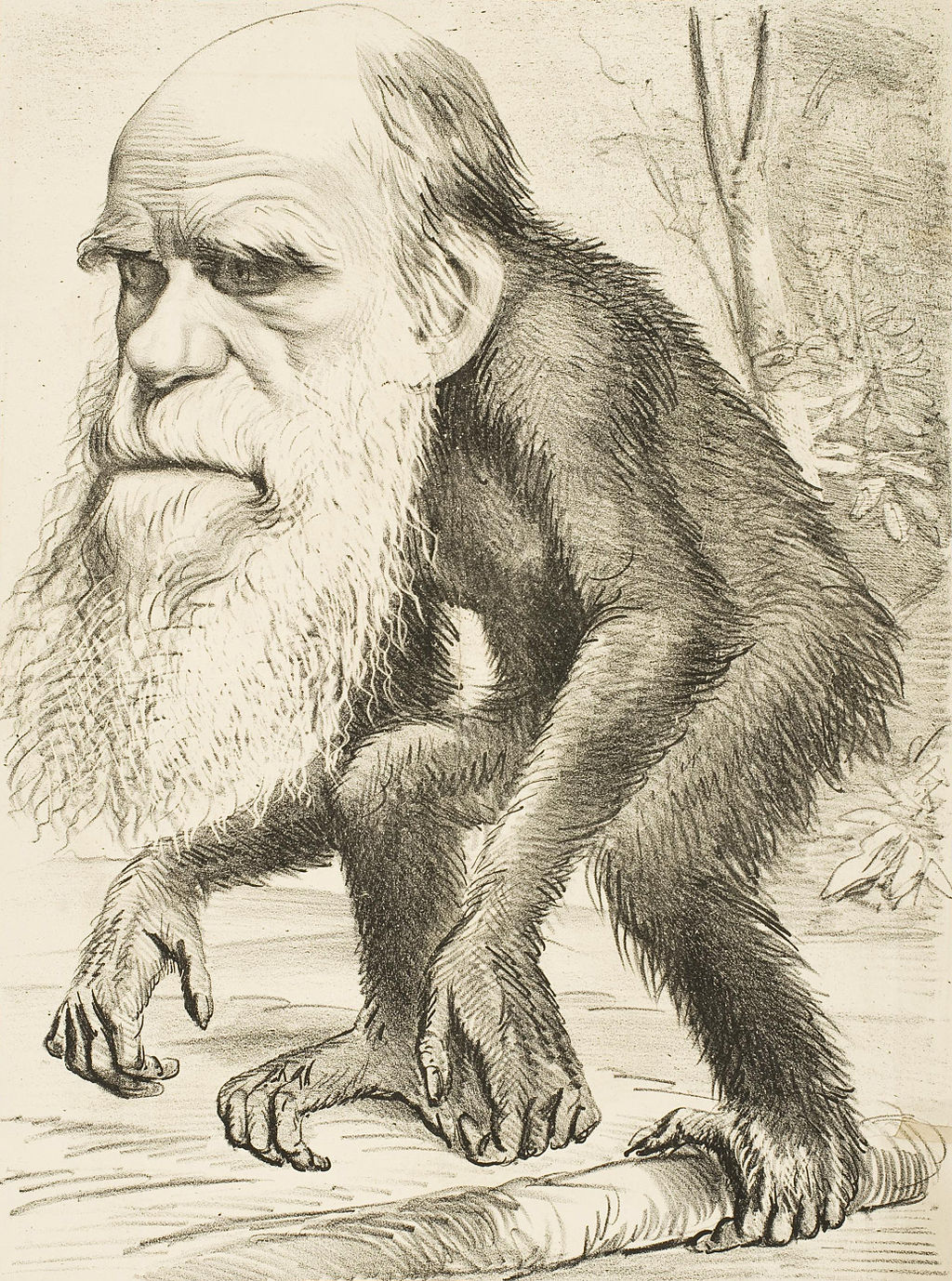
Social Darwinism
☆社 会ダーウィニズムとは、自然淘汰や適者生存の生物学的概念を社会学・経済学・政治学に適用しようとする様々な理論や社会的実践を指し、1870 年代に西ヨーロッパや北米の学者によって大きく定義された[1][2]。社会ダーウィニズムの強者と弱者の定義は様々であり、また強者に報酬を与え、弱者 を罰する正確なメカニズムについても異なっている。このような見解の多くは自由放任の資本主義における個人間の競争を強調する一方で、国家や人種集団間の 闘争を強調し、右翼政治、優生学、人種差別、帝国主義、ナショナリズムを支持する者もいる。
☆ハーバート・スペンサーと社会ダーウィニズム
| Social Darwinism and racial views |
社会ダーウィニズムと人種観 |
| For many,[citation needed] the
name of Herbert Spencer is virtually synonymous with Social Darwinism,
a social theory that applies the law of the survival of the fittest to
society and is integrally related to the nineteenth-century rise in
scientific racism. In his famed work Social Statics (1850), he argued
that imperialism had served civilization by clearing the inferior races
off the earth: "The forces which are working out the great scheme of
perfect happiness, taking no account of incidental suffering,
exterminate such sections of mankind as stand in their way. ... Be he
human or be he brute – the hindrance must be got rid of."[25] Yet, in
the same work, Spencer goes on to say that the incidental evolutionary
benefits derived from such barbarous practices do not serve as
justifications for them going forward.[26] |
多くの人々にとって[出典必要]、ハーバート・スペンサーの
名は、社会ダーウィニズムとほぼ同義である。社会ダーウィニズムとは、適者生存の法則を社会に適用する社会理論であり、19世紀における科学的人種主義の
台頭と密接に関連している。彼の著名な著作『社会静力学』(1850年)において、彼は帝国主義が劣等な人種を地球上から一掃することで文明に貢献したと
論じた。「
「完全な幸福という偉大な計画を実現させる力は、付随的な苦悩を顧みることなく、その邪魔になる人類の集団を根絶する。……人間であれ獣であれ――障害と
なるものは排除されなければならない。」[25]
しかし、同書の中でスペンサーはさらに、そのような野蛮な慣行から派生する付随的な進化的利益は、将来にわたってそれらを正当化する根拠にはならないと述
べている。[26] |
| Spencer's association with
social Darwinism might have its origin in a specific interpretation of
his support for competition. Whereas in biology the competition of
various organisms can result in the death of a species or organism, the
kind of competition Spencer advocated is closer to the one used by
economists, where competing individuals or firms improve the well-being
of the rest of society. Spencer viewed private charity positively,
encouraging both voluntary association and informal care to aid those
in need, rather than relying on government bureaucracy or force. He
further recommended that private charitable efforts would be wise to
avoid encouraging the formation of new dependent families by those
unable to support themselves without charity.[27] Focusing on the form
as well as the content of Spencer's "Synthetic Philosophy", one writer
has identified it as the paradigmatic case of "social Darwinism",
understood as a politically motivated metaphysic very different in both
form and motivation from Darwinist science.[28] |
スペンサーと社会ダーウィニズムとの関連は、彼が競争を支持した点に対
する特定の解釈に由来するのかもしれない。生物学において、様々な生物間の競争は種や個体の死をもたらすことがあるが、スペンサーが提唱した競争は、経済
学者が用いる概念に近いものであり、そこでは競争する個人や企業が社会全体の福祉を向上させる。スペンサーは私的慈善活動を肯定的に捉え、政府の官僚機構
や強制に頼るのではなく、自発的な団体や非公式な支援を通じて困窮者を助けることを奨励した。さらに彼は、慈善活動を行う際には、慈善なしでは自立できな
い人々が新たな扶養家族を形成することを助長しないよう注意すべきだと提言した。[27]
スペンサーの『総合哲学』の内容だけでなくその形式にも焦点を当てたある著者は、これを「社会ダーウィニズム」の典型例であると指摘している。ここでいう
社会ダーウィニズムとは、ダーウィニズムの科学とは形式も動機も大きく異なる、政治的な動機に基づく形而上学として理解されるものである。[28] |
| In a letter to the Japanese
government regarding intermarriage with Westerners, Spencer stated that
"if you mix the constitution of two widely divergent varieties which
have severally become adapted to widely divergent modes of life, you
get a constitution which is adapted to the mode of life of neither – a
constitution which will not work properly." He goes on to say that
America has failed to limit the immigration of Chinese and restrict
their contact, especially sexual, with the presumed European stock. He
states "if they mix they must form a bad hybrid" regarding the issue of
Chinese and (ethnically European) Americans. Spencer ends his letter
with the following blanket statement against all immigration: "In
either case, supposing the immigration to be large, immense social
mischief must arise, and eventually social disorganization. The same
thing will happen if there should be any considerable mixture of
European or American races with the Japanese."[29] |
西洋人との異人種間結婚について日本政府に宛てた書簡の中で、スペン
サーは次のように述べている。「互いに大きく異なる生活様式に適応してきた、大きく異なる二つの人種の体質を混ぜ合わせると、どちらの生活様式にも適応し
ない体質、すなわち正常に機能しない体質が生まれる」。彼はさらに、アメリカは中国人の移民を制限し、特にヨーロッパ系と見なされる人々との性的接触を制
限することに失敗したと述べている。彼は、中国人および(民族的にヨーロッパ系の)アメリカ人に関する問題について、「もし彼らが混血すれば、必ず劣った
雑種が生まれる」と述べている。スペンサーは、あらゆる移民に対する以下の包括的な主張をもって書簡を締めくくっている。「いずれの場合も、移民の規模が
大きければ、甚大な社会的弊害が生じ、最終的には社会の崩壊を招くだろう。ヨーロッパ人やアメリカ人の人種と日本人が相当程度混血した場合にも、同じこと
が起こるだろう。」[29] |
| 25. Lindqvist, Sven (1996). Exterminate all the brutes. New Press. p. 8. ISBN 978-1565843592. 26. Spencer, Social Statics, pp. 417–419. 27. Offer, John (2006). An Intellectual History of British Social Policy. Bristol: Policy Press. pp. 38, 142. ISBN 1861345305. 28. Stewart, Iain (2011). "Commandeering Time: The Ideological Status of Time in the Social Darwinism of Herbert Spencer" (PDF). Australian Journal of Politics and History. 57 (3): 389–402. doi:10.1111/j.1467-8497.2011.01604.x. 29. Hearn, Lafcadio (2012). Japan: An Attempt at Interpretation. Read Books. ISBN 978-1406722383. |
25. リンドクヴィスト、スヴェン(1996)。『Exterminate all the brutes』。ニュー・プレス。8頁。ISBN 978-1565843592。 26. スペンサー、『社会静学』、417–419頁。 27. オファー、ジョン(2006)。『英国社会政策の知的歴史』。ブリストル:ポリシー・プレス。pp. 38, 142. ISBN 1861345305. 28. スチュワート、イアン(2011)。「時間の徴用:ハーバート・スペンサーの社会ダーウィニズムにおける時間のイデオロギー的地位」(PDF)。『オース トラリア政治史学雑誌』。57 (3): 389–402. doi:10.1111/j.1467-8497.2011.01604.x. 29. ハーン、ラフカディオ(2012)。『日本:解釈の試み』。リード・ブックス。ISBN 978-1406722383。 |
| https://en.wikipedia.org/wiki/Herbert_Spencer |
☆
★
| Social Darwinism | Social Darwinism
refers to various theories and societal practices that purport to apply
biological concepts of natural selection and survival of the fittest to
sociology, economics and politics, and which were largely defined by
scholars in Western Europe and North America in the 1870s.[1][2] Social
Darwinism holds that the strong see their wealth and power increase
while the weak see their wealth and power decrease. Social Darwinist
definitions of the strong and the weak vary, and also differ on the
precise mechanisms that reward strength and punish weakness. Many such
views stress competition between individuals in laissez-faire
capitalism, while others, emphasizing struggle between national or
racial groups, support right-wing politics, eugenics, racism,
imperialism and/or nationalism.[3][4][5] |
社
会ダーウィニズムとは、自然淘汰や適者生存の生物学的概念を社会学・経済学・政治学に適用しようとする様々な理論や社会的実践を指し、1870
年代に西ヨーロッパや北米の学者によって大きく定義された[1][2]。社会ダーウィニズムの強者と弱者の定義は様々であり、また強者に報酬を与え、弱者
を罰する正確なメカニズムについても異なっている。このような見解の多くは自由放任の資本主義における個人間の競争を強調する一方で、国家や人種集団間の
闘争を強調し、右翼政治、優生学、人種差別、帝国主義、ナショナリズムを支持する者もいる[3][4][5]。 |
| Social
Darwinism declined in popularity as a purportedly scientific concept
following the First World War, and was largely discredited by the end
of the Second World War—partially due to its association with Nazism
and partially due to a growing scientific consensus that eugenics and
scientific racism were groundless.[3][6][7] Later reference to social
Darwinism was usually pejorative.[7][8][9] |
第
一次世界大戦後、社会ダーウィニズムは科学的概念と称して人気を失い、第二次世界大戦の終わりには、ナチズムとの関連や優生学や科学的人種差別は根拠がな
いという科学的コンセンサスの高まりから、ほぼ信用を失っていた[3][6][7]。後に社会ダーウィニズムへの言及は通常卑下的であった[7][8]
[9]。 |
|
| Some
groups, including creationists such as William Jennings Bryan, argued
that social Darwinism is a logical consequence of Darwinism.[8]
Academics such as Steven Pinker have argued this is a fallacy of appeal
to nature as natural selection is a description of a biological
phenomenon and does not imply that this phenomenon is morally desirable
in human society.[10] While most scholars recognize some historical
links between the popularisation of Darwin's theory and forms of social
Darwinism, they also maintain that social Darwinism is not a necessary
consequence of the principles of biological evolution. Social Darwinism
is generally accepted to be a pseudoscience.[11][12][13][14] |
ウィ
リアム・ジェニングス・ブライアンのような創造論者を含むいくつかのグループは、社会ダーウィニズムはダーウィニズムの論理的帰結であると主張した[8]
スティーブン・ピンカーのような学者は、これは自然への訴えの誤謬であると主張しており、自然選択は生物学的現象の記述であって、この現象が人間社会にお
いて道徳的に好ましいことを意味するものではないためだ。 [10]
ほとんどの学者はダーウィンの理論の普及と社会ダーウィニズムの形態との間に歴史的なつながりがあることを認識しているが、社会ダーウィニズムは生物進化
の原理の必然的な結果ではないとも主張している。社会ダーウィニズムは一般に疑似科学であると受け止められている[11][12][13][14]。 |
|
| Scholars
debate the extent to which the various social Darwinist ideologies
reflect Charles Darwin's own views on human social and economic issues.
His writings have passages that can be interpreted as opposing
aggressive individualism, while other passages appear to promote
it.[15] Darwin's early evolutionary views and his opposition to slavery
ran counter to many of the claims that social Darwinists would
eventually make about the mental capabilities of the poor and
indigenous peoples in the European colonies.[16] After the publication
of On the Origin of Species in 1859, one strand of Darwin's followers,
led by Sir John Lubbock, argued that natural selection ceased to have
any noticeable effect on humans once organised societies had been
formed.[17] However, some scholars argue that Darwin's view gradually
changed and came to incorporate views from other theorists such as
Herbert Spencer.[18] Spencer published[19] his Lamarckian evolutionary
ideas about society before Darwin first published his hypothesis in
1859, and both Spencer and Darwin promoted their own conceptions of
moral values. Spencer supported laissez-faire capitalism on the basis
of his Lamarckian belief that struggle for survival spurred
self-improvement which could be inherited.[20] An important proponent
in Germany was Ernst Haeckel, who popularized Darwin's thought and his
personal interpretation of it, and used it as well to contribute to a
new creed, the monist movement. |
学
者たちは、様々な社会ダーウィニズムの思想が、人間の社会的・経済的問題に対するダーウィン自身の見解をどの程度反映しているのかについて議論している。
ダーウィンの初期の進化論的見解と奴隷制への反対は、社会ダーウィン主義者がヨーロッパの植民地の貧しい人々や先住民の精神的能力について最終的に行うこ
とになる多くの主張と対立していた[15]。
1859年に『種の起源』が出版されると、ジョン・ラボック卿に代表されるダーウィン信奉者の一派は、組織化された社会が形成されると、自然淘汰が人間に
顕著な影響を与えることはなくなると主張した[16]。
[しかし、ダーウィンの見解は次第に変化し、ハーバート・スペンサーなど他の理論家の見解を取り入れるようになったと主張する学者もいる[18]。スペン
サーはダーウィンが1859年に初めて仮説を発表する前に社会に関するラマルク的進化論を発表し[19]、スペンサーもダーウィンも独自の道徳観の概念を
広めていた。スペンサーは、生存のための闘争が自己改善を促し、それが継承されるというラマルク的な信念に基づいて、自由放任の資本主義を支持した
[20]
。ドイツにおける重要な支持者はエルンスト・ヘッケルで、彼はダーウィンの思想とそれに対する彼の個人的解釈を広め、それを新しい信条、単性論(=聖書の
記述に従い人類は共通の祖先をもつこと)運動に貢献するためにも使用した。 |
|
| Origin of the term |
The
term "Darwinism" was coined by Thomas Henry Huxley in his March 1861
review of On the Origin of Species,[21] and by the 1870s it was used to
describe a range of concepts of evolution or development, without any
specific commitment to Charles Darwin's theory of natural selection.[22] The phrase "social Darwinism" first appeared in Joseph Fisher's 1877 article on The History of Landholding in Ireland, which was published in the Transactions of the Royal Historical Society.[23] Fisher was commenting on how a system for borrowing livestock called "tenure" had led to the false impression that the early Irish had already evolved or developed land tenure;[24] |
「ダー
ウィニズム」という言葉は、トーマス・ヘンリー・ハクスリーが1861年3月に『種の起源』の批評の中で作ったものであり[21]、1870年代
までには
チャールズ・ダーウィンの自然選択説に対する特定のコミットメントなしに進化や発展に関する様々な概念を表すために使用されていた[22]。 社会的ダーウィニズム」というフレーズは、1877年に『王立歴史学会紀要』に掲載されたジョセフ・フィッシャーの「アイルランドにおける土地所有の歴 史」という論文で初めて登場した[23]。 フィッシャーは、「テニュア」という家畜を借りるシステムが、初期のアイルランド人がすでに土地所有権を進化または発展させていたという誤った印象につな がったとコメントしているところだった[24]。 |
| Citation These arrangements did not in any way affect that which we understand by the word " tenure", that is, a man's farm, but they related solely to cattle, which we consider a chattel. It has appeared necessary to devote some space to this subject, inasmuch as that usually acute writer Sir Henry Maine has accepted the word " tenure " in its modern interpretation and has built up a theory under which the Irish chief " developed " into a feudal baron. I can find nothing in the Brehon laws to warrant this theory of social Darwinism, and believe the further study will show that the Cáin Saerrath and the Cáin Aigillne relate solely to what we now call chattels, and did not in any way affect what we now call the freehold, the possession of the land. — Joseph Fisher[24] |
【引用】 これらの取り決めは、我々が「テニュア」という言葉で理解するもの、つまり人間の農場には何ら影響を与えず、我々が動産とみなす家畜にのみ関係するもので あった。鋭敏な作家であるヘンリー・メイン卿が、「テニュア」という言葉を現代的な解釈で受け入れ、アイルランドの首長が「封建的男爵」に発展したという 理論を構築したため、この話題に若干のスペースを割く必要があると思われるようになったのである。私は、この社会ダーウィニズムの理論を正当化するものは ブレホン法には見出せず、さらに研究すれば、Cáin SaerrathとCáin Aigillneは、現在我々が動産と呼ぶものにのみ関係し、現在我々が自由所有権と呼ぶもの(土地の所有)に何ら影響を与えていないことが分かると信じ ている。 - ジョセフ・フィッシャー[24]。 |
|
| 優生学と社会ダーウィニズム |
Despite
the fact that Social Darwinism bears Charles Darwin's name, it is also
linked today with others, notably Herbert Spencer, Thomas Malthus, and
Francis Galton, the founder of eugenics. In fact, Spencer was not
described as a social Darwinist until the 1930s, long after his
death.[25] The term "social Darwinism" first appeared in Europe in
1880, and journalist Emilie Gautier had coined the term with reference
to a health conference in Berlin 1877.[23] Around 1900 it was used by
sociologists, some being opposed to the concept.[26] The American
historian Richard Hofstadter popularized the term in the United States
in 1944. He used it in the ideological war effort against fascism to
denote a reactionary creed that promoted competitive strife, racism,
and chauvinism. Hofstadter later also recognized (what he saw as) the
influence of Darwinist and other evolutionary ideas upon those with
collectivist views, enough to devise a term for the phenomenon,
Darwinist collectivism.[5] Before Hofstadter's work the use of the term
"social Darwinism" in English academic journals was quite rare.[27] In
fact, |
社会ダーウィニズムは、
チャールズ・ダーウィンの名前を冠しているという事実にもかかわらず、今日、他の人々、特にハーバート・スペンサー、トーマス・マルサス、優生学の創始者
であるフランシス・ゴルトンとも結びつけられている。実際、スペンサーが社会ダーウィニストと呼ばれるようになったのは、彼の死後かなり経った1930年
代である[25]。
社会ダーウィニズムという言葉は1880年にヨーロッパで初めて登場し、ジャーナリストのエミリー・ゴーティエが1877年にベルリンで開かれた健康会議
に関連してこの言葉を作った[23]。
1900年頃には社会学者によって使われ、一部の人はこのコンセプトに反対した[26]。アメリカの歴史家のリチャード・ホフスタッターが1944年にこ
の用語をアメリカで広めた。彼はファシズムに対する思想的な戦争努力の中で、競争的な争い、人種差別、排外主義を促進する反動的な信条を示すためにこの用
語を使用した。またホフスタッターは後に、ダーウィニズムやその他の進化論的な考えが集団主義的な考えを持つ人々に影響を与えている(と彼が見た)ことを
認識し、この現象を表す言葉としてダーウィニスト集団主義を考案した[5]。
ホフスタッターの研究以前は、イギリスの学術雑誌において「社会ダーウィニズム」という言葉の使用は非常に稀だった[27]。 事実、その通りである。 |
| ...
there is considerable evidence that the entire concept of "social
Darwinism" as we know it today was virtually invented by Richard
Hofstadter. Eric Foner, in an introduction to a then-new edition of
Hofstadter's book published in the early 1990s, declines to go quite
that far. "Hofstadter did not invent the term Social Darwinism", Foner
writes, "which originated in Europe in the 1860s and crossed the
Atlantic in the early twentieth century. But before he wrote, it was
used only on rare occasions; he made it a standard shorthand for a
complex of late-nineteenth-century ideas, a familiar part of the
lexicon of social thought." — Jeff Riggenbach[1] |
私
たちが今日知っているような「社会的ダーウィニズム」の概念全体が、事実上リチャード・ホフスタッターによって発明されたという証拠がかなりある。エリッ
ク・フォナーは、1990年代初頭に出版されたホフスタッターの本の新版の序文で、そこまで踏み込むことは断っている。「社会ダーウィニズムという言葉
は、1860年代にヨーロッパで生まれ、20世紀初頭に大西洋を渡ってきたもので、ホフスタッターが発明したわけではない。しかし、彼が執筆する以前は、
この言葉はごくまれにしか使われていなかった。彼はこの言葉を、19世紀末の複合思想を表す標準的な略語として、社会思想の語彙の一部として親しまれるよ
うにしたのである」。 - ジェフ・リッゲンバッハ[1](Jeff Riggenbach |
|
| Usage |
Social
Darwinism has many definitions, and some of them are incompatible with
each other. As such, social Darwinism has been criticized for being an
inconsistent philosophy, which does not lead to any clear political
conclusions. For example, The Concise Oxford Dictionary of Politics
states: Part of the difficulty in establishing sensible and consistent usage is that commitment to the biology of natural selection and to 'survival of the fittest' entailed nothing uniform either for sociological method or for political doctrine. A 'social Darwinist' could just as well be a defender of laissez-faire as a defender of state socialism, just as much an imperialist as a domestic eugenist.[28] The term "social Darwinism" has rarely been used by advocates of the supposed ideologies or ideas; instead it has almost always been used pejoratively by its opponents.[9] The term draws upon the common meaning of Darwinism, which includes a range of evolutionary views, but in the late 19th century was applied more specifically to natural selection as first advanced by Charles Darwin to explain speciation in populations of organisms. The process includes competition between individuals for limited resources, popularly but inaccurately described by the phrase "survival of the fittest", a term coined by sociologist Herbert Spencer. Creationists have often maintained that social Darwinism—leading to policies designed to reward the most competitive—is a logical consequence of "Darwinism" (the theory of natural selection in biology).[8] Biologists and historians have stated that this is a fallacy of appeal to nature and should not be taken to imply that this phenomenon ought to be used as a moral guide in human society.[10] While there are historical links between the popularization of Darwin's theory and forms of social Darwinism, social Darwinism is not a necessary consequence of the principles of biological evolution. While the term has been applied to the claim that Darwin's theory of evolution by natural selection can be used to understand the social endurance of a nation or country, social Darwinism commonly refers to ideas that predate Darwin's publication of On the Origin of Species. Others whose ideas are given the label include the 18th-century clergyman Thomas Malthus, and Darwin's cousin Francis Galton who founded eugenics towards the end of the 19th century. The massive expansion in Western colonialism during the New Imperialism era fitted in with the broader notion of social Darwinism used from the 1870s onwards to account for the phenomenon of "the Anglo-Saxon and latin overflowing his boundaries", as phrased by the late-Victorian sociologist Benjamin Kidd in Social Evolution, published in 1894.[29] The concept also proved useful to justify what was seen by some as the inevitable "disappearance" of "the weaker races... before the stronger" not so much "through the effects of ... our vices upon them" as "what may be called the virtues of our civilisation." Winston Churchill, a political proponent of eugenics, maintained that if fewer 'feebleminded' individuals were born, less crime would take place.[30] |
社
会ダーウィニズムには多くの定義があり、その中には互いに相容れないものもある。そのため、社会ダーウィニズムは矛盾した哲学であり、明確な政治的結論を
導き出さないという批判がある。たとえば、『コンサイス・オックスフォード・ディクショナリー・オブ・ポリティクス』にはこう書かれている。 賢明で一貫した用法を確立することの難しさの一端は、自然淘汰の生物学と「適者生存」への献身が、社会学的方法にも政治的教義にも、何の統一性も伴わな かったことである。社会ダーウィニスト」は国家社会主義の擁護者と同様に自由放任主義の擁護者であり、国内優生主義者と同様に帝国主義者である可能性があ る[28]。 社会ダーウィニズム」という用語は想定されるイデオロギーや思想の擁護者によって使用されることはほとんどなく、その代わりにほとんど常にその反対者に よって侮蔑的に使用されてきた[9]。 この用語は様々な進化的見解を含むダーウィニズムの共通の意味を引き出しているが、19世紀末には生物の集団における種分化を説明するのにチャールズ・ ダーウィンによって最初に進められた自然選択により具体的に適用されてきた。この過程には、限られた資源をめぐる個体間の競争が含まれ、社会学者ハーバー ト・スペンサーの造語である「適者生存」という言葉で一般的に説明されているが、不正確な表現である。 創造論者はしばしば、社会的ダーウィニズム(最も競争力のある者に報酬を与えるように設計された政策)は「ダーウィニズム」(生物学における自然淘汰の理 論)の論理的帰結であると主張してきた[8]。生物学者や歴史家は、これは自然に訴えることの誤りであり、この現象が人間社会における道徳指針として用い られるべきであると意味するものとして受け止めるべきではないとしている。 10] ダーウィン理論の一般化および社会的ダーウィニズムの形態には、歴史上のつながりはあるものの、社会的ダーウィニズムが生物進化の原理から必ず生じるもの ではあるまい。 この用語は、ダーウィンの自然淘汰による進化論が国家や国の社会的耐久性を理解するために使用できるという主張に適用されているが、社会ダーウィニズムは 一般的にダーウィンの『種の起源』の出版より前の思想を指すことがある。18世紀の聖職者トーマス・マルサスや、ダーウィンの従兄弟で19世紀末に優生学 を確立したフランシス・ゴルトンなどの思想がこれにあたる。 新帝国主義の時代における西洋の植民地主義の大規模な拡大は、1870年代以降にヴィクトリア朝後期の社会学者ベンジャミン・キッドが1894年に出版し た『社会進化論』で述べた「アングロサクソンとラテンが境界を越えて溢れ出す」現象を説明するために用いられた社会ダーウィニズムという広義の概念に合致 するものであった[29]。 [この概念はまた、「弱い民族が強い民族の前に...消滅する」のは避けられないことであると一部の人々が考えていたことを正当化するのにも有用であるこ とがわかった。優生学の政治的支持者であるウィンストン・チャーチルは、もし「心の弱い」人々が生まれることが少なければ、犯罪は少なくなると主張した [30]。 |
| Proponents |
Pros Herbert Spencer's ideas, like those of evolutionary progressivism, stemmed from his reading of Thomas Malthus, and his later theories were influenced by those of Darwin. However, Spencer's major work, Progress: Its Law and Cause (1857), was released two years before the publication of Darwin's On the Origin of Species, and First Principles was printed in 1860. In The Social Organism (1860), Spencer compares society to a living organism and argues that, just as biological organisms evolve through natural selection, society evolves and increases in complexity through analogous processes.[31] In many ways, Spencer's theory of cosmic evolution has much more in common with the works of Lamarck and Auguste Comte's positivism than with Darwin's. Jeff Riggenbach argues that Spencer's view was that culture and education made a sort of Lamarckism possible[1] and notes that Herbert Spencer was a proponent of private charity.[1] However, the legacy of his social Darwinism was less than charitable.[32] Spencer's work also served to renew interest in the work of Malthus. While Malthus's work does not itself qualify as social Darwinism, his 1798 work An Essay on the Principle of Population, was incredibly popular and widely read by social Darwinists. In that book, for example, the author argued that as an increasing population would normally outgrow its food supply, this would result in the starvation of the weakest and a Malthusian catastrophe. According to Michael Ruse, Darwin read Malthus' famous Essay on a Principle of Population in 1838, four years after Malthus' death. Malthus himself anticipated the social Darwinists in suggesting that charity could exacerbate social problems. Another of these social interpretations of Darwin's biological views, later known as eugenics, was put forth by Darwin's cousin, Francis Galton, in 1865 and 1869. Galton argued that just as physical traits were clearly inherited among generations of people, the same could be said for mental qualities (genius and talent). Galton argued that social morals needed to change so that heredity was a conscious decision, to avoid both the over-breeding by less fit members of society and the under-breeding of the more fit ones. In Galton's view, social institutions such as welfare and insane asylums were allowing inferior humans to survive and reproduce at levels faster than the more "superior" humans in respectable society, and if corrections were not soon taken, society would be awash with "inferiors". Darwin read his cousin's work with interest, and devoted sections of Descent of Man to discussion of Galton's theories. Neither Galton nor Darwin, though, advocated any eugenic policies restricting reproduction, due to their Whiggish distrust of government.[33] Friedrich Nietzsche's philosophy addressed the question of artificial selection, yet Nietzsche's principles did not concur with Darwinian theories of natural selection. Nietzsche's point of view on sickness and health, in particular, opposed him to the concept of biological adaptation as forged by Spencer's "fitness". Nietzsche criticized Haeckel, Spencer, and Darwin, sometimes under the same banner by maintaining that in specific cases, sickness was necessary and even helpful.[34] Thus, he wrote: Wherever progress is to ensue, deviating natures are of greatest importance. Every progress of the whole must be preceded by a partial weakening. The strongest natures retain the type, the weaker ones help to advance it. Something similar also happens in the individual. There is rarely a degeneration, a truncation, or even a vice or any physical or moral loss without an advantage somewhere else. In a warlike and restless clan, for example, the sicklier man may have occasion to be alone, and may therefore become quieter and wiser; the one-eyed man will have one eye the stronger; the blind man will see deeper inwardly, and certainly hear better. To this extent, the famous theory of the survival of the fittest does not seem to me to be the only viewpoint from which to explain the progress of strengthening of a man or of a race.[35] Ernst Haeckel's recapitulation theory was not Darwinism, but rather attempted to combine the ideas of Goethe, Lamarck and Darwin. It was adopted by emerging social sciences to support the concept that non-European societies were "primitive", in an early stage of development towards the European ideal, but since then it has been heavily refuted on many fronts.[36] Haeckel's works led to the formation of the Monist League in 1904 with many prominent citizens among its members, including the Nobel Prize winner Wilhelm Ostwald. The simpler aspects of social Darwinism followed the earlier Malthusian ideas that humans, especially males, require competition in their lives to survive. Further, the poor should have to provide for themselves and not be given any aid. However, amidst this climate, most social Darwinists of the early 20th century actually supported better working conditions and salaries. Such measures would grant the poor a better chance to provide for themselves yet still distinguish those who are capable of succeeding from those who are poor out of laziness, weakness, or inferiority.[citation needed] |
【賛
成派】 ハーバート・スペンサーの思想は、進化進歩主義と同じく、トーマス・マルサスの読書に端を発しており、その後の理論はダーウィンの影響を受けてい る。しかし、スペンサーの代表作である『進歩。その法則と原因』(1857年)はダーウィンの『種の起源』が出版される2年前に発表され、『第一原理』は 1860年に印刷された。 The Social Organism (1860)において、スペンサーは社会を生物に例えて、生物が自然淘汰を通して進化するように、社会も類似のプロセスを通して進化し、複雑さを増すと論 じている[31]。 多くの点で、スペンサーの宇宙進化論はダーウィンよりもラマルクやオーギュスト・コントの実証主義の作品と共通するところが多い。 ジェフ・リゲンバッハは、文化や教育が一種のラマルク主義を可能にするというのがスペンサーの見解であったと論じ[1]、ハーバート・スペンサーが私的慈 善の支持者であったと指摘している[1]が、彼の社会ダーウィニズムが残したものは慈善とは言い難いものであった[32]。 スペンサーの仕事はマルサスの仕事への関心を新たにする役割も果たしていた。マルサスの仕事はそれ自体社会的ダーウィニズムとして適格ではないが、彼の 1798年の作品『人口原理に関する試論』は信じられないほど人気があり、社会的ダーウィニストによって広く読まれていた。例えば、この本の中で、著者 は、人口が増加すると、通常、その食料供給量を上回るので、弱い者は飢餓に陥り、マルサス的な破局が起こると論じている。 ルーセによれば、ダーウィンがマルサスの有名な『人口原理に関する試論』を読んだのは、マルサスが亡くなって4年後の1838年のことである。マルサス自 身、慈善事業が社会問題を悪化させることを示唆し、社会ダーウィン主義者を先取りしていたのである。 ダーウィンの生物学的見解の社会的解釈のもう一つは、後に優生学として知られるもので、ダーウィンの従兄弟であるフランシス・ゴルトンが1865年と 1869年に提唱したものである。ゴルトンは、身体的形質が何世代にもわたって明確に遺伝するように、精神的な資質(天才や才能)にも同じことが言えると 主張した。ゴルトンは、社会的モラルを変え、遺伝が意識的な決定であるようにし、社会的不適合者による過剰繁殖と、より適合した者による過小繁殖の両方を 回避する必要があると主張した。 ゴルトンは、福祉施設や精神病院などの社会制度によって、劣った人間が生き残り、立派な社会に住む「優れた」人間よりも早く繁殖することを許しており、す ぐに是正しなければ、社会は「劣った」人間で溢れかえってしまうと考えたのである。ダーウィンは、従兄弟の研究を興味深く読み、『人間降臨』の一部をガル トンの理論の議論に費やした。しかし、ゴルトンもダーウィンも、政府に対するホイッグ的な不信感から、優生学的な繁殖制限の政策を提唱することはなかった [33]。 ニーチェの哲学は、人為的淘汰の問題に取り組んでいたが、ニーチェの原理はダーウィンの自然淘汰の理論とは一致しないものであった。特に病気と健康に対す るニーチェの視点は、スペンサーの「適性」によって作り上げられた生物学的適応の概念と対立するものであった。ニーチェは、特定の場合には病気は必要であ り、役に立つとさえ主張することによって、ヘッケル、スペンサー、ダーウィンを、時には同じ旗印の下で批判した[34]。 進歩が起ころうとするところではどこでも、逸脱した性質が最も重要である。全体のあらゆる進歩は、部分的な弱化に先行されなければならない。最も強い性質 は型を維持し、弱い性質はそれを前進させるのに役立つのである。これと似たようなことが個人にも起こる。退化や切り捨て、あるいは悪癖や肉体的・道徳的な 損失が、他のどこかに利点をもたらさない限りは、めったにない。たとえば、戦争好きで落ち着きのない一族では、病気の人が一人になる機会があり、そのため より静かで賢くなるかもしれない。片目の人は片目がより強くなり、盲人は内面が深く見え、確かによく聞こえるようになる。この限りにおいて、適者生存の有 名な理論は、人間や人種の強化の進行を説明する唯一の視点ではないように私には思われる[35]。 エルンスト・ヘッケルの復者論はダーウィニズムではなく、ゲーテ、ラマルク、ダーウィンの思想を組み合わせようとしたものであった。ヘッケルの著作は、 1904年にノーベル賞受賞者ヴィルヘルム・オストワルトを含む多くの著名な市民をメンバーとするモノイスト連盟を結成させることになった[36]。 社会ダーウィニズムのより単純な側面は、人間、特に男性が生存するためには生活の中で競争が必要であるというマルサス以前の考え方に倣ったものであった。 さらに、貧しい者は自活すべきであり、いかなる援助も与えるべきではない。しかし、このような風潮の中で、20世紀初頭の社会ダーウィン主義者の多くは、 労働条件や給与の改善を実際に支持していた。このような措置は、貧しい人々に自活するためのより良い機会を与え、なおかつ成功する能力のある人々と、怠惰 や弱さ、劣等感から貧しい人々とを区別することになる[citation needed]。 |
| Hypotheses relating social
change and evolution |
One
of the earliest uses of the term "social Darwinism" was by Eduard Oscar
Schmidt of the University of Strasbourg, when reporting at a scientific
and medical conference held in Munich in 1877. He noted how socialists,
although opponents of Darwin's theory, used it to add force to their
political arguments. Schmidt's essay first appeared in English in
Popular Science in March 1879.[37] There followed an anarchist tract
published in Paris in 1880 entitled "Le darwinisme social" by Émile
Gautier. However, the use of the term was very rare—at least in the
English-speaking world (Hodgson, 2004)[38]—until the American historian
Richard Hofstadter published his influential Social Darwinism in
American Thought (1944) during World War II. Hypotheses of social evolution and cultural evolution were common in Europe. The Enlightenment thinkers who preceded Darwin, such as Hegel, often argued that societies progressed through stages of increasing development. Earlier thinkers also emphasized conflict as an inherent feature of social life. Thomas Hobbes's 17th-century portrayal of the state of nature seems analogous to the competition for natural resources described by Darwin. Social Darwinism is distinct from other theories of social change because of the way it draws Darwin's distinctive ideas from the field of biology into social studies. Darwin, unlike Hobbes, believed that this struggle for natural resources allowed individuals with certain physical and mental traits to succeed more frequently than others, and that these traits accumulated in the population over time, which under certain conditions could lead to the descendants being so different that they would be defined as a new species. However, Darwin felt that "social instincts" such as "sympathy" and "moral sentiments" also evolved through natural selection, and that these resulted in the strengthening of societies in which they occurred, so much so that he wrote about it in Descent of Man: The following proposition seems to me in a high degree probable—namely, that any animal whatever, endowed with well-marked social instincts, the parental and filial affections being here included, would inevitably acquire a moral sense or conscience, as soon as its intellectual powers had become as well, or nearly as well developed, as in man. For, firstly, the social instincts lead an animal to take pleasure in the society of its fellows, to feel a certain amount of sympathy with them, and to perform various services for them.[39] |
社
会的ダーウィニズム」という言葉が最初に使われたのは、ストラスブール大学のエドワード・オスカー・シュミットが、1877年にミュンヘンで開かれた科
学・医学会議で報告したときであった。彼は、社会主義者がダーウィンの理論に反対であるにもかかわらず、自分たちの政治的主張に力を加えるために、この理
論を利用したことを指摘した。その後、1880年にパリで出版されたエミール・ゴーティエの「Le darwinisme
social」と題するアナーキストの小論文がある[37]。しかし、この用語の使用は、少なくとも英語圏では非常にまれであり(Hodgson,
2004)[38]、第二次世界大戦中にアメリカの歴史家Richard Hofstadterが影響力のあるSocial Darwinism in
American Thought(1944)を出版するまで、その使用はなかった。 社会進化や文化進化に関する仮説はヨーロッパでは一般的なものでした。ダーウィンに先立つ啓蒙思想家たち、たとえばヘーゲルは、社会はますます発展する段 階を経て進歩するとしばしば主張した。また、それ以前の思想家たちは、社会生活の固有の特徴として対立を強調した。ホッブズが17世紀に描いた自然状態 は、ダーウィンが描いた天然資源をめぐる競争と類似しているように思われる。社会ダーウィニズムが他の社会変動論と異なるのは、ダーウィンの独特の思想を 生物学の分野から社会学に引き入れている点である。 ダーウィンは、ホッブズとは異なり、この天然資源をめぐる闘争によって、特定の身体的・精神的形質を持つ個体が他の個体よりも頻繁に成功し、その形質が時 間とともに集団に蓄積され、ある条件下では子孫が新種と定義されるほど異なるものになると考えていたのである。 しかし、ダーウィンは、「同情」や「道徳感情」といった「社会的本能」も自然選択によって進化し、それが発生した社会を強化する結果になったと考え、『人 間降臨』にそのことを書いたほどである。 つまり、どのような動物であれ、親や親への愛情を含む社会的本能を備えていれば、知的能力が人間と同じか、ほぼ同じ程度に発達した時点で、必然的に道徳的 感覚や良心を獲得するだろうということである。なぜなら、第一に、社会的本能は、動物をその仲間の社会に喜びを感じさせ、彼らに一定の共感を覚えさせ、彼 らのために様々な奉仕をするように導くからである[39]。 |
| Young Turks |
The
Committee of Union and Progress in the Ottoman Empire adopted Social
Darwinist ideology. Belief that there was a life-or-death conflict
between Turks and other ethnicities motivated them to carry out
genocides and ethnic cleansing campaigns against the Armenians,
Assyrians, Kurds, Greeks and other groups. Social Darwinism enabled
them to view extermination of entire population groups and the murder
of women and children as a necessary and justified course of
action.[40][41][42][43][44][45][46] Social Darwinism was also an aspect of Kemalism.[47][48] |
オ
スマン帝国の「連合と進歩の委員会」は、社会ダーウィニズムのイデオロギーを採用した。トルコ人と他の民族の間には生死を分ける対立があるという信念が、
アルメニア人、アッシリア人、クルド人、ギリシャ人などに対する大量虐殺や民族浄化作戦を実行させる動機となったのである。社会ダーウィニズムによって、
彼らは人口集団全体の絶滅と女性や子供の殺害を必要かつ正当な行動方針とみなすことができた[40][41][42][43][44][45]
[46]。 社会ダーウィニズムもまたケマリズムの一側面であった[47][48]。 |
| Nazi Germany |
Nazi
Germany's justification for its aggression was regularly promoted in
Nazi propaganda films depicting scenes such as beetles fighting in a
lab setting to demonstrate the principles of "survival of the fittest"
as depicted in Alles Leben ist Kampf (English translation: All Life is
Struggle). Hitler often refused to intervene in the promotion of
officers and staff members, preferring instead to have them fight
amongst themselves to force the "stronger" person to prevail—"strength"
referring to those social forces void of virtue or principle.[49] Key
proponents were Alfred Rosenberg, who was hanged later at Nuremberg.
Such ideas also helped to advance euthanasia in Germany, especially
Action T4, which led to the murder of mentally ill and disabled people
in Germany.[50] The argument that Nazi ideology was strongly influenced by social Darwinist ideas is often found in historical and social science literature.[51] For example, the philosopher and historian Hannah Arendt analysed the historical development via social Darwinist ethics to racist ideology.[52] Another example is recent scholarship that portrays Ernst Haeckel's Monist League as a mystical progenitor of the Völkisch movement and, ultimately, of the Nazi Party of Adolf Hitler. Scholars opposed to this interpretation, however, have pointed out that the Monists were freethinkers who opposed all forms of mysticism, and that their organizations were immediately banned following the Nazi takeover in 1933 because of their association with a wide variety of causes including feminism, pacifism, human rights, and early gay rights movements.[53] |
ナチ
ス・ドイツの侵略の正当化は、ナチスのプロパガンダ映画の中で、『Alles Leben ist Kampf』(英訳:All Life ist
Struggle)に描かれている「適者生存」の原則を示すために実験室で戦うカブトムシなどのシーンを用いて定期的に宣伝されていた。ヒトラーはしばし
ば将校やスタッフの昇進に介入することを拒み、代わりに「より強い」人間を勝たせるために将校同士を戦わせることを好んだ-「強さ」とは美徳や原則を持た
ない社会的勢力のことを指す[49]。
主唱者はアルフレッド・ローゼンベルクで、彼は後にニュルンベルクで絞首刑にされている[49]。そのような考えはまた、ドイツにおける安楽死、特にドイ
ツにおける精神病者や障害者の殺害につながった行動T4の推進に寄与していた[50]。 ナチスのイデオロギーが社会ダーウィニズムの思想に強く影響されていた という主張は歴史や社会科学の文献にしばしば見られる[51]。 例えば哲学者で歴史家のハンナ・アーレントは社会ダーウィニズム倫理を経て人種差別思想への歴史的発展を分析している[52]。 もう一つの例は、エルンスト・ヘッケルの単一論連盟をフェルキッシュ運動、ひいてはアドルフ・ヒトラーのナチス党の神秘的な先祖として描いている最近の研 究である。しかし、この解釈に反対する学者たちは、単産主義者たちはあらゆる形態の神秘主義に反対する自由思想家であり、彼らの組織はフェミニズム、平和 主義、人権、初期の同性愛者の権利運動を含む幅広い運動と関連していたため、1933年のナチの買収後すぐに禁止されたことを指摘している[53]。 |
| United States |
Within
American society, ideas of social Darwinism reached their greatest
prominence during the Gilded Age—predominantly through the rationale of
the late 19th-century industrial titans such as John D. Rockefeller
(1839–1937) and Andrew Carnegie (1835–1919).[54] Nationwide monopolists
of this type applied Darwin's concept of natural selection to explain
corporate dominance in their respective fields and thus to justify
their exorbitant accumulations of success and social advancement.[55]
Rockefeller, for example, proclaimed: "The growth of a large business
is merely a survival of the fittest...the working out of a law of
nature and a law of God."[56] Robert Bork (1927–2012) backed this
notion of inherent characteristics as the sole determinant of survival
in the business-operations context when he said: "In America, the rich
are overwhelmingly people—entrepreneurs, small-business men, corporate
executives, doctors, lawyers, etc.—who have gained their higher incomes
through intelligence, imagination, and hard work."[57] Moreover,
William Graham Sumner (1840–1910) lauded this same cohort of magnates,
and further extended the theory of "corporate Darwinism". Sumner argued
that societal progress depended on the "fittest families" passing down
wealth and genetic traits to their offspring, thus allegedly creating a
lineage of superior citizens.[54] However, contemporary
social-scientists repudiate such claims[58] and demand that economic
status be considered[by whom?] not a direct function of one's inborn
traits and moral worth.[citation needed] In 1883 Sumner published a highly-influential pamphlet entitled "What Social Classes Owe to Each Other", in which he insisted that the social classes owe each other nothing, synthesizing Darwin's findings with free-enterprise capitalism for his justification.[citation needed] According to Sumner, those who feel an obligation to provide assistance to those unequipped or under-equipped to compete for resources, will lead to a country in which the weak and inferior are encouraged to breed more like themselves, eventually dragging the country down. Sumner also believed that the best equipped to win the struggle for existence was the American businessman, and concluded that taxes and regulations serve as dangers to his survival. This pamphlet makes no mention of Darwinism, and only refers to Darwin in a statement on the meaning of liberty, that "There never has been any man, from the primitive barbarian up to a Humboldt or a Darwin, who could do as he had a mind to."[59] Sumner never fully embraced Darwinian ideas, and some contemporary historians do not believe that Sumner ever actually believed in social Darwinism.[60] The great majority of American businessmen rejected the anti-philanthropic implications of Sumner's theory. Instead they gave millions to build schools, colleges, hospitals, art institutes, parks and many other institutions. Andrew Carnegie, who admired Spencer, was the leading philanthropist in the world in the period from 1890 to 1920, and a major leader against imperialism and warfare.[61] The Englishman H. G. Wells (1866–1946) was heavily influenced by Darwinist thought, but reacted against social Darwinism.[62] American novelist Jack London (1876–1916) wrote stories of survival that incorporated his views on social Darwinism.[63] American film-director Stanley Kubrick (1928–1999) has been described as "just an old-fashioned social Darwinist".[64] On the basis of U.S. theory and practice, commercial Darwinism operates in markets worldwide, pitting corporation against corporation in struggles for survival.[65] |
ア
メリカ社会において、社会的ダーウィニズムの考えは、ジョン・D・ロックフェラー(1839-1937)やアンドリュー・カーネギー(1835-
1919)のような19世紀後半の産業の巨頭の論理を通して、主に金ぴか時代に最も顕著になった[54]。この種の全国的な独占者は、それぞれの分野にお
ける企業の優位性を説明し、それによって彼らの成功や社会進出における法外な蓄えを正当化するのにダーウィンの自然選択の概念を適用した[55]
ロックフェラーは例えば、次のように宣言していた。「大企業の成長は適者生存に過ぎない...自然の法則と神の法則の働きである」[56]
ロバート・ボーク(1927-2012)は、事業運営の文脈における生存の唯一の決定要因としてこの固有の特性の概念を支持し、彼は次のように述べてい
た。「アメリカでは、金持ちは圧倒的に、起業家、中小企業家、企業幹部、医師、弁護士など、知性と想像力と努力によって高い所得を得た人々である」
[57] さらに、ウィリアム・グラハム・サムナー(1840-1910)は
この同じ大物集団を賞賛し、「企業ダーウィニズム」の理論をさらに拡張している。サムナーは社会の進歩は「適者生存」の家族が富と遺伝的形質を子孫に受け
継ぐことに依存しており、したがって優れた市民の系統を生み出すと主張していた[54]。
しかし現代の社会科学者はそのような主張を否定し[58]、経済的地位が先天的形質と道徳的価値の直接的な関数ではないと考えられることを要求している
[引用者註:誰がですか]。 1883年にサムナーは「社会階級が互いに負っているもの」と題する非常に影響力のある小冊子を出版し、その中で彼は社会階級が互いに何も負っていないと 主張し、その正当化のためにダーウィンの知見を自由企業資本主義に合成している[citation needed]。 サ ムナーによれば、資源を奪い合う能力がない者や能力が低い者に援助を与える義務を感じる者は、弱い者や劣った者が自分と同じ者をさらに生み出すようにな り、結局は国の足かせになると述べている[citation needs]。また、サムナーは、生存競争に勝つための最良の装備はアメリカのビジネスマンであると考え、税金や規制は彼の生存を脅かすものであると結論 づけた。このパンフレットはダーウィニズムには全く触れておらず、自由の意味について「原始の野蛮人からフンボルトやダーウィンに至るまで、自分の思い通 りにできる人間は一人もいなかった」と述べているのみである[59]。 サムナーはダーウィンの考えを完全に受け入れることはなく、現代の歴史家の中にはサムナーが実際に社会ダーウィニズムを信じていたとは考えていない者もい る[60]。 アメリカのビジネスマンの大多数はサムナーの理論の反人情的な意味を拒否していた。その代わりに、彼らは学校、大学、病院、美術研究所、公園、その他多く の施設を建設するために何百万も寄付をした。スペンサーを賞賛していたアンドリュー・カーネギーは、1890年から1920年の間、世界一の慈善家であ り、帝国主義や戦争に反対する主要な指導者であった[61]。 イギリス人のH・G・ウェルズ(1866-1946)はダーウィニズム思想に大きく影響されていたが、社会ダーウィニズムに対して反発していた[62]。 アメリカの小説家ジャック・ロンドン(1876-1916)は社会ダーウィニズムに対する彼の見解を取り入れた生存の物語を書いた[63] アメリカの映画監督スタンリー・キューブリック(1928-1999)は「単なる古いタイプの社会ダーウィニスト」として描写されてきた[64]。 米国の理論と実践に基づき、商業ダーウィニズムは世界中の市場で機能しており、生存のための闘争において企業と企業を戦わせている[65]。 |
| Japan |
Social
Darwinism has influenced political, public health and social movements
in Japan since the late 19th and early 20th century. Social Darwinism
was originally brought to Japan through the works of Francis Galton and
Ernst Haeckel as well as United States, British and French Lamarckian
eugenic written studies of the late 19th and early 20th centuries.[66]
Eugenism as a science was hotly debated at the beginning of the 20th
century, in Jinsei-Der Mensch, the first eugenics journal in the
empire. As Japan sought to close ranks with the west, this practice was
adopted wholesale along with colonialism and its justifications. |
社
会ダーウィニズムは、19世紀後半から20世紀初頭にかけて、日本の政治、公衆衛生、社会運動に影響を与えた。社会ダーウィニズムはもともと、フランシ
ス・ゴルトンやエルンスト・ヘッケルの著作や、19世紀後半から20世紀初頭のアメリカ、イギリス、フランスのラマルク派の優生学の文献研究を通じて日本
にもたらされた[66]。科学としての優生学は20世紀初頭、帝国最初の優生学雑誌『人
性-Der Mensch』で熱い議論が行われた。日本が西洋と肩を並べようとしたとき、この慣習は植民地主義やその正当化とともに、全面的に採
用された。 ・加藤弘之(Katō Hiroyuki, 1836-1916) |
| China |
Social
Darwinism was formally introduced to China through the translation by
Yan Fu of Huxley's Evolution and Ethics, in the course of an extensive
series of translations of influential Western thought.[67] Yan's
translation strongly impacted Chinese scholars because he added
national elements not found in the original. Yan Fu criticized Huxley
from the perspective of Spencerian social Darwinism in his own
annotations to the translation.[68] He understood Spencer's sociology
as "not merely analytical and descriptive, but prescriptive as well",
and saw Spencer building on Darwin, whom Yan summarized thus: Peoples and living things struggle for survival. At first, species struggle with species; they as [people] gradually progress, there is a struggle between one social group and another. The weak invariably become the prey of the strong, the stupid invariably become subservient to the clever.[69] By the 1920s, social Darwinism found expression in the promotion of eugenics by the Chinese sociologist Pan Guangdan. When Chiang Kai-shek started the New Life movement in 1934, he "...harked back to theories of Social Darwinism", writing that "only those who readapt themselves to new conditions, day by day, can live properly. When the life of a people is going through this process of readaptation, it has to remedy its own defects, and get rid of those elements which become useless. Then we call it new life."[70] |
社
会ダーウィニズムは、影響力のある西洋思想の大規模な翻訳シリーズの中で、ハックスレーの『進化と倫理』の顔福による翻訳を通して正式に中国に紹介された
[67]。顔福の翻訳は、原書にはない国民的要素を加えたので中国の学者に強い衝撃を与えた。閻福は翻訳に対する自身の注釈の中で、スペンサーの社会ダー
ウィニズムの観点からハックスリーを批判していた[68]。
彼はスペンサーの社会学を「単に分析的で記述的なものではなく、処方的でもある」と理解しており、閻福がこのように要約したダーウィンに基づいてスペン
サーを構築していると見ていた。 「民族と生物は生存のために闘う。最初は種が種と闘い、(人間が)だんだん進歩すると、ある社会集団と別の社会集団の間で闘うようになる。弱者は必ず強者 の餌食となり、愚か者は必ず利口者に従属するようになる」[69]。 1920年代までに、社会ダーウィニズムは中国の社会学者である潘光丹による優生学の推進において表現されるようになった。1934年に蒋介石が新生活運 動を始めたとき、彼は「...社会ダーウィニズムの理論に言及し」、「日々、新しい条件に自分を再適応させる人だけが正しく生きることができる」と書いて いる。民族の生活がこの再適応の過程を経るとき、民族は自らの欠陥を是正し、無用となった要素を排除しなければならない。そのとき、私たちはそれを新しい 生活と呼ぶのである」[70]。 |
| Central America |
The
Aztecs were not the first civilization in Mesoamerica to practice human
sacrifice of the weak, disabled and infirm such as children with Down
syndrome, as a way to strengthen the population and remove
non-productive members. The first to use these practices was probably
the Olmec civilization (1200–300 BCE), which began such rituals atop
their sacred pyramids. Other civilizations such as the Maya and Toltecs
continued the practices. The Aztecs did, however, take sacrifice to an
unprecedented scale. It is thought that hundreds, perhaps even
thousands, of victims were sacrificed each year. |
【出
典が明示されておらずかなり無理がある議論】メソアメリカの文明で、人口を増やし、非生産的なメンバーを排除するために、弱い者、障害者、ダウン症の子供
などの人身売買を行ったのはアステカが最初ではない。オルメカ文明(紀元前1200〜300年)は、神聖なピラミッドの頂上でこのような儀式を始めた、と
言われている。その後、マヤやトルテカなどの文明がこの儀式を継続した。しかし、アステカ文明では、生贄を捧げるという行為が前代未聞の規模で行われた。
毎年、何百人、何千人もの犠牲者が出ていたと考えられている。 |
| Germany |
In
the 1860s and 1870s, social Darwinism began to take shape in
interaction between Charles Darwin and his German advocates, namely
August Schleicher, Max Müller and Ernst Haeckel. Evolutionary
linguistics was taken as a platform to construe a Darwinian theory of
mankind. Since it was thought at the time that the orangutan and human
brain were roughly the same size, Darwin and his colleagues suspected
that only the invention of language could account for differentiation
between humans and other Great Apes. It was suggested that the
evolution of language and the mind must go hand in hand. From this
perspective, empirical evidence from languages from around the world
was interpreted by Haeckel as supporting the idea that nations, despite
having rather similar physiology, represented such distinct lines of
'evolution' that mankind should be divided into nine different species.
Haeckel constructed an evolutionary and intellectual hierarchy of such
species.[71] In a similar vein, Schleicher regarded languages as
different species and sub-species, adopting Darwin's concept of
selection through competition to the study of the history and spread of
nations.[72] Some of their ideas, including the concept of living space
were adopted to the Nazi ideology after their deaths.[71] Social evolution theories in Germany gained large popularity in the 1860s and had a strong antiestablishment connotation first. Social Darwinism allowed people to counter the connection of Thron und Altar, the intertwined establishment of clergy and nobility, and provided as well the idea of progressive change and evolution of society as a whole. Ernst Haeckel propagated both Darwinism as a part of natural history and as a suitable base for a modern Weltanschauung, a world view based on scientific reasoning in his Monist League. Friedrich von Hellwald had a strong role in popularizing it in Austria. Darwin's work served as a catalyst to popularize evolutionary thinking.[73] A sort of aristocratic turn, the use of the struggle for life as a base of social Darwinism sensu stricto came up after 1900 with Alexander Tille's 1895 work Entwicklungsethik (Ethics of Evolution), which asked to move from Darwin till Nietzsche. Further interpretations moved to ideologies propagating a racist and hierarchical society and provided ground for the later radical versions of social Darwinism.[73] Social Darwinism came to play a major role in the ideology of Nazism, which combined it with a similarly pseudo-scientific theory of racial hierarchy to identify the Germans as a part of what the Nazis regarded as an Aryan or Nordic master race.[74] Nazi social Darwinist beliefs led them to retain business competition and private property as economic engines.[75][76] Nazism likewise opposed social welfare based on a social Darwinist belief that the weak and feeble should perish.[77] This association with Nazism, coupled with increasing recognition that it was scientifically unfounded, contributed to the broader rejection of social Darwinism after the end of World War II.[6][7] |
1860年代か
ら1870年代にかけて、ダーウィンとその支持者であるドイツのアウグスト・シュライヒャー、マックス・ミュラー、エルンスト・ヘッケルとの間で、社会
ダーウィニズムが形成されはじめた。進化言語学は、ダーウィン的な人間論を構築するためのプラットフォームとして活用された。当時、オランウータンとヒト
の脳の大きさはほぼ同じと考えられていたため、ダーウィンたちは、ヒトと他の類人猿との区別は言語の発明によってのみ説明できるのではないかと考えた。言
語の進化と心の進化は両立するはずだというのである。このような観点から、ヘッケルは、世界中の言語から得られた経験的証拠から、国家は、生理学的にはむ
しろ類似しているにもかかわらず、「進化」の異なるラインを表し、人類は9つの種に分けられるべきであるという考えを支持すると解釈したのである。ヘッケ
ルはそのような種の進化的かつ知的な階層を構築していた[71]。
同様にシュライヒャーは言語を異なる種および亜種とみなして、ダーウィンの競争による選択の概念を国家の歴史と伝播の研究に採用していた[72]。
生活空間の概念を含む彼らの考えのいくつかは、彼らの死後にナチの思想に採用された[71]。 ドイツにおける社会進化論は1860年代に大きな人気を得て、まず強い反体制的な意味合いを持っていた。社会ダーウィニズムは、聖職者と貴族の絡み合った 体制であるトロンと祭壇のつながりに対抗することを可能にし、社会全体の進歩的な変化と進化という考えをも提供したのである。エルンスト・ヘッケルは、自 然史の一部としてのダーウィニズムと、科学的推論に基づく近代的世界観の基礎として、『モノイスト同盟』を提唱している。また、フリードリッヒ・フォン・ ヘルヴァルトは、オーストリアにおけるダーウィニズムの普及に大きな役割を果たした。ダーウィンの著作は進化論的思考を普及させる触媒として機能した [73]。 一種の貴族的な転回、社会的ダーウィニズムの感覚的な基盤としての生命のための闘争の使用は1900年以降、アレクサンダー・ティレの1895年の著作 Entwicklungsethik (Ethics of Evolution)で出てきて、ダーウィンからニーチェに移るように要求していた。さらなる解釈は人種差別的で階層的な社会を宣伝するイデオロギーに移 り、後の社会ダーウィニズムの急進的なバージョンに根拠を与えていた[73]。 社会ダーウィニズムはナチズムのイデオロギーにおいて主要な役割を果たすようになり、それはナチがアーリア人または北欧の支配者民族とみなすものの一部と してドイツ人を識別するために人種的階層に関する同様の疑似科学的理論と組み合わされた[74] 。 [ナチズムは同様に、弱者や弱者は滅びるべきであるという社会ダーウィニズムの信念に基づいて社会福祉に反対していた[77]。このナチズムとの関連は、 それが科学的に根拠がないという認識の高まりと相まって、第二次世界大戦終了後に社会ダーウィニズムをより広く拒絶することに寄与した[6][7]。 |
| Criticism and controversy |
||
| Multiple incompatible definitions |
Social
Darwinism has many definitions, and some of them are incompatible with
each other. As such, social Darwinism has been criticized for being an
inconsistent philosophy, which does not lead to any clear political
conclusions. For example, The Concise Oxford Dictionary of Politics
states: Part of the difficulty in establishing sensible and consistent usage is that commitment to the biology of natural selection and to "survival of the fittest" entailed nothing uniform either for sociological method or for political doctrine. A "social Darwinist" could just as well be a defender of laissez-faire as a defender of state socialism, just as much an imperialist as a domestic eugenist.[78] |
社
会ダーウィニズムには多くの定義があり、その中には互いに相容れないものもある。そのため、社会ダーウィニズムは矛盾した哲学であり、明確な政治的結論を
導き出さないという批判がある。たとえば、『コンサイス・オックスフォード・ディクショナリー・オブ・ポリティクス』にはこう書かれている。 「賢明で一貫した用法を確立することの難しさの一つは、自然淘汰の生物学と「適者生存」へのコミットメントが、社会学的方法にも政治的教義にも、何ら統一 したものを伴わないことである。社会ダーウィン主義者」は国家社会主義の擁護者と同様に自由放任主義の擁護者であり、国内優生主義者と同様に帝国主義者で ある可能性がある」[78]。 |
| Nazism, eugenics, fascism,
imperialism |
Social
Darwinism was predominantly found in laissez-faire societies where the
prevailing view was that of an individualist order to society. A
different form of social Darwinism was part of the ideological
foundations of Nazism and other fascist movements. This form did not
envision survival of the fittest within an individualist order of
society, but rather advocated a type of racial and national struggle
where the state directed human breeding through eugenics.[79] Names
such as "Darwinian collectivism" or "Reform Darwinism" have been
suggested to describe these views to differentiate them from the
individualist type of social Darwinism.[5] As mentioned above, social Darwinism has often been linked to nationalism and imperialism.[80] During the age of New Imperialism, the concepts of evolution justified the exploitation of "lesser breeds without the law" by "superior races".[80] To elitists, strong nations were composed of white people who were successful at expanding their empires, and as such, these strong nations would survive in the struggle for dominance.[80] With this attitude, Europeans, except for Christian missionaries, seldom adopted the customs and languages of local people under their empires.[80] |
社
会ダーウィニズムは、個人主義的な社会秩序が支配的な自由放任主義の社会で主に見られるものであった。しかし、ナチズムをはじめとするファシズムの思想的
基盤には、別の形の社会ダーウィニズムが存在する。この形態は社会の個人主義的な秩序の中での適者生存を想定しておらず、むしろ国家が優生学を通じて人間
の繁殖を指示するタイプの人種的・民族的闘争を提唱していた[79]。これらの見解を記述するために「ダーウィン的集団主義」または「改革ダーウィニズ
ム」といった名称が社会ダーウィニズムの個人主義タイプとは異なるものとして提案されてきた[5]。 上述のように、社会的ダーウィニズムはしばしばナショナリズムや帝国主義と結びついてきた[80]。 新帝国主義の時代には、進化の概念は「優等人種」による「法のない劣等種」の搾取を正当化していた[80]。 エリート主義者にとって、強い国家とは帝国の拡大に成功した白人で構成されており、そのためこれらの強い国家が支配権争いで生き残っていくことになった [80]。 この姿勢によりヨーロッパ人はキリスト教宣教師以外、彼らの帝国下にいた地元の人々の習慣や言語がほとんど取り入れられることはなかった[80]。 |
| Peter Kropotkin and mutual aid |
Peter
Kropotkin argued in his 1902 book Mutual Aid: A Factor of Evolution
that Darwin did not define the fittest as the strongest, or most
clever, but recognized that the fittest could be those who cooperated
with each other. In many animal societies, "struggle is replaced by
co-operation". It may be that at the outset Darwin himself was not fully aware of the generality of the factor which he first invoked for explaining one series only of facts relative to the accumulation of individual variations in incipient species. But he foresaw that the term [evolution] which he was introducing into science would lose its philosophical and its only true meaning if it were to be used in its narrow sense only—that of a struggle between separate individuals for the sheer means of existence. And at the very beginning of his memorable work he insisted upon the term being taken in its "large and metaphorical sense including dependence of one being on another, and including (which is more important) not only the life of the individual, but success in leaving progeny." [Quoting Origin of Species, chap. iii, p. 62 of first edition.] While he himself was chiefly using the term in its narrow sense for his own special purpose, he warned his followers against committing the error (which he seems once to have committed himself) of overrating its narrow meaning. In The Descent of Man he gave some powerful pages to illustrate its proper, wide sense. He pointed out how, in numberless animal societies, the struggle between separate individuals for the means of existence disappears, how struggle is replaced by co-operation, and how that substitution results in the development of intellectual and moral faculties which secure to the species the best conditions for survival. He intimated that in such cases the fittest are not the physically strongest, nor the cunningest, but those who learn to combine so as mutually to support each other, strong and weak alike, for the welfare of the community. "Those communities", he wrote, "which included the greatest number of the most sympathetic members would flourish best, and rear the greatest number of offspring" (2nd edit., p. 163). The term, which originated from the narrow Malthusian conception of competition between each and all, thus lost its narrowness in the mind of one who knew Nature.[81] Noam Chomsky discussed briefly Kropotkin's views in an 8 July 2011 YouTube video from Renegade Economist, in which Kropotkin ...argued that on Darwinian grounds, you would expect cooperation and mutual aid to develop leading towards community, workers' control and so on. Well, you know, he didn't prove his point. It's at least as well argued as Herbert Spencer is ...[82] Kropotkin, an anarchist, described how co-operation exists in nature, and that it too must serve a purpose in natural selection. This is only social Darwinism in that the case for mutual aid in society is made by appealing to evolutionary biology. To Kropotkin, the state is "unnatural" in the sense that it prevents the realisation of what he deemed to be the next stage of human social evolution: anarcho-communism. Though there are similarities, this position differs from dialectical materialism. |
ピー
ター・クロポトキンは、1902年に出版した『相互扶助』(Mutual Aid:
ダーウィンは適者生存を最も強い者、最も賢い者とは定義せず、適者生存とは互いに協力し合う者であると認識していたのである。多くの動物社会では、「闘争
は協力に取って代わられる」のである。 【クロポトキンの引用】 「ダーウィン自身、当初は、初期種における個体変異の蓄積という一連の事実のみを説明するために最初に持ち出した要因の一般性を十分に認識していなかった のかもしれない。しかし、彼は、自分が科学に導入しようとしている「進化」という用語が、その狭い意味、すなわち、存在のための単なる手段をめぐる別々の 個体間の闘争という意味だけで使われるなら、その哲学的な、唯一の真の意味を失うであろうことを予見していた。そして、その記念すべき著作の冒頭で、この 言葉を「ある存在が他の存在に依存すること、そして(より重要なのは)個人の生命だけでなく、子孫を残すための成功も含む、大きな比喩的意味」でとらえる よう主張したのである。[種の起源』第3章、初版の62頁を引用している]」。 「彼自身は主に自分の特別な目的のためにこの言葉を狭い意味で使っていたが、その狭い意味を過大評価するという誤り(彼自身もかつて犯したようだ)を犯さ ないように信奉者に注意を促した。彼は、『人間降臨』の中で、その正しい広い意味を説明するために、いくつかの力強いページを割いている。彼は、無数の動 物社会で、生存手段をめぐる別々の個体間の闘争がいかに消滅し、闘争がいかに協力に取って代わられ、その結果、知的・道徳的能力が発達して、種に生存のた めの最良の条件が確保されるかを指摘した。このような場合、適者とは肉体的に最も強い者でもなく、最も狡猾な者でもなく、共同体の福祉のために、強い者も 弱い者も同様に互いに支え合うように結合することを学ぶ者であることを、彼は示唆したのである。「そして、「最も共感的なメンバーを最も多く含む共同体 は、最もよく栄え、最も多くの子孫を残すだろう」(第2版、163ページ)と書いている。この言葉は、一人一人と万人との間の競争というマルサスの狭い概 念から生まれたものであるが、こうして自然を知る者の頭の中ではその狭さが失われていた」[81]。 ノーム・チョムスキーは2011年7月8日にYouTubeで公開されたRenegade Economistのビデオでクロポトキンの見解について簡潔に論じている。 「ダーウィン的な根拠から、協力や相互扶助がコミュニティや労働者の管理などに発展していくことを期待すると主張した。まあ、彼は自分の主張を証明しては いないのだが。少なくとも、ハーバート・スペンサーと同じくらいよく議論されている」。 無政府主義者であるクロポトキンは、協力がいかに自然界に存在し、それも自然淘汰において目的を果たすに違いないと述べている。これは、社会における相互 扶助のケースが進化生物学に訴えることによってなされるという点で、社会ダーウィニズムに他ならない。クロポトキンにとって国家は、人類の社会的進化の次 の段階である無政府共産主義の実現を妨げるという意味で「不自然」な存在である。この立場は、類似性はあるものの、弁証法的唯物論とは異なっている。 |
| Fabianism |
In
contrast, Fabians in the early 1900s sought to use the state as the
means through which a collectivist social Darwinism was to be put into
effect. The common Fabian views of the time reconciled a specific form
of state socialism and the goal of reducing poverty with eugenics
policies. "[These policies] imply a total disregard for any idea of individual self-fulfilment as the aim of a socialist society...These policies also implied a notion of the person as a set of genetically fixed qualities, where experience and environment came a very poor second by comparison with innate characteristics. In the debate between nature and nurture, the former was seen to have a massive advantage."[83] |
これに対して、1900年代初頭のフェビアンたちは、集団主義的な社会
ダーウィニズムを実現する手段として、国家を利用しようとした。当時のフェビアンの共通見解は、国家社会主義の特定の形態と貧困削減の目標を優生学政策と
調和させるものであった。 「これらの政策は、社会主義社会の目的である個人の自己実現という考えをまったく無視したものであり、また、人間を遺伝的に固定された資質の集合としてと らえ、経験や環境は生来の性質と比較して非常に劣るものであるという概念を意味している。自然と育成の間の議論において、前者が圧倒的に有利であるとみな されていた」[83]。 |
| https://en.wikipedia.org/wiki/Social_Darwinism. |
https://www.deepl.com/ja/translator. |
|
| Biodiversity Critias Cultural elitism Cultural evolution Cultural selection theory Environmental racism Evolutionary linguistics Eugenics Hierarchy Historical race concepts Meritocracy Might Is Right (1896) Racial hygiene Scientific racism Social ecology Social implications of the theory of evolution Social progress Sociobiology and evolutionary psychology Supremacism Titan (mythology) Transhumanism Universal Darwinism |
生物多様性 クリティアス 文化的エリート主義 文化進化 文化的選択説 環境人種主義 進化言語学 優生学 階層 歴史的な人種概念 実力主義 『力即正義』(1896年) 人種衛生 科学的人種主義 社会生態学 進化論の社会的含意 社会的進歩 社会生物学と進化心理学 優越主義 タイタン(神話) トランスヒューマニズム 普遍的ダーウィニズム |
☆脚注情報・参照文献等
| References Riggenbach, Jeff (2011-04-24) The Real William Graham Sumner, Mises Institute Williams, Raymond (2000). "Social Darwinism". In John Offer (ed.). Herbert Spencer: Critical Assessment. London; New York: Routledge. pp. 186–199. ISBN 9780415181846. Claeys, Gregory (2000). "The "Survival of the Fittest" and the Origins of Social Darwinism". Journal of the History of Ideas. 61 (2): 223–240. doi:10.1353/jhi.2000.0014. S2CID 146267804. Bowler 2003, pp. 298–299 Leonard, Thomas C. (2009) "Origins of the Myth of Social Darwinism: The Ambiguous Legacy of Richard Hofstadter's Social Darwinism in American Thought", Journal of Economic Behavior & Organization 71, pp. 37–51. Rohatynskyj, Marta (5 September 2018). "Social Darwinism". The International Encyclopedia of Anthropology. pp. 1–3. doi:10.1002/9781118924396.wbiea1641. ISBN 978-0-470-65722-5. "Social Darwinism". APA Dictionary of Psychology. 19 April 2018. Bannister, Robert C. (2000). "Social Darwinism". Microsoft Encarta Online Encyclopedia 2000. Archived from the original on 2 October 2019. Paul, Diane B. in Gregory Radick (2009). The Cambridge Companion to Darwin. Cambridge University Press. pp. 219–20. ISBN 978-0521711845. Like many foes of Darwinism, past and present, the American populist and creationist William Jennings Bryan thought a straight line ran from Darwin's theory ('a dogma of darkness and death') to beliefs that it is right for the strong to crowd out the weak Hodgson 2004, pp. 428–430 Sailer, Steve (30 October 2002). "Q&A: Steven Pinker of 'Blank Slate'". UPI. Archived from the original on 5 December 2015. Retrieved 5 December 2015. Dennis, Rutledge M. (1995). "Social Darwinism, Scientific Racism, and the Metaphysics of Race". TJNE. 64 (3): 243–252. doi:10.2307/2967206. JSTOR 2967206. "Social Darwinism". History.com. 21 August 2018. Retrieved 31 May 2019. Huxley, T.H. (April 1860). "ART. VIII. – Darwin on the origin of Species". Westminster Review. pp. 541–570. Retrieved 19 June 2008. What if the orbit of Darwinism should be a little too circular? Bowler 2003, p. 179 Fisher 1877, as quoted in the Oxford English Dictionary Fisher 1877, pp. 249–250 Hodgson 2004. Ward, Lester F (1907). "Social Darwinism". American Journal of Sociology. 12 (5): 709–710. doi:10.1086/211544. Hodgson 2004, pp. 445–446 McLean, Iain (2009). The Concise Oxford Dictionary of Politics. Oxford University: Oxford University Press. p. 490. ISBN 978-0199207800. "Survival of the Fittest | Definition & Examples | Britannica". www.britannica.com. 14 June 2024. Retrieved 19 June 2024. Spencer, Herbert (1852). "4"A Theory of Population, Deduced from the General Law of Human Fertility". Westminster Review. 57: 468–501. Bowler 2003, pp. 301–302 Bowler 2003, pp. 300–301 Adrian Desmond and, James Richard Moore (2009). Darwin's Sacred Cause: How a Hatred of Slavery Shaped Darwin's Views on Human Evolution. New York: Houghton Mifflin Harcourt. Eddy, Matthew Daniel (2017). "The Politics of Cognition: Liberalism and the Evolutionary Origins of Victorian Education". British Journal for the History of Science. 50 (4): 677–699. doi:10.1017/S0007087417000863. PMID 29019300. Claeys, Gregory (2000). "The 'Survival of the Fittest' and the Origins of Social Darwinism". Journal of the History of Ideas. 61 (2): 223–240. doi:10.1353/jhi.2000.0014. S2CID 146267804. Benjamin Kidd, Social Evolution, Kessinger Publishing, LLC, 2007, 400 pages, ISBN 978-0548805237, p. 47. King, D. (1999). In the name of liberalism: illiberal social policy in Britain and the United States (Oxford: Oxford University Press). Spencer, Herbert. 1860. 'The Social Organism', originally published in The Westminster Review. Reprinted in Spencer's (1892) Essays: Scientific, Political and Speculative. London and New York. Paul, Diane B. (2003). The Cambridge Companion to Darwin. Cambridge: Cambridge University Press. p. 227. ISBN 978-0521771979. Paul, Diane (2006). "Darwin, social Darwinism and eugenics" (PDF). In Hodge, Jonathan; Radick, Gregory (eds.). The Cambridge companion to Darwin. Cambridge: Cambridge University Press. p. 230. ISBN 978-0511998690. Barbara Stiegler, Nietzsche et la biologie, PUF, 2001, p. 90. ISBN 2130507425. See, for ex., Genealogy of Morals, III, 13 here [1] Archived 5 January 2009 at the Wayback Machine Friedrich Nietzsche, Human, All Too Human, §224 Scott F. Gilbert (2006). "Ernst Haeckel and the Biogenetic Law". Developmental Biology, 8th edition. Sinauer Associates. Archived from the original on 3 February 2008. Retrieved 3 May 2008. Eventually, the Biogenetic Law had become scientifically untenable. Bowler, Peter (15 September 2006). "Malthus, Darwin, and Social Darwinism". Encyclopedia of Life Sciences. doi:10.1002/9780470015902.a0005882. ISBN 978-0-470-01617-6. Retrieved 19 March 2025. Schmidt, Oscar (March 1879). "Science and Socialism". Popular Science Monthly. 14. Translated by Fitzgerald, J.: 577–591. ISSN 0161-7370. Darwinism is the scientific establishment of inequality but see Wells, D. Collin (1907). "Social Darwinism". American Journal of Sociology. 12 (5): 695–716. doi:10.1086/211544. JSTOR 2762378. Descent of Man, chapter 4 ISBN 1573921769 "The Extermination of Ottoman Armenians by the Young Turk Regime (1915–1916) | Sciences Po Mass Violence and Resistance – Research Network". Extermination-ottoman-armenians-young-turk-regime-1915-1916.HTML. 25 January 2016. the subsciption of the Young Turks to Social Darwinism (the theory of the application to humans of the survival-of-the-fittest in the animal world) had convinced them that the construction of the Turkish nation would be realized through the elimination of the Armenians Kurt, Umit; Gurpinar, Dogan (2016). "The Young Turk Historical Imagination in the Pursuit of Mythical Turkishness and its Lost Grandeur (1911–1914)". British Journal of Middle Eastern Studies. 43 (4): 560–574. doi:10.1080/13530194.2016.1139443. S2CID 159857101. Kieser, Hans-Lukas (2010). "Germany and the Armenian genocide of 1915–17". In Friedman, Jonathan C. (ed.). The Routledge History of the Holocaust. Taylor & Francis. doi:10.4324/9780203837443.ch3. ISBN 978-1136870606. Suny, Ronald Grigor (2015). "They Can Live in the Desert but Nowhere Else": A History of the Armenian Genocide. Princeton University Press. pp. 149, 245. ISBN 978-1400865581. Lay summary in: Ronald Grigor Suny (26 May 2015). "Armenian Genocide". 1914–1918-online. International Encyclopedia of the First World War. Kieser, Hans-Lukas (2018). Talaat Pasha: Father of Modern Turkey, Architect of Genocide. Princeton University Press. pp. 7, 61, 85, 264–265, passim. ISBN 978-1400889631. [Talat's] belief in social Darwinism and a total war—jihad made the annihilation of civilians, including women and children, acceptable for him. Lay summary in: Kieser, Hans-Lukas. "Pasha, Talat". 1914–1918-online. International Encyclopedia of the First World War. Ter-Matevosyan, Vahram (2015). "Turkish Experience with Totalitarianism and Fascism: Tracing the Intellectual Origins". Iran and the Caucasus. Vol. 19. pp. 387–401. doi:10.1163/1573384X-20150408. Bloxham, Donald (2005). The Great Game of Genocide: Imperialism, Nationalism, and the Destruction of the Ottoman Armenians. Oxford University Press. p. 111. ISBN 978-0199226887. "The Nazis: A Warning from History". 10 September 1997 – via IMDb. "T4 Program | Definition and History". Encyclopedia Britannica. Retrieved 26 August 2020. E.g. Weingart, P., J. Kroll, and K. Bayertz, Rasse, Blut, und Gene. Geschichte der Eugenik und Rassenhygiene in Deutschland (Frankfurt: Suhrkamp, 1988). Arendt, H.: Elements of Totalitarianism, Harcourt Brace Jovanovich: New York 1951. pp. 178–179 Weikart, Richard (2002). "Evolutionäre Aufklärung"? Zur Geschichte des Monistenbundes. Wissenschaft, Politik und Öffentlichkeit: von der Wiener Moderne bis zur Gegenwart. Wien: WUV-Universitätsverlag. pp. 131–148. ISBN 3851146646. "BRIA 19 2 b Social Darwinism and American Laissez-faire Capitalism". Constitutional Rights Foundation. Retrieved 27 June 2020. Captains of industry like John D. Rockefeller and Andrew Carnegie made fortunes. They also preached "survival of the fittest" in business. Reich, Robert (20 November 2005). "The Two Darwinisms". The American Prospect. Retrieved 27 June 2020. Felix, Elving. "Research Guides: John D. Rockefeller: Topics in Chronicling America: Introduction". guides.loc.gov. Retrieved 27 June 2020. Reich, Robert B. (2005). Reason: Why Liberals Will Win the Battle for America. Vintage Books. ISBN 978-1400076604. Reich, Robert (20 November 2005). "The Two Darwinisms". The American Prospect. Retrieved 30 September 2021. Scientists who are legitimized by peer review and published research are unanimous in their view that evolution is a fact, not a theory. Social Darwinism, meanwhile, is hogwash. Social scientists have long understood that one's economic status in society is not a function of one's moral worth. It depends largely on the economic status of one's parents, the models of success available while growing up, and educational opportunities along the way. The Project Gutenberg eBook of What Social Classes Owe To Each Other, by William Graham Sumner. 16 June 2006. Retrieved 15 April 2018 – via www.gutenberg.org. "A careful reading of the theories of Sumner and Spencer exonerates them from the century-old charge of social Darwinism in the strict sense of the word. They did not themselves advocate the application of Darwin's theory of natural selection." The Social Meaning of Modern Biology: From Social Darwinism to Sociobiology "At least a part—and sometimes a generous part" of the great fortunes went back to the community through many kinds of philanthropic endeavor, says Bremner, Robert H. (1988). American Philanthropy (2nd ed.). University of Chicago Press. p. 86. ISBN 978-0226073248. Wyllie, Irvin G. (1959). "Social Darwinism and the Businessman". Proceedings of the American Philosophical Society. 103 (5): 629–635. ISSN 0003-049X. JSTOR 985421. Retrieved 14 May 2024. Leonard, Thomas C. (July 2009). "Origins of the myth of social Darwinism: The ambiguous legacy of Richard Hofstadter's Social Darwinism in American Thought". Journal of Economic Behavior & Organization. 71 (1): 37–51. doi:10.1016/j.jebo.2007.11.004. Retrieved 14 May 2024. Page, Michael R. (2012). "'Dim Outlines on a Desolate Beach': H.G. Wells". The Literary Imagination from Erasmus Darwin to H.G. Wells: Science, Evolution, and Ecology. London: Routledge (published 2016). p. 162. ISBN 978-1317025276. Retrieved 30 September 2021. The Traveller's conjectures allow Wells to make a startling critique of social Darwinism [...] and to suggest an alternative evolutionary trajectory that moves beyond the desire for utopia: in the end, human evolution will reverse itself and witness an inevitable decline; progress itself must inevitably result in degeneration. "Borrowing from Charles Darwin's theory of evolution, social Darwinists believed that societies, as do organisms evolve over time. Nature then determined that the strong survive and the weak perish. In Jack London's case, he thought that certain favored races were destined for survival, mainly those that could preserve themselves while supplanting others, as in the case of the White race." The philosophy of Jack London Archived 27 October 2005 at the Wayback Machine Herr, Michael (2000). Kubrick. Grove Press. p. 11. ISBN 978-0802138187. Retrieved 20 February 2016. He was just an old-fashioned social Darwinist (seemingly) [...]. Vengrow, Jeffrey; Voehl, Frank (2020). "Value Stream Quality System". In Stein, Martin; Voehl, Frank (eds.). Macrologistics Management: A Catalyst for Organizational Change (reprint ed.). CRC Press. ISBN 978-1000162240. Retrieved 30 September 2021. In the global marketplace, commercial Darwinism is alive and well. Survival of the fittest in this sense has little to do with genetics, but it has everything to do with developing a competitive advantage. [...] Survival is often associated with adaptation and change. Otsubo, S.; Bartholomew, J. R. (1998). "Eugenics in Japan: some ironies of modernity, 1883–1945". Sci Context. 11 (3–4): 545–565. doi:10.1017/S0269889700003203. PMID 15168677. S2CID 840243. Wong, Stephanie M. (2025). Making Catholicism Chinese: the Catholic Church in a Modernizing China. New York, NY: Oxford University Press. ISBN 978-0-19-762369-5. Jonathan D. Spence. The Search for Modern China. W.W. Norton, 1990, p. 301. Jin, Xiaoxing (2019). "Translation and transmutation: The Origin of Species in China". The British Journal for the History of Science. 52 (1): 117–141. doi:10.1017/S0007087418000808. PMID 30587253. S2CID 58605626. Spence (1990), p 301 Spence (1990), pp. 414–415. Rocha, Leon Antonio (2010). Sex, Eugenics, Aesthetics, Utopia in the Life and Work of Zhang Jingsheng (1888–1970) (PhD thesis). University of Cambridge. Leary, Charles Leland (1993). "Intellectual Orthodoxy, the Economy of Knowledge and the Debate Over Zhang Jingsheng's Sex Histories". Republican China. 18 (2): 99–13. doi:10.1080/08932344.1993.11720223. Chiang, Howard (2010). "Epistemic Modernity and the Emergence of Homosexuality in China". Gender & History. 22 (3): 629–657. doi:10.1111/j.1468-0424.2010.01612.x. Richards, R. J. (2013). Was Hitler a Darwinian?: Disputed Questions in the History of Evolutionary Theory. University of Chicago Press. ISBN 978-0226058931. Aronoff, Mark (2017). "Darwinism tested by the science of language". In Bowern; Horn; Zanuttini (eds.). On Looking into Words (and Beyond): Structures, Relations, Analyses. SUNY Press. pp. 443–456. ISBN 978-3946234920. Retrieved 3 March 2020. Puschner, Uwe (2014). Sozialdarwinismus als wissenschaftliches Konzept und politisches Programm, in: Gangolf Hübinger (ed.), Europäische Wissenschaftskulturen und politische Ordnungen in der Moderne (1890–1970) (= Schriften des Historischen Kollegs, Kolloquien 77), München 2014, pp. 99–121 (in German). Walter de Gruyter GmbH & Co KG. ISBN 978-3110446784. Baum, Bruce David (2006). The Rise and Fall of the Caucasian Race: A Political History of Racial Identity. New York City/London: New York University Press. p. 156. Barkai, Avaraham 1990. Nazi Economics: Ideology, Theory and Policy. Oxford Berg Publisher. Hayes, Peter. 1987 Industry and Ideology IG Farben in the Nazi Era. Cambridge University Press. Evans, Richard J. (2005). The Third Reich in Power. New York: Penguin Books. pp. 483–484. ISBN 978-0143037903. McLean, Iain (2009). The Concise Oxford Dictionary of Politics. Oxford University: Oxford University Press. p. 490. ISBN 978-0199207800. Leonard, Thomas C. (2005) Mistaking Eugenics for Social Darwinism: Why Eugenics is Missing from the History of American Economics History of Political Economy, Vol. 37 supplement: 200–233 Perry, Marvin; Chase, Myrna; Jacob, Margaret; Jacob, James; Daly, Jonathan W.; Von Laue, Theodore H. (2014). Western Civilization: Ideas, Politics, and Society. Vol. II: Since 1600 (11th ed.). Boston, MA: Cengage Learning. pp. 634–635. ISBN 978-1305091429. LCCN 2014943347. OCLC 898154349. Retrieved 1 February 2016. The most extreme ideological expression of nationalism and imperialism was Social Darwinism. In the popular mind, the concepts of evolution justified the exploitation by the 'superior races' of 'lesser breeds without the law.' This language of race and conflict, of superior and inferior people, had wide currency in the Western nations. Social Darwinists vigorously advocated empires, saying that strong nations—by definition, those that were successful at expanding industry and empire—would survive and others would not. To these elitists, all white peoples were more fit than nonwhites to prevail in the struggle for dominance. Even among Europeans, some nations were deemed more fit than others for the competition. Usually, Social Darwinists thought their own nation the best, an attitude that sparked their competitive enthusiasm. ... In the 19th century, in contrast to the 17th and 18th centuries, Europeans, except for missionaries, rarely adopted the customs or learned the languages of local people. They had little sense that other cultures and other peoples deserved respect. Many Westerners believed that it was their Christian duty to set an example and to educate others. Missionaries were the first to meet and learn about many peoples and the first to develop writing for those without a written language. Christian missionaries were ardently opposed to slavery. Kropotkin, kniaz' Petr Alekseevich. "Mutual Aid: A Factor of Evolution". Shaw, Christopher (1987). "Eliminating the Yahoo Eugenics, Social Darwinism and Five Fabians". History of Political Thought. 8 (3): 521–544. ISSN 0143-781X. JSTOR 26213235. PMID 11620187. |
参考文献 リッゲンバッハ、ジェフ(2011年4月24日)『真のウィリアム・グラハム・サムナー』、ミーゼス研究所 ウィリアムズ、レイモンド(2000年)。「社会ダーウィニズム」。ジョン・オファー編『ハーバート・スペンサー:批判的評価』。ロンドン・ニューヨーク:ラウトリッジ。186–199頁。ISBN 9780415181846。 クレイス、グレゴリー(2000年)。「『適者生存』と社会ダーウィニズムの起源」。『思想史ジャーナル』。61巻(2号):223–240頁。doi:10.1353/jhi.2000.0014。S2CID 146267804. ボウラー 2003, pp. 298–299 レナード, トーマス・C. (2009) 「社会ダーウィニズム神話の起源:リチャード・ホフスタッターの『アメリカ思想における社会ダーウィニズム』が遺した曖昧な遺産」, 『経済行動・組織ジャーナル』 71, pp. 37–51. ロハティンスキー、マルタ(2018年9月5日)。「社会ダーウィニズム」。『国際人類学百科事典』。pp. 1–3。doi:10.1002/9781118924396.wbiea1641。ISBN 978-0-470-65722-5。 「社会ダーウィニズム」。『APA心理学辞典』。2018年4月19日。 バニスター、ロバート・C.(2000)。「社会ダーウィニズム」。『Microsoft Encarta Online Encyclopedia 2000』。2019年10月2日にオリジナルからアーカイブされた。 ポール、ダイアン・B.(グレゴリー・ラディック編、2009)。『The Cambridge Companion to Darwin』。ケンブリッジ大学出版局。pp. 219–20. ISBN 978-0521711845. 過去および現在のダーウィニズムの多くの敵対者と同様に、アメリカのポピュリストであり創造論者であるウィリアム・ジェニングス・ブライアンは、ダーウィ ンの理論(「闇と死の教義」)から、強者が弱者を駆逐するのは正しいという信念へと一直線につながると考えていた ホジソン 2004, pp. 428–430 セイラー、スティーブ(2002年10月30日)。「Q&A:『白紙の心』のスティーブン・ピンカー」。UPI。2015年12月5日にオリジナルからアーカイブされた。2015年12月5日に閲覧。 デニス、ラトレッジ・M.(1995年)。「社会ダーウィニズム、科学的人種主義、そして人種の形而上学」。『TJNE』。64巻3号:243–252頁。doi:10.2307/2967206。JSTOR 2967206。 「社会ダーウィニズム」。History.com. 2018年8月21日。2019年5月31日閲覧。 ハクスリー, T.H. (1860年4月). 「ART. VIII. – 種の起源に関するダーウィン論」. Westminster Review. pp. 541–570. 2008年6月19日閲覧。もしダーウィニズムの軌道が、少しばかり円形すぎたとしたらどうだろうか? Bowler 2003, p. 179 Fisher 1877, 『オックスフォード英語辞典』より引用 Fisher 1877, pp. 249–250 Hodgson 2004. Ward, Lester F (1907). 「社会ダーウィニズム」. 『アメリカ社会学雑誌』. 12 (5): 709–710. doi:10.1086/211544. ホジソン 2004, pp. 445–446 マクリーン, イアン (2009). 『オックスフォード政治学辞典(コンサイス版)』. オックスフォード大学: オックスフォード大学出版局. p. 490. ISBN 978-0199207800. 「適者生存 | 定義と例 | ブリタニカ」。www.britannica.com。2024年6月14日。2024年6月19日閲覧。 スペンサー、ハーバート(1852)。「4『人間の生殖力に関する一般法則から導かれた人口論』」。『ウェストミンスター・レビュー』。57: 468–501。 Bowler 2003, pp. 301–302 Bowler 2003, pp. 300–301 エイドリアン・デズモンド、ジェームズ・リチャード・ムーア (2009). 『ダーウィンの聖なる大義:奴隷制への憎悪がいかにしてダーウィンの人類進化論を形作ったか』. ニューヨーク:ホートン・ミフリン・ハーコート. エディ、マシュー・ダニエル(2017)。「認知の政治学:自由主義とヴィクトリア朝教育の進化的起源」。『英国科学史ジャーナル』。50 (4): 677–699. doi:10.1017/S0007087417000863. PMID 29019300. クレイス、グレゴリー(2000)。「『適者生存』と社会ダーウィニズムの起源」。『思想史ジャーナル』。61 (2): 223–240. doi:10.1353/jhi.2000.0014. S2CID 146267804. ベンジャミン・キッド、『社会進化論』、ケシンガー・パブリッシング社、2007年、400ページ、ISBN 978-0548805237、p. 47。 キング、D. (1999). 『リベラリズムの名の下に:英国と米国における非リベラルな社会政策』(オックスフォード:オックスフォード大学出版局)。 スペンサー、ハーバート。1860年。「社会有機体」、元々は『ウェストミンスター・レビュー』に掲載された。スペンサー(1892)の『エッセイ:科学的、政治的、および思索的』に再録。ロンドンおよびニューヨーク。 ポール、ダイアン・B. (2003)。『ケンブリッジ・ダーウィン・コンパニオン』。ケンブリッジ:ケンブリッジ大学出版局。p. 227。ISBN 978-0521771979. ポール、ダイアン(2006年)。「ダーウィン、社会ダーウィニズム、そして優生学」(PDF)。ホッジ、ジョナサン;ラディック、グレゴ リー(編)。『ケンブリッジ・ダーウィン・コンパニオン』。ケンブリッジ:ケンブリッジ大学出版局。p. 230。ISBN 978-0511998690。 バーバラ・スティグラー、『ニーチェと生物学』、PUF、2001年、90頁。ISBN 2130507425。例えば、『道徳の系譜』第3部第13節を参照 [1] 2009年1月5日ウェイバックマシンにアーカイブ フリードリヒ・ニーチェ、『人間、あまりに人間』、§224 スコット・F・ギルバート (2006). 「エルンスト・ヘッケルと生物発生の法則」. 『発生生物学』第8版. シナウアー・アソシエイツ. 2008年2月3日にオリジナルからアーカイブされた。2008年5月3日に閲覧。結局、生物発生の法則は科学的に成立しなくなった。 ボウラー、ピーター(2006年9月15日)。「マルサス、ダーウィン、そして社会ダーウィニズム」。『生命科学百科事典』。doi: 10.1002/9780470015902.a0005882。ISBN 978-0-470-01617-6。2025年3月19日に閲覧。 シュミット、オスカー(1879年3月)。「科学と社会主義」。『ポピュラー・サイエンス・マンスリー』。14号。フィッツジェラルド、J. 訳:577–591頁。ISSN 0161-7370。ダーウィニズムは不平等の科学的根拠である が、ウェルズ、D. コリン(1907年)を参照。「社会ダーウィニズム」。『アメリカ社会学雑誌』。12巻(5号) :695–716。doi:10.1086/211544。JSTOR 2762378。 『人間の由来』第4章 ISBN 1573921769 「青年トルコ党政権によるオスマン帝国アルメニア人の絶滅(1915–1916) | Sciences Po 大規模暴力と抵抗 – 研究ネットワーク」。Extermination-ottoman-armenians-young-turk-regime-1915- 1916.HTML. 2016年1月25日。青年トルコ党が社会ダーウィニズム(動物界における適者生存の原理を人間社会に適用する理論)を信奉していたことは、アルメニア人 の排除を通じてトルコ国民の建設が実現すると彼らを確信させた Kurt, Umit; Gurpinar, Dogan (2016). 「神話的なトルコ性と失われた栄光を追求する青年トルコ派の歴史的想像力(1911–1914)」. British Journal of Middle Eastern Studies. 43 (4): 560–574. doi:10.1080/13530194.2016.1139443. S2CID 159857101. キーザー、ハンス=ルカス(2010年)。「ドイツと1915–17年のアルメニア人虐殺」。フリードマン、ジョナサン・C.(編)。『ラウ トリッジ・ホロコースト史』。テイラー&フランシス。doi:10.4324/9780203837443.ch3。ISBN 978-1136870606。 サニー、ロナルド・グリゴール(2015年)。『「彼らは砂漠なら生きられるが、それ以外の場所では生きられない」:アルメニア人虐殺の歴史』。プリンストン大学出版局。pp. 149, 245。ISBN 978-1400865581。 一般向け要約:ロナルド・グリゴール・サニー(2015年5月26日)。「アルメニア人虐殺」。1914–1918-online。『第一次世界大戦国際百科事典』。 キーザー、ハンス=ルーカス(2018)。『タラート・パシャ:近代トルコの父、虐殺の設計者』。プリンストン大学出版局。pp. 7, 61, 85, 264–265, 随所。ISBN 978-1400889631。[タラートの]社会ダーウィニズムと総力戦——ジハードへの信仰は、女性や子供を含む民間人の殲滅を彼にとって容認可能な ものにした。 一般向け要約:キザー、ハンス=ルカス。「パシャ、タラト」。1914–1918-online。『第一次世界大戦国際百科事典』。 テル=マテヴォシアン、ヴァフラム(2015)。「全体主義とファシズムに関するトルコの経験:知的起源の追跡」。『イラン・コーカサス』第19巻、387–401頁。doi:10.1163/1573384X-20150408。 ブロクサム、ドナルド(2005)。『ジェノサイドのグレート・ゲーム:帝国主義、ナショナリズム、そしてオスマン帝国アルメニア人の破壊』。オックスフォード大学出版局。p. 111. ISBN 978-0199226887. 「ナチス:歴史からの警告」。1997年9月10日 – IMDb経由。 「T4計画 | 定義と歴史」。ブリタニカ百科事典。2020年8月26日閲覧。 例:ヴァインガルト、P.、 J. クロール、およびK. バイエルツ、『人種、血、そして遺伝子。ドイツにおける優生学と人種衛生の歴史』(フランクフルト:スールカンプ、1988年)。 アレント、H.:『全体主義の諸要素』、ハーコート・ブレス・ジョバノビッチ:ニューヨーク 1951年。pp. 178–179 ヴァイカート、リヒャルト(2002)。「進化論的啓蒙」? モノイスト連盟の歴史について。『科学、政治、そして公衆:ウィーン・モダニズムから現代まで』。ウィーン:WUV大学出版局。pp. 131–148。ISBN 3851146646。 「BRIA 19 2 b 社会ダーウィニズムとアメリカの自由放任資本主義」。憲法権利財団。2020年6月27日閲覧。ジョン・D・ロックフェラーやアンドルー・カーネギーのような実業家たちは巨万の富を築いた。彼らはまた、ビジネスにおいて「適者生存」を説いた。 ライヒ、ロバート(2005年11月20日)。「二つのダーウィニズム」。『ザ・アメリカン・プロスペクト』。2020年6月27日閲覧。 フェリックス、エルヴィング。「リサーチ・ガイド:ジョン・D・ロックフェラー:『クロニクル・オブ・アメリカ』のトピック:序論」。guides.loc.gov。2020年6月27日閲覧。 ライヒ、ロバート・B.(2005年)。『理性:リベラル派がアメリカをめぐる戦いに勝つ理由』。ヴィンテージ・ブックス。ISBN 978-1400076604. ライヒ、ロバート(2005年11月20日)。「二つのダーウィニズム」。『ザ・アメリカン・プロスペクト』。2021年9月30日閲覧。ピ アレビューと公表された研究によって正当性を認められた科学者たちは、進化は理論ではなく事実であるという点で意見が一致している。一方、社会ダーウィニ ズムはでたらめである。社会科学者たちは、社会における個人の経済的地位が道徳的価値に左右されるものではないことを、かねてより理解している。それは主 に、親の経済的地位、成長過程で目にする成功のモデル、そしてその過程での教育機会に依存するものである。 ウィリアム・グラハム・サムナー著『社会階級は互いに何を負っているか』のプロジェクト・グーテンベルク電子書籍。2006年6月16日。2018年4月15日取得 – www.gutenberg.org 経由。 「サムナーとスペンサーの理論を注意深く読めば、厳密な意味での社会ダーウィニズムという1世紀にわたる非難から彼らを免罪できる。彼ら自身 は、ダーウィンの自然選択説の適用を提唱していなかったのだ。」 『現代生物学の社会的意味:社会ダーウィニズムから社会生物学へ』 「巨額の富の少なくとも一部――時にはかなりの部分」が、様々な慈善活動を通じて社会に還元されていたと、ブレムナー、ロバート・H.(1988)は述べ ている。『アメリカン・フィランソロピー』(第2版)。シカゴ大学出版局。p. 86。ISBN 978-0226073248。 ワイリー、アーヴィン・G.(1959年)。「社会ダーウィニズムと実業家」。『アメリカ哲学協会紀要』。103 (5): 629–635。ISSN 0003-049X。JSTOR 985421。2024年5月14日閲覧。 レナード、トーマス・C.(2009年7月) . 「社会ダーウィニズム神話の起源:リチャード・ホフスタッターの『アメリカ思想における社会ダーウィニズム』が遺した曖昧な遺産」. 『Journal of Economic Behavior & Organization』. 71 (1): 37–51. doi:10.1016/j.jebo.2007.11.004. 2024年5月14日閲覧. ページ, マイケル・R. (2012). 「『荒涼とした浜辺のぼんやりとした輪郭』:H・G・ウェルズ」. 『エラスムス・ダーウィンからH・G・ウェルズに至る文学的想像力:科学、進化、そして生態学』. ロンドン:ラウトリッジ(2016年刊)。p. 162. ISBN 978-1317025276. 2021年9月30日閲覧。『旅人』における推論により、ウェルズは社会ダーウィニズムに対する衝撃的な批判を展開し[...]、ユートピアへの憧れを超 越した別の進化の道筋を提示している。すなわち、最終的に人類の進化は逆行し、避けられない衰退を目の当たりにするだろう。進歩そのものが、必然的に退化 をもたらすのだ。 「チャールズ・ダーウィンの進化論を借用し、社会ダーウィニストたちは、生物と同様に社会もまた時間の経過とともに進化すると信じていた。そ して自然は、強者が生き残り、弱者が滅びることを定めた。ジャック・ロンドンの場合、彼は特定の選りすぐられた人種、主に他者を駆逐しつつ自らを保存でき る人種、例えば白人種のように、生存する運命にあると考えていた。」『ジャック・ロンドンの哲学』2005年10月27日ウェイバックマシンにアーカイブ マイケル・ハー(2000年)。『キューブリック』。グローブ・プレス。p. 11。ISBN 978-0802138187。2016年2月20日閲覧。彼は(一見すると)単なる昔ながらの社会ダーウィニストに過ぎなかった[...]. ヴェングロー、ジェフリー; フェール、フランク(2020)。「バリューストリーム品質システム」。スタイン、マーティン; フェール、フランク(編)。『マクロロジスティクス・マネジメント:組織変革の触媒』(再版)。CRCプレス。ISBN 978-1000162240。2021年9月30日閲覧。グローバル市場において、商業的ダーウィニズムは健在だ。この意味での「適者生存」は遺伝学と はほとんど関係がないが、競争優位性を確立することとは密接に関係している。[...] 生存はしばしば適応や変化と結びつけられる。 大坪 誠; バーソロミュー, J. R. (1998). 「日本における優生学:近代化のいくつかの皮肉、1883–1945年」. Sci Context. 11 (3–4): 545–565. doi:10.1017/S0269889700003203. PMID 15168677. S2CID 840243. ウォン、ステファニー・M. (2025). 『カトリックを中国化する:近代化が進む中国におけるカトリック教会』. ニューヨーク州ニューヨーク:オックスフォード大学出版局. ISBN 978-0-19-762369-5. ジョナサン・D・スペンス. 『近代中国を求めて』. W.W.ノートン社, 1990, p. 301. ジン・シャオシン (2019) . 「翻訳と変容:中国における『種の起源』」. 『英国科学史ジャーナル』. 52 (1): 117–141. doi:10.1017/S0007087418000808. PMID 30587253. S2CID 58605626. スペンス (1990), p 301 スペンス (1990), pp. 414–415. ロシャ、レオン・アントニオ (2010). 『張景生(1888–1970)の生涯と作品における性、優生学、美学、ユートピア』(博士論文)。ケンブリッジ大学。 リアリー、チャールズ・リーランド(1993)。「知的正統性、知識の経済学、そして張景生の性史をめぐる論争」。『Republican China』。18 (2): 99–13. doi:10.1080/08932344.1993.11720223. チャン、ハワード(2010)。「認識論的近代性と中国における同性愛の出現」。『ジェンダー・アンド・ヒストリー』。22 (3): 629–657. doi:10.1111/j.1468-0424.2010.01612.x. リチャーズ, R. J. (2013). 『ヒトラーはダーウィニストだったのか?:進化論史における論争の的となった問題』. シカゴ大学出版局. ISBN 978-0226058931. アロノフ, マーク (2017). 「言語科学によって検証されるダーウィニズム」. Bowern; Horn; Zanuttini (編)『言葉(そしてその先)を覗く:構造、関係、分析』所収。SUNY Press。pp. 443–456。ISBN 978-3946234920。2020年3月3日取得。 Puschner, Uwe (2014). 『科学的概念および政治的プログラムとしての社会ダーウィニズム』、ガンゴルフ・ヒュービンガー(編)、『近代におけるヨーロッパの科学文化と政治秩序 (1890–1970)』(=シュリフテン・デス・ヒストリシェス・コレグ、コロキウム77)、ミュンヘン 2014年、99–121頁(ドイツ語)。Walter de Gruyter GmbH & Co KG. ISBN 978-3110446784. バウム、ブルース・デイヴィッド(2006)。『白人種の興亡:人種的アイデンティティの政治史』。ニューヨーク/ロンドン:ニューヨーク大学出版局。p. 156。 バーカイ、アヴァラハム 1990. 『ナチスの経済学:イデオロギー、理論、政策』. オックスフォード・バーグ出版社. ヘイズ、ピーター. 1987 『産業とイデオロギー:ナチス時代のIGファルベン』. ケンブリッジ大学出版局. エヴァンス、リチャード・J. (2005). 『権力の座にある第三帝国』. ニューヨーク:ペンギン・ブックス. pp. 483–484. ISBN 978-0143037903. マクリーン、イアン(2009)。『オックスフォード政治学辞典(コンサイス版)』。オックスフォード大学:オックスフォード大学出版局。p. 490。ISBN 978-0199207800。 レナード、トーマス・C.(2005)『優生学を社会ダーウィニズムと混同すること:なぜ優生学はアメリカ経済史から欠落しているのか』『政治経済史』第37巻補遺:200–233 ペリー、マーヴィン;チェイス、マーナ;ジェイコブ、マーガレット;ジェイコブ、ジェームズ;デイリー、ジョナサン・W.;フォン・ラウエ、 セオドア・H.(2014)。『西洋文明:思想、政治、社会』。第II巻:1600年以降(第11版)。マサチューセッツ州ボストン:Cengage Learning。pp. 634–635。ISBN 978-1305091429. LCCN 2014943347. OCLC 898154349. 2016年2月1日取得。ナショナリズムと帝国主義の最も極端なイデオロギー的表現は、社会ダーウィニズムであった。一般大衆の意識において、進化の概念 は、「法なき劣等な種族」に対する「優越した人種」による搾取を正当化するものとして受け止められていた。人種と対立、優越と劣等というこの言説は、西洋 諸国で広く通用していた。社会ダーウィニストたちは帝国を熱心に擁護し、強国――定義上、産業と帝国の拡大に成功した国々――は生き残り、それ以外の国は 生き残れないと主張した。これらのエリート主義者にとって、支配をめぐる闘争において勝利するには、すべての白人が非白人よりも適していた。ヨーロッパ人 の中でも、競争においてある国々は他の国々よりも適していると見なされていた。通常、社会ダーウィニストたちは自国こそが最良であると考え、その態度が彼 らの競争への熱意に火をつけた。……19世紀には、17世紀や18世紀とは対照的に、宣教師を除いて、ヨーロッパ人は現地の人々の習慣を取り入れたり、そ の言語を学んだりすることはほとんどなかった。彼らは、他の文化や他の人々が尊重に値するという意識をほとんど持っていなかった。多くの西洋人は、模範を 示し、他者を教育することがキリスト教徒としての義務であると信じていた。宣教師たちは、多くの民族と出会い、彼らについて学ぶ最初の存在であり、文字を 持たない人々のために文字を開発した最初の存在でもあった。キリスト教の宣教師たちは、奴隷制に熱心に反対していた。 クロポトキン、ペトル・アレクセーエヴィチ公。「相互扶助:進化の要因」。 ショー、クリストファー(1987)。「ヤフーの排除:優生学、社会ダーウィニズム、そして5人のファビアン派」。『政治思想史』。8 (3): 521–544. ISSN 0143-781X. JSTOR 26213235. PMID 11620187. |
| Primary sources Robinson, Daniel N., ed. (1977), Darwinism: Critical Reviews from Dublin Review, Edinburgh Review, Quarterly Review, University Publications of America, ISBN 9780890931738. (reprints 19th-century reviews and essays) Darwin, Charles (1859), On the Origin of Species by Means of Natural Selection, or the Preservation of Favoured Races in the Struggle for Life, London: John Murray. Darwin, Charles (1882), The Descent of Man, and Selection in Relation to Sex (2nd ed.), London: John Murray. Fisher, Joseph (1877), "The History of Landholding in Ireland", Transactions of the Royal Historical Society, V, London: 228–326, doi:10.2307/3677953, JSTOR 3677953, S2CID 145423812. Fiske, John (1900), Darwinism and Other Essays, Houghton, Mifflin, and Co. Secondary sources Bannister, Robert C. (1989), Social Darwinism: Science and Myth in Anglo-American Social Thought, ISBN 9780877225669. Bannister, Robert C. (1987), Sociology and Scientism: The American Quest for Objectivity, 1880–1940, ISBN 9780807817339. Bernardini, J.-M. (1997), Le darwinisme social en France (1859–1918). Fascination et rejet d'une idéologie, CNRS Edition, ISBN 9782271054838. Boller, Paul F., Jr. (1969), American Thought in Transition: The Impact of Evolutionary Naturalism, 1865–1900, OCLC 12715, archived from the original on 4 June 2011. Bowler, Peter J. (2003), Evolution: The History of an Idea (3rd ed.), University of California Press, ISBN 978-0520236936. Crook, Paul (1994), Darwinism, War and History : The Debate over the Biology of War from the 'Origin of Species' to the First World War, Cambridge University Press, ISBN 9780521444651. Crook, Paul (1997), Social Darwinism in European and American Thought, 1860–1945, doi:10.1017/CBO9780511558481, ISBN 9780511558481, archived from the original on 4 June 2011. Crook, Paul (2007), Darwin's Coat-Tails: Essays on Social Darwinism, Peter Lang, ISBN 9780820481388. Degler, Carl N. (1992), In Search of Human Nature: The Decline and Revival of Darwinism in American Social Thought, Oxford University Press, ISBN 9780195063806. Desmond, Adrian; Moore, James (1991), Darwin, London: Michael Joseph, Penguin Group, ISBN 9780718134303. Dickens, Peter (2000), Social Darwinism: Linking Evolutionary Thought to Social Theory, Open University Press, ISBN 9780335202195. Gossett, Thomas F. (1999), Race: The History of an Idea in America, Southern Methodist University Press, ISBN 9780870740657, archived from the original on 4 June 2011. Hawkins, Mike (1997), Social Darwinism in European and American Thought 1860–1945: Nature and Model and Nature as Threat, London: Cambridge University Press, ISBN 978-0521574341. Hodge, Jonathan; Radick, Gregory (2003), The Cambridge Companion to Darwin, ISBN 9780521771979, archived from the original on 20 October 2011. Hodgson, Geoffrey M. (December 2004), "Social Darwinism in Anglophone Academic Journals: A Contribution to the History of the Term", Journal of Historical Sociology, 17 (4): 428–463, CiteSeerX 10.1.1.524.4248, doi:10.1111/j.1467-6443.2004.00239.x, hdl:2299/406, retrieved 17 February 2010, Social Darwinism, as almost everyone knows, is a Bad Thing. Hofstadter, Richard (1992) [1944], Social Darwinism in American Thought (new introduction ed.), Philadelphia: University of Pennsylvania Press, ISBN 9780807055038. Jones, Leslie (August 1998), "Social Darwinism Revisited", History Today, 48 (8): 6–8, ISSN 0018-2753, archived from the original on 4 June 2011. Kaye, Howard L. (1997), The Social Meaning of Modern Biology: From Social Darwinism to Sociobiology, Transaction Publishers, ISBN 9781560009146. Sammut-Bonnici, T.; Wensley, R. (2002), "Darwinism, Probability and Complexity: Transformation and Change Explained through the Theories of Evolution", International Journal of Management Reviews, 4 (3): 291–315, doi:10.1111/1468-2370.00088. Smith, George H. (2008), "Social Darwinism", in Hamowy, Ronald (ed.), The Encyclopedia of Libertarianism, Thousand Oaks, CA: Sage; Cato Institute, pp. 472–474, doi:10.4135/9781412965811.n289, ISBN 978-1412965804, OCLC 750831024 Versen, Christopher R. (2009), "What's Wrong with a Little Social Darwinism (In Our Historiography)", The History Teacher, 42 (4): 403–423, JSTOR 40543493. |
一次資料 ロビンソン、ダニエル・N. 編(1977)、『ダーウィニズム:ダブリン・レビュー、エディンバラ・レビュー、クォータリー・レビューからの批評的論評』、ユニバーシティ・パブリ ケーションズ・オブ・アメリカ、ISBN 9780890931738。(19世紀の書評や論説を再録) ダーウィン、チャールズ(1859年)、『種の起源、すなわち自然選択による種の起源、あるいは生存競争における選好された人種の保存』、ロンドン:ジョン・マレー。 ダーウィン、チャールズ(1882年)、『人間の由来、および性に関する選択』(第2版)、ロンドン:ジョン・マレー。 フィッシャー、ジョセフ(1877年)、「アイルランドにおける土地所有の歴史」、『王立歴史学会紀要』第5巻、ロンドン:228–326頁、doi:10.2307/3677953、JSTOR 3677953、S2CID 145423812。 フィスク、ジョン(1900年)、『ダーウィニズムおよびその他のエッセイ』、ホートン・ミフリン社。 二次資料 バニスター、ロバート・C.(1989年)、『社会ダーウィニズム:英米社会思想における科学と神話』、ISBN 9780877225669。 バニスター、ロバート・C. (1987)、『社会学と科学主義:客観性を求めたアメリカの探求、1880–1940』、ISBN 9780807817339。 ベルナルディーニ、J.-M. (1997)、『フランスにおける社会ダーウィニズム (1859–1918)』。あるイデオロギーへの魅惑と拒絶、CNRSエディション、ISBN 9782271054838。 ボラー、ポール・F・ジュニア(1969)、『変遷するアメリカの思想:進化的自然主義の影響、1865–1900』、OCLC 12715、2011年6月4日にオリジナルからアーカイブされた。 ボウラー、ピーター・J.(2003)、『進化:ある思想の歴史』(第3版)、カリフォルニア大学出版局、ISBN 978-0520236936。 クルック、ポール(1994)、『ダーウィニズム、戦争、そして歴史:『種の起源』から第一次世界大戦に至る戦争の生物学をめぐる論争』、ケンブリッジ大学出版局、 ISBN 9780521444651。 クルック、ポール(1997)、『欧米思想における社会ダーウィニズム、1860–1945』、doi:10.1017/CBO9780511558481、 ISBN 9780511558481、2011年6月4日にオリジナルからアーカイブされた。 クルック、ポール(2007)、『ダーウィンの後光:社会ダーウィニズムに関する論考』、ピーター・ラング、ISBN 9780820481388。 デグラー、カール・N.(1992)、『人間性の探求:アメリカ社会思想におけるダーウィニズムの衰退と復活』、オックスフォード大学出版局、ISBN 9780195063806。 デズモンド、エイドリアン;ムーア、ジェームズ(1991)、『ダーウィン』、ロンドン:マイケル・ジョセフ、ペンギン・グループ、ISBN 9780718134303。 ディケンズ、ピーター(2000)、『社会ダーウィニズム:進化思想と社会理論の結びつき』、オープン大学出版局、ISBN 9780335202195。 ゴセット、トーマス・F.(1999)、『人種:アメリカにおける一つの思想の歴史』、サザン・メソジスト大学出版局、 ISBN 9780870740657、2011年6月4日にオリジナルからアーカイブされた。 ホーキンス、マイク(1997)、『欧米思想における社会ダーウィニズム 1860–1945:自然とモデル、そして脅威としての自然』、ロンドン:ケンブリッジ大学出版局、ISBN 978-0521574341。 ホッジ、ジョナサン;ラディック、グレゴリー(2003年)、『ケンブリッジ・ダーウィン・コンパニオン』、ISBN 9780521771979、2011年10月20日にオリジナルからアーカイブされた。 ホジソン、ジェフリー・M.(2004年12月)、「英語圏の学術雑誌における社会ダーウィニズム:用語の歴史への一考察」、『歴史社会学ジャーナル』、 17巻4号:428–463頁、CiteSeerX 10.1.1.524.4248、 doi:10.1111/j.1467-6443.2004.00239.x, hdl:2299/406, 2010年2月17日取得。社会ダーウィニズムは、ほぼ誰もが知っているように、悪いものだ。 ホフスタッター、リチャード(1992年)[1944年]、『アメリカ思想における社会ダーウィニズム』(新序文版)、フィラデルフィア:ペンシルベニア大学出版局、ISBN 9780807055038。 ジョーンズ、レスリー(1998年8月)、「社会ダーウィニズム再考」、『ヒストリー・トゥデイ』、48巻(8号): 6–8、ISSN 0018-2753、2011年6月4日にオリジナルからアーカイブされた。 ケイ、ハワード・L.(1997)、『現代生物学の社会的意味:社会ダーウィニズムから社会生物学へ』、トランザクション・パブリッシャーズ、ISBN 9781560009146。 サミュット=ボンニチ, T.; ウェンスリー, R. (2002), 「ダーウィニズム、確率、複雑性:進化論を通じて説明される変容と変化」, 『International Journal of Management Reviews』, 4 (3): 291–315, doi:10.1111/1468-2370.00088. Smith, George H. (2008), 「社会ダーウィニズム」, Hamowy, Ronald (編), 『リバタリアニズム百科事典』, カリフォルニア州サウザンドオークス: Sage; Cato Institute, pp. 472–474, doi:10.4135/9781412965811.n289, ISBN 978-1412965804, OCLC 750831024 ヴァーセン、クリストファー・R.(2009)、「(我々の歴史学において)少しの社会ダーウィニズムに何の問題があるのか」、『The History Teacher』、42巻4号:403–423頁、JSTOR 40543493。 |
| https://en.wikipedia.org/wiki/Social_Darwinism |
+++
Links
リンク
文献
その他の情報




++
Copyleft,
CC, Mitzub'ixi Quq Chi'j, 1996-2099
