21世紀の革命について
On
Revolution in 21st Century

21世紀の革命について
On
Revolution in 21st Century
ルイ16世「ところであれはレヴォルトなのかね?」
に対するラ・ロッシュフーコー卿の答え「いいえ、陛下、あれはレヴォルシオンでございます」(ブルスティン 2022:18-19)
| 落合仁司先生原稿 |
池田光穂コメンタリー |
| 16世紀以来20世紀にいたるまで「革
命」という言葉は人々を大いにひきつけてきた。 (i)ルネサンスや宗教改革のようなユマニストの革命、 (ii)科学革命や産業革命のようなテクロノーグの革命、 (iii)抑圧からの解放や規則からの自由化のようなリベルタンの革命、 (iv)民主主義革命や社会主義のようなデモクラートの革命。 16世紀から20世紀の革命には少なくともこれらの4つの類型が存在した。いわゆるリベラルはこのうちテクノローグの革命とデモクラートの革命だけを「革 命」と考え、保守はユニマニストとリベルタン革命のみが「革命」の名に値すると考えた。 |
・「革命」の概念への人々の魅了 ・「易経」革卦の「湯武命を革 (アラタ) め、天に順 (シタガ) いて人に応ず」由来するが、通常社会革命とは「被支配階級が時の支配階級を倒して政 治権力を握り、政治・経済・社会体制を根本的に変革」したり、その現象がモデルとなって「物事が急激に発展・変革する」 ことである。この変化は、つねに革命を起こそうとするものも従うものも「よき変化」が期待されている。しかし、つねに、革命後に「悪化することは常態」で あるが、革命は武力によるものであっても、革命後の政権は「人民による支持」があるため、革命後に社会的な改善機構はうまく働かないのが「歴史主義的」な 経験的事実である。 |
| 21世紀の現在、イノベーションという名
のテクノローグの革命は依然として声高に叫ばれてはいるが、デモクラートの革命はポ
ピュリズムの台頭に逢着し、原点回帰を説くユマニストの革命はしばしば
覚醒しているが、リベルタンの革命は新自由主義であるとして毀誉褒貶相半ばする。21世紀の現在「革命」という言葉はあまり耳目を集めない
ように見える
が、「革命」はイノベーションか原点回帰かの分断、ポピュリズムか新自由主義かの分断において深く静かに進行している。21世紀の現在に「革命」という言
葉はなお意味を持つか、持つとすれば21世紀の「革命」は何を意味するか、21世紀の世界が直面している深い分断に「革命」はどう関わるのか? |
21世紀の革命(=大変革)の3パターン 1)デモクラート=ポピュリズム 2)ユマニスト=原点回帰 3)リベルタン=新自由主義 ・イノベーションの反対概念は、落合によると「原点回帰」、イノベーションがポピュリズムの思想だとすれば、新自由主義には原点回帰の思想がある。 ・21世紀の分断に、革命はいかなる意味の担うのか? |
| イノベーション、ポピュリズム、原点回
帰、新自由主義、分断 |
|
| 2 1
世紀に入って、社会の保守とリベラルへの分断が激しさを増している。米国トラン
プ政権、英国ブリクジットを初めとして、仏独の移民政策、日本の成長政策等、社会は深
い亀裂を曝け出している。2 0 世紀の冷戦終結後、フランシス・フクヤマをして「歴史の
終り」とまで言わしめた自由民主主義と資本主義的経済成長の勝利は一体どこへ行ってし
まったのか。 |
|
| 近代リベラリズムは、自由民主主義と資本
主義的経済成長を2 本の柱として、近代社会
を牽引して来た。これに対して近代保守主義は、民主主義と自由の間には実は深い亀裂が
存在することを剃扶し、経済成長の間断なき持続が人聞の常態と遠く歌離する可能性を懐
疑した。ここから近代保守主義の民主主義とは区別される自由の主張、経済成長とは一線
を画す常態への回帰の主張が帰結する。 |
・近代リベラリズムと、それに拮抗する勢
力としての近代保守主義 ・保守主義の淵源はエドマンド・バーク(Edmund Burke, 1729-1797)に由来。『フランス革命の省察』(Reflections on the Revolution in France)における革命概念への批判の立場が、自由主義的保守(Liberal conservatism) |
| 2 1
世紀の現在、近代リベラリズムが追求して来た民主主義はポピュリズムに逢着し、
経済成長の原動力たるイノベーションは企業のみならず、政府や大学等教育文化にまで強
迫されている。これに対する近代保守主義の自由は、新自由主義として段誉褒既に曝さ
れ、常態への回帰は長期に渡る企業家精神の席巻の結果、何が人間の常態であったかでさ
え忘却の彼方に消え去ろうとしている。 |
|
| 2 1
世紀の分断は、このポピュリズムにまで至ったデモクラートと新自由主義にまで皮
められたリベルタンとの分断であり、イノベーションの強迫にまでいたったテクノローグ
と回帰すべき常態を見失ったユマニストとの分断である。2 1 世紀の分断とは何か、それ
はどのように捉えられ、何をもたらすのか。2 1 世紀の保守とリベラルの分断を理論的、
実証的、フィールド的、極私的に捉える意欲的な研究発表を期待したい。 |
|
| 目的(ochiai_sensei200608.pdf)with
password Since the beginning of the 21st century, the divide between conservatives and liberals has grown ever wider. This paper clarifies that this divide stems from differences in the very frameworks used to judge the rightness or wrongness of human behavior, and proposes a methodology for organizing the similarities and differences within the conservative and liberal frameworks. |
・保守とリベラルの定義の確認 ・保守とリベラルの間の「亀裂」の確認、例証(→美学的事象) ・《人間行動の是非を判断する準拠枠》において「保守」と「リベラル」の2つの差異を示すことが必要。また同一という共通点の指摘も必要。 |
| 方法 Lacanian psychoanalysis provides a framework for differentiating behavior by judgment, in that it posits that an event (événement, sA∈S/A) occurs when the Other (Autre, A), written with a capital letter, makes a judgment (jugement, a∈A, sa∈S) regarding the behavior (comportement, s∈S) of the unconscious subject (Sujet, S). Incidentally, if we consider the subject S as a set and the Other A as a group, then S/A (which Lacan would likely call the divided subject, Sujet divisé, $) is the orbit space resulting from A’s action on S, and is the set obtained by dividing S into orbits sA. |
・ラカンの精神分析は、「無意識の主体の
行動」と「他者の判断行為」との相互作用により事象がうまれる、という図式的理解でよいか? ・「行動を判断によって差異化する準拠枠」が与えられるので、それらが「触知(=経験的に観察可能)」されなければならないと思うがそれでよいか? ・その数学的ベース:「主体Sを集合、他者Aを群と考えれば、S/A(ラカンなら分割された主体 Sujet divisé, $と呼ぶところだろう)は S への A の作用による軌道空間であり、S を軌道 sA に分割した集合」 |
| 考察過程 Under this framework, let us consider the origins of the rift between conservatives and liberals. First, let us examine the aesthetic event (événement esthétique). The action that is the object of aesthetics is the free act of creation (comportement de la composition). Aesthetics judges this act of creation based on the sensation of jouissance it evokes. In contrast, the ethical event (événement éthique) judges the act of rational hope (comportement de l’espérance) based on whether it embraces social compassion (compassion). For example, it judges the act of revolution based on whether it benefits society’s most vulnerable members. |
・美学的事象をめぐる「保守とリベラルの
亀裂」 ・美学の範疇→「自由な創作行動 comportemet de la composition」 ・美学の判断→創作行動が「いかなる享楽 jouissance の感覚をもたらすかで判断 jugement」される。 ・倫理的判断→「理性的な希望の行動 comportement de l’espérance を、それが社会的な共苦 compassion を引き受けているか」ということ(例:革命は「最も弱い者たちの利益になるか否か」で評価される) |
| 結果 Depending on whether we consider the action s∈S of the unconscious subject S to be a free creative act or a rational act of hope, , or as a judgment a∈A, sa∈S by the Other A (with a capital “A”), as the enjoyment of sensation or social shared suffering—the resulting phenomenon sA∈S/A is differentiated aesthetically or ethically. |
・(普遍的人間を措定して)「自由な創作
行動/感覚の享楽」〈対〉「理性的な希望の行動/社会的な共苦」の対立は、《美学的》〈対〉《倫理的》の対立にパラレルという理解でよいか? |
| 結論 In the 21st century, conservatism is represented by the libertarian (libertaire), who advocates for freedom and sensual pleasure, while liberalism is represented by the populist (populiste), who advocates for rational reform and social justice (though some may take offense at the characterization of liberals as populists). Since an aesthetic attitude affirms free creative action and the enjoyment of sensory pleasure, it can be considered the framework of the libertaire; since an ethical attitude affirms rational, hope-driven action and the sharing of social suffering, it can be considered the framework of the populist. The rift between conservatives and liberals, and between libertarians and populists in the 21st century, stems from the rift between their respective frames of reference—aesthetic and ethical attitudes. |
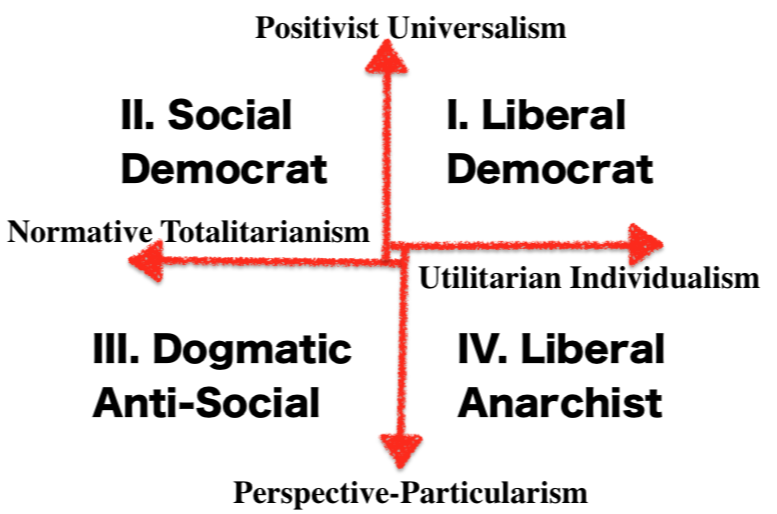
・リベラル=ポピュリストには私には異論
なし(=だが、その判断は美的かつ倫理的判断か?) ・「美学的態度は、自由な創作行動と感覚の享楽判断を是とするのであるからリベルテールの準拠枠」=別掲図の第1象限(=19-20世紀の保守) ・「倫理的態度は、理性的な希望行動と社会的な共苦判断を是とするのであるからポピュリストの準拠枠」==別掲図の第3象限(=19-20世紀の 革命) ・リベルテールと倫理的判断を有するのは「21世紀のコンシューマー」=第2象限(で、前二者には矛盾項に相当する)。 ・リベラル=ポピュリストは「20世紀の前衛芸術家」とりわけスターリンに粛清されたソビエト構成主義芸術家を想像できる。21世紀ではコンピュターアー ティストや路上芸術家(例:バンクシー)がそれに相当するか |
| 【池田原稿】先住民運動からみた日本の保
守とリベラルの位相 |
The Dynamics of Conservatism and Liberalism in Japan as Seen Through the Indigenous Rights Movement |
| 1. 目的:先住民運動というもうひとつ
の「政治的立場」から、保守とリベラルという政治的位相を照射することを通して、21世紀の世界と国民国家(日本)における政治的対立構造のダイナミズム
を明らかにする。 |
1.
Purpose: By examining the political spectrum of conservatism and
liberalism from the perspective of the indigenous rights
movement—another “political stance”—this study aims to elucidate the
dynamics of political conflict structures in the 21st-century world and
within the nation-state of Japan. |
| 2.
方法:保守とリベラルという「政治的立場」の対抗軸に加えて、先住民運動というもうひとつの「政治運動・政治イデオロギー」を導入するというトライアン
ギュレーション化を試みることを通して、それらの3つの立場を観点主義的方法とおして描出する。仮説の検証にいたる具体的な方法としては、インターネット
等のメディア報道における言説分析、関係者への聞き取りをおこなった。 |
2.
Method: By attempting a triangulation approach—which introduces the
indigenous movement as a third “political movement/ideology” alongside
the opposing axes of “conservative” and “liberal” political
stances—this study examines these three positions through a
perspectival approach. To test the hypothesis, specific methods
included discourse analysis of media reports (including online sources)
and interviews with relevant stakeholders. |
| 3.
結果:現代日本における保守とリベラルという位相の割り当てを党派政治に当てはめると奇妙な捩れがある。リベラル派の市民(選挙民)は、自民党の正式英
語名称 Liberal Democratic Party
だと聞いても、その党派には民主主義もリベラリズムもないと多くの人は指弾する。他方、少数派の中道から左派を自認する政党ならびに支持者が考えるリベラ
ルで民主主義的な理想的な政策は、いわゆる五十五年体制において自民党と日本社会党が築いた国民皆保険や社会福祉政策を、今後も護持することである。つま
り何も変えないという保守主義的政策をリベラルを自認する人たちが支持している。この伝統的な保守〈対〉革新の体制は、日本のリベラル・ナショナリズムの
通奏低音であり続けている。そのなかでは、国民統合に棹差す先住民運動は、自民党あるいは超党派の日本会議派においては国家統合の分断分子に他ならず、そ
の支持者たちからヘイト運動を生み出す原因になっている。またリベラル派は、LGBTを含めてあらゆるタイプのマイノリティー擁護を是とする中での先住民
運動を基本的に支持するが、国際基準のダイヴァーシティ容認には、保守志向の選挙民に配慮しつつ、分派主義化には警戒する。先住民運動の側にも日本のマイ
ルドな国民国家への包摂を基調とする政府系の穏健派と海外の先住民運動の影響を受けて国際社会並みの権利獲得ためにはより積極的に政府と対峙しようとする
革新派は存在し、その分断が先住民運動の停滞化をもたらしている。 |
3.
Results: When the categories of “conservative” and “liberal” in
contemporary Japan are applied to party politics, a strange distortion
emerges. Many liberal-leaning citizens (voters), even upon hearing that
the Liberal Democratic Party’s official English name is “Liberal
Democratic Party,” criticize the party, arguing that it embodies
neither democracy nor liberalism. On the other hand, the liberal and
democratic ideal policies envisioned by minority political parties and
their supporters—who identify as centrist or left-wing—are the
continued preservation of universal health insurance and social welfare
policies established by the LDP and the Japanese Socialist Party during
the so-called “55-Year System.” In other words, those who identify as
liberal are supporting conservative policies that seek to change
nothing. This traditional “conservative versus reformist” framework
continues to serve as the underlying current of Japanese liberal
nationalism. Within this framework, indigenous movements that challenge
national unity are viewed by the LDP and the cross-party Nippon Kaigi
faction as nothing less than divisive elements undermining national
unity, and they serve as a catalyst for hate campaigns among their
supporters. Furthermore, while liberals generally support the
indigenous peoples’ movement as part of their broader advocacy for all
types of minorities—including the LGBT community—they remain cautious
about embracing diversity to international standards, mindful of
conservative-leaning voters and wary of fragmentation. Within the
indigenous rights movement itself, there are government-aligned
moderates who advocate for inclusion within Japan’s “mild” nation-state
framework, and progressive factions influenced by overseas indigenous
movements who seek to confront the government more aggressively to
secure rights on par with those in the international community; this
division is causing the indigenous rights movement to stagnate. |
| 4.
結論:21世紀における保守とリベラルの対立は、直接投票による大統領選挙や国民投票が契機になり政治的分断が起こり、サイレントマジョリティが政党を
してポピュリズム化を推し進めることが起因することが特徴としてみられる。そこでは、合理性による理性の政治というものから真理よりも情動に訴える政治
へ、冷静よりも怒りや興奮を基調にするものが多い。そこで使われる政治言説もまた「情動の語彙」が多用される。伝統社会における権力分析としてかつて強み
を発揮した理論枠組みとして、社会人類学におけるV・ターナーの象徴分析ならびに英国マンチェスター学派の政治人類学の手法というものが現代のポピュリズ
ム政治を分析することには有益であることが分かった。 |
4.
Conclusion: A defining characteristic of the conflict between
conservatives and liberals in the 21st century is that political
polarization arises from direct presidential elections and referendums,
leading the “silent majority” to push political parties toward
populism. In this context, politics often shifts from a rational,
reason-based approach to one that appeals to emotion rather than truth,
and is characterized more by anger and excitement than by calmness. The
political discourse employed in this context also makes heavy use of an
“emotional vocabulary.” It has become clear that theoretical frameworks
that once proved particularly effective in analyzing power in
traditional societies—namely, V. Turner’s symbolic analysis in social
anthropology and the methods of political anthropology from the
Manchester School in the United Kingdom—are useful for analyzing
contemporary populist politics. |
| ・先住民表象と先住民運動 ・政治的アイデンティティと先住民運動 |
|
+++
Links
リンク
文献
その他の情報




Copyleft, CC, Mitzub'ixi Quq Chi'j, 1996-2099

☆ ☆
☆

