Tag Archives: book

[June 12, 1971] A Hole in the Head? (July 1971 Amazing)

A black and white headshot of a white man with short dark hair and glasses, wearing a suit and tie.
by John Boston

The July 1971 Amazing, like the previous issue, is fronted by a bright and initially puzzling cover, this one by Dan Adkins, which resolves on closer scrutiny to a stylized human (or robot?) form with a big hole in its forehead and wires plugged into its scalp, with a planet and a crescent . . . something-or-other . . . in the background.  Well, it attracts the eye on the newsstand, which I guess is the point, and I’ll leave it there.

The cover of Amazing Science Fiction Stories.  Featured stories: The Second Trip, by Robert Silverberg; The Peacefulness of Vivyan, by James Tiptree, Jr.; Border Town, by Pg Wyal; The Worlds of Monty Willson, by William F. Nolan; Bohassian Learns, by William Rotsler; and The Science in S. F., by Gregory Benford. The illustration shows a red-shadowed bust of a bald man with wires extending upward from his head, against a red background.
by Dan Adkins

Continue reading [June 12, 1971] A Hole in the Head? (July 1971 Amazing)

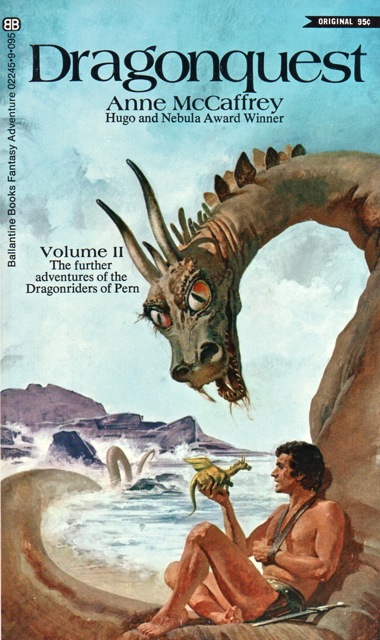
[May 28, 1971] Dragonquest by Anne McCaffrey

photo of a plump blonde man, looking over his shoulder
by George Pritchard

Almost two years after her introduction to the planet of Pern, home of dragons that can traverse space and time in a blink (oh, and their riders are there, too), Anne McCaffrey has returned with a sequel to Dragonflight: Dragonquest.

Cover of Dragonquest, showing a man in a loincloth, holding a small golden dragon in one hand and sitting on the tail of a large brown dragon.
Dragon, man, and fire-lizard! (Cover by Gino D'Achille)

Continue reading [May 28, 1971] Dragonquest by Anne McCaffrey

[April 17, 1971] Mrs. Frisby and the Rats of NIMH (Second May Galactoscope)

The three books in April's second Galactoscope run the gamut from crap to celestial—ahh, but that summit is worth apexing!

Continue reading [April 17, 1971] Mrs. Frisby and the Rats of NIMH (Second May Galactoscope)

[April 16, 1971] The Insane City (April 1971 Galactoscope)

For this edition of Galactoscope, we plumb the depths and scrape the heights.  Read on, for recommendations and warnings!

Five science fiction book covers, all described in detail in the article proper

Continue reading [April 16, 1971] The Insane City (April 1971 Galactoscope)

[April 12, 1971] The Lathe of Heaven (May 1971 Amazing)

Image a lanky man wearing glasses.
by John Boston

The May Amazing grabs the eye with an attractive cover by Jeff Jones that seems to depict some sort of scientific or communications satellite or platform against a bright yellow and orange background—somebody’s exploring the Sun?  No matter, it looks good and should get some attention on crowded newsstands.

Cover of the Amazing magazine.
by Jeff Jones

This is—it says above the title—the “45th Anniversary Spectacular!” Well, not precisely.  The calendrical blunder of several years ago means that this magazine that started with April 1926 no longer has issues in April.  And the celebration is muted, though probably not for that reason.  In past years anniversary issues have been all or mostly reprints.  Fortunately, this issue merely devotes ten pages to a portfolio of reproductions of the covers of past anniversary issues, unimpressive in black and white.  It’s pointless but innocuous, and takes the place of the usual “Famous Amazing Classic” reprint, mercifully given the quality of recent selections.

Ted White’s editorial consists of a commendably compact and lively history of Amazing, warts and all—or as he puts it in conclusion, “unvarnished.” It’s well worth reading, since the post-1930s history of the magazine has been much less hashed over than its earlier days (admittedly, for good reason).

In other non-fiction, the book reviews are back; this time it’s the fanzine reviews that are crowded out.  Dick Lupoff takes on Niven’s Ringworld, asserting that Niven represents the Jules Verne tendency in SF rather than the H.G. Wells tendency, cataloging his virtues and limitations (both considerable), and concluding: “I'm glad that there's a Larry Niven around writing his particular brand of science fiction, but I'm really glad that there's only one of him.” (Just wait—or so I predict.) Alexei Panshin reviews Terry Carr’s second New Worlds of Fantasy anthology, noting that some of it is actually “soft science fiction,” too many are “shallow, gimmicked,” but plenty are worthwhile—either for their treatment of outre ideas or their depth of characterization “and a narrative I could sink vicariously into.” Here’s Lupoff again, praising Michael Moorcock’s Behold the Man, which he says has more to it than to the novella version that won a Nebula: “It is such a good book that it transcends the usual limitations of genre fiction, and one trembles in anticipation of the old couplet: ‘This can't be good, it's science fiction/This can't be science fiction, it's good.’” (The couplet is grossly misquoted.) The longest review is editor White on James Steranko’s The Steranko History of Comics, Volume One, which he describes as “an amazingly thorough job” despite its numerous errors.  In particular, he credits Steranko with recognizing and chronicling the influence of the pulp magazines on comics.

And there is of course the letter column, less interesting than some, since more of it than usual is devoted to readers’ opinions of the stories.  (Since my opinions are obviously correct, these are superfluous.) Most interesting in terms of the magazine’s production is White’s reply to a letter from Carl Glover, who had previously commented on the larger type size and now also notes (as I somehow failed to notice) that the January issue was 16 pages shorter than the previous issues (132 pages rather than 148).  White responds:

“When I initially prepared your letter for publication, we had no concrete plans for increasing the type size, and no plans for cutting back in pages. When we did decide to increase the type size, we intended to do so only for the fiction—retaining the smaller type for the features. But something went awry between our editorial offices and the typesetter, and for one pair of issues—the January Amazing and the February Fantastic, everything was in the larger type. When it became necessary to cut pages too, well, I was left feeling somewhat foolish, and only a piece of last-minute surgery on my reply to your letter in the January issue kept me from appearing yet more foolish. Hopefully, we've now settled down for an issue or two—but keep your fingers crossed. New changes in format are under contemplation, which should result in a superior package—if something doesn't go awry again.”

So the buried lede here is that they’ve cut the magazine by 11% without previous comment or explanation.  This is not a healthy sign for its longevity.

Also interesting is White’s reply to reader Jerry Lapidus’s comments on artwork.  Lapidus did not care for the cover of the January issue, the “totally blah . . . ‘flying saucer’ cover.” (I thought it looked more like a slightly flattened Saturnian planet or something knitted from fuzzy wool, but White says it was a galactic cluster.) More generally, Lapidus complains about the uniform format of interior illustrations (one column in a two-column page format, meaning tall and narrow), which White says is “imposed upon us by the medium in which we work,” without further explanation. 

Continue reading [April 12, 1971] The Lathe of Heaven (May 1971 Amazing)

[March 16, 1971] Furthest: The Other Side of the Sun (Galactoscope, March 1971)

Enjoy these reviews for a lovely quintet of books, two of which are excellent, one of which is middling, and two of which are… to be avoided.

Continue reading [March 16, 1971] Furthest: The Other Side of the Sun (Galactoscope, March 1971)

[February 19, 1971] Tomorrow is too far (February Galactoscope #2)

For February's second Galactoscope, we not only have an Ace Double and a James White novel, but an update from West Germany…

The covers of the books discussed in this article, described more fully hereafter.

Continue reading [February 19, 1971] Tomorrow is too far (February Galactoscope #2)

[February 18, 1971] The Truth About Dragons (February 1971 Galactoscope #1)

For the first Galactoscope of the month (yes, it's a bumper crop, once again), we've got a quintet of tomes for you: 60% are worth your time, and be glad of the warning on the other two!

A banner of the covers of the five stories covered in the article.

Continue reading [February 18, 1971] The Truth About Dragons (February 1971 Galactoscope #1)

[February 12, 1971] Billing and Couping (March 1971 Amazing)

A black-and-white photo portrait of John Boston. He is a clean-shaven white man with close-cropped brown hair. He wears glasses, a jacket, shirt, and tie, and is looking at the camera with a neutral expression.
by John Boston

The March 1971 Amazing leads off with the first installment of Ursula K. Le Guin’s new novel, The Lathe of Heaven, which of course gets top billing—and it’s a coup!  (Nurse, the slapstick, please.) You would think that the instantly near-revered winner of the Hugo Award for her previous novel The Left Hand of Darkness would command the more elevated pages of Fantasy and Science Fiction, or at least those of the fading Galaxy

Unfortunately the cover does not reflect any such refined sensibility as Le Guin’s; it’s another generic one by John Pederson, Jr., featuring a guy (or maybe an alien) in space suit on a barren planet or satellite, leaning on what looks like a gun, unless it’s a stick vacuum cleaner.

Colour cover illustration of the March 1971 issue of Amazing Science Fiction Stories.  The painted image depicts a solitary figure in an insulating outfit (closely resembling a NASA Lunar EVA suit sans pressure seals).  They stand in a landscape of snow and stone, a moon hanging large in the sky, with a hawk-contoured rocket perched on its tail just behind the nearest hill.
by John Pederson, Jr.

This month’s editorial recounts the somewhat tortuous path to publication of Dick Lupoff’s groundbreaking comics history book, All in Color for a Dime, to which White contributed, then segues to an account of his unpleasant experience as a guest on a radio program with a gossipy and airheaded mistress of ceremonies with crude misconceptions about science fiction. 

And speaking of unpleasant experiences: in last November’s issue, Barry N. Malzberg’s article “Dianetics: The Evolution of a Science” recounted his encounter with Dianetics’s successor Scientology.  Apparently the editor was contacted by Scientology representatives (details a little murky), and as a result this issue contains “What Is Scientology,” by the Rev. Robert N. Thomas, Deputy Guardian for the U.S. Churches of Scientology.  I didn’t manage to finish it (not that I tried very hard) and will not comment on it.  The editor says that this item “is not a dispassionate survey or evaluation of Scientology. It was written in rebuttal to Malzberg and is designed to state the Scientologists’ own case as persuasively as it might.” He adds that its publication is not an endorsement of Scientology, that it is published “largely in the interests of fair play,” and that he hopes it will close the Pandora’s Box Malzberg’s article inadvertently opened.

But there’s more: a note from Malzberg himself states that he was contacted by an attorney who accused Malzberg of libelling an interviewer who appeared in a film shown at the Scientology center.  He says: “I wish to put the following on the record: it was not my intention in this article to make any comment or inference on the character of this alleged interviewer, who I do not know and have never met. The article was a self-investigation written within the context of an encounter with modern Scientology. It was autobiographical in intention and execution and I had hoped that the context of this article would have made that clear.” It’s a fair inference that the editor received an equally menacing communication from the notoriously litigious Scientology organization, and that’s why White has given over nine pages of his magazine to this turgid lump of propaganda.

And that is no doubt why the book review column is missing again this month, to my continued annoyance, along with the fanzine review column.  But the letter column “Or So You Say” survived the Scientology onslaught, with the usual mix of the interesting and the tiresome.  With the James Blish/Ted White feud put to bed last issue, now we have Sam Moskowitz tediously disputing Richard Lupoff’s review of his book Under the Moons of Mars and claiming Lupoff is biased because Moskowitz has discredited his theories about Edgar Rice Burroughs’s work.  Lupoff replies, less bombastically. 

Robert A.W. Lowndes, former editor of SF mags and famous for making something out of almost nothing in the way of budget, recounts James Blish’s acerbic comments on the dumbing down of popular taste. There’s yet more about Dr. Fredric Wertham, who attacked comic books in The Seduction of the Innocent: it seems this book contained a picture portraying a man’s shoulders with a detail that, if sufficiently enlarged, sort of resembles a woman’s crotch.  Unfortunately the editor merely tells but does not show us this wonder.  And there’s more on Dianetics, parent of Scientology; but enough of that. 

A reader accuses Bob Shaw of plagiarism of two earlier short stories in his recent serial One Million Tomorrows, based on having read its first installment. Editor White says he hasn’t read the stories, but “Ideas are a dime a dozen in this field; there's not one which hasn't been used many times before and by many writers, often without knowledge of each other.” He also chides the writer for making the accusation based on only half the story.  Another reader wants to know why the new cover logo looks so much like Analog’s.  White responds that it “was designed to fit approximately the same space as the old.  It was designed to be modern, sans-serif, and attractive. Esthetically, that demanded lower-case letters (perhaps you remember our uppercase logo of the fifties?).” And they wanted something that looked good and those design choices inexorably yielded something a bit like Analog's "extremely well-designed package.”

Continue reading [February 12, 1971] Billing and Couping (March 1971 Amazing)

[January 16, 1971] The Sword of the Golem… and beyond (January Galactoscope #1)

What a delicious offering we have for this month's first round-up of science fictions stories!  But first, we have to get through the Ace Double.  A spoonful of medicine makes the sugar go down!

The covers of the five stories discussed in the article, described more fully hereafter.

Continue reading [January 16, 1971] The Sword of the Golem… and beyond (January Galactoscope #1)