Showing posts with label sf. Show all posts

01 September 2024

11.22.63 by Stephen King

11.22.63

11.22.63 by Stephen King
My rating: 5 of 5 stars

Stephen King's books are a mixed bag -- some very good, some very bad, and some mediocre. This one, I think, is one of his best. It's also difficult to classify. It involves time travel, so perhaps it is science fiction, but the time travel is not the result of any scientific discovery, and its mechanism is never explained. Fantasy then? But no, everything else in the story, apart from the time travel, is pretty mundane In that respect, it most resembles The Time Traveler's Wife by Audrey Niffenegger. It's also, to some extent, a love story, so one could perhaps add "romance" to the list of genres covered.

In the story Jake Epping, a school teacher in Maine, USA, is told by his friend Al Templeton about a time gateway, and Al tries to persuade him to go back in time from 2011 to prevent the assassination of President John Kennedy in 1963. The gateway, however, will only take him back to 1958, so if he accepts the task it will take five years of his life.

It has an interesting plot, and I had a great deal of sympathy for the main characters, and even for several of the minor ones.

The story has a great deal of historical information about the assassination of President Kennedy, and to some extent that part of the story was familiar to me. The names Lee Harvey Oswald and his killer Jack Ruby were familiar, as were references to the "grassy knoll" and the Texas Book Depository, not from reading history, but from contemporary news reports.

View all my reviews

03 September 2023

Utopia as Dystopia: R.A. Lafferty's "Past Master"

Past MasterPast Master by R.A. Lafferty
My rating: 4 of 5 stars

A bit like Brave New World and 1984 on steroids.

Astrobe is the new Earth, and a paradise where poverty is unknown, and wealth and comfort are freely available to all. The paradise is marred, however, when increasing numbers of people, like the savage in Brave New World, reject this, and opt for a life of voluntary poverty, deprivation and disease.

A group of leading citizens decide to bring Sir Thomas More, the English lawyer and martyr who wrote the original Utopia from the past, as the eponymous "Past Master" to help them to solve this problem. More arrives, and discovers that the paradise is not all that it seems. Those who doubt the vision become the target of programmed killing beasts and are eliminated from the society, rather as More was eliminated from his own English society back in 1535.

The Astrobian Utopia has a far better surveillance system than 1984 and can detect treasonous thoughts before even the thinker is aware of them. This seems to be significant for the role of so-called "AI" in our current society, and it is worth reading for that reason. R.A. Lafferty raises the kind of questions we should be asking about "AI".

There are more interesting parallels with out society. In South Africa there is a widening gap between rich and poor, though in Astrobe it is large still yet entirely voluntary. Thomas More, after first encountering the contrast, remarks:
I was never an advocate of wealth and fineness. I believe fully in holy poverty. But I say that poverty is like drink: a little of it is stimulating and creative; too much of it is depraved and horrifying.
And More has a better name for what we misleadingly call "AI" -- eloquence machines.
At this one thing for which Astrobe has a hunger now, high oratory, we were the professionals and you are the amateurs. I know that you have analyzed the thing and broken the personal aura down into its elements. It is like chopping up a bird, but can you make a bird? Perhaps you can, since you made the Programmed Persons, but we recognize them as artificial. I know you have built intricate eloquence machines, man, but they ring false. The laughter of the people at them like autumn leaves blowing is evidence of this. I've heard the eloquence machines, and I've heard the people's response. I've heard human and programmed orators who have studied under the eloquence machines. I've heard a lot of things in one week on Astrobe. People are hungry for the real thing...
And then there was the tantalising hint of more: "Evita had been battling principalities and powers for a long time, and it showed on her. And yet she didn't appear more than seventeen."

25 November 2022

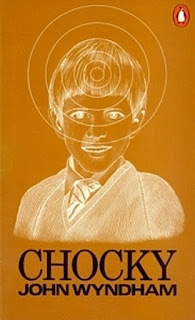
1950s sf written in the 1960s: Chocky, by John Wyndham

ChockyChocky by John Wyndham
My rating: 4 of 5 stars

Back in the 1960s, when I was young, I read quite a lot of science fiction. and in many ways the 1950s and 1960s were vintage decades for science fiction. Later I rather lost my taste for it, or else the genre itself changed, and the newer productions did not appeal to me so much. One of the sf authors I liked most was John Wyndham. I recently re-read a couple of his novels to see how well they had stood the test of time, and found them surprisingly old-fashioned. In hindsight, the writing seemed to have the flavour of the 1940s, very much mired in the time it was written, like the writing of Nevil Shute.

But when I found Chocky in a second-hand bookshop, I was interested because I had not read it before, and it was also published later than most of the others, in 1968, which was the year of student power and student revolution. So I wondered what the atmosphere of the story would be like. And it seemed to be describing British middle-class life in the mid-1950s.

One of my reasons for reading it now is that I am writing a series of children's novels set in the 1960s, and so I am interested in books published in that period, and the kind of language they used. One of the ones I've looked at is The Weirdstone of Brisingamen by Alan Garner. In that one, the language has hardly dated at all, and it could have been written in almost any decade since then. Not so the works of John Wyndham.

Another thing that I found interesting from the point of view of a writer is that several of the people who have read my children's books have commented that in the stories the children seem to have a lot of freedom, and are allowed to roam around freely without adult supervision. They have suggested that this makes the stories seem rather unrealistic. So I was interested to see that in Chocky Matthew and his sister Polly are given what is possibly an even more unrealistic degree of freedom, even after being in danger. And this in a book that is not merely written about the period, but in the period itself.

In the story an 11-year-old boy, Matthew Gore, starts talking to an invisible friend. His parents are concerned, because though his younger sister had an invisible friend, it was at a much earlier age, and she had already got over it. Also, as the younger sister Polly informs the family, when she had an invisible friend, she talked to her friend, her friend did not talk back to her. Matthew, however, is heard arguing with his invisible friend as though the friend is talking back to him.
His parents are worried because "hearing voices" could be a sign of mental disorder, and their concern makes Matthew sometimes wonder if he is going mad. Then his teachers at school start complaining about his school work. He starts solving mathematical problems using unorthodoc methods, he argues with his geography teacher about the location of earth, and with his physics teacher about the speed of light.

The end of the story is predictable and slightly disappointing, and the thing I liked most about the story was the attitude and character of Matthew himself.

There is one other respect, however, in which the story seems dated, and especially not fitting its 1968 publication date, and that is the sexist language. I've read many other 1960s authors, and few of them are as sexist as this. Yet another characteristic that adds to the 1950s "feel" of the book.


View all my reviews

14 September 2022

The Dispossessed: an sf novel on two dystopian cultures

The DispossessedThe Dispossessed by Ursula K. Le Guin
My rating: 4 of 5 stars

One of Ursula le Guin's better novels, I think.

Two planets orbiting the same sun act as moons to each other, and the inhabitants have split because of political and cultural differences. Anarres is dry and austere, and its inhabitants are libertarian and socialist. Urras is lush and green, and its inhabitants are authoritarian and capitalist, or propertarian, as the Anarresti like to call them.

Shevek, a physicist on Anarres , feels that his research and discoveries are unappreciated at home, and makes a journey to Urras to meet physicists there, but finds that the Urrasti want to use his discoveries to increase their own power.

The people of both Anarres and Urras have adopted a kind of apartheid, and want to keep their cultures and political systems separate, so that neither will be contaminated by the views and principles of the other. . The culture of Urras is closer to that of the world we live in and so is easier to depict; the culture of Anarres has no real life model, though certain aspects of it have been advocated by some anarcho-syndicalists, thus it is harder to depict in a convincing way. But authoritarianism manages to creep in there, under the guise of protection of liberty. Though I'm inclined to favour anarcho-syndicalism myself, I've never really tried to envisage just how such a society would work. Ursula le Guin makes a valiant attempt, but it is not quite convincing enough. For the most part Ursula le Guin does a fairly convincing job of showing how such diverse cultures might interact with each other.

Apart from space travel, le Guin does not envisage much technological development in society, and most of the technology -- transport, communications, computers, and the like, are much as they were in the mid-20th century on earth. Anarres has abandoned the week, and based its time measurement on units called decads, presumably of 10 days. But they also speak of "years" when referring to the age of people, and though it seems that these years must be fairly similar to earth years, it is nowhere stated that they are, or how it relates to the orbits of Anarres and Urras.


View all my reviews

06 May 2022

A Dystopian View of the Generation Gap: The Midwich Cuckoos by John Wyndham

The Midwich Cuckoos

The Midwich Cuckoos by John Wyndham
My rating: 5 of 5 stars

When I first read The Midwich Cuckoos, sixty years ago, I thought it was one of the better sf novels I had read. That was so long ago that I'd forgotten most of it except the main plot outline. Now it reminds me of Arthur C. Clarke's Childhood's End -- both are about a strange generation of children appearing in the world.

I thought John Wyndham was one of the better science fiction writers, though in re-reading The Kraken Wakes I found it rather pedestrian. The Midwich Cuckoos is better, but still slower paced than I remembered.

What I liked about Wyndham's books, however, is the same thing that I liked about Charles Williams's books - they are set in this world. As with fantasy, so with science fiction, I'm not particularly interested in outer space -- the sf books I've enjoyed most have all been set in this world -- Brave New World, A Canticle for Leibowitz and so on. And I read them all in the early 1960s, and have reread most of them several times since.

But John Wyndham belonged to my father's generation, and now I notice that many popular British novels of the 1940s and 1950s have characteristics that strike me as odd now. Not Tolkien and C.S. Lewis, but John Wyndham, Nevil Shute and others. Apart from all their descriptions of people smoking, they are all conscious of class, and written from a self-consciously upper middle-class point of view, seeing themselves as the "educated class" and the others as uneducated. They often have a Sir Somebody-or-Other in them who is respected for his expertise in a particular field, almost as though one cannot be an expert in anything unless one is a Sir. Wyndham would have been at school during the First World War, and was in the army in the Second, and so in addition to the division between the "educated class" and the rest, there is also a "Service" point of view that the main characters identify with.

Wyndham also now appears to me as sexist, not overtly, but quite subtly so. One of the minor characters in The Midwich Cuckoos has a PhD, and I get the feeling that Wyndham sees her as an oddity. That is a perhaps a generational thing, and perhaps The Midwich Cuckoos and Childhood's End speak of how people of Wyndham and Clarke's generation approached the generation gap.

In my own life, the 1950s now seem a foreign world to me. That was when I was at school, and the adult world of "business" seemed strange and alien to me. My mother used to dress up to go to town, and to go to church, and I hated dressing up, from about the age of 11 onwards. I was most comfortable in khaki shirt and shorts, which we wore at Mountain Lodge school most of the time. Shorts were uncomfortable for riding horses, and at first I went for jodhpurs, because that is what one did, but Mr Groos, who taught me riding, wore riding breeches. But later I found jeans more comfortable. And perhaps our whole generation was like that, because by the late 1960s everyone was dressing as I had imagined I would like to dress when I was 11 or 12.

In 1962 when we went to church in casual clothes people stared at us, but now everyone dresses like that, and most people I know tend to speak rather disparagingly of "suits". The change came between 1962 and 1967, and has persisted ever since. But perhaps Wyndham and Clarke could see it coming in the 1950s, a strange and alien generation of children growing up to become flower children rather than "Service" children. Books written before 1962 have a different style. Nowadays people speak a lot of different generations, giving them letters, X, Y, Z and so on and I have little idea of what they mean. My own generation seems to have no name and no letter. Back in the day of Childhood's End and The Midwich Cuckoos we did have a name, however. Those born after The War were "baby boomers", and we were "war babies", but since the 1950s no one has spoken of that distinction much, yet for me, at least, that distinction is far more real than the XYZ one, which seem quite indistinquishable to me. If one wanted to give our generation a name today, I suppose it would be the Beat-Hip generation, falling between the Beat Generation and the hippies. Roughly the time when "hipster" got shortened to "hippie", and before it go lengthened again.


View all my reviews

21 April 2012

The seeds of time: book review

The Seeds of TimeThe Seeds of Time by John Wyndham

My rating: 4 of 5 stars


In my youth I liked John Wyndham's science fiction stories, and when I picked this one off a dusty shelf to catalogue it on GoodReads, I decided to re-read it before putting it back. The seeds of time is a collection of short stories, and I had forgotten some of them, and had only vague memories of the rest, so it was almost like reading them for the first time. And I enjoyed them just as much as when I first read them some 40-50 years ago.

And that made me wonder.

When I was in my teens and twenties I read quite a lot of science fiction, both short stories and full-length novels. Now I hardly read any. On the rare occasions that I browse the science-fiction shelves of book shops I usually don't come away with anything. On the even rarer occasions when I have bought recently-published science-fiction, I've usually been bored, and abandoned the book.

Have I changed, or has the genre changed?

At first I thought that I had lost my youthful taste for science-fiction, and that it was probably something one grew out of, but re-reading these stories by John Wyndham showed me that that isn't the case. So the genre must have changed, or everything that can be said has already been said and the new stuff is just boring repetition. Or else, most likely, popular culture has moved on and left me behind. What a drag it is getting old, as the Rolling Stones (anyone remember them?) used to sing.


View all my reviews

LinkWithin

Related Posts with Thumbnails