Showing posts with label writing. Show all posts

04 May 2026

Writing as a business

 In my long and unsuccessful career as a fiction writer[1] I have read many books that purport to give advice to writers and would-be writers. Some of the advice has been good, some bad, though people might disagree with my criteria for what is good or bad, but one of the worst pieces of advice (in my opinion) was that "writing is a business", and that writers must therefore do market research to find what is selling at the moment, and write books that will sell. 

And the "traditional" publishing world works like that. Authors (or their agents) submit their work, and the first question they ask, in evaluating the work, is "will it sell?" Though they sometimes make mistakes, their experience of the book market is such that they usually have a pretty good idea of what will sell, and most of them have a marketing and publicity section that works hard to get the book into the hands of willing buyers. 

If they don't think your book will sell, but you still want to publish it, until about 20 years ago you had two options -- vanity publishing or self-publishing. Vanity publishers would publish your book for a fee, which would cover their costs of production and also their profit. They do minimal marketing, that is up to you. In self-publishing, you get your book printed bound and  sell it by whatever means you can.

More recently self-publishing has become easier with print-on-demand for  paper books, and ebooks. You submit your book, they print and distribute it at no cost to you, and keep a percentage of each book sold, to cover their costs and profit. And that leaves you free to decide whether writing, for you, is a business or not.

More recently still, however, Large Language Models (LLMs) like ChatGPT, Claude, CoPilot and many other examples of "generative AI" have outsourced the writing to machines. If you think of writing primarily as a business, then you don't need to write the book yourself, you get the machine to do it.  And so you find ads like the one on the right, for writing prompts to feed into AI bots that will, you hope, cause them to spit out the kind of book that will sell.

If you see writing as a business, and that is what you are looking for, you will find the kind of thing advertised on the right here.  And no, I'm not getting paid for displaying the ad or providing the link, I'm just putting it there to illustrate the "writing as a business" model, and to show where it leads.

Many people, including, no doubt, some who accept the "writing as a business" model, are shocked and horrified at the idea of generative AI writing books for them, and speak as though AI were something evil in itself. I don't share that view. I think AI is as good or as evil as the humans who use it, and determine the uses to which it is put. If you think writing is a business and that the primary purpose of writing is to make money, then you should have no more objection to having bots write books, than to having bots assemble cars and pack cornflakes. 

But the reason I write is not primarily to make money. It is more like a conversation between C.S. Lewis and J.R.R. Tolkien in which one of them, I forget who, said that if they they wanted more of the kind of stories they liked, they should have to write them themselves. I write because I want more of the kind of stories I like, and I write for the kind of people who like those kinds of stories. I would rather sell 50 books to people who like the stories in them and enjoy them than sell 5000 books to people who will never read them.

If I see writing as a business, then I must write what sells, or get a bot to write the books for me.  But I don't see it primarily as a business. I don't want to write what sells; I want to sell what I write to those who might enjoy reading it. That means targeted advertising, in order to find the people who might like such a book, and tell them that it exists and where to find it. But how? 

There are also ads for bots that will run your advertising for you. Sell more books. 

Out of curiosity I followed a couple of them up, and saw the kind of questions they asked in order to "draw up a business plan" for advertising. And the questions did not inspire confidence. They asked how many did you want to sell and how much did you want to spend. They did not ask what I was selling. 

At the beginning of this article I put "traditional publishers" in quotation marks, because while most people speak of the alternative to self-publishing as "traditional publishing", it is not really "traditional", but is rather commercial publishing. Traditional publishers, while they hoped to make a living from publishing, did not have that as their primary aim. They very often started their publishing house with the aim of making certain kinds of books available, usually the kind of books they liked to read, or books that they thought people ought to read. 

When the founders died, others took over, sometimes members of their family, or sometimes partners. Sometimes the original vision would remain, or in other cases it would become diluted as the publishing house was run by people who had different interests or a different vision. But though some of the names remain, very often the vision doesn't. If you look at the back of the title page of recently published book, you will find the publisher information, which may have the name of a "traditional" publisher, but you discover that it is a "Hatchette Company" or some other part of some other large conglomerate. If you really want a "traditional" publisher you might need to look for a small independent press, and not one that is a small part of a large conglomerate whose interests may extend into other fields than publishing. 

 The problem for those who don't see  writing primarily as a business is to find readers for the stuff they write. And that is often passed on by word of mouth -- people who liked a book telling others, recommending it to others, writing a bit about it on social media, asking for the book in libraries and bookshops, or even donating used copies.

So if you've read any of my books and liked them, please tell others, discuss them with friends, share links to them on social media and if possible write a review and post it on a blog, or a site like GoodReads.

And if you haven't read any of them, have a look at the right-hand column of this page, where they are listed, or see my author page here. 

----------------------

Notes 

[1] My long and unsuccessful career as an author began when, at the age of about 5-6 I began to write fan fiction based on my favourite stories at the time (some of which attempts I still have). I wrote short stories for school essays, and made a few attempts at writing novels, mostly unfinished. I wrote tracts, mafazine articles and news articles as a journalist, and a non-fiction book, Black Charismatic Anglicans, which was published by Unisa Press in 1990. The first novel I actually completed was Of Wheels and Witches, completed in 1999, published as an ebook in 2014. A second edition is due to appear some time.

10 January 2026

Abandoned books

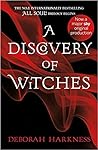
There are many reasons one might abandon a book before finishing it. When I do, it is usually because I find it boring, or because I have a lot to do and after a few busy days or weeks have lost the urge to read it. But here is a book that put me off before I reached the end of the first page.

A Discovery of Witches (All Souls Trilogy, #1)A Discovery of Witches by Deborah Harkness


I'm not going to rate it, because I haven't read it.

I don't usually write reviews for books I haven't read, but I thought I would say why I don't think I'll finish this one, and in fact I didn't get further than the first page. There were two things on the first page that put me off.

"...the summer crush of visiting scholars was over and the madness of fall term had not yet begun."

The speaker, the first person protagonist, is apparently something like a visiting scholar, and is in the Bodleian Library at Oxford University in England. Oxford University does not have a "fall term"; it has a Michaelmas Term. Calling it a "fall term" tells me either that the supposed scholarship of the protagonist is phony, or the author has done a poor job of research for the book.

I suppose one could argue that the author is American, the character is American, and the envisaged (or should that be envisioned?) readers are American, so "fall term" would be understood by them all, whereas "Michaelmas term" might not be. But what would be wrong with "...the summer crush of visiting scholars was over and the madness of Michaelmas term (as the fall term is called at Oxford) had not yet begun." It makes the characters and the setting more authentic, and the readers learn something about the setting. 

And then the visiting scholar or whatever she is thanks the librarian for getting the books she had ordered, "flashing him a grateful smile". I'm not quite sure why, but that phrase put me off completely. It's the kind of language I associate with badly-written and poorly-edited self-published Y/A fantasy novels (for an example, see my review of The Enchanted Crossroads).

I found more examples of such usage in another such book I read recently, The Raven Moonstone, which had phrases like I tossed Jesse a questioning look and Jesse shot me a dopey grin. 

The thought of another nearly 700 pages of the same put me off. If it were 200 or even 250 pages I might persevere in the hope that it would improve, but this fat book is just too long. I read one Twilight book, and that was enough.

But perhaps if I post this here someone who has read it might tell me that my judgement is too hasty, and if I read on it might improve, and I might even enjoy it.

I read somewhere that Stephen King said that Fritz Leiber had written some good books, so when I found Ill Met in Lankhmar in the library I took it out and began to read it, but didn't finish it. Leiber may have written a good book, but this wasn't it.

But there are some bad books (or at least books that I have thought bad) that I've not only finished, but have actually read twice, mainly because I couldn't believe they were as bad as I thought them after the first reading. More on that here: On Reading Unbelievably Bad Books. 

04 June 2025

Travels in the Free State and KZN, May 2025 (Part 2)

 (Continued from Part 1)

Val Hayes & Cath Stempowski
On Wednesday 14 May we had tea with Huberto and Cath Stempowski at Cowies Hill. We had met them at Clarens, where they had also gone for the memorial to Peter Walters. 

Cath is an artist, and worked in various media, and showed us some of her pictures. She said she would be interested in playing with a possible illustration for the cover of the second edition of my children's book Of Wheels and Witches, which is being prepared for publication by Shack Simple Press in Texas, and she suggested some styles that could be used.

The story is about four children who have adventures in the Southern Drakensberg back in the time of apartheid, and spend some time riding around on horses, so the illustrations could show them on horseback or on foot, at any point in the story. Cath had one picture of a horse that suggested one possible style that could be used.

We drove down from Cowies Hill into Pinetown, and there found Sandy's Supermarket, which had been there forever. In the same shopping centre was a Spur Steak Restarant, so we had lunch there. We had their old folks special -- coffee; 124g steak with salad and chips, and ice cream, for R129.00, which was less than half the cost of the single course we had had at Granny Mouse's Country House the previous day.

Revd Theophilus Ngubane

Back to Theo Ngubane's place for supper, and more talking afterwards about old times together in the Anglican Diocese of Zululand in the 1970s and 1980s. Theo was amazed that Steve remembered the names of many people that he had forgotten, and said that most of those we had known had died. The only one left was Hamilton Mbatha, who had been Rector of KwaMagwaza Parish and rural dean of the Mthonjaneni Deanery when we had been there. Hamilton, Theo said, was still active in his retirement, and was often asked to preach in various places. Remembering names was easy because it was a close-knit community, and people often gathered at the diocesan conference centre at KwaMagaza. It was a place where we had many friends, and felt closer to people than in the big city. Once the burglar alarm went off at our neighbour's house in Kilner Park, in the Great City of Tshwane, and we phoned the neighbour to let him know, and he said he had moved away two years previously. Big cities are very anonymous places.

Perhaps one thing that has made it easier to remember people's names is that we had taken photos of many of them, and looked at the photos occasionally to remind ourselves of them.

Nagina, near Pinetown, with yellow roadside flowers
On Wednesday Theo asked us to lead morning prayers, so we read the Hours of Pascha, with its repetitions of "Christ is Risen". After breakfast Theo took us in his son's car, a Yaris that was newer than ours, up to Maritzburg, up a back road from Nagina near Pinetown, where Theo lives, , the M61 West via Shongweni Dam, where we could see all the houses built on what until quite recently were bare hillsides. The hills were very steep, and there were lots of yellow flowers at the sides of the road, a bit like the orange zinnia-like ones in Gauteng, except that these were a bit more like daisies.

At one place Theo pointed out sewage pipes coming out of houses and emptying into the gutter of the road, and said that people bribed the municipal inspectors for such things. Up at the top,just before joining the N3, there was a new shopping mall, Westown, a huge affair out in the veld, with access roads being built to it from Hillcrest and other places.

Macrina Walker, Val Hayes, Carl Brook, Theo & Steve
From there we drove along the N3 to Hilton, and much of it being worked on, so it was reduced to 2 lanes, with the left lane being mostly occupied by 26-wheeler trucks. We went to Sweetwaters to see Carl Brook and his wife Elma. He is now head of ESSA (the Evangelical Seminary of South Africa). after having worked in Swaziland for a while. We had last seen them in 2008 when they were living down the South Coast. I had first met Carl online back in the 1990s and he was researching monastic and other intentional communities in southern Africa, and we had later met face-to-face a few times.

Val Hayes & Macrina Walker at Macrina's new cottage
After a while Macrina Walker, who lives just down the road, joined us, and we took her to lunch at a place called "The Upper Millstone" where they served sandwiches and coffee which for the four of us cost little more than lunch for one at Granny Mouse's Country House.

 Macrina took my book of St John Chrysostom's Liturgy and said she would rebind it for me. She was looking for an apprentice  of sorts to do that kind of work, as she is now mainly binding new books that she sells overseas, through her bookbinding service Annesi Bindings.

 Macrina is another person we had first met online, when she was a Roman Catholic nun in the Netherlands, and thinking of becoming Orthodox.

Theo Ngubane, Linelle Irvine, Val Hayes
We went across to Hayfields to see Linelle Irvine, who had been at varsity with Steve back in the 1960s, and hadn't seen each other for nearly 60 years.  She was living at the Lutheran Gardens Retirement Home, opposite the Lutheran Church. She had spent most of her working life as an English teacher.

We were very much having a "seeing people" holiday, visiting old friends and family that we hadn't seen for a long time, as many as said they would like to see us.

Darryl & Anne Honey, Val Hayes. Sarnia, 15 May 2025
On Thursday 15 May we visited another old friend, Darryl Honey. He had been a neighbour of Steve at Culemborg Flats in Sandringham, Johannesburg, and later in Cheltondale. And we reminisced about old times and people we had known. We had found him on Facebook -- he was one of the people Facebook said we might know, as we had a mutual friend Tony MacGregor. Darryl said he had actually been friends with Tony's brother Chris MacGregor, through his interest in jazz, and said he had had a jazz guitar when he was younger, but when his bike was stolen his father had refused to get him a new one, and he had swapped his guitar for a bike. That is one of the main uses of social media web sites like Facebook -- they help you to re-establish contact with people you had lost touch with.

Val Hayes, Tim & Celia Sparks
In that afternoon we had tea with more old friends, Celia Sparks and her son Tim. Steve had first met Celia when a mutual friend, Martin Goulding, had commandeered her garage to repair Steve's old car, a 1961 Peugeot 403 station wagon, which needed new main bearings, not a job which could be done out in the street. 

Tim had been interested in Orthodoxy, and had visited a monastery near Pretoria. He is now a poet, and we talked mostly about books of Charles Williams. 

On the Saturday we left Theo’s home in Nagina and went to the other side of Pinetown to visit Val's sister Elaine and her family.

Val Hayes, Elaine Machin, Wyatt Anderson
They have an interesting family arrangement as Val's niece Lesley and her husband Jay have a house with a small second house on the premises and their mothers live together there. This gives security to the ladies and also provides for baby-sitting for their mutual grandchild Wyatt, who certainly does not suffer from the lack of love and attention from two grannies.

Elaine has not been well for the past few months, and also had a very bad fall which left her face bruised and cut . I had been very concerned for her, but was happy to see that she is well and recovering. She is very artistic and I encouraged her to pick up her paints again and spend time doing something she really enjoys.

They spoiled us with lovely tea/lunch and it was great to catch up on so many years since we were last together (13 years). Wyatt is a beautiful, active, enquiring little boy.

Wyatt and his other granny, Averil Anderson


(continued in Part 3)

31 January 2025

Fantasy Adventure Stories for Kids

I've written a series of three fantasy adventure stories for kids. They are not a trilogy, and not a series, or at least they don't have a series title, though if anyone who as read them has any suggestions, I'd be open to them. 

The books feature four children who are unrelated to each other, but become friends, partly through sharing adventures together, though sometimes their friendship is strained. The stories are also historical novels, being set in the mid-1960s. The first two, Of Wheels and Witches and The Enchanted Grove (ISBN 978-1-920707-65-1), are set mainly in the southern Drakensberg of South Africa, where the apartheid system dominated the lives of people, and this is reflected in the lives of the children too. In the third book, Cross Purposes, the scene shifts, though the background is no less authoritarian.

Now the first book in the series, which went under the title Of Wheels and Witches, is out of print, but a second edition is in the press now. One of the things it needs is a cover illustration, and I was thinking of how to describe the kids for an illustrator. I started by describing them to an AI app, and after about 7-8 attempts it came up with this, which represents fairly accurately how I and some of the readers pictured the kids. 

The children are shown oldest to youngest, their ages as in the first book. 

On the left is Sipho Mdluli (12), grandson of a peasant farmer in the foothills of the Natal Drakensberg. His father has been banished to the Northern Transvaal by the apartheid government.

Next is Jeffery Davidson (11), son of a Johannesburg businessman, whose parents have sent him to stay on a farm that takes children as guests while they go gallivanting overseas. 

Then comes Janet Montgomery (10), daughter of a rich white farmer on a farm next door to the one where Jeffery is a guest. 

On the right is Catherine Kopirovsky (9), whose grandparents were refugees from Bolshevik Russia. She is an orphan, as her parents were killed in a car crash, and she stays with an aunt and her grandmother in Oxford, England, but has come to South Africa to stay with another aunt, Irene Sanderson, who runs the farm where Jeffery is a guest. 

After writing three books about them I've grown quite fond of them, and haven't abandoned them completely. Some of them appear as minor characters in other books I've been writing. So it's nice to have a picture of them, more or less as I saw them when writing the books, and I hope that the picture can be used by whichever illustrator gets to do the cover picture. 

They don't have to be shown walking. They could be running from the villain(s), who, in the first two books include the apartheid police and a witches. Or they could be riding horses, or having a picnic by a river, or exploring caves in the mountains.

Here's another of the AI app's attempts at picturing them. I don't like it quite as much as the top one, but I hope it would be enough to give the illustrator an idea.

One of the reasons for posting this is that the use of so-called AI in book publishing is quite controversial. 

Some people, it appears, use AI to write and illustrate stories, with virtually no human input at all. I've seen apps and web sites advertised that claim to be able to do this, and you can submit 10 or 20 books to publishing sites like Amazon KDP every day. 

But AI is a misnomer. It may be artificial, but it isn't intelligent. The creators of AI bots just pour millions of written texts into the machine to make word salad, and it analyses them to try to rearrange the words in a way that make sense to human readers. They don't make sense to the machine, they don't have to.

I haven't tried to do that. I think there are uses for AI in book production, but mainly in research and providing models, as these pictures could be models for an artist doing a picture to illustrate a book or book cover. It could possibly be used for abstract pictures but really it's better producing models. For text, what I might try asking an AI bot to produce might be something like a letter written be a farmer in Scotland, or a clergyman in the English Midlands (would it nick stuff from Trollope, I wonder?) and hope to have a model, though one would still need to be wary of anachronisms, like sneaking in a "snuck". 

Anyway, meet my characters. And if you'd like to read about them, see here, or here.


08 March 2024

Advice to would-be horror writers

The Abominations of Yondo

The Abominations of Yondo by Clark Ashton Smith
My rating: 3 of 5 stars

When I first bought this book, about 50 years ago, I disliked it intensely. If I were reviewing it then, I would have given it one star.

I bought it because I liked horror stories, or thought I did, and the blurb led me to believe that I had found some good ones. When I began reading them, however, I was put off by the author's style. He tried to build an atmosphere of horror by piling adjective on adjective which became so cloying as to be almost meaningless, so by the time one reached the end of the story there was no horror left.

My taste for horror was shaped by reading Dracula and a collection of short stories edited by Dorothy Sayers, called Detection, Mystery, Horror. For more on that, see A Taste for Horror. Clark Ashton Smith did not appear in it, and his stories were disappointing by comparison.

Years later, when I became a professional editor, I read books on writing to help me in my work. I read warnings against this practice of piling on the epithets, and advice to use them sparingly. When I read that advice I thought of Clark Ashton Smith and thought I knew exactly what they meant.

Later, in the 1990s, a friend, who was researching new religious movements, told me about H.P. Lovecraft, who, he said wrote some passably good horror stories as well as a lot of third-rate dreck. His interest was sparked by the phenomenon of some readers thinking that a fictional book mentioned in some of Lovecraft's stories, the Necronomicon, actually existed, and developed a cult based on it. 

I got a book of Lovecraft's stories from the library and read it. I agreed with my friend's assessment, and when I discovered that Clark Ashton Smith was an associate of Lovecraft, I decided to try and read his stuff again, and found it not quite so rebarbative as I did the first time.

Nonetheless, I would urge any would-be fiction writers who have wondered about the advice to be sparing with adjectives and adverbs to read books like this with that advice in mind. Not all of Clark Ashton Smith's stories are overflowing with superfluous modifiers, which showed that he could write quite decent prose if he wanted to. But in re-reading this one I did note some over-the-top examples, like:

corroding planets
dark orb-like mountains
abysmal sand
hoary genii
decrepit demons
leprous lichens
unmentionable tortures
unknown horrors
immemorial brine
undetermined shadows
abominable legends
cacodemoniacal night
forbidden inferences
and eldritch anything at all

Many have the prefix un- or the suffix -less (nameless is another favourite).

Smith and Lovecraft gave rise to the Eldritch School of horror writers, and many have tried to imitate them since then, with unmentionable results. Perhaps it was this that inspired another prolific author of horror stories, Stephen King, to advise aspiring writers to go through their manuscripts and remove every forbidden adverb they found.

View all my reviews

06 September 2023

Good Advice for Fiction Writers

More on How to Write a MillionMore on How to Write a Million by William Noble
My rating: 5 of 5 stars

When I got a job as an editor of academic texts I began looking at books in the university library with advice to writers and editors. I could recognise bad writing when I saw it (even as a student, having to read obfuscatory prescribed texts), but as an editor my job as to improve it, and turn a bad text into a good one.

As a result, I read quite a lot of books on writing, both fiction and nonfiction, and when I saw this one going cheap on a book sale, I bought it. I would not have bought it at the full price, because the title put me off. I thought someone really needed to edit that (a million what?). But on sale it was cheap enough that there was nothing to lose, and I'm glad I did, because it really is one of the better books on the subject.

It is actually 3 books in one, by three authors I had never heard of. The three books in one binding have separate page numbers, indexes and tables of contents. They are on Description, Revision and Setting. As an editor, I read the Revision one first, and also used it when revising my first novel, Of Wheels and Witches, and have just reread it for working on a second edition.

They give sensible advice. For example, nearly all books on writing give the advice (or sometimes a command) to "Show, Don't Tell", and this one covers it from three points of view -- in description, revision and setting. But here it is not overly prescriptive about it. It is more helpful than that, and gives advice on when to show and when to tell, and also how to do both showing and telling, when each is most appropriate.

I recommend it for both beginning and experienced fiction authors, but nonfiction authors and editors could also benefit.


View all my reviews

10 August 2023

Celtic themes in fantasy literature and literary genres

Here's an interesting review of a collection of essays on the influence and use of Celtic mythology, or themes from Celtic mythology in fantasy literature. 

I'm unlikely to find the book in a bookshop, or to be able to afford it even if I could, but I found the review itself very interesting and informative, and it sparked off several ideas. If you find these things interesting, you might like to read the review. and possibly the book if you can get hold of it. Strange Horizons - Imagining the Celtic Past in Modern Fantasy edited by Dimitra Fimi and Alistair J.P. Sims By Debbie Gascoyne:

In her introduction to this useful and insightful collection, co-editor Dimitra Fimi writes: “This edited volume aims to open a conversation about fantasy's multifaceted and enduring fascination with the Celtic past, and its various perceptions” (p. 4). Fimi notes that, while previous scholarship (including her own 2017 monograph) has focused on work written for children, the essays in this volume examine texts aimed at adult readers. The collection is divided into four sections: the first deals with what is loosely defined as “intrusion fantasy,” in which a Celtic “otherworld” overlaps with our own; section two looks at “worldbuilding” and the way authors use Celtic elements to create a fantasy world; section three has discussion of works in languages other than English; and the fourth and final section looks at how “the fantastic is situated within cultural practices perceived as Celtic” (p. 5).

The first thing that struck me about that was the notion of "intrusion fantasy", a term that I was unfamiliar with, but which seems to me an apt description of the novels of Charles Williams and the early children's novels of Alan Garner, which are among my favourites. It also seems to describe most of the fiction I have tried to write (examples of which you can see in the side panel on the right).

 Since  I had not heard of "intrusion fantasy" before I did a web search to make sure that it meant what I thought it did, and came across some interesting web sites, such as this one: Bring These 5 Intrusive Fantasy Books Into Your World

If you’re wondering what intrusive fantasy is—apart from sounding like something very rude and impatient—you’re not alone. In Rhetorics of Fantasy, Farah Mendlesohn argues there are four categories of fantasy, one of which is “intrusive.” (The others, in case you’re interested, are portal, immersive, and liminal.) If a portal fantasy is one in which the protagonist and the reader travel from the ordinary world into a magical one (Alice in Wonderland and The Lion, the Witch, and the Wardrobe are classic examples), then an intrusive fantasy is the reverse. In intrusive fantasy, magic comes from an Elsewhere into the ordinary world, changing it and the protagonist forever.

Of the five books mentioned there, I've read 1.15. I read The Historian by Elizabeth Kostova about 12 years ago -- see my review here: At last, a good vampire story. I did find Jonathan Strange & Mr Norrell among the new books in our local library, but it is an enormously long book, and after reading 150 pages and realising it would take forever to finish, I returned it to the library to give other readers a chance.

For more on Farah Mendlesohn's four categories of fantasy, see here.

Concerning Celtic mythology and its use by fantasy authors, Debbie Gascoyne goes on to say:

Several of the chapters in this volume make it clear how many of the most popular ideas about “Celtic mythology” or “Celtic traditions” actually arose from the nineteenth and early twentieth centuries. Robert Graves and Jessie Weston (among others) have a lot to answer for. For example, I was quite shocked to learn from Gwendolen Grant’s chapter on Alan Garner that the “triple goddess figure” he weaves through his Weirdstone trilogy owes more to The White Goddess (1948) than to any Irish or Welsh source material (p. 44). Juliette Wood’s chapter on “The Celtic Tarot” describes an “imaginative, though unhistorical link between current ideas about Celtic myth and a divination device that dated back only to the eighteenth century” (p. 175).

...from which I infer that most of the authors of the book disapprove of the rather loose way in which many fantasy writers use mythological themes and tropes, or at least Celtic ones.

Without having read the essays themselves it is hard to tell, but I don't think that in writing fiction one can treat mythology and folklore as if one were documenting them for an academic study. Alan Garner, for example, borrows eclectically from Celtic, Anglo-Saxon, Nordic and 20th Century English mythology and folklore, and stirs the mixture quite vigorously. Though the blurb mentions "Celtic mysteries", he freely links the Anglo-Saxon Herlathing with the modern notions of ley lines and the "old straight track" with nothing Celtic about either. He does include Celtic mythology in the mix, but also Norwegian (the strömkarl), more old English (mara - related to nightmare), Nordic (the lios alfar and the svart alfar, as well as Ymir, whose maggot brood they were). The Morrigan is Irish, and hence Celtic, and the bodachs and brollachan are Scottish but Garner gives each of them some characteristics derived from his own imagination, to suit his story.

I haven't made much use of specifically Celtic mythology in my own writing, but as most of my stories are set in southern Africa, there are other mythologies to draw on, but I assume that what the essaysts say about Celtic mythology would apply, mutatis mutandis, to any other system of mythology.


22 June 2023

Gods of Power - allegedly

Gods of Power

Gods of Power by Philip M. Steyne
My rating: 3 of 5 stars

This book is quite extraordinary. The author presents a kind of Platonic ideal of animism, as he sees it, and then criticises it from the point of view of "biblical Christianity". As I read it I kept reminding myself of the saying, "To the person whose only tool is a hammer, everything looks like a nail. And so, for this author, everything looks like animism.

There is page after page about what "animist man" believes and does, because that is that the author tells us "animist man" believes and does. One page of vague generalisations follows another, often quite contradictory. "Animist man" we are told feels powerless in a universe where everything is controlled by powerful spirits, but with the right rites "animist man" can control and manipulate these spirits and become omnipotent. So the picture emerges of "animist man" as simultaneously powerless and omnipotent.

The main problem with such an approach is that "animism" appears as a purely external construct. The ubiquitous "animist man" is never asked for his opinion of what his beliefs and practices are, and there aren't even any empirical examples. The "Gods of Power" of the title is an abstraction, because none of the gods referred to is named or described.

"Animism" is a term used by anthropologist Edward Tyler (1832-1917) to describe and explain the beliefs of some people, who were not raised in the culture of Western modernity, that non-human life forms, such as animals and plants, and even objects regarded as inanimate by Western man, such as rocks, mountains and rivers, had their own personality or soul. Since it is an attempt to interpret one kind of culture in terms of another, such attempted interpretations often tell us as much or more about the interpreting culture than about the one ostensibly being interpreted. 

Steyne, however, tells us nothing of this, but instead asserts, "Animism's chief presupposition is the sovereignty of man." This is almost diametrically opposed to Tyler's point, which was that animism's chief presupposition is that humanity is merely one life-form among many, and that other life forms have their own purposes which might not necessarily coincide with human ones.

There are lots of references and the book has a fairly comprehensive bibliography; one would only have hoped that the author had made better use of it.

I said at the beginning that this was an extraordinary book. Most of it is extraordinarily bad, in that one will learn very little about animism or a Christian evaluation of it from its sweeping over-generalisations, and even less about gods of power. The first 14 chapters range from mediocre to very bad. Chapter 15 is somewhat better, but of questionable relevance. The final chapter, however, is quite extraordinarily good, and contains some excellent missiological advice, whether one is evangelising animists or not.

View all my reviews 

Well, that's my review though why anyone should now be interested in a review of a 30-year-old book I'm not sure. But for anyone interested (and if you've read this far you might be), here are some more personal thoughts on and inspired by the book. 

I spotted this book on the library shelf and took it out because I was attracted by the title, Gods of Power. I was attracted by the title because I'm exploring a theme, or a trope, in a novel I'm writing. Yes, I am a missiologist, and that no doubt influences my fiction writing when it touches upon missiological topics, as in this case.

The theme that I'm writing about in my novel is what happens to gods of people when they lose their power? Neil Gaiman wrote on a similar theme in his American Gods, about what happens to gods when their worshippers are transported to a new environment. My theme is somewhat different, though -- it's more what happens to the gods of vanished empires who have lost their worshippers. Will they go searching for new sources of power in other lands?

Unlike Steyne, I don't think all such deities are "animist", or that they were worshipped by "animist man". Several religions in the ancient Near East had notions of divine kingship, where a god personified the power of the state, and was linked to the king. Regarding rocks, mountains and rivers as personalities, or at least as occupied by spirits, is animist, but seeing abstract entities, like the state, in the same way, it seems to me, falls outside the definition of animism. So Steyne's labelling them all as animist, without giving any specific instances, was of little use to me. So his book didn't suit my purpose, but does that mean that my reaction to it is just sour grapes? I don't think so. I think that if he had stuck to the generally accepted understanding of animism and based it more on empirical evidence of actual animist beliefs and practices to justify his description and labelling, it would have been a better an more useful book generally.

And in the mean time I'm still looking for stories of gods who have lost their power because no one worships them any more.

09 March 2023

Urban Fantasy vs Rural Fantasy in Children's Books

Over the last few years I've taken to writing children's novels that could be broadly categorised as "rural fantasy". I've published three such books, all of them set in the mid-1960s. Two of them are set in apartheid South Africa, while the third has a more international setting.

One of the motivations for writing such stories was a conversation between C.S. Lewis and J.R.R. Tolkien, in which they concluded that if they wanted to see more of the kind of stories they liked, they should have to write them themselves. I liked some of the stories they had written as a result, and also stories by their fellow Inkling Charles Williams, and ones by Alan Garner.

Alan Garner's first two children's stories, The Weirdstone of Brisingamen and The Moon of Gomrath were rural fantasy, but his third, Elidor ventured into urban fantasy. They are set in Manchester and neighbouring Cheshire in England. I liked them, but Alan Garner moved on to other things, and Lewis and Tolkien were dead, so I thought I'd have to write some myself.

Another motivation was to give South African children an idea of what life was like under apartheid, and rural fantasy seemed the best vehicle for that. One reason for that is that, by the very nature of apartheid, black children and white children had few opportunities to meet in towns. White children sometimes had opportunities to meet black adults, though mostly as domestic servants and therefore as social inferiors. Black children had even fewer opportunities to meet white adults. So I chose to set my children's stories in rural areas of the southern Drakensberg, where there were white farming families, and also some independent black peasant farmers who were not employed by whites, and therefore not servants, though they were under threat of removal from what the apartheid government had declared as "white areas".

But now I'm trying my hand at urban fantasy, which is a more recognised genre than rural fantasy, but also in some ways more difficult to write. So I wrote about a group of white children, who have few or no opportunities of meeting black children. And in the 1960s the only black people that most urban white children had an opportunity to meet were clergy, and that only if they knew white clergy who would introduce them to black clergy.

I thought I'd try setting my story in Johannesburg, mainly because that was where I happened to be living at that time and so was most familiar with it. But there are also disadvantages. Many urban fantasy novels feature things like underground railways and underground tunnels. and there was a shortage of those in Johannesburg in my period. The only underground tunnels that I was aware of was stormwater drains. And, in the southern parts, mines. I suppose one could make something of those.

Are there any other urban fantasy novels, esecially ones for children, set in Johannesburg? Or indeed in any other South African city? I would like to know how they handled some of these things.

12 October 2022

Cross Purposes: A New Novel

I've written a new novel, Cross Purposes (ISBN 9781005618209), which was released as an ebook on 22 October 2022. It is available from Smashwords and other ebook retailers here..

It's intended to be a children's story for kids aged about 9-12, but adults who like books like C.S. Lewis's Narnia stories or books like The Weirdstone of Brisingamen by Alan Garner might enjoy it too.

The main characters, who appeared in my earlier books Of Wheels and Witches and The Enchanted Grove,  are Sipho Mdluli (13), Jeffery Davidson (12), Janet Montgomery (11) and Catherine Kopirovsky (10). Catherine is given a jewelled cross by he grandmother, an ancient family heirloom from Russia, which gives them mysterious signals when they go on holiday together. At first they think it might just be warning them of danger, but later it seems to be leading them on a quest, whose nature they must find out as they go along

I quote from one review (well, the only one so far, but I won't link to it because it has too many spoilers):

These books seem to me to be what (Charles) Williams might have written, had he been spared to do so, if he had decided to write children's novels, somewhat under Lewis's influence, South African children in the early 1960s (with, yes, all the social and political baggage that implies). They have (to me) the same sense of the blurring of the natural and the supernatural so that the natural becomes numinous and the supernatural sensorily immediate that I love in Williams.
You will be at a *slight* disadvantage if you start with this one; it is about four characters established in the earlier novels, and, perhaps as a courtesy to those who have read those other books, does not spend as much energy in setting up the children as another writer might. There are no plot summaries to explain how they, and especially Sipho, met and became friends; you just have to take it as given.

The stories are set in the mid-1960s, which is when apartheid was at its height in South Africa, so in a way that makes them historical novels, because any children, even South African children, who are in the age range of the target readership will have had no experience of what apartheid was like, and part of the aim of the first two books was to give children who didn't live through it some idea of what it was like to live under apartheid. 

This isn't really the aim of Cross Purposes, though, because most of the action takes place outside South Africa. But I've tried to make the historical background as accurate as possible without being too didactic about it.

This one is less ambitious than the immediately preceding one in the series, The Enchanted Grove. I made that one available in hard copy, and asked my son (an artist) to design a special cover, and made it available in a paperback edition as well, but it didn't sell enough copies for me be able to buy enough copies to send to the copyright libraries, never mind pay my son for the cover design. So this one is less ambitious: ebook edition only, and an el cheapo abstract cover. In the unlikely event of the sales of this one covering the production cost of The Enchanted Grove, I may think about new paperback editions of the other two with better covers. The only way that can happen is if this one gets a lot of good reviews. 


06 May 2022

A Dystopian View of the Generation Gap: The Midwich Cuckoos by John Wyndham

The Midwich Cuckoos

The Midwich Cuckoos by John Wyndham
My rating: 5 of 5 stars

When I first read The Midwich Cuckoos, sixty years ago, I thought it was one of the better sf novels I had read. That was so long ago that I'd forgotten most of it except the main plot outline. Now it reminds me of Arthur C. Clarke's Childhood's End -- both are about a strange generation of children appearing in the world.

I thought John Wyndham was one of the better science fiction writers, though in re-reading The Kraken Wakes I found it rather pedestrian. The Midwich Cuckoos is better, but still slower paced than I remembered.

What I liked about Wyndham's books, however, is the same thing that I liked about Charles Williams's books - they are set in this world. As with fantasy, so with science fiction, I'm not particularly interested in outer space -- the sf books I've enjoyed most have all been set in this world -- Brave New World, A Canticle for Leibowitz and so on. And I read them all in the early 1960s, and have reread most of them several times since.

But John Wyndham belonged to my father's generation, and now I notice that many popular British novels of the 1940s and 1950s have characteristics that strike me as odd now. Not Tolkien and C.S. Lewis, but John Wyndham, Nevil Shute and others. Apart from all their descriptions of people smoking, they are all conscious of class, and written from a self-consciously upper middle-class point of view, seeing themselves as the "educated class" and the others as uneducated. They often have a Sir Somebody-or-Other in them who is respected for his expertise in a particular field, almost as though one cannot be an expert in anything unless one is a Sir. Wyndham would have been at school during the First World War, and was in the army in the Second, and so in addition to the division between the "educated class" and the rest, there is also a "Service" point of view that the main characters identify with.

Wyndham also now appears to me as sexist, not overtly, but quite subtly so. One of the minor characters in The Midwich Cuckoos has a PhD, and I get the feeling that Wyndham sees her as an oddity. That is a perhaps a generational thing, and perhaps The Midwich Cuckoos and Childhood's End speak of how people of Wyndham and Clarke's generation approached the generation gap.

In my own life, the 1950s now seem a foreign world to me. That was when I was at school, and the adult world of "business" seemed strange and alien to me. My mother used to dress up to go to town, and to go to church, and I hated dressing up, from about the age of 11 onwards. I was most comfortable in khaki shirt and shorts, which we wore at Mountain Lodge school most of the time. Shorts were uncomfortable for riding horses, and at first I went for jodhpurs, because that is what one did, but Mr Groos, who taught me riding, wore riding breeches. But later I found jeans more comfortable. And perhaps our whole generation was like that, because by the late 1960s everyone was dressing as I had imagined I would like to dress when I was 11 or 12.

In 1962 when we went to church in casual clothes people stared at us, but now everyone dresses like that, and most people I know tend to speak rather disparagingly of "suits". The change came between 1962 and 1967, and has persisted ever since. But perhaps Wyndham and Clarke could see it coming in the 1950s, a strange and alien generation of children growing up to become flower children rather than "Service" children. Books written before 1962 have a different style. Nowadays people speak a lot of different generations, giving them letters, X, Y, Z and so on and I have little idea of what they mean. My own generation seems to have no name and no letter. Back in the day of Childhood's End and The Midwich Cuckoos we did have a name, however. Those born after The War were "baby boomers", and we were "war babies", but since the 1950s no one has spoken of that distinction much, yet for me, at least, that distinction is far more real than the XYZ one, which seem quite indistinquishable to me. If one wanted to give our generation a name today, I suppose it would be the Beat-Hip generation, falling between the Beat Generation and the hippies. Roughly the time when "hipster" got shortened to "hippie", and before it go lengthened again.


View all my reviews

10 November 2021

On writing fiction

Here are two articles that may be of interest to writers, or potential writers of fiction. 

I've sometimes wondered whether there's any point in writing stories that no one will want to read anyway. Is it just a way of filling in time between retirement and death? "Why kill time when you can kill yourself?" as one character said in a film I saw a long time ago. So this article is an encouragement to carry on writing: 

Is writing a waste of time?  

But there is also the question of what to write, and, even more important, what not to write, and that is where this article comes in: 

Find your own well  

... which is a criticism of those who write fan fiction (fanfic) and write on National Novel-Writing Month (NaNoWriMo). 

Now I have in the past challenged people to join NaNoWriMo and write a novel in the genre of Charles Williams. 

I don't regret giving that advice, but I do see its limitations, having taken my own advice and tried to write such a novel. The critique I received, comparing it with other stories I had written, showed that trying to write a 50000-word novel in a month is not a very good idea, at least not for people who write stories the way that I do.

The problem is that journalism has deadlines, but novel-writing shouldn't, unless you are suffering from a terminal illness or are under a death sentence.

No matter how much editing, rewriting and revising one does, a novel written in a month is likely to have a lot of shortcomings that no amount of patching can fix, unless, perhaps, you are one of those people who can outline a plot well beforehand, and simply write to fill in the outline. But I'm not one of those. I often start writing a story and have no more idea than the characters in the story where it will end up.

Now I'm writing a story that leads me into unfamiliar territory, and so I have to check other books to see if I've got the background information right. One can't do that in a month when one is dependent on fortnightly.trips to the library. But I'd still like to see more stories in the genre of Charles Williams and the early Alan Garner, so, to my friends who like those authors I say:  please get writing, but do find your own well and don't try to write fan fiction.

Most of the fiction I have tried to write have been children's stories (like the early Alan Garner), and some of my reviewers have compared them to Enid Blyton's "Famous Five" stories. I don't find the comparison flattering, because I never liked the Famous Five as a child, finding the very term "Famous Five" rather pretentious and silly, and preferred Blyton's "Adventure" and "Secret" series, which had more interesting plots, even if they weren't better written. And it surely doesn't take much to write better than Enid Blyton (What a surprise!)

An online friend, whose own writing was cited in the first article mentioned above, commented that he had written a few children's books, but was deterred from preparing them for publication, or self-publishing them on a site like Smashwords, because as an academic he would not be able to put them on his CV. 

Now my academic field is one where works of fiction wouldn't be much use on one's CV, so I don't face his particular problem, but I still say don't let your manuscript moulder in a drawer or on a hard disk somewhere, but publish it on a site like Smashwords where anyone who wants to can read it. 

I mention Smashwords because publishing there is dead easy.

They give you a template. You format your manuscript according to the template, upload it and it is done. The first time I did it, it was sent back for a few tweaks, but my subsequent books were accepted first time. And, if you want to publish on Amazon's KDP, a simple Search and Replace, on a copy of the manuscript, changing every instance of "Smashwords" to "Kindle", will do it for you though Smashwords also produces the MOBI format used by Kindle readers. 

If your first few readers spot any typos you missed, you can upload a corrected version, and offer those readers a free coupon for the corrected version too.

How does this compare with commercial publishing? 

If you don't need to put it on your CV, I think it compares quite well.

For my first children's novel I queried dozens of literary agents who  said they handled children's books. I didn't get any rejections slips. None of them rejected it, they didn't want to read it at all. I thought writing books was more fun than writing query letters, and gave that up. 

I have had a couple of academic books published by university presses. The most recent one, where I collaborated with two other authors, did not produce a single review, at least not any that I have seen. My most recent children's book, The Enchanted Grove (ISBN 978-1-920707-65-1), has had several reviews on the GoodReads site and elsewhere. I thought it might appeal to fans of Alan Garner or Charles Williams but most of the reviewers who compare it to other books compared it to the The Dark is Rising sequence by Susan Cooper.

OK, these are not reviews from academic specialists in children's literature (I'd love to have a couple of those, if any such people could be persuaded to read it), and even more I'd love to have reviews from kids in the target age group (9-12), but at least there are reviews, whereas the book published by traditional academic publishers produced none. And while not all reviews are useful, a good review (which is not necessarily the same as a flattering one), can show you how to write better next time.


11 April 2021

[Writing a ThrillerWriting a Thriller by Andre Jute
My rating: 4 of 5 stars

One of the things that I am still a bit confused about is literary genres, and people seem to have so many different names for them that it gets very confusing. Some are used by publishers to say what kinds of books they do or don't publish, and those are reasonably clear -- crime, romance, children's etc. So when I found a couple of books on writing thrillers in the local library,I read them to try to answer the question "What is a thriller?"

The first one I read, Writing the Thriller (my review here), was also because I was doing a final edit on my children's book, The Enchanted Grove. My book is an adventure story, rather than a thriller, but where does one draw the line? And even adventure stories have thrilling scenes in them, where the characters are in danger, don't they?

Writing a Thriller by Andre Jute at least answered that question for me. The adventure story has the characters in danger from external enemies. In the thriller the situation is complicated by betrayal from within. The thriller is therefore more complex.

The only problem with that definition is that many books advertised as thrillers might not actually be thrillers.

I found this book more useful for clarifying that and similar questions that I had. But it is also an older book, and may not be so useful to would-be thriller writers in the information it gives on the publishing process and manuscript submission. Clearly, it was written when word processors were in their infancy, and assumed that most people would be typing their story directly onto paper, and editing the paper typescript, and cutting and pasting literally with scissors and paste, and not in the sense of the Microsoft Windows metaphor.

The book also cites some of the thrillers that the author himself has written as examples, Reverse Negative and Sinkhole, but I notice that neither has a single review or rating on GoodReads. And, on a personal note, the author seems to have a strong prejudice against missionaries, and as a missiologist, I have a particular interest in missionaries, but that is just a personal prejudice and shouldn't affect one's evaluation of the book.

If you're thinking of writing a thriller, it could be a useful book to read, bearing in mind that it deals with dated technology. But the actual writing advice is generally useful.

View all my reviews

30 March 2021

Reading old books

March 21 is commemorated as Human Rights Day in South Africa, and it also commemorates the Sharpeville Massacre of 1960. Yet a survey showed that very few young people know what the Sharpeville massacre was.

A similar question was asked a few years ago about how many books people have read that were published before they were born. It's similar not in that it has to do with knowledge of a specific historical event, but rather enables one to realise that the past is another country, a different world, with a different culture. Reading books published at different times can be almost as broadening as travelling to different countries, perhaps even more so.

Since then I have tried to keep a record of the books I have read that were published before I was born, and here's my list over the last five years. How many of them have you read, and which others have you read that were published before you were born?

  • Ballantyne, R.M. . 1966 [1857] The Coral Island.
  • Conrad, Joseph. 1955 [1904] Nostromo.
  • Dickens, Charles. 1981. Bleak House.
  • Dostoevsky, Fyodor. 1959 [1880] The brothers Karamazov.
  • Dostoevsky, Fyodor. 2009. Devils.
  • Eliot, George. s.a. Adam Bede.
  • Greene, Graham. 1974 [1936] A gun for sale.
  • Haggard, H. Rider. 1965 [1910] Queen Sheba's ring.
  • Haggard, H. Rider. 1972. Jess.
  • Haggard, H. Rider. 1979. King Solomon's mines.
  • Huxley, Aldous. 1994 [1926] Jesting Pilate: the diary of a journey.
  • Kingsley, Charles. s.a. The Heroes.
  • Kipling, Rudyard. 1994. Puck of Pook's Hill.
  • Montgomery, L.M. 1994 [1908] Anne of Green Gables.
  • Nesbit, E. 1978. Five children and It.
  • Nesbit, E. 1978. The Phoenix and the Carpet.
  • Nesbit, E. 1986 [1899] The story of the treasure seekers.
  • Sayers, Dorothy. 1970 [1931] The Five Red Herrings.
  • Steinbeck, John. 1967 [1939] Cannery Row.
  • Sterne, Lawrence. 1948. Tristram Shandy.
  • Tolstoy, Leo. 1926 [1899] Resurrection.
  • Turgenev, Ivan. 1967. On the Eve.
  • Turgenev, Ivan. 2015 [1862] Fathers and sons.

I've also been reading books about writing, and find it interesting to see the contradictory advice given to writers on what they should be reading to imporve their writing. One said that one should only read books published in the last couple of years, because that way you will know what kind of books are currently popular and will sell well. 

Others, as I said, point out that your own writing will have greater depth and greater human sympathy if you read books published before you were born. 

Want to give it a try?

Read this:

Read a book published before you were born this year

03 March 2021

The Enchanted Grove

 My children's book, The Enchanted Grove, is available in paperback (ISBN 978-1-920707-63-7) from Lulu Bookshop. It is suitable for kids aged 9-12 (and also for those kids over 25 who enjoy children's stories like the Narnia books).

It is also available as an ebook (ISBN 978-1-920707-65-1) in various formats from most ebook retailers, like Apple, Barnes & Noble, Kobo etc. and from Smashwords. A Kindle version (ISBN 978-1-920707-64-4) is also available from Amazon.

Jeffery, Janet and Catherine spend their summer school holidays swimming and riding horses in the foothills of the Drakensberg mountains of South Africa. But then they have to deal with bullying teenagers who are into witchcraft, poachers, and the strange guardian of a cave of Bushman paintings. And just when it seems that things couldn’t possibly get worse, the children stumble across a secret government project that the police think they know far too much about. 

The story is set in December 1964, in the southern Drakensberg, in the fictional village of Pineville (so no one will be tempted to try to identify any of the characters, other than contemporary political leaders, with actual historical characters).

The Enchanted Grove is a sequel to Of Wheels and Witches, which is about an earlier adventure of Jeffery, Janet and Catherine and their friend Sipho. But each story stands on its own, and they do not need to be read in any particular order.

Read a sample chapter here:

ISBN

978-1-920707-63-7 Lulu (paperback)
978-1-920707-64-4 Kindle e-book
978-1-920707-65-1 Smashwords ebook

Of Wheels and Witches is out of print at present, but a second edition is in preparation at Shack Simple Press.

If you have read The Enchanted Grove I would be grateful if you write a review, on your blog, or in any journal or magazine you contribute to, or on the Smashwords page or the GoodReads page for the book.

17 February 2021

Historical novel and fantasy subgenre

The Golden Horde (Tales of Old Russia #3)

The Golden Horde by Peter Morwood
My rating: 4 of 5 stars

I bought this book cheap on a sale 21 years ago and never read it because when I got home I discovered that it was part of a series, and we did not have the first two parts. Then, with the library closed because of Covid, I took it off the shelf where it had sat all these years, and discovered that it is a mixture of two genres -- the historical novel and the fantasy/fairy story. As most of my attempts to write fiction have been in the same sub-genre, and the one I've been writing most recently has a similar setting, I thought it was time I read it if only to see how someone else handles that particular genre, and how they handle similar tropes. 

The Golden Horde is set in Russia in the 13th century, in the time of the Mongol invasions, and to begin with I did not like it very much and nearly abandoned it after the first couple of chapters, but then it seemed to improve. There are references to the preceding volumes in the series, which I still don't have, but it stands up quite well as a stand-alone story.

So much for my actual review of the book -- to say much more would reveal too much of the plot, so if you haven't read it and might want to, stop reading here.

I didn't much like the way Peter Morwood handled some of the historical figures mentioned, and some of the tropes. Perhaps that is prejudice on my part; for example, as an Orthodox Christian I was sorry that he had nothing good to say about St Alexander Nevsky. Now Alexander Nevsky is not my favourite saint, mainly because, as a pacifist, I am not drawn to soldier saints very much, or at least I am more drawn to the ones who, like St Martin of Tours, became conscientious objectors. But the Orthodox Church is not a "peace church" like the Quakers and the Mennonites. It has as both soldier saints and peacenik saints. And in the times in which St Alexander Nevsky lived, it was almost impossible for anyone in political leadership not to be drawn into wars. But Peter Morwood seems to think that sorcery is the better option, and his portrayal of St Alexander Nevsky is entirely negative.

In other tropes, however, there is a hint of the Inklings, especially the novels of Charles Williams and C.S. Lewis in his novel That Hideous Strength. Batu, Khan of the Golden Horde, collects the crowns of the Russian princes he conquers. Those who surrender hand over their crowns voluntarily, in acknowledgement that henceforth they rule at the Khan's pleasure. Those who do not surrender their crowns have them taken by force. And the accumulation of crowns represents a dangerous accumulation of power, which irrupts into the world in Charles Williams fashion when a group of Russian nobles decide to offer a sacrifice to Chernibog, an old Russian pagan god. 

To counter this, the Princess and sorceress Mar'ya Morevna uses her grimoire to summon Byelobog, the white god of ancient Russia. As Morwood describes it:

To the Tatars, that was Tangri the Eternal Blue Sky fighting Erlik Khan with his thunderbolt, though Ivan knew there was at least one old servant who had come with him down from Khorlov who would see Othinn or Thorr wielding spear or hammer against their old adversary Jorungandr  the Midgarth-serpent. To some of the Russians, it would be Byelobog struggling with Chernobog, but the rest would see the Archangel Mikhail come to do battle against the darkness and the old serpent, not for them alone, but for all thee wide white world.

... echoes of the scene in That Hideous Strength where the gods of the planets descended on Belbury, where all the evil in Thulcandra has gathered.


View all my reviews

19 December 2020

Even Steven (book review)

Even Steven

Even Steven by John Gilstrap
My rating: 3 of 5 stars

I read this book for the second time after reading Writing the Thriller by Tricia Macdonald Skillman. It was 18 years after my first reading, so I remembered very little of the plot or the characters, and. since John Gilstrap was mentioned in and contributed to Writing the Thriller as an established thriller writer, I wanted to see how well one of his books fitted into the genre, and how Skillman's advice was applied. My conclusion was that it wasn't applied very well.

Reading Even Steven therefore left me with a somewhat higher opinion of Writing the Thriller (my review here) as I think that if some if the advice in there had been consistently applied, Even Steven would have been a better book.

Spoiler Alert If you haven't read Even Steven, be warned that what follows constains spoilers

Even Steven seems to belong to three of the sub-genres mentioned in Writing the Thriller: Psychological suspense, and Women and Children in Jeopardy suspense. There is also a certain element of Action/Adventure Suspense.

The psychological suspense is seen mainly in the first part of the book, where the characters spend a lot of time worrying about what might happen to them. The danger they are in is largely imagined future danger rather than actual present danger.

The basic plot is quite simple: Bobby and Susan Martin are on a camping trip in a nature reserve trying to work through their grief at the loss of a stillborn child. A child who has escaped from kidnappers comes into their camp[, chased by one of the kidnappers trying to recapture him. Bobby kills the kidnapper in a fight, discovers that he has a police badge on him, and they return home in a panic, taking the child with them. Susan sees him as a heaven-sent substitute for their lost son Steven, and names the kidnapped child after him.

The child had been kidnapped by contractors to gangsters as an incentive for his stepfather to pay his drug and gambling debts and his mother, April Simpson, is unable to pay them. She pleads with the gangsters who don't care how she gets the money, and will allow her son to die in the wilderness if they don't get the money -- the debt, plus interest, plus expenses -- the fee paid to the sub-contractors who carried out the actual kidnapping, one of whom had been killed by Bobby Martin, leaving only his mentally defective brother, Samuel, who has now lost the child and must try to get him back.

There are several info-dumps of the backstories of the characters. The backstory is important in a psychological thriller to explain the motivation of the characters. The problem is that a lot of this psychological build-up is simply glossed over in the end. Throughout the story the reader is impressed with Susan's psychological need which leads her to see the kidnapped child as her own and her fear and refusal to give him up, but the reader is not told how this was resolved.

There are long descriptions of Samuel's mental state, and how he alternates between being more stupid and less stupid than he looks, but in the end we learn nothing of his fate. The daughter of one of the gangster leaders is injured in a scene in which her father is killed by a rival gang leader, but we learn nothing of her fate either.

The problem is that far more information is given about some of the characters than is needed to explain their motivation and behaviour. If we are told about them in that much detail we begin to care about what happens to them, but then the author simply drops them without explanation. The book either needed a couple of extra chapters to tie up the loose ends, or it should have been cut by about a third, sparing the reader the unnecessary psychological details.

I suspect that if I had not read Writing the Thriller I might have been a lot less critical of this book, but it can, as I hoped it might, also make me more critical of my own writing, even if I'm not writing thriller/suspense novels. And perhaps thrillers are just not my kind of reading. Perhaps lovers of thrillers will be less critical than I was. Many of the things that others see as genres (suspense, horror, action, mystery etc) I tend to see as story elements. If one of those elements predominates or is absent the story seems unbalanced to me. 


View all my reviews

LinkWithin

Related Posts with Thumbnails