The award recognizes the best speculative poem of 1–10 lines (or up to 100 words for prose forms) published in the previous year that examine speculative themes. It was created to honor excellent scifaiku, tanka, cinquains, and other types of short poems that examine speculative themes which tend to be overshadowed in SFPA’s Rhysling Award competition.
Winner
“Perish and Live Forever” • Pedro Iniguez • Mexicans on the Moon: Speculative Poetry from a Possible Future (Space Cowboy Books)
Second Place
[old junkyard] • Ngô Bình Anh Khoa • Star*Line 47.2
The award recognizes the best speculative poem of 1–10 lines (or up to 100 words for prose forms) published in the previous year. It was created to honor excellent scifaiku, tanka, cinquains, and other types of short poems that examine speculative themes which tend to be overshadowed in SFPA’s Rhysling Award competition.
Winner
“the infinite possibilities of trees” by Xiao Xi (translator, Yilin Wang) (Prism International 61:3)
Second Place
“All-Kinds-of-Fears” by Amelia Gorman (Dreams and Nightmares 125)
Third Place
“Nikola Tesla” by F.J. Bergmann (Star*Line 46.2)
Honorable Mentions
“Beyondness” by Lorraine Schein (Penumbric 6:6)
[for the always was] by Patrick Sweeney (limited edition coin, Zoland Editions)
“Souvenire from the Center of the Universe” by Peter Payack
Xiao Xi 小西Yilin Wang 王艺霖Amelia GormanF.J. Bergmann
When it comes to accomplished fiction writers, you don’t get much more prodigious than Stephen King. So iconic is his work that the YouTube channel Yellow Medusa created an artificial intelligence-driven video that hypothesizes how the “Harry Potter” films would look like if King — and not J.K. Rowling — created the franchise. This is one of several videos where the channel reimagines the “Harry Potter” movies if they were directed or written by other famous creators….
(2) SFPA MEMBERS NOMINATE FOR AWARDS. The Science Fiction & Fantasy Poetry Association reminded members today of the deadlines to submit nominees for three annual awards.
RHYSLING AWARD NOMINATIONS The 2024 Rhysling Chairs are Brian U. Garrison & David C. Kopaska-Merkel. Nominations are open until February 15 for the Rhysling Awards for the best poems published in 2023. Only SFPA members may nominate one short poem and/or one long poem for the award. Poets may not nominate their own work. All genres of speculative poetry are eligible. Short poems must be 11–49 lines (101–499 words for prose poems); Long poems are 50–1,199 lines, not including title or stanza breaks, and first published in 2023; include publication and issue, or press if from a book or anthology. Online nomination form: bit.ly/2024RhyslingNom. Or nominate by mail to: SFPA, PO Box 6688, Portland OR 97228, USA.
DWARF STARS AWARD NOMINATIONS The 2024 Dwarf Stars Chair is Brittany Hause. Nominations due by May 1, but poems may be suggested year-round. Enter title, author, and publisher of speculative micro poems published in 2023 at https://bit.ly/ dwarfstars or by mail to: SFPA, PO Box 6688, Portland OR 97228, USA. Anyone may suggest poems, their own or others’; there is no limit.
ELGIN AWARD NOMINATIONS The 2024 Elgin Chair is Felicia Martínez. Nominations due by June 15; more info will come by MailChimp. Send title, author, and publisher of speculative poetry books and chapbooks published in 2022 or 2023 to [email protected] or by mail to: SFPA, PO Box 6688, Portland OR 97228, USA. Only SFPA members may nominate; there is no limit to nominations, but you may not nominate your own work. Books and chapbooks that placed 1st, 2nd or 3rd in last year’s Elgin Awards are not eligible.
(3) BE ON THE LOOKOUT. [Item by Steven French.] “Fiction to look out for in 2024” in the Guardian includes an SF novel tipped for the Booker:
…in September, there’s my early pick for this year’s Booker: Creation Lake (Jonathan Cape) by Rachel Kushner. It’s a wild and brilliantly plotted piece of science fiction. This is the story of a secret agent, the redoubtable Sadie Smith, sent to infiltrate and disrupt a group of “anti-civvers” – eco-terrorists – in a France of the near future where industrial agriculture and sinister corporations dominate the landscape. Think Kill Bill written by John le Carré: smart, funny and compulsively readable….
…So when it came time to rank the greatest sci-fi movies of all time, we couldn’t stop at 100. Instead, we went bigger and bulked it up with an extra 50 entries, all the better to pay lip service to more of the pulpy, the poppy and the perverse entries — not to mention some of our personal favorites — that don’t normally get shout-outs in these kinds of lists. There were more than a few arguments when it came to the picks. (It was also decided early on that superhero movies as a whole usually fall out the parameters of science fiction, so you won’t the MCU, et al., canon on this list — with one very notable exception.) Here are our picks for the best the genre has to offer. Live long and prosper. May the force be with you….
At the bottom:
150 ‘Tank Girl’ (1995)
What would the post-apocalyptic world look like if the hero was a riot grrrl and the soundtrack was curated by Courtney Love? Behold the adventures of Tank Girl (Lorri Petty), as our hero roams through the decimated Outback, years after a comet hit earth and an evil corporation seized control. It’s got some of the hallmarks of a traditional sci-fi adventure — a jet-flying sidekick played by Naomi Watts; an army of half-kangaroo, half-man beings, including one played by Ice-T — but Rachel Talalay’s adaptaion of the cult British comic diverges from the typical dystopia formula by layering everything over a very 1990s alt aesthetic, all bright colors and snappy, sexualized wisecracks. “No celebrities, no cable TV, no water — it hasn’t rained in 11 years,” Tank Girl explains early on in the film. “Now 20 people gotta squeeze inside the same bathtub — so it ain’t all bad.” —Elisabeth Garber-Paul
Rated number one:
1 ‘2001: A Space Odyssey’ (1968)
It begins at the Dawn of Man and ends with the rebirth of humanity, with Homo sapiens having finally been granted one last evolutionary level-up. In between those two poles of the human experience — one in our prehistoric past, the other light years into our future (hope springs eternal) — Stanley Kubrick give us what still feels like the benchmark for science fiction cinema that engages you in mind, body, and soul. It’s not just that his adaptation of Arthur C. Clarke’s short story “The Sentinel” has become part of our collective consciousness, enough that Barbie could kick off with an extended riff on one of its most famous scenes and everyone got the joke. Or that 2001 contains what may be the single best example of film editing as a communicative art form unto itself. Or that the closest the film has to an antagonist, the self-aware HAL 9000 supercomputer who discovers that machines are no more immune from neurosis and malice than its flesh-and-blood programmers are, is the character we end up feeling the most sympathy towards. “Daissss-yyyy… daisssss-yyyyy…”….
…The wisecrack was always that 2001: A Space Odyssey was exactly like the big, black monolith that connected its eon-spanning chapters: gorgeous, meticulously constructed, inhuman in its perfection and inscrutable in terms of concrete meaning. Conventional wisdom is that it’s actually closer to the Star Child — something that takes the entirety of the universe in and stares at it in awe, reflecting back how far we have come and how far we still have to go. —DF
As of today, the traditionally protective Walt Disney Co will have to deal with an onslaught of Mickey Mouse parodies, mockeries and likely rather explicit variations as the iconic character slips into the public domain.
Sorta.
In the sober light of 2024, Steamboat Willie, the 1928 short that effectively launched the empire that Walt built, can now be used by anyone and everyone. The legal status of Mickey and Minnie Mouse from Steamboat Willie and Plane Crazy, from earlier that same year, has been long fought over and probably not something to which Disney was looking forward. Yet, in a new year that also sees Virginia Woolf’s groundbreaking Orlando, Peter Pan, Charlie Chaplin’s The Circus, Buster Keaton‘s The Cameraman and Tigger from AA Milne’s The House at Pooh Corner now in the public domain, if you are anticipating a Steamboat Willie free-for-all, think again.
Besides Disney being notoriously litigious, the color version of Mickey that came into being in 1935’s The Band Concert, is a lot different in 2024 than the non-speaking Mickey of Steamboat Willie in 1928. Evolving over the decades, the brand icon that is today’s Mickey has a lot more meat on his bones, is full of many more smiles, has that chirpy voice and a far less rough disposition, wears white gloves, and clearly looks a lot less a rat than the Steamboat Willie Mickey – and, to paraphrase MC Hammer: you can’t touch that.
“More modern versions of Mickey will remain unaffected by the expiration of the Steamboat Willie copyright, and Mickey will continue to play a leading role as a global ambassador for the Walt Disney Company in our storytelling, theme park attractions, and merchandise,” a Disney spokesperson said of the dos and don’ts of the sound-synched film entering the public domain today….
(6) TODAY’S BIRTHDAY.
[Written by Cat Eldridge.]
Born January 1, 1954 — Midori Snyder, 70. This first novel by Midori Snyder that I read was The Flight of Michael McBride, a three decades old work by her set in the old American West blending aspects of First Folk, Irish-American and Mexican folklore. A most excellent read.
Like Pamela Dean with her Tam Lin novel, she’s delved in Scottish myth as her first novel, Soulstring, was inspired by the Scottish legend of Tam Lin.
Midori Snyder
It was however not her first published work as that was “Demon” in the Bordertown anthology, the second of the Bordertown series. She would later do two more Bordertown stories, “Alison Gross” that’d be in Life on the Border, and “Dragon Child” in The Essential Bordertown.
Now don’t go looking for any of these as ePubs as, like the Year’s Best Fantasy & Horror series which I noted in Ellen Datlow’s Birthday a few days ago, ePub rights weren’t written into the publication contracts.
The newest Bordertown anthology, Welcome to Bordertown, is available as an ePub.
Next up is a trilogy of books that remind me of Jane Yolen’s The Great Altar Saga in tone — New Moon, Sadar’s Keep, and Beldan’s Fire. They were published as adult fantasy by Tor Books starting thirty four years ago where they were The Queens’ Quarter Series. Interestingly they would be reprinted as young adult fantasy by Firebird Books just eighteen years ago as The Oran Trilogy. I see that Firebird is no longer the domain of Sharyn November which it was explicitly related for.
Now I positively adore The Innamorati which draws off the the Commedia dell’Arte theatre and the Roman legends as well. This stellar novel gained her Mythopoeic Fantasy Award for Adult Literature. It is without doubt her best novel – great characters, fascinating setting and a wonderful story.
Hannah’s Garden was supposed to be one of the novels inspired by a painting by Brian Froud. (I remember de Lint’s The Wild Wood and Windling’s The Wood Wife are two of the others but I forget the fourth. I know they got their novels with his art but I don’t if she or the fourth writer did.) It’s a more personal novel, more scary in tone I think than her other work is.
Except the Queen was written by her and Yolen. It’s a contemporary fantasy featuring two fey who are banished here in the guise of old women. I’ll not spoil what happened next. That was her last novel and it was published thirteen years ago.
She wrote the title short story for Windling The Armless Maiden and Other Tales for Childhood’s Survivors anthology anthology about child abuse survivors. Grim reading but recommended. It was nominated for an Otherwise Award.
It’s one of a not deep number of short stories she’s written, none collected so far.
She did the text to the “Barbara Allen” graphic story Charles Vess illustrated and first published in his Ballads chapbook in 1997 which I’ve got here somewhere. Let me go see… yes, it’s also in the autographed copy of The Book of Ballads that he sent me. That came out on Tor seventeen years ago. God, time goes by fast!
Though not about her fiction writing, she would win a World Fantasy Award for her editorial work on Windling’s Endincott Studio website. It is a fascinating site covering what Terri, Midori and others think is interesting in fairy tales, myth, folklore, and the oral storytelling tradition. It is here now.
China will simplify the visa application process for tourists from the United States as part of its efforts to step up interactions between people from the two countries.
Starting from January 1, those applying for tourist visas within the US will no longer need to submit proof they have a round-trip air ticket and hotel reservation, as well as their itinerary or a letter of invitation, according to a notice published on the website of the Chinese embassy in Washington on Friday.
The measure aims to “further facilitate people-to-people exchanges between China and the United States”, it said.
It added that “since visa applications are processed on a case-by-case basis”, applicants should still refer to the Chinese embassy and consulates-general for specifics….
The move follows a cut in visa fees for US applicants of around 25 per cent until December 31, 2024 announced earlier this month, and a previous decision to allow walk-in visa applications.
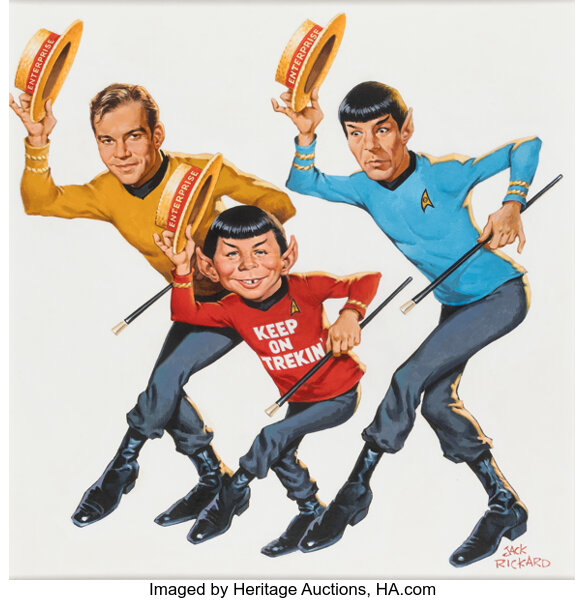
Jack RickardMAD#186 Star Trek Cover Original Art (EC, 1976). Captain Kirk (William Shatner) and Spock (Leonard Nimoy) join Vulcan officer Alfred E. Neuman (who will likely soon meet a terrible fate, hinted at by his red shirt) tap dance their way across the cover of the parody magazine to promote the “Star Trek” Musical buried within its pages. Spock looks surprised to see Neuman sporting a pair of pointy Vulcan ears, with the adage “Keep on Trekin'” printed on his uniform. A fun poke at the beloved sci-fi TV series painted in gouache on illustration board with an image area of 16″ x 16.75″, matted and Plexiglas-front framed to 27″ x 28.5″. Light frame wear. Signed by Rickard in the lower right corner and in Excellent condition.
… The grenade was not without precedent. Two months before, Mr. Kane managed to pull a gun out of a lake near where he lives. It might have been used in a murder, he suggested, and he was told there was a chance he might be subpoenaed. He was eager to avoid that entanglement.
On that unseasonably warm November afternoon, Mr. Kane, who is 39 and looks a bit like the actor Seth Rogen playing a deckhand, just yanked the thing right off his magnet. It took quite a bit of effort, given that the magnet (from Kratos Magnetics, for $140) was advertised as having a “pull force” of 3,800 pounds. The gunpowder had been emptied out of the bottom, so he figured the corroded explosive was something that would put him on the map, rather than blow him off it. Still, he put it on the ground and covered it with a plastic bucket — just in case.
As he dialed 911, he paused to wonder: Would the operator remember him? Was he something of a known quantity by now? Just the week before, he’d found a top-loading Smith & Wesson in Prospect Park Lake. And he’d also found a completely different grenade about a month ago, which he said led the police to evacuate a restaurant near the United Nations. But to his disappointment, that day’s dispatcher didn’t react.
“You’re gonna know Let’s Get Magnetic,” Mr. Kane told the operator, referencing the name of his YouTube channel. “I’m getting famous.”
His partner, Barbie Agostini, continued filming as the police arrived. Two beat cops who showed up took some pictures of the grenade on their phones. Meanwhile, a woman pushed a baby carriage inches away from it. More cops eventually came to cordon off the area, but the content creation did not stop there. Another officer squatted on the ground to take more close-ups. Wanting a wider-angle view of the ruckus he’d wrought, Mr. Kane moved slightly down the sidewalk and kept fishing.
It wasn’t long before a well-put-together young woman in a pinned-on hat stopped and stared as Mr. Kane pulled a hunk of junk out of the water with his magnet.
“What are you guys fishing for?” she asked.
“Anything metal,” he told her. “This is a bed frame from the 1900s.”
The woman looked astounded at this dubious bit of history.
“God bless you,” she said….
…After lunch, Mr. Kane, Ms. Agostini and Jose returned to their duplex. Mr. Kane pulled out a Styrofoam chest full of his favorite finds. They included the magazines from four guns, the barrel of a sniper rifle and two tiny cannonballs that might predate the city itself, which he plans on giving to the American Museum of Natural History.
Evidence of a collector’s lifestyle exists throughout the apartment — unopened retro video games and hand-painted Japanese anime figurines covered nearly every spare inch of wall space. Mr. Kane pulled out some tiny pieces of metal from the cooler, one in the shape of a bow and arrow, and another that looked like a ball-peen hammer.
“This is black magic,” he said. “One hundred percent.” Then came a key fob for an Audi that still lit up when he pressed a button. “This unlocks a car,” he said. “We just don’t know where the car is.” Then came his collection of iPhones, which he proudly displayed on his purple couch. All of them worked. Well, all but one. “It smokes if you turn it on,” he said. “But that’s the only problem.”…
Elon Musk‘s X on Thursday has lost its bid to change a California law on content moderation disclosure by social media companies.
X sued California in September to undo the state’s content moderation law, saying it violated free speech rights under the U.S. Constitution’s First Amendment and California’s state constitution.
Today, U.S. District Judge William Shubb dismissed the social media company’s request in an eight-page decision .
The law requires large social media companies to issue semiannual reports that describe their content moderation practices. They must also provide data on the number of objectionable posts and how they were addressed.
“While the reporting requirement does appear to place a substantial compliance burden on social medial companies, it does not appear that the requirement is unjustified or unduly burdensome within the context of First Amendment law,” Shubb wrote.
X did not immediately respond. The company’s content moderation policies have long been contentious, dating to before Musk bought the company.
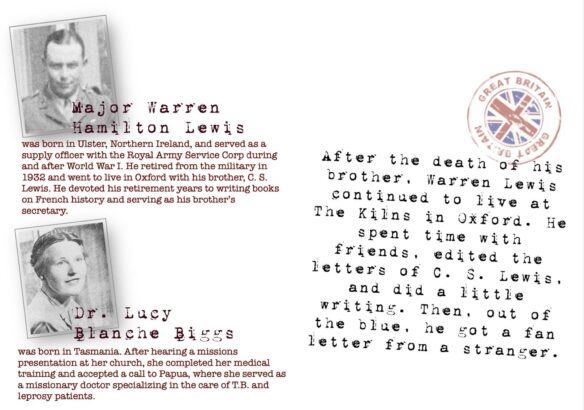
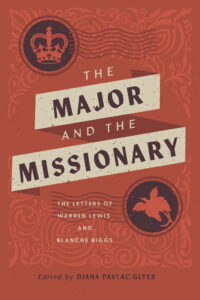
(11) ANOTHER INKLING NAMED LEWIS. This postcard ad for The Major and the Missionary edited by Diana Pavlac Glyer caught my eye and reminded me to kick off the new year by mentioning this collection of letters of interest to Inklings fans.
After the death of his brother, Warren Lewis lived at The Kilns in Oxford, spent time with friends, edited his famous brother’s letters, and did a little writing of his own. Then, out of the blue, he got a letter from a stranger on the far side of the world. Over the years that followed, he and Blanche Biggs, a missionary in Papua New Guinea, shared a vibrant correspondence. These conversations encompassed their views on faith, their politics, their humor, the legacy of C. S. Lewis, and their own trials and longings.
Taken as a whole, these collected letters paint a colorful portrait that illuminates not only the particulars of distant times and places but the intimate contours of a rare friendship.
Edited and introduced by Bandersnatch author Diana Pavlac Glyer.
[Thanks to Steven French, Mike Kennedy, Andrew Porter, Scott Edelman, Mark Roth-Whitworth, John King Tarpinian, Chris Barkley, Cat Eldridge, and SF Concatenation’s Jonathan Cowie for some of these stories. Title credit belongs to File 770 contributing editor of the day Peer.]
The award recognizes the best speculative poem of 1–10 lines (or up to 100 words for prose forms) published in the previous year. It was created to honor excellent scifaiku, tanka, cinquains, and other types of short poems that examine speculative themes which tend to be overshadowed in SFPA’s Rhysling Award competition.
WINNER
(Tie)
“Believe the Graves” by Rasha Abdulhadi
“In Perpetuity” by Bruce Boston
SECOND PLACE
“Excerpt from a Proposal for the New City” by Alyssa Lo
THIRD PLACE
(Tie)
“As Slow as Starlight” by Kim Whysall-Hammond
“Surviving” by Sumiko Saulson
“Trichotillomania” by Warsan Shire
HONORABLE MENTIONS
[diameter pi the lake solves for moon] by Kat Lehman
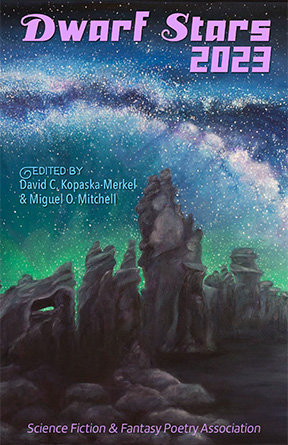
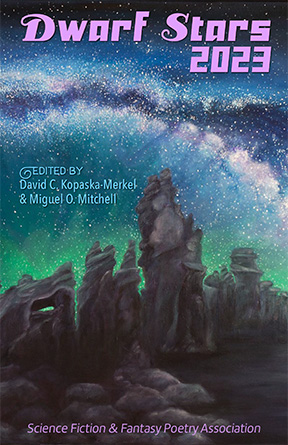
The 2023 Dwarf Stars Anthology contents have been finalized, which constitutes the shortlist for the Science Fiction & Fantasy Poetry Association‘s Dwarf Stars award. The poems were selected by editors David Kopaska-Merkel and Miguel O. Mitchell, Ph.D.
The award recognizes the best speculative poem of 1–10 lines published in the previous year, and is designed to honor excellent scifaiku, tanka, cinquains, and other types of short poems that tend to be overshadowed in SFPA’s Rhysling Award competition.
Brief biographies of the contributing poets are here. A copy of the Dwarf Stars anthology is included with SFPA membership. It is also available for purchase here.
(1) PULLING RANK. Amanda S. Green puts a blip on indie author’s radar screens. There’s been a change in what rankings Amazon displays to readers: “And so it goes” at Mad Genius Club.
…And Amazon has changed the rules without much fanfare when it comes to what rankings they show. According to another author who queried Amazon about what they were seeing, Amazon has shifted to a policy where only three category rankings will show on a product page. In other words, you can be in the top 10 in four or more categories but Amazon will only show three. As if that’s not bad enough, the categories I see might not be the same one you see because their bots choose which ones to show based on our browsing histories.
As a reader, I don’t see a big problem. As a writer, this is a huge problem….
The Kindle Storyteller Award is a £20,000 literary prize recognising outstanding writing. It is open to writers publishing in English in any genre, who publish their work through Kindle Direct Publishing. Readers play a significant role in selecting the winner, helped by a panel of judges including various book industry experts.
The 2022 Kindle Storyteller Award was open for entries between 1st May and 31st August 2022.
If you want to watch the next incarnation of Doctor Who, you’re going to need a Disney+ subscription.
Disney announced Tuesday morning that it will be the new home for upcoming seasons of the classic BBC science fiction series in the United States and around the world, a major streaming acquisition for a streaming service that’s already home to major franchises like the Marvel Cinematic Universe and Star Wars. Ncuti Gatwa, who will play the Fifteenth Doctor on the series, confirmed the news during an appearance on Live with Kelly and Ryan this morning, according to a Disney press release….
(4) GATEWAY TO THE PAST. Young People Read Old SFFfeatures a look at the Susan C. Petrey that ends her posthumous collection Gifts of Blood, which included essays by Le Guin, Vonda McIntyre, and Kate Wilhelm. What do the panelists think of this Hugo finalist?
October 2022’s Young People Read Old Hugo Finalists offers a story unusual in several ways. Firstly, I was utterly unfamiliar with Susan C. Petrey’s Hugo finalist story “Spidersong1”. A glance at Petrey’s ISFDB entry offers a grim explanation: Susan Petrey died in her mid-thirties, 5 December 1980. Most of her work seems to have been published posthumously, largely in the Magazine of Fantasy and Science Fiction, a magazine that for no good reason I did not read.
In addition to her Hugo nomination, in spite of having just three stories in print (1979’s “Spareen Among the Tartars”, 1980’s “Spidersong”, and 1980’s “Fleas”), Petrey was nominated for the Astounding Award for Best New Writer2. Petrey died before the results of the nomination were announced. In fact, Petrey was one of two authors present posthumously on the 1981 Astounding Award3; Robert Stallman died August 1, 1980. As far as I can tell, this is the only year any nominees, let alone two4, for the Astounding were nominated post-mortum.
“Spidersong” is unusual in a third, far more positive way: it is still in print, for web-based values of in print. Spidersong can be read in Issue 54 of Light Speed Magazine….
By 2018, I had read dozens of great stories by women in my trek through all the period science fiction magazines. That same year, I ran across A. J. Howells, who had started up a small press to republish The Office by Fredric Brown. His experience made me realize that it’s not too hard to start a press these days. Putting two and two together, it was obvious what my first project would be: a collection of all of my favorite stories by women from the era….
Booker prize-winning author Shehan Karunatilaka has asked people not to circulate pirated versions of his novel.
Karunatilaka won the prize…for his second novel, The Seven Moons of Maali Almeida. In an Instagram story and a Facebook post two days after his win, Karunatilaka said it had “come to light that an unofficial and illegal” pdf version of his book was “doing the rounds on Sri Lankan social media”.
In his post, titled “Do not steal the moon”, the author wrote: “The book took seven years to write, with countless hours of research, craft and hard work poured into it. If you wish to support and honour Sri Lankan art, please do not forward pirated versions of the book and tell those who are circulating it to refrain from doing so.”…
UHBC Blog: …Do you think it’s possible to write near-future fiction and not include some time of climate change elements?
Premee Mohamed: Well, anything’s possible in fiction.
But suppose I wanted to write a murder mystery set in London in a fancy house in the middle of the city in 1942. In theory, I could write the entire book just about the murder mystery and these friends would have to solve it.
But in practice, if I didn’t mention World War II at any point or the Blitz or the bombs or people that they knew that had died in the war … it would feel very weird and I feel like the book would be kind of missing something enormous about the reality of London in 1942….
…Interactions between living organisms and their environments include abiotic and biotic factors. Abiotic factors are nonliving factors, such as the sun, wind, precipitation, slope, or substrate (whether rock or other substance). Biotic factors are those that are living, such as plants, fungi, protists, or animals. Think about how both living and nonliving elements in your world affect your characters.
Other considerations include predator–prey relationships in your worlds. An apex predator is a top predator in a food chain. If your world has creatures, assume that there are predator–prey interactions. Where does each creature in your world fit in a food chain? What happens when you take the top predator away? What sorts of population pressures do your characters face? Showcasing these factors in your fiction weaves a unique tapestry for your characters to inhabit….
(9) CALLING OUT FATPHOBIA IN SFF. [Item by Olav Rokne.] Writing at Tor.com, R. K. Duncan enumerates the ways in which SFF has been a space that marginalizes those who are large. “SFF’s Big Fat Problem” is an important piece for us to read and to think about, when we’re consuming and creating fiction.
In my lifetime, SFF has become unimaginably more welcoming of my queer self than it was when I began to read. My fat self, not so much. This essay is a callout for everyone who feels they are a part of this community. Do better.
October is, as I noted in an earlier essay, a season for ghosts and ghouls. Days are shortening, winter is coming (at least for us folks in the northern hemisphere). It’s a season for melancholy entertainment.
Of course, autumn is also a busy season—even if, like the overwhelming majority of my readers, you don’t have to worry about getting crops in. You might not have the time, or the inclination, to read something long (there will be plenty of time for that in the cold days ahead). Happily, novellas are there for you. You might want to try one or more of these five….
(11) MEMORY LANE.
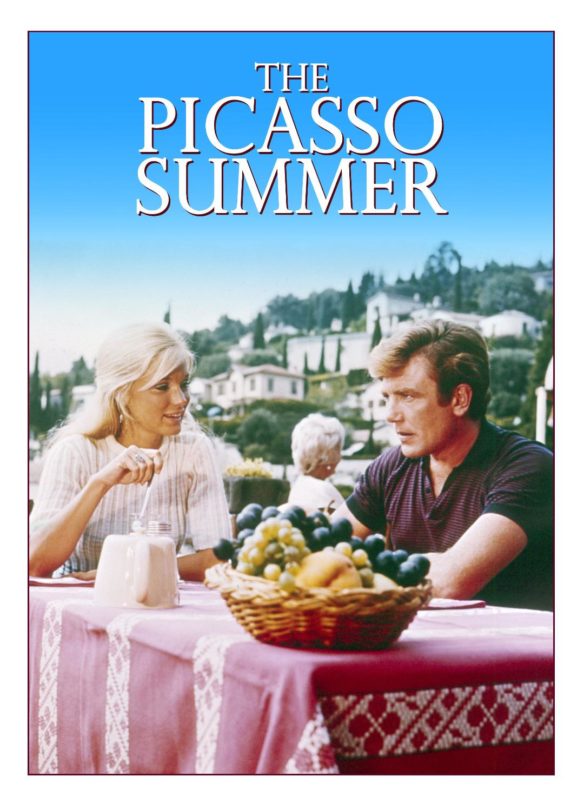
1969 — [By Cat Eldridge.]The Picasso Summer
Back in the Summer of love or thereabouts, Mister Bradbury wrote the script for The Picasso Summer which by the time it was in the can had involved artist Pablo Picasso, French directors Francois Truffaut and Serge Bourguignon, cinematographer Vilmos Zsigmond, animators Faith and John Hubley, composer Michel Legrand and Barbra Streisand. Even Bill Cosby was in the mix as his company produced it, as was another actor, Yul Brunner.
It’s based off his “In a Season of Calm Weather” short story which was first published in the January 1957 issue of Playboy. It was most recently, 2013, published by Bantam in his Medicine for Melancholy collection.
SPOILERS OF A VERY PSYCHEDELIC NATURE FOLLOW. SENSITIVE MINDS SHOULD GO ELSEWHERE.
Bradbury wrote a most excellent script here.
His story is that SF architect George Smith (as played by Albert Finney) is vacationing in France with his wife Alice (a very beautiful Yvette Mimieux) with the hopes of meeting Picasso. Why he wants to meet him is not explained. The back story is he is terminally weary of being an architect.
The young couple are turned away from the artist’s home, and a fight breaks out. George in a rather nasty mood goes off to Spain to meet Spanish bullfighting legend Luis Miguel Dominguín, who might be a friend of Picasso and might get him an introduction. He doesn’t.
So Alice stays behind and alone in France, very miserable. Upon he returns, he apologizes for the quite bad vacation. They go for a final swim on the beach, utterly failing to notice Picasso playing in the sand with his family just a few hundred yards away as they stroll away from him into the sunset.
YOU COME BACK. WE’RE NOT DOING INTERESTING DRUGS ANYMORE. I THINK.
I must stress that it includes some very trippy and quite lively animated sequences of Picasso’s work done up in the finest Sixties style possible. Groovy man! It’s quite delightful and all goes superbly well for our couple in the end.
It was shot in 1969, partly re-shot and tooted into the vault in 1969, but not shown publicly until 1972. It doesn’t appear in the Warner Bros. release records because it never hit the theaters only to premiere in the States on CBS’s Late Nite Movie. Warner Bros put a clip from it up here. Please, please do not link to the many extended clips from the film including the animated sequences as they are clear violations of copyright as the film is still very much under copyright.
(12) TODAY’S BIRTHDAYS.
[Compiled by Cat Eldridge.]
Born October 25, 1902 — Philip Wylie. Writer of SF snd mysteries alike. Co-author with Edwin Balme of When Worlds Collide, his most important work, which was first published as a six-part monthly serial (September 1932 through February 1933) in the Blue Book magazine with illustrations by Joseph Franké. The novel was the basis of the 1951 film of the same name that was produced by George Pal. (Died 1971.)
Born October 25, 1909 — Whit Bissell. You most likely know him as Station Manager Lurry on “The Trouble With Tribbles”, but his major contribution to the SFF genre was being in all thirty episodes of The Time Tunnel as Lt. Gen. Heywood Kirk. He also did one-offs on The Invaders, I Dream of Jeannie, The Man from U.N.C.L.E., Voyage to the Bottom of the Sea, Science Fiction Theater, The Incredible Hulk and The Outer Limits. And yes, in the Time Machine film. (Died 1996.)
Born October 25, 1928 — Marion Ross, 94. Best remembered as Marion Cunningham on Happy Days but she does have some genre roles, including an uncredited appearance in The Secret of The Incas often cited as the inspiration for Raiders of the Lost Ark. Charlton Heston was adventurer Harry Steele. Anyone see it? Again uncredited, she’s in a Fifties version of Around the World in 80 Days. The Sixties are kinder to her as she starts getting credited for her work, first for being on The Outer Limits as Agnes Benjamin in “The Special One” episode followed by being Angela Fields in Colossus: The Forbin Project. To date, her last genre role was on the animated Galaxy as the voice of Doctor Minerva in “Gotta Get Outta This Place”.
Born October 25, 1940 — Janet Fox. Author whose stories appeared in countless genre zines and anthologies between the Seventies and mid-Nineties. Her long fiction, mostly the Scorpio Rising series, was done as Alex McDonough. She’s also know for the Scavenger’s Newsletter which featured a number of noted writers during its run including Linda Sherman, Jeff VanderMeer and Jim Lee. (Died 2009.)
Born October 25, 1963 — John Gregory Betancourt, 59. Writer known for his work in Zelazny’s Amber universe but who has written quite a bit of other franchise fiction including works in the Star Trek, Hercules, Robert Silverberg’s Time Tours, Dr. Bones and The New Adventures of Superman. Most of his original fiction was early in his career. He’s also edited in a number of magazines including Weird Tales, Amazing Stories, H. P. Lovecraft’s Magazine of Horror, Adventure Tales and Cat Tales. He even co-edited with Anne McCaffrey, Serve It Forth: Cooking with Anne McCaffrey. His Wildside Press has been nominated three times for World Fantasy Awards.
Born October 25, 1971 — Elif Safak, 51. Turkish writer with three genre novels, one written originally in Turkish (Mahrem), The Gaze in its English translation, and two written in English, The Architect’s Apprentice (which was translated into Turkish as Ustam ve Ben) and 10 Minutes 38 Seconds in This Strange World.
Born October 25, 1971 — Marko Kloos, 51. Author of two MilSF series, Frontlines and The Palladium Wards. His Lines of Departure was nominated for Hugo Award for Best Novel at Sasquan on a slate organized by the Sad Puppies. In reaction to this, Kloos withdrew the novel from consideration for the award. He was subsequently honored by George R. R. Martin for this decision. And that gets him Birthday Honors. Five of his books have been Dragon Awards nominees in the Best Military SF or Fantasy category.
Since 1958, the Society of Illustrators has elected to its Hall of Fame artists recognized for their distinguished achievement in the art of illustration.
Artists are chosen based on their body of work and the impact it has made on the field of illustration.
2021 Hall of Fame Laureates
Braldt Bralds
Craig Mullins
Floyd Norman
Margaret Brundage
Jean Alexandre Michel André Castaigne
Walter Percy Day
Dale Messick
2022 Hall of Fame Laureates
Charles Addams
George Booth
Emory Douglas
Wendy and Brian Froud
Reynold Ruffins
(14) HUGO SWAG. Cora Buhlert recently received her 2022 Hugo finalist certificate and pin. You can see a photo here: “Look What the Mailman Brought Me”.
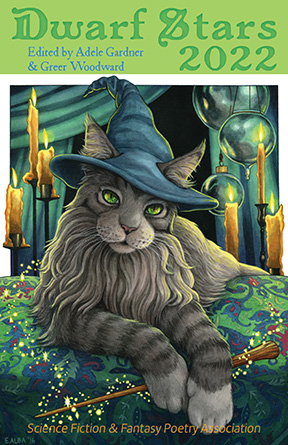
(15) SCIENCE FICTION & FANTASY POETRY ASSOCIATION MILESTONE. Adele Gardner and Greer Woodward, Editors of the 2022 Dwarf Stars Anthology made a historic announcement about the poet who took second place in the 2022 Dwarf Stars Award for his poem “Colony.”
Jamal Hodge is the first black man to win or place in the competition. Though the editors are saddened that there have not been prior accolades for black men in the Dwarf Stars Award, we are so very glad that Jamal Hodge has broken this barrier and lifted us with the quality of his work.
Jamal Hodge is a multi-award-winning filmmaker and writer from Queens NYC who has won over 80 awards with screenings at Tribecca Film Festival, Sundance, and the Cannes Short Film Corner. As a writer, Hodge is an active member of the Horror Writers Association and the SFPA, being nominated for a 2021 & 2022 Rhysling Award for his poems “Fermi’s Spaceship” and “Loving Venus,” while placing second in the 2022 Dwarf Stars. His poetry is featured in the anthology Chiral Mad 5 alongside such legends as Stephen King and Linda Addison. His written work was featured in the historical all-black issue of Star*Line (43.4), Space and Time Magazine, Hybrid: Misfits, Monsters & Other Phenomena, Penumbric Speculative Fiction Magazine, Savage Planets, and many others. https://linktr.ee/directorh
Hodge’s 2022 Dwarf Stars poem “Colony” is a poignant observation of humanity. Although scientists have developed technology superb enough to send people to Mars and establish a colony, human nature has remained unchanged. The fact that murder is one of the things that marks our humanity is not only tragic, but may well damage prospects for a hopeful future. The editors admired the way this powerful message was expressed in only 29 words.
Choosing the best quotes from The Lord of the Ringsis difficult, because there are so many amazing lines in this fantasy epic. Nevertheless, here are 23 of my favorite The Lord of the Rings quotes.
First out of the gate:
“‘Why was I chosen?’ ‘Such questions cannot be answered,’ said Gandalf. ‘You may be sure that it was not for any merit that others do not possess: not for power or wisdom, at any rate. But you have been chosen, and you must therefore use such strength and heart and wits as you have.’”
How can it be that my own favorite isn’t even on the list!
(17) VIDEO OF THE DAY. [Item by Martin Morse Wooster.] In “Honest Trailers: The Rings Of Power (Season 1),” the Screen Junkies say this Lord of the RIngs prequel has so many mysterious strangers show up in the first episodes that “It’s hard to keep up with the people who aren’t mysterious. Stop making me do homework to watch TV!” the narrator complains. He shows at least five clips where the cast are trying very very hard not to say they’re making rings that characters can be lords of. Noting this is an Amazon project, the narrator asks, “do the orc slaves get free two-day shipping?”
[Thanks to Chris Barkley, Michael Toman, Cat Eldridge, Cora Buhlert, Mike Kennedy, Martin Morse Wooster, JJ, and John King Tarpinian, and Andrew Porter for some of these stories. Title credit belongs to File 770 contributing editor of the day Jim Janney.]
The award recognizes the best speculative poem of 1–10 lines published in the previous year, and is designed to honor excellent scifaiku, tanka, cinquains, and other types of short poems that examine speculative themes which tend to be overshadowed in SFPA’s Rhysling Award competition.
WINNER
[Tie]
“Poem with Lines from My Son” by Jen Stewart Fueston
“What Trees Read” by Mary Soon Lee
SECOND PLACE
“Colony” by Jamal Hodge
THIRD PLACE
“Future Portrait of Dark Matter” by Gene Twaronite
HONORABLE MENTIONS
“Mexico City, 2101 AD” by Juan Manuel Pérez
“fury” by Lee Murray
“Mother” by Merie Kirby
“Past Equinox” by Ann K. Schwader
And a tie between
“—And They All Lived Together—” by Andrew J. Wilson
“[cricket song]” by Joshua Gage
The authors who composed the 120 short poems selected from the 1,371 qualifying submissions have reason to celebrate.
The 2022 award chairs Adele Gardner and Greer Woodward, who edited the collection, gave their thanks to each and every poet; Elisabeth Alba, cover artist; the many editors who helped them; all the participants in the Dwarf Stars Zoom readings, including hosts Denise Dumars and Deborah P Kolodji, reader Colleen Anderson, and all the poets and readers; and so many members of SFPA, including Brian Garrison (SFPA Secretary), F. J. Bergmann (anthology layout and website), Deborah P Kolodji (searched mainstream haiku journals); Diane Severson Mori and Jordan Hirsch (publicity); and so many more.
“But first and foremost—we honor and celebrate all of these wonderful poets, who made our task so light. We shall trip through the stars together many times, in memory.”
The award recognizes the best speculative poem of 1–10 lines published in the previous year, and is designed to honor excellent scifaiku, tanka, cinquains, and other types of short poems that tend to be overshadowed in SFPA’s Rhysling Award competition.
Brief biographies of the contributing poets are here. A copy of the Dwarf Stars anthology is included with SFPA membership. It is also available for purchase here.
SFPA members have until August 31 to vote their favorite short-short poem from the anthology and determine who will receive the Dwarf Stars Award.
Some poems have a title, others are identified by a phrase from their first line placed in brackets:
The award recognizes the best speculative poem of 1–10 lines published in the previous year, and is designed to honor excellent scifaiku, tanka, cinquains, and other types of short poems that tend to be overshadowed in SFPA’s Rhysling Award competition.
FIRST PLACE
“Yes, Antimatter is Real” by Holly Lyn Walrath (Analog Science Fiction and Fact, Sept/Oct 2020)
SECOND PLACE
“The Softness of Impossible Fossils” by Robert Borski (Asimov’s Science Fiction, July/Aug 2020)
THIRD PLACE
“Frozen Hurricanes” by Herb Kauderer (Minimalism: A Handbook of Minimalist Genre Poetic Forms, ed. Teri Santitoro; Hiraeth Press, 2020)
The award recognizes the best speculative poem of 1–10 lines published in the previous year, and is designed to honor excellent scifaiku, tanka, cinquains, and other types of short poems that tend to be overshadowed in SFPA’s Rhysling Award competition.
SFPA members have until August 31 to vote their favorite short-short poem from the anthology and determine who will receive the Dwarf Stars Award. A copy of the Dwarf Stars anthology is included with SFPA membership.
Some poems have a title, others are identified by a phrase from their first line placed in brackets:
Anthology Table of Contents:
[6 months] • Susan Burch
[adrift in space] • semi
[alien hovercraft] • Deborah P Kolodji
[alternate history] • Greer Woodward
[bacon and coffee] • Michelle Muenzler
[black rabbits] • Michelle Muenzler
Blue Mood • Gretchen Tessmer
[bovine witnesses] • William Shaw
[brain software warning] • Julie Bloss Kelsey
Document Search • Lorraine Schein
[downwind] • Nick Hoffman
[driving home] • Susan Burch
[every lover] • Christina Sng
[evil comes always] • Juan Manuel Perez
Fairy Ring • John C. Mannone
[fireflies] • Anna Cates
Frozen Hurricanes • Herb Kauderer
[the FTL squad] • Deborah P Kolodji
Garden • Kim Goldberg
[happy hour] • LeRoy Gorman
[head in one hand] • David C. Kopaska-Merkel
How to Tidy the Asteroids • Mary Soon Lee
[how bright you shine] • Monica Louzon
I Think the Article Said Something about First Contact • R. Mac Jones
[in a cracked mirror] • Julie Bloss Kelsey
Lesser Eternity • F. J. Bergmann
Light Voyager • Adele Gardner
[lonely robot] • Noel Sloboda
More Than a Feeling • Lauren McBride
[on a pirate ship] • Lana M. ‘Rochel
Phoenix • Colleen Anderson
[photons in knit and purl] • Kimberly Nugent
[probably mist] • John Hawkhead
[right at home] • LeRoy Gorman
Runaway Greenhouse Effect • David C. Kopaska[1]Merkel
Sailing the Seas of Lune • Robert Borski
Saint George’s Lament • Jacob Bergstresser
seasonal greeting • Herb Kauderer
[shapeshifter] • Ngo Binh Anh Khoa
Sheets • Deborah L. Davitt
The Softness of Impossible Fossils • Robert Borski